Chiapas Support Committee
Home of the Compañero Manuel blog on zapatistas & mexico
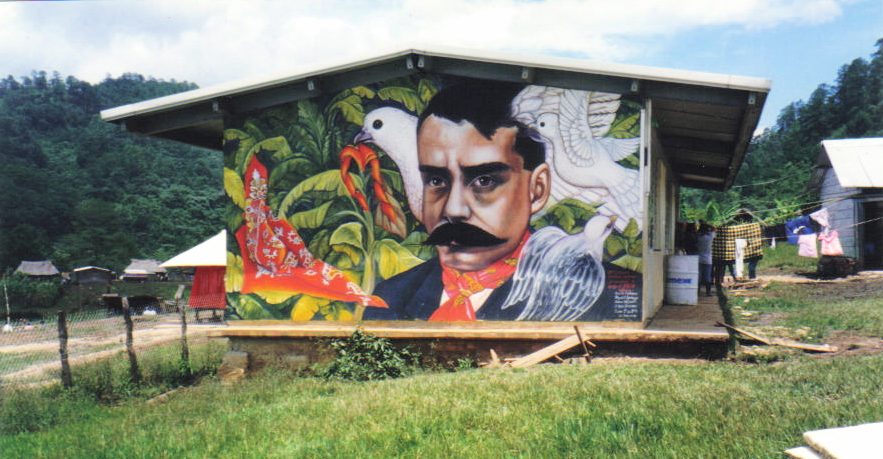
Celebrating the life of MaryAnn Tenuto-Sánchez

Today our sorrow turns to seek a place in your hearts. Our thoughts ask little, only that you no longer hold back your desire to find that lost dignity. We only ask that a small piece of your heart be Zapatista. That it will never sell out. That it never surrender. That it resist. That you continue in your places and with your means, to struggle forever so that dignity and not poverty be the harvest in all corners of our nation.
–from an EZLN communique, 1994.
MaryAnn Tenuto Sánchez gave a big piece of her heart to the Zapatista cause. The last time she returned from leading a delegation to meet with Zapatista communities in Chiapas she shared a conversation she had with members of a Zapatista council of good government who asked her: How long do you plan on working with the Zapatista communities? She replied: Until I die.
And today our sorrow turns to that place in Zapatista hearts to mourn the loss and celebrate the life of MaryAnn Tenuto-Sánchez.
Founding member of the Chiapas Support Committee, MaryAnn Tenuto Sánchez passed away on October 1, 2023, after an intense battle with cancer in Oakland, California. She was accompanied by her family and closest friends. MaryAnn would have turned 87 years old this November.
Members of the Chiapas Committee express their most heartfelt condolences to her family and friends and send her courageous heart and activism to the Zapatista communities to hold with us.
MaryAnn’s passing is a deep loss to her family, our community and the Zapatista solidarity work in the U.S. Through her work in the Chiapas Support Committee, MaryAnn created and supported pathways and relationships between Zapatista communities across borders. She worked fervently to expose and stop the violence and wars that were waged against the Zapatistas since 1994. And she worked even more fervently to organize and express solidarity with the Zapatistas.
MaryAnn was the leading and founding member of the Chiapas Support Committee (CSC) in Oakland, California, and had been active in the Zapatista solidarity movement since the mid-1990s. She became active first in the Comité Emiliano Zapata during 1995-1998. The Comité Emilano Zapata (CEZ) was a founding member of the Zapatista’s National Commission for Democracy in Mexico (NCDM, a U.S.-based Zapatista grassroots support network that was started after the 1994 uprising).
MaryAnn participated in the work of the CEZ and in NCDM national gatherings. She attended the EZLN’s Intercontinental Encounter for Humanity & Against Neoliberalism, dubbed the Intergaláctica, in the Lacandón rainforest in July 1996 as part of an NCDM delegation. Then, she went on to found the Chiapas Support Committee in 1998 and forged, first, a sister-to-sister relationship with the San Manuel community in Zapatista territory. Then, with the CSC, she worked to organize, inform, educate and bring people together in solidarity with the Zapatistas. She helped raise funds to support the autonomous projects of Zapatista communities.
MaryAnn, with a collective of CSC members, also organized and led various delegations during 1998-2018 to Chiapas to meet with and learn from the Zapatista communities’ struggles for autonomy and land justice. With the CSC, she also facilitated exchanges and meetings in Oakland with Mexico-based Indigenous leaders and activists from the Congreso Indígena Nacional (CNI) and other solidarity and Zapatista support organizations in the Bay Area and U.S.
Over the last few years, she focused on closely following developments and events in Chiapas and Mexico. MaryAnn became quite knowledgeable and an authority on the dynamics of the Zapatista movement and the situation and developments impacting Chiapas and Mexico. She was a speaker on the Zapatistas, presenting analyses and information to a diversity of social justice movement meetings, conferences and organizations.
MaryAnn wrote continuously on Chiapas and Mexico. She published timely translations of reports, writings and analyses from key activists, writers, organizations and leaders in the Zapatista movement and community struggles on Compa Manuel, the CSC blog. MaryAnn scoured online reports, newspapers, interviews, videos and journals to read and study the Zapatistas’ organizing and analyses, their autonomous projects and the different movement-building initiatives and struggles that uplifted Indigenous power and voices.
MaryAnn wrote her own sharp analyses of the crucial struggles being waged by Zapatista and Indigenous communities. Even as she battled cancer, she continued translating articles and reports on developments in Chiapas right up to a couple of weeks before she became too ill to do so.
MaryAnn Tenuto-Sánchez, presente.

MaryAnn Tenuto-Sánchez was born on November 21, 1936 in Indianapolis, Indiana, and was adopted as a newborn by Catherine and Andrew Goes. Her parents raised her in a rural community and instilled in her lifelong values that shaped her lifetime commitment to working for justice in working class communities.
She spent her childhood in South Bend, Indiana and moved to Michigan with her parents. There, MaryAnn attended University of Michigan where she graduated with a bachelor’s degree in social work in 1958. She moved to Chicago where she married in 1959 and was a social worker for Catholic Charities. She gave birth to four sons: Frank, John, Michael and Robert.
Then, she returned with her family to Indianapolis where lived until 1968 before returning to Chicago once again.
In Indiana, she worked as a volunteer in Robert F. Kennedy’s 1968 presidential campaign, which spurred her activism. MaryAnn was inspired by the civil rights and anti-war movements of the late 1960’s and early 1970’s to become an active participant. MaryAnn divorced in 1971 and moved with her four sons to Oakland, CA later that year, with the express purpose of being close to one of the national organizing centers of the U.S. anti-war movement.
In California, MaryAnn continued being a social worker, providing services in Contra Costa county, and became involved in her union’s collective bargaining negotiations. Moved by her experience and also by different struggles facing her family and community, she decided to go to law school and become a lawyer. She received her law degree from Golden Gate University in San Francisco in 1979.
MaryAnn worked, first, as chief legal counsel for the Stanford University employees union for ten years. Then, she worked as an attorney for the National Treasury Employees Union (NTEU) for the next few years representing IRS workers until she retired in 1998.
After retiring, MaryAnn dedicated her life full time to the indigenous Zapatista movement in Chiapas until her death.
MaryAnn is survived by her husband, José Sánchez; her four sons, Frank, John, Michael and Robert; and five grandchildren and six great-grandchildren. (See her son’s testimony for more details.)
The Chiapas Support Committee will carry forward the work and dedication that MaryAnn Tenuto Sánchez showed. And, emulating her example, we will continue strengthening relationships between our communities here with Zapatista communities in Mexico.
MaryAnn Tenuto Sánchez, presente.
Tributes for MaryAnn Tenuto-Sánchez from her son and members of the Chiapas Support Committee
Yes, there are two paths you can go by, but in the long run
There’s still time to change the road you’re on . . .–Stairway to Heaven, Led Zeppelin
Michael Tenuto: I am the son of Mary Ann Tenuto- Sánchez. Below is our mom’s life story, We thought it would be appropriate to share this with the people, as we shared our mother with the people of Chiapas, Mexico.
MaryAnn Tenuto-Sánchez was born November 21, 1936. Adopted by Catherine and Andrew Goes in 1936 in Indiana. Her early childhood was spent in South Bend Indiana, where she attended Catholic grammar and high schools. She moved to Lake Charlevoix, Michigan with her parents and attended Michigan University which she graduated with honors in 1958. MaryAnn moved to Chicago to work as a social worker and married and had four children, all boys.
Mary Ann is survived by her sons Frank Tenuto 64, John Tenuto 62, Michael Tenuto 61, Robert Tenuto 60, and five grandchildren, Steven, Christina, Alyssa, Michael Jr., Daphne, and six great-grandchildren, Mason, Allison, Madison, Liam, Kenah, Halle and her second husband José Sánchez. MaryAnn and José were married in April 2001.
In 1971 MaryAnn moved to Oakland, California with her four boys. MaryAnn worked from 1972 until 1979 as a social worker for Contra Costa County, California. MaryAnn went to Golden Gate Law school in 1981 and was admitted to the California Bar in 1984. MaryAnn worked at Stanford University representing the workers at Stanford University between 1979–1989. MaryAnn retired in 1999, after working as an attorney with the National Treasury Employees Union (NTEU) for 10 years. At NTEU she represented federal workers at the IRS in Fresno, California and Ogden, Utah.
MaryAnn had a passion for helping the underprivileged and disadvantaged people, no matter who or where they were located.
MaryAnn took a special interest in the people of Chiapas Mexico in 1994. She started the Chiapas Support Committee in 1998. MaryAnn traveled to Chiapas many times between 1994-2015. She would raise money with the other members of the Chiapas Support Committee, bring the cash to the people of Chiapas Mexico to fund clinics, supplies for the clinics, a warehouse, trucks, toros.
A dear friend of our mother told us a great story about the toros. Our mom had brought a good deal of cash down to the people of Chiapas and they bought a bunch of toros (bulls). As the people needed cash to build the clinic, they would sell the toros. During the construction of the clinic the toros would mate and make baby toros, call it interest on the original investment. MaryAnn visited Chiapas and wondered where is the clinic and the leader of the community pointed to the toros. Mary Ann worried about what she was going to tell the Chiapas Support Committee. Eventually the clinic was built and the community in Chiapas Mexico had bulls left over, this is a good example of letting the community decide how to allocate their own resources.
Our mom loved the people of Chiapas Mexico, just as much as she loved her children, grandchildren, great grandchildren. She always chose the high road and told everyone she met, “you can always change the road you’re on,” a line from her favorite song Stairway to Heaven.
What an amazing life! You set the bar high. Rest In Peace, Mom.
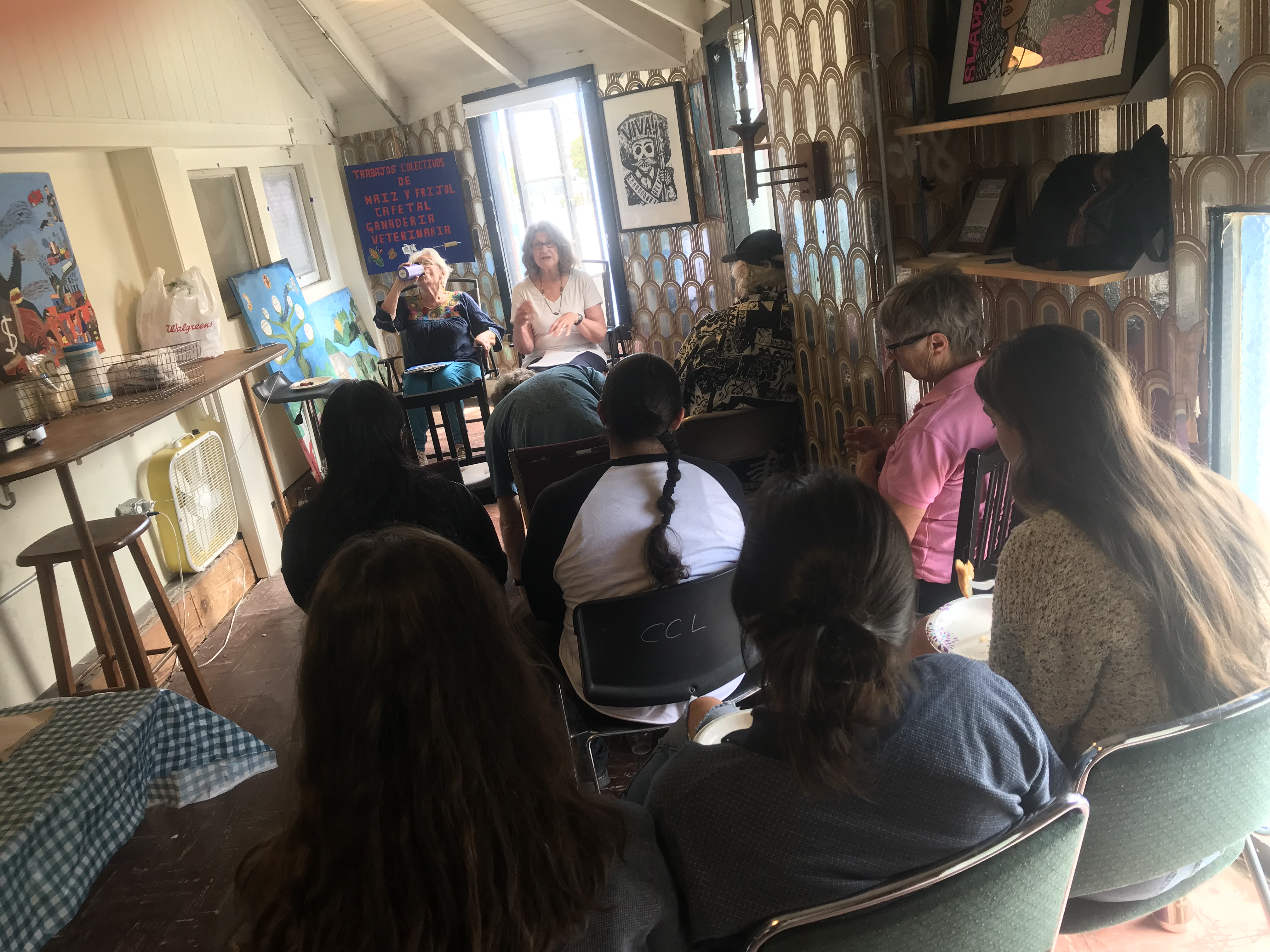
Evette Padilla: I’ll never forget the first time I encountered MaryAnn. It was during Winter of early 2018 maybe. It was for Waffles & Zapatismo on a Saturday morning in the cold basement of Omni Commons in Oakland. José was making waffles in the back and MaryAnn was presenting. MaryAnn’s clear, factual and serious presentation made me immediately know that she was a true real source of comprehensive Zapatismo and I’m positive I was not the only captivated audience member. Her presentation immediately let me know that her group, Chiapas Support Committee, was a Zapatista resource to be reckoned with. The wealth of Zapatista history MaryAnn has not only provided to my brain and spirit, but also to a vast amount of others in the Zapatista supportive community is real and of great note. She has so generously shared her wealth of knowledge with so many of us and I believe this to be a part of her legacy and I am so blessed to have been in her company. Blessings on the journey with the Ancestors, MaryAnn.
Roberto Martínez: It has a been a true inspiration to witness MaryAnn’s life-long dedication to the cause, to the struggle, to the compas Zapatistas. As a member of the Chiapas Support Committee, I had the opportunity to work alongside MaryAnn and learn so much about the hard work, rigor and corazón that underlies the powerful movement that MaryAnn helped put into motion. It is not a simple task to work within the capitalist hydra and its extractive structures and build a support network for the Zapatista struggle for autonomy. MaryAnn was a bridge between Chiapas and Oakland – both, places where la digna rabia lives and moves us to fight for a better world, both places similar but different in our struggles and approaches, but both places that MaryAnn called home.
MaryAnn led by example and showed us what strength and dedication looked like. For over 30 years she helped build the Chiapas Support Committee and now as she holds us in an ancestral embrace, we will continue to do the work of organizing locally, supporting the Zapatista projects for autonomy, and strengthening the bridge between las comunidades Zapatistas and us here in Oakland.
Mil gracias MaryAnn. Your legacy continues.
Elizama Rodas: I remember MaryAnn as a woman of stories. Through those stories she sought compassion and the pursuit of social justice, putting in countless hours and determination to let the world know of the suffering and constant attack against the people of Chiapas. Her memory and words will always live on. MAryAnn was a warrior till her death.
Rest in peace, MaryAnn
Todd Davies: I knew MaryAnn for about 21 years, from the time just before my first visit to Chiapas as a peace camper in December-January 2002-03 until her recent death. As an event attendee, then member of Chiapas Support Committee delegations to Zapatista territories, and as a member of the CSC Board for 9 years, I came to know MaryAnn like many did — as a fierce advocate and worker for the cause of Zapatista autonomy, and for solidarity from below across the US and Mexico. On a personal level, she was an extraordinarily kind friend and mentor to me as I learned from her years of experience as an activist. We traveled together, participated in countless meetings and events, and hung out with fellow activists for over a decade. And although she could not travel there herself in 2013, MaryAnn secured invitations for me and others to attend the life-changing Zapatista Escuelita that summer. I will never forget these experiences.
I think the greatest lesson MaryAnn taught me for my own life was the example of her retirement. When I met her, she was 65 and had been organizing with the Chiapas Support Committee for almost 5 years. She told me that she had retired early in order to devote herself to her greatest political passion. Starting with her prior involvement with the Comité Emiliano Zapata in the mid-90s, and continuing with the founding of the CSC in 1998, MaryAnn helped build a community and movement around Zapatista solidarity that has now outlived her. Through 25 years, the CSC has been a go-to organization for advocacy, material support, education, information sharing, and personal connections between Northern California and the Zapatistas, and as part of a network of solidarity activists from around the world. MaryAnn’s dedication to the work of the CSC — right up until her death — inspires me every day, as I near my own retirement. I hope I can use my own golden years in a similar way.
Although MaryAnn loved her family and her husband dearly and spoke of them often, she was also devoted to people and struggles far from where she lived. I came to understand her later-life work as a beautiful blend of unabashed love for a people and their land, and a belief that the Mayan struggle for freedom is our struggle too. MaryAnn knew and could convey the meaning of Zapatismo for our own lives in el area de la Bahía, and I endeavor to carry its principles with me in everything I do.
Thank you forever, MaryAnn. ¡La lucha sigue!

Arnoldo García: I remember the first time I spoke with MaryAnn on the phone. I was returning her call. This was in late 1995 or early 1996. And ever since then we were in public and house meetings, picket lines and marches, forums, the Zapatista intergalactic gathering in Chiapas in the summer of 1996–where she got the flu and I helped her get into the back of small truck that was packed with other activists from around the world heading back to San Cristóbal for the same reason.
MaryAnn’s dedication and sheer will to get things done was always impressive. Very few could keep up with her and there was no need because she knew the work that had to be done. MaryAnn did voluminous amounts of translations of timely analyses and news coming out of Chiapas and Mexico, literally keeping thousands of people fully informed with meticulous details. No one will be able to fill your shoes.
And MaryAnn did it. Last year she shared one of the last conversations she had had with Zapatista compas in San Manuel. When they asked her: How long will you do this work of solidarity and accompanying the Zapatista communities? MaryAnn replied: Till I die. Even in these last months MaryAnn never let up and kept the translations and her own analysis coming. I deeply appreciate her dedication and commitment to the Zapatista cause and their communities.
I believe MaryAnn will always accompany us in this life-long struggle and movements for life and liberation. Thank you, MAryAnn, for being you and for always pushing hard to make real in what you believed in
Sending you and all your loved ones, abrazos sin fronteras.

The Chiapas Support Committee would like to thank José Sánchez, MaryAnn’s husband, who contributed the details to MaryAnn’s story. And to her sons, grand-children and great-grandchildren for sharing their her life with the CSC and the Zapatista cause and communities.
The Tenuto Sánchez family made great sacrifices and showed deep love to MaryAnn, supporting her to share her and their heart with the Zapatistas.
______________
César Vallejo
At the end of the battle,
and when the combatant was dead, a man came towards her
and said: “Don’t die, I love you so much!”
But the corpse, oh! kept dying.
Two approached her and repeated:
“Do not leave us! Courage! Come back to life!”
But the corpse, oh! kept dying.
Twenty, one hundred, one thousand, five hundred thousand came to her
Crying “So much love, yet, powerless against death!”
But the corpse, oh! kept dying.
Millions of people surrounded her,
with their unanimous plea: “Stay sister! Stay brother!”
But the corpse, oh! kept dying.
Then all the women and all the men of the earth
surrounded her; the sad, emotional corpse saw them;
Sat up slowly,
hugged the first woman; and started walking…
From César Vallejo’s book Spain, Take this chalice from me (1939)
César Vallejo
Al fin de la batalla,
y muerto el combatiente, vino hacia él un hombre
y le dijo: «¡No mueras, te amo tanto!»
Pero el cadáver ¡ay! siguió muriendo.
Se le acercaron dos y repitiéronle:
«¡No nos dejes! ¡Valor! ¡Vuelve a la vida!»
Pero el cadáver ¡ay! siguió muriendo.
Acudieron a él veinte, cien, mil, quinientos mil,
clamando «¡Tanto amor, y no poder nada contra la muerte!»
Pero el cadáver ¡ay! siguió muriendo.
Le rodearon millones de individuos,
con un ruego común: «¡Quédate hermano!»
Pero el cadáver ¡ay! siguió muriendo.
Entonces todos los hombres de la tierra
le rodearon; les vio el cadáver triste, emocionado;
incorporóse lentamente,
abrazó al primer hombre; echóse a andar…
Del libro de César Vallejo España, aparta de mí este cáliz (1939)
CNI calls for global action against the war on indigenous peoples
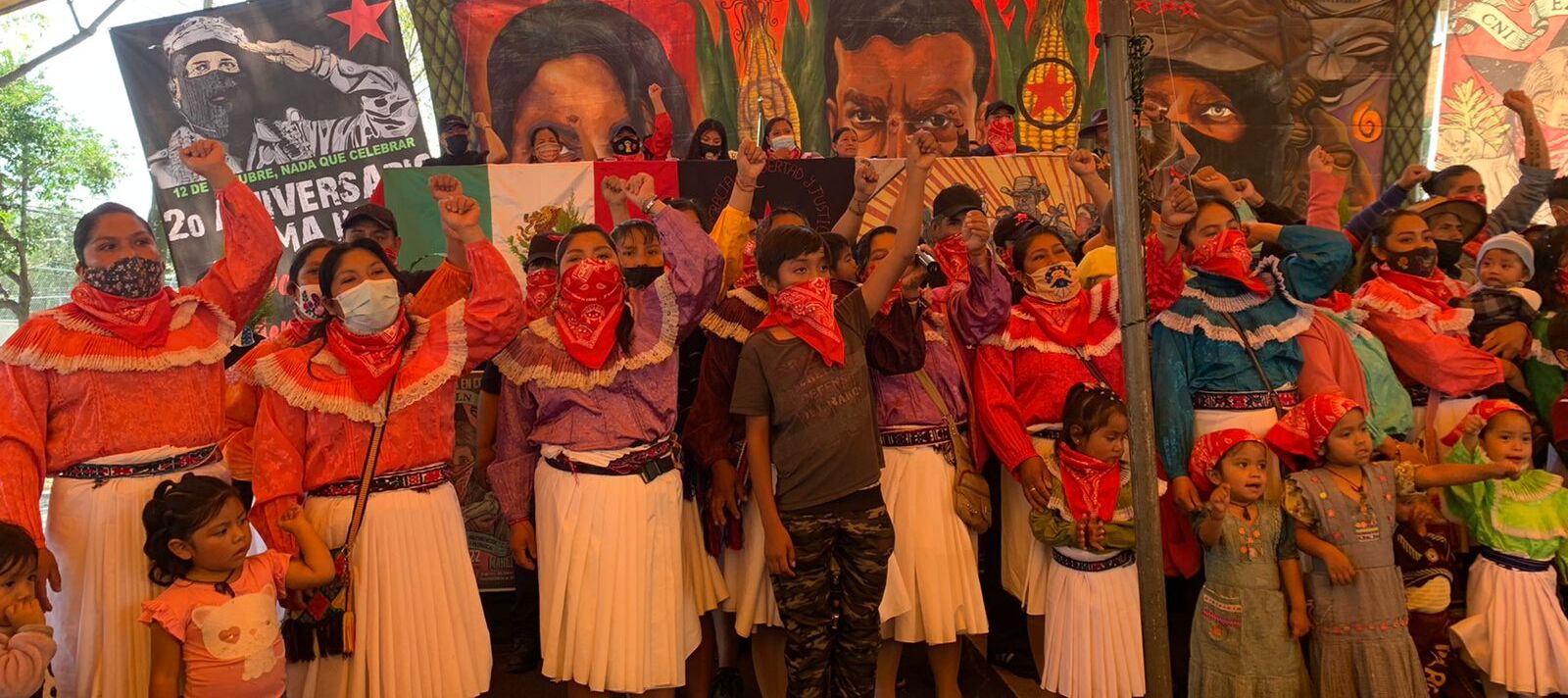
Mexico City | Desinformémonos. The Congreso Nacional Indígena (CNI, National Indigenous Congress) – Consejo Indígena de Gobierno (CIG, Indigenous Council of Government) (CNI-CIG) have called for a global action to stop the war against the people of Mexico and the world, to demand an end to the harassment of the Zapatista autonomous communities in Chiapas, end the militarization of indigenous territories, dispossession, extractivism and looting.
The action will take place on October 12 in commemoration of the 531 years of resistance of the indigenous peoples in Mexico, where communities, organizations, groups and activists will speak out “to stop this war that is structured through dispossession and exploitation, growing threats that involve the plundering of water, the extraction and distribution of hydrocarbons, mining and infrastructure megaprojects aimed at the savage ordering of populations, borders and territories.”
The CNI denounced that violence against indigenous communities continues to increase through a war “developed and systematized by Andrés Manuel López Obrador, ‘Supreme Chief of the Armed Forces’” and head of the Federal Executive, to guarantee and safeguard the interests of big capital and the narco-state.
They pointed out as examples of the war against the people the paramilitary attacks, harassment, threats and repression towards the Zapatista communities in Chiapas, the imposition of megaprojects such as the Mayan Train, the Morelos Integral Project and the Transismic Corridor, and the militarization of the country.
The activities of the Global Action will be against military and paramilitary violence, organized crime and capitalist corporations and in defense of life. Orgnizations and individuals can be register at cnicomunicacion@gmail.com to join the global action.
“October 12 marks the beginning of the resistance of our peoples and communities against the greatest genocide in the history of humanity, against invasion, against conquest, against the dispossession of our lands and territories, against the extermination of our institutions, languages, culture and traditions; that is, against the death that global capitalism produced and continues to produce,” the CNI-CIG stated in the call.
Below is the full statement (Read original in Spanish here.):
OCTOBER 12, DAY OF RESISTANCE AND INDIGENOUS DIGNITY
DECLARATION:
STOP THE WAR AGAINST THE PEOPLE OF MEXICO AND THE WORLD,
AGAINST THE ZAPATISTA PEOPLE AND THE ORIGINARY PEOPLE OF MEXICO
To the people of Mexico and the world,
To the National Coordination Space Against War,
To the National Assembly for Water and Life,
To the fathers and mothers of the 43 disappeared from Ayotzinapa,
To the organizations and groups that defend human rights,
To the Networks of Resistance and Rebellion,
To the Sixth National and International,
To the signatories of A Declaration for Life on the five continents,
To the Rebellious, Dignified and Rebellious Europe.
531 years after the beginning of the resistance and rebellion of our peoples against the war of capitalist invasion and conquest and within the framework of the 27 years since the Congreso Nacional Indígena (CNI, National Indigenous Congress) was founded as the space for struggle and unity of the native peoples of Mexico, WE CALL ON the peoples of Mexico and the world to redouble our resistance against the death that today more than ever is imposed on us by patriarchal capitalism on a planetary scale.
October 12 marks the beginning of the resistance of our people and communities against the greatest genocide in the history of humanity. Against invasion, against conquest, against the dispossession of our lands and territories, against the extermination of our institutions, languages, culture and traditions; that is, against the death that global capitalism produced and continues to produce.
Together with the Asamblea Nacional por el Agua y la Vida (National Assembly for Water and Life), we declare that the war that we people, in communities, neighborhoods, shanty towns, tribes and nations face throughout the national territory, is developed and systematized by Andrés Manuel López Obrador (AMLO), “Supreme Chief of the Armed Forces” and head of the Federal Executive, to guarantee and safeguard the interests of big capital and the narco-state; Furthermore, AMLO militarizes the entire country, as a guarantee to impose its mega projects of death such as the Maya Train, the Interoceanic Corridor, the Morelos Comprehensive Project and the Santa Lucía International Airport, which, based on colonialism, patriarchy, homogenization, imposition, hatred and fear, seek to order and reorder our territory. Therefore, we denounce that organized crime and paramilitary groups systematically collaborate with the armed forces, the National Guard and the state and municipal police, to the point where we can no longer understand them as different phenomena, but rather codependent pieces, muscles and ligaments of the armed forces of the Narco Capitalist State.
The siege of the Zapatista communities and the Zapatista National Liberation Army (EZLN), massacres such as that of Acteal, or the executions and forced disappearances against members of the Consejo Indígena y Popular de Guerrero-Emilano Zapata (Indigenous and Popular Council of Guerrero-Emilano Zapata) and the Nahua community of Santa María Ostula, as well as the disappearance of the 43 young people from Ayotzinapa, together with the growing and continued violence against women, or the murder of land defenders, as is the case of our brother Samir Flores Soberanes, are forceful signs of this war.
Hand in hand with the Espacio de Coordinación Nacional Contra la Guerra (National Coordination Space Against War) we say that Chiapas is Mexico. And today many of the violences that afflict the entire Mexican territory are concentrated in Chiapas. The war that was imposed on our country from the United States–and that Felipe Calderón undertook the task of deepening–today reaches the entire national territory. The border has moved to the southeast, and with it the war, a war that the current administration has not stopped: 153,941 intentional homicides, 42,935 people missing and not located, 69 journalists and 94 defenders of land and territory and indigenous peoples and the environment murdered in the ongoing process of militarized and criminal recolonization of the current six-year term. Concluding that, in this context, paramilitary and paramilitary groups that have operated with total impunity in Chiapas for three decades, have increased their belligerent actions against the Zapatista peoples. The Organización Regional de Cafeticultores de Ocosingo (ORCAO, Regional Organization of Coffee Growers of Ocosingo), which at least since 2000 has operated in the service of different governments, political parties and power groups in the region, has carried out more than 100 attacks between 2019 and 2023 against Zapatista communities belonging to Caracol 10, Floreciendo la Semilla Rebelde, based in Patria Nueva, Junta de Buen Gobierno Nuevo Amanecer en Resistencia y Rebeldía por la Vida y la Humanidad.
In the face of this capitalist and patriarchal war of world corporations and their governments against humanity, we mobilize to demand a total stop to the military and paramilitary siege and the counterinsurgency strategy directed against the EZLN and the Zapatista communities; and against the indigenous peoples of Mexico, through militarization, militarism, paramilitarization, organized crime or the so-called indigenous justice plans that official indigenism promotes; We organize to stop this war that is structured through increasing dispossession and exploitation that involves the plundering of water, the extraction and distribution of hydrocarbons, mining and infrastructure megaprojects aimed at the savage ordering of populations, borders and of the territories of our peoples.
For all of the above, as an agreement of the Expanded Meeting of the Coordination and Monitoring Commission of the CNI-CIG, we call on the people of Mexico and the world who resist death and oblivion and on the social, civil and political organizations, as well as well as to the women and men of good heart, so that together we raise our voices against the war in Mexico and in the world, against the war against the Zapatista peoples and the indigenous peoples of Mexico and, consequently, we CALL on you to according to your times, modes, calendars and geographies:
ON OCTOBER 12, 2023, WE WILL CARRY OUT:
A GLOBAL ACTION TO STOP THE WAR AGAINST THE PEOPLE OF MEXICO AND THE WORLD, AGAINST THE ZAPATISTA PEOPLE AND THE ORIGINARY PEOPLE OF MEXICO
And we are called to demonstrate in the streets, embassies and consulates, study centers and workplaces, on social networks; everywhere that is possible and essential, against military and paramilitary violence, organized crime and capitalist corporations and in defense of life, registering your activity at cnicomunicacion@gmail.com. We call on each other and we call on you to join forces to collectively weave and plan a NATIONAL AND INTERNATIONAL DAY OF DISLOCATED ACTIONS, as well as our participation in the THIRD ANNIVERSARY OF THE TAKEOVER OF THE INPI BUILDING (today Casa de los Pueblos Samir Flores Soberanes) by of the Otomí Indigenous Community in Mexico City and a CENTRAL MOBILIZATION IN THE HEART OF MEXICO CITY.
THE WAR AGAINST THE PEOPLE IN MEXICO IS CALLED A CAPITALIST NARCO-STATE.
AFTER 531 YEARS OF WAR WE CONTINUE RESISTING. 27 YEARS OF THE NATIONAL INDIGENOUS CONGRESS.
SINCERELY
Never again a Mexico without us!
For the Comprehensive Reconstitution of our Peoples!
Congreso Nacional Indígena – Consejo Indígena de Gobierno
(NATIONAL INDIGENOUS CONGRESS – INDIGENOUS GOVERNMENT COUNCIL)
_________________________
Translated by the Chiapas Support Committee from the original published in Desinformémonos, September 23, 2023 at https://desinformemonos.org/cni-convoca-a-accion-global-contra-la-guerra-hacia-los-pueblos-indigenas/
Read the Congreso Nacional Indígena-Consejo Indígena de Gobierno’s (CNI-CIG) October 12 2023 call to global action here.
¡Stop the war against the people of Mexico and the world!
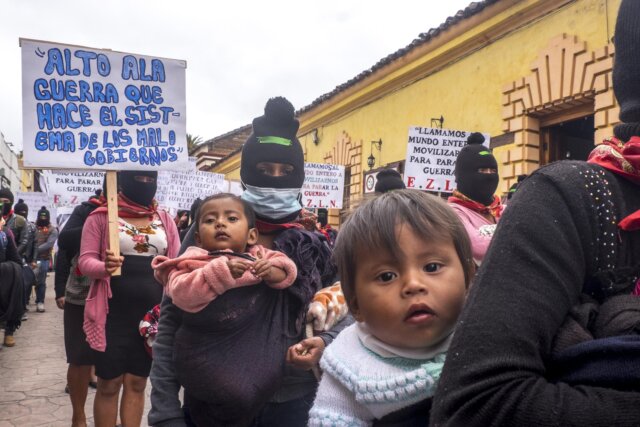
By Gilberto López y Rivas, La Jornada
The National Indigenous Congress (CNI, Congreso Nacional Indígena) and its Indigenous Council of Government (CIG, Consejo Indígena de Gobierno) made public a call to commemorate, this October 12, the 531 years of the beginning of the resistance and rebellion of indigenous peoples and communities against what was described as the “greatest genocide in the history of humanity, against the conquest, against the dispossession of our lands and territories, against the extermination of our institutions, languages, culture and traditions… against the death that global capitalism produced and continues to produce.” In addition, on this date the 27th anniversary of the founding of the CNI “as the space for struggle and unity of the indigenous peoples of Mexico” is celebrated, within the framework of the San Andrés dialogue between the government of the Republic and the Zapatista Army of National Liberation (EZLN).
The CNI-CIG call constitutes a vigorous denunciation of the character of the current government as a safeguard and guarantee of big capital, which, based on militarization and complicity with organized crime and paramilitarism, seeks to implement its megaprojects of death, such as the Mayan Train, the Interoceanic Corridor, the Morelos Comprehensive Project and Santa Lucía International Airport, “which, based on colonialism, patriarchy, homogenization, […] hatred and fear, seek to order and reorder our territory.”
As unequivocal and forceful signs of this war against the people: the siege against the Zapatista communities and the EZLN, massacres such as that of Acteal, the executions and forced disappearances of members of the Consejo Indígena y Popular de Guerrero-Emiliano Zapata (Indigenous and Popular Council of Guerrero-Emiliano Zapata) are pointed out. and the Nahua community of Ostula, as well as the disappearance of the 43 young people from Ayotzinapa, along with the growing and continuous violence against women, and the murder of land defenders, such as the case of Samir Flores Soberanes.
The CNI-CIG, together with the Espacio de Coordinación Nacional Contra la Guerra (National Coordination Space Against War), express their view that Chiapas is Mexico, and it is in this state that the violence that afflicts the entire national territory is concentrated. Likewise, it is considered that the border has moved to the southeast and, with it, the war, which the current administration has not stopped, but rather deepens with the process of militarized and criminal recolonization. The people are organizing to stop this war that is structured through increasing dispossession and exploitation, which involves the plundering of water, the extraction and distribution of hydrocarbons, mining and infrastructure megaprojects aimed at the violent reorganization of the communities, the borders and territories.
It is in this socio-political context, to which the interoligarchic conflicts and contradictions entailed by next year’s early electoral process are added, that the CNI-CIG calls on the people of Mexico and the world who resist against death and oblivion, to social, civil and political organizations, and to good-hearted women and men, to raise their voices against the war in Mexico and the world–especially the war against the Zapatista peoples and the native peoples of the country. The CNI-CIG calls on everyone to carry out on October 12, “according to their times, ways, calendars and geographies”, a global action against this war, a national and international day of dislocated actions, to celebrate the third anniversary of the taking of the building of the Instituto Nacional de los Pueblos Indígenas (National Institute of Indigenous Peoples), by the Otomí indigenous community, and to a central mobilization in the heart of Mexico City.
This call shows the analytical-conceptual level and the organizational-representative capacity achieved by the National Indigenous Congress-Indigenous Council of Government during these 27 years of resistance.
The ethical congruence demonstrated and recognized by the electoral authorities in obtaining citizen signatures in support of the candidacy of their spokesperson Marichuy, in 2018; legal defense and political support for communities and defenders of land and territories; their active and committed presence in the resistance of the peoples of the entire national geography against the recolonization and comprehensive occupation of the territories, as a recognized and honest interlocutor; permanent accompaniment to the Zapatista Army of National Liberation; their defense of the Zapatista autonomous governments and the autonomous processes of leading by obeying in various regions of the country, make the CNI-CIG, together with the EZLN and its solidarious movement, a bastion of anti-capitalist, anti-patriarchal, anti-racist, to the left and from below struggle, which, irreducibly, it does not tire, it does not give up and keeps the flame of rebellion and fight for life alive, of everything for everyone, for us nothing, and the hope of a better world.
________________
Translated by the Chiapas Support Committee from the original in Spanish published September 29, 2023, in La Jornada, Mexico City. Available here: https://www.jornada.com.mx/noticia/2023/09/29/opinion/alto-a-la-guerra-contra-los-pueblos-de-mexico-y-del-mundo-1975
Diocese of San Cristóbal: Chiapas, a failed state, overwhelmed and colluding with criminal groups
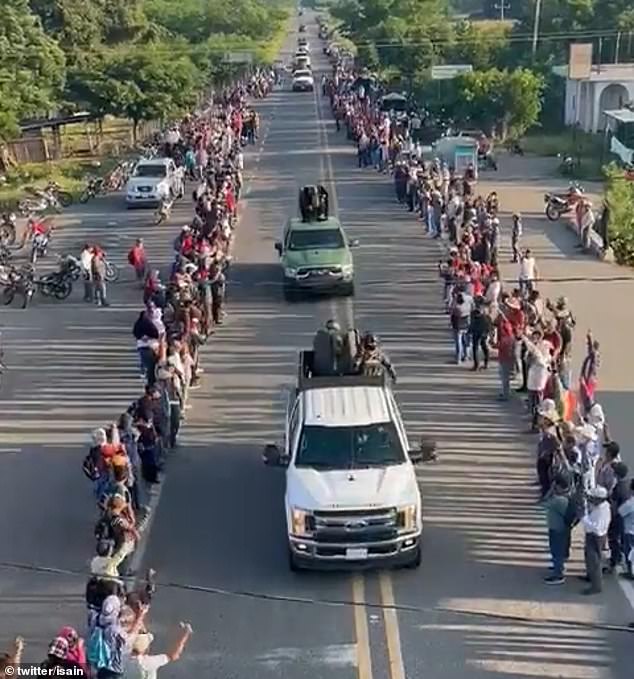
Comalapa and San Gregorio Chamic are cheered by residents. See the video here.
Mexico City | Desinformémonos. Faced with the growing dominance of organized crime groups throughout Chiapas, the Diocese of San Cristóbal criticized “the silence of the authorities” which demonstrates “a failed state that has surpassed and/or colluded with criminal groups,” whose presence and territorial disputes subject the population to a general climate of violence in which forced recruitment, kidnappings, threats and dispossession predominate.
“Criminal groups have taken over our territory and we find ourselves in a state of siege, under social psychosis with narco-blockades, which they use as a human barrier to civil society, forcing them to be there and putting their lives and that of their families at risk,” The Diocese denounced in a statement released on September 23, in which it pointed out the omission of “municipal and regional prosecutors, municipal presidents, and the state and federal governments.”
Journalist Hermann Bellinghausen, a correspondent in Chiapas, summarizes the situation of violence as generated largely by territorial disputes among cartels in search of new routes to the north of the state, especially the Sinaloa Cartel and the Jalisco Nueva Generación Cartel. The climate of violence is also due to the presence of armed civil groups in municipalities such as Pantelhó and Chenalhó, the so-called “motonetos” in San Cristóbal de las Casas, the protection fees for spaces in public markets and “old” territorial conflicts.
“The alarming cocktail [of violence] is accompanied by the immense wave of Central and South American migrants that floods the land border strip and who seek to enter the country at all costs. They constitute another commodity for criminals,” highlights Bellinghausen.
Control by organized crime groups extends from the capital to the municipalities and roads throughout the state. Just today a video was released in which a caravan of armed men from the Sinaloa Cartel can be seen on the highway between the municipalities of Frontera Comalapa and San Gregorio Chamic, amidst cheers and applause from the civilian population on the sides of the via. [See the video at Desinformémonos here.]
According to the Diocese of San Cristóbal, organized crime not only keeps the population of Chiapas subject to threat, harassment, persecution and shortages, but also exerts “pressure and social, political and psychological control of different groups so that the people take sides with one party or another of the criminal groups.”
So far, there has been no clear statement about the government’s intervention to protect the people of Chiapas and address the crisis of violence that the state undergoing. Already in 2021, the Zapatista Army of National Liberation (EZLN) had already framed the violent panorama in its statement “Chiapas on the brink of the civil war,” where the EZLN denounced the armed and paramilitary attacks on the indigenous communities of the state, the pilfering by officials “of everything they can from the state budget,” as well as the alliances of public servants with drug traffickers. “The government of Chiapas not only supports drug trafficking gangs, it also encourages, promotes and finances paramilitary groups,” Subcomandante Galeano said then.
__________________________
Translated by the Chiapas Support Committee from the original published September 25, 2023 by Desinformémonos available at https://desinformemonos.org/chiapas-un-estado-fallido-rebasado-y-coludido-con-los-grupos-delincuenciales-diocesis-de-san-cristobal/
The socio-cultural aspects of the Maya Train
By: Gilberto López y Rivas
First of all, I would like to highlight the non-consulted nature of the Tren Maya mega-project among the affected populations, which include original peoples protected by the Constitution and by international agreements, such as ILO Convention 169 and the 2007 UN Declaration on the Rights of Indigenous Peoples, which stipulate, among others, the right to prior, free, informed, good faith and culturally appropriate consultation regarding projects and actions of the State and corporations of various kinds that could affect their lands, territories, identities, cultural heritage and environment.
In this sense, the communiqué of the Office in Mexico of the United Nations High Commissioner for Human Rights (UN-HR) was very clear in calling attention to the indigenous consultation process carried out by the INPI, from November 15 to December 15, 2019, for not having complied with all the international standards on the matter, assuring that the authorities unilaterally decided the method of the process without the agreement of the communities, for which it criticized the partiality of the consultation.
For its part, the International Tribunal for the Rights of Nature, which met to hear the case of the Maya Train, held the Mexican State responsible for ecocide and ethnocide for the violation of the fundamental rights of nature, of the Maya people, of Mother Earth, and of the right to life and existence. It also ordered Mexican authorities to immediately suspend the megaproject, as well as the demilitarization of indigenous territories and the suspension of the processes of dispossession of ejido land.
In the cultural sphere, the conflictual rupture within an institution whose task is the research, dissemination and preservation of the cultural heritage of the nation and its peoples is notable: the National Institute of Anthropology and History (INAH), a situation aggravated by its participation in the Maya Train, and by serious problems within the institution that have not been resolved. Specifically, the commitments acquired by INAH with the Maya Train, under the control of the Secretary of National Defense (SEDENA), have caused the deepening of this rupture between authorities who obey the demands of tasks, times, disciplines and ways of working of SEDENA, and the union of academics of the institution that has expressed its rejection of the repressive policies of the authorities against researchers who maintain critical perspectives towards the megaproject, as demonstrated by the paradigmatic case of the archaeologist colleague Fernando Cortés of Brasdefer.
Likewise, it is worth mentioning opinions that consider that INAH should limit itself to one of its disciplines, archaeology, such as in the Maya Train, and, consequently, minimize or ignore the contributions of other anthropological and historical sciences that within the institution are represented by numerous researchers, whose knowledge, specialties and opinions are not taken into account in INAH, except for those who are in favor of what is considered the anthropology of social dissuasion, which, as in the State indigenism of the past, mediates the resistances of the peoples in favor of the neo-developmentalist policies, as the current government is doing.
Also, and based on the condemnations of international organizations, ignored by the Federal Executive, it seems to me necessary and urgent to become aware of the global context in which this mega-project is embedded. This is something that the Zapatista Mayas consider to be the storm that is approaching and is reaching us, and which is neither metaphorical nor symbolic, nor does it allude to an apocalyptic vision of prophetic voices, but rather to the real and scientifically-based possibility of a catastrophe on a planetary scale. Carlos Taibo referes to it as a collapse, a general and massive collapse of the dominant system, characterized by substantial reductions in industrial production; the simultaneous and combined financial, commercial, political, social, cultural and ecological meltdown due to its own contradictions and verifiable realities that are taking place: climate change, depletion of energy raw materials, irreversible damage to biodiversity, social conditions of unemployment, poverty, hunger, massive forced displacements, exponential increase in mortality from curable diseases and pandemics, wars for raw materials, and geopolitical strategies to impose or continue the economic, political and military domination of imperialist powers in certain regions; genocides, ethnocides, ecocides, state terrorism, proliferation of nuclear weapons, collapse of mega-cities and the transition to necropolis, and the spread of criminality and criminal gangs as the other face of recolonization or militarized and mafia-like accumulation.

Originally Published in Spanish by La Jornada, Friday, September 15, 2023, https://www.jornada.com.mx/2023/09/15/opinion/012a2pol Translated by Schools for Chiapas and Re-Published by the Chiapas Support Committee
Indigenous peoples: Farewell to the so-called new relationship
By: Magdalena Gómez
At the time of the suspended dialogue between the federal government and the Zapatista National Liberation Army (EZLN) it was claimed that a new relationship would be built between the State and the indigenous peoples. The farewell ceremony began in September 1996, when EZLN declared the suspension of the dialogue due to a crisis in what was to be the second round table on democracy and justice. It has been 27 years since that event, which was not announced as a rupture, since the Law for Dialogue, Reconciliation and Dignified Peace in Chiapas of 1995, established that while the dialogue is maintained, the State will not exercise persecutory actions for the armed uprising of the EZLN on January 1, 1994. This law, still in effect by the way, did not establish sanctions against the State in case of non-compliance with the agreements signed on February 16, 1996, those of San Andres on indigenous law and culture resulting from the first roundtable, which ultimately was the only roundtable. It is not possible to extend this anniversary, since it is already well known that successive governments since then have waged war by other means, as the classic would say. Including the indigenous counter-reform of 2001, which in Fox’s time, along with allied parties, tried to declare the San Andres Accords fulfilled. With that, it put an end to the political will expressed by the EZLN to resume the dialogue if the conditions they set, among them the constitutional reform in accordance with the referred agreements, were fulfilled.
From 2001 to this date, the State has not risked its word in this regard. The aforementioned farewell has been endorsed in times of the so-called 4T and it must be recognized that the President of the Republic has not offered anything in this respect, despite the initial expressions of the current head of the National Institute of Indigenous Peoples (INPI) that had to be omitted. He did put together a strategy of indigenous consultation forums with which they supported a proposal for a new constitutional reform, although it never came to life as an initiative, they recently organized a campaign with indigenous people and academics involved in this process, demanding that the President keep his word, which he did not do even with the Yaquis, when they publicly handed him the document containing the proposal. The campaign was silenced like the mariachis when one of the deputies of the Commission of Indigenous Affairs publicly affirmed that there were no conditions for such demand. Its proponents have remained silent.
This brief recounting of the farewell serves to remind us that the National Indigenous Congress has pointed out that the peoples do not define their struggles by sexennia and, nonetheless, we can already guess the hackneyed discourse on the subject, since at the end of the day its members represent potential votes. We already have two pearls voiced by the two women who will be on the ballot for next year’s presidential election.
The newly elected Claudia Sheinbaum as national coordinator of the Committees for the Defense of the Fourth Transformation, a prelude to Morena’s candidacy for the Presidency of the Republic in 2024. Even while campaigning, sorry, in an informational assembly in San Cristóbal de las Casas, Chiapas, on August 13 she declared: “I will never fail you, I will always be close to the heart of the indigenous peoples, after receiving from indigenous women present the baton of authority and traditional dress ceremony. She highlighted, among the advances of the 4T, the construction of historic works, such as the Mayan Train and reiterated: It is a historic moment for the country, in addition justice is being done for the indigenous peoples which is something that must not stop and must continue, which represents recovering land, territory. Water. It means the wellbeing of the peoples. It means support for the indigenous peoples, but not from the top down, but in a dialogue between the peoples and their authorities.”
I would like to know her data to support this discourse because I have other data. Days later, on September 2, Xóchitl Gálvez, elected by the Frente Amplio por México, also in San Cristóbal stated, I confess that to my astonishment: I will comply with the San Andres agreements. She acknowledged that they are still pending and criticized the incapacity of the current government to promote a constitutional reform. She is informed, no doubt, but she does not recognize the many failures of the Fox government in which she participated. And she outlined her plan that, in addition to economic support, there will be infrastructure development and ecotourism projects and equitable access to education. It is difficult for both speeches to be transformed even when they come from women, and assuming that the axis of the peoples is autonomy and self-determination; even worse: they do not sympathize with the violence that is being suffered throughout the country, especially in Guerrero and Chiapas. True, it is too much to ask. They are only campaigning.

Originally Published in Spanish by La Jornada, Tuesday, September 12, 2023, https://www.jornada.com.mx/2023/09/12/opinion/022a2pol and Re-Published by the Chiapas Support Committee with English interpretation by Schools for Chiapas
The “Narco” in the Lacandón Jungle
By: Luis Hernández Navarro
The San Javier Crossroads, on the Palenque-Trinitaria Highway, is a strategic point of the old Desert of Solitude. Communities that make up the Lacandón Community intersect there: Frontera Corozal, Lacanjá and Nueva Palestina, where Choles, Lacandons and Tseltals live. The crossing is, symbolically, the headquarters of the communal property commission. The indigenous prosecutor’s office and the municipal police are also located there.
As part of its strategy to take over the territory, a commando from the Jalisco Nueva Generación Cartel (CJNG) took control of the place and began to extort protection money. Every vehicle that crosses must pay a fee. The police had their uniforms taken away.
To transport a shipment of sugar, the community of Nueva Palestina hired a transporter who is a member of Pueblos Unidos in Defense of Uses and Customs (Paduc), an association of more than a thousand vehicle owners, to transport people and goods in the jungle. They organized to confront extortion by organized crime. They carry walkie-talkies in their vans and trucks to provide help in emergency cases.
When the drug traffic stop halted the transportation of the sweetener, the driver refused to pay the fee they demanded and alerted his associates from Paduc in Nueva Palestina. He claimed that the merchandise was not his. The criminals, in addition to savagely beating him, carved the initials CJNG on his back with a sharp weapon.
Six of the driver’s companeros came to support him but were subdued with heavy-caliber weapons. Inside the prosecutor’s office, they were kidnapped and tortured, pulling out their nails. They tried to disappear them, but a crowd, with machetes and weapons, came to rescue them. The criminals fled, probably towards the municipality of Benemérito de las Américas, where they have had a base of operations for years.
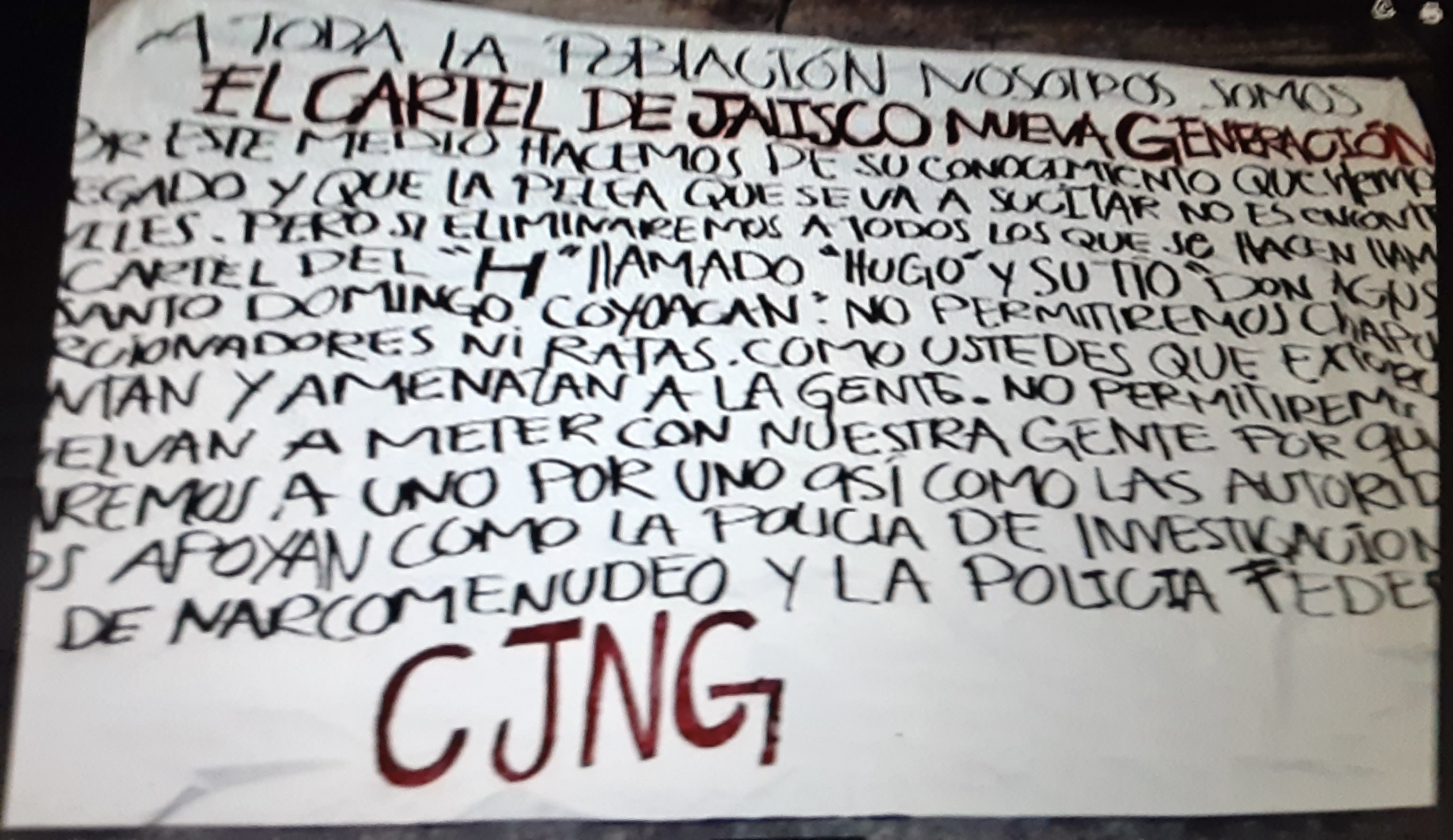
So that there would be no doubt about their intentions, they distributed a notice entitled “Tread carefully, raza.” There they warn that the Jalisco Nueva Generación cartel has arrived and established a curfew starting at 11 p.m. They threaten to torture, kill and dismember the fucking rats that we have already located (sic). They prohibit driving in vans with tinted windows (very widespread in the area) and announce a total clean-up, especially of glass sellers and consumers.
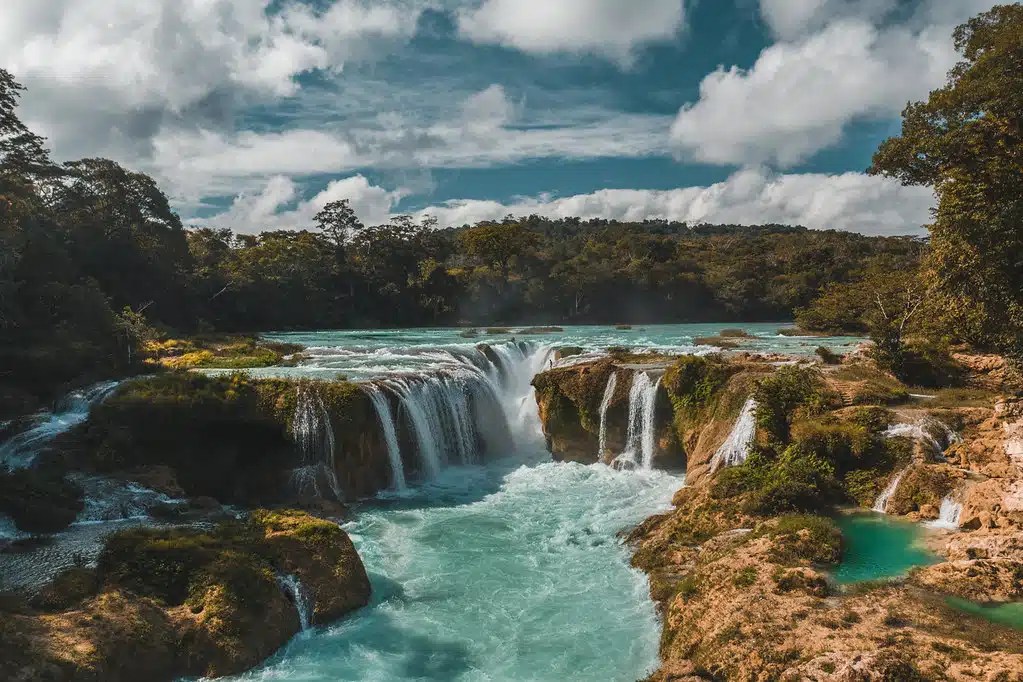
What happened at the San Javier crossroads is just a sample of what is experienced in the region. On July 22, 18 Chol families from the Corazal ranch were evicted from their lands by criminals. They took refuge in the community of Salvador Allende, on the border with the town of Amador Hernández. On August 28, they did the same with 34 families from San Gregorio, who sought asylum in Ocosingo. There is a strategic landing strip and it is also the route to reach the impressive waterfalls of the Río Negro and an unexplored archaeological zone.
On September 6, the authorities of Nueva Palestina addressed a letter to President López Obrador in which they denounced the attacks they are experiencing at the hands of a commando linked to the Sinaloa Cartel of Mayo Zambada. A day before, the hitmen entered the offices of the community property commissioner, attacked elements of the rural police and announced that they would take control of the town.
It is not an exaggeration to say that Lacandón territory has been invaded by organized crime. It has taken over its jungle. Drug traffickers have opened clandestine landing strips to transport cocaine. They control the trafficking of undocumented immigrants. They charge floor rights to small merchants and fees to tourism service providers. They carry out forced evictions of hundreds of families. They threaten to kill community leaders. They enslave young Central American women to work as prostitutes. Simultaneously, the northern culture – as it is known in the region – with its corridos tumbados and narco-corridos, flourishes in the towns, while the consumption of glass, marijuana and crack spreads. Gangs of boys have emerged who wear colored headscarves as a badge.
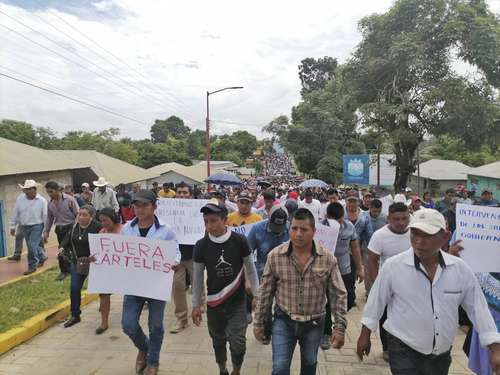
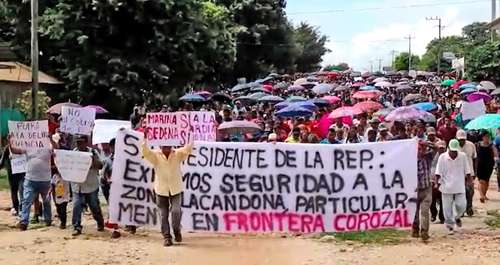
On August 7, more than 3,000 residents of Nueva Palestina, with signs painted by hand on cardboard, demanded: Out with cartels! and No more polleros! They traveled 3 kilometers and denounced the construction of land rights. On September 8, the people of Frontera Corozal marched peacefully against organized crime and to demand security. Their banner read: Mr. President of the Republic: we demand security in the Lacandón area, particularly in Frontera Corozal.
Since 2008, to achieve peace and security, and leave behind the shadow of the Viejo Velasco massacre, the Lacandón Community has carried out an absorbing and incessant work of dialogue and reconciliation with the 52 ejidos that surround it. The signing of a territorial reorganization and promulgation decree is pending that would create conditions to reestablish new bases of coexistence in the area. The war of the cartels against the inhabitants of the jungle is a broom in the hornet’s nest of inter-community conflicts that derails the possibility of peaceful coexistence.
Organized crime advances in the Lacandón Community. It seeks to appropriate the territory, recruit young people, dismantle the associative fabric and tighten the siege on the peoples in rebellion. The alarm lights are on.
Twitter: @lhan55
Originally Published in Spanish by La Jornada, Tuesday, September, 12, 2023, https://www.jornada.com.mx/2023/09/12/opinion/023a1pol and Re-Published with English interpretation by the Chiapas Support Committee
Allende and don Pablo through the great avenues
By: Raúl Romero*
Pablo González Casanova used to narrate with irony what his detractors said about him and his constant trips to Chile during his time as rector (1970 -1972): I traveled so much, that they told me that I was more in the Palacio de la Moneda than in the Rectory, and that is why what had happened to me had happened to me. Interviewed by Claudia Rojas, Hugo Miranda, who was director of the Casa de Chile in Mexico, will recall: the former rector of the National Autonomous University of Mexico (UNAM) Pablo González Casanova goes to Chile, has links with the University of Chile, gives conferences, has meetings with the intellectual world and all that is creating a friendship and a very close bond between Mexico and Chile.
For those years, don Pablo not only occupied the UNAM’s Rectory, in his works Democracy in Mexico and Sociology of Exploitationhe had expressed his commitment against inequality and exploitation, choosing as an alternative the struggles for socialism, democracy and liberation, which years later he would refer to as three alternatives in one. The experiences of the government of Jacobo Arbenz, the Cuban revolution and the world revolt of 1968 would deeply mark González Casanova in those years, and of course, he would follow with attention the rise of the Popular Unity to the government of Chile. From different spaces, it will be deeply committed to the Chilean road to socialism, and will also open spaces for the dissemination and strengthening of that experience. After the fateful September 11, 1973, don Pablo will devote his energies to help bring to Mexico intellectuals and political leaders who in Chile will be at risk of imprisonment, torture and death. His relationship with Pedro Vuskovic, who was Minister of Economy under Salvador Allende, and who after the coup d’état was exiled in Mexico, will be testimony to this solidarity.
With his great friends Luis Cardoza y Aragón and Lya Kostakowsky, don Pablo will approach a powerful network of intellectuals, artists and popular leaders committed to the struggles of Latin America. Thus, González Casanova will forge friendship with Pablo Neruda, who will also keep him informed about the details and particularities of the process in Chile.
If the Cuban revolution summoned González Casanova to be in the front line of solidarity in the anti-imperialist struggle, Popular Unity and Salvador Allende will lead him to reflect on the peaceful, legal and democratic path to socialism, a socialism that at the same time posed the struggle against imperialism and for internationalism. The processes of the nationalization of copper, iron and coal allowed the rector of the UNAM to observe the difference of the Chilean process with other populists and revolutionary nationalists in the region.
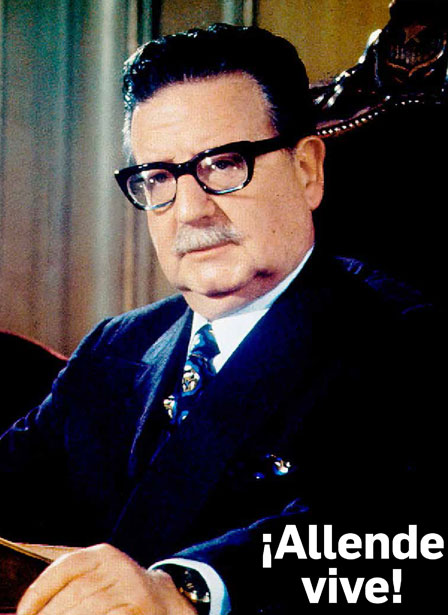
But González Casanova not only recognized the feat of the Chilean people, he also had a deep respect for Salvador Allende, whom he saw as a great orator, a great politician and above all a revolutionary. Just a few weeks after having resigned from the UNAM, in November 1972, at Allende’s direct request, Don Pablo will participate by making contacts and relations for the historic trip that the Chilean president made in December of the same year to Mexico.
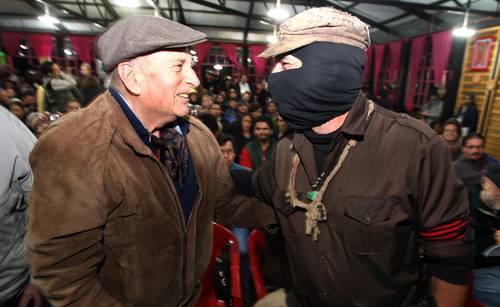
Don Pablo highlighted Allende’s congruence, of doing what he said and to what he was committed: He used the word as an exact announcement of the action. Salvador Allende, recognized that the author of Democracy in Mexico had a place next to Fidel Castro as leaders of revolutionary processes that theorized about their processes and that with their speeches and writings contributed to educate and arm the peoples with theory.
Six years after the coup d’état in Chile, Don Pablo will write: He died like no Latin American president, invested with the symbols that the people gave him, weapons in hand, the palace burned and destroyed, the project of defense of the law for the popular program alive, and a new history that they would write being born, as he thought, America and its people.
The neo-fascist and neocolonialist repression that would be unleashed first in Chile, and then in much of Latin America, would commit González Casanova to support exile and collaborate in safeguarding the heroic memory of the Chilean people. Thus, among other initiatives, he supported the Salvador Allende Center for Latin American Studies, which will promote the analysis of the Chilean road to socialism and recover writings of the former Chilean president.
Each people is free to choose its own path to socialism, said Salvador Allende, and González Casanova helped to understand that the path chosen by the Chilean people was a contribution to the struggles of Latin America and the world. Today Allende and Don Pablo walk through the great avenues of history, and sooner rather than later the peoples of our America will travel that path that they and so many other men and women helped to trace.
*Sociologist

Originally Published in Spanish by La Jornada, Sunday, September 10, 2023, https://www.jornada.com.mx/2023/09/10/opinion/006a1pol and Re-Published with English interpretation by the Chiapas Support Committee
Inhabitants of Nueva Palestina demand help in the face of an invasion by organized crime
From the Editors
Approximately 3,000 residents of the community of Nueva Palestina, municipality of Ocosingo, Chiapas, marched yesterday to demand the presence of security forces because members of organized crime, who are disputing the territory, are trying to charge small businesses with “derecho de piso” (extortion to continue operating, aka “protection monay”).
At the same time, authorities of the town, located in the Lacandon jungle, sent a letter to President Andres Manuel Lopez Obrador asking him to protect the town by land and air, as we are being threatened by organized crime.
During the demonstration, which concluded in the central plaza, the Tseltales affirmed that they marched to reclaim their rights “to life, tranquility and peace.”
“Andrés Manuel López Obrador: we still believe in you. Send us the Army, the Navy, the federal forces, the National Guard; send them to New Palestine, they demanded.”
With a bull horn placed on a vehicle at the front of the march, they warned: “If the government does not act, the people are also organizing to take care of themselves.”
They pointed out that members of the Sinaloa Cartel are extorting them and asked: “What derecho de piso, if we are farmers and ranchers? We are peaceful and hard-working people.” Then they chanted: “Out with the Sinaloa Cartel! Out with organized crime! Yes to the Army! We want order, peace and tranquility! On their placards they read messages such as: No more smugglers in Nueva Palestina, no more cartels, and we denounce the collection of money by criminals.”
They claimed that at the San Javier intersection, located seven kilometers from Nueva Palestina, members of the Sinaloa cartel are positioned, operating alongside the Public Prosecutor’s Office.
Extortionists announce they will take over the community
Authorities commented that on Tuesday “about 16 hired killers arrived in two white vans. They entered the offices of the ejidal police station armed, wanting to kill us. Then they left. They are angry because we did not give them permission to charge the small businesses.”
They explained that they forced the door and entered. They told them that they were going to “work in an orderly manner without disrespecting anyone”, that they were “only” going to charge a “floor fee.”
They slapped the rural policeman who was recording them, snatched his phone and erased the contents. They warned that they would enter the community “because it was their right.”
In the letter addressed to the President they recounted what happened on September 5 and added that the individuals arrived to inform them that they would take control of the town and the region that day. Later they surrounded the house of the president of the commission, but fortunately they retreated.
They stated: “We are a peaceful people and we confirm that we are willing to receive the troops of the Mexican Army and the police, to whom we urgently request their actions with flyovers and by land.
The local leaders confirmed that they were alerted that an armed group “that calls itself the Sinaloa Cartel of El Mayo Zambada is surrounding the town,” the reason for which they insisted on requesting the government’s prompt intervention.
Other sources said that the Jalisco New Generation Cartel (CJNG) has control of the San Javier intersection, a key point in the Lacandon Community, and is charging a fee. The driver of a sugar truck had the letters CJNG engraved on his back because he refused to pay them.
An anonymous letter circulated in recent days states that in the last two months the inhabitants of the San Javier crossing have been threatened by self-proclaimed members of the Jalisco Cartel, who are charging all the truck drivers and migrants who pass through. There have already been violent encounters and people marked on their skin with the initials CJNG.
Originally Published in Spanish by La Jornada, Friday, September 8, 2023, https://www.jornada.com.mx/2023/09de8/estados/024n2est English translation by Schools for Chiapas and Re-Published by the Chiapas Support Committee
Thousands march in Ocosingo to demand an end to the “cobro de piso”
By: Elio Henríquez
San Cristóbal de Las Casas, Chiapas
Thousands of indigenous Choles from the community of Frontera Corozal, municipality of Ocosingo, marched peacefully this Friday to demand the presence of federal security forces, due to the fact that members of narco-trafficking organizations seek to collect floor rights (protection money).
The demonstrators – 7,000, according to community authorities – said that because it is a border point, the government must put more interest and reinforce security in the area.
Today we demonstrate to show the federal government and the entire world that we are peaceful communities and peoples. We want peace; Frontera Corozal, as its name implies, is the gateway to the Lacandón Jungle and Mexico, but the organization must also prevail, they said.
We have the same problem as the community of Nueva Palestina, because the drug trafficking groups want to enter to charge the inhabitants a flat fee and that is why we are demanding that there be security, they said.
They pointed out that they are on par with Nueva Palestine, where 4,000 inhabitants marched on Thursday to also demand the presence of federal and state forces.
They remarked: we are indigenous and we are used to living in peace, tranquility and working calmly in what we are used to, which is to cultivate the land.
The march began at the entrance arch to the town and after walking two kilometers concluded in the central square. A banner with the legend: Mr. President of the Republic. We demand security for the Lacandón area, particularly in Frontera Corozal (sic), led the mobilization.
They affirmed that they marched to fulfill the agreement that the Frontera Corozal assembly took on Thursday because the situation is getting worse every day due to insecurity.
He added that in the last three years, the territory of the Lacandón has been invaded by organized crime, which with impunity has been increasingly seizing control of its jungle, opening clandestine airstrips for the transfer of cocaine, controlling the trafficking of undocumented immigrants and floor rights of floor to small merchants, as well as quotas to tourism service providers; carrying out forced evictions of hundreds of families, disappearing people and committing femicides.
Originally Published in Spanish by La Jornada, Saturday, September 9, 2023, https://www.jornada.com.mx/2023/09/09/estados/022n1est and Re-Published with English interpretation by the Chiapas Support Committee
 Chiapas Support Committee