Chiapas Support Committee
Home of the Compañero Manuel blog on zapatistas & mexico
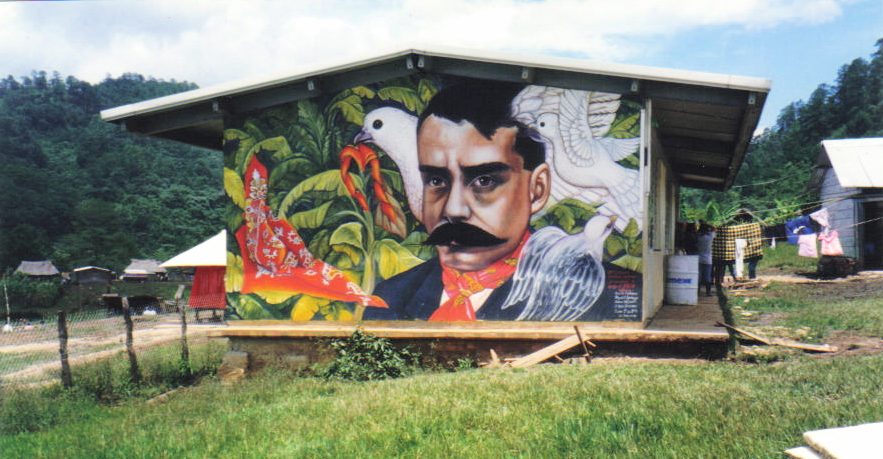
Pueblo Creyente proposes to construct autonomy in their communities
CHIAPAS: “We propose constructing autonomy in our communities,” 25 anniversary of Pueblo Creyente*
Communiqué of Pueblo Creyente (Believing People) on the Sixth Anniversary of the Death of Jtatik Samuel (Bishop Samuel Ruiz)
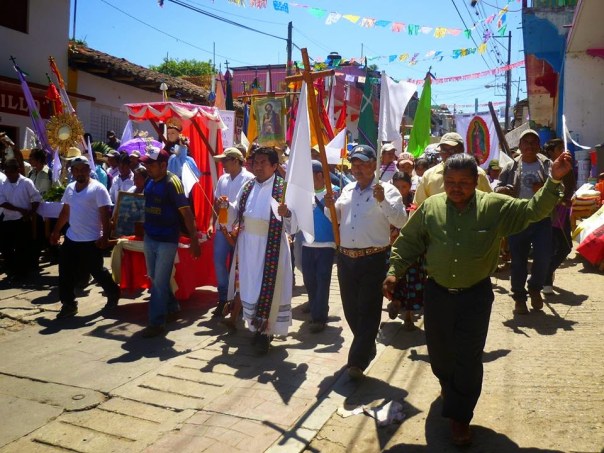
Pueblo Creyente marches in Chiapas
“We denounce the death projects”
To public opinion
To the different religious creeds
To the State and Federal governments
To the communications media
To the men and women that construct peace
Popol Vuh: The dawn came upon all the tribes together. The sun (33) immediately cleansed the face of the earth. The dawn came to the peoples who have walked again and again in the different darkness periods of history.
We greet and we congratulate our sisters of CODIMUJ that celebrate 25 years of walking.
Pueblo Creyente, conscious of the reality that we experience, are constructors of alternatives, are an example and lesson of an organization in defense of Mother Earth. We are people of faith in movement in many places and many forms. There is agreement that Pueblo Creyente has to do with those who have faith. We have eagerness for the fight for freedom and an economy that benefits the peoples and unites us in a common struggle. We complete 25 years walking with a prophetic voice.
The words of Pope Francisco in San Cristóbal inspire us:
The law of the Lord is perfect for everyone and comforts the soul, a law that helped the People of God to live in the freedom to which they had been called; a law that wanted to be the light for his steps and to accompany the pilgrimage of his People. A people who have experienced the slavery and despotism of the Pharaoh, who have experienced the suffering and mistreatment until God says: Enough! We have seen the affliction; I have heard the cry, I have known its anguish (cf. Ex 3, 9).
We denounce the death projects:
There is violence and dispossession of the Land, the Territory and the natural resources, cutting down trees. Megaprojects: Super-highways, eco- tourism projects, mining, dams, wind farm, gas, oil, and the destruction of ecosystems. There is privatization of resources, high fuel and electricity prices, as well as agro-chemicals and, in particular, water pollution. Transgenic seeds. Agrarian reform. Mono-crops.
In politics we denounce: the deceptions of the Political Parties, the sickness of power, the government projects, structural reforms, corruption and impunity, the government’s lack of listening to social demands, the oppression and repression from authorities and that we are not taken into account in the elaboration of laws. We believe that “public servants” should not be servants of their own interests. We further denounce the structural reforms, the TLC, the legalization of dispossession, the violence and the impunity. We are against the PROCEDE that finishes with our ejidos.
In the social we denounce the divisions the machismo the violence and exploitation of women, the misuse of the Internet, the use of pharmaceutical medicine and no longer traditional medicine, the sale and consumption of drugs and alcohol. We denounce the government that has used youths for local drug dealing and consumption of drugs as a strategy, the junk food, the shortage of water due to privatization of the water, the projects and reactivation of the hydroelectric dams, the infiltration and creation of groups to break up the people’s struggle, the oil wells and the physical illnesses.
We also denounce the social diseases: family violence, prostitution, organized crime, hunger, violation of the human rights of migrants and the abuse, extortion on the part of immigration authorities, police and the Army because they are linked with organized crime. We denounce divisions by other religions, militarization of our territory, infiltrating of the groups in power, organized crime, the lack of jobs and public services, the dismantling of health services and the shortage of medicines in hospitals. We denounce those who use our sisters and brothers as cheap manual labor in companies in the north of our country that work in conditions of slavery.
As Pueblo Creyente we propose:
Constructing autonomy in our communities, recuperating our government structure. As Pueblo Creyente we are not a specific organization, as Mexican citizens we have legal rights and spaces for constructing our political and economic alternatives. We need to maintain our resistance to the projects of death and recuperate our autonomous, community governments.
Facing the 2018 elections, the political parties are already going into the communities controlling and organizing their people. We urge society not to sell out. We fight for our dignity and for the truth, which we won’t sell out. Oxchuc is an example of this process.
As Pueblo Creyente we are defending la Mother Earth and territory with our way of life and through pilgrimages and prayers. We organize and inform ourselves through the alternative media. There are processes of taking conscience of reality.
The projects of life we are constructing are: unity, awakening of conscience, dignified life, autonomy, self-government, fraternity, articulation, alternatives for social construction, native seeds, food security-autonomy, an government for the community, freedom, resistance, the word of our ancestors, true life, the power of the people, a common house, caring for all the plants, animals and other species and Justice.
We are in solidarity with the collectives and organizations that defend life, those who defend women’s rights, like the CODIMUJ. We share the same objectives with the CNI of wanting to strengthen the voices of our peoples and to create our autonomy. We are in solidarity with the families of the thousands of disappeared.
We urge other peoples to unite because it’s necessary to join with us for our people and our territory, not to be afraid of approaching us, because fear is a tool of capital to paralyze us; we are encouraged with the words of Pope Francisco: “one must mobilize.”
May the Heart of the Sky and the Heart of the Earth, owner and creator of man, woman and nature, illuminate and strengthen us on our path.
BELIEVING PEOPLE of the DIOCESE of SAN CRISTÓBAL DE LAS CASAS, CHIAPAS
JANUARY 25, 2017
*This would seem an important announcement. Pueblo Creyente/Believing People are Catholic people of faith in the San Cristóbal de las Casas Diocese, a large and heavily indigenous diocese encompassing all of Eastern Chiapas. The announcement that they will construct autonomy (self government) in their communities looks like a move in support of the National Indigenous Congress’ decision to form a (national) Indigenous Government Council.
——————————
Source: Published in Spanish by Pozol Colectivo
Re-Published with English interpretation by the Chiapas Support Committee
Delegation to Chiapas, March 26-April 1, 2017
CSC SPRING DELEGATION to CHIAPAS, March 26 – April 1, 2017

The Chiapas Support Committee of Oakland, California announces a Delegation to Chiapas, Mexico. We hope you will join us to explore the autonomous parallel government being constructed in Zapatista communities.
On January 1, 1994, the Zapatista National Liberation Army (EZLN) rose up in arms against the government of Mexico and took control of large expanses of land owned by cattle ranchers. Thirteen days later, the Zapatistas declared a truce and began the process of developing autonomous government for the communities on the land they now controlled, and told the official government to stay out. The Mexican Congress enacted the truce into law. Since then, the Zapatistas have been constructing another world, one characterized by regional self-government, collective economic projects, the full participation of women, autonomous education and health care centers. They call their project autonomy.
The Good Government Boards (Juntas de Buen Gobierno), referred to in Chiapas simply as Juntas, are the revolutionary centerpiece of Zapatista civilian government. They are the regional governance centers and represent the highest civilian authority in each of the 5 Zapatista regions. Launched in 2003, the Juntas are located in regional centers, called Caracoles, where visitors enter the region, disputes are resolved and economic development is distributed fairly. Every 3 years, each autonomous municipality within the region elects representatives that take turns serving on the Junta. Each region has developed its own education system with trained promoters of education (teachers), and autonomous schools. (Autonomous means no involvement with the official government.) All regions have primary schools. Several regions have middle schools. Each region has developed a health care system with community members trained as healthcare workers that practice in the communities, the municipal capitals and in the Caracoles. Each region has a large clinic, a pharmacy, herbal medicine, laboratory and women’s health services. Surgeries are performed in several large clinics/hospitals.
The indigenous peoples of Chiapas and Mexico confront a design by multilateral organizations such as the World Bank and the IMF to re-colonize indigenous territory for exploitation by transnational corporations. The Zapatistas live in resistance to the Mexican government and are committed to resisting the corporate acquisition of their lands and natural resources. Many indigenous communities throughout Mexico joined together in the National Indigenous Congress (CNI, its initials in Spanish) to resist the projects that threaten their lands and communities. Hydroelectric dams, soft drink bottling plants and upscale tourist facilities threaten water supplies. The exploration and extraction of oil and minerals by mining companies threaten displacement and the poisoning of both land and water. Some communities fear displacement and soil depletion from mono-crop agriculture, such as biofuels. They are looking for a way to control and protect their communities, their territories and their natural resources. They are the first line of environmental defense.
On January 1, 2017, the National Indigenous Congress (CNI, its initials in Spanish) announced the adoption of a proposal initially made by the EZLN, also a member of the CNI. The proposal is to form an Indigenous Governing Council on a national level; that is, a parallel autonomous government for Mexico! The CNI also adopted the proposal to run an indigenous woman from the CNI as an independent candidate for president in Mexico’s 2018 elections! These measures are in response to the projects and corporations that threaten the very existence of their communities, their way of life and the environment.
This delegation will visit Zapatista communities, including the Caracoles of Oventik and La Garrucha to meet with members of the Good Government Juntas. We will also receive briefings from Chiapas NGOs on the political climate in Chiapas and Mexico. While in San Cristobal, there will be a little time for shopping and entertainment. We invite you to join us for an amazing learning experience.

Getting there, cost, etc.
Delegates will arrive in Tuxtla Gutiérrez by plane and then travel by bus or taxi to the colonial city of San Cristobal de las Casas. Airline reservations are made for Tuxtla Gutiérrez (TGZ), although the international airport is located several miles outside of Tuxtla in Chiapa de Corzo. We will assemble at a hotel in San Cristobal de las Casas on Sunday, March 26. Several days later, when the delegation travels into the communities, conditions will be like rough camping and require both a sleeping bag and a hammock.
Cost of the delegation is US $500.00. This does NOT include airfare. Nor does it include bus transportation to and from San Cristobal de las Casas and the international airport in Chiapa de Corzo. It DOES include most food (2 meals per day), lodging (double room) and ground transportation to and from the communities. Your tuition ALSO includes a donation for each community we visit, an honorarium for each NGO briefing we receive, delegation expenses and educational materials, if any. We provide each delegation with experienced group leaders and a translator. Delegation dates are March 26 through April 1, 2017. [Delegates can arrange to stay in Chiapas longer at their own expense.] We are working on arranging NGO briefings now. When we have arrangements confirmed, we will prepare a day-to-day itinerary and will send it to those who express interest in the delegation.
Who is the Chiapas Support Committee?
The Chiapas Support Committee is a grassroots nonprofit collective founded in 1998. All of us are unpaid volunteers. We support autonomous development in civilian Zapatista communities in Chiapas. Our current project is to support the construction of schools in the Caracol of La Garrucha. We also process applications for the Zapatista Language School in Oventik and support the production of Zapatista artisan cooperatives. We are an adherent to the EZLN’s 6th Declaration of the Lacandón Jungle and have been organizing delegations to Chiapas since 2001.
Conditions in Chiapas
The areas we visit in Chiapas are in a “conflict zone.” Although a truce has been maintained for 23 years, there are still military bases and “paramilitary” groups within the zones of Zapatista influence. Any existing conflict is almost entirely between unarmed Zapatista communities and armed civilian groups referred to as “paramilitary.” Violence has not been directed against foreign visitors. Compared to the Drug War violence in other Mexican states, Chiapas is generally peaceful. Nevertheless, it is classified as a “conflict zone,” which means that conditions are not entirely predictable. Delegates travel at their own risk.
How to apply
Please email cezmat@igc.org, requesting an application. Act now! There are only 8 spaces on the delegation, so the sooner you send in your application the better. We must receive all applications by February 28, 2017. A deposit of $100 is required with your application in order to reserve a space. Balance is due March 5, 2012. For those who want more information, just email your questions to mailto:enapoyo1994@yahoo.com
*******************************************
Chiapas Support Committee/Comité de Apoyo a Chiapas
P.O. Box 3421, Oakland, CA 94609
https://www.facebook.com/CSCzapatistas/
Dangerous Nostalgias
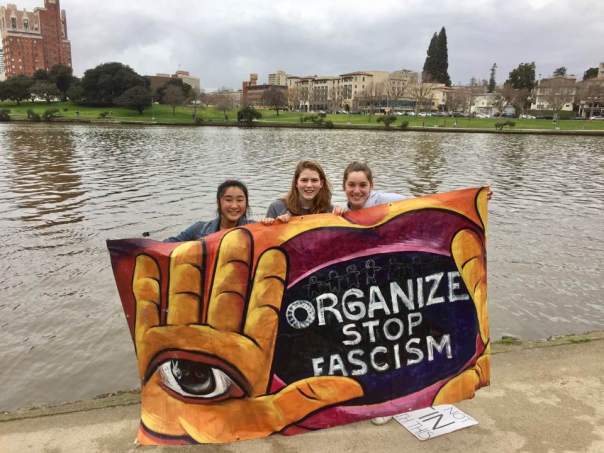
Photo from Oakland Women’s March showing Lake Merritt
By: Gustavo Esteva
We are in a time of grave danger. We can’t close our eyes. But daring to open them demands being willing to acknowledge that we can be caught up in what threatens us.
A nostalgic belief today appears as a program of government. Mr. Trump expresses it in a spectacular and shameless way, prominent Republican Party leaders protect it… and millions of Americans share it. Among them, an idealized image of their country is deeply rooted, according to which they would be exceptional and a blessing to the world. It was formed throughout 200 years and seemed to be confirmed at the end of World War II, when the United States generated more than half of the world’s registered product, was universal creditor and had “the bomb,” while Europe and the Soviet Union suffered the consequences of the war and Japan was occupied. Its evident hegemonic condition was recognized in all the international institutions created in those years, from Bretton Woods to the United Nations.
Americans wanted something more. In order to stabilize their hegemony they conceived an emblem that even the anti-Yankees were able to accept, a paradigm that would convert their way of life into a universal and permanent ideal. On January 20, 1949, upon taking the oath of office, President Truman politically coined the word under-development and offered to share scientific and technological advances with “under-developed areas” so that they would be able to enjoy the “American way of life.” The proposal caught the general fantasy of the whole world. In Mexico it became a religion of the politicians and upper classes and caught on in almost all of the population.
In the years that followed the United States became the champion of national liberation and contributed to dismantling what was left of the European empires. This operation, combined with the Marshall Plan, the Alliance for Progress, the Peace Corps and many other legal or illegal devices, made a new type of imperial exercise possible. It almost never implied the territorial occupation through force of other countries.
To give viability and legitimacy to the endeavor, those who organized it shared a significant part of the “imperial pie” with broad groups of American workers, who thus enjoyed several decades of unprecedented prosperity. They were very broad groups… but they did not embrace the whole population. The design was put into effect with a racist and sexist tinge that characterized it from the beginning and was applied inside as well as outside the United States. The denunciation of its racist and sexist character was customarily scorned. Many Americans persist even today in denying it as a substantive feature of their society, although it has been inherent in it since its beginning.
The postwar scenario passed into history. The United States also won the Cold War, but the world of today is not like the world of yesterday. It will not be possible to march backwards in history. Nevertheless, millions of Americans, perhaps the majority, share the dream of recuperating the position that the country came to hold. Although it may lack realism, the attempt to recuperate it will cause immense damage; millions of Mexicans and Muslims and many others already suffer the consequences. It also provokes resistance. Those who will try to block that mad path are already mobilized, which has generated a profound polarization in American society. For their own interest and conviction, they could impede the shots-in-the-foot that Trump announced, and will try to stop his mad and inhumane policies.
Mexico will be able to do little to change things there. The apparent unity of the political classes, artificially constructed with the ritual use of the flag, will not last; it has popular appeal, but lacks a solid foundation. From below, on the other hand, we could confront the threats with organization and talent. We could, for example, offer the Mexicans abroad a successful reinsertion in Mexico. Millions of able, qualified people and workers would be a blessing for the country if we receive them in appropriate conditions. And we could become a worldwide example of the dignified way of treating the Central American and Caribbean migrants, if we organize to impede the national shame that represents the infamous treatment that criminals and functionaries give them. We could thus advance in the construction of a new society.
Trump believes, like many Americans, what the Mexican government has proclaimed since Carlos Salinas: that NAFTA was a great benefit to Mexico, achieved with astuteness versus the United States. No evidence of the disaster that it has meant for us will be able to convince him otherwise; he will try to get even more at the negotiating table. Nor will he change his belief, also widely shared, that Mexican immigrants are a problem and a danger to his country; he won’t be able to recognize how much they need them.
A century ago Proust observed that: “facts don’t penetrate in the world that our beliefs inhabit, and as they didn’t give them life they can’t kill them; they can constantly deny them without weakening them, and an avalanche of misfortunes or sicknesses that occur without interruption in a family doesn’t make them doubt the goodness of their gods or the talent of their doctor.” Neither the ‘real facts’ nor the ‘alternative facts’ matter for the case. No one will be able to modify that dangerous attitude that is taking a frightening course.
Machado said this convincingly: “Below what is thought is what is believed, as if they were in a deeper level of our spirit.” We must take into account the depth and extent of American superstitions about Mexicans as we strive to construct new hope, based on our own notion of what it is to live well.
———————————————————–
Originally Published in Spanish by La Jornada
Monday, January 30, 2016
http://www.jornada.unam.mx/2017/01/30/opinion/018a2pol
Re-Published with English interpretation by the Chiapas Support Committee
https://chiapas-support.org/2017/02/08/dangerous-nostalgias/
Word Movement: Poets against war & racism
Poets against War & Racism | Poetas contra la guerra y el racismo

- Amira Ali
- Arnoldo Colibrí Hummingbird
- Rafael Jesús Gonzalez with Gerardo Omar Marín
- Invited poets & performers
- Open mic.
- Update with short new video on the Congreso Nacional Indígena congress held October 2016 in San Cristóbal de las Casas, Chiapas, Mexico.
…
- How will we reclaim all the Black lives lost? How will we change the relationship we have with each other and with the original peoples when we are uninvited guests on Indigenous lands?
- How do we live in community where everyone belongs and has something important to contribute, to do and to say?
- What is to be done?
- What is to be dreamt of together?
Joint CNI-EZLN communiqué on Rarámuri murders
Joint Comunicado of the National Indigenous Congress and the Zapatista National Liberation Army in solidarity with the Rarámuri People
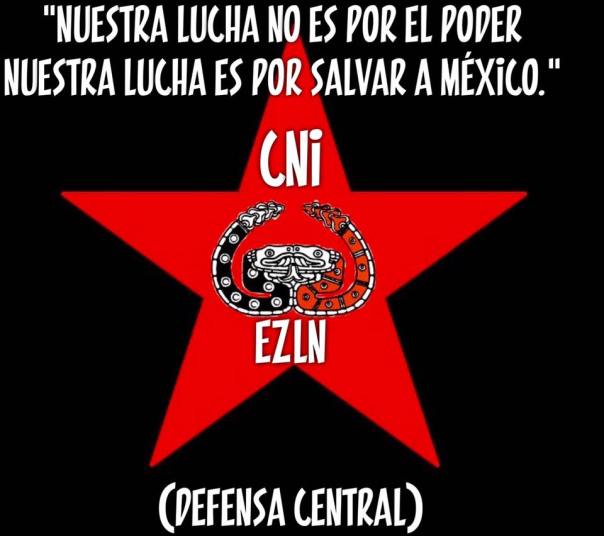
“Our fight is not for power, our fight is for saving Mexico.”
STOP THE MURDERS OF INDIGENOUS RARAMURIS COMPAÑEROS IN DEFENSE OF THEIR TERRITORY!
Indigenous Territories of Mexico,
February 4, 2017
To the people of Choreachi,
To all the Rarámuri People
To the Indigenous Peoples
To the people of Mexico
To the peoples of the world
We found out today about the murders perpetrated against the indigenous Rarámuris Juan Ontiveros Ramos and Isidro Baldenegro, both from the community of Choreachi, in the municipality of Guadalupe y Calvo, Chihuahua, respectively on February 2 and the other 15 days ago.
We urgently denounce this new barbarity against compañeros with outstanding commitment in their people’s struggle for the recuperation of their territory monopolized for more than 40 years by large cattle ranching landholders and organized crime groups.
As the National Indigenous Congress and the Zapatista National Liberation Army, we are in solidarity with the Rarámuri people so hurt by these two murders that were added to the 18 homicides against their communities since 1973, four of them in the last year.
Compañeros and compañeras, you are not alone! We accompany you in your pain; we open our hearts to the tireless fight you are waging against organized crime and landholders supported by the bad governments; we offer you our support as indigenous peoples of the country that we organize to defend our lives and our territories.
STOP THE MURDERS OF INDIGENOUS SOCIAL STRUGGLERS!
NEVER MORE A MEXICO WITHOUT US!
CONGRESO NACIONAL INDIGENA
ZAPATISTA NATIONAL LIBERACION ARMY
Zapatista Alchemy

January 2, 2017.
We take a lot of care with the value of the word. When we talk about someone, we’re not just saying his or her name: we’re naming his or her presence with us.
That’s what we mean when we say “brother” or “sister”; but when we say “compañera” or “compañero,” we’re talking about a back and forth, about someone who is not outside but rather who sees and listens to the world, and fights for it, together with us.
I mention this because here with us is the compañero Don Pablo González Casanova, who is, as is evident, a Zapatista Autonomous Municipality in Rebellion unto himself.
Since the compañero Pablo Gonzalez Casanova is here, I’m going to try to raise the level and scientific rigor of my presentation, avoiding any sort of double-entendre (large or small, pay attention).
-*-
Alchemy. Before you use up your data on your cell phones and tablets checking what “alchemy” is on “Wikipedia,” and overwhelm me with all sorts of definitions, let me clarify that with this term we’re referring to an antecedent, a step that precedes (whether necessary or not, you can decide) the constitution of science as such. Or as the late Sup Marcos used to say, “alchemy is a sick science, a science invaded by the parasites of philosophy, ‘folk wisdom,’ and the kind of evidence that saturates the complex world of contemporary communication,” as we can read in one of the documents left behind after his death.
In that text, the deceased indicated that alchemy was not necessarily a precursor to science as indicated by the saying, “all science was alchemy before it was science.” Rather, it was a non-science that aspired to be science. He also said that alchemy, unlike the pseudo-sciences, does not build on a mix of truths and knowledge, with evidence and clichés. Pseudo-science, he says, does not move closer to science but rather separates itself from it and will become its most ferocious enemy; it will succeed in getting more publicity in times of crisis. It does not constitute an alternative explanation of reality (as is the case with religion), but rather a “reasoning” that supplants, invades and conquers scientific thought, defeating it in the most important contest in a media society: that of popularity.
Pseudo-science does not aspire to the argument of faith, hope and charity. Rather, it offers an explanation with a logical structure that “tricks” reasoning. To put it plainly: pseudo-science is a fraud, typical of the charlatanism that abounds in academia.
Alchemy, on the other hand, aspires to free itself, to “cure” itself, to “purge” the parasites that are the non-scientific elements.
Although it claims dubious maternity rights over the sciences, philosophy, which calls itself “the science of the sciences,” is, according to the text of the deceased, one of those very parasites. “Perhaps the most dangerous one,” continues the late Sup, “because it presents itself to science as a way out of that affirmation-negation, ‘I don’t know’, that, sooner or later, science bumps up against. Its commitment to rationality leads science to supplant religion with philosophy when it arrives at its limit.”
For example, if it didn’t have the capacity to explain why it rains, instead of invoking the argument that god is the one who decides about rainfall, science would prefer to invoke a reasoning along the lines of, “The rain is none other than a social construction, with a theoretical-empirical appearance revolving around a random perception that occurs in the context of a continual conflict between being and non-being; it’s not that you get wet when it rains, but rather that your perception of ‘getting wet’ is a vacillating part of a universal de-coloniality.”
Even though all this could be summarized as, “it’s really up to the rain whether it falls, or falls on you,” science would embrace this external explanation, because, among other things, science believes that its explicatory power is in language, and not in the power to make possible the transformation of reality. “Know in order to transform,” they told us here a few days ago. Philosophy successfully sells science its certificate of legitimacy: “you are science when you achieve a logic in language, not when you are able to understand.”
If we go even further, for “Zapatista alchemy,” science not only understands reality and thereby makes possible its transformation; scientific knowledge also “opens the path” and defines new horizons. That is to say, for Zapatista alchemy, science completes its duty by continually arriving at the recognition that “what is missing is yet to come.”
If, in the philosophical and scientific thought of the last century, the sciences progressively “dismantled” religious explanations, offering verifiable knowledge; then in the coming crisis, the pseudo-sciences do not confront reality with a magical explanation, but rather “invade” and “parasitize” the sciences, first in order to “humanize” them, and then in order to supplant them.
Philosophies are then transformed such that they no longer function as the tribunal that sanctions scientificity according to the logical structure of language, but rather the generic, naturopath and homeopathic explanation opposed to the “obvious” scientific one. To make myself clear: for postmodern philosophy, micro-doses are the best weapon against the big pharmaceutical monopolies.
The popularity of the pseudo-sciences is rooted in the fact that a scientific background is unnecessary: it’s enough to nourish oneself in the hidden corners of language, to supplement ignorance with badly concealed pedantry and evidence and platitudes with complex linguistic inventions.
Faced with an affirmation like: “the law of universal gravitation says that the force of attraction between two bodies with mass is directly proportional to the product of their masses and inversely proportional to the square of the distance that separates them,” science will recur to observation and experimentation, while philosophy will analyze the logical reasoning in the language.
Another example: an assertion from the neurosciences, like “a lesion in area 17 of the occipital lobe can cause cortical blindness or blind spots, depending on the extent of the lesion,” can be confirmed with functional magnetic resonance imaging, an electroencephalogram or similar technologies.
Clearly, in order to be able to do this it was necessary for science to advance to be able to study the brain and explain its parts, but the development of other sciences was also necessary to obtain the functional neuro-images.
When, upon the recommendation of a compa, I read that excellent text called The Man Who Mistook his Wife for a Hat, by the neurologist Oliver Sacks, I thought that Sacks must have been itching to open that man’s head to see what was happening in his brain. Although I would have preferred to open his wife’s head to understand how she could stand to be confused for a hat and why she didn’t “fix” her husband’s dysfunction with a good smack upside the head.
Now, scientific-technological advances will make it possible to study, for example, what happens in the Cat-dog’s brain without the necessity of opening its head.
Despite this, faced with a scientific explanation for brain function, pseudo-science will offer its own explanation using a supposedly scientific language, and it will tell us that our problems are due to the fact that we haven’t developed the full capacity of our brain function. And so, theories abound that say that intelligence is measured by the percentage of the brain that is used. A more intelligent person uses a greater percentage of his or her brain. For example, Donald Trump and Enrique Peña Nieto would have in common that they use 0.00001% of their brains, while Einstein would have used, let’s say, 30%. The success of the movie “Lucy” is not limited to the box-office, nor due only to the fact that it was directed by Luc Bensson and stars my ex, Scarlett Johansson; it’s because it permits the appearance of charlatans who offer courses so you can become more intelligent using “scientific techniques” to take advantage of your maximum brain capacity.
And so the commercial success of products with pheromones to attract the opposite sex was brief. (“If you, my friend, can’t manage to catch the bus much less a man or woman-friend, it’s not because you can’t pull yourself away from the TV or computer screen, it’s because you don’t use this soap-perfume: after the first use, you’ll see how they throw themselves at you as if you were a youtuber, tweetstar or a trendy meme. And just look, for one time only we have a special offer of 333 for the price of 2, but only if you call the number on the screen in the next 15 minutes. Remember to have your credit card number on hand. You don’t have a credit card? For the love of…well that’s why you can’t even catch a cold, much less a partner; no, friend, not even pheromones will help you. Change the channel or go watch videos of funny accidents, the prophecies of Nostradamus or similar things that will provide conversation material in the chat room of your preference).
But just behind in the relay race is the stupid blunder of “brain capacity,” which is supplanting the pheromone lotions with products that develop your cognitive capacities: you too, friend, can be a successful person and learn to fly and repair interstellar spaceships on you tube.
Perhaps this proposal, which is neither modern nor post-modern, would not be so supported even by some scientists if they knew that one of its promoters was Dale Carnegie, with his self-help best-seller, which dates from 1936, titled How to Win Friends and Influence People, which sits on the bedside table of John M. Ackerman et al.
In sum, while scientists try to confirm or discard their hypotheses about how the brain works, pseudo-scientists sell you courses on brain gymnastics and things like that.
And, in general, while the sciences require rigor, study, theory and exhaustive practice, the pseudo-sciences offer knowledge at the click of that dark object of desire for the Cat-dog: the computer mouse.
Which is to say that science is not easy: it’s hard, it demands, it obligates. It’s obviously not popular even among the scientific community.
And then science doesn’t do anything for itself and it decides to break your heart without a second thought. It happened to me, for example. You all have to be strong and mature for what I’m about to tell you. Sit down, relax, be in harmony with the universe, and prepare yourselves to learn a crude and cruel truth. Are you ready? Well, it turns out that the moka or moca doesn’t exist. There’s no such thing as a moka tree or a moka mineral. The moka is not a creation of the first gods to alleviate the life and death of SupMarcos. It’s not the prohibited fruit with which the serpent, dressed-up as a seller of rejuvenating cosmetics, tricked wicked Eve, who in turn coaxed noble Adam and screwed over Rome. Nor is it the Holy Grail, the sorcerer’s stone that moves the search for knowledge. No, it turns out that…. moka is a hybrid or a mix or something like that. I don’t remember of what with what because, when they told me about it, I got more depressed than when one of the scientists said that the most brilliant alchemist was not present, and then, I confess, I threw myself into vice and perdition. I distanced myself from worldly distractions and I understood, then, the success of the philosophies and pseudo-sciences in vogue today. What is there to live for if the moka is nothing but a construction of the social imaginary? Then I got a better understanding of that spontaneous philosopher who would have had great success on social networks, and who responded to the name of Jose Alfredo Jimenez. “Paths of Guanajuato” [“Caminos de Guanajuato”] would have been the Critique of Pure Reason that Kant couldn’t elaborate.
But, despite injuries and scars, the presentations you all gave start to produce effects:
One insurgente official listened to the talk that Dr. Claudio Martinez Debat gave about genetic inheritance, and he concluded that it’s true. “I applied it quickly, thinking about the communities and, yes, if a compa is a certain way, you see that his father and mother have the same way about them. For example, if SubMoy is very bad-tempered, then it’s because his father was very bad-tempered himself.”
“Ah,” I said to him, “so SubMoy gets mad at us not because we don’t complete our tasks, but because his father was very bad-tempered?”
The scientific investigation is still pending because at that moment SubMoy arrived to check whether we had prepared the things to go to Oventik. That is, justice fell upon on us.
-*-
This is a meeting of the Zapatistas and the sciences. We added “con” to “sciences” not just because of the play on words, but also because your having accepted this meeting with us goes beyond your duty and could imply a reflection about the world, too, as well as an explanation of what you work on in your respective specialties.
As in our previous participations, Subcomandante Insurgente Moisés and he who writes and reads this are making an effort to give you data so you can form an image (a profile, they would say these days) of the type of Zapatista who is interested in learning from you all.
We’re striving for this because, as we also said in our other intervention, our aspiration is for this meeting to be repeated, and for it to multiply quantitatively and qualitatively.
With your presentations, you all give us an idea not only of the knowledge you possess, but also of your reasons for accepting our invitation and for being present here in person or via texts, audios and videos.
Because we need science, we are displaying all our charms now, together with SubMoy, in order to convince you all that here, with us, you can and should do science.
That’s why we’re telling you not about science, but about what we have been and what we are, and what we want to be.
We can do what we can. We can’t offer you scholarships, resources, or recognitions to plump up your curriculum vitae. Gosh, we can’t even help you get a few class-hours, much less a tenured position.
It’s true, we could try to con you and put on our “I’m a poor Zapatista who lives in the mountains” face.
Or insinuate, with a seductive voice, “What’s up my plebian friend, I know you want a piece of this, come on already. You know the scientists say not to produce any more production because the world is as full as the metro at 7:30am: don’t make any more products they say, better to adopt instead. So you and I are going to offer them a full assortment as they say, like cow-tongue or shredded pork tacos, so they have options. If it comes out a boy we’ll keep going until we get a girl, or the other way around, switching, going by pairs. The point is that what’s important isn’t winning, but rather competing.”
Or with a DM that invites: “Come on, let’s deconstruct our clothes and contextualize our private parts.”
Or we could send you a whatsapp that suggests: “You, me, and a particle accelerator: I’m just saying, think about it.”
We could do that, though it surely wouldn’t be successful.
What we’re thinking of doing is what we’re saying: show ourselves as we are and how we’ve come to be what we are.
So that you don’t feel you’re at a disadvantage knowing that you’re being not only listened to, but evaluated (the closing ceremony of this event, on January 4, is when the 200 masked men and women, our compañeros and compañeras, the Zapatista bases of support, will evaluate this event), we’ve tried to give you elements so that you can evaluate us and decide how to answer the complex question of whether you will return, or file these days under “never repeat ever again.”
That evaluation will be our first disagreement and we will have to decide if we overcome it like mature adults and take up couples therapy, or if we call it a day.
In any case, it is to be expected that on your way home you’ll say to yourselves, “sonofa…and I was complaining about the Conacyt [National Council of Science and Technology] and the National System of Researchers.”
-*-
Before, I told you that one way to get to know us was to ask why we ask what we ask. So other possible questions could be, “what do you understand by and expect of science and of scientists?”
For us, science implies knowledge that doesn’t depend on other factors. Note, that’s science, not scientific research. That is, for example, exact science by antonomasia, mathematics in the singular or various kinds of mathematics. Is there a capitalist math and one below and to the left? I give this extreme example because, starting from the still-developing sciences, the “young” sciences as they say, with their understandable errors and stumbling explanations, generalizations are made that say “science is guilty of this and that.” “Science is racist, discriminatory, and doesn’t take into consideration the personal and passionate drama of the scientist.” And there, in the apocalypse of the cat-dog, it becomes the “mother of all misfortune.”
We Zapatistas don’t do science, but we want to learn it, study it, know it, apply it.
We are familiar with the courtship the pseudo-sciences offer us, and with their path of poverty-optimization: the attempt to sweet talk us with the idea that the non-knowledge we have are really “wisdoms.”
I’m going to ignore for now the fact that this position invariably comes from someone who has never done science, that is, beyond middle school science experiments.
But that’s what they tell us, and they give us the example that we know when to plant. It’s true, we do know when to plant; we identify certain “signals” in nature and, through tradition and custom, we know it’s time to sow seeds.
But we don’t know why those signals indicate that it’s time to plant, nor what the relationship is between those signals.
The Zapatista young peoples’ interest in science (as in the example of the estafiate [i] that Subcomandante Insurgente Moisés told us about a few days ago) finds echo and support from the adults and the elders, because climate change has caused those signals to become blurry.
So now, with climate change, the dry season and rainy season have been disrupted. Now it rains when it’s not the time for rain and doesn’t rain when it is. The cold season has been reduced in time and intensity. Animals that are supposed to belong in certain zones begin to appear in others that have neither similar vegetation nor climate.
When the rains are late in coming and the crops are at risk, the custom in the communities is to set firecrackers off into the sky “to wake the clouds,” or to remind god that it’s time for rain, like a reminder of the work at hand in case god got distracted. But it turns out that god is either really busy or not listening, or just doesn’t have anything to do with the extended draught.
So you see, ancestral knowledge isn’t enough, if in fact you can call it knowledge.
So what some call the “ancestral knowledge” of the indigenous confronts a world that they do not understand, that they do not know. And the Zapatistas, instead of consoling ourselves in churches or shrines or resorting to prayer, realize that we need scientific knowledge, now not out of curiosity but out of the necessity to do something real to change our reality or to confront it under better conditions.
That’s why the generations that prepared and carried out the uprising, those that sustained resistance with rebellion, and those that grew up in the context of autonomy and maintain the rebellion and resistance, all agree on one need: scientific knowledge.
-*-
We don’t know how sensitive science is to public opinion, social networks, or the imposition of paths or explanations, not because of the pressure of money, Power, or the system, but because of self-censorship.
We don’t know if something exists that could be called “another science,” and if it would correspond to a media or social court that judges, condemns, and executes sentences against the sciences.
To whom does the construction of another science correspond, if there is something that can be named as such?
We Zapatistas think it corresponds to the scientific community, regardless of its phobias, affinities, political militancy or lack thereof. And we think that community should resist and combat the parasites that latch onto it, or that already inhabit and weaken it.
That is why, even if we don’t manage to convince you that ours is an effort for life as well and that we need you in that endeavor, you should keep on without tiring, without compromise, and without concessions, to us or anyone else.
You should keep on because your commitment is to science, that is, to life.
Thank you very much.
From CIDECI-Unitierra, San Cristóbal de Las Casas, Chiapas, Mexico,
SupGaleano.
Mexico, January 2017
From the Notebook of the Cat-Dog
The 3-of-3 of the Cat-Dog
I don’t know if this is still the case, but 10-12 years ago, people sang and danced ska. I vaguely remember that concerts were organized in solidarity with various people’s struggles. At those concerts, and I don’t know either if they still do this, but instead of paying money, dough, bread, cash, you could get in with a pound of rice, beans, or sugar that would later be sent to those movements. Some of those concerts were to support the Zapatista communities’ resistance, and on one occasion, I think in 2004, they sent me some videos where the only thing you could see was a cloud of dust, in the midst of which you could vaguely make out the crowd jumping around as if they had ants in their pants to the rhythm of “La Carencia,” which is what Defensa Zapatista found on the internet when she looked up the word. I told the compa you couldn’t see a damned thing on the video and he responded that maybe it was my computer, because on his you could see, I quote, “dope, man, dope.”
Of course it turns out that his computer was one of those super-modern ones with a foot control, a heliport, a bowling alley and a minibar, and mine, well how can I tell you, it had a DOS operating system and the most modern thing it could read was a 5-inch floppy disk (which was like trying to read the “Piedra del Sol,” [ii] which is or was housed in the National Museum of Anthropology, with the disinterested support of IBM).
On one trip that compa made to these mountains, he checked my laptop over and declared, and I quote: “yeah that’s lame, plus it’s not even the original video, who knows who that’s from, here, this is the real thing,” and he pulled up another video taken from the stage. There you could hear the music and see the crowd holding up different kinds of stuffed animals. If people still play, sing, and dance to that kind of music, they must have been dying of envy when they saw the Sherlock Holmes and Einstein dolls I had here during the first talk.
It turns out around that around that same time the deceased SupMarcos recorded a CD with the musicians who call themselves “Panteón Rococó,” named “3 times 3,” although I don’t know the reason or motive for the name. This is relevant in this case because perhaps one can find there the antecedent for this “3of3.” Now that it is publicly known that the National Indigenous Congress has decided to form an Indigenous Governing Council and run the spokesperson of that Council as candidate for the Mexican presidency in 2018, the Cat-Dog felt obligated to present its own “3of3,” you know, not to be caught flatfooted and better a bird in the hand and sit down before you’re knocked off your feet. [iii]
1 of 3: Artificial Intelligence versus Zapatista Intelligence
“The political system has been hacked,” reads the news ticker across all of the screens in the Society of Power Artificial Intelligence complex.
The central Chat forum lights up and almost simultaneously various nicknames appear, all worse than ridiculous.
A dull conversation begins, but stops immediately when the nickname “Bossy” appears.
It’s not just any meeting. And I don’t mean because nobody is physically there. There aren’t even real avatars, just voices.
But every voice knows its place in the hierarchy. The less they speak the higher their rank.
At that moment a voice points out:
“I don’t think there’s anything to worry about really. It’s clear that this will only further saturate the [political] center. One more option for those who think they choose and decide. I don’t really see that there’s a problem; let them do it. And well, that geography was defined a long time ago. I suggest we move on to the next item…”
A voice interrupts, their rank evident in their dubious tone:
“Pardon me. I think we should not underestimate what they intend. That should be clear from the fact that this wasn’t even contemplated among the thousands of scenarios that our systems predicted. In fact, we didn’t even realize it was happening until it appeared on the screen.
When we saw the warning blinking “The political system has been hacked,” we thought it was another hacker invasion and that there was no reason to worry. The firewalls would take care not only to neutralize the attack, but also to counterattack with a virus that would send the intruder back to smoke signal communication. But no, the system didn’t even warn of a virus or infiltration risk. It just indicated that there was something for which it didn’t even have a category of classification.”
Another voice, same volume, similar tone:
“I agree. The proposal is too daring for them to be satisfied with a dispute over the center. I was doing the calculations and I think they are aiming for those people who don’t even appear in our statistics. Those people want to destroy us.”
Several voices begin to murmur. The screens erupt with texts in characters illegible for those not familiar.
A voice inquires with authority:
“What do you suggest?”
“A vacuum,” says another voice, “that the media focus elsewhere. And may the well-behaved left attack them. There’s no lack of racism there, a mere insinuation will be enough for it to carry on with its own inertia. We’ve done it before, there won’t be a problem.”
“Proceed,” the voice with authority states, and “offline” immediately appears on several screens.
Only the smallest voices continue chatting:
“Well,” one says, “I think we’re going to have to deal with unpredictable surprises, like that of 1994.”
“And what would you do?”
“Hmm… remember that bad joke from a few years ago, that if you wanted to prepared for the future you should learn Chinese? Well, I recommend that you start studying native languages. You?”
“Well, we could try to find a bridge, some kind of communication.”
“For what?”
“Well, to negotiate decent conditions in prison. Because I don’t think these people are going to offer any kind of amnesty, not before or after the fact.”
“And what do you suggest?”
A voice, until that point silent says:
“I’d say to learn, but I think it’s too late for that.”
“But I have a hypothesis,” the voice continued, “what happened is that the Artificial Intelligence that motors our central server functions with the information that we give it. Based on that data, the AI predicted all of the possible scenarios, their consequences, and the appropriate measures to take. What happened is that what they actually did wasn’t in any of our scenarios; the AI got upset and didn’t know what to do, simultaneously activating the anti-hacker and antivirus warnings and launching the reaction to the closest scenario on hand, which was Sup Marcos as presidential candidate.”
Another voice interrupts: “But isn’t Marcos dead?
“He is,” responds another, “but for the same reason.”
“So they did it to us again, fucking Zapatistas.”
“And there’s no way to fix this?”
“Well I don’t know about you all but I’ve already reserved a flight to Miami.”
“I now look with fear on the Indians, it never occurred to me that they would come to rule.”
Almost simultaneously, “Standby Mode” appears on the various screens.
The red lights are still on. The alert sirens are still going off, alarmed, hysterical.
Far away, some women of the color of the earth that we are turn off their computer, disconnect the server cable, smile and converse in an incomprehensible language.
A little girl arrives and asks in Spanish: “Hey moms, I finished my homework, can I go play? See, we haven’t filled up the team yet but don’t worry ma, there will be more of us, sometimes it takes awhile but there will be more of us.”
The women leave, running and laughing behind the little girl. They run and laugh as if, in the end, there will be a tomorrow.
I testify.
Woof-Meow.
Note: Upon questioning the Cat-dog on why its “3of3” declaration only has one part and not 3 like its name suggests, it only growled and purred: “what’s missing is yet to come.”
[i] Also known, depending on the source, as Artemesia, white sage, silver herb, mugwort, or wormwood.
[ii] The Sun Stone or the Stone of the Five Eras, is a late post-classic Mexica sculpture, often mistakenly referred to as the Aztec Calendar, consisting of a massive 24-ton basalt disc of Aztec carvings: https://en.wikipedia.org/wiki/Aztec_calendar_stone
[iii] A mix of three metaphors in Spanish.
En español: http://enlacezapatista.ezln.org.mx/2017/01/13/alquimia-zapatista/
The gasolinazo and the protests
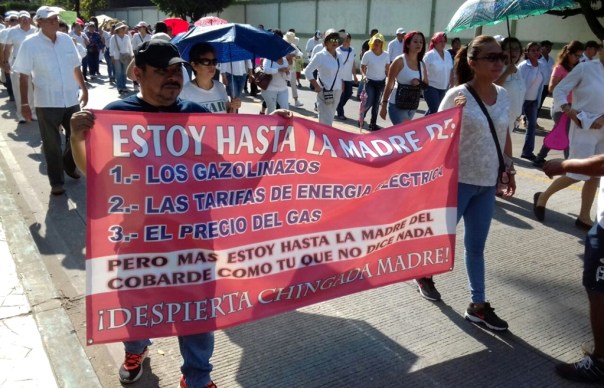
Banner in a Chiapas march: “We are fed up with: 1. the hikes in fuel prices; 2. the cost of electricity; and 3. the price of gas. But we’re more fed up with the coward who does nothing. Wake up mother fucker!
By: Luis Hernández Navarro
The image has been reproduced a thousand times as a symbol of the times. At the exit of a department store sacked by a plebeian multitude, a young man carries an enormous new screen on his back.
With that screen, he recovers from the offense of being needy in a country in which being so is not only a material tragedy but also the symbol of social defeat.
Installed in the perpetual fiesta of consumption, the lords of money exhibit their fortune without modesty. They exhibit their luxuries without any modesty, as material evidence of their success in life. And, the pariahs, without an entry pass to the spectacle of extravagance, watch the ostentation and opulence of the powerful from their humble homes through the window of television programs, until the opportunity arrives to take their revenge.
With that screen, its new owner has the illusion that he has achieved slipping into the banquet of the wealthy. The robbery’s harvest, two or three times larger that the almost 10 million television sets that the federal government gave away with the pretext of the 2015 analogue blackout, doesn’t commit either his vote or his loyalty, as happened during that year’s elections.
That television is also his personal retaliation to the politicians’ endless swindles. If the ex governors of Veracruz, Chihuahua, Quintana Roo, Coahuila and Nuevo León embezzled from state coffers without suffering any punishment, why not keep an item without having to pay for it?
He obtained that screen by breaking the law. But perhaps those above don’t do it like that? He snatched it in a strike of luck and audacity, in an act of rage and rancor accumulated for years, from which the gasolinazo took the lid off.
That is an explanation for the wave of looting that have shaken several regions of the country, like the state of Mexico, Veracruz, Hidalgo and Nuevo León. However there are those who put that explanation in doubt and offer another: that of a plot. Some say that public functionaries organized the pillage as part of a variant of the shock doctrine to justify the intervention of public force against those in disagreement with the increase in gas prices, and to discourage the popular protests.
This strategy of fear combines disinformation campaigns in the social networks, public calls to rob warehouses, the absence of public force guarding businesses, government agents and police that offer money and impunity for committing robberies and the action of provocateurs like Antorcha Campesina.
Abundant testimony and evidence have been published in the social networks that seem to corroborate this hypothesis, above all in the state of Mexico and in Puebla. In more than one video police can be seen stealing merchandise.
Has this strategy had success? Yes and no. Yes, because in different sectors of the population a climate of fear and uncertainty has been created, which has inhibited their incorporation into the protests. Yes, because groups of impresarios that were opposed from the beginning to the gasolinazo now demand a heavy hand for calming down the protests.
No, because, despite everything, far from diminishing, the social discontent continues expanding and shows no signs of weakening in the short-term. The relationship between the number of protests and looting is, according to a recap of journalistic notes, at least five to one. And no because the pillage has expanded beyond the control of its hypothetical sponsors: more than 800 businesses according to the Concanaco (Mexico’s National Chamber of Commerce).
Then, are the robberies of large warehouses actions orchestrated by government actors or are they expressions of the social rancor? They are probably both. Although in the beginning they may have been induced from some sphere of power, they are also an expression of a genuine and accumulated social discontent.
Looting is the most visible face of the popular insurrection under way, but it’s far from being the only one. Meetings, marches, liberation of toll booths on superhighways and blockages of gas stations, highways, railroads and centrals of Pemex have been carried out all over the country. Expressions of solidarity abound. The big rig drivers that in Chihuahua obstructed vehicle movement say, half in jest half seriously, that they had never eaten as well as they do now because of the popular support: meat at breakfast, lunch and dinner.
The protest against the gasolinazo is an unprecedented act, generalized, amorphous, spontaneous, lacking set direction and organizational center. In the acts, we’re dealing with multiple regional protests, each one different than the others.
In the first line of opposition are big rig drivers, transport drivers, taxi drivers, all those whose work is directly associated with the consumption of fuel. They are the ones who have organized many of the roadblocks. They have paid a high price. Many of their compañeros have been arrested.
But, irrigation farmers, campesinos, self-convoked citizens, housewives, professionals, parish priests and teachers also participate in the days of struggle. The gasolinazo hit a part of the “middle class” at the waterline and launched it into the public squares. The awesome Monterrey demonstration tells the story.
The block in power is fractured. The governors of Sonora, Chihuahua and Tamaulipas ask to reconsider the increase in gas prices. The governor of Jalisco went even further and reached an agreement with Enrique Alfaro [1] and Movimiento Ciudadano (Citizen Movement). [2] With an even more energetic tone, the Conference of Mexican Bishops (Conferencia del Episcopado Mexicano, CEM) did the same thing. And just in case something is missing, in what is the cherry on the cake on the cake of this rupture, Coparmex (Mexican Employers Association) rejected Peña Nieto’s proposed economic package.
Disconcerted, a good part of the traditional opposition leaders, social leaders as well as political leaders, have been bypassed. Their astonishment comes from the hand of the governmental inability to comprehend what it has in front of it. New popular local leaderships have emerged in the heat of the fight.
The January 7 marches, in at least 25 states, would seem to be an indicator of the advance of national protest. In them, it went from the demand to lower the price of fuels to the demand for the President’s resignation. Those demonstrations, some large and others small, could be a point of inflection in the ability to organize resistance.
[1] Enrique Alfaro is the Mayor of Guadalajara, Jalisco and a member of Movimiento Ciudadano.
[2] Movimiento Ciudadano (Citizen Movement) is a registered political party in Mexico.
———————————————————————-
Originally Published in Spanish by La Jornada
Tuesday, January 10, 2016
http://www.jornada.unam.mx/2017/01/10/opinion/015a2pol
Re-Published with English interpretation by the Chiapas Support Committee
https://chiapas-support.org/2017/02/01/the-gasolinazo-and-the-protests/
Oxchuc Celebrates the “Day of Civil Resistance”
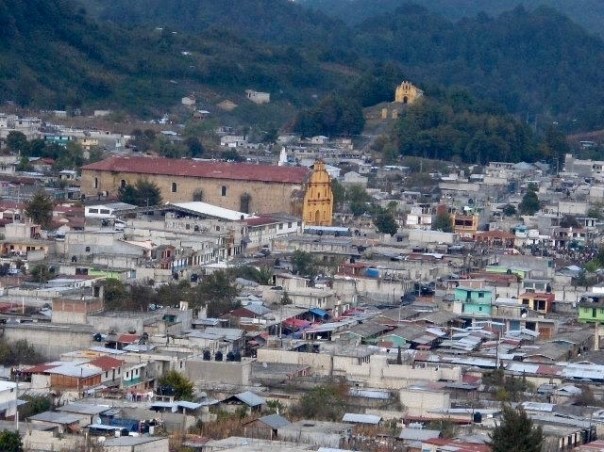
Aerial view of the town of Oxchuc, the capital of Oxchuc municipality, located in the Highlands of Chiapas, Mexico.
By: Isaín Mandujano
With marches, public assemblies, dance, food and sports activities, for two days, thousands of indigenous Oxchuc residents, celebrated the “Day of Civil Resistance” in that municipal capital, to remember that January 8, 2016 on which hundreds of state police attempted to enter the municipal capital but were repelled with a negative result for the police.
During Saturday and Sunday, residents of some 97 communities and the 22 neighborhoods in the municipal capital congregated to remember that pitched battle, which they called a “historic gesture,” that they had with some 700 police that tried to enter the town to subject them.
The town of Oxchuc maintains a civilian resistance against the mayor elected in July 2015, María Gloria Sánchez and that the Electoral Tribunal of the Judicial Power of the Federation (TEPJF) ratified; they accuse her of having won buying votes, manipulating and coercion of the vote during the elections to prolong the political boss system in that municipality that she maintains with her husband Norberto Sántiz.
In a plebiscite residents elected Oscar Gómez López, who although the local government already recognized him, the state government obliges him to install María Gloria Sánchez in his position because of a TEPJF resolution.
January 8, 2016 was marked in the history of Oxchuc, the bravery with which everyone went out in the streets to confront the state police. Minutes before, state police had detained 38 Oxchuc leaders during a negotiating session in San Cristóbal de Las Casas.
When the state police entered, residents burned a dozen buses and patrol cars and provoked more than 50 injuries. The residents also captured 27 state police, among them eight women, as well as the Oxchuc judge for Indigenous Peace and Conciliation, Rogelio Sántiz López, and four of his sons and two little boys.
The Oxchuqueros (residents of Oxchuc) used the captured state police and civilians as hostages to demand the freedom of their 38 leaders. Therefore the state government had to accede immediately to the demand.
Last Saturday and Sunday, Oxchuqueros went into the streets to march, held a huge assembly with representation from the 97 communities and the 22 barrios of the municipal capital. There, they ratified Oscar Gómez López as their mayor-elect through uses and customs.
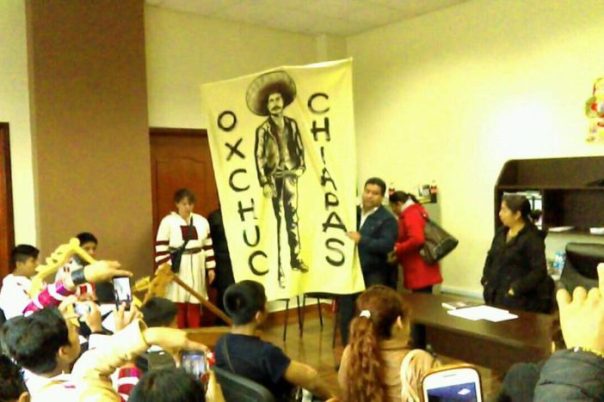
Mayor Oscar Gómez López and his Emiliano Zapata banner.
In an interview, Mayor Oscar Gómez López demanded that the state government and particularly the Treasury Secretary, release the Oxchuc municipal council’s bank accounts, because the situation has already reached a point at which it’s not possible to support some expenses they must make, like paying police, repairing patrol cars and buying gas.
Also, thousands of men, women and children are affected by the lack of ambulances, because these already are lacking or rather there is no longer any fuel for taking out the sick and injured from the more than 100 rural communities.
Gómez López said that the people have made the decision to block that stretch of highway again on January 18, to demand that the state government release the frozen bank accounts; and if they are not released they will block that highway stretch until they are heard. [1]
Blocking Oxchuc is a crisis for the state government because it paralyzes the economy, the movement of tourists and the local population that travels from the Highlands to the Jungle Region and the Northern Zone of Chiapas.
Gómez López said that the people of Oxchuc remain firm in maintaining him as mayor-elect through uses and customs and that in no way will they permit the return of the political bosses María Gloria and Norberto.
[1] Oxchuc residents maintained a roadblock on Wednesday and Thursday (January 18 and 19) to demand that the state government release the city’s bank accounts, because thousands of inhabitants are suffering the consequences of the lack of public resources like water, public services like garbage collection, security and patrolling, and health care and other matters. The state government and the members of the Permanent Commission for Peace and Conciliation, the body that heads the civil resistance movement against the region’s caciques, reached an agreement and they lifted the roadblock. In the evening, after lifting the roadblock, residents of Oxchuc heard shots fired into the air and believe they came from groups that support María Gloria. There is concern about an outbreak of violence in the town and in the municipality. http://www.chiapasparalelo.com/noticias/chiapas/2017/01/temen-enfrentamiento-en-oxchuc/
———————————————————————–
Originally Published in Spanish by Chiapas Paralelo
Sunday, January 8, 2017
http://www.chiapasparalelo.com/noticias/chiapas/2017/01/celebra-oxchuc-dia-de-la-resistencia-civil/
Re-Published with English interpretation by the Chiapas Support Committee
Learning to govern ourselves

Freedom!
By: Gustavo Esteva
The storm rages; cold and hurricane-force winds threaten from the north, which will be accentuated after next Friday, January 20, and a cyclone forms level with the land all over the country. There is nowhere to take shelter.
There are those who seek refuge in the dominant system. They think that doing so is realistic. They consider it romantic or utopian, for example, to openly challenge capitalism. Likewise, although they know that the state apparatuses are falling apart, dragged through the storm, and that the people distrust the parties and the electoral process more all the time, they hang all their hope on 2018. They think that circumstances will finally make it possible for their permanent candidate to win the elections; they are confident that, once in power, he will fix everything fixable.
They saw with disgust the decision of the National Indigenous Congress (CNI) to create a government council that will express itself in the voice of an indigenous woman, who will be an independent candidate in the presidential elections. They circulate new racist and sexist comments to disqualify the decision. They also warn that the decision will divide what is still called “the left” and will benefit the candidates who administer what remains of the government.
Debate has been scarce. Democratic dogmas are launched over rebel heads like projectiles. There is resistance to abandoning the dominant mental framework, although evidence and experiences that it’s not sensible or realistic to take refuge in the remains of the institutional shipwreck multiply.
Along with that dogmatic nonsense, probably unyielding, disagreement and confusion also spread. It’s not easy to escape from the dominant habits. For el CNI, for example, it will not be easy to constitute the government council from below cleanly. Different small groups are already mobilizing to insert their cadres into it. They perceive it as a body with power from which they will be able to impel their agendas, which embrace very diverse points on the ideological spectrum.
The challenge that we confront obviously demands a kind of imagination to which we are not accustomed. It implies, first of all, recognizing that far from escaping from the storm and seeking provisional shelters, it’s necessary to submerge oneself in it. There, from the inside, we will be able to realize that candidates, parties or even the dominant structures form part of our strategic adversary, which we still call “fascism,” and they nourish the “fascist” that we carry inside, hidden in the desire to be governed.
The patriarchal mentality, rooted in the course of millennia, makes it very difficult to conceive the world without hierarchies and structures of control. Upon warning that without them we would fall into chaos, they deny the fact that we are in current disorder because of them; the illusion of governing ourselves through representatives deepens the chaos instead of remedying it: it pushed us to the abyss of violence and decomposition in which we find ourselves.
It’s easy to talk about what we’re dealing with: governing ourselves: that we are capable of managing our own lives, nothing more nothing less. It turns out to be difficult because we are infected with the subordination virus: we allow publicists, business people, bankers, leaders, the Internet and almost anything or anybody to govern us. We believe that it’s freedom and democracy to decide between the choices that the system presents us, between brands of soap or between candidates or parties. And the “fascist” that we carry inside is constituted.
There are places and spaces in which the people have not stopped governing themselves since millenniums ago. We must not idealize them; there one also observes patriarchal impositions and habits of domination. But the practice exists. A certain number of people are still born in contexts in which many aspects of daily life are the fruit of common agreement. In questions of enormous importance to people, heteronomy, regulation by others, can be kept at bay
Although the majority isn’t accustomed to governing themselves, the impulse is profound and general. Nobody needs training to do it. It starts at home, when we create conditions so that the whole family, including small children and elders, may participate in the decisions that affect everyone. It passes from there to the condominium, the street, the district, to all the spheres of the reality in which each one moves.
Examples of how to change the pattern of behavior that makes us desire someone to govern us exist everywhere. In San Cristóbal, for example, a city that was not constructed for automobiles, traffic lights and police govern traffic… with bad results. The “one by one” device in which the drivers themselves govern the crossing of each street has demonstrated the advantages of self-governance.
On that path we are able to discover that the country still has immense reserves of autonomous wisdom. In popular sectors that collective possibility of self-government has been a condition of survival. And if we deal with the storm in that way, practicing our own forms of self-government at all levels, organizing ourselves for that, we will be prepared to do what we have to do inside of 18 months.
———————————————————————–
Originally Published in Spanish by La Jornada
Monday, January 16, 2017
http://www.jornada.unam.mx/2017/01/16/opinion/016a1pol
Re-Published with English interpretation by the Chiapas Support Committee
The Arts and the Sciences in the history of (neo) Zapatismo

Words of Subcomandante Insurgente Galeano
December 28, 2016
Last night I spoke to you about the interplanetary upheaval that had given rise to the question “Why is this flower this color? Why does it have this shape? Why does it have this scent?”
Ok, maybe I was exaggerating with the claim of “interplanetary.” I should have said the upheaval created by the question that young Rosita had put to Subcomandante Insurgente Moisés in the micro-cosmos of Zapatismo had provoked.
Although I believe it is obvious, it doesn’t hurt to mention that the response that SubMoy gave to the young Zapatista woman was the same one that, I’m not sure, but probably, I’m imagining, has fueled the advance of science since its very beginning: “I don’t know.”
Now I think that, certainly, the young woman knew what his response would be, but she also hoped that SubMoy would understand that, within the flower, there was a larger question.
We know now, because we are here in this meeting, that SubMoy knew that the response, “I don’t know” was not only insufficient, but also useless if it did not lead to other questions.
In a few minutes he is going to talk to you about what, as it were, is the context of the question…and about his response.
I am meant to speak to you briefly about the prehistory of this question and this response.
The arts and sciences prior to the Uprising, within the eezeelen, had a very small universe and a brief history. Both the sciences and the arts had a purpose, a direction, and an imposed reason: war.
First in the guerilla encampments, then in the barracks, and later in the communities, the arts were limited to music, poetry, and a little bit of drawing and painting, all with exclusively revolutionary messages. Of course, it was not unusual that soon songs of love and broken hearts, corridos, rancheras and even the occasional Juan Gabriel ballad would appear, but that was only clandestinely within our clandestinity.
Film or cinematography had its exclusive location, its VIP room, in our imagination. One of the insurgents narrated the same film to us over and over again, but he would find a way to change it a little bit each time he told it, or to combine it with the plots of other films. That was how we saw both the original and various “remakes” of “Enter the Dragon,” with Bruce Lee playing the only role, because the compa would spend hours explaining his movements and punches to us. This went on until, with a small electric source and a heavy and cumbersome 16mm projector, we saw a Vietnamese film that I think was called “Point of Contact” or something like that and which, of course, was only in its original language, and so we used our imaginations to add dialogue in Spanish, turning it into a different film than the original. I’m not sure, but I think you call this “artistic intervention.”
I call attention to this because I think that it was the first time that the sciences and the arts came together in a Zapatista encampment. And by the sciences, I’m not referring to the portable generator and the projector, but to the popcorn, which someone had kindly included when they sent the machine and the film.
Of course, we chowed down on the popcorn with the shout of “eat today or die tomorrow.” And the next day we nearly made the slogan come true: beginning in the wee hours of the morning, with collective diarrhea, the entire insurgent battalion abandoned the spot as if a herd of wild boars had taken it over. We consoled ourselves afterward, imaging that it had been a case of bacteriological warfare. Moral of the story: be careful with your slogans.
Contact with the communities broadened this limited horizon: in the celebrations, the compas would set aside time for “the cultural program,” as they called it and “for the party.” And, in a program that got shorter over the years, they recited poetry, read thoughts aloud, and sang songs, all about struggle. Gradually, the duration of “the party” got longer and better. At that time they danced and sang whatever was in fashion at the time. Eventually what we call “pop music,” started to be displaced by music that was produced locally. First, they changed the words of the songs; later they wrote the music as well.
The dances changed: from dancing in two lines facing one another, to dancing in couples. Originally, in the dances in the communities, they used to dance in two lines: one was made up of women, and, in front of them there was another line made up of men. This had its own logic: with a clear line of women, the mothers could control their daughters, and they could see whether they escaped or if they had remained in the continuous repetition of “the Red Ribbon (Moño Colorado).” Later, little by little and after some very heated assemblies, they were allowed to dance in couples, although to the same rhythm. But the existence of the line was deep. It was not uncommon to see a couple dancing, but with her looking to one side and him looking to the other side. Theater, or what we called “sign,” happened very sporadically. The drawings and paintings of the periodic murals of the mountains moved to the communities, but the themes remained the same.
-*-
If it seems like artistic activity was rather sparse, science was practically non-existent (because the book by Isaac Asimov, which the deceased carried in his backpack, doesn’t count as science). For contact with nature, we used the knowledge of the communities, which is to say, we limited ourselves to knowing facts, without knowing the explanation, or we explained those facts according to the stories and legends that circulated in the communities. For example, regarding the rainy season and the times for planting, there was empirical data that indicated whether it was going to rain or not, and this functioned statistically. In the encampments in the mountains, for example, when the mosquitos grew in number and aggressiveness, it meant that it was going to rain. Of course, we also had barometers and altimeters, but the mosquitos were more accurate. If someone had asked us at that time what the relationship was between the mosquitos and the rain, we would have responded, “I don’t know,” but we wouldn’t have gone any further, and what we did know was that it meant that it was time put up the plastic roofs or hurry to arrive at a community or at the encampment, but not time to do scientific research.
The most scientific thing that we did was calculate the force and trajectory of bullets and the resistance of different materials to those bullets (because we had to know how to protect ourselves from the gunshots of the enemy), align the scopes on the guns, fabricate explosives, and we did “terrestrial navigation” with the use of maps, altimeters and inclinometers, for which it was necessary to study the basics of trigonometry, algebra, and calculus. We wanted to learn how to use a sextant in order to orient ourselves at night, but we didn’t really get to learn how to use it. It was no longer necessary because the compas from the communities knew the land so well that we didn’t need any kind of machine to help us to get around. And they could already “predict” natural phenomena based on other phenomena, or on usos y costumbres.
The world was inhabited then by magical people, with the Sombrerón and Xpaquinté walking along the royal roads, trails, and misplaced paths, and sitting with us in the insurgent encampments in the mountains of southeast Mexico.
In medicine we applied two fundamental methods. Since we didn’t know about the existence of curing with quartz, bio-magnetism, or other things of equal scientific rigor, we resorted to the power of suggestion or autosuggestion. Given that it was more than a few times that we didn’t have medicine, if we had a fever, we would repeat over and over: “I don’t have a fever, it’s all in my head.” This might make you laugh, but the deceased Sup Marcos told us that he overcame various cases of salmonella with this method. “And did it work?” we would ask him. He responded with his customary modesty, “Well look at me, I’m alive and more beautiful than ever.” Ok, this was before we made him die.
When we did have medicine, we used the scientific method of “trial and error.” Which is to say that if someone became ill, we gave them one medicine, and if that didn’t work, we tried another, and we went on like that until we got it right or until the illness, surely tiring of our methodology, yielded.
Another scientific method for curing illness was called “the shotgun.” If someone had symptoms of an infection, we gave them a wide spectrum antibiotic. This almost always worked and, of course, chemically purified the patient, with just the bare minimum to survive until the next infection.
Years later, as the deceased would tell it, the medical treatments given were based in a simple statistic: in the mountains, x or y symptoms would be treated with x medicines in x% of cases; if in a given troop of x numbers of combatants, a certain number take ill with certain symptoms, there was x% of probability that they have the same illness.
-*-
An anecdote from the mountains, also told by the deceased Sup Marcos years ago, might serve to contrast with what we are showing you now: the deceased told us that in an exploratory trip into the depths of the Lacandón Jungle, a section of the insurgent infantry was far from the base encampment and found itself obliged to stay overnight with no blankets other than the treetops and the plant leaves; they made a fire to see if they could roast a water moccasin, which was the only thing that they had been able to hunt. At that time, Sup Marcos wasn’t a “sup” but Lieutenant Infantry Sergeant and he was in charge of this military unit.
As was customary at the time, when the night finally fell from the trees and sat among the insurgents, with the shadows descending to also sit alongside the fire, every kind of history, stories and legends which, among other things, fulfilled their role of mitigating hunger and drying clothes of the sweat and the rain that had drenched them. The then-Lieutenant Infantry Sergeant sat apart from the group and was limited himself to listening to what the troops were discussing.
One of the new recruits had rubbed up against, as happens when one walks forgotten paths, the leaves of a plant called La’aj or Ortiga, which had caused hives in one of his hands and it had swelled up. Between hurting and itching, the recruit asked another combatant why this plant, which did so much damage, even existed. The veteran, feeling obliged to educate the new recruit, responded: “Look compa, of course I must inform you that only God and the leaf know why.”
Maybe this story is the reason why the deceased Sup Marcos, when he was the Zapatista spokesperson, told and retold legends, stories, and anecdotes that referred more to explanations of reality that linked to ancestral culture, like, for example, the stories of Old Antonio.
If at that time the deceased was a window to look through onto Zapatismo, and now it is Subcomandante Insurgente Moisés who does this, it is not only that the window has changed, but also what is seen and heard through this window has changed. Zapatismo today in the communities is quantitatively and qualitatively different, not just from what it was 30 years ago, but even from 10 or 12 years ago, which is the period in which the little girl who calls herself “Defensa Zapatista” was born.
With this I want to tell you that if the children that 25-30 years ago were born during the preparation for the uprising and those that were born 15-20 years ago were born in resistance and rebellion; those born in the last 10-15 years were born in a process of consolidated autonomy, with new characteristics, among which is the need for Science. Now Subcomandante Insurgente Moisés, to whom I am ceding the word, will talk to you…
Words of Subcomandante Insurgente Moisés
Good evening brothers and sisters, compañeros, compañeras.
The science that we Zapatistas are discussing here, the kind of science that we want is science for life. I don’t need to further explain what Sub Galeano was saying, about the fact that, yes, we also studied science when we were in the mountains, during the period of preparation. And when we finally applied this science, that is when we went to war, killing and dying, our compañeros and compañeras from the communities, the bases of support, told us that there was another way to make war without losing sight of the principles that we wanted. And so from that moment on something good happened. We, as men and women combatants, recognized that something important exists within our compañeros and compañeras, within the communities. So we started to learn, to understand and to know that to be an army, any kind of army, whether an army of the rich or of the poor who struggle, is to be exclusive, because not all men, women, and children can fight in the army. And our compañeros and compañeras proposed that we fight together in order to achieve what we wanted. And they told us that in order to fight together, the weapon of struggle is resistance and rebellion.
And so then that meant that if we didn’t want the bad government, the bad system, we had to reject all of the forms through which they deceived us, and so we, the combatants, the insurgents, we learned how this was done. We learned how to do this. And so we men and women began to understand how to fight together, how the communities themselves lived and still live today in common, in collective. In the face of that the system, now the bad government, tries to divide the communities, but it hasn’t been able to do so. The communities themselves understood, for example, that even though in some communities there are various political parties, or various religions, they are still a community. And so this community has a piece of their land invaded by another community, this invaded community immediately comes together, which is to say they forget that they are divided in various political parties or religions. And that is how it works where they cannot erase what it means to be in common, to be in community.
And so then we started to understand what they were saying, what our compañero and compañera bases of support were saying to us, which was that we had to fight together. And so it ended up being so much better than what we had imagined because when we did that it meant that not only the combatants fought, everyone did. And so we, the combatants began to work together with the communities and what happened was that in this struggle, in this organization, we began creating the very forms that we were seeking. That is to say that the compañeras and compañeros, began at that time to put into practice that which they were seeking.
And so, with their autonomy, with the autonomous government of our compañeros and compañeras, something began that we had not yet known about during our time of clandestinity, during our preparation. So then we started to understand this, which was a new way of thinking about change, and this is what we have done during these 23 years that we are self-governing with our communities. The truth is that since that time we don’t have as many deaths, or bullets, or as many people injured, tortured, or disappeared as we did at first, in 1994. With these 23 years, what our compañeros and compañeras have shown us is another way to make war on the system, where you don’t die and you don’t kill. But to do this, you need organization, you need agreement, you need work, you need to struggle, and you need practice.
Now we see that with this resistance and rebellion as our weapons of struggle, the system has been unable to do anything against our compañeros and compañeras. The system has not been successful at anything that it has tried to do to us. Why? Because the compañeras and the compañeros already live in what they have for 23 years been constructing. As Sub Galeano put it, we ourselves were surprised, because we had never even dreamt this, but if we didn’t see it, it is because it is the compañeros and the compañeras that have managed to do it, through their thinking, by figuring out what they need and thinking about what to do about it. They have managed to do something to make things better and to take steps for the good of our peoples.
And so now these same compañeras and compañeros can confirm this themselves. And of course their mothers and fathers support them, because they had not seen this before. For example there are compañeras who work as, I’m not sure what you call it, the ones who help the doctors by passing them the tools that they need, like mechanics assistants who are like, here are your clamps, here is your hammer, here is your marro, as they call it. Well the compañeras are now working as assistants to doctors in order to pass them the tools that need while they are doing medical surgeries. They know how to use the ultrasound machines, and because the doctors have taught them how, then can even make diagnoses with these machines. They know how to read the images or the photos that come from the ultrasound machine, and it is the same thing with many other medical devices, which the compañeras and compañeros already know how to use – devices used by dentists, devices for pap smears, and many other things related to the area of health and medical labs.
We never imagined that this would be possible, and now we think back and say, would we have been able to build this with 23 years of bullets? And our response is that with 23 years of bullets we would not be here speaking to you now, brothers, sisters, compañeros, compañeras, scientists. If we had had 23 years of bullets, we would not have even known you. But thanks to their way of seeing, that of our compañeros and compañeras, we are here speaking with you. That is how significant the advances of our compañeros and compañeras were. Of course, we had to separate ourselves from the mode of exploitation, from capitalism, or from the bad government in order to create this freedom that they imagined, that we have achieved, and in order to begin to build our way of understanding it.
And that is how now they have their education, their Agro-ecology, their community radio, their own exchange of experiences. Our compañeras and compañeros have their own “sharing,” because what they want is life. Just like in the example that Sub Galeano gave from the stories shared by the compañeros of how to stop a baby’s death, as explained in one of the questions posed to the scientists about a baby’s placenta –they boil the placenta in water until they manage to stabilize the life of the baby. But this knowledge comes from struggle, because there is no study that shows whether this is the best way to save the baby.
And so there are many generations that have moved this learning forward. This is what Sub Galeano was saying when he was talking about how the flower is to blame, which is that Zapatista Autonomous Education has advanced to such an extent that the young women and men see that they have already learned so much. And so what happened is that the son of one of the compas, one of the Tercios Compas, started to ask questions. He told his father that he had already finished his primary school, his first level as the compañeros in the communities call it. He said to his father, “dad I already finished my school, but I’m going to continue because I want to learn more.” And so the Tercio Compa who is his father responded, son, let me see how you can, because the second level, or secondary school as they call it, is still being planned, because we want to make sure that in the education that we want we don’t learn things that aren’t useful or that we don’t need, and we are still in the process of thinking about what we should learn and what it will be useful for. And so the young man, who was only 13 or 14 years old said: “Dad, don’t think about sending me there to Cideci, because in Cideci all you learn is how to make clothes, make shoes, and other things. It is better for us to do it here in the Caracol, it’s just that we haven’t decided to do that yet.” And so the young man continued, “what I want to learn is what substance is in the estafiate and what it can cure.” And so the compa, he’s over there with his son, wanted me to tell him when and where he could learn this, and so I told him, well, let me see, I don’t know.
And so I was really surprised, which is a good thing. And even I thought, is it even possible to learn this? And so I was talking to Sub Galeano and he said, well, this has to do with the scientists, with science, with those who study science and are scientists. And so what we are seeing is that the generations now and those that are growing up are already seeing the need to know new things. And the good thing is that they are thinking, because the young man that I was telling you about is in the communities that have the “sharing” as we call it, where they talk about the three areas, or where the compañeros and compañeras go to exchange their experiences about medicinal plants, midwifery, and bone-setting, and that is where this young man heard about this estafiate and other plants that they say cure certain things and not others, right? But what they don’t know there is exactly what it is, what substances the plants have that do the curing.
And so the very practices that they have, their very knowledge that the compañeras and the compañeros in the communities have open the way to other experiences, but they simultaneously open up other needs, the desire to learn more, and so on. And so I think that in listening to what is being put forth here among us, maybe then you will come here to put it into practice with the communities, in collective, it would make the compañeros and compañeras really happy to take advantage of this knowledge because with the little bit that they know, they are doing, well…as I told you, that is what they are doing, what the compañeros and compañeras are building others can see, the brothers and sisters who aren’t Zapatistas. That is, for example, in the hospitals that the compañeros have, in the autonomous hospitals, there are more partidista (party member) brothers and sisters who are operated on than there are Zapatistas. And so that is where non-Zapatista people, partidistsas as we call them, see that what the Zapatistas are doing is better. They even say that what the Zapatistas are doing is much better. But it isn’t just that the compañeras and compañeros help them to have somewhat better health, but they also help to orient them, or to do politics, to explain to them why they are being deceived, or why they are manipulated, or why they are dominated.
And so if there had been a little bit more support from science, then there would have been more advances among the compañeros and compañeras. So we wanted to tell you that maybe we really should start this, here and now with our compañeros and compañeras in the communities. We could see if they could have classes, workshops, practical things, because the compañeros see that this stuff is so interesting and necessary in order to confront the capitalist hydra. They see that we have to improve health, and we have to improve nutrition, but for this we need to learn, we need science. The compañeros and compañeras do it, but as we have already said many times, it is through usos y costumbres, or that is to say that they have the proof that if you plant corn you will see that it grows. The same goes for the squash, or the sweet potatoes. You see how they will grow, because there is no scientific study about what is going to grow on this land, or about which plant will grow right here in this location. And living like this has caused a lot of suffering, but if you saw that there is a science, a laboratory for example, then it would be different, it wouldn’t be a question of trying stuff out because there would be a scientific study that could tell us that Mother Earth is missing this or that, or that this thing is what will grow well here, and so on.
And so you see, that is how the compañeras and compañeros do their studies as well, and where what we are here for can be born. The truth is that this thing about the estafiate that the young man was saying that he wanted to know about what the substance was, we also saw there that the other Zapatista Autonomous Schools had other needs so that they could provide what the young people want to learn.
And so, brothers, sisters, compañeros, compañeras, together with the compañeros and compañeros we invite you to join us in making a collective, because we Zapatistas move in collective, and we can later show the people of Mexico that the people themselves can create a way of life. We can show them that we don’t need anyone who manipulates our wealth, or who expropriates what belongs to the people. Rather, we as peoples need to come together – the original peoples with the science of the scientists and the science of the artists. We can show them that together we can imagine or construct, or practice and demonstrate for ourselves what we can do as compañero and compañera bases of support. We can show them that with more and more of your own strength, your own resistance, and your own thinking to see and create, imagine, that even though you may not know how to read and write, and even though you may not speak Spanish very well, but in your deeds you have, as we say here, placed the system, the bad government of Mexico, aside. We are practicing what we think and what we believe, but we feel alone because not only are we indigenous people of Mexico exploited, but the brothers and sisters in the countryside and the city are as well. But for this we need the Sciences, we need a way to build the new world.
We feel the need for this. It is just as the young man was saying, that being a young man he is thinking about what he wants to know, and he wants to know why the substance in the estafiate is so important, because it is much discussed in collective, in the “sharing” that the compañeras and compañeros have. And so this is what we want to propose to you – that perhaps we should unite in order to create another way of seeing, another way of thinking and imagining how we can create change that is more than simply a change in name or in color.
That is what we wanted to share compañeros and compañeras, brothers and sisters.
Subcomandante Insurgente Moisés | Subcomandante Insurgente Galeano
En español: http://enlacezapatista.ezln.org.mx/2016/12/28/las-artes-y-las-ciencias-en-la-historia-del-neo-zapatismo/
 Chiapas Support Committee