Chiapas Support Committee
Home of the Compañero Manuel blog on zapatistas & mexico
EZLN: “The capitalist enemy won’t let the people rule”
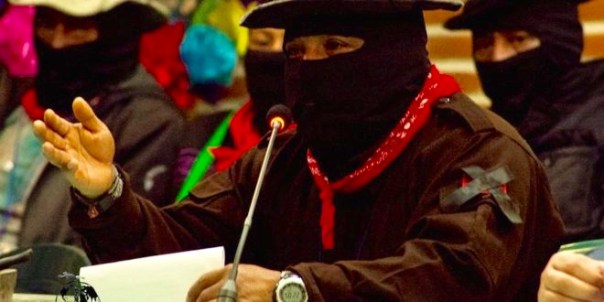
Subcomandante Moisés speaks at the seminar “The Walls of Capital and the cracks on the Left.”
San Cristóbal, Chiapas, April 13, 2017
“Migrants didn’t leave because they wanted to, but rather because they could no longer stay in their finca, better known as a country,” Subcomandante Moisés said this evening, upon reiterating his support to those who have emigrated to the United States, due to the poverty and violence in their place of origin; where they are exploited, repressed and dispossessed just like on a finca 100 years ago. Sup Moisés made these statements on the second day of the seminar “The walls of capital, the cracks on the left,” at Cideci Unitierra, Chiapas.
“One must support those who supported us. Now it falls to us to tell them to fight with resistance and rebellion,” is how Moisés explained the reason they are in solidarity with discriminated and exploited society. They helped us 23 years ago after our Uprising, the Zapatista spokesperson said and reported that they will support migrants in the American union with income from the sale of 3791 kilos of coffee.
The indigenous Zapatista called once again on society to organize because “the capitalist enemy is not going to let the people rule.” “The enemy is not going to negotiate and say, I’m going to half exploit,” the Subcomandante pointed out. “Those below must help each other, to demonstrate that we don’t need those that give conditioned aid,” Moisés added, in reference to the government and the political parties. “One must re-organize, re-educate what we thought was already educated,” he summoned.

For his part, the historian Carlos Aguirre Rojas, with his speech “the Latin American situation, seen from below and to the left,” invited learning what the Zapatistas have taught, which is to look at the world from below and to the left. “We cannot understand XXI Century capitalism without relying on Marx’s theory of value and history,” the academic also added.
How can we look at the above of Latin America, the social researcher began by asking, to which he answered that two elements exist. The first are the States: which can be of the ultra right, like that of Peña Nieto, which are anti-national, surrendered to another, repressive and anti-cultural; or they can be so-called “progressive” States, like in Venezuela, Bolivia or Ecuador, which at first don’t rely on repression, but rather on cooptation, and which despite their discourse are profoundly pro-capitalist, like in the case of López Obrador, he explained.
Another of the questions Aguirre Rojas posed was how the picture of those above is presented, answering with the analogy Subcomandante Moisés made yesterday, in that countries have become like fincas in charge of the international bourgeoisie, which it not interested its domestic market and is anti-nationalist, citing the case of Carlos Slim in Mexico. “The State is part of above, it will always be the enemy,” the historian said, therefore he recommended putting in place a government like that of the Zapatistas that rules by obeying.
The sociologist Arturo Anguiano was also at this evening’s session. He emphasized the vindictive character of the struggle of the peoples against the neoliberal policies of the governments. There are governments that cannot be defined as progressive or left, because they permit mining extractivism and agro-businesses, which set aside the parameters of sustainability and destroy the environment, the social researcher pointed out.
Anguiano asked: What can truly be characterized as left? He indicated that it’s only that which attacks discrimination, dispossession and oppression, in other words finishes with capitalism. “One cannot be more left than the anti-capitalist, someone below, who with the original peoples, campesinos and proletarians fights against power and capital, for true equality, for self-management and for autonomy,” he said.
For tomorrow, Friday, at 4:00 pm, we will have the participation of Paulina Fernández and Magdalena Gómez. Then, at 7:00 pm, Alicia Castellanos, Luis Hernández Navarro and the EZLN’s Sixth Commission will speak, which you can tune in to through the webpage http://enlacezapatista.ezln.org.mx
PHOTOS: Area of Communication Abejas of Acteal and Pozol
AUDIOS: https://radiozapatista.org/
—————————————————————–
Originally Published in Spanish by Pozol Colectivo
Friday, April 14, 2017
Re-Published with English interpretation by the Chiapas Support Committee
https://chiapas-support.org/2017/04/15/ezln-the-capitalist-enemy-wont-let-the-people-rule/
EZLN: “Peña, an overseer at the service of capitalism”

Photo of the EZLN’s Sixth Commission taken in Cideci. Pablo González Casanova is second from left.
The Zapatista National Liberation Army (EZLN) opened its participation in the seminar “The walls of capital and the cracks on the left” in Chiapas, with a “Fuck Trump” in the native languages of the women commanders on the Sixth Commission. “We Zapatistas are like an hourglass,” Subcomandante Galeano shared, since they see the time that has passed to try to understand what’s coming, the Chiapan insurgent added, who also remembered poets like Juan Bañuelos and Pablo Neruda.
How is it that we are now confronting those that exploit us, asked Subcomandante Moisés, who gave a detailed explanation of what the grandparents have told him about how they were exploited and how they organized to liberate themselves. “We were punished until being faint and dizzy,” but as a group they decided to leave the plantations (haciendas), Moisés remembered.
“Capitalism wants to convert the world into fincas. Peña is no longer the one that governs, he is an overseer at the service of capitalism,” Sup Moisés emphasized, and he added that the legislators didn’t approve the federal administration’s so-called structural reforms, but rather “their boss – capitalism.” To the latter, the Mexican, Guatemalan, Costa Rican and Haitian fincas exist to this very day, the insurgent Chiapan exemplified, at the same time that he questioned the indigenous and non indigenous: why do capitalists change how they exploit and we don’t change the way we fight?
In his second talk of the evening Sub Galeano mentioned that the deceased Sub Marcos remembered that former Cuban president, Fidel Castro, when he reproached former President Kennedy in a speech for telling another country what regime to have, which seemed absurd to him. It showed that he had no concept of respect for the sovereignty of peoples. Galeano also said that the same thing is happening now with Donald Trump.
Fidel Castro was the Maradona of international politics, said Sub Galeano, because he will never forgive the goals that the powers scored. “If they couldn’t kill him when he was alive, much less can they now that he’s dead,” the Zapatista spokesperson added. In this first work group the former rector of the UNAM, Don Pablo González Casanova, who will give his presentation on Saturday, April 15, accompanied the Chiapas rebels.
Tomorrow, April 13, starting at 4 pm the seminar will hear from Gilberto López y Rivas, Tom Hansen and Sergio Rodríguez Lascano. Later, at 7 pm, Arturo Anguiano, Carlos Aguirre Rojas and the Sixth Commission of the EZLN will share their word.
You can tune in to live transmissions (in Spanish) through:
http://enlacezapatista.ezln.org.mx/
AUDIOS: http://radiozapatista.org/
http://komanilel.org/2017/04/13/dia-1-los-muros-del-capital-las-grietas-de-la-izquierda/
PHOTO-REPORTING: http://espoirchiapas.blogspot.mx/2017/04/seminario-de-reflexion-critica-los.html
—————————————————————–
Originally Published in Spanish by Pozol Colectivo
Wednesday, April 12, 2017
Re-Published with English interpretation by the Chiapas Support Committee
https://chiapas-support.org/2017/04/13/ezln-pena-an-overseer-at-the-service-of-capitalism/
The Walls of Capital, the Cracks on the Left starts today
The WALLS OF CAPITAL, THE CRACKS ON THE LEFT,” a seminar of critical reflection, starts today
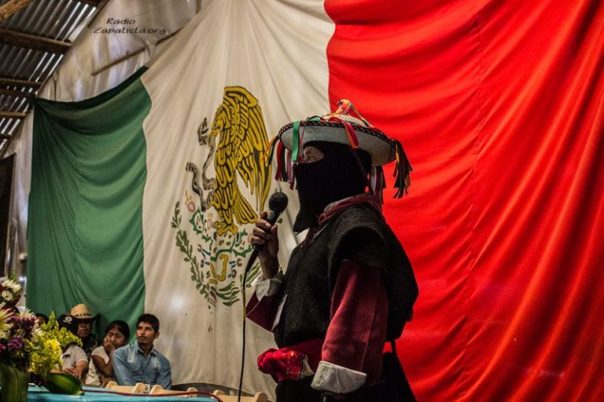
Registration began for “The WALLS OF CAPITAL, THE CRACKS OR THE LEFT,” a seminar of critical reflection started on Tuesday, April 11, 2017 at 10:00 am in the installations of CIDECI-Unitierra in San Cristóbal de las Casas. The gathering takes place within the context of the global campaign: “Faced with the Walls of Capital: resistance, rebellion, solidarity and support from below and to the left,” convoked by the Chiapan rebels, who rose up in arms on January 1, 1994.
The international campaign Facing the Walls of Capital, has the objective of “calling for organization and worldwide resistance, faced with the aggressiveness of big money and its respective overseers on the planet that now terrorize millions of people all over the world,” the indigenous Zapatistas communicated last February 14 on their official web page. “We call to organize with autonomy, to resist and rebel against the persecutions, detentions and deportations. If anyone must go, let it be them, those above,” the Chiapas rebels argued with respect to the mass deportation of migrants on a global scale. “Every human being has the right to a free and dignified existence in the place that seems best to him, and has the right to struggle to stay there,” they added.
“One must organize. One must resist. One must say “NO” to the persecutions, expulsions, prisons, walls and borders. And one must say “NO” to the bad national governments that have been and are accomplices of that policy of terror, destruction and death. Solutions don’t come from above because that’s where the problems are born,” the Zapatistas exposed, in a climate of constant demonstrations of non-conformity that have taken place in Mexico, with the administration of Peña Nieto and Donald Trump, in the American Union.
The speakers at the seminar of critical reflection held at CIDECI-UniTierra, from April 12 to April 15, 2017, will be: Don Pablo González Casanova; Carlos Aguirre Rojas; María de Jesús Patricio Martínez (CNI); Arturo Anguiano; Paulina Fernández C; Sergio Rodríguez Lascano; Alicia Castellanos; Christian Chávez (CNI); Magdalena Gómez; Carlos González (CNI); Gilberto López y Rivas; Luis Hernández Navarro and the EZLN’s Sixth Commission.
——————————————————
Published in Spanish by POZOL COLECTIVO
Monday, April 10, 2017
Re-Published with English interpretation and Updated by the Chiapas Support Committee
Tohono O’odham tribe files petition with IACHR against the wall
THE TOHONO O’ODHAM TRIBE GOES to the IACHR TO NOT BE DIVIDED BY THE BORDER WALL
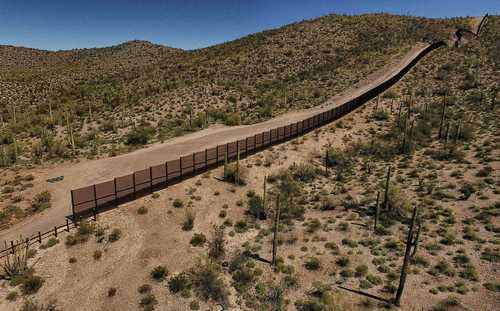
View of metal wall along the border in Sonoyta, Sonora, between the Altar Desert in Mexico and Arizona, in the United States. Photo Afp
By: Roberto Garduño
The Tohono O’odham [1] (people of the desert), who live in territories of Sonora and Arizona, filed a petition with the Inter-American Commission on Human Rights (IACHR) for the purpose of impeding the wall from being built between the United States and Mexico, because “when completed, the construction of a wall on the border dividing both countries would affect the human rights to life, the protection of honor and dignity, family, private property and political rights.”
The petition was presented yesterday in the region of that people, signed by representatives Alicia Chuhuahua and Gemma Guadalupe Martínez Pino.
Among the arguments given to the IACHR, they warn that: “in recent decades the indigenous peoples have started to organize, since they have realized that they have to do something to safeguard and legally protect these lands.
“What is legally named indigenous customary law is not a structured body, much less codified; it’s a series of real practices that are carried out in different ways in different communities, in order to solve a series of problems in the administration of justice, conflict resolution, maintenance of internal order, normativity and their connection with the outside world.”
The Tohono ethnicity argues that the United States has shown evidence that by constructing a wall: “it will divide our indigenous territory; our right to life is not guaranteed, because of which there is a violation of Article 4 of the American Convention (on Human Rights), in connection with the general obligation to respect and guaranty the rights established in Article 1” of that document.
Thus, with the advice from the head of the Commission for Dialogue with the Indigenous Peoples of Mexico, Jaime Martínez Veloz, in the petition to the IACHR it warns of the need to respect the right to dignity, which is manifested in the inviolability of the human condition:
“No State activity can be founded on contempt for human dignity. This implies that the right to dignity is the most important value to respect, nor matter how despicable the crime may be that a person commits, their behavior or their attitudes.
“Therefore, with the construction of a wall that will divide our indigenous people, the dignity of all the members of our tribe would be injured, since it would break apart social relationships among each one of the members of the indigenous people that live in Sonora and Arizona.”
[1] According to the CNI Convocation, the Tohono O’odham tribe is sending one or more representatives to the Constituent Assembly of the Indigenous Government Council, which takes place in Chiapas on May 26, 27 and 28, 2017.
———————————————————–
Originally Published in Spanish by La Jornada
Sunday, April 9, 2017
http://www.jornada.unam.mx/2017/04/09/politica/013n1pol
Re-Published with English interpretation by the Chiapas Support Committee
Joint CNI-EZLN Comunicado denouncing repression in Arantepacua, Michoacán
JOINT COMUNICADO of the CNI and the EZLN DENOUNCING REPRESSION AGAINST the PURÉPECHA COMMUNITY of ARANTEPACUA, MICHOACÁN

To the Purépecha Community of Arantepacua, Michoacán:
To the alternative communications media:
To the peoples of the world:
The National Indigenous Congress, the peoples, nations and tribes that make it up, show our indignation over the bad government’s cowardly attack against the Purépecha community of Arantepacua, Michoacán, on the days of April 4 and 5, 2017.
While a commission of comuneros sought to hold a dialogue with the bad Michoacán state government, Governor Silvano Aureoles Conejo betrayed them. First they obstructed their passage with hundreds of riot police and dozens of buses when they were heading to Morelia to try to reach agreements would resolve an old agrarian conflict. Later, while the commission was negotiating with the government, large contingents of Michoacán Police and State Ministerial Police attacked the community jointly with federal forces, sowing terror, entering homes to arrest the comuneros and opening fire indiscriminately, taking the lives of three Arantepacua comuneros: José Carlos Jiménez Crisótomo (age 25), Luis Gustavo Hernández Cuenete (age 15) and Francisco Jiménez Alejandra (approximately 70).
There were also an unspecified number of injured, two of whom are in grave condition, while the Michoacán government arrested 38 comuneros on April 4 and 18 more on April 5, accusing them of crimes fabricated in order to criminalize the demand for their rights.
Brothers and sisters of Arantepacua, your pain because of the murder of the compañeros is our pain. We struggle because we are certain that punishment of the guilty will emerge from the dignity, resistance and rebellion of our peoples. Sowing truth and justice in the destruction that the powerful bring us is what the peoples know how to do.
The bad governments think that sprinkling terror in the indigenous territories of Michoacán, and in a large part of the national geography, is how they are going to silence the peoples and their word, but that won’t happen because the word that the original peoples shout collectively today is justly born from indignation, from being fed up and from the decision that we won’t kill, plunder, divide or buy off.
We pronounce together with the communal assembly of Arantepacua for:
- That the repressive escalation against Arantepacua and the region’s Purépecha communities cease immediately.
- The immediate release of the compañeros detained by the bad government.
- Justice for the victims of the cowardly aggression and reparation of all damages caused.
- Punishment of Governor Silvano Aureoles and all those responsible, materially and intellectually, for the crimes committed.
- That police and military forces be withdrawn from Arantepacua, because the harassment of comuneros will not stop while they are present.
Attentively,
April 6, 2017
Justice for Arantepacua
Justice for the Purépecha People
For the Full Reconstitution of Our Peoples
Never more A Mexico Without Us
National Indigenous Congress
Zapatista National Liberation Army
Convocation of the Constituent Assembly of the Indigenous Government Council for Mexico
NATIONAL INDIGENOUS CONGRESS
CONVOCATION

Considering that the V National Indigenous Congress (CNI, its initials in Spanish), in its second stage carried out on December 29, 30, 31, 2016 and on January 1, 2017, agreed:
FIRST. – “…To name an Indigenous Government Council with men and women representatives from each one of the peoples, tribes and nations that belong to it; and that this council proposes to govern this country. And that it will have as a spokesperson an indigenous woman from the CNI, who has indigenous blood and knows her culture. In other words, it will have as its spokesperson an indigenous woman from the CNI that will be an independent candidate to the presidency of Mexico in the 2018 elections…”
SEGUNDO. – “…[To call] the original peoples of this country, the collectives of the Sixth, men and women workers, fronts and committees in struggle of the countryside and the cities, the student, intellectual, artistic and scientific community, civil society that is not organized, as well as all good-hearted people to close ranks and go on the offensive. We call on you to dismantle the power of above and to reconstitute ourselves now from below and to the left, not only as peoples but as a country, to come together in a single organization where dignity will be our final word and our first action. We call on all of you to organize with us to stop this war, and to not be afraid to sow our seeds and build ourselves upon the ruins left by capitalism…”
THIRD: “…[to convoke] a constituent assembly of the Indigenous Governing Council for Mexico in the month of May 2017 to make the earth tremble at its core, to overcome fear and recuperate what belongs to humanity, what belongs to the earth, and what belongs to the peoples, to recuperate the territories that have been invaded or destroyed, for the disappeared of this country, for the freedom of all political prisoners, for truth and justice for all of those who have been murdered, for the dignity of the countryside and the city…making dignity the epicenter of a new world.”
We have agreed to convoke the authorities, representatives, delegates, and councilpersons named by the indigenous peoples, nations, tribes, barrios, communities, and organizations that participate in the CNI to celebrate the:
CONSTITUTIVE ASSEMBLY OF THE INDIGENOUS GOVERNING COUNCIL FOR MEXICO
To be held May 26, 27, and 28 of 2017 at the facilities of the Indigenous Center for Integral Learning (CIDECI-UNITIERRA) in San Cristóbal de las Casas, Chiapas, Zapatista territory, in accordance with the following schedule:
P R O G R A M
May 26: 1) Arrival and in-person registration of indigenous councilpersons, authorities, representatives, and delegates, as well as of press and guests invited by the Coordinating Commission of the CNI and 2) Traditional Ceremony.
May 27: 1) Inauguration and installation of the Constitutive Assembly of the Indigenous Governing Council for Mexico. 2) Working groups on the following topics: a) Proposals and strategies for the Indigenous Governing Council, b) Functioning and Organization of the Indigenous Governing Council , c) Links between the Indigenous Governing Council and other sectors of civil society, and d) Naming of the Spokeswoman for the Indigenous Governing Council
May 28: 1) Constitutive Plenary of the Indigenous Governing Council for Mexico and swearing-in ceremony of its members., 2) Discussion and approval of agreements, resolutions, and declarations, and 3) Assembly closing ceremony.
The naming of council members to the Indigenous Governing Council should be carried out according to the guidelines indicated in Appendix I of this Convocation and in the regions documented in Appendix II. Any concerns with regard to the proposed regions or necessary revisions should be communicated to the CNI coordinating committee.
Advance registration of indigenous delegates can be made through the CNI email: catedrajuanchavez@congresonacionalindigena.org. Those who are explicitly invited by the CNI coordination or the EZLN may participate as INVITED OBSERVERS. Members of the national and international Sixth who would like to attend as observers can register beforehand at the email: cni20aniversario@ezln.org.mx
Sincerely,
March 2017
For the full reconstitution of Our Peoples
Never More a Mexico without Us
National Indigenous Congress
Zapatista National Liberation Army
APPENDIX I
_________________________________________________________________
BASIS FOR APPOINTING THE COUNCIL MEMBERS TO THE INDIGENOUS GOVERNING COUNCIL FOR MEXICO IN ACCORDANCE WITH THE AGREEMENTS ADOPTED BY THE FIFTH NATIONAL INDIGENOUS CONGRESS IN ITS FULL ASSEMBLY ON JANUARY 1, 2017.
- The Indigenous Governing Council (CIG, its initials in Spanish) will be made up of two council members, preferably one man and one woman, from each of the participating indigenous regions in the National Indigenous Congress (CNI, its initials in Spanish) as indicated in the following appendix, with the exception of those peoples residing in the metropolitan zones of Mexico City and Guadalajara, who will name one council member from each people.
- The council members will be named through the assembly consensus of their people or in agreement with the traditions and customs of each people, and should be documented in writing.
- Those who are proposed as council members should obey the mandate of the people that named them and that of the CNI assembly, and work collectively under the seven principles of the CNI.
- Those who are proposed as council members should meet the following requirements: Have permanent membership in the CNI ; Practice the seven principles of the CNI; Belong to an original people ; Know the history and culture of their people and hold recognition and moral authority in their community; Be nominated, named, and confirmed in Assembly or in the decision-making body of their people according to its traditions and customs.; Have accompanied their people in struggle and have a congruent trajectory of struggle; they should be people who know how to work the land, who are humble, who listen to and serve their people, who know the path of the CNI and are anticapitalist, from below and to the left.
- The council members’ position will rotate over the time period decided by each people and is immediately revocable by the assembly or the body by which it was named.
- Council members should preferably be named before the CNI assembly programmed for May 27 and 28 in San Cristóbal de las Casas. That assembly will agree upon the organization and functioning of the council members and the CIG.
FOR THE FULL RECONSTITUTION OF OUR PEOPLES
NEVER MORE A MEXICO WITHOUT US
THE PROVISIONAL COORDINATION
APPENDIX II
_________________________________________________________________
LIST OF REGIONS FOR THE INDIGENOUS GOVERNMENT COUNCIL
| Region No.
|
People – Language |
| Baja California | |
| 1 | Cucapá |
| 2 | Kumiai |
| Campeche | |
| 3 | Castellano de Candelaria |
| 4 | Chol de Campeche |
| 5 | Maya de Campeche |
| 6 | Tzeltal de Campeche |
| Chiapas | |
| 7 | Castellano de la Costa de Chiapas |
| 8 | Chol |
| 9 | Mam de Chiapas |
| 10 | Tojolabal |
| 11 | Tzeltal de la Selva Norte |
| 12 | Tzeltal de los Altos de Chiapas |
| 13 | Tzeltal Zona Fronteriza |
| 14 | Tzotzil de los Altos de Chiapas |
| 15 | Tzotzil de la Costa de Chiapas |
| 16 | Tzotzil de la Región Centro de Chiapas |
| 17 | Lacandón |
| 18 | Zoque del Norte de Chiapas |
| Chihuahua | |
| 19 | Rarámuri |
| Ciudad de México | |
| 20 | Nahua del sur del Distrito Federal |
| Colima | |
| 21 | Nahua de Colima |
| Durango | |
| 22 | Wixárika de Durango |
| Guanajuato | |
| 23 | Chichimeca |
| Guerrero | |
| 24 | Afromexicano |
| 25 | Mephaa de la Montaña de Guerrero |
| 26 | Nahua Centro de Guerrero |
| 27 | Nahua Montaña de Guerrero |
| 28 | Amuzgo de Xochistlahuaca |
| 29 | Ñu Savi de la Costa de Guerrero |
| 30 | Ñu Savi de la Montaña de Guerrero |
| Hidalgo | |
| 31 | Nahua de Hidalgo |
| Jalisco | |
| 32 | Coca |
| 33 | Nahua del Sur de Jalisco |
| 34 | Tepehuano de Jalisco |
| 35 | Wixárika de Jalisco |
| Estado de México | |
| 36 | Matlatzinca |
| 37 | Nahua del Centro del Estado de Mexico |
| 38 | Nahua del Oriente del Estado de Mexico |
| 39 | Otomí- Ñatho |
| 40 | Otomí- Ñañhú |
| Michoacán | |
| 41 | Mazahua |
| 42 | Nahua de La Costa de Michoacán |
| 43 | Otomí de Michoacán |
| 44 | Purépecha |
| Morelos | |
| 45 | Nahua de Morelos |
| Nayarit | |
| 46 | Náyeri |
| 47 | Wixárika de Nayarit |
| Oaxaca | |
| 48 | Chinanteco de la Chinantla Alta |
| 49 | Chinanteco de la Chinantla Baja |
| 50 | Cuicateco |
| 51 | Ikoots |
| 52 | Mazateco |
| 53 | Mixe |
| 54 | Ñu Savi de la Costa Chica Oaxaqueña |
| 55 | Ñu Savi de la Mixteca Alta Oaxaqueña |
| 56 | Ñu Savi de la Mixteca Baja Oaxaqueña |
| 57 | Ñu Savi de la Mixteca Media Oaxaqueña |
| 58 | Triqui Alta |
| 59 | Binnizá de la Sierra Norte |
| 60 | Binnizá de la Sierra Sur |
| 61 | Binnizá del Istmo |
| 62 | Binnizá de Valles Centrales |
| 63 | Chontal de Oaxaca |
| 64 | Zoque de Chimalapas |
| Puebla | |
| 65 | Nahua de la Mixteca Poblana |
| 66 | Nahua de la Sierra Norte de Puebla |
| 67 | Nahua de los Volcanes Puebla |
| 68 | Totonaco de La Sierra Norte de Puebla |
| Querétaro | |
| 69 | Otomí- Ñañhú de Amealco y Tolimán |
| Quintana Roo | |
| 70 | Maya de Quintana Roo |
| San Luis Potosí | |
| 71 | Castellano de Wirikuta |
| 72 | Nahua de la Huasteca potosina |
| Sinaloa | |
| 73 | Mayo de Sinalóa |
| Sonora | |
| 74 | Guarijío |
| 75 | Mayo de Sonora |
| 76 | Seri |
| 77 | Tohono Odham |
| 78 | Yaqui |
| Tabasco | |
| 79 | Chol |
| 80 | Chontal de Tabasco |
| 81 | Zoque de Tabasco |
| Veracruz | |
| 82 | Nahua de la Huasteca |
| 83 | Nahua del sur de Veracruz |
| 84 | Nahua de Zongolica |
| 85 | Otomí- Ñuhú |
| 86 | Popoluca |
| 87 | Sayulteco |
| 88 | Tepehua del Norte de Veracruz |
| 89 | Totonaco de la Costa de Veracruz |
| 90 | Totonaco de la Sierra del Totonacapan |
| Yucatán | |
| 91 | Maya de Yucatán |
| Pueblos migrantes | |
| 92 | Pueblos residentes en el Valle de México |
| 93 | Pueblos residentes en Guadalajara |
Zibechi: They assassinate journalists to discipline the media

Miroslava Breach, the La Jornada journalist murdered this month.
By: Raúl Zibechi
They are not, they cannot be, the collateral and undesired effects of the war on drugs. Critical journalists are one of the objectives; not the only one, because the principal target continues to be those below that organize (the organized of below). Assassination is the way that those above, that complex narco-impresario-state alliance, have for disorganizing movements and neutralizing critical journalists and the media (the few) that publish them. I resist seeing it another way, because of the very history of the media.
Until some decades ago, until the 70s or 80s (somewhat arbitrary dates), the section chiefs were the ones who put order into the newsrooms: politics, society, culture, and so forth. The editorial board was a sort of central committee in the daily newspapers and weekly magazines, which were the most distributed media, followed and appreciated by those who wished to inform themselves with a minimum of quality as to analysis and style.
Each section chief was accustomed to meeting with the group of journalists that it was his responsibility to direct, proposing themes to them and listening to any observation, less because power functioned from top to bottom. An old Tupamaro journalist, who worked after the Uruguay dictatorship as editor of the bi-weekly Mate Amargo, used to say –half in jest half seriously– that the “good journalist” was limited to asking “how many lines” he should write (no characters were mentioned then) and, above all, whether the note should be “in favor or against.”
Over the years, with the crisis of hierarchies and, above all, of patriarchies, relationships in the media (at least in the press with which I am familiar), suffered a strong chastising. Fittingly, the editorial board of Brecha is now made up only of women; the director and the four section chiefs are women. And, they are young.
More than change, a true tsunami that would have left the journalists that formed us perplexed. Many of them, like Carlos María Gutiérrez (author of the first interview with Fidel in the Sierra Maestra and founder of Prensa Latina together with Rodolfo Walsh) and Gregorio Selser, who also collaborated in La Jornada, came from and wrote for the mythic Marcha.
Today the newsrooms are very different. The journalists usually take the initiative, propose the themes and define the ways to approach them. They investigate without waiting for their bosses’ approval. They conduct themselves with greater autonomy all the time and, although they can be a minority, they know what they want and the way to get it. Although I did not know her personally, Miroslava Breach must have belonged to that breed and watered at the same well.

An image from the demonstrations in Chiapas protesting the murder of Miroslava Breach reads: My heart will never be quiet!
What I want to say is this: journalists are murdered instead of attacking the media, as was done before; and there are the dozens of newspapers the dictatorships closed, or the attack against El Espectador in Bogotá by Pablo Escobar’s group in 1989, with more than 70 injured. Critical journalists –reporters, photographers, and etcetera– are themselves an objective, as are the leaders of anti-systemic movements.
In the 20 years that the Vietnam War lasted (1955-1975), 79 journalists died (https://knightcenter.utexas.edu/en/blog/reporters-who-covered-vietnam-war-reunite-former-saigon), it having been the armed conflict with the most press coverage in history and one of the most lethal, with the number of deaths that, according to sources, exceeded 4 million. The number contrasts vividly with the more than 120 journalists murdered in Mexico since 2000, in a completely different situation to that of Southeast Asia.
The increase in crimes against journalists forms part of the complete open control that the system realizes, for which it uses the armed apparatus of the State, as well as the narco. The mode of operating has changed radically in the last half century.
Starting with Vietnam, where journalism played a relevant role of informing the population at that time, the doors began to close. Images like that of the naked girl fleeing from napalm bombing, or the film of an official executing an unarmed guerrilla with a shot to the head, contributed decisively to turning public opinion, particularly American public opinion, against the war.
In many senses the Vietnam failure was a parting of waters. That is when the “social policies” were born from the hand of Robert McNamara, who had served as Secretary of Defense during Vietnam and later as president of the World Bank, and who comprehended that wars were not won with weapons. Those policies, so devastating to the autonomy and self-esteem of those below are, as of today, the children of the Yankee military defeat.
Two additional events happened during those same that are worth remembering. One, capitalism counter-attacks the workers’ movement with a complete labor restructuring, in which automation is born in the central countries and the maquila (sweat shop) on the peripheries.
Second, the war against drugs made its first moves against the Black Panther Party in the United States at the end of the 1970s, murdering leaders and developing the so-called “Counterintelligence Program” (COINTELPRO) in order to annihilate an organization that had achieved deep community ties. The FBI flooded black neighborhoods with drugs, as part of the fight against the “insurgency.”
By the way, it’s necessary to remember that United States intelligence services allegedly staged California journalist Gary Webb’s “suicide” in 2004 because of his investigations that placed in evidence the CIA’s connections to the massive selling of crack in black neighborhoods to finance the Pentagon’s illegal wars.
It’s evident that the narco-state-bourgeoisie alliance enjoys good health, being one of the most solid pillars of the regimes called “democracies.” Despite the horror, we must not lose the north: the murders are part of a war against the peoples. They don’t kill them for being journalists, but rather for their commitment to those below.
———————————————————–
Originally Published in Spanish by La Jornada
Friday, March 31, 2017
http://www.jornada.unam.mx/2017/03/31/opinion/018a1pol
Re-published with English interpretation by the Chiapas Support Committee
Mining: the hope of Mexico?

By: Gilberto López y Rivas
Statements from the Mexican Network of those Affected by Mining (Rema, for its initials in Spanish) made to the leader of the Morena Party did not go unnoticed. In an open letter, it rejects Andrés Manuel López Obrador’s proposal to “make commitments in order to achieve greater investment of the Canadian mining companies in Mexico, with fair wages and care of the environment,” which is inscribed in a Decalogue to counteract Donald Trump’s policies.
Rema clarifies that it has no ties to any political party, and that its position obeys the need to express its profound concern before the fact that “the country’s political class continues deaf and dumb to the recurrent denunciations that society, and especially the Rema, have made against the mining companies that work in Mexico and in Latin America. […] Mining is one of the extractive processes that have the largest emission of toxic contaminants into the water, the sediments and the air, and this contamination is practically irreversible. The model is maintained in the spirit of obtaining the greatest possible profit, and is a precursor to the destruction of labor rights, because it was the first to promote-adopt the attack against traditional trade unionism, it raises up and favors the appearance of company unions, to later confront workers in the same mine and, increasingly uses outsourcing more and more as its principal means of contracting workers […] Its interest in promoting Canadian investment leaves much to be desired, not only because the Canadian mining companies concentrate 70% of that industry’s projects in our country, but also because it’s just in Canada where the current predatory extractive mining model was developed […] Canada doesn’t recognize or respect the right of the peoples to prior, free and informed consent, because it’s not a signatory to Convention 169 of the International Labor Organization (ILO) and delayed four years to sign the United Nations Declaration on the Rights of Indigenous Peoples […] there are hundreds of experiences of what we state here. We are not fantasizing; the extractive mining model is predatory and “improving it,” “diminishing it” or “better regulating it” is not enough, since that is impossible. Today, mining extraction is the planet’s most predatory technical and technological system. From our humble contribution to its Decalogue, we tell you that this investment must be banished from the country.” (See the page http://www.remamx.org/).
As has frequently been made evident in La Jornada through opinion articles, editorials and numerous special reports, the mining corporations promise jobs, public services, productive projects and respect for the environment, but it is a fact that historically these companies have left a trail of death, impoverishment, irreversible damage to the environment and health effects, polarization and social division in the communities. Toxic mega-mining is especially injurious and contrary to the spirit and letter of Constitutional Articles 2 and 27, since different secondary laws grant the exploration, exploitation and benefit of minerals the character of “public utility” and “preference” over any other use or of the terrain, and give extraordinary facilities to private parties for accessing the lands that the concessions protect, transforming the ejido owners and comuneros into the unprecedented condition of “surface owners,” outside of every criteria or legal framework. These privileges for corporations, the majority foreign, which already possess concessions for 35% of the national territory, constitute a rupture of the constitutional pact that results from the Mexican Revolution of 1910-1917, and one more proof of the governing clique’s national betrayal.
In the global ambit, empirical data shows that mining companies leave a sequel of millions of tons of removed earth and rocks in extensive operation areas, with the consequent destruction of the habitat and deterioration of the social atmosphere: they contaminate rivers, groundwater, dams and drainage with extremely toxic substances; they monopolize the water; exploit their workers and expose them to conditions with extreme risk; they support anti-democratic regimens–like the one in Mexico–, they even contract gunmen (sicarios) and paramilitary groups to confront their opponents and organize powerful “pressure groups” (called lobbies for the Anglican euphemism) that act in the parliaments, bribing and buying consciences, even of congresspersons of the institutionalized left, so that they support their businesses directly or indirectly in the country. All of that in exchange for the very scarce income that residents of the exploited territories receive (1.3 to 2.9 percent, between rent and subsidies, when they actually receive them), when they get pressured to grant the “permits” through deception, because of the commanding need and the corruption of “leaders” or caciques that lend themselves to serve as the corporations’ native clerks.
The only defense in the face of the mining threat is organization, mobilization and the strengthening of the autonomy of the affected indigenous-campesino communities, and of the social movements that defend popular sovereignty from below. The ignorance and disinformation throughout Mexico, with respect to the multiplicity and severity of the damages that toxic mega-mining implies, be it among campesinos in assemblies, among professionals and academics, among legislators, judges, functionaries and political leaders has very serious consequences for our country and its territories. And one must not expect any kind of defense or protection from the Mexican government, which loses more credibility and dignity with each day that passes. Breaking records as for “opening” to foreign investment, Mexico is perhaps the country in the world where it’s easiest to obtain a concession for this kind of mining exploitation, and its government even grants inclusive favorable credits and numerous other protections to the mining companies.
On this theme, as in many others, it is necessary to listen to the peoples.
———————————————————–
Originally Published in Spanish by La Jornada
Friday, February 24, 2017
http://www.jornada.unam.mx/2017/02/24/opinion/020a1pol
Re-Published with English interpretation by the Chiapas Support Committee
IACHR finds the State responsible for death of Tzeltal
 By: José Antonio Román
The Inter-American Commission on Human Rights (IACHR) concluded that the Mexican State is responsible for violating the right to life of the Tzeltal Gilberto Jiménez Hernández, executed at the hands of members of the Army in Altamirano, Chiapas, on February 20, 1995, inside the so- called Chiapas 94 Campaign Plan, with which it sought to retake the territory in which the Zapatista National Liberation Army (Ejército Zapatista de Liberación Nacional, EZLN) had operated.
The IACHR points out that after 22 years the Mexican State has not complied with any of the recommendations issued to repair the damage and to guaranty that the acts are not repeated. They also committed offenses and crimes against relatives of the victim and the villagers.
The acts occurred in the La Grandeza ejido in Altamirano municipality, when Army officials extra-judicially executed Jiménez Hernández while he was fleeing with his family and some 70 other residents. There were allegedly investigations in ordinary federal and state agencies, as well as military, but impunity prevailed.
The State’s version is that his death resulted from a confrontation between members of the EZLN, the group to which the victim belonged, and members of the Army.
These acts occurred after February 9, 1995, when then President Ernesto Zedillo launched the Army against the EZLN, betraying his offer of dialogue. That same day, the Attorney General of the Republic announced that members of the Zapatista leadership had been accused of the use of weapons for the Army’s exclusive use and also terrorism.
According to the testimonies of villagers, the soldiers “opened continuous fire” against the people that had taken shelter in an improvised encampment on the hill after being warned that the soldiers were coming. They also said that the Army destroyed the interior of the houses in the empty community.
The villagers fled after the shooting on February 20. Gilberto Jiménez attempted to hide, but he couldn’t because he was carrying his 2-year old daughter “tied to his back with a shawl.” Abner García Torres, a soldier, found him and in Spanish ordered him to stop.
Gilberto obeyed and was extended on the ground, but the soldier, “without any warning or motive, shot him without considering that he was carrying his daughter on his back.” One of the bullets penetrated his right eye and caused his immediate death. His wife and several of his ten children with whom he was fleeing were witnesses to the execution.
———————————————————–
Originally Published in Spanish by La Jornada
Tuesday, March 21, 2017
http://www.jornada.unam.mx/2017/03/21/politica/005n3pol
Re-Published with English interpretation by the Chiapas Support Committee
EZLN: The first of several
ZAPATISTA NATIONAL LIBERATION ARMY
MEXICO

March 2017
To the Sixth in the world:
Compas:
Because we had told you that we were going to see the way of supporting you so that, at the same time, you will support the resistance and rebellion of those who are persecuted and separated by walls, well we now have a small advance.
The first ton of Café Zapatista (Zapatista Coffee) is now ready for the campaign “Facing the walls of Capital: resistance, rebellion, solidarity and support from below and to the left.”
It’s 100 % Zapatista coffee. Cultivated on Zapatista lands by Zapatista hands; harvested by Zapatistas; dried under Zapatista sun; ground in a Zapatista machine; the Zapatista mill was out of order due to the Zapatistas’ fault; the Zapatistas fixed it (it was non-Zapatista part); later packaged by Zapatistas, labeled by Zapatistas and transported by Zapatistas.
This first ton was achieved with participation from the 5 Caracoles, with their Good Government Juntas, their MAREZ and the communities’ collectives, and it is already found in the CIDECI-UniTierra in San Cristóbal de Las Casas, Chiapas, rebel Mexico.
This Zapatista coffee has the best taste if you drink it struggling. We place a small video here that the Tercios Compas made where you can see the process: from the coffee field, to the warehouse.
We are now classifying and packing the works with which the Zapatistas participated in the first CompArte, which we will also send to support your activities.
We hope that we will be able to deliver (the coffee) at the April event so that it can move to the different corners of the world where the Sexta is, in other words, where there is resistance and rebellion.
We hope that with this first support you are able to initiate or continue your work in support of all the persecuted and discriminated of the world.
Perhaps you will ask yourself how the coffee will arrive in your corners. Well in the same way in which it was produced, in other words, being organized.
In other words we’re asking that you organize not only for that, but also and above all for making activities to support all the people that today are persecuted simply because of a skin color, a culture, a belief, an origin, a history, or a life.
And it’s not all for now: always remember that one must resist, one must rebel, one must struggle and one must organize.
Oh, and we ask how you say what we want to say, but in a way that you will understand it:
¡Fuck Trump! (And at the same time also all the others that is Peña Nieto, Macri, Temer, Rajoy, Putin, Merkel, May, Le Pen, Berlusconi, Jinping, Netanyahu, al-Assad, and you can add in there whatever it’s called or will be called the wall that must be brought down in a way that all of the walls receive the message).
(That is to say that it’s the first of several tons and the first of several mentions –that are not minty).
From the mountains of the Mexican Southeast,
Subcomandante Insurgente Moisés | Subcomandante Insurgente Galeano.
Mexico, March 2017
A video by the Tercios Compas accompanies this comunicado with the song “Somos sur,” (“We are the South), words and music of Ana Tijoux, accompanied by Shadia Mansour. It can be found, along with photos of the coffee coops, at:
http://enlacezapatista.ezln.org.mx/2017/03/16/la-primera-de-varias/
 Chiapas Support Committee