Chiapas Support Committee
Home of the Compañero Manuel blog on zapatistas & mexico
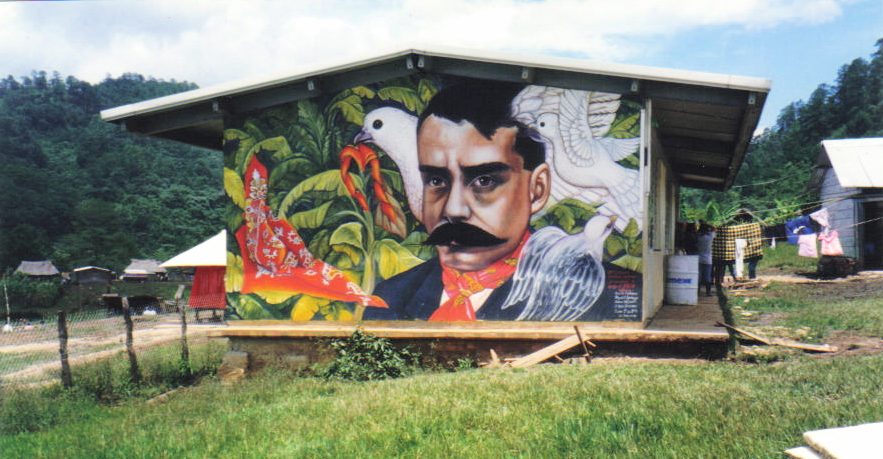
Indigenous Women: an expanding view
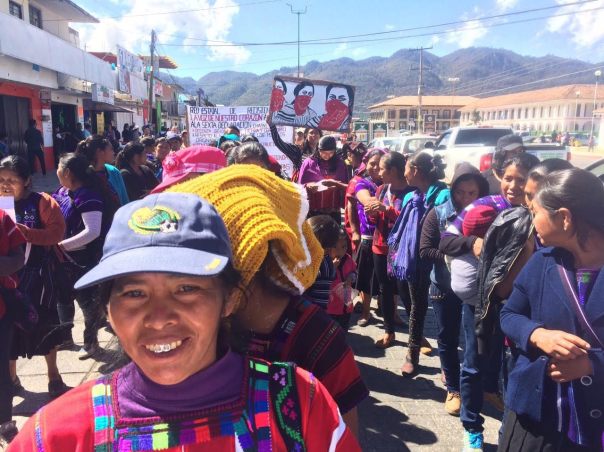
Chiapas Women march in San Cristóbal and Tuxtla Gutiérrez on International Women’s Day. Photo from proceso.com
By: Magdalena Gómez
March 8 is International Women’s Day. In the case of Indigenous women, as of today, the complexity is not fully realized that their belonging to a people and the dimension of gender involve. In the last 20 years, indigenous women, immersed in the dynamic of the indigenous peoples’ political movement, have constructed new spaces favorable to the vindication of their own demands as women. Many of them are similar to the generic demands of all women, but others question, from inside of their peoples, certain conceptions and practices endorsed by so-called custom.
A good example of this process is the document that was presented to the National Indigenous Congress for the purpose of its creation, in October 1996. In the first place, they again took up the spaces won during the discussion at the dialogue table between the Zapatista National Liberation Army (EZLN, its initials in Spanish) and the federal government, because of that it was noted that the women’s law and the need for parity among men and women were recognized at the negotiating table for the San Andrés Accords; however, the mechanisms for implementing them and for making that law effective were not agreed upon.
It emphasized that there is no doubt that the indigenous woman fulfills a productive and symbolic role equally important as the man’s. Nevertheless, women are generally excluded from public decisions and have fewer rights than men. At the same time, it clarified that indigenous women set forth their demands and vindicate their rights, not to go against their culture or their group, but rather to think about the customs from a perspective that includes them and does not do violence to them. With respect to that, they concluded: “therefore we say together with other organized indigenous sisters that insistently advocate for changing the customs that we want to open a new path for thinking about customs from another view, which does not do violence to our rights as persons and that gives dignity and respect to indigenous women. We always want to change the customs that don’t affect our dignity.” They insisted on denouncing the triple oppression that indigenous women experience, because of being poor, being indigenous and being women.
The perspective of their political rights was already glimpsed when they supported the recognition of autonomy for Indian peoples, with the guaranty of parity to women I all representative bodies. They added themselves to the questioning the counter-reform to Constitutional Article 27 demanding it be modified so that women have the right to land, together with the right of all indigenous peoples. In this 1996 document we are able to appreciate that the demands are formulated directly, even if an image of embroidering is profiled about the inter-relation between their belonging to the indigenous peoples and in some way their vindication of participation in the political process with the situation that they live inside of those collectivities as women.
Today the indigenous women’s movement has expanded and diversified its agendas. In relation to their political rights some, very few, have participated in local and federal deputations or in the municipios through the political parties or in the case of de Oaxaca through election by uses and customs. Those individual trajectories are added to the generic agenda of the political parties and they seek to introduce some similar demand. We find an example of this tendency in the case of a Zapotec woman Eufrosina Cruz, who expressed: “let’s go grabbing more; what I have understood in my experience is that if you don’t grab for something, then you’re not going to get it; sensitivity is needed in public spaces in every rubric of decision-making, backwardness is in all sectors.” (Milenio, 5/3/17)
The National Indigenous Congress (CNI, its initials in Spanish) with the EZLN’s support set this profile of electoral political participation with the postulation of an indigenous woman as an independent candidate to the Presidency of the Republic, and without a doubt it will mark a significant turn. We’re talking about a radical change that an indigenous woman will head; it is in and of itself an affirmative action, which entails a rupture with the patriarchal hegemony of the political elites. The other element that constitutes an authentic parting of waters is that this indigenous woman will bring with her an anti-capitalist program, which marks a rupture with the profile of the electoral agendas underway.
From this perspective, what the CNI pointed out last January 1 makes sense: “we want to shake the conscience of the nation, which in effect means that we seek that indignation, resistance and rebellion figure on the 2018 electoral ballots, but it’s not our intention to compete in any way with the parties and all the political class that still owes us a lot… Don’t let us confuse you, we don’t seek to compete with them, because we are not the same.”
Such is the challenge.
————————————————
Originally Published in Spanish by La Jornada
Tuesday, March 7, 2017
http://www.jornada.unam.mx/2017/03/07/opinion/017a2pol
Re-Published with English interpretation by the Chiapas Support Committee
Absalón Castellanos dies; EZLN put him on trial in 1994

EZLN delivers ex governor Absalón Castellanos in 1994.
By: Isaín Mandujano
The former Chiapas governor, Absalón Castellanos Domínguez, who the Zapatista National Liberation Army put on trial in 1994, died this afternoon at 93.
His grandson with the same name, Absalón Castellanos Rodríguez, announced the death of the general, born in Comitán de Domínguez, in social networks: “May you rest, Grandfather! You are now with God… October 2, 1923 – March 10m 2017 (93 years) A great man in every sense and a proud Mexican, descendent of Belisario Domínguez, Proudly Chiapaneco!”
After graduating from the Heroic Military College in June 1942, the ex governor served as the commander of the body of cadets of the First Mixed Weapons Support Group of the Corps of Presidential Guards.
He was the director of the Military School of “Mariano Escobedo” Classes, commander of the 18th. Military Zone and the 2nd Infantry Zone, as well as of Military Camp No. 1, and also director of the Heroic Military College, inspector general of the Army and commander of the 31st and 13th Military Zones.
He governed the state of Chiapas (1982-1988) with a heavy hand, which was also distinguished by land invasion and the constant repression of the protests of campesino and indigenous groups.
In response, on January 1, 1994, behind he EZLN’s armed uprising, the masked ones surprised him at his Momón ranch in the municipio of Las Margaritas. A group with now Subcomandante Insurgente Moisés in command took him prisoner and led him to the heart of the Lacandón Jungle to be tried. [1]
He was delivered to Bishop Samuel Ruiz García with whom he always had political friction.
After the gestures of peace negotiator Manuel Camacho Solís and then Bishop Samuel Ruiz García, the EZLN’s Indigenous Revolutionary Clandestine Committee-General Command (CCRI-CG) ordered the retired general’s release.
“For the purpose of favoring the prompt start of the dialogue for peace with dignity that all Mexicans desire and as a signal of our EZLN’s sincere disposition, we communicate to you that on Wednesday, February 16, 1994 division general Absalón Castellanos Domínguez will be set free,” the Zapatistas said at that time.
Division General Absalón Castellanos Domínguez was delivered to Peace and Mediation commissioners Manuel Camacho Solís and Samuel Ruiz García, in Guadalupe Tepeyac, municipio of Las Margaritas. After his liberation, medical personnel from the International Committee of the Red Cross checked his health condition.
The Zapatistas argued that they had decided to set him free “for the purpose of favoring the easing of tension in the conflict zone during the realization of the dialogue for peace with dignity.”Durante that delivery, the EZLN announced the general was a “prisoner of war,” accused of different crimes against the indigenous population of Chiapas and a “popular trial” for what happened.
Castellanos Domínguez was accused of edging the indigenous population of Chiapas towards rising up in arms against injustices because he closed off every legal and peaceful path for their just demands during the time in which he was governor of Chiapas.
“Division General Absalón Castellanos Domínguez was found guilty of, in complicity with the federal government during the time of his state mandate, having obliged indigenous Chiapanecos to rise up in arms by closing off every possibility to them of a peaceful solution to their problems. Patrocinio González Blanco Garrido and Elmar Setzer Marseille, who succeeded him as governors of Chiapas and who continued edging our peoples towards this path, with the complicity of the respective federal governments, are accomplices of division general Absalón Castellanos Domínguez in the commission of this crime,” the Zapatistas pointed out.
Before, during and after the time in which he discharged his duties as governor of Chiapas, he was accused of repressing, kidnapping, incarcerating, torturing, raping and murdering members of the Chiapas indigenous populations that fought legally and peacefully for their just rights.
He was also accused of dispossessing indigenous Chiapas campesinos of their lands, in complicity with the federal government, “and in this way having become one of the most powerful landholders in the state of Chiapas,” the Zapatista Justice Tribunal emphasized at that time.
After deliberating and analyzing all the accusations against the ex governor and his guilt having been demonstrated, his verdict was issued and his sentence decided:
“Division General Absalón Castellanos Domínguez was condemned to life sentence doing manual labor in an indigenous community of Chiapas and in this way earning the bread and means necessary for his subsistence.”
Afterwards it resolved: “As a message to the people of Mexico and to the peoples and governments of the world, the Zapatista Justice Tribunal of the EZLN commutes the life sentence of division general Absalón Castellanos Domínguez, it sets him physically free and, instead, condemns him to living the rest of his days with the sentence and shame of having received forgiveness and kindness from those who he humiliated, kidnapped, dispossessed, robbed and murdered for so long.”
The Zapatista Justice Tribunal turned that resolution over to the EZLN’s Indigenous Revolutionary Clandestine Committee-General Command, so that they would take the necessary and pertinent measures for the fulfillment of the resolution.
At the same time, it recommended that the federal government should propose the exchange of division general Absalón Castellanos Domínguez for all the Zapatista combatants and civilians that federal troops unjustly took as prisoners during the 12 days that the fighting lasted in 1994.
It was also suggested exchanging the military man for food supplies and other means that would alleviate the grave situation of the civilian population in the territories under control of the EZLN.
After his release, the general lived for 23 years on a ranch near Tuxtla Gutiérrez. He never accepted talking to the media and journalists to give his version of that trial.
Translator’s Note:
[1] In 2001, when the Zapatistas arrived in Mexico City at the end of the March of the Color of the Earth, journalists noticed Comandante Tacho wearing a Cartier watch, and speculated that it was the watch the former governor said was taken from him while he was held as a prisoner of war. The Zapatistas have never commented about this!
——————————————————————
Originally Published in Spanish by Chiapas Paralelo
Friday, March 10, 2017
Re-Published with English interpretation by the Chiapas Support Committee
The transition blossoms, although we may not see it

Autonomous Zapatista cooperatives produce hand-woven artistry for the local market. Photo by Carolina Dutton.
By: Raúl Zibechi
We are transitioning towards a new, post-capitalist world. In the measure that it is a process we are experiencing, we don’t have sufficient distance to know which period we’re in, but everything indicates that we’re crossing through the initial phases of said transition. Although it has deep similarities to previous ones (transitions from antiquity to feudalism and from feudalism to capitalism), a remarkable fact is the inability to comprehend what’s happening before our very eyes: a true process of the collective construction of new worlds.
In emancipatory thinking and especially in Marxism, the idea that all transition begins with the taking of power at the nation-State level has been converted into common sense. This assertion should have been re-thought after the Soviet and Chinese failures, but above all since the demolition of the states by neoliberalism, in other words by financial capital and the fourth world war underway. It’s certain, however, that power must be taken in order to move towards a non-capitalist world power, but why at the State level, why at an institutional level?
This is one of the essences of the problem and an enormous conceptual difficulty in being able to visualize the transitions that really exist. The second difficulty, tied to the former, is that transitions are not homogenous, and don’t involve all of the social body in the same way. History teaches us that they usually begin on the peripheries of the world-system of each nation, in remote rural areas and in small towns, in the weak links of the system, where they collect force and then expand to the centers of power.
On the other hand, transitions not only are not uniform from the geographic point of view, but also the social, since they are processes guided by human need and not by ideologies. Those who first construct other worlds are usually the peoples that inhabit the basement, Indians, blacks and mestizos; the popular sectors, women and youth are usually the principal protagonists.
I want to give an example of something that is happening right now, since it has a degree of important development and that can hardly be reversed, except with genocide. I refer to the experience of the Unemployed Workers Union (Unión de Trabajadores Desocupados, UTD) in General Mosconi, in northern Argentina. The city has 22,000 inhabitants that worked at the state oil company YPF until its privatization in the 1990s, which left a lot of people unemployed. In those years a strong movement of unemployed workers, known as piqueteros, took off and forced social plans out of successive governments.
During the cycle of piquetero struggles, the UTD was one of the principal referents in the whole country and the other movements enthusiastically followed its memorable roadblocks. The UTD and its leaders enjoyed strong prestige, which carried over to hundreds of cases before the courts because of the roadblocks and other “crimes;” they were the most popular ones in Argentina.
Things changed very quickly. The arrival of Nestor Kirchner to the presidency in 2003, and the retraction of the movements, took the UTD out of the media scenario and away from the attention of the social militants. News about what’s happening in far away northern Argentina is as scarce as nebulous.
Nevertheless, the UTD took advantage of the social plans (now cut by Macri) to construct a new world. At this time 110 agro-ecological vegetable gardens function, of two hectares each, where an average of 30 people work and produce a large variety of vegetables, besides a chicken coop and pigs in each garden. They have a carpentry workshop that is nourished from the zone’s abundant wood, workshops for soldering, classification of seeds and recycling of plastics in the five large structures the movement has, as one can read in the reporting of Claudia Acuña in the magazine MU (July 2016).
They built nurseries that reproduce native flora with which they supply from the town squares to the woods, those threatened by the dizzying expansion of transgenic soy and woodcutters. They dedicate part of their work to sustaining public spaces in the city and in the surrounding forests, a region where drug trafficking is increasing under state-police protection and complicity.
A simple calculation shows that from 4 to 5 thousand people make their living in relation to the collective work the UTD organizes, which is equivalent to 40 percent of Mosconi’s active population. Those families forged food autonomy, they no longer depend on social plans, and they are aiming from the production of food to the construction of housing, in other words they are reproducing life outside the framework of the system, without relating to capital or depending on the State. In sum, they work with dignity.
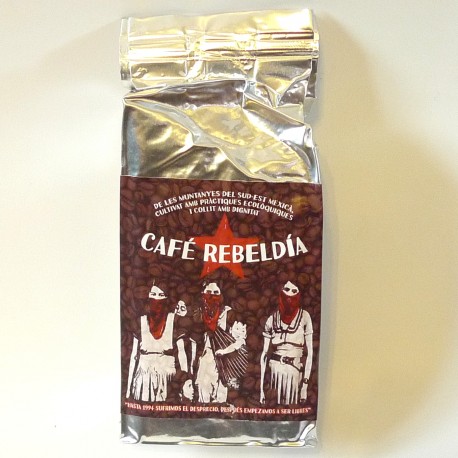
Zapatista coffee cooperatives produce coffee that is sold in Chiapas, in Mexico and internationally.
It will be said that it’s just a local experience. But the gardens and the UTD’s ways of doing things are already expanding to neighboring Tartagal, which has triple the population. Many thousands of undertakings of this kind in Latin America, because the popular sectors comprehended that the system doesn’t need them or protect them, as happened during the brief years of the welfare states. There is an implicit strategy in this group of new worlds that does not pass through nation-states, but rather through strengthening and expanding each initiative, in sharpening the anti-systemic and anti-patriarchal traits, and in strengthening resistances.
A stroke of maturity of a good part of these new worlds consists of maintaining distance from the political party and state institutions, although they can always demand support and glean resources with one eye set on guarantying survival and the other on maintaining independence.
In the long transition underway, impossible to know whether it will be decades or centuries, the new worlds are facing one of the system’s most powerful offensives. What they have achieved up to now permits us to breathe a serene optimism.
———————————————————–
Originally Published in Spanish by La Jornada
Friday, March 3, 2017
http://www.jornada.unam.mx/2017/03/03/opinion/020a1pol
Re-Published with English interpretation by the Chiapas Support Committee
Tarahumaras faced with violence from organized crime seek asylum in US

Children in the Sierra Tarahumara. Photo: Eduardo Miranda
By: Patricia Mayorga
CHIHUAHUA, Chih. (apro). – The Rarámuri, Santiago Cruz Castillo, 26, requested political asylum in El Paso, Texas, after organized crime took away his lands in La Laguna de Aboreachi, municipality of Guachochi, like hundreds of indigenous and mestizos of the Sierra Tarahumara.
Another family from the La Trinidad ejido, in Guadalupe y Calvo municipality arrived before Santiago Cruz to request asylum. After five months, they are still holding David Ríos Laija, one of the members of that family, in custody.
Santiago Cruz arrived alone; he is single and his parents stayed in the Sierra. “I arrived in the United States on November 24 because of the violence that exists in the communities. Many people have gone away because they started to take the land away through criminal activity, through violence; they kill and disappear us and no one gives us protection. We have to leave.”
The young Tarahumara says that they snatched their small parcels of land and their houses to plant poppies and marijuana.
He opted to travel to Juárez, they invited him, they contracted with him and they took him to that border. He worked on a ranch close to Ciudad Juárez, but they were paying him very little and he worked a lot and he became discouraged. “I wasn’t comfortable, I worked long hours, they paid very little and I wasn’t treated well.”
On November 24 he decided to cross into the United States, he was in the detention center and afterwards made contact with the expert immigration lawyer, Carlos Spector, who took his case and is in the process of requesting political asylum.
Santiago Cruz’ wish is to help his people from there, because he is convinced that he can denounce the situation and is confident that the authorities will do something.
“I want to help my people, so that the government will let them work, I want to help from here. The truth is that the violence is strong, I know how it is, don’t tell me,” he insists.
Carlos Spector said that six months ago the Rios family arrived from Guadalupe y Calvo, after an armed group disappeared the father, who was the community’s commissioner.
“The widow Aureliana Leija and her two sons came in September. David Ríos Leija, 22, is a student of Medicine; they are Christians, it is a clean family and they are mestizos. The other son that came is Elías Ríos, 19.
“They fled due to the father’s political situation, they began to seek it and they (the criminals) tell him that they will leave him in peace, that they won’t look for him and they leave seeking asylum. That is part of the press communication, they let the mother go later, Elías 2 months after the credible fear test,” the lawyer detailed.
Nevertheless, David is still detained and Spector denounced that they don’t want to release him despite the fact that he already passed the credible fear test, because the criteria hardened with the Donald Trump government.
“It’s a case of immigration abuse. There exists a bi-national policy of persecution and the incarceration of poor Mexicans, human rights defenders or people that complain and ask for asylum. They incarcerate them or separate them from their family. After being detained for 5 months, there is no possibility of closing the case quickly; that’s the point of prolonged detention. It’s a political kidnapping to discourage strong political asylum cases,” Carlos Spector said.
The lawyer said that in theBarack Obama government and in other administrations, when they ask for political asylum like is done at the international bridge, they would detain them for two months until they passed the credible fear test and then release them if they showed that they didn’t represent threats to the community and if they guarantied that they would attend all the hearings.
Before, he said, the local “Migra” signed the conditional release, the conditional freedom, but now they decided that the national assistant director of immigration in Washington must approve those requesting political asylum to be released.
“It’s a democratic way to not grant asylum to anyone. That is the new policy and a formula for repression and mass deportation, applying the law in an extremely rigid and repressive way. The family wants to leave because the young man wants to leave, but he has to appear in court on March 8. Now they have undertaken a campaign to free him.”
This Monday, Spector announced, they have an appointment with the archbishop for the area, who has spoken out against the criminalization of political asylum.
The lawyer announced that the authorities are going to build more detention centers because soon the people aren’t going to fit in those that exist and he reproached that when people ask for political asylum at the bridge, they are entering legally, in accordance with the laws of the United States and with international laws, therefore he reproached the repressive measures, which he compared to those for the Japanese.
Spector reported that Santiago Cruz is the first Rarámuri to request political asylum, but there are another 300 Tarahumaras that are in prisons in the Southwestern United States, without defense because they don’t have translators.
Saúl Bustamante has finally helped them. He is mestizo and was raised in a cave in the Tarahumara by an indigenous family, because of which he is a firm defender of his people and principally of those who don’t have access to justice. He has organized events to promote Tarahumara culture in El Paso, like (running) races, and hopes to achieve the freedom or the just defense of indigenous Chihuahuans.
————————————————————-
Originally Published in Spanish by Proceso.com
Friday, February 24, 2017
http://www.proceso.com.mx/475704/tarahumaras-piden-asilo-en-eu-ante-la-violencia-crimen-organizado
Re-Published with English interpretation by the Chiapas Support Committee
The Cat-Dog and the Apocalypse

Marcos speaks in the Mexico City Zócalo in 2001.
Science fiction.
Remember that: science fiction. You’ll see that, in your coming nightmares, it will help you to not become so distressed, or at least not uselessly distressed.
Perhaps you remember some science fiction movie. Perhaps science fiction set some of you down the path of scientific science.
It didn’t do that for me, perhaps because my favorite science fiction movie is La Nave de los Monstruos i with the unforgettable Eulalio González, known as “el Piporro,” the soundtrack for which has been unjustly excluded from the Oscars, the Golden Globes, and the local and renowned “Clay Pozol Bowl.” ii Perhaps you’ve heard talk of the movie: it’s a “cult” film, according to one of those specialized magazines that nobody reads, not even the people who edit it. If you remember the film and/or you see it, you’ll doubtless understand why I ended up lost in the mountains of the Mexican Southeast and not in the suffocating bureaucratic web that, at least in Mexico, chokes scientific investigation.
You’ll also cheer the fact that that movie is my point of reference for science fiction, instead of 2001: A Space Odyssey by Kubrick, or Alien by Ridley Scott (with Lieutenant Ripley breaking with Charlton Heston’s blueprint of the macho survivor in “Planet of the Apes”), or Blade Runner, also by Ridley, where the question “Do androids dream of electric sheep?” is the nodal point.
So you should thank Piporro and his “Star of Desire”iii and the robot Tor in love with a jukebox iv for the fact that that I’m not on their side in this encounter.
Anyway, cinephile philias (film buffs?) aside, let’s suppose an average film of the genre: an apocalypse in progress or in the past; all of humanity in danger; first an audacious and intrepid man as the protagonist; then, from the hand of innocuous feminism, a woman, also audacious and intrepid; a group of scientists is convoked to a super secret facility (invariably of course located in the United States); a high-ranking military official explains to them: they must create a plan to save humanity; they do so, but it turns out that in the end, they need an individual hero or heroine who, as the story goes, annuls the collective work and at the last second, with a pair of pliers that appeared inexplicably, cuts the green or blue or white or black or red cable at random, and ta-da, humanity is saved; the group of scientists applauds like crazy; the young man or woman finds true love; the respectable public vacates the theater while the free-loaders check the seats to see if anyone left any half-finished cartons of popcorn, with that delicious and unbeatable taste of sodium benzoate.
The catastrophe has a variety of origins: a meteorite has changed course with the same constancy as a politician making declarations about the gas hikes; or a tornado of sharks; or a planet spinning off its course; or an irritated sun sending one of those igneous tongues out of its orbit; or an illness that comes from outer space, or a spaceship, or a biological weapon that gets out of control and, converted into an odorless gas, transforms whoever has contact with it into a professional politician or maybe into something not quite so horrible.
That, or the apocalypse is already a done deal and a group of survivors wanders without hope, injecting the exterior barbarity into their individual and collective behavior, while humanity struggles between life and death.
The end can vary but the constant is the group of scientists, be they the ones who caused the disaster or the only hope of salvation, if of course a handsome man or woman appears at the opportune moment.
The film’s conclusion could be open-ended, or it could be a downright “dark beating” (José Alfredo Jiménez had already warned us that “life isn’t worth anything”).
Sure, let’s take as an example any novel, movie or TV series with an apocalyptic or catastrophic theme. Let’s say one with a popular theme: zombies.
A concrete example: the TV series The Walking Dead. For those who aren’t familiar with the plot, it’s simple: due to some unspecified cause, people who die “turn into” zombies; the protagonist wanders, he encounters a group, they establish a hierarchical organization in continual crisis and they try to survive. The series’ success could be due to the fact that it shows characters that, in normal situations, are mediocre or pariahs, and they become heroines and heroes willing to do whatever it takes. Some of them are:
Michonne, a housewife ignored and belittled by her husband and siblings, who becomes a fearsome warrior with a katana (played by the actress and dramaturge Danai Jekesal Gurira and, not to make you jealous, she’s the only one whose real name I give because, in the trunk left by SupMarcos, I found a picture of her in the character of Michonne, dedicated by her own hand to the deceased. Arrrrroz con leche! v).
Daryl, a manipulated pariah transformed into a “tracker” and a fearsome crossbowman. Up until now the symbol of the refusal to submit, resistance and rebellion.
Glenn, a pizza delivery boy turned star explorer. The handyman and “thousand lives” of the series, until Rickman returned to the comic.
Maggie is a young woman that the zombie apocalypse saves from the monotonous life on a farm and converts her into a leader, despite being pregnant.
Carol, an abused wife transformed into a female version of Rambo, but smart.
Carl, is an adolescent that behind his eye patch hides a serial killer, as Negan well deduced.
Eugene, a nerd who symbolized science and eventually goes from being a pathological liar to becoming useful to the group.
Father Gabriel, the self-serving, opportunistic religious leader who reconverts himself and becomes necessary.
Sara and Aaron, the lesbian woman and the gay man who ensure the political correctness of the plot.
Rosita, my preferred wet dream, is the Latina who combines passion, skill and courage.
Morgan is the survivor in “shaolin monk” mode.
Sasha, the woman who changes from the classic romantic role to that of realistic survivor.
And in the upper part of the hierarchy, the battered symbol of order, Rick, an ex-sheriff’s deputy who barely hides the fascist inclinations of any police officer.
I don’t know what season you’re on. Since the fifth one I stopped watching because the law caught up with the movie guy who used to send me the “alternative” editions and now who knows where he is (which is a shame, because he had promised me up to season 10, though not even Kirkman knows if there will be 10 seasons). But with what I’ve been able to watch, I understand the reason for its success.
It’s not hard to follow the plot, anyway: it’s enough to look at the spoilers that filter through on the respective Twitter hash tags.
A few moons ago, I asked a compañera what would have happened if Rick, or any member of the group, had known ahead of time that what was going to happen would happen. I choose the police officer as my example because it seems that he is the only one whose survival is guaranteed, at least in the comic of the same name.
Would Rick have prepared himself? Would he have constructed a bunker and stockpiled in it food, medicines, fuel, weapons and ammunition, and the complete works of George Romero? vi
Or would he perhaps have tried to stop the disaster?
The compañera, Zapatista to the end, answered me with the same question: what did I think Rick Grimes would have done?
I didn’t hesitate to answer her: nothing. Even knowing what was going to happen, neither Rick nor any of the characters would have done anything.
And there’s a simple reason for that: despite all the evidence, they would have kept thinking, up until the very last minute, that nothing bad was going to happen, that it wasn’t such a big deal, that someone somewhere would have the solution, that order would be re-established, that there would be someone to obey and someone to boss around, that, in any case, the tragedy would happen to other people, somewhere else, geographically distant or distant in terms of their social position.
They would think up until the night before that the tragedy was something destined not for them [ellas, ellos, elloas], but for those who survive below… and to the left.
Zombies aside, in the majority of those apocalyptic narratives, there are one or more moments in which someone, invariably the protagonist, when everyone is surrounded by a horde of zombies or the meteorite is a short distance from their heads, or in a similar situation, says, with all the serenity and aplomb, “Everything is going to be all right”.
And it turns out that for this meeting I got stuck with the role of party pooper. So I should tell you what we see: No, it’s not a science fiction movie, but rather reality; and no, everything is not going to be all right, only a few things will be all right if we prepare ourselves ahead of time.
According to our analysis (and until now, we haven’t seen anyone or anything that refutes it; on the contrary, they confirm it), we are already in the middle of a structural crisis that, in colloquial terms, means the reign of criminal violence, natural disasters, runaway shortages and unemployment, scarcity of basic services, collapse of energy infrastructure, migration, hunger, sickness, destruction, death, desperation, anguish, terror, helplessness.
In sum: dehumanization.
The crime is in progress. The biggest, most brutal and cruel crime in the brief history of humanity.
And the criminal is a system willing to go to any lengths: capitalism.
In apocalyptic terms: it’s a fight between humanity and the system, between life and death.
The second option, death—I wouldn’t recommend it.
Actually, don’t die. It’s not in your best interest. Believe me, I know something about that because I’ve died several times.
It’s very boring. Since the entrances to heaven and hell suffer from an annoying bureaucracy (though it’s not as bad as those in the universities and research centers), the wait is worse than an airport or a bus station during holiday season.
Hell’s the same, you have to organize gatherings of the arts, exact and natural sciences, social sciences, original peoples, and other equally terrible things. They force you to bathe and comb your hair. They inject you and make you to eat squash soup all the time. You have to listen to Peña Nieto and Donald Trump in a never-ending press conference.
Heaven, for its part, is the same, just that there you have to put up with a monotonous chorus of pallid angels, and they all give you the runaround if you want to talk to God to complain about the music.
In sum: say no to death and yes to life.
But don’t fool yourselves.
You’re going to have to fight every day, at all hours and everywhere.
In that fight, sooner or later, you’ll realize that only collectively will you have any possibility of triumph.
And even so, you’ll see that you also need the arts and that you need us, too, and others [otros, otras, otroas] like us.
Organize yourselves.
As Zapatistas we are, we’re not only not asking you to abandon your scientific practice, we’re demanding that you continue it and deepen it.
Continue exploring this and other worlds, don’t stop, don’t despair, don’t give up, don’t sell out, don’t give in.
But we’re also asking you to seek out the arts. Even though the contrary might seem to be true, they will “anchor” your scientific task in what you have in common: humanity.
Enjoy dance in any of its forms. Perhaps at the beginning you won’t be able to avoid framing the movements in the laws of physics, but afterwards you’ll feel it, boom.
Go beyond geometry, color theory and neurology and enjoy painting and sculpture.
Resist the temptation to find the scientific logic to that poem, that novel, and let the words discover galaxies for you that only inhabit the arts.
Surrender when faced with the lack of scientific basis to the stories that in theater and film peer into that which is humanly imperfect, unstable, and unpredictable.
And so on with all the arts.
Now imagine that it’s not your own daily life but rather the arts which are in danger of extinction.
Imagine people, not statistics: men, women, children, elders, with a face, a history, a culture, threatened with annihilation.
See yourselves in those mirrors.
Understand that it’s not about fighting for them or in their place, but rather with them.
See yourselves as we Zapatistas see you.
Science is not your limit, your dead weight, your useless burden, the activity you should carry out in clandestinity or hiding in the closet of the academies and institutes.
Understand what we have already understood: that, as scientists, you all fight for humanity, that is to say, for life.
-*-
Yesterday Subcomandante Insurgente Moisés was explaining to us that the communities are, and have been for decades, our teachers and tutors. That the interest in science is new in Zapatismo. That it’s been incited by the new generations, by the Zapatista youth who want to know more and better how the world works. That out of the organized communities came this newest push that has us here in front of you.
It’s true. But what’s not new in Zapatismo is the struggle for life.
Even in our willingness and plans when faced with death, we were concerned with life from the start.
Those who are older, or who are interested despite not being older, may know about the uprising: the taking of 7 municipal capitals, the bombardments, the clashes with the military forces, the desperation of the government upon seeing that they couldn’t defeat us, the civil uprising that forced them to stop, what’s followed in these almost 23 years.
What you might not know is what I’m going to tell you next:
We prepared ourselves to kill and to die—Subcomandante Insurgente Moisés already summarized that for you. So then we had two options in front of us: the country as a whole would be ignited, or we would be annihilated. Imagine our bewilderment when neither the one nor the other took place. But that’s another story for which perhaps there will be another occasion.
Two options, but both had the common denominator of death and destruction. Even though you might not believe it, the first thing we did was prepare ourselves to live.
And I don’t mean those of us who fought in combat, those of us for whom knowledge of the resistance of different materials was useful for taking cover and finding shelter in combat and during bombardments; nor the knowledge that allowed the insurgent health workers to save the lives of dozens of Zapatistas.
I’m talking about the Zapatista bases of support, those to whom, as Subcomandante Insurgente Moisés explained last night, we owe the path, the pace, the direction and the destination as Zapatistas we are, just as we owe to them the interest in the arts, the sciences, and the effort to include us with the workers of the countryside and the cities, the world headquarters of struggle, resistance, and rebellion that’s called “the Sixth.”
Starting a few years prior to that apparently now distant January 1, in the Zapatista communities the so-called “reserve battalions” were formed.
The mission that was given to them was the most important one in the gigantic operation that carried thousands into combat: to survive.
For months they were given instruction. Thousands of boys, girls, women, men and elders trained to protect themselves from bullets and bombs; to gather and retreat in orderly fashion in case the army attacked or bombarded the towns; to place and locate deposits of food, water and medicine that would allow them to survive in the mountains for a long time.
“Do not die” was the only order that they were to follow.
The order that those of us who went to combat had was: “Don’t give up, don’t sell out, don’t give in.”
When we came back to the mountains and we met back up with our communities, we fused the two orders and made them into one alone: “Struggle to build our freedom.”
And we agreed to do so with everyone [todas, todos, todoas].
And we agreed that, if it wasn’t possible to do so in this world, then we would make another world, a bigger one, a better one, one where all the possible worlds fit, the ones that already exist and the ones we still haven’t imagined but that can already be found in the arts and sciences.
Thank you very much.
From CIDECI-Unitierra
SupGaleano
Mexico, December 2016.
From the Notebook of the Cat-Dog.
“What’s Missing”
I was in my hut, reviewing and analyzing some videos of plays by Maradona and Messi.
Like a premonition, a ball bounced inside. “Defensa Zapatista” arrived behind it, entering without giving notice or asking permission. Behind the girl came the notorious Cat-Dog.
“Defensa Zapatista” grabbed the ball and approached to look over my shoulder. I was busy trying to keep the Cat-Dog from eating the computer mouse so I didn’t notice that the girl was watching the videos with great interest.
“Hey Sup”, she said to me, “do you think Maradona and Messi are all that?”
I didn’t answer. From experience I know that Defensa Zapatista’s questions are either rhetorical or she’s not interested in hearing my answer.
She continued:
“But you’re not seeing the issue,” she said, “for as much as they might have of art and science, they both have a serious lack.”
Yes, that’s how she said it: “lack.” There I did interrupt her and I asked, “And just where did you get that word or where did you learn it?”
She responded, indignant: “That very bad Pedrito said it to me. He told me that I couldn’t play football because girls lack technique.”
“I got mad and I gave him a slap upside the head, because I didn’t know what that word meant and what if it’s a bad word. Of course, the very bad Pedrito ran to the education promotora to make a complaint about me and they called me in. I explained to the teacher the national and international situation, as they say, that the situation with the Hydra is really messed up and everything. And since the promotora understood that we have to support each other as the women we are, they didn’t reprimand me, but they sent me to look up what “lack” means. And well, I thought it was a better punishment than if they had sent me to eat squash soup.”
I nodded understandingly as I tried to get the mouse out of the Cat-Dog’s mouth.
“Well anyway, I went to look up what “lack” means on the internet in the office of the Junta de Buen Gobierno [Good Government Council] and I found that it’s a song by the musicians of the struggle, that it’s really happy and that everyone starts dancing and jumping around as if they gotten into an anthill of leafcutter ants. So I went to the education promotora and I told her that “lack” is a song that goes: “I wake up in the morning and I don’t feel like going to school.” She laughed and told me, “it’s ‘going to work.’” So then I told her that songs are up to each person’s taste and the problems they have. Which is to say I gave her the political explanation, but I don’t think she understood, because she just laughed. And then she sent me back to find out not about the song, but rather to look up what the word means. So I headed back and when I get there I had to wait for the guy who was on duty at the Junta to send out a denunciation. After that I was able to go in and there I saw that “lack” means you’re missing something. So I headed back to the education promotora and told her, and she said that there, now I’d seen that it wasn’t a bad word and she congratulated me. But since Pedrito was there eavesdropping I gave him another slap upside the head for going around saying that I lack technique. And then the promotora said she was going to tell my moms that I was doing that kind of thing, so I came to hide here because I know that nobody comes to see you.”
I took the jab heroically, as I was finally able to snatch the mouse back from the Cat-Dog.
“Defensa Zapatista” continued her long-winded speech:
“But don’t worry Sup, before coming in, first I peeked in to make sure you weren’t looking at pictures of naked ladies that, errrr, just to get it over with, Sup, it’s really unbelievable, and anyway I’m not going to make a complaint against you with the collective “The Women We Are,” but I’ll tell you plainly that it’s no good what you’re doing, because it just means you have a lack of moms, that is, like SupMoy says when he gets angry, no tienes madre” [you have no mother].
I’d like to clarify here that it’s not true what “Zapatista Defense” says, what happened is that I was taking a correspondence course on anatomy.
Anyway, before the girl could continue airing my secrets, I asked her why she said that Maradona and Messi were seriously lacking in something.
She was almost in the threshold of the door when she answered:
“Because they’re missing the most important thing: being women.”
-*-
“An Interstellar Trip”
Among the pile of papers and drawings that the late SupMarcos left, I found what I’m going to read to you below. It’s a sort of draft or notes for a script, or something like that, supposedly for a science fiction film. It’s called:
Toward What Does the Gaze Look?
Planet Earth. Some year in the distant future, let’s say 2024. Among the new tourist destinations, now it’s possible to travel to space and go around the world in a satellite adapted “ad hoc” for that purpose. The spaceship is a scale replica of the lunar satellite, with a big window that looks out, during the whole trip, onto Earth. On the other side, let’s say the back, there’s a sort of skylight, about the size of a house window, which always looks out onto the rest of the galaxy. The tourists, of all colors and nationalities, crowd up against the window that looks onto the planet of origin. They take “:selfies” and live-stream the images of the world, “blue like an orange,” to their friends and family. But not all the travelers are on that side. At least four people are in front of the opposite window. They’re forgotten about their respective cameras and they look out in ecstasy at the jumbled collage of celestial bodies: the snaking line of dusty light that is the Milky Way, the twinkling glimmer of stars that might not exist anymore, the frenetic dance of asteroids and planets.
One of the people is an artist; they’re not immobile, in their brain they imagine rhythms, lines and colors, movements, sequences, words, inert or mobile representations; their hands and fingers move involuntarily, their lips mumble incomprehensible words and sounds, their eyes open and close continuously. The arts see what they see and they see what could come to be seen.
Another one of the people is a scientist; their body doesn’t move at all, they look fixedly not at the closest lights and colors but rather at the most distant ones; in their brain they imagine unthought galaxies, inert and living worlds, stars being born, insatiable black holes, interplanetary vessels without flags. The sciences see what they see and they see what could come to be seen.
The third person is indigenous, of short stature, with dark skin and ancestral features. They look at and touch the window. Their mind and body press upon the solid, transparent material. In their brain they imagine the path and the pace, the speed and the rhythm; they imagine a destination that’s constantly changing. The original peoples see what they see and they see the life that could be created in order to be seen.
The fourth person is Zapatista, of changing color and features. They look through and delicately touch the glass with their hand. They take our their notebook and start writing frenetically. In their brain they begin to make calculations, lists of tasks, jobs to start, they trace maps, they dream. Zapatismo sees what it sees and sees the world that it will be necessary to build so that the arts, sciences, and original peoples can realize and fulfill what they see with their gaze.
At the end of the trip, while the other travelers acquire their last souvenirs in the “duty free” shops, the artist runs to their studio, or whatever it is, so that others [otros, otras, otroas] can see and feel what they see; the scientist immediately convokes other scientists because there are theories and formulas that need to be proposed, demonstrated, and applied; the indigenous person gets together with their fellow peoples and tells them what they saw in order that, collectively, the gaze can define the path, the pace, the company, the rhythm, the speed and the destination.
The Zapatista person goes to their community and in the community assembly explains and details everything that must be done so that the artist, the scientist, and the indigenous person can travel. The first thing the assembly does is critique the story or the tale or the script or whatever it’s called, because it’s missing the workers of the city and the countryside. It is proposed then that a commission write a letter to the deceased SupMarcos so that he puts the fifth element in the story, that is, the Cat Dog, because it already ate the internet cable and two flash drives belonging to the Tercios Compas, and it spends all its time chasing around the computer mouse, so better that they take it with them; and so that he also adds, as the sixth element, the Sixth, because without the Sixth the story isn’t complete. Having approved this, the assembly proposes, discusses, adds and subtracts, plans the timetables, distributes the tasks, votes to determine general agreement and names the commissions for each task.
Before the assembly is adjourned and everyone goes to start the tasks assigned to them, a little girl asks to have the floor. Without coming up to the front, standing almost at the back of the communal house, the girl strains to raise her voice and says: “I propose that on the list of things to take, that they include a soccer ball and a whole lot of pozol.” The rest of the assembly laughs uproariously. SubMoy, who’s sitting on the panel that’s coordinating the meeting, calls for order. Having achieved silence, SubMoy asks the girl what her name is. The girl responds, “My name is Defensa Zapatista,” and she puts on her best “you’ll never get past me, not even if you’re aliens” face. SubMoy then asks Defensa Zapatista why she is proposing this.
The girl climbs up on a wooden bench and argues: “The ball is because if they aren’t going to be able to play, then it’s pointless to go there where they want go. And the whole lot of pozol is to give them strength so they don’t faint along the journey. And also so that way out there, far away, where the other worlds are, they don’t forget where they came from”.
The little girl’s proposal is approved by popular acclaim. SubMoy is about to adjourn the meeting when “Defensa Zapatista” raises her little hand asking again for the floor. It is conceded to her. As the girl speaks, in one arm she holds a soccer ball and in the other hugs a small animal to her. It seems to be a dog… or a cat, or a cat-dog: “I just want to say that we haven’t filled out the team yet, but don’t worry, soon there are going to be more of us, sometimes it takes a while, but soon there are going to be more.”
I testify.
Woof-meow.
December 29, 2016
Translator’s Notes
i “La Nave de los Monstruos” (1960) or “The Ship of the Monsters,” a Mexican science fiction comedy film.
ii “Pozol de Barro,” prize to be awarded by the EZLN to the winning team in a 2005 soccer (football) competition between the Zapatista team and the FC Internationale de Milán.
iii Musical number by Piporro that appears in “La Nave de los Monstruos.”
iv Tor the robot and his jukebox lover are characters in the film.
v Literally “rice with milk,” a sweet rice dessert, but in this context an exclamation after a suggestive comment or as a general exclamation of excitement, as in “Yeehaw” or “Woohoo”
vi Director of cult classics Night of the Living Dead and Dawn of the Dead among many other horror films.
En español: http://enlacezapatista.ezln.org.mx/2016/12/29/el-gato-perro-y-el-apocalipsis/
Until dignity becomes the custom

Jacinta Francisco Marcial, accompanied bu her two children: José Luis and Estela Hernández Jiménez. Photo: María Meléndez Parada, La Jornada
By: Francisco López Bárcenas [1]
Everything was going according to what was programmed until Estela Hernández, the daughter of Jacinta Francisco Marcial, [2] took the microphone and spoke her word. It was straight to the point from the beginning. She said that it was lamentable and shameful that 11 years has passed before the Attorney General of the Republic would recognize, obliged by a judge, that the process against her mother, the same as that against Alberta Alcántara and Teresa Hernández, the three Hñahñu women accused of kidnapping six federal police in August 2006, was an error. The Jaime Torres Bodet Auditorium, in the National Museum of Anthropology, murmured, and ceded its place to a silence more solemn than the act itself. The act prepared in order that the Mexican State would recognize the innocence of the three women unjustly processed and would offer them a public apology was transformed into a space for denouncing the state’s repression, the lack of justice, the insecurity, discrimination and racism.
It’s probable that Teresa would not see the effect that her words caused among those present, above all the discomfort in which it placed the attorney general of the Republic, located at the center of the scenario. She narrated how her mother was arrested, sentenced and then released, thanks to support from the Miguel Agustín Pro Juárez Human Rights Center. “It’s a simple example of the many illegal arbitrary acts that authorities who have an official title, appointment and recognition commit in our country that is Mexico,” she said, and added: “Now it is known that it’s not necessarily the criminals that are in prison, it’s the poor that don’t have money, those without the knowledge to defend themselves, those the powerful subject to their will.” Next she was asked: “How many innocent people are in prison today for a crime they didn’t commit or for a non-existent crime? How many kidnappers, criminals authorized with a title and legally appointed go free, charging our taxes, incarcerating, persecuting or harassing with a fabricated crime?”
Then she referred to the motive for the event. She said that the public apology and recognition of innocence that the PGR offered her mother and the two other Hñahñu women that day was not enough to repair the damage that the false accusation and simulated process had caused them. She clarified that they did not want the money for the reparation of the damage because their wealth is not based on money: “Our existence today has to do with our solidarity with the 43 teachers college students that are missing, with the thousands of dead, disappeared and persecuted, with our political prisoners, with my fallen teacher compañeros, with my compañeros that are hunted for defending what rightly belongs to us. I ask for them because that is the treatment we receive for seeking better living and working conditions.” And she continued in that direction. “To the current victims, to my brother social fighters, to my fellow teachers that are fighting, to the fallen, the disappeared, incarcerated, exiled, persecuted, terrorized that defend and fight in favor of human rights, I want to tell you that after experiencing this State terrorism, we assume the pain and we conquer fear so that victory will be ours.”

These are the three women that were wrongly accused, convicted and imprisoned for kidnapping 6 police agents!
While I was listening to her, I was thinking that the event was similar in many ways to the public trials that indigenous communities hold for those who violate their norms of co-existence, where when they already have the evidence they exhibit it in front of those affected. Estela Hernández, converted into the voice of Mexico’s aggrieved, pointed to the institutions responsible: the National Commission for the Development of Indigenous Peoples and the National Human Rights Commission, which were both quiet “despite knowing about the case and told us that nothing could be done because it was a very serious crime.” She demanded that they are put to work for truth, and that they not only make recommendations when other non-governmental institutions have already made them. She told the Attorney General of the Republic that they were not content or happy about the act of apology and she asked that he cease the repression against the indigenous peoples, the persecution of social fighters and demanded the liberation of political prisoners, “whose only crime is aspiring to better conditions of work, life and a just and dignified homeland.”
And she closed with a convincing phrase: “This case changed the way we look at life. We now know that it isn’t necessary to commit a crime to be disappeared, persecuted or be put in prison. For those of us that continue fighting for liberty, justice, democracy and the sovereignty of Mexico, for our homeland, for life, for humanity, we are always and forever with you, […] until dignity becomes the custom.” Her words were marked by the applause of those present that stood up and agreed with the message. At the end of the event, we all left the place thinking that the governmental apology and recognition that the rights of the three indigenous women that had been violated were important, but their greater relevance would be that we should work so that it didn’t happen again, because no reason exists for it to be repeated.
–Ω–
Translator’s Notes
[1] Francisco López Bárcenas is an indigenous lawyer and writer from Oaxaca
[2] Read Jacinta’s story here: http://centroprodh.org.mx/en/?p=453
———————————————————-
Originally Published in Spanish by La Jornada
Thursday, February 23, 2017
http://www.jornada.unam.mx/2017/02/23/opinion/021a1pol
Re-Published with English interpretation by the Chiapas Support Committee
What’s Next? II. The Urgent and the Important
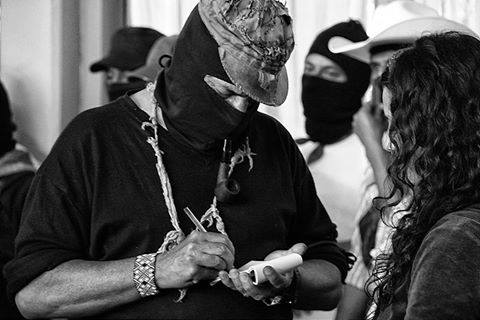
Galeano signing autographs.
January 3, 2017
I’ve been listening to you: sometimes when I’m here with you all, sometimes via the CIDECI stream, sometimes via what your Zapatista students mention to me.
I always try to get a grasp on the meaning of your presentations, the path and direction of your words. We have heard brilliant presentations, some didactic, some complex, the majority polemical, but on and about things that can be debated. And we think you should do so, among yourselves. For that discussion, perhaps it would help you to first clarify the confusion that exists between science and technology.
With regard to the rest, we are as surprised as you are. This interest [of the Zapatista students] in science is not something we ordered or imposed, but rather something that was born from inside [of the Zapatista communities].
Twenty-three years ago, when feminism came to demand that we order women’s liberation, we told them that was not something that can be ordered, because it belongs to the compañeras. Freedom is not ordered; it is conquered. Two decades later, what the compañeras have achieved would put to shame those who at that time claimed to be the vanguard of feminism.
It’s the same now. Science is not imposed. It is the product of a process of the peoples, exactly as Subcomandante Insurgente Moisés explained.
I’ve told you that we thought the majority of your presentations were good, but there were some, just a few, that, well I don’t know what to tell you.
One of them said admiring things about me; I listened with attention and waited for the moment when he would say: “everything I have just said is a fraud, I presented it to you so you would see what pseudo-science is and so that you don’t trust the principal of authority; just because someone has a formal education doesn’t mean that what they say is scientific.” But no, that moment never came.
I scrutinized his face to see if he was smiling maliciously, but no. He was sincerely convinced of the barbarities he was presenting, and appreciatively received the applause of his buddies in the crowd and others he had managed to sweet-talk.
When an insurgent compañera heard that thing about not needing to make babies, that it’s better to adopt because there are a lot of people on the planet already, she said to me: “so that’s how they get rid of people, the Hydra isn’t even necessary, that idea is sufficient. That’s the idea of rich people; even if there are only one or two of them, they are already too rich and too many, they are the ones who are in the way and of no use. That idea that was presented tells us there is no need to struggle to make another world, we just need to take contraceptives.”
I’m going to tell you what someone once told me about the time when the world was like an apple, waiting for the bite of original sin.
This man was explaining to me how he made a living. He used the “Boa Constrictor” method, as he called it. He had a helper, and together they would put Vaseline into small jars and make labels that read “Balm for Absolutely Everything.” The small print told you that this balm could cure everything from Alzheimer’s to a broken heart, including along the way polio, typhoid fever, hair loss, evil eye, toothache, foot odor, bad breath, and some other ailments that I don’t remember.
This is what this person would do: stand on a corner and begin to rail against zoos and circuses, about oh the poor little animals, locked up like that. And he would announce: “That is why we are going to show you a boa constrictor, 7 meters long, that we found in the sewer and rescued and now take care of, and right here and now we are going to show it to you, madam, sir, young man, young lady, child, the public in general.”
People would gather around curiously, mostly because the boa constrictor was nowhere in sight, just an old suitcase full of small jars of a balm called “Absolutely Everything.”
When he decided there were enough people around, he would turn to his helper and say loudly, “Secretary! Brrrrrinnnnnngg me the boa!” The accomplice would nod and run off to who knows where.
The man would watch his helper move into the distance. Picking at random, he would comment to someone close: “It seems like a lie, but just a few weeks ago that boy couldn’t move, not even with a cane, only in a wheelchair. And just look at him now. It seems like a miracle, but no, that’s not it. What happened was, luckily, I found the scientific formula for a medicine that cured him. Here, I’ll show you.”
Of course, the “innocent” comment that was supposedly aimed at one person was said in such a way for several to hear. The man would then go to the suitcase and take out a jar and tell the first person to whom he had directed the comment: “Look, this is what I was telling you about.” The person would take the jar and read the label while the man would pretend indifference, rearranging the little jars and looking in the direction the assistant had gone and commenting as if to himself, “why is that boy taking so long? I hope the boa constrictor hasn’t escaped on him, because if it has, we’ll see it in the news tomorrow, poor animal, they might cage it or turn it into bags and shoes.”
In the meantime, the innocent person who received the jar would be showing it to the person beside them, commenting on what had happened to the boy who went to get the boa. In a few minutes the jar had been passed through some 10 people, and the man would say then: “Okay now, give the medicine back to the madam, the gentlemen, the young man, young woman,” accordingly, and then to that person would add, “you keep it, as a gift, try it, you’ll see.”
Others would then come up asking for their free sample too and the man, apologetically, would explain: “No, I’m sorry, I can’t give them to everyone, it’s a special order from the Secretary of Health. But, not that I think about it, it’s better for you all to have a chance to try it instead of those government scoundrels. Just give me 10 pesos each so I can replace the government order.”
It was enough that 5 or so people would come up for others to join in, and soon he would have around him a decent number of people. The people would comment among themselves what the balm was all about and the man, pretending indifference, would merely charge for each jar while lamenting the delay of his “secretary” and the cursed boa.
In a matter of minutes, the helper would come back all agitated and worried and whisper something to the man. The man would answer “My god, really? Are you sure?” Then he would quickly pick up the now empty or almost empty suitcase and, addressing the people gathered there, proclaim: “Run! The boa escaped and the police and patrols are on their way.” He and the helper would take off with alarm and as the word of warning spread the people would scatter also.
I asked him how much the cursed medicine cost. He told me he pulled the little jars out of the trash and the Vaseline, well that came out to about a peso per jar. So this method earned him some 100 pesos a day, at a time when the minimum wage was 8 pesos a day.
Anyway, I just wanted to say to those who tried to apply that method in this gathering that even if you have an academic degree, we’re not buying your little jars. You’ll have to look for another corner from which to hock your quack commodities.
-*-
Perhaps somebody out there still has the image in mind of the ignorant and naive indigenous, and thought they could tell us they were going to talk about one thing knowing full well that they were going to talk about something else that had nothing to do with science. Hell, it doesn’t even manage to be pseudoscience. I’ve read better-developed, more original, and equally false things on social media.
Let me tell you: if you complain that the science departments in academia don’t take seriously what is pure existential nonsense, well, here we don’t either.
If in academia they don’t take your political activism in account, well we don’t either. But I can tell you where they do: on the institutional left. There, yes, you can go and say: I’m a doctorate in who knows what and I’ve participated in this many marches, rallies, and classes, and indeed they will give you some leadership position in something, anything, as advisors or coordinators.
Here, if you came because you know mathematics, then we want to hear you talk about mathematics, even if you don’t know what surplus value or class struggle is, even if you don’t know if “The International” is a song of struggle, an opera, or the name of a corner store. As Subcomandante Insurgente Moisés already told you, science is science, whether you are a partidista [associated with a political party] or a Zapatista.
It’s also not worth your time to come here and fawn over or court us, although I think that does work in academic institutions.
Neither are we interested in being manipulated around skin color, sexual preference, or religious belief. You either know what you’re talking about or you don’t; it doesn’t matter if you are dark-skinned, white, red, yellow, black, or mixed; it doesn’t matter if you are a man, woman, homosexual, gay, trans, or whatever; it doesn’t matter if you are Catholic, Muslim, atheist, agnostic, Mohammedan, or whatever; if you’re going to do science, then you do science, not religion, philosophy, or the quackery currently trending on social media.
So here we don’t discriminate. Here differences aren’t a demerit, but they aren’t a merit either. With respect to the personal sufferings or dramas you may have, fine, we understand. But you should understand that we are a very poor audience from which to expect pity. With everything you have suffered and continue to suffer, it could not compare with what it has been, and is, to be what we are.
But I understand what’s going on with you; everyone gets off with what they can. However, it doesn’t seem honest to us to come here and lie, saying you came to talk about science and not your existential lashings.
But the compañeros and compañeras are noble and understanding. We invited you to talk to us and we have honored that; we have listened with respect, which isn’t the same as saying that we have swallowed all your tall tales. We honored the agreement. Those people did not.
Imagine that this is an assembly in one of the Zapatista communities, and you go up to present one of your projects. You have said you are going talk about biology, medicine, laboratory work, clinical analysis, agro-ecology, engineering, or pharmaceuticals, and the assembly says, yes, go ahead, these things are urgent. Or you are coming to talk about physics, chemistry, math, volcanology, astronomy, and other sciences, and the assembly says yes, go ahead, these things are important.
But if someone comes who says they are going to tell us that science needs to do postmodern philosophy and take the existential variables of each person into account, well, the assembly is going to listen to you, but they aren’t going to tell you to go ahead. They are going to propose that you infiltrate Skynet and convince Artificial Intelligence to accept your scientific proposal. I’m sure that it would collapse in no time, which would relieve the duality suffered by John Connor, and humanity as a whole would be liberated from the Terminator sequels.
Of course, I recommend that you truly study and realize that you are closer to Aristotle and Ptolemy than to Copernicus, Galileo, and Kepler.
-*-
The Apocalypse According to Defensa Zapatista
The mountains of the Mexican Southeast. Territory in resistance and rebellion. There is an autonomous school. A classroom. There, the education promoter (teacher) is talking to the Zapatista girls and boys:
“Before we leave I’m going to tell you a story. You have to think about it and respond to the question I ask at the end.”
On one of the benches at the back, a little girl stops drawing complicated diagrams in her notebook which, although they appear to be flowcharts, are really diagrams of soccer tactics. At the margin of the lines and arrows one can read “when we fill up the team.” At the little girl’s feet there is a ball, frayed and full of lumps, and on her laps sleeps a kind of cat…or a dog… or something.
It’s not just the little girl, but rather the whole class that’s hanging on the words of the promoter (promotora, in Spanish) who says:
“There is a voice that tells us what it sees. It says to realize that the world is going to end once and for all, and that we can see that there are only two men left. The two are standing face to face; they aren’t talking to each other, but you can tell they are very angry. They are the only men left; everyone else has died already. They are the last men on Earth. These two men don’t talk to each other or look at each other, but they are arguing angrily. And they aren’t talking to or looking at each other because they are sending each other messages on their phones. That is, as they say, they are fighting as if their cellphones were weapons, the only ones left because the world is ending. They are scolding each other harshly, as only the two of them can see. One is saying to the other, that is, he is sending him a text message:
“It is all your fault because with science you created destruction.” (send)
The other looks at the message on his phone, gets angry and answers:
“No, it is your fault because instead of science, you starting saying we should do what the ancient primitives did and not use technologies.” (send)
The first really gets mad now and you can see in his eyes that it’s like he wants to burn up the screen of his phone. He writes:
“No, it’s your fault because with your science and technology you created the weapons that killed off everything, including the poor little animals.” (send)
The other looks at the message and you can see in his eyes he’s thinking “you’ll see, you bastard,” and he responds:
“No, it’s your fault because you said that we shouldn’t learn science because science is bad because it doesn’t respect Mother Earth and does her harm.” (send)
The other looks with hate at the screen and types out:
“No, it’s your fault because you think you know so much with your science and you don’t take the people’s needs into account and you go around with a big head thinking nobody can match you and all that shit you talk.” (send)
The first reads and gets so furious you wouldn’t believe it. He looks at the other and in his eye you can see “you’re going to die, bastard.” So he writes:
“No, it’s your fault because you criticized science out of pure laziness, you don’t want to study or learn because it’s clear that you’re just slothful and trifling.” (send)
The two men go on like this for a while, fighting angrily over their cellphones. They don’t know it, but this is the last day; as soon as night falls, everything is over. But because they were fighting and looking at their cell phones, they didn’t realize when the sun hid itself in the mountains and the land fell dark.”
The education promotora who has used everything she learned in her education preparation courses in order to tell the story, concludes:
“Okay, so this is the story the voice has narrated. So, the question you must answer is: “Which of the men survived the end of the world?
The children stay quiet, thinking.
In the first row of the classroom sits Pedrito. He says it’s so that he can pay close attention, but we all know it’s because he’s totally in love with the promotora, but we’re not going to publish that because it’s his secret.
Pedrito raises his hand, asking to be called on.
The promotora is about to say, “Let’s see, Pedrito, what do you think,” when from the back of the classroom a little girl’s voice says:
“Well that’s easy.”
Everyone, including the promotora, turns to look at the little girl who has stood up and already has her bag over her shoulder with her notebook and pen inside. In her little hands she holds the frayed ball, while the Cat-dog stretches at her feet. The teacher says resignedly:
“Okay Defensa Zapatista, tell us what you think.”
The little girl is already moving toward the door of the classroom as she announces:
“The answer is easy, because it’s clear that it’s the fucking men’s fault that the world is ending because they’re so terrible with that patriarchality of theirs which is just impossible to believe in anymore. And they didn’t study the fucking Hydra which has been consuming and screwing over the whole planet earth. So there they are, all macho, fighting with their cell phones and their songs about horses and love and then about lost love, I mean why can’t they just decide already.
Anyway, teacher, so that you understand as the women that we are, I’m going to explain the word “patriarchality” which is like where the men rule and they want us women to just be waiting on them hand and foot, and then later they tell us how much they love us and how we have very pretty eyes, as if they were looking at our eyes, no, they’re looking at something else. I don’t know what it is that they’re really looking at because I’m not grown up yet, but that’s what my moms told me the fucking men do. When I grow up, they better not even think about it, I’m going to give them their slaps upside the head and a few kicks if they look at me wrong. So, the “patriarchality” means that the fucking men just want us to make them their pozol and then are always pestering us for a kiss. Do you think we’re just going to give them a kiss, just like that? Oh no, I don’t think so, maybe instead of a kiss a knock on the head. And then they think they’re going to convince us with their songs about horses. They’re just so dumb, let’s see if they can find a horse to make them their pozol, what are they going to come up with then, never ever…”
The teacher knows the little girl very well already, so she interrupts:
“Okay, Defensa Zapatista, answer the question.”
The little girl is already at the door. As the Cat-dog wags its tail happily at her feet, she responds:
“Look, it’s easy. Neither of the two men live. They both die because they were stupid. Clearly it’s the fault of the patriarchality that the world is going to end, but it doesn’t, because it turns out there is someone who lives which is the compañera who is telling the story. Because if it’s not a compañera who tells the story then there’s no story. And the compañera who tells the story carries her little baby on her back in her shawl and is giving what you might call political lessons to the baby, so that the baby learns that we have to support each other as the women that we are.”
The little girl didn’t wait to see what the education promotora would say, and accepting as a given that her answer was correct, ran out of the classroom yelling “Let’s play!” as the Cat-dog and the rest of the class followed her out the door.
The education promotora smiles as she puts away her notebooks and books, one of which reads across the cover, “Twentieth Anniversary Anthology. National Indigenous Congress. Never Again a Mexico Without Us.” Ready to leave, the teacher notices that not all the children have left.
On the front bench sits Pedrito, looking all sad and defeated. The promotora goes over and sits down beside him asking,
“What’s wrong Pedrito, why are you sad?”
Pedrito sighs and answers, “Because I didn’t get to answer the question because Defensa Zapatista spoke first.”
“Ah,” the teachers says, “don’t worry Pedrito, what was your answer?”
Pedrito explains with a tone of the obvious:
“Well I was going to answer that the story doesn’t hold up, because if there are only two men left, arguing over their cell phones, then who is working so that there’s a cell signal? This means that there are others who continue working, that is, that there can’t just be two left. So you see what I’m saying teacher, your story lacks logic, coherence in the argument. So the answer is that the very premise is faulty and for that reason, the conclusion, whatever that may be, is false. This would have been understood if critical thinking was applied to the analysis.” (Trust me, that’s how Pedrito talks, if you get to meet him some day you’ll see I’m not making things up).
Pedrito, after finishing talking, returns to his posture of sorrow and sadness.
The education promotora is thinking about what the words “coherence” and “premise” mean, and that this is always the case with Pedrito, that he uses words that challenge even the Comandancia. The promotora isn’t embarrassed to ask Pedrito what those words mean, but she sees that Pedrito is sad so she hugs him and says:
“Don’t worry Pedrito, your answer is good, too.”
Pedrito, upon being hugged, turns all shades of red and puts on his “no one has ever hugged me before” face, just like the deceased SupMarcos taught him. Letting himself be loved on, Pedrito thinks that it turned out well after all that Defensa Zapatista answered first, because this was why the promotora was hugging him and from within the embrace, Pedrito understands that no, the world is not going to end, that as long as the embrace lasts the world will keep giving opportunity to life, because that is what life is, an embrace.
Pedrito is reflecting on this when the little girl appears in the doorway and says to him, “Hurry up Pedrito, we have to fill up the team so we can bring a challenge.”
Pedrito separates himself from the embrace of the promotora as if tearing his heart out, but he goes over to the little girl because he is, in addition to a little boy, a Zapatista, and a Zapatista can’t allow the team to be let down on their account. Before leaving the room Pedrito says to the little girl: “But I’m telling you straight-up right now that I’m not playing goalie anymore, put the one-eyed horse on goalie, I want to play forward.”
Defensa Zapatista is not going to let a boy have the last word in this story, so she says:
“Forward? Puh-leeze. SupGaleano showed me some videos and now I have a new plan. Now we are going to play according to the science of ‘total soccer’ like those Dutch orange ones. Don’t you know you have to study for that? You do. Both things, science and art. Later I’ll explain it to you. Just as soon as we fill up the team you’ll see, don’t worry, there will be more of us, it might take awhile, but there will be more.”
The little boy and the little girl leave. It is only then that we can see that the little girl has on an orange t-shirt that hangs nearly to her heels and taped on the back are crooked letters that spell “Cruyff” [1] and below them: “Resistance and Rebellion.”
Off to the side of the pasture waits a motley crew including: a old horse leisurely chewing on a empty tobacco bag; a short man with gray hair shivering despite his coat; and a tall, thin man who stands out for his height and the strange hat he is wearing. He is using his magnifying glass to study with great interest a small strange animal that, at a distance seems to be a dog… or a cat.. or a cat-dog.
Nearby, where the community has been working to deepen the scratches in the wall, anonymous hands have written, below and to the left, a graffiti that is bursting in color. It reads:
“We are the National Indigenous Congress and we are going for everything, and it will be for everyone.”
In a bunker far away, alarms are going off and the earth is trembling. Above, brother John Berger, smiling, has drawn a question in the clouds, for whoever looks high: “Y tú qué?” (And you what?”)
-*-
The Urgent and the Important
The story I’m going to tell you is a little bit sad.
It’s sad because it includes the tears of a little Zapatista girl. But despite this, or precisely because of it, I’m going to tell the story because after hearing you speak, present, reflect, and try to respond and teach, I’ve been thinking about what’s next. I don’t know if you all have thought about it. If not, I recommend that you do—think about what’s next.
I’ve imagined that we’re in another time, further ahead. Here goes:
This time, without being announced by a soccer ball rolling in, “Defensa Zapatista” has arrived at my hut. It’s clear that she’s been crying, and a few tears still glow on her cheeks. “Defensa Zapatista” maintains that little girls don’t cry, that that’s for men, and that women are stronger. So I understood why the little girl had come to my hut, where there are only ghosts and silences. Here she is safe, here she can cry without anyone, except me, seeing her. Here she can put her strength away in a box and let feelings fill her gaze and sorrow become liquid.
I didn’t say anything. I acted like I didn’t see her and that I was busy sweeping tobacco and crumpled up papers off the floor around the table. Finally, she wiped her tears with a red handkerchief, sighed, and cleared her throat in order to ask me:
“Hey Sup, do you know what it’s like to have a bad dream?” “I sure do,” I responded, “bad dreams are called nightmares [pesadillas].”
She looked intrigued and asked, “And what’s the purpose of those quesadillas, why do they exist and who made them? Because they’re beastly.”
“They’re called “pesadillas,” not “quesadillas.” Quesadillas are good because they have cheese. Pesadillas aren’t good. But why do you ask?”
“I had a really bad dream and I woke up with something like a stomach ache, like something wasn’t okay, something was hurting,” she said.
“Tell me about it,” I encouraged her and lit my pipe.
“Well, I dreamed we were in the community assembly and as it turns out the situation is really rough because of the bad system. And a lot of people are coming here and asking to stay in the community because other places have become unlivable, and so the people come here because we Zapatistas did in fact prepare.
But the people are coming from other countries, as far away as goodness knows where.
So there isn’t enough food and the community has to make the land produce more, because as Zapatistas we have to support other peoples of the world because we’re, as they say, compañerismos. So in the assembly they’re looking at how to organize to be able to give food to those brothers and sisters.
So then someone in the assembly says that we have to find more terrain where we can plant.
And then someone else says what about in the pasture where we play soccer, the Petumax flowers are already blooming, like white, but not, sort of gray but not, I think cream-colored or whatever you call that color.
And they say the saw the Chene’k Caribe flower too, which is true because I play with those flowers and pretend they’re little baby chicks.
And that they also saw the “Sun” flower that seems like a sunflower, but isn’t.
So then that compañero said that means that the soil is good in the pasture, that we can plant corn and beans there. And then I got, as they say, worried because there in the pasture is where the one-eyed horse lives and where we play soccer. Well, we don’t exactly play because we haven’t completed the team yet, but we practice and we train really hard.
So then the authority asks the assembly if there’s agreement that we’ll plant in the pasture and make a milpa [corn field] there, and if there’s anyone who disagrees they should say their piece so we can figure out what to do.
So then the whole assembly is silent and nobody asks to speak. And I want to talk to say that we shouldn’t plant in the pasture because then we won’t be able to play, or train that is. But I don’t know how I’m going to say it, because I can see that we do need food to support those other sisters and brothers.
And I’m really upset because nobody says anything and I don’t have the thinking to convince the assembly, and I can see in the authority’s eye that they’re about to say that if nobody has any other comments, that they’ll approve the proposal to plant in the pasture.
And there I am, looking for a good thought and I can’t find one, and I get mad that I can’t find the right words and with the anger the tears come out, and it’s not that I’m crying, it’s just the anger of not knowing what to say.
And right there I woke up and I came running. And on the way I got even madder because of that stinking bad dream, and who sent it or why they’re doing that.”
As she’s been talking, “Defensa Zapatista’s” face is reproducing her pain and desperation.
I remained quiet, but the little girl kept looking at me as if waiting for what I was going to say.
Even though I realized that “Defensa Zapatista” hadn’t come to sit on the [psychiatrist’s] divan, nor just to vent, I was looking for the right words. I understood that the girl hadn’t come just to hide, she was also looking for answers, and me, well I’m the Subcomandante of stainless steel, the one who, according to “Defensa Zapatista’s” criteria, has the grave defect of being a man. But nobody’s perfect, and besides, I let the Cat-Dog climb up on the keyboard and ruin the texts, and sometimes I have cookies to share (which, for Defensa Zapatista means that she and her little animal gobble up all the ones I like and the ones I don’t, too, and they just leave me the empty package), and I tell stories where she and her gang get into mischief and come out triumphant.
So I’m presenting with you all with the, as they say, context, so you understand that the girl had not really come to tell me a bad dream, but rather to present me with a problem.
When I had been looking through the trunk of memories that the deceased SupMarcos left in my custody, I remembered having seen something that could be useful. I gestured to “Zapatista Defense” that she should wait and I started looking. Under some drawings that John Berger made when he was in Cideci, I found what I was looking for. The papers were shabby, stained with tobacco and humidity, but the clumsy handwriting of the deceased was still legible.
I picked my pipe back up and lit it. I read almost in silence, only making a few gestures and emitting incomprehensible grunts. The girl watched me in suspense, waiting. The Cat-Dog had left the computer mouse in peace and, its ears perked, remained expectant.
After acting all important for a few minutes, I told her:
“There it is, there’s no problem. I’ve found the solution to your nightmare. It turns out that in this writing by the deceased SupMarcos (may baby Jesus keep him in holy glory and may the dear Virgin fill him with blessings) explains that nightmares are problems and that they can be alleviated if you resolve the problem of the nightmare.
Then he says that dreams are the solution to nightmares.
That what you have to do is find the solution and then the good dream comes out.
That way you save a ton of money on psychiatrists, psychologists, therapists and antacids. Okay, that’s not related.
And in this other writing, he says that the problem is not just knowing what’s urgent and what’s important.
What’s urgent is what you have to do right now, and what’s important is, for example, what you know you must do.
For example, in the case of the bad dream you’re telling me about, what’s urgent is that the compas have to increase food production; and what’s important is not to lose the space where you play.
In which case it’s a big problem, because if you protect the place to play, well, then they won’t plant there and there will be hunger; and if they plant there, well then there won’t be any more place to play.”
“Defensa Zapatista” nodded, convinced of what I was saying to her. I continued:
“So the deceased says here that that’s called ‘exclusive options,’ which is to say that you do one thing or the other, but you can’t do both. SupMarcos says that this is almost always false, which is to say that it’s not necessarily one or the other, but rather that something different can be imagined. And he gives the example of the original peoples, which is to say the indigenous.
He says: ‘For example, the original peoples, going back centuries, have always done two things at the same time: what’s urgent and what’s necessary. What’s urgent is to survive, which is to say to not die, and what’s important is to live. And they resolve this with resistance and rebellion, which is to say that they resist dying and at the same time they create, with their rebellion, another way of living.’ So he says that whenever possible, it’s necessary to think about creating something else.”
I put down the papers and I turned to “Zapatista Defense”:
“So I believe what you can do with the problem of your bad dream is explain to the assembly what’s urgent and what’s important.
Which is to say that both parts have good thought behind them, but if you pick one, well, you’ve screwed the other.
So explain to the assembly that it doesn’t necessarily have to be one thing or the other, but rather that it’s necessary to think of something else, something different but so that both objectives are met.
And then it’s not that the assembly’s problem is getting resolved nor that your problem is getting resolved, but rather that it’s a different problem altogether.
And it’s the new problem that you both have to think about, that is, you and the assembly.”
The whole time the girl had been sitting quietly with her chin in her little hand, paying attention.
Contrary to his usual habits, the Cat-Dog had also been still.
“Zapatista Defense” stayed silent, looking fixedly at the floor.
I don’t know much about what happens in the head of a little girl. Of a boy, sure, perhaps because I haven’t matured despite the many kilometers I’ve covered. But girls, whatever their age, continue to be a mystery that perhaps science will one day be able to solve.
Suddenly, “Zapatista Defense” turned to look at the Cat-Dog, and he in turn looked at her.
The mutual glance lasted only a few seconds, and the Cat-Dog began to jump, bark and meow. The girl’s little face lit up and she practically shouted: “Yes, the Cat-Dog!” and she began to jump and dance together with the animal.
I didn’t just put on my confused face; in fact, I didn’t understand what all this was about. But, resigned, I waited for “Defensa Zapatista” and the Cat-Dog to calm down, which didn’t happen for several more minutes that seemed eternal to me. Finally the commotion died down and, still excited, the girl explained:
“It’s the Cat-Dog, Sup! I have to bring the Cat-Dog to my bad dream and I have to bring him to the assembly and he’s going to help me and so then it’ll be a good dream.”
The solution to the problem was right here but I hadn’t studied it.
It’s the Cat-Dog, it’s always been the Cat-Dog.”
I think that my “What?!” face must have been very obvious, because “Defensa Zapatista” felt obliged to clarify:
“Look I’ll explain it to you Sup: the Cat-Dog, is he a cat? No. Is he a dog? Not that either. So then he’s neither one thing nor the other, but rather something else, he’s a Cat-Dog. If I show the Cat-Dog to the assembly, obviously they’re going to see that we have to do something else, so both sides can happily be in mutual agreement.”
I couldn’t understand how the assembly was going to make the, as they say, “epistemological leap” from that thing, that is to say the Cat-Dog, to the disjuncture between the pasture for playing soccer or the pasture for planting. But it seems that “Defensa Zapatista” wasn’t worried about that.
The next day, on the way to town, I passed by the pasture. Night was already beginning to fall and the sound of those who were scratching at the wall continued. There was still enough light, because “Zapatista Defense” was on the field, together with a group in which I recognized the old one-eyed horse that accompanies her sometimes, the Cat-Dog, and Pedrito. There were also two men, one short and one tall, who I didn’t recognize and I assumed that they were from the Sixth and that the girl was trying to incorporate them into her perpetually incomplete team.
The girl saw me from afar and greeted me with an energetic wave of her hand. I returned the greeting, realizing that “Zapatista Defense” had resolved the problem because she laughed and ran from one side to the other, showing the group where they should position themselves in some sort of formation that looked to me to have the shape of a snail.
I continued on my path, remembering the ending to that day of tears, when “Defensa Zapatista,” then smiling and with her face lit-up, said goodbye: “I’m leaving now Sup, I’ve got to go.”
“And what are you going to do?” I asked her.
She was already gaining distance when she shouted: “I’m going to dream.”
While I waited for the compañeros and compañeras to whom I had to give a talk, the night arrived with its own steps and sounds.
I thought then that perhaps the deceased SupMarcos would have liked to have been present for “Defensa Zapatista’s” dream to know how she made her argument and what the decision of the assembly was. Or perhaps he was in fact there because, at least in these lands, the dead walk around. They laugh and cry with us, struggle with us and they live with us.
Thank you very much.
From the CIDCI-Unitierra, San Cristobal de Las Casas, Chiapas, Mexico,
SupGaleano.
Mexico, January 2017.
[1] Hendrik Johannes “Johan” Cruijff, a Dutch professional soccer player and coach famous for promoting the philosophy known as “Total Football.” https://en.wikipedia.org/wiki/Johan_Cruyff
En español: http://enlacezapatista.ezln.org.mx/2017/02/02/que-sigue-ii-lo-urgente-y-lo-importante/
“There will be no wall:” Sioux, Yaqui and Tohono O’odham
Indigenous struggles unite from Standing Rock to the Sierra Norte of Puebla
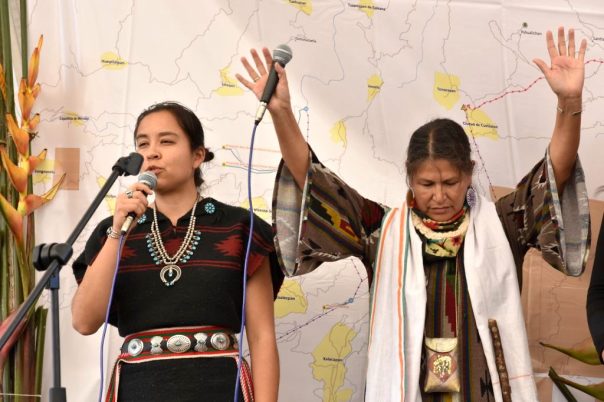
Photos by Diógenes Rabello / Hijos de la Tierra
From the Editors of Desinformémonos
February 20,2017
Trump’s “xenophobic and aggressive policy against Mexico” has placed the Native peoples of the United States and Mexico on alert. They declared that: “there will be no wall!” The struggle of indigenous peoples is added to on both sides of the border, and in Cuetzalan, in the Sierra Norte of Puebla, with the presence of representatives of indigenous peoples from New Mexico and Dakota, who all ratify the defense of their lands and territories.
Tohono O’odham, Sioux and different indigenous tribes are against the policies of Donald Trump and they promise to go as far as the ultimate consequences in defense of their territory.
The Standing Rock Sioux tribe and its defenders have pledged to resist Donald Trump’s executive order that authorizes the construction of an oil pipeline in Dakota and they are thinking about using legal measures, calling for civil disobedience and installing a resistance camp to protect the river water.
“President Trump has the legal obligation to respect the rights that the treaties recognize and guaranty that the whole process for the construction of the oil pipeline is fair and reasonable,” explains Dave Archambault, chief of the Standing Rock Sioux tribe.
Others have promised that they will express their solidarity with protests throughout the country. “We need a massive civil disobedience movement and citizens expressing their solidarity with Standing Rock,” explains Kandi Mossett, a member of the Mandan, Hidatsa and Arikara tribes.
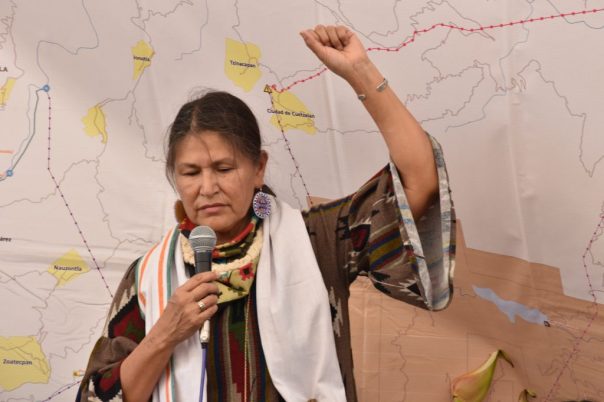
“The Trump administration is provoking a revolution that will make us stronger than ever.”
The Sioux peoples already faced the Democratic administration of Barack Obama, who they classify as “the lord of drones and wars.” The Sioux, together with the Mdewakanton Dakota and Dine peoples, achieved a victory in 2016 when they obtained the cancellation of Obama’s decree to construct an oil pipeline in Dakota. However, last month Trump decided to revive the decree with which is approved the construction of this work that they consider predatory to the environment and destructive to its ancient habitat.
Now, the Sioux once again reject the measure and make a call to mobilize, not just against the oil pipeline, but also against the “border wall” that Donald Trump wants to construct.
The Tohono O’odham tribe of Arizona, which controls more than two and a half million acres, in part bordering with Mexico, expressed its absolute rejection of the wall that Trump seeks to construct because it goes against ancestral customs.
This nation currently has 28,000 members. Prior to the Treaty of Guadalupe-Hidalgo that provoked the loss of more than half of Mexican territory to the United States in the 19th Century, the Tohono O’odham moved freely between the states of Sonora and Arizona. Now, they denounce that United States immigration police have unleashed a war against them, therefore they warned that they would mobilize against the border wall they want to construct.
The Yaqui Tribe shares territory in the state of Sonora in Mexico and in Arizona, in the United States. It was also recognized as a nation in 1978, and they have shown their support for the “anti-wall” movement. “Over my dead body,” is one of the slogans of the border tribes that share territory with Mexico. ”It divides our ancestral land and families that have crossed freely since before the borderline was drawn.”
“We arrived before nations and borders divided us,” an indigenous leader pointed out after Trump insulted members of the Hopi tribe with the title of “Pocahontas.”
Against the Donald Trump government, the wall, forced deportations and other xenophobic policies, Mexican and American workers must unify their demands with those of the Sioux and Tohono O’odham peoples. Bring down the wall by constructing resistance with workers, indigenous peoples and women on both sides of the border.
From Standing Rock to the Sierra Norte of Puebla: indigenous peoples join together in defense of territory
The campesino, indigenous and mestizo peoples of the Northeast Sierra of Puebla have demonstrated, once again, their capacity for organization and self-determination.
As is now the custom in this region, every other month, and now on February 18, hundreds of people came from 173 towns and 16 municipalities to gather together in the 18th Assembly in Defense of Territory to reaffirm the power to decide on their lives and the destiny of their territories.
The meeting was held in the municipal capital of Cuetzalan, [1] where its residents wage an important fight against the imposition of an electric substation and high-tension wires. According to what the web page Hijos de la Tierra has reported, those installations are destined to favor mining megaprojects, fracking and hydroelectric dams in la region.
Representatives of social movement struggles were present from the Indigenous Peoples Front in Defense of Mother Earth, of San Francisco Xochicuautla community, the Maya community of Hopelchén, Campeche that struggles against the planting of transgenic seeds, students from the rural teachers colleges, mothers from Ayotzinapa and two representatives of the Native peoples of New Mexico and South Dakota in the United States, who organize and defend their Standing Rock territory and rivers against the “Dakota Access” pipeline impelled once again by Donald Trump.
The municipal presidency of Cuetzalan and representatives of the Federal Electricity Commission (CFE, its initials in Spanish) were invited to the meeting so that they could provide information about the motive and objectives of the electric project that they want to develop at that place. They did not attend however and therefore the assembly decided to continue stopping the construction work and to maintain the encampment installed since the month of November.
[1] Cuetzalan, Puebla is one of Mexico’s “magical towns.” See: http://www.visitmexico.com/en/magicaltowns/center-region/cuetzalan
——————————————————————–
Originally Published in Spanish by Desinformémonos
Monday, February 20, 2017
Re-Published with English interpretation by the Chiapas Support Committee
What Comes Next I: Then and Now
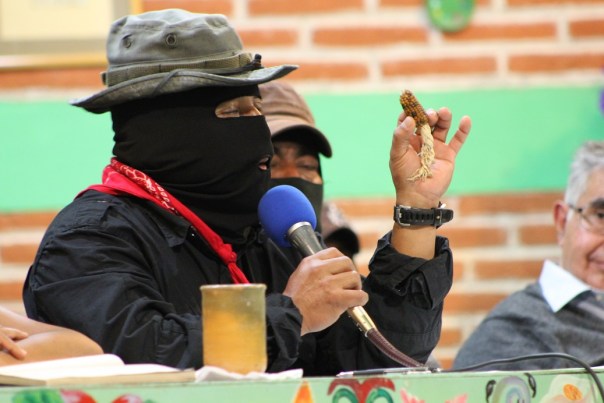
By: Subcomandante Insurgente Moisés
January 3, 2017
Good evening everyone. We just want to say that this is going to take a while, so now is the moment to leave or take a nap.
So first of all, just like the compañera said who spoke here about Viejo Antonio [Old Antonio], the name says it all, Viejo Antonio. [1] His time is over. There are some things we might be able to recover from that moment, but now times have changed.
We Zapatistas want to tell you that truly, seriously, we want to learn what real science is. Not the kind that Viejo Antonio employed, which was useful in its time, a time now past. Now it’s different because life now is different. We want to talk to you about what it’s like for the compañeras and compañeros who are here as a commission of delegates, what they’ve confronted through their struggle in resistance, and the fact that even though they’d like to live the way their fathers and mothers did, it doesn’t work for them anymore.
For example, in the Lacandón Jungle when they plant their corn, they know that in three months the kernels should grow, but now the kernels come in earlier. In the highlands, near Oventik, the Caracol of Oventik, it used to be that in six months there would be kernels, and now it happens in five. This makes it difficult because before they knew when to plant. They knew when to start, using the old method like Viejo Antonio did, but now that has changed. How did it change, and who changed it? That’s where all this interest comes from. And just like with everything else, we’re not making things up, as Sup Galeano has said these past few days. Because Viejo Antonio did in fact know when the cold would come, when to go get firewood, charcoal, how to be prepared, but this method doesn’t work anymore.
That’s why we started to wonder who could explain this to us, and we’d heard people say that there are scientists, and we wondered what kind of work they do. Could they assist us? Because they say these people study in order to be able to explain, to be able to understand, and then to be able to explain to others if something can be done and what can be done.
Our compañeros and compañeras need these kinds of things, because it turns out that in their 23 years of autonomous governance, many needs have arisen, needs that can no longer be addressed the way Viejo Antonio used to. He was resisting and surviving, but that way doesn’t work anymore. The compañeros and compañeras are constructing something else, and they’re putting it into practice. When they engage in these practices, that’s when they start to discover what’s missing.
For example, so that you understand what I’m saying, among the compañeras who are Zapatista bases of support entered the struggle 33 years ago, none of them dreamed that their daughter or son would learn how to operate an ultrasound. Now it turns out that their daughter operates one, because many compañeras do. It’s mostly compañeras because they’re the ones who want to see how the baby is doing while it’s growing, that’s why it’s mostly compañeras who do this.
I’m going to tell you about a need and a lack we have encountered, because it was a lack as well as an error, a failure, which we recognize as such. Because the compañeras, compañero, well they’re reclaiming the good parts of the culture and leaving behind the bad parts.
So there are promotores [health care workers], as well as midwives, both men and women, in the communities. In one community a compa went to the midwife and the midwife checked the compañera and told her: it seems you’re going to have twins, compañera. And the compa was happy about the twins, but he knew that in the clinic, in the Autonomous Hospital, there’s an ultrasound, and the compa wanted to be sure that they were really going to have twins. So they went to the hospital and had the photograph taken, I’m not sure what you call it. But first the compa says to the compañera who knows how to operate the ultrasound, “the midwife told me it looks like it’s twins, so I want to check using the machine to see if it’s true, no?” And so they check and take the photo or whatever it’s called and the compañera tells him, “Yes, it’s twins.” So then the compa is even happier.
So then when it was time for the twins to be born, they went to the government hospital because there was trouble with the birth because the compañera was having a lot of pain. So as an emergency they went to a government hospital in Guadalupe Tepeyac, and they attended to her there and gave her a Cesarian. So the compa goes to see his two twins, right? And it turns out there’s just one. So the compañero says, “No, I know that they were twins,” and starts to argue with the hospital director. “No, I know that they’re twins. You’re trying to steal one from me.”
The director says, “No sir, no Zapatista, there’s only one. Let’s not argue here, let’s go to your wife because she saw everything.” So the director and the compa go to the wife and the compa says, “Why are you letting the hospital directors steal one of our babies?” And the compañera says, “No, there really was only one.”
“But how? If the compañera who did the ultrasound told us it was definitely twins and the midwife also told us it was definitely twins?”
So there they are with the compañera saying that there was definitely only one and the compa is saying it has to be two because that’s what the midwife and the health promotora said and the people from the hospital are saying it’s definitely only one.
So then they have to bring in the compañera who did the ultrasound in the Zapatista hospital clinic. The compañera arrives, so there are four different people there now: the compa, the compañera who had the cesarian, the compañera who did the ultrasound, and the directors of the hospital. And they start talking there, and the attending doctor starts explaining that it depends on how the image is taken for the ultrasound, and the compañera who did the work of the ultrasound says, “yes, we did in fact take it from the side.” So then the doctor says, “That’s what happened, because of the reflection it seemed like there were two, because the image wasn’t taken the way it should have been.” Then the compa, the father of the baby, starts to understand that there was a mistake, an error in the way the work was done by the Zapatista health promotora.
So that’s where we learn that we can’t say, this is fucking capitalism’s fault, because this wasn’t about capitalism; we were lacking science. That’s why a failure isn’t just about saying they don’t know, or the people from the hospital robbed us because it’s run by the bad government. We can’t say these things. We recognize that we were lacking something, that we were lacking something as Zapatistas. It’s not that we’re autonomous and that therefore we can’t fail. We failed at science.
So there are a lot of other things like that, and Viejo Antonio didn’t have the opportunity to learn them because his time has passed. But thanks to Viejo Antonio who had a form of resistance and rebellion, [our people] were able to survive at that time.
So for example, the person speaking to you, whose name is Moisés—this Moisés has changed three times. Because if the Moisés in his community was still in his community he wouldn’t be here talking with you, right? And what would this Moisés be like if he was still in his community? Who knows. Not even Moisés himself knows.
Okay. But then that Moisés that was, is no longer. Then Moisés entered into the clandestine organization, so that Moisés changed again. He was no longer the same Moisés in clandestinity that he had been in his community. Then Moisés went out, learned, and we’re not going to repeat everything here, but he learned the science that we applied in 94. And now after 23 years, the Moisés who was in clandestinity is not the same Moisés who has been in the public light for 23 years because of what he and his compañeros and compañeras did. Right?
So the Moisés of right now, today, January 3, 2017—this Moisés now sees other things. This Moisés sees many things, not what he saw before during the 10 years of clandestinity; things have changed. But we have to study this change scientifically, with science, for the good of the people, in order to love life even more.
So what are we going to do when we realize, with science and scientifically, that something’s not right? What good is it just to say that something’s wrong and then just leave it at that?
So that’s what’s happening to our compañeros and compañeras: they run into these needs, they need this [knowledge] not for the good of a few, but for thousands, or perhaps the millions of us in this country called Mexico. And perhaps this could take wing and fly off to another world, no?
Because today, 23 years later, there are many things the compañeros are putting into practice, and they run into these needs. They need theory and they need practice. We indigenous people do things in practice. That is, it is through practice that we are convinced of something. And when that happens, then we do not tire when we hear the theory. But if it’s all blah, blah, blah, well we get sleepy. But if it’s through practice, then yes, we become focused because we’re seeing how things move and how they work. If we like what we see and think that something will solve many of our needs, then our eyes become sharper than an eagle’s.
So when we engage in practice and see that yes, something does in fact solve our needs, then we begin to ask: if I do it like this could it turn out like that? And if I do it like this what will happen? Could it be that someone could teach us even more? Could they tell us even more about how to do it? Then in that caswe we need theory, because we were encouraged by what we saw, because we saw that it solved our needs or problems when we saw it in practice.
There is the problem that sometimes it’s really hard for us to present the theory, but we can do it in practice. Perhaps it’s possible to see if there’s an image or something to help understand how things are in practice. Take for example this instance I’m about to tell you about, which our compañeros and compañeras have basically obligated me to keep in my head.
These men and women have their autonomous government, and they’re struggling and struggling for it to be half and half. If there are 40 members of the Junta de Buen Gobierno [Good Government Council], it should be 20 women and 20 men, and if there are 20 members of the Zapatista Autonomous Municipalities in Rebellion, it should be 10 women and 10 men, and so on.
So they do their work according to what they’ve understood of the 7 Principles of Leading by Obeying. They make the word Democracy their own, which means that the people lead and the government obeys. Men and women discuss their own laws, they develop education in the way they think boys and girls should learn, and what the education promotores should learn, according to what their communities need.
So in what some might call primary school, and other Caracoles might call first level, but in any case the compañeros, compañeras, the fathers, the mothers, say: what we want is for our children to learn to read well, to know how to write papacito and mamacita. And they’ve seen how the young people have learned a shitload like that. It’s the same in the area of health too; there are many areas of work like that. There is the work with medicinal plants which continues, and the compas have detected various needs there, because they want to know, they say for example: when the plant is green, or the husk or the root, what substance does it contain? What about when it dries, does it preserve or lose that substance? But that’s where we realize we have our limits, because for that we need science to do a study in a laboratory, and many other things like that.
They have their community radios, and sometimes certain pieces of the machines burn out, so they want to know how to fix that. The other communities want to listen to what is being produced and transmitted, so they want to make the signal reach them, but the signal doesn’t reach. So the radio broadcasters ask, might there be a way to invent something so [the signal] is stronger, so it reaches further?
But their fathers and mothers had never dreamed of this. Moisés in clandestinity had never thought of it. Things changed, and now it turns out that these young men and women—because we’re working with the compañeros—they tell us that this thing or that thing is lacking, and so now Moisés can no longer say… because it’s easy to order people around, to say enough, shut up, go back to work, go check on your cornfield, go… no? But we understand there are needs. So that’s why I’m saying that Moisés isn’t the same as he was in clandestinity, not after 23 years with the communities, with their autonomous government.
Well, for more than a year now we’ve been talking about the capitalist hydra, the monster, along with our compañeros and compañeras in the communities. And this is truly what we’re seeing, it’s like it reared its head when we mentioned it. So the compañeros and compañeras in the communities say that the way we’ll resist is that we must have food and we must have medicine, we need these things to be able to confront this. So that’s where they begin to think seriously about how to make this happen with land that doesn’t produce anymore, no matter how much we work and work and work it, it doesn’t produce anymore. So they’ve heard people talk about boron, magnesium, sulphur, molyb…molybdenum, or something like that, or zinc, or the pH…but they only know that people say that these are things that can help the earth. But how can we know, even if I grab a piece of earth, how can I know what it needs?
So, the compañeros ask: who are the people who study this? Who are the people that say this? This need starts emerging from various places, the desire to learn, to study the earth without harming it.
So, among many other things that they do, the compañeros are identifying needs, seeking [answers]. Before all this, before these needs began to develop more, there were other compañeros who were seeing other needs emerge around how to construct autonomy. For example, a group of compañeros saw that a lot of gasoline was being wasted to generate electricity in the Caracol. So they began to wonder, why does the gasoline make the motor turn and then produce electricity, energy? They said, that just means there has to be a way to turn the motor. So why don’t we adapt, find a different way to start the motor? Like in the case of the water mill, where they grind the sugar cane. It has a water canal and wheels and containers where the water flows into, and that makes the mill turn. So we should look for a way to adapt the motor, or the generator. And they did it, but it was very slow, and they couldn’t get past that point because they didn’t know how to multiply the force… I’m not even sure how you say it. So, where are the people who know the science of how to do this? Because then we wouldn’t need petroleum to be able to make gas, or oil, but rather we could make use of nature itself for this. Well, at least for one part, because the pieces of the motor are metal and plastic and all those things.
So the compañeros and compañeras really want to learn new things, whenever they can find someone to teach them. But…it’s not like it was before for the young men and women, like in the days of Viejo Antonio. They’re not going to just let things be if their question isn’t answered. They won’t be satisfied if they don’t get the right answer to their question, and worse so if you try to tell them otherwise.
For example, at the end of the Little School in 2013-2014, we had an Assembly to evaluate it. There it came out that one of the students had been saying how great it is that we’re indigenous, that we should never lose our indigenous identity, and therefore… but then that we’re no longer truly indigenous because we wear shoes, that we should stop wearing shoes. We have to touch [the earth] with our skin, with the soles of our feet, that’s how we’ll keep being indigenous. And in the Assembly people were saying that person who said that, we should call him in the rainy season, when there’s lots of mud and sometimes your feet sink 50 or 80 centimeters, and you don’t realize there’s glass or sharp rocks underneath. Let’s see him walk there then. Then they said, and we work in the brush, we’re going to ask him to please take his clothes off and work there naked, let’s see what he thinks then.
I’m telling you this because they don’t let buy this anymore; when these young people are able to understand that what’s being said isn’t going to resolve their needs, they simply say: let’s see, you do it first and then we’ll see.
So this all means—and it has to do with you, brothers, compañeros, compañeras, sisters—as has been said here, as you’re seeing, if you see and understand that things are really rough, well then there’s much work to be done. First, what is it that needs to be done, among you who study science, scientific matters, what needs to be done? And furthermore, the compañeros and compañeras have questions, and they need you to answer them, and answer them scientifically, right? Then there’s also the fact that they want to learn, they want practice. That’s another thing, because that’s the only way the compañeros and compañeras will feel that they are being taught, through practice as to how they might possibly resolve the issues that come up, or things that they need. The only thing is that we have to be careful that it’s not a deceitful trick, that’s what they don’t want. They want to see the results of what they’re told.
In that regard, according to what we’re hearing, although it’s not over yet, we see and feel that with this practice we’re engaging in now we’re making twice the effort. Because for example: I’ve heard you here while you’re participating as scientists—you’re speaking among yourselves, as scientists. And the idea was for you to speak to the compañeras and compañeros. So the compañeros are asking, what are they saying? Because you’re speaking from one scientist to another. And then the delegates try to speak with the participants, but you’re all listening and maybe wanting to debate what another participant is saying, and we’re missing something.
So what we see is that it would be helpful to have another gathering in which you speak to one another, scientists to scientists. You would speak to one another and we want to see how you discuss; we want to hear, in the end, how you reach agreements like in the communities. In the communities, among the peoples, they get into it and then they say, okay, we’re going to let it go because we have an agreement. That’s what they do. So we want to learn, because if not, how are we going to learn how to be scientists?
What we are doing here, which I’ve already told you about, is something of a science. This new government system that the compañeros have, it’s small, but the compañeros are putting science to work in this act, and because of it, this small act, they’ve brought us together here. That is why we’re talking here today, thanks to the science of self-government, thanks to the compañeros.
So I don’t know how you all will see it, maybe it seems like a long time away to plan for you to come in December, in order to have this meeting where we can see how you debate among yourselves, to see what agreements arise about what to do or how to do it. Also, if you are able, either collectively or individually, we could somehow reach an agreement for you to come here, go to a Caracol, set up your workshop… the only thing is that if you need a laboratory that includes more than an axe and a machete…well, we don’t have laboratories, but if you can bring it you’re welcome to. And there will be no lack of pozolito. [2] It might be sour, but there will be plenty. There will be beans, vegetables, and no lack of students with the desire to learn. Above all, to learn in practice, like I told you.
So, this is the problem we’re presenting to you, wondering how you might help the compañeros who need not just medicine and land, but many other things that you’ll see when you come, when you go to the Caracol or Caracoles. There you’ll hear a lot of, “listen, how can we do this, or that, or this other thing.” And you’ll say, “thing is, I’m not a technician, I’m not an engineer, I’m a scientist.” Like there are so many things the compas need right now.
So now you have some months to think about it, and then you can send us your word, your thoughts and your plans so that we can see the fruit of what we’re doing here. Then we can also reach an agreement about the next gathering in December. And we’ll see about where, or we’ll ask our compañero here, the Doc, if it can be here, or we’ll think about where else it could be. That’s what we wanted to talk about with you, compañeros, brothers and sisters. Thank you very much.
[1] Viejo Antonio is a character in the early writings of the defunct Subcomandante Insurgente Marcos who plays the role of indigenous teacher and guide for the young insurgent during the early days of clandestine organization.
[2] A drink made of ground corn and water.
————————-
En español: http://enlacezapatista.ezln.org.mx/2017/01/18/que-sigue-i-antes-y-ahora/
The walls above, the cracks below (and to the left)

February 2017
The Storm on Our Path
For us, the Native Zapatista peoples, the storm, the war, have gone on for centuries. It came to our lands with the fictitious accounts of the dominant civilization and religion. In that time, the sword and the cross both bled our people dry.
With the passage of time, the sword was modernized and the religion of capital dethroned the cross, but it continued demanding our blood as an offering to the new god: money.
We resist, we always resist. Our rebellions were supplanted in the dispute between some against others for Power. Both, always above, demanded of us struggling and dying to serve them, they demanded obedience from us, and submission under the lie of liberating us. Like those who said and say to fight, they came and they come to command. Thus there were supposed independences and false revolutions, past and the future. Those above took turns and take turns, ever since, to govern poorly or to aspire to do it. And in past and present calendars, their proposal continues being the same: that we will give the blood; while they govern or simulate governing.
And before and now, they forget that we don’t forget.
And the woman is always below, yesterday and today. Even in the collective that we were and are.
But the calendars not only brought pain and death to our peoples. Upon expanding their dominion, the Power created new brotherhoods in misfortune. We then saw the worker and the campesino become one with our pain, and lie under the four wheels of Capital’s mortal wagon.
As the Power advanced in its passage through time, more and more grew below, expanding the base over which the Power is the Power. We then saw teachers, students, artisans, small businesses and professionals, etcetera added on, with different names but identical regrets.
It wasn’t enough. Power is an exclusive, discriminatory and select space. Differences were also openly persecuted then. Color, race, creed, sexual preference, were expelled from the paradise promised, being that that their permanent home was in hell.
Youth, childhood and old age were next. The Power thus converted the calendars into a matter of persecution. Everyone below is guilty: for being ma woman, for being a child, for being young, for being an adult, for being old and for being human.
But, by expanding exploitation, dispossession, repression and discrimination, the Power also expanded the resistances… and rebellions.
We saw then, and now, the view of many rising up, different but similar in their rage and insubordination.
The Power knows that it’s just about those who work. It needs them.
It responded and responds to each rebellion by buying or deceiving the least, incarcerating and murdering the most. It doesn’t fear their demands; it’s their example that causes it horror.
It wasn’t enough. In the dominating nations, the Power of Capital wanted to put all of humanity under its heavy yoke.
It wasn’t enough either. Capital now intends to manage nature, tame it, domesticate it and exploit it; in other words, to destroy it.
Always with war, in its destructive advance the Capital, the Power, first demolished fiefdoms and kingdoms. And nations rose up over their ruins.
Later it devastated nations, and over their shambles it erected the new world order: a big market.
The entire world became an immense warehouse for merchandise. Everything is bought and sold: water, wind, land, plants and animals, governments, knowledge, fun, desire, love, hate and people.
But not only merchandise is exchanged in the grand market of Capital. “Economic freedom” is only an illusion that simulates mutual agreement between those who sell and those who buy. In reality, the market is based on dispossession and exploitation. The exchange is then of impunities. Justice is transformed into a grotesque caricature and on its scale money always weighs more than truth. And the stability of that tragedy called Capitalism depends on repression and contempt.
But that’s not enough either. Dominating in the material world is not possible if one does not dominate in ideas. The imposition of religions deepened and reached the arts and sciences. Philosophies and beliefs emerged and emerge like clothing styles. The arts and sciences stopped being what is distinctive about being human and became a shelf of the global supermarket. Knowledge became private property, the same as recreation and pleasure.
Capital thus consolidated itself as a giant shredder, using not only all of humanity as raw material for commodity production, but also knowledge, art, and…nature.
The destruction of the planet, the millions of displaced, the rise in crime, unemployment, poverty, the weakness of governments and the wars to come are not products of the excesses of Capital, or of a mistaken detour of a system that promised order, progress, peace, and prosperity.
No, all of these tragedies are the essence of the system. It feeds on them; it grows at their cost.
Destruction and death are the fuel for the great machine of Capital.
Attempts to “rationalize” or “humanize” its functioning were, are, and will be futile. Irrationality and inhumanity are its key parts. There is no possible repair. There wasn’t before, and there is no way now to mitigate its criminal path.
The only way to stop the machine is to destroy it.
In the current world war, the dispute is between the system and humanity. That is why the anticapitalist struggle is a struggle for humanity.
Those who still try to “fix” or “save” the system are really proposing a mass global suicide, like a posthumous sacrifice to Power.
But, there is no solution in the system.
Neither the horror, the condemnation, nor resignation are enough; nor is the hope that the worst has passed and things can only get better.
No. What is certain is that things will get worse.
For these reasons, in addition to what each of us can add from our particular calendars and geographies, we must resist, rebel, say “no,” one must struggle, one must organize.
That is why we must raise the wind from below with resistance and rebellion, with organization.
Only then will we be able to survive. Only then will it be possible to live. And only then, as we said 25 years ago, will we be able to see that…. “When the storm calms, when the rain and fire leave the earth in peace once again, the world will no longer be the world, but something better.”
-*-
The War and the Walls Outside and Inside
Provoked by the greed of big money, the intention above is to make those suffering the current nightmare pay for it. Borders are no longer just lines drawn on maps and customs checkpoints, but walls of armies and police, of cement and brick, of laws and persecution. In the world above, the hunting of human beings increases and is celebrated with clandestine competitions: whoever expels, incarcerates, confines, and murders the most wins.
As we have been saying for more than 20 years, neoliberal globalization did not bring about a global village, but rather the fragmentation and dissolution of the so-called “Nation-States.” Then and now we called this process by the name that best describes it: “world war” (the fourth, according to us).
The only thing that was globalized was the market, and with it, war.
For those who operate the machines and bring the land to life, borders continue to exist and continue to be what they always have been: prisons.
Two decades ago, our assertion of this reality provoked mocking smiles from the international intelligentsia, tied to its old and expired dogmas.
Those same people today stutter in the face of a frantic reality, or they recommend old recipes, or they move on to a currently trendy idea that, through complex theoretical elaboration, hides the only truth at hand: they haven’t the slightest idea what is happening, nor what is coming, nor what brought on the current nightmare.
They lament this. The thinking from above had promised them a world without borders, and the result was instead a planet crammed with chauvinist trenches.
The world was not transformed into a gigantic metropolis without borders, but rather a great sea writhing in an unprecedented storm. In that sea, millions of displaced (who are grouped together by the media paintbrush as “migrants”) flail in small boats, waiting to be rescued by the gigantic ship of big Capital.
Not only will it not rescue them, but big Capital is the principal cause of the storm that threatens the existence of humanity in its entirety.
Under the awkward disguise of fascist nationalism, the most retrograde dark times return, claiming privileges and attentions. Tired of governing from the shadows, big Capital dismantles the lies of “citizenship” and “equality” before the law and the market.
The flag of “freedom, equality, and fraternity” with which capitalism adorned its conversion into the dominant world system is merely a dirty rag, tossed in the garbage bin of history from above.
Finally the system unmasks itself and shows its true face and vocation. “War Always, War Everywhere,” reads the name on the proud ship that navigates through a sea of blood and shit. It is money and not artificial intelligence that fights humanity in the decisive battle: that of survival.
No one is safe. Not the naive national capitalist who dreamed of the bonanza that was offered by open global markets, nor the conservative middle class surviving between the dream of being powerful and the reality of being the flock for the shepherd in turn.
Then there are the working classes of the city and countryside who increasingly find themselves in even more difficult conditions, if that were possible.
And, to round out the apocalyptic image, the millions of displaced and migrants piling up at the borders that have suddenly become as real as the walls that governments and criminals raise with every step.
In the global geography of the mass media and the social networks, the displaced, nomadic ghosts without name or face, are merely a statistic that identifies their location.
The calendar? Just one day after the promise of the end of history, of the solemn declaration of the supremacy of a system that was to have guaranteed wellbeing to those who worked for it, of victory over the “communist enemy” who sought to restrict freedom, impose dictatorships and create poverty, of the promised eternity that would annul all genealogies. The same calendar that announced just yesterday that world history was only getting started. And it turns out that no, it was all nothing more than a prelude to the most frightening nightmare.
Capitalism as a world system is collapsing, and the great captains, now desperate, can no longer figure out where to go. That’s why they are withdrawing into the lairs from which they came.
They offer the impossible: local salvation against global catastrophe. And this rubbish sells well among a middle class that is blurring into those from below in terms of its income, but which aspires to make up for its unmet economic needs with authentications of race, creed, color and sex. Salvation from above is Anglo-Saxon, white, religious, and masculine.
Now, those who lived on the crumbs that fell from the tables of big capital watch desperately as walls are erected against them, too. And the worst part is that they intend to head the opposition to this warlike policy. Here we see the intellectual right making contrary gestures and attempting timid and ridiculous protests. Because, no: globalization was not the triumph of freedom. It was and is the current age of tyranny and slavery.
Nations are not Nations anymore, although their respective governments might not have noticed it yet. Their flags and emblems are threadbare and discolored. Destroyed by globalization from above, sick with the parasite of Capital and with corruption as their only sign of identity, the national governments try with inept haste to protect themselves and attempt the impossible reconstruction of what they once were.
In the airtight compartments created by their walls and customs checkpoints, the system drugs the middle sectors of society with the opium of a reactionary, nostalgic nationalism, with xenophobia, racism, sexism, and homophobia as a plan for salvation.
Borders multiply within every territory. Not just the ones that are drawn on maps; also, and above all, the ones that are erected by corruption and crime turned into government. The postmodern bonanza was nothing but a balloon inflated by finance capital. And then reality came to pop it: millions of people displaced by the great war fill the land and waterways, they pile up in customs and begin making cracks in the walls already raised and the ones still to be built. Encouraged before by big Capital, fundamentalisms find fertile ground for their proposals for unification: “from terror will be born a single way of thinking: ours.” After being nourished with dollars, the beast that is terrorism threatens the house of its creator.
It’s the same thing in the United States as in Western Europe or neo-czarist Russian; the beast writhes and tries to protect itself. It extols then (and not only then) the crudest stupidity and ignorance, and synthesizes its proposal in its government figureheads: “Let’s go back to the past.”
But no, America will not be great again. Never again! Nor will the whole system in its entirety. It doesn’t matter what those above do. The system has already arrived at the point of no return.
-*-
Against Capital and its Walls: All the Cracks
The international offensive of Capital against racial and national differences, in promoting the construction of cultural and legal walls as well as those of cement and steel, seeks to shrink the planet even further. In this way they are trying to create a world where the only ones who fit are those above who are alike.
It may sound ridiculous, but this is how it is: to face the storm, the system is not looking for roofs to protect itself, but rather walls behind which to hide.
This new period of Capital’s war against Humanity must be faced, yes, with organized resistance and rebellion, but also with solidarity and support for those whose lives, freedoms, and property are being attacked.
Therefore:
Considering that the system is incapable of stopping the destruction,
Considering that below and to the left there must be no room for conformity and resignation,
Considering that it’s time to organize to struggle and to say “NO” to the nightmare they impose on us from above,
THE SIXTH COMMISSION OF THE EZLN AND THE ZAPATISTA BASES OF SUPPORT CONVOKE:
- – A global campaign: Facing the walls of Capital: resistance, rebellion, solidarity and support from below and to the left.
With the objective of calling for organization and global resistance in the face of the aggressiveness of big money and its respective overseers on the planet, which already terrorize millions of people all around the world:
We call to organize autonomously, to resist and rebel against persecutions, detentions, and deportations. If someone has to go, let it be those above. Every human being has the right to a free and dignified existence in the place that they deem best, and has the right to fight to stay there. Resisting detentions, displacements, and expulsions is an obligation, just as it is an obligation to support those who are rebelling against those arbitrary actions REGARDLESS OF BORDERS.
It is necessary to let all those people know that they are not alone, that their pain and rage are seen even from a distance, that their resistance is not only welcomed, it is also supported, even with our limited possibilities.
It’s necessary to get organized. It’s necessary to resist. It’s necessary to say “NO” to persecutions, expulsions, prisons, walls and borders. And it’s necessary to say “NO” to the national bad governments that are and have been accomplices to that policy of terror, destruction and death. Solutions will not come from above, because that’s where the problems were born.
For this reason we are calling on the Sixth in its entirety to organize itself, according to its times, ways, and geographies, to support activities for and by those who are resisting and rebelling against expulsions. This may be by supporting their return to their homes, by creating “sanctuaries” or supporting the ones that already exist, through legal advice and support, with money, through the arts and sciences, through festivals and mobilizations, through commercial and media boycotts, in cyberspace, wherever and however possible. In all the spaces we move through it is our duty to support and be in solidarity with each other.
The time has come for creating committees in solidarity with criminalized and persecuted humanity. Now, more than even before, your house is also our house.
Like the Zapatistas that we are, our strength is small and, although our calendar is wide and deep, our geography is limited.
Because of that and to support those who resist the detentions and deportations, since several weeks ago the EZLN’s Sixth Commission has initiated contacts with individuals, groups, collectives and organizations adhered to the Sixth in the world, to see the way of making a little aid reach them in a way that is useful to them as a basis for launching or continuing all sorts of activities and actions in favor of the persecuted.
To begin, we’ll send you artistic works created by the indigenous Zapatistas for CompArte last year, as well as organic coffee produced by the indigenous Zapatista communities in the mountains of the Mexican Southeast, so that, with its sale, you realize artistic and cultural activities for concretizing support and solidarity with the immigrants and the displaced that all over the world see their lives, their liberty and their property threatened by the xenophobic campaigns promoted by governments and the ultra right in the world.
That’s it for now. We’re already planning new forms of support and solidarity. Zapatista women, men, children and elderly won’t leave you alone.
- – We also invite all adherents to the Sixth and all those who are interested to the seminar of critical reflection “THE WALLS OF CAPITAL, THE CRACKS OF THE LEFT” to be celebrated April 12 – 15, 2017, in the installations of the CIDECI-UniTierra, San Cristóbal de Las Casas, Chiapas, Mexico. Those participating are: Pablo González Casanova, Paulina Fernández C., Alicia Castellanos, Magdalena Gómez, Gilberto López y Rivas, Luis Hernández Navarro, Carlos Aguirre Rojas, Arturo Anguiano and Sergio Rodríguez Lascano, as well as Christian Chávez, Carlos González and María de Jesús Patricio Martínez, from the CNI.
We’ll give more details soon.
III. – We call all artists to the second edition of “CompArte for Humanity” with the theme: “Against Capital and its walls: all the arts” to be celebrated all over the world and in cyberspace. The “real” part will be on the dates of July 23 to 29, 2017 in the Caracol of Oventik and CIDECI-UniTierra. The virtual edition will be from August 1 to 12, 2017 in the Internet. We’ll give more details soon.
- – We also ask that you be attentive to the activities that the National Indigenous Congress convenes as part of its own process of formation of the Indigenous Government Council
- – We convoke the scientists of the world to the second edition of the “ConSciences for Humanity” with the theme: “The sciences versus the wall,” to be celebrated December 26 – 30, 2017 in CIDECI-UniTierra, San Cristóbal de Las Casas, Chiapas, Mexico, and in cyberspace. We’ll give the details soon.
That’s not all. One must resist, one must rebel, one must struggle and one must organize.
From the mountains of the Mexican Southeast,
Subcomandante Insurgente Moisés | Subcomandante Insurgente Galeano
Mexico, February 14 (also the day of our dead), 2017
——————————————————————-
Originally Published in Spanish by Enlace Zapatista
February 14, 2017
http://enlacezapatista.ezln.org.mx/2017/02/14/los-muros-arriba-las-grietas-abajo-y-a-la-izquierda/
 Chiapas Support Committee