Chiapas Support Committee
Home of the Compañero Manuel blog on zapatistas & mexico
María de Jesús Patricio, the CIG’s spokesperson
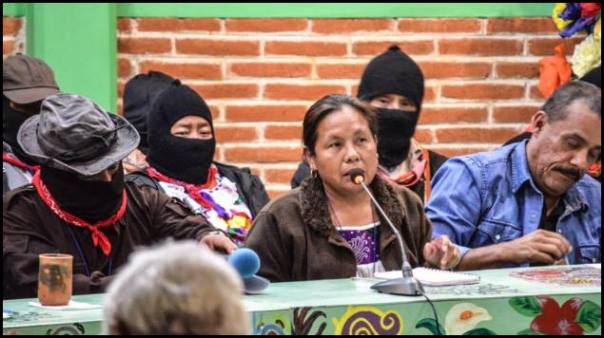
María de Jesús Patricio, spokesperson for the Indigenous Government Council
By: Luis Hernández Navarro
María de Jesús Patricio is an indigenous Nahua woman. Born in 1963 in the municipality of Tuxpan (land of the rabbit), Jalisco. She will be 54 years old next December. She is the mother of three children. She is a traditional doctor and herbalist. She has won different recognitions for her work in defense of the original peoples. Now she is also the spokesperson of the Indigenous Government Council and its candidate for the Presidency of the Republic.
Her friends and compañeros affectionately call María de Jesús “Marichuy.” Her commitment to the local and national indigenous struggle goes back many years. She attended the National Indigenous Forum, a Zapatista convocation, held in San Cristóbal in January 1996 as a representative of her community. In October 1996 she was part of the founding assembly of the National Indigenous Congress (CNI, its initials in Spanish) and read final declaration of the nascent organism. In March 2001, she responded brilliantly to the questions formulated by the legislators in the Chamber of Deputies, when the EZLN occupied the tribunal to defend the San Andrés Accords.
“We know –she said on that occasion to the deputies– that the national indigenous movement wasn’t born in 1994. The national indigenous movement has many years; it’s just that now, after 1994, is when Mexico shook and many who didn’t even know that the indigenous existed turned around to see.”
Very few individuals (men and women) have the pulse of what happens with the struggle of the original peoples that she has. Her knowledge of what’s happening in the entrails of the communities is profound and reflective. It is first hand. It comes, as much from her commitment to the reconstitution of her people, as from her participation of more than two decades in gatherings, forums, seminars, sharings and congresses all over Mexico. Additionally, she has elaborated a diagnostic statement of what is happening in the country.
It was during her participation in the National Indigenous Forum of San Cristóbal that she discovered that the inhabitants of her community were not the only poor ones and that other Native communities suffered the same problems as hers. She immediately adhered to the indigenous cause, in which she found her place and her life’s mission.
It was not exclusively an individual decision, but rather part of the feeling of all of a people. When Subcomandante Marcos visited Tuxpan, in March 2006, the representative of the municipality’s elders, Félix Vázquez Ceballos, told the Zapatistas: “Since 1994, the year in which you rose up against the government, the Nahua communities of Tuxpan have accompanied your step, because we have understood that your struggle is the struggle of all the indigenous peoples.”
María de Jesús remembers that when she was born, in Tuxpan there was only light and stone pavement in the center of the municipality, and the houses were made of adobe and roof tile. They used to carry water in jars hung on the ends of a stick (Revista Tukari, https://goo.gl/0sd0Kq).
The Nahuas of Tuxpan, dispossessed of their lands, had been neglected, impoverished and officially “disappeared” from the los census, in the face of the combined attack from cattle ranchers, the lumber industry, mining companies and government programs. And the teaching of their language was banished from the classrooms and educational programs.
Nevertheless, despite that aggressive neocolonial offensive against them, her indigenous identity resisted the pounding from the new colonialism. Against the current, from the intricacies of their culture, the Nahuas of Tuxpan undertook their reconstitution as a people. María de Jesús was fully involved in this rebirth.
Marichuy directs the Calli Tecolhuacateca Tochan Clinic, a space for the exercise and development of traditional indigenous medicine. A tool privileged in the reconstitution of the peoples, this therapy permits preserving and transmitting knowledge acquired for years by the ancestors. “It focuses –according to Doctor Patricio– not only on curing a particular evil, but also an evil of the community.”
Her calling as a traditional doctor was born in her since she was little, “when I observed how the older women, my aunts and my grandmother among them, healed the sick of fright, shock, possession by an evil spirit, bile, weakness or heat stroke. My Aunt Catarina, for example, did the cleansings with plants and she prepared ointments that she spread all over the body of the sick” (Revista Tukari, https://goo.gl/0sd0Kq). Her father and her aunt were her teachers.
The exercise of traditional medicine forms part of a project of broader resistance and emancipation. “The Clinic –asserts María de Jesús– has led us to the defense of traditional medicine, indigenous territories and Mother Earth from an anti-capitalist perspective, of the libertarian struggle of the indigenous peoples, a circumstance that has made us active promoters of the CNI, of the forums and meetings in defense of traditional medicine and of the strategic alliance between the civilian indigenous movement and the EZLN.” (https://goo.gl/d6M3eT)
Marichuy has reflected for many years on the question of the indigenous woman and her liberation. In her talk at the Seminar The Walls of Capital, the cracks of the Left, she documented the two faces of the feminine condition: on the one hand –she said– “the country is thinking without the woman,” and women are always oppressed and excluded, on the other hand –she assured– they are the ones who now head the resistances.
For her, dismantling capitalism walks hand in hand in the fight against machismo. That’s why she sees in the proposal of the CNI-EZLN that the Indigenous Government Council (CIG, its initials in Spanish) has a woman from below, indigenous and anti-capitalist, as its spokesperson and independent candidate to the Presidency of Mexico, the way to simultaneously struggle against machismo and the capitalist hydra.
On May 28, the CNI’s plenary, made up of 693 delegates, 71 council members, 230 Zapatista delegates and 492 invited guests, decided that the woman that is going to make history as the CIG’s spokesperson and candidate, who doesn’t seek votes, but seeks to defend life, is neither more nor less than her: María de Jesús Patricio.
———————————————————–
Originally Published in Spanish by La Jornada
Tuesday, May 30, 2017
http://www.jornada.unam.mx/2017/05/30/opinion/021a1pol
Re-Published with English interpretation by the Chiapas Support Committee
CNI-EZLN: The Time Has Come

Young Zapatista Woman
To the Peoples of the World,
To the Media,
To the National and International Sixth,
We send our urgent word to the world from the Constitutive Assembly for the Indigenous Governing Council, where we met as peoples, communities, nations, and tribes of the National Indigenous Congress: Apache, Amuzgo, Chatino, Chichimeca, Chinanteco, Chol, Chontal of Oaxaca, Chontal of Tabasco, Coca, Cuicateco, Mestizo, Hñähñü, Ñathö, Ñuhhü, Ikoots, Kumiai, Lakota, Mam, Matlazinca, Maya, Mayo, Mazahua, Mazateco, Me`phaa, Mixe, Mixe-Popoluca, Mixteco, Mochó, Nahua or Mexicano, Nayeri, Popoluca, Purépecha, Q´anjob´al, Rarámuri, Tének, Tepehua, Tlahuica, Tohono Odham, Tojolabal, Totonaco, Triqui, Tseltal, Tsotsil, Wixárika, Xi´iuy, Yaqui, Binniza, Zoque, Akimel O´otham, and Comkaac.
THE WAR THAT WE LIVE AND CONFRONT
We find ourselves in a very serious moment of violence, fear, mourning, and rage due to the intensification of the capitalist war against everyone, everywhere throughout the national territory. We see the murder of women for being women, of children for being children, of whole peoples for being peoples.
The political class has dedicated itself to turning the State into a corporation that sells off the land of the original peoples, campesinos, and city dwellers, that sells people as if they were just another commodity to kill and bury like raw material for the drug cartels, that sells people to capitalist businesses that exploit them until they are sick or dead, or that sells them off in parts to the illegal organ market.
Then there is the pain of the families of the disappeared and their decision to find their loved ones despite the fact that the government is determined for them not to, because there they will also find the rot that rules this country.
This is the destiny that those above have built for us, bent on the destruction of the social fabric—which allows us to recognize ourselves as peoples, nations, tribes, barrios, neighborhoods, and families—in order to keep us isolated and alone in our desolation as they consolidate the appropriation of entire territories in the mountains, valleys, coasts, and cities.
This is the destruction that we have not only denounced but confronted for the past 20 years and which in a large part of the country is evolving into open war carried out by criminal corporations which act in shameless complicity with all branches of the bad government and with all of the political parties and institutions. Together they constitute the power of above and provoke revulsion in millions of Mexicans in the countryside and the city.
In the midst of this revulsion they continue to tell us to vote for them, to believe in the power from above, to let them continue to design and impose our destiny.
On that path we see only an expanding war, a horizon of death and destruction for our lands, our families, and our lives, and the absolute certainty that this will only get worse—much worse—for everyone.
OUR WAGER
We reiterate that only through resistance and rebellion have we found possible paths by which we can continue to live and through which we find not only a way to survive the war of money against humanity and against our Mother Earth, but also the path to our rebirth along with that of every seed we sow and every dream and every hope that now materializes across large regions in autonomous forms of security, communication, and self-government for the protection and defense of our territories. In this regard there is no other path than the one walked below. Above we have no path; that path is theirs and we are mere obstacles.
These sole alternative paths, born in the struggle of our peoples, are found in the indigenous geographies throughout all of our Mexico and which together make up the National Indigenous Congress. We have decided not to wait for the inevitable disaster brought by the capitalist hit men that govern us, but to go on the offensive and convert our hope into an Indigenous Governing Council for Mexico which stakes its claim on life from below and to the anticapitalist left, which is secular, and which responds to the seven principles of Rule by Obeying as our moral pledge.
No demand of our peoples, no determination and exercise of autonomy, no hope made into reality has ever corresponded to the electoral ways and times that the powerful call “democracy”. Given that, we intend not only to wrest back from them our destiny that they have stolen and spoiled, but also to dismantle the rotten power that is killing our peoples and our mother earth. For that task, the only cracks we have found that have liberated consciences and territories, giving comfort and hope, are resistance and rebellion.
By agreement of this constitutive assembly of the Indigenous Government Council [CIG its initials in Spanish], we have decided to name as spokesperson our compañera María de Jesús Patricio Martínez of the Nahuatl people, whose name we will seek to place on the electoral ballot for the Mexican presidency in 2018 and who will be the carrier of the word of the peoples who make up the CIG, which in turn is highly representative of the indigenous geography of our country.
So then, we do not seek to administer power; we want to dismantle it from within the cracks from which we know we are able.
OUR CALL
We trust in the dignity and honesty of those who struggle: teachers, students, campesinos, workers, and day laborers, and we want to deepen the cracks that each of them has forged, dismantling power from above from the smallest level to the largest. We want to make so many cracks that they become our honest and anticapitalist government.
We call on the thousands of Mexicans who have stopped counting their dead and disappeared and who, with grief and suffering, have raised their fists and risked their own lives to charge forward without fear of the size of the enemy, and have seen that there are indeed paths but that they have been hidden by corruption, repression, disrespect, and exploitation.
We call on those who believe in themselves, who believe in the compañero at their side, who believe in their history and their future: we call on them to not be afraid to do something new, as this is the only path that gives us certainty in the steps we take.
Our call is to organize ourselves in every corner of the country, to gather the necessary elements for the Indigenous Government Council and our spokeswoman to be registered as an independent candidate for the presidency of this country and, yes, to crash the party of those above which is based on our death and make it our own, based on dignity, organization, and the construction of a new country and a new world.
We convoke all sectors of society to be attentive to the steps decided and defined by the Indigenous Government Council, through our spokeswoman, to not give in, to not sell out, and to neither stray from nor tire of the task of carving the arrow that will carry the offensive of all of the indigenous and non-indigenous peoples, organized or not, straight toward the true enemy.
From CIDECI-UNITIERRA, San Cristóbal de las Casas, Chiapas
May 28, 2017
For the Full Reconstitution of Our Peoples
Never Again a Mexico Without Us
National Indigenous Congress
Zapatista National Liberation Army
En español: http://enlacezapatista.ezln.org.mx/2017/05/28/llego-la-hora-cni-ezln/
CNI | EZLN Solidarity and support for our brothers and sisters of the Wixárika people
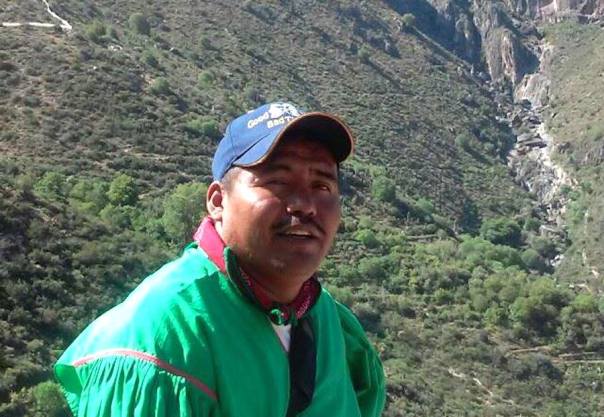
Miguel Vázquez Torres
To the Wixárika People
To the Peoples of the World
Gathered together in the Constitutive Assembly of the Indigenous Council for Mexico at CIDECI–UNITIERRA, Chiapas, the indigenous peoples, nations, and tribes who make up the National Indigenous Congress and the Zapatista National Liberation Army say to the Wixárika people that we stand together, that your pain and rage are also ours, and that the path of your historic struggle is part of the hope we have as a country and as a world.
We repudiate and condemn the cowardly murder of the compañeros Miguel Vázquez Torres and Agustín Vázquez Torres of the Wixárika community of Waut+a- San Sebastian Teponahuaxtlán in the state of Jalisco on May 20 of the present year at the hands of the mercenaries of organized crime. This crime could not have happened without the absolute complicity of the bad governments on all levels, given that the riches of the Wixárika lands are coveted by the powers of capital which know no limits and which use their narco-paramilitary groups to try to dismantle an organization as exemplary as that of the Wixaritari.
We know they will not achieve this; they have never been able to and never will because the fabric that keeps the original peoples alive also sustains the hope we are building together in order that a new world be born of resistance, rebellion, and the determination to keep existing.
We salute the exemplary defense of the territory that the compañero Miguel led, without ever turning back, as well as the paths the Saint Sebastian community is forging to recuperate nearly 10 thousand hectares invaded by ranchers, supposed small landowners from Huajimic, Nayarit. These ranchers are protected by the capitalist governments’ determination to pretend to dialogue while preparing a bloody end to this conflict, disguising it as drug cartel activity, as unclear state or municipal borders, as lying “task forces” i, as complicated judicial proceedings, or as supposed budget limitations.
Wixaritari compañeras and compañeros, we are with you and we know that the steps you collectively decide to take will be wise and dignified. We will not be indifferent nor oblivious to the support and solidarity that we have mutually shared on the CNI’s historic path.
We emphatically demand the solving of this crime against a whole people, punishment of the guilty, and the dismantling of the Jalisco New Generation Cartel and all the criminal capitalist corporations that seek to take over the territories and autonomous organization that we peoples, nations, and tribes defend.
We demand that the the ancestral territories of the Wixárika people be wholly respected, that the territory invaded on the outskirts of Huajimic, Nayarit, be urgently restored [to the people], and that the forms of security and justice decided upon and exercised by the community of Waut+a- San Sebastian Teponahuaxtlán be fully respected.
Attentively,
May 27, 2017
National Indigenous Congress
Zapatista National Liberation Army
En español: http://enlacezapatista.ezln.org.mx/2017/05/27/solidaridad-y-apoyo-con-el-pueblo-hermano-wixarika-cni-ezln/
Marichuy, the independent candidate close to the EZLN
Marichuy, the independent candidate always close to the EZLN since 1994 and one of the founders of the CNI
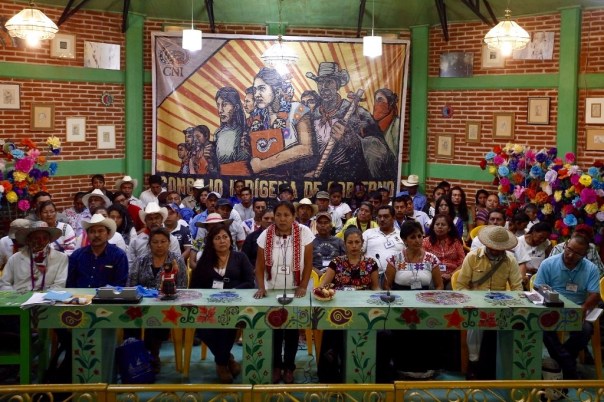
Marichuy, spokesperson of the CIG and elected as an independent candidate for president of the Republic in 2018
By: Isaín Mandujano
“Even with all our contradictions, this movement goes on, because to the peoples to whom we are not obliged, because while we want to be on the electoral ballots in 2018, our struggle will be for life, for organization, to continue existing,” members of the Indigenous Government Council (CIG, its initials in Spanish) said upon presenting and supporting María de Jesús Patricio Martínez as the spokesperson and independent candidate to the presidency of the republic.
A Nahua of Tuxpan, in southern Jalisco, where she was born on December 23, 1963, the indigenous woman who completed high school to dedicate herself to the preservation of traditional and herbal medicine, was the one elected as the spokesperson of the Indigenous Government Council by the National Indigenous Congress and by the General Command of the Indigenous Revolutionary Clandestine Committee (CCRI-CG) of the EZLN.
“We think that compañera Marichuy, doesn’t sell out, doesn’t give up and doesn’t surrender, as she was trained inside the CNI, we believe that,” said one of the women of the CIG al leer the pronouncement of the Constitutive Assembly.
Marichuy, as everyone in the CNI and the Zapatistas know her, received the unanimous support of everyone present in that big hall in which were more than 1,400 delegates of some 58 indigenous peoples and some 250 more EZLN representatives.
In May 2015, for preserving traditional and herbal medicine, as well as for her linkage with the country’s indigenous communities, the Tuxpan Municipal Government Council delivered the Tuxpan Award of Merit to María de Jesús Patricio Martínez (Marichuy), allotted by the Unit of Support to the Indigenous Communities of the Coordination of Linkage and Social Service of the University of Guadalajara.
The award was given to her in the area of Science and Culture, for her work in the House of Health with traditional and herbal medicine.
Today Marichuy directs the Calli Tecolhuacateca Tochan Clinic, a place for the exercise and development of the traditional indigenous medicine of the Nahua community of Tuxpan. The Indigenous Communities Support Unit (UACI) of the University of Guadalajara (UdeG) has supported this project for 22 years, for the purpose of attending to the sick with an integral community health scheme that serves as a space for the training of the region’s indigenous health promoters.
Currently, the Calli Tecolhuacateca Tochan Clinic is located on Abasolo Street, number 57-A, in the El Cóbano neighborhood. It’s open Monday through Friday from 9:00 am to 2:00 pm and from 4:00 pm to 6:00 pm. On Saturdays it’s open from 9:00 am to 2:00 pm. Until today, she has personally attended to people.
But her life has taken a radical turn by now being named spokesperson of the CIG and an independent candidate to the presidency of the republic on the part of the indigenous peoples.
Although neither she or her husband Carlos González, who is also a figure and stands out inside the CNI, have said so, their children will remain under the care of the EZLN support bases and commanders in Chiapas, who will take care of them and give them protection, but above all give them education.
Prior to her name being known, some already predicted that it she would be the one elected, because few women like Marichuy have stood out inside the CNI. Since the EZLN’s 1994 armed uprising, she was already supporting the Zapatista cause. She participated in every one of the events that the armed group has convoked.
She was chosen to take the microphone on the platform, together with the Zapatista commanders and sub-commanders, after the first departure of the Zapatistas from the Lacandón Jungle and their big march to Mexico City. It was on that occasion that Comandanta Esther of the EZLN stood out.
Recognized as one of the founders of the CNI, in her speech on March 29, 2001 before the Congress of the Union, Marichuy spoke in the name of the indigenous women of Mexico.
 That tiny little woman that was always going from one side to another in each and every one of the gatherings and forums that the EZLN celebrated in the CIDECI-Unitierra of San Cristóbal de Las Casas, in Oventik, or in any other Zapatista Territory or Caracol.
It wasn’t difficult for experts in Zapatismo to know that the EZLN and the CNI would anoint Marichuy on Sunday the 28th, when around three o’clock in the afternoon white smoke came out of that big auditorium.
Absent in that auditorium, but present in another room nearby, following every detail of the Constitutive Assembly, were Subcomandante Galeano and other commanders like Tacho, and other individuals that have always supported the civilian path, Jorge Javier Elorriaga and Sergio Rodríguez Lazcano.
Subcomandante Insurgente Moisés headed the plenary of the Constitutive Assembly together with Bettina Cruz Velazquez, of the indigenous Zapotec people and a member of the Assembly of the Indigenous Peoples of the Isthmus of Tehuantepec in Defense of Land and Territory, Santa María Xadani, Oaxaca.
The CIG members introduced Marichuy and pointed out that more than an electoral campaign it will be a campaign for la organization, for life, for defense of territory. Its mission will be the articulation of all the country’s indigenous peoples and movements.
Although they did not say it, it could be something similar to the “Other campaign” that then Subcomandante Marcos (Comandante Zero) made through the whole country, but the difference is that this time they seek to appear on the 2018 electoral ballots.
Marichuy said that she will take this “great responsibility” that the CNI and the EZLN have given her, but she is not alone in that, but rather she counts on all the support of the members of the CIG that are around 50 men and women, all from different states of the country and from different indigenous peoples.
The next meeting for everyone to get together will be October 12 in Zapatista Territory. Marichuy, as well as the new council members, made a call to all the indigenous peoples of Mexico to add themselves to this struggle before capitalism levels and disappears all the original peoples.
——————————————————————-
Originally Published in Spanish by Chiapas Parallel
Monday, May 29, 2017
Re-Published with English interpretation by the Chiapas Support Committee
CNI Mexico: It’s time for the voice of the peoples
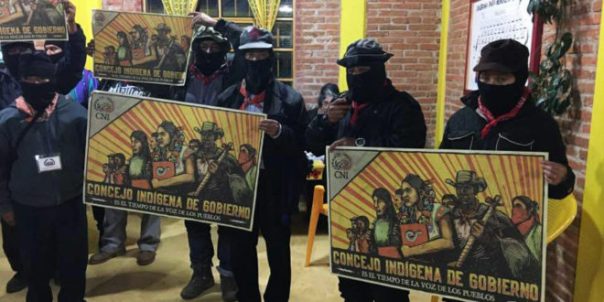
Published by Pozol Colectivo
San Cristóbal de las Casas, Chiapas, Mexico
Numerous buses and long lines of delegates from the national Indigenous Congress (CNI), gathered today at the Cideci-Unitierra, at the start of registration for the Constitutive Assembly for the Indigenous Government Council (CIG), whose spokesperson will be a candidate in the 2018 presidential elections in Mexico.
With the slogan “it’s time for the voice of the peoples,” members of the original peoples for the CIG’s constitutive assembly, after having consulted on the proposal in each one of their communities in Mexican geography and after having been approved by their members.
Representatives of the Cucapa and Kumiai people arrived from Baja California; Chol, Maya, Tzeltal and Castellano from Campeche; Castellano, Chol, Mam, Tojolabal, Tzeltal, Tzotzil, Lacandón and Zoque from Chiapas; Raramuri from Chihuahua, Nahua from Mexico City; Nahua from Colima; Wixarika from Durango; Chichimeca from Guanajuato; Afro-Mexican, Mephaa, Nahua, Amuzgo and Ñu Savi from Guerrero; Nahua from Hidalgo; representatives of the Coca, Nahua, Tepehuano and Wixarika peoples from Jalisco; Matlatzinca, Nahua, Otomí-Ñatho, Otomí-Ñañhú from the State of Mexico; Mazahua, Nahua, Otomi and Purépecha from Michoacan; Nahua of Morelos; delegates from the Nayéri and Wixarika peoples of Nayarit; the Chinantecos, Cuicateco, Ikoots, Mazateco, Mixe, Ñu Savi, Triqui, Binniza, Chontal and Zoque from Oaxaca; the Nahuas and Totonaco from Puebla; the Otomí-Ñañhú from Querétaro; the Mayas of Quintana Roo, the Castellanos and Nahua of San Luis Potosi, representatives of the Mayo People of Sinaloa; the Guarijio, Mayo, Seri, Tohono and Yaqui of Sonora; the Chol, Chontal and Zoque from Tabasco; the Nahuas, Otomí-Ñuhú, Popoluca, Sayulteco, Tepehua and Totonaco from Veracruz; the Mayas from Yucatan; and the resident migrant peoples in Guadalajara and in the Valley of Mexico.
For tomorrow, May 27, they foresee the inauguration and installation of the Constitutive Assembly of the Indigenous Government Council for Mexico, as well as workshops with the following axes:
1) Proposals and strategies of the Indigenous Government Council;
2) Functioning and Organization of the Indigenous Government Council;
3) Linkage of the Indigenous Government Council with other sectors of civil society; and,
4) Naming of the Spokesperson of the Indigenous Government Council.
Translators Note: Espoir Chiapas, an online publication of French solidarity folks, reported that there were thousands of people attending.
—————————————————————–
Originally Published in Spanish by Pozol Colectivo
Friday, May 26, 2017
Re-Published with English interpretation by the Chiapas Support Committee
The CNI starts meeting today
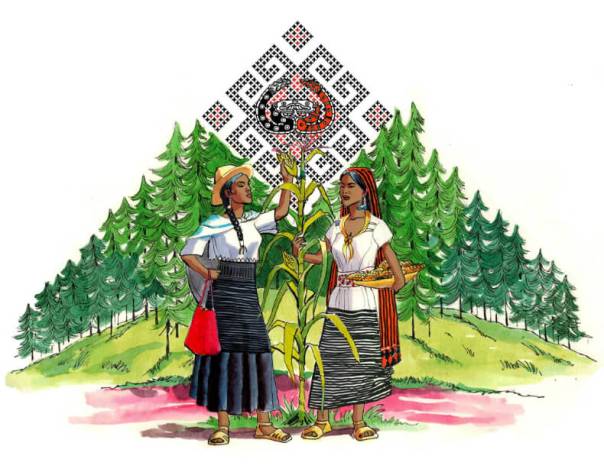
Published by Pozol Colectivo
Chiapas, Mexico
“The National Indigenous Congress prepared for 20 years to reach this day and point out a good path,” Subcomandante Moisés argued last January 1, with respect to the creation of the Indigenous Government Council on the part of the National Indigenous Congress on May 26, 27 and 28, and whose spokesperson will be a presidential candidate in the 2018 elections. “Who will now question the path they have chosen and to which they are calling everyone?” If their struggle and the path that they follow is not respected, if it is not welcomed, if it is not supported, then what message does society send? What paths are left for indignation,” the Zapatista Chiapaneco asked. “This struggle is for those who have nothing more than pain, rage and desperation,” he assured from the Zapatista Caracol of Oventic Chiapas.
It was on October 14, 2016, when the National Indigenous Congress (CNI), after denouncing a panorama of “death, violence, dispossession and destruction” against the original peoples, reported its intention to consult in each one of its territories, the agreement of the Fifth National Congress to name an Indigenous Government Council (Concejo Indígena de Gobierno, CIG), whose word would be materialized by an indigenous woman, an independent candidate to contend in the name of the CNI, in the 2018 presidential elections. “We confirm that our struggle is not for power, we don’t seek it; but rather we will call upon the original peoples and to civil society to get organized in order to stop this destruction,” the indigenous Mexicans specified in the communiqué “May the earth tremble at its core!”
“If just the possibility of citizen existence (with all its rights and obligations), of an indigenous woman, makes “the earth tremble at its core,” what would happen if her ear and her word would travel through the Mexico of below,” asked Subcomandante Galeano on October 21, 2016, facing the wave of comments over the nomination of an indigenous woman in the 2018 presidential elections and the creation of the CIG. “Are they worried that the indigenous woman doesn’t know how to speak Spanish well, but not that the current head of the federal executive doesn’t know how to speak, period,” the EZLN spokesperson added. “Is it that the Mexican political system is so solid, and that the tactics and strategies of the political parties are so fundamental and consistent that it’s enough that someone says publicly that he’s thinking something, and that he’s going to ask his peers what they think about what he’s thinking, that they become hysterical,” asked the insurgent.
The CNI’s proposal provoked so many unfounded questions that on November 11, 2016, Subcomandante Moisés, in the name of the EZLN, dedicated a comunicado called ”It’s not the decision of one person,” to “the racists.” “Why do you turn against the indigenous and treat them like they have no brains and that they don’t know where they’re going,” the indigenous Chiapaneco asked. “First, learn to read, then read it well, then learn to understand what you read,” the Zapatista leader recommended. To the “PhDs and even honorary doctors or however you say it,” which turns out to be that: “you don’t know how to read or write,” and plainly “you don’t understand anything.” The insurgent specified that in the CNI proposal, “It doesn’t say that the EZLN is going to consult with its support bases as to whether they are in agreement with running an independent candidate from the Zapatista support base.” “They say they are very studious and have a lot of advanced technology and don’t even bother to read; they go to the corporate media and get their words from there,” Moisés asserted about the “intellectuals.”
On December 2, the CNI and the EZLN, felt the need to publish a joint communiqué titled: “Despite aggressions, the consultation continues,” in which they reported that: “the fear of the powerful, of the extractive industries, of the military, of the narco-paramilitaries is so great that our consultation is being attacked and harassed where our peoples are meeting to discuss and decide the steps to follow as the CNI;” and he used as an example the cases of: Santa María Ostula, Michoacán, Zoque territory of Northern Chiapas and San Luis Acatlán, Guerrero.
On January 1, 2017, the results of the CNI consultation was announced: “gathered together in this 5th Congress, 43 peoples of this country, WE AGREE to name an Indigenous Government Council with male and female representatives from each one of the peoples, tribes and nations that belong to it. This council proposes to govern this country and it will have as its spokesperson an indigenous woman from the CNI, who will be an independent candidate to the presidency of Mexico in the 2018 elections.” In the same way, the indigenous Mexicans specified with respect to the political parties that: “Don’t be confused about us, we don’t seek to compete with them because we are not the same, we are not their lying and perverse words. We are the collective word of below and to the left, that which shakes the world when the earth trembles with epicenters of autonomy, and that makes us so proudly different.”
Subcomandante Moisés, in the name of the EZLN indicated that same January 1, 2017, that: “Now, conditions of the people of Mexico in the countryside and the city are worse than 23 years ago,” when they rose up in arms. “Poverty, desperation, death and destruction, are not only for those who originally populated these lands. Now, the affliction reaches everyone,” the EZLN’s military chief explained.
“Now our brothers and sisters from the organizations, barrios, nations, tribes, and original peoples, organized in the National Indigenous Congress, have decided to shout their YA BASTA (ENOUGH!). They have decided that they are not going to permit that our country continues to be destroyed. They have decided not to let the people and their history die because of the sickness that is the capitalist system. And they have decided to do it by means of civilian and peaceful paths. Their causes are just, undeniable,” Moisés argued.
“Now, the National Indigenous Congress calls us to a struggle in which all of us can participate, without age, color, size, race, religion, language, income, knowledge, physical strength, culture or sexual preference mattering. The struggle to which the National Indigenous Congress calls us and invites us is a struggle for life with liberty, justice, democracy and dignity. It’s the hour of all working people, together with the original peoples, lodged under the flag of the National Indigenous Congress,” the EZLN spokesperson said.
—————————————————————–
Originally Published in Spanish by Pozol Colectivo
Thursday, May 25, 2017
Re-Published with English interpretation by the Chiapas Support Committee
Mexico: the legacy of the left | Pablo González Casanova

Subcomandante Moisés and Pablo González Casanova in the seminario ‘The walls of capital, the cracks of the left.’ Photo: Daliri Oropeza
By: Pablo González Casanova
The EZLN invited the former rector of the UNAM to offer a conference at the seminar ‘The walls of capital, the cracks of the left’, and he explained what left ideology is. He also criticized the closure of Donald Trump with respect to climate change and maintained that the Zapatistas’ intention to participate in the presidential elections is an opportunity to open the consciences of Mexicans.
Here is his complete discourse:
First an excuse, because yesterday I was trying to finish, and I finished, a paper that I was going to read and that now I think that it was best not to read… Because, I had brought three texts to Chiapas, thinking that I was going to speak at the beginning of the meeting, of the gathering, and it turns out that they invited me for the end of the gathering, and what I was thinking about saying wasn’t appropriate. Then I decided to do… agreeing with the teacher Alfonso Reyes, who told me that when I was able to give a conference without reading, it would be much better to give it without reading, and that if I read it I would see more… of the audience than the paper. Here I can see a little, in the midst of the darkness, of the audience, and telling you that I think about the convenience of what the left is to… in part, contradict those who are accusing us of dividing the left. And it seemed to me that that problem is interesting to bring up here, and then it occurred to me to see how the Mexican people have defined the left throughout their history.
I started to think about the rebel priests that fled from the Inquisition and from the Christianity of Carlos V and Felipe II. And those rebel priests are the beginning of a process that corresponds to human emancipation; and that naturally includes a category that didn’t exist in the social sciences, or that wasn’t central in the social sciences, and that is central in human life, which is the category of the exploitation of some men over others.
That category didn’t exist before, but it’s not the only thing that makes emancipating thought, in other words, you can’t have human emancipation if there is exploitation of some men by others; that is absolutely clear, but ending exploitation is not sufficient because human emancipation is much more than that. Then, starting with this position, it seemed to me that those priests; that priest that went up to the pulpit on the island of Santo Domingo and before the fury, the unleashed rage of the conquistadores, declared or said in his sermon that the Indians have a soul; in other words, they are not animals… that priest demanded respect for them, for their human dignity. And the conquistadores became furious, and good, in reality they were the heirs of the Aristotle that managed the Inquisition, the one that recommended Alexander the Great, a disciple of theirs, when he went away to conquer Asia; and told him: “treat the Greeks as citizens and the Barbarians as animals or as plants.”
Then, respecting the human being, respecting the dignity of the human being, is a very big struggle that continues happening even today; and the word, the term dignity, is part of the terminology most dear to us.
I just sent the Marxist Encyclopedia of Social Sciences of Germany a work about dignity, and there I cite those rebel priests that vigorously defended the dignity of the Indians. But as we see, this struggle continued until our time and among the theologians appeared liberation theology with Gustavo Gutiérrez, in Peru; with several notable theologians and political thinkers in Brazil, like Leonardo Boff, or like Frei Betto, who I have met many times in Cuba, and who is now fighting not only for recognizing the human dignity of the Natives, but also for socialism.
A first definition then of left would be: that which struggles for the human dignity of whatever human being that is oppressed and discriminated. A second one is the struggle for independence, a struggle which is not given the importance that it had, and that it has, but until very recently; until some decades ago with Fanon, in which the colonial man –he that lives in the colonial countries- appeared as an oppressed man, and under an oppression and a form of domination and of scorn, and of deprivation, special; and so special, that now we see for example with what is occurring in Africa.
In 7 African countries, several million inhabitants are about to die or have already died of hunger; a thing that will happen if what Magdalena Gómez told us yesterday, according to what they told me, occurs in Mexico, where they are not only taking resources like oil, electricity, etcetera away from us, but also lands, water and subsoil, and where colonial “enclaves” are being created like the ones that she mentioned.
So, it remains a special problem to be against colonialism, which later on is going to link to monopoly capital and is going to acquire another name, that of imperialism, and I will talk about that a little later. The struggle for independence also united the Indian peoples with the leaders of the Independence… When Guadalupe Victoria proposed Morelos to lead the war, Hidalgo, as they told me, answered him: “No, this is a war of the people” and it seems that there were more Indian peoples in the war fighting for independence that mestizos, or whites.
So, the Indians have been inserted in our history ever since this country was born as an independent one, and we must realize that what is now being done is saying that again; again expressing the tight linkage, the total linkage that the Indian and the non-Indian have in Mexico. Also that pair of priests, Hidalgo and Morelos, apart from waging the people’s war, one of them, Morelos, made the first self-governed community, and that is another way of defining the left: with communities and networks of self-governed and self-sufficient communities.
And now I turn to a legacy more about what those who carried on that somewhat fundamental Marxism, with which I don’t agree, said that it was a bourgeois revolution, etcetera; but no, it’s something else, another legacy of emancipation that Don Benito Juárez is going to realize. Emancipation from what! From the use of religion to oppress and from the church hierarchy that together with many of the colonial era’s wealthy were the ones that remained with the power and riches when Spain could no longer retain them. And it was a great virtue of Juárez to make “The Reform” as it’s called, the most profound in all of Latin America, taking their immense properties away from the clergy, and establishing lay education and the right to think without anyone invoking God to tell you that you were wrong. So, that’s another legacy that defines the left and the struggle for human emancipation.
Other forms of emancipation also appear with the liberals. One is that which happens through University Autonomy; the great struggle that occurs throughout the 19th and 20th centuries, and that demands State independence so that official thinking does not intervene in what the professors and students teach and learn. It was and is a marvelous struggle, which continues happening over the years and that will give us up to “’68” much of what human emancipation is.
And in that current someone stands out who wasn’t born in Mexico, but who is Latin American and is one of the most notable writers of the Spanish language: José Martí, who represents a radical liberalism, of a truly extraordinary depth, because on the one hand he gives a strength, a central importance, to the moral as power; and on the other hand, he denounces, with his richest pen, the nascent imperialism; and even more… he organizes a revolutionary struggle in which he invites a communist to form part of the revolutionary leadership. All this radical liberalism at the end of the XIX Century is the antecedent of the only revolution that survives at this moment out of all the struggles that were made in search of socialism. And it means that those who rejected, or even asked us not to speak about morality, didn’t understand that we weren’t talking about morality, as Benedetti correctly called it, but rather we were talking about the spirit of struggle, the spirit of cooperation and of a word that always comes to me in red on the computer because the Spanish Academy still doesn’t accept it and that the Zapatista compañeros invented here, which is what permits us to emphasize the spirit of sharing (compartición)… So, the spirit of struggle, the spirit of cooperation, the spirit of sharing clarify what spirit we are talking about and that we tenaciously seek to practice; and both clarifications finish completely with the absurd proposals, and with the false syllogisms that a large anarchist current suffered, and also finish with the simulation of those who talk about spirit only to deceive and pretend that they are something they aren’t…
Thus, the contributions to the left from the liberal currents are very strong and are going to last until our day when they are enriched a lot with countless experiences and practices that proved their strength in the power of movements and collectivities.
But, I am going to more or less follow the course of history of legacies and I’m going to move to the Mexican Revolution, in which Mexico is also the one that made the most profound agrarian reform in all of Latin America, a revolutionary reform in which the campesinos and the Indian peoples participated very actively, above all with the historic Zapatismo, with the first Zapatismo, and it wad a revolution of those that were overlooked in a certain moment as bourgeois by those who also qualified as bourgeois to the revolutions of State socialism, in a way of thinking using stereotypes that impede us from seeing the evolution of the struggles and of the revolutionary and counter-revolutionary actions. And it’s the struggles in their historic drive that really define the processes… In effect, the Mexican Revolution was not a revolution that the workers would have made alone, and moreover, communism had not spread as much as anarchism among the workers.
But the los workers participated in that war the campesinos, the Indian peoples and the petty bourgeoisie participated, and it became a revolution that achieved that 1917 Constitution, which was much more advanced than that of the Soviet Union, with really extraordinary political principles of free self-determination of the peoples and of non-intervention, and with workers rights and campesino rights… and all that occurred in processes in which it seems that for a moment the bourgeoisie allied with the popular forces for the objectives that they seek, but little by little those alliances were lost, and the bourgeoisie again recuperated its consuming greed and their egotism and the process functions in the most perverse manner… It produces a phenomenon that we have seen recently with the majority of the new progressive governments of Latin America.
It is a phenomenon that is repeated and will be repeated whenever possible, if we are not prepared to confront it as soon as it appears. And that process occurred with the Mexican Revolution of that era, which we see having really extraordinary moments of left definition. Its policy, for example, of receiving Trotsky, was really a very, very great talent for explaining what our position was; because on the other side was the alliance with Lombardo and with the workers, an alliance of classes that Lombardo took too far and that was discredited, but that at a given moment helped him radicalize many of the positions of his own Cardenismo.
Then, in Mexico we see one of the revolutions, which at the global level led to revolutionary nationalism, to the most profound re-structuring of national sovereignty, of the right to land of the campesinos, ejido owners, comuneros and small property owners, of the right of workers to organize to defend their values and interests. And that revolution, like many others, suffers a process of recuperation that leads first to establishing governments of the so-called populist type, with a populism in which the lack of public spirit starts to prevail, but not to the degree that will dominate today. There is really a qualitative leap in shamelessness, and at this moment this leap has taken place and one sees that the impunity and the exhibition of illegally obtained wealth, coincide with the impoverishment of the country and its people.
Then that populism is going to stumble and is going to lose fore and there enters the grand project of domination and accumulation of globalizing neoliberalism on a worldwide scale. And that project has reached a global level because something similar was occurring in the Soviet Union and in China to such a degree that Kissinger organized the so-called ultra-left very well, which ravaged in Peru and finished off many cadres of the Communist Party, which was pro-Soviet.
And in the case of President Allende… I was there when Compañero Fidel Castro was, and the de-stabilization policy was operating in which at the same time that prices went up, supplies were hidden and provocateurs were let loose to agitate; and many of them were genuine, they were not police agents, but believed they were more revolutionaries and had the green light as a consequence of the previous talk with Mao Tse Tung and Kissinger. And so we saw and we see a very, very painful process in which the discourse, reflection and reasoning of Fidel was useless.
I heard him there, I was at several events where Fidel was, and in one of them we were in the City’s Government Palace and they -Allende and Fidel- were on the central balcony, and I was physically a little to their left. Then Fidel gave a marvelous speech, truly, and suddenly when he had now captivated his audience, he said: -“And do you believe, do you think… that the people are wrong?” And then everyone in the plaza shouted: -“No, they are not wrong!” “Well believe it!” That laughter was the loudest that I have heard in my life. And so what he was trying to explain to them is that the correlation of forces that Allende had, were not able to recognize it, and that Allende could not go farther, nor faster, and that they were trying push him to take it farther; because a person that is running, can only be pushed in two ways: by pushing the foot, or by pushing him in the back. And that was what they were doing.
So there we have another problem, another way of defining the left in the sense one has who carefully calculates the kind of alliances that are made, and that there are always possibilities of error, but that thinking in terms of a single current is completely contradictory and unity in diversity is necessarily imposed.
There is one more element to which I want to refer and it’s that which concerns the enrichment of values, or of the goals for which the left struggles. That enrichment takes place in a notable way in the case of Cuba, where it’s authentically certain that the teacher, or the intellectual author of the revolution… is Martí, and where we see that we’re really dealing with another socialism. And it’s enough to see the role that the Cuban Communist Party plays, which is not a party that dominates truth and that is the spokesperson of the conscience of the proletariat; but rather is a party that orient and that learns. And we see there an enormous importance that defines the left with liberation pedagogy of Paulo Freire and with Fidel’s speeches, which are really exemplars for transmitting power to the people; because it’s very, very pretty to think that the people govern, but do they know how to talk, do they know how to listen? No, but they can be taught, and by teaching them, one can also learn. And that’s what happened to the leaders of the July 26 Revolution; they learned a lot. So, there appears a new revolution that we see has a capacity for resistance that the others didn’t have, and that will be the final theme to which I refer; because before I would like to say something more in relation to the new values that define the left and human emancipation.
One of them refers justly to the woman, the homosexual, the trans-sexual, to a series of values that were not recognized and that suddenly emerge in the forefront with appalling sufferings whose existence we had not perceived, and that occurs in “68” with the student movements. And as the population had a much shorter life expectancy before, for example, I would not be speaking here if we were in the 19th Century, because a new and very important figure appears in the revolutions, which is the youth. And the youth play a role of linkage between all ages and brings these new values to the forefront, and brings them, for example, with another extremely original movement of which I am going to speak very carefully because I don’t want to commend my hosts too much, who show me this fraternal hospitality; but what has occurred in the Lacandón, I believe that is the beginning of a project of universal democracy.
If imperialism, if monopoly capital, if the business, military, political and media complexes have a project of neoliberal globalization, I believe that we have a project that was born here in the Lacandón, which is not only national, which is universal and that will be universal if humanity is saved. That is the ultimate problem that I wanted to treat. And it’s that we are seeing a tremendous effectiveness of the new forms of organization that are using two techniques, or two scientific technologies, very efficient. One of them is relates to the communications sciences, of information, of messages, of the reading of the message and of the execution of the message.
Another is linked to the existence, or modeling and staging of systems that are called intelligent and that seek to achieve an objective. And that whole system is dominated by a completely foolish system, which is capitalism, and which is denying the validity, the value of the very sciences that it cultivates as soon as they say that something affect its greed for power, wealth and profits.
The problem is that in academic life there is a fear, an attitude of caution, a fear that prevents its members from saying that there is really no solution for resolving vital problems inside of capitalism. That all the measures that capitalism has taken in the past to solve its crises and the problems it poses to humanity and the earth, to life on earth are in crisis, but many specialists don’t dare to say it and I give you an example: Trump recently denied that climate change was due to industrial gases and returned to the use of coal and other contaminants and ignored the value of science, and the president of the U.S. Academy of Sciences wrote a letter of protest, but at the end of the letter, he says that science opened the Pandora’s Box; in other words, for these people to think that capitalism is the origin of its own death and of the death the death of their own heirs is impossible. They are foolish and impertinent, and they become furious; as you will have seen if you are told something that is absolutely elemental. It’s as if one were angry because the law of gravity exists and one becomes furious.
We encounter a very delicate situation in which movements like the Zapatista movement are of the utmost importance; and for me, as much Cuba as the Lacandón, are the hope for humanity. In both of them there are present all the values of potential human emancipation, and there is a fact that we must carefully repair, and that is that in other countries we believed were going towards socialism, and at least I never imagined that we were going to return to capitalism; and capitalism was restoring and is now governing in Russia, in China and in the West. So, the responsibility of our project is immense because presents elements for passing from the idea of democracy, to the idea of democracy with power distributed among all the people. There is the possibility of going from (the democracy of) pure rhetoric to democracy for all, with everyone and for everyone, and to a world in which all worlds fit. It can become reality that that could remain nothing more in a sentence, in a group of words, in a group of concepts; it can become reality by the techniques that we put in order today and by la spirit of struggle, of cooperation and of sharing that we sustain.
We have an advantage now, and it’s that what before had to remain rhetoric, can now become real and we must take advantage of it and have the capacity to increase it; we must increase our ability to communicate our projects with the rest of the world, beginning with our country. This is why the decision that the EZ has made with the National Indigenous Congress to participate in the elections, and of doing it in the form in which it was introduced, knowing that the electoral processes have served exclusively for intervening in class struggles and the struggles of the peoples; now it’s entering, not to play that intervening role and not to occupy little public posts, but rather to create a space for ideological struggle that opens the conscience of many more Mexicans, of those who speak Native languages, which is how we can best define the Indian peoples, by their languages.
It proposes to us the problem of impeding the restoration, and for that the theoretician Durito told us something that is very important and it’s that one must bury capitalism face down so that if it wants to get out it gets in deeper and deeper and doesn’t come back. Gracias.
———————————————————–
Originally Published in Spanish by La Jornada
Friday, May 12, 2017
Re-Published with English interpretation by the Chiapas Support Committee
The “democratic” dictatorship of the powerful
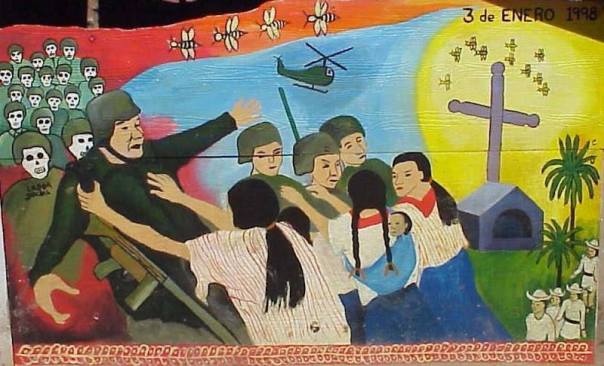
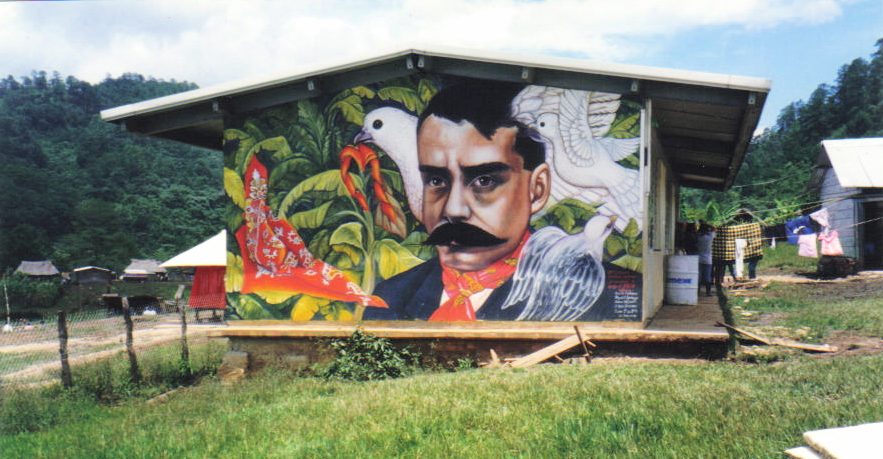
Xoyep Mural
By: Raúl Zibechi
We’re lacking ideas. The mind doesn’t think with information but rather with ideas, as Fritjof Capra emphasizes in La trama de la vida (The web of life). In this tremendous transition/storm that we experience, we need lucidity and organization to comprehend what’s happening and to construct the exits. When reality becomes more complex and perception is muddied, a characteristic of the systemic storms, clarifying the gaze is an ineludible and vital step.
Thus they stuff us with junk information, because it contributes to increasing the confusion. It is in this sense that the media play a systemic role that consists of diverting attention, making important and decisive things have the same treatment as more superficial things (a highway accident has more coverage than climate chaos) and they treat serious themes as if they were a soccer game.
As we know, there are those who think that there are no major changes, and that the systemic storm is a passing crisis after which everything will continue it’s normal course. But those below need to sharpen our senses, detect sounds and imperceptible movements, because our lives are at risk and any misstep can have disastrous consequences. We don’t have life insurance or private guards, like those above have.
The French historian Emmanuel Todd reflects on the elections in his country, with a very interesting analysis. The first thing is that camps of stable social forces have existed for several decades, which permits him to assure that society is divided into two halves, and that this division remains almost unaltered (goo.gl/p1i6WN).
Secondly, he asks why in the last quarter of a century the rejection of the neoliberal model has not increased (in Europe), despite the increase in unemployment and the failure of the euro. He analyzes the population, a structural fact that analysts tend to minimize. In France, the population got six years older since 1992 and, in fact, the elderly “have lost the right to vote,” because an exit from the euro would lower their pensions.
The second question he contemplates is the educational stratification. He concludes that: “the people with higher education produced a mass oligarchy” and that that elite went from 12 percent of the population in 1992 to 25 percent in just 25 years. The conclusion is upsetting: an aging population coupled with a mayor “oligarchic mass” leads to a growing conformism of half the population, while the other half from below has deteriorated notably since the 1992 Maastricht Treaty.
When Marx wrote the Communist Manifesto, the relation between those below and those above was nine to one. There were no pensions for the elderly and the university was reserved for the elites. It was an unstable system, where 90 percent had an interest in overthrowing it.
The two changes Todd mentioned (demography and higher education) represent profound mutations for those of us who aspire to transform the world. Even in 1960 university students like Che were abundant, disposed to utilizing their knowledge together with the oppressed. The system knew how to comprehend that it had a weak point among university youth and took measures.
Teachers at that level now earn fortunes up to 30 times the minimum wage in several countries. The students have fellowships that permit them to extend their postgraduate studies until they reach the age of 40 and then aspire to enter into the university elite. In the collective imaginary social advancement passes through higher education to which is given a good part of one’s life.
Three decades ago, Immanuel Wallerstein maintained (in Marx and under-development) that under capitalism the upper class went from 1 percent to 20 percent of the world population. The number can now approach the 25 percent that Todd surmises for the “mass oligarchy.” In Latin America the numbers might be a shade less, but we’re getting there.
It’s possible that we are bordering on the “perfect domination:” societies divided into almost equal parts, between those that need to smash the system and those that fear any change. One half conformist and the other half crushed by the fourth world war. Above both, the 1 percent controls state power, material power and the electoral democracies.
“To the extent that the dimensions of the group at the top expands, to the extent that we are making members of the group at the top more equal all the time among each other in their political rights, it becomes possible to extract more from those below,” Wallerstein writes in After liberalism (page 168). And he adds that: “a country half free and half slave can indeed last a long Time.”
The consequences of these changes must lead us to draw some “strategic” conclusions.
First, democracy is felt in that sector that doesn’t want to destabilize the system, while the other half doesn’t feel represented. The half above feels it has electoral democracy, but it’s a prison for those below.
Two, for the disinherited half of the population, the current design of capitalism is an oppressive reality, since the focused social policies tend to neutralize and divide those who need to rise up against the system.
The center-left parties collect the aspirations, and the fears, of that half of the population that only wants cosmetic changes and whose exclusive political exercise is voting every five or six years and attending meetings to applaud their political bosses.
The half below cannot trust in a political system that functions as a “democratic dictatorship.” “A political structure with total freedom for the half above can be the most oppressive form imaginable for the half below,” Wallerstein continues.
Those who live in the zone of non-being, in Fanon’s words, are those who resist and construct other worlds, because of the mere necessity to survive. But they are bombarded by the fantasy that they can change their destiny without breaking the system.
———————————————————-
Originally Published in Spanish by La Jornada
Friday, May 12, 2017
http://www.jornada.unam.mx/2017/05/12/opinion/022a2pol
Re-Published with English interpretation by the Chiapas Support Committee
Closing Words of the Seminar “The Walls of Capital, The Cracks of the Left”
Closing Words of the Seminar on Critical Reflection “The Walls of Capital, The Cracks of the Left”

Words of Subcomandante Insurgente Moisés, Friday, April 15, 2017
Good evening.
Thank you, compañeras and compañeros of Mexico and the world.
Thank you, sisters and brothers of Mexico and the world.
I thank you because you made a great effort to listen to us during these days that we have been here together, you worked hard to get here and to return home, and we know that requires significant effort. We who presented spoke a great deal, and it falls to you to sift through our words to see which will be useful to you in organizing, working, and struggling in the places where you live.
We do want to insist to you that capitalism is going to turn the world into its plantations.
That means we poor women and men of the world have to organize, struggle, and work.
We have already seen, understood, and explained countless times what capitalism does to us in the communities where we live, in the country we live in, or on the continent we’re from.
Today we discovered capitalism’s hidden plans for us, we even discovered the name for it—they already know what they’re going to call it, they say: “The world is my plantation and on it I shall have my indentured slaves.”
This means that we poor people ought to be thinking about organizing ourselves, working and struggling as the guardians of the world that we are, and saying “NO” to capitalism.
Let us think about how to organize ourselves, how to struggle and work in the world that capitalism wants to turn into its plantation. It’s clear now that we must struggle not just for one country, but rather for the world. That’s what we’ve been hearing here, that’s what we’ve been saying here, that that’s what’s happening in Mexico and what’s happening in the other countries in the Americas, and we’re sure that it’s happening on the other continents because it’s the same capitalism that’s fucking things up there too. One doesn’t have to be too much of an expert to know whether capitalism is exploiting people on the other continents, but we think we should be experts on how to destroy capitalism so that these evils never come back again.
All of us should study, but we shouldn’t stop at study; rather we should practice what we have understood through study, studying history to improve our practice, to advance.
And study is not just in books, which are good; study is also thinking about what life is like and what it would be like to do something good, or about how bad life used to be and why and how it should be instead.
We all use the word “revolution” or “change”: that change or revolution should be for all the women and men of the world; it’s not revolution or change if it’s for only a few men and women. It’s like justice, democracy and freedom are for everyone, just like with everything.
Today, the compañeros and compañeras of the National Indigenous Congress are calling on us to organize ourselves to struggle from the countryside and the city against capitalism.
The CNI is not calling on us to seek votes; they are seeking and calling on the millions of poor people in the countryside and the city to organize ourselves and destroy capitalism in the world.
So don’t worry, compañeras and compañeros, whether you vote or not is not the problem; the problem is called capitalism, it’s the exploitation they subject us to, and which we suffer.
What we want, and what the compañeros from the National Indigenous Congress want, is for all of Mexico, countryside and city, to be organized against capitalism.
There’s no other way, no other remedy for the suffering caused by capitalism.
Organizing ourselves: that’s what the journey of the candidate and the Indigenous Governing Council is about; it’s like a commission that’s going to do a national tour to call on us to GET ORGANIZED.
They will listen directly to the women and men of the countryside and the city; that is, the Indigenous Governing Council and the candidate are our eyes and ears so they can tell us, in the living voice of the peoples, how the bad capitalist system-cum-government has not been able to resolve the peoples’ needs, and the peoples know how those needs should be resolved. But there is no organized people that faces that issue, because in this system we are not taken into account. That’s why we have to organize ourselves, without asking anybody for permission.
Just as they didn’t ask permission to exploit us, there’s no reason for us to ask permission for how we’re going to organize ourselves against that exploitation.
We are going to direct our own affairs, let’s not let anyone else rule us; we’ll listen to proposals but not let them be imposed on us, not anymore, we’ve already lived through that. The people rule and the government obeys, as we Zapatistas say.
This is another opportunity to listen to each other, for the people of Mexico from the countryside and the city to put our dignified rage, wisdom, and intelligence together in order to mark the path of our destiny, instead of capitalism marking the path we should walk and where our destiny will go—those evils we have talked so much about.
That’s what the National Indigenous Congress’s effort is about, and that is why the candidate and the Indigenous Governing Council will make a tour. It’s not to win votes; we already know that there will be few votes and that they’ll still defraud us out of those few votes, and that the bad system will revive the dead to vote in its favor. Enough of that already!
We are seeking the path of our destiny. That’s the task of the compañeras and compañeros of the Indigenous Governing Council and of the independent candidate-spokeswoman: to weave the organization of the original peoples, to weave the decision of those peoples. The non-indigenous, too!
The National Indigenous Congress, the Indigenous Governing Council and the spokeswoman should always direct their gaze below; their ear should always be attentive to the sounds of below; not looking and not listening up above anymore—life will not come from there, only death.
Let us construct the world where there will be life. But for that, it is necessary to be organized. We need to organize ourselves, we’re not going to get tired of saying it because that’s all we have left—organizing ourselves is all we have left, with intelligence and wisdom, from the countryside and the city.
Compañeras and compañeros, sisters and brothers from Mexico and the world, this means organizing ourselves around the new justice we want, for the true democracy we want, for how we want to live and create our freedom.
It implies the organization of how we’re going to take each other into account in making new laws born of the peoples.
It means organizing how we’re going to achieve our thirteen demands: land, work, food, housing, health, education, true information, equality between women and men, freedom, justice, democracy, and peace. There’s a lot to say about why we have to get organized, but those who know the most are the poor women and men of the countryside and the city.
We’re saying that we have to get organized.
This is why just organizing votes won’t solve the problem; so whether or not you vote is not the problem.
Get organized, struggle and work, with resistance and rebellion.
Organize yourselves, original peoples of the world.
Organize yourselves, poor people of the cities.
Let’s organize ourselves, poor people of the world.
Don’t forget that, compañeras and compañeros of the National Indigenous Congress.
Don’t forget that, compañeras and compañeros of the Indigenous Governing Council.
Don’t forget, compañera spokeswoman—independent candidate, to call upon the peoples to organize themselves in the countryside and the city.
Thank you.
 Chiapas Support Committee