Chiapas Support Committee
Home of the Compañero Manuel blog on zapatistas & mexico
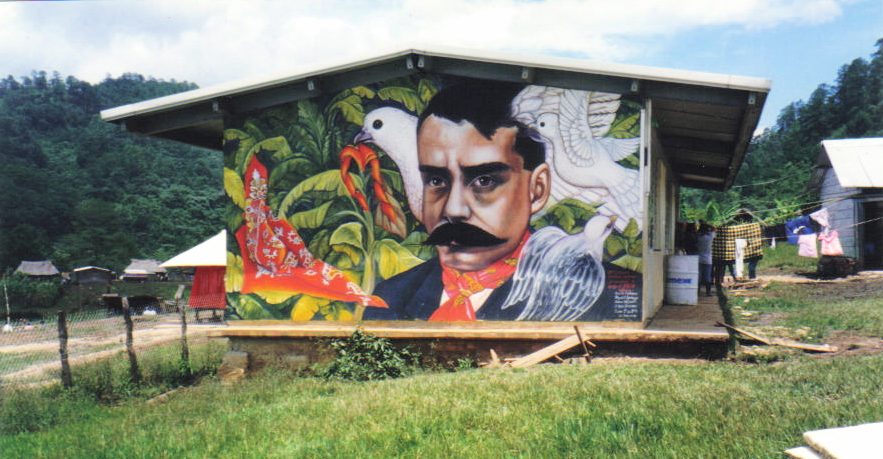
And it shook! A Report from the Epicenter
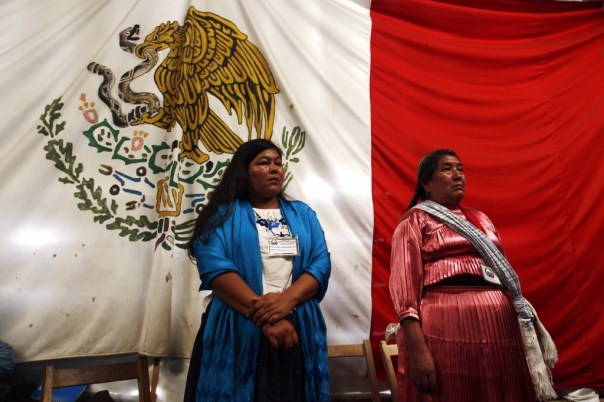
To the Original Peoples of Mexico
To Civil Society of Mexico and of the World
To the National and International Sixth
To the Free Communications Media
Brothers, Sisters,
It is the time of the peoples, for seeding and reconstructing ourselves. It’s the time for going on the offensive and this is the agreement that is drawn in our eyes, in the individuals, in the communities, in the towns, in the National Indigenous Congress; it’s time that dignity governs this country and this world and on the way democracy, liberty and justice will flourish.
We announce that in the second stage of CNI 5 we minutely evaluated the result of the consultation with the peoples that are the National Indigenous Congress and that took place in the months of October, November and December 2016, in which in all the modes, forms and languages that represent us in the geography of this country we issued agreements of communal assemblies, ejido assemblies, of collectives, municipal, inter-municipal and regional, that one more time lead us to understanding and assuming with dignity and rebellion the situation through which our country, our world crosses.
We greet the messages of support, of hope and of solidarity that intellectuals, collectives and peoples gave, which reflect hope in our proposal that we named “May The Earth Shake At Its Centers” and that web made public in the first stage of CNI 5. We also greet the critical voices, many of them with fundamentally racist arguments, which reflect a furious indignation and scorn over thinking that an indigenous woman seeks not only to contend in a presidential election, but also sets forth to really change, from below, this pained country.
To all of them, we say that in effect the earth shook and us with her, and that we seek to shake the conscience of the nation, that in effect we seek that indignation, resistance and rebellion figure in the 2018 electoral ballots, but that it’s not our intention to compete in anything with the parties and all the political class that still owes us a lot; every dead, disappeared and incarcerated person, every dispossession, every repression and every defamation. Don’t be confused about us, we don’t seek to compete with them because we are not the same, we are not their lying and perverse words. We are the collective word of below and to the left, that which shakes the world when the Earth shakes with epicenters of autonomy, and that make us so proudly different that:
- While the country is submerged in the fear and terror that is born among thousands of dead and disappeared, in the municipios of the mountains and the coast of Guerrero our peoples have created security conditions and real justice. In Santa María Ostula, Michoacán, the Nahua people have united with other indigenous communities to keep security in the hands of the peoples, where the epicenter of resistance is the communal assembly of Ostula, guarantor of the ethics of a movement that has now permeated the municipios of Aquila, Coahuayana, Chinicuila and Coalcomán. On the Purépecha mesa the community of Cherán has shown that with organization, taking the politicians out of their bad government structure and exercising their own forms of security and government, one can not only construct justice, but also that just like in other geographies of the country only from below, from rebellion are new social pacts, autonomous and just, reconstructed and we don’t leave nor do we stop constructing from below the truth and justice denied to the 43 students from the teachers college in Ayotzinapa, Guerrero, disappeared, the 3 compañero students that were murdered and the compañeros injured, all of them by the Mexican narco government and its repressive forces. Meanwhile the bad governments criminalize social struggle, resistance and rebellion, persecuting, harassing, disappearing, incarcerating and murdering faultless men and women that fight for just causes.
- While the destruction reaches all corners of the country, without knowing the limits separating the belonging to the land and the sacred, the Wixárika people, together with the committees in defense of life and water of the Potosí Highlands have shown that one can defend a territory, its environment and equilibrium based on recognizing one with nature, with a sacred vision that renews each day the ancestral links with life, the land, the sun and the ancestors, encompassing 7 municipios on the sacred ceremonial territory of the Wirikuta in San Luis Potosí.
- While the bad governments deform State policies in education matters placing it at the service of the capitalist corporations so that it stops being a right, the original peoples create primary and secondary schools, high schools and universities with their own education systems based on protection of our Mother Earth, on territorial defense, on production, on the sciences, on the arts, on our languages and despite the fact that the majority of those processes grow in support at no level of the bad government, it is at the service of everyone.
- While the communications media for pay, spokespersons for those who prostitute every one of the words that they publish and deceive keeping the peoples of the countryside and the city asleep, passing off as criminals those who think and will defend what is their and they are always the bad ones, the vandals, the misfits. Meanwhile, those that live in ignorance and alienation are the socially good ones, and those that oppress, repress, exploit and dispossess are always the good ones, those that deserve to be respected and govern to serve themselves. And while that’s happening the peoples have made their own communications media de ideating different forms so that the conscience is not clouded by the lie that the capitalists impose, also using the media for strengthening organization below, where every true word is born.
- While the representative “democracy” of the political parties has been converted into a mockery of popular will, in which votes are bought and sold like so much merchandise and are manipulated by the poverty in which the capitalists keep societies in the countryside and the cities, the original peoples continue caring for and strengthening forms of consensus and assemblies as organs of government in which the voices of all make profoundly democratic agreements, embracing entire regions through assemblies that are versed in the agreements from other assemblies and at the same time emerge from the profound will of each family.
- While governments impose their decisions for the benefit of the few, supplanting the collective will of the peoples, criminalizing and repressing those who are opposed to their death projects that impose over the blood of our peoples as is the case with the New Mexico City Airport, feigning that they are consulting while they impose their death, the original peoples have the modes and the constant forms of prior consultation, as free and informed for small as for large.
- While with their privatizing reforms the bad governments deliver the country’s energy sovereignty to foreign interests and the high cost of gasoline betray the capitalist lie that only traces paths for inequality and the rebel response of the indigenous and non-indigenous peoples of Mexico, which the powerful will not be able to hide or silence; the peoples make a front and fight to stop the destruction of our territories through fracking, wind parks, mining, oil wells, and gas and oil pipelines in states like Veracruz, Sonora, Sinaloa, Baja California, Morelos, Oaxaca, Yucatán and all of the national territory.
- While the bad governments impose toxic and GMO food on all the consumers of the countryside and the cities, the Maya peoples maintain a tireless struggle for stopping the planting of GMOs on the la de Yucatán Peninsula and all over the country for conserving ancestral genetic wealth, which also signifies our life and collective organization and the basis of our spirituality.
- While the political class only destroys and promises, the peoples construct not to govern but rather to exist with autonomy and self-determination.
Our resistances and rebellions constitute the power of below, they don’t offer promises or bright ideas, but rather real processes of radical transformation in which all participate and that are tangible in the diverse and enormous indigenous geographies of this nation. It’s because of that as the National Indigenous Congress, 43 peoples of this country gathered together at this 5th Congress, AGREE to name an Indigenous Government Council with representative men and women from every one of the peoples, tribes and nations that belong to it, that this council proposes to govern this country. And that it will have as the voice an indigenous woman from the CNI, in other words, that she will have indigenous blood and she knows her culture. Or it’s that it has as spokesperson an indigenous woman from the CNI that will be an independent candidate to the presidency of Mexico in the 2018 elections.
It’s because of that that the CNI as the House of All the Peoples is the principle one that configures the ethics of our struggle and in which all the original peoples of this country fit, those principles on which the Indigenous Government Council is lodged are:
To obey and not command
To represent and not supplant
To serve and not serve yourself
To convince and not conquer
To step down and not up
To propose and not impose
To construct and not destroy
It’s what we have invented and reinvented not for gusto, but rather as the only way we have to continue existing, in other words those new paths taken from the collective memory of our own forms of organization, are the product of resistance and rebellion, of making a front every day against the war that has not stopped and that has not been able to finish with us. In these forms it has not only been able to draw the path for the integral reconstitution of the peoples, but rather new civilizing forms, collective hopes that become community, municipal, regional and state hopes and that are giving precise answers to real problems in the country, far away from the political class and its corruption.
From this 5th National Indigenous Congress we call to the original peoples of this country, to the collectives of the Sixth, to the workers, the fronts and committees in struggle in the countryside and the cities, to the student, intellectual, artistic and scientific community, to unorganized civil society and to all people with a good heart to close ranks and go on the offensive, to dismantle the power of above and to reconstitute ourselves no longer only as peoples, but also as a country, from below and to the left, to add ourselves to a single organization in which dignity is our ultimate word and our first action. We call on you to organize and stop this war, to not be afraid to construct and plant over the ruins left by capitalism.
That’s what our humanity and our Mother Earth that is the land demand from us, in it we find that it’s time for rebel dignity and that we are materialized convoking a constitutive assembly of the Indigenous Government Council for Mexico in the month of May 2017 and from this moment we will tender bridges to the compañeros and compañeras of civil society, the communications media and the original peoples to make the Earth shake at its core, conquering fear and recuperating what belongs to humanity, the land and the peoples, for the recuperation of territories invaded or destroyed, for the presentation of the country’s disappeared, for the freedom of all political prisoners, for truth and justice for those murdered, for the dignity of the countryside and the city. In other words, have no doubt, we’re going for it all, because we know that we face perhaps the last opportunity as original peoples and as Mexican society of changing peacefully and radically our own forms of government, making dignity the epicenter of a new world.
From Oventik, Zapatista Territory, Chiapas, México
Never More a Mexico Without Us
National Indigenous Congress
Zapatista National Liberation Army
——————————————————————
Originally Published in Spanish by Enlace Zapatista
Monday, January 2, 2017
http://enlacezapatista.ezln.org.mx/2017/01/02/y-retemblo-informe-desde-el-epicentro/
Re-published with English interpretation by the Chiapas Support Committee
https://chiapas-support.org/2017/01/04/and-it-shook-a-report-from-the-epicenter/
CNI announces an autonomous parallel government for Mexico
THE EZLN EXTENDED THE CONSULTATION TO DEFINE ITS PRESIDENTIAL CANDIDATE
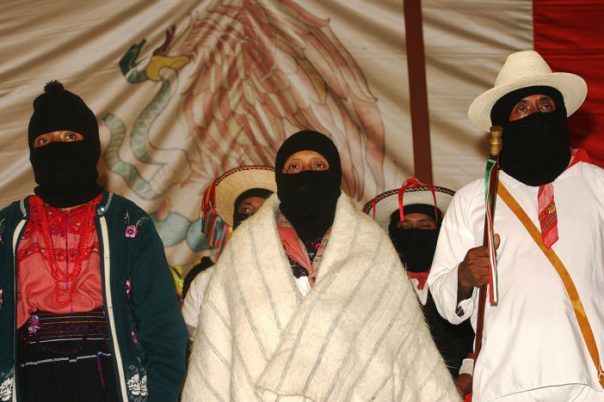
Zapatistas at anniversary celebration – Photo: Janet Schwartz
By: Isaín Mandujano
OVENTIK, Chiapas. (proceso.com.mx). – Some 3,000 participating delegates of the National Indigenous Congress (Congreso Nacional Indígena, CNI), with support from the Zapatista National Liberation Army (Ejército Zapatista de Liberación Nacional, EZLN), announced the constitution of an Indigenous Government Council (Consejo de Gobierno Indígena, CGI) as an autonomous parallel government for the country.
Today, they also delineated the profile that the candidate will have that they will postulate in the 2018 elections for the presidency of the Republic.
Within the framework of the 23rd anniversary of the EZLN’s armed uprising in Caracol II at Oventik, the CNI today called: “to all the original peoples throughout the country, to all persons with a good heart to close ranks and go on the offensive,” in this new stage of struggle, to reconstruct ourselves no longer just as people but also as a nation.
After two days of closed-door sessions, this Sunday January 1, the CNI and the EZLN held an open-door plenary meeting to which the communications media had access. In it they announced the report of the results of the consultation held during October, November and December of 2016 in at least 43 different indigenous towns throughout the country.
The work group in which Comandante David was present, as the host in the EZLN’s Los Altos of Chiapas bastion, and with Subcomandante Insurgente Moisés, military commander of the armed group, were half a dozen delegate participants from the CNI who announced the details of how the CGI will be created and how they will present themselves heading towards 2018 with an independent woman candidate.
“Indignation, resistance and rebellion will figure in the 2018 electoral ballots, said the women that read the results of the consultation in that extensive auditorium gathered together in a big wooden structure with a sheet metal roof.
They indicated that some 43 different original peoples of 25 of the country’s states were consulted.
The indigenous agreed to construct paths of resistance in which the struggle will be collective and above all they proposed eliminating from their communities everything that divides the indigenous peoples, like the political parties and the governmental assistance programs.
They proposed expanding communication and making it permanent among the peoples throughout the country; in the same way, creating commissions at the community, regional, state and national level.
They indicated that after the consultation during the three prior months, the CNI came out strengthened and doubled the number of attendees in its plenary meetings, but that above all they expanded their presence in more communities that participated in the consultation and that were not considered previously.
While they demonstrated the need for respecting the peoples that are not in agreement with this process of struggle that the CNI and the EZLN propose, they recognized that in many communities they were not able to carry out the consultation because of the violent situation that exists or because of the change of authorities in those communities.
The women said that after the two-day closed-door meeting, they agreed to continue the consultation, which will be permanent, as is traditionally done among the original peoples and communities. Besides the fact that Afro-Americans and immigrants lack being consulted.
As one of the principal agreements, they ratified the creation of an Indigenous Government Council (CGI) as the representative of all the peoples and tribes of this country. This Council, they specified, will be collective; it will not do what occurs to it, but rather what all the original peoples represented there mandate.
It was also agreed that this CGI would have as its spokesperson and indigenous woman from the CNI. This same woman will be the candidate in the 2018 elections.
They said that the CGI will be formally constituted next May 18, and that the spokesperson of that body will be a woman that has permanence in the CNI, who belongs to one of the original peoples of Mexico, who speaks that indigenous language, who must proposed and legitimized in assembly, who is distinguished as a person that has accompanied the peoples in their struggles.
She will also practice the principles of govern by obeying (mandar obedeciendo, she will know that making agreements will be by consensus and that those who make up the Council of which she is the spokesperson, and they must be aware that the CNI’s Assembly will be the only one able to take away that position when it is so considered.
The CGI will have several commissions, such as security, finances, communication, culture, elders councils, health, environment and a commission charged with Mother Earth and territory.
Said council that would govern for all the original peoples of the country was defined as an anticapitalist collective, from below and from the left, that will respect the decisions of the people and decisions of the CNI, and that above all will have the ability to create alliances with other peoples that are not from the CNI.
They said that the woman candidate will be on the ballot in 2018, but they warned:
“Don’t get confused thinking that we seek to compete with them because we are not the same. We are the collective word of below and to the left.”
They indicated that while the country is submerged in fear and terror, the peoples have created conditions for security and real justice. And only from below is it possible to construct autonomy.
Before this scenario what’s necessary, they insisted, is the creation of the CGI that is being proposed to govern this country and that will impel its own candidate to do that; and, this project is not exclusive, because all the original peoples of the country fit.
Subcomandante Moisés said that the time for the peoples has come, for all the peoples that are in the countryside and in the city. And he said that what the CNI now proposes is a “¡Ya Basta!” (Enough!) of hope that others will tell us what to do and how to do it.
He said that it has been sought to deceive the peoples of Mexico “with promises and brazen lies,” and that what the CNI now proposes is what the peoples themselves will direct.
Moisés outlined fighting for truth and justice, fighting for democracy, but where the people govern and the government obeys. He called to fight for freedom, and for that it’s necessary to rescue the history of the original peoples that have centuries resisting for life.
He said that they EZLN and the CNI already have many years of knowing each other. He ratified that the EZLN is now and will always be with the CNI on the path that has been outlined.
“We’re with you, we’re definitely going with the National Indigenous Congress (…) Listen to the pain and rage that there is in every corner of this country. May the Earth shake at its core with your step. May they look at you with surprise and admiration, may the peoples of the world admire you in your decisions and goals. And above all, it’s not important that they will use everything they have against you, that they attack you in every way, don’t surrender, don’t sell out, don’t give in,” Moisés concluded.
——————————————————————
Originally Published in Spanish by Proceso.com
Sunday, January 1, 2017
http://www.proceso.com.mx/468261/amplia-el-ezln-consulta-para-definir-a-su-candidata-presidencial
Re-Published with English interpretation by the Chiapas Support Committee
https://chiapas-support.org/2017/01/02/cni-announces-an-autonomous-parallel-government-for-mexico/
EZLN asks scientists to form schools within its territory
[Administrator’s Note: Official EZLN communications from “The Zapatistas and ConSciences for Humanity” are very long and, therefore, are taking a long time to translate; so, we’re posting news articles about it. This article has special significance to us (the Chiapas Support Committee) because our solidarity work is with the autonomous Zapatista education system.]

Galeano walking around at “The Zapatistas and ConSciences for Humanity.” It’s interesting to note the absence of his military cap and shirt.
By: Angeles Mariscal
“We want to learn and do science and technology to earn the only competence that matters: that of life against death,” members of the Zapatista National Liberation Army (Ejército Zapatista de Liberación Nacional, EZLN) pointed out at the inauguration of the meeting with scientists from different countries that came to Chiapas to meet with members of the insurgent group.
The gathering named The Zapatistas and ConSciences for Humanity called to Germany, Canada, Chile, United States, Spain, Israel, Paraguay, United Kingdom, Uruguay, Brazil and Mexico -some members of the National Investigators System -, who will debate with the Zapatistas the work of the scientific community facing the social, economic, political and environmental crisis derived from the capitalist system.
“Scientifically are there studies about whether one can live without capitalism? What is the scientific or non-scientific explanation of why money was invented? Scientifically, can you explain to us the principles of neoliberalism? Scientifically, can you explain to us why capitalism prepares certain crisis every so often to reactivate its economy? What are the ethical principles?” These are some of the questions that the EZLN’s political and military leader, Subcomandante Galeano, asked during the inauguration.
For ten days scientists from diverse fields will debate about this and other themes, “as a start for watching and walking what to do in the world in which we live,” explained Subcomandante Moisés, who in the name of the General Command of the EZLN considered that scientific research and discoveries have been used as an instrument for the accumulation of wealth: “the rich changed the destiny for which it was created, gave it another use, for their convenience.”
“Our survival is in our hands, or the other construction of a new world (…) We Zapatistas, we’re here now as your pupils, your students, your apprentices. We don’t conceive knowledge as a symbol of social status or a measure of intelligence (…) We don’t want to go to the university, we want the university to be erected in our communities, to be taught and to learn together with our people.”
The insurgent leader threw out a challenge to the scientific community to share their knowledge with members of the EZLN. “The question that moves us, the scientific curiosity, the zeal to learn, to know, comes from a long time ago, so long ago that scientific calendars don’t have a count (…) we don’t want to go to big laboratories and scientific research centers in the metropolis, we want them constructed here. We want schools built for the formation of scientists, not workshops disguised as schools, which only teach the functions of work at the service of capitalism (cheap and poorly qualified manual labor). We want scientific studies, not just technical studies. We want to learn and make science and technology to gain the only competence that’s worth the effort: that of life against death.”
“We cannot delegate to others the work that corresponds to us as complete human beings, Subcomandante Galeano stated.
——————————————————————–
Originally Published in Spanish by Chiapas Paralelo
Tuesday, December 27, 2016
Re-Published with English interpretation by the Chiapas Support Committee
CNI-EZLN, the Mexican State and the registry of an independent candidate
The CNI-EZLN and the MEXICAN STATE VERSUS the REGISTRY of an INDIGENOUS WOMAN AS AN INDEPENDENT CANDIDATE FOR 2018

By: Gaspar Morquecho
It’s probable that on January 1, 2017 the CNI-EZLN will announce the strategic agreements, “if there are any,” facing “the offensive against the peoples” (…) and the steps that they are going to take: “for dismantling from below the power that above imposes on us and that offers us nothing but a panorama of death, violence, dispossession and destruction.”
It’s also probable that they will make public the results and evaluation of the Consultation around the proposal to create: “an indigenous government council whose word will be materialized by an indigenous woman, a delegate from the CNI as an independent candidate that contests in the name of the National Indigenous Congress and the Zapatista National Liberation Army in the 2018 electoral process for the presidency of this country.” (Joint Comunicado from the CNI-EZLN. October 14, 2016.)
Perhaps the most important debates can be presented around the proposal for the participation “in the 2018 electoral process;” even more in the debate as to whether the indigenous woman is registered or not as an independent candidate. It’s very clear that the EZLN is in favor of entering the 2018 contest and in favor of the registry of the independent candidate. In that way they will be able to measure the acceptance of the proposal and its incidence in the indigenous population and in the non-indigenous population. If they don’t register the candidate in the 2018 campaign it will be difficult to go beyond the ambit of the adherents to the VI, of the close allies and sympathizers. Without registry, the day’s work would be something like the Other Campaign but now with an indigenous candidate.
Going for the Yes to the 2018 political electoral contest and for the registry of the candidate can require:
1. – The mobilization of the EZLN and the CNI in their regional and national ambits.
2. – The mobilization of their national and international allies.
The Electoral Law requires the following for the registry of the indigenous candidate:
1. – Getting 820,000 signatures within 120 days from voters of at least 17 federative states.
2. – Forming a civil association, presenting it to the Tributary Administration System and opening a bank account for that purpose.
3. – In that way, in this case, the independent presidential standard bearer would have the same rights as her competitors, like access to time on radio and television, public and private financing, and designating representatives to the INE.
In other words, the CNI and the EZLN would have to organize and mobilize a network in at least 17 states to get at least one million signatures. Upon achieving that, they would have a first indication of the indigenous and non-indigenous population that supports their initiative in this conservative, racist and patriarchal country.
Those million signatures would also be an indicator of the minimum number of votes they could obtain in the contest and to design a campaign to add at least 5 million votes. The initial platform of the Indigenous Government Council and the strength of the indigenous woman’s voice that would set the struggle for life and against violence, dispossession and the destruction that it is submitting to the peoples.
It’s very probable that the Mexican State and its electoral political apparatuses are giving following up on the CNI-EZLN proposal and defining their strategy versus the same. Surely they are also making their evaluations, in other words, the convenience or not of granting registry to the independent candidate of the CNI-EZLN.
If the Mexican State and its apparatuses evaluate that giving registry to the independent candidate oxygenates the electoral contest obliging the political parties and their candidates to give quality and competition to their electoral offer so as to exceed previous contests and as a result increase voter turnout, the Mexican State would not hesitate in giving registry to the candidate of the CNI-EZLN.
In that scenario the CNI-EZLN would have the space to strengthen its presence in the country, to contribute to the cohesion and strengthening of the movements in resistance versus the “panorama of death, violence, dispossession and destruction.”
Nevertheless, it’s necessary to take into account that the scenarios are adverse to the objectives of the CNI and EZLN campaign around their independent candidate:
1. It’s very clear that it (the campaign) will travel through territories where the Capitalist Beast has planned or carried out investments in so-called mega-projects: highways, dams, mining and wind parks. (It will also travel) through territories under the control of Radical Companies dedicated to the cultivation, shipment and commercialization of drugs, and trafficking of undocumented persons. Both businesses have their own armed forces.
2. The presence of those Companies has fragmented the social fabric of the peoples and has done violence or confronted them not just a few times.
3. The national State at the service of Multinational Capital has used its armed forces not just a few times to undermine the resistance of the peoples that defend the land and territory.
In the logic of the Counterinsurgency Strategy that the Mexican State has designed for annihilating the EZLN and that others call the Integral Campaign of Exhaustion, the CNI and the rebels would be permitted to mobilize and carry out a preliminary campaign to raise one million signatures in 17 states in accordance with Law, a not so east job, and later… denying them registry and leaving the CNI and the EZLN navigating in a marginal campaign that can be exhausting and frustrating.
Anyway, on January 1, 2017, we will find out what the delegates resolved at the Second Stage of the 5th Nacional Indigenous Congress during December 30 and 31, 2016.
——————————————————————-
Originally Published in Spanish by Chiapas Paralelo
Monday, December 26, 2016
Re-Published with English interpretation by the Chiapas Support Committee
Words of the EZLN at the Opening of “The Zapatistas and ConSciences for Humanity”
Words of the General Command of the EZLN in the name of the Zapatista women, men, children and elders at the opening of the Gathering “The Zapatistas and ConSciences for Humanity”

Good morning.
Compañeras, compañeros of Mexico and of the world:
Brothers and sisters of Mexico and of the world:
First and foremost, in the name of the compañeras and compañeros who are Bases of Support of the Zapatista Army for National Liberation, we thank all of the compañer@s of CIDECI who once again have provided us with these spaces so that we, Zapatista original peoples and scientists, can gather here as a way to begin to look and walk toward what must be done in this world we live in, which capitalism is destroying.
We also thank the compañeros who have worked on registration and coordination for this event.
We also thank the compañer@s from the transport support team.
We thank you in advance, compañeras and compañeros of the various teams and collectives for the shitload of work that you have done to make this gathering happen. Many thanks.
For we as Zapatista men and women, today begins our long walk in search of others with whom we think share the great responsibility to defend and save the world we live in – with the art of artists, the science of scientists, and the original peoples alongside those below from across the entire world.
A handful of some so-called “neoliberal capitalists” have decided to savagely destroy everything, caring nothing at all for this house that we live in.
This makes us Zapatistas think and ask ourselves:
Where are we poor people of the world going to live, because they, the rich, might just go and live on another planet?
What should we do now, as we see that they are destroying our house?
Or what happens if they take us to another planet to be their slaves?
After turning this over many times in our heads, we conclude that:
Below there are women and men who study science, who study scientifically, who do good science. But the wicked capitalists come along and use this science to do harm to the very people who discovered that science. What kind of harm?
They use science to make the rich richer.
The rich use it as they choose, for a destiny other than that for which it was created. They use it to kill and destroy.
Now it is getting worse for them up there, and that will be used even more harshly against us living beings and our mother earth.
That is how all of these bad things began and how they continue, bringing us to a very dire point today.
This is how things happened, and in the same way they use the artists who make art – capitalism uses everything to the detriment of society and for the good of capitalism. What was natural, nature and those who live within it, which is to say the originary peoples, will be destroyed along with Mother Nature.
Therefore, we believe, think, and imagine.
We can organize ourselves, work, struggle, and defend who we are – the foundation of this world – so that this world, the house in which we live, can’t be disappeared by the capitalists. Now is the time, brothers and sisters, compañer@s, compañeroas; no one is going to bring us salvation. It is up to us.
Begin to dream and you will see that we can only fight capitalism with good scientific science, the art of the artist, and the guardians of mother nature together with those below from across the world. This is our responsibility.
I don’t mean to say that we are the only ones who should struggle, not at all. But when we look around at how things are, we realize that all of the useful things that we have in our houses are a matter of science, in terms of where they came from, and all of the figures and figurines in our houses and rooms are the art of artists, and all of the materials for these things come from mother nature, where the original peoples live.
It is as if we are the “seeds” of all of this.
Let’s put it even more clearly.
Who figured out how to make today’s most modern cellphone? It’s the same for thousands of other products – they are used to benefit the rich, and not for the use science intended, nor for the people.
Who figured out how to make the images that are held within cellphones which are now manipulated on any whim?
Where did the materials that cellphones are made of come from? The same question goes for thousands of other goods.
Capitalism has converted science into something used for harm: something to feed its massive accumulation of wealth; something to manipulate at its every whim. It takes no responsibility for the destruction it has wrought with these actions.
We know what will happen.
One more point of clarity.
We are the lifeblood of the rich; we are the flesh and bone that make their lives possible, and the rest of the organs (in this body) are made up of the consumers; meanwhile, they live to do us harm in this capitalist system.
The origin of the evil the capitalist system wreaks on us is revealed.
Our survival, and the other construction of a new world, is in our hands.
Today we are here not to tell each other what to do, but to understand what our function is to capitalism in this world, and to see if what capitalism has us doing is any good for this world that we live in, human and living beings.
And if we discover that it is entirely bad, that the use capitalism makes of our sciences is harmful, then we have to take responsibility and decide what to do.
Before I finish compañeras and compañeros, sisters and brothers, today December 26, we do not forget that there are lives missing from our midst, the life of the 46 missing young people from Ayotzinapa, Guerrero.
Together with their families and friends who continue to search for them and who do not give up or sell out, we Zapatista men and women also demand truth and justice. To these mothers, fathers, sisters and brothers of the missing, we give our largest collective embrace.
So, welcome to this gathering, to this long walk of the other sciences during which there is no rest, because rest would mean that the other, new world is already built, and until it is built there will be no rest.
May your wisdom, scientists, encounter and embrace our desire to learn and to know about the worlds.
Many thanks.
From CIDECI-Unitierra, San Cristóbal de las Casas, Chiapas.
Subcomandante Insurgente Moisés.
Mexico, December 26, 2016
Program of activities for “The Zapatistas and ConSciences for Humanity”
Program of activities for the gathering “THE ZAPATISTAS and CONSCIENCES for HUMANITY.”
 Where: CIDECI-Unitierra. San Cristóbal de Las Casas, Chiapas, Mexico.
When: From December 26, 2014, through January 4, 2017.
[Admin Reminder: The 2nd phase of the 5th CNI is on December 29, 30, 31 and January 1 in Oventik. The decision on the indigenous woman candidate is anticipated January 1.]
December 26
10:00 – 11:00. Inauguration. Words of Subcomandante Insurgente Moisés on behalf of the Zapatista women, men, children, and elders.
General Sessions. Participation by:
Biologist Adriana Raquel Aguilar Melo: “The Academy May Be Exclusionary, But Can Science Be A Common Good?”
Dr. Marco Antonio Sánchez Ramos: “Sisyphus and Science”
Dr. Tonatiuh Matos Chassin: “A Fundamental Law for the Progress of a Nation”
Physicist Eduardo Vizcaya Xilotl: “(Meta)Sciences, Utopias and Dystopias”
Professors Luis Malaret and Diane Rocheleau: “Ecology From Below”
Dr. Iván Alejandro Velasco-Dávalos: “Who Does Science Serve? A Collective Vision Regarding the Importance of the Joint Popularization of the Arts and the Sciences”
Alchemist SupGaleano: “Some Questions for the Sciences”
December 27
General Sessions. Participation by:
Physicist Alejo Stark: “The Role of the Sciences in the Transformation of the World”
Dr. Claudio Martínez Debat: “Biology and Biotechnology: Who Do They Serve?”
Doctoral Candidate Dr. Luis Fernando Santis Espinosa: “The Slavery of Science: The National Market for Natural Resources and Their Privatization”
Dr. Kristen Vogeler: “Thoughts on the Relation Between Science and Customs”
Dr. Mariana Benítez Keinrad: “Some Reflections on Science from the Cubicle of a Development Biologist”
Dr. Tatiana Fiordelisio: “The Sciences: A Raft For the Storm?”
Alchemist SupGaleano: “The Flower is to Blame”
Informational Talks. Participation by:
Dr. Jerome Leboeuf: “The Potential and Applications of Artificial Intelligence”
Dr. Marco Antonio Sánchez Ramos: “What Are the Stars Made Of?”
Dr. Patricia Ramos Morales: “What Are Mutagens and Where Are They Located?”
Dr. María Alejandra Jiménez Zúñiga: “Our Place In the Cosmos: What Astrophysics Tells Us”
Mathematician Florencia Cubría: “Connectivity In Graphs”
Master of Science, Verónica López Delgado: “Gravity and Magnetism: Determinate Forces In Our World.”
Biologist Felipe Gómez Noguez: “Pteridium, A Capitalist Fern”
Workshops. Participation by:
Atenea Martínez Dolores and Manuel Alejandro Lara, Engineers. Robotics Workshop for The Masked, I (only for Zapatista students)
December 28
General Sessions. Participation by:
Elfego Ruiz Gutiérrez, Master of Science: “Critical Reflections and Practices On the Scientific Endeavor For Life”
Dr. Gabriela Piccinelli Bocchi: “Science…and ConScience, What For?”
Dr. Igor Valencia Sánchez: “Bloodsucker Science: Free Access to Knowledge and Biohackers”
Dr. Jaime del Sagrado Corazón Morales Hernández: “Agroecology and the Sciences For Sustainability”
Dr. Carlos Román Zúñiga: “Astronomy: the Poetry of the Exact Sciences”
Dr. Yuri Nahmad Molinari: “Flaws and Benefits of Mexican Energy Reform”
Subcomandante Insurgente Moisés and Subcomandante Insurgente Galeano: “The Arts and the Sciences in the History of (neo) Zapatismo”
Informational Talks. Participation by:
Dr. Natalia Ismene Pavón Martínez: “Estrogen and Its Influence On the Heart”
Mathematician Eric López González: “Emotional Mathematics”
Biologist Adriana Raquel Aguilar Melo: “Come Together, Separate, and Come Together Again for ‘Buen Vivir’: The Case of Non-Human Primates”
Mathematician Elisa Rocha Cardozo: “How are Living Beings Distributed Spatially?”
Dr. Gabriel Ramos Fernández: “Complexity, Resilience, and Uncertainty: Socioecosystems and Biodiversity”
Dr. Lev Jardón Barbolla.
Workshops. Participation by:
Atenea Martínez Dolores and Manuel Alejandro Lara, Engineers. “Robotics Workshop for The Masked II” (only for Zapatista students)
December 29
General Sessions. Participation by:
Dr. Adolfo Olea Franco: “The Social Function of Science”
Engineer Fayez Mubarqui Guevara: “Feeling-thinking the Energy Crisis”
Dr. Octavio Valadez Blanco: “Scientists and Humanists as Participants in Social Struggle: Challenges in the Mexican Capitalocene”
Dr. Eva Jablonka: “Epigenetics: The Science that Connects”
Dr. Melina Gómez Bock: “The Obscurity of a Theoretical Physics”
Dr. Lev Jardón Borbolla: “The Storm in the Sciences and the Sciences in the Face of the Storm: It is Possible to Change the Relations of Production”
Alchemist SupGaleano: “The Cat-Dog and the Apocalypse”
Informational Talks. Participation by:
Dr. John Vandermeeer: “Ecological factors in Controlling Coffee Blight”
Dr. Carlos Román Zúñiga: “Gestation and Life of the Stars”
Engineers Iván Domenzain del Castillo Cerecer. “Frankensteins Also Sow Seeds”
Dr. Alejandro Vásquez Arzola: “Light and Its Enemies”
Dr. Claudio Martínez Debat: “Genetically Modified Vegetable Organisms in Uruguay”
Dr. Grodecz Alfredo Ramírez Ovando: “Geometry: A World Where Many Worlds Fit”
Workshops. Participation by:
Dr. Patricia Ramos Morales. Workshop: How Does a Scientist Work? (only for students)
December 30
General Sessions. Participation by:
Dr. Pablo González Casanova: “Capitalism and Ecology”
Dr. John Vandermeer: “Ecology As a Science and As a Component of Cosmovisions”
Dr. Ivette Perfecto: “Ecology As a Science and As a Component of Cosmovisions, II”
Jesús Vergara Huerta, Master of Science: “The Eruption of Free and Communitarian Science In the 21st Century”
Gibran Mubarqui Guevara, Engineer: “From Imposition to Communitarian: Remaking the Sciences”
Dr. Stuart Newman: “Social Uses of Science”
Subcomandante Insurgente Moisés: “Original Peoples and the Sciences in the Service of Life”
Informational Talks. Participation by:
Dr. Carlos Rodrigo Martínez Prieto: “Theory of the Origin of the Universe and Other Speculations”
Dr. Ivette Perfecto. “Ecological Complexity in the Coffee Farms of Chiapas”
Dr. Yuri Nahmad Molinari: “Harvesting the Sun”
David Franco Martínez, Master of Engineering: “Use of Renewable Energy Resources”
Physicist Alejo Stark: “Cosmos Without Borders: the Poetic Relational Logic of Physical Cosmology”
Medical Doctor Lilia Piélago García: “Palliative Cities: A Universal Right”
Dr. Emilio Molinari. “Another World is Possible, and We Are Looking for It”
Workshops. Participation by:
Karla María Castillo Espinoza, Master of Science: “What Do Fossils Tell Us About the Earth’s Past?” (only for Zapatista students)
January 2
General Sessions. Participation by:
Dr. Kristin Mercer: “The Effect of Money in Academic Research”
Dr. Gabriel Ramos Fernández: “Complexity and Uncertainty: Scientists and Decision Making”
Dr. Gertrudis Hortensia González Gómez: “Some Promises of Science, Or, How To Care For Our Health”
Alejandro Muñoz: “García in Nuevo León and the Free-Scientific-Technology Vision for the 21st Century”
Dr. Jérôme Leboeuf: “The Risks That Arise With Artificial Intelligence”
Dr. Valeria Souza Saldívar and Dr. Luis Eguiarte Fruns: “The Water Paradigm”
Alchemist SupGaleano: “Zapatista Alchemy”
Informational Talks. Participation by:
Dr. Ramón Carrillo Bastos: “Quantum Mechanics and Causality”
Dr. Mariana Peimbert:“Color Inheritance in Dogs”
Dr. Adolfo Olea: “Corn seed: From Indigenous Varieties to Hybrids and Genetically Modified Versions”
Dr. María Magdalena Tatter: “Application of Knowledges and Values in Pediatrics”
Physicist Alejandro Muñoz: “Nuclear Fusion in General as a Source of Clean Energy”
Dr. Luis Concha Loyola: “Using Magnetic Resonance Imaging to Understand the Human Brain”
Dr. Azucena de León Murillo: “Pearls of Neurological Disease”
Practicum. Participation by:
Dr. Gertrudis Hortensia González Gómez and Dr. Tatiana Fiordelisio C: “How We Study the Brain, the Muscles, and the Heart: Our Senses and Learning”
January 3
General Sessions. Participation by:
Dr. Alejandra Arafat Angulo Perkins: “The Path and the Practice of Science in Mexico”
Teacher Ernesto Hernández Daumas: “Food Production and Public Health”
Dr. Fabiola Méndez Arriaga: “The Destruction of the Environment in the Name of Capitalist-Health: Pharmaceuticals Contaminating the World”
Dr. Juan Manuel Malda Barrera: “Science and Dialogue Between Cultures”
Christian Abraham Enríquez Olguín, Engineer: “The Transitions Between Points of Epistemic Equilibrium”
Dr. Carlos Rodrigo Martínez Prieto: “Are Physics and the Natural Sciences a True Tool of Liberation for Communities and People?”
Subcomandante Insurgente Moisés and Subcomandante Insurgente Galeano: “What’s Next?”
Informational Talks. Participation by:
Biologist Jani Azucena Olvera Maldonado: “Pathogenic Bacterial Causes of Gastrointestinal Illness and Their Relation to Water Purification”
Karla Aguilar Lara, Master of Science: “There Is No Hope For Those Who Wait (Food Technology)”
Dr. Luis David Alcaraz: “Microorganisms, Their Genes, and Health”
Dr. Manuel Fernández Guasti: “Tlayohualchieliztli and Indigenous Knowledge”
Jesús Vergara Huerta, Master of Science: “Don’t Look Into Its Eyes: New, Non-invasive Techniques for Ecophysiological Study ”
Physicist Gustavo Magallanes Guijón: “Of Whales, Jaguars, and Microbes: Geocomputational Visualization of Biological Species from the Roof of the House the Size of the World”
Dr. Juan Manuel Malda Barrera: “Empathy and Evolution”
January 4
General Sessions. Participation by:
Dr. Celia Oliver and Dr. César Abarca: “Bioethical Reflections on the Inversion of Specialized Resources In Science, Art and Humanities, Employment, and Educational Spaces”
Hugo I. Cruz Rosas, Master of Science: “A Possible Place for Basic Science In the Process of Social Transformation”
Maria del Pilar Martínez Téllez, Master of Science: “The Sciences and the Capitalist Hydra”
Dr. Martha Patricia Mora Flores: “Two Ways to see Nature: The Capitalist Lens of Patriarchy and the Very Other Gaze Of the Communities”
Physicist Nelson Ravelo: “How Can Social Movements Appropriate the Construction of a Science and Technology In Line with Social Transformation?”
Dr. Steven Rose: “Science for Oppression or Science for Liberation?”
Informational Talks. Participation by:
José Manuel Serrano Serrano, Master of Science: “What Do Females Sing In Environments Where Males Predominate? The Case of Frogs and Toads”
Mariana Patricia Jácome Paz, Master of Science: “Social Effects of the Eruption of El Chichón Volcano, Chiapas”
Biologist Nolasca Valdés Navarrete: “The Monopolization of the Ocean… The Illusion Of Fishing?”
Closing: Zapatista students and Subcomandante Insurgente Moisés.
En español: http://enlacezapatista.ezln.org.mx/2016/12/24/17693/
Juan Villoro: Mexico is a gigantic necropolis after 10 years of the drug war
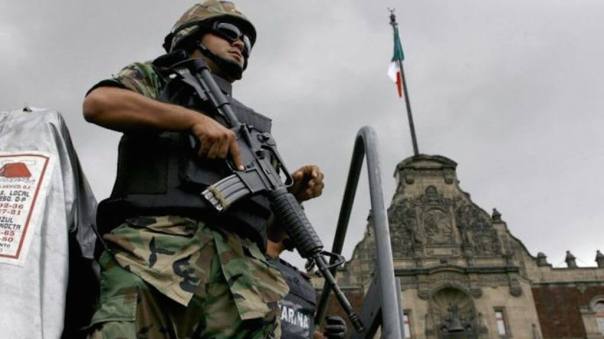
Mexican soldiers. Photo: Getty images.
By: Juan Paullier / BBC Mundo
December 19, 2016
Juan Villoro doesn’t hesitate. Witch hunts, great irresponsibility, and total failure.
Upon completing 10 years last December 11 from the start of the so-called War against Drug Trafficking in Mexico, the writer can only find dark words to define what this disastrous period has meant for the country.
There’s not even clarity about the impact in numbers. The dead as a consequence of this conflict could be around 150,000, the disappeared almost 30,000.
From religious cartels to thousands of displaced: 5 collateral effects of the War on Drugs in Mexico
“Mexico,” Villoro tells BBC Mundo in an interview, “has become a gigantic necropolis.”
The writer has no doubt about the negative result of the strategy of fighting the cartels that then president Felipe Calderón started in 2006.
“The State has lost total sovereignty, social inequality has increased, and the consumption of drugs has not gone down. It has then been a total failure because it has been understood that the only solution for fighting the problem of drug trafficking is military and the only thing that has come, it seems to me, is the proof that each bullet is a lost bullet,” he assures. Villoro, 60, admits that back then it was impossible to know what the president’s decision was going to imply for the country.
“None of us calculated the dimension that it was going to reach,” he explains, “the bloodbath in which we were going to insert ourselves because of the immense irresponsibility of President Felipe Calderón, who did not know completely the enemy that he was going to confront, and had no strategy in that regard.”
How and when did Mexico become so ferocious?
And in spite of the fact that the governmental focus has not yielded results, there is no sign from the group in power that it is looking for an alternative.
“The military strategy has been a disaster because there has not been a withdrawal of the violence, there has not been a decrease in the trafficking of drugs and it (the military strategy) has only contributed to accentuating the blood bath. There isn’t any evidence from a practical point of view that might endorse this strategy. If it hasn’t fulfilled its purpose, it’s time to change the focus, but that hasn’t been done.”
Although when Enrique Peña Nieto arrived in the presidency four years ago the discourse was different in the beginning; in practical terms and on the ground the situation has not changed.
“There were encouraging signs in the sense that he said that drug trafficking ought not be focused on as a national security problem but as one of public health,” Villoro asserts about the arrival of Peña Nieto, “(but) sufficient mechanisms were not created to be able to modify the strategy.”
Then followed a militarist inertia, he comments in the interview with the BBC, and he recognizes that the social reforms of this government stimulated illusion but were failing one by one and that the president lost credibility because of the Ayotzinapa case and the corruption scandals.
Some cry, others throw parties, others take “selfies”: it’s the harsh encounter of the families with the bone fragments of their disappeared family members.
One doesn’t have to take care of the bad ones, but rather of those that seem good
Villoro emphasizes a central moment of these ten years upon remembering Calderón’s statement about the existence of 7.5 million ninis in the country; in other words, youths that don’t work or study.
“Curiously, the very same president that gave that statistic didn’t do anything to confront the problem,” he says. “Evidently that kind of youth are the perfect culture for drug trafficking; they don’t become gunmen because they have a demoniacal calling. The best rational sensible offer that they face is that of entering drug trafficking.”
It’s the existence in the background of a more complex social problem that has not been attacked and that is not solved with soldiers in the streets attempting to capture drug cartel leaders. And it’s not just about complementing and diversifying a military strategy.
“As we could see in the Ayotzinapa case,” Villoro asserts, “the drug traffickers and the authorities are completely colluded (…) then attacking the drug traffickers means investigating the government.”
That is where one of the greatest challenges is found at the time of fighting the situation. And to introduce the theme remembers a sentence from the Mexican writer Elmer Mendoza: “One must not take care of the bad ones, but rather of those that seem good.”
By having too many interests at play, what’s lacking, he considers, is the political will to confront the problem.
Those who “seek to maintain an honorable facade and serve as a contact or as an associate with drug trafficking: those are the people that have a lot to lose if it becomes known that they have contact with organized crime, therefore they are the ones that most threaten the journalists, the ones that are in charge of protecting an apparently institutional society from organized crime.”
The zones of silence in the war on drugs in Mexico
“All societies of the world have corruption and all have a zone where the illicit becomes apparently licit (…) but the problem in Mexico is that this has reached an enormous scale, so then the range of impresarios, militaries, police and politicians colluded with organized crime is enormous, and then it’s very difficult to fight it and this is the sector that is the most dangerous for whoever tries to do it.”
And if here the magnitude of the phenomenon reached unimaginable heights in part it’s because of having the United States on the other side of the border.
“It’s important to understand that we are neighbors of the country that consumes the most drugs in the world and that sells the most arms in the world… that defines much of the Mexican situation.”
What Villoro doesn’t find much understanding of is the brutality of the violence.
“In some way the executioner feels more protected with this extreme annihilation,” he says, “but it’s a difficult phenomenon to explain and there would be nothing more grave than that this would begin to seem normal to us,” he considers.
Being an optimist belongs to the dissidence
Villoro emphasizes the need to set pessimism aside despite the fact that the atmosphere doesn’t help to see things another way.
“Optimism is a big challenge and is a radicalness. Being an optimist today belongs to the dissidence, belongs to the rebel (…) it would seem that there aren’t many possibilities to be optimistic but I believe that it’s worth it to think that things can be different,” he asserts.
He takes advantage of the issue of optimism to explain that Mexicans should not become resigned to having the country that they have today and he adds that Mexico, its reality, is schizophrenic.
]We’re talking about a rich country, despite the fact that almost half the population is poor, the tourism increases, the industries grow and there is a creative cultural atmosphere framed within a nation of “two speeds.”
And he illustrates this divergence with an example: the city of Guadalajara is the scene every year of the most important Spanish language book fair and at the same time he remembers that cadavers were found outside of that very same event.
He considers the roadmap that includes the State taking control again of the zones from which it has withdrawn and the drug traffickers acting at their own pace, as well as the legalization of some drugs.
“In a country where the State does not impart justice, it offers no labor options, guaranties no security, the drug trafficker is the one that by substitution fulfills those tasks and that is what is grave. There are of course ways of reclaiming the State’s presence, that is undeniable, it’s difficult but it can be done.”
And in that plan that he proposes he also warns of the need to integrate the society and that a part of it will be shaken by a dangerous indifference towards the horror that crosses the country.
Although the authorities have more responsibilities, he remembers a comment of the writer Cristina Rivera Garza about the people that practice a sort of “militant indifference, an apathy as a way of life so as not to assume the responsibility for doing something.”
“There is everything so that we are indignant and so that we take action, but at the same time it’s always more comfortable to do nothing. Then there is an apathy cultivated by broad sectors of the population and there are also sectors of the population dedicated to fomenting that apathy,” he points out.
“Many times the indignation stays in a tweet.(…) If we are going to change the world in that often underrated space that is reality, one must pass from criticism to transformation,” he thinks.
Villoro considers that if these ten years of the drug war have left any lesson it’s that this is the path that must be left behind.
“The only pedagogy has been that of error, we know that it should not be done, at least not in this way, and it’s the only good thing that we can get from these years”.
———————————————————————
Originally Published in Spanish by Desinformemonos
Monday, December 19, 2016
Re-Published with English interpretation by the Chiapas Support Committee
The Standoff at Standing Rock: Reflections from a White Ally

Tents and tepees at Oceti Sakowin (seven council fires) Camp with Flag Road in the background. Photo: Todd Davies, November 22, 2016.
By: Todd Davies
For background information, please go to OcetiSakowinCamp.org and StandingRock.org.
[NOTE: This post appears as an article in the December 2016 issue of Chiapas Update, and was written on December 6, 2016.]
As I write this, the Army Corps of Engineers (CoE) has just denied an easement for building the Dakota Access Pipeline (DAPL) under the Oahe reservoir, next to un-ceded treaty lands of the Standing Rock Sioux Tribe. CoE’s promise to do an Environmental Impact Statement came eight months after the establishment of the Camp of the Sacred Stone, where the Cannonball and Missouri Rivers meet. Sacred Stone and its extension camps (Rosebud, Oceti Sakowin, and Red Warrior) have grown from a handful of Native people last spring to thousands of inhabitants. CoE’s failure to do a proper environmental review initially, as well as the racism that led the pipeline to be routed through Native treaty lands, brought indigenous Americans and their allies together at Standing Rock. The CoE’s reversal feels like a victory, but the battle against DAPL is not over.
Energy Transfer Partners (ETP) built almost the entire pipeline in six months this year. But ETP lacked legal authority to complete the full pipeline, and now finds itself on what may be the losing end of a $3.8B gamble. Contracts with investors expire on January 1st, and solidarity campaigns are now focused on banks such as Wells Fargo, urging them to pull their investments and leave the pipeline in the ground, as a stranded asset.
Like many Bay Area activists, I have followed Standing Rock from afar, attending local events such as the November 15 Day of Action at CoE offices. And like quite a few from our community, I have also been fortunate to visit Standing Rock as a guest. My visit from Nov. 21-24 was much briefer than I wanted, but was all the time I could spare between work and personal commitments. After reading and hearing about life in the camps, I resolved to make up for the brevity of my visit by being of use while there. At the orientation meeting I attended on my first morning, in Oceti Sakowin Camp. I wrote down the other guidelines (in addition to “Be of use”) taught to new arrivals: Indigenous-centered, Building a new legacy, and Bring it home.
I flew into Bismarck, which is usually an hour’s drive from the camps, but took longer since police closed the main road to protect the drillers. I bought firewood at a local store in Bismarck, and donated the logs when I entered Oceti Sakowin Camp on the Monday of my visit. As many others who have traveled to Standing Rock have said, the spiritual feeling one gets from the water protectors is immediate and palpable. I arrived just after the violent night of November 20, when militarized police attacked water protectors in freezing temperatures with water fire, solid/lethal projectiles, and chemical weapons. Many in the camp had suffered wounds and hypothermia, including one woman whose retina was severed, and another whose arm was mutilated. I was instantly in the company of others, mostly non-Native allies, who had been involved in direct action movements in the U.S. in recent decades. But I was also aware that this was indigenous land, and that despite my many stays in Zapatista territory in Mexico, I had never been in the midst of an indigenous struggle of this magnitude in the U.S.
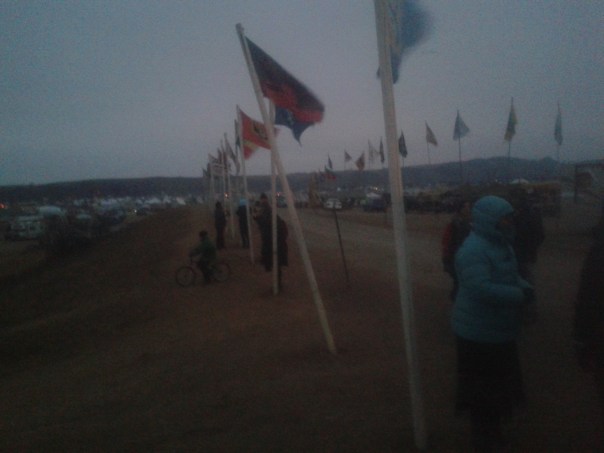
Water protectors are bundled up as the wind blows on Flag Road in the Oceti Sakowin Camp, North Dakota, November 22, 2016.
Rather than pitching my tent in the freezing air of North Dakota, I rented a room at the Standing Rock Sioux Tribe’s Prairie Knights casino. When I contacted the camp before my trip, I said I would be staying at the hotel, and that I would be happy to welcome water protectors who needed showers or shelter during my stay. Sure enough, soon after I checked in, half a dozen young activists knocked on my door. They all showered and told me what they had been through early that morning, during perhaps the most brutal police attack on water protectors since the camps had gone up. These shower seekers had been on the “front line,” where the cops had barricaded the road at the end of Backwater Bridge, just north of Oceti Sakowin Camp. They showed me large welts and bruises on their arms, legs, and torsos that came from freezing high-speed water, rubber bullets, and beanbag projectiles. These activists had been at the camp for weeks. One of them told me he was willing to die to stop the pipeline. There was a lot of reflection, and some argument, about the details of the night – what a choice to confront police means for the movement and for one’s friends, how to understand the words of the Tribal elders, and why police were acting as they did.
On Tuesday, I went through the daily Nonviolent Direct Action training next to the Indigenous People’s Power Project (IP3) camp. I joined many new arrivals in receiving instructions from the Legal Collective and from Morton County public defenders. As an indigenous trainer led exercises in peacefully holding and moving through spaces, and regrouping amidst aggressive police role-players, a surveillance helicopter circled ominously overhead. A medic gave instructions on how to deal with mace, tear gas, and other chemical weapons.
Just before twilight, I was directed to a press conference at the Backwater Bridge, just across from where the police were building a new barricade. This was the closest I got to the front lines, because after that, the elders asked everyone to go back to the camp. “We are worried the police will attack us,” they said. An apparently white male accompanied by a woman argued with a young Native camp guard, saying he did not have to follow what the elders advised. “I live here!” the white man said, although he was clearly a guest. I filmed this with the guard’s permission (and with my press pass displayed). The white activist made a run toward the bridge as Native security ran after him.
As a new arrival who had been through an allies’ orientation, I had been asked to respect the Sioux leaders, and interpreted this to mean the Tribal Council members. But I gradually learned that Standing Rock has different voices of leadership, and while they all agree on the need to stop DAPL from being built under Lake Oahe, on other issues they often disagree. This is not surprising, given the vigorous political differences that exist in most communities, including my own. But it sometimes poses a dilemma for me as a colonial settler trying to be an ally to Native people. Whatever I do, or do not do, is a choice that supports some people more than others. If I look for an indigenous activist who shares my tactical viewpoint, I am likely to find one. But if, say, white allies do this collectively, then it seems we are enacting white dominance by proxy. If we only do what elected Tribal leaders command, on the other hand, we may sometimes fail to provide needed support for Tribe members who rightfully disagree with their leaders. If we act as foot soldiers for the Tribal Council, we may amplify its power to struggle against oppressive U.S. Government policies. But if we are free to do what we believe is right, and what more radical indigenous people do and advocate, we may be able to act in ways that are productive for the struggle, but for which the Tribal government cannot safely take responsibility. Or we might screw everything up.
In the aftermath of the CoE denying a permit for DAPL, we are seeing this dilemma play out. Tribal Chair Dave Archambault II has asked non-Sioux water protectors to leave. But the founder of the camps, LaDonna Brave Bull Allard, on whose land Sacred Stone was established, is saying this would be a mistake. I don’t know enough to say who is right.
I participated in two actions on the Wednesday of my visit, using my rented car to transport water protectors to a prayer ceremony at the police blockade on the northern side of the Route 1806 closure, and also to a caravan through downtown Bismarck. The trainings had been useful, but seeing exactly how our Native action leader organized the ceremony, and interacted with police amidst ceremonial drumming, deepened my appreciation for the prayerful approach that characterizes Standing Rock. Returning to camp late in the day, I listened to speakers at the Youth camp. One Native young person thanked those of us who could only come to the camp for a few days. All of us can contribute to protecting the water, she said, and more will come to take our places when we leave.
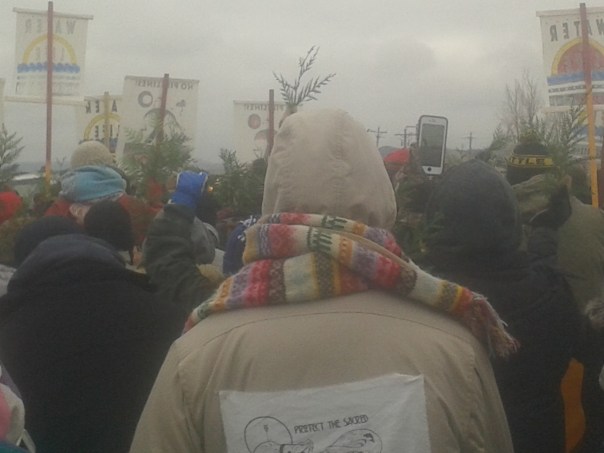
Standing Rock water protectors march peacefully toward police at the northern blockade of North Dakota Route 1806 along the Missouri River, on November 23, 2016.
I made my way to the Sacred Stone Camp across the Cannonball, where I had to go in order to make an offering from the Chiapas Support Committee to the Standing Rock Sioux Tribe. The atmosphere in this original camp was quiet but deliberate. The Sioux woman who took our gift described what is happening as a last stand. Standing Rock has lost so much, most visibly at that spot, where the joining of the rivers once created spirit rocks, but which was destroyed, and the Tribe’s lands flooded, when the dam was built. As darkness fell, I looked at the rivers and at the ugly, glaring lights that illuminate the path of the pipeline in the distance.
Snow was falling in Cannon Ball as I left on “Thanksgiving” morning. I met friends in Mandan for a holiday brunch, before heading to the airport. As we talked about the hostility directed at water protectors by many non-Native North Dakotans, and how many times I got told “Go home!” by angry white folks during my brief visit, I got a sympathetic look from one of my friends. The public hearings about the pipeline, he says, were held in Minot, Williston, and Bismarck – the mostly white centers of “oil country” in North Dakota, where the pipeline has public support. But no hearings were held where Standing Rock Sioux Tribe members live, where the Missouri was planned to be crossed, or downstream. Many non-Natives in North Dakota prefer a pipeline to the cargo trains that carry oil through cities and that often explode, he says. But, he notes, a pipeline is sure to leak in a really bad way that, especially when it is under ground, can continue for a long time.
This is exactly what the water protectors have said. A route for the pipeline that would have crossed the Missouri in mostly white areas around Bismarck was rejected, for the same reasons that the Sioux people do not want it near them. If it is too risky for white people, it is too risky for Native people. Amidst the complexities of ally-ship and leadership in this struggle, that basic point is as transparent as fresh water.
Update on “The Zapatistas and ConSciences for Humanity”
Update on the Gathering “The Zapatistas and ConSciences for Humanity.” Subcomandante Insurgente Moisés

ZAPATISTA NATIONAL LIBERATION ARMY
MEXICO
December 15, 2016
To the scientific community of Mexico and the world:
To the National and International Sixth:
We send you our greetings. We want to update you on the plans for the gathering “The Zapatistas and ConSciences for Humanity,” to be held at the CIDECI-UniTierra in San Cristóbal de las Casas, Chiapas, from December 25, 2016 through January 4, 2017.
- As of December 12, 2016, we have the confirmed participation of 82 scientists from the following countries: Germany, Canada, Chile, United States, Spain, Israel, Paraguay, United Kingdom, Uruguay, Brazil and Mexico (Baja California, Campeche, Mexico City, Mexico State, Jalisco, Morelos, Oaxaca, Puebla, Querétaro and San Luis Potosí).
- The areas in which they work are the following: Quantum Field Theory, Mathematics, Volcanology, Astrophysics, Astronomy, Cosmology, Nuclear Fusion, Genetics, Microbiology, Geophysics, Statistical Physics, Optics, Bioethics, Quantum Field Theory, Biophysics, Evolutionary Biology, Marine Biology, Molecular Biology, Biochemistry, Physiology and Biophysics of Excitable Cells, Solar Photochemistry, Genetic Mutation and Environmental Pollution, Genomics of Microorganisms, Origin and Evolution of Life, Complex Systems, Intelligent Systems Control, Energy Conservation, Food Science and Technology, Energy Science, Nutrition Science, Animal Behavior and Communication, Biodiversity Conservations, Palliative Care, Pediatrics, Behavioral and Conservation Ecology, Evolutionary Ecology of Microorganisms, Marine Ecology, Theoretical Ecology, Ecology and Agro-ecology, Renewable Energy, Energy Systems Engineering, Hydrology, Environmental Chemical Engineering, Chemical Engineering and Magnetic Separation of Minerals.
- Scientists and attendees may register on December 25, 2016. Activities will begin on December 26, at 10am, and will conclude on January 4, 2017, at 6pm. There will be an intermission on December 31, 2016 and January 1, 2017.
- The electronic address to register as a listener/observer is: conCIENCIAS@ezln.org.mx
- Two hundred Zapatista bases of support—women, men, children, and elders—of the languages Tzeltal, Tzotzil, Tojolabal, Chol, Zoque, Mame, and mestizo, will attend as students. The Zapatista students are the only ones who may direct questions to the scientists who present.
- The gathering will have general sessions, information sessions, and workshops.
That’s all for now.
From the mountains of the Mexican Southeast,
Subcomandante Insurgente Moisés
Mexico, December 2016
Trump and 21st Century fascism
By: William I. Robinson *

Piñatas of Donald Trump are popular in California.
Contrary to what is thought, Donald Trump is a member of the transnational capitalist class (TCC), since he has strong investments around the world and a very important part of his “populism” and anti-globalization discourse responded to political demagoguery and manipulation in performing the duties of the presidential election.
At the same time, this transnational capitalist class and Trump himself depend on the migrant labor for their accumulations of capital and don’t really seek to get rid of a population in labor peonage, due to their status as a migrant and not of citizen or “legal” resident. His sought-after plans for deportation, already reduced in number as president-elect, and his proposals for criminalization of immigrants on a larger scale seek, on the one hand, to convert the immigrant population into a scapegoat for the crisis and channeling the fear and action of the citizen working class (the majority white) against that scapegoat and not toward the elites and the system. On the other hand, the dominant groups have explored how to replace the current system of super- exploitation of migrant labor (based on lack of documentation) with a system of un migrant workers with visas; in other words, guest worker programs.
At the same time Trump seeks to intensify the pressures for lowering wages in the United States, for the purpose of making American labor “competitive” with foreign labor; in other words, with the cheap labor from other countries. The transnational leveling of wages downward is a general tendency of capitalist globalization that continues ongoing with Trump, this time with a discourse of “returning competitiveness” to the U.S. economy and “bringing jobs back” to the country.”
One must not overlook the dimension of Trump’s extreme racism, but rather analyze this dimension more in depth. The United States system and the dominant groups find themselves in a crisis of hegemony and legitimacy, and the racism and the search for scapegoats is a central element for challenging this crisis. At the same time, important sectors of the American white working class are experiencing a de-stabilization of their working conditions and living conditions, a downward mobility, “precariousness,” insecurity and very great uncertainty. This sector had historically certain privileges thanks to living in what’s considered the first world and because of “racial”-ethnic privileges with respect to Blacks, Latinos, etcetera. They are losing that privilege by gigantic steps versus capitalist globalization. Now the racism and the racist discourse from above channel that sector towards a racist and neofascist conscience.
Equally dangerous is Trump’s openly fascist and neofascist discourse, which has achieved “legitimizing” and unleashing the ultra-racist and fascist movements in United States civil society. In that direction I have been writing about the “fascism of the 21st Century” as a response to the grave and greater all the time crisis of global capitalism, and that it explains the turn towards the neofascist right in Europe, as much in the West as in the East; the resurgence of a neofascist right in Latin America; the turn towards neofascism in Turkey, Israel, Philippines, India and many other places. One key difference between the fascism of the 20th Century and that of the 21st Century is that now it’s about the fusion not of national capital with reactionary political power, but rather a fusion of transnational capital with that reactionary political power.
“Trumpism” represents an intensification of neoliberalism in the United States, together with a greater State role for subsidizing the transnational accumulation of capital in the face of stagnation. For example, Trump’s proposal to spend one trillion dollars on infrastructure, when we study it well, his objective in reality is to privatize that public infrastructure and transfer taxes of the workers to capital in the form of tax cuts to capital and subsidies for the construction of privatized public works. An epoch of changes is coming in the United States and in the whole world. I fear that we are on the edge of the inferno. There will surely be massive social explosions, but also a horrifying escalation of state and private repression.
The crisis in the spiral of global capitalism has arrived at a crossroads. Either there is a radical reform of the system (if not its overthrow) or there will be a brusque turn towards “21st Century fascism.” The failure of elite reformism and the lack of will of the transnational elite to challenge the depredation and rapaciousness of global capitalism have opened the way for an extreme right response to the crisis. “Trumpism” is the United States variant of the rise of a neofascist right facing crisis all over the world; Brexit, the resurgence of the European right; the vengeful return of the right in Latin America, Duterte in Philippines, etcetera. In the United States the treason of the liberal elite is as responsible for Trumpism as the extreme right forces that mobilized the white population around a program of racist, misogynist scapegoating based on the manipulation of fear and economic destabilization. Critically, the political class that has prevailed for the last three decades is more than bankrupt and has paved the way for the extreme right and eclipsed the language of the working and popular classes and of anti-capitalism. It contributes to derailing the revolts underway from below, pushes white workers to an “identity” founded on white nationalism and together with the neofascist right helps to organize them into what Fletcher names “a united white and misogynist front.”
* Professor of sociology at the University of California Santa Barbara and author of the book Latin America and global capitalism, a critical perspective of globalization (Baltimore, Johns Hopkins University Press, 2008).
———————————————————–
Originally published in Spanish by La Jornada
Sunday, December 4, 2016
http://www.jornada.unam.mx/2016/12/04/opinion/026a1mun
Re-Published with English interpretation by the Chiapas Support Committee
 Chiapas Support Committee