Chiapas Support Committee
Home of the Compañero Manuel blog on zapatistas & mexico
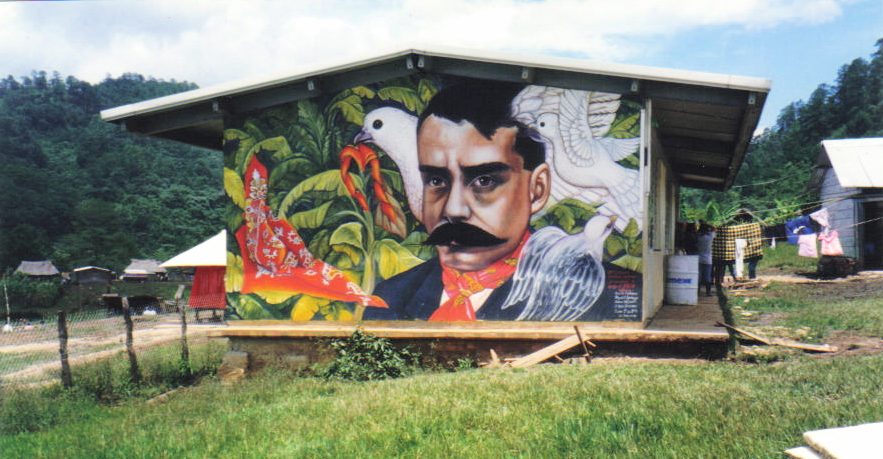
CNI-EZLN: Despite aggressions, the consultation continues
JOINT COMMUNIQUE BY THE NATIONAL INDIGENOUS CONGRESS AND
THE ZAPATISTA NATIONAL LIBERATION ARMY

Zapatista musicians
December 2, 2016.
TO THE PEOPLE OF MEXICO:
TO THE PEOPLES OF THE WORLD:
TO THE FREE MEDIA:
The steps taken by our peoples are great, wise steps when taken in collectivity, and the National Indigenous Congress turns with attentive ears to listen to each other, to the thoughts of we who are the word and the agreements of the 5th CNI. We continue in permanent assembly, traveling to all corners of our country, Mexico.
Our permanent assembly arises from and convenes among the peoples, nations, and tribes of all the languages spoken by the National Indigenous Congress; in large and small assemblies; in meetings of communal councils, in deep reflections by dispersed families; in regional forums and ceremonial spaces. In our collective words, we continue to conclude that it is the time of our peoples, time for the earth to tremble at its core.
The fears of the powerful, the extractive companies, the military, and the narco-paramilitaries are so great that our consultation is being attacked and harassed in the places where our peoples are meeting to discuss and decide the steps to take as the CNI. For that reason, we denounce the following:
– In the indigenous Nahua community of Santa María Ostula, Michoacán, there is intensified narco-paramilitary harassment by the Caballeros Templarios [Knights Templar] cartel, which threatened, on a paper signed on November 19, 2016—the same date that a regional assembly on the coast of Michoacán was discussing the resolutions from the first stage of the 5th CNI—to undertake a “cleansing” of those participating in mobilizations alongside the community police.
– As agreed upon in the assembly of the 5th CNI in October 2016, our compañeros have traveled to different geographies of the country where Native peoples have requested dialogue with delegates of other peoples with respect to our political proposal. These compañeros have been victims of aggressions and harassment by criminal gangs or unknown people, including the burning of homes in their communities and aggressions by vehicles trying to push them off the roads they must travel.
– While foreign companies attempt to take control of 12 oil wells in Zoque territory in Northern Chiapas, this past November 23, 2016, a group of armed men pretending to be government-sponsored teachers, and with the consent of the Assistant Secretary of Federal Education in Chiapas, Eduardo Campos Martínez and the boss, Delfino Alegría García, kidnapped a group of indigenous professors from the National Coordination of Education Workers (CNTE) in the northern zone of Chiapas. They also attacked them with high-powered weapons outside the office of the Secretary of Education in the municipality of Ixtacomitán, Chiapas. The sneak attack claimed the life of Zoque teacher Roberto Díaz Aguilar, originally from Chapultenango, Chiapas, and injured three others.
– The teacher Irineo Salmerón Dircio, Coordinator of the House of Justice in San Luis Acatlán and member of the Regional Coordination of Community Authorities (CRAC-PC), was kidnapped/disappeared by an armed group in the municipality of Tixtla, Guerrero. Two days later his lifeless body was found in the municipality of Chilapa, Guerrero, just a few days after at least 15 communities from the Emiliano Zapata Indigenous and Popular Council of Guerrero had held an assembly in the same municipality as part of the consultation we are currently carrying out.
– From the collective heart of the Native peoples of the National Indigenous Congress, we pronounce our absolute respect for the territory of the Sioux people, in Standing Rock, North Dakota, where more than 200 tribes are organizing to stop the plunder the capitalists are trying to impose through oil pipelines that destroy water sources and ceremonial sites. We condemn the brutal repression these tribes were subject to this past November 20, and the repression planned against them with the announcement of an ultimatum to vacate their lands. If we Native peoples had ever responded to the ultimatums of the powerful, we would have ceased to exist centuries ago. To the Sioux People we send a brotherly embrace and we reiterate that they are not alone, that their pain and rage are ours, also. We call on the Native peoples of the United States and Mexico, on the free media, and on civil society to strengthen their solidarity with this historic struggle.
We send a greeting of solidarity to the compañer@s of the Chanti Ollin community, adherents of the Sixth Declaration of the Lacandón Jungle, who were violently evicted—in the middle of the night on November 22, 2016—from the building where they promote culture, art, and the alternatives necessary for a new world. We repudiate the repressive, sellout policies represented by the bad government of Mexico City.
We salute the mobilizations held by the Committee in Defense of Indigenous Rights (CODEDI) from the coastal region of Oaxaca against the repressive policies of the bad governments who, for lack of any valid reason, use criminalization as their only recourse to impose 11 hydroelectric projects in the coastal region of Oaxaca, including the Multi-Use Hydraulic Exploitation Project Paso de la Reyna.
Likewise, the peoples, nations, and tribes of the CNI express our profound respect for and solidarity with the Cuban people, who have shown the world that through dignity we can reconstruct the fabric unraveled by capitalism. We know that their resistance and rebellion will continue shining and concretizing hope.
Attentively,
DECEMBER 2016
FOR THE FULL RECONSTITUTION OF OUR PEOPLES
NEVER AGAIN A MEXICO WITHOUT US
NATIONAL INDIGENOUS CONGRESS
ZAPATISTA NATIONAL LIBERATION ARMY
En español: http://enlacezapatista.ezln.org.mx/2016/12/02/a-pesar-de-las-agresiones-la-consulta-va/
Chiapas: Modevite will consult their communities about EZLN proposal
THEY DEMAND RESPECT FOR SELF-DETERMINATION OVER THEIR TERRITORY and AGREE TO CONSTRUCT COMMUNITY GOVERNMENTS

Movement for the Defense of Life and Territory Photo: Chiapas Paralelo
By: Angeles Mariscal
In this state of the Mexican Southeast, the mining industry has been granted concessions to almost 20 percent of the territory, and there are more than 30 governmental authorizations to use tributary rivers in the installation of mini-hydroelectric dams, five projects for constructing dams and an open solicitation for extracting hydrocarbons from 12 wells; the project to construct a gas pipeline is also in the works, and through the decree for creation of the las Special Economic Zones they granted eased tariffs so that corporations consolidate their businesses linked to the extractive industry.
This is the scenario that thousands of indigenous face in Chiapas; and it’s because of that that this November residents of the municipios of Salto de Agua, Tumbalá, Yajalón, Chilón, Ocosingo, Altamirano, Oxchuc, San Juan Cancúc, Tenejapa, Huixtán and San Cristóbal de las Casas left their communities to tour the region and demonstrate their rejection of these projects that threaten stability in their territory.
They are from the Tsotsil, Chol and Tseltal indigenous ethnicities, who make up part of the faithful of the Diocese of San Cristóbal de las Casas, grouped together in Pueblo Creyente (Believing People), and since four years ago have been members of the Movement for the Defense of Life and Territory (Movimiento por la Defensa de la Vida y el Territorio, Modevite).
On their 15-day tour, Modevite members met with more than 20,000 different indigenous peoples, with whom they dialogued about the common problems that cross through their territories.
“We have walked to listen to the problems of our communities and the risks that threaten our culture and our Mother Earth with mega-projects and super-highways. We walked to unite us in one single voice. We have been able to converse, reflect and dream as one people,” they explained in a joint pronouncement.
Mines, hydroelectric dams and wells on indigenous lands
“We are at a strategic place regarding the mega-projects. This territory is one of the objectives of extractivism,” they pointed out upon arriving in San Cristóbal de las Casas, in a plaza full of indigenous and mestizos.
There, in the plaza, they said that ac cording to the Secretary of Economy, in the last three six-year presidential terms 99 concessions for exploiting minerals that are found on 1.5 million hectares –almost 20 percent of Chiapas territory- have been delivered to corporate investors, the majority lands belonging to indigenous groups that would have to be displaced to make way for the mining industry.
They also said that the Federal Electricity Commission (CFE) has identified Chiapas as a state with great hydrology potential, and plans to construct 90 hydroelectric dams with different capacities. Four of those stand out that would directly affect indigenous territory: the Altamirano Dam on the Tzaconejá River; the Livingstone Dam on the Tzaconejá River; the Santo Domingo Rapids Dam (previously Huixtán I) on the Santo Domingo River; and the Santa Elena Dam (previously Huixtán II) on the Santo Domingo River, among others. They emphasized that investors have asked the Secretariat of the Environment and Natural Resources (Semarnat) for the installation of at least 32 “mini-hydroelectric” dams.
They also said that the perforation of 12 wells for the extraction of gas and oil has been projected for 2017 in the indigenous Zoque zone. This project will affect 845 square kilometers located in two areas within the municipios of Tecpatán, Francisco León, Ixtacomitán and Pichicalco.
Another risk to indigenous territories –they reminded- is the planting of genetically modified seeds (GMOs). From 2010 to the middle of 2016 the Monsanto Company planted genetically modified soy in 13 Chiapas municipios.
They call for strengthening community governments
The inhabitants of the zones where these extractive projects are located pointed out that accepting them would mean being displaced from their territory, and with that also losing their roots.
They started to organize four years ago and since then they have achieved suspending the construction of the San Cristóbal-Palenque Super-Highway. “Now we see that our fight is bigger; we have the job of defender our life, our culture and the commons that there are in our territory,” they underscored.
They said that throughout their tour through indigenous territory, there was agreement that not only must they denounce the affectation to their territory because of the extractivist projects, “but we must also care about the land.”
They said that if the federal, state and municipal governments support and promote the extractive industry, their option is to create community governments that respond to the interests of the indigenous peoples that are being affected.
Therefore, the indigenous agreed to add themselves to the proposal of the National Indigenous Congress (Congreso Nacional Indígena, CNI) and the Zapatista National Liberation Army (Ejército Zapatista de Liberación Nacional, EZLN), to consult with their communities about the decision to participate in the next national elections with an independent indigenous candidate.
“We share the same objective (as the CNI and EZLN), we believe that it’s necessary to strengthen the la voice of our indigenous peoples on the political agenda, and therefore we want to take this initiative to our communities and municipios. We can no longer work divided but rather it’s necessary to unite for our peoples, for our territories,” they said.
Modevite members announced that they would strengthen the initiative for constructing autonomous governments as a measure for conserving their territories and their culture. “It’s our right to decide the use of and destiny of our territory,” they said.
——————————————————————-
Originally Published in Spanish by Chiapas Paralelo
Thursday, December 1, 2016
Re-Published with English interpretation and edits by the Chiapas Support Committee
EZLN: a clarifying text

SCI Marcos before he died and became SCI Galeano. Photo: Vice
By: Magdalena Gómez
I dedicate this collaboration to the Cuban people and to Pablo González Casanova for the “Lessons of Fidel” and, his own. Very opportune the text “A story to try to understand,” [1] elaborated by sub Galeano and Subcomandante Insurgente Moisés, spokesperson and current head of the EZLN. Obliged reading for those who in good faith are interested in knowing and sharing the initiative underway, about which the National Indigenous Congress is consulting with indigenous peoples and communities. The detailed story about the gestation of the initiative gives an account of a political conviction of the EZLN that is certainly not the first time they put it into practice. We remember their historic decision in the dialogue with the federal government, of ceding the table to the country’s indigenous peoples so that they would be the ones that in the first instance would discuss the proposals on indigenous rights and culture in coordination with the indigenous commanders. The San Andrés Accords owe their relevance to that construction and unpublished collective debate.
The correct allegation about the more than evident fact that neither dreams nor nightmares fit into ballot boxes, for the effects of the subject initiative in consultation is a double edged sword, because, as is recognized, “there have been, there are, and there will be doubts and legitimate and rational questionings,” among them is rightly the one that proposes to go to an election when it (the election) is recognized as being meaningless.
Nevertheless, one must turn to that evaluation and the text that proposes it clearly: there is no other more convincing way of making the situation of the indigenous peoples visible than placing themself on the stage where the whole political class will see them in 2018. Very strong what they shared with the CNI upon presenting their proposal to them: “Our pain reaches fewer people all the time. Our deaths don’t echo like before. And it’s not that the people outside have become cynical or apathetic. It’s that the war we have suffer since a long time ago as Native peoples, now reaches them, it is now in their streets, in their houses, in their schools and in their workplaces. Our pains are now one more among many others. And, although the pain extends and becomes deeper, we are more alone than ever. Each time we’re going to be fewer. Soon the CNI won’t be able to meet because no one will be able to leave their territories, be it because of the cost, be it because of the bad government, be it because of the corporations, be it because of crime, be it because of a natural death or a bad death mala that it impedes you. In a while more we will only be talking among ourselves, already knowing what we’re going to say.”
Also very significant, for those who want to understand, the story about the meeting that the now-deceased Sup Marcos had 10 years ago with a northwest indigenous chief of the country’s northwest 10 years ago, when he (Marcos) was touring with the other campaign. The chief had previously received institutional governments. The chief told Marcos: “I know very well that they didn’t want you to meet with me, that they pressured you so that you would not be here. They also pressured me so that I would not receive you. I don’t know why you are here. I imagine that those who command you told you that you should see us and listen to us. I don’t know. But I’m going to tell you why I received you. I have received the governments. They have come from all the colors and sizes. They come and take their photo, they say a few words, they go away and they don’t come back. I have received them because my predecessors told me that my duty was to see that my people, my pueblo, would not die, that they would survive. I received them for that reason. I receive you because of that. I don’t believe that you b ring me ether advice or teachings, although it’s good that you don’t seek a photo and that you listen instead of talking. I received them because I think my people will survive a while longer that way and won’t die. So I receive you because I believe that something will be seen from what we are and that view, although only for a little time, will help my people survive.”
Upon the deceased Sub Marcos questioning whether he wasn’t worried that they would judge him receiving him, he answered: “Only my own people can judge me. If my people condemn me for what I have done and for what I do, that would mean that I wasn’t wrong. My people will have to have survived in order for them to condemn me. So that would mean that I have fulfilled my duty and I can show the dead that I have done so, although the living condemn me.”
Another of the document’s central messages is the clarification that it will not be the EZLN that participates in the election: “the CNI is who will decide if it participates or not with its own delegate, and, if so, it will have the support of Zapatismo.” It couldn’t be clearer. The decision of the peoples in the consultation is complex, because they rightly resist the enslavement of power, but also, like the indigenous chief of the northwest, they are supported in institutional mechanisms like survival strategy. They know that the community, individual and secret vote will be visible and they will be objects of multiple pressures. There is the task of the indigenous peoples we have accompanied and obviously we decided to assume it.
[1] Well, it turns out that the English translation of the recent EZLN communiqué entitled “A story to try to understand” is too long to post on this blog. The English translation can be found at: http://enlacezapatista.ezln.org.mx/2016/11/26/a-story-to-try-to-understand/
———————————————————–
Originally Published in Spanish by La Jornada
Tuesday, November 29, 2016
http://www.jornada.unam.mx/2016/11/29/opinion/020a1pol
Re-Published with English interpretation by the Chiapas Support Committee
Convocation of the second phase of the fifth CNI

“Our fight is not for power, our fight is for saving Mexico.”
CONVOCATION OF THE SECOND PHASE OF THE FIFTH NATIONAL INDIGENOUS CONGRESS
Given that:
- During the first phase of the Fifth National Indigenous Congress (CNI), we analyzed and discussed in depth the different faces of the capitalist war on our peoples. We agreed that it is urgent to halt the displacement, destruction, disrespect, oblivion and death to which our peoples are subjected and which seek to put an end to our individual and collective resistances and leave our homeland in the hands of the capitalists that govern this country and this world.
- It is urgent to struggle, to take serious steps and to go on the offensive alongside the peoples of the countryside and the city, indigenous and non-indigenous, to construct a new nation from below.
- We agreed to remain in permanent assembly while carrying out a consultation in all of our geographies on the resolutions reached October 9-14, 2016, with respect to the formation of an Indigenous Governing Council, to be represented by an indigenous woman who is a CNI delegate who will run for the Mexican presidency in the electoral process of 2018.
WE CONVOKE THE SECOND PHASE OF THE FIFTH NATIONAL INDIGENOUS CONGRESS:
To be held December 29, 30, and 31, 2016, and January 1, 2017, in the Zapatista Caracol of Oventik. This Congress will have decisive capacity with regard to the agreements proposed in the first phase of the Fifth National Indigenous Congress as well as with regard to any agreements reached during this second phase. The Congress will be carried out according to the following schedule:
December 29:
- a) Arrival and registration of CNI commissions.
- b) Opening ceremony.
December 30: In a closed plenary session it will discuss:
- a) The installation of the second phase of the Fifth CNI
- b) The report on the results of the internal consultation by the commission named for this purpose.
- c) Evaluation of the results of the internal consultation in work groups.
- d) Determination of the paths the CNI will take in the face of capitalist displacement, repression, disrespect, and exploitation, and the strengthening of our resistances and rebellions.
- e) The steps to be taken toward the constitution of an Indigenous Governing Council for Mexico.
December 31: The work group discussions continue.
January 1: Plenary Session in the Zapatista Caracol of Oventik.
With regard to the above, and based on the agreements, reflections, and results that come out of the work around the internal consultation that is being carried out in each of the geographies of our peoples, we ask the peoples, nations, and tribes who make up the National Indigenous Congress to name delegates who will discuss and agree upon the steps to take. These delegates should register at the official email address: catedratatajuan@gmail.com
In addition, as agreed during the general meeting of the Provisional Coordinating Commission held November 26, 2011, at the UNIOS facilities in Mexico City, we ask that the results of the consultation—as acts, minutes, pronunciations, or other forms that reflect the consensuses reached according to the methods of each people, nation, or tribe—be submitted by December 15 at the latest to the email address: consultacni@gmail.com
The points put forward in this convocation will be discussed in closed sessions December 30 and 31, 2016, in which EXCLUSIVELY CNI delegates may participate. Compañer@s of the National and International Sixth as well as accredited media may participate in the January 1, 2017 plenary, or in any moment that the assembly deems appropriate.
Members of the National and International Sixth, special invitees of the CNI, as well as media who want to participate as observers in the open sessions of the second phase of the Fifth CNI should register beforehand at the email address: cni20aniversario@ezln.org.mx
Attentively,
November 26, 2016
For the Full Reconstitution of Our Peoples
Never Again a Mexico Without Us
National Indigenous Congress | Zapatista National Liberation Army
A history that cannot be written with words

9 days of mourning for Fidel Castro in Cuba!
By: João Pedro Stédile *
São Paulo, Brazil
We lost Fidel. We gained a history of examples and wisdom.
The history of Fidel is indescribable; we cannot delineate it with words. Then, I would like to give a testimony.
He used all his wisdom, knowledge, ability as a leader and dedication to construct a united people throughout the decade of the 1960’s, which became unbeatable, confronting the 20th Century’s most powerful economic and military forces: United States capital.
During all those years, the people knew how to face the worst adversities, be they natural, with their hurricanes and strong winds. He faced an unacceptable economic blockade. And he remained standing in a permanent war, even with the Bay of Pigs military invasion in 1961.
He faced the difficulties of a society with limits on the production of material goods, a colonial heritage of extreme inequality, of slave labor, of the sugar cane mono-crop agriculture and of cultural servitude.
He combatted the worst moments of a peripheral country, dependent on global geopolitics.
He won all the battles.
He constructed a society that intensely seeks equality of rights and opportunities among all its citizens.
He defeated ignorance and it became the country with the highest scholastic index in the world.
He produced preventive, humanitarian and solidarity medicine and he sent more than 60,000 doctors to almost all the countries and joint international bodies. And he sent us 14,000 doctors so that 44 million Brazilians could know quality preventive medical attention for the first time.
He was always in solidarity with all the peoples of the world that fought against oppression and exploitation, above all in Latin America and Africa.
Our grouping, the Landless Workers Movement (MST), received the permanent solidarity and support of the Cuban people, with their technical schools, in their Latin American School of Medicine (ELAM), where hundreds of poor Brazilian youths were formed, and received the experience and method in adult literacy (Yes I can!). Together we constructed international connection of movements, Vía Campesina, ALBA, with Cuban campesinos from the ANAP and their agronomy technicians from the Actaf, with CTC, the Martin Luther King Center etcetera. But, above all, we learned a lot with his example of struggle and persistence.
We participated actively with the Cuban people in the anti-ALCA campaign and against the empire’s domination over Latin America.
And Fidel was always the organizer and inspiration of all the people.
This is not the place, now, for extolling the personal qualities of that unique figure, as statesman, sage and political strategist. He just wanted his example to reinforce our militancy, in two fundamental aspects of his life. One was the love of studying. Fidel was a propagandist of the importance of studying, of scientific knowledge, of liberating education. He always studied, from a young age to his last days. He always asserted: “only knowledge truly liberates people,” reiterating his inspirer: Martí.
He was always together with his people, at all moments, being the first in line, in all the difficult situations: in wars, in the organization of production and of knowledge. He didn’t measure efforts and set an example of the spirit of sacrifice.
Fidel was a genial man, because of his ideas and his coherence.
He left us a fantastic legacy, as an example to follow.
Long Live Fidel! Fidel will live forever!
* João Pedro Stédile is the leader of the Landless Workers Movement (MST) in Brazil.
——————————————————————————
Originally Published in Spanish by La Jornada
Sunday, November 27, 2016
http://www.jornada.unam.mx/2016/11/27/opinion/006a1pol
Re-Published with English interpretation by the Chiapas Support Committee
Zibechi: It can be done: those below as subjects

Marcha de la Gorra / Cap March, November 2014
By: Raúl Zibechi
When those most below, the poor youths (men and women) of the peripheries, the forever nobodies, take the reins of their lives and also do it collectively, it’s because something very profound is changing. A new world begins to sprout when the intellectual, the leader, the strategist (masculine), dissolves before the collective power that announces a strong political, social and cultural wind.
On Friday, November 19, a crowd of more than 20, 000 people walked the tenth Cap March, in Córdoba (Argentina). You had to see and above all feel those dancing youths, singing, shouting at the head of the march, those that day-by-day are beaten, murdered and disappeared by provincial police, one of the country’s most lethal. It’s a march that began in 2007 demanding the repeal of the Code of Faults, today disguised in the Code of Coexistence, which equates faults with criminal offenses, a legal trap of the provincial power to pursue “dangerous” youths; in other words, the poor that live on the peripheries.
A police State exists in Córdoba functional for a militarized capitalism that has in soy extractivism and urban real estate speculation its nucleuses of capital accumulation. Those that don’t consume are intrusive; they don’t exist either to the power or to the media, they are to blame for the “insecurity” and, as Giorgio Agamben points out, they can be murdered without it being considered a crime. The Code of Faults approved in 1994 is the legal gear piece.
Last year, 73,000 people were arrested, the majority for “wearing a face,” in other words, for their aspect, for being youths with darker skin, wearing caps and clothing “suspicious” to the police. Some 200 young men are arrested every day. Since 2011, more than 150 were murdered and several thousand beaten and injured. The legal figure that the police use is the merodeo (marauding), which can be confused with strolling, walking or circulating. Eighty percent of the young men between 18 and 25 were arrested at some time.
The worst thing is that the code grants the police the power to arrest, instruct and judge at any point of the processing of the act. Impunity is the most adequate word. They don’t permit them to leave the peripheries. The police systematically detain them on the bridges and at the exits from the barrios and pursue them each time that they return to their homes.
Huayna synthesizes the definition of a police State; it’s a member of the Federation of Grass Roots Organizations, in Barranca de Yaco, a peripheral barrio with precarious houses put up over a garbage dump. “We call an ambulance and the police come. We call the firefighters and the police come. It’s the only service the State has for us.”
Those young men that head the march with portraits of their murdered friends, like Güere Pellico, 18, shot in the back when he was returning home on a motorcycle, have traveled a long road. Now they are capable of editing a memorable text, like the Open letter to the police State, the proclamation that was read at the end of the walk.
I do not seek to shed light on public action that, finally, is similar to those that champion those below throughout the world. The central point was how poor youths are converted into subjects.
Since the 1997-2002 cycle of protests, whose peak was the uprising of December 19 and 20, 2001, dozens of university students and professionals (the majority women) work in poor barrios creating community theater, street music, magazine and radio workshops with a basis in popular education. Towards 2007, the community psychologist Lucrecia Cuello relates, the young people of the barrios began to meet in large assemblies of up to 300 members. They produced a formidable act there.
“They told us about the decisions they wanted to make, that they wanted to go out into the street and not only make workshops. They told the technicians to separate to one side and that they would call us back later,” Cuello explains. They separated and waited. But, above all, they understood that their academic work logic reproduced “the colonial tutelage over the poor that continues being inferior in relation to the NGO’s and the leftist parties.” The Youth Collective of Youths for Our Rights that called the Cap Marches was born from those meetings.
With time and permanence in the territories, a fistful of professional women accompanied the youths that “overthrew popular education thanks to the meeting that they held, which was determinative for breaking with the technician and the militant that go into the territory.” We’re talking about an explanation similar to that which Huayna and other militants of the ten-long social organizations that work in the peripheries offer. “Us for us,” would be the synthesis, although more and more all the time one must use the feminine, since they started working hard in recent years.
There, in a nutshell, is the story of standing up that made the Cap March possible, from the double vision of the peripheries and of the “technicians.” Questions abound. Are we in conditions of thinking and sensing that the poorest can be subjects? What do we militants say? Do we accept placing ourselves to one side to “simply” accompany the subjects from below? Do we really sense that they can change the world without a political or intellectual vanguard?
Having reached his point, what is the role of militants, or whatever we call that life attitude? The first, comprehending with the skin, making ours the collective pain. The second, accompanying a process without leading it. The third, renegotiating by being accepted as one more. The fourth, saying what we think when they may ask us about it and keeping silent the rest of the time; policies of ethics and humility. The opposite will limit our revolution to reproducing colonialism and racism.
——————————————————-
Originally Published in Spanish by La Jornada
Friday, November 25, 2016
http://www.jornada.unam.mx/2016/11/25/opinion/024a2pol
Re-Published with English interpretation by the Chiapas Support Committee
Donald Trump names three extremists to his future cabinet
[Admin Note: The Mexican press is worried and anxious about Trump’s election, to put it mildly! Here’s a little taste of what they’re saying.]
_ .. _
Donald Trump names three extremists to his future cabinet: Jeff Sessions, Attorney General; Mike Pompeo, CIA Director, and Michael Flynn, national security advisor
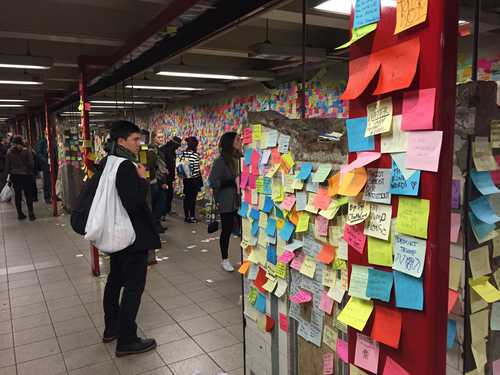
A wall with messages about the election of Trump as president of the United States in a hall of the Union Square Metro in New York. Photo: David Brooks
By: David Brooks, Correspondent
New York
President-elect Donald Trump confirmed some of the worst fears of the defenders of rights and civil liberties here and around the world upon naming three extremists to his future cabinet: Senator Jeff Sessions as Attorney General, who at the same time functions as head of the Justice Department; Representative Mike Pompeo as head of the Central Intelligence Agency (CIA), and General Michael T. Flynn as National Security Advisor.
Sessions, an Alabama senator for 20 years, was the first legislator of the high chamber to support Trump’s candidacy. He is considered the high chamber’s most anti-immigrant legislator and has a long racist history. One of the architects of the anti-immigrant positions of the Trump campaign, Sessions has headed the opposition to almost all immigration reform legislation in the Senate for two decades.
Although the Trump team dared to present him as a champion of civil rights and someone that is “universally respected in both parties,” the Senate denied Sessions confirmation 30 years ago, when Ronald Reagan nominated him for a federal judgeship for his racist comments and positions.
In his statements to the Senate on that then he referred to respected Afro-American civil rights organizations, among them the oldest one, the NAACP, as “anti-American” and “inspired by communism.”
Today, the president of the NAACP’s Legal Defense Fund, Sherrilyn Ifill, stated that Sessions has a history of decades of “opposition to civil rights and equality. It’s unimaginable that he could be serving as the chief official in charge of compliance with the law and the civil rights of this nation.” The American Civil Liberties Union denounced the naming. It remembered that he has fought against the positions on gay rights, the death penalty, abortion rights and presidential authority during his entire stay in the Senate. Others remember that he has justified torture and other illegal methods in the “war against terrorism.”
Sessions will receive Justice Department keys from Loretta Lynch, the current attorney general, who is Afro-American, a civil rights defender and an heir to the changes forged by the civil rights movement, which the senator has opposed.
General Flynn was director of the Defense Intelligence Agency (DIA) until President Barack Obama terminated him in 2014. He retired only to suddenly amaze his colleagues at the highest levels upon appearing together with Vladimir Putin at an anniversary celebration for the television network Russia Today, where he was supposedly paid for giving a speech.
He was added to the Trump campaign while he continued expressing ideas that “radical Islamic terrorism” represents an existential threat against the United States and justified that: “the fear of Muslims is rational.” He has referred to the Muslim faith as “a cancer.”
Meanwhile, he promotes the idea adopted by Trump that it is the principal threat and we must cooperate with others, above all Russia, in this common front. He proposes with Trump the idea of reducing and controlling the flow of Muslim migrants and establishing a registry of all Muslims, including U.S, citizens, in the country.
Basic rights organizations, like Human Rights Watch and others, affirm that Flynn has shown little respect for the Geneva Conventions and norms against practices like torture.
Pompeo is the federal representative from Kansas and former Army official. The Koch brothers –billionaires that have armed the country’s most powerful ultra-conservative political force and did not support Trump– financed and promoted his (Pompeo’s) political career. He is a ferocious opponent of the Iran nuclear agreement and was among the most prominent critics of Clinton when she was Secretary of State, above all in the interminable investigation into the incident in Bengazi, Libya, where, it was suspected, there was some kind of a cover up of the facts.
Pompeo has aggressively defended mass espionage programs in house as well as overseas, and opposes the limits that have been implemented on them. He is also a defender of the concentration camp at Guantánamo and of the torture programs. He has called the CIA torturers “heroes.”
Ultra-conservative organizations and figures, including white supremacists like David Duke, former head of the Ku Klux Klan, among others, celebrated the three nominations. Meanwhile, organizations that defend immigrant rights, other rights and civil liberties of different sectors continued condemning what they consider a government that could achieve reversing decades of legislative achievements.
The interviews and meetings continue today for constituting the rest of the cabinet and other Executive Power positions (there are approximately some 4,000 total) inside of Trump Tower Fifth Avenue.
Saturday, the president-elect will move to one of his golf clubs in New Jersey, where he has programed a meeting with Mitt Romney, former Republican presidential candidate in 2102, who headed the anti-Trump movement in the party during the past year. It is speculated that perhaps he might offer him the position of Secretary of State, but others say that it’s only a meeting to repair relations.
Meanwhile, some 25 blocks to the north of Trump Tower, residents of three luxury buildings decided to physically take down the name Trump from the properties (part of his business is to rent his name –the buildings don’t belong to him), and on Wednesday two employees happily removed the golden letter for letter of the surname of the president- elect, the result of a request from the residents, embarrassed by Trump throughout the campaign.
In the opposite direction, more than 40 blocks to the south of Trump Tower, inside of the Union Square Metro Station, some walls are covered over with post-it messages about what people are feeling after Trump’s win. Pencils and notes to attach are available for those that wish to add more, in what some call a “social therapy” program. The overwhelming majority of the messages son expressions of anger, protest, sadness and lament in various languages, in what is a species of the wall of tears.
—————————————————————-
Originally Published in Spanish by La Jornada
Saturday, November 19, 2016
http://www.jornada.unam.mx/2016/11/19/mundo/024n1mun
Re-Published with English interpretation by the Chiapas Support Committee
A talk on Indigenous Struggles for Autonomy & Rights in Chiapas
En español con interpretación al inglés (ver abajo)
Walking together:
INDIGENOUS STRUGGLES FOR AUTONOMY & RIGHTS
IN CHIAPAS & OTHER STRUGGLES

Invites you to a talk with
Luisella Preciado
from the Fray Bartolomé de Las Casas Human Rights Center, Chiapas
nd Omni Commons
Caminando Juntos
Lucha por Autonomía y Derechos de los Pueblos Indígenas en Chiapas, México y otras luchas
Domingo, 4 de diciembre, 2016 | 7:00-9:00 p.m.
Oakland Omni Commons | 4799 Shattuck Ave Oakland, CA 94609
** La asistencia es libre y abierto a todas personas **
Luisella Preciado es defensor de los derechos humanos y abogado con el centro de derechos humanos FrayBa en Chiapas, Mexico. Allí, ella acompaña a los pueblos indígenas luchando por sus derechos como comunidades autónomas.
En su trabajo diario Luisella Preciado escucha y documenta los testimonios de personas defendiendo sus derechos convirtiéndose en sujetos de su propia historia. Es con estos sujetos potentes que analizan los eventos dentro del contexto político para presiónar gobiernos y a la sociedad para respetar a los pueblos originarios de México.
Luisella Preciado hablará sobre las luchas indígenas por la autonomía y sus derechos en Chiapas, México y otras luchas.
Co-patrocinado por
Galeano: Don’t get confused, the EZLN doesn’t bet on the electoral path to reach power
GALEANO; DON’T GET CONFUSED, THE EZLN DOESN’T BET ON THE ELECTORAL PATH TO REACH POWER, MUCH LESS BY MEANS OF ARMS
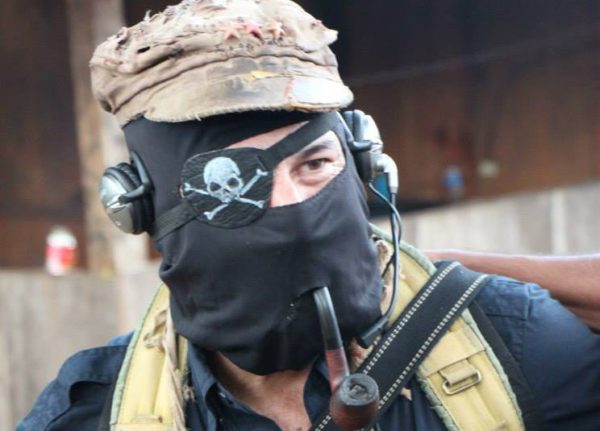
Sup Galeano of the EZLN. Photo: Chiapas Paralelo
By: Isaín Mandujano
At 33 years from the foundation of the National Liberation Forces (Fuerzas de Liberación Nacional, FLN) in the Lacandón Jungle, the seed from what would later be the Zapatista Nation Liberation Army (EZLN), Subcomandante Galeano clarified today that he doesn’t struggle for taking power and one more time clarified that the independent indigenous woman candidate in 2018 is a proposal that the armed group made to the National Indigenous Congress (CNI) that made it theirs and will impel it.
And that it doesn’t matter if they win la presidency of the Republic or not, “what matters is the challenge, the irreverence, the refusal to submit, the total break with the image of the indigenous as an object of alms and pity.”
Faced with the polemic unleashed, Subcomandante Galeano clarified that the indigenous woman postulated will not be from the EZLN’s ranks, and that nobody supplants the initials of the armed group for that of the CNI because the EZLN continues firm in its word of not betting on the electoral path, that it will not convert into a political party and that it will not seek to attain power through the armed path, because they took to arms to make use of them and not to become enslaved with them.
On November 17, 1983, that first armed group arrived, headed by Fernando Yañez, alias Comandante Germán, who in the heart of the Jungle planted the first seed of what would be the EZLN, was called the FLN, an organization persecuted and repressed since the seventies in different parts of the country. It had a Marxist-Leninist cut with views of achieving power and installing socialism.
In recent weeks, the EZLN as a member of the CNI caused a polemic, because they proposed a consultation to postulate an indigenous woman as an independent candidate in the 2018 presidential elections, a theme that has provoked the most hostile reactions in the Mexican political class, the media and Mexican analysts.
In his missive, “A history to try to understand,” Galeano made clear that they were the ones that made that proposal last October 13 to the CNI, a conglomerate of indigenous peoples from different regions of the country. That occurred within the framework of the 20th anniversary of that national body, but not in a way that they will have active participation in concretizing that candidacy.
“No, not the EZLN as an organization, nor any of its members, are going to participate for a “popular election position” in the 2018 electoral process. No, the EZLN is not going to convert into a political party. No, the EZLN is not going to present a Zapatista indigenous woman as a candidate to the presidency of the Republic in the year 2018. No, the EZLN “has not taken a turn” of any degrees that may be, nor will it continue its fight through the institutional electoral path,” Galeano said.
Then the EZLN is not going to postulate an indigenous Zapatista woman for president of the Republic? They are not going to participate directly in the 2018 elections? To answer that question, he responds with a “No.”
“Why not; because of the arms?
No. Those who think that are roundly wrong because: the Zapatistas took up arms to be useful to us, not to be enslaved by them.
Then, because the institutional electoral political system is corrupt, inequitable, fraudulent and illegitimate?
No. Even if it were transparent, equitable, just and legitimate, the Zapatista men and women would not participate to attain and exercise Power from a post, a position or an institutional appointment.
But, in determined circumstances, for strategic questions and/or tactics, would you not participate directly to exercise a position?
No. Although “the masses” may demand us; although the “historic juncture” may need our “participation;” although “the Homeland,” “the Nation,” “the People,” “the Proletariat,” (ok, that’s very out of style now) may demand it, or any concrete or abstract concept (behind which is hidden, or not, personal, family or group or class ambition) that is hoisted as a pretext; although the juncture, the confluence of the stars, the prophesies, the stock exchange index, the manual of historic materialism, the Popol Vuh, the polls, the esotericism, “the concrete analysis of concrete reality” and the convenient etcetera.
Why?
Because the EZLN does not struggle to take Power.
Galeano said that the postulation of the indigenous woman as an independent candidate is no longer in the EZLN’s hands,
Therefore he asked that they stop awarding it to the armed group, because they are only part of that big organism of the country’s indigenous peoples.
Insisted that no one from the EZLN seeks a position of popular election and that the independent indigenous woman candidate will not come from their ranks.
“No insurgent, male or female, be it of the command or of the troops; nor any comandanta or comandante of the CCRI can even be authorities in the community, nor in an autonomous municipio, nor in the different autonomous organizational bodies. They cannot be members of the autonomous councils, nor of the good government juntas, nor of the commissions, nor any of the responsibilities that the assembly designates, created or to be created in the construction of our autonomy; in other words, of our freedom,” Galeano explained.
“Our work, our task as the EZLN is to serve our communities, to accompany them, support them and not command them. Supporting them, yes. Sometimes we achieve it. And yes, certainly, sometimes we obstruct, but then the Zapatista peoples give us a slap (or several, accordingly) so that we can correct ourselves,” he clarified.
When the EZLN made the proposal to the bosom of the CNI, they told them: “that it doesn’t matter if they win the presidency of the Republic or not, what was going to be important was the challenge, the irreverence, the refusal to submit, the total break with the image of the indigenous as the object of alms and pity –an image so settled in law and, who I should say, also in the institutional left of “real change” and its organic intellectuals addicted to the opium of the social networks-, that their daring would move the entire political system and that it would have echoes of hope not in one, but in many of the Mexicos of below… and of the world.”
He said that it is not sought that an indigenous woman from the CNI is president, but rather that what is desired is to carry a message of struggle and organization to the poor in the countryside and the city of Mexico and of the world.
“It’s not that we take into account that, if we get together the signatures or win the election, it goes well, but rather that it goes well if we can talk and listen to those who nobody talks or listens to. That’s where we’re going to see if it goes well or not, if a lot of people are going to find the strength and hope to get organized, to resist and rebel,” Galeano said.
En español: UNA HISTORIA PARA TRATAR DE ENTENDER
————————————————————
Originally Published in Spanish by Chiapas Paralelo
Thursday, November 17, 2016
Re-Published with English interpretation by the Chiapas Support Committee
Chiapas Indigenous initiate a 12-day march against mega-projects
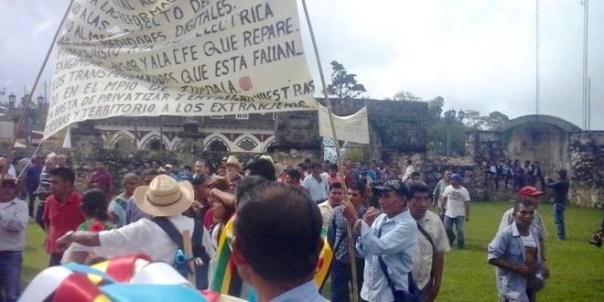
Indigenous initiate a march against mega-projects in Chiapas.
TUXTLA GUTIÉRREZ, Chiapas, (apro)
By: Isaín Mandujano
More than a thousand indigenous Choles, Tzeltales and Tzotziles, left this Tuesday morning for Salto de Agua, in a pilgrimage that will tour 11 municipalities (municipios) to denounce and protest against the mega-projects that threaten their lands and the life of their communities.
Throughout 12 days, the indigenous will be added to in each one of the municipios through which the march will travel until arriving in San Cristóbal de Las Casas. Today, they left Salto de Agua for Tumbalá where a traditional celebration will be held. They will spend Wednesday night in Yajalón, where they will hold the forum “The Original Peoples’ Fight” from the experience of Pueblo Creyente of Simojovel.
On Thursday they will be in Chilón, where they will participate in the forum “The fight for the defense of water.” On Friday, the caravan will depart for Ocosingo, where the forum “Care of Mother Earth” will be held. On Saturday, they will be in Altamirano where they will hold the forum “Alcoholism in the indigenous communities.” On Sunday, November 20, the marchers will spend the night in Oxchuc where they will hold the forum “Community Governments.”
On Monday the 21st, they will be in Cancuc, where a traditional indigenous ceremony will be celebrated. On Tuesday the 22nd they will arrive in Tenejapa, where the auxiliary bishop of the San Cristóbal de Las Casas Diocese, Enrique Díaz Díaz, will head a traditional religious ceremony. On Wednesday the 23rd they will be in Huixtán to celebrate the forum “Government projects in the indigenous communities.”
On November the 24th, they will arrive in La Candelaria, a rural community within the municipio of San Cristóbal de Las Casas, where they will celebrate another traditional indigenous ceremony and dialogue about the situations that threaten their community life. On Friday the 25th, they will finally arrive in the central plaza of San Cristóbal de Las Casas, where the gathering of thousands of marchers that have added themselves to movement is expected.
The Movement in Defense of Life and Territory (Modevite) called for this march and pilgrimage, composed of 10 parishes of 11 municipios. Since four years ago, the Pueblo Creyente of the Diocese of San Cristóbal has organized in defense of their territory. They have achieved stopping the construction of the Palenque-San Cristóbal superhighway, which would have crossed through their territory. Their objective now is to decide the use and destiny of their territory, principally in the face of threats from the extractive industry and the mega-projects.
“We know our rights as original peoples. We seek to unify our voices and our efforts against the ambition of the impresarios and the government that covet our natural resources,” says Father Marcelo Pérez Pérez.
“We are in a strategic place for the mega-projects. This territory is one the objectives of extractivism,” he added.
For example, Father Marcelo says, in the Tulijá (River) Valley they plan to construct an artificial lake that will flood 396 square kilometers of forests and indigenous lands. The lake would have the capacity of 24 billion 540 million cubic meters, which contemplates the construction of “modern industrial, small farming and aquifer population centers” on the sides of the dam.”
“We don’t want projects that only benefit some, we don’t want projects without consulting us, we don’t want improvements for the rich while the poor continue in the same condition,” the another indigenous Ch’ol speaker said today before departing for Tumbalá.
“We seek to organize the peoples to construct our autonomy; that our right as original peoples to the life that we want is recognized. We need to join our voices in defense of our forests, our rivers. We demand that the governments stop the extractive industry and the mega-projects that are being imposed without consulting us,” Father Marcelo Pérez Pérez stated.
—————————————————————–
Originally Published in Spanish by Proceso.com.mx
Tuesday, November 15, 2016
Re-published with English interpretation by the Chiapas Support Committee
 Chiapas Support Committee