Chiapas Support Committee
Home of the Compañero Manuel blog on zapatistas & mexico
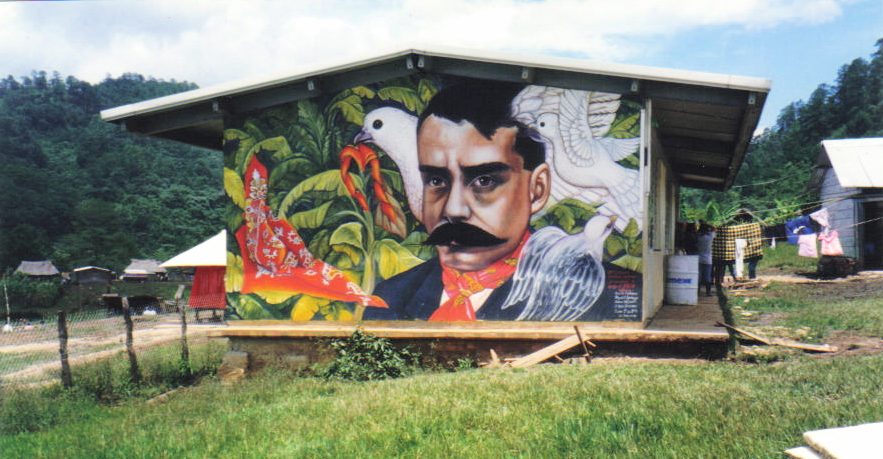
CNI, EZLN and the power from below

Zapatistas at the Fifth National Indigenous Congress.
By: Neil Harvey*
The recent comunicado from the National Indigenous Congress (CNI) and the Zapatista National Liberation Army (EZLN), “May the earth tremble at its core,” published on enlacezapatista.org, has the virtue of placing at the center of attention the defense of land, forests, water, and everything that is threatened by the development megaprojects and the dispossession of the commons. It also represents a call to society as a whole to organize for supporting a new political initiative that would be expressed in the independent candidacy of an indigenous woman, a CNI delegate, in the 2018 presidential elections.
The comunicado was issued at the end of the 5th National Indigenous Congress, held in Cideci-Unitierra, San Cristóbal de Las Casas, Chiapas, on the 20th anniversary of the CNI and on one more anniversary of the resistance of the indigenous peoples throughout more than five centuries. The CNI continues being an expression of hope for a new nation, despite the government’s refusal to implement the San Andrés Accords signed in 1996. The resistance struggles against the economic model continue, with the arduous construction and defense of their own spaces that now form the basis of this new group of the CNI and the EZLN.
Although this proposal will be based on these experiences of struggle, it will not be limited only to ethnic demands, but it will also include civil society in general. What’s new is that it proposes another view of national politics; in other words, it represents an invitation to re-think the nation from the experiences of dispossession and repression lived by the indigenous peoples in the countryside and in the city. It’s not about something external or additional to the nation’s defense, but rather that it forms the central part of that. Nor is it about seeking power, but rather of constructing one more solid, articulated and national defense against the megaprojects and dispossessions all over the country. Finally, what it seeks is to reaffirm the value of life, as the Zapatistas declared in January 1994, when they rose up to not die in abandonment.
The proposal not only assures that there will be an indigenous woman as an independent candidate in the presidential elections, but it also seeks to give a new political form to ancestral demands and the new ones that were expressed in the last Congress. As the same comunicado points out, it’s “the power from below that has kept us alive.”
The method of selecting the independent candidate is based on the organization of this “power from below.” The CNI and the EZLN have declared themselves in permanent assembly with the proposal to take the agreement of the 5th Congress to consultation “in each one of our geographies, territories and directions” to name an indigenous government council. From that council will emerge the proposal that will declare an indigenous woman as a candidate for the Presidency of the country.
The proposal is also different from other experiences in Latin America where indigenous peoples have not always had favorable results when they decide to participate in the electoral ambit in alliance with political parties. In Ecuador, for example, in the middle of the “90s, the Coordinator of Indigenous Nationalities of Ecuador (Conaie) decided to participate in the elections, taking advantage of a 1994 electoral reform that permitted candidacies of independent organizations and removed a law that obliged registering members in at least 10 provinces and registering candidates in 12 provinces. In that new context, the Conaie decided to form the party of the Movement of Plurinational Unity Pachakutik, or the MUPP, which participated in alliances with other parties to remove corrupt presidents, attaining spaces in the government headed by Lucio Gutiérrez in 2002. Nevertheless, Pachakutik remained marginalized when that same government, once elected, decided to adopt austerity policies and other unpopular measures that derived into the resignation or removal of the Pachakutik representatives. Such a situation also negatively impacted that same indigenous movement and led to a re-evaluation of the importance of local and community organization versus alliances with candidates of national parties, which tend to impose their own agenda, as has happened in the case of the government of Rafael Correa. Something similar has occurred in Bolivia, where the emergence of the Movement towards Socialism (MAS) as a political party, based in great part on the indigenous mobilizations, has led to contradictions and tensions between the momentum the MAS governments have given to the extractivist economy and the resistances to said model because of its damaging effects for self-management and the environment in indigenous territories.
In the case of Mexico, the CNI and EZLN’s proposal is not about forming a party or allying with political parties, but rather creating an “indigenous government council” and, from there, promoting its proposals through an indigenous woman, a delegate of the CNI, as an independent candidate in 2018. It’s an initiative that seeks to assure that the relationship between the peoples that compose said council and its candidate is stricter and less inclined to cooptation. It’s a different way of confronting the political dilemma of how a popular movement can gain a national presence without losing the relationship with the social bases that support it. Also, as is to be expected, the proposal of the CNI and the EZLN is going to compete with that of other candidates and parties, which could derive into mutual disqualifications, or into a necessary debate about the country’s direction and the role of the indigenous communities, barrios and towns in the process of defining that direction. We still don’t know the reception this proposal will have. For the moment, it’s necessary to recognize that it’s an idea that guaranties that the problems of dispossession, impunity, violence and repression expressed by the CNI and the EZLN will be inescapable in the national debates and, for that very fact, the proposal constitutes an opportune and welcome contribution.
*Professor-researcher, New Mexico State University
————————————————
Originally Published in Spanish by La Jornada
Monday, October 17, 2016
http://www.jornada.unam.mx/2016/10/17/opinion/020a2pol
Re-Published with English interpretation by the Chiapas Support Committee
CNI-EZLN: May the earth tremble at its core
MAY THE EARTH TREMBLE AT ITS CORE
To the peoples of the world
To the free means of communication
To the National and International Sixth [la Sexta Nacional e Internacional]
Brought together by the commemoration of the 20th anniversary of the Congreso Nacional Indígena (CNI, Indigenous National Congress) and by the living resistance of the peoples, nations and tribes of this country Mexico, by the languages Amuzgo, Binni-zaá, Chinanteco, Chol, Chontal from Oaxaca, Coca, Náyeri, Cuicateco, Kumiai, Lacandón, Matlazinca, Maya, Mayo, Mazahua, Mazateco, Mixe, Mixteco, Nahua, Ñahñu, Ñathô, Popoluca, Purépecha, Rarámuri, Tlapaneco, Tojolabal, Totonaco, Triqui, Tzeltal, Tsotsil, Wixárika, Yaqui, Zoque, Chontal from Tabasco and our brother Aymara, Catalán, Mam, Nasa, Quiché and Tacaná — we say firmly that our struggle is from below and to the left, that we are anti-capitalists and that the time of the peoples has arrived, to make this country vibrate with the ancestral heart beat of our mother earth.
This is how we have come together to celebrate life at the Fifth Congress of the Congreso Nacional Indígena that took place from October 9-14, 2016, at the CIDECI-UNITIERRA, Chiapas, where we once again become aware of the intensification of dispossession and repression that has not stopped in 524 years since the powerful unleashed a war whose goal is to exterminate those of us who are of the earth and as her offspring we will not allow her destruction and death to benefit capitalist ambition which knows no end but destruction itself. The resistance that we must continue building life today becomes word, learning and agreements.
In our lands we build ourselves every day in the resistances to stop the capitalist storm and offensive that does not stop but becomes every day more aggressive and has converted itself into a threat to civilization not only for the indigenous peoples but for the peoples in the cities that should also create dignified and rebellious ways so that they are not assassinated, dispossessed, poisoned, sickened, enslaved, kidnapped or disappeared. Within our community assemblies we have decided, exercised and built our destiny since time immemorial, so that keeping our forms of organization and defense is only possible with rebellion against the bad governments, their companies and their organized crime.
We denounce that:
- The Coca people, Jalisco, the businessman Guillermo Moreno Ibarra invaded 12 hectares of forest in the place known as El Pandillo in conspiracy with the agrarian institutions, using the criminalization of those who struggle, which led to 10 community members being subjected to four years of trials. The bad government is invading the island of Mezcala that is communal sacred land, while at the same time the government through state indigenous legislation un-recognizes Coca people with the objective of erasing them from history.
- The Otomí Ñhañu, Ñathö, Hui hú, and Matlatzinca peoples in the states of Mexico and Michoacán are being assaulted through the imposition of a mega-construction project building a private highway in Toluca–Naucalpan and a suburban train-line, destroying houses and sacred sites, they buy people’s minds and tamper with community assemblies using police presence, besides the double-dealing census of community members who usurp the voice of an entire people, the privatization and dispossession of water and territory in the volcano of Xinantécatl, known as the Toluca Snowcap [Nevado de Toluca], which the bad governments themselves take away the protection that they themselves gave it to give it to tourist businesses. We know that behind every one of these projects there is interest in plundering the water and life in the region. In the area of Michoacán they deny the Otomí people their identity while a group of police have entered the region to guard the mountain forests to stop indigenous people from going up and cutting wood.
- The original peoples residing in Mexico City are thrown off their lands, which they have won to earn a living working, robbing their merchandize and using police force. They are despised and repressed for wearing their traditional clothes and speaking their language, in addition to being criminalized accused of selling drugs.
- The territory of the Chontal people of Oaxaca is invaded by mining concessions that dismantle the commons, which will affect five communities, their people and natural resources.
- On the land of the Maya people on the peninsula of Campeche, Yucatán and Quintana Roo there is a plundering of lands to plant transgenic soy and African palm trees, the contamination of aquifers by agrochemicals, the building of wind farms, solar farms, the development of eco-tourism and real estate companies. Likewise they are in resistance against the high electricity rates that has brought down upon them harassment and arrest warrants. In Calakmul, Campeche five communities are dispossessed by the imposition of protected nature zones, payment for environmental services and the capturing of carbon in Candelaria, Campeche the struggle for the certainty of land tenure persists. In the three states a strong criminalization is taking place against those who defend the land and natural resources.
- The Maya people of Chiapas, Tzotzil, Tzeltal, Tojolabal, Chol and Lacandón, continue suffering the plundering of their territories with the privatization of natural resources, which has brought imprisonment and murder against those who defend the right to remain on their territory, they face discrimination and are constantly repressed when they defend themselves and organize to continue constructing their autonomy, increasing human rights violations carried out by police forces. There are internal campaigns to fragment and divide organizations, as well as the murder of compañeros that have defended their territory and natural resources in San Sebastián Bachajón. The evil governments continue trying to destroy the EZLN base of support communities and cloud the hope that emanates from them and that offers a light to the whole world.
- The Mazateco people of Oaxaca have been invaded by private property holders, who exploit the territory and culture for tourism, such as naming Huautla de Jiménez “Magical Pueblo” to legalize the plunder and commercialization of ancestral knowledge, accompanied by mining concessions and the exploration of existing caves by foreign speleologists. They impose this through an increasing harassment by drug traffickers and the militarization of the territory. The femicides and rape of women in the region are increasing always with the remiss complicity of the evil governments.
- The Nahua and Totonaca peoples of Veracruz and Puebla are faced with aerial fumigations that make our people suffer illnesses. There is the exploration and exploitation of mining and hydrocarbons through fracking and there are eight basins endangered by the new projects that are poisoning the rivers.
- The Nahua and Popoluca peoples of the south of Veracruz face the siege of organized crime and suffer the risks of being territorially destroyed and disappearance as a people as a result of the threat of mining. Wind farms and, over all, the exploitation of hydrocarbons through fracking.
- The Nahua people, who live in the states of Puebla, Tlaxcala, Veracruz, Morelos, State of México, Jalisco, Guerrero, Michoacán, San Luis Potosí and Mexico City, face a constant struggle to contain the advance of the so-called Morelos Integral Project, which encompasses gas pipelines, aqueducts and thermoelectricity. The evil governments desiring to end the resistance and communication of the peoples attempts to take away the community radio of Amiltzingo, Morelos. Likewise, the construction of the New Airport of Mexico City and complementary works threaten the lands surrounding Texcoco lake and the Basin of the Valley of Mexico, principally Atenco, Texcoco and Chimalhuacán. While the Nahua people in Michoacán face the pillage of their natural resources and minerals by hired assassins accompanied by the police or army and the militarization and paramilitarization of their teritories. Their attempt to stop this war has cost the murder, persecution, jailing and harassment of community leaders.
- The Zoque people of Oaxaca and Chiapas face the invasion of mining concessions and supposedly private property holders on their communal land in the region of Chimalapas; as well as three hydroelectric plants and the extraction of hydrocarbons through fracking. There are livestock herders and as a consequence excessive clear-cutting of forests to create pastures; they are also creating transgenic seeds. At the same time there are Zoque migrants in various states of the country reconstituting their collective organization.
- The Amuzgo people of Guerrero face the plunder of the San Pedro River’s water for use in residential areas and to supply the city of Ometepec. Their community radio has also been subject to constant persecution and harassment.
- The Rarámuri people of Chihuahua suffers the loss of agricultural lands due to the construction of highways, the Creel airport and the gas pipeline that is coming from the United States to Chihuahua, besides the existence of Japanese mining and dams and tourism.
- The Wixárika people of Jalisco, Nayarit and Durango face the destruction and privatization of their sacred sites which they depend on for their social, political and familial ties, the dispossession of their community lands in favor of bosses [caciques], using the lack of defined boundaries between states of the Republic and campaigns orchestrated by the evil governments.
- The Kumiai people of Baja California continue struggling for the reconstitution of their ancestral lands, against invasions by individuals, the privatization of their sacred sites and the invasion of their territories by gas pipelines and highways.
- The Purépecha people of Michoacán have the problem of deforestation, exercised through complicity among the bad governments with narco-military groups that pillage the forests and the wood. For them, the organization from below of communities is an obstacle to their plunder.
- In the Triqui people of Oaxaca the presence of political parties, mining companies, paramilitaries and evil governments fuel the disintegration of community relationships for the plunder of natural resources.
- The Chinanteco people of Oaxaca’s forms of community organization are destroyed by land distribution, the imposition of fees for environmental services, the capture of carbon and ecotourism. The projection of a four-lane highway crosses and divides the territory. In the Cajono and Usila rivers the bad governments are planning three dams that will affect the Chinanteco and Zapoteco peoples. There are mining concessions and oil drilling explorations.
- The Náyeri people of Nayarit face the invasion and destruction of their sacred lands in the site called Muxa Tena on the San Pedro River through the Las Cruces hydroelectric project.
- The Yaqui people of Sonora maintains a sacred struggle against the gas pipeline that crosses its territory and in defense of the waters of the Yaqui river that the bad governments decided to take to the city of Hermosillo, Sonora, going against court rulings and international resources that have shown legal and legitimate reason, using criminalization and harassment of authorities and spokespersons of the Yaqui tribe.
- The Binizzá and Ikoot peoples organize and speak out to stop the advance of wind farm, mining, hydroelectric, dams, gas pipelines projects and especially in the zone called the Special Economic Zone of the Isthmus of Tehuantepec and the infrastructure that threatens the territory and autonomy of the peoples of the isthmus of Tehuantepec, who have been labeled as the Talibans of the environment and the Talibans of indigenous rights in the words uttered by the Mexican Association of Energy [Asociación Mexicana de Energía], referring to the Asamblea Popular del Pueblo Juchiteco [Popular Assembly of the Juchiteco People].
- The Mixteco people of Oaxaca suffers the plunder of its agriculture lands, affecting their uses and customs through threats. Deaths and jailings that seek to silence the voices of those who rebel, with the bad governments promoting armed paramilitary groups, as in the case of San Juan Mixtepec, Oaxaca.
- The Mixteco, Tlapaneco and Nahua peoples of the mountain and coast of Guerrero face the imposition of mining mega-projects supported by drug-traffickers, their paramilitaries, and the bad governments, who dispute over the territories of the original peoples.
- The bad Mexican government continues lying and trying to hide its decomposition and absolute responsibility in the forced disappearance of the 43 students from the rural teachers’ school “Raúl Isidro Burgos” in Ayotzinapa, Guerrero.
- The State maintains kidnapped the compañeros Pedro Sánchez Berriozábal, Rómulo Arias Míreles, Teófilo Pérez González, Dominga González Martínez, Lorenzo Sánchez Berriozábal y Marco Antonio Pérez González from the Nahua community of San Pedro Tlanixco in the State of México, the zapoteco compañero from the Loxicha Álvaro Sebastián region, the compañeros Emilio Jiménez Gómez and Esteban Gómez Jiménez prisoners from the community of Bachajón, Chiapas, the compañeros Pablo López Álvarez and maintaining in exile Raúl Gatica García and Juan Nicolás López from the Consejo Indígena y Popular [Indigenous and Popular Council] of Oaxaca Ricardo Flores Magón. Recently a judge imposed a 33 year prison sentence on compañero Luis Fernando Sotelo for demanding the presentation with life of the 43 disappeared students of Ayotzinapa, the compañeros Samuel Ramírez Gálvez, Gonzalo Molina González and Arturo Campos Herrera from the Coordinadora Regional de Autoridades Comunitarias—PC [Regional Coordinator of Community Authorities—PC]. Likewise, hundreds of indigenous and non-indigenous prisoners are held throughout the country for defending their territories and demanding justice.
- The Mayo people’s ancestral territory is being threatened with road-building projects to link Topolobampo with the state of Texas, United States; at the same time that ambitious touristic projects are being planned for the Barranca del Cobre [Copper Canyon].
- The Dakota nation is seeing how it’s sacred lands are being invaded and destroyed by gas and oil pipelines, which is why it is maintaining a permanent encampment to protect what is theirs.
For all that we have said above, we reiterate that the care of life and dignity, that is to say resistance and rebellion from below and to the left, is our obligation to which we can only respond to in a collective way. Rebellion, well, we construct it from our small assemblies in places that conjoin onto large community, ejidal [community-owned land] assemblies, in good government councils and in agreements as peoples which unite us under one identity. In the sharing, learning and constructing of who we are as the Congreso Nacional Indígena we see and feel ourselves in our suffering, discontent and in our ancestral grounds.
To defend who we are, our walking and learning has been consolidated in collective spaces to make decisions, using national and international legal resources, acts of peaceful civil resistance, pushing aside political parties that have only generated death, corruption and buying of dignities, we have made alliances with diverse sectors of civil society, creating our own means of communication, community and self-defense police, popular assemblies and councils, the exercise and defense of traditional medicine, the exercise and defense of traditional and ecological agriculture, our own rituals and ceremonies to pay mother earth and continue walking with her and in her, the planting and defense of native seeds, forums, campaigns to promote cultural and political activities.
That is the power from below that has kept us alive and that’s why to commemorate resistance and rebellion is also to ratify our decision to continue living building the hope of a possible future over the ruins of capitalism.
Considering that the offensive against the peoples will not cease but they will attempt to continue increasing it until they have finished with the last traces of who we are as peoples from the countryside and the city, as carriers of profound discontent that also blossom in new, diverse and creative forms of resistance and rebellions in this Fifth Congreso Nacional Indígena it is why we have determined to initiate a consultation with every one of our peoples to take down from below the power that is imposed on us from above and that offers us a panorama of death, violence, plunder and destruction.
Given the above, we declare ourselves in permanent assembly and we will consult in each of our geographies, territories and directions the agreement of this Fifth CNI to name an indigenous council of government whose word will be materialized by an indigenous woman, a CNI delegate who will contend as an independent candidate in the name of the Congreso Nacional Indígena and Ejército Zapatista de Liberación Nacional in the electoral process of the year 2018 for the presidency of this country.
We ratify that our struggle is not for power, we do not look for it; but that we will call on the original peoples and civil society to organize ourselves to stop the destruction, strengthen ourselves in resistances and rebellions, which is to say in defense of the life of every person, family, collective, community or neighborhood. Of building peace and justice by rethreading ourselves from below, from where we are who are.
It is the time of rebel dignity, of building a new nation and by and for everyone, of strengthening power from below and to the anti-capitalist left, of those guilty of causing the suffering of the peoples of this multi-color Mexico.
Finally, we announce the creation of the official page of the CNI at the address www.congresonacionalindigena.org
From CIDECI-UNITIERRA, Chiapas, October 2016
For the integral reconstitution of our peoples
Never again a Mexico without us
Congreso Nacional Indígena [CNI, Indigenous National Congress]
Ejército Zapatista de Liberación Nacional [EZLN, Zapatista National Liberation Army]
EZLN and CNI delegates call for closing ranks

By: Isaín Mandujano
TUXTLA GUTIERREZ, Chiapas, Mexico
This Tuesday some 500 delegates of the National Indigenous Congress (CNI) and the EZLN’s military commanders initiated the fifth national gathering where they will analyze the national political situation, because they warned that the scenario would not be better heading into 2018. Therefore, it is urgent to close ranks and organize before the assault that comes from those that “badly govern” the country.
Called to celebrate the 20th anniversary of the creation of the CNI, indigenous coming from all corners of Mexico arrived at the Holistic Center for Indigenous Training-University of the Earth (Cideci, its Spanish acronym) in San Cristóbal de las Casas to analyze the national political situation through which the country crosses and to prepare an action plan in a coordinated and articulated way.
The indigenous talked about the 2018 elections and ratified that the path of elections is no longer the path for achieving the change that the country needs. The speakers, one-by-one, gave details of the mega-projects that threaten the original peoples in their regions.
They also warned that the future holds nothing promising for the indigenous peoples of Mexico, because of which it’s urgent to achieve unity and organize before the assault of the powerful that “badly govern” this country.
At the soldiers’ table where Subcomandante Galeano, Subcomandante Moisés, Comandante Tacho and other members of the EZLN’s General Command were, the speakers talked about the need to instrument an action plan for being prepared “to face what’s coming.”
Access to the event was restricted to the press, where participants were rigorously registered to access the gathering that started last Sunday and was formally inaugurated today (Tuesday, October 11).
Moisés spoke in the name of the EZLN. He remembered the context and the necessity for creating the CNI 20 years ago, with the participation of the largest number of the original peoples of Mexico.
They also honored the now-deceased founders, among them Comandante Ramona, great father Juan Chávez, honorary insurgent major Félix Serdán, compañero Ramiro Taboada and brother Efrén Capiz.
“Talking among ourselves the original peoples was and is very necessary now more than ever, because the destruction that the capitalists do against Mother Earth is extensive now and that means that we will also be destroyed, because we live on her,” Moisés warned.
“Dialoguing with each other does us good, helps us understand, helps us to orient ourselves in many things about our life, but only working it bears fruit, if it isn’t worked it doesn’t bear fruit, the working is with the peoples, the fruit is the peoples that work organizing each other, and fighting, strengthen each other, sacrificing, as often as needed. If we don’t do that work, who is going to do it? We know very well that nobody will come,” he added.
“Today we believe that we are here precisely for that, to see each other, listen to each other, which is what we have done, how we have done it. What we lack is what to do and how we’re going to do it; where we fail and how we’re going to correct and improve,” said Moisés.
“Now more than ever we must be united, countryside and city. Our trench for struggle, work and organization, is where we live in each town and later in each nation, in each tribe, in each barrio, as original peoples,” he emphasized.
He also called for organization and unity in each town and each barrio, in each trench, because now more than ever it’s necessary to continue the fight “like our ancestors did, Resistance and Rebellion, but now for a change that the poor of the countryside and the city truly need. We need to construct among ourselves the world we want.”
Moisés continued: “We who are exploited need to be together in the countryside and in the city and to construct the world that we want. We think that in that we ought to dedicate our efforts, our sacrifices to working and organizing, to know what to do when necessary. Now nothing is left to us other than to bind together to get ourselves, the original peoples of the countryside and of the city, organized.”
Especially, he noted, the task is to realize among the barrios, tribes, nations and original peoples that they no longer have a place to take refuge, because they are attacked in the countryside and in the city.
“Today we must lift our eyes among ourselves the exploited to organize ourselves, work and fight for the city and the countryside to be organized together. Because in truth we native peoples of the countryside and the city are witnesses to the fact that in the capitalist system there is not any good or tiny thing for a better life for the original peoples or those in the city,” said the Zapatista military command.
————————————————————–
Originally Published in Spanish by Proceso.com
Wednesday, October 12, 2016
http://www.proceso.com.mx/458374/ezln-delegados-del-cni-llaman-a-cerrar-filas-cara-al-2018
Re-Published with English interpretation by the Chiapas Support Committee
Atenco women’s case will finally reach the Court
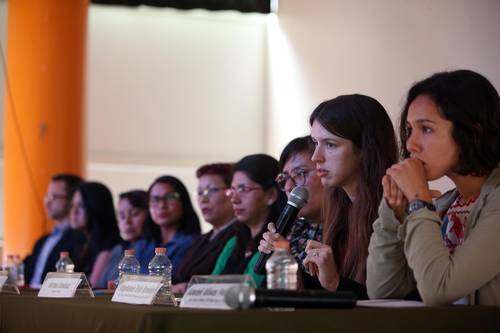
Patricia Torres, Ana María Velasco, Claudia Hernández, Yolanda Núñez, Italia Méndez, Norma Jiménez, Stephanie Brewer and Araceli Olivos during the press conference held at the Centro Pro. Photo: Jesús Villaseca
By: José Antonio Román
The Mexican government not only lied when it asserted that it was the one that proposed taking the case of the Atenco women to the Inter-American Court of Human Rights (Coridh, its initials in Spanish), but that it also “surprisingly advanced” to the Inter-American Commission on Human Rights (IACHR) making this decision public.
This case, which arrives at the Coridh after 10 years of impunity in the country, could represent the eighth sentence against the Mexican State, in which 11 women of San Salvador Atenco denounced sexual torture and other human rights violations by state of Mexico police and federal police in May 2006.
Stephanie Erin Brewer, lawyer for the victims and coordinator of the Miguel Agustín Pro Juárez Human Rights Center’s international area, explained that it was “very strange” to find out about the federal government taking the case to the Court rather than the IACHR taking it, as regularly happens in these cases.
But she also clarified that the State not only didn’t ask to send the case to the court, but rather “did everything possible to delay it, and avoid the case reaching that body,” as it has neither had reparation measures for the victims nor funds nor help actions, which have been repeatedly rejected.
‘‘There’s no dialogue either, as the government says. That dialogue is broken because of the repeated lack of fulfillment, the lack of advance and the absence of a showing of the will to reach a conclusion. No dialogue is underway: what is underway is a litigation,” the director from Centro Prodh clarified.
In a press conference that six of the 11 women complainants attended, accompanied by their legal advocates from the Centro Prodh and the collective for Justicia and International law (Cejil), it was pointed out that the case reaching the Coridh is a historic achievement in the search for truth and justice, which was impossible to access on the national level.
The lawyers Brewer and Marcia Aguiluz, from Cejil –connected via Internet from Costa Rica–, explained that since last December the IACHR adopted the background report that contains its conclusions about the case and that it gave reason to find that the complainants suffered unlawful and arbitrary detention, diverse acts of physical, psychological and sexual torture, a lack of due process and denial of justice, violations for which the Mexican State will have to respond.
A decade after the acts of May 3 and 4, 2006, [1] there is not one single firm criminal sentence and the criminal processes underway are limited to state protection and are developed starting with accusations against four dozen agents with a low rank, without touching the chain of command and other spheres and levels of responsibility. At the time that the acts occurred, the governor of the state of Mexico was Enrique Peña Nieto, now president.
And although the Coridh does not impose individual criminal responsibilities, in the background report it gives an account of the responsibility of some individuals, and mentions the necessity of investigating on two levels the responsibility of the governor of the state of Mexico. “The first is around the possible emission of statements that promised the independence and autonomy of the investigations, and the second is because of the absence of an in-depth investigation about the chain of command,” explained Santiago Aguirre, assistant director of the Centro Prodh.
[1] On May 3 and 4, 2006, state and federal police terrorized the town of San Salvador Atenco right after Subcomandante Marcos spoke at a rally in the town as part of the EZLN’s “Other Campaign.” 2 people died and approximately 150 were arrested and taken to jails.
———————————————————–
Originally Published in Spanish by La Jornada
Wednesday, October 5, 2016
http://www.jornada.unam.mx/2016/10/05/politica/003n1pol
Re-Published with English interpretation by the Chiapas Support Committee
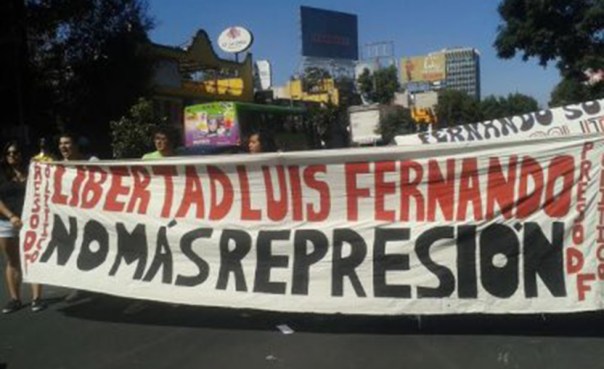
Freedom for Luis Fernando Sotelo
LOS DE BAJO: EXEMPLARY PUNISHMENT
By: Gloria Muñoz Ramírez
Not content with lying about the whereabouts of the 43 normalistas from Ayotzinapa, the State incarcerates those who, like Luis Fernando Sotelo, [1] don’t keep quiet and go out in the streets to demand the truth. Two years of impunity about Ayotzinapa, not one intellectual author incarcerated and a sentence of 33 years and five months of prison for the 21-year old youth, accused of attacks on the “ways of communication” and against the public peace, and also of property damage in a legal process replete with irregularities.
Luis Fernando was also sentenced to pay a fine of $519, 815 pesos (around $26,000 dollars) and reparation of the damage, which rises to more than 8 million pesos. In this sentence, the collective Los Otros Abogadoz [2] warns, “one clearly observes the vengeance, hate and contempt that the head of Government (Miguel Ángel Mancera) has against students, above all the youths that think differently, that question and are opposed to the injustices and bad decisions of the current ruler.”
In November 2014, scarcely two months after the disappearance of the 43 normalistas, Luis Fernando was dressed in black, with short hair and a crest painted green. He was dressed up as a rebel when he was arrested and accused of burning the Metrobus station and a bus in University City. He was arrested together with another young man, Sergio Pérez Landeros, who the Metrobus driver and the agents implicated in the detention pointed out as authors of the fire. Sergio proved that he was at his school at the time of the acts and he was released. But Luis Fernando remained in prison and was sentenced this week. He is 21 years old and they sentenced him to stay in prison until he is 52. And yet the Public Ministry is in disagreement and is appealing for more years and more money.
The Los Otros Abogadoz collective considers that the Public Ministry fabricated the accusation, altered the facts and omitted evidence. The lawyers indicate that it’s “about finding Luis Fernando guilty to send an exemplary message and punishment to all those that decide to get organized and to protest: youths, students, teachers, indigenous, street venders, districts and all those that resist below and organize.”
On September 28, Luis Fernando and Abraham Cortés (prisoner in Reclusorio Norte) initiated an indefinite hunger strike in protest of the unjust sentence. A national and international campaign accompanies them demanding their freedom.
[1] Luis Fernando Sotelo is the young man referred to in the recent CNI & EZLN Communiqué Party to War and Resistance #44. He is an adherent to the EZLN’s 6th Declaration.
[2] Los Otros Abogadoz translates as The Other Lawyers. “The Other” seems to refer to the EZLN’s “Other Campaign,” which is no longer in existence; however, it also implies adherence to the Sixth Declaration of the Lacandón Jungle. The use of “z” instead of “s” to pluralize abogado (lawyer) also indicates adherence to the Sixth Declaration.
————————————————————————————–
Originally Published in Spanish by La Jornada
Saturday, October 1, 2016
http://www.jornada.unam.mx/2016/10/01/opinion/010o1pol
Re-Published with English interpretation by the Chiapas Support Committee
The education project of the new right
[Admin: This article shows the importance of autonomous (self-governed) educational institutions, like those the Zapatistas are constructing in their communities.]
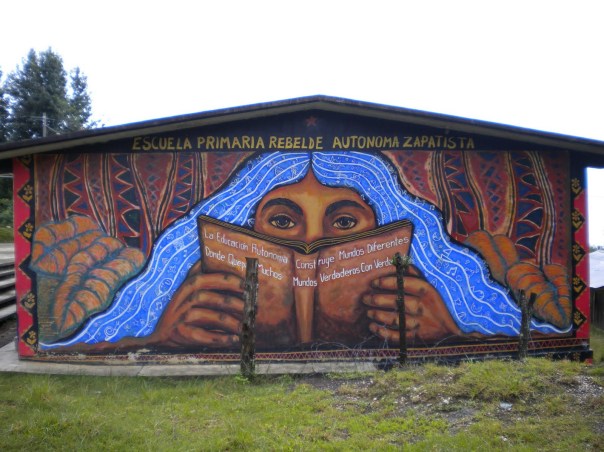
Zapatista primary school in the Caracol of Oventic, Chiapas.
By: Raúl Zibechi
A new right appropriate for extractive times and for exploitation-piracy against the peoples has been born; a right after the Welfare State, which no longer aspires to development, but rather to consolidate inequalities, segregation of the half that is poor, mestizo, Indian and black on our continent. An implacable right formed in rejection of the popular, in national sovereignty, in laws and constitutions.
In the terrain of education, that new right seeks to rid itself of prior commitments, among them the laity and freedom of the teachers, for accommodating the educational system to the period of war and confrontation that we travel through. The objective is to retake control of the whole of the education system, from the ministers to the classroom, consolidating an anti-emancipatory education and one in which control of the population is almost exclusively the objective.
The non-governmental organization School Without Party was born 12 years ago in Brazil, very active on the social networks and the big media, articulated with deputies and councilors from the most diverse parties to get their proposals approved. On its website (escolasempartido.org/) one can access the six-point program entitled Teachers’ obligations, in which it emphasizes that the teacher shall not promote his own ideas in the classroom, prejudice the students that profess different ideas or make political-party propaganda and shall be limited to exposing the program in a neutral way; and it grants parents the selection of the “moral education” that they want for their children.
Some “principles” of School Without Party appear compatible. Nevertheless, they bring with them objectives that make us go back more than a century. On the one hand, it differentiates between the act of educating and that of instructing. For them, education is the responsibility of Church and family, while teachers should be limited to instructing; in other words, to transmitting knowledge as if it were neutral, ahistorical, de-contextualized.
The second is what they consider as “indoctrination” in the classroom. Talking about feminism, homophobia or reproductive rights, for example, would be like imposing “gender ideology” in schools. Everything that might deviate from the subject is considered “indoctrination,” a situation that en los proposed legislation that School Without Party has presented in various municipios and in state parliaments would be classified as a “ideological assault crime” and “abuse of authority,” punishable with prison and aggravated sentences.
In the part “capturing the indoctrinator” on its web page, appears a long list of common classroom situations, like “defaming historic, political or religious personalities,” among many others. The teacher would have to mention Hitler, Pinochet or Mussolini without more, like any other personality, without establishing differences, leaving opinion exclusively to the parents. It’s the same with respect to genocides, femicides and so on, because mentioning values is rigorously prohibited. They consider that debates about sexual diversity, contemplated in the curricula of many countries, would in this case be “unconstitutional.”
One of the more serious practices School Without Party promotes is spying on the teaching practice to denounce it afterwards. Under the epigraph “Planning your denunciation,” it asks the students and parents to carefully take notes or film the moments in which the teacher would be “indoctrinating” the students. They promote attitudes that lead the youths to police the teachers.
One of the central objectives of the new right within the educational terrain is the disqualification of the teachers that would be guilty of all the evils of education, from scholastic failure to low quality of instruction. In that way they get to divert attention from the structural problems in education, focusing only on the consequences and hiding their causes. The teacher is always suspected of leftism. In parallel, they consider that the students don’t have the capacity to form their own convictions and that they must be subject to paternal, church or teaching authority.
As was expected, the teachers have reacted with campaigns denouncing the project, since it was approved in the state of Alagoas, Brazil, and will be brought up in others. But we should not forget that what is proposed in this conjuncture, not only in Brazil, is to stop short the growing student movement, in particular the secondary students, who are the least susceptible of being coopted by the state institutions and the electoral left.
In effect, the Brazilian political crisis is modeled by the mobilizations of June 2013, a crisis that is far from having been closed with the illegitimate removal of President Dilma Rousseff. Even Chile, the exemplary neoliberal regime for its stability, travels through a crisis of legitimacy as a consequence of the powerful student movement that since 2011 opened spaces through which diverse social actors are passing. One of the most important impresarios, Andrónico Luksic, recognizes that “the country is falling” and emphasizes the role of the movement for education in this crisis (goo.gl/qpXIsA).
Something similar is happening in other countries. In Paraguay students are shown as a powerful actor in the middle of the reactionary government of Horacio Cartes. New nests of young rebels are present in almost all countries. To say nothing of Mexico, after the parting of waters that was Ayotzinapa.
A good part of the objectives that School Without Party proposes in Brazil may seem utopias in that they have scarce support. Nevertheless, they should not be underestimated. When the political crises deepen, powerful bifurcations appear; the right takes off the veil to show itself for what it is: the party of order, disposed to run over everything. The lefts are the ones that must decide if they opt for the institutions or for accompanying the resistances.
—————————————————————————–
Originally Published in Spanish by La Jornada
Thursday, September 29, 2016
http://www.jornada.unam.mx/2016/09/29/opinion/019a1pol
Re-Published with English interpretation by the Chiapas Support Committee
CNI & EZLN communique: Party to war and resistance #44

Standing Rock Water Resistance in North Dakota.
To the peoples of the world
To the alternative, free, autonomous or however they are called means of communication
To the National and International Sixth
Party to war & resistance # 44
And the other 43? And the ones who are next?
It turns out that this country is not the same as two years ago when the bad government committed one of the worst crimes possible when it disappeared 43 young indigenous students from the rural student-teacher school “Raúl Isidro Burgos” in Ayotzinapa, Guerrero. This deed made us aware of the profound darkness in which we find ourselves and troubled our individual and collective heart and spirit, illuminating the night with rage, with suffering and with hope that is embodied now in the families and compañeros of the 43, and which shines in the face of millions of persons in all the geographies of Mexico and the world of below, and of the international civil society that is in solidarity and conscious.
As neighborhoods, tribes, nations and original peoples that we are, we see and make our word now as before, from the collective heart that we are.
From the geographies and calendars from below, where the mirrors of who we the Indigenous National Congress (CNI, Congreso Nacional Indígena) are, made with our resistances, rebellions and autonomies; from the places and directions from where we the original peoples are and understand the world, that is to say, from the ancient geographies where we do not cease to see, understand and resist that same violent war that the powerful implement against everyone, who suffer and resist, from who we are with an individual and collective face, we see and make the face of the 43 absent ones our word, who are present in all the corners of our country in search of truth and justice, the face that is drawn with the faces of millions of others and that shows us in the middle of the night the sacred directions, because our suffering and hope is sacred. That collective face multiplies and sees the geographies of resistance and rebellion.
From the geographies of below
The disappearance of the 43 students of Ayotzinapa continues in impunity, and to search for the truth in the midst of the putrefaction of power is to rummage through the worst of this country, in the cynicism and perversion of the political class, which only pretends to look for the disappeared compañeros, but in the face of growing evidences that demonstrate the guilt of the terrorist narco-state, those responsible for lying and trying to deform the truth even more are rewarded – as is the change of Tomás Zerón, responsible for planting supposed proof of his historic lie in the trash dump of Cocula, to the Technical Secretariat of the National Security Council (Secretaría Técnica del Consejo Nacional de Seguridad) ‒ giving us another example of the criminal nature of the bad government.
To its lie, farce and impunity, the bad government adds the outrages and injustice it commits against those who have offered solidarity and shown their support for the struggle of the families and compañeros of 43, like the youth Luis Fernando Sotelo Zambrano, who was always in solidarity with the struggles of the original peoples – like those of Cherán, the Yaqui tribe, the indigenous prisoners, the Zapatista communities – who was condemned by a judge to a sentence of 33 years and five months for the sextuplet crime of being young, a student, poor, being in solidarity, a rebel and being consistent.
This is what we see when we look upward to who is Power: for who murders, covers up and lies, rewards and protects, for who becomes indignant and protests against injustice, attacks and jails.
-*-
And when we see ourselves:
In the south, the struggle of the peoples in defense of their territories against bosses and businesses, dissolves into the struggle for security and justice against the organized bands of delinquents, whose intimate relationship with the political class is with certainty, as a people, the only relationship we have with whatever state organ.
The formation of the shock groups that act against the mobilizations permeates the towns and the government plays at generating conflicts that ignite the internal weavings. Which is to say, it tries to make mirrors of its war planting discord in the communities and betting on the destruction of the most sensitive fibers. Nothing is more explosive and dangerous for this nation.
In the west, the struggles for land, security and justice are taking place in the middle of the administration of the drug cartels, which the state disguises as combating delinquency or as development policies. In turn, the peoples that have resisted and even brought down criminals through organizing from below must struggle through the permanent attempts of the bad governments to allow organized crime and its preferred political parties to take possession anew of the territories through diverse forms.
The autonomous organization of the communities, their unwavering struggle for the sacred places and ancestral lands does not cease. The defense of our mother is not negotiable. We pay close attention to the struggle of the Wixárika of Wauta-San Sebastián Teponahuaxtlán community for the recuperation of close to 10,000 hectares of land surrounding the settlement of Huajimic, Nayarit, where, in spite of proving their rights in land courts, the judicial authorities have been remiss; and the bad governments make the false geographies official that divide the states, a pretext to incentivize the dispossession of the original peoples. To the Wixárika people, in their rebellion and autonomy we say: we are with you.
In the north, where the struggles for the recognition of territories persist, the mining industry’s threats, the expropriation of land, the robbery of natural resources and the submission of the resistances by the narco paramilitaries, the original peoples continue constructing every day.
The original peoples of the tribes of the north, where the Sioux nation weaves its own geographies that go beyond the official false geographies that places them in another country – but that for us we are daughters and sons of the same mother – are resisting the invasions of its sacred lands, burial sites and ceremonial centers by the construction of oil pipelines carried out by the Energy Transfer Partners company, which seeks to transport through their territories the oil that has been gotten through fracking in the Bakken region in North Dakota, which has inspired the solidarity and unity of the original peoples of the north. To them we say that their rage is ours and as the Congreso Nacional Indígena we raise and will continue raising our voice with yours. Your dignified struggle is also ours.
In the peninsula, the Maya peoples resist being disappeared by decree, defending their lands from attacks by tourist and real estate companies, where white guards proliferate and operate with impunity to dispossess the peoples, where the invasion by the transgenic agro-industry threatens the existence of the Maya peoples and the filth of magnates who are taking over agricultural lands, archeological cultural sites and even indigenous identity, attempt to convert a living people like an extension of their tongue, into commercial fetishes. The peoples that struggle against high tariffs for electricity are persecuted and criminalized.
In the center, the infrastructure projects, highways, gas pipelines, aqueducts, re-zonings, are being imposed violently and human rights are every day weakened and made more distant by the laws being imposed. The criminalization, cooptation and division outlines the strategy of powerful groups, all linked tightly in a corrupt and obscene manner with the criminal who believes he is governing this country, Enrique Peña Nieto.
In the east of the country, the violence, the fracking, the mining, the trafficking in migrants, the governmental corruption and dementia are the current against the struggle of the peoples, in the middle of entire regions taken by violent criminal groups orchestrated from the highest levels of government.
From dialogue and betrayal
Just as has been done by the teachers’ struggle, the original peoples have looked to dialogue with the bad government with our urgent demands regarding our territories, with the presentation of the disappeared, the liberating of prisoners, of justice for the murdered, of getting the police or the military out of our lands or of our demands for security and justice. But the government always refuses until it detains our spokespersons throughout the country, the military opens fire against children in Ostula, the bulldozers destroy the houses of those that resist in Xochicuautla, the federal police open fire against the dignified people that accompany the teachers in Nochixtlán. The bad governments pretend to dialogue and simulate for years agreements with the Wixárika people to achieve the peaceful restitution of its territory, while configuring the violent reordering of the region.
And the government talks as if nothing has happened and offers the will to cede, as long as both sides agree. The government cedes a part of what it has just finished destroying, frees a prisoner, compensates the family of a murdered one, pretends to look for the disappeared. And in exchange asks that the peoples cede their collective patrimony, which is their dignity, their autonomous organization, and their territory.
In various geographies of our country we are resorting to consultations when we say that we do not want their mines, their wind turbines, their transgenic seeds, their dams and we demand that they ask the peoples, but the bad government always responds pretending that it “consults how to consult if it consults or not the form of consulting” (or something like that), which is full of simulation, the supplanting of our word, the manipulation and cooptation of our people, of threats and repression. And it’s this way until it says that’s enough and that we have already said that yes we want their projects of death, or that we are divided and should attend to all the positions.
And while they pretend to keep us pacified with their lying agenda and the NGOs “experts” in “consultations” fill their pockets, advancing quickly to concretize – even before beginning their supposed consultation – the robbery of the water from the Yaqui river, the mining companies and their rights to destroy Wirikuta, the wind turbines to invade all the Isthmus and the imposing of transgenic seeds on the Maya Riviera.
The directions of the world are our geographies and in them we find and recognize each other, because we know that the struggle is not just for today or today only, we do not struggle for power or folklore that lying campaigns offer, but to weave and reweave what we are, were and will be as original peoples.
The faces of the 43 missing and the tenacity of their families and compañeros, are the 43 other parties to war and resistance. To them we add our suffering, our rages, the resistances of the original peoples and the rebellion of millions in Mexico and the world.
And the parties of war and resistance of the persecuted and stigmatized other, of the abused, disappeared and murdered women, of infancy converted into merchandise, of the criminalized youth, of exploited labor, of the persecuted rebellions, of the polluted natural world, of the suffering humanity are next.
With all that humanity, with this land that we are, today we reiterate that truth and justice are an indispensable demand and that the punishment of the guilty ones, of all the guilty ones, will be born from the struggle from below, where, now more than ever and as original peoples of the CNI, we know that there is no room for surrender, or selling out, or wavering.
Truth and Justice for Ayotzinapa!
Freedom for Luis Fernando Sotelo Zambrano!
Free all political prisoners
For the full reconstitution of our peoples
Never again a Mexico without us.
Congreso Nacional Indígena (Indigenous National Congress)
Ejército Zapatista de Liberación Nacional (Zapatista Army of National Liberation).
Mexico, September 2016.
En español: http://enlacezapatista.ezln.org.mx/2016/09/22/parte-de-guerra-y-de-resistencia-44/
Ayotzinapa: the government rewards those responsible
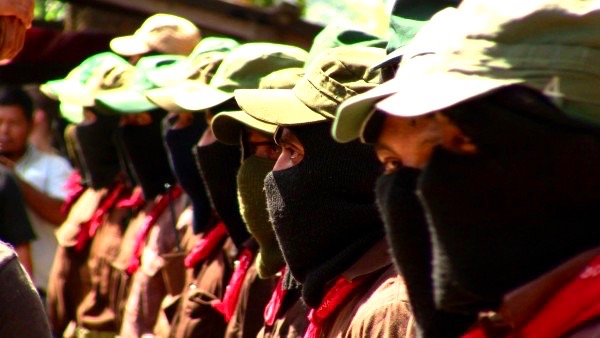
EZLN support for the Ayotzinapa students. Photo: Saúl Kak
THE GOVERNMENT REWARDS THOSE RESPONSIBLE and THOSE THAT LIE and IT PURSUES THOSE THAT SEEK TRUTH and JUSTICE
[Admin: the recent joint comunicado from the EZLN and the CNI has not been posted in English on Enlace Zapatista, so we translated a very good article about it. A link to the Spanish is below and we’ll post the English translation when it becomes available.]
By: Isaín Mandujano
The Zapatista National Liberation Army (EZLN) and the National Indigenous (CNI) announced today that two years after “the bad government committed one of its worst crimes” by disappearing 43 young indigenous students from the Raúl Isidro Burgos Rural Teachers College in Ayotzinapa,” it rewards those responsible for lying and trying to distort the truth even more and it pursues and incarcerates those who seek truth and justice.
In a joint comunicado, [1] the EZLN and the CNI remembered that this act only confirmed the profound darkness in which we find ourselves in the country, and it stirred the heart and the individual and collective spirit illuminating the night with rage, with pain and with the hope that the family members and compañeros of the 43 now embody, “and that shines in the face of millions of people in all the geographies of Mexico and of the world of below, and of international civil society in solidarity and aware.”
“The disappearance of the 43 Ayotzinapa students remains unpunished, and seeking the truth in the midst of the power’s decay is to delve into the worst of this country, into the cynicism and perversion of the political class, which not only continues pretending to look for the disappeared compañeros, but that before the growing evidence that shows the culpability of the terrorist narco-state, rewards those responsible for lying and trying to distort the truth even more ‒as is the change of Tomás Zerón, the one responsible for planting alleged proof of their historic lie in the Cocula garbage dump, to Technical Secretary of the National Security Council‒ giving one more account of the bad government’s criminal nature,” both organizations of an indigenous profile pointed out.
They add that to the lie, the simulation and the impunity, the bad government adds outrages and injustices against those who have been in solidarity and demonstrated in support of the struggle of the family member compañeros of the 43, like the youth Luis Fernando Sotelo Zambrano [2], always in solidarity with the struggles of the original peoples –like those in Cherán, the Yaqui tribe, the indigenous prisoners, the Zapatista communities-, who a judge has sentenced to 33 years and 5 months in prison for the sextuple crime of being young, being a student, being poor, being in solidarity, being rebellious and being consistent.
“We see that when we look at who above is the Power: at who murders, covers up and lies, rewards and protects; at who is indignant and protests against injustice, coups and prison,” they point out.
The EZLN and the CNI refer to the long struggles that exist in the south, the west, the north, the Peninsula, the Center and the east of the country, where the struggle is against political bosses, against the dispossession of territory, against the big transnational mining companies, against shock troops, against the onslaught that threatens to extinguish the peoples of Mexico in resistance.
They explained that just like the teachers have done in their struggle, the original peoples pueblos have sought dialogues and answers from the bad government to their urgent demands with respect to the territories, about the presentation of the disappeared, about the liberation of prisoners, about justice for the murders, about getting the police or the soldiers out of our lands or about our demands for security and justice.
But the government always denies that they even detain the spokespersons all over the country, the Army shoots at children in Ostula, machines destroy houses of those who resist in Xochicuautla, the federal police shoot at the dignified people that accompany the teachers in Nochixtlán. “The bad governments make like they dialogue and simulate for years agreements with the Wixárika [3] people to attain the peaceful restitution of their territory, while they configure a violent reordering of the region.”
And the government talks as if nothing had happened and offers a willingness to yield, always so that both parties agree. The government yields a part of what it just destroyed; it releases a prisoner, indemnifies the family of the one they murdered and feigns looking for the disappeared. And in exchange it asks the peoples to cede their collective patrimony, which is their dignity, their autonomous organization and their territory.
That in various geographies of the country they are resorting to consultations when they say no to their mines, their wind farms, their GMOs, their dams and demand that they must ask the peoples, “but the bad government always answers feigning that: “it consults how to consult, whether it consults or not and the form of the consultation” (or something like that), which is full of simulation, supplanting of our word, manipulation and cooptation of our people and of threats and repression.”
“The faces of the 43 absent and the tenacity of their families and compañeros, are the 43 other parties of war and resistance. To them are added the pains, the rages, the resistances of the original peoples and the rebelliousness of millions all over Mexico and the world,” the EZLN and the CNI said.
And for all that, the parties remain at war and the other’s resistance persecuted and stigmatized, women raped, disappeared and murdered, infancy converted into merchandise, youth criminalized, labor exploited, the rebel persecuted, nature dishonored and humanity in pain.
“With all that humanity, with this land that we are, we reiterate today that truth and justice are an inalienable demand and that punishment of the guilty ones, all the guilty, will be born from the struggle from below, where, now more than ever and as original peoples pueblos of the National Indigenous Congress, we know that it’s not appropriate to surrender, sell out, or give in,” says the writing.
[1] The joint comunicado is entitled Parte de guerra y de Resistencia #44.
Para leer en español: http://enlacezapatista.ezln.org.mx/2016/09/22/parte-de-guerra-y-de-resistencia-44/
[2] Luis Fernando Sotelo Zambrano – A young man that participated in the 3rd day of global action for Ayotzinapa. Police arrested him in the vicinity of a bus stop that was burned during the protest.
[3] Wixárika – Native Mexicans, also known as Huicholes.
————————————————————————-
Originally Published in Spanish by Chiapas Paralelo
Thursday, September 22, 2016
Re-Published with English interpretation by the Chiapas Support Committee
Ayotzinapa on the threshold of two years without the 43

By: Magdalena Gómez
In the last report of the Group Interdisciplinary Group of Independent Experts (GIEI) on the Iguala case, issued April 24 of this year, announced photographs and a video in which Tomás Zerón de Lucio appears at the bed of the San Juan River along with Agustín García Reyes, an alleged member of Guerreros Unidos, in work that was never integrated into the investigation. Consequently the GIEI considered that the head of the el titular de la Criminal Investigation Agency (AIC, its initials in Spanish) of the PGR twisted information about efforts at the San Juan River that was carried out on October 28, 2014. The following day they allegedly found in the very same place some black bags with fragments of bone remains fragments that, after expert testing at the University of Innsbruck, in Austria, it was determined that they corresponded to Alexander Mora Venancio, one of the 43 disappeared students. The functionary Zerón unsuccessfully tried to defend himself, because he wanted to involve the office of the United Nations High Commissioner for Human Rights, pointing out that it attended the work, but it was immediately clarified that neither its representative nor any other accompanier went to the San Juan River.
The gravity of the accusation, at least the strong indicia of planting evidence, didn’t merit the slightest insinuation of a resignation so that the full clarification and demarcation of responsibilities would be freely processed, as the parents of the 43 Ayotzinapa students demanded. After intense pressure, it was reported that the Inspector General’s Office of the Attorney General of the Republic (PGR) would carry out an internal investigation to determine whether Zerón incurred omissions, alteration of a crime scene, abuse of authority or any other responsibility of an administrative or criminal type, due to having carried out work related to the disappearance of the 43 Ayotzinapa students without having given an account of that to the Federal Public Ministry. Faced with zero results from that, the family members broke off dialogue with the PGR last August 18.
Surprisingly, last September 14 Tomás Zerón de Lucio resigned from the leadership of the Criminal Investigation Agency in the PGR, and had also strangely presented his resignation two days before César Chávez Flores, who was in charge of the inspectorate charged with the investigation into the Zerón case. Now he must also explain whether there is a nexus between his conclusions and the resignation of “the person being investigated.” What’s certain is that the head of the PGR accepted Zerón’s resignation without any reference to the internal investigation underway and, in a virtual exoneration, recognized his work at the front of the agency, which integrates three substantive areas of the institution, like the Federal Ministerial Police, the General Coordination of Expert Services and the National Center of Planning, Analysis and Information for the Combat of Crime (Cenapi), strategic areas for the fate of any investigation.
The success that the prosecutor presaged in his personal and professional projects materialized three hours later: President Enrique Peña Nieto designated the ex functionary of the PGR, Tomás Zerón de Lucio, technical secretary of the National Security Council. The Secretary of Governance pointed out that: “the naming is a recognition of his actions and responds to the experience and ability that he has demonstrated in his previous positions.” The following day, at a press conference in the Miguel Agustín Pro Juárez Human Rights Center, the parents of the 43 Ayotzinapa students said well that the President gave him an award instead of investigating him, and their lawyers noted concern for the message of impunity, because they had rather demanded his resignation, which ought to be accompanied by the limitation of responsibilities and sanction, in his case. These days the press once again lined up against the GIEI’s expert José Torero, who showed investigative results that reiterate the impossibility of the incineration of the 43 youths, as Murillo Karam maintained during his time. A lot of haziness that doesn’t impede pointing to a pattern of impunity in this and other cases, because Zerón de Lucio resignation is added to that of Enrique Galindo as commissioner general of the Federal Police, which happened in the midst of indications of an extrajudicial execution of 22 people in Tanhuato, Michoacán, which occurred in May 2015, according to a report of the National Human Rights Commission. He resigned without clarifying his responsibility in Nochixtlán, Oaxaca. This pattern is certainly not new; we remember that the massacre in Acteal, Chiapas, motivated the resignation of Emilio Chuayffet as head Governance and justice has not arrived. It does not augur well for the start of the IACHR’s special follow-up mechanism for attending to the recommendations formulated by the GIEI. As this group noted, there are very strong and very high-up interests, determined to impede the clarification of these brutal disappearances.
———————————————————–
Originally Published in Spanish by La Jornada
Tuesday, September 21, 2016
http://www.jornada.unam.mx/2016/09/20/opinion/015a1pol
Re-Published with English interpretation by the Chiapas Support Committee
EZLN gives the Grito in Chiapas!
THE GOVERNOR of CHIAPAS GIVES the GRITO AT AN ALTERNATE SITE; THE EZLN GOES AHEAD OF the MAYOR and GIVES IT IN PALENQUE

EZLN Sympathizers arrived in Palenque’s principal plaza. Photo: Isaín Mandujano
By: Isaín Mandujano
TUXTLA GUTIÉRREZ, Chiapas. (apro)
While Governor Manuel Velasco Coello had to give the Cry of Independence (Grito de Independencia) in Tapachula as an alternate site, because the plaza of the state capital is occupied by striking teachers, in Palenque hundreds of men and women sympathizers of the Zapatista National Liberation Army (EZLN) took over the plaza and gave the Grito, assaulting the balcony of the municipal presidency where the mayor of Palenque would be to give it.
In Tapachula, hundreds of citizens that sought to irrupt at the Cry of Independence, were repressed with clubs and tear gas, prior to the event that Governor Manuel Velasco Coello headed.
Municipal and state police contained residents that since the morning through the social networks started to call for a boycott of the Cry of Independence. So, in the midst of a strong security circle, the governor came out on the balcony waving the flag and intoning the names of each one of the country’s heroes at the same time that the bell was ringing.
Meanwhile in Palenque, men and women came from different communities, many of them with ski masks. After the march, folks who were identified as teachers, campesino parents and adherents to the EZLN’s Sixth Declaration arrived in the central plaza.
There, the contingent realized honors to the flag and the masked escort marched. Later, they put up a ladder and climbed up to the balcony where everything was ready for the mayor to come out to give the Cry of Independence. But the masked ones advanced and intoned slogans against “the bad government,” read the names of the heroes of Independence and made a pronouncement against the structural reforms, among them the education reform.
In Tuxtla the teachers celebrated a popular evening festival in the central plaza where the striking teachers’ continue their encampment. They gave the “Anti-grito” there by intoning slogans against the government of Enrique Peña Nieto and rendered honors to the flag.
In Tila, ejido authorities celebrated the expulsion of the municipal authorities and they celebrated the Cry of Independence (Grito de Independencia).
“We had to recognize that it isn’t easy to carry out our ejido autonomy, but conscious of that we must continue although stumbling blocks may exist, but always with our head held high in our conscience of struggle; since during the stay of the municipal council in our ejido, besides the dispossession and paramilitary violence, the municipal council illegally increased expenditures for alcoholic beverages by authorizing licenses to liquor stores, bars and cantinas; as well as the increase of prostitution, drug addiction, local drug dealing and burglary. Bars and cantinas can be observed a few meters from the schools and one has to be working little by little to avoid that our people continue being poisoned and now we are doing different tests as the general assembly agreed,” says the letter read by the ejido owners says.
————————————————————–
Originally Published in Spanish by Proceso.com
Friday, September 16, 2016
Re-Published with English interpretation by the Chiapas Support Committee
 Chiapas Support Committee