Chiapas Support Committee
Home of the Compañero Manuel blog on zapatistas & mexico
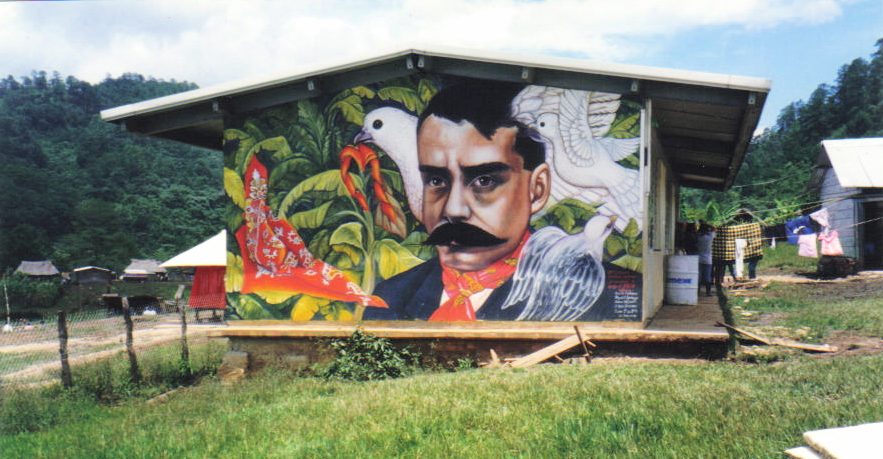
Narco-governments and organized crime add to the repression in Chiapas

Above: Presentation of the El Machete Self-Defense group, in Pantelhó, Chiapas, last July – Photo: Image taken from YouTube
This is the second of two articles from Hermann Bellinghausen that gives an overview and analysis of the current situation in Chiapas.
By: Hermann Bellinghausen
The PRI hegemony, taken for granted for decades in Chiapas, was broken on New Year’s Day of 1994. The reality was much more porous, the complexity of the indigenous peoples turned out to come from deep, having great diversity and being crossed by important historical tensions that, after gaining visibility on the political agenda, became of national interest. Great and terrible days followed one another in the next decade. Chiapas became an essay of the future on two opposite fronts. The organized indigenous people, in rebellion, in resistance, or at least in protest against the government and the state of things were and are very numerous. Against them, the acute militarization, massive by the standards of 25 years ago, established a land of exception in the Mayan Mountains of Chiapas.
The segregation, racism, invisibility and contempt towards indigenous peoples had been the hallmark of the urban population and the property owners, the so-called cashlanes (non-indigenous people). The inequality was abysmal, even after the Revolution and its distant agrarian reform. In the communities people were dying from the flu, diarrhea, hunger, and nobody cared. Many were slaves. Elections came and went, total, the polls were full.
The unexpected indigenous emancipation altered the balance sheets and calculations. Ever since then, the state governments have been nonexistent for practical purposes (with the relative exception of Roberto Albores Guillén, a proactive collaborator with the generals, and Pablo Salazar Mendiguchía, who quickly squandered his democratic credentials). The state went from being “governed” from the center (the federal government in Mexico City) to governing itself, for better or worse. Zapatista discipline and its autonomy in the territories where exercised, are a guaranty of governability, but it has also generated any number of paramilitary-style replicas that evolved into powers unto themselves. The communities and pacifist organizations that inherited the theology of liberation from tatic Samuel Ruiz García receive the same response.
The partisan replay in Chiapas ever since “democracy” arrived in 2000, according to the center, has not been less ruthless against the communities, not by pantomime, which, with the continuous ingredient of the military presence in their territories, was always loaded with counterinsurgent propaganda. No less is the role of the countless Christian denominations that with varying degrees of legitimacy and transparency have created divisions, violence and pretexts in favor of the State.
Long-term war
The Zapatista National Liberation Army (EZLN, Ejército Zapatista de Liberación Nacional) declared war on the federal government, a declaration, by the way, that is still in effect. And the government, especially from 1995 on, responded with long-term war. The initial clashes in January 1994 with the Salinas government responding to the war with war, were small in the face of what was experienced during the administration of Ernesto Zedillo.
Community division was considered strategic and was stimulated where possible: confrontations between Evangelical or Pentecostal Christians and Catholics; red or green parties against yellow or purple ones; the insidious “regularization” of cattle lands recuperated for the native peoples thanks to the insurrection; the emergence of clearly para-militarized groups, aggressive and well armed.
The multitude of layers and folds that such divisiveness unleashed is explained by the great economic, political, logistical, intelligence, manipulation and corruption investment in the indigenous regions of the jungle, the Highlands and the Northern Zone.
These ingredients generated a great disorder that makes it difficult to coexist among brothers in communities, ejidos, municipalities and traditional indigenous regions. All this, naturally sprinkled with the sustained introduction of weapons. Faced with the Zapatista challenge, the government, which, although it said yes, never intended to comply with the rebels demands for the native peoples that had become national, responded with an arms escalation seasoned with alcohol, prostitution and drugs.
Permanent shootings
All this must be considered in order to interpret terrible and absurd acts like the permanent shooting that some 15 Tsotsil communities of Aldama (or Magdalena) suffer. The existence of shock groups, militias, paramilitaries and now sicarios in Chamula, Pantelhó, Chenalhó, Simojovel, Ocosingo, Pueblo Nuevo and Altamirano comes from both the old white guards of the finqueros and from the marginal people and criminals authorized as paramilitaries in the Highlands and the Northern Zone.
The emergence of self-defense groups, in principle on the side of the peoples and against crime, can be the product of the example of Zapatista armed resistance and the effectiveness of their autonomies, and not only of the historical perversities of the local chiefdoms (cacicazgos). That would be the case of El Machete of Pantelhó, and maybe the self-defense groups announced in Simojovel and Altamirano.
It would also seem to weigh the dispute between two candidates for governor from the block for now related to the federal government, which would guaranty the continuity of the Chiapas political farce anchored to it, and it reinforces the tempests that government agencies and institutions, the armed forces and political parties sowed in the past four or five six-year terms. The municipal presidencies in the Highlands (los Altos) make up true narco-governments (Pantelhó, San Cristóbal, Chenalhó). Let’s add to this the expansion in the Chiapas Highlands of criminal organizations dedicated to the trafficking of arms, drugs, pornography and migrants. Let’s not forget that the state has become the gateway for the growing tide of Central American and Haitian families. The border with Guatemala is heavily militarized.
Political groups within indigenous communities have been blocking highways for years, retaining machinery and officials; usually with explicit demands, or because of electoral conflicts that are endemic in Oxchuc and other municipalities.
Now in the communities, they intercept the National Guard (the paramilitaries did it in Santa Martha, Chenalhó; Mitontic residents did it to prevent the National Guard from going into Los Altos), and they also disarm it.
The government’s negotiating commissions come and go in Aldama, Chenalhó, Pantelhó and Altamirano, without containing the violence.
The most serious executions, not the only ones, have been of the special prosecutor for the Pantelhó case, Gregorio Pérez Gómez, last August 8 on the main avenue of San Cristóbal de Las Casas, and that of the former president of Las Abejas de Acteal, Simón Pedro Pérez Gómez, on July 5 in the Simojovel market. In both cases they were the objects of an act of sicarios (hit men) on a motorcycle, which has become the new modus operandi. It’s no longer repression, but rather “organized crime.”
——-Ω——-
Originally Published in Spanish by La Jornada
Tuesday, October 19, 2021
https://www.jornada.com.mx/2021/10/19/politica/005n1pol
Re-Published with English interpretation by the Chiapas Support Committee
Social decomposition and overflowing violence hit Chiapas
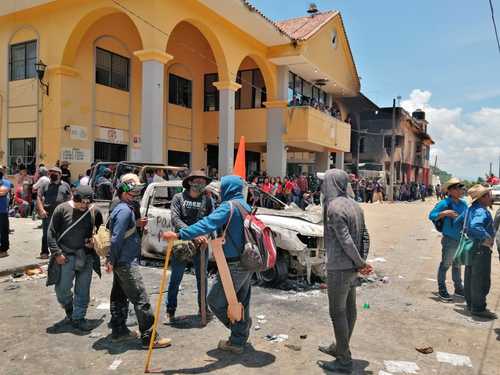
Above: A self-defense group named El Machete irrupted in Pantelhó last July. Photo: Elio Henríquez Tobar
This is the first of Hermann Bellinghausen’s two-part overview and analysis of the current situation in Chiapas that led Subcomandante Galeano to say that Chiapas is “on the brink of civil war.” Bellinghausen has many years chronicling the Zapatista Uprising and the indigenous movement in Chiapas.
By: Hermann Bellinghausen
The succession of violent events in indigenous regions of Chiapas leaves the impression that they occur outside of institutional control. Day after day for hours, since many months ago, the Tsotsil families in several communities in the municipality of Aldama receive a rain of large-caliber bullets or are threatened with explosives; there are seven dead, several injured, traumatic displacement, hunger and fear: an isolated scenario, yes (allegedly an agrarian dispute). Each scenario of armed violence seems isolated. The fearsome scooters (motonetos) take over the days and nights of the once peaceful and touristic San Cristóbal de Las Casas, the country’s most indigenous city.
In Pantelhó and Chenalhó, groups that are armed and related to the municipal governments kept the population terrorized until the El Machete armed self-defense group emerged and drove them out, although the paramilitaries and sicarios (hit men), who the people identify as drug traffickers (narcos), threaten to return. Among those murdered is the former president of Las Abejas of Acteal, Simón Pedro Pérez López, whose community is displaced, like others. And among their leaders are members of the PRD and the PVEM.
The ORCAO, once a coffee organization in the most populated zone of Ocosingo, maintains harassment, sabotage, kidnapping, shootings, blockades and thefts of land against the Zapatista bases in autonomous Tseltal communities. On September 11, they kidnapped Sebastián Núñez and José Antonio Sánchez, member of the Patria Nueva autonomous Zapatista government. The violent decomposition affects Chalchihuitán communities attacked from Chenalhó, just like what happens to Aldama. In San Juan Chamula, armed political-criminal groups have controlled the life and commerce for years, and their tentacles reach into San Cristóbal and other municipalities where the population of Chamula has spread.
Meanwhile, the Zapatista National Liberation Army (EZLN, Ejército Zapatista de Liberación Nacional) points out that Chiapas is “on the brink of civil war” in a brief and tremendous communiqué (September 19); it’s evident that the federal civil authorities, their National Guard and the Federal Army itself are permissive, and in fact leave the dozens of attacked communities helpless. The local police are incompetent or complicit. As Subcomandante Galeano suggests upon characterizing the wild-card party, of green Gatopardismo [1], which artificially predominates in the region, courtesy of the PRI, seeks “to destabilize the regime in power.”
He accuses officials of corruption and robbery, “perhaps preparing for a federal government collapse or betting on a change of the part in power.” The EZLN blames the Morena Governor Rutilio Escandón directly for this irresponsible and dangerous lack of control.
Paraphrasing the leitmotif of the great novel by the discredited businessman Mario Vargas Llosa, Conversation in The Cathedral, today more cited than read, has become commonplace: At what moment did Chiapas get screwed? Not that there wasn’t an abundantly fucked up reality in the intense, poor and yet full of riches state in the Mexican Southeast, but rather that the lives of its residents, especially the indigenous people, had not overflowed into decomposition, even despite the massacres at the end of the 20th century, and much less on the side of violent crime, similar to that which has disgraced a good part of Mexican territory in recent six-year terms.
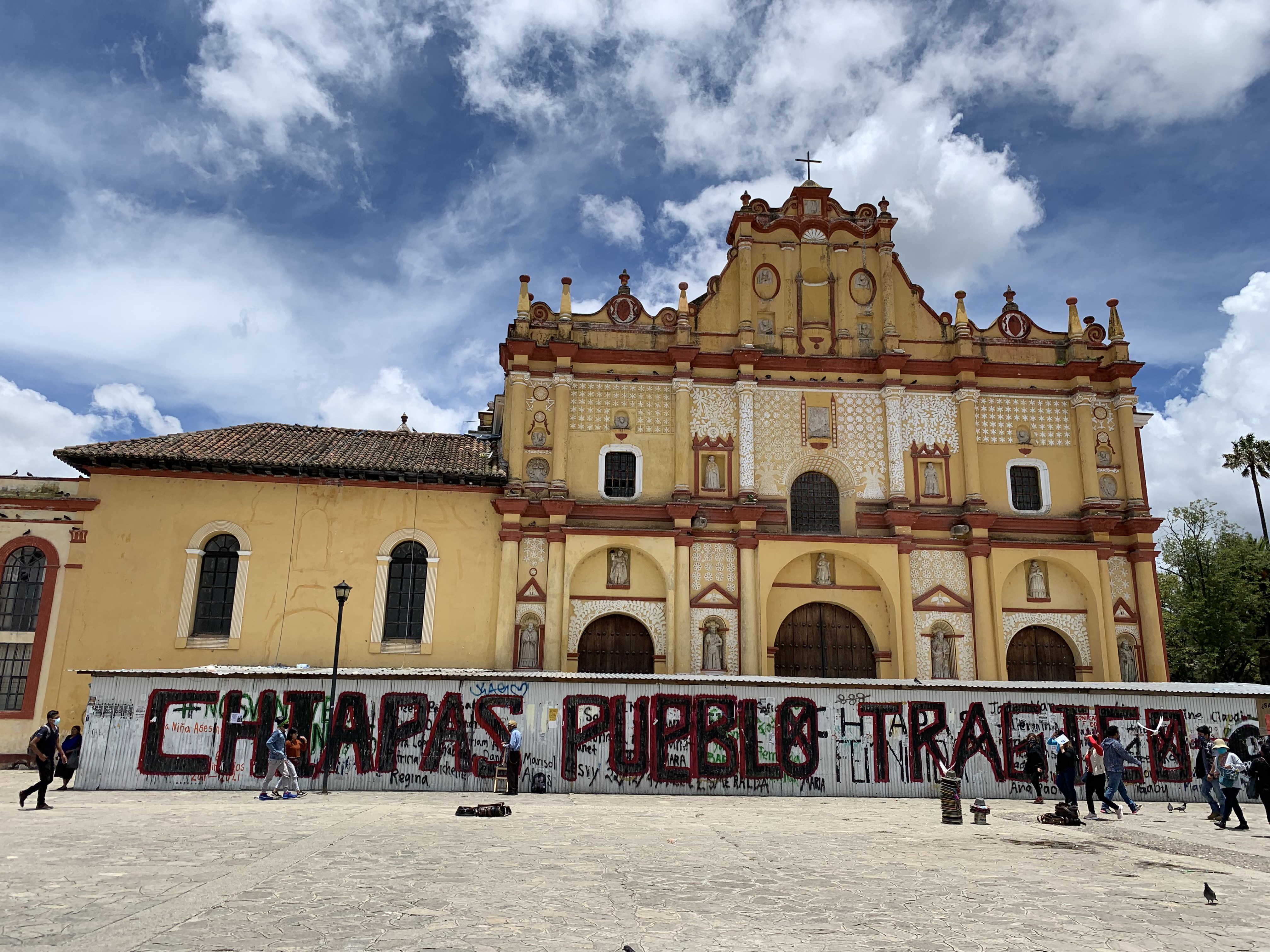
Above photo reads: “Chiapas, tragic town,” which is a play on the “magic town” designation the federal government gives to cities and towns that have tourist attractions, such as archaeological sites, sandy beaches, colonial architecture, etc. The photo is taken in front of the Cathedral in San Cristóbal de Las Casas, Chiapas.
Control from the center
The place called Chiapas (as a documentary of the Canadian Netty Wild is titled) has always been a geographical and historical exception. We have a canonical book that recounts it admirably, Resistance and Utopia: A memorial of grievances and a chronicle of revolts and prophecies that occurred in the province of Chiapas during the last 500 years of its history, from Antonio García de León (1985). An obscure corner of the country, Chiapas was always governed from the center [of the country], which is a saying, because it was so far from the news, the independences, reforms, wars and revolutions came late.
Previously the exclusive subject of ethnology, archaeology, folkloric photography and the occasional crime note, starting in 1994 the ink ran on and from Chiapas. Its communities of Maya origin rebelled, achieving international projection with a new and convincing discourse. For the first time in history, “the most forgotten corner” came to occupy the center of the national agenda; to such a degree that the absence of a state government was accentuated, since the Presidency of the Republic converted Chiapas into the principal theater of war and counterinsurgency operations, establishing in its military zones and regions an authentic army of armies.
The state governments, once distant and now dummies, continued to be conspicuous for their absence. As the historian Andrés Aubry recalled, Emilio Rabasa governed Chiapas from Mexico City, almost from Porfirio Díaz’s office. The unfolding of the revolutionary period turned it into a land of caciques and landowners, more than a consolidated federative state.
The 1994 explosion put this peripheral condition into evidence. The last governor prior to the indigenous uprising, Patrocinio González Garrido, had attempted to avoid the center, and its president Carlos Salinas de Gortari brought him in to take the crown away from the tropical kinglet, to make him Secretary of the Interior (Gobernación) and thus shorten his reins. This episode is part of the tragicomedy of the Chiapas political class (to call it something).
Now that a brutal and it would seem absurd violence lashes precisely the indigenous mountain regions of Chiapas, it’s essential to remember what contributed to such lack of control. The decomposition comes from the lack of fulfillment of the 1996 San Andrés Accords between the federal government and the EZLN and the definitive interruption of the most important negotiations between the State and the original peoples of all of Mexico in history, led by the liberated communities in a struggle for self-determination.
[1] Gatopardismo is the art of making change that doesn’t actually produce change, but rather keeps everything much the same.
——–Ω——-
Originally Published in Spanish by La Jornada
Monday, October 18, 2021
https://www.jornada.com.mx/2021/10/18/politica/003n1pol
Re-Published with English interpretation by the Chiapas Support Committee
Moisés Gandhi autonomous community denounces armed attack from ORCAO
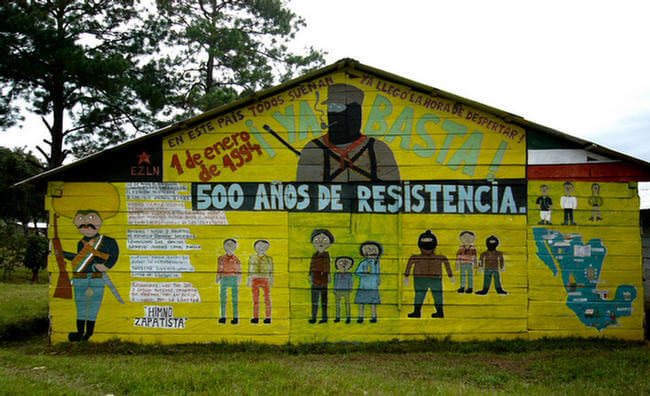
Mural in Moisés Gandhi community.
By: Elio Henríquez
San Cristóbal de Las Casas, Chiapas
The Ajmaq Network of Resistance and Rebellion denounced that members of the Regional Organization of Ocosingo Coffee Growers (ORCAO, its initials in Spanish) “once again began armed attacks against the support bases of the Zapatista National Liberation Army (EZLN, Ejército Zapatista de Liberación Nacional) in Moisés Gandhi autonomous community.”
In a communiqué, the organization said that the “attacks” started Wednesday at 8:30 pm, according to information from the Good Government Junta New Dawn in Resistance and Rebellion for Life and Humanity,.
It added that at 1:25 am (in the very early hours of the morning) this Thursday: “the bursts of gunfire intensified, even entering the autonomous secondary (middle) school. At 2:20 pm the group of heavily armed people remained just 30 meters from the homes of the EZLN support base families, who had to forcibly displace to seek a safe refuge.”
It stated that: “the paramilitary group’s attacks ended at approximately 3:30 am (on the same Thursday), according to information from the Good Government Junta.”
The network recalled that a little more than a month ago members of ORCAO “arbitrarily detained José Antonio Sánchez Juárez and Sebastián Núñez Pérez,” members of the Junta. “We demand respect for the land and territory of the Zapatista peoples, for autonomy and self- determination,” the group concluded.
——-Ω——-
Originally Published in Spanish by La Jornada
Friday, October 15, 2021
https://www.jornada.com.mx/2021/10/15/estados/035n2est
Re-Published with English interpretation by the Chiapas Support Committee
Comandante Machete: That the government recognizes our elected authorities and not Trujillo Morales!
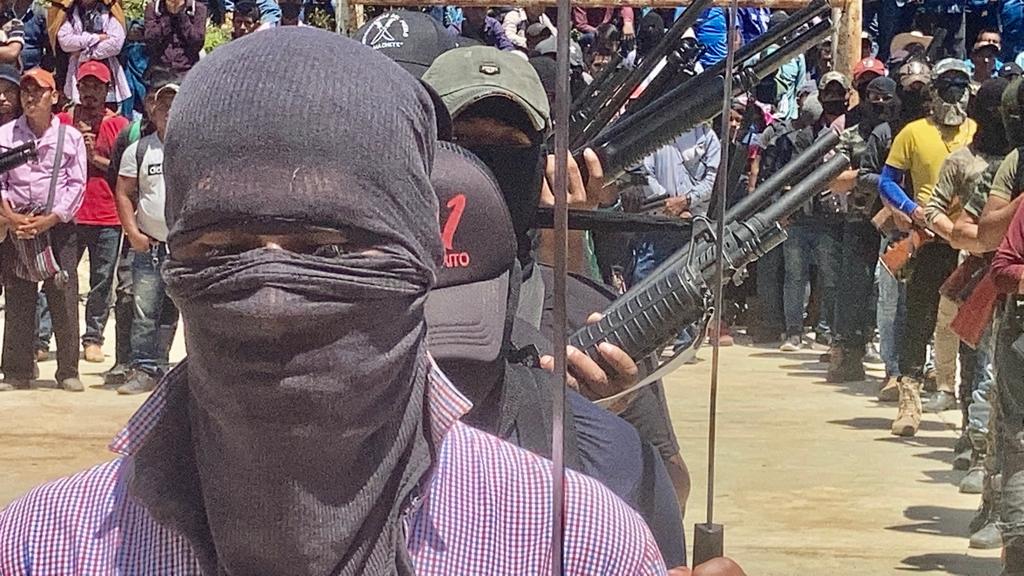
The El Machete Self-Defense group asks the government to recognize its authorities and not Raquel Trujillo Morales Photo: Isaín Mandujano
By: Isaín Mandujano
The El Machete Self-Defense group warned today that if “anything happens to” any of the three councilors of the municipal government of Pantelhó, of the 20 commissioners of the 86 communities or to Father Marcelo Pérez Pérez, we are going to mobilize to reach all “possibilities.”
In a letter signed by Comandante Machete, leader of the Self-Defense group, he said today that the armed group made up of “indigenous soldiers” irrupted publicly last July 7 to confront the Los Herreras organized crime group, which from the municipal seat of Pantelhó under the command of Dayli de los Santos Herrera Gutiérrez, had already left a trail of some 200 dead people.
They did not rise up in arms for partisan political purposes, but rather they did it to put an end to the “criminal group” that from the PRD Municipal Council of Pantelhó, controlled the town’s resources (money), so that in the 86 rural communities support didn’t arrive and therefore they still lack good roads, schools, health centers, safe drinking water, electricity and other public services for the benefit of the population.
Commander Machete recalled that a commission of 20 people was created to represent the 86 communities and different neighborhoods of the municipal seat, and also that the State Congress swore in the three members of the Pantelhó Municipal Council, and that now we all walk together for the reconstruction of the municipality.
And that they won’t let the one who calls himself Mayor Raquel Trujillo Morales enter the municipality, because if he won these were not legitimate elections, since votes were bought and the voters were threatened to vote for the PRD in that municipality via “the hit men of Dayli” group.
They mentioned that this is an opportunity for the government to show whether it’s on the side of the people of Pantelhó or on the side of the Los Herrera sicarios, and if the government doesn’t recognize the authorities they elected, the government will only reaffirm “its abandonment and betrayal of the people of Pantelhó.”
They pointed out that neither the three councilors on the municipal council, nor the 20 commissioners from the 86 communities depend on them, and that as an armed group they don’t have to give orders to them; Los Machetes are only “for the protection of the people against the hit men.”
Given the allegations that Father Marcelo Pérez Pérez was the founder of that group and that he gives orders to the members of the Self-Defense group, Comandante Machete rejected such assertions, indicated that those accusations “are lies,” that they were organizing little by little, and that they didn’t even know Father Marcelo before they irrupted publicly.
They ask the government to investigate the Los Herrera group of sicarios. “The pain and death forced us to organize to defend our people. If we have more than 200 murdered, we cannot stay with our arms crossed,” they said.
And that Father Marcelo Pérez Pérez has only been a mediator for peace, a mediator in the dialogue tables, a peacemaker who has kept violence from spilling over in that municipality.
Therefore they warned that if “anything” happens to the three councilors, the 20 commissioners or to Father Marcelo Pérez Pérez, they are going to mobilize as far as they can to protect and defend them from those who attack them.
They asked the state and federal governments to better investigate the criminal group of Dayli de los Santos Herrera Gutiérrez, who the State Attorney General arrested Tuesday, accused of being the alleged intellectual author of the murder of the indigenous justice prosecutor, Gregorio Pérez Gómez, riddled with bullets last August 10 in the southern part of San Cristóbal de Las Casas.
They should investigate who the ex military man is that came to train the hit men (sicarios) of the “Los Herrera” organized crime group and also investigate their protectors in the state capital, such as César Espinosa Morales, one of the state leaders of the PRD in Chiapas.
The El Machete self-defense group said nothing about the 21 missing persons, who their relatives claim and who accuse El Machete of having kidnapped last July 26 in the municipal seat of Pantelhó.
——-Ω——-
Originally Published in Spanish by Chiapas Paralelo
Thursday, October 14, 2021
https://www.chiapasparalelo.com/noticias/chiapas/2021/10/94156/
Re-Published with English interpretation by the Chiapas Support Committee
Altamirano residents resort to armed self-defense to shake off the caciques
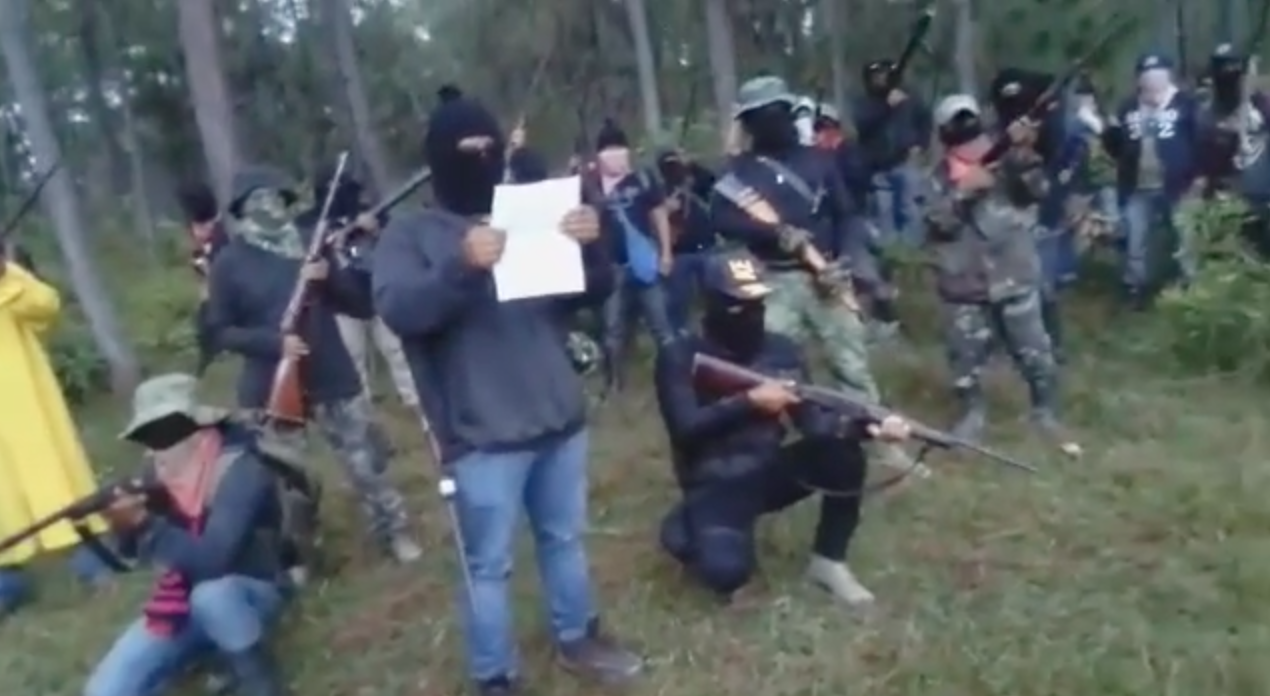
Above Photo is a screen shot taken from the armed self-defense group’s video.
By: Angeles Mariscal
In Altamirano, the municipality located in the jungle zone of Chiapas, the Kanter family has governed since 2002. The men of the family and their wives have rotated holding the position of municipal president. Residents of the place decided that this was going to end, and since last October 1 they closed the entrance to the municipal seat to prevent Gabriela Roque Tipacamú, wife of Roberto Pinto Kanter, from taking office as mayor. Meanwhile, in support of this movement, an armed self-defense group came to public light in this municipality.
“The self-defense group greets you. We’ll leave it without a name, not because it doesn’t have one, but rather out of respect for the EZLN brothers. What we are interested in telling you from this municipality of Altamirano, Chiapas, is that we have seen how the rich protect each other, how the politicians protect each other, regardless of party. They want to deceive us sating that because they changed political party now they are new. What never changes is their indifference to us, the indigenous Tseltal and Tojolabal peoples,” they said in a video, where a group of masked men are observed, carrying hunting rifles, like those used in rural communities. Watch the video in Spanish here: https://www.youtube.com/watch?v=tzAPSHw2LDQ&t=47s
Altamirano is one of the municipalities that the Zapatista National Liberation Army (Ejército Zapatista de Liberación Nacional, EZLN) took over in January 1994. It was also in January 1994 when opponents came out against the Zapatista movement and its measures for regaining possession, such as taking over ranches and haciendas that were in the possession of the latifundistas (big plantation owners) where the indigenous peoples worked as housed peons (serfs).
Jorge Constantino Kanter was one of them. He headed the hacendados (plantation owners) of Altamirano, Comitán and Las Margaritas, in the marches and protests to demand that the Mexican Army enter the jungle to fight the Zapatistas.
Constantino Kanter became famous for saying loudly: “the life of a chicken is worth more than the life of an indigenous person.” They didn’t recover their ranches, now in the possession of indigenous peoples, but the Kanter family held on to political power in the region.
Armando Pinto Kanter occupied the municipal presidency of Altamirano between 2002 and 2004 and Jorge Constantino Kanter occupied the presidency of Comitán from 2005 to 2007. Heidi Pino Escobar, wife of Armando Pinto Kanter, occupied the presidency of Altamirano from 2007 to 2010 after his brother-in-law, Roberto Pinto Kanter, left the position. In 2015, Roberto’s wife, Gabriela Roque Tipacamú, was in the presidency; however on this occasion she was punished for the direct marital relationship with her predecessor, but Roberto Pinto Kanter reclaimed the presidency again in 2018, and he inherited it again from Gabriela Roque, his wife, for the period that would begin last October 1.
It was at this time that Altamirano residents protested, arrested Roberto Pinto Kanter, burned the family house and closed off access to the municipality. Since then, they have demanded that the Chiapas government form a municipal council. There has not been a response. And it’s in this context that a new armed self-defense group announced itself in Altamirano on October 7.
“We are seeing how our brothers from different communities have been fighting for several days, under the sun and the rain, to drive out the Pinto (Kanter) family, who came just to take advantage of the pay: abandoned highways, people without jobs, a lot of migration to the United States, because we live in the same poverty. There is no electricity, water, the hardest, without justice and without democracy,” they said in the video, this self-defense group.
“Here, the one who wins an election is the one who has the most money, because here in Altamirano, democracy and justice have a price. To these brothers who are struggling, we say that they have our support. We will help them defend this territory, at whatever cost, so that there are no more criminals and thieves, so that deaf and self-seeking governments end, and so that the exploitation of our natural resources ends.
From the mountains of Altamirano, ¡Viva Altamirano! ¡Viva the self-defense groups!” they maintained. In Chiapas, last July, the first self-defense group emerged in Pantelhó municipality, “Los Machetes,” who expelled the municipal authorities, and who they consider part of the organized crime groups that had positioned themselves in the region and murdered dozens of residents. In addition to “Los Machetes” and the Altamirano group, two other groups have come forth, one in Simojovel, and another that claimed to be “people of the jungle.” Residents of those localities have not legitimized the latter two.
——-Ω——-
Originally Published in Spanish by Chiapas Paralelo
Friday, October 8, 2021
Re-Published with English interpretation by the Chiapas Support Committee
They demand forming a municipal council in Altamirano
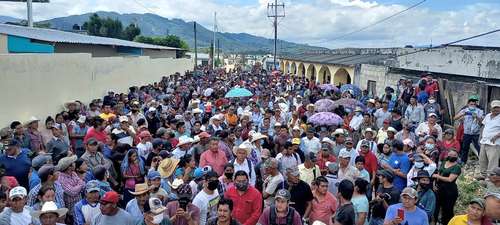
Above Photo: La Jornada – In an assembly held on September 24, hundreds of residents of Altamirano, Chiapas, demanded forming a municipal council, thereby rejecting that Gabriela Roque Tipacamú, of the Green Party, govern the place.
By: Elio Henríquez
San Cristóbal De Las Casas, Chiapas
Ejido owners and residents of Altamirano municipality demanded that Mayor Gabriela Roque Tipacamú and her predecessor, her husband Roberto Pinto Kánter, held in the ejido’s jail for the last four days, “leave town definitively, because “they have threatened to murder four or five” representatives of the movement against them.
Leaders of the protesters, who asked to remain anonymous for fear that Gabriela Roque and Roberto Pinto might retaliate against them, said that it is not known if Roque Tipacamú took the oath of office as mayor on September 30, when the council that her husband headed concluded its functions, or on October 1, “but she has not been seen in the town.”
They assured that: “the people no longer only have the initial demand that a municipal council be formed so that the couple no longer can govern, but that the whole family leave the municipality.” They added that: “the people are very agitated and inflamed, but there has been no answer from the state government, although the local Congress also has to participate, not just the Secretary of Government.”
They emphasized that at the moment, residents of the 10 neighborhoods that make up the city of Altamirano [1] are in charge of providing security to the population, because the municipal police have been without leadership since September 30, when Pinto Kánter was arrested in his private domicile. They commented that the former mayor couldn’t be released “just like that, but that there has to be an agreement, with the state government’s intervention.”
They recalled that the couple has governed the municipality for nine years, “and if Roque Tipacamú stays it will be 12 years. The people got tired of them being the same as shock groups and buying votes in order to direct the destinies of the municipality.”
They added that in an assembly held Sunday night it was agreed that the Pinto Roque family must leave Altamirano, “it’s no longer that they don’t govern, because of what he has said that by leaving he’s going to carry out an operation to murder four or five.”
The opponents specified that: “the demand is that they leave and that a municipal council is formed, they can no longer be in Altamirano because they have done a lot of damage to the municipality, and because on Sunday they again threatened to move people from some rural areas. We are calm and peaceful, hoping that the state government will resolve the situation.”
The leaders pointed out that since September 29 they have blocked access to the municipal seat, allowing passage every six hours, and they don’t rule out that they will close down completely this Tuesday.
Regarding security within the municipality, they stated that 10 residents of each one of the neighborhoods carry out surveillance tasks in order to prevent crime, besides the fact that it was agreed to establish a “dry law,” with the argument that individuals could insult or attack someone after drinking alcoholic beverages. “Five people have already been arrested and accused of robbery, and were locked up in the jail and authorities of the municipal agency will judge them,” they declared.
They referred to the fact that due to the lack of authority in Altamirano the garbage has not been collected or taken to the dump that is located in the town of Santa Rosa, three kilometers from the municipal seat. “The municipal council that Pinto presided over left a garbage dump because it didn’t pay for the passage of the trucks. Perhaps tomorrow (Tuesday), with the support of dump truck transportation they will take away the garbage, but the problem is that at the access to the dump they unloaded before reaching the ravine and it’s difficult for a car to pass; you have to bring in a backhoe to clean up,” they said.
[1] The City of Altamirano is just a few miles down the road from Zapatista Caracol IV, located in Morelia, where the Women’s Gatherings have taken place.
——-Ω——-
Originally Published in Spanish by La Jornada
Tuesday, October 5, 2021
https://www.jornada.com.mx/2021/10/05/estados/029n1est
Re-Published with English interpretation by the Chiapas Support Committee
A second armed group emerges in Chiapas, to support El Machete

Photo: People of the Jungle, an armed group in Chiapas, emerges in support of El Machete (Screen Shot)
The new armed group is called Gente de la Selva (People of the Jungle) and emerged in support of the El Machete Self-Defense group against the municipal government of Pantelhó
By: El Debate
Chiapas – “People of the Jungle” is another armed group that emerged in a video published on social networks, where they launched a threat at the three levels of government and showed support for the El Machete Self-Defense group that led an uprising against the municipal government of Pantelhó, Chiapas.
The drug war continues generating violence and fear among Pantelhó residents, since they confrontations have emerged between rival groups that have made them leave their homes and displace to other territories. This tension will be increased given the appearance of the new-armed group “People of the Jungle.”
“We are People of the Jungle, people from the mountains and the bush, and this communiqué is to let the El Machete Self-Defense group know that it is not alone. We, those of the jungle, are here to support you,” mentioned a man equipped with a bulletproof vest, a long gun and wearing a cap with the Mexican flag.
The video was broadcast through the social networks where dozens of subjects with faces covered and military clothing can be seen carrying long arms in the middle of a mountain, en which they broadcast a threat to the three levels of government in Mexico.
The spokesperson for the armed group supported the actions of El Machete to confront the mayor of Pantelhó, Raquel Trujillo Morales, who [allegedly] took the oath of office last Friday October 1, and who is the husband of former municipal president Delia Velasco; the couple was accused of financing organized crime.
“We support the machetes of the armed uprising against the narco municipal council that operates in Pantelhó of the current (sic) president and her husband, Raquel Trujillo, who have been financing organized crime, which is led by Dayli Herrera,” said the armed subject.
The drug trafficking group mentioned is that of “Los Herrera.” The leaders of that organization would be Austraberto Herrera Abarca, Daily de los Santos Herrera Gutiérrez, Rubén Estanislao Herrera Gutiérrez, Raquel Trujillo Morales, (elected president) and Delia Janeth Velasco Flores (ex substitute president). They would also be Wendy Lorena López Goches, director of Civil Protection, Arturo Martín Ramos Salazar, José Lázaro Gutiérrez Ballinas and José Francisco Ballinas Rojas.
To end the video, the “People of the Jungle” group reaffirmed its support for El Machete: “Cheer up Machete, we’re here. So, any attack against that Machete Self-Defense group, we’re here to support. Courage, don’t crack, we’re here for you. Iron.”
——-Ω——-
Originally Published in Spanish by El Debate
Sunday, October 3, 2021
Re-Published with English interpretation by the Chiapas Support Committee
They won’t let the PRD mayor govern, Pantelhó self-defense forces warn
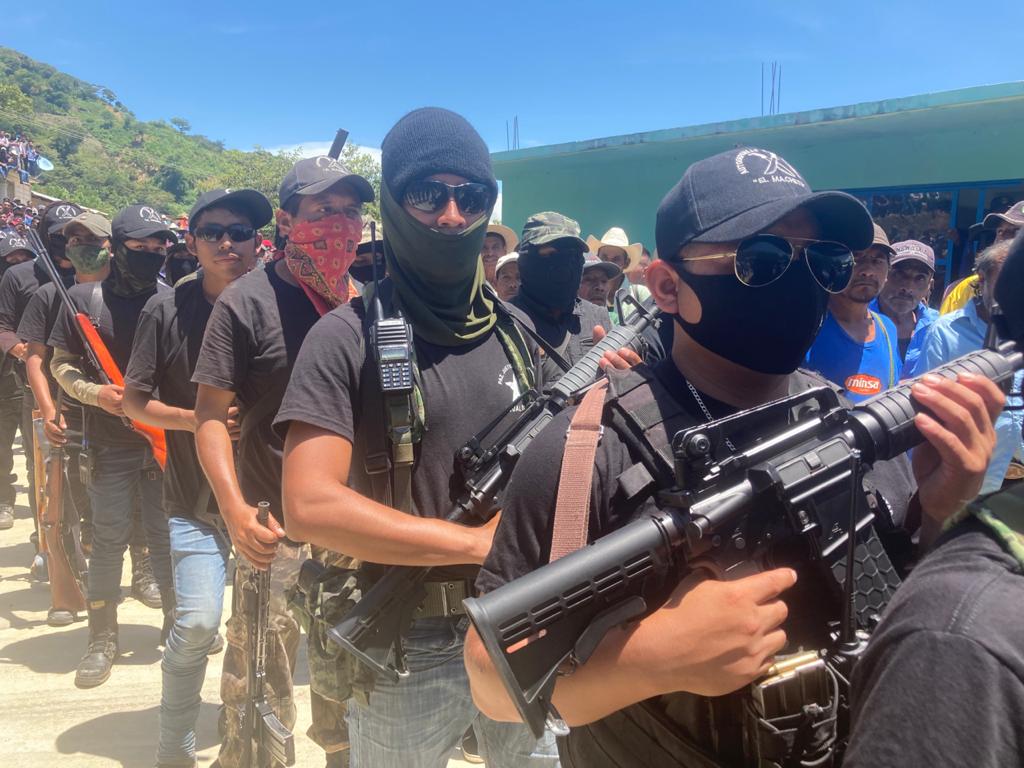
Above Photo: El Machete Self-Defense Forces of Pantelhó
By: Elio Henríquez
San Cristóbal de Las Casas, Chiapas
After PRD member Raquel Trujillo Morales supposedly took the oath of office as mayor of Pantelhó secretly in a Tuxtla Gutiérrez hotel, the El Machete Self-Defense forces of the People warned that: “he will not be able to enter the town” to govern.
“We’re not worried, because the authorities and the people of the 86 communities are supporting the municipal council” that took office last August 18 de and whose functions concluded on September 30, one of their representatives remarked.
A high-level source in the state government informed La Jornada that Trujillo Morales accepted last week that he will not be able to govern and promised to ask for leave after taking the oath of office. Nevertheless, “he doesn’t even answer now and we don’t know where he is,” after adding that the situation in Pantelhó is tense, that’s why security was recently reinforced in order to prevent violent acts.
The El Machete representative consulted on Saturday said that: “although Raquel wants to come to govern Pantelhó, who is going to want him if he has no people?” He asserted that Trujillo Morales is no longer going to enter, although the government wants him to govern Pantelhó, it won’t be that way because the only thing that’s going to happen “is that more blood is going to run in Pantelhó.”
He commented: “they say that Raquel Trujillo took the oath of office in a hotel; but we don’t worry because the 86 agents are in favor of the council. We will wait today (Saturday) and tomorrow (Sunday) to see how he is.”
For his part, the state government source pointed out that Trujillo Morales “has already been told, it has already been made clear to him and he knows it, that they are not going to even allow him to enter (Pantelhó). He is clear that he cannot take office and that they are not going to let him govern because the people reject him, that is more than clear.”
He added that the state authorities are “speaking with all parties and seeing with those who remained as councilors, whose term ended on September 30. We will see how we can work together so that violence is not generated.”
Rumor that he took the oath of office in a hotel
He said that the PRD member “supposedly took the oath of office Friday in a hotel, and that cannot be, although legally from the first minute of October 1 he is the authority, but de facto it’s not him; it definitely cannot be him, because he cannot be imposed.
We don’t know where he is; he had come to the government palace asking for security and we told him that the conditions did not exist for him to take office, and suddenly he stopped responding, left [the government palace] and now he has appeared in some videos” saying that he took the oath of office.
The source affirmed that Raquel Trujillo accepted requesting an indefinite leave of absence, “but someone advises him and makes him change his mind. He agreed to the request for leave last week; but now he is refusing.”
Meanwhile in Altamirano, Roberto Pinto Kanter, whose responsibility as mayor of Altamirano ended September 30, completed two days this Saturday in the ejido’s jail, located in the municipal seat, by hundreds of residents who demanded that his wife, Gabriela Roque Tipacamú, both from the Green Party, not assume the position of municipal president and that a municipal council be named in her place.
“The former mayor complains that he is in poor health. We are looking for a way to release him, and in that case, (Roque Tipacamú) will not be able to take office either, although she is already taking office as municipal president,” the same Chiapas government source stated.
——-Ω——-
Originally Published in Spanish by La Jornada
Sunday, October 3, 2021
https://www.jornada.com.mx/2021/10/03/estados/025n2est
Re-Published with English interpretation by the Chiapas Support Committee
Exodus from Pantelhó due to political tension
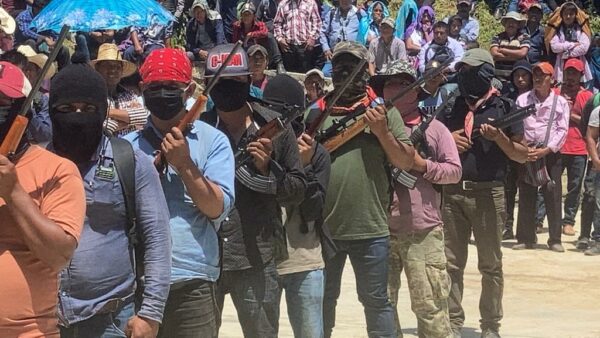
Above photo: El Machete Self-Defense Forces of the People
By: Elio Henríquez
San Cristóbal De Las Casas, Chiapas
The Fray Bartolomé de Las Casas Human Rights Center (Frayba) reported that at least 90 indigenous people from the communities of Nuevo Paraíso, San José El Carmen and the municipal seat of Pantelhó, members of the Las Abejas of Acteal Civil Society Organization, have displaced themselves due to the political tension that place experiences, because of the possible taking of possession of the mayor-elect, Raquel Trujillo Morales, who is due to assume the position on October 1.
The Frayba assured that: “violence has been on the rise after statements from Trujillo Morales, who will take possession of his position, which has impacted and generated fear in the population, thereby causing new displacements.”
The organism over which the Bishop Emeritus of Saltillo Raúl Vera López presides, affirmed that: “the ineffectiveness and simulation of the Mexican State’s actions continues favoring an atmosphere of violence and fear against the Tsotsil and Tseltal communities of Chenalhó and Pantelhó in the Chiapas Highlands, thereby forcing people to abandon their homes.”
Meanwhile, the group called the El Machete Self-defense forces of the People affirmed that: “by the will of the entire population and by the decision of the 86 communities of Pantelhó” Trujillo’s presence will be rejected.
They added that: “the Municipal Council that Pantelhó has now will continue working with us until 2024;” it was elected through the system of uses and customs on August 9, after the request to leave office presented by members of the PRD municipal council, which Delia Janet Velasco Flores, substitute PRD mayor and wife of the mayor-elect headed.
“Political parties no longer exist in Pantelhó, Mr. Raquel Trujillo Morales; you no longer lie to the people; if you really love your people we ask you to please speak and express what the community was like during the government of your wife.”
——–Ω——-
Originally Published in Spanish by La Jornada
Wednesday, September 29, 2021
https://www.jornada.com.mx/2021/09/29/estados/033n2est
Re-Published with English interpretation by the Chiapas Support Committee
ORCAO, the paramilitary arm

Above: The mural ORCAO destroyed in Ricardo Flores Magón autonomous Zapatista municipality
By: Luis Hernández Navarro
Just last September 11, two Zapatista authorities from the Patria Nueva good government junta, of Caracol 10 (Ocosingo), José Antonio Sánchez Juárez and Sebastián Núñez Pérez, were kidnapped. They were disappeared for eight days. They were also dispossessed of a radio for communication and 6,000 pesos in cash.
It was not a minor event. The provocation was obvious. That day, the Extemporaneous, a Zapatista airborne delegation of 177 people of Maya roots, was in Mexico City to undertake its expedition to Europe.
The Regional Organization of Ocosingo Coffee Growers (ORCAO), a paramilitary organization responsible for multiple aggressions against the Zapatista support bases in the last 20 years, perpetrated the kidnapping.
The first attack took place on October 28, 2001, when members of this group arrived in the community of Cuxuljá to paint over the mural of the New Dawn of the Rainbow [1] commercial center, created by various autonomous municipalities in rebellion, set a fire, threatening and beating up those who were there. Since then, and with different pretexts, attacks against the rebel support bases have not stopped.
Cuxuljá means Living Water in the Tseltal language. It is part of the municipality of Ocosingo. Some 1500 people live there. For them, water is sacred. Before, it was called “Enchantment Well.” The well gives its inhabitants identity (https://bit.ly/2WhONlG).
In December 2000, the EZLN demanded three signs from the government of Vicente Fox to renew the peace talks: fulfillment of the San Andrés Accords, the release of Zapatista political prisoners and the “withdrawal and closure” of seven Army positions, of the 259 that it had at that time in the conflict zone.
One of those positions was Cuxuljá, on the highway that links San Cristóbal and Ocosingo. The military presence in the community was not secondary. The town is part of a corridor of great geopolitical relevance. It’s a key point of communication for eight autonomous municipalities and a complex social network. Thus, when the soldiers abandoned it, the government replaced them with a counterinsurgency that had a civilian and indigenous face: the ORCAO.
Simultaneously, according to what three autonomous communities warned in October 2001, the Army coopted three community members, who, armed and in uniforms, tried to kill the children of Zapatista authorities, and distributed marijuana seeds for sowing. “To this denunciation –they pointed out– we added the harassment that soldiers, Public Security and Federal Highway Patrol have done about our new store that we’re building in our place that belongs to us at the position that the federal Army abandoned in Cuxuljá.”
The ORCAO was formed in 1987, starting from the work of the Catholic Church with 12 communities in Sibaca. It spread with [land] invasions to the fincas [2] close to Ocosingo, and to towns in the municipalities of Chilón, Oxchuc, Huixtán and Altamirano. In part, it’s a product of the 1974 Indigenous Congress in San Cristóbal and the mobilizations against the extinct Mexican Coffee Institute for better coffee prices, more collection centers and more support, in which the Union of Unions was also formed. It also struggled against the agrarian backlog and opposed the reforms to constitutional article 27. In 1992, it participated in the days to commemorate the 500 years of indigenous, black and popular resistance and vindicated indigenous self-determination. At some point it joined the Emiliano Zapata National Indigenous Campesino Alliance (Anciez, its Spanish acronym). It was part, until its expulsion in 2015, of the Unorca (https://bit.ly/3goUvWS).
The municipality of Ocosingo was constituted in 1921. It was the most extensive in Chiapas. In July 1999, as part of the counterinsurgency policy of “Croquetas,” Roberto Albores Guillén, [3] it was divided to form two new municipalities: Marqués de Comillas and Benemérito de las Américas.
The state, and especially its jungle region, was militarized. So much so that Juan Vázquez, one of the leaders of the ORCAO, now dedicated to businesses, denounced before being coopted by the government, that Chiapas was dressed in green… because of the number of soldiers deployed there. Despite that, on December 19, 1994, the EZLN broke the military siege and founded 38 autonomous municipalities in rebellion, nine in Ocosingo.
When, on April 11, 1998, the federal and state governments launched a violent police-military operation in Taniperlas against Ricardo Flores Magón autonomous municipality, it had as one of its objectives to destroy a beautiful mural that has been replicated by hundreds in different countries, the ORCAO allowed it.
Endowed with a military structure, weapons and uniforms, the association soon forgot its origins and became a paramilitary-style force against Zapatismo. Its leaders became municipal, state and federal public officials during the governments of Pablo Salazar and Juan Sabines. Juan Vázquez was appointed first secretary of Rural Development and then secretary for reconciliation, and Nicolás López (now deceased), director of the Coordinating Center of the National Indigenist Institute in Ocosingo. For more than two decades it has received millions of dollars in governmental resources for a multitude of projects, including cattle ranchers, the engine to parcel out common land.
The political decomposition of the organization has walked hand in hand with the personal degradation of its leaders. With the passage of years and several internal crises, leaders like José Sánchez and Tomás Santiz Gómez, even more violent than previous ones and at the service of a diversity of interests, took control of the association, which divided. Its strike force accommodates to the interests of the highest bidder. Its support for the Green Party in Ocosingo has brought it important dividends.
In Chiapas there is not a series of isolated inter-community conflicts, but rather the crisis of a regional system of domination. The ORCAO is one more piece of that model, one of its paramilitary arms. That crisis places the state, as the Zapatistas warn, on the brink of civil war.
Notes:
[1] Nuevo Amanecer del Arco Iris
[2] Fincas are large estates or plantations.
[3] Roberto Albores Guillén was the governor of Chiapas from January 1998 to December 2000. Subcomandante Marcos nicknamed him Croquetas, which means dog biscuits in Mexican Spanish.
——-Ω——-
Originally Published in Spanish by La Jornada
Tuesday, September 28, 2021
https://www.jornada.com.mx/2021/09/28/opinion/020a1pol
Re-Published with English interpretation by the Chiapas Support Committee
 Chiapas Support Committee