Chiapas Support Committee
Home of the Compañero Manuel blog on zapatistas & mexico
In Chiapas, thousands march in support of the CNTE
THOUSANDS of INDIGENOUS CATHOLICS MARCH IN SUPPORT of the CNTE IN CHIAPAS

The banner reads: We, Believing People of Simojovel, demand that the government not betray the dialogue with the CNTE like it betrayed the agreements signed in San Andrés with the EZLN.
By: Isaín Mandujano
TUXTLA GUTIÉRREZ, Chiapas
Thousands of Indigenous faithful from almost 50 parishes of the San Cristóbal de las Casas Diocese marched today (Monday) in the Chiapas capital in support of the teachers’ movement.
During the mobilization they demanded that the federal government “not betray” the National Coordinator of Education Workers (CNTE), like it betrayed the Zapatista National Liberation Army (EZLN) in the San Andrés dialogues.
For the fifth time, the Catholics of Pueblo Creyente marched for several kilometers from the state capital’s eastern exit until reaching the central plaza, where after issuing a pronouncement in favor of the teachers in the occupation, they held a mass, an act in which there were prayers, songs and chants in favor of the teachers’ fight.
During the march Father Gustavo Andrade, from the parish of Venustiano Carranza, and the priest Marcelo Pérez Pérez, from the Simojovel temple, celebrated the realization of this approach between the CNTE and the Secretariat of Governance (Segob) to achieve agreements that permit satisfying the teachers’ demands against the education reform.
Nevertheless, it was Pérez Pérez who stated his concern that the federal government “would betray” its word as it already did with the EZLN, after the agreements from the dialogues in San Andrés in 1996.
“We are worried, we must be attentive and alert so that the government does not betray its word, because it would not be the first time in which the government failed to fulfill the agreements that it signed,” said the parish priest that marched with the banner of the Virgin of Guadalupe.
With drum music, and accompanied with the sound of the conch shell, the faithful arrived in the capital escorted by thousands of teachers that protected their walk for several kilometers until reaching the central plaza.
There on the platform the parish priest of Tila, Heriberto Cruz Vera, asked the teachers not to stop their fight against unjust laws, and if for this fifth time they left their communities, it is because they consider it a peaceful struggle in which they have the need to add themselves.
He asked the priests that don’t leave their parishes to tour the Chiapas communities and observe the misery, poverty and marginalization, the places in which the teachers work in the most undignified conditions.
“We want a reform that really benefits the teachers and the boys and girls of Chiapas, a reform that really puts an end to those destitute conditions in which classes are imparted in Chiapas, not a reform that attacks the teachers’ labor rights,” Cruz Vera said.
Also on the platform was Father Joel Padrón, who along with Cruz Vera is considered a disciple or follower of the work that the late Bishop Emeritus Samuel Ruiz García constructed and left as a legacy.
Joel Padrón is a parish priest that was persecuted and imprisoned in the 1990’s, who the state government of Patrocinio González Garrido accused of promoting the invasion of ranches.
It was during his incarceration 25 years ago that what is called Pueblo Creyente (Believing People) was born as a Catholic organization that defends the rights among the indigenous peoples and communities of Los Altos of Chiapas.
Today, Pueblo Creyente alerted the teachers in a missive not to cede in their fight, because in they have great social support in the state from those who believe and trust in them to achieve that the government retracts the unjust laws, like it did with the so-called 3×3 Law after minimal protest of a group of business owners.
—————————————————————
Originally Published in Spanish by Proceso.com.mx
Monday, July 18, 2016
http://www.proceso.com.mx/447687/marchan-miles-catolicos-indigenas-en-respaldo-a-la-cnte-en-chiapas
Re-Published with English interpretation by the Chiapas Support Committee
EZLN: The geography? Oventik; the calendar? July 29, 2016
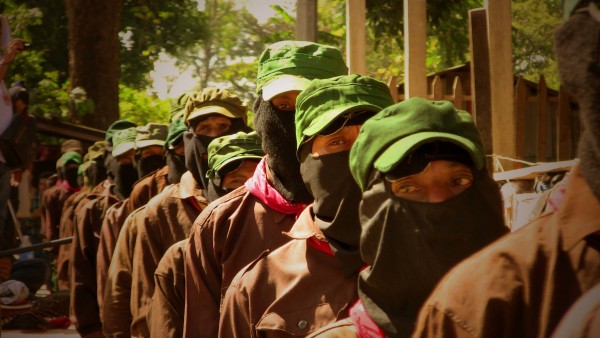
ZAPATISTA NATIONAL LIBERATION ARMY
MEXICO
July 17, 2016
To the Artist participants in the CompArte:
To the National and International Sixth:
Sisters and brothers:
Compañeras, compañeros and compañeroas:
Receive our greetings. We write you to communicate the following:
We want in some way to let you know and feel, all the artists that committed to participate in the CompArte, not just our admiration and respect. Also and above all, our conviction that the current dark hours, and those that will come, require your occupation and creativity for finding the path that, like humanity, we want, we need and we deserve.
And when we speak of darkness, not only do we refer to the horror that leaps out and destroys at any point of the already suffering world geography. We also refer to the political and economic commercialism that, mostly without importance to the deaths and afflictions, is launched over the still warm cadavers of the victims, and tries to extract profit and advantage.
If the machine imposes this perverse logic in which each pain doesn’t anger but rather waterproofs, perhaps the Arts can be those who remind humanity that it not only destroys and kills the person, it imposes and subjects, scorns and forgets. It is also capable of creating, liberating and remembering. Don’t life and freedom beat even in the most sorrowful and bloodcurdling artistic creations?
That’s good, we think, we feel, we believe, as the Zapatistas that we are, that there are artists that will know how to extract, from the most profound of the most obscure calendar, a light for humanity.
If not now, then when?
We don’t want to make them feel that they owe something to anyone, or submission, or pursuit, or absoluteness. We don’t seek their votes or their vetoes. We just want to say to them that, in that world that we catch sight of from the crow’s nest, we look at them. Or better still, we look at their creations.
That’s what we think. Nevertheless, we see that our ideas and sentiments don’t even begin to cover it with these words.
It’s because of this the Zapatistas silently persist in a new effort that we now want to communicate:
We want to greet you and honor you as what you are. Not as activists in the causes that people the world with different colors and symbols, but as the step in which we anticipate a more human, more dignified, a better tomorrow.
We Zapatistas don’t gaze towards above.
We only raise our eyes, our ears in front of the sciences and the arts. And fear and obedience don’t lift our view that way. It’s the portent of knowledge; it’s the marvel of the arts.
Therefore, we have organized ourselves to present a very squeezed version of what our work for the CompArte has been. This is with the sole purpose of trying to make you feel how great you are to us, the Zapatistas.
We know that the compas of the Sixth and part of the artistic community of Chiapas, with the on-going commitment of the compas of the CIDECI, have moved forward with the organization of the CompArte in the CIDECI to be celebrated in its space, from July 23 to 30, 2016. We truly expect that celebration to be a brilliant as is your artistic work and that, in these calendars of dark despair, in that corner of the world breathes another air and it’s not the night from above that reigns. That, although it may be in the fugacity of a musical piece, a trace of paint, a dance step, a photogram, a line from a dialogue, a verse, a whatever, the hour of the police is defeated, and in a second at least the possibility of another world breathes.
Then, taking advantage of the fact that some of you (no all, for sure) will be creating at CIDECI during those dates, we want to invite you (invitarlas, invitarlos, invitarloas) participants and attendees, to the Caracol of Oventik on July 29, 2016. From 10 am and until at least 7 pm (national time) we will be presenting theater, dances, music, poetry, painting, thoughts, and perhaps even predictions. Although it will only be a small part of what was prepared in the towns for the CompArte, the 5 caracoles that support the Tzotzil, Chol, Tzeltal, Tojolabal, Zoque, Mam and mestizo Zapatista peoples will be present. Even with the haste, the Zapatista compas, have prepared to celebrate, in your honor, life and liberty.
It will no longer be everything that was prepared on our part, but it will not be something minor: a present that we want to give you. We hope you like it, or not so suddenly. But we are sure that you will find here sounds, colors, lights and shades that have no other aspiration than to make you listen, watch and feel the “gracias” with which we embrace you.
The Zapatista artists make their presentation on July 29 and on July 30 they return to their communities, unless, of course, someone invites them to be at the last day of the CompArte Festival in the CIDECI. In such a case, they will make a stopover at CIDECI to learn something from you.
So now you know:
The geography? The Caracol of Oventik.
The calendar? July 29, 2016, from 10:00 am to 7:00 pm.
Maybe it will rain, maybe not. Perhaps it’s cold, perhaps not, but we’re here, we will be here.
Because this corner of the world, where it falls to us to resist and fight, is only our temporary house.
Our great house, in the morning and asleep, has been, is, and will be the world that we will create with others.
We await you here.
Of course we always await you.
And although you cannot come, receive our biggest hug, which we give you…
From the mountains of the Mexican Southeast,
Subcomandante Insurgente Moisés | Subcomandante Insurgente Galeano
Chiapas, Mexico. July 17, 2016
——————
Originally Published in Spanish by Enlace Zapatista
Sunday, July 17, 2016
Re-Published with English interpretation by the Chiapas Support Committee
For la Maestra, with affection

To the maestras [female teachers] of the teachers in resistance:
To the national and international Sixth:
To the attendees and participants of the CompArte all over the world:
Compas, hermanoas,[i] etcéteras:
We send you all [todas, todoas, todos] our greetings and respect. We hope that your health is good and your spirits high.
We are writing to send you a few videos of the contributions that the Zapatista bases of support had prepared for the CompArte. For now we are including two videos dedicated to women below and to the left, and especially to the maestras in struggle. Here goes:
_*_
“TO DANCE A THOUGHT”
This first video that we will show you is from the Caracol of La Garrucha. It a bailable [choreographed dance] entitled “The Rights of Women.” As is the case with almost everything here, it was prepared collectively by men and women, young people trained in the Zapatista autonomous education system. Zapatista bases of support wrote it, practiced it, and prepared to present it at the CompArte. The MC [maestra or master of ceremonies] explains everything. If you end up repeating the chorus, that’s to be expected. But we can tell you one thing: when you are capable of, as the compañera MC says, “singing a thought,” then perhaps you will have to rethink the idea that Art only comes from above, while below what we have are “crafts” [artesanías].
The value of a bailable lies not only in what you will see and hear below, but in its genealogy: the Selva Tzeltal zone, whose Junta de Buen Gobierno [Good Government Council] is located in La Garrucha, was the last [zone] to incorporate women into positions of organizational responsibility. Just as the bailable or choreography demonstrates, it was just a few women at the beginning who started participating (two or three, as we remember). The other compañeras began taking on other positions of responsibility later, yes, but not because the men told them to, or because the mandos [EZLN authorities] gave an order, or because of the “consciousness-raising” that various feminist groups tried to impose on us once we were “famous.” Rather, it was the Zapatista women themselves who explained to each other, convinced each other, and began to take on positions of responsibility.
So there’s the challenge: go figure out how to dance a thought; then we’ll talk.
The video is from April of 2016, and it was produced by “Los Tercio Compas.” Copyleft: Junta de Buen Gobierno, etc.
Gender gossip: a delegate from the “Subterranean” section of the Tercios Compas went down, underground where the late SupMarcos is resting poorly, to show him the video. The deceased just made a few pained gestures and declared: “forget about the dance, the problem is the reality.” Then, upon seeing how each compañera who joined the dance cast the men behind her and took position ahead of them, he shook his head in disapproval and, before returning to his non-eternal slumber, said “nobody has any values anymore.”
The Dance of the Rights of Women:
_*_
“Las Musiqueras”
The following video is not finished. It’s just a clip, less than a minute, because… because… well, because of technical problems. Talking among ourselves, we were remembering the festivals and celebrations from before (meaning, more than 22 years ago), when women only danced. They were never seen playing an instrument. What’s more, we didn’t even imagine it was possible for the women to make music other than church songs. So watch and listen to the history of struggle behind this track of ranchera-corrido-balada-cumbia-norteña. This part isn’t in the video, but when we asked the women in charge to call the band over to make the video, they commented among themselves, “hey, go look for the musiqueras, they’re going to get their picture taken.”
If you manage to dance a thought, perhaps you will discover the genealogy behind those ski masks, the history that embraces the violin as if it were embracing a shield, and which grips the trumpet as if it were what it is: a sword.
The song is by a collective from the community “OSO,” MAREZ [Autonomous Zapatista Municipality in Rebellion] “Lucio Cabañas,” Caracol of the Tzotz Choj zone which includes Tzeltales, Tzotziles, and Tojolabales, and is titled “Our Demands.” The video is from April 2016 and was produced by “Los Tercios Compas.” Copyleft or whatever it’s called.
Musiqueras
_*_
Okay, compas and non-compas. That’s all for now. It possible, maybe probable, who knows, perhaps, that another day we’ll send along more examples of what we prepared for CompArte, with photos and videos. And maybe, we’re not sure, who knows, perhaps, we’ll tell you about an upcoming surprise.
From the mountains of the Mexican Southeast,
Subcomandante Insurgente Moisés
Subcomandante Insurgente Galeano
Mexico, July 2016
From the notebook of the Cat-dog:
Conversation captured by the interstellar satellite system “Pozol Systems,” during July of 2016. The coordinates are classified, but of course everybody knows that it was in Chiapas, Mexico, America, Planet Earth on the path of extinction. The audio is defective and it’s impossible to tell who’s talking and whether it’s a man, a woman, unoa otroa, an animal, vegetable, or mineral:
“Los maestros” [the teachers],” “los dirigentes” [the ones in charge], “los líderes” [the leaders], ha. All referring to “los,” [men]. And what about the “las” [women]? They’re out there too. And there aren’t just a few of them. No, I’m not sure of the exact quantity. What, I have to actually count them? Huh? So approximately how many? I mean it’s not a popularity contest, my friend. You all are always concerned with quantities, you always end up counting ‘likes,’ thumbs up, views, followers, subscribers, affiliates, members, marked ballots… you even demand statistics from reality. Yes I know, but your logic of accuracy and correction infuriates me. If it was up to you all, shit would be your candidate and your slogan would be “millions of flies can’t be mistaken.” Huh? Ah true, that’s already the case. But look, the issue isn’t what you count, it’s what you don’t. Let’s say you apply this thing about gender equality to the teacher’s popular movement, well, they wouldn’t be in compliance. There are more women than men. And if that’s how we’re doing things, then why don’t you count loas elloas? They’re there too. Huh? Yes, among the people, not just among the teachers. Go and see for yourselves, because you all say they’re vandals, criminals—you’re almost at the point of calling them “terrorists.” There you are going to see women from the market, the lady who sells tortillas, you know, people from the community. People who break their backs every day, all day, trying to make enough to live poorly. Yes, these are the ones who not only support the teachers, but also demand justice, freedom, democracy, good government. Eh? The Zapatistas? I don’t know really, they are in their caracoles, you can go ask them if you want. I’m telling you about the blockades, which are more like a people’s encampment then a blockade. What? You don’t like the word? Oh yes, of course, your obsession with “populism.” By the way, listen, how ridiculous was that guy who went and got himself a boss among the gringos… oh it was in Canada? Same thing, the geography doesn’t change the result. An idiot anywhere is an idiot everywhere. Oh I see, I can’t say anything against the main guy, the one at the top, the one with the money? Well anyway I was talking about the women. No, not about the teacher’s movement, but about the women. Because you all think they’re only good for… huh? Without being rude? Oooooh, look how sensitive you all turned out to be. Fine then, about the women: some are teachers, yes, others employees, others housewives or “box” wives because don’t tell me you can call those cardboard constructions houses. Some are students, yes. Professionals? Well, I don’t go around asking them for their degrees or their voting registration or anything like that. I just watch, see, hear, listen, learn. Anyway, I was telling you about the maestras. They’re out there. They get beaten, gassed, and chased too. And the things people say to them. It’s not that they’ve told me about it; I’ve seen it myself. And did you see them give up? No. They don’t falter, that is, they aren’t doormats. No, they aren’t manipulated by diabolic forces, nor are they part of a conspiracy. They are, well, normal. Young women, mature women, elderly women. They are all different, but they are alike because they are all from below and they are women. Look, what I notice is the gaze. And it’s clear that these women have their gaze set, as if they were saying no more, this is the line, enough already. Why? I don’t know, but I think it’s because they know now that they are not alone…
I testify. Woof-Meow
[i] The text uses “hermanoas” for sisters [hermanas] and brothers [hermanos] to give a range of possible gendered pronouns including male, female, transgender and others.
En español: http://enlacezapatista.ezln.org.mx/2016/07/13/a-la-maestra-con-carino/
Mega-march fills Tuxtla Gutiérrez
The participation of urban and rural civil society is giving the teachers’ protest broader content. It’s no longer about actions against the education reform, as the contingents that follow the teachers proclaim; it’s about a “resistance to all the structural reforms that harm the peoples without their consent,” according to what a handwritten banner reads in a contingent from the Tojolabal zone.

A view of the Mega-March in Tuxtla. Photo: Pozol Colectivo.
By: Hermann Bellinghausen, Envoy
Tuxtla Gutiérrez, Chiapas
A demonstration more of strength from the National Coordinator of Education Workers (CNTE), the mega-march held this afternoon through the Chiapas capital’s principal avenue was to say: “No more talks that lead nowhere. We want resolution of our demands,” maintained José Luis Escobar Pérez, state spokesperson for the Coordinator at the start of the demonstration. “In case it doesn’t go that way, a plan of forceful actions of greater intensity has been designed.
Escobar Pérez, a member of Section 7 of the National Education Workers Union (SNTE), wearing a marine blue shirt with “Ya basta” in red, and covering his chest with the famous photo of Subcomandante Marcos giving the finger, said to the communications media that the roadblocks “are only in recess and can be re-installed at any moment.”
Before beginning the long twilight walk from the western part of Tuxtla Gutiérrez, thousands of teachers met under the shade from the trees. They come from practically all the state’s regions: the borders, the jungles, the cities of Comitán, Tapachula, Cintalapa, the Northern Zone, Bachajón, Las Margaritas, the Sierra and the Coast.
Their permanent occupation fills ten blocks of Avenida Central and blocks the government palace, silent and with passage obstructed. Hundreds of rows of plastic and canvas with the banners of the Sections and regions sit over the sidewalks, the plaza and the atrium of the San Marcos Cathedral.
The teachers’ spokesperson reiterated the demands of the mega-march: ‘‘Revocation of Articles 3 and 73 of the reformed Constitution; realization of forums and consultations that permit designing an education model that permits the people’s participation.”
In third place, “compensate for the damages from the deceptively named education reform;” that is, pressures, firings and docked wages. ‘‘We are willing to continue the blockages during the whole vacation period,” Escobar Pérez answered reporters.
“The teachers owe the families and the communities. Government authorities decide vacation periods, but we are willing to work during that period to make up classes,” if that’s what the communities decide.
To the chant of “it’s seen, it’s noted, in Chiapas there’s no defeat,” Sections 7 and 40 of the teachers’ union marched at the front. Later, the workers of Higher Education, followed by students, parents and diverse social organizations.
It’s been a long time since we’ve seen a confluence so full of independent Chiapas organizations; especially if one adds the explicit and in kind support that the teachers’ movement received this weekend from the Good Government Juntas in the Zapatista Caracoles, and with pronouncements of Las Abejas, Xi’Nich, Pudee and other organizations.
There was also support from the barrios and colonies in the cities, especially San Cristóbal de las Casas, the only place now where parents and villagers continue blocking a highway.
The participation of urban and rural civil society is giving the teachers’ protest broader content. It’s no longer about actions against the education reform, as the contingents that follow the teachers proclaim; it’s about a “resistance to all the structural reforms that harm the peoples without their consent,” according to what a handwritten banner reads in a contingent from Tojolabal zone.
Now the teachers speak to worldwide public opinion, especially on Latin America, as Escobar Pérez made clear: “The assault against the Mexican teachers is the same all over the world. We are at a time to make an organization without borders to stop it. We didn’t put up those borders,” he concludes. They have no importance when it’s about uniting the peoples.
The tens of thousands of teachers from all the regions of Chiapas that walk this Monday from the exit for Mexico City –the place they call La Pochota, although the tree with that name disappeared some time ago– endure the sun and rain la in the direction of the center, whose principal artery they have kept occupied for almost two months.
They maintain, as at the beginning, their rejection of “the punitive evaluation and educational degradation to favor its privatization.” They struggle against the end of public education.
And they march “with tired feet,” with continuous stops, “to hope that the government sits down to negotiate with the teachers’ demands.”
———————————————————–
Originally Published in Spanish by La Jornada
Tuesday, July 12, 2016
http://www.jornada.unam.mx/2016/07/12/politica/005n1pol
Re-Published with English interpretation by the Chiapas Support Committee
CompArte is happening at CIDECI
COMPAÑEROS of the CIDECI-UNITIERRA ANNOUNCE THAT the COMPARTE FESTIVAL IS ON
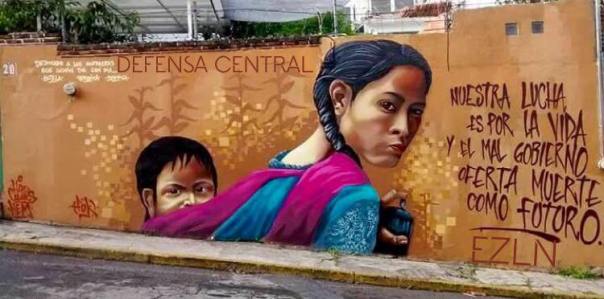
The Word on the Wall: Our struggle is for life and the bad government offers death as the future.
San Cristobal de las Casas, Chiapas, Mexico
July 8, 2016
To all of the artists participating and attending CompARTE:
To the national and international Sixth:
Brothers and sisters:
We send you fraternal greetings on behalf of all of those who make up CIDECI-Unitierra.
With regard to the celebration of the CompArte Festival convoked by our compañer@s of the EZLN, and convinced also that “the arts are a hope for humanity… [and] that in the most difficult moments, when disillusionment and impotence are at a peak, the Arts are the only thing capable of celebrating humanity” (EZLN Communique, 7/6/2016), we want to inform you that we are continuing preparations to celebrate this sharing-exchange from July 23 through July 30. Our CIDECI-Unitierra community will keep its doors open to receive all of the persons, communities, and collectives that have felt in their hearts this call to come share experiences of art, struggle, and resistance.
As of the initial CompArte convocation, we have been happy to be able to offer our grain of sand to this celebration. You can count on us to put all of our efforts into making you feel as welcome as possible. We await you here.
Chin up!
CIDECI-Unitierra
P.S. 1. All previously registered participants and attendees can collect their accreditation in CIDECI-Unitierra as of July 18, from 10am to 8pm.
P.S. 2. Anyone not yet registered can register directly at CIDECI-Unitierra, also between 10am and 8pm.
==============
Note: The Zapatistas announced that they are “suspending” their participation in the CompArte Festival so as not to detract from focusing on the teachers’ movement, but that the Festival can continue without them in locations outside Zapatista Territory.
Zibechi: Accumulation by extermination
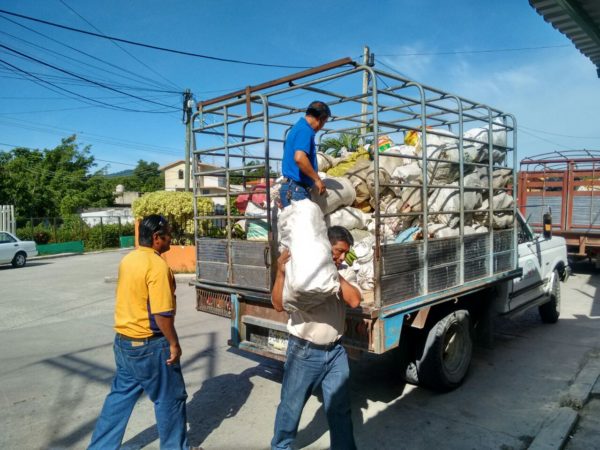
Chiapas teachers unload food sent by the Zapatistas! Photo: Chiapas Paralelo.
By: Raúl Zibechi
The evolution of war in the last century, in relation to population, offers us clues about the type of society in which we live. Until the First World War the fighting happened between national armies, at the barricades, where big slaughters were produced that inflamed worker consciousness. They affected the population indirectly, because of the massive death of their sons and brothers. When they did it directly, most of the time they were “collateral damage” of the conflict or, occasionally, warnings to weaken the morale of those who were fighting at the front.
The Second World War changed things radically. From the Hamburg and Dresden bombings to the atom bombs over Hiroshima and Nagasaki, passing through the Japanese bombing of Chongqing to the German concentration camps, the objective passed to be the population. There is a before and after of that war and of the concentration camps, as Giorgio Agamben points out, since the camp as well as the “strategic bombing” became paradigms for modern war policy.
It’s not about the appearance of aviation as a central form of combat. To the contrary: aviation became decisive because the objective passes to being the population. Vietnam is another point of inflection. It is the first time that United States deaths are counted by the thousands, with a much greater impact than in previous wars. Starting from there, the air war doubles its importance for avoiding entering into body-to-body combat with the inevitable result of U.S. deaths.
Accumulation by dispossession (open sky mining, mono-crops like soy, and the mega-projects) has a logic similar to the current war, not only for the use of herbicides tried in the war against the Vietnamese people, but also for the same military logic: to clear the field of the population in order to seize the commons. For dispossessing/robbing, it’s necessary to take half away from that disturbed people; it is the reasoning of capital, a logic that is worth as much to the war as to agriculture and mining (http://goo.gl/OBH7an).
Therefore, it’s important to refer to the current model as “the fourth world war,” like the Zapatistas do, since the system behaves that way, including of course allopathic medicine that is inspired in the principles of war. The EZLN’s arguments square with those of Agamben, when he points out that domination of life through violence is the dominant mode of government in current politics, particularly in poor regions of the global south.
The brutal repression of the teachers in Oaxaca shows the existence of a totalitarianism disguised as democracy, which according to Agamben is characterized by “the installation, by means of a state of emergency, of a legal civil war, which permits the physical elimination not only of political adversaries, but rather of entire categories of citizens that for some reason turn out to not be able to integrate into the political system (El Estado de excepción, p. 25). The same author reminds us that since the concentration camps there has been no possible return to classic politics, which was focused on demanding from the State and interaction with the institutions.
How to name a form of accumulation anchored in the destruction and death of a part of humanity? In the logic of capital, accumulation is not a merely economic phenomenon, and thus the importance of the Zapatista analysis that places the accent on the concept of war. I want to say that the type of accumulation that capital needs in the current period, cannot but go preceded and accompanied structurally by war against peoples. War and accumulation are synonymous, to such a degree that they subordinate the nation-State to that logic.
The type of State adequate for that class of accumulation/war is the weak point of those who analyze “accumulation by dispossession” or “post-extractivism.” In these analyses, beyond the value they possess, I find several problems to be debated in order to strengthen the resistances.
The first is that it’s not only about economic models. Capitalism is not an economy; it is a system that includes a capitalist economy. In its current stage, the extractive model or accumulation by robbery is not reduced to an economy, but rather to a system that functions (from the institutions to the culture) as a war against the peoples, as a mode of extermination or of accumulation by extermination.
Mexico is the mirror in which we can watch the peoples of Latin America and of the world. The more than 100,000 deaths and the tens of thousands of disappeared are not a deviation of the system, but rather the nucleus of the system. All the parts that make up that system, from justice and the electoral apparatus to medicine and music (for just a few examples), are functional to extermination. “Our” music and “our” justice (and that way with all aspects of life) are part of the resistance to the system. They are broken off or separated from it. They don’t form part of a systemic whole, but rather they now make up “another world.”
The second question is that the state institutions have been formatted by and for the war against the peoples. Therefore it has not the least sense of dedicating time and energy to incrusting itself in them, except for those who believe (by ingenuity or petty interest) that they can governor them in favor of those below. This is perhaps the principal strategic debate that we face in this somber hour.
In sum, creating and caring for our spaces and protecting each other from above without letting us be seduced by its scenarios, becomes the vital question for our movements. We remember that, para Agamben, those secluded in the countryside are people that: “anyone can kill without committing homicide.” This way of seeing the current world better explains the facts Ayotzinapa and Nochixtlán than speeches about democracy and citizenship, which appeal to the system’s justice.
————————————————————
Originally Published in Spanish by La Jornada
Friday, July 8, 2016
http://www.jornada.unam.mx/2016/07/08/opinion/019a1pol
Re-Published with English interpretation by the Chiapas Support Committee
EZLN: The CompARTE Festival and Solidarity
Compañeroas of the Sixth:
Artists from the five continents:
Teachers in Resistance:
As you know, we have decided to suspend our participation in the CompArte Festival. Of course, for those who know how to read carefully, we didn’t say that the festival itself was suspended. We merely indicated that we as Zapatistas would not be able to contribute. So if someone thought the former and decides not to participate, well then we apologize because we know you already took on expenses. No one should give orders to the Arts. If there is a synonym for freedom, perhaps the last bastion of humanity in the worst situations, it is the arts. We Zapatistas neither can nor should—nor has it even crossed our minds—to tell the workers of art and culture when they should create or not. Or worse, impose a topic on them and, using the native peoples in rebellion as justification, drag out concepts of “cultural revolutions,” “realisms,” and other arbitrary notions that merely hide what is some kind of cop determining what is “good art” or not.
No, artist sisters and brothers [hermanas, hermanos, hermanoas]; for us Zapatistas, the arts are the hope of humanity, not a militant cell. We think that indeed, in the most difficult moments, when disillusionment and impotence are at a peak, the Arts are the only thing capable of celebrating humanity.
For us Zapatistas, you, along with scientists [l@s científic@s], are so important that we cannot imagine a future without your work.
But that is a subject for a later letter.
The task here is to honor a commitment to you all. As of June 15, 2016, the last day for registration, we had a report prepared to let you know how the CompArte Festival was coming. Unfortunately, the national situation got progressively tenser (thanks to the irresponsibility of that child with a box of matches who works out of the SEP [Department of Public Education]), and we kept postponing it until coming to the decision that we have already told you about.
In any case, it’s good for you to know how the CompArte was coming along. So, to summarize:
There are 1,127 national artists and 318 artists from other countries registered.
The national artists come from: Aguascalientes, Baja California, Baja California Sur, Campeche, Chiapas, Chihuahua, Colima, Coahuila, Mexico City (previously DF), Durango, Estado de México, Guanajuato, Guerrero, Hidalgo, Jalisco, Michoacán, Morelos, Nayarit, Nuevo León, Oaxaca, Puebla, Querétaro, Quintana Roo, San Luis Potosí, Sinaloa, Sonora, Tabasco, Tamaulipas, Veracruz, Yucatán and Zacatecas.
And the artists from other countries come from (by continent): EUROPE (Germany, Belgium, Denmark, Scotland, Slovenia, Spanish State, Finland, France, Greece, Netherlands, England, Ireland, Italy, Norway, Portugal, Russia and Switzerland; AMERICA (Argentina, Brazil, Canada, Chile, Colombia, Costa Rica, Cuba, Ecuador, El Salvador, United States, Guatemala, Honduras, Nicaragua, Peru, Puerto Rico, Trinidad and Tobago, Uruguay and Venezuela; ASIA (China, Iran, Japan, Russia and Taiwan; AFRICA (Morocco and Republic of Togo); and OCEANIA (Australia and New Zealand).
The oldest participating artist is a singer-songwriter who is around 80 years old, although he looks much younger (you’re welcome, Oscar). His songs, which revive popular culture and its musical parodies (surpassed only by reality), are still heard in the Zapatista Mountains, and perhaps in some of the places where the teachers resist.
The youngest participating artists are: a 6-year-old boy who dances Son Jarocho with the Altepee collective; the Children’s Choir of Huitepec whose ages range from 3 to 11-years-old; a little girl, 10-years-old, who plays the cajón de tapeo with the Banda Mixanteña of Santa Cecilia: and a little girl, 10-years-old, who plays the piano.
The youngest participating artists are: a 6-year-old boy who dances Son Jarocho with the Altepee collective; the Children’s Choir of Huitepec whose ages range from 3 to 11-years-old; a little girl, 10-years-old, who plays the cajón de tapeo with the Banda Mixanteña of Santa Cecilia: and a little girl, 10-years-old, who plays the piano.The oldest participating artist is a singer-songwriter who is around 80 years old, although he looks much younger (you’re welcome, Oscar). His songs, which revive popular culture and its musical parodies (surpassed only by reality), are still heard in the Zapatista mountains, and perhaps in some of the places where the teachers resist.
ARTISTIC ACTIVITIES TO BE SHARED: PERFORMANCE ARTS: (Flamenco, Tango, Circus, Clown, Storytelling, Dance, Aerial Dance, Contemporary Dance, Folkloric Dance and Poetry Reading, Lima-Lama, Magic, Juggling, Puppets, Clowning, Performance Theater, Shadow Theater, Sensory Theater and Puppets; VISUAL ARTS: (Alebrijes [i], Architecture, Embroidery, Political Cartoons, Mexican Papier-Maché, Collage, Comics, Graphic Comics, Drawing, Graphic Design, Bookbinding, Sculpture, Photography, 3-D Photography, Recording, Graffiti, Illustration, Ephemeral Installation, Space Intervention/Public Art, Laudería [ii], Masks, Painting, Body Painting, Pot Painting, Mural Painting, Silk-Screening, Stencil and Tatooing; AUDIO-VISUAL: (Audio Stories, Film, Documentary, Digital Photography, Video, Documentary Video, Video Clip and Video Sculpture; MUSIC: (Wind Bands, Beat Box, Blues, Bolero, Bossanova, Protest Music, Chilenas, Cumbia, Dub, Ethnorock, Fusion, Gitana, Hip-Hop, Jazz, African Music, Concert Music, Harp, Piano, Violin, Tuba, Flute, Guitar, Bagpipe Music, Hang Drum Music, Lute, Hompak Music, Organ Grinder Music, Traditional Music, Punk, Opera, Rap, Reggae, Rockabilli, Alternative Rock, Ska, Son Cubano, Son Jarocho, Swing and Trova;
OTHER ACTIVITIES:
Should CompArte happen? That question is for all of you. And the answer should include how, where, and the customary etcetera’s. We think that if you are capable of aweing the world with your work, you can surely organize yourselves to celebrate humanity in the face of the machine.WORKSHOPS (ON ALMOST EVERYTHING THAT WILL BE PERFORMED)
We Zapatistas have suspended (not cancelled) our participation. We think, we believe, and we hope that there will be cleaner days in which to offer it. We don’t know when, maybe for the birthday party of the National Indigenous Congress, but we don’t want to commit ourselves because what if…
The Zapatista CompArte
But since we’re on the topic, we want to let you know what our artistic contribution was going to be like. Well, better yet, we’ll tell you what Comandante Tacho told us, in so many words: “There is a compa who created his song, he finished the whole thing, that is, the lyrics and the music. And in his community they started a band. In the selection process in the caracol of La Realidad, where we were evaluating contributions from all of the communities to select which ones would go to Oventik, I heard his song, which is about resistance. Just imagine, sup, this compa was just a little thing when we rose up in 1994 and his song explained the resistance better than I could. I didn’t know whether to applaud or take notes. Now we’re really getting somewhere.”
Comandante Zebedeo also told us: “one compa came up to me and said that the situation was pretty bad, that he thought maybe they wouldn’t be able to have the festival because of all the attacks against the teachers. But he was happy because, as he said, “I didn’t know I could sing; now I know I can sing and I can even create my own songs where I talk about how we Zapatistas do things. Even if there isn’t a festival, I’m happy. What’s more, even if it doesn’t happen this time, perhaps we can do it another time.
And if you, artists, compas of the Sixth, are trying to imagine what the Zapatista artistic contributions would be like, well we’re including a video here. Maybe another day we’ll put up more, or maybe photos, because we really struggle with this Internet thing. This dance in the video was created by a collective from the Altos zone, in the caracol of Oventik. We don’t know if it’s called dance or choreography, but it is called resistance and the music is a mix of the track by Mc Lokoter “Esta tierra que me vio nacer” [This land birthed me], and a ska track, “El Vals del Obrero” [The Worker’s Waltz] from the Spanish group SKA-P. The MC at the beginning explains the meaning of the dance. The video was produced by “Los Tercios Compas” in one of the selection rounds for who would go to Oventik, a little over two months ago (meaning, we didn’t suspend our participation because we weren’t prepared). Here it is. Aaaaaaaaah jump!
Try watching this video on www.youtube.com
Well, now that we’ve caught our breath, we want to give you as much detail as possible about the material support that we are taking to the teachers in resistance in various parts of Chiapas, Mexico, as a sign of our solidarity, respect, and admiration.
But first…
Tojolabal, Zoque, Mame, Chol, Tzeltal, Tzotzil, and Mestizo artists from the 5 caracoles were going to participate as listeners on behalf of the Zapatista bases of support.
From the Caracol of Roberto Barrios (Northern zone of Chiapas) 254 artists and 80 listener-observers.
From the Caracol of La Realidad (Selva Fronteriza zone): 221 artists and 179 listener-observers.
From the Caracol of Garrucha (Selva Tzeltal zone): 311 artists and 99 listener-observers.
From the Caracol of Morelia (Tzotz Choj zone): 276 artists and 88 listener-observers.
From the Caracol of Oventik (Highlands zone of Chiapas): 757 artists and 1,120 listener-observers.
Total: 1,819 artists and 1,566 listener-observers. Grand total: 3,385 men, women, children, and elders, Zapatista bases of support.
Food as an art of resistance.
The resources set aside for the Zapatista artists varied according to each caracol, because the cost of things can be pricier or cheaper in different places. But the average food expense was $12.08 pesos per Zapatista artist per day. Everything we had put together for our participation, including all five caracoles, amounted to $290,000.00 (two hundred ninety thousand Mexican pesos). Of course, that’s before the next currency devaluation…err, yes, apologies, no more spoilers.
Where did the money come from? From the INE [National Electoral Institute in Mexico]? From the PROSPERA [government aid] program? From organized or disorganized crime—that is, the bad government? From some NGO? From a foreign power interested in promoting the Arts in order to destabilize Mexico’s “tranquility?” No compas, the money came from the work of the production collectives across the communities, regions, and zones, as well as from the MAREZ [Zapatista Autonomous Municipalities in Rebellion] and the Good Government Councils. That is, it’s clean money, earned the way the immense majority of people of Mexico and the world earn: from work.
Is it a lot or a little?
Well, the average DAILY food consumption of a Zapatista artist, for example, in Roberto Barrios, during the 7 days that our participation would have lasted is:
171 grams of beans, 50 grams of rice, 21 milliliters of cooking oil, 0.02 of a bag of pasta, 20 grams of sugar, 8 grams of salt and 1.17 tostadas.
Now, what are they going to do with all that? What are they going to donate to the teachers in resistance?
Zapatista Solidarity
The compas organized themselves by caracol in order to deliver the support accordingly:
The Caracol of La Realidad will deliver the following to the teachers in resistance:
570 kilos of beans, 420 kilos of rice, 350 kilos of sugar, 15 liters of cooking oil, 21 kilos of soap, 21 kilos of salt, 28 kilos of coffee, 1,571 kilos of non-GMO corn, 840 kilos of tostadas, 400 kilos of pinole, 5 vats for cooking, 5 ladles and 4 medicine boxes.
A commission from the caracol of La Realidad will deliver all of this to the teachers in resistance in Comitán, Chiapas, July 9, 2016, at…well, as soon as they get there.
The Caracol of Roberto Barrios will deliver: 400 kilos of beans, 250 kilos of rice, 125 kilos of pasta, 24 kilos of salt, 24 liters of cooking oil, 15 kilos of coffee, 10 kilos of soap, 3 kilos of chili pepper, 10 kilos of onion, 30 kilos of tomato, 50 kilos of sugar, 320 kilos of pinole, 620 kilos of tostadas and 1,000 kilos of chayote, yams, yucca, and plantains.
A commission from the caracol of Roberto Barrios will deliver all of this to the teachers in resistance in Playas de Catazajá, Chiapas, July 8, 2016. A commission has already gone there to arrange things with the teachers there for the delivery.
The caracol of Garrucha will deliver: 300 kilos of beans, 150 kilos of rice, 150 kilos of sugar, 20 kilos of coffee, 15 kilos of salt, 1 box of soap and 60,000 tostadas.
A commission from the caracol of La Garrucha will deliver all of this to the teachers in resistance in San Cristóbal de las Casas, Chiapas, July 9, 2016.
The caracol of Morelia will deliver:
1,044 kilos of non-GMO corn, 500 kilos of beans, 300 kilos of rice, 250 kilos of sugar, 25 kilos of salt, 1 box of soap, 25 kilos of coffee and 1 box of cooking oil.
The caracol of Oventik will deliver: 114,584 tostadas (some 300 kilos), 1,475 kilos of beans, 672 kilos of sugar, 456 bags of pasta (some 97 kilos), 206.5 kilos of rice, 68 kilos of coffee, 5 kilos of pinole, 48.5 kilos salt, 12.5 liters of cooking oil, 21 kilos of tomato, 10 kilos of onion, 165 kilos of vegetables and 20 kilos of tea.
A commission from the caracoles of Morelia and Oventik will deliver all of this to the teachers in resistance in Tuxtla Gutiérrez, Chiapas, July 10, 2016. We won’t deliver all of the tostadas at once because there are a lot and they would get moldy. Better a little to start with and then more later.
_*_
So that’s how things are, compas of the Sixth and artists and teachers in resistance.
Now, if you ask us what we think about you coming or not, we say clearly: come. Chiapas is beautiful. And now even more so with the teachers’ resistance flourishing in the streets, roads, highways, and communities.
Are you wondering if, once you’re here, you can take a trip to the caracoles? Yes of course you can. But one thing you can count on, at the entrance of the caracoles they will ask you, “did you already go see the teachers in resistance?”
From the mountains of the Mexican Southeast,
Subcomandante Insurgente Moisés. Subcomandante Insurgente Galeano
July 2016
[i] Folk art sculptures of fantastical animals, a craft native to Oaxaca.
[ii] The Art of construction, repair, and maintenance of stringed instruments.
——————————————————
http://enlacezapatista.ezln.org.mx/2016/07/08/the-comparte-festival-and-solidarity/
EZLN: June’s lessons

CHIAPAS, diciembre 30, 2013 (Xinhua)
July 2016
Compañeras, compañeros, compañeroas of the Sixth in Mexico and the World:
Artists of the five continents:
Teachers in rebellion:
We send you all [todos, todas, todoas] greetings from us, the indigenous Zapatista communities. We are writing this letter to tell you about what we have seen and heard this past month of June and to let you know about a decision we Zapatistas have made. Here goes:
Lessons from Above
In just the last few weeks of June, we have been given a true educational seminar.
Once again, the character of the Mexican state has been laid bare: as soon as the capitalists snapped their fingers, regarding what is called the “Law 3 of 3,” the institutional powers scrambled to correct what didn’t please their masters. Not content merely with knowing that they rule, the great lords of money demonstrated, to anyone who wished to see, who really makes the decisions. A handful of masters, in luxury brand suits and ties, came out to the Angel of Independence [1] and, to mock its meaning, gave what amounts to a class in modern politics. “We rule,” they said without speaking, “and we do not like that law. We do not need to sacrifice lives, hold marches, or suffer blows, humiliation, or imprisonment. We don’t even need to show ourselves. If we do so now it is only to remind all of the politicians of their place, both those who are in office and those who aspire to be. And for the lumpen, well, this is just to remind them of the contempt we feel for them.” And then the system’s legal structure (and those who create, implement, and enforce it) showed its true purpose: within just a few hours, the governmental “institutions” fell over themselves apologizing and trying to ease the anger of the gentlemen of money. Like overseers eager to serve their masters, the governing officials prostrated themselves and maneuvered to make the law appropriate to the system’s design. “We didn’t even read it,” the legislators murmured as they expressed reverence and made servile apologies to their masters.
But when the teachers in resistance and the communities, movements, organizations, and persons who support them demanded the repeal of the education reform (really just a presidential pre-campaign platform for Aurelio’s aspirations to be a police informant), the government and its masters declared that nothing (meaning, the use of force) was off the table in order to defend “the rule of law.” With a tone more hysterical than historical, they emphasized that the law would not be negotiated. And they made this declaration just a few hours after they bowed before the powers of money… to negotiate modification of a law.
They didn’t bother to insist on the arbitrary imposition of an education reform that they haven’t even read. One careful read would be enough to realize that it has nothing to do with education. It never ceases to be pathetic that the political class and the press that accompany them say that they are defending the institutions of law and justice as they shamelessly demonstrate the contrary.
In June, the lesson from above has been clear and cynical: in Mexico, capital rules and the government obeys.
Lessons from below
For their part, the teachers grouped together under the National Coordination of Education Workers (CNTE), as well as the families and communities who support them, have also given classes in the streets, roads, and highways of Mexico below.
In just a few weeks, they have dismantled all of the staging put up by the political class over multiple years and with a lot of money, to disguise the new war of conquest, going under the name “Pact for Mexico,” which is encapsulated in the so-called “structural reforms.” The dignified movement of teachers in resistance has also made evident the profound decomposition of the federal, state, and municipal governments. Governmental corruption, inefficiency, and clumsiness can no longer be hidden behind the makeup offered by the servile paid media and social networks, manipulated with the same lack of skill with which they govern.
In an attempt to manipulate the generalized social “bad mood” and try to redirect it toward the democratic teachers’ union, the governments and paid mass media mounted an impressive (and ineffective) campaign of slander and lies: the poor don’t have gasoline, beer, liquor, sweets, lollipops, sliced bread, or the ground-up corncobs they sell as “corn flour.” And it’s all the teachers’ fault. Not because they are resisting, but because they are not large property owners.
Here in Chiapas at least, the supposed shortage of gasoline was nothing but the shameless speculation of that sector’s businessmen who knew that the price would go up on Friday and as of Tuesday were circulating the rumor of scarcity on social media. Curiously, at the gas stations, there was only diesel, the price of which wasn’t supposed to go up. The workers said there was in fact fuel, but “the boss told us to ration it and later to put up signs that there wasn’t any. They also messed with the pumps, so that the liters weren’t really full liters, but less. But that happened before, even when there weren’t blockades.”
Similarly, the scarcity of food and perishable products only occurred in the big supermarkets. The neighborhood markets continued to offer fruits, vegetables corn, beans, rice, meat, and eggs without any rise in prices. It’s true that products like bottled soft drinks, cigarettes, beer, and liquor began to run out, in addition to what is commonly known as “junk food.” The “third party interests” that the government is referring to when it talks about who is affected are none other than the interests of the big businesses of commercial capital. As the governing officials and media and social network that accompany them were shouting their heads off about the teachers’ movement being only in the poorest states whose social backwardness is, of course, the CNTE’s fault, thousands of teachers in Monterrey, Nuevo Leon took the streets, not once but multiple times, of that former lair of national capital, demanding the education reform be repealed.
When the teachers in resistance decided to open the blockades for individual vehicles, public transportation, water trucks, and local traffic but not to big business, the overseers bellowed furiously, threatening and demanding that the commodities that feed big capital be allowed to pass through instead of the “rabble.”
And in the paid media: extensive coverage of the SEDENA airplanes, used to distribute Maseca (not corn), with which José Antonio Meade initiated his pre-campaign to replace Aurelio Nuño as presidential pre-candidate. At the same time they buried any news on the Hercules airplanes that transported anti-riot tanks and federal police troops to Chiapas and Oaxaca… and Guerrero… and Michoacán… and Tabasco… and Nuevo León? Oh the rebellious geography of the rebellion! No. Those above are not interested in children’s education. Hell, they’re not even interested in the supposed education reform. Neither the lame policeman operating out of the Department of Public Education nor any of the legislators who voted for the reform have read it. And when the teachers insist that this or that article is harmful, those above turn nervously to their advisors and bodyguards, not only because they don’t know what those articles say, but because they don’t know what the word “harmful” means. The only thing that matters to them is to get into the line of succession, to see who will get the presidential nomination for the PRI or any of the other parties.
But despite threats, blows, prison, and the outrageous massacre in Nochixtlán, Oaxaca, the teachers resist. But now they are not alone.
While what was expected was that after being threatened, the number of people at the blockades and encampments would diminish, instead what happened was that… more teachers arrived… and people from all of the barrios, neighborhoods, villages, and communities! That was how the teachers in rebellion and the people who support them concluded their free public seminar this month of June, giving us the most comprehensive lesson: in Mexico capital rules and the government obeys… but the people rebel.
The most important thing
When we Zapatistas say that we respect a movement, that’s what we mean: we respect it. That means that we don’t meddle in their schedules and ways of doing things, in their organizational structure, in their decisions, strategies, tactics, alliances, and decisions. All of that corresponds to the discernment and decision of those who make up that movement.
Whether they vote or not, ally with political parties or not, dialogue or not, negotiate or not, come to an agreement or not, whether they are believers or atheists, skinny or fat, tall or short, pretty or ugly, mestizo or indigenous, we support them because their struggle is just. And our support, though perhaps small, is unconditional. That is, we don’t expect anything in return. Unfortunately, because of our essence as the EZLN, most of the time our support can’t go beyond our words, and more than a few times has to be silent. With regard to the teachers in resistance—they have enough accusations and pressures already leveraged against them to add on that they are being “managed” or “infiltrated” by political-military organizations.
So let it be known across the entire political spectrum: everything achieved by the teachers in resistance is and has been their own effort, their decision, and their perseverance. It is the teachers themselves who have explained their struggle, who have spoken in community assemblies, in barrios and neighborhoods, and who have been able to convince. In contrast to other mobilizations, the teachers turned to look below, to direct their gaze, ear, and word below. It is their resistance that has convoked such a broad range of support. At least that is the case in Chiapas. Instead of slander or conspiracy theories, the government intelligence (ha!) services, as well as the media that feed off of them, should take lessons from the teachers. Our economic limitations (the product of our rebellious resistance, not of teachers’ blockades) impede us, at this point, from sending something substantial (for example, corn and not Maseca) to the teachers and the communities that support them to alleviate the difficult conditions in which they resist all of the wars waged against them.
We also can’t hold large mobilizations because we don’t have institutional economic subsidies, and our every movement, however minimal or symbolic, must be funded by our very limited economy.
Yes, we know. You can chant to us “we don’t see your support.” But we Zapatistas aren’t trying to be seen, or trying to get votes, or affiliations, or trying to get on the list of acronyms that tend to become “fronts” or “broad fronts,” nor are we trying to get paid in one form or another. We also do not demand or expect “reciprocity.”
We Zapatistas only want the teachers to know that we respect them, that we admire them, and that we are attentive and taking notes on the lessons they are giving.
We think resistance should continue. And today, in this geography and calendar, resistance carries the face, the determination, and the dignity of the teachers in rebellion.
To say it more clearly: for us Zapatistas, the most important thing on this calendar and in the very limited geography from which we resist and struggle, is the struggle of the democratic teachers’ union.
The lesson from the native peoples
Let’s hope that dialogue is held with respect and truth, and not as a simulation that hides preparations for a new wave of repression. Let’s hope that dialogue takes place without the bravado and table pounding so characteristic of he who thinks he rules.
Let’s hope that the governing class, big capital, and the media that accompany and serve them stop playing with matches, lighting them and throwing them onto a prairie it has dried up with its own policies, corruption, and lies.
Let’s hope that those above stop thinking that the storm will put out the fire that they, and no one else, try to stoke. Let’s hope that they manage to see that the storm will end up drowning them too and that then there will be no columnist of the written or electronic press, no hashtag or social network, no television or radio program that can save them.
Let’s hope so, but in our experience, no, that will not happen.
The native peoples, compañeros and brothers of the National Indigenous Congress have said clearly that we are speaking from within the storm.
“From within the storm,” these were the words chosen by our sisters and brothers in pain, rage, rebellion, and resistance who go under the name National Indigenous Congress (CNI). With just those three words, the CNI gave a lesson on the calendars and geographies ignored by social networks, by the paid and free press, and by the progressive intellectual class. We Zapatistas felt that those words were also ours, and that is why we asked the National Indigenous Congress that we sign jointly.
Because for the native peoples, threats, lies, slander, beatings, prison, disappearance, and murder have been part of our daily life for years, decades, centuries.
Because what the teachers in resistance are suffering now, the originary peoples, in their barrios, nations, and tribes, have long suffered without anyone—anyone who isn’t part of the Sixth—noticing.
Because for a while now, the native peoples, from their countryside, valleys, and mountains, have seen and known what was coming for everyone [todos, todas, todoas]. That includes those who look at us with disdain, or as a target of mockery and charity (same thing), or as a synonym for ignorance and backwardness. That includes those who, short on vocabulary and imagination, reissued the word “indian” as an insult.
To all, todos, todas, todoas, we say: if you didn’t see it before, look now. Upon seeing or hearing about what they are doing to the teachers, think “I’m next.”
Because after the elementary education workers will come the pensioners, those in the health sectors, the bureaucrats, the small- and medium-sized businesses, the transportation workers, the university workers, those working in media, all of the workers of the countryside and city, indigenous and non-indigenous, rural and urban.
Perhaps this will be the conclusion of the families who, without belonging to organizations, parties, or movements, support the teachers. Maybe it is because they know “I’m next” that they lend so much popular support to the teachers. It doesn’t matter how much Aurelio Nuño writhes and gesticulates proclaiming that the teachers in resistance are a threat to those families and their children. Those families support the teachers’ movement. And they will continue to do so, even while the media and the paid machinery of the social networks endeavor, in futility, to echo the poor arguments that badly conceal the repression underway.
It is as if the lesson from below, without a face or an acronym, was: “If what has run out above is time, what has run out here below is fear.”
A difficult decision
This is the time of the teachers in resistance. It is necessary and urgent to be with them. Over long months and in extremely difficult conditions, the Zapatista bases of support have prepared, practiced, and created artistic expressions that, perhaps, would surprise some for the CompArte festival.
But we Zapatistas think that supporting the teachers is so important that we have decided…
First: To suspend our participation in the CompArte festival, in the Caracol of Oventik, as well as in CIDECI in San Cristobal de las Casas, Chiapas, which will be held July 17-30, 2016.
Second: To donate all of the money and food we have saved for our transportation to and from Oventik and CIDECI and for provisions while we are there to the teachers in resistance.
Third: To the 1,127 artists from every corner of Mexico, to the 318 artists from other countries (including native peoples from the Americas, Europe, Asia, Africa, and Oceania) registered for CompArte, we give our sincere apologies and ask for your understanding. We know that the neither the expense nor the effort you have made are small, in addition to adjusting your schedules in order to be able to come and share your creations with us Zapatistas. We hope that what is now suspended can be later celebrated. We hope that you understand that it is an ethical assessment that has led us to this decision. We analyzed each and every one of our options and arrived at the conclusion, erroneous or not, that this is the way to support the struggle of the teachers and their communities. We are not willing to be strike-breakers or to dispute the limelight the teachers have won with pain and rage.
We respectfully ask that you, in accordance with your ways, times, and abilities, raise your art up with the teachers in resistance, in their activities, encampments, marches, rallies, and wherever the National Coordination of Education Workers and your artistic expressions deem appropriate.
We also ask the compañeroas of the Sixth to create, in line with their calendars, geographies, and abilities, the spaces and conditions for the Arts and their irreverent challenge to imagine other worlds, in order to celebrate humanity, its pains, its joys, and its struggles; because that and only that is the objective of Comparte.
We Zapatistas will be in our places, attentive to what happens, to what is said and what is not said. We will continue to look with hope and respect at each and every resistance that arises in the face of the predatory machine.
For now we will put away our musical instruments, our paintings, our theater and cinematic scripts, our clothes for dancing, our poetry, our riddles (yes, there was a section for riddles), our sculptures and everything that, thinking of you all, we prepared to share. We will put this all away for now, but, as Zapatistas, we won’t rest.
From the mountains of the Mexican Southeast,
Subcomandante Insurgente Moises Subcomandante Insurgente Galeano Mexico, July 2016
From the notebook of the Cat-Dog:
What a way to irritate and polarize a whole country! Who advises them? The same people who told them they would win in the state elections, that Brexit wouldn’t happen and that, once the vote was in, the impact would be minor, that the machine works so well it practically purrs? Or the businessmen hidden behind the “Mexicanos Primero” [2] campaign? Well, if these are the minds that made the education reform, there you have an example of their great capacity for “analysis.” Did they tell them that Oaxaca was a kind of cheese? That Chiapas is the name of the ranch belonging to the Velascos, the Sabines or the Albores? That Guerrero’s border is the Sol highway and the hotel zones? That what must be protected in Michoacán is the Monarch butterfly? That nothing is happening in Nuevo Leon? That Tabasco is an Eden? That the health workers are going to be quiet and put up with anything? That the entire Nation is going to limit itself to venting via clever hashtags? Well, it turns out that they are getting lessons on national geography: Oaxaca’s last name is “indomitable”; Chiapas is the cradle of the EZLN, where the twenty-first century came early, where the end of the world was announced (the end of their world), and where culture, science, and art shout out what the media silences; Guerrero (and the entire country) are named Ayotzinapa; in Michoacán there is a place called Cherán and another called Ostula, and in all of the cardinal points there is a below that doesn’t give up, that doesn’t give in, and that doesn’t sell out. If the education reform isn’t modified, they should at least modify their advisors. Ah, and tell them at “Mexicanos Primero” that reality already evaluated them: they flunked.
I testify
Grrr, meow.
[1] The “Angel of Independence” is a landmark statue on the thoroughfare Paseo de la Reforma in Mexico City, built in 1910 to commemorate the centennial of the beginning of Mexico’s War of Independence.
[2] “Mexicanos Primero” (Mexicans First) is a corporate education reform lobby that backed the education reform mandating a standardized system of test-based hiring and teacher evaluation, among other things.
Originally Published in Spanish by Enlace Zapatista
Monday, July 4, 2016
http://enlacezapatista.ezln.org.mx/2016/07/04/las-lecciones-en-junio/
Zibechi: Communities stand up for life

The campfires in Cherán, Michoacán, Mexico.
By: Raúl Zibechi
Dozens of communities in resistance from 17 states of Mexico started a long campaign that seeks to coordinate struggles, denounce extractivism and offer a space for mutual aid among those that are being attacked by capital and the State.
“The campaign seeks a dialogue and common actions that construct a fabric,” explains Gerardo Meza of the Acapatzingo Housing Community, in Mexico City. “Because the State takes advantage of the lack of information about what happens to the megaprojects it impels against the peoples. Therefore, we seek to construct non-organic organizational spaces for generating identity in the neighborhoods and to weave a process of autonomy in Mexico City.”
Gerardo refers to the National Campaign in Defense of Mother Earth and Territory that started April 10 and will culminate November 20, two dates with deep rebel content in Mexico. The Francisco Villa Popular Organization of the Independent Left participated in it along with 180 organizations from 17 states, grouped into nine regions. A Committee for Mother Earth made up of 40 musicians, actors, religious men and women and professionals supports the campaign that at each activity united hundreds and thousands of people: from the 1,500 that went to the launch in Mexico City on April 10, to the hundreds that mobilized in support of Xochicuautla, where the community resists the construction of a superhighway in the State of Mexico.
“The spearhead of the extractive model is mining,” Meza reasons, “leveling entire communities, taking territory away from them and destroying their identities.” The campaign places affected communities in a relationship with other affected communities in a direct, horizontal relationship, not mediated by representatives but rather of people to people. Of the campaign signers, 97 communities and barrios have conflicts with extractivist capital and State, who resist often with very high human costs.
In the Mexican capital, for example, the barrios are being affected by urban infrastructure and communication projects, through the construction of metro lines, inter-urban trains and real estate speculation, one of the most destructive and least analyzed facets of the extractive model. We’re able to talk about an “urban extractivism,” which is connected with the general model and in many cases acts to complement the mode of accumulation, since the enormous profits in mono-crops and mining is apt to be invested in urban speculation, which results in gentrification of the cities and the expulsion of its poorest inhabitants.
From Norte to South: young and brave women
The Campaign reports that the most of the conflicts are produced by the construction of hydroelectric dams and other energy generation projects (34%), followed closely by mining projects (32%). The transportation projects like highways and trains (12%) and urbanization (11%) appear at more distance. The privatization of water embraces 15% of the conflicts, but many mining and energy projects also appropriate the commons like water, therefore it must be one of the principal motives for the community resistances.
In the north, in the state of Sonora, the Comcáac Nation resists the destruction of 100 kilometers of Pacific littoral, where fisherpersons seek to save their sources of work from the La Peineta mining project. Gabriela Molina, of the Comcáac Territory Defenders organization, assures that half of his peoples’ territory has been conceded to a mining company that seeks to extract iron, copper and silver at sites that are sacred to his nation. “The nation is a place where deer and bighorn sheep reproduce, because of which we don’t want an extractive activity on our territory, which is also very close to the Canal del Infiernillo, where there are plants that we use for our artesanía, like jojoba and elephant tree (torote), and it is thus a site of material spiritual importance for the survival of our people.”
As happens all over the world, mining succeeded in diving the Comcáac people with promises and a few resources. “Our group is made up of 22 women that organize against mining and we are dedicated to informing the peoples of the Sonora Sierra that are not familiar with what mining is,” Gabriela says. As Comcáac Nation, they are supported with the Traditional Guard, armed self-defense that was born in 1979 for the protection of autonomous territory. The guard is elected by the council of elders and the traditional governor and is composed as much by men as women.
“Until we added ourselves to the campaign our people were invisible,” Gabriela finished, who also denounces hydric extractivism that diverts waters for business production and tourist projects in zones her people inhabit.
Since 2008, the town of San José del Progreso, in the state of Oaxaca, has opposed the arrival of a mining company in a campesino population that cultivates corn, beans and garbanzos. According to official data of the Secretariat of the Economy, since the approval of the 1992 Mining Law, Mexico delivered 31,000 concessions on almost 51 million hectares to more than 300 companies that manage around 800 projects. Rosalinda Dionisio, who is a m embers of the Coordinator of United Peoples of the Ocotlán Valley, suffered an attack when members of the organization were ambushed for opposing the mining Cuzcatlán, a subsidiary of the Canadian Fortuna Silver Mines, which exploits 700 hectares for extracting uranium, gold and silver.
The mine is located near San José del Progreso municipality (municipio), one of the three poorest in the state. Although the better part of its six thousand inhabitants reject mining, the mayor supports it and heads a group that attacks members of the Coordinator. In February and March 2012, the activists were attacked, in one case by the municipal police and in another by unknown persons, with a result of two dead and various injured, among them Rosalinda. That was the reaction to the community protests, when tubes were installed to carry water to the mine, diverting it away from the campesinos’ crops.
A monster that is called the State
“With the campaign we seek to speak clearly with other communities, since we must redouble in the face of repression, and be able to inform other peoples what is happening to us,” Rosalinda explains. “We have a monster State that has hit us very hard, with disappearances, with repression, and therefore we need a network to support each other, based on mutual aid, for confronting the monster that takes life away from us,” says this young and brave woman, survivor of the war against the peoples. She has still not completely recovered her mobility after various surgeries, but she shows an admirable combative spirit.
The resistance of the community of Cherán doesn’t need presentation, because since 2011 it has been an example for peoples that resist the extractive model and the armed groups (state or paramilitary) that promote and protect it. Severiana Fabián, a member of the High Council of the P’urhépecha indigenous community of Cherán and forms part of the National Campaign in Defense of Mother Earth and Territory. Her community rose up to expel the criminal woodcutters supported by local caciques.
“We fight to defend a commons as it is Mother Earth,” explains Severiana. The key to the success of this community is its organization, extensive and profound, which reaches all corners, is open and transparent, solid and convincing. “We are organized by uses and customs (traditional indigenous governing practices) and we have attained that Cherán is calm and secure by the force of our community organization,” says a woman that feels proud of the work accomplished in five years, which she considers an example for Mexicans.
The form of organization, from below to above, begins by the campfires. There are four barrios (neighborhoods) and in each one there are between 50 and 60 campfires (fogatas), at the rate of one per block. There are 53 campfires in Severiana’s barrio, which speaks of a way of outdoor organization, in which families can participate, from the children to the elderly. Each barrio elects three individuals to the High Council, in which there are currently three women.
Cherán has a population of 20,000 inhabitants and in each one of the 240 campfires installed on each corner there are some one hundred people. “This organization is the key to everything,” exclaims Severiana. The campfires are meeting places among neighbors, spaces where the community is re-created, but they are also organs of power in which collective decisions are made and where the participation of women is decisive.
As the synthesis of these years of struggle, Severiana assures that in Cherán “courage overcame fear.” Maybe it will be the legacy of this community that it can gather and expand the National Campaign in Defense of Mother Earth and Territory.
———————————————————
Originally Published in Spanish by Rebelión
Saturday, June 25, 2016
http://www.rebelion.org/noticia.php?id=213817
Re3-published with English interpretation by the Chiapas Support Committee
A dialogue with the smell of ’68
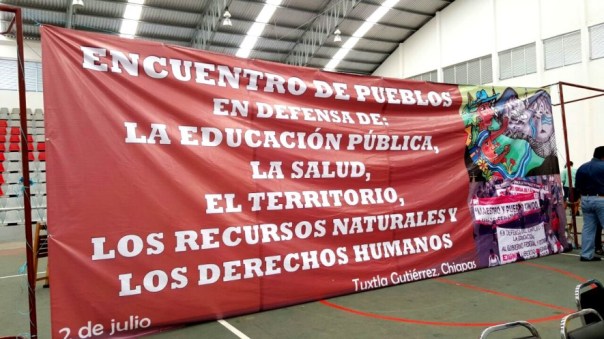
Gathering of Peoples in Defense of Public Education, Health, Territory, Natural Resources and Human Rights in Chiapas.
After the bloody eviction in Nochixtlán, the federal government started to dialogue with the CNTE. However, it refuses to consider the teachers’ principal demand, which is abrogating the education reform. On the other hand, it began to issue a threat in the voice of the principal bishops of the regime: if the teachers do not become peaceful, the force of the State will be unleashed against them. Osorio Chong said: “Time has run out.” And last week the Chiapas governor, Manuel Velasco, repeated (badly) the words that Gustavo Díaz Ordaz pronounced just before the Tlatelolco Massacre: “We have been tolerant of censurable excesses.”
The tone reached its highest point on Friday afternoon, July 1, when Osorio Chong announced, with a severe tone, the coming eviction of the roadblocks that the CNTE maintains in several points of the country, above all in Chiapas and Oaxaca. In the less than five minutes that the brief message lasted, the functionary warned on two occasions that: “time has run out.” Proceso.com July 2, 2016
http://www.proceso.com.mx/446065/dialogo-aroma-a-68
In Chiapas
On July 2, the Fray Bartolomé de las Casas Human Rights Center in Chiapas issued an urgent action facing the threat of violent eviction of protesting teachers from the roadblocks and actions of a “shock” group that infiltrates those roadblocks. http://frayba.org.mx/archivo/acciones_urgentes/160702_au_03_cnte.pdf
Also on July 2, the CNTE met with social organizations in Chiapas and formed a popular movement against the “fascist” government in defense of public education (abrogation of the education reform), territory, natural resources, indigenous rights and culture, health, human rights, the countryside and sustainable development. (See banner above)
Thousands of Catholics march in Chiapas while Guatemala teachers demonstrate support
Las Abejas march in support of teachers in Chiapas.
On July 1, thousands of Catholics from at least 20 parishes of the San Cristóbal Diocese held a march –the third in less than a month– in Tuxtla Gutiérrez to express their support for the teachers that have been on strike since May 15 to demand the abrogation of the education reform and to demand that the Secretary of Governance, Miguel Angel Osorio Chong, maintain a table for dialogue with the National Coordinator of Education Workers (CNTE, its initials in Spanish).
The parish priest of Simojovel, Marcelo Pérez Pérez calculated that “between 20,000 to 25,000 personas” participated. He stated that the marchers not only ask for the repeal of the education reform, but also of all the other reforms because “they only benefit the big corporations.” Pueblo Creyente of Simojovel warned that: “the way things are going more repression and evictions by federal and state police are predicted.” http://www.jornada.unam.mx/2016/07/02/politica/004n1pol
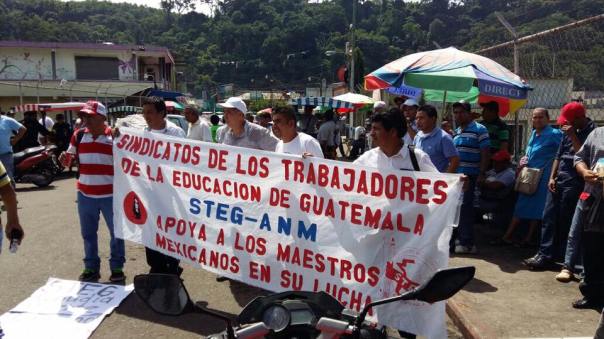
Guatemalan teachers demonstrate on the border with Mexico in support of the CNTE.
While Catholics were marching in Chiapas, members of the Guatemalan Education Workers Union (STEG) arrived at the three main border crossings with Mexico to demonstrate their support for the CNTE and briefly block them while announcing their solidarity with Mexican teachers.
Doctors and nurses march with the teachers
On June 22, thousands of doctors, nurses and other workers from the health sector in Chiapas went into the streets of Tuxtla, Tapachula, Palenque, Tonalá and San Cristóbal de Las Casas to show their support for the National Coordinator of Education Workers (CNTE) and to reject the labor reform and the reform in matters of public health that the federal government impels.
——————
Compiled by the Chiapas Support Committee
July 3, 2016
 Chiapas Support Committee