Chiapas Support Committee
Home of the Compañero Manuel blog on zapatistas & mexico
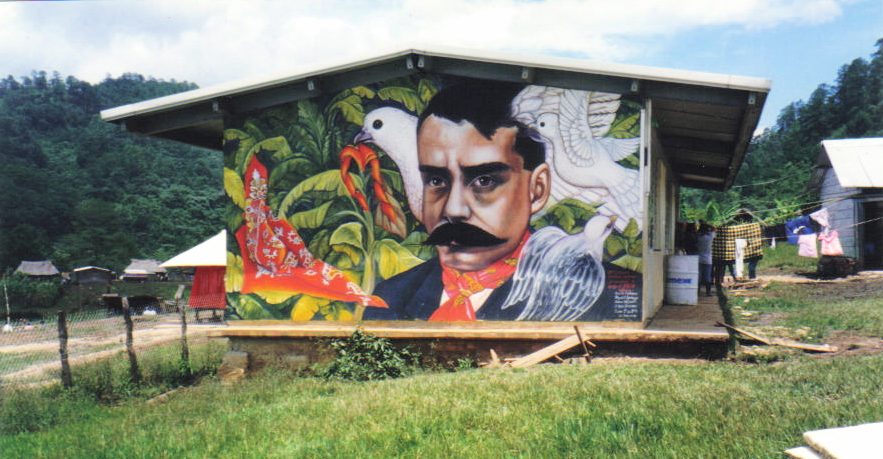
CNTE extends roadblocks to 4 states
They will only permit passage to automobile drivers, gasoline and national products.
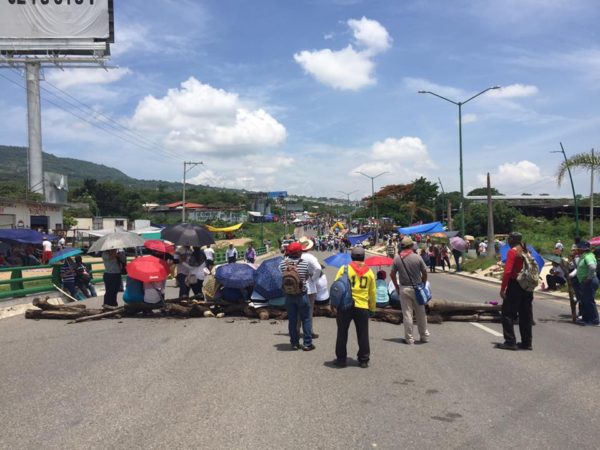
Roadblock at the exit to Chiapa de Corzo and San Cristóbal de las Casas.
By: Angeles Mariscal and Isaín Mandujano
They will permit the passage of people in automobiles and public transportation, of food and gasoline; they will impede the movement of products and merchandise from “businesses owned by those who impelled the education reform.”
The leader of the National Coordinator of Education workers (CNTE) in Chiapas, Pedro Gómez Bámaca, announced that the state and national teachers’ assemblies decided to continue with the mobilizations to demand the abrogation of the education reform.
In a press conference, after announcing the suspension of the (national) negotiating table between the CNTE and the Secretary of Governance, Osorio Chong, and after the announcement of the functionary that public forces would unblock the roads occupied by teachers in the states of Oaxaca and Chiapas [1], the leader of the Coordinator announced that they will maintain protest actions “cost what it may.”
“We are not going to demobilize, we have social support and because of that we announce that starting Thursday the teachers from the states of Guerrero and Michoacán will be added to the roadblocks,” he said.
Nevertheless, Gómez Bámaca recognized that the roadblocks they maintain at strategic points in Chiapas have affected the fuel supply and thus the population.
Because of that, he announced that beginning Wednesday night they will permit the passage of people in both private and public transportation; also the passage of gasoline, food and other necessary items. They will only impede the movement of products and merchandise that is the property of transnational corporations, “business owners that impelled the education reform,” detailed Manuel Mendoza, leader of the CNTE in the indigenous zone of Chiapas.
“The imposition of the reform has caused blood and those who orchestrated this reform were corporate owners; those that benefit from this reform are those owners. We say to them, your merchandise will not pass,” he warned.
Members of the Coordinator explained that as part of the support for their movement on the part of diverse sectors of society, and within the framework of the strategy for demanding renewal of the dialogue and abrogation of the education reform from the federal government, 15 parishes from the indigenous zone of Chiapas will march in a new demonstration of support next Friday, the third since the labor strike started. [2] This demonstration will end at the encampment that the teachers maintain in the center of the Chiapas capital.
On Saturday, also in the state’s capital, teachers, social organizations and residents from different parts of the state will hold what they called a “Meeting of peoples in defense of education, health, and territory.” [3]
The objective –they said- is to join together all the social dissent “and make just one river, a torrent. We warn that if there are consequences we assume them, (…). We demand that Osorio Chong be sensible and reopen the dialogue. All las laws have a way to be modified.”
[1] Chiapas and Oaxaca are the two states that have maintained roadblocks, occupations, marches and other protest actions from the start of the strike.
[2] Different sectors of Chiapas society hold marches in support of the teachers on different days. In addition to the roadblocks, social and cultural organizations march almost every day.
[3] See also May: Between Authoritarianism and resistance, the EZLN’s statement of support for the teachers’ strike.
——————————————————————-
Originally Published in Spanish by Chiapas Paralelo
Thursday, June 30, 2016
http://www.chiapasparalelo.com/noticias/chiapas/2016/06/cnte-extiende-bloqueos-permitira-paso/
Re-Published with English interpretation by the Chiapas Support Committee
Mining and the Oaxaca massacre
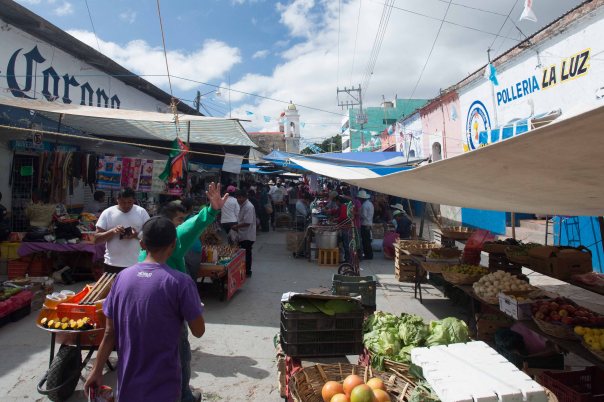
A market scene in Nochixtlán, the capital of a large indigenous district. The police attack took place on a market day, thereby maximizing the number of civilians present.
By: Agustín Ávila Romero
The massacre in Nochixtlán, Oaxaca where 11 people lost their life, more than 100 were injured and 18 were removed from a funeral so that the Federal Police could present them as detainees, not only shows that grave democratic backwardness lives in Mexico, where a civilian demonstration is answered with the use of heavy-caliber firearms despite being prohibited for dissuading social protest in international protocols; it also shows the inability of the Secretary of Education, Aurelio Nuño, to start a dialogue and carry out an education reform that fully includes the actors in the process of teaching-learning in the impetus of education in Mexico.
But beyond freeing a path of communication, what are the reasons behind why the Mexican government would act this way? What hidden and open interests are expressed behind this massacre? Why the cruel federal police attack against inhabitants of Nochixtlán, and why in this place? We’re trying to get close to an answer.
The Peña Nieto government accomplished a series of constitutional modifications with structural reforms that make possible the dispossession of lands in campesino and indigenous zones of Mexico. Different than the reform of the 90´s, foreign capital today can fully invest and through the national energy law establish serfdom schemes –they’re defined that way- where the campesinos can receive rent only for oil, gas and mineral exploitation. In that regard it defines priority use as that of energy and minerals and below that food or cattle production. Said reform has been advancing strongly in states in the country’s north and particularly in Veracruz. The dispossession and affectations to health due to mining and fracking (exploitation of gas and oil through fracture of the earth with high-pressure water) already live and beat in many regions of Mexico.
But it’s in the states in Mexico’s south-southeast -where the agrarian tradition is strongest- where capital confronts resistances and a decided opposition to its interests. Coincidentally, on June 1, some days before the repression in Oaxaca, Peña Nieto issued the decree about Special Economic Zones, through which spaces for transnational capital (STC) are constructed that would permit them to construct the enclave infrastructure necessary for the exploitation and exportation of mineral, energy (like the wind farms already installed on the Oaxacan Isthmus) and agro-combustible resources that these zones possess.
Meanwhile, what is verified in the state of Oaxaca is the process of decomposition of social and community fabrics by means of violence that would permit taking advantage and full disposition of these zones in the dynamic of accumulation by dispossession that the foreign mining companies and national and foreign capital have that were auctioned in rounds 1 and zero last year.
This is grave. If we look at a map we can think that this process of erosion and violence of the commons, initiated with force in the state of Michoacán with the full domination of drug trafficking over many territories (we remember La Familia Michoacana and the Apatzingan and Tanhuato Massacres), under force in Guerrero where the massacre of the Ayotzinapa students in Iguala, showed the alliances of political power with drug trafficking and mining in the exploitation of gold in the region. And now it arrives in Oaxaca in a noisy way with this news that goes around the world. This tendency towards the South begs the question: after Oaxaca, does a new massacre follow in Chiapas? At the bottom of this Shock logic –taking a phrase from Naomi Klein- it’s looking to deterritorialize these spaces, in other words, that the inhabitants abandon their other productive logics and that campesino reasoning to completely impose on them their condition as paid workers and agricultural subordination to the needs of transnational financial capital.
The chief of the federal police and the one finally in charge of the Oaxaca massacre, Enrique Galindo, now adds to a long list of violent evictions and extrajudicial executions. He led the eviction of teachers from the Mexico City Zócalo in 2013 with various teachers beaten and gassed. On November 20, 2014, he also led the expulsion from the Zócalo of the big demonstration that the parents of the disappeared Ayotzinapa students headed. Under his command, the elimination of the autodefensas of Michoacán in Apatzingán left 16 deaths in January 2015 and in Tanhuato 43 people accused of being drug traffickers were dead.
Meanwhile, one cannot assert that Galindo does not possess experience in the theme. It was something coldly calculated that happened in Oaxaca last Sunday, what they did not foresee was that they would film them using firearms, which they continue denying as of this date.
Nochixtlán, Oaxaca, according to studies of EPN’s Secretary of Economy, has mining potential that dates from the colonial epoch in the case of gold and silver in the El Dorado and La Soledad mines and from the middle of the last century for Manganese. It has five areas of minerals: Huaclilla-El Parian, Buenavista, Jaltepec, Jalpetongo and La Joya. It maintains one of the highest averages of attaining minerals by the ton, and a potential for gas exploitation also exists in that territory. And it is a connecting zone between the mining zones of the Oaxacan Mixteca, where private companies like Minerales del Norte of the AHMSA Group have started iron exploitation, affecting the rights of the indigenous peoples.
According to information from the federal government’s Secretariat of Energy, more than 15 percent of Oaxacan territory (more than a million hectares) is already conceded to mining companies for exploration and exploitation. Among those companies, foreign and Mexican companies stand out like: Golden Trump Resources S.A de C.V, Linear Gold Corp, Arco Resources Corp, Zalamera, S.A. de C.V. filial de Chesapeake Gold Corp, Cemento Portland Cruz Azul, SCL, Fortuna Silver-Continuum Resources, Compañía Minera del Norte, Aurea Mining Inc., Linear Metals Corp, Radius Gold, Compañía Minera Plata Real, New Coast Silver Mines LTD, Aura Silver Resources Inc. and Intrepid Mines Ltd.
In February of this year, residents of 48 communities and representatives of 30 organizations demanded the cancellation of 400 concessions and 35 mining projects in indigenous zones of Oaxaca, civilian organizations like EDUCA, Tequio Juridico, Unión de Organizaciones de la Sierra Juárez de Oaxaca and Servicio del pueblo Mixe, among others, supported said pronouncement.
Criminalizing and murdering members of organizations like the Frente Indígena de Organizaciones Binacionales (FIOB), el Consejo de Defensa de los Derechos del Pueblo (CODEP), el Frente Popular Revolucionario (FPR) or the Oaxaca Commune, among other organizations, only has the objective of sowing terror in the state and thus being able to fully carry out mining activities with their consequent effects on indigenous life and culture, on the environment, on health and on social relations.
The strategy of territorial division is something that the political parties have done, but in this fight in particular the teachers have achieved confronting, and uniting the inhabitants of the different regions of Oaxaca, Chiapas and Guerrero, where the fight is not strictly for education vindications, but rather has now moved to the defense of territory, life and ecology. Perhaps that is what the federal forces detected in Oaxaca and, therefore, wanted to give this blow that would permit breaking those social and community bonds of self-management.
———————————————————————
Originally Published in Spanish by Desinformemonos
Thursday, June 23, 2016
http://desinformemonos.org/mineria-el-fondo-de-la-masacre-de-oaxaca/
Re-Published with English interpretation by the Chiapas Support Committee
Psychosis in Nochixtlán, Oaxaca
PSYCHOSIS IN NOCHIXTLÁN AFTER THE BRUTAL EVICTION, THE MAYOR ELECT DENOUNCES

NOCHIXTLAN, OAXACA, June 19, 2016.- CNTE teachers supported by citizens were attacked by Federal Police that sought to remove a highway blockade that the teachers had maintained for days as part of their fight against the Education Reform. 12 people are now reported dead.
PHOTO: ARTURO PEREZ ALFONSO /CUARTOSCURO.COM
By: Gabriela Romero Sánchez
Almost one week after the eviction of the Section 22 teachers belonging to the National Coordinator of Education Workers (CNTE) by the Federal Police, residents of Nochixtlán, Oaxaca, are afraid to go into the streets and afraid of being repressed again upon being considered unstable and rebel people by the federal government, narrates the municipal president elect of Nochixtlán, Rubén Alcides.
“On Thursday, a helicopter without registration letters to identify it, started to fly very low, and that motivated people going about their daily activities to run and hide,” he said.
He comments that there are still people with bullet wounds that go to private doctors offices for medical attention. “No one wants to say their name, because they think that the federal government will come to capture them for having participated in the protest.”
Alcides and a group of nine neighbors from the municipal capital resorted to federal Deputy Jesús Valencia to look for support from different bodies, among them the Government of Mexico City (now a state), for the reconstruction of their town, since, they assure, not any rapprochement exists on the part of the federal government.
“We’re talking about people that are experiencing a tremendous psychosis, who have bullet wounds,” he describes.
He describes that the eviction from the federal highway began around 6 o’clock in the morning and that a group of teachers and parents were there, “let’s say a reduced number,” but it was also market day, therefore upon initiating the operation many people came out to support a friend or parent.
They refute the version of the authorities that assert that members of the federal police were not carrying arms: “They were indeed armed. It was a totally unequal attack, underhanded and above all disproportionate,” the municipal president elect summarizes.
Alcides denies that the local priest had incited violence; to the contrary, he asserts, he gave space in his parish church for attending to the injured without importance to whether they were civilians or federal police; while at the hospital only the police were received.
A doctor in the group, who also aided in the parish that day and asked for anonymity out of fear, intervenes: “There was no surgical material for attending to the injured, around 30 people went there, of which at least 10 had bullet wounds. How can they say that they were rubber bullets when they had entry and exit orifices in their thorax and in their arms or legs!”
He indicates that around 10 o’clock in the morning they asked permission to use the two ambulances that exist in Nochixtlán, without obtaining an answer. “People started to get angry over that, they wanted to move the injured to a hospital; then, they set fire to the municipal presidency to get them out.”
The tension increased, he said, when they heard that there was one death. “People came out of their houses to support their sons, brothers, fathers. They were saying: ‘they are killing us!’”
He rejects that there were individuals unrelated to the community in the town, “we see each other every day; some of them go to my doctor’s office.”
Alcides points out that upon assuming the office he will receive a destroyed town, with the municipal palace (City Hall) and the Civilian Registry burned, without services. Above all “with intense pain in the population that feels hatred towards the federal and state governments. They arrested 19 people from the town when they were digging a tomb for a relative, their crime was carrying a pick and shovel.”
The municipal president elect urges the competent authorities to indemnify the families of the people that died: “it’s people that live in extreme poverty.” He asks for resources for the reconstruction of the damaged public buildings: “we are without legal identity, they don’t issue birth and death records.” And he asked to activate job sources.
In the afternoon the Secretary of Mobility, Héctor Serrano Cortés, attended to the group of people on behalf of the Mexico City Government. After listening to them he offered to support them with medications and food.
——————————————————–
Originally Published in Spanish by La Jornada
Saturday, June 25, 2016
http://www.jornada.unam.mx/2016/06/25/politica/007n1pol
Re-published in English by the Chiapas Support Committee
EZLN: Hour of the Police 4
FROM THE SPOILERS NOTEBOOK OF THE CAT-DOG
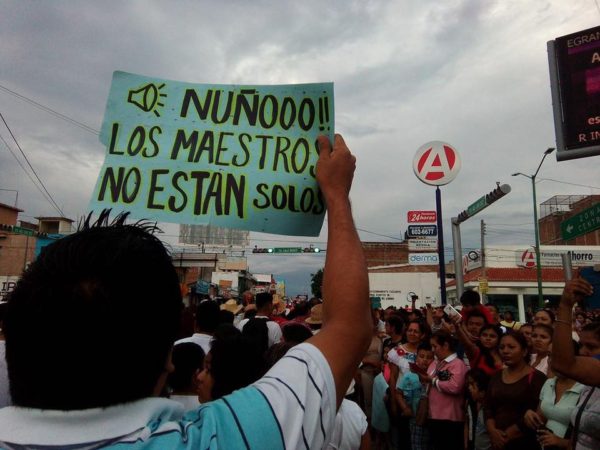
The sign reads Nuñooo!! The teachers are not alone. A phoyo from demonstrations in Tuxtla Gutiérrez,Chiapas.
June 2016
– This is the question. What would the most appropriate metaphor be for the sad and gray overseer police aspirant?
Aurelio Donald Nuño Trump? [1]
Aurelio Ramsey Nuño Bolton?
We believe, in accordance with his thirst for blood and his cowardice, he would prefer the second. And, just like in the television series “Game of Thrones,” Ramsey Bolton is devoured by the dogs that he used before for attacking others; the paid media that Nuño has used to slander, threaten and attack the teachers in resistance and the communities and solidarity organizations, will be preying on him when he falls.
Could it be said the same way tomorrow?
“Your words will disappear.
Your house will disappear.
Your name will disappear.
All memory of you will disappear.”
To you and the entire system that you serve.
Time will tell.
Wow-Meow
—————————-
[1] Aurelio Nuño is the name of Mexico’s Secretary of Public Education
Originally Published in Spanish by Enlace Zapatista
Thursday, June 23, 2016
EZLN and CNI: From the Tempest
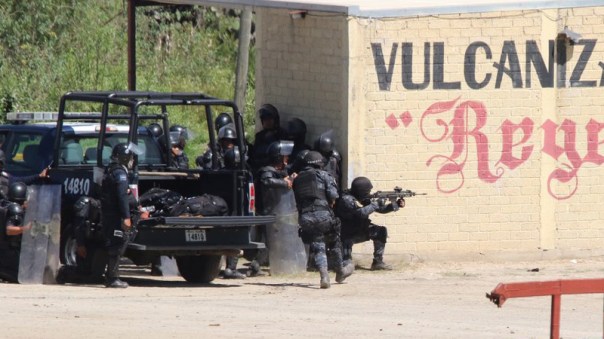
Federal Police opened fire on protesting teachers on June 19 in Nochixtlán, Oaxaca. There are at least 8 dead, around 100 injured (including both police and civilians) and many more arrested.
Joint Comunicado of the National Indigenous Congress and the EZLN about the cowardly police attack against the National Coordinator of Education Workers and the Indigenous community of Nochixtlán, Oaxaca
June 20, 2016
To the People of Mexico:
To the Peoples of the World:
Faced with the cowardly repressive attack that the teachers and the community suffered in Nochixtlán, Oaxaca, -with which the Mexican State reminds us that this is a war against everyone-; the peoples, nations and tribes that make up the National Indigenous Congress and the Zapatista Nacional Liberation Army, we say to all the dignified teachers that you are not alone; that we know that right and truth are on your side; that the collective dignity with which your resistance speaks is unbreakable and that it is the principal weapon of those of us below.
We repudiate the repressive escalation with which they seek to impose on the whole country the capitalist neoliberal reform that they call “educational,” principally in the states of Oaxaca, Chiapas, Guerrero and Michoacán. With threats, persecution, blows, unjust incarceration and now murders they want to bend the dignity of the teachers in rebellion.
We call to our peoples and to civil society in general to be with the teachers that resist at all times, to recognize them, because the violence to dispossess them of basic labor rights for the purpose of making education private, is a reflection of the violence with which they are evicting the native peoples, the campesino and urban peoples.
Those in power that are consumed with passion decided that education, health, the indigenous and campesino territories, and even peace and security, are merchandise for those who are able to pay for it; that rights are not rights but rather products and services that are snatched away, dispossessed, destroyed, are negotiated according to what big capital dictates. And they seek to impose this aberration in a bloody way; murdering and disappearing our compañeros, sending our spokespersons to high security prisons, making torture shameless governmental marketing and, with help from the paid communications media, equating the bravest of Mexican society, in other words those who fight, don’t surrender, don’t sell out and don’t give up, with the criminals.
We demand the cessation of the repression against the teachers in struggle and immediate and unconditional liberation of ALL political prisoners.
We invite all the peoples of the fields and the cities to be attentive and in solidarity with the teachers’ struggle, to organize autonomously to be informed and alert before this storm that falls upon everyone, knowing that a storm, besides tempest and chaos, also fertilizes the land from which a new world is always born.
From the mountains, fields, valleys, canyons and barrios of the native peoples, nations and tribes of Mexico
Never more a Mexico Without Us!
National Indigenous Congress – Zapatista National Liberation Army Mexico, June 20, 2016
——————————————————————
Originally Published in Spanish by Enlace Zapatista
http://enlacezapatista.ezln.org.mx/2016/06/20/desde-la-tempestad/
EZLN: the government of Chiapas is losing the media war against the CNTE

Parachicos march in support of the teachers. Photo: Eduardo Miranda.
By: Isaín Mandujano
TUXTLA GUTIÉRREZ, Chiapas
The Zapatista National Liberation Army (EZLN) said today that the mobilization y protest actions of the peoples, communities, organizations and activists in Chiapas, the government is losing the media war against the teachers’ movement that impugns the education reform.
“We don’t know about the rest of the country, but at least in Chiapas, those above are losing the media war. We have seen entire families, in rural and urban surroundings, supporting the teachers,” the EZLN asserts in a public comunicado.
And it’s not referring to support of the type “this fist is seen,” “the people united, will never be defeated,” and the slogans that despite distances in calendars and geographies, continue being the same –says the guerrilla group– “because underneath continues being the fundamental principle of solidarity.” If in previous mobilizations of the rebel teachers the “citizenry” appeared fed up and disturbed, it continued, now things have changed.
“There are more families all the time that aid the teachers, support their travels and marches, are anguished when they are son, offer them food, drinks and shelter. They are families that, according to the taxonomy of the electoral left, would be ‘stupefied’ by television, ‘eat sandwiches,’ ‘are alienated,’ ‘are driven in’ and ‘have no conscience.’ But apparently, ‘the enormous media campaign’ against the teachers that resist, has failed,” the writing points out.
It adds that now the resistance movement against the education reform has been converted into a mirror for more and more people-people all the time, in other words, not people of the social and political organizations, but rather common people.
“As if it had awakened a collective feeling of urgency before the tragedy that is coming. As if each blow with a club, each gas canister, each rubber bullet, each arrest warrant, were eloquent slogans: ‘today they attacked her or him; tomorrow I will go after you. Perhaps because of that, behind each teacher are entire families that sympathize with their cause and with their fight.
“Why? Why does a movement that has been ferociously attacked on all fronts continue growing? Why, if they are ’vandals,’ ‘loafers,’ ‘terrorists,’ ‘corrupt,’ ‘opponents-of-progress,’ do many people from below, not a few in the middle, and even some of those above, salute, though that may be at times in silence, the teachers that defend what any person would defend,” the armed group that rose up in arms on January 1, 1994 points out.
Later it lets loose against the media, in particular against the Chiapas newspaper “Cuarto Poder,” which it labels as being a media nostalgic for the epoch of fincas (estates) and Lords of the manor.
“Reality is a lie,” the EZLN points out, ought to be the title of its note when “it denounced” the popular (cultural) fiesta as false that was celebrated last June 9 in the streets of Tuxtla Gutiérrez, in support of the teachers in resistance.
“Parachicos, danzantes, folk musicians, traditional dress, persons in wheel chairs, marimbas, drums, whistles and flutes, the best of Zoque are and thousands of people greeting the resistance, the subversive group relates.
And it emphasizes that the “success” of the media war against the CNTE gave an account that day of a handmade sign that prayed: “Gracias teacher, for teaching me to fight” and another one that pointed out: “I am not a teacher, but I am Chiapan and I am against the education reform.”
More than three years after promulgating the alleged “education reform,” the EZLN lashes out, “Señor (Aurelio) Nuño still cannot present any educational argument, be it even the minimum, in favor of his ‘personnel adjustment program.’
“Its arguments have been, up to now, the same as any overseer from the Porfirio Díaz epoch: hysterical cries, blows, threats, firings, incarcerations. The same ones that would use any sad and gray aspirant to the post-modern police,” it emphasizes.
And it stirs things up
“They already beat them, gassed them, incarcerated them, threatened them, fired them unjustly, slandered them and ordered a de facto state of emergency in Mexico City. What’s next? Do they disappear them? Do they murder them? Seriously? Will the ‘education’ reform be born in the blood and dead bodies of teachers? Are they going to substitute the teachers’ occupations with police and military occupations; blockades of protest with blockades of tanks and bayonets?”
Later it refers to the Secretary of Education, as a “terrorist” for taking hostages, “that and nothing else is what the arrest is of members of the CNTE’s leadership.” In any kind of terrorism –whether that of the State or that of its fundamentalist mirrors—the EZLN points out, that (hostage taking) is a resource to force a dialogue and negotiation.
“We don’t know if up there above they have realized it or not, but it turns out that the other part (the teachers) is the one that seeks dialogue and negotiation. ¿Or is the SEP now affiliated with ISIS and takes hostages just to sow terror,” the armed group ironizes.
The Zapatistas point out in their comunicado that they don’t know much about the communications media, “but in our humble opinion, it’s bad business to place at the front of the media campaign about a shameless privatization, a sad and gray overseer that wants to be a police agent,” they say in reference to Nuño.
“Initiating the children into the first steps of science and art, that is what the teachers do,” the comunicado concludes.
——————————————————-
Originally Published in Spanish by Proceso
Friday, June 17, 2016
Re-Published with English interpretation by the Chiapas Support Committee
Zibechi: The New Venezuela
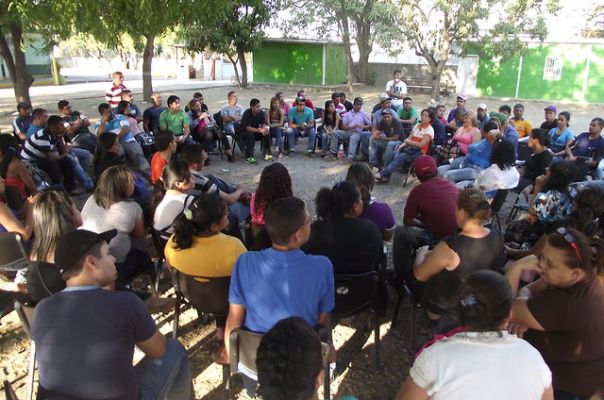
Cecosesola meeting. The cooperative functions non-hierarchically.
By: Raúl Zibechi
Systemic crises usually provoke long-term mutations that leave nothing in place. The crisis of Spanish domination over our continent converted it into a completely new reality. Societies that were established towards the second half of the 19th century had little to do with those existing in 1810, when the May Revolution in the district of Río de la Plata occurred.
Those critical periods also enable the birth of different social relations than the hegemonic ones that are one of the keystones of social change. Something new is not born during the mediocrity of stability, but rather in the midst of fierce storms when we are always capable of innovating, of working and creating.
Something similar is happening in Venezuela. Behind or beneath the political crisis, the offensive of the opposition and Washington, the government’s paralysis, the corruption that crosses the whole country from top to bottom, the scarcity and endless lines to buy food, another country exists. A productive country, in solidarity, where people don’t fight with each other in order to appropriate flour, sugar and corn for themselves, a country in which they are able to share what’s there.
An extensive and intensive tour through communities in the states of Lara and Trujillo, from the city of Barquisimeto to the Andes region permits confirming this reality. We’re talking about a broad network of 280 campesino families integrated into 15 cooperative organizations, besides 100 producers in the process of organization, who make up the Cooperative Central of Social Services of Lara (Cecosesola), which supply three urban markets with 700 tons of fruits and vegetables every week, at prices 30 percent below the market rate, since they elude the coyotes and middle men.
The direct visit to five rural cooperatives, some with more than 20 years and others in the process of formation, permits comprehending that campesino cooperation has an extraordinary strength. A simple cooperative with 14 producers in Trujillo, 2,500 meters (roughly 8,200 feet) above sea level, achieved buying three trucks, constructing a warehouse, the campesino house and a dormitory, basically producing potatoes and carrots manually, without tractors because their lands are sloping. A small miracle is called family and community work, because all the cooperatives have common lands that everyone cultivates.
Work and debate to correct errors, what we used to call self-criticism and was forgotten in some black hole of the masculine/militant ego. The 3,000 annual meetings that the 1,300 workers associated with the Cecosesola hold, open to the community, are extensive, harsh and frontal, in which personal deviations that harm the collective are not hidden. As we say in the South, they don’t go halfway; they go straight without anesthesia or diplomacy, which doesn’t damage but rather consolidates the atmosphere of partnership.
The network of 50 community organizations (15 rural and 35 urban) supplies more than 80,000 people per week in three markets for family consumption, which have 300 booths simultaneously. In these times of scarcity, they supply half of the fresh foods for a city of one million inhabitants, because of which lines of up to 8,000 people form in the central market, the most crowded of all, since the government closed some of the markets due to a lack of products.
The rural cooperatives produce fruits and vegetables; the urban community production units elaborate pastas, honey, salsas, sweets and articles for hygiene and for the home. In total, there are 20,000 associates from the popular sectors of Barquisimeto that are directly involved in the network.
The savings in production, markets and collections permitted them to construct the Integral Community Health Center, which cost 3 million dollars, has 20 bed and two operating rooms where they perform 1700 surgeries annually at half the price of the private clinics, managed by almost 200 people horizontally and in assembly. Besides, they have a cooperative fund (a sort of popular bank) for financing harvests, buying vehicles, medical needs and other family needs.
Everything, absolutely everything, they got through their own work and community support. They did not receive one single bolivar (the Venezuelan dollar) from the State throughout more than 40 years. How did they do it? Some documents elaborated by the network explain it in two concepts: ethics and community cooperation.
It’s not that there are no problems. There are many, with cases of individual profit, like everywhere. The document Ethics and revolution, distributed last March, says: “In our country a new private property modality is hastily being imposed, with each one attempting to seize the space that one fancies according to his or her convenience.” They are intransigent about that. It’s the same spirit that leads them to set prices without paying attention to market prices, but rather according to agreements between producers, making agreements by consensus, eliminating voting, perceiving all the same production needs and working to dismantle the hierarchies of internal power.
The guide it not the program, nor is it the relationship between tactics/strategy, but rather it’s the ethics. “Is there revolution without ethics,” the quoted document ends. History tells us that the popular sectors can overthrow the dominant classes, as has happened in half the world since 1917. What has not been demonstrated is that we are able to establish ways of life different from capitalism.
The Cecosesola workers can take from “their” markets the same amount of products as the rest of the community. If there is a kilo of wheat per person, it’s for everyone equally, whether they form part of the network or not. That is ethics. The scarcity is for everyone, without privileges.
That is the new Venezuela, where ethics guide. Although they are surrounded with meanness, they follow their path. Wasn’t that the revolutionary spirit?
———————————————————–
Originally Published in Spanish by La Jornada
Friday, June 10, 2016
http://www.jornada.unam.mx/2016/06/10/opinion/016a2pol
Re-Published with English interpretation by the Chiapas Support Committee
Beyond Chenalhó

Members of Las Abejas of Acteal, December 22, 2014.
By: Rafael Landerreche*
What’s happening in Chenalhó (I use the present because the fire has not been put out) must be examined beyond the obvious dimension of post-electoral conflicts or of the undeniable but partial component of gender. But to get to the bottom of the issue it’s necessary to go back in history to something that’s not about this moment nor exclusive to Chiapas, but that, nevertheless, is the deep root of what happens here and now.
The big lesson of the last century for the Mexican political class was that in order to maintain themselves in power it was necessary to make concessions to the people; not isolated and circumstantial, but rather, so to speak, of a permanent and structural character. That was the social policy of the “governments that emanated from the revolution,” which permitted the PRI to stay in power for 70 uninterrupted years of relative social stability. We all know of course the vices that accompanied and corrupted this social policy: a lack of democracy, paternalism, corporatism, electoral patronage, application of an economic model that was incompatible with those demands, corruption, etcetera. The system had its clear limits and anyone who would attempt to exceed them would abide the worst consequences (Tlatelolco is not forgotten). However, that social dimension was real and one of the proofs of that is the void that appears now that it’s dismantling.
The new generations of the political class formed in the rarified heights of neoliberalism, didn’t know or didn’t want to see the difference between social policy and the vices that were parasitic to it. They placed everything indistinctly into the same bag, put the ambiguous label of “populism” on it and threw it in the trash. It’s like the saying that they threw the baby out with the bathwater, but we could modify the image saying that in this case they threw out the baby and were left with the dirty water, because the social and nationalist policies have gone away, but the corruption, vote buying and lack of democracy continue. For a sample, the button of the SNTE: what has been fought is every attempt at political independence –including its independence from the teacher Elba Esther– what has been maintained is the absolute political, bureaucratic and electoral manipulation.
Upon disavowing the great lesson of the 20th Century, to which it owed its stay in power, the new political class was sustained by just three props, rigid but not solid: media manipulation, colossal vote buying but in drips (in the end, vote buying on scales that reduce to insignificance the old practice of a sandwich and a soft drink) and brute force, as a last resort, the Army. In places like Chiapas, with high social marginalization and very incipient political awareness (lights that aim in the opposite direction like the work of the Diocese of San Cristóbal and the lightening of Zapatismo should not impede seeing this sad generalized reality), the media manipulation assumes tragic-comical characteristics of the daily exaltation of a governor in a permanent campaign, the vote buying with government supports and programs has the subtle efficiency of a steamroller and the Army and other forms of repression are always around the corner.
One must add to this a fact that is more specific to Chiapas. It turns out that the governor and a sector of the political class that accompanies him, with an incredible blindness, the product of unmeasured ambition for power (that hubris about which Javier Sicilia speaks so much, which inevitably brings about its nemesis) decided to throw over the edge not only the social policies of the old PRI, but even the very cover and party name, ignoring that, if there was anywhere it had taken root and they had to thank for their stay in power it was among the indigenous communities of Chiapas. They shook the hand of the Green Party, which was born to be on the stage with others, and they converted it into the center of their political project. So, nothing else than their pistols imposed the Green candidates on communities of the old PRI roots. Chenalhó it nothing else that the last of a long list: Chamula, San Andrés, Oxchuc, Chanal, Altamirano and many more. Practically all the post-electoral conflicts that have devastated Chiapas since last year’s elections are like that, the creation and exclusive responsibility of those that now suffer their consequences. In the case of Chenalhó it is complicated by a combination with the survival of the paramilitaries responsible for the Acteal Massacre, but that merits a separate analysis.
Division in the communities and destruction of the social fabric is now, unfortunately, an old and sad story in Chiapas, the fruit in good measure (although not exclusively) of the counterinsurgency plans for confronting the Zapatista insurgency. But with these actions, the political class has taken division to the interior of its own support bases and has given a new twist to the destruction of the social fabric. The confrontation in Chenalhó has nothing to do with independent forces in the municipio, the Zapatistas, Las Abejas, not even with the relative of so-called opposition parties. They are simply the old governing sectors, arbitrarily divided by their own state bosses into PRIístas and Greens, who dispute the municipal budget booty, period. But they are taking the whole municipio between the legs (not to speak of the old Secretary of Government and now leader of the Congress). Las Abejas members of the Colonia Puebla are now displaced from their community again (for the third time since 1997) and two people, including a female minor, died there in the crossfire between PRIístas and Greens (for sure, neither the deaths or the displaced angered the authorities as much as the teachers haircuts). Even the Zapatista communities, clearly foreign to all the party fights, feel worried about a violence that could be directed against them at any moment.
At first blush this situation is a product of the blindness and incredible political insensitivity of the ruling class, more than of a deliberate plan to create greater destabilization; the fate run by the leader of the (Chiapas) Congress, would seem to corroborate it: they have not even been capable of protecting themselves. But, who knows? Chiapas is the site and destination of important megaprojects and we know about the increasing pressures throughout Latin America to bring about transnational projects, cost what it may. A churning river is an advantage for fishermen. And the third prop; will it be the Army like they claimed with Ayotzinapa, right there, watching?
*Advisor to alternative education projects on Chenalhó.
———————————————————————-
Originally Published in Spanish by La Jornada
Tuesday, June 7, 2016
Re-Published with English interpretation by the Chiapas Support Committee
2 Dead and 250 displaced after Chiapas mayor is ousted
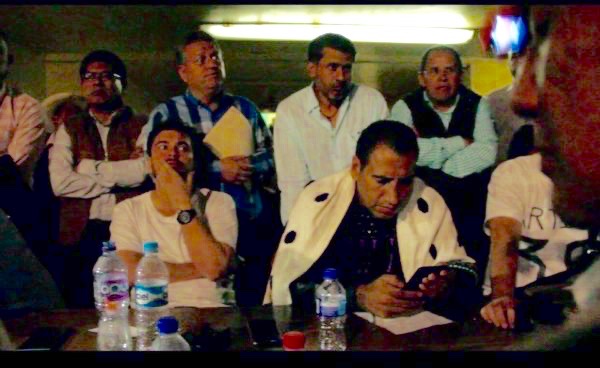
Eduardo Ramírez Aguilar, president of the State Congress of Chiapas, dressed as a Tsotsil woman, listens to residents’ demands in the municipio of Chenalhó, Chiapas.
In the midst of a militant Chiapas teachers strike, part of a national teachers strike over the education reform, some other Chiapas news tends take a back seat. The story that follows seems, however, to merit telling; first, because it reflects the violence that lies just beneath the surface in many parts of the state, and also because of the recent history of violence in Los Altos (the Highlands) of Chiapas.
On April 27, a Chiapas blog reported that 7 police were injured while in the process of evicting indigenous Tsotsils from Chenalhó who held members of the State Congress and its workers (some 300 people) hostage for eight hours on April 25. It turned out that this was the third time the commission from Chenalhó had visited the Congress to ask that it accept the resignation of Mayor Rosa Pérez Pérez of the Green Ecologist Party of Mexico (PVEM). And, for the third time the president of the State Congress, Eduardo Ramírez Aguilar, refused to approve the resignation, claiming that it was signed under duress. It was after this third refusal that the Chenalhó residents closed off the doors of Congress and held all those inside hostage.
This may not have made the news were it not for the fact that in the hour-long process of removing the Tsotsils from the Congress, some of the police were beaten up and then used tear gas. The tear gas drew the attention of people in the area near the Congress and soon there were groups looting nearby merchants, which resulted in the arrest of more than 20 people.
On May 2, the group from Chenalhó held a press conference in front of the San Cristóbal de las Casas Cathedral. They talked about what they termed the “violent” April 25 eviction and again demanded that the State Congress accept the mayor’s resignation. They accused Rosa Pérez of not completing the public works she promised during her campaign and of claiming 70 million pesos in personal expenses.
The group’s spokesperson, Tomás Pérez, stated that Chenalhó residents were determined to remove the mayor and held a plebiscite in which they voted to replace her with a current member of the municipal council, Miguel Sántiz Álvarez. He warned that if the Congress doesn’t accept her resignation on May 3, there would be thousands of Chenalhó residents from 100 towns going to the State Congress on May 5.
The next news reported was not about thousands of Chenalhó residents that marched to the State Congress on May 5. They apparently changed their minds and resorted to another and more drastic tactic: kidnapping.
La Jornada reported that on May 25, some 30 or so masked Chenalhó residents burst into the installations of the San Cristóbal Diocese and forcibly removed the president of the State Congress, Eduardo Ramírez, and the Deputy Carlos Penagos. They were meeting with Father Gonzalo Ituarte, the Vicar for Justice and Peace for the Diocese. Ituarte said that he, in the name of the San Cristóbal Diocese, members of the Peace and Transparency Commission of Chenalhó and a representation from the Legislature, headed by Ramírez, met to find a resolution to the conflict.
The following day, Chiapas Paralelo reported that Ramírez and Penagos were taken to Chenalhó, where Ramirez was dressed in the traditional skirt and blouse of an indigenous Tsotsil woman of Chenalhó (to represent the absent mayor) and taken to the town square where they both had to listen to the residents’ demands. They accused the mayor of diverting 50 million pesos (to her personal use) during her seven months in office and demanded not only her resignation, but also the return of the public funds. By now, we had learned the name of the dissident group: Movimiento Pedrano Chenalhó (Chenalhó Pedrano Movement). They have a Facebook page too!
It was somehow resolved overnight; the mayor submitted a request for permanent leave, her resignation was accepted and the new mayor was officially installed. Ramírez and Penagos were released and whisked back to the state capital by plane, while the Chenalhó Pedrano Movement celebrated its victory in the municipal capital. But, that’s not the end of this rather unusual Chiapas story.
However, when members of the Chenalhó Pedrano Movement were returning to their homes in the Colonia Puebla from celebrations in the municipal capital, supporters of the now ex mayor, Rosa Pérez, violently attacked them in the Puebla Ejido, also known as the Colonia Puebla. The attack left 2 people dead, 2 disappeared, several injured and 250 members of that movement displaced to an auditorium in the municipal capital of Chenalhó. Mexico’s National Human Rights Commission issued precautionary measures on behalf of the displaced.
As if this political tale were not already sufficiently intriguing, former mayor Rosa Pérez filed a court action on June 1 asking to be reinstated to her position as mayor, essentially claiming duress. She also asked the National Human Rights Commission to issue precautionary safety measures for herself and for all the residents of Chenalhó!
June 6 Update: Las Abejas of Acteal reports that that 14 families, a total of 81 people, belonging to Las Abejas (The Bees) were among those displaced from the Colonia Puebla in the attack that followed the installation of the new mayor. Las Abejas and its members are adherents to the EZLN’s Sixth Declaration. In a June 4 communiqué, Las Abejas says it believes that the conflict is a dispute for power among the political parties and reminds us that the their members were displaced from the Colonia Puebla in 2013, also due to violence. In an article about the 2013 death threats and displacements, La Jornada quoted members of Las Abejas as saying, in reference to the Colonia Puebla: “it is where the first paramilitaries emerged, those who spread the conflict and incited para-militarism in various Chenalhó communities in 1997.” [1]
By: Mary Ann Tenuto-Sánchez
————————————————————————–
[1] For background on the paramilitary violence in Colonia Puebla see:
https://compamanuel.com/2013/09/02/paramilitaries-re-emerge-near-site-of-acteal-massacre/
May: Between authoritarianism and resistance
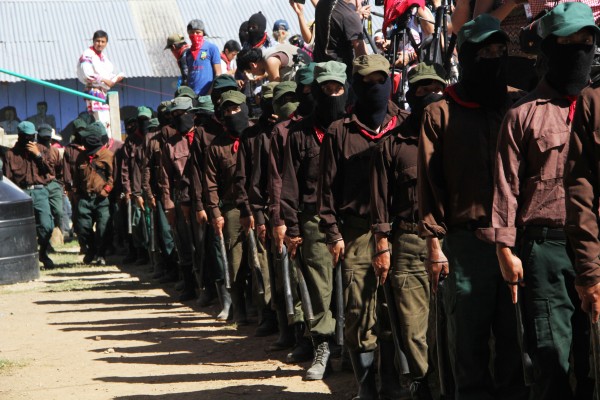
The calendar? May 2016
The geography?
Well, it could be any part of this country, scratched open and bleeding with forced disappearances, impunity made institution, intolerance as a form of government, corruption as the modus vivendi of a fetid and mediocre political class.
But it could also be any part of this country healed by the persistence of the families who do not forget their missing, their tenacious search for truth and justice, their rebellious resistance in the face of blows, bullets, and clubs, and their eagerness to construct a path without masters, bosses, saviors, guides, or caudillos; through defense, resistance, rebellion; through the strength of pain and rage making the crack deeper and wider.
“Mexico” as this country is commonly called, reflects in its own way the crisis that is shaking the entire world.
It seems that at some moment in the brief and intense history of the 20th century, this country was an international referent for tourism. One heard about its landscapes, its gastronomy, the hospitality of its people, the perfection of the perfect dictatorship.
But both before and during this travel agency pamphlet image, what happened happened. No, I won’t ply you with information on what has happened in the immediate past, say the last 30 years.
The thing is that over the past few years, “Mexico” has become a world referent for governmental corruption; for the cruelty of narco-trafficking; the full complicity and cohabitation, not merely infiltration, of organized crime and the official institutions; the forced disappearances; the army out of the barracks and into the streets and onto the highways; the murders and imprisonments of opposition figures, journalists, and others; the “warning” signs on the paths of tourists; the cynicism as idiosyncrasy in the media and social networks; and life, freedom, and personal possessions gambled in the deadly roulette of daily life (“if they didn’t come for you today, maybe tomorrow”). If you are a woman, of whatever age, multiply the risks. The feminine, along with any difference, is ahead only in this respect: more likely to suffer violence, disappearance, death.
But you already know all of this. It is enough to have lived here, in these lands and under these skies, a little, not much, let’s say from just a few months old to less than five years old, which was the age of the little girls and boys murdered in the ABC Daycare in Hermosillo, Sonora, Mexico, June 5, 2009, almost seven years ago.
What crime did those children commit? Were they victims of bad luck, of a dark divine design, of chance? Or were they victims of a political class that allows itself anything (such as the fact that one of those implicated—and not investigated—in this crime is a pre-candidate for the Mexican presidency for the National Action Party)?
So the place could be Sonora, where nevertheless, neither the crime nor the shamelessness of those responsible were able to defeat the families of the toddlers of the ABC Daycare.
Or the place could be Mexico State, where the Ñatho community of San Francisco Xochicuautla is at risk of being destroyed and buried by one of big capital’s highways. Their crime? Defending the forests. But, on the ruins of their homes, the community members maintain their resistance.
Or the place could be Oaxaca, in the Binizza community of Álvaro Obregón, in Juchitán, where the population was shot at by paramilitaries of the National Action Party and the Party of the Democratic Revolution. What is their offense? Opposing the privatization of the wind, imposed by big capital in the Isthmus as “wind farms.”
Or it could be Veracruz, already a territorial hunting ground targeting women, young people, and journalists, whether or not they are oppositional. Or the Yucatán, where the government has implemented the so-called “Escudo” [shield] against the population of Chablekal as a way to protect its own acts of displacement. Or Guerrero, where all of Mexico is renamed “Ayotzinapa.” Or Morelos, converted into a gigantic clandestine cemetery. Or Mexico City where opposition protests are prohibited because there the automobiles rule, including over the Constitution. Or Puebla, bastion of water and highway privatization. Or Tamaulipas, where, like everywhere in the country, the PRI is the institutional arm of organized crime. Or anywhere in this republic called “United Mexican States” with its waves of firings, displacements, theft, disappearances, destruction, death…war.
But it turns out that it is Chiapas. And in Chiapas, we see…
Tuxtla Gutiérrez, the capital city. May 2016. Average temperature: 37 degrees [Celsius] in the shade. Altitude: 522 meters above sea level. Date: May of the teachers in resistance and rebellion. But before we go further, allow me a few corrections:
- The deceptively named “education reform” is not about education but rather about labor. If it were about education it would have taken into consideration the perspective of teachers and families. When the government refuses to dialogue about the reform with teachers and families, it is acknowledging that this is not about improving education, but about “payroll adjustment” (which is how capital refers to firings).
- The law isn’t being applied, it is being violated. Those who say they are defending the constitution (through the educational reform) are violating the constitution (the laws that guarantee basic rights such as gathering, petition, and free movement).
- What the paid mass media are doing is useless. They declare back and forth: “everything running normally,” “the majority of schools are still functioning,” “over 90 percent of teachers are working.” But there is no referent in reality for these declarations, because the teachers are in the streets. In the villages the families already said clearly that they would not accept substitute teachers, that they won’t let them in or will run them off.
- The teachers aren’t defending their privileges, they are fighting in the last trench any human being has: for the minimal life conditions for them and their families. Are you surprised that someone is willing to defend the little they have left? A despicable salary, a few classrooms that look like they have been bombed (and they have been, but by economic bombs), not one but multiple work shifts, excessively large classes? In sum: little pay, bad working conditions, and a shitload of work. Sound familiar? And yet, the teachers show up at their schools and teach the little boys and girls the ways of the arts and sciences.
- The objective of the supposed education reform is to destroy those teachers who prepared for years and dedicated practically their whole lives to this profession. Of course, due to the perseverance of the media, which gets bonuses for their trouble, the teachers’ movement has been given the image of corrupt leaders. But this image is just a decoy, an attempt to get people to take the bait. The objective [of the reform] is not the leaders, but all of the teachers, including the servile National Education Workers Union [SNTE]. Now, if you want a model of corrupt leaders, you have the leadership of the SNTE.
- Yes, the objective of the education reform is to privatize education. In fact, this privatization is already in process. The attempt to abandon and defund the schools didn’t finish off public education in Mexico for one reason: the teachers. So now the teachers must be destroyed. They [the government] are trying to provoke a catastrophe in the education system such that families turn to private schools, working double shifts to pay for tuition, or resort to raising their daughters and sons on television, radio, and digital media, or in the street, or not even that. The teaching profession is not improvisational, nor is it a question of intuition. It requires study, preparation. Not just anyone has the capacity and the knowledge to educate. Because in school students are educated, not just taught. Not just anyone can successfully take on a group of school-age or preschool-age children. That is why the Escuelas Normales [Teachers’ Colleges] are necessary.
- Have you been told that what’s going on is that the teachers are lazy and don’t want to study? That’s a lie, any teacher wants to be better, better prepared and better trained. Do yourself what the government hasn’t done: talk to a teacher. Even better, listen to them. You will see that when they talk about their situation, it will seem like they are describing yours.
_*_
We Zapatistas try to understand. And in order to understand one has to listen. Whenever we can, we rely on direct information. In this case, we sent a group of “Los Tercios Compas” (Zapatista media that isn’t paid, or autonomous, or free, or alternative, but they are compas) and we listened to the Zapatista bases of support that are part of the teaching profession. We took the following from one of these listeners:
“Compañero Subcomandante Insurgente Moisés, I greet you and hope that you are in good health and doing the work of the struggle.
Having given this brief greeting, I offer my report: Well, we saw the teachers’ march. It wasn’t just male teachers; there were also many female teachers. The damned police attacked them and also attacked the people nearby. They even beat children. Later we saw a sign, well a sign painted on a wall, that said: “The police: such bad asses against the people, such pussies against the narco.” We saw that the teachers were happy in the march. As if they didn’t care that they were being beaten and pursued and sprayed with that gas that doesn’t let you breath. The teachers [male and female] just kept going, along with some of the mothers and fathers of the children that go to the schools and whose families support the teachers. It was clear that no one had forced them to go, but rather that they had come because they wanted to. They were excited. And the people in the houses along the street were shouting their support to the teachers. And in the streets people gave them water and fruit. You can tell that the people love those teachers who are in struggle. So then the teachers would shout the chant, “we see your support” and well, I thought there’s probably support that isn’t seen also, but there’s no chant for that.
Later we went to see the damned police who were following the teachers in order to harass them. We saw the police looking very defeated. There were just a few who were enthusiastic and who were beating their batons on their plastic shields, supposedly to frighten people, but it’s not frightening. The majority of the police could barely walk, I think because of the heat. The sun is strong in Tuxtla. And the teachers, well you can tell they’re used to it because they were happy. They sang songs and yelled chants. They sang that one called “We shall overcome” and I even started to sing too, but then I remembered that I was there in the role of “Tercio compa” and so better not. Every time the police paused for a moment they would all run for the shade. Their commander would scold them because they didn’t stay in formation. We heard one police officer telling another about how he pursued a little girl and a teacher, and that the teacher ran faster than the child. And that damned officer laughed like it was a joke to pursue a little girl. And when they got the order to advance, the police went dragging their shields behind them. Some were wearing metal boots. Others carried clubs. As they went by, the people in the street would say things to them, telling them to leave and not to bother the teachers anymore. Some people straight up cussed them out. The police looked at them with anger in their eyes but they didn’t stop. And these are families that are yelling. In some houses and buildings there were signs, like homemade posters expressing support for the teachers. On the radio stations people called in to comment, but not like other times when they complained that the teachers were blocking roads. Now they were complaining about the federal police, that they are just creating trouble, that it looks like we’re at war, that not even during the Zapatista uprising were there so many police in the streets of Tuxtla. No one was thanking the government; they were all saying clearly that this is all the fault of the government. And the radio stations would cut the people off, you can tell they didn’t like what the people were saying. And the newspapers have no shame; they publish stuff that doesn’t have anything to do with anything. The journalists are worried because in Chenalhó some partidistas [people affiliated with political parties] kidnapped some other partidistas. But the teachers do politics, they explain their struggle and the people hear them and understand them. We heard what the people say. They don’t listen to or understand the governments. They call Velasco “the kid” and complain about how “the kid” is only good for getting his picture taken and going out for a stroll. And the rumors say that he’s not even in charge anymore, that there is fighting to see who will take the governorship. They say that “whoever gets it is a shameless thief.” They don’t respect the government.
They respect and love the teachers, they give them water and fruit, they applaud them. Even the cars, when they drive by the march, honk and wave. But the police only get insults. We heard one teacher explain their struggle: “This is now about putting food on the table for our children.” In one place close to Tuxtla, called Chiapa de Corzo, the people organized themselves and ran the federal police out of there. They weren’t teachers, they were families. The police hit them and threw gas at them, but the people didn’t give up and they ran off the federal police. Once we had seen all of this, we came back to give our report.
What we think is that who knows what will happen, but the governments already lost.
That’s all I have to say.
_*_
Now, questions for the exam on the federal government:
If a government isn’t willing to dialogue and negotiate with the opposition, what path does it leave the opposition? If the government only employs argument via the use of force, what does it expect as a counter argument?
From the mountains of the Mexican Southeast
Subcomandante Insurgente and Moisés Subcomandante Insurgente Galeano
Mexico, May 2016
From the notebook of the cat-dog:
The Hour of the Police 2
That vendor of deodorant for metrosexuals, the postmodern version of Gordolfo Gelatino, Aurelio Nuño Mayer, should stop his campaign for the presidency and recognize that the reform he purports to defend is neither a reform nor is it about education. It’s merely a shameless personnel switch. A boss badly dressed in institutional clothing uses a perfumed foreman to get rid of jobs.
To be an idiot foreman that longs to be a good policeman, follow these instructions: write 100 times, “public education in Mexico is a business and that’s how it must be managed.” Ah, and don’t study history. Forget that the National Coordination of Education Workers was born in 1979, in Chiapas, Mexico. And it was born as a response to government brutality.
_*_
The battles that the teachers and the families wage do not end with May. They are just the beginning of many months and struggles that will come, and not only for the teachers. In the geographies and calendars below, history doesn’t happen; it is made.
I testify. Woof-Meow.
=======================
Originally Published in Spanish by Enlace Zapatista on May 30, 2016
http://enlacezapatista.ezln.org.mx/2016/05/30/mayo-entre-el-autoritarismo-y-la-resistencia/
 Chiapas Support Committee