Chiapas Support Committee
Home of the Compañero Manuel blog on zapatistas & mexico
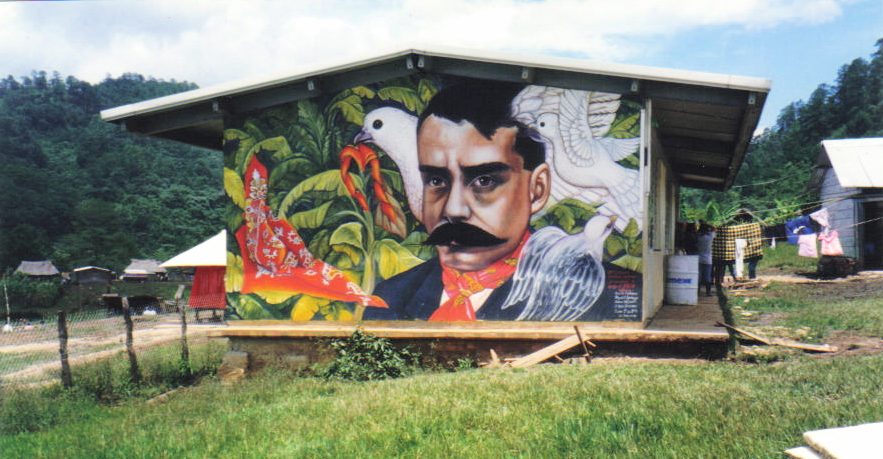
EZLN and CNI on Chablekal repression
JOINT COMMUNIQUE BY THE CNI AND EZLN ON REPRESSION AGAINST THE COMMUNITY OF CHABLEKAL
To the media
To the Human Rights organizations
To the Union of Inhabitants of Chablekal
To the people of Mexico
Sisters and Brothers
We, the peoples, communities, tribes, neighborhoods, organizations, and collectives who make up the National Indigenous Congress (CNI) denounce and condemn the events today in the community of Chablekal, Yucatán, where the police attempted to evict an elder of the community from his home. Upon learning of the unjust eviction, the inhabitants decided to protest to try to stop the action, to which state antiriot police responded with tear gas. Women, children, and elderly persons were present; as of now more than 40 canisters of tear gas have been found in the community.
Jorge Fernández Mendiburu and Martha Capetillo Pasos, in their role as human rights defenders and members of the Human Rights Center Indignación A.C. and the National Indigenous Congress, were arbitrarily detained, beaten, and handcuffed in an aggressive manner and against all due process. Although they were released shortly after, this constitutes an act of intimidation and criminalization of human rights observation and social protest.
In addition, we denounce this act as an attempt to intimidate not only the Human Rights defenders but also the inhabitants of the community of Chablekal, who organized the Union of Inhabitants of Chablekal in Defense of land, territory, and natural resources to defend what remains of their territory from the theft and displacement they have suffered over the last few years on behalf of speculators—new landowners who have the support of the municipal, state, and federal agrarian and political authorities. Their demand to halt the indiscriminate selling off of lands has been answered with this and other attempts at intimidation of their members and those who accompany them and defend their rights.
This abuse of authority and its associated crimes take place in the context of the imposition of the “Yucatán Shield” strategy. This strategy, carried out through large economic loans with unclear ends, is meant to render citizens defenseless against police actions. The Indignación A.C. team has presented a document denouncing this aspect and other irregularities in this strategy. This treatment of groups critical of police action is one of the digressions of this plan, which should be more closely analyzed before its implementation.
With regard to the above, WE DEMAND
–INVESTIGATION OF AND PUNISHMENT FOR THE POLICE OFFICERS RESPONSIBLE FOR THE ARBITRARY AND ILLEGAL DETENTION OF THE MEMBERS OF THE INDIGNACION A.C. TEAM
–THE IMMEDIATE RELEASE OF THE FOUR MEMBERS OF THE CHABLEKAL COMMUNITY STILL DETAINED
*Pedro Euan Flores
*Alfonso Tec
*Pedro Euan Santana—member of the MPDT of Chablekal and of the CNI
*A 15 year old
–INVESTIGATION OF THE AGGRESSION COMMITTED AGAINST THE INHABITANTS OF THE COMMUNITY OF CHABLEKAL
–SAFETY GUARANTEES FOR HUMAN RIGHTS DEFENDERS
–A HALT TO ACTS OF INTIMIDATION AGAINST THE UNION OF INHABITANTS OF THE COMMUNITY OF CHABLEKAL IN DEFENSE OF LAND, TERRITORY, AND NATURAL RESOURCES.
–THAT THE NECESSITY FOR AND DETAILS OF ANY SECURITY ACTION, INCLUDING THE “YUCATAN SHIELD,” THAT MAY VIOLATE HUMAN RIGHTS BE FIRST DISCUSSED WITH COMMUNITIES AND CITIZENS
Sisters and brothers of Chablekal,
YOU ARE NOT ALONE!
NEVER AGAIN A MEXICO WITHOUT US!
FOR THE FULL RECOGNITION AND VINDICATION OF OUR PEOPLES!
NATIONAL INDIGENOUS CONGRESS
ZAPATISTA NATIONAL LIBERATION ARMY
————————————————————-
Originally Published in Spanish by Enlace Zapatista
May 4, 2016
10 Years since the repression in San Salvador Atenco

Father Miguel Concha Malo officiated at a mass in memory of the individuals that died in the repression against the San Salvador Atenco ejido owners that opposed the construction of an airport on May 3 and 4, 2006. Photo: Javier Salinas
By: Javier Salinas Cesáreo, Correspondent
San Salvador Atenco, Mexico
Yesterday, the Peoples Front in Defense of Land (FPDT) commemorated the tenth anniversary of the repression and occupation of San Salvador Atenco community by federal forces. On that occasion they arrested more than 200 campesinos, and dozens of women suffered sexual abuse and two young men were murdered.
The FPDT assured that it would continue fighting until the project for a New Mexico City International Airport (NAICM) is cancelled.
“The torture that we experienced during the long night of May 3 to 4, 2006 is still fresh in our memory. Saying that 10 years have passed is only a reference for not forgetting all the pain and offense that we still have and relive today. The repression and political vengeance to which they subjected us still makes us angry,” said Adela Romero Núñez, a member of the FPDT.
On May 3, 2006, state police beat up on campesinos from the Frente that defended the eviction of a group of flower vendors from the Texcoco municipal market. Their leader, Ignacio del Valle Medina, was arrested during that action.
Hundreds of residents and ejido owners blocked the Texcoco-Lechería Highway and police arrested dozens. In the early morning of May 4, thousands of police agents irrupted in the community. They threw tear gas, broke into houses and arrested hundreds of the FPDT’s ejido owners, who five years earlier had achieved the suspension of airport construction.
The Atenco campesinos demanded that the material and intellectual authors of the repression be punished, as well as for the murder of the Autonomous National University of Mexico student, Ollín Alexis Benhumea Ramírez, and of the youth Francisco Javier Cortés. They warned that those who ordered the repression now occupy high positions, among them President Enrique Peña Nieto, then governor of the state of Mexico.
Since 15 years ago, they added, they have faced the threat of dispossession of their lands for the airport’s construction. “The Red May of 2006 was a cruel and condemnable vengeance. Now, in 2016, the government insists on the construction of its air terminal on our lands,” they pointed out.
They warned that they are not going to permit “more humiliation” and they will fight legally and with mobilizations to defend their lands against “the death project.”
The commemoration started with a mass that the priest Miguel Concha Malo officiated and with a press conference of the Atenco residents. Among those in attendance were the mothers of Martín Getsemany Sánchez, Jorge Antonio Tizapa and Abel García, three of the 43 Ayotzinapa students attacked in Iguala, Guerrero.
Miguel Concha stated that the FPDT has shared for a decade “hope and the fight for the defense of territories,” and is a symbol of “human rights defense in the face of violent repression” against the community.
“We don’t forget those who try to grab our land and our hope; they have made and now make a repressive use of State forces. We don’t forget that now justice must exist for the two murdered youths, the more than 30 sexually abused women and hundreds of people that suffered repression; we cannot forget and we are here because of that today,” he said.
Gilberto López y Rivas also participated in the name of the Committee in Defense of Mother Earth. He considered that the FPDT has become an “example of all the country’s struggles that are defending nature, land and all its life forms; and besides, Atenco has been a symbol in defense of human rights.”
At the same time it warned that the work of the Cypsa Vise company provoke tension and polarization in Tocuila, Texcoco municipality, where a superhighway to the airport is being built.
The commemoration continued in the afternoon with cultural and musical activities that the local PRI municipal council sought to boycott with an activity to celebrate the “Day of the Child,” for which it placed dozens of horns at full volume and a boxing ring on the esplanade.
———————————————-
Originally Published in Spanish by La Jornada
Wednesday, May 4, 2016
Re-Published with English interpretation by the Chiapas Support Committee
The GIEI’s Tsunami
By: Magdalena Gómez
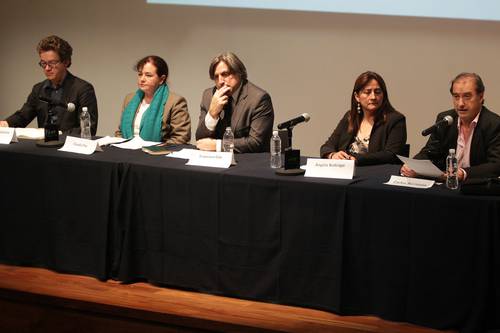
The second and last report of the Interdisciplinary Group of Independent Experts (GIEI, the Group’s initials in Spanish) opened with the assertion that there is no evidence that the normalistas had links with organized crime and discards that they went to boycott a political act in Iguala that day. On the whole, it shows the structural deficiencies of the system of procuring justice in the country. Its recommendations are a group of measures to take. They allow the government to assert that it will attend to them, in an escapist notion. The public presentation session of the GIEI’s report has a very singular attendance makeup: human rights and social groupings, academics, journalists and European diplomatic representations.
The president of the IACHR, James Caballaro, received the report and pronounced a harsh discourse, lamenting the absence of the federal government. It was, without a doubt, the evident ratification of the assumed decision on the distancing with the Inter-American space and the group of experts. It also showed that it is not willing to agree to any follow-up mechanism. But that wasn’t the terrain that generated an authentic tsunami for Peña Nieto loyalists. It was the revealing of a video that shows the presence of Tomás Zerón, head of the Criminal Investigation Agency (of the PGR), at the San Juan River, the place at which they supposedly would find some bags the following day, with the allegedly incinerated remains of the students, in the Cocula garbage dump. The grave question is that similar bags already appear in the video that the GIEI showed. The GIEI did not assert that they were planted, but it did point out that Zerón’s work was not listed in the case file. If we remember that the procedure of removing the bags from the river was the basis for the so-called historic truth announced by Murillo, we realize that not only is it in question whether the 43 students were reduced to ashes in the Cocula garbage dump, situated 40 kilometers from the river, but it also does not appear clear how and for what reason the alleged remains were taken to the river. All that was constructed from the statements of those arrested, whose signs of torture were also shown in the GIEI’s second report. That fact, eventually, would give standing for the liberation of the arrested declarants. The revelation of the video will permit the defense for the relatives of the disappeared to challenge the basis of the investigation that has been carried out as of today. They would already share a first analysis in that regard.
The Zerón factor impacted the past week and is determining; nevertheless, the Ayotzinapa Report II contains questions about intelligence activities, control of the C-4 cameras and the data they had at all times about the students’ movements. They precisely define the extended circles in the zone. They describe a concerted action of police bodies that goes beyond municipal levels to reach federal levels.
They also shared the questionnaire about the interviews that were going to be held with members of the Army, which they were denied. They reaffirmed the need for maintaining the line of investigation into the fifth bus, noting that they now doubt that the vehicle and the driver that they placed opposite them may be involved in the Iguala events. At the same time, it was concluded that the results from the third fire expert on the Cocula garbage dump have no scientific analysis or reasoning.
The GIEI convincingly confronted the statements of Tomás Zerón. The experts denounced him because he edited the video that he presented. The functionary sought to justify that he has the ability to do investigative work on a case underway without giving an account of the work in the case record of the investigation. Besides, he attempted to involve the UN office and to avoid the Argentine experts finding out about his visit to the San Juan River. The GIEI making the accusation that their second mandate was systematically blocked makes sense. Without a doubt their requests for specific work contributed to the government’s posture of cutting off the collaboration. Peña Nieto is enclosed by the international reactions of support for the GIEI, from the United Nations as well as from the U.S. State Department. Facing that, the statements from the PGR and from Governance appeared weak with common statements that “we continue investigating and we are going to review the recommendations,” before the avalanche unleashed by the accusation against Zerón. Now up against the wall, they indicated that he would be investigated. He, in turn, stated that he would not resign.
Deficiencies in the Ayotzinapa investigation are not motivated by technical reasons. There has been, in effect, an unknown hand up to now that blocked the GIEI with the support of the highest level. Where do they intend to take the conflict with the Inter-American bodies and those of the UN? That has been an ominous and authoritarian sign in South America in past decades.
———————————————————-
Originally Published in Spanish by La Jornada
Tuesday, May 3, 2016
En español: http://www.jornada.unam.mx/2016/05/03/opinion/018a2pol
Re-Published with English interpretation by the Chiapas Support Committee
Zibechi: Reflections on the Brazilian Crisis

In this March 13, 2016 photo, a demonstrator holds a poster with the photo of Brazilian President Dilma Rousseff and former President Luiz Inacio Lula da Silva in prison stripes during a protest on Copacabana beach in Rio de Janeiro, Brazil. (AP Photo/Silvia Izquierdo, File)
By: Raúl Zibechi
A relatively short time ago, the dominant classes of the world decided to unleash a war against the peoples in order to keep themselves in power in a period of acute change. They decided that democracies are an obstacle to unleashing that war, and they need, in whatever way, to neutralize them, put them at their service, as well as those elected to govern. On this point they don’t permit the least fissure.
To deduce the strategic thinking of those above one must put themselves in their place, since they don’t usually formulate it openly. We must ask ourselves what we would do if we were part of the one percent that has assured domination.
The first response is that there are too many people in the world and that the planet doesn’t allow that much population if they all want to live, not like the 1% lives now, but, for example, at a level of the 20-30% of higher incomes. The world designed for the domination of the 1% barely tolerates half of the planet’s current population. The rest are unnecessary and no longer even count as producers of surplus value, because the system accumulates by stealing. The question is what policies are derived from this fact.
The second is that the 1% abandoned the Welfare State (or similar substitutes like those that we had in Latin America) and it doesn’t enter into their plans to revive it. Therefore, the democracies we know are no longer necessary or useful for the kind of political systems facilitating accumulation by dispossession/plunder/robbery that we are suffering. The increasing militarization of the poor zones occupies their place, like in the urban peripheries and all those spaces that the big multinationals colonize, displacing entire peoples.
Of course, the 1% swears fidelity to democracy and its values, because it must create the illusion in a good part of those below about the importance of the vote and the party system. But, on top of that, it requires a rogues’ nest of individuals that perform as representatives and that act as intermediaries between them and the rest of the population. As Immanuel Wallerstein points out, domination is stable when it is established in three parts (classes) and is unstable when there are only two. The intermediate sectors are keys to the system: from the middle classes to the academics, along with the politicians and the big communications media.
As a consequence, occupying the higher rungs of the state apparatus supposes administering the current model of accumulation/war against the peoples. And, by the way, it’s useful to remember one of the principal lessons that the progressive governments leave us: given the current correlation of forces on a global scale, the governments are limited to administering extractivism, diverting (in the best of cases) resources to the popular sectors without touching the basis of the model.
The third big objective of the 1% is to neutralize all movements of resistance against it, from the leftist and progressive parties to the anti-systemic movements. Although in previous periods negotiating with unions predominated and it tolerated the social democratic lefts occupying government positions, in the new stage we live in it seems necessary to close ranks and avoid diversions in its plans and projects to keep those below at bay.
When parties or individuals arrive in government that –because of their trajectory or stated objectives– can depart from the extractive script, they create the conditions for neutralizing them. That happens in two ways. One is domestication, by inserting the new rulers into the elites, something that is not very difficult to attain, since the system possesses numerous ways to co-opt/buy off those who resist it. The other is the removal of rulers, in any way possible without appealing to classic State coups, but rather to legal, although illegitimate means.
These days in Brazil we can see a combination of both strategies. First it was domesticated, and then removed. The PT governed twelve years allied with super exploitive Brazilian multinationals (like the big construction companies), which financed its electoral campaigns, its leaders travel and numerous soft jobs.
Social policies are applied to the movements that seek to pacify those below with small monetary transfers that impact the poverty, but not the inequality, and avoid the realization of structural reforms. The PT delivered less land to the campesinos than the neoliberal government of Fernando Henrique Cardoso because it prioritized an alliance with the agribusiness that occupies now the Agriculture Ministry.
What should the strategies of the anti-systemic movements be in view of this panorama and in light of the experiences of the last 15 years?
In the first place, thinking long term. The few forces that we have should be used strategically, not for momentary and timely gain. If we conclude that we suffer a war against those below, we must think about how to eat away at the system and avoid that it eat away at us. It’s evident that the progressive cycle didn’t consume them, but it weakened the movements.
The second is the conviction that the worst path we can take is to administer the difficulties of the system. I have no doubt that at some time it will be necessary to aim at the State (to take it over or destroy it, depending on the different positions existing among us); but, while the system may be strong, the government is synonymous with managing accumulation by dispossession, or the war against the peoples.
I believe that the greatest strategic urgency lies in comprehending the extractive model of dispossession. In that we have committed gross errors (starting with the one who writes), since we have barely emphasized its environmental problems and we have broached it from the economy and not from the political. If we are really facing a war, administering any aspects of the concentration camp is not the best path, because it must be destroyed, since it cannot be reformed.
——————————————————–
Originally Published in Spanish by La Jornada
Friday, April 29, 2016
Re-Published with English interpretation by the Chiapas Support Committee
Esteva: Inside Out
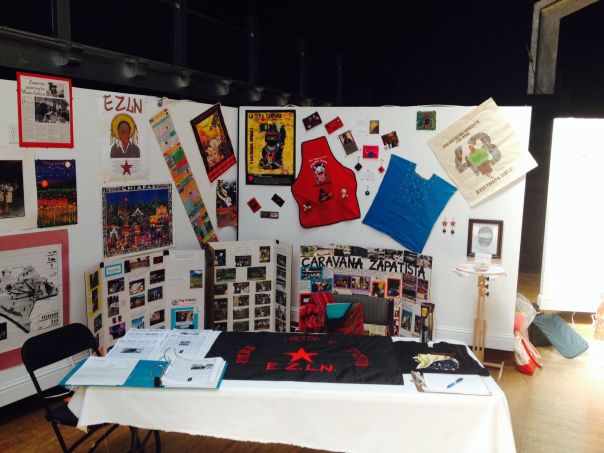
Autonomous Art at the Omni Fair. Interesting day with great food and interesting people.
By: Gustavo Esteva
Once in a while we get a compañero out of prison, stop the machines that come to destroy, stop a megaproject, impede a dispossession… Resorting to the law, to judicial proceedings, still produce results. But that should not be the only reason to continue using them, with all foolishness.
Before anything else, we must recognize that space is closing. In many cases, we only get what we want when we add social and political pressure to the legal. It becomes more difficult all the time to make the law or our rights work. What according to Benjamin was only a tradition of the oppressed is extended to a wider spectrum of the population: the rules of the state of emergency, the situation in which the law is used to establish illegality.
In prison, the nature of power doesn’t need to be dissimulated: it can show itself in all its nudity and crudeness. It thus takes on the sense of John Berger’s observation that prison is the word that best defines the current condition in the world: we are incarcerated. What is experienced now is that power shows its nature without inhibitions. We even see that it is deploying its worst aspects and that it now makes an object of exhibition and spectacle that it previously lied about or hid under the rug. It now forms part of the strategy of intimidation.
Continuing to use judicial proceedings should not have only pragmatic motives. The law should conserve its strength and significance until circumstances like the current ones, when the entire judicial apparatus is contaminated by illegality, corruption and injustice; when it is openly at the service of the privileged; when it is only useful for hanging a curtain over the despotic nature of the regime that administers it.
Those circumstances should not make us discard the very idea of the law, the formulation and application of norms. Judicial proceedings cannot be separated from political proceedings: they are structurally interwoven. Both shape and express the structure of freedom inside of history, and it is that structure which we now need to reconstruct or which we must elevate to where it never existed. It is the key to stopping the horror.
The parties have lost all credibility and the governments have lost the little legitimacy that they had. One another, together with technologies and systems, they have been converted into mere strategic devices of power with which it manipulates and controls us. It seems clearly impossible to save from ruin as whole world that falls violently into pieces around us, causing as much damage to nature as to culture. In this situation, in times so clearly apocalyptic as the present, nothing remains but to resort to reconstruction.
To reconstruct now, as a supreme expression of resistance, is not to repair or remedy institutions that are more counterproductive, threatening and irrational all the time. In rigor, nothing can save them. What we are starting to see is that some of their more astute operators have realized it and are running for safety, like the rats that they are. Others attempt to protect themselves from the multiple collapses in different institutional lairs. Others escape towards the future, and there are many, even at the first levels, those who don’t seem to realize anything and close their eyes tightly so as to not see the disaster of which they are a part.
What must be reconstructed isn’t there, but rather below. It’s true that we have been dispossessed of a good part of what we won in the last 200 years and that they continue mutilating the political liberties on which our conviviality was put in place, but we are still able to resort to ordinary language and to formal proceedings for reconstructing or reformulating our own norms in communities and barrios, within the bosom of our renewed organizations.
From there, in the tight weave of real men and women that are known to each other, who can see what is in the eyes of the other, in the spaces in which being ourselves is a state of things and a way of being, we are able to seriously tell the truth, tell it to each other. There, we are able to denounce the irremediably cancerous and unhealthy character of the formulas and dominant institutions and to nourish, against the desperations of the whole spectrum they germinate around, the hopes that are derived from an authentic autonomous construction.
Those hopes do not represent the triumph of optimism over reality. They are not mere illusion. They emerge from the perception that organized autonomous persistence, which comes from below, which is affirmed in dignity in the face of all disasters and knows that to live is to fight, extends farther all the time and begins to appear as a network of interconnected and self-sufficient shelters in the midst of the storm that announce another possibility.
———————————————————–
Originally Published in Spanish by La Jornada
Monday, April 25, 2016
Re-Published with English interpretation by the Chiapas Support Committee
GIEI: there was no cremation in Cocula
FINAL AYOTZINAPA REPORT
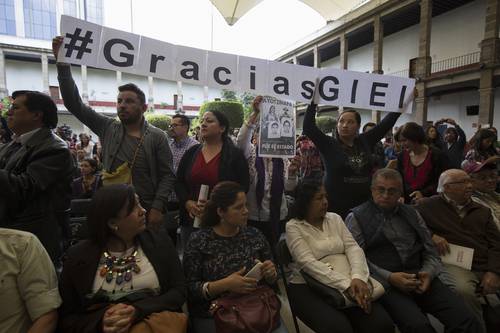
Relatives of the normalistas thanked the Interdisciplinary Group of Independent Experts for their investigative work. Photo: Cristina Rodríguez
By: Emir Olivares Alonso and José Antonio Román
The Interdisciplinary Group of Independent Experts (GIEI) for the Ayotzinapa case did not find “one single piece of evidence” for assuring that the 43 students of that rural teachers college, disappeared since September 2014, were executed and incinerated in the Cocula, Guerrero garbage dump. To the contrary, a year and a half of work confirmed their conclusion –which the group reached seven months ago– that the incineration of these bodies did not take place in that garbage dump.
Upon presenting its 608-page final report on the case yesterday, the experts assured that the authorities have not followed key lines of investigation, evidence has been manipulated, obstructed and investigative work rejected, officials that would have participated in the disappearance protected, and alleged suspects tortured to obtain confessions that support the government’s version. They emphasized that the Mexican justice system only investigates and punishes the material authors of the crime, but is remiss with the intellectual authors. “Investigation into the chain of command does not exist.”
With this report, the experts close their work in Mexico (their work concludes April 30), after the federal government refused to prolong their mandate. They lamented that the principal objective of the GIEI –the location of the students– had not been achieved.
A key element to the investigations, they said, was to obtain direct testimony from the military personnel that were present at several of the scenes of the violent acts in Iguala, which the administration of Enrique Peña Nieto repeatedly rejected.
The soldiers –they pointed out– even had knowledge of the beating and detention of the normalistas, “but took no measures to protect them.” Another fact to emphasize is that relatives of the Los Avispones soccer players directly requested help from the 27th infantry battalion, where they answered that they could not offer aid because “it’s not our jurisdiction.”
The experts concluded that certainty exists that normalistas there was “perfect coordination” in the attack on the students for more than 10 hours between different police corporations and alleged organized crime members, for the purpose of creating “a circle of control” that embraced up to 80 kilometers, to avoid the exit of the buses (taken over by the students) from Iguala.
In contrast, different police, among them the federal police, would have let the so-called fifth bus pass (which according to the GIEI’s hypothesis is key to the investigation, since it could be related to the shipment of narcotics from Iguala to Chicago). This unit, they added, wasn’t even incorporated into initial case record.
Angela Buitrago emphasized: “We’re dealing with a massive and indiscriminate attack on the civilian population, about which no explanation from the PGR exists as of the moment. The fifth bus is an investigative hypothesis that could justify an attack of that intensity. That line is not and cannot be closed.”
In the midst of great expectation to know the content of the report titled: Informe Ayotzinapa II: avances y nuevas conclusiones sobre la investigación, búsqueda y atención a las víctimas, [1] dozens of people, among them relatives of the victims, human rights defenders, the president of the Inter-American Commission on Human Rights, James Cavallaro, politicians and intellectuals, were invited to the principal patio of the University Cloister of Sor Juana.
Official absences
The places remained empty that were destined for the assistant secretaries of Human Rights in the Secretariat of Governance, Roberto Campa; of Multilateral Issues and Human Rights of the Secretariat of Foreign Relations, Miguel Ruiz, and the assistant prosecutor for Human Rights in the Attorney General of the Republic’s office, Eber Betanzos, despite being invited. The argument for that absence was that they were hoping to know the report before its presentation, but it was finished at 10 PM on Saturday, and therefore it was impossible to get it to them.
Down with the “historic truth!”
In a long presentation and a press conference afterwards, which lasted almost four hours, the experts described some elements to throw down, once again, the so-called “historic truth.”
The GIEI found a registry of the activity of the mobile phones from at least seven of the now disappeared students, several hours and even days after September 26 and 27. For example, one of them made a call at 1:26 AM on the 27th, registered on the Huitzuco-Tenango highway. In the official version, the students would already have been murdered and their cell phones destroyed at that time.
One more element that was not investigated despite a request from the relatives and from the GIEI, is that a text message was sent from Jorge Aníbal Cruz Mendoza’s cell phone to his mother asking her “to give his balance; that telephone remained active even months after” the Iguala events.
The GIEI’s report shows that an alleged member of the Guerreros Unidos criminal organization, identified as El Caminante, and that as of now the authorities don’t know who he is, talked about the “critical hours” with at least seven municipal police located at key places, like Cocula and Iguala. One circumstance that is included in the PGR’s case record is that Jonhatan Osorio, one of the detainees blamed for the alleged incineration of the bodies, made a call from his telephone from the Cocula garbage dump, where–according to the experts– there is no signal.
Different testimonies obtained by the GIEI throw out the hypothesis that the 43 students would have been separated and led to different places. Various witnesses affirmed that between 10 and 14 of them were seen on the patio of the Iguala municipal police command post, where they would have spent the night of September 26 and 27. Others indicate that another group was taken to Huitzuco. “They fucked up a compañero and are taking them to Huitzuco, and the boss there will decide what to do with them,” one police agent would have said to the other.
The experts sent by the IACHR accredited acts of torture to at least 17 of the detainees because of the case, among them the five alleged members Guerreros Unidos that gave statements around the incineration of the 43 bodies in the Cocula garbage dump. Of the complaints presented to (Mexico’s) National Human Rights Commission for torture, 15 are from the 17 pointed out by the GIEI.
They condemned the media disqualifying –with which the federal government was complacent– of its work and they added that since January the PGR unnecessarily delayed or rejected the investigative work the group proposed. The report makes a series of recommendations that hoped would be complied with by the Mexican State.
For these facts, they added, there were 180 direct victims and 700 indirect victims. While they are leaving tranquil with the work carried out, Francisco Cox recognized: “We leave with the worst taste” because of not having fulfilled el principal objective: the location of the disappeared normalistas.
[1] Ayotzinapa Report II: advances and new conclusions about the investigation, search and attention to the victims.
———————————————————–
Originally Published in Spanish by La Jornada
Monday, April 25, 2016
Re-Published with English interpretation by the Chiapas Support Committee
Forensic anthropologists publish report on Cocula garbage dump
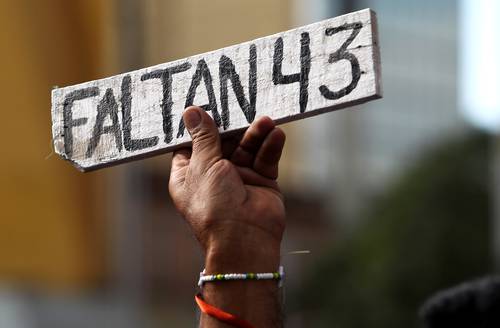
43 Missing
* The objective is to encourage scientific and informed debate about the students’ whereabouts
By: José Antonio Román
The Argentine Forensic Anthropology Team (EAAF, its initials in Spanish) decided to place at the disposition of public opinion the entire report of the expert tests done on the garbage dump in Cocula, Guerrero. The report concludes that: “it’s not possible” that the 43 disappeared Ayotzinapa students were incinerated and executed in that place.
Although the EAAF doesn’t usually publish its work completely, on this occasion it pointed out that the decision seeks “to generate scientific and informed debate” about the acts that occurred on September 26 and 27, 2014 in Iguala, and the disappearance of the young students.
In this way, the judgments of this Argentine team are public and that carried out by the Peruvian expert José Torero, published by the Interdisciplinary Group of Independent Experts (GIEI); consequently only the complete publication of the experts from the Attorney General of the Republic (PGR) remain pending and, especially, the report that contains the judgment that the panel of specialists in fire would have recently formalized, announced by its spokesperson Ricardo Damián Torres last this month (April 2016).
“The publication of all the judgments and technical opinions will permit an open discussion among experts for the benefit of the investigation that occupies us. Only transparency and scientific discussion will permit comprehending the findings in the Cocula garbage dump,” it points out in a communiqué diffused by the Miguel Agustín Pro Juárez Human Rights Center, one of the instances that represent the parents of the 43 disappeared students.
The work carried out by the recognized Argentine team took more than a year of independent scientific work on the physical evidence collected and analyzed from the garbage dump, in which a group of 26 specialists in archaeology, anthropology, criminalistics, entomology and forensic botany, ballistics, fire dynamics, interpretation of satellite images, forensic dentistry, genetics and bone trauma participated. These specialists are from Argentina, Mexico, United States, Colombia, Uruguay and Canada.
———————————————————-
Originally Published in Spanish by La Jornada
Thursday, April 21, 2016
Re-Published with English interpretation by the Chiapas Support Committee
EZLN and CNI: Declaration of Maximum Alert for Xochicuautla and Ostula
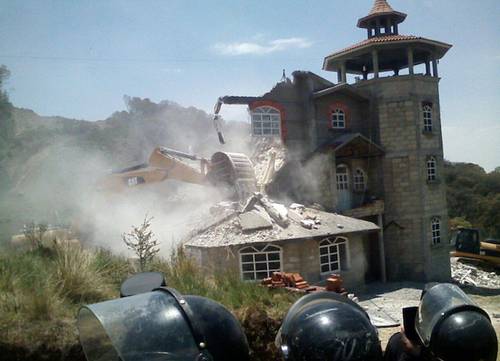
Protected by riot police, construction company’s heavy equipment destroys a house in Xochicuautla. Photo: La Jornada
April 13, 2016
TO THE PEOPLES OF THE WORLD
TO THE ALTERNATIVE MEDIA
Faced with the cowardly betrayal of the Natho indigenous community of San Francisco Xochicuautla, municipality of Lerma in the State of Mexico, in order to impose the project of the highway from Toluca to Naucalpan, and the attack suffered by Community police of Ostula, municipality of Aquila, Michoacán, we, the Indigenous National Congress declare ourselves on maximum alert and call on the people, organizations and those in solidarity to be vigilant and respond to the call made by the community of Xochicuautla.
We denounce that:
On Monday April 11, at around 9 in the morning, more than 1,000 state police of the State Commission of Public Safety (CES) and the Forces of Action and Reaction (FAR), began arriving, entering the community on 3 sides, the Buenavista colonia, down Cuauhtémoc Street to get to the place known as “Lampeni,” and in the place called “Lapondishi” where the Camp of Peace and Dignified Resistance was situated, which was destroyed by the police.
At the place called “Lampeni,” Compañero Armando Garcia Salazar, uncle of David Ruiz García, delegate of the National Indigenous Congress, who attended the sharing between the CNI and the EZLN in August 2014, held in the Zapatista La Realidad, had his house and his children’s heritage. Inside the house about 25 people were gathered to defend the property, mostly women, they were very violently evicted, pushing and pulling the compañera Isabel Hernandez, aged 64, who is part of the Supreme Indigenous Council and at that time was holding a female child in her arms.
Accompanied by police, a letter was handed to Compañero Armando informing him that his house was on federal property and they had to destroy it; they also showed him the expropriation decree against which they had won an injunction.
Without further words, those inside the house were pushed out, and the possessions that were on the first floor were thrown out, leaving documents, clothing and tools inside.
Once again the bad government demonstrates that the laws it claims to represent and the supposed rule of law are nothing more than tools for dispossession which are used as long as and only when they are against the people. Dispossession and repression violate the suspension granted in injunctions (amparos) 1123/2015 and 771/2015 that were granted on February 18, 2016 and the court notified most authorities on 23 February, including SAASCAEM, which is the institution to which the Xochicuautla territory was granted in the expropriation decree.
Meanwhile, on the night of Sunday 10th April, compañero members of the community police of Santa Maria Ostula were attacked, near the town of San Juan de Alima, Michoacán, when, from a moving car, comunero Francisco Grajeda was killed and comunero Abraham Girón was wounded, he is also commissioner of the community to the National Indigenous Congress and a participant in the sharing held in the Zapatista La Realidad.
We denounce the bad government’s attempt to minimize this crime with which it seeks to encourage the return of violence to the region of Michoacán’s coastal sierra, and to put the territory, natural resources, dignity and peace of the region back into the hands of the narco-politicians, their paramilitaries, gunmen and businesses.
We call on the people of Mexico and the world to show solidarity urgently with the actions in defense of the rights of San Francisco Xochicuautla, by physically being present in the community, and mobilizing wherever they are to denounce and demand the cessation of attacks against community, its territory and peoples.
We hold Eruviel Avila and his boss Enrique Peña Nieto responsible for the integrity of our colleagues and of all those who give solidarity to the dignified struggle.
FOR THE INTEGRAL VINDICATION OF OUR PEOPLES
NEVER AGAIN A MEXICO WITHOUT US
APRIL 12, 2016
NATIONAL INDIGENOUS CONGRESS
ZAPATISTA ARMY OF NATIONAL LIBERATION
————————————————————
Originally Published by in Spanish by Enlace Zapatista

Frayba: Repression, torture and arbitrary arrests of Chiapas teachers
CHIAPAS: “ARBITRARY DEPRIVATION OF FREEDOM AND TORTURE OF CNTE TEACHERS,” FRAYBA

Federal Police arrive in Chiapas before teachers’ demonstrations. Photo: Chiapas Paralelo.
The Mexican State’s repression criminalizes social protest in Chiapas.
San Cristóbal de Las Casas, Chiapas, México, April 16, 2016
Press Bulletin
The Fray Bartolomé de Las Casas Human Rights Center (Frayba) documented human rights violations consistent with: the disproportionate use of Public Force, arbitrary deprivation of freedom, torture and cruel, inhuman and degrading treatment that form a pattern of repression and criminalization of social protest. Acts committed in San Cristóbal de Las Casas and Tuxtla Gutiérrez, Chiapas, during the operations for dislodging the demonstrations called by Section VII of the National Coordinator of Education Workers of the State of Chiapas (CNTE) and the National Union of Education Workers (SNTE). Actions perpetrated by members of the Federal Police, the Gendarmería and the State Policía used tear gases and rubber bullets indiscriminately and unjustifiably damaged the salud of those who demonstrated on April 15, 2016, from approximately 10:00 am to 2:00 pm. They also physically injured the population that passed by or those who were at the place of the repression, including girls, boys, women and the elderly.
Testimonies refer to the fact that in San Cristóbal de Las Casas, police aggressions included breaking into private homes and businesses, the use of tear gas damaging the family members sick people that were in the Hospital of Culturas, people beaten although they had nothing to do with the demonstrations, vigilance on the part of soldiers dressed as civilians and the infiltration of shock groups to justify repression and to generate confrontation. At the same time two Federal Police helicopters, without registration, flew over and shot tear gas, and one helicopter from civil protection.

During the protests, the mayor’s offices and several vehicles were set on fire in San Cristóbal de las Casas. Photo: Chiapas Paralelo.
In Tuxtla Gutiérrez they implemented a police circle that started at the La Pochota demonstration point and turned the teachers towards the center, in zones where the attacks with tear gas, rubber bullets and stones affected the population in general. Helicopters also flew over launching tear gas. There were an undetermined number of people injured and with nervous crisis.
In Tuxtla Gutiérrez and San Cristóbal de Las Casas, Chiapas members of the police arbitrarily detained and with cruel, inhuman and/or degrading treatment, without respect for individual guaranties or mediating protocols that safeguard security and integrity, at least 8 female professors, 10 male professors and three people that were passing by the place: a distributor of water, an electricity technician and a gym instructor, also a student that was at a mechanics shop and two other unidentified individuals. These detentions were made between 10:00 am and 12:00 Noon in different places and the people detained were taken to the installations of the Attorney General of the Republic in Tuxtla Gutiérrez, Chiapas.
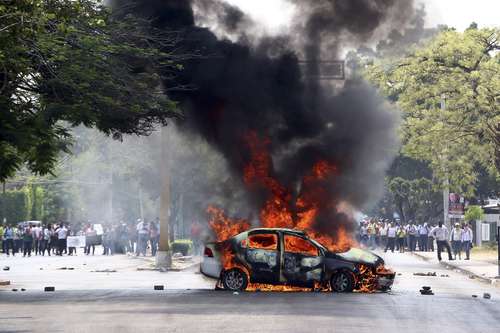
Car set on fire in Tuxtla Gutiérrez. Photo: La Jornada.
Testimonies mention that they knew about the detention of their family member through social networks, but it was not until no 11:00 o’clock at night that they received calls from the individuals detained; thus, they were incommunicado more than 12 hours and they were allowed to see a relative for only 5 minutes each, it being the last visit where they could have contact with their relative at 5:00 am on April 16. The majority said they didn’t know details about the legal situation of the persons detained.
On April 16 in the morning, the 18 teachers were transported in a Boeing 727 airplane, Registration XC_MPF belonging to the Federal Police to the maximum-security prison at Tepic, Nayarit. The teachers are accused of attacking general roadways, damages, terrorism and injuries, typical crimes to inhibit social protest, thereby criminalizing freedom to demonstrate. Lo anterior violates the rights to demonstrate, associate and meet, thought and expression, as well as also wounding the right to personal integrity and security and personal freedom and, in relation to the foregoing, the right to legal due process.
The referenced facts generate a pattern of repression and criminalization of protest in Chiapas and in the country, which puts the general population at risk of being indiscriminately attacked, being that women, boys and girls had specific rights violated.
We place responsibility on the Secretary of Government, Juan Gómez Aranda, who had published his commitment to “privilege dialogue and the un restricted compliance with the law as the only way to con find solutions to the problems of Chiapanecos;” on Manuel Velasco Coello, Governor of the State of Chiapas, on Renato Sales Heredia, National Security Commissioner and on Jorge Llaven Abarca, Secretary of Citizen Security and Protection, who Frayba had informed of the grave situation urging avoiding events and/or damages that are impossible to repair. At the same time, Enrique Peña Nieto and Miguel Ángel Osorio Chong, who are producers of the repressive policy of the current authoritarian regime.
This Human Rights Center urges the Mexican State to: assume the obligation to protect, guaranty and respect human rights; cease the repression and criminalization of social protest; guaranty life, integrity and personal security of those who exercise their legitimate right to demonstrate freely; immediately, efficiently, promptly, seriously, exhaustively and impartially attend to these acts sanctioning those responsible for the human rights violations described; and that it immediately free the individuals arbitrarily detained and unjustifiably moved accused of crimes fabricated as a justification for repressive actions.
Source: http://www.frayba.org.mx/archivo/boletines/160416_boletin_10_represion_estado.pdf
———————————–
Published by: Pozol Colectivo
Saturday, April 16, 2016
Re-Published with English translation by the Chiapas Support Committee
 Chiapas Support Committee