Chiapas Support Committee
Home of the Compañero Manuel blog on zapatistas & mexico
Zibechi: Financial inclusion and full-spectrum domination

Will money as we know it disappear?
By: Raúl Zibechi
Financial inclusion being one of the principal neoliberal initiatives, it’s difficult to accept the scarce debate existing among those who say they are enemies of that model centered on the domination of financial capital. The World Bank (WB) is the principal impeller of financial inclusion, with the objective that all of the world’s population will be dependent on the banking system, which proposes to eliminate physical money.
The initial argument insisted that financial inclusion is necessary to combat money laundering and drug trafficking. Later the same bank was adding new arguments, very similar to those that it utilizes for “fighting poverty.” In 2015, it says on its web page: “Two billion or 38 percent of the adults in the world don’t use formal financial services and an even greater percentage of the poor don’t have a bank account” (http://goo.gl/3Tf0Nt).
The WB defends the thesis that financial inclusion contributes to reducing poverty, to “empowering women” and “impelling shared prosperity.” Among its objectives it figures that all the income and expenses of the popular sectors are carried out electronically and it promotes that social loans not be paid in cash, but rather through the banking system, as is already happening in several countries.
In the short term, the WB proposes: “to reach another billion people that are now excluded from the financial system,” even using the key word “exclusion,” to give the impression that they are disadvantaged people and that access to financial services is the key to their inclusion as citizens (http://goo.gl/NCpYqp). The president of the World Bank, Jim Yong Kim, imposed goals for offering universal access to financial services to all adults of working age no later than 2020.
The objective is to advance the use of banking in the emerging countries and in the world’s South. In the United States and in Europe people that don’t have a bank account are less than 20 percent; a number that climbs in Latina America to 50 percent and in several countries of Africa exceeds 80 percent of the population.
What’s striking, to say the least, is that the progressive governments had adopted this policy without previously opening a debate. In Brazil, the salary grew 80 percent between 2001 and 2015, but individual credit increased 140 percent. The result is an exponential growth of consumerism and of family indebtedness: in 2015, 48 percent of their income was dedicated to the payment of debts; it was 22 percent in 2006.
Financial inclusion is the first step towards the elimination of physical money, with which all of us will be dependent on the bank and the financial system, annulling or making extremely difficult our individual and collective autonomy. It is a “micro” modality of domination of a complete spectrum. In several countries, like Uruguay, limits are already imposed on the amount of money to extract from the ATMs and this year taxi rides will have to be paid with debit or credit cards.
In Germany there is a campaign against the extinction of physical money under the slogan “Cash protects you from the State’s vigilance.” Various political groups condemned the limits on cash money. Konstantin von Notz, a deputy of the Green Party, explained the reasons on Twitter: “Cash permits us to remain in anonymity during day-to-day operations. In a constitutional democracy, it’s a freedom that must be defended” (http://goo.gl/CD53LE).
The data shows a clear difference in the behavior of Germans with respect to citizens of other developed countries. Only 18 percent of payments in Germany were made with cards in 2013, compared to 59 percent in the United Kingdom, 54 percent in the United States and 50 percent in France. They (Germans) pay four of every five invoices with bills and coins (http://goo.gl/CD53LE).
I find two reasons that financial inclusion and the disappearance of physical money are not part of the necessary debates in Latin American critical thought, in the lefts and in the popular movements.
The first reason is the option for not questioning the current basis of capitalism, in other words, putting the one percent in view, although the discourse may say otherwise. Financial capital plays a central role in the current world and disputing power implies playing hard, to the point of putting at risk the conservation of presidential chairs and the benefits that political leaders usually have, since that sector has an enormous capacity to provoke crisis and precipitate the fall of any government.
We’re going through a period of accommodation to the system of the lefts and of progressivism. It’s easier to criticize imperialism abstractly that to work with their social bases that are trapped in consumerism –and therefore with financial capital through the bank– so that they overcome the culture of consumption. The cultural defeat of popular country life has led to underestimating conflict as a source of change and to over-emphasizing the electoral question.
The second completely affects critical thought and the critical thinkers. It can be defined as the inability to go against common sense, to adapt to the reality and to not place in question hegemonic ideas among the popular sectors due to a lack of commitment to them. It is impossible to advance if one isn’t capable of swimming against the current, which evidently implies certain isolation, as much of the state institutions as of the part of the population that still believes in them.
If capital continues consolidating a type of society based on mass consumption, the principal obstacle to its domination will be solved: the existence of structural and social heterogeneities. Although a part of the left believes that they are things of the past, without tianguis [1], tequio [2] and reciprocity we won’t be able to even dream of overcoming capitalism.
[1] Tianguis – outdoor public markets
[2] Tequio – collective work that each member owes to his or her community
———————————————————–
Originally Published in Spanish by La Jornada
Friday, April 15, 2016
Re-Published with Spanish interpretation by the Chiapas Support Committee
Anti-War Caravan in Mexico City
THE WAR on DRUGS HAS LEFT THE POLITICAL POWER WITH ENORMOUS PROFITS
Caravan for Peace: the economic interests of powerful nations are behind it.
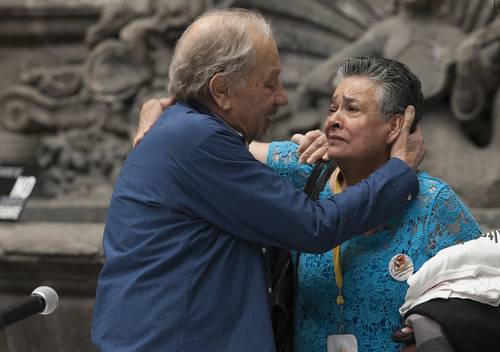
The academic Adolfo Gilly and María Herrera, who is looking for her four sons, during the forum. Photo: Cristina Rodríguez.
By: José Antonio Román
Members of the Caravan for Peace, Life and Justice, to whom are added religious representatives, academics, researchers, intellectuals and activists, asked to put an end “to the war on drugs,” which has left hundreds of thousands of victims, and also left enormous profits for the owners of money and the political power.
They pointed out that this “war,” impelled from the economic interests of the most powerful countries, has left scourges like the militarization of public security, forced internal displacement, disappearances, torture, extra-judicial executions, arbitrary detentions, corruption and impunity in the Mesoamerican nations.
Meeting in a forum organized on behalf of the caravan and specialists, they warned that our societies cannot continue ceding their rights to the “terrible and absurd” fight against drugs, which has placed almost all the countries Central America and Mexico among the most violent nations in the world.
The caravan, which left Honduras on March 28 and since then has traveled through El Salvador and Guatemala to arrive in Mexico, has New York City as its final destination, where it seeks to arrive on April 18, the eve of the special session called by the General Assembly of the United Nations to discuss the theme of international policy on drugs.
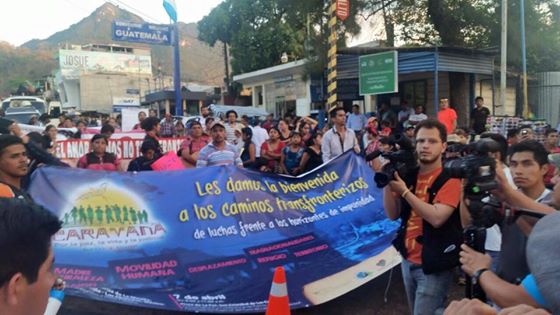
Laura Carlson, director of the Americas Program; Martín Baraona, Bishop emeritus of the Anglican Episcopal Church of El Salvador, and Alex Sierra, of Global Exchange –all members of the caravan– pointed out that the objective is to demand that the UN have an open dialogue that will give way to alternative policies, emphasizing the extremely high social cost that prohibitionist policy and the war on drugs have had. Respect for human rights and diminishing violence must always be prioritized, they all agreed in their talks.
Meanwhile, the Dominican priest Miguel Concha, the historian and intellectual Adolfo Gilly, and the executive director of the Mexican Commission for Defense and Promotion of Human Rights, José Antonio Guevara, emphasized the enormous importance of this caravan for comprehending what is really behind this “war;” in other words, the interests of the owners of money and political power.
“Enough now of death, violence and of military and police control in the territories and over people,” the priest Miguel Concha said, who questioned why President Enrique Peña Nieto doesn’t attend the UN’s special session especial where the theme of the fight against drugs will be broached, despite the fact that he was the president that asked it go forward.
Adolfo Gilly, for his part, pointed out that: “against the arbitrariness and the autistic craziness of power,” the caravan is recuperating solidarity among the peoples and this collective work transcends borders in the spirit of raising our voice before the death and working for peace, justice and dignity.
During the forum, in the Mexico City Museum, they set forth that this movement, as one of defense of land and territory, forms part of society’s reaction in the face of this phenomenon, which is the “terrible civilizing crisis” that humanity confronts.
———————————————————-
Originally Published in Spanish by La Jornada
Tuesday, April 12, 2016
http://www.jornada.unam.mx/2016/04/12/politica/005n1pol
Re-Published with English interpretation by the Chiapas Support Committee
60 Chiapas communities reject dam on the Usumacinta River
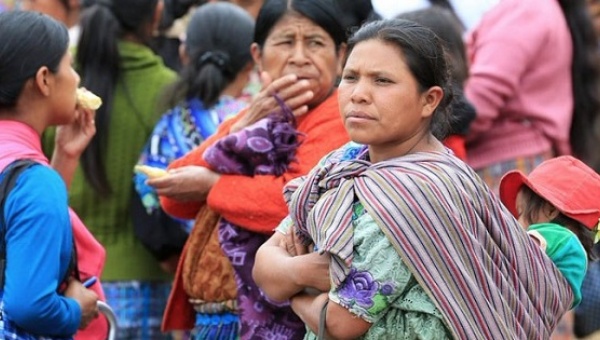
“According to researchers, the construction of dams across Mexico has displaced some 200, 000 people, while advocacy groups warn that the country’s new water law will just continue to make the situation worse. Many of Mexico’s 4, 462 dams registered in official records are in Indigenous and campesino communities.” TeleSur
By: Elio Henríquez, Correspondent
San Cristóbal de las Casas, Chiapas
Representatives of more than 60 communities from seven municipios in the Northern Zone and Jungle regions of Chiapas and from the Petén Front Against Dams of Guatemala issued statements against the construction of the bi-national Boca del Cerro hydroelectric dam, on the Usumacinta River, because it will invade their lands and the communities will be evicted.
In a statement published this Saturday, the almost 300 attendees at the Fourth Forum of resistances and alternatives of peoples of the Northern Zone of Chiapas said that construction work already started on the containment walls on both sides of the Usumacinta, which divides Mexico from Guatemala, for an expanse of 40 kilometers.
The gathering, called by the Peoples Light and Power Civil Resistance Organization of the Northern Region, an adherent to the EZLN’s Sixth Declaration of the Lacandón Jungle, was held on April 6 and 7 in the Victórico Grajales Ejido, Palenque Municipio, Chiapas, one of the municipios affected together with Tenosique, Tabasco, and communities in the Department of El Petén, Guatemala.
The bi-national Boca del Cerro hydroelectric dam is one of the five dams planned on the waterway that divides Mexico from Guatemala. According to data of the Federal Electricity Commission (CFE), the works are planned over four years and will have a maximum height of 55.5 meters (approximately 182 feet).
The total surface of the reservoir contemplates 4,443 acres; 1,746 acres are within the municipio of Tenosique and 2,697 within the municipio of Palenque.
Those who attended the Forum pointed out that the start of the work will immediately provoke that: “the San Carlos Boca del Cerro community, Tenosique, will disappear because it will be converted into the offices and camp of the company that constructs the dam’s curtain.”
Their concern, they stated, is because in addition to all the damage that the dam will cause, “the government will not indemnify us for our lands, the cost of living will increase and we, Chols and Tzeltals, will disappear from the region as indigenous peoples.”
They assured that the federal government imposes the dam on them and violates Article 2 of the Mexican Constitution and Convention 169 of the International Labor Organization (ILO), which refers to the autonomy of Native peoples and their right to consultation.
Due to the above, they committed to applying a work plan for stopping construction of the Boca del Cerro Dam and pledged solidarity “with the actions of sister organizations that are fighting to stop projects for mining, highways, hydroelectric dams and for expelling us from our lands that owners of the big companies have who want to dispossess us of our lands.”
They reported that they agreed to apply actions that permit them to put into practice the control and care of their territory, because said project would contaminate the river and the fish.
They also stated their opposition to the construction of other dams projected for Chiapas territory, because “they would affect the life of the peoples, and the profits that they would generate would be used to enrich foreign companies, the result if the energy reform, at the expense of the eviction of our peoples and of our lands.”
They also demanded justice for the murder of the activist Berta Cáceres Flores, coordinator of the Civic Council of Popular and Indigenous Organizations of Honduras, “and for respect of human rights and the lives of those that fight against the megaprojects and against dams, in Mexico, Central America and other places in the world.”
———————————————————–
Originally Published in Spanish by La Jornada
Sunday, April 10, 2016
En español: http://www.jornada.unam.mx/2016/04/10/estados/024n1est
Re-published with English interpretation by the Chiapas Support Committee
The Anti-War Caravan from Honduras to New York
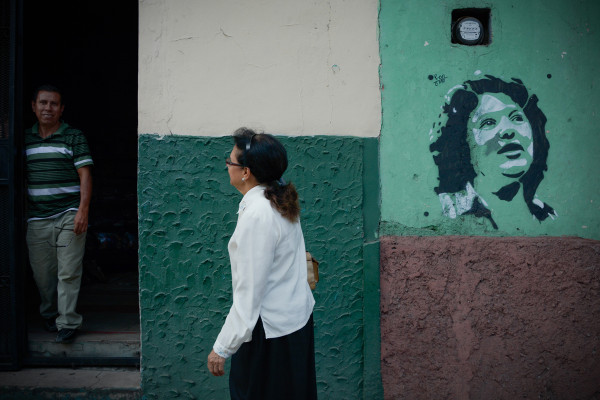
The image of Berta Cáceres on a wall near the start of the Anti-War Caravan.
By: Journalists on Foot (Periodistas de a Pie)
The Caravan will tour more than 5, 000 kilometers from this country (Honduras) to New York. Photo: PieDePágina
Text and photograph: Ximena Natera. Text: Daniela Pastrana
Honduras, the largest expeller country of Central American migrants, which has the most violent city in the world and one of the spaces of major citizen struggle and resistance, is the scene of the start of the Caravan for Peace, Life and Justice that will tour 5,000 kilometers, to New York, to demand a debate on the anti-drug policy that has left death, dispossession and misery in this place.
TEGUCIGALPA, HONDURAS. – It’s Holy Sunday. Dozens of people and human rights defenders are headed to the start of the Caravan for Peace, life and justice, a long walk through America that will seek to debate the policy of the war against drugs, impelled from the United States.
The start of the Caravan, which will tour more than 5,000 kilometers from Honduras ta Nueva York, coincides with the anniversary of the Civic Council of Popular and Indigenous Organizations of Honduras (Copinh), one of the strongest groups of struggle and resistance in this bruised country.
The road to the starting place, in this Central American capital, is tapestried with the face of Berta Cáceres, an indigenous leader and environmentalist, human rights defender and the founder of Copinh, who was murdered in her home 24 days ago because of her work.
Because of that, this Holy Sunday is very special. Because in the face of Berta, on the anniversary of the Copinh and in the path of the Caravan is symbolized the citizens’ indignation over the violence, but also the resistance of a people that seeks to live in peace.
+++
This long walk through America, which seeks to arrive in New York on April 18, on the eve of the start of the Special Session of the United Nations General Assembly (UNGASS) –that after 18 years will discuss drug policy again- seeks to open a dialogue between the civil society of Honduras, El Salvador, Guatemala, Mexico and the US about the war against drugs policy, which has left hundreds of thousands dead, displaced, arrested and disappeared in the region.
Ted Lewis, of the Global Exchange organization, that organized this walk, is confident that the Caravan is an unprecedented opportunity to review and reorient national drug policies and the future of the international framework for the control of drugs at a time in which there is a strong debate in the United States about criminal justice and a recognition of Michelle Alexander’s thesis about the New Jim Crow (legalizing discrimination).
“It is a very important time and in fact we are in contact with the two presidential campaigns to invite them to the final event,” pointed out Lewis, who emphasized that the Caravan also coincides with the start of the Democratic primaries.
Thirty activists from Honduras, El Salvador, Guatemala and Mexico also participate, and Sebastián Sabini, a deputy of the Frente Amplio Party of Uruguay, who has come to explain the reasons that led them to legalize the use of marijuana in that country, as an alternative measure for confronting drug trafficking and the consumption of illegal drugs.
“Militarization and repressive apparatuses don’t lead us to a better place. There are countries that are realizing that it doesn’t work,” the deputy Sabini said, who warns that the greatest risk that the [current] policy is extended in the region is narco-politics.
+++
Honduras is a country of 8 million inhabitants and one of the poorest in Latin America. It is the principal expeller of Central American migrants to the United States because the country did not achieve recovering from the economic disaster that Hurricane Mitch left in 1998 or from the political effects of the State coup in June 2009, when Manuel Zelaya was deposed.
“We are starting to see things happen here that have already happened in Mexico,” considered Thelma Mejía, an experienced journalist, referring to the infiltration of narcos and power groups and politicians.
Thelma refers to the case of the Rosenthals. In October 2015, the United States Treasury Department determined that Jaime Rosenthal -founder of the Continental Bank, ex Vice President and one of the most powerful families in Honduras-, his son Yani and his nephew Yankel were “specially designated drug traffickers” according to the Kingpin Law. It was the first time that a bank outside of the United States was classified in this category.
The problem in Honduras is a mix of criminal power, of transgression, of gangs like the Maras and of institutions.
But people in Honduras are fed up and following Berta’s fighting example and that of other human rights leaders, they have provoked the earth to move:
In 2016 the Mission for support against corruption and impunity (MACIH) will start to function and will be installed in the Office of the High Commissioner of the United Nations. Besides, it will be the commission for watching over the funds of the Alliance for Prosperity, an agreement signed between the United States, Honduras, El Salvador and Guatemala to impel development and stopping migration.
Perhaps because of all that movement –of resistance and violence- the Caravan started in Honduras. In their walk through this Central American country, it will tour La Ceiba, Progreso, San Pedro Sula –the most violent city on the continent—and La Esperanza, where the Lencas resist.
Carlos Sierra, a Honduran, a member of the Center for Investigation and Promotion of Human Rights (Ciprodeh) and of the Friedrich Ebert Foundation, opined that the Honduras government is obliged to dialogue with groups that it has not wanted to hear: environmentalist leaders, like Berta, the indigenous and migrants.
“The fact that the Caravan starts here, besides making all the problems visible, can favor that the theme includes whether what has been done in the fight against drugs has or has not gone well.”
+++
As part of the launch of the Caravan, the Forum of organizations was held in this capital. Sandra Maribel Sánchez, of Radio Progreso, a space for migrant support, spoke in the Forum.
“If they don’t kill us with a shovel blow, they’ll kill us with hunger,” she said.
She, like the rest of the participants, considers that the war on drugs –the theme of this Caravan- is a State policy, a war that through terror and militarization seeks territorial control to remain communal wealth.
In this forum the idea resounds that anti-drug policies have in their bowels the legalization of dispossessing territory.
“We are the countries to the South (of the United States) who put up the deaths. If we don‘t initiate a discussion about new anti-drug policies no one else is going to do it,” emphasized Sabini, the Uruguayan politician that traveled from further south to share the experience of his country with the rest of America.
Participants of the countries that make up the Caravan are in agreement on something: at some point the war on drugs became a war against people. And here in Honduras, the people are losing.
——————————————–
Originally Published in Spanish by Chiapas Paralelo
Wednesday, March 30, 2016
http://www.chiapasparalelo.com/noticias/nacional/2016/03/la-caravana-antiguerra/
Re-published with English interpretation by the Chiapas Support Committee
Rigorous questioning from the IACHR of the Mexican government
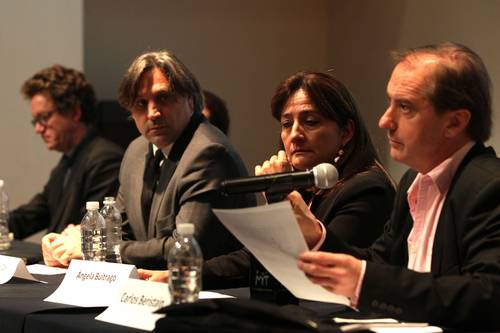
Members of the Interdisciplinary Group of Independent Experts
Washington, DC
In a harsh and unpleasant session, members of the Inter-American Commission on Human Rights (IACHR) severely questioned the Mexican government not only because of the direct attacks against one of its functionaries, but also because of the negative way in which it has reacted to the critical report about the grave human rights situation in the country.
In an especially harsh tone, Commissioner Enrique Gil Botero said that refusing to recognize that there are situations where these rights are violated is being out of touch with reality. This attitude, he added, “is one of the first manifestations of schizophrenia.”
Commissioner Paulo Vannuchi denounced “the strong attack by Mexico’s public authorities” on the work of the IACHR’s Interdisciplinary Group of Independent Experts (GIEI, the group’s initials in Spanish), and the “irreparable harm” inflicted on their Executive Secretary Emilio Álvarez Icaza, a Mexican.
“It’s a bit cowardly because it must have been an attack on the Commission. All of Emilio’s work was in the name of the commissioners,” he added.
Vannuchi recognized that the government of President Enrique Peña Nieto rejected the complaint, but he emphasized that the case would serve to discourage Mexico’s public institutions and those of other countries from accepting those kinds of accusations.
So, in the first of four public hearings about cases in Mexico, dedicated to a general review of human rights in the country, the IACHR called Mexico out for the “strong attack” on its Executive Secretary and the criticisms thrown at a group of experts from the organism that investigate the disappearance of 43 students in Iguala, Guerrero, on the 26 and 27 of September 2014.
In the beginning, during the development of the hearing, the civil organizations representatives of the Mexican government discussed the situation of rights in Mexico, but the accusations against the human rights body stopped it.
A few weeks ago, in a complaint that the Attorney General of the Republic (PGR) accepted and later rejected, a citizen accused the Executive Secretary of the IACHR, Emilio Álvarez Icaza, of “fraud” in the investigation into the disappearance of the 43 teachers college students. The same Executive Secretary has complained that a “defamation campaign” exists in Mexico against members of the GIEI, who investigate what happened to the students.
And while the Mexican government has praised the investigation and the experts’ recommendations, the group’s work has not been exempt from confrontations and differences with Mexican institutions.
Just last Wednesday, the GIEI warned that it will break with the Attorney General of the Republic (PGR) if it does not clear up questions about a new expert examination of the Cocula garbage dump, with which it seeks to validate the official version presented in November 2014, according to which Iguala police attacked the young men and delivered them to gunmen for the Guerreros Unidos Cartel, who would have murdered them and incinerated their bodies in said garbage dump. However, this new test result is “preliminary.”
In other sessions on Mexico –within the context of the 157th session of the IACHR–specific themes were brought up like the rights of individuals deprived of freedom (detainees) and privatization of the prison system; the disappearances of minors of age, and access to information and indirect restrictions on freedom of expression.
The Mexican government only requested the first one; the remaining three were requested by national civil society organizations.
Freedom of expression
On the other hand, the commissioners and Edison Lanza, the IACHR’s special relator for the Freedom of Expression, asked the Mexican government a series of questions about the theme of freedom of expression, to which Assistant Foreign Relations Secretary Miguel Ruiz Cabañas committed to respond in writing.
The relator asked the government of Enrique Peña Nieto to permit him, together with the United Nations relator for Freedom of Expression, to visit Mexico in order to bring up and observe the lack of transparency theme, harassment of the press and the murder of journalists, on a date in the second half of this year, probably in September, according to what he proposed.
———————————————————
Originally Published in Spanish by La Jornada
Friday, April 8, 2016
En español: http://www.jornada.unam.mx/2016/04/08/politica/005n1pol
Re-published with English interpretation by the Chiapas Support Committee
Gustavo Castro: Foreign Relations delayed his return
GUSTAVO CASTRO REPROACHES THE SRE’S DELAY IN ATTAINING HIS RETURN FROM HONDURAS
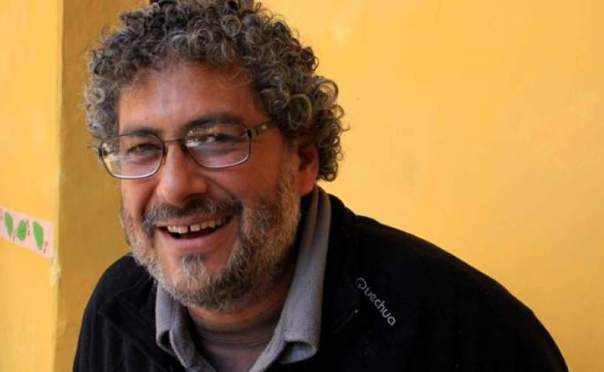
Gustavo Castro Soto
By: José Antonio Román
Gustavo Castro, the Mexican activist held almost a month in Honduras due to being a witness to the murder of Berta Cáceres, reproached the delay with which the Secretariat of Foreign Relations (SRE, its initials in Spanish) acted to attain his return to national territory.
“Faced with the evident lack of application of Honduran laws in my case, and the irregularities, it’s strange that the Mexican government here had not acted sooner, and that it waited for so long having legal frameworks and mechanisms for doing so,” the coordinator of the Otros Mundos Chiapas organization said.
In his first statements in the country, where he arrived last Friday, he said that this delayed action of the Mexican Chancellery prolonged his stay in the Central American country in the midst of total uncertainty. “For me it was like psychological torture not having clarity about what assistance the government (of Honduras) wanted, what it wanted from me, and also including the possibility that my stay there could be prolonged.”
Castro remained almost a month held “illegally and arbitrarily” by that country’s judicial authorities that are investigating the murder of the human rights defender Berta Cáceres, perpetrated with gunshots in the early morning of last March 3 in the leader’s home casa.
At a press conference, Castro said that it would be “absurd” to oblige him to return to Honduras for the investigation, because during his retention he cooperated with authorities and gave a statement about everything he knew about the Honduran activist’s murder; she had invited him to her country to participate in several workshops on sustainable projects. Berta Cáceres was advising different indigenous communities against a hydroelectric project that would affect several rivers.
Nevertheless, in response to an express question, he pointed out that he has not yet decided whether he will file a complaint or not against the Honduran government for this “arbitrary and illegal” retention committed against him. “It’s something about which I still have to speak with the lawyers,” he said.
On the other hand, representatives from diverse organizations that accompanied Castro’s defense process during his retention lamented the “poor political and diplomatic behavior” that the Chancellery realized from Mexico for a co-national to whom the Honduran State did violence and re-victimized.
They even deplored that Foreign Relations now brags that its gestures caused Gustavo Castro’s return to Mexico, when it was the work of the Mexican activist’s lawyers and the growing national and international pressure demanding his liberation that was cornering the Honduran government into terminating the retention. This is also pointed out in a joint position with the Mexican Network of those Affected by Mining (Rema) and the Mexican Movement of those Affected by Dams and in Defense of Rivers.
They mentioned that the Chancellery proposed waiting for the 30-day “immigration alert” imposed on Gustavo Castro to conclude to act. They were also the ones that offered information to the functionaries for the diplomatic mediation. Chancellor Claudia Ruiz Massieu refused to receive the Mexican activist’s family members, arguing a “tight agenda.”
In contrast, the organizations as well as Castro recognized the “excellent protection operation” that Mexico’s ambassador in Honduras, Dolores Jiménez Hernández, and Consul Pedro Barragán had, for guarantying his security.
———————————————————-
Originally Published in Spanish by La Jornada
Tuesday, April 5, 2016
En español: http://www.jornada.unam.mx/2016/04/05/politica/014n1pol
Re-published with English interpretation by the Chiapas Support Committee
20 Years of millions of dollars and Chiapas remains poor
MORE THAN 20 YEARS OF A MILLION-DOLLAR ECONOMIC SPILL AND CHIAPAS REMAINS JUST AS POOR
By: Isaín Mandujano
Chiapas is the state that has received the most resources to combat poverty in the whole country during the last 20 years; nevertheless, the measurements demonstrate that it has not been reduced; to the contrary, it seems to increase in a slow but sustained way. [1]
That’s what they concluded in the presentation of the report “Inequality and Social Exclusion in Chiapas, a long-term view,” realized by Chiapas social and economic researchers and financed buy the international organism Oxfam México.
The document elaborated by Jorge López Arévalo and Gerardo Núñez Medina, two researchers from the Autonomous University of Chiapas (UNACH) reveals the critical situation that exists in Chiapas, which has received millions of dollars since the 1994 armed uprising that have had little impact among the state’s indigenous and campesino communities.
Elvia Quintanar, coordinator of the research project, said that a large part of the reason these resources have no impact, is the corruption with which the bureaucratic government apparatus in Chiapas is plagued at every level, the federal, state and municipal
He said that the lack of any transparency and the absence of accountability favor a recurring corruption that doesn’t end in Chiapas and that consequently, of the resources (funds) that are designated for fighting poverty, only a few drops reach the recipients.
Ricardo Fuentes de Oxfam México said that there is a growing tendency of inequality and that it’s a global phenomenon about which Oxfam has warned since 2014, when it revealed that 85 people possess more wealth than half of the world’s population.
He explained that the inequality crisis that the world is experiencing has special characteristics and that is why, in June 2015, Oxfam México published the document “Extreme Inequality in Mexico: The concentration of economic and political power,” wherein they warned about the gap that exists between those that have it all and those that have nothing.
“We found that in Mexico the fortunes of four people grew five times in the period 1996-2014, while, in the same period, the per capita GNP grew at less than 1% annually. The country with 55.3 million people in poverty is also the country of some of the richest men – yes, men – in the world. “Many Mexicos,” is a common, but no less certain phrase,” Ricardo Fuentes said.
He added that the document presented Thursday in Chiapas, specifically seeks to give a reason for the inequalities that exist in different regions of Mexico, their causes and consequences from territorial and communitarian constructions; as well as the exit routes that can be sketched from the local.
“A system in which it’s possible that 55 million people live in poverty worries us,” he indicated.
The report points out that Chiapas is considered as the state with the greatest concentration of its population in poverty and extreme poverty. Consequently, it is the state that has received the most resources (money) in Programs to Combat Poverty for the last 20 years. However, the measurements show that it has not been reduced; to the contrary, it seems to increase slowly but surely.
The document is divided into four parts: Inequality in Chiapas: the problems on the inside and the outside; Social inequalities: the difference between being born into an indigenous family and into a mestizo family; Inequalities and public expenditures and Development with equity: Conclusions and proposals.
(….)
The document emphasizes that Chiapas, has experienced a slow growth for more than a century, which has deepened in the last 35 years, configuring a weak and unstructured job market: it presents the lowest rate of salaried work at the national level and one of the highest rates of informality, which reached 80% in the second trimester of 2015.
It points out that inside of Chiapas, the precariousness of employment, added to the loss of the real value of wages, are the principal determinants of the economic inequalities. In addition, access to job opportunities is tied to discriminatory factors that sharpen the fragile condition of the indigenous populations.
The report says that during the last century, the population of Chiapas increased and the economy grew; nevertheless, the living conditions of its inhabitants did not improve.
In 2010, Chiapas occupied seventh place in terms of population on a national level, with a total population of 4.79 million inhabitants. In economic terms, the same year it generated 1.8% of the GNP and it occupied the 19th place, as well last place in the country’s per capita GNP.
As a result of a historic process with high rates of population growth, recurring crises and economic stagnation, a vicious circle has been generated between poverty and inequality so that the state reports the highest indices of poverty and inequality in every ambit.
An important Note
[1] Although it is not specifically stated in this article, it is almost certain that Zapatista communities are not represented in this report because the EZLN does not permit this type of research in its civilian communities. Importantly, this study would seem to support the recent EZLN communiqué regarding the deteriorating condition of the non-Zapatista communities affiliated with the political parties.
——————————————————————
Originally Published in Spanish by Chiapas Paralelo
Friday, April 1, 2016
Re-published with English interpretation by the Chiapas Support Committee
IACHR condemns campaign against experts
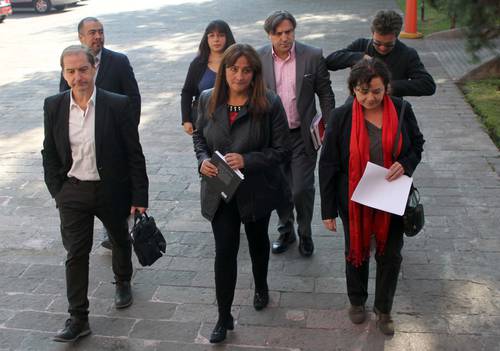
Members of the Group of Independent Experts
By: Emir Olivares Alonso
The Inter-American Commission on Human Rights (IACHR) categorically rejected “the defamation campaign that takes place in Mexico” against the Grupo Interdisciplinary Group of Independent Experts (GIEI), which works on the Ayotzinapa Case, and against its Executive Secretary, Emilio Alvarez Icaza Longoria [1] –investigated by the Attorney General of the Republic (PGR, its initials in Spanish) for alleged fraud in prejudice of the Mexican State–; trusted in the functionary’s integrity and classified the complaint against him as “unfounded and reckless.”
The IACHR gave its complete support to the members of the GIEI and to the work they have carried out for almost a year, as well as their reports. It reminded that family members of the victims as well as government representatives endorsed the selection of the five experts.
It also gave total support to Alvarez Icaza, denounced before the PGR by José Antonio Ortega Sánchez, president of the Citizen Council for Security and Criminal Justice, [2] for alleged fraud damaging the Federation for almost 2 million dollars, money destined for the investigation of the Ayotzinapa case.
On this point, the IACHR expressed its absolute confidence in Alvarez Icaza’s integrity, because the money was deposited directly in the accounts of the Secretary General of the Organization of American States by means of the secretary of administration and finances. “The IACHR did not administer those resources; so, neither did the executive secretary.”
It emphasized that at the signing of the cooperation agreement with Mexico –adhered to by government authorities and representatives of the victims–, Alvarez Icaza acted in representation of the Secretary General of the OAS.
“The IACHR expresses its consternation and considers inadmissible the opening of a preliminary investigation into the basis for that complaint, which because of not containing any act constituting a crime turns out to be reckless and unfounded,” and expressed confidence in Alvarez Icaza’s innocence because his behavior is known, in relation to the specific theme as well as in relation to his whole term.
The human rights organism stated that the three parties that subscribed to the agreement agreed to the GIEI’s incorporation “for carrying out a technical verification of the actions initiated by the Mexican State” after the disappearance of the 43 Ayotzinapa students, beneficiaries of precautionary measures.
It emphasized that the report of the investigation and the GIEI’s first general conclusions, presented on September 6, 2015, pointed to “irregularities, inconsistencies and/or absences in the investigation of the facts by the state authorities. In particular, it questioned ‘the historic truth,’ a version of the facts announced by then head of the PGR, Jesús Murillo Karam, saying that the normalistas had been incinerated in the Cocula garbage dump. As a consequence of the GIEI’s work and recommendations, the Mexican State has pointed out that new lines of investigation have been opened, which represents a significant advance in the search for truth and justice in this case.”
[1] Prior to his appointment as the Executive Secretary of the IACHR, Emilio Alvarez Icaza was a key member of Javier Sicilia’s Movement for Peace with Justice and Dignity. He was also president of the Federal District’s Human Rights Commission. http://www.oas.org/en/iachr/media_center/PReleases/2012/092.asp
[2] The Citizens’ Council for Public Security and Criminal Justice has previously been described as an ultra-conservative and pro-military rightwing group. See: http://compamanuel.com/2016/02/04/ayotzinapa-investigators-face-rightwing-smears/
———————————————————-
Originally Published in Spanish by La Jornada
Wednesday, March 30, 2016
En español: http://www.jornada.unam.mx/2016/03/30/politica/006n1pol
Re-published with English interpretation by the Chiapas Support Committee
Gustavo Castro returns to Mexico
THE ACTIVIST GUSTAVO CASTRO SOTO RETURNS TO MEXICO AFTER BEING HELD FOR 27 DAYS IN HONDURAS

Gustavo Castro Soto
By: Blanca Juárez
The activist Gustavo Castro Soto, the only witness to the homicide of the environmentalist Berta Cáceres returned to Mexico yesterday after being retained for almost a month by Honduras authorities in that country.
Just this Thursday Honduran justice revoked the order for the director of Otros Mundos/Friends of the Earth-Mexico to remain there as a witness and collaborate in the clarification of the Cáceres murder, perpetrated by unknown individuals last March 3.
He arrived at the International Airport in Mexico City a little after 11 o’clock in the morning on Flight TAI430 of Avianca Airlines. The plane made a stop in El Salvador and afterwards headed for Mexico.
The sociologist traveled in the company of his brother Oscar and of the Mexican Consul in Honduras, Arturo Corrales. Other family members received him when he arrived, as well as authorities from the Secretariat of Foreign Relations, who assisted him in his return, according to information from that department.
After his arrival, Castro Soto was led to a distinct area of the arrival gate, where various reporters were already waiting for him, but he did not give statements to the press.
Last March 6, three days after the armed attack in the home of the social struggler Berta Cáceres, and in which the Mexican received minor injuries, authorities of the Central American country impeded his exit. They intercepted him at the Tegucigalpa International Airport when he was attempting to take a flight to Mexico.
Cáceres was the coordinator of the Civic Council of Popular and Indigenous Organizations of Honduras. La indigenous Lenca woman stopped one of the largest hydroelectric projects in her country, which would have affected nearby communities if it had been completed.
Despite the formal request from the Mexican government –which was repeated on several occasions– for the environmentalist to be able to return to the country as soon as possible, the sociologist could not abandon Honduras until yesterday.
The Inter-American Commission on Human Rights (IACHR) requested Gustavo Castro’s presence in Washington on next April 6 so that he participates in the 157th session. They permitted the activist to leave after the Mexican government’s insistence and international pressure.
———————————————————–
Originally Published in Spanish by La Jornada
Saturday, April 2, 2016
http://www.jornada.unam.mx/2016/04/02/politica/007n1pol
Re-published with English interpretation by the Chiapas Support Committee
Chomsky: Humanity’s most critical moment
THIS IS THE MOST CRITICAL MOMENT IN THE HISTORY OF HUMANITY
In an extensive conversation, Chomsky reviews the principal tendencies on the international scene, his country’s militarist escalation and the growing risks of nuclear war. He stops on the United States electoral process and sketches a reflection on hopes for peace in Colombia

Noam Chomsky in an image from September 2009 during a visit to Mexico. Photo: Carlos Ramos Mamahua
By: Agustín Fernández Gabard and Raúl Zibechi
“The United States was always a colonizing society. It was eliminating the indigenous population even before being constituted as a State, which meant the destruction of many Native nations,” the U.S. linguist and activist Noam Chomsky synthesizes when he was asked to describe the global political situation. A most bitter critic of the foreign policy of his country, he maintains that since 1898 the international scenario was upset with the control of Cuba, “which was essentially converted into a colony,” and by later invading the Philippines, “murdering a couple of hundred thousand people.”
He continues patching a sort of counter-history of the empire: “Later it robbed Hawaii of its original population, 50 years before incorporating it as one more state.” Immediately after the Second World War the United States became an international power, “with power unprecedented in history and an incomparable security system, it controlled the Western hemisphere and both oceans, and naturally drew up plans for trying to organize the world to suit its whim.”
He accepts that the superpower’s power has diminished with respect to what it had in 1950, the peak of its power, when it accumulated 50 per cent of the world’s gross domestic product, which has now fallen to 25 percent. Even so, it still seems necessary to remember that the United States continues being “the richest and most powerful country in the world, and is incomparable on the military level.”
A one-party system
Chomsky compared the elections in his country with the selection of a brand of toothpaste in a supermarket. “Ours is a country with only one political party, the party of enterprise and businesses, with two factions, Democrats and Republicans,” he proclaims. But he believes that it’s no longer possible to continue talking about those two old political communities, since their traditions suffered a complete mutation during the neoliberal period.
“The modern republicans are the ones that call themselves Democrats, while the old Republican organization remained outside the spectrum, because both parties moved to the right during the neoliberal period, just like what happened in Europe.” The result is that the new Hillary Clinton Democrats have adopted the program of the old Republicans, while those were completely displaced by the neoconservatives. “If you look at the TV spectacles where they say they are debating, they just shout at each other and the few policies that they present are terrifying.”
For example, he emphasizes that all the Republican candidates deny global warming or are skeptical, which means that while they don’t deny it they say that the governments shouldn’t do anything about it. “Nevertheless, global warming is the worst problem that the human species has ever confronted, and we are heading for a complete disaster.” In his opinion, climate change has effects only comparable to nuclear war. Even worse, “the Republicans want to increase the use of fossil fuels. We are not facing a problem of hundreds of years, but rather of one or two generations.”
The denial of reality, which characterizes the neoconservatives, responds to logic similar to that which impels the construction of a wall on the border with Mexico. “Those people that we try to turn away are those who flee from the destruction caused by United States policies.
“In Boston, where I live, a couple of days ago the Obama government deported a Guatemalan that lived here for 25 years; he had a family, a business, he was part of the community. He had escaped from the Guatemala destroyed during the Reagan administration. In response, the idea is to construct a wall to protect ourselves. It’s the same in Europe. When we see that millions of people flee from Libya and Syria to Europe, we have to ask ourselves what happened in the last 300 years to arrive at that.”
Invasions and climate change feed on each other
The type of conflict that we observe today in the Middle East didn’t exist just 15 years ago. “It is a consequence of the United States invasion of Irak, which is the worst crime of the century. The US-British invasion had horrible consequences, they destroyed Irak, which is now classified as the least happy country in the world, because the invasion cost the lives of hundreds of thousands of people and generated millions of refugees, which were not given shelter by the United States and they had to be received by poor neighbor countries that were in charge of picking up the ruins of what we destroyed. And worst of all is that they instigated a conflict between Sunnis and Shiites that did not exist before.”
Chomsky’s words remember the destruction of Yugoslavia during the 1990s, instigated by the West. Just like Sarajevo, he emphasizes that Bagdad was an integrated city, where the different cultural groups shared the same barrios, married members of different ethnic groups and religions. “The invasion and atrocities that followed instigated the creation of a monstrosity called the Islamic State, which was born with Saudi financing, one of our principal allies in the world.”
In his opinion, one of the greatest crimes was the destruction of a large part of the Syrian agricultural system, which assured nourishment, and which drove thousands of people to the cities, “creating tensions and conflicts that explode just as the repression begins.”
One of his most interesting hypotheses consists in crossing the effects of the Pentagon’s armed interventions with the consequences of global warming.
In the war in Darfur (Sudan), for example, the interests of the powers converge with the desertification that expels entire populations from the agricultural zones, which aggravates and sharpens the conflicts. “Scary crises flow from these situations, like those that happen in Syria, where the biggest draught in their history is taking place. It has destroyed a large part of the agricultural system, generating displacements and exacerbating tensions and conflicts,” he reflects.
We have still not thought thoroughly, he emphasizes, about what this denial of global warming implies and the long-term plans of the Republicans that seek to accelerate it: “If the sea level continues rising and goes up much faster, it will swallow countries like Bangladesh, affecting hundreds of millions of people. The Himalayan glaciers are melting rapidly putting the water supply for Southern Asia at risk. What will happen to those hundreds of millions of people? The imminent consequences are horrendous, this is the most important moment in the history of humanity.”
Chomsky believes that we are facing a turn of history in which human beings must decide if we want to live or die: “I say it literally. We are not all going to die, but the possibilities of a dignified life would indeed be destroyed, and we have an organization called the Republican Party that wants to accelerate global warming. I don’t exaggerate –ending it– it’s exactly what they want to do.”
Next, he quotes the Bulletin of Atomic Scientists and his Doomsday Clock, to remind that the specialists say that at the Paris Conference on global warming it was impossible to get a binding treaty, only voluntary agreements. “Why? It’s because the Republicans would not accept it. They have blocked the possibility of a binding treaty that could have done something to impede this massive and imminent tragedy, a tragedy like never has existed in the history of humanity. What we are talking about, are not things of minor importance.”
Nuclear war, a certain possibility
Chomsky is not one of the people that are impressed by academic or intellectual modes; his radical and serene reasoning seeks to avoid furors and, perhaps because of that, he is reluctant to ring the bells quickly over the announced decadence of the empire. “It has 800 [military] bases around the world and invests as much in its army as the whole rest of the world together. No one has anything like that, with soldiers fighting everywhere in the world. China has a principally defensive policy, doesn’t have a big nuclear program, although it’s possible that it may increase.”
The case of Russia is different. It’s the principal stone in the shoe of the Pentagon’s domination, because “it has an enormous military system.” The problem is that Russia and the United States are both expanding their military systems; “both are acting as if war were possible, which is collective craziness.” He thinks that nuclear war is irrational and that it could only happen in the case of an accident or human error. Nevertheless, he agrees with William Perry, ex Secretary of Defense, who said recently that the threat of nuclear war is greater today than what it was during the Cold War. Chomsky estimates that the risk is concentrated in the proliferation of incidents that involve the armed forces of nuclear powers.
“War has been very closer innumerable times,” he admits. One of his favorite examples is what happened during the government of Ronald Reagan, when the Pentagon decided to put Russian defenses to the test through the simulation of attacks against the Soviet Union.
“It turned out that the Russians took it very seriously. In 1983, after the Soviets automated their defense systems, they detected a US missile attack. In these cases the protocol is to go directly to the high command and to launch a counter-attack. There was one person that had to transmit this information, Stanislav Petrov, but he decided that it was a false alarm. Thanks to that, we are here talking.”
He maintains that the United States’ defense systems have serious errors and a couple of weeks ago a case from 1979 was published, when a massive Russian missile attack was detected. When the National Security advisor, Zbigniew Brzezinski, was picking up the telephone to call President James Carter and to launch an attack in reprisal, the information arrived that it was a false alarm. “There are dozens of false alarms every year,” he asserts.
At this time the provocations of the United States are constant. “NATO is carrying out military maneuvers 200 meters from the Russian border with Estonia. We would not tolerate something like that happening in Mexico.”
The most recent case was the downing of a Russian fighter that was bombing Jihadist forces in Syria at the end of November. “There is a part of Turkey almost surrounded by Syrian territory and the Russian bomber flew across that zone for 17 seconds, and they brought it down. A great provocation that luckily was not responded to with force, but it took their most advanced anti-aircraft system into the region, which permits it to bring down NATO planes.” He argues that similar acts are happening daily in the China Sea.
The impression that one infers from his gestures and reflections is that if the powers that are attacked by the United States acted with the same lack of responsibility as Washington, the die would be cast.
———————————————————–
Originally Published in Spanish by La Jornada
Sunday, February 7, 2016
http://www.jornada.unam.mx/2016/02/07/politica/002n1pol
Re-published with English interpretation by the Chiapas Support Committee
 Chiapas Support Committee