Chiapas Support Committee
Home of the Compañero Manuel blog on zapatistas & mexico
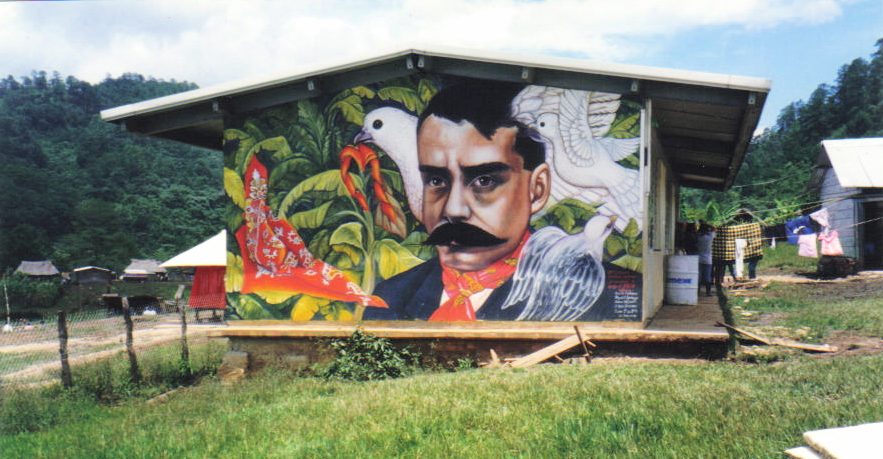
EZLN supports the teachers in their fight against the education reform
[Here’s a sneak peek at the the new comunicado from the Zapatistas. We’ll publish the entire comunicado when the official English translation is available.]

A member of the EZLN in San Cristóbal de las Casas. Photo: Isaín Mandujano.
By: Isaín Mandujano
TUXTLA GUTIÉRREZ, Chis. (apro). – The Zapatista National Liberation Army (EZLN) today came out in favor of the teachers fight against the education reform and asserted that with the repression and the closure to dialogue and negotiation, the Mexican government does not seek to apply the law, but rather to do violence to it.
The government: “is not applying the law, the law is being violated. It says it is defending the constitution –the education reform–, violating the constitution -the laws that guaranty fundamental rights such as the rights of assembly, petition and free movement,” it accused.
By means of a comunicado called “May: Between authoritarianism and resistance,” it pointed out that the battles that the teachers, as well as their families unleash now, do not end with May: “They are barely the beginning of many months and struggles that will happen, and not only with the teachers. In the geographies and the calendars of below history doesn’t elapse, it is made.”
At 16 days from the start of the fight of the “teachers in resistance and rebellion,” Subcomandante Galeano and Subcomandante Moisés, spokespersons and military leaders of the EZLN announced today their position on what’s happening in Chiapas and other parts of the country where battles against “the misnamed education reform” are taking place.
“The misnamed ‘education reform’ is not about education, it’s about labor. If it were educational the views of the teachers and families would have been received. When the government refuses to dialogue about the reform with the teachers and families, it is recognizing that we’re not dealing with improving education, but rather with ‘adjusting the roster –that’s how capital calls the firings,” says the missive signed by both masked men.
To the EZLN, what the paid communications media do is useless. Statements come and go: “everything’s normal,” “the majority of the schools are working.” “Ninety something percent of the teachers are working.
“But those statements don’t know the reality, because the teachers are in the streets. In the towns the families already said clearly that they are not going to accept the substitutes, that they are not going to let them enter or that they are going to run them out,” the leaders of the rebel group said.
It clarifies that the teachers are not defending privileges, they are struggling in the last trench for any human being: the minimum living conditions for themselves and their families.
“Does it surprise you that anyone is willing to defend what little is left to them? An infamous salary, some classrooms that appear to have been bombed (and they have been, but by economic bombs), not one but rather several shifts, excessively numerous groups? In sum: little pay, bad working conditions and very fucked up. The EZLN questions: sound familiar?
In the comunicado the spokespersons for the EZLN say that: “the objective of the alleged educational reform is to destroy that teacher that prepared for years and has dedicated practically all of his or her life to that craft.”
With perseverance “which in the media is paid with banknotes,” they said, the image has been constructed of corrupt leaders, but that image is the lure for biting the fishhook: “No, the objective isn’t the leaders, but rather all the teachers, including those in the servile National Education Workers Union. Now, if you want a model for corrupt leaders, you have it there in the leadership of the SNTE.”
According to the EZLN the objective of the education reform is to privatize education and that in fact, that privatization is already underway, because leaving the schools without attention or a budget won’t finish off public education in México for a human reason: the teachers.
Now the other objective, the guerrilla group abounded, is to destroy those teachers. “It tries to provoke a catastrophe in the education system so that the families tend, doubling shifts, to private schools; or are in agreement that their daughters and sons are formed consuming television, radio and digital media, or in the street.
“The teaching profession does not improvise, nor is it a question of intuition. It studies, demands preparation. Not just anyone has the ability and the knowledge to educate. Because one is educated in school, one doesn’t just learn. Not just anyone can successfully face a group of school-age or pre-school age children. Therefore, the Teachers Colleges (escuelas Normales) are necessary,” the EZLN’s leaders add in their missive.
Galeano and Moisés ask:
“Have they told you that what occurs is that the teachers are loafers and that they don’t want to be prepared? They lie, any teacher aspires to be better, to be better prepared. Do what the government hasn’t done; speak with a teacher. Even better, listen to her! You will see how, when he or she talks about their situation, it seems that they describe yours.
“If a government is not willing to dialogue and negotiate with its opponents, what path do they leave them? If only the argument of force is used, what do they expect as a counter argument?”
————————————————————
Originally Published in Spanish by Proceso.com
Tuesday, May 31, 2016
Re-Published with English interpretation by the Chiapas Support Committee
Indigenous win lawsuit against the San Cristóbal-Palenque Superhighway
ANNOUNCE COURT ORDER AGAINST THE SAN CRISTÓBAL DE LAS CASAS-PALENQUE SUPERHIGHWAY
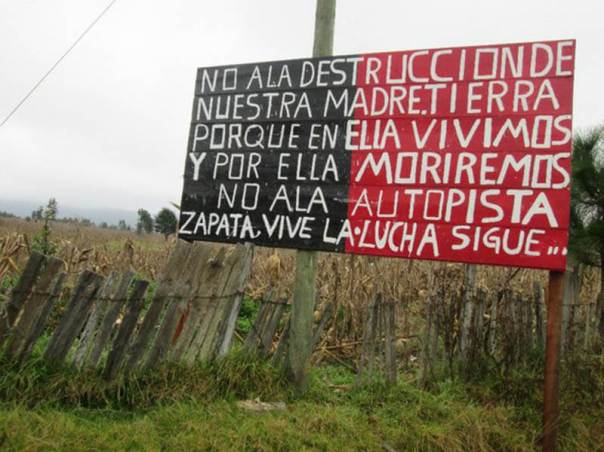
No to the destruction of our mother earth because we live on it and we die for it. No to the Superhighway! Zapata Vive! La Lucha sigue!
From the Editors of Desinformémonos
The amparo [1] against the San Cristóbal de las Casas-Palenque superhighway project, in Chiapas was granted to the Tsotsil community of Los Llanos last January 18 after imposition under government threats and intimidation over the construction of the highway, by means of the municipal council and the secretary general of government in Chiapas since November 2013, residents of the Los Llanos ejido and San José El Porvenir reported.
The community stressed to authorities of the three levels of government that their land is not for sale, not “at present or in the future,” besides stressing their rejection of the highway project that dispossesses the indigenous communities of what’s “most sacred in this life:” the land.
In the amparo decision it orders the cancellation of the field line of the construction project or any other expansion of the San Cristóbal de las Casas-Palenque superhighway in Chiapas, in the mileage comprised inside of the municipalities of San Cristóbal de las Casas and Huixtán, and in particular on the community’s land. [2]
Besides, they reported that in fulfillment of the constitutional and international norms, and stipulated in the sentence, the authorities are obliged to respect the right of free, prior and informed consultation through the traditional representatives and leaders of the community, to thus provide complete information that contemplates the environmental and health risks that derive from the project.
“We are natives of these lands, our grandparents were born here and died here, therefore we demand respect for the life of our community and of all the indigenous peoples that are threatened with being dispossessed by private and government interests in exploiting their natural resources,” pointed out the residents of Los Llanos, who invited all the communities and peoples to continue organizing in defense of territory to not fall into divisionism.
Finally, the ejido demanded respect for all the rights of the indigenous peoples recognized in the Federal Constitution, international treaties and in the San Andrés Accords.
[1] An amparo is a court order granting protection to someone against something. It functions like a permanent injunction.
[2] This court order does not affect other municipalities located between San Cristóbal and the city of Palenque; such as, Oxchuc, Ocosingo, Chilón, Salto de Agua and Palenque; the court order would, however, seem to set an important precedent regarding prior, free and informed consultation.
Originally Published in Spanish by Desinformémonos
Monday, April 4, 2016
Re-Published with English interpretation by the Chiapas Support Committee
Teachers and police clash in Chiapas

The confrontation between teachers and police in Tuxtla. Photo: Chiapas Paralelo
By: Isaín Mandujano
Wednesday, May 25, 2016
TUXTLA GUTIÉRREZ, Chis (apro). – Federal and state police confronted this morning with members of the National Coordinator of Education Workers (CNTE) that tried to block east and west accesses and exits of this capital, with a result of one police agent and several teachers injured.
The police arrived at the point known as La Pochota, at the exit for Oaxaca and Mexico City, and they took up positions. Almost immediately the teachers blocked vehicle movement, while helicopters flew over the zone.
Minutes before, at the eastern exit from this capital, on the stretch known as Parque Chiapasiónate, which connects with the state’s Highlands and Jungle regions, the teachers threw sticks and stones at the police, and they responded with tear gas and threw back the stones.
The incident took place near “Dr. Gilberto Gómez Maza” hospital, where relatives of the patients, who were spending the night outside of the hospital, suffered effects from the gas.
Various vehicles that were parked nearby also got damaged, among them one belonging to the Megacable Company.
The following teachers were injured in the brawl: Blanca Nelly Agustín Argueta, of Huehuetan; Verónica Vilches Espinosa, of Tuxtla Gutierrez, and Juana Maria Solís Gómez, of Chiapa de Corzo. It was also reported that one police agent was injured by a firecracker that exploded in his face.
Parallel to that clash, bureaucrat workers that demonstrated in front of the government palace withdrew from the place before the possible arrival of federal and state police to evict the teachers from Sections 7 and 40 of the National Education Workers Union (SNTE) that have been posted at the place for 11 days to demand the overthrow of the education reform.
————————————————————————–Originally Published in Spanish by Proceso.com
==============================================
FEDERAL POLICE REPRESS PARENTS THAT SUPPORT TEACHERS WITH TEAR GAS IN CHIAPAS

In Chiapa de Corzo parents of school children march to demand that the Federal Police leave!
By: Isaín Mandujano
TUXTLA GUTIERREZ, Chis. (apro). – Federal Police repressed parents with tear gas. They were going with their children to protest in front of a hotel in Chiapa de Corzo, where the agents were lodged.
Hundreds of parents gathered this afternoon in the central plaza of Chiapa de Corzo and, upon adding up to some two thousand people, they started a walk to the La Ceiba Hotel, some 500 meters away.
Upon reaching the establishment they shouted slogans and, with signs, repudiated the repression against the teachers perpetrated this Wednesday morning in the state capital.
The response with tear gas came from inside the hotel when someone in the crowd threw a rock that broke a window. When the tear gas bomb was launched, the parents ran hugging their children to then disperse among the streets of that colonial city.
Some parents protested to the police about the use of the tear gas bombs because there were children in the march, students of the teachers that fight against the education reform.
Another march of parents with their children took place in the state capital. From the Diana Cazadora fountain, to the city’s east, a contingent departed, dressed in white and with signs, to arrive at the central plaza.
The demonstrators passed through the teachers’ camps, where the teachers gave them ovations and thanked them for the gesture of support for their struggle.
The parents with their children repudiated the police repression against the teachers of the National Coordinator of Education Workers (CNTE).
They also clarified that the teachers are in their fight, it doesn’t matter to them that their children miss classes if it stops the education reform.
During the confrontations that took place in the center of the city, between 11 am and 2 pm, hundreds of families took buckets with water to deliver to the teachers that confronted federal and state police.
Men and women opened their doors and took out bucket of water to leave in the street. The teachers that were opposing the police used the liquid to wash themselves and to lessen the effects of the tear gas.
Many people threw pieces of cloth or T-shirts for the teachers to wet and clean their face. Other people put out empty soft drinks cases or empty beer boxes that were used as projectiles against the police.
In some streets the neighbors and business people of the zone where the confrontations took place went out to ask the police to withdraw from the place, because there were children and elderly people in the streets.
After several hours of battle, the police and the teachers finally went away and returned to their camps.
A burned municipal Transit and Streets patrol car was left in the zone, as well as barricades that the teachers used, where they also burned tires. In fact, the proprietor of a nearby mechanics shop brought out all his old tires to deliver them to the teachers to be burned.
Personnel of a self-service store even started to give the teachers and neighbors bottled water and soft drinks so that the demonstrators could have a drink and clean their face given the heat from the gas that entered several homes.
In a missive, the CNTE condemned this Wednesday’s police repression and thanked the parents that marched and went out in the street to protest against the police and in support of the teachers’ struggle.
For his part, the secretary general of Government, Juan Carlos Gómez Aranda, made a new call for dialogue to the teachers to attend to the themes of the state education agenda and, at the same time, to discuss how to reconcile the right that they have to demonstrate with the rights of the citizenry.
The president of the State Human Rights Commission, Juan Oscar Trinidad Palacios, also called for order and for the peaceful alleviation of differences and, faced with the different events that have been presenting themselves in different parts of the state, principally in the Chiapas capital, the ombudsman announced that he is in favor of the way of dialogue for solution of the problems that are presented in relation to the education reform.
———————————————————–
Originally Published in Spanish by Proceso.com
Wednesday, May 25, 2016
Re-Published with English interpretation by the Chiapas Support Committee
Sad conflict in Las Abejas of Acteal

By: Hermann Bellinghausen, Postcards from the revolt
In the mountains of Chiapas “friendly fire” has created a conflict that can only be seen as lamentable. The Civil Society Organización Las Abejas, founded in 1992, an expression of Liberationist Theology framed historically with the exodus of Tsotsil communities in Chenalhó and the Acteal Massacre in December 1997, has been a referent with a vocation of peace in the tumultuous river of insurrection, resistance and autonomy that overflowed in the mountains of Chiapas in January 1994. In October 2014, a group within the organization founded 28 years ago with the encouragement of Bishop Samuel Ruiz García, decided to separate, adopting the name of the Counsel of Pacifist Planters for Peace; the key difference was that the second group wanted to change the strategy with respect to the demands for justice and reparations that Las Abejas have maintained in relation to the terrible massacre that they suffered 18 years ago. “Since that date they have carried out violent actions against members of our Organization and especially against the Executive Board,” Las Abejas declared on April 20, 2016.
It’s not the first crisis of division in Las Abejas. In 2008 a group got close to negotiating with the Chiapas government of Juan Sabines under cover of the PRD, when that cover then was already not what it had meant a decade before. In the beginning, the group attempted to confuse the media and other organizations, but its own actions soon put them in their place. They kept the name of Las Abejas, but differentiated it.
A while later, towards 2011, in the United States, unidentified complainants, alleged victims of the massacre belonging to Las Abejas undertook a noisy demand against former president Ernesto Zedillo for his responsibility in the genocide that occurred in Chenalhó in 1997. They also demanded economic damages. The ambiguity of the process, from which Las Abejas opportunely set itself apart, culminated in something worse than a defeat: the confirmation of unrestricted impunity for former Mexican rulers at the international level.
The Pacifist Council’s split, with its particularities, has been less clear, and with daring supplanting elements (theft of seals, a dispute over the space called “Sacred Land” in the hollow of Acteal, Chenalhó, where the massacre occurred and where the victims are buried, headquarters of an independent and active organization, which has never yielded in its resistance, its pacifism, or in its demands for justice and reparations (in that order and not the reverse). They have never before put forward the negotiation of economic resources, indemnifications or “supports” as their central demands, for more that the mendacity and the State’s impunity it will continue ridiculing the Tsotsil Pedranos that a government as PRIísta as the current one massacred.
According to information in the weekly magazine Proceso, members of the current Pacifist Council could have been promoters of the complaint against Zedillo in the United States; they have denied it.
Also against the Frayba
Another component of this rupture is the animosity of the Pacifist Council against Las Abejas and against those who work with the organization since its origin lending legal support and diffusion. The Pacifist Council sued the Fray Bartolomé de las Casas Human Rights Center (Frayba) and Bishop Raúl Vera López, its president, in the courts, and although the unheard of complaint had nothing with which to support it, it leaves a painful precedent. The Frayba considers it “risky,” in that it opens a new flank in the incessant siege that centers like the Frayba and organizations like Las Abejas suffer, like the targets that they are in the low-intensity war that it doesn’t stop delivering every day in the mountains of Chiapas.
It has continued a declarative offensive that seeks “to discredit” this labor. The Pacifist Council, maintains the Frayba, “undertakes a disparagement campaign that seeks to delegitimize the process of autonomy of Las Abejas of Acteal,” and the denial of information or any discriminatory treatment are not accredited.
On May 12, the Frayba Center, with offices in San Cristóbal de las Casas, expressed itself fully in that regard. “The Frayba faces daily campaigns of defamation and disparagement of its work in defense of human rights in Chiapas. An actor that was recently added to these disparaging acts of is the Pacifist Council.” The Frayba has accompanied the Civil Society Las Abejas of Acteal Organization since its foundation in 1992 and its process of seeking and constructing justice after the Acteal Massacre in December 1997. During these more than 23 years of accompaniment, the Frayba has respected and recognized the work of this organization, its representation bodies, its decision-making and its authorities like the Board of Directors. At the end of 2014 and the beginning of 2015, the Frayba attended as an observer a three dialogue meetings between members of Las Abejas of Acteal. Those present were: the Board of Directors of the organization, the only organ of authority and representation of Las Abejas of Acteal, representatives and coordinators of different work areas, and the members of Las Abejas de Acteal that afterwards would form the Pacifist Council.”
The meetings, the organism adds, “had as their purpose that the parties find a dialogued solution to the problems stirred up by part of the now members of the Pacifist Council.” The invitation to the Frayba was as an observer, not as a mediator.
The Board of Directors, together with representatives and coordinators of Las Abejas of Acteal, attended to the Pacifist Council members. When it was time for the Authorities of Las Abejas of Acteal to speak, Pacifist Council members refused to listen, then they proposed their withdrawal from the organization, and they terminated the dialogue.” Nevertheless, the Frayba “encouraged a both parties to continue the dialogue,” without success.
Accusations before a federal tribunal
“In January 2015, Pacifist Council members and their legal advisor, who previously worked at the Frayba, requested a copy of case record 12.790 Manuel Santiz Culebra and others (Acteal Massacre), a case presented on behalf of Las Abejas of Acteal to the Inter-American Commission on Human Rights (IACHR) with the Center as co-petitioner,” which consulted the petitioners, Las Abejas of Acteal, “who by means of its General Assembly agreed that the Pacifist Council would have to obtain the information requested via the IACHR, because the right of access to information was safeguarded there, it being the instance with jurisdiction for that.” Not in agreement, folks from the Pacifist Council asked to talk to Frayba’s Council of Directors, “a meeting that took place on May 15, 2015.” The position of Raúl Vera López and the Council of Directors was “to respect the decision of the Civil Society Organization Las Abejas de Acteal as well as the survivors in their role of petitioners to the IACHR.”
The document emphasizes that: “the historic and legitimate interlocutor” that the organism accompanies in the Acteal Massacre Case before the IACHR is The Civil Society Organization Las Abejas of Acteal “through its only authority, the Board of Directors, the legitimate leadership organ for the organization’s communities, as well as for the survivors of the Acteal Massacre that continue recognizing the Board of Directors as their proper instance for representation and thus for establishing its own internal regulation.”
In June, Pacifist Council members and their legal representative Ricardo Arturo Lagunes Gasca filed a complaint with federal government bodies against Vera López, in his role as president of the Human Rights Center. They presented a complaint for a protective order (amparo) to the Second District Court in Chiapas, “pointing to Frayba as the responsible authority” insisting on delivery of the cited case record that, it reiterates, “is found in the IACHR”.
As they also alleged “discrimination and denial of the right to information,” Vera López, the Directive Council and Frayba’s director “were requited to answer by means of a justified report, equating us to a government agency.” On January 25, 2016, the Board of Directors of Las Abejas of Acteal was required (to answer) in the same way.
On April 20, Las Abejas issued a pronouncement with respect to that, and now the Frayba elaborates a characterization of such acts, which “turned out to be arbitrary on the part of the federal court because it wasn’t credited as a civilian human rights defense organization, nor was the Board of Directors of Las Abejas of Acteal; they were equated to a responsible private authority, with the risk of setting a precedent for human rights defense organizations in the country and creating one more mechanism for persecuting the Defenders.”
The Pacifist Council and its legal representative at the same time asked the IACHR for: “its incorporation as co-petitioners in the case and a copy of case record 12.790.” On December 10, 2015, the IACHR informed about its acceptance of the new co-petitioners. “They obtained the case record that they requested from Frayba in this way, as Las Abejas of Acteal pointed out at the time.”
On March 16, the Pacifist Council’s suit for amparo was thrown out, because the Frayba “is not a responsible authority.” Nor was it accredited that it denied the right the information or committed any discrimination.
The Center considers “contradictory” that the Pacifist Council would decide to go to the federal judge complaining against Frayba and the same organization that they renounced,” although during the trial “they said they belonged” to it. A “usurpation of functions of community authority,” to which is added “the undue use of logos, seals and the figure of the organization’s representatives.”
Hostility and threats
In April, Las Abejas denounced that the Pacifist Council has carried out actions “contrary to the pacifist, autonomous and non partisan spirit” that they profess, and “they maintain a double discourse: in their public word they talk about conciliation, peace and that they want to agree on a dialogue, but their word is false because they behave with threats and harassment” because “they want to appropriate our organization’s physical and symbolic spaces in Acteal, the House of Memory and Hope.”
To that, the Frayba points out that the Pacifist Council realizes “actions similar to those of the Mexican government against our work within a national context of criminalization and judgment of defenders.” Besides, with its actions, “it generates confusion, deepens division, fragments and weakens the process of construction of autonomy of Las Abejas of Acteal.”
The situation, Frayba concludes in its argument, “is an effect of the wear and tear of the Mexican State’s war,” and therefore “it’s lamentable” that the Pacifist Council confuses, deceives and twists the “dignified, historic and legitimate struggle” of the Civil Society Organization of Las Abejas of Acteal, who we continue to accompany in its radical demand for truth and construction of The Other Justice.”
———————————————————–
Originally Published in Spanish by La Jornada
Saturday, May 21, 2016
http://desinformemonos.org.mx/triste-conflicto-en-las-abejas-de-acteal/
Re-Published with English interpretation by the Chiapas Support Committee
EZLN-CNI Joint comunicado on Álvaro Obregón community
EZLN-CNI JOINT COMUNICADO ABOUT THE ATTACK ON THE COMMUNITY OF ÁLVARO OBREGÓN, OAXACA
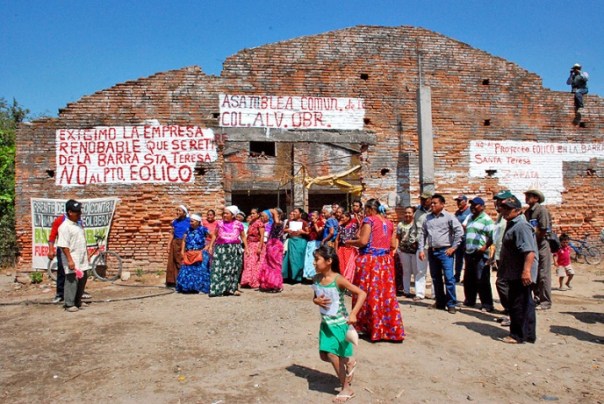
The autonomous community of Álvaro Obregón, Juchitán, Oaxaca
To the media
To the solidarity organizations
To the Human Rights organizations
To the dignified Binizza community of Álvaro Obregón, Juchitán, Oaxaca
Sisters and Brothers
Our peoples, tribes, communities, organizations, and neighborhoods see with rage and indignation how the bad government boasts its total lack of shame, through its political parties of every color, as it continues to attack our peoples and its political parties continue trying to divide our communities. Our voice will not tire of denouncing and shouting: Enough!
On May 14, brutally and shamelessly, the police and bodyguards of the PAN-PRD candidate Gloria Sánchez López dared to aim their murderous weapons at the dignified community of Álvaro Obregón, Juchitán, injuring the six compañeros who were in an assembly, defending their physical and political territory from deadly wind energy projects, whose “clean” energy is filthy with blood, corruption, and death. The candidates from all of the political parties—who even though they are only candidates feel they can already benefit from the impunity they are granted for belonging to the band of criminals badly governing the state of Oaxaca and the country—believe that with bullets they will manage to change the conscience and kill the dignity of the Binizza people.
National politics makes it increasingly clear that the political class has no shame. They believe that they can attack, threaten and intimidate the dignified struggle of the people. With aggressions and violence they try to sow fear in the dignified hearts that defend the land, the water, and the wind. From the four cardinal directions of our indigenous territories we say to them: you cannot! You cannot stop the rage in our hearts from turning into solidarity; you cannot strip us of the dignity of struggling to defend our territories and the life of our peoples; you cannot intimidate the dignified struggle of the Binizza people, who have honored the National Indigenous Congress by being a member for many years now.
Therefore, brothers and sisters of Álvaro Obregón, Juchitán, Oaxaca, from the four directions of our territories we say to you, you are not alone! You are not alone! We declare ourselves against the acts that the bad government of Mexico and Oaxaca, through their henchman Saúl Vicente Vázquez, municipal president of Juchitán, carry out against the rights to self-determination and autonomy of the people of Álvaro Obregón.
We denounce that the cowardly aggressions made with firearms on May 14 and the ongoing threats. These are an attempt to intimidate the community of Álvaro Obregón, which opposes the installation of wind energy projects in their territory. The politicians get angry when they cannot make their profits by installing these projects of death and who believe that by intimidating the people they will be able to. They are mistaken!
Because of all of this we declare that:
We hold the government of Gabino Cue and Saúl Vicente Vázquez responsible for the aggressions that have occurred and continue to occur against the assembly of the community of Álvaro Obregón, Juchitan, Oaxaca.
We demand the investigation and punishment of those responsible for the shots fired by the municipal police of Juchitán and the bodyguards of Gloria Sánchez López.
[We demand] the cancellation of the wind energy projects that they are trying to impose on the territory of the Álvaro Obregón community.
We demand that Gloria Sánchez López and all of the candidates stop trying to impose their party system on the community of Álvaro Obregón.
We demand that they respect the legitimate rights of the Binizza people to elect their own authorities in an autonomous manner.
To the community of Álvaro Obregón, Juchitán, Oaxaca, we say, you are not alone; as the CNI we will be vigilant to make sure these events do not happen again and we will make our voice heard from every corner of our blood-soaked country.
For the full reconstitution of our peoples!
Never again a Mexico without us!
National Indigenous Congress
Zapatista National Liberation Army
Zapatista autonomous justice
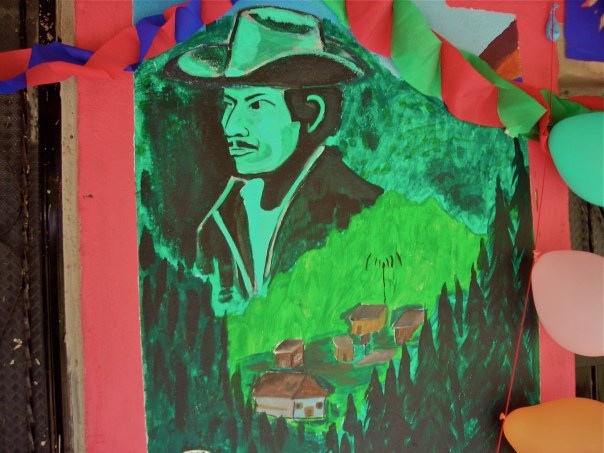
A mural on the front of the Good Government Junta’s offices in La Garrucha includes the image of Francisco Gómez, one of the EZLN’s early organizers in this Zone. He died in the bloody battle of Ocosingo in January 1994.
By: Luis Hernández Navarro
The notoriety that the Zapatista armed uprising acquired in the mass communications media during its first years has diminished noticeably. The rebels have stopped being daily news. There is one who even announces its extinction with approval.
Of course, that’s not true. The Zapatista National Liberation Army (EZLN) continues being a very relevant political force inside and outside of the country. However, the attention that the glitter of their guns attracted has been diluted before the epic of constructing from below and without asking permission, against all odds, another world.
Many books, theses and reports –some very good– were written about the indigenous insurrection of the Mexican southeast. Very few have been elaborated about the rebel feat of constructing a government and a system of autonomous justice in a broad territory under their control. Although thousands of people have visited and lived in the Zapatistas communities for varied lapses of time, literature that tells what happens there does not abound.
Certainly, there are some very notable works that give an account of the avatars of the rebel education project, from their experiences with collective organization to production on occupied lands or of the impact of their autonomic project on the struggles of the Indian peoples. Nevertheless, compared with the intellectual boom that accompanied the armed uprising, those that analyze and document day-to-day self-government are rather scarce.
One of those books is Zapatista autonomous justice: Tzeltal jungle zone, from Doctor Paulina Fernández Christlieb. It’s not just one more work, but rather by far the most complete and documented investigation about the way in which justice is imparted in four Zapatista municipios. [1]
Zapatista autonomous justice: Tzeltal jungle zone is a collective work with collectives, which gathers the voices of the rebel support bases. Very far from a classic academic essay, the book makes a passionate X-ray of the construction of alternative government and justice institutions born from the entrails of the rebel communities, a countercurrent to the logics of power.
Those institutions, already present in the January 1, 1994 Uprising and in the laws that it produced, started to take a finished form because of a government betrayal. On February 16, 1996, the federal government signed the San Andrés Accords on Indigenous rights and culture with the Zapatista National Liberation Army (EZLN). Nevertheless, the Mexican State as a whole (its three powers) betrayed its word and refused to convert them into laws. Far from shrinking in fright, the rebels decided to put them into practice, without the restrictions that the ones negotiated obliged.
They have done it, above all, within the autonomous territory established on the thousands of hectares occupied at the beginning of 1994, and distributed to work for the collective benefit. Three administrative spaces have been constructed in this territory in dispute: the communities, the Zapatista Rebel autonomous municipios (MAREZ) and the Good Government Juntas. Their jurisdictions are differentiated by the complexity of the problems that each one of them must solve. That is where justice is exercised, required not only by the rebels, but also, surprisingly, by the non-Zapatistas. Zapatista autonomous justice: Tzeltal jungle zone narrates and analyzes that challenge.
Paulina Fernández confesses that her book has a double proposition. The first is to show the ability of the Zapatista indigenous peoples to construct a project of autonomous life , government and justice, an alternative to the dominant ones in Mexico, on this space in dispute.
The academic idealization of the finca is in style. Some studies present it as a “harmonic” living space between housed serfs and landowners. Through the testimonies of those who suffered the savage exploitation of this productive unit and of their descendants, Zapatista autonomous justice: Tzeltal jungle zone de-mystifies this vision.
“For those who were born and worked on those fincas –Paulina Fernández writes–, what is still important to those old ones that were treated like animals, are the whip lashings that they received as punishment. There are also the more than 12-hour days without pay and the kilometers between the finca and the city where they had to go and from where they had to carry cargo on their backs.”
From that humiliating experience, from the life they came from on the fincas, from the abuse of women, was born the courage and the obligation to change things, the will to rebel against an order not only unjust, but also undignified.
In the midst of an era of soft coups against progressive governments in Latin America, of disenchantment with institutional politics on fringes of the population that are broader every day and of the sharpening of the policies of dispossession against the commons, the experience narrated and analyzed in Zapatista autonomous justice: Tzeltal jungle zone acquires enormous relevance. What the Zapatistas narrate in the book are not abstract ideas to fulfill, but rather another world that is being constructed.
Zapatista autonomous justice: Tzeltal jungle zone is an essential book, not only for comprehending what Zapatismo is today, but also what the struggle for emancipation can be.
[1] The four autonomous Zapatista municipios in the Tzeltal jungle zone are: Francisco Gómez, San Manuel, Ricardo Flores Magón and Francisco Villa. Their Caracol, or headquarters, is located in La Garrucha.
—————————————————————–
Originally Published in Spanish by La Jornada
Tuesday, May 17, 2016
Re-Published with English interpretation by the Chiapas Support Committee
Thousands of Chiapas teachers initiate a strike
THOUSANDS of CNTE TEACHERS in CHIAPAS INITIATE A STRIKE

Chiapas teachers march in the state capital of Tuxtla Gutiérrez.
By: Isaín Mandujano
TUXTLA GUTIÉRREZ, Chis. (proceso.com.mx). – This Sunday, on Teachers’ Day, thousands of members of the National Coordinator of Education Workers (CNTE) started an indefinite work stoppage to protest against the education reform.
Even with coercive economic measures like withholding paychecks and freezing the savings accounts, this Sunday teachers from Sections 7 and 40 of the National Education Workers Union (SNTE) carried out a mobilization that started on the east side of the capital and concluded at the central plaza, where they held a meeting.
The Financial Intelligence Unit of the Secretariat of the Treasury and Public Credit notified the teachers maestros in Section 7 of the SNTE by means of an official letter that “by disposition of the authority” the bank accounts of the Fund for Savings and Social Benefit were blocked, and therefore they would not be able to use them.
Alberto Mirón, one of the leaders of the CNTE in Chiapas, stated his rejection of this federal government arrangement and said that they would not stop the teachers movement in Chiapas, even with these repressive measures.
“To the contrary, they are only going to anger and disturb the Chiapas teachers more therefore, as was foreseen, beginning this Sunday we will be in an occupation and labor strike indefinitely,” Mirón said.
Thousands of teachers who had taken steps to obtain a loan prior to the strike were left without their checks, and therefore have to wait until the bank accounts are unfrozen.
They blamed the Secretary of Public Education (SEP), Aurelio Nuño, for being behind what they classified as a repressive measure, and because of which they will now radicalize their protest actions even more in the coming hours.
This measure is added to the withholding of their biweekly paychecks that thousands of teachers were not able to collect since last Friday. The teachers gave them until this Monday to pay them for the first two weeks of May, if not they will intensify their protests.
Pedro Gómez Bámaca, another leader of the CNTE’s teachers, said that faced with the arrival of Federal Forces in Chiapas, they would be on alert and that in case any teachers is arrested within the framework of their protests, they will start to retain functionaries and take them to the occupation located on the central plaza, where they will be displayed.
Gómez Bámaca asked the federal government to open the door to dialogue and negotiation, because “it ought to be clear that if in 36 years no previous government was able to make the CNTE disappear, even less will this government of Enrique Peña Nieto be able to do it.”
Other teachers’ unions from other levels and educational sectors accompanied the teachers, as well as campesinos and parents that were adding on to the march along its tour of some seven kilometers to reach the central plaza.
[More photos of the march here.]
As to the warning that they will be fired from their positions if they don’t present themselves at their workplaces in three working days, Gómez Bámaca said that the teachers would challenge the education authorities and would be in the occupation more than three days to see if they are able to fire them.
Whatever they do, whatever they attempt, for each one of us they fire we are going to respond with more spirit and organization, we are not going away, the teacher compañeros have no fear,” Gómez Bámaca said.
“All the members of Section 7’s Executive Committee have gone five months without pay, they haven’t paid us, and here we are, here we continue showing our face in the mobilizations,” Gómez Bámaca said.
He added that there are threats of capture and open preliminary investigations where they point to terrorists, but despite that he warned that they would in their movement.
Although the state government indicated that there were only 3,500 teachers; what’s certain is that there were tens of thousands that marched this Sunday in Tuxtla.
In Section 7 alone there are 45,000 teachers and 22,800 in Section 40; that’s without counting the thousands of workers from other unions that added onto the protest today.
——————————————————-
Originally Published in Spanish by Proceso.com
Sunday, May 15, 2016
http://www.proceso.com.mx/440716/inician-paro-miles-maestros-la-cnte-en-chiapas
Re-Published with English interpretation by the Chiapas Support Committee
Wikileaks: Temer was a U.S. Embassy informant in 2006
This morning, Saturday, May 14, 2016, La Jornada in Mexico published the Wikileaks news about Brazil’s new interim president, Michel Temer, having given information about the political situation in Brazil to the U.S. Embassy in 2006. La Jornada interprets this as having been a CIA informant. Other news outlets around the world are also publishing this story. http://www.jornada.unam.mx/2016/05/14/mundo/017n2mun
Meanwhile, Raúl Zibechi believes that the cause of Dilma’s impeachment was a fear of those below by Brazil’s 1%. See his article below.
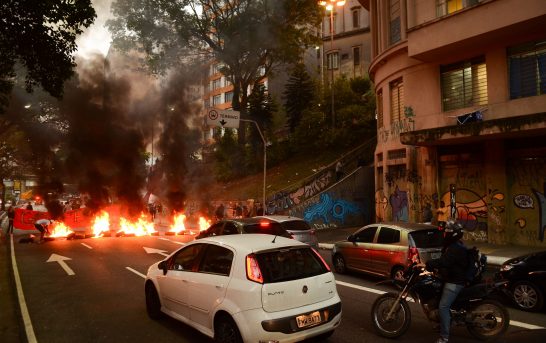
Anti-impeachment protests in Brazil.
CAUSE OF THE IMPEACHMENT: THE ONE PERCENT’S FEAR OF THOSE BELOW
By: Raúl Zibechi
In the face of the Brazilian crisis the decisive question must be: Why did the big financiers that had supported Lula and Dilma break with the governments of the PT and launch a potent offensive to obtain removal? The offensive of the Brazilian right against President Dilma Rousseff was the product of an abrupt turn, a consequence of the intensification of class struggles, in particular of the poor, blacks and inhabitants of the favelas.
In order to elucidate this hypothesis it’s necessary to reconstruct what happened in recent years. The events they say were the turning point in the tolerance of the bourgeoisie happened in 2013. With the distance of time it’s possible to show confluence among diverse sectors of workers and young people in a juncture that permitted giving an enormous qualitative leap in the popular sectors’ ability to mobilize. For that we see three events: the mobilizations of June 2013, the notable rise of strikes and the growing organization of the different los de abajos (those below).
We have talked a enough about the first point: in June 2013, millions of young people won the streets against the increase of urban transportation and police repression, in actions that ought to be understood as a gigantic denunciation against the inequality that the Workers Party governments did not modify, although there is a decrease in poverty. Now we know that inequality not only didn’t fall, but rather tends to increase, even in the periods of economic bonanza, when the one percent monopolized 25 percent of the wealth, percentages that will have risen during the present crisis.
The second is related to strikes. The workers’ struggles in Brazil had reached a peak after the exit of the dictatorship, in the period of approval of the new Federal Constitution in 1988 and the first direct presidential elections in 1989. In those years they reached an historic peak of 1,962 strikes in 1989, and something less in 1990, to descend abruptly in the neoliberal decade and stabilize under the two Lula governments to around 300 strikes annually.
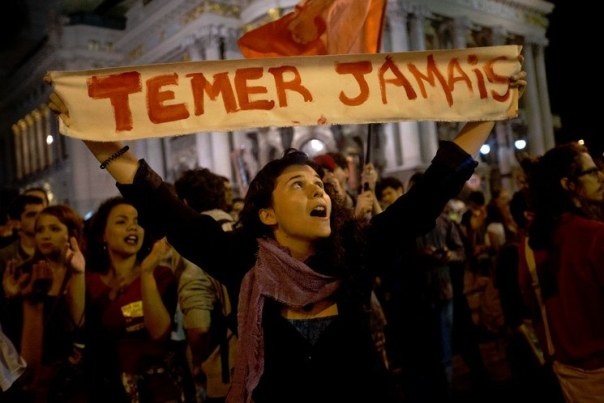
A Brazilian protester’s sign reads: “Never Temer.”
The year 2013 produced a sudden increase in strikes (although they had already increased in 2012), beating the record of the historic series of the last 30 years. According to a report from the Inter-Union Department of Statistics and Economic Studies, Balance of Strikes in 2013 (http://goo.gl/o35Wi6), there were 2,050 strikes that year. But quantitative growth is data that doesn’t show the strong changes in the protests.
The cited report emphasizes that there was an expansion of struggles to sectors that usually don’t mobilize. It maintains that there was an “overflow” of “the most fragile professional categories, as much from the viewpoint of remunerations as for working conditions, health and security.” It particularly refers to workers in the food and urban cleaning industries.
Some 800,000 people work in the cold storage industry, of which between 20 and 25 percent present health problems, since they realize between 70 and 120 movements per minute, when it’s recommended not to exceed 35. In 2010, 70 percent of the workers at the multinational Brazil Foods suffered pains because of the work, and 14 percent thought about committing suicide because of the pressure to which they are subjected (http://goo.gl/x0Bxfi). A youth that enters the industry at 25, already has irreversible injuries at 30.
The urban cleaning workers of Rio de Janeiro went on a memorable strike during Carnaval 2014 and got increases of 37 percent in their salaries. It was a massive and combative strike that was maintained based on direct democracy, unknown to the bureaucratic union (http://goo.gl/zvl58G). The immense majority of them are blacks and mestizos that live in the urban peripheries and in the favelas.
In 2014, the less qualified and lower paid layers of the working class irrupted, encouraged by the June 2013 mobilizations and impelled by the crisis that they started to feel in 2012.
The third question consists of the increase of organization and activism in the favelas, where the poorest Brazilians live. On June 24, 2013, while millions were peacefully demonstrating in the avenues, the police entered shooting into the Complexo da Maré [1] in Rio de Janeiro, and murdered 10 black youths. That’s common. What was different was the response of favela residents: 5,000 neighbors cut off the strategic Brazil Avenue for two hours. It was the beginning. In July, the actions multiplied because of the disappearance of the worker Amarildo de Souza at the Pacifying Police Unit, of the Rocinha favela.
The flash mobs, or strolls, (rolezinhos) happened in December and January, where thousands of poor youths met up in the shopping malls and, dancing, challenged the police. From there, there were dozens of reactions to the police brutality. Favela residents neutralized control and started to organize cultural groups in many favelas, for denunciations, human rights defense. Those groups are connected to other groups from other favelas. They have lost their fear.
Those below re-launched their fight for dignity and for life. It sounded the alarm for those above. In one of the world’s most unequal countries, where class coincides with skin color, classism and racism are expressed with the brutal violence that characterizes colonial societies. Thus, Brazil must be analyzed as a colonial society, where capital accumulation supports itself on segregation that supposes the non- recognition of the humanity of those below.
The crisis has devolved that democracy is barely the veil that those above use to hide their shames: the first and fundamental being that they are not willing to share the pie with blacks and mestizos; only the leftover crumbs are for them. But the problem is something else: we believed the story, some for convenience, and others because of slowness or fear.
[1] To read about the current situation in the Complexo de Maré, a group of neighborhoods in Rio, see: http://www.telegraph.co.uk/news/worldnews/southamerica/brazil/11515531/Rio-favela-still-wracked-with-fear-and-violence-as-Olympics-2016-approaches.html
—————————————————————————
Originally Published in Spanish by La Jornada
Friday, May 13, 2016
http://www.jornada.unam.mx/2016/05/13/opinion/015a2pol
Re-Published with English interpretation by the Chiapas Support Committee
A Dialogue with Raúl Zibechi
EXTRACTIVISM IS A WAR AGAIST PEOPLE

A dialogue with journalist Raúl Zibechi (left), who reviews the irruption of new social movements in Latin America within the framework of the end of the cycle of the progressive governments.
By: Mirko Orgáz Garcí, journalist
Bolivia, March 13, 2016
Journalist Raúl Zibechi was at the XXIV Marcelo Quiroga Free Seminar “Analysis and alternatives to dependence and extractivism [1] within the framework of the global economic crisis,” held on Tuesday, February 16 in the auditorium of the UMSA [2]. He asserts that extractivism is a global war from those “above,” from the multinationals and the States, against the peoples to appropriate land and water for themselves. “The particularity of Latin America in the last 10 or 15 years is that this extractive model, this accumulation by dispossession, is the fourth world war and it has been headed by progressive governments,” he says. He proposes getting out of extractivism, which not only is an economic model but also a political, social and cultural one, driving the financial system, “that 1% that dominates the world and every one of our countries.”
What are the characteristics of the current global political economic crisis?
We are not facing an economic crisis but rather a systemic re-composition, the system as such cannot continue without fundamental changes, and a civilizational crisis that basically affects Western civilization. The system rests on two pillars: the international division of labor, the fruit of creating a center and a periphery five centuries ago. The second transfers wealth to the first, through different mechanisms throughout time, from the unequal colonial trade to the financial system’s most recent transfers thanks to the petrodollar. But the strengthening of countries previously on the other side of the globe is provoking a collapse of that stability, affecting principally Europe and the United States. It’s the creation of the multipolar world that we are seeing.
The end of the progressive governments in Latin America is talked about. Why do these governments appropriate the banners of social revolution?
I prefer to talk about the end of a cycle, because in reality having progressive governments will continue but now they are becoming conservative governments. What happened is that one of the pillars of their governability, the high international prices of commodities, came down. It was a long cycle of super-high prices that permitted improving the material life of the majority of individuals without modifying the productive model and without touching the privileges of the richest 1% of the population.
They appropriate banners with the same logic as the system, which needs to subsume everything that rejects it as legitimate. Now Mauricio Macri talks about never again in reference to the violation of human rights. The system functions like this, independently of those who are at the head. We have discourses about green and sustainable mining and all of that.
Did Latin America live through a lost decade with the progressive governments?
I don’t believe that it is a lost decade. People learned a lot, in several senses. On the one hand, it has been gaining in self-esteem, happenings like the water war or the two gas wars leave sediments, as well as the march in defense of the TIPNIS, to mention the big events in Bolivia. Inverting the previous question, we can say that the peoples in movement are so strong that the governments need to appropriate the banners of those below in order to have a minimum legitimacy.
How does society confront this end of the cycle?
With much calm and a lot of patience. The pendulum is not only going from left to right, it’s also going from above to below. It is the common people’s turn, the Indian peoples’, the women, youth, all the oppressed, those that were quiet these years because they had to listen to those above.
There is a very strong contrast between what happened on the afternoon of October 17, 2003 in San Francisco Plaza, when the crowd cried out “Yes we can,” and what came afterwards. To whom did they cry out the day of the fall of Goni? [3]
No to the President that was already a political cadaver. They were shouting at themselves, it was a shout of self-esteem, “Yes, we can take the sky by assault,” as Mao would say. But in the following years that empowerment disappeared, in part because some leaders said what the people wanted to hear, but also because many people wanted to let them govern, which the governed the good or their own, which is always the easiest path.
But now the limits of government from above were shown. And now the pendulum goes down again, perhaps as in the decade of the 1990s, before the 1990 march when the peoples slowly started to self-organize. I believe that things are going in that direction, but one will have to follow things very closely because the professionals of discourse are going to do their job.
About what new subjects are we talking and what is their political horizon?
This is the million-dollar question that we are still not able to answer, except in the case of Brazil and even there only partially. I tend to think that old-style movements, those called social movements, championed the TIPNIS March. But June 2013 in Brazil, with the irruption of millions of youths in the cities, the new-new movements that are small collectives that function based on autonomy, decisions by consensus, outside the political parties and horizontally. They no longer want leaders or apparatuses that mark the path for them, they decide for themselves where to go and towards where they walk.
I believe that we are going to experience movements of a new kind, because the progressive cycle moved many things and demonstrated the inability of the big apparatuses to do anything better than permit their leaders to become palace lackeys. Those big structures are more empty shells, hierarchic and patriarchal all the time, incapable of promoting anything that has any relation to emancipation.
To the contrary, we see a infinity of small groups with young people, which express themselves through cultural forms opposed to the established powers. It’s still too soon to know the reach of these new subjects, but there is learning: “it’s of little value to organize for entering the palace because in a little while those who enter will be just like the ones we threw out.” In other words, we’re dealing with creating something new, different, on the basis of what we learned.
Toward what type of society does that society in movement lead us?
We cannot know that. We hope that it is toward a fuller life, democratic, free, not subject to states or parties that come to substitute for the old churches. We aspire to a society where people govern themselves in the greatest number of spheres possible, where others do not govern them. For that, one must create a communitarian culture, not in the image and likeness of the old ayllu [3] that is very useful as an inspiration but that must be reconstructed above other bases, overcoming patriarchate, generational hierarchies and strongmen. It won’t be anything simple because we’re dealing with a very profound cultural revolution that, necessarily, will be expanding gradually, because culture changes over long periods of time.
===============
Translator’s Notes:
[1] Extractivism – What David Harvey calls accumulation by dispossession Zibechi calls extractivism. It consists of financial speculators taking away something from the common people to obtain corporate profit; for example, the use of land, clean water, clean air, natural resources. Zibechi applies this concept to both rural and urban settings in South America. The urban setting often involves real estate speculation (flipping houses, replacing old single-family homes with condos, shopping centers, etc.). These are transfers of wealth from the poor or the working class to the rich, involving physical and cultural displacement.
[2] UMSA – Higher University of San Andrés, located in La Paz, Bolivia.
[3] “Goni” refers to Gonzalo Sánchez de Lozada, who served two terms as president of Bolivia.
[4] Ayllu – An indigenous local government model across the Andes region of South America, particularly in Bolivia and Peru.
—————————————————————————
Originally Published in Spanish by Movimientom4.org
Friday, April 6, 2016
http://movimientom4.org/2016/04/el-extractivismo-es-una-guerra-contra-los-pueblos/
Source: Página Siete
—————————————–
Re-Published with English interpretation by the Chiapas Support Committee
Los de Abajo: Chablekal Resists!
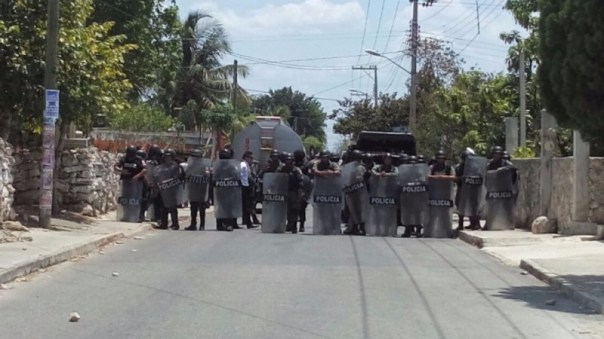
Yucatán police in Chablekal.
By: Gloria Muñoz Ramírez
Behind the police attack on the town of Chablekal, Yucatán, is found the savage dispossession that real estate and tourism investors have done in this peninsular community, and the putting into effect of Yucatán Shield, a security strategy at the service of the owners of capital, analyzes the team of Indignación A.C. human rights defenders, whose members were also attacked and detained.
Chablekal is territory under siege, a paradise for speculators since two decades ago, because its privileged location, just some 20 kilometers from Merida, makes it perfect for wealthy families that don’t want to live in the city, but close to it.
It was in this small community of barely 4,000 inhabitants, in which last May 3 between 30 to 40 patrols saturated with Yucatán police agents, two fire trucks and ambulances irrupted, for the purpose of executing an eviction order on a piece of land belonging to an elderly gentleman that faces a legal dispute with a relative that attempted to sell his property.
Chablekal is a tranquil town pueblo in which apparently nothing happens. But the violent irruption and disproportionate number of police woke up its inhabitants and made them confront them, because they were attacked with everything, firing tear gas against men, women, children and elders.
The arbitrariness and outrages, the detentions and violence, also convoked the solidarity and accompaniment of organizations throughout the country, including the Zapatista National Liberation Army (EZLN) and the National Indigenous Congress (CNI), who jointly denounced this act as: “an attempt at intimidation of the human rights defenders as well as the in habitants of the community of Chablekal, which has organized in the Union of Chablekal Inhabitants for the Right to Tenancy of the Land, Territory and Natural Resources, in order to defend what remains of their territory from the theft and dispossession that they have been suffering in recent years from speculators and new land owners.”
The four detained during the operation were released 48 hours later, but the Indignación Center specifies that multiple political, administrative and/or criminal responsibilities derived from the operation are pending. “This experience evidences that a police state cannot be the basis for combatting the situation of insecurity and social conflict that exists in Yucatán,” the team emphasizes.
The final result is a community more united and organized that proved to itself that it can defend its residents and that they are not alone.
————————————————————-
Originally Published in Spanish by La Jornada
Saturday, May 7, 2016
Re-Published with English interpretation by the Chiapas Support Committee
 Chiapas Support Committee