Chiapas Support Committee
Home of the Compañero Manuel blog on zapatistas & mexico
Zibechi: New black movements in Latin America

Black lives matter art by Emory Douglas.
By: Raúl Zibechi
Last June 11, a group of neighbors from the Morumbi barrio of São Paulo demonstrated in support of the police that killed Ítalo, a 10-year old black boy. According to the demonstrators, the boy was just a delinquent that deserved what happened to him. Morumbi is the city’s richest neighborhood and is known for its mansions and luxury condominiums, where Brazil celebrities and important people live.
That same morning, 30 black activists from the urban periphery arrived with banners and photos of youths murdered by the Military Police, rebuking the demonstrators as “racist killers.” “I am here fighting against the bourgeoisie that goes into the street to make our death natural and banal, the death of black youths from the periphery,” a 21-year old youth from the east zone of São Paulo told the media (http://goo.gl/cdOYBE).
Certainly, it was a small but important response that places in evidence what to many is the current Brazil’s greatest contradiction: racism. It’s interesting to emphasize that the young black militants crossed the whole city, in a trip of no less than two hours each way, to challenge the dominant classes in the territory that represents the nucleus of their power; an attitude that reveals conscience, organization and courage.
That same week of June, the black Colombian communities that participated in the Agrarian, Campesino, Ethnic and Popular Minga carried out important actions, like the takeover of Port Buenaventura, in which 130 boats of fishermen and hundreds of demonstrators grouped together in the Process of Black Communities (PCN, its initials in Spanish) closed the port. “The sea belongs to us,” was the slogan with which they blocked the most important port of the Pacific, the region converted into territory where part of the black people live.
The Association of Community Councils of the Northern Cauca (Aconc) mobilized within the same context as the Minga demanding the defeat of the mining titles that were granted to transnationals, with mass marches in Quinimayó, in the municipio of Santander de Quilichao. One of their leaders, Víctor Hugo Moreno, emphasized that mega-mining “is displacing ancestral and artisanal mining, affecting water sources and breaking up our territories and organizational processes” (http://goo.gl/Loz21s).
The PCN is made up of 120 grassroots territorial organizations, from the Caribbean to the Pacific, and functions with their base in regional palenques (Afro-Colombian historic villages), with a national assembly that elects a council of all the palenques. The Aconc unites around 40 community councils in 10 municipios in the northern Cauca. Both participate in the Agrarian Summit that organized the national strike in June (http://goo.gl/DfboIk).
With big differences between them, the new movements of Brazil and Colombia are experiencing a new phase. After resisting an undeclared war, they show signs of going on the offensive. Of the 5 million black Colombians, terrorist actions of the paramilitary groups and the armed forces have forcibly displaced more than 700,000. In Brazil, violent death of blacks increased almost 40 percent since 2003, when Lula arrived in government, while the violent death of whites fell 25 percent. They are not, of course, the only countries where black resistance is entering into a new stage.
Dozens of collectives have been born in the favelas and urban peripheries of Brazil that represent a new generation of militants; many of them formed in secondary colleges and universities, with strong leadership from young women. One of the most significant is called Occupy Alemão, in the complex of favelas of Maré (Río de Janeiro). The collective groups together between 20 and 40 people; it was born in response to the military occupation of the Alemão favela in 2010, and the construction of cable cars so that tourists can photograph the poor, a real open sky panoptic for control of the population.
Occupy Alemão proposes that: “we occupy our favela with collective actions.” They reject the way in which the lefts relate to the favelas and don’t spare criticisms of the NGOs. Among their activities they emphasize cine-debates, games with children, graffiti workshops, the Occupy Rock Festival held in August 2015 and the annual Black Economic Fair, iteration between black spaces, for the purpose of spread the cultural and political resistance.
In the fairs, each exhibitor gives 20 percent of his earnings to a fund for fights and support for victims of the State. They maintain that: “economic blackness does not offer anything new for the favela or to black people, nor does it represent a new ideology”; to the contrary, “it is the quilombo (palenque) that teaches us about economic autonomy and self-management. The favela inherited it and makes its business of its space. Economic blackness is our best way of supporting ourselves collectively. Our own fair: Black Autonomy!” (https://goo.gl/AQ4Z5I).
The Occupy Alemão members recognize having passed through three stages. The first stage was with NGOs and it left a bad taste. Next, they linked with autonomous movements in other favelas and created the Popular Forum of Mutual Support. In the third stage, they tightened their ties with the React or Die campaign (Reaja ou Seja Morta, reaja ou seja morto), which was born in Bahia in 2005, with which they organized the March against the Genocide of Black People.
The React campaign is, probably, the most important creation of the black movement in Latin America (for its rejection of cooptation and the State, for its autonomous ways, for its radicalism), which we activists should know about (reajanasruas.blogspot.com). Hamilton Borges, founder of React, traces a balance of these 10 years based on what he calls the “theory of general failure, if success is promoting equality. If success is sitting down with the enemy faced with the blood of our people, then we prefer the failure of confronting terror in the streets.”
————————————————————
Originally Published in Spanish by La Jornada
Friday, July 22, 2016
http://www.jornada.unam.mx/2016/07/22/opinion/018a1pol
Re-Published with English interpretation by the Chiapas Support Committee
Critical thought versus the capitalist hydra II

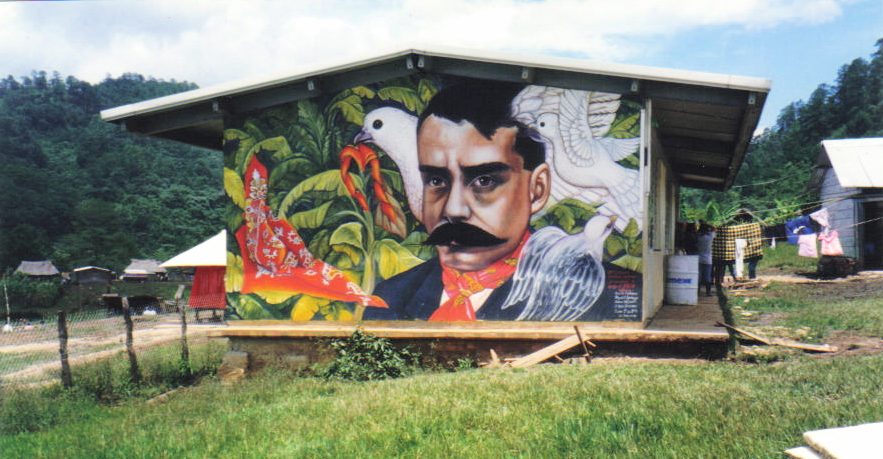
Mural art at CompArte in the Zapatista Caracol of Morelia, Chiapas.
By: Gilberto López y Rivas / II
Continuing with commentary on the second tome of the work Critical thought versus the capitalist hydra, Sergio Rodríguez Lascano proposes that, faced with the diversity of rebellious processes, the idea of a vanguard becomes obsolete and he replaces it with meeting and sharing, which must also be present within the terrain of ideas. “Breaking with individualism in theoretical elaboration is a precondition of critical thought.” He proposes constructing a world in which the hydra cannot be reproduced. It’s not about conceiving other worlds, but rather about constructing them. “One cannot destroy the hydra if our political and ethical behavior counts on the same principles that the hydra has imposed, since domination is domination.”
Luis Lozano Arredondo begins with a criticism of the universities, which, he asserts, remain in the comfort of theory, while the knowledge of the communities in resistance advances in the construction of a world of self-management. He exposes how exploitation and dispossession in our country is expressed, to the extent that 85 percent of the population experiences poverty has lost all its labor rights and maintains high levels of unemployment and overexploitation. He proposes collaborating, cooperating and sharing our knowledge with other humans to imagine and construct another world.
Rosa Albina Garavito considers that the catastrophe that the Zapatistas announce in reality surrounds us, destroying everything in its path: our labor force –up to 60 percent of the occupied population swelling the ranks of informal employment–, labor stability, working conditions agreed upon bi-laterally, pension funds, salaries, savings accounts, the more than a thousand quasi-state companies, among them Pemex. Health services, education, housing, nutrition have deteriorated; in sum, the capitalist hydra has dismantled without effort social rights we won and the only thing left is our dignity and self-organization. She considers autonomy as the project of the future, with dignity and decision-making ability versus the State. With autonomy, the Zapatistas are cutting off many heads of the capitalist hydra. It is the seed of the new country.
Efraín Herrera, from the Callejero Collective, considers that they construct a distinctive esthetic discourse starting with a rebel attitude in capitalist society, starting with what Bertolt Brecht maintained; that “before being an artist, you are a social being.” It is in the field of rebellion where one finds creative character, imaginative and purposeful. This implies taking an attitude versus the State. They found that the pamphlet doesn’t provoke immediate reflection and opted for the metaphor as an effective tool that leaves the door open to a lasting reflection. They are convinced that there is no other alternative than to form more and more collectives.
Eduardo Almeida Acosta considers that we are experiencing the global apocalyptic situation, a capitalist nightmare, now neoliberal, globalizing and extractivist: “The narcissistic zeal or the effort to preserve one’s own existence at the expense of all the others… and to seek its perpetuation as a system without importance to whether it implies violence, war and death. That is reflected in our country, the mined Mexico: a bankrupt republic, a country at war with itself; a mafia State and a corporate waster, a dark government, about social control and aligned with speculative business elements and in collusion with criminals.” One head of the hydra is the perversion of politics; another has been the injustice in the treatment of different cultures; a third is the plunder of national sovereignty, of the individual rights and of social and community rights, and a fourth head forms the complex of misadventures that all Mexico suffers due to the impoverishing management of the macro-economy. The injustices of the financial markets are another big head. He wonders: what to do in the face of this devastation? Intensifying rage, putting the body (on the line), challenging everything, inventing new forms of struggle versus domination: another democracy, other forms of autonomy, another anti-imperialism. Dreaming, imagining, ideating other forms of weaving social cohesion.
Vilma Almendra, an indigenous Nasa-Misak woman from Colombia, confronts the four heads of the hydra: terror and war, structural adjustment, propaganda and cooptation and assimilation of struggles. Terror and war as the instrument for dispossessing the communities; structural adjustment between the transnationals and the States for defining all the laws of dispossession and for imposing the agendas of above; propaganda in the communications media, the churches, the schools that seek to dispossess distinctive and critical thought, and the cooptation that robs entire processes, stops the movements, even through concepts like multiculturalism. She criticizes negotiations with governments, which are executioners and that ultimately end up with meeting after meeting, committee after committee, confusing the political agenda of struggle and being subjected to the State’s agenda. Despite it all, she considers that the policies of the transnationals and the bad government are not winning, making a journey through the struggles for Mother Earth / Madre Tierra. “It’s important to see and to know that these struggles, resistances and freedoms, despite the politics of extermination and dispossession, continue flourishing, continue emerging, are there in front of us, versus the capitalist hydra.” She invites re-appropriating words into the walk, in what she names “palabrandar our path of the dignified word.” Revitalizing the assemblies as the maximum authority. She maintains that: “from the territories, and also from academia (it’s about), attaining harmonizing theory and practice, because at times from academia we imprison ourselves in the practices and we convert them into concepts, we are leaving them without wings.” Nevertheless, she rejects that essentialism constitutes a position of the peoples and the communities; “we are not pure,” she asserts.
———————————————————–
Originally Published in Spanish by La Jornada
Friday, August 5, 2016
http://www.jornada.unam.mx/2016/08/05/opinion/018a2pol
Re-Published with English interpretation by the Chiapas Support Committee
Art that is not seen or heard

Occupy (Okupa) art from CompArte! Note the remembrance of the black power protest during the 1968 Olympics.
(Note: the following are the comments made by Subcomandante Insurgente Moisés to mark the conclusion of the Zapatista’s contribution to the CompArte, in the Caracol of Oventik, on July 29, 2016. The threat of rain and the pressure of time did not allow for the compañero to fully develop some of his points and there were others that he was unable to touch on at all. Here we present the original version that he was going to give. In his voice is our Zapatista word).
THE ZAPATISTA NATIONAL LIBERATION ARMY
MEXICO
July 29, 2016.
Artists of Mexico and the world:
Sisters, brothers, and hermanoas:
For us, the Zapatistas, art is studied by creating many imaginations, reading the gaze, studying in listening, and practicing.
It is by putting it into practice, that is, by doing it, that you will begin to see the result of the science and the art of imagination – the art of creativity.
There is some science and art that is needed immediately, the kind that helps us imagine how to do it.
There can be medium term science and art, and there is long term science and art that improves over the course of time.
For example: To even make something tiny that will contribute to the new world requires that we involve ourselves profoundly in the science and art of imagination, in the gaze, in listening and in creativity, patience, and attention. It requires that we think about how to move forward while building and many other things that must be taken into account.
Because what we want, or what we think about, is a new world, a new system. We don’t want a copy of what we have, we don’t want to improve it a little bit. This is a problem, we say, because there is no book or manual that explains how to create this new world. This book or manual hasn’t been written yet, it is still in the heads of those with imagination, in the eyes that are ready to gaze at the new world that they want to see, in the ears that are attentive in order to hear the new world that they want.
This requires a lot of wisdom and intelligence, a good understanding of many words and thoughts.
We say that it works like this because this is how the development of our autonomy has been and will continue to be.
It was built by thousands of Zapatista men and women, with science and art, and for now it can be seen in the 5 zones of the caracoles.
The art that we are showing you, our compañeras and compañeros, had a crude birth, it emerged from the heads of those women and men who themselves decided how to present it to you, [it is] about how they have worked as Zapatistas and autonomous people, with their resistance and their rebellious ways.
The entire process was a chain of art – from the thinking about what they would present, whether it would be a dance number, song, poetry, sculpture, theater, or pottery, to the words, the ideas about how they would get from place to place, then where they were going to get the money for their rehearsal and performances, because they are collectives from the community, the region, the municipalities and the zone.
There were three rounds of selection. For the first round, the people got together in their regions; then the regions met as autonomous municipalities for the second selection; and the municipalities met in zones for the final round.
Their preparations took months.
For the communities of thousands of Zapatista men and women, it was another iteration of what we are, but in a different form, it didn’t happen through conversation or blah blah blah, but through the technique of Art, and everyone participated – children, teenagers, fathers, mothers, and grandparents.
In artistic form, in the art form of the Zapatista compañer@s, they were practicing their resistance and rebellion, their autonomous government of the Junta de Buen Gobierno, their MAREZ (Zapatista Autonomous Municipalities in Rebellion), their local authorities (comisariadas, comisariados, agentas, and agentes), their autonomous health systems, their autonomous education system, their autonomous radio stations, their 7 principles of lead by obeying in their new system of autonomous government, their democracy as communities, their justice, their freedom, their defense of mother earth, and their collective work on mother earth. This will all be the basis on which new generations of young women and young men will be formed, the basis for the Zapatista future.
This is what we presented to you, compañeras and compañeros of the national and international Sixth from Mexico and the world; only a small portion of the compañer@s that were going to participate actually participated. One day we will present the rest to you, but right now there isn’t time, because if we had all come, it would have taken over a month to do all of our presentations, and so that means that there is also an art and a science to how we planned to do a one-day presentation. Because collective mutual support is the most marvelous of all of the arts.
-*-
Compañeras and compañeros from the National and International Sixth:
Sisters and brothers of Mexico and the world:
The storm and the hydra of monstrous capitalism want to prevent us from seeing one another, but through our great effort we are seeing one another here and now.
The compañeras and compañeros from the thousands of Zapatista bases of support for the Zapatista National Liberation Army want to show you their art.
You have seen one part here and in other caracoles you could see other parts. Because more than two thousand artists have been selected and there were even more who didn’t come, not because they didn’t make it through the selection process, but because we didn’t have the money to transport thousands of compañera and compañero artists.
Our compañera and compañero artists aren’t professional artists, but rather their profession is what we call “Everythingologist [Todólogo]” because they are carpenters, masons, shop keepers, they work the land, are radio hosts, milicianos and milicianas, insurgentas and insurgents, autonomous authorities, teachers at the Zapatista little school, health and education promoters, and they still find the time to be artists.
They are true artists in the art of constructing a new system of governance, the autonomy where the people command and the government obeys.
It is an art that you can see, study, and that exists in practice, that you can know through its sharing.
But the compañeras and compañeros also make other art that you don’t know about, that isn’t disclosed in any press releases.
It is the art of solidarity, the support for the people who struggle.
Because the other art and science that the compañera and compañero Zapatista bases of support practice is their support for the struggle of the teachers movement.
You did not see this science and art, but the way it was delivered; the food support was like the art of a hornet’s nest, but there was also an art and science that preceded this.
This is what happened:
We realized that we needed to support this struggle by the teachers who are resisting the capitalist hydra and storm, which we have been talking about for a year.
So then we figured out how much support we were able to give. First we used our word to support them, to say that their struggle is a just one.
Then we tried to figure out how to support the resistance at the sites where they were putting up roadblocks and sit-ins and we realized that we could support them by providing food.
Then we assessed how much support we could send them, and first, how our compañeras and compañeros would respond if we supported them with food from the little that we have as a result of our collective labors.
We figured out how, for example, the food support could work—the delivery, the bags, and all of that. But what you don’t see is the organization of the food collection community by community, the division of how much each community was supposed to provide, figuring out how many tons they were going to be able to get together so that they could figure out how they were going to transport it. Then there was the timing, because the news was saying that the blockades were still there, and then that the teachers were going to take them down to avoid being forcefully evicted because what they were doing was really hurting the rich, and this put a lot of pressure on us because the food that we collected would spoil if there wasn’t any place to take it to.
They had meetings everywhere in order to come to an agreement, because all of the compañer@s said that the support that we needed to give to the teachers’ movement was just and necessary.
So they started to do the math (i.e division), the accounts as we say, say of how much each zone, MAREZ, region, and community was responsible for. There were a few zones where the commissions failed to meet their goal, they didn’t fail in a bad way, but in a good way, because they had reported that their commission would provided 2 tons of food and when the time came they actually provided 7 tons more than they had promised, which was the case with the Zapatista bases of support in the Northern Zone of Chiapas, from the Caracol of Roberto Barrios. And so, well, resolving the problem was Art, because no one had even imagined that they could provide 9 tons. We only had a 3-ton truck.
The compañeras’ work is really art, because they were asked how long it will take them to have 100 thousand tostadas ready – how could they calculate that when the corn is still on the cob?
Well the compañeras responded that the tostadas would be ready on x day at x time. Because they know how many hours it takes to cook the corn, and how many tostadas you can get from a kilo of corn.
And the compañeras even add flavor to the tostadas, from a little bit of beans, and salt, because they know that the tostadas are to support the teachers at the sit-ins and in resistance.
And that is how they did it and now it is done, but you can’t see it because it is already in people’s stomachs, or it has become fertilizer because the companer@ teachers have already consumed it.
Collective work, the common, made it so that they could move things easily, from one hand to another, others moved things on horses, others by foot and on their back, others by car.
Thanks to the collective work of the compañeras and compañeros.
It was all a mathematic calculation, from beginning to end.
All of this, it is all an expenditure, and the great majority is from collective work, communities, regions, autonomous municipalities. It is the real fruit of our work as organized communities of men and women.
But you didn’t see any of this and you wouldn’t know about it if we didn’t tell you about it, and it’s all the work of our Zapatista compañera and compañero bases of support, in order to show that we care about a people who struggles with resistance.
Why do we do this? Well, because we know and understand what it is to resist in struggle and how much work it takes to maintain a struggle in resistance.
Figuring out how to provide this support is an art of imagination by the Zapatista communities. The “resistance” of the compañeras and compañeros has gone on for 22 years, and that’s a lot of experience and solidarity is a great building block. It is the demonstration of collectivity. For 22 years we Zapatistas have been in resistance and rebellion against capitalism, and we’ve had, for 22 years, a new system of governing ourselves where the people command and the government obeys.
-*-
There are those who think that we should go out and struggle for the teachers. But if they think that way, then they haven’t understood anything at all. Because that would mean that I want someone to come and struggle for me. We, the Zapatista men and women, don’t ask anyone to come and struggle for us. Each person must struggle, and we should mutually support one another, but that support cannot replace each person’s struggle. Whoever struggles has the right to decide the direction of their path and with whom they walk that path. If others insert themselves, then they are no longer supporting that struggle, but supplanting it. Support is respect, not trying to direct or command. Just as we have understood that no one is going to give us what we need to eat if we don’t work for it ourselves – it’s the same thing. No one is going to liberate us except for ourselves.
That is how we peoples of Mexico and the world organize ourselves, how we struggle in the world where we are in order to change it, as workers, teachers, peasants, all kinds of workers, we don’t hold out hope that someone is going to come and struggle for us.
This is how we already live, and they [the bad government] only come to try to manipulate us, to fool us and to do the all of the things they do to us.
-*-
Art, brothers and sisters, compañeras and compañeros, is very important, because it is what provides us with an illustration of something new in life, something that illustrates something very different in real life—it doesn’t lie.
Art is so powerful because it is already real life in the communities where the people command and the government obeys, thanks to the art of the imagination and the knowledge of how to create a new society, how to create a life in common. Our art shows that it is possible to create another form of governing, one that is totally different, that it is possible to create another life working in common to benefit the community itself.
This makes me think of the deceased Subcomandante Insurgente Marcos, who often asked us questions when we were building a little house, there in the jungle, with Comandante Tacho. The deceased asked us, “These crossbeams, what are they for? Can you explain to me scientifically what they are for? And we were about to answer, when he hit us with another question, “Is it science, or is it custom?” Comandante Tacho and I looked at each other, and since he was in charge of the construction it was up to him to respond, “Well, I learned from my father, and my father learned from my grandfather, and so on,” said Comandante Tacho. The deceased responded, “Ah, well then it’s custom, and it’s not based on a scientific study.” So he explained to us why the sciences and the arts are so important. And now we are coming to understand this. But wait, I’ll tell you what the deceased scribbled down or wrote to us from the place where he now lives six feet under; we’re going to ask him to send it to us and we are going to publish it, those of us who are still alive here where he had been living before. So, compañeras and compañeros, sisters and brothers, we Zapatistas think that now more than ever, we need ART, ORIGINAL PEOPLES, AND SCIENTISTS in order to give birth to a new world.
So compañera and compañero artists from the National and International Sixth, get involved in the work of art with a lot of enthusiasm.
Join us, brothers and sisters of Mexico and the world, in dreaming of an art where the people command, for their own good and the good of the people themselves.
Thank you,
From the mountains of the Mexican Southeast,
Subcomandante Insurgente Moisés.
Mexico, July 29, 2016.
Song: “The Capacity of Women”. Lyrics, music, and choreography from the young, female and musical Zapatista group “Dignity and Resistance,” bases of support from the Altos Zone of Chiapas. When they performed in Oventik, on June 29 in the afternoon, the sound system failed and it made them a little bit sad. And so on June 30, in CIDECI, SubMoy asked the compañero musicians Panteón Rococó and Oscar Chávez to stop for a minute and they gave up a few minutes of their time (Thank you Don Óscar, thank you Panteones). The compañeras were able to present what they had been preparing for more than 5 months. When they finished they reported back to SupMoy. “We’re back,” they said. SupMoy said, “How did it go?” and they said: “We won.” SupMoy didn’t say anything but he was definitely thinking,” “All in all, 500 years is a short time, but I never thought that I would get to hear this.” They continued, “We felt a little bad because the people were asking for another. A lot of people were yelling ‘One more! One more!’ but we didn’t know another one. It took us a long time just to make this one. If they want another one, they are going to have to wait a another six months.” SubMoy asked, “And so what did you do?” “We left the stage quickly and hid ourselves among the compañeros.” That’s what they said and then they went to the dance floor for the Panteones’ ska.
https://www.youtube.com/watch?v=yqjLuz8drqs
Dance number: “The Dance of the collective work of Maize.” Choreography by the Zapatista bases of support of the Altos Zone in Chiapas. This is the version that they presented during the selection process. For the presentation on July 29 in Oventik they added a few more things, as those who were there got to see. Maybe in the compa media they have a video of July 29 in Oventik.
https://www.youtube.com/watch?v=KJWcAzH7N-Q
Poetry: “When the Horizon looks to tomorrow.” Written by a young Zapatista base of support from the Altos Zone in Chiapas. This is the version that he presented in the selection process. When he presented it, he was told that there would be a lot of people there, but not to get nervous. “Keep your eyes on your notebook and don’t look up,” they recommended. He said that he wasn’t scared but he was confused about one thing. “What is it?” they asked him. He said, “I don’t know if you are supposed to say ‘poem’ or ‘poetry’. And so we ask you for a reply to his question.
https://www.youtube.com/watch?v=9eb6qfbDowg
=====================
En español: http://enlacezapatista.ezln.org.mx/2016/08/03/el-arte-que-no-se-ve-ni-se-escucha/
Critical thought versus the capitalist hydra

Movement art from the CompArte Festival in Chiapas. It reads: Many Colors, Many Histories, Common Struggle.
By: Gilberto López y Rivas/ I
The second book of Critical thought versus the capitalist hydra includes the positions and interventions –among individuals and collectives– of 35 invitees to the seminar that, with that name, was held in San Cristóbal de Las Casas, Chiapas, from April 29 to May 9, 2015. The compiled texts, which range from greetings, interventions or words to formal positions, touch an extensive variety of themes that, in their majority, try to respond to the call of the Zapatistas around the exercise of critical thought, not idle or routine, much less conformist, which contribute to emancipatory and anticapitalist struggles, facing that monster with multiple heads: the hydra, which has led humanity, and the planet itself, to the brink of their possible destruction.
Different than the first tome, in which are included all the participations of EZLN members, and is characterized by its internal coherence in its thematic diversity, in this book diverse political positions are exposed, as a group also very heterogeneous about issues that, nevertheless, in the majority express an effort to deepen the diagnosis of the storm in which we are immersed, and in the proposals for the construction of an alternative project to that of capitalism.
The initial words from the parents of the Ayotzinapa students, victims of an enforced disappearance, give an account of those ties of tenderness that unify the struggles in a torrent of dignified rage and reciprocal solidarity faced with a criminal State, some constructing autonomy and others looking for their sons until finding them, “cost what it may!”
Juan Villoro refers to the loss to human beings of the direct relationship with our residence on Earth, absorbed in the virtual world of television and computers (and I would add, the cell phone), that spectral life that produces a new egotism. He reminds us that the material world exists and must be transformed, and he emphasizes the motto of the University of the Earth, “And you what?” At the same time he questions the erosion of the world on the altars of progress, which now represents madness. He maintains that contemporaneously one must conceive it starting with change, and from that point the contemporaneous character of Zapatismo. He asserts that conservative thought takes refuge in the analysis of the present, abdicates its responsibility to face the future and he criticizes those who feign their independence in the immobility of not being either in favor or against. He asserts that: “communism was not the bad-tasting cure-all that the Soviet Revolution promised at its dawn, but the necessity of associating thought with the modification of reality has not lost its urgency.” Zapatismo represents a genuine modernity, while the construction of another way of life is founded in community, where the “we” predominates over the “I; an ethic of shared values. Within this ambit, power is not an end in itself, but rather a service that is governed by a dialectical slogan: govern obeying.”
Adolfo Gilly offers a perspective on what he names the “financial unification of the world,” a new epoch of capitalism and of the relationship of domination of capital over work and nature. He maintains that: “we are facing an unedited form of the domination and subordination relationship: the universal domination of the world and the command of finances –global financial capital– over societies and economies… [And] a humanity that sees and experiences the destruction or degradation of their worlds of life.” This has brought with it, he points out, the formation of a new historic subject: the global workers. He maintains that it’s not the time for hope, but rather the time for anger and rage.
Sergio Rodríguez Lascano debates about the power and the left, in that the positions are polarized without abiding by the new reality of capitalism. He asserts that today “the strategy of a good part of the left is not to take power to change the country or the world, but rather to change the administration (not even the government) without touching the power.” He maintains that we experience a cycle of accumulation of fictitious money, of speculative capital and a domination of shadowy finances. The fundamental error of geopolitical analysis is that it continues understanding the world economy as the sum of the national economies, when in reality “it is the sum of the large legal and illegal financial societies and the large industries with organized or disorganized crime.” He maintains that crisis is the permanent reality of capitalism, its very own dynamic, its essence. “This new form of capital –the financial system– levels countries, peoples, cultures, languages ways of life.” In this situation, the Nation-State no longer plays any role that it played before, especially, that of the regulator of investment… The national bourgeoisie is part of the museum of relics.” Just like Juan Villoro, Sergio considers that: “the storm that approaches is not the product of savagery, but rather of… Progress… The catastrophe that approaches is not one more crisis in the history of capitalism. It is an adjustment of accounts between capital and humanity, and it goes beyond good or bad intentions of such and so Government.” He thinks that, in the Mexican case, the storm is already among us. He enumerates the new characteristics of capitalism as a project of domination that: “seeks to disorganize-reorganize the economy of course, but also the culture, the human ties that have been constructed since centuries ago, the moral economy of those that live in the countryside and the cities.” Part of these characteristics are: the concentration of power in thirty cities, while to the side there are other zones transcendent to the future of capitalism, because the world’s energy reserves are found in them. Here, control of territory is converted into an essential productive factor while it directly generates conditions for engendering value. “This is the day by day scenario of the most significant confrontations between capital and the guardians of the land: the Native peoples.” As for the historic subject of revolution he proposes: “today there is not a unified nucleus of resistance, (but rather) there are many different processes of rebellion.”
———————————————————-
Originally Published in Spanish by La Jornada
Friday, July 22, 2016
http://www.jornada.unam.mx/2016/07/22/opinion/016a2pol
Re-Published with English interpretation by the Chiapas Support Committee
What’s the government gambling on versus the CNTE’s demands?
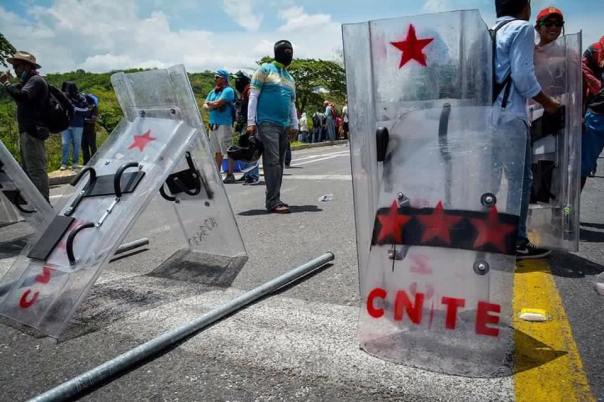
CNTE roadblock in Chiapas
By: biko
Tuxtla Gutiérrez, Chiapas. Pozol. July 28, 2016.
75 days of occupation is not just anything. And, nevertheless, despite the respect that this long two and a half-month path of struggle deserves; the State just vacillates without offering serious responses. There is a clear strategy of wear and tear (exhaustion), there are no responses, only delays to a problem that the National Coordinator of Education Workers (CNTE), presents in a precise and simple manner: abrogate the “education reform.”
While the government sits down at the table and presents a conciliatory discourse, through its mass media vociferates, again and again, that there is nothing to negotiate. There is a joke, a game not just in the management of language and time, also in the hope of the mobilized base. But this joke is not only on the CNTE; it’s also a joke on the people in struggle and on those people that the power names “audience,” “Market.”
You don’t need to be a specialist to know that if the government sat down to negotiate (very reluctantly), it means that it has to offer something in response to the CNTE’s demand that, as already stated, has been very clear. Sin embargo, outside of the table, the government makes it known to everyone that: “the law is not negotiable;” in other words, makes it clear that it’s not going to the table to negotiate, but rather to gain time. The teachers’ movement has evidenced that rough language: the cynicism, peculiar to power and its decadence. But it has left other things in evidence: the ruling classes’ fear of the social mobilization and the patent ineptitude of some upstart business owners/rulers.
Sitting down to negotiate (or simulating negotiations while in your real language, the media, you say something else) and maintaining that negotiating space, indicates that the rulers don’t have the ability to establish another form of domination (although it may be simulated) towards the CNTE. Another form would have “attended to” the problem in other ways without resorting to these bodies. But it has not been capable of that, nor of making use of police repression, or repeating the lie through the mass media.
To those weapons, indeed powerful by themselves, it now adds the shameless pressure of those who really govern this (and any) country: the ownership class.
The statements of the Employers’ Confederation of the Mexican Republic (Confederación Patronal de la República Mexicana, COPARMEX), which in recent days have been reiterated, are added to a conjuncture that, presumably, those up there above observe: wear and tear on the movement after two and a half months of struggle (police repression + political persecution + exhaustion + economic wear and tear + social discredit of the movement derived from the permanent and intense media attack).
They think that it’s the time to carry out another repressive offensive (either through their multiple repressive bodies, shock groups, “legal” mechanisms, or some NGO´s, etcetera). More than a month has passed since the attack on the town of Nochixtlán, a month of pause, which they calculated, has passed through the “dialogue-negotiation tables.
So, are they betting that it’s enough time to forget? They have gambled on dividing civil society in solidarity with the teachers with campaigns of hatred and discredit towards the teachers; they have bet on a internally dividing movement (as they have always done in this and in other struggles); they have gambled on exhaustion and fear. What is the strategy now (if there is any): the forgetting and indifference of civil society towards the CNTE to carry out the belligerent orders of the bosses?
If it’s perhaps a theme of memory, it’s convenient that they remember: Nochixtlán, where the people far from fleeing, courageously confronted the police and paramilitaries; San Cristóbal de las Casas, where the people far from turning tail in the face of the police and paramilitary attack, recuperated the roadblock and increased their rage; San Juan Chamula, where their montage, added to the years of sowing hatreds, made everything get out of (their) control and the government was once again left standing idle.
The EZLN warned them. They didn’t understand.
The crisis that prevails now is serious and very complex, but in our territories this complexity also allows the ineptitude of the politicians and business owners that “govern.”
“A dialogue table cannot be maintained with those who, at the same time, remain in the streets violating the law with impunity,” assures Gustavo de Hoyos, head of the COPARMEX. “The Mexican State would seem to be losing the battle versus some that systematically violate the law.” We don’t know if the head of that employers’ association referred to the teachers or to the business owners and politicians whose history of crime, corruption and alliances with organized crime, is an open secret for the population.
“It seems to me that we have learned about the process. At best they should have considered what the different scenarios of consequences could be before emitting the laws. They didn’t do that, and now we are finding out.” It’s plausible that the specialist Sylvia Schmelkes (de facto writer of the education reform) is learning, it’s just lamentable that it’s only now (after so much blood spilled “in that process”) that it occurs to her to suspect what she ought to have done before, what it now seems necessary to do.
“There is nothing to discuss, there is no dialogue with respect to any education reform because that education reform is helping the country, the youths, the children, the teachers, just like there is nothing to discuss with respect to any reform.” If that is what the Secretary of Government, Osorio Chong, asserts to the media, why continue at a negotiating table that justly seeks to abrogate the education reform?
The bosses call the majority that fights for their rights (employment and education) a minority and criminals; the “intellectuals” of the “education reform” are not capable of processing information in a simple interview, or articulating simple ideas when giving answers and they vomit surprising gibberish; the politicians are incapable of generating arguments, or at least disguising them to confuse the people, as is their intention.
Not in the bosses’ belligerence of Hoyos; not in Schmelkes’ intellectual gibberish; nor in Chong’s ineptitude and political ravings; or in the sputtering of “communicators” like Dóriga, do we glimpse serious answers to the dignified movement of the CNTE, and above all, to the dignified support and popular solidarity movement. Up there above there are no merits or abilities, the only weapons they possess are violence and lies, the intellect passes unnoticed.
This corporate-political ruling class seeks to win this war (its war), without a single battle being presented, without brandishing a single weapon and with violence and the lie as argument (baldy employed, for sure). They bet on fatigue, on the error of the other, not on the merits.
There was a time in which those that governed were a class that earned and defended, by force, their titles and their power on the battlefields. Now, there is just a gang of rich kids inheriting places that “they defend” with structures of repression, also inherited, in unequal battles in their favor. There is not a single merit among those that up there above shriek terms like: competitiveness, honesty, efficiency, success, quality, and etcetera.
And, even so, they have the cynicism of judging-for-repressing those who defend the rights they won through long struggles, against unequal odds.
—————————————————————–
Originally Published in Spanish by Pozol Colectivo
Thursday, July 28, 2016
Re-Published with English interpretation by the Chiapas Support Committee
Governing ourselves

Street art in Nochixtlán, Oaxaca, that reads “killers.”
By: Gustavo Esteva
Cornered in their alley, disconcerted and pathetic elected officials look for an exit from their impossible predicament: they cannot ignore/be unaware of, nor recognize their own disgrace, the fact that their “security forces” operated like bands of criminals in Nochixtlán, just like in Ayotzinapa. The worn out formula of the scapegoat no longer functions. The media campaign produces the opposite desired effects. Desperate, they seem ready to jump off the precipice, no matter the cost. And that cost would be immense for everyone.
On Tuesday the 21st, at the funeral of one of the murdered boys in Nochixtlán, the son of a teacher, health minister of the town council of Apazco, we all felt the family’s pain. We were moved even further by the father’s reflection: “Yes, this is the price that we had to pay. But the struggle must continue, the struggle cannot stop here. These are not the first deaths, nor will they be the last. No matter. We are learning things like this in the struggle.”
A couple of days later, at a meeting of campesino producers in La Mixteca, the conversation became more agitated. What had brought them there was put aside. The attack of the teachers felt like their own, but they were no longer mobilizing just in solidarity. They had reached their limit. It was the moment to struggle for themselves, for their own survival, with the conviction that united it would be possible to change a state of unbearable things.
The front lines (of the battle) are multiplying under very different configurations and styles. It’s not the same in La Mixteca as in Monterrey. What remains clear is that the teachers’ struggle articulates generalized discontent that seeks its best form of expression.
Governments, commercial media, impresarios, the so-called “real powers,” continue yelling at the top of their lungs because of the challenge they face. They look for reasons and pretexts that justify the heavy hand, for which they prepare for public opinion. Some common people share their demand to “reestablish order.”
They insist like that from above, that time is running out and it is urgent to return calm to the millions of affected citizens. They sweep the way in which they lost it under the rug. The teachers tried all the possible forms of struggle and administrative procedures before taking the current course. Three days before last year’s elections the government broke off negotiations and refused to return to the table until Nochixtlán obligated it to do so.
Nochixtlán is on the dialogue’s official agenda, where the government pretends to “repair the damage” with mere economic compensation. It can include labor issues like arbitrary stoppage, lowered and withheld wages, and even political prisoners and other abuses. But nothing more, nothing about the heart of the matter. They do not understand people’s reaction. When one of the victims of Nochixtlán tells them that they were at the crime scene “because we believe that we have to throw out this reform,” they need to attribute this behavior to manipulation, to “ideological fabrication,” and even, like in Chiapas, to the meddling of “extremist groups.” They don’t want to appear informed about what is happening.
The authorities are deriving the worst from the lessons of the mobilizations of ten years ago. In creating the 2007 commission that investigated what happened in Oaxaca, the Supreme Court acknowledged that the police forces “physically affected a large number of people in an inhumane and cruel way,” resulting in wounded and tortured individuals and deaths, and it affirmed that “a de-facto suspension of constitutional rights” had been produced. The Court appeared interested in realizing justice. What it did, however, was extend a certificate of impunity to the violators. It seemed that “the use of public force was legitimate”…although late: they should have done what they did earlier. Against its own statute and its own words, the Court ruled that the authorities can and should violate constitutional guarantees.
Today the authorities want to shelter themselves under that umbrella. They let loose all our demons just like that. Before the disaster that is outlined, the source of hope can be in the possibility that people exercise from below the capacity to govern, upon confirming that those above have lost that capacity. The first steps have been taken on that path, as the changes in the strategy of mobilization demonstrate.
We citizens, men and women, standing up at a barricade like those among the leaders of the CNTE, we should make decisions as a government. The teachers of Oaxaca can start implementing their Educational Transformation Program with its sensible system of evaluation and innovative pedagogies. We would begin in that way to disregard the meddling of corrupt bureaucrats of the SEP in the content and form of education.
In any case, it would be suicide to continue trying to get water from a rock, waiting/ hoping for these political classes to do what is needed. It’s our turn. Doing what is necessary in this critical circumstance will serve as practice for us for what is to follow.
Originally Published in Spanish by La Jornada
Monday, July 4, 2016
http://www.jornada.unam.mx/2016/07/04/opinion/018a1pol
Translated by Rebecca Gamez
EZLN confirms and extends its participation in CompArte
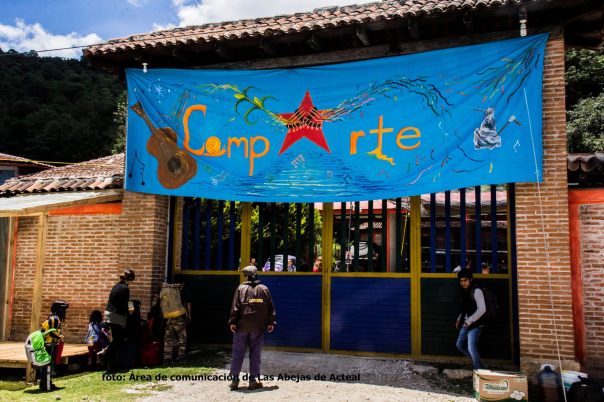
CompArte banner at Cideci in San Cristóbal.
Zapatista National Liberation Army
Mexico
July 26, 2016
To the participants and attendees of CompArte:
To the National and International Sixth:
Compañeros, compañeras, compañeroas:
Although we could not replace the money that had been allocated for food and transportation for our artistic community, as Zapatistas we sought a way not only to reciprocate the efforts of the artists who responded to our invitation to CompArte, but also to make them feel the respect and admiration their artistic work inspires in us.
We would like to inform you of the decision that we have come to:
We will present, though in different calendars and geographies, some of the artistic work that we Zapatistas prepared for you. The presentations will take place according to the following schedule:
Caracol of Oventik: July 29, 2016, from 10:00 national time to 19:00 national time. Participation by Zapatista artists of the Tzotzil, Zoque, and Tzeltal native peoples from Los Altos in Chiapas.
CIDECI, San Cristóbal de Las Casas: July 30, 2016. A Zapatista delegation will attend CompArte as listener-viewers.
Caracol of La Realidad: August 3, 2016, from 09:00 on August 3 through the early morning hours of August 4. Participation by Zapatista artists of the Tojolabal, Tzeltal, Tzotzil, and Mame native peoples as well as mestizos from the Selva Fronteriza zone.
Caracol of La Garrucha: August 6, 2016, from 09:00 on August 6 through the early morning hours of August 7. Participation by Zapatista artists of the Tzeltal and Tzotzil native peoples from the Selva Tzeltal zone.
Caracol of Morelia: August 9, 2016. Celebration of the 13th anniversary of the birth of the Zapatista caracoles and the Juntas de Buen Gobierno, from 09:00 on August 9 through the early morning hours of August 10. Participation by Zapatista artists of the Tojolabal and Tzeltal native peoples from the Tsots Choj zone.
Caracol of Roberto Barrios: August 12, 2016, from 09:00 on August 12 to the early morning hours of August 13, 2016. Participation by Zapatista artists from the Chol and Tzeltal native peoples from the Northern zone of Chiapas.
In order to attend you will need your CompArte registration name tag from CIDECI and to have registered at the table set up for that purpose in CIDECI as of the afternoon of July 27, 2016. Note: bear in mind that here…well, everywhere, it is storm season.
We know that the great majority of you will not be able to attend all of the presentations now that the calendar and geography have been expanded. Or perhaps you will, that is up to you. In any case, whether you are there or not, we will present with you in mind.
THE PAID MEDIA WILL NOT BE ALLOWED ACCESS (even if they pretend that they also work for the unpaid media).
The compa media—that is the free, autonomous, alternative, or whatever-you-call-it media—will be welcome, even by the Tercios Compas, because here we do have trade solidarity.
-*-
As Zapatistas, on this day we reiterate our support for the demand for truth and justice for Ayotzinapa and all of the disappeared that is tirelessly maintained by the mothers, fathers, families, and compañer@s of the missing. To all of them, those who are missing and those who search for them, we offer our greatest embrace. Your pain is our pain and our dignified rage.
From the mountains of Southeastern Mexico,
Subcomandante Insurgente Moisés. Subcomandante Insurgente Galeano.
Mexico, July 2016.
Originally Published in Spanish by Enlace Zapatista
Massacre in San Juan Chamula
WITNESS: “IT WAS A MASSACRE!”
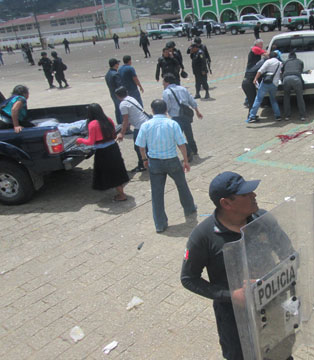
Removing the bodies from the plaza in San Juan Chamula.
Protest, violence and death
They report some 20 injured by gunshots, as well as with machetes; they used guns
By: Hermann Bellinghausen
San Juan Chamula, Chiapas [1]
“It was a massacre,” says a young witness to the shooting that occurred here yesterday at 8 o’clock in the morning in the central plaza of this traditional and famous Tzotzil locality.
An act of demand from various communities, something common here, turned into a lethal shootout that cost the life of Mayor Domingo López González and the council member Narciso Lunes Hernández, as well as an undetermined number of dead and wounded, although those residents present agree that around 20 could be dead, the majority from bullets, but also machetes.
It’s difficult to know the precise number, but the testimonies agree that the first shots came from the city hall.
“People met in the communities from 6 in the morning, to come to demand the programs that the municipio promised. Everyone came, men and women. No one knew what was going to happen,” the witness. “At 8 in the morning President Domingo (of the Green Ecologist Party of Mexico) came out on the balcony of city hall.”
“After listening to the dissidents he asserted forcefully that he would deliver those resources later, and he asked the people to withdraw. Then he entered the building. The people did not disperse, and then rockets and ‘bombs’ (of gunpowder) came out from inside the building, and the first gunshots.” Various subjects, some masked, who arrived with the PRIístas, had taken up positions below the municipal palace. They were carrying rifles and started to shoot at the building. This group has previously appeared with their faces covered in their protests in Tuxtla Gutiérrez.
It was then that the mayor attempted to leave through the back, but the masked men went after him and they immediately shot him. “They came for that, they were prepared.
“He also had to have others in the streets above, because some came out running and others went behind shooting,” adds the young man, who requests anonymity, but speaks with total fluency and in good Castilla. Three other men surround us that just listen. The first shots came out of the municipal presidency, according to this version, which two other indigenous men present in the plaza confirmed later, who surrounded a man standing up with a bullet wound, who with a hand on his abdomen observed the police on the plaza past 11 o’clock in the morning, almost three and a half hours after the events.
“How long did the shots last? No more than 10 minutes. All the people started to run to the edge of the plaza. Women? Many came, but they stayed at the edge. Yes, there were injured; I don’t know if there were any dead,” the witness explains to La Jornada. Apparently there were other shots afterwards.
The municipal building, painted completely green, is barely separated by a narrow passage from the municipal building of the Institutional Revolutionary Party (PRI, its initials in Spanish). “Ruddy of heart,” proclaims a big sign on its facade. On the side, the presidency shows numerous bullet impacts and broken windows. High-powered weapons were used, according to what a ministerial agent said later, when the police finally arrived. They found cartridges from a 45-caliber pistol, an AK-47 and an R-15. An orifice is distinguished on a screen that a police agent of mature age considered as a shot from inside.
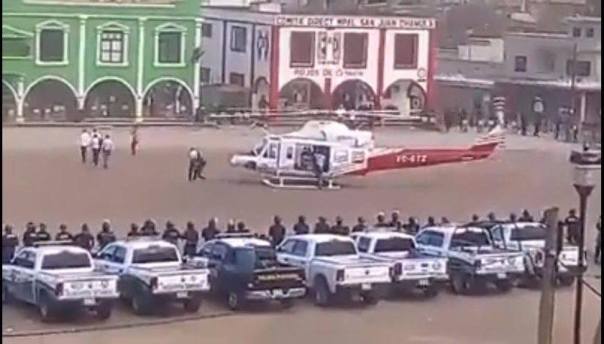
The photo shows the 2 municipal buildings, one green, one red), as well as the plaza, now taken over by police.
A town in shock
The body of an older man lies over an abundant puddle of blood on the line of the small area of a soccer field traced at the western side of the plaza. His loneliness is absolute; no one is nearby. An elderly woman remains seated on the stairs at the side of the plaza, like unrelated to everything, silent. Another cadaver continues in sight on the street that goes to the market. According to the testimonies, the mayor and his councilman would have fallen behind the municipal presidency when they were attempting to flee. A number of unknown individuals died in the plaza, because their family members or companions removed them before 10 o’clock in the morning. According to two Chamulans from the municipal capital, two Nissan “Estaquitas” (trucks) entered the plaza after the confrontation, some indigenous men picked up the dead and injured, and then they went away.
After the shootout, the masked men that would have killed Domingo López and his collaborator carried the bodies to the front of the city hall, and with gestures and shouts they pointed to them and were calling to the people that were approaching. At least one was re-killed there. “He was already dead, you can come now,” they said. “But the people had not come to fight. They were not informed,” the witness says. By then, the hundreds of indigenous that were protesting had fled and only residents of the municipal capital remained, unrelated to the tragedy, but too impressed to classify them as voyeurs. The town is in a state of shock, the streets deserted, except for small groups of men.
Erase that photo
“Erase that photo,” a state police agent with a helmet demands, pointing his tear gas rifle at this reporter when he sees him taking a picture of the man stretched out on the ground. A dozen police vehicles just entered the plaza and jump out onto the ground clutching their weapons, extremely nervous. “Erase it,” he insists. Upon being questioned as to why, another agent farther away aims his rifle for a few seconds, and the first agent, maybe reconsidering, points to the scarce number of indigenous that observe from the periphery of the extensive central plaza: “If you don’t, they people will hit you.” “Then why do you aim at me?”
In fact, the only time that some indigenous attempted to question the reporters was when a state functionary headed to a group of his acquaintances and indicated: “remove the journalists;” the indigenous were limited to impeding us from approaching the presidency, the PRI and the market.
Vehicles from the municipal police of San Cristóbal de Las Casas, the state police and investigative agents arrived sounding their sirens towards 11:30 in the morning and they cordoned off the front part of the plaza with anti-riot equipment and regulation weapons. The nervousness of the agents and functionaries is the most alarming of all. They immediately proceed to collect cartridges and other evidence, and only later will they use latex gloves and bags. More than investigating, they are cleaning up the plaza.
From early on, the social networks were flooded with a lot of photographs of the dead functionaries. One of every two Chamulans must have a cell phone. “A lot of photographers were there,” relates the witness quoted above.
Nevertheless, the first press images are from the air and from when the patrols were already at the place. All the images that circulated in the networks and some media were from local residents and are late scenes.
Towards noon, a pick up truck goes into the plaza. Two women are in the box. One, an older woman, cries inconsolably. Two men get out of the cabin, pick up the cadaver and hastily throw it into the vehicle’s box, facedown. In order that the doors close, they bend the knees up, only his feet and the soles of his huaraches are seen once they close the back door of the box. The second woman aboard the cabin and the pick up gets out. Various police surround the scene without daring to intervene. The woman looks briefly at the feet of the cadaver, turns the face and cries desperately. Nearby, a white truck picks up another body.
Soon, only police agents and patrol cars were in the proximity of the buildings of the PRI and of the municipal council. Not one business is open in the entire town. The people are sheltered in their homes. Some families remain on the flat roofs of the houses near the plaza.
At the border between San Cristóbal and Chamula, in the middle of the road a little sign warned in the morning: “Don’t go to Chamula. There’s a problem.” To say the least!
——————————————
Translator’s Note:
[1] San Juan Chamula is close to the tourist mecca of San Cristóbal. Chamula is the home of “traditional” religious practices, at least that’s what they tell tourists. Day trips for tourists to Chamula are very popular and the municipio (municipality, or county) makes a lot of money from these tourists trips. Chamula is also home to some of the thugs that attacked, evicted and destroyed the encampment and occupation of the “people’s movement” in San Cristóbal. In its Open Letter to the Governor of Chiapas, the EZLN warned the Governor of the danger of stirring up the rivalries in Chamula!
———————————————————–
Originally Published in Spanish by La Jornada
Sunday, July 24, 2016
http://www.jornada.unam.mx/2016/07/24/politica/002n1pol
Re-published with English interpretation by the Chiapas Support Committee
EZLN: Open letter on the San Cristóbal attacks
OPEN LETTER ON THE AGGRESSIONS AGAINST THE PEOPLE’S MOVEMENT IN SAN CRISTÓBAL DE LAS CASAS, CHIAPAS
ZAPATISTA NATIONAL LIBERATION ARMY, MEXICO
July 21, 2016
To the current governor and the other overseers of the southeastern Mexican state of Chiapas:
Ladies (ha) and Gentlemen (double ha):
We do not send greetings.
Before it occurs to you to try (as the PGR[i] is already attempting in Nochixtlán) to blame the cowardly aggression against the people’s resistance encampment in San Cristóbal de Las Casas, Chiapas on ISIS, we would like to provide you, at no charge, the information we have collected on the subject.
The following is the testimony of an indigenous partidista[ii] (PRI) brother from San Juan Chamula, Chiapas, Mexico:
“At 9am (on July 20, 2016) the Verde party followers were called to the governor’s palace. They went and were told to do again what they had done the other day.”
(NOTE: he is referring to the incident in which a group of indigenous people affiliated with the Partido Verde Ecologista (Green Ecology Party) put on ski masks and went to create chaos at the [teachers’] blockade between San Cristóbal and Tuxtla Gutiérrez, the capital of Chiapas. When they were detained by the CNTE’s [teachers’ union] security, they first said they were Zapatistas (they weren’t, aren’t, and never will be), and later admitted they were partidistas.
But this time they were supposed to dialogue so that the people at the blockade would let the trucks from Chamula that do business in Tuxtla go through. The municipal president (who belongs to the Verde Ecologista Party) sent police patrols and local ambulances. The municipal president of San Cristóbal sent some more police. The governing officials in Tuxtla sent a bunch more. See, they [the people from Chamula] had made a deal with the police—they already had a plan. So they went in there like they were going to dialogue but one group went into the blockade’s encampment and started destroying things, stealing or burning everything they found. Then they started shooting—the Verdes are indeed armed—but shooting like a bunch of drunks and druggies. The police were acting like their security detail, their backup. We don’t agree with what the Verdes did. Now the tourists are scared to come to the municipal center (of San Juan Chamula) and this screws everybody over because it really hurts our businesses. It’s not the blockade but rather the fucking Verdes that are fucking us over. Now we’re going to go protest in Tuxtla and demand they remove that asshole of a president. And if they won’t listen to us, well then we’ll see what we have to do.”
With regard to that clumsy attempt to dress paramilitaries in ski masks and say they were Zapatistas, it was a total failure (in addition to being a tired old trick that has been tried before by Croquetas Albores).[iii] Questioned on whether they thought it had been Zapatistas who destroyed the blockade and committed these outrageous acts, here are the comments of two townspeople, without any known political affiliation:
A street vendor, approximately 60 years old:
“No! The people who destroyed all that stuff yesterday are people paid by the government, we all know that. They aren’t the ones that support the teachers. The teachers’ struggle is valid; the other option would be that we’d have to pay for education ourselves. And where do they get money to pay the teachers anyway? From the people. What we need is for the majority of other states to join the struggle, there are four that are already in but we don’t know how long the others will take.”
A Chamula indigenous person, a street vendor:
“Naaahhh, those weren’t Zapatistas. Zapatistas don’t act like that. Plus the Zapatistas support the teachers and those people yesterday were trying to pass themselves off as Zapatistas by putting on ski masks, but they aren’t; they don’t act like Zapatistas at all.”
“So who were those people yesterday?”
“Those are other people, they get paid for that.”
“What do you think of the teachers’ struggle?”
“That we should all support them.”
_*_
We are sure that you don’t know this (either that or the stupidities that you commit are because you are in fact stupid), but the so-called “teachers’ conflict” arose because of the stupid arrogance of that mediocre police wannabe who still works out of the Department of Public Education (SEP by its Spanish acronym. Oh you’re welcome, no thanks needed). After the teachers’ mobilizations and the government’s response in the form of threats, firings, beatings, imprisonment, and death, the teachers in resistance managed to get the federal government to sit down to dialogue. This is in fact a federal issue. It is up to the federal government and the teachers in resistance to dialogue and come to an agreement or not.
You sympathize with the hardheadedness of that mediocre policeman. We Zapatistas sympathize with the teachers’ demands and we respect them. This applies not only to the CNTE, but to the entire people’s movement that has arisen around their demands. As Zapatistas, we have made our sympathy public by supporting them in word and deed, with the small amount of food that we could put together from our own tables.
Do you think this movement, now taken up by so many people, is going to be defeated by evicting a few encampments, even when you disguise it as “citizen rage?” You’ve already seen that doesn’t work. Just like what happened with our brothers, the originary peoples in Oaxaca—if you destroy their camps they’ll build them back up. Time and time again. The thing is that here below there is no fatigue. Your bosses calculated that the teachers’ resistance movement would deflate over summer vacation. Now you’ve seen that you were wrong (hmmm, that’s more than three failures in one evaluation. If we applied the “education reform” in this case you would already have been fired and would be looking for work in the Iberdrola alongside the psychopath.)[iv]
The movement has been able to generate and concretize the sympathies of the people, while you all only generate dislike and repudiation.
As we were already saying as of two months ago, the movement already encompasses various social sectors and, of course, their specific demands. For example, you’re not around to hear it but people are demanding Cancino be removed from office (the supposed municipal president of San Cristóbal de Las Casas, a city in Chiapas, Mexico, in case you didn’t know) and Narciso be put in jail (the paramilitary boss of the ALMETRACH.)[v] This and the other things they are demanding can be summarized in one word: good government. How long will it take you to realize that you are just in the way, parasites that infect the entire society, above and below?
The thing is that you all are so sure of yourselves that you send your attack dogs to steal the few belongings of these people who are PEACEFULLY protesting. Well, we Zapatistas will again begin to collect the food and basic necessities you stole from them and supply them once again. And we will do so over and over again.
Instead of making ridiculous declarations (like denying having a role in that cowardly attack on the people’s encampment in San Cristóbal), you could contribute to the easing of tensions necessary for this dialogue and negotiation to take place as determined by both parties (which are, we might remind you, the Federal Government and the National Coordination of Education Workers). It would be a good idea to tie up your attack dogs (Marco Antonio, Domingo, and Narciso). Just whistle and shake a wad of bills at them and you’ll see how they come running.
And some unsolicited advice: don’t play with fire in Chamula. The unrest and division you are inciting in that town with your stupidities could provoke an internal conflict of such terror and destruction that you wouldn’t be able to quash it with social network bots or paid “news” articles or the little money that Manuel Joffrey Velasco Baratheon-Lannister has left in the state treasury.
So be calm. Be patient and show some respect. We hope the federal government will dialogue and negotiate with seriousness and commitment, not only because the teachers’ demands are just, but because this might be one of the last times there is someone with whom to dialogue and negotiate. The process of decomposition you have encouraged is so advanced that soon you won’t even know who to slander. Plus there won’t be anyone on the other side of the table. Understood?
So, do your thing. That is, go back to Photoshop, to the celebrity news, the flashy parties, the spectacle, the gossip magazines, to the frivolity of those who lack intelligence. Govern? Oh come now, not even the paid media believe you do that.
It’s better that you step aside and learn, because this is Chiapas, and the Chiapas population is a lot to take for such a lame government.
_*_
To whom it may concern:
As Zapatistas it is our conviction—and we act in accordance—that the movement’s decisions, strategies, and tactics should be respected. This applies to the entire political spectrum. It is not acting in good faith to hitch oneself onto a movement and try to steer it in a direction outside of its internal logic. And that goes for attempts to slow it down or speed it up. If you can’t accept that, then at least say clearly that you want to use this movement for your own ends. If you say so directly, perhaps the movement will follow you, perhaps not. But it is healthier to tell the movement what you are seeking. How do you expect to lead if you don’t respect the people?
We Zapatistas are not going to tell our current teachers (those from the CNTE and also from the towns, barrios, and neighborhoods that support them) what to do and what not to do. This should be crystal clear to all noble people in struggle: ANY ACTION TAKEN BY THE ZAPATISTAS IN RELATION TO THE CURRENT POPULAR MOVEMENT (or those that later emerge) WILL BE PUBLICLY MADE KNOWN AHEAD OF TIME, always respecting the movement’s times and ways. The National Coordination of Education Workers as well as the originary peoples’ movements, neighborhoods, and barrios that support the teachers should understand that whatever decisions they make—whether about their path, their destiny, their steps, or their company—they will have our respect and our salute.
This thing of dressing up like Zapatistas and yelling slogans that involve others is fine as a bit of entertainment and a line on your resumé, but it is nevertheless false and dishonest. We did not rise up to hand out stolen junk food, but rather for democracy, freedom, and justice for all. If you think breaking windows and stealing food that isn’t even nourishing is more revolutionary and of more help to the movement, well, let the movement decide. But clarify that you are not Zapatistas. We don’t care when people tell us we don’t understand the “conjuncture,” or that we don’t have a vision of how to use electoral advantage, or that we are petit-bourgeoisie. We only care that that teacher [maestro, maestro] that señora, that señor, that young person [joven, jóvena] feel that here, in the mountains of southeastern Mexico, there are those who love them, respect them, and admire them. This is what we care about, even though such sentiments do not come into play in grand electoral strategies.
The teachers in resistance and, now more and more often, the people’s movement that gathers around them face very difficult adverse conditions. It isn’t fair that, in the midst of all of that, they have to deal not only with clubs, batons, shields, bullets, and paramilitaries, but also with “advice,” “orientation,” and “with-all-due-respect”-type orders telling them what to do or what not to do, or whether to advance or retreat—that is, what to think and what to decide.
We Zapatistas don’t send junk food to those who struggle, but rather non-GMO corn tostadas which are not stolen but rather homemade through the work of thousands of men and women who know that to be Zapatista does not mean to hide one’s face but rather to show one’s heart. Because reheated Zapatistas tostadas relieve hunger and inspire hope. And you can’t buy that in convenience stores or supermarkets.
From the mountains of the Mexican Southeast.
Subcomandante Insurgente Moisés Subcomandante Insurgente Galeano
Mexico, July 21, 2016
[i] Procuraduría General de la República, Mexico’s Attorney General
[ii] Refers to someone affiliated with one of the registered political parties.
[iii] “Croquetas,” or doggy biscuit, was the nickname assigned by the EZLN to Roberto Albores Guillén, governor of Chiapas from 1998-2000.
[iv] This likely refers to ex-president Felipe Calderón who recently took a job with a subsidiary of Iberdrola.
[v] La Asociación de Locatarios del Mercado Tradicional, Traditional Market Tenants’ Association.
=======================
Originally Published in Spanish by Enlace Zapatista
Carta abierta sobre la agresión al movimiento popular en San Cristóbal de las Casas, Chiapas
Violent eviction of the CNTE from Chiapas occupation
[The EZLN has issued a statement on this violent eviction. We’ll post it as soon as the English translation is available. Meanwhile, here’s what happened.]
VIOLENT EVICTION of the CNTE OCCUPATION in CHIAPAS; THEY REINFORCE IT AT NIGHT

Some 200 individuals violently evicted the occupation that CNTE teachers maintained on the San Cristóbal de Las Casas-Tuxtla Gutiérrez toll road, along with parents and members of civil groups that support the teachers. Photo: Colectivo Tragameluz and Elio Henríquez
By: Elio Henríquez and Hermann Bellinghausen
San Cristóbal de Las Casas, Chiapas
Yesterday (Wednesday) noon, around 200 people that were carrying sticks, machetes and firearms attacked the roadblock that teachers, students, parents, representatives of more than 50 of the city’s neighborhoods and members of different organizations have maintained on the San Cristóbal-Tuxtla Gutiérrez toll road since June 27, to demand the abrogation of the education reform.
Accompanied by municipal and states police, the aggressors knocked over the tarps and tents, destroyed them with kicks and machetes, and set them on fire, while the forces of law and order surrounded them to let them finish their action.
During the attack the primary school teacher Romualdo Guadalupe Urbina received a clavicle injury from a 22-caliber bullet. Another participant in the roadblock was run over and suffered a fractured tibia and fibula.
Both were confined in the clinic of the Institute of Security and Social Services for State Workers, while neighbors in the barrio where it is located blocked the Santa Martha Bridge and the access streets “to protect the injured.”
The aggressors, allied with the PVEM
Several dozen pro-government people from San Juan Chamula perpetrated the aggression, as well as more than a hundred indigenous settled in San Cristóbal. Some teachers pointed them out as part of the Traditional Markets Tenants Association of Chiapas (Almetrach), which Narciso Ruiz Sántiz heads and that in in previous days had already threatened to attack the roadblock. These groups are identified with the Green Ecologist Party of Mexico (PVEM), which governs both municipios (San Cristóbal and Chamula).Teachers and parents did not respond, but rather withdrew to the central park to re-group.
The violent eviction began at 12:30 pm. Carrying a few small signs and brandishing sticks, machetes and stones, the attackers arrived asserting that they came “peacefully,” only to immediately attack the roadblock’s installations and remove the tree trunks, tires, rocks and other obstacles.
A heavy truck and several small trucks of state and municipal police sounding their sirens came behind them. The police agents did not participate directly in the eviction; they just protected the indigenous individuals that destroyed and burned tarps and tents.
Some of the assailants attacked Dolores Rodríguez, a reporter from Noticiero en Redes (Network News?), “for taking photographs.” One of the aggressors pointed a pistol at her head. Another one threw big firecrackers in a horizontal trajectory towards the forest.
Police agents withdrew a little later and the place stayed under the control of the aggressors, who Adalberto Hernández Rabanales, leader of Section 7 in Los Altos, classified as a “shock group;” he also placed responsibility for the acts on the three levels of government.
When local police withdrew, teachers and members of civil organizations re-grouped one hundred meters further ahead, near the Hospital of the Cultures, and the masked men shot at them when they tried to return to rescue the vehicles. That’s when Urbina Estrada, a teacher in San Andrés Larráinzar, was injured.
Afterwards six patrol cars arrived from the Federal Police (PF). La burning and destruction of the encampment continued while the police watched. The action concluded at 3 o’clock in the afternoon exactly, when the contingents of masked indigenous men abandoned the spot at kilometer 47 of the highway to Tuxtla Gutiérrez.
The group from San Juan Chamula boarded a Cristóbal Colón bus and the larger group marched in formation returning to the city. The place remained under the charge of three PF patrols until 16 hours, when dozens of neighbors from the southern part of San Cristóbal returned with sticks and stones that they threw at the police patrols.
The police drew away in the vehicles and stopped one kilometer ahead. The roadblock was re-established in a matter of minutes. More people continued arriving in the evening. They extended the obstruction of streets with bonfires, tree trunks and iron. Once again there are several hundred parents, teachers and neighbors from the different barrios in an atmosphere of excited tension.
In the afternoon, in the central park, Hernández Rabanales said that since early “there were rumors that the people from Chamula would evict us, but compañeros from social organizations told us that they were in communication with government agencies and they told them that the Chamulas were on the way to an activity in Tuxtla Gutiérrez.”
In an interview with La Jornada, the teachers’ leader added: “It seems that the idea was to provoke a break in the dialogue, because since yesterday the negotiating committee said that it had no chance to talk because the government was only trying to impose.”
In the afternoon, the teachers marched in the center of town while in the park a group of masked youths set fire to the wooden doors of the old municipal presidency (that is being arranged as a museum) and entered the building, breaking all the windows. Smoke was coming out of some windows.
Meanwhile, unidentified masked indigenous men, unrelated to the organizations that support the teachers, looted an Oxxo [1] located a half block from the ex mayor’s office. They distributed cigarettes, drinks and other products to lumpen children and youth in a relaxation plan.
In the state government’s version, the police went to “dissuasively dislodge in order to avoid a confrontation between San Juan Chamula residents and CNTE demonstrators.”
In a comunicado, the state maintains that faced with an alert the C4i [2] issued, and because it pointed to the presence of Chamula inhabitants at kilometer 46 of said road, blocked by CNTE members, they sent 200 members of the police to guard the integrity of the citizens, thereby avoiding any motive for confrontation.”
Police and the attackers arrived at the events together. According to the government’s version, the indigenous went to “dialogue peacefully and to request the free transit of citizens, businesspeople and transport drivers,” because of which “the demonstrators opted for withdrawing from the place voluntarily” and “the roadway was opened.”
The coleto [3] mayor, Marco Antonio Cancino González, set himself apart from any responsibility in the midday eviction.
Notes:
[1] OXXO stores are similar to 7 Elevens or a gas station with a mini-mart.
[2] C4i is the abbreviation for the State Center of Control, Command, Communication, Computation and Intelligence.
[3] A coleto is a male resident of San Cristóbal that claims to descend directly from the Spanish invaders.
———————————————————————
Originally Published in Spanish by La Jornada
Thursday, July 21, 2016
http://www.jornada.unam.mx/2016/07/21/politica/005n1pol
Re-published with English interpretation by the Chiapas Support Committee
 Chiapas Support Committee