Chiapas Support Committee
Home of the Compañero Manuel blog on zapatistas & mexico
The Attack in Polhó, Acteal’s legacy: former member of Las Abejas
Chiapas, at “war” due to the abandonment and complicity of authorities
By: Elio Henríquez, Correspondent,
San Cristóbal de Las Casas, Chiapas
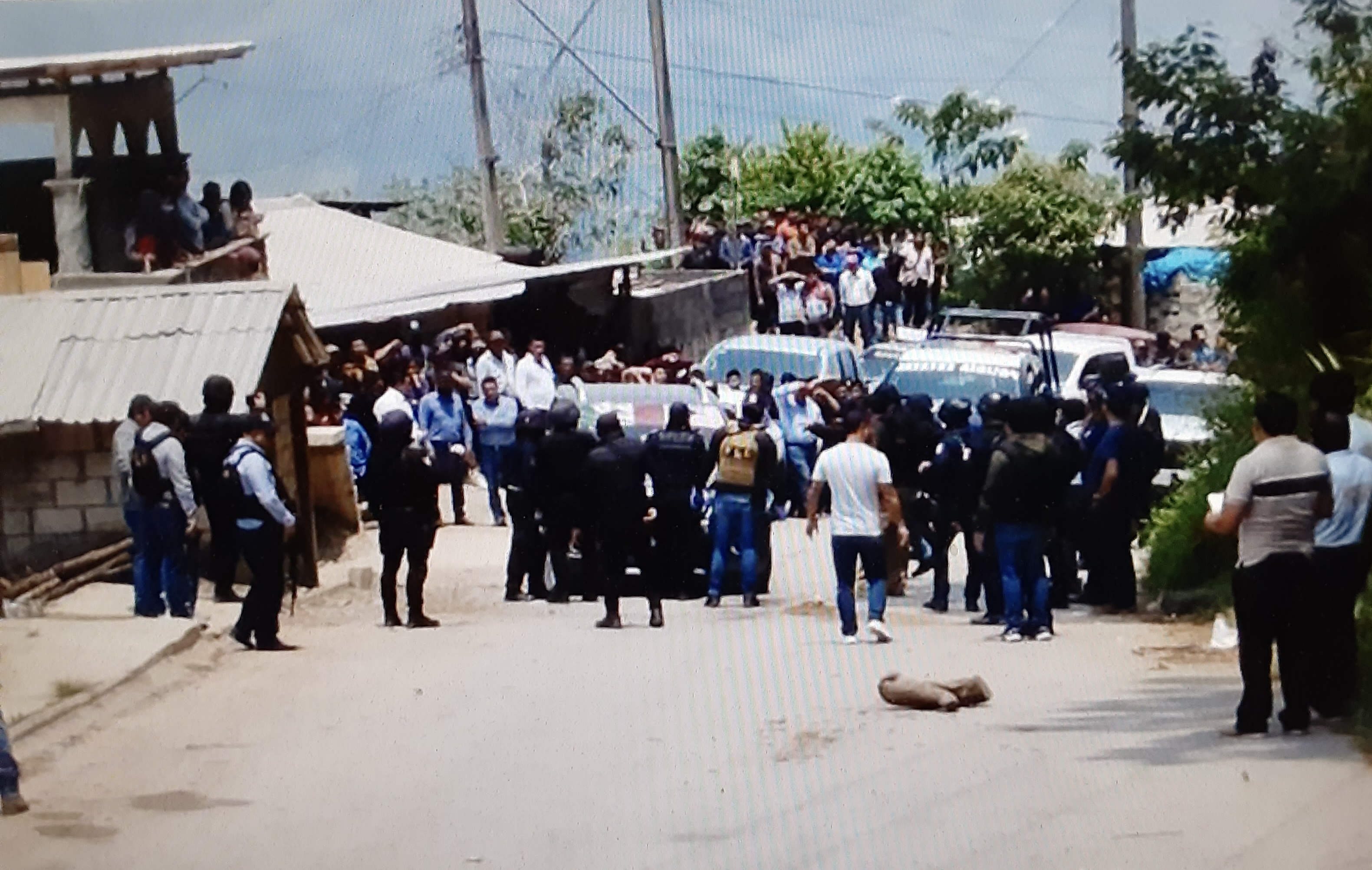
“We are in a war scenario as a consequence of the abandonment and complicity of the governments, because of which armed attacks have proliferated,” warned the Fray Bartolomé de Las Casas Human Rights Center (Frayba) regarding the attack against the more than 200 displaced people from Santa Martha, municipality of Chenalhó, who are refugees in the community of Polhó, perpetrated on Friday with a result of seven dead.
Pedro Faro Navarro, the person responsible at the space of international incidence of Frayba, said that: “in the armed attacks between crime groups, the civilian population is in the crossfire, torturing scenarios of great psycho-social impacts, as well as direct executions, disappearances and forced displacements.”
In statements to La Jornada, he explained that “there are territories in which armed groups have proliferated, many of them successors of paramilitarism, caused by the active impunity of the Mexican State, which detonates violence, a terrified population, murders and displacements.”
In the attack with high-caliber weapons committed on Friday at 3 p.m. in Polhó, seven people died, including a three-year-old child, which has caused a situation of tension and fear in the area, in which the community of Acteal is located, where on December 22, 1997, 45 Tsotsiles belonging to the Las Abejas Civil Society Organization were massacred.
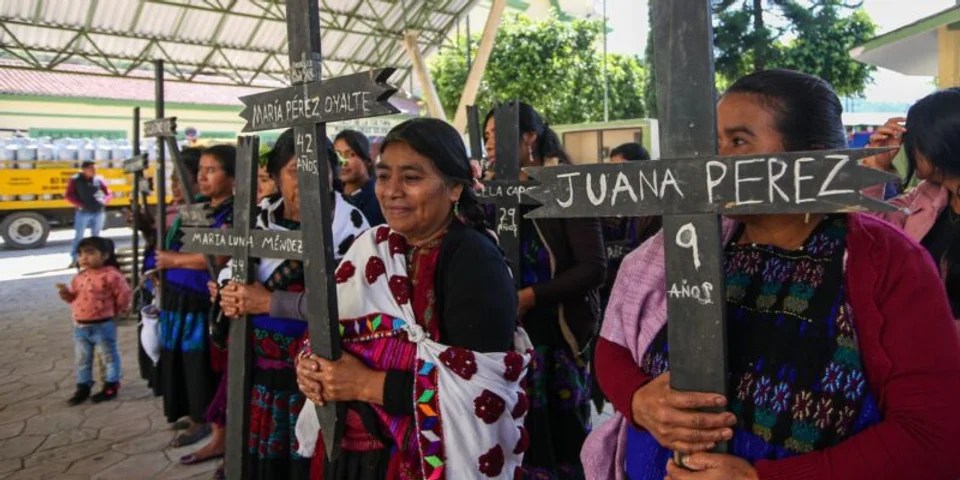
On that occasion, PRI paramilitaries who had caused the displacement of hundreds of residents of different communities attacked the members of Las Abejas who were fasting and praying to demand that the violence be stopped. They massacred 45 indigenous people, despite the fact that various organizations, including Frayba, warned of the danger of a massacre.
José Vázquez Gutiérrez, a human rights defender who accompanies the displaced people of Santa Martha, said: “26 years later, the same thing continues as when the Acteal massacre happened because I was there; The situation has not changed.”
He added that for months, representatives of the more than 200 displaced people from Santa Martha demanded greater security from federal and state authorities after the attack committed on Friday.
“The police and the National Guard are camped at the exit of the municipal seat of Chenalhó, but people want them to patrol to avoid aggression.”
Vazquez Gutierrez affirmed: “There is no security for them. We have asked the state government to provide us with security, because even we as human rights defenders are persecuted and threatened with death.”
A former member of the pacifist organization Las Abejas, Vázquez Gutiérrez said he has filed complaints with the Indigenous Prosecutor’s Office about the threats he has received for accompanying citizens who have had to leave their homes due to violence.
In an interview, he said that “all the residents of Polhó are very afraid; There are no more people at the entrance to the community.”
He insisted that the demand is that “there be immediate security for the displaced. Security forces patrols to protect the displaced who are in fear.”
José Vázquez also demanded that: “it be investigated, justice be done and the law be applied to those who burned their houses and displaced the Santa Martha inhabitants who are now suffering as refugees because they were dispossessed of all their belongings.”

Originally Published in Spanish by La Jornada, Monday, June 5, 2023, https://www.jornada.com.mx/2023/06/05/estados/028n1est/ and Re-Published with English interpretation by the Chiapas Support Committee
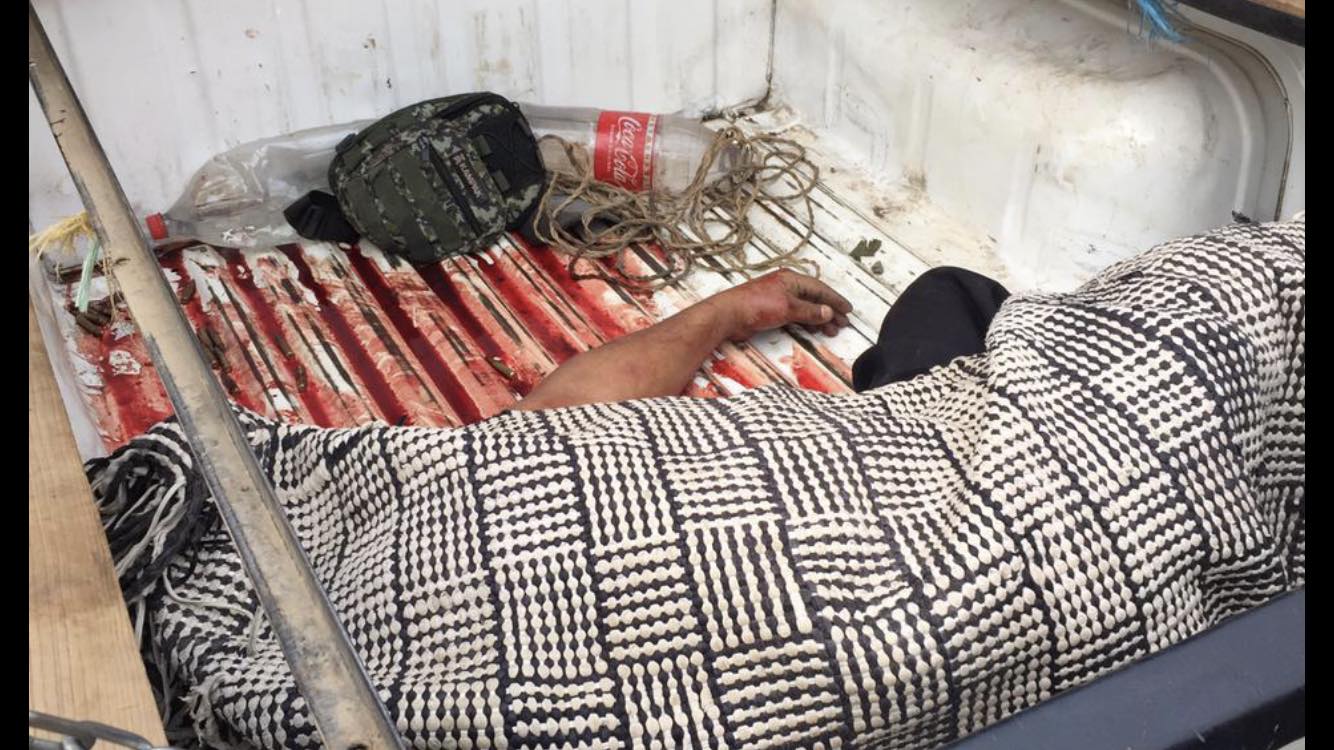
Armed attack on Santa Martha displaced in Polhó, Chiapas; 7 dead and 3 injured
By: Elio Henríquez, Correspondent
San Cristóbal de Las Casas, Chiapas
[Excerpt from the first La Jornada article dated June 3.]
Seven indigenous people died and three were injured during an armed attack committed yesterday evening in the locality of Polhó, municipality of Chenalhó, where inhabitants of the Santa Martha ejido, belonging to the same municipality, are sheltered, official sources reported.
Residents of the area, close to Acteal, said that “they attacked the more than 200 displaced persons” from Santa Martha who left their homes in October 2022, because of an internal agrarian conflict. One of their representatives, who requested anonymity, commented that the attackers belong to an armed group that left Polhó. “We know that they attacked Fernando Ruiz, the owner of the house where the displaced are living.
“I came to pick up a wounded man who is one of the displaced and we transferred him to the municipal seat of Chenalhó. There were several deaths. We heard the sound of gunfire,” he added. He maintained that one of the deceased is the son of Fernando Ruiz. “I saw about three or four dead in a car when I went to pick up the wounded young man named Manuel Gomez.”
He said that, “according to some displaced persons, among the aggressors there were also residents of Santa Martha who had warned that they would attack the owner of the house in which the displaced are staying.”
In this area, on December 22, 1997, a paramilitary group murdered 45 members of the pacifist civil organization of Las Abejas.[1]
Note
[1] The massacre of 45 Las Abejas members on December 22, 1997 took place in Acteal, just one or two miles up the road from Polhó. The paramilitary violence leading up to, during and after the Acteal Massacre caused an estimated 9 thousand residents of the area to leave their homes and seek shelter. Polhó is an autonomous Zapatista community, the municipal seat of San Pedro Polhó autonomous municipality, belonging to the Caracol of Oventic. In 1997, Polhó accepted many thousands of those who displaced to seek refuge, both Zapatistas and non-Zapatistas.
[BELOW – Article dated June 4.]
Polhó residents fear for their lives after attack that left 7 dead
By: Elio Henríquez, Correspondent
Polhó, Chiapas
Due to the lack of conditions for personnel of the Indigenous Justice Prosecutor’s Office to enter the community of Polhó, municipality of Chenalhó, it was not until Saturday morning, 18 hours later, that they picked up the bodies of four of the seven people shot dead on Friday, including a 3-year-old boy.
Representatives of the more than 200 residents from the Santa Martha ejido who have been refugees in Polhó since the beginning of October 2022, said that the “attack” in which seven people died and three were injured was committed around 5 p.m. on Friday [June 2].
Although the State Attorney General’s Office reported in a statement Friday night that the deceased were displaced, Manuel Gómez Velasco, representative of the indigenous people, said that they only “defended themselves,” and the six deceased belong to the group of alleged aggressors, headed by Gilberto Pérez Gómez, who lost his life along with his wife, his son-in-law, his 3-year-old grandson and two of his bodyguards.
The other victim, he added, is Oliverio Ruiz, the son of Fernando Ruiz, the owner of a warehouse that they rent to the displaced persons from Santa Martha.
“The attack was against the more than 200 displaced people, because they wanted to finish us off,” said Gómez Velasco, one of its representatives, who reiterated that “armed men arrived and directly came to attack us. We have always told the state and federal governments that the people of Santa Martha are looking for a way to finish us off. They fired everywhere at the displaced.”
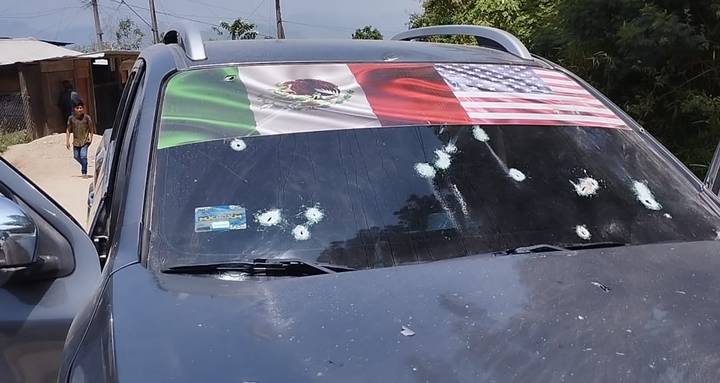
The staff of the Office of the Prosecutor of Indigenous Justice attested to the bodies of Gilberto Pérez who was lying next to his truck in the middle of the road with a high-caliber weapon at his side; of his son-in-law Antonio Pérez Pérez, and his three-year-old son, who were inside the unit that had more than 50 high-powered bullet wounds.
The agent of the Public Ministry also attested to the body of Oliverio Ruiz, who since Friday night was transferred by relatives to his house, located in front of the site of the shooting, to be waked.
Several houses had holes from bullet impacts. A transformer of the Federal Electricity Commission was damaged, so the area was left without power.
According to residents, Angelina Gómez Pérez, Pérez Gómez’s wife, died the night of the attack while being taken to a hospital, as did the two brothers and bodyguards, Antonio and Gilberto Jiménez Pérez, who were in a Ford Estaquita pick-up truck, identified as members of a group nicknamed Los Ratones. Amalia and Estela Perez Gomez, ages 11 and 19, daughters of Perez Gomez, are hospitalized.
José Vázquez Gutiérrez, assistant human rights defender, said that “there is no security for the displaced, although we have requested it from the government. All communities are very afraid.”
He pointed out that “it was an attack against the displaced, but they responded because Oliver Ruiz, son of the owner of the house in which they live, was already dead. That’s when the shooting started, that’s why they responded.”
For its part, the state government reported that “it is presumed that this aggression was between individuals and occurred when driving through the area aboard a vehicle, people were attacked with gunfire.”
He said that: “immediately after learning of the violent events that occurred in the Polhó community, he activated the attention protocol to guarantee security in that region.”
Originally Published in Spanish by La Jornada, Sunday, June 4, 2023, https://www.jornada.com.mx/2023/06/04/estados/021n1est and Re-Published with English interpretation by the Chiapas Support Committee
Armed forces retake control of Frontera Comalapa
From the Editors
Yesterday, federal and State security forces, with the support of airplanes, retook control of Frontera Comalapa, Chiapas, where several communities were the scene of confrontations between two organized crime groups last week, which caused the displacement of at least 3,000 residents.
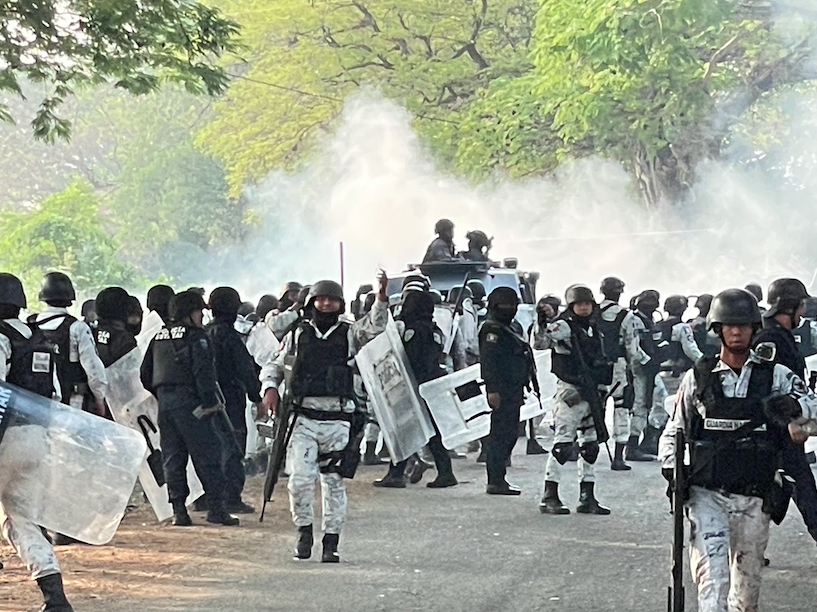
Hundreds of troops left the municipality of Comitán early to head to the Joaquín Miguel Gutiérrez ejido, known as Quespala, some 50 kilometers (about 30 miles) from the municipal seat of Frontera Comalapa, where they encountered dozens of residents who tried to prevent their entry, and therefore there was a confrontation.
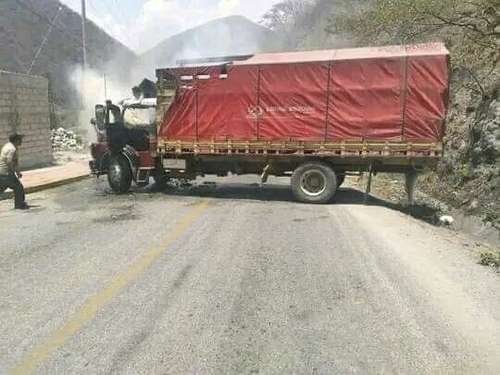
According to testimonies of neighbors, some people placed vehicles, tree trunks and a steel boom across the entrance to the community and started to throw sticks and stones at members of the security forces. They responded with tear gas in order to disperse the dissidents and then they took control of the town amid cries of rejection and complaints. The authorities did not disclose whether there were any injuries or arrests.
Another convoy entered the municipal seat at noon. There were no incidents in this case. Local residents explained that some uniformed forces arrived from Tapachula or from coastal municipalities. “There were so many Army cars and they stayed at the entrance.”
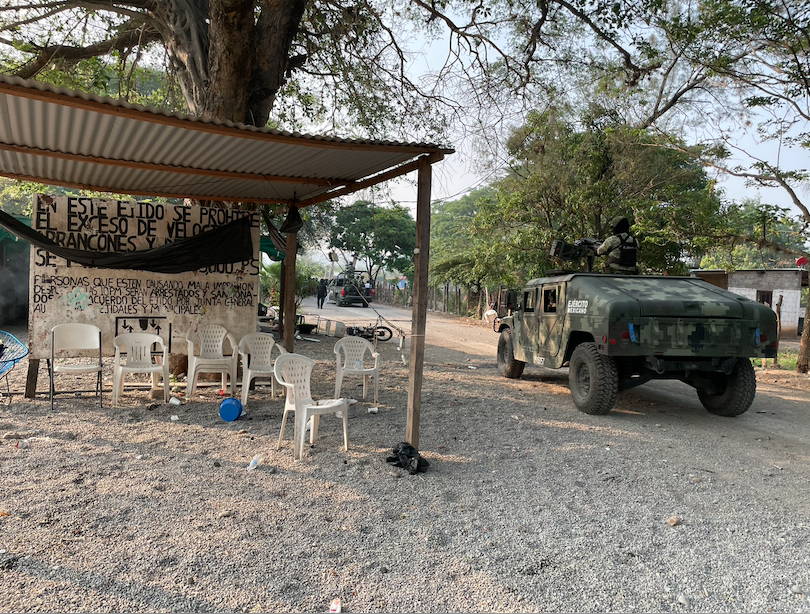
They indicated that a little before these forces arrived, a small plane, presumably of the Mexican Army, flew over the area; while in other regions, like Paso Hondo, on the border with Guatemala, several helicopters were seen.
On Monday, the Secretary of National Defense announced the start of this operation of the regional task force of the Seventh Military Region, the Navy, the National Guard, the Attorney General of the Republic, the State’s Attorney General and the state’s Secretariat of Security and Citizen Protection.
Yesterday morning, a voice message was broadcast, attributed to an alleged leader of the El Maíz group, linked to the Cartel Jalisco Nueva Generación (CJNG), in which could be heard: “Compañeros of the foundation, Have a good morning. We’re going to be very relaxed, the law is coming, it’s going to do its job, it’s going to be searching.”
According to the inhabitants of Frontera Comalapa, the troops, as well as federal and state agents remained in the community as of Tuesday night, so daily activities were renewed.
They calculate that more than 1.000 members of the security forces participate in the operations implemented because of the roadblocks and confrontations that took place last week between members of the Jalisco Nueva Generación and the Sinaloa cartels, mostly in Nueva Independencia (Lajerío).

Originally Published in Spanish by La Jornada, Wednesday, May 31, 2023, https://www.jornada.com.mx/2023/05/31/estados/028n1est/ and Re-Published with English interpretation by the Chiapas Support Committee
The CJNG and El Maíz control Frontera Comalapa with torture and murders
From the Editors
Together with the Cartel Jalisco Nueva Generación (CJNG), the criminal grouping El Maíz has been able to control residents of the municipality of Frontera Comalapa, where there are some 3,000 displaced by the violence. Those who refuse to participate in the roadblocks are killed, disappeared, kidnapped, fined or beaten with boards, denounced inhabitants of that place, situated 25 kilometers (15.5 miles) from the border with Guatemala.
“Some of those who are closing roads are transport drivers, gum sellers, shoe shiners, businessmen; everyone who seeks to earn their daily bread with the simplest work is subject to this group,” they accused.
“Under threat and fear, everyone is pressured. So is Comalapa. Those who have a conscience are few; the majority of the people of Comalapa do not participate of their own volition,” said some locals consulted on condition of anonymity.
“If the tenants of the market are told that they have to close and go to block [roads], they must obey; Otherwise, they fine them, lock them up for three days and even take away their booths,” they explained.
They said that the situation in Comalapa broke down more than two years ago, when a group of the Sinaloa cartel split and joined the CJNG. Then, they formed El Maíz, now a feared group, to form their social base through threats and pressure.
The clashes that began two years ago are the result of the Sinaloa cartel seeking to regain territory.
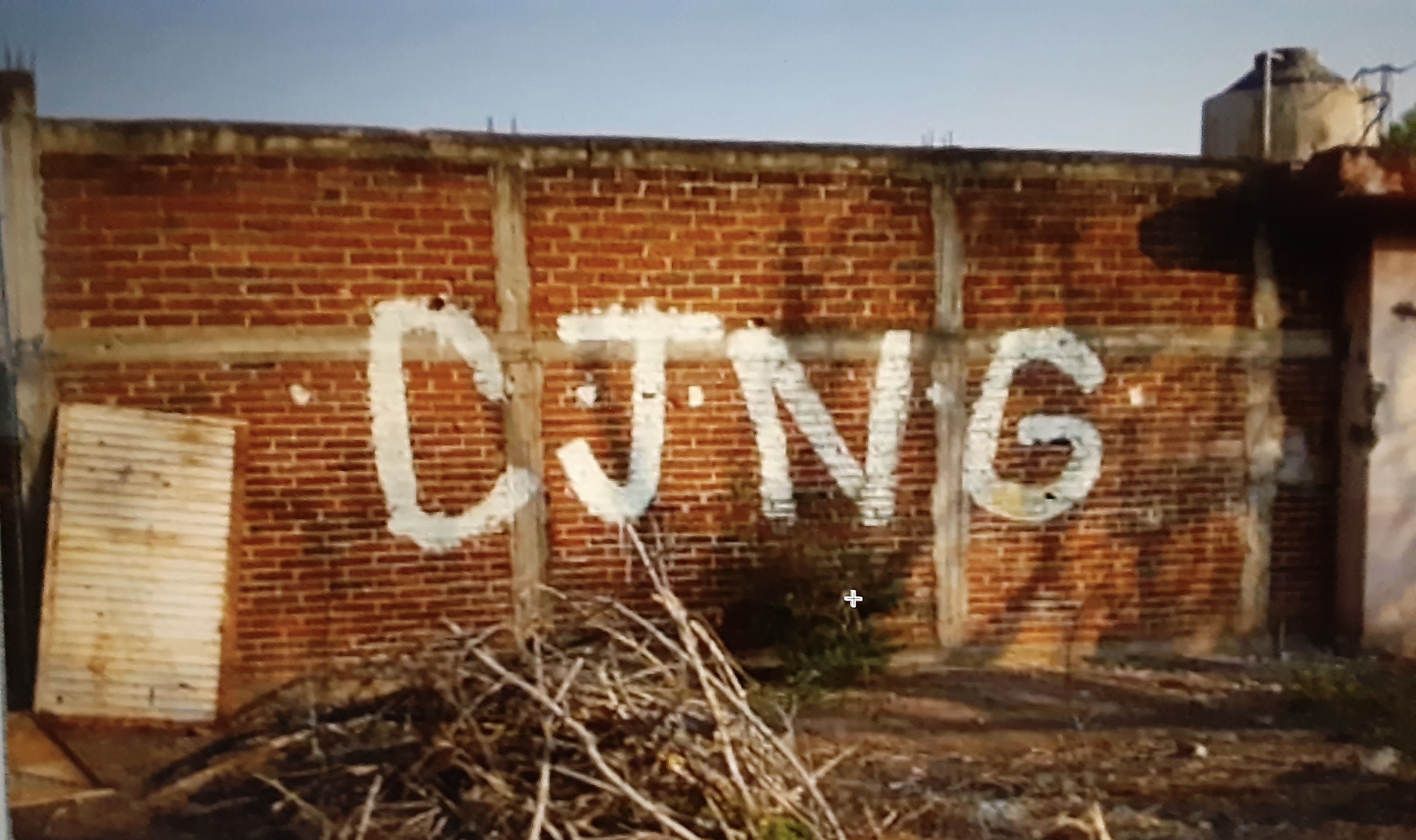
“They have subjected the unions of workers who sell pozol, gum, meat, tortillas, shine shoes, load cargo, etc. (only teachers and health workers have not been forced to join); From the smallest to the largest are subject to this organization, backed by four letters,” a resident revealed.
Since last Tuesday, when the most recent confrontations began, in which according to some neighbors even drones were used, the constant threat, especially through WhatsApp messages, is that they will enter the municipal seat to capture the leaders or that there will be forced recruitment.
In response, El Maíz forces citizens to block different points and confront an opposing group approaching Lajerío or some other community.
“The least that can happen to those who resist participating is that they board them: they lower their pants and with a piece of board they hit them on the buttocks until they defecate because of the pain,” a local man said.
Paralyzed Economy
Comalapa, governed by a municipal council presided over by Alejandro Mérida, is now taken over by men of the CJNG-El Maíz, which without the presence of public security forces, move through the streets at any speed in pick-up trucks, and with high-power weapons.
When they participate in confrontations they use the so-called monsters, armored vehicles with thick metal plates.
The residents of Frontera Comalapa asserted that the clashes in recent days have left an undetermined number of dead and injured from the two gangs. There have also been heavy economic losses due to the closure of shops, paralyzed transport and citizens unable to work.

Originally Published in Spanish by La Jornada, Monday, May 29, 2023, https://www.jornada.com.mx/2023/05/29/estados/030n1est and Re-Published with English interpretation by the Chiapas Support Committee
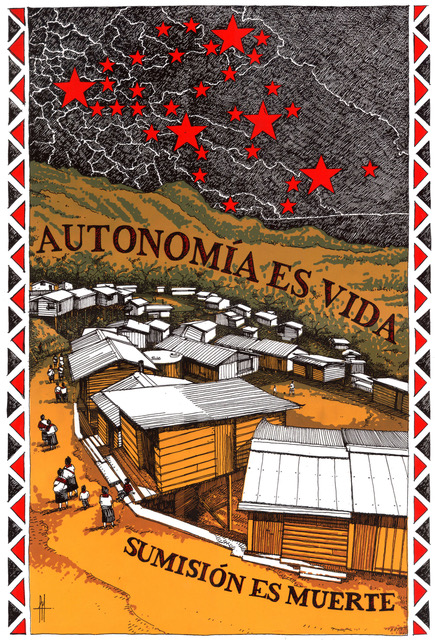
National and international statement in response to the aggression against the Moisés Gandhi community: Stop the paramilitary violence against the Zapatistas

Chiapas Support Committee will join a Mexican zapatista movement-led international mobilization on Thursday, June 8, 2023, to denounce the paramilitary violence against Zapatista and Indigenous communities.
National and international statement in response to the aggression against the Moses Gandhi community
[Puedes leer la versión original en español AQUI.l
June 2023
To the peoples of Mexico and the world,
To the individuals, collectivities and peoples who defend Life
To those who feel the urgency of acting before a Mexican southeast on fire.
Today, at this time, Mexico is on the limit, to that limit that always seems distant until a bullet that comes from above detonates the rage of the Mexico from below. The Zapatista compañero Jorge López Santíz is on the edge between life and death due to a paramilitary attack from the Regional Organization of Coffee Growers of Ocosingo (ORCAO, for its acronym in Spanish), the same group that has been attacking and harassing the Zapatista communities. Chiapas is on the verge of a civil war with paramilitaries and hitmen of the various cartels fighting for the plaza (geographical area of influence); and self -defense groups, with the active or passive complicity of the state and federal governments of Rutilio Escandón Cadenas and Andrés Manuel López Obrador.
The Zapatista Army of National Liberation (EZLN), that has maintained peace and has developed its autonomous project in its territories, has tried to avoid violent clashes with paramilitary and other forces of the Mexican State, nevertheless, it is harassed and constantly attacked. Since the end of the 20th century, and up to now, the EZLN has opted for the political struggle by civil and peaceful means, despite the fact that their communities are shot, their crops burned and their cattle poisoned. Instead of investing their work in war, they have invested it in building hospitals, schools and autonomous governments that have benefited Zapatistas and non-Zapatistas alike, and yet governments from Carlos Salinas to López Obrador have tried to isolate, delegitimize and exterminate them. Today, a few months before the EZLN struggle ́s 40th anniversary, the paramilitary attack by ORCAO has one man’s life hanging in the balance, the same from which hangs the eruption of Mexico from below that can no longer stand the pressure on its dignity or the war against its communities and territories.
The ORCAO attack is not a conflict between communities, as Carlos Salinas would characterize it and as López Obrador will surely try to do it. The attack is the direct responsibility of the Government of Chiapas and the Federal Government. The first for covering up the growth of criminal groups that have caused Chiapas to go from relative tranquility to a red hot spot of violence. The second for remaining silent and passive in the face of the evident situation in the southeast. Why does ORCAO attack the Zapatista communities? Because they can. Why does the government of Rutilio Escandón allow it? Because in the Chiapas of above, governing means bathing with indigenous blood. Why does López Obrador keep silent? Because the governor of Chiapas is brother -in -law of his beloved Secretary of the Interior, Adan Augusto López; because as his predecessors, he cannot tolerate that a rebel group is a reference of hope and dignity; because he needs to justify military action to “clean” the southeast and finally be able to impose his megaprojects.
We also understand this attack as the result of the current government’s social policies to divide and corrupt, destroying the social fabric of the communities and peoples in our country, particularly, in Chiapas. We see with concern that programs such as “Sembrado Vida”, -which practically has the same budget that the Federal Ministry of Agriculture-, and other similar programs, promote confrontation between communities historically stripped of their lands and their rights. They are used as mechanisms of political control and as bargaining chips for organizations such as ORCAO to gain access to the supposed benefits that these programs provide, at the cost of the theft of recovered Zapatista autonomous lands. For us it is clear that it is not a matter of conflicts between peoples; It is a counterinsurgency action that seeks to destroy them, destroy the EZLN and all the communities and peoples that continue to fight for a life with dignity.
Those of us who sign this letter do so to summon ourselves and those who believe that dignity and word must be risen to stop the massacre that is looming; to call upon those who support the current government to open their hearts to the injustices that inundate the present of this country, beyond their affinities or political sympathies; so that we can join forces in this need to act with the common purpose of stopping this atrocity.
We sign this letter because we see the urgency to put a stop to the paramilitary violence in Chiapas, because failure to do so means letting Mexico sink deeper into this endless war that is tearing it apart. We demand justice for Jorge López Santíz. We demand the absolute dissolution of the ORCAO. We demand a thorough investigation of the Government of Rutilio Escandón. We demand that the silence of López Obrador cease to be an accomplice of the violence in Chiapas.
Taking up the demands presented by the National Indigenous Congress we demand:
1. That the health of compañero Jorge be guaranteed and that he be provided with all the necessary attention and for the time required.
2. That the armed attack against the Moisés Gandhi community be stopped and its autonomous territory be respected.
3. That the material and intellectual authors of these paramilitary attacks be punished.
4. That the armed groups, through which the war against the Zapatista communities continues to be active and growing, be dismantled.
We, as well, demand the immediate release of Manuel Gómez, support base of the EZLN, whose unfair imprisonment we do not forget.
With the CNI, we warn that the war declared against the original peoples, guardians of Mother Earth, forces us to act organized to stop the violence that grows and to restore our connection and care of Life.
We call upon ourselves to demonstrate in the streets, embassies and consulates, study centers and workplaces, in social media; everywhere possible and essential for us; against military,
paramilitary and organized crime violence, and in defense of life.
We call ourselves and call upon you to join efforts to weave a day of dislocated actions from May 27th to June 10th with a national and international coordinated action on June 8th.
Stop the war against the Zapatista peoples.
If they touch one of us, they touch us all.
Signatories,
Noam Chomsky
María de Jesús Patricio Martínez
Carlos González García
Enzo Traverso, (escritor y profesor de la universidad de Cornell)
Michael Hardt
Yvon Le Bot
Michael Löwy, Sociólogo, Paris
Bertha Navarro
Juan Villoro
Alfonso Cuarón
Gael García Bernal
Diego Luna
Jorge Volpi
Julieta Egurrola
Joaquín Cosío
Franck Gaudichad (co presidente de Francia America Latina)
Raoul Vaneigem
Anselm Jappe
Tomás Ibañez, Escritor, militante libertario
Alicia Castellanos
Pierre Salama, profesor emérito de la Universidad Sorbonne- Nord
Júlio Henriques, revista Flauta de Luz (Portugal)
Rubén Navarro, profesor, Lyon, Francia
María Herrera Magdaleno (Familiares en Búsqueda María Herrera)
Daniel Giménez Cacho
Marcos Roitman Rosenmann
Carlos Taibo (autor de varios libros Colapso, entre otros)
Jaime Pastor, editor de la Revista Viento Sur, Estado Español
Gilberto López y Rivas
Malú Huacuja del Toro
Arturo Escobar, Colombia
Ofelia Medina
Javier Sicilia
Alfonso Reynoso Rábago
Ana Laura Gamboa Muñoz
Sabrina Melenotte. Investigadora del CIESAS
Francisco Barrios, El Mastuerzo
Ariadna Flores Hernández
Sophie Alexander-Katz
Raúl Delgado Wise
Santiago Corcuera Cabezut
Luis de Tavira
Guadalupe Nettel
Everardo González
Carlos Cuarón
Fernanda Navarro
Raul Zibechi, Uruguay
Vilma Almendra
Manuel Rozental
Diego Osorno, reportero. Sonora, México
Sylvia Marcos, Investigadora
John Holloway
Magdalena Gómez
Fernanda Aragonés
Carmen Ventura, El Colegio de Michoacan
Antonio Gritón, Artista Visual, México
Daniela Rea Gómez, Periodista
Servando Gajá, Cineasta
Margara Millán, Profesora
Jérôme Baschet, México, Francia
Rocío Martinez, México
Anne Gerschel, directrice artistique des Chapiteaux Turbulents, Paris, Francia
Jean-Luc Untereiner, directeur des écoles immersives alsaciennes, Bischheim Francia
Ana Laura Nettel
Arturo Anguiano
Juan Wahren
Clara Jusidman
Emory Douglas, Political / Social Justice and Black Panther Party Revolutionary Artist
Juan Carlos Rulfo, cineasta
Marcela Turati, periodista
Daniela Rea
Natalia Beristáin
Kyzza Terrazas, cineasta y escritor
León Chávez Teixeiro
Pedro de Tavira
Ana Esther Ceceña
Bárbara Zamora López, Bufete Jurídico Tierra y Libertad
Mariana Elkisch Martínez, Secretaria General de la Universidad Autónoma de la
Ciudad de México (UACM)
Valentina Leduc, documentalista, Ciudad de México
Marina Stavenhagen
Jacobo Dayán
Carolina Coppel Urrea
Raquel Gutiérrez Aguilar, BUAP
Alberto Cortés
Ana Lydia Flores Marin (Ibero, Puebla)
Miguel Urbán, Eurodiputado, Estado Español
Youssef Diawara, comédien, Paris Francia
Christine Pellicane, metteur en scène, Paris, Francia
Philippe Maymat, comédien, Paris, Francia
Madame Miniature, musicienne, Paris, Francia
Sergio Canto, réalisateur, Paris, Francia
Sylvain Sèchet, réalisateur, Paris, Francia
Viviana Saint Cyr, psychanalyste Paris, Francia
Rime Ateya, médiatrice culturelle, Paris, Francia
Solène Merran, comédienne, Paris, Francia
André Lejarre, photographe, Paris, Francia
Catherine Rauscher, artiste peintre, Paris, Francia
Fanny Gaillanne, professeur, Paris, Francia
Jon López de Vicuña, musicien, Paris, Francia
Amaia Cabranes, professeur Université Paris Ouest Nanterre Francia, Nanterre, Francia
Manon Buisson, conseillère principal d’éducation, Aubervilliers, Francia
Gabriel Gau, coordinateur socio-culturel, Aubervilliers, Francia
Joseph Kempf, comédien, Montreuil, Francia
Sandrine Demoron, comédienne, Montreuil, Francia
Barthélémy Maymat, comédien Bordeaux, Francia
Serge Balu, musicien, Saint-Denis Francia
Ilef Jerbi, étudiante, Saint-Denis Francia
Thomas Girou, comédien, Colombes, Francia
Aurélien Desclozeaux, danseur, Marseille, Francia
Odile Lauria, comédienne, Arcueil, Francia
Cécile Mesnard, directrice de collège retraitée, Plouha (22) Francia
Aline Paillet, journaliste , Francia Lercoul
Sarah Viennnot, comédienne, Nantes, Francia
Judith Arsenault, comédienne, Rustrel
Laure Gilquin, artiste plasticienne, Berlin, Alemania
Pascaline Lefèbvre, coordinatrice de production à l’opéra, Portland, Estados Unidos
José Luis Humanes Bautista, ex-secretario de organización de CGT y ex-coordinador
general de la CGT-Comisión Chiapas), España
Tamara Pearson
Miguel Barrera Rocha
Pilar Gonzalo Arranz, Madrid. Estado Español
Lola del Valle
Gaya Makaran, Investigadora CIALC-UNAM
Vivian Abenshushan, escritora
Manuel Garí Ramos, Economista, Comisión de Economía de Anticapitalistas, Estado
Español
Mariana Mora, CIESAS, Ciudad de México
Luciana Kaplan
Gabriela Jauregui, Escritora y editora, Estado de México
Paula Mónaco Felipe, periodista
Fernanda Paz, UNAM
Tatiana Coll, profesora y articulista de La Jornada
David Flores Magón Guzmán
Araceli Osorio Martínez
Ángeles Eraña, UNAM
Silvia Ribeiro, investigadora
Gabo Revuelta (Mexikan Sound System)
Luisa Riley, Documentalista
Lengualerta, Ciudad de México
Daniela Alatorre
Elena Fortes
Ramón Vera-Herrera, (ojarasca)
Carmen Giménez Cacho
Fernando Matamoros Ponce, ICSyH-BUAP
Alexis Ontiveros
María Minera
Julieta Giménez Cacho
Jorge V. Villalobos G.
Peter Rosset
Ariel García, escritor
Josué Vergara
Mariana Rivera
Gilda Revueltas
Roberta Alexander, Profesora emérita, Estados Unidos
Raúl Romero, México
Argelia Guerrero Rentería, México
Sandra Patargo Muriedas
Luis Fernando García Muñoz
Ixchel Cisneros Soltero
Magdiel Sánchez Quiroz
Lucia Linsalata
Zenia Yébenes Escardó
Amilcar Paris Mandoki
Francesca Cozzolino, profesora-investigadora Paris
Christy Petropoulou, Grecia
María Herrera
Nancy Mercado, pan artesanal La patrona
Inés Durán Matute, México
Mina Lorena Navarro, BUAP – Puebla
Alfonso Diaz, Colectivo de prácticas narrativas
Mir Rodríguez Lombardo
Papús Von Saenger
Marcos Giralt
Yael Weiss
Vicente Moctezuma Mendoza
Isabel Mateos
Carlos A. Ventura Callejas
Luca Newman
León Fierro, Mexicali Resiste
David Zonana
Lila Avilés
Sofía Arrollo
Sophie Alexander
Gabriela Zanabria Corona
Graciela Delgado Ramírez
Constanza Cuetia
Aracelia Guerrero Rodríguez
Marceo Sandoval
Piña Palmera AC. (México)
Paola Diaz Lizé (Chile)
Pierre Beaucage (Canadá)
Cecilia Zeledón (México)
Oscar Soto Badillo (México)
Álvaro Quiroz SJ (Mëxico)
Gabriela Di Lauro Bentivogli (México)
Mercedes Núñez Cuétara (México)
Antonio Fuentes Díaz (México)
Eduardo García Vázquez. Universidad Iberoamericana Puebla (México)
María Eugenia Sánchez Díaz de Rivera (México)
Itzel López Nájera (México)
Marcela Ibarra Mateos, Universidad Iberoamericana Puebla, México.
Claudia Magallanes Blanco, Universidad Iberoamericana Puebla (México)
Guadalupe Chavez Ortiz Académica de la Ibero Puebla (México)
Patricia Maldonado (México)
Compas Arriba – colectivo de Medios Libres
Lado B Medio (Puebla)
Silvia Coca, México
Jéssica Coyotecatl
Fortino Domínguez Rueda, Centro de Lengua y Cultura Zoque – Universidad de
Guadalajara. México.
David Garcia Cazares
Rocio Martinez
Diego Luna, Monterrey, N. L.
Lylia Palacios Hernández , Monterrey, N. L.
Martine Gerardy, Liège, Bélgica
Isabelle Mouly, Francia
Alfonso Leija Salas
Francisco De Parres Gómez, Antropólogo y fotógrafo
Carolina Elizabeth Díaz Iñigo, Antropóloga
María Gabriela Debus, San Martin de los Andes, Argentina
Rodrigo Alexander Uribe Cevallos, Cuernavaca, Morelos
Lila Calderón, Cipolletti, Rio Negro, Argentina
Maria Teresa Bermudez , Venezuela
Adazahira Chávez Pérez
Patricia Botero-Gómez, Centro de estudios independientes, Color tierra, Colombia
Eva Arán Vidal
Eva María Serna Arán
Rocío Servín Jiménez, Guanajuato
Charlotte Sáenz , California, E. U.
Gisela Espinosa Damián
David Barrios Rodríguez, Ciudad de México
Raúl Ornelas, Académico de la UNAM
Héctor Tomás Zetina Vega
Laura Gisela García Domínguez, Profesora de la ENAH.
José Ignacio Sánchez Alaniz
Ana María Vera Smith
Víctor Manuel Ortiz Villarreal
Nora Tzec Caamal
Alberto Coria Jiménez
Jorge Antonio Cruz López
Profra. Jubilada Guadalupe Castillo Feliciano
Fabián Guerrero, editor
Fernando Medina
Felipe Ignacio Echenique March
María Guadalupe Mea Lavaniegos
Aline González Balcázar, Colima, México
Carlos Garza Falla
Graciela de la Torre
Oralba Castillo Nájera, Cuernavaca, Morelos
Verónica Ortiz Cisneros
Ma. del Rosario Aguilar Pizaña
Arturo Carrasco Gómez, sacerdote anglicano
Tania Paloma Hernández, Academica, UACM
Lina Odena Güemes Herrera
Silvia Resendiz Flores, Ensenada, BC
Blanca Lilia Narváez Rivera
Margarita Rodríguez
Bonifacia Hernández Flores
María Elena Ferrer Amarillas
Jacinta Zepeda Nuñez
Josefina Fregoso
Sashenka Fierro Resendiz
Rosa Paulina Resendiz Flores
Jorge Luis López López
Shula Erenberg cineasta
Paula Lucía Muñoz Güemes
Siria Garibay Marrón
Tania Gallaga Hernández
Betsabé Rivera López
María Cristina Peralta Casillas
Elena Katzenstein Ferrer
Alejandra sierra
Alejandro Rodríguez Andrade, Villa de Álvarez, Colima
Elena Fortes Acosta
Natalia Pérez Turner
Sofía Arroyo Martin del Campo
Irene Alvarado Saravia
Laura Ulloa
Arturo Sampson Alazraki.
Jaime Chabaud, dramaturgo y periodista
Stella Maris Figueroa
Hugo Molina
Mathias Órdenes Delgado, Universidad Católica de Temuco, Chile
Mario Bladimir,
Dalia Alejandra Luna Muñoz, Ciudad de México
Ruben Bello Traverso, Artista Plástico , Integrante del Conversatorio Abya Yala
Uruguay
Lila Avilés
Andrés Hirsch Soler
José Antonio Arenas Romero, Colectivo Jirafa. Cuernavaca, Mor
Araceli Joshabet Mendoza Granados
Anayatzin Temores Alcántara
Maria Gracia Castillo Ramírez, APJI-SNPICD-INAH
María Gutiérrez Zúñiga
Edo Schmidt, sociólogo, Münster/Alemania
Laura E Hinojosa Her
Mónica Sainz Ibarra
Laura Espejel
Aída Analco Martínez
Dante Anaya Saucedo
María Cristina Castillo Velázquez
Edith López Ovalle
Isabel Gutiérrez Paredes
Florina Mendoza Jiménez
Adolfo Valtierra
Yolanda Abrajan Flores
Roberto Quiroz González
Rodolfo Oliveros Espinosa
Alexis Daniel Rosim Millán
Rocío Badillo Garrido
Ana Vianey Figueroa Rodríguez
Lilia García Torres
Volga De Pina
Sandra Estrada Maldonado
Mireya P. Ruiz Esparza
Paula Herrera Martínez
Merary Beatriz Vieyra Carmona
Marisela López Pérez
Julieta Flores Muñoz
Abraham Héctor Cano Alarcón
Mario Galván, Sexta Grietas del Norte, Sacramento, CA, Estados Unidos
Mtra. Julieta García L, CNTE, Ciudad de México
Juan Manuel Ayala, Red Ciudadana Alcaldía Miguel Hidalgo
Consuelo Barajas Aviles, terapeuta, Estado de México
Karla Edna Garcia Rocha, Académica, Ciudad de México
Juan José Hernández López, Docente, Ciudad de México
Melva Hortensia Vázquez Velasco, Docente, Ciudad de México
Ricardo Padilla Reyes, Empleado público, Ciudad de México
Pablo Casares Arrangoiz
Jesús González Pazos, Euskal Herria/País Vasco
Aris Mermigkas Honorario Abogado, Athens Bar Association Grecia
María José Martínez Gutiérrez
Simona Maria Frigerio, periodista, directora del Semanario Inthenet, Italia
Manuela Fulvia Micolano
Carmen Domingo
Héctor Estomba Valencia, España
Eduardo Viveiros de Castro, Universidade Federal do Rio de Janeiro Brasil
Daniela Alatorre Benardhttp://noficcion.mx/
Margaret Cerullo Hampshire College, Estados Unidos
Bárbara A. Riviello Falcón, Adherente a La Sexta
Eugenia Ogarrio Calles
Rubén García R., Docente jubilado UAQ.
Diana Itzu Gutiérrez Luna, Chiapas, México
Claudia Fausti, Misiones, Argentina
Maya Goded
Martha Elena Welsh H.
Matilde Belem Huerta
Clementina Gutiérrez Zúñiga.
Carlos Tornel, investigador, Universidad de Durham, RU
Humberto Robles dramaturgo, México
Virginia Ortega Cervantes, Colectiva Jirafa/Nuestra alegre rebeldía, Cuernavaca,
Morelos
Deyanira Cortes Martinez
David Jiménez, Geografias Comunitarias
Emilia Torres, Geografias Comunitarias
Rene Olvera Salinas, Docente de la Universidad Pedagógica Nacional, Querétaro,
México
José Antonio Ortega Rangel
Marco Arturo Calderas Osorio
Armando Soto Baeza
Porfirio Martínez González
Johan Gordillo García
Elena Aguayo
Alma Idalia Kullick Lackner.
Cecilia Dávalos, Alemania
Alma Sánchez, Periodista de Medios Libres, Morelos, México
Delmy Tania Cruz Hernández
Adel Gutiérrez Tenorio
María del Lucero Pacheco Blas, Estudiante de doctorado
Francisca Urias Hermosilo
Antonio Sarmiento Galán, Cuernavaca, Morelos
Rogelio Vizcaino
Guillermo Ramírez, FES Acatlán UNAM
Timo Dorsch, Alemania
Ebru Celtikli, Alemania
Luis Carlos Andrade García Peláez
Verónica Munier
José Resendiz
Cecilia Duarte
Carlos Chablé Mendoza Cronista de Felipe Carrillo Puerto, Quintana Roo, México
Miguel Napoleón Estrada Serrano, Trabajador de la UACM
Juan Luis Sosa Mendoza
Alptekin Aydogan, Ohio, Estados Unidos
Camila Barragán, ICSyH-BUAP, Puebla, México
Silvia Beatriz Della Maddalena, Buenos Aires, Argentina
Otoniel Toledo Salinas médico intensivista perteneciente al colectivo Ángela Davis
de la Liga Comunista de México.
Luis Gonzaga Braga Filho, São Paulo / Brasil
Agustín Vaca García
Mariana Favela
Ernesto Camou Healy, Hermosillo, Sonora
María Isabel Ruiz Quiroz
Rodrigo Camarena González
Braulio Montequin, Txiapasekin (país vasco)
José María Gamboa Herrera
Eduardo Michel González
Blanca Ibarra, Ciudad de México
María Isabel Concepción Pérez
Enrique Avila Carrillo
Gerardo Salvador, Ciudad de México
Daniela Lechuga, Ciudad de México
Joel Ortega Erreguerena, Profesor de la UNAM.
Mariana Ramirez Manzano
Michael Breidsprech
Selva Enríquez Bejarano
Verónica Isabel Rivera Vázque
Jessica Alonso Flores
Rosa Carrasquillo
Eleuterio Payan
Dolifet Antunez
José Manuel Juárez Núñez, UAM Xochimilco
Carlos Hagerman
Roger Maldonado Baqueiro
Marisol Fernández, Artista Plástica, Tepoztlán, Morelos
Mayra Almanza, Córdoba-Argentina
Fabiana Bringas, Córdoba-Argentina
Valeria Sbuelz
Carolina Santizo Portillo
Soledad Herrera
Ana Paula Morel, Universidade Federal Fluminense (UFF), Brasil
Ullrike Röding-Gilberg
Paula Seidel
Oskar Röding
Beatriz Vela, San Agustín, Jalisco
Guadalupe Miranda
Vicki Alexander, Berkeley, California, Estados Unidos
Lourdes Padilla-Cabrera, Académica
Michalis Psimitis, Universidad del Egeo
Jorge V. Villalobos G
Paula Canal Huarte
Mario Vázquez Dirzo, Iztapalapa Ciudad de México
Arturo Espinoza, Comunicólogo
Roxana Bolio
Leonel López
María de Lourdes Mejía, Madre de Carlos Sinuhé Cuevas Mejía
Roberto Rodríguez Contreras “Gato”
Zoraida Rosalía Balcázar Cedillo, Ciudad de México
Felipe I Echenique March, INAH
Lorna Scott Fox
Santiago Llerenas
Ana G Quijano, Colombia
Lino von Saenger
Patricia de Obeso González
Francisco Ortega García
Oscar Arturo González Espinosa, Naucalpan, Edo Mx
Lourdes Gutiérrez
Mercedes Simoncini, Rosario, Argentina
David Olguín
María Isabel Pérez Enríquez, San Cristobal de las Casas, Chiapas
Nicolas Pérez Rulfo
Javier Méndez
Elia Bedonia, Bolonia, Italia
Lenin Andrés Fonseca
Claudio García Ehrenfeld
Andrea Medina Riancho, California, Estados Unidos
Berta María Rayas Camarena, Mujeres y la Sexta Jalisco
Ma. de La Paz Espino del Castillo Barrón
William C. Quinn, Zapopan, Jalisco
Servando Gajá Rodríguez, Cineasta, Morelos, México
Tania Claudia Castillo
Lia Pinheiro Barbosa, socióloga, Brasil
Max Elbaum, Convergence Magazine Editorial Board
Pablo Martinez, Pachuca, Hidalgo
Mariano Francesco De Luca, Italia
Rodolfo Miguel Hirsch Soler
Joe Liesner, California
Elisa Cruz Rueda
Alma López
Aaron Pollack
Daliri Oropeza, periodista independiente
Cecilia María Salguero, Junín de los andes Neuquén, Argentina
Amaranta Cornejo Hernández, Puebla, México
Rosángela Pérez Mendoza, Ciudad de México
José Luis García Ortíz
Argelia Rentería Ravizè
Arturo Guerrero Alonso
Johnatan Guerrero Rentería
Janet Jarrell, San DIego, California, Estados Unidos
Nina Serrano, Ciudad de México
Eduardo Espino, Montevideo, Uruguay
David Muñoz-Alcántara, Finlandia
Kate Keller, Montana, Estados Unidos
John Wolverton, Montana, Estados Unidos
Pablo Reyna Esteves
Adriana del Moral Espinosa, editora México/Estados Unidos
Sonia Larramendy
Chaco de la Pitoreta, Honduras
Fernando Alan López Bonifacio, UNAM
Brenda Porras Rodríguez, UNAM.
Cristina Leal, Estado español
Rosa María Barajas Aviles, México
Enrique Davalos Lopez, México
Adolfo Olea Franco
Alejandra Cárdenas Santana
Violeta A. Chávez Bautista, Veracruz
Johanna Murillo.
Gabriel Pascal
Vicky Lili, Grecia
Antonio Flores González, Universidad Autónoma de Querétaro
Ángel Ancona
Maribel Nicasio González, Guerrero, México
Karina Bustos García, Fotógrafa, Ciudad de México
Mario Espinosa Ricalde
Polo Castellanos, Movimiento de Muralistas Mexicanos, México
Alma Leticia Fregoso Rodríguez, Aguascalientes,
María Cecilia Sheridan Prieto
César Silva Montes
Armida Elia Valverde Cabral
Alicia Cruz, Adherente a la Sexta, Tepic, Nayarit, México.
Estela Valverde Cabral
Danilo de Assis Clímaco
Stefanía Cecconello, Córdoba-Argentina
Ricardo Enrique Flores Corrales.
Pía Camil, Artista visual, Edo Mx
Marlen Alicia Cano Morales
Sihara Casillas Gaeta, Bióloga
José Martín Velázquez Pérez
Kaori Citlali Flores Valverde
Cecilia Soler
Isabel Castillo
Yuriria Pantoja Millán
Amanda Ramos García
Natalia Hernández Cornejo
Víctor Hugo Guzmán Cuevas
Claudia I. Espinosa Díaz
Claudia Ledesma Hernández
Xochitl Zolueta Juan
León Benito Silva Velázquez
Pável Valenzuela Arámburo
Roxana Carmona Viveros
Dulce María Reyes Páramo
Gibrán Rodrigo Mejía Toriz
Hugo Pérez Trejo
Alejandro Araujo Pardo
Adriana Ruiz Gadea
Alejandra Hernández Bocanegra
Lilia Bocanegra Moreno
Francisco Pérez Hernández
Edgar Aguilar Espinoza
Selene Solís Tejada, Cd. Juárez, Chihuahua
Alberto Barrera
Carmen Georgina Treviño González
Jack & Ayda Lucero Fleck, Oakland, California, Estados Unidos
Florina Piña Cancino, gestora cultural y trabajadora universitaria
María Rosaria Mariniello, Napoli, Italia
Patricia González-Zúñiga, California, Estados Unidos
Mtro. Gilberto Zuniga, San Diego, California, Estados Unidos
Carolina Irene Márquez Méndez
Carovane Migranti, Italia-Tunisia-México
André Nascimento, Diário da Guanabara
Luca Manunza, Sociólogo investigador Association cultural Perda Sonadota, Cerdena,
Italia
Elizama Rodas
Gabriela Aguilar
German Hernández
Verónica Marín
Yazmin Cano
Katya Ramírez
Evelyn López Simental
Patricia Ortega
Martha Rodríguez
Dulce Ureña Hernández
María José Larios Corrales
Diana Rubio
Verónica Beltrán
Fiama Rosas Rodríguez
Magaly Romo Pedroza
Martha Ruiz Ballesteros
Daniel Don
Abelardo Chávez
David Pavón Cuéllar
Nithia Castorena-Sáenz, Chihuahua
Lucia Elena Cara, Reggio Calabria, Italia
Ana Belén Sánchez Montalvo, Ciudad de México
Aguanno Enza, Florencia, Italia
Vladmir Souza, São Paulo, Brazil
Olivier Malcor, Italia
Calixto Trinidad Carbajal
María Inés Roqué
Lídia Serrano Martínez, Cantabria (España)
Marina Roio, Italia
Israel Solorio Sandoval, Facultad de Ciencias Políticas y Sociales UNAM
Atanacia Rescalvo
Juan Martínez, Tepoztlan, Morelos
Coquis Delgado, Tepoztlan, Morelos
François Paumier, Saint-Girons, France
Isabel Sanginés Franco, profesora universitaria.
Ena Miroslava Martínez Pérez
Mabel Nogueira
Raquel Vázquez Díaz
Lorenzo Perrona, Italia
Rodrigo García Leija
Maud Febvay, enseignante
Stephan Lynn DeWeese-Parkinson, Tijuana, BC
Catherine DeWeese Párkinson, Tijuana, BC
Emely Arroyo Elizarraraz, Tijuana, BC
Fabio Bertazzo, Italia
Sara Islas, feminista lesbiana independiente
Patricia de Obeso
Astrid Puentes
Renata Demichelis
Adriana Muro
Valeria Villalobos
Diego Morales de Murga
Andrea Ariza Ruiz
Amalia De Montesinos Zapata
Irene López Caltenco
Natalia Iliana López Medina
Ricardo Reyes Márquez
Margarita Cervantes
Eduardo Velasco Vásquez
Elena de la Fuente
Gabriele Braghelli
Juan Ramón Castillo R.
Ruben Macias Esparza
Guillermo Büsch
Luis Alberto Hernández Guzmán
Tobias Müller, The New Institute, Hamburg, and University of Cambridge
Tekwani Fernández
Itztliocelotl Miguel Romero
Ana Laura Vázquez Caso
Mary Ann Tenuto, Chiapas Support Committee
Miguel Ángel Radilla, Red de Resistencias y Rebeldías de Tijuana, Tijuana, BC
Ferdinando Alliata, Palermo, Italia
Ivette Leyva C.
Alicia Andares, trabajadora independiente, Ciudad de México.
Carlos Hagerman
Ruth Betancourt Vargas
Tlatoani Tlacaelel Flores
Mary Zapala
Diego Luz
Alicia Mendoza Guerra
Ángeles Sánchez Bringas
Ricardo Falomir
Mauricio Acosta
Enriqueta López de la Cruz
Miguel Ángel Alvarado Hernández
Sergio Visquerra, Seminario Subjetividad y Teoría Crítica del Posgrado de Sociología
de la Benemérita Universidad Autónoma de Puebla.
Teresa Jacob
Rosa María Jurado Muñoz
Erica Serrano
Teresa Rodríguez de la Vega Cuéllar, FCPyS UNAM
Carmen Dayana Ayala Lopez, Tijuana, BC
Andrea Schwuchow
Andrea Sánchez Grobet
Sofía Falomir Sánchez
Andrea Ramírez Aburto
Lucía Riojas
Carolina Torreblanca Becerra-Acosta
Daniel Cuevas
Mónica Meltis Véjar
Simón Sánchez Ortega
Regina Barrios Parlange
Simón Sánchez Ortega
Regina Barrios Parlange
Mariana Orozco Ramirez
Pablo E. Martínez Rodríguez
Jimena Soria
Marcela Azuela Gómez
María Álvarez Reyes
Regina Ganem
Jimena Garcia Cabello
Isabel Garcia Lievana
Lilian Karina Barriga Castañeda
Yael Viridiana Ramírez Romero
Brenda Ana Isabel Rolón García
Vladimir Chorny
Aldo Sotelo
Francisco Lagunes Gaytan, Antropologo
Elisa Cruz Rueda. Escuela de Gestión y Autodesarrollo Indígena. Universidad
Autónoma de Chiapas.
Ana María Sánchez Rodríguez
Regina Pérez Ysunza
Paulina Botella Alanis
Jorge Hidalgo Zurita
Anahí Espíndola Pérez
Judith Chaffee Hoppe
María de Lourdes Covarrubias Velasco
Valentina Glockner Fagetti
Roberto Rosete Guzmán
Celeste Maribel Tamayo Carrera
Paulino Alvarado Pizaña
Huáscar Salazar Lohman (Bolivia)
Lesly Yobany Medoza, Nubenegra
Ragueb Chaín Guadarrama
Melina Gómez
Shuravi Serratos
Marcela De Alva
Ericka Sánchez
Rosalba Zambrano Velasco México
Gerardo Pérez Viramontes (México)
Guillermo Pérez Esparza (Guadalajara, Jalisco)
Ernesto Aroche (Puebla, México)
Mely Arellano Ayala ( Puebla, México)
Nuria Ciofalo (Estados Unidos)
Joaquín Osorio Goicoechea
J. Jesús María Serna Moreno
Pedro Raul Suarez Treviño, Asesor juridico
Ericka Ileana Escalante Izeta (México)
Al-Dabi Olvera Castillo (México)
Cecilia Peraza Sanginés UNAM
Liliana Daunes Comunicadora feminista argentina
Angela Daly, Escocia
Jesse Hutchison , Sextas grietas del Norte California, Estados Unidos
Giuseppe Rotiroti
Irene Mulazzani
Virgilio Mail
Emmanuel Galaviz, Red de Resistencias y Rebeldías de Tijuana Tijuana, BC
Cassandra Cárdenas Pimentel Promotora Cultural
Sinaí Rivera Martínez Integrante del colectivo Ilusionistas sociales
Marco R. Alcántara Jiménez
Karen Huffman
Adriana López Catalán
Eliézer González Luévanos, Profesor de primaria y cantautor, Saltillo, Coahuila
Ma. Asunción Gutiérrez González
Rosaria Ronchi, Italia
Priscilla Mojica, Tijuana, BC
Agustin Solano Lopez, Guerrero, México
Luz Verónica Gallegos Cantú, Profesora universitaria, Monterrey, N. L.
María Belmonte Vega, Monterrey, N. L.
Diana Puente, Monterrey, N. L.
Vanessa Sugey Catalán Sánchez, Cuautla, Morelos
Oswaldo Salvador Alba Chavez, Tallerista del faro Indios Verdes
Nayade Monter Arizmendi
Heriberto Rodriguez, fotógrafo, México
Amarela Varela Huerta Profesora Investigadora. Academia de Comunicación y
Cultura San Lorenzo, Tezonco
Maria Auxilio Barajas Aviles, trabajadora independiente Estado de México
Alejandro Bonada Chavarría, Universidad de Granada
Omar Vargas Angeles, estudiante de posgrado en CIESAS-Sureste.
Raúl Ybarnegaray, trovador, Cochabamba – Bolivia
José Luis Aguilar Alatorre, Corregidora, Querétaro
Wilda Western Universidad Autónoma de la Ciudad de México
Alberto Velázquez Solís Universidad Intercultural de Campeche Yucatán, México
Juan Carlos Alejandre
Maria Isabel Pérez, Colectivo Chikinte’
Rodrigo Carrillo Barajas, estudiante UNAM, Edo Mx
Maria Refsland
Susanne Normann
Viljar Eidsvik
Åsne Rosseland
Eline Mannino
Ingrid Fabiola Ocares Moen
Hedda Østgaard
Haley de Korne,
Eva Maria Fjellheim
Ragnhild Holtan
Henrikke Ellingsen
Tuva Sætre Ressem
Sonia Munoz Llort
Sarah McClain, Missoula, Montana EEUU
Robbie Liben, Missoula, Montana EEUU
Carol Wald, Missoula, Montana EEUU
Robert C. Rosen, Missoula, Montana EEUU
Kim Bostrom, Missoula, Montana EEUU
Char Jones, Hamilton, Montana EEUU
Dave Jones, Hamilton, Montana EEUU
JP Kaljonen, Visual artist
Alèssi Dell’Umbria
Maurizio Acerbo
Luis Hernández Herrero, médico, España
Lorena Cortés Manresa
Kurt Richards McLean, Baja California, Mx y San Diego, Estados Unidos
Carmen Valle
Alejandro Simental Casillas
Cipriano Izquierdo
Claudia Ramírez Martínez, artista interdisciplinaria
Elena Delgado
Maria Concepcion Garcia Batalla, España
Juana Cruz Jimenez de las margaritas
Ludovica Pivari
Giovanni Cuocci
Felipe de Oliveira Uba, FGV, Brasil
Patricia Guerrero, UFSC, Brasil
Adriana Angelita da Conceição, UFSC, Brasil
Brenda Arelli Urbina Bolaños, actriz Performer
Jérémie Bonheure, Francia
Andrea Guerrero, Colombia
Diego Florez, Colombia
Samantha Alflen, Brasil
Aline de Jesus Nascimento, Brasil
Fernando Neri Valente, Brasil
Natalia Walzburger Martins, Brasil
Amanda Becker, Brasil
Ana Lilia Félix Pichardo, UFSC, Mex/Brasil
Natalia Escobar, Periodista
Jorge Abraham Rábago Vega
Raúl Camargo, Estado Español
Lisa Lugrin, autora de comics
Clément Xavier, autor de comics
Filiberta Nevado Templos
Rudy Graves, Reino Unido
Ivette Sampson Avila, Mexico
Ricardo Giraldo Montes
Clara Redal Móntan
Laura E. Prianti, Ciudad de Mexico
Pilar Redal Montané
Hernán Uviña, Autor, Argentina
Gizela Garciarena Hugyecz
Zaidy Manoella Dzay Graniel, Red Recrearte Germina, Yucatán, Quintana Roo
Diana Gabriela Uiz Ateaga, Red Recrearte Germina, Yucatán,Quintana Roo
Luis Carlos Andrade
Cecilia Espinoza Reyes
Miguel Jiménez Mendoza
Armando Mora Martínez
Gerardo Tort
Bertha María Preza Martínez, Ciudad de Mexico
Raquel Herrera, Red De Resistencias y Rebeldías en Tijuana, Tijuana, B C
Norma Angélica Parra Hernández
Luiz Miguel Mendonça Gonçalves
Crisstian Villicaña, Periodista, Tijuana, BC
Rubén Guevara, Ensenada
Noemí Domínguez Gaspar
Rosa Merino, Escribano, Madrid, España
Nayar López
Reyna Cliiff
Daniel De Santis
Juan Trujillo Limones, Barcelona, España
Silvia Resendiz Flores
Blanca Lilia Narváez Rivera
Margarita Rodríguez
Bonifacia Hernández Flores
María Elena Ferrer Amarillas
Jacinta Zepeda Nuñez
Josefina Ibarra Fregoso
Rosa Paulina Resendiz Flores
María Cristina Peralta Casillas
Virginia Rivera Gutiérrez
Fabian Hector Luna
Claudia Martínez Sánchez, Puebla
Francisco Toscano Sosa
Mónica Sánchez
Ángel Manuel López Rafael
Teresa González de Chávez Fernández, Madrid, España
Ángel Serrano Galindo, Comunero de Xalatlaco
Cresencio Chávez Salazar, Docente, Ciudad Juárez, Chihuahua.
Tania Paulina Viña Frías
Isaac Aldana Serrano
Ana Valentina López De Cea
Alejandra Madrigal
Araceli Maldonado
Sonia Tuset
Juan Espinosa, Argentina
María Belén Maña, Argentina
Marcos de Vedia, Argentina
Toluz Chediex, Argentina
Morelia Montes, Argentina
Mariano Pierri
Denise Sol Margulis, Argentina
Remigio Gomez
Raúl Alberto Cela, Argentina
Carolina González González, Red Regional de RyR, La Paz, BC, Mexico
Itzamna Hernández, Músico y Actor
Wendy Juárez
Miriam Diana
Constanza Campos Cerón, estudiante, UAZ
Manuela Salazar Suárez
Mario Alberto Cortez Campos
Francisco Javier Tapia Hernández
Nadia Constanza Hernández Díaz
Jesús Espinoza Mendez
Gildardo Izaguirre Fierro
Jennifer Zoe Borrego Duran
Jaime Renan Ramírez Zavala
Ana Laura Ríos Morón
Ramón Ernesto Jara Guzmán
Iris de la Peña López
Brenda Yohana López
Alma Leticia Borrego
María Betzabe García Galindo
Ilich David Escobar Corona
Victoria Gallegos Guerrero
José Alberto Zamudio Salazar
Gildardo Izaguirre Fierro
Alfredo Galvez Rubio
Germán Mendez Lugo
Héctor Abraham Borrego Duran
José Antonio Estrada Godinez
Luis Alain Lizarraga Sánchez
Ricardo Vazquez Gonzalez
Pablo Montaño
Nysai Moreno, Red regional de RyR San José BCS, Ensenada, BC
Carmen Morales Mendez, socióloga
Silvia Anguiano Rodriguez, abogada
Nery Chaves García
Mariana Edith González Alvarado, etnóloga
Mariana Alaide Jiménez Toris
Ireri Mejía Almonte
Ma del a Carmen Bustos Garduño
José Alberto Dávila Corella, músico
Axel Gottschalk, Argentina
Rosa María Mila Degante, Huamantla, Tlaxcala
Efrén López Mila, Huamantla, Tlaxcala
Diego René Rosas Martínez, Puebla
Carlos Damién Nava Suárez , Puebla
Rubén Torija Luna, Puebla
León Julián Mayorga Vaca, Puebla,
Guadalupe D. Vargas, CDMX
Pável Alejandro Mayorga Vaca
Ana Laura Suárez Lima
Nemir Viveros Cantera, San Pedro Cholula, Puebla
Israel Rivera González, Ciudad de México
María Teresa Ascencio Cedillo, Puebla.
Francisco Jorge Espinosa, Argentina
Noé Humberto cazetta, São Paulo, Brasil
Silvio Carneiro, São Paulo, Brasil
Menna Mourad, Africa, Egypt
Elismar de Souza, Rio de Janeiro, Brasil
Marina Rago Moreira , São Paulo, Brasil
Rayssa Cortez, Brasil
Angelica Santamaria Alvarado
Adair Daer Simoes Filho, Santo André SP, Brasil
Anielle Gonçalves de Oliveira, Atalanta, SC, Brasil
Flávio Miranda, Rio de Janeiro, Brasil
José Blanes Sala, São Paulo, Brasi
Ricardo de Sousa Moretti, São Paulo, Brasil
Igor Celestino Ramos, Santo André, SP, Brasil
Eduardo Massayuki, São Bernardo do Campo, SP, Brasil
Leonardo Leite, Niterói, Brasil
Jônatas da Silva Abreu Aarão, Niterói, Brasil
João Nackle Urt, Brasil
Robson Luiz Pretodio
Adriana de Carvalho Alves, Brasil
Isaac dos Santos Bezerra, Brasil
Alessandra Prates Barreras Carriero, Porto Alegre, Brasil
Marcos Paulo Vitorino, Santo André, SP, Brasil
Raul Garcia Simões, São Paulo, Brasil
Pedro Puertas Silveira, São Paulo, Brasil
Sávio Freitas Paulo, Rio de Janeiro, Brasil
Miriam Oliveira, São Paulo, Brasil
Andrea Avila Serrano, Bogotá, Colombia
Liam, Nueva York, EUA
Paulo Henrique Furtado de Araujo, Niterói,Brasil
Fabiane Santana Previtali, Coordenadora do GPTES, UFU, Brasil
Andrea Santos Baca, CRU Solo , UFABC, SP, Brasil
José Antonio Foronda Farro, CdMx
Cecilia Torres Garibaldi, Argentina
Rodrigo Vera Reyero
Elina Aguiar, Argentina
Yhaira González-Avilez, Tijuana, Baja California, México.
Iris Nayeli López Pérez
Elia Gutiérrez Díaz
María Paola Ortiz Santiago Reyes Herrada
Susana Molina Medina
Paulina Genea Parra Chávez
Dany Gutiérrez
Karen Elizabeth Zúñiga Fernández
Ivonne Monte de Oca
María Estrada, Tijuana, BC
Cipactli Yruegas Rubalcaba
Lizet Romero Guzmàn
Ricardo Javier Suárez Estrada
María Magdalena Cerda Báez
Ernesto García Hernández, Puebla
Theresa Ortega, San Diego, CA
Cristina Steffen, CdMx
Addison Winslow, California, EUA.
Enrique Ávila Carrillo,
Luz Rivera
Miguel Alejandro Gutiérrez Hernández
Lizeth Capulín Arellano
Macarena Marey, Argentina
Luis Rojas, Paraguay
Nicolás Salvi, Argentina
Matías Blaustein, Argentina
Pablo Díaz, Uruguay
Pablo Vommaro, Argentina
Carla Gras, Argentina
Fernanda Torres, Argentina
Pablo Alabarces, Argentina
Bernardo Mançano Fernandes, Brasil
Manuel Riveiro, Argentina
Pablo Dalle, Argentina
Pabel López Flores, Bolivia-Italia
Elver Guerrero Espitia, Colombia
Jorge Montenegro, Brasil
Paula Varela, Argentina
Stalin Herrera Revelo, Ecuador
Salvador Schavelzon, Brasil
Sergio Elías Uribe Sierra, Chile
Mariano Millán, Argentina
Vanda Ianowski, Argentina
Fabiana Bringas, Argentina
Stefanía Cecconello, Argentina
Valeria Sbuelz, Argentina
Juan Wahren, Argentina
Dolores Roca Rivarola, Argentina
Renata Ferreira da Silveira, Brasil
Marcelo Argenta Câmara, Brasil
Mariana Caballero Briones
Ilyana Ramírez Gutiérrez
Margarita Espino Del Castillo Barrón
Alejandra Martínez, Monterrey, N.L.
Alejandro Bernal, Monterrey, N.L.
Hugo Gottschalk, Argentina
Jesús Gómez
Yarazeth Mayoral Santiago
Victoria Ruiz Rincón
Elena Morúa, San Cristóbal de las Casas, Chiapas
Ernesto Flores Escareño , Zacatecas, México
Miguel Ángel Sánchez Salas, Zacatecas, México
Martin Argumedo López, Zacatecas, México
Sergio Armando Flores Carranza, Zacatecas, México
Juan Enrique Ortiz Sanchez, Zacatecas, México
Sonia Viramontes Cabrera, Zacatecas, México
Jairo Antonio López, Zacatecas, México
Betsy Malely Linares, Zacatecas, México
Gilberto Raúl Mendoza Martínez, Zacatecas, México
Silvana Andrea Figueroa Delgado, Zacatecas, México
Norma Angélica Andrade Haro, Zacatecas, México
Raúl Morones Muñoz, Zacatecas, México
Josué De Ávila Gonzalez, Zacatecas, México
Alba Amaranta Hernández Martínez, Zacatecas, México
Noé Hernández Cortez, Zacatecas, México
Sigifredo Esquivel Marín, Zacatecas, México
José Antonio Garamendi, Zacatecas, México
José Fernando Rojas Morales, Zacatecas, México
Luis Rubio Hernansaez, Zacatecas, México
Ricardo Bermeo, Zacatecas, México
Florentina Santiago Santiago, Zacatecas, México
Erika Isabel Varela, Zacatecas, México
Gamaliel Moreno Chávez, Zacatecas, México
Domingo Cervantes Barragan, Zacatecas, México
Sandra Magdalena Montelongo Cortez, Zacatecas, México
Martín de la Rosa Trejo, Zacatecas, México
Kevin Jareth Gonzalez García, Zacatecas, México
Norma Ávila Baez, Zacatecas, México
Patricia Lerma Ríos, Zacatecas, México
Humberto Catalán Carbajal, Zacatecas, México
Mónica Yunuen Ávila Valdivia, Zacatecas, México
Daniel Omar García Magallanes , Zacatecas, México
Mauricio Moncada de León, Zacatecas, México
Ana Dorrego Carlón, España
Eric A. Valdes
Alma Laura López Gabriel
Adán Israel Martinez Murillo,
Silvia Moguillansky, Argentina
Lev Moujahid Velázquez Barriga
Laura Gabriela Rivera Acosta
Nidia Andrea Olvera Hernández
Gerardo Buenrostro Rivera
Amaranta Cabrera Pimentel
Raúl Rodríguez Fernández, Escultor
Jordi Vera
Yesenia del Carmen Cortés, socióloga
Silvia Martínez Saavedra, gestora cultural
Viridiana Coria Heredia, docente
Víctor Gutiérrez Torres, editor
Katia Reyes Garduño
Noé Arias Barajas
Laura Díaz-Ortíz Salgado
Emmanuel Díaz Hernández
Mariana Uribe Cortés
Maribel Aguilar Medina
Edgar Salvador Sanabria
Cindy Vanessa Olvera Camacho
Laura Eugenia Malagón Castro
Rubén Morales Farías
Jonathan Sibrahim Macotela Aldrete
Yurisan Berenice Bolaños Ruíz
Dante Khalil Ibarra Pichardo
Melissa Lara Flores
Roberto Briceño Figueras
Alejandro Manuel Castro, Argentina
Juliana Gómez, BUAP
Guillermo Bustamante Castañares
Francisco Arturo Rubio Michaus
Mariana Saenz Arroyo Valencia
Jorge Gordillo Matali
Bosque David Iglesias
Taide Martínez Gómez
Daniel J. Ehrlich V
María Mac Gregor
José Guillermo Villegas Cruz
María Matilde Salazar Rodríguez
Francisco Hernández Ochoa
Maria L. Guillen Valdovinos, Seattle, Estados Unidos
Christopher Rishel, Tijuana, BC
Gerardo Díaz, Tijuana, BC
José Manuel Lomelin, Tijuana, BC
Xirli Thomas, Tijuana, BC
Carolina González González, La Paz, BCS
Alejandra Córdova, Tijuana, BC
Valeria Salas, Tijuana, BC
Beatriz Córdova, Tijuana, BC
Kanec Chris Rodriguez, Los Angeles, California, Estados Unidos
Targol Mesbah, Los Angeles, California, Estados Unidos
Linda Quiquivix, Los Angeles, California, Estados Unidos
Martha Josefina Molina Avila, Tijuana, BC
Miriam Garcia, Tijuana, BC
Waldo López, Tijuana-San Diego
Bertha Jottar, Nueva York, Estados Unidos
Daniel Mejía, Tijuana, BC
Eduardo Chairez Mendoza, Tijuana, BC
Daniela Cortés, Tijuana-San Diego
Guadalupe Duarte Espinoza, Tijuana, BC
Lorena Muro, Guadalajara, Jalisco
Priscilla Mojica, Tijuana, BC
Liz Huato, Tijuana-San Diego
Karén Marquez Saucedo, Tijuana, BC
Diana Damián Palencia, San Cristobal de las Casas, Chiapas
Nelly Yaxaira Espinoza Martinez, Tijuana, BC
Bianka Itzel Verduzco Carrazco, Tijuana, BC
Efrain Avila Delfin, Tijuana, BC
Roberto Flores, Los Angeles, California, Estados Unidos
Jaime Cota Aguilar, Tijuana, BC
Giselle Estrada, Tijuana, BC
Maria Isabel Pérez, Colectivo Chikinte, San Cristobal de las Casas, Chiapas
Ana Lourdes Téllez Rojo Solis
Alice Valenzuela, colectivo "hij@s del maíz pinto”, Tlaxcala
Mauricio González González
Rut Miramontes Cabrera, Zacatecas
Martin Bustamante
Pablo Scafati, Argentina
Quetzalli Ocampo Quinto, Escuelita viva
José Ricardo León Gazca
Itzam Antonio Cano Espinoza
Alain Gilberto Cano Espinoza
Arian Yunes Morales
Evelia Espinoza Hernández
Amarylis Castillo Barrera
Mars Mars, San Diego, California, Estados Unidos
Lourdes Gutiérrez
Claudia García Hernández
Sagrario Méndez Bustamante
Yasmin Méndez
Rebeca Franco Méndez
Abzurdo Chávez del Chahuistle, Puebla, México
Luis Fernando Juan Mendoza
Gerardo Juan Mendoza
Liliana Juan Mendoza
Ángel Juan Mendoza
Luis Fernando Juan Mendoza
Danny Fredi Rodríguez Chávez
Ykciv Avlis
Gloria Pérez Vargas, Colima
Magda Escareño Torres, Colima
María Goretti Rodríguez Hernández, Colima
Claudia Estefanía Valle Tapia, Colima
Lilibeth Paulina Ochoa de Dios, Colima
Jesús Alexis Cortés Córdova, Colima
Miguel Ángel Ceceña González, Colima
Antonio López, Colima
Lionel Alejandro Pérez Farías, Colima
Darío Michel Luna, Colima
Ivanovich Michel Luna, Colima
Telésforo Rojas Munguía, Colima
Hugo Alejandro Rojas López, Colima
Juan Manuel Zerón Hernández, Colima
José Francisco Moreno Ceballos, Colima
Julio César Chávez Aguilar, Colima
Isela Analí Zárate Rubio, Colima
Sebastián Velasco Villegas, Colima
Esteban Martínez Velasco, Colima
Héctor Velasco, Colima
Adán Velasco Velasco, Colima
Emiliano Velasco Ledesma, Colima
Julieta Nogales Zempoalteca, Colima
Juan Diego Perales Franco, Colima
Gabriela Adame Parra, Colima
Juan Pablo Sánchez Castellanos, Colima
Francisco Javier Cervantes Ávalos, Colima
Francisco Arreola, Colima
Antonio Contreras Núñez, Colima
Erik Eney Galvez Rivera, Villa de Álvarez, Colima
Enrique Sarabia, Colima
Germán Mancilla, Colima
Paulina Aguilar Velasco, Jalisco
Camelia Lidia Balcázar Cedillo, Cd Mx
Oscar Arturo González Espinosa, Naucalpan, Edo Mex
Nahir Antonio Velasco Velasco, Cd Mx
Gloria Alicia Ponce Pérez, Quebec, Canada
Fátima Monasterio Mercado, Bolivia
Karim Velasco Asserías, Colombia
Simón Velasco Montaño, París, Francia
David Luna Velasco, París Francia
Anahí Luna Velasco, Inglaterra
Ana Victoria Padilla Velasco, Ilinois, Estados Unidos
Oscar Barragán Guerrero, Ilinois, Estados Unidos
Valentina Velasco Montaño, California, Estados Unidos
Camila Joselevich Aguilar
Dionisio Eduardo Carreón Sánchez
Roxana Alvelais Pegueros
Pavel Ortiz Estivill
Ximena Verduzco Flores, Michoacán, México
José Alejandro Barón Hernández , Jalisco, México
Teresa Flor de Jesús Sauceda González, Jalisco, México
Julia Ramírez Delgado, Coahuila. México
María Eugenia Gabriel Ruiz, Michoacán, México
Ma Del Carmen Flores Arteaga, Michoacán, México
Jaasiel Isaí Ortiz Razo, Jalisco, México
Asunción Alondra Felipe González, Michoacán, México
Mayra Anahí Fregoso Corona, Jalisco, México
Miram Moreno Sánchez, Jalisco, México
Daniel Reyes Lara, Jalisco, México
Jaime Morales Hernández, Jalisco, México
Ivonne Ayala González, Jalisco, México
Salvador Fong Fierro, Jalisco, México
Paulo Orozco Hernández, Jalisco, México
Emma Osorio Jacob, Jalisco, México
Martha Elena Aguiar Barrera, Jalisco, México
Zaira Lorena Gámez Flores, Jalisco, México
Fabián González, Los Ángeles, CA, Estados Unidos
Sergio E Rosales Wybo, Jalisco, México
Mónica González Aguilar, Jalisco, México
Yunuen Marili Pérez Gómez, Jalisco, México
Antonio Ramírez Chávez, Jalisco, México
Jacobo Ramírez, Jalisco, México
Domi, Jalisco, México
Sergio Araht Ortiz Rosales, Jalisco, México
Edgardo Badial, Jalisco, México
Magdalena Alcázar Gómez, Jalisco, México
Ma. Del Refugio Madera Rentería, Jalisco, México
Claudia Velasco Madera, Jalisco, México
José Manuel Márquez Ponce, Jalisco, México
Josefina Eliza Noriega Martínez, Jalisco, México
Manuel Márquez Noriega, Jalisco, México
Andrés Volcan Niz, Jalisco, México
Carmen Díaz, Jalisco, México
Ana Carolina Delgadillo Rosas, Jalisco, México
Paloma Patlán Reinoso, Jalisco, México
Juan Pablo Villaseñor Méndez, Jalisco, México
Andrés Marquez Noriega, Jalisco, México
Anahí Acosta Felix, Jalisco, México
Alejandra Vizcarra Jonsson, Jalisco, México
Cristina Barragan Salin, Jalisco, México
Margarita Robertson Cierra, Jalisco, México
Resurrección Rodríguez Hernández, Jalisco, México
Rosa María Jurado Muñoz, Jalisco, México
José Arnoldo Hinojosa Iglesias, Jalisco, México
Arturo Espinoza Maldonado, Jalisco, México
Lorenza Petersen Orendain, Jalisco, México
Tania Flores de la Torre, Jalisco, México
Daniel Rodríguez Partida, Jalisco, México
Rubén Martín Martín, Jalisco, México
Sandra Vanesa Robles Aguilar, Jalisco, México
Erik de Luna Fors, Jalisco, México
Emilia Noemí Cervantes Zambrano, Jalisco, México
Ludmila Chalian
Carmen Edith Flores Gutiérrez
Cristina González García
Laura Salas Sánchez
Alberto Germán Hernández Hernández
Atzin Gordillo Acevedo
Luis Daniel Vázquez Valencia
Paulina Mariana Cervantes Alonso
Rosa Rosano Rodríguez
La Nezia Café
Julia Escalante De Haro
Cynthia Astudillo Ventura
Alejandro Ramírez Ángeles
Alejandra Ramírez Ángeles
Laura Karen Pavón Chagoyán
Cinthia Perdomo Pavón
Gloria Aragon Cruz
Marie Richard
Miguel Santos Diego, Ensenada, BC
Vicky Mora, Ensenada, BC
Arcelia Pazos, Ensenada, BC
Miguel Navarrete, Ensenada, BC
Atsumi Ruelas, Ensenada, BC
Tito Fernando Piñeda Verdugo, La Paz, BCS, México
Ramona Avilés Gómez, La Paz, BCS, México
Isaac Amarillas Peralta, La Paz, BCS, México
Alma Castro Rivera, La Paz, BCS, México
Homero Avilés, La Paz, BCS, México
Gilberto Piñeda Bañuelos, La Paz, BCS, México
Mirna Verdugo Silva. La Paz, BCS, México
Antonieta Barrera Sánchez, La Paz, BCS, México
Bertha Gloria Manríquez Zárate, La Paz, BCS, México
Ivan Castro Beltrán, La Paz, BCS, México
Elisa Paz Rosas, La Paz, BCS, México
María Dolores Rosas Romero, La Paz, BCS, México
Alinne Zamora Ulloa, La Paz, BCS, México
María Gomez José, La Paz, BCS, México
Luis Fernando Paez Rosas, La Paz, BCS, México
Cristian Fernando Paez Gómez, La Paz, BCS, México
Miguel Angel Fuentes Piña, La Paz, BCS, México
Oscar Castro Romero, La Paz, BCS, México
Quayaip Avilés Castro, La Paz, BCS, México
Deniss Joana Arellano García, La Paz, BCS, México
Janneht Armendáriz Villegas, La Paz, BCS, México
Lefteris Becerra, La Paz, BCS, México
Andrea Carolina López Vergara, La Paz, BCS, México
Berenice Castro Rivera, La Paz, BCS, México
Daniel Alexandro Borja Carrisoza, La Paz, BCS, México
Judith Carrisoza Rodríguez, La Paz, BCS, México
Areli Eunice López Lozano, La Paz, BCS, México
Ruth Lonngi Vélez, La Paz, BCS, México
Carolina Cecilia Bastidas Rosales, Sinaloa, México
Antony Benjamín León Zavala, Sinaloa, México
María Dolores Hernández Valenzuela, Sinaloa, México
Andrey Martínez Escalante, Sinaloa, México
Jesús Eduardo Martínez López, Sinaloa, México
María Guadalupe Rodarte Segoviano, Sinaloa, México
Aguirre Toledo Heri David, Sinaloa, México
Santos García Eduardo Gerónimo, Sinaloa, México
Gastelum Corrales Gilberto, Sinaloa, México
Garibaldi Robles Ian Andrés, Sinaloa, México
Astorga Ríos Jacqueline, Sinaloa, México
Castillo Arce Brisa Marina, Sinaloa, México
Celis Felix Miguel Angel, Sinaloa, México
Felix Velarde Esmeralda, Sinaloa, México
Gaxiola Osuna Eduardo Cayetano, Sinaloa, México
Hernandez Valenzuela Martha Alicia, Sinaloa, México
Leal Camacho María José, Sinaloa, México
Meza Castillo Perla Araceli, Sinaloa, México
Meza Quintero José Ángel, Sinaloa, México
Villa Loza Jesús Clemente, Sinaloa, México
Uriarte Gavilanez Anel Angelina, Sinaloa, México
Samanta García Rojo Sinaloa, México
Castro Juárez Gilberto, Sinaloa, México
Miranda Angulo Benito, Sinaloa, México
Moreno Angulo Perla Sarahi, Sinaloa, México
Olmeda Campos Jose Carlos, Sinaloa, México
Sainz Bueno Adriana, Sinaloa, México
Sánchez Sarabia Pablo Emmanuel, Sinaloa, México
Taboada Cárdenas Jesús Alexis, Sinaloa, México
Terrazas López Ibis Abelardo, Sinaloa, México
Torres Juárez Marbella, Sinaloa, México
Velasco López Araceli, Sinaloa, México
Jacob González Tejeda
Sara Rodríguez
Carla Teresa Hinojosa Iglesias
Fidel Juan Mendoza
Irene Téllez
Ángel Juan Santos
Alfonso Reynoso Rábago
Ana Laura Gamboa Muñoz
Sabrina Melenotte, Investigadora del CIESAS
Claudia Andrea Gotta, Argentina
Olga Claveria Iranzo
Pablo Domínguez Carrasco
Mariana Itzel Espinosa, Alemania
Gloria Janet Guerrero Téllez
Joel Velázquez Trejo
Juan Carlos Gómez Palacios
Daniel Galicia García
Karina Araceli Flores Cordero
Gerardo Emmanuel García Rojas
Edin Noé López Dueñas
Alejandro Mira Tapia
Patricia Westendarp Palacios
Angelica RIco Montoya
Danilo Lillia Como, Italia
Anpi Dongo, Italia
Caleb Emiliano Posada, California, Estados Unidos
Lilly Lizzete Aguilar Rosas
Regina Álvarez De La Cadena Hernández
Germany
Colectivo gata-gata
interventionistische Linke
Café Libertad Kollektiv
Red Ya-Basta-Netzwerk
Argentina
Voices in Movement
Marabunta
Red de solidaridad con Chiapas de Rosario en la Otra Casa
Acción Socialista Libertaria (ASL)
Colectivo desde el Pie (CdP)
Corriente Político Sindical – Rompiendo Cadenas (CPS-RC)
Unión de Trabajadores Desocupados UTD
Exaltación Salud, Exaltación de la Cruz
Grupo de Estudios Rurales – Grupo de Estudios de los Movimientos Sociales de América Latina (GER-GEMSAL)
Colectivo de Comunicación Contrahegemoniaweb
La Chispa Prensa
Red de Solidaridad con Chiapas de Buenos Aires
Espacio de Desaprendizaje Autónomo desde la Sexta
Espacio Cultural La Otra Casa
Río Jarana – batucada feminista/disidente Alto Valle Neuquén – Patagonia Extrandina – Puel Mapu
Tinta Limón Ediciones
Feministas del Abya Yala
Asamblea de Mexicanxs en Argentina
Movimiento Centroamericano 2 de marzo
Pañuelos en Rebeldía
Asociación mutual Sentimiento
Ramona Mercado Autogestivo Natural
Bodegón Cultural Casa De Pocho. Ludueña
Universidad de Buenos Aires (UBA)
Enclave Rabia Caracol
Belgium
Le Front Antifasciste de Liège 2.0
Casa Nicaragua
Groupe CafeZ
Asociación Identité Amérique indienne
Brazil
Rede de Economia Solidária e Alternativa do ABC SP
Instituto Giramundo Mutuando – SãoPaulo/Brasil
Coletivo Pilula Preta SP Brasil
South Feminist Futures, Zimbabue, Global South
Teia dos Povos do Rio Grande do Sul
Teia dos Povos Pernambuco
Teia dos Povos RJ
Ateneu Libertário a Batalha da Várzea
Quilombo Coxilha Negra – São Lourenço do Sul
Território Junana – Maquiné
Retomada Mbyá Guarani Tekoá Ka’agüy Pora
Retomada Kaingang Konhún Mág
Retoamada Xokleng Konglui, Brasil
COMPAZ- Comunidade Kilombola Morada da Paz
Retomada Kaigang Gah Teh Porto Alegre
Horta Comunitária Vó Maria
Território Okupado dos Mil Povos
Assentamento Urbano Utopia e Luta
Vila Resistência
Araucária Resiste
Guandu Grupo Agroecológico do Assentamento C. Marighella
Banquinha Etinerante Cordel Libertário
Movimento das Mulheres Trabalhadoras Rurais de Pernambuco
Associação Quilombola de Castainho
Associação Sítio Ágatha
Sitio Ágatha
Grupo Mulheres N’Ativa
Gris Espaço Solidário
Resistencia Popular
Associação Kapi’wara
Resistência Popular Alagoas
Articulação Nacional das Pescadoras
Coletivo Ação Libertária
Quilombo Semear
Quilombo Catucá
Aldeia Malhador Kapinawá
Instituto Candeeiro
Teia dos Povos
Coletivo de Estudos sobre Conflitos por Território e por Terra (Enconttra)
Ramona Mercado Autogestivo Natural
CRU Solo – São Paulo
Colombia
Tejido de Colectivos-Universidad de la Tierra Manizales y Suroccidente Colombiano
Pueblos en Camino
Colectiva Feminista Campesina (en)candilando
Chile
Tierra y Libertad para Arauco – Wallmapu
Dinamarca
Foro Internacional, Grupo México
Ecuador
Desde el Márgen
Spanish State
Ass. Cafè Rebeldía-Infoespai
La Adhesiva
colectivo Movimiento Feminista de Murcia
Confederación General del Trabajo (CGT)
Caracol Extremadura
Derechos Humanos Madrid
Espacio Común 15M
Centro de Documentación sobre Zapatismo – CEDOZ
Txirbilenea – Pais Vasco
Gernikatik mundura – Pais Vasco
Ingeniería sin fronteras – Pais Vasco
Lumaltik Herriak – Pais Vasco
Y Retiemble! Espacio de apoyo al Congreso Nacional Indígena (México) y al EZLN desde Madrid, Estado Español
Anticapitalistas
Fundación Viento Sur
Colectivo Peruanxs en Madrid
Ecologistas en Acción
OMAL – Paz con Dignidad
Kuautlalu A.c
Colectivo Agita’t Gràcia
Colectivo Sobrevivir al Descalabro
Red solidaria de acogida de Madrid
colectivo de autodefensa feminista Turas
Colectivo de peruanos y peruanas residentes en Mallorca
United States
Red de Solidaridad con México
Universidad Autónoma de Movimientos Sociales
A Legacy of Equality, Leadership and Organizing (LELO)
Rhizomatica Communications
Hormigas, San Diego
Xican@patistas Autonomxs
Armadillos Ni Un Migrante Menos
Organización Subaltern Voices. Org
Organización Ious Cogenus Fundation
Union del Pueblo Fronterizo
Bay Area chapter of the Committee in Solidarity with the People of El Salvador
Midnight Books
Galveston 161
the National Lawyers’ Guild
Red Nodo Norte Feminista Descolonial
Women’s International League for Peace and Freedom, U. S. Section
Chiapas Support Committee
Schools for Chiapas/Escuelas para Chiapas
Semillas Collective
Slovenia
Iniciativa Anarquista Ljubljana
prstovsto (Ljubljana)
France
Union syndicale Solidaires
CSPCL (comité de solidarité avec les Peuples du Chiapas en Lutte)
Echanges Solidaires
CSIA (comité de solidarité avec les Indiens des Amériques)
CNT-f (Confédération Nationale du Travail-France)
Collectif Contre Culture
Asociación Solidaria: Mut Vitz 13
Comité de Solidaridad con los Pueblos Indigenas de las Américas (CSIA-Nitassinan)
Espoir Chiapas, Esperanza Chiapas
Caravane de convergences pour les Autonomies & Résistances en Lengadoc
Syndicat Solidaires09
Colectivo Intercerros de las 2 orillas del rio Aveyron
Asociasion Café des 2 rives
Asociasion Americasol
Compagnie Tamèrantong
Compagnie Jolie Môme
Compagnie Izidoria
Compagnie Débrid’Art
Djab Production
Tatcha Compagnie
Collectif El Cambuche de Toulouse
colectif, Grains de Sable, Francia
Collectif Paris-Ayotzinapa
Soulèvements de la Terre
Asociación Alerta Feminista
Espace Autogéré des Tanneries
Quartier Libre des Lentillères
Finland
Grupo de México de la Unión Finlandesa para la Paz
Debt for Climate, Finland
Colectivo Armadillo Suomi
Museum of Impossible Forms
Varisverkosto
Mustan Kanin Kolo
Havu Laakso
Greece
Asamblea Libertaria Autoorganizada Paliacate Zapatista, Grecia
Italy
Colectivo Nodo Solidale
Associazione Ya Basta! Milano
Centro Sociale CasaLoca
colectivo PLAT (plataforma por la intervencion social).
Centro sociale intifada Empoli
Polisportiva Antirazzista Assata Shakur
Brigate Volontarie per l’Emergenza – Marche ETS
Il Circolo Libertario Emiliano Zapata
Parteciparte compañía de teatro del oprimida/o
Comitato Piazza Carlo Giuliani ODV
Sud éducation 09/solidaires 09
laboratorio sociale occupato e autogestito Buridda
COBAS SCUOLA
Circolo Anarchico Berneri di Bologna
Comitato NoMuos/NoSigonella
Ufficio d’informazione del Kurdistan in Italia
Campi Aperti, per la sovranità alimentare
Circolo Fratellanza di Casnigo
Arbèschia Rebelde, Comitato solidarietà Sardegna – Chiapas
La lanterna di Diogene (Solara di Bomporto. Mo. Italy)
Centro Sociale Occupato autogestito Zapata
Il Coordinamento Regionale Sanità di Roma e del Lazio
Tatawelo
Ya Basta Marche (Italia)
Partito della Rifondazione Comunista
Il Csa Intifada/Comunità in Resistenza Empoli
Sicilie Zapatiste (Sicilia)
C.s.a. Officina Rebelde (Catania)
Casa della cooperazione (Palermo)
Movimento No Muos (Sicilia)
Terra Insumisa Alcamo (Alcamo-Trapani)
CISS (Palermo)
Caracol Albergheria (Palermo)
Siracusa Ribelle (Siracusa)
CSA Pacì Paciana
México
Congreso Nacional Indígena – Concejo Indígena de Gobierno
Llegó la hora de los pueblos
Madres y Padres de los 43
Sindicato Mexicano de Electricistas
Organización Popular Francisco Villa de Izquierda Independiente.
Nueva Central de Trabajadores
Centro de Derechos humanos de la Montaña Tlachinollan
Asamblea Nacional de Usuarios de la Energía Eléctrica
Confederación de Jubilados, Pensionados y Adultos Mayores de la República Mexicana
Archivo histórico de luchas en la maquila, mujeres, zapatismo, trotskismo
Colectivo Aequus.- Promoción y Defensa de Derechos Humanos
Coordinación de Familiares de Estudiantes Víctimas de la Violencia.
Colectivo:trabajo Libertad y Autonomía
Espacio estudiantil: Mitotzin Resiste UACM/SLT
Plantón de Huexca y Asurco en Resistencia
Red de Mujeres que Luchan
Colectivo In Laak Le IxI’mó
Colectivo Híjar
Colectiva Jirafa
Universidad de la Tierra en Puebla, A. C. (UnitierraPuebla).
EL Bordado de Ramona
Resistencias Enlazando Dignidad-Movimiento y Corazón Zapatista (RedMyCZ)
Espacio de Lucha contra el Olvido y la Represión (ELCOR-CHIAPAS)
Colectivo de defensoras Antsetik Ts ‘unun
Movimiento de Mujeres en Defensa de la Madre Tierra y nuestros Territorios
Colectivo de Mujeres Tejiendo Resistencias
Grupo ETC
colectivo Tierra y Libertad
Colectivo Chikinte’
colectivo Ocotenco-Kuautlali
Colectivo CriptoPozol + DDHH
Colectiva SucuLENtaZ
Ediciones Caradura
Imprenta la Rueda
Taller El ángulo
Casa del centro
Clínica de Heridas
La Ezkina
Red de Resistencias y Rebeldías de Tijuana
Mujeres que Luchan Xalapa
Comunidad de Xochitlanezi
Tlanezi Calli en Resistenci
Colectivo Ollin Calli
Concejo Indígena Y Popular De Guerrero Emiliano Zapata (CIPOG-EZ).
Red De Apoyo Iztapalapa Sexta (RAIS).
Brújula Roja
Colectivo De Profesorxs En La Sexta
Colectivo Gavilanas
Colectivo De Trabajo Cafetos
Colectivo Cuaderno Común
Colectivo La Otra Justicia
Red de Resistencia y Rebeldía Ajmaq
Desarrollo Económico y Social de los Mexicanos Indígenas AC (DESMI, A.C.)
Hijas de su Maquilera Madre
Brigada Cigarra
Colectivo cultural Los Amorosos del Espacio
Molotov, la cooperativa de cafe zapatista
El Bloque de la izquierda
Radio Tlanixco
Red Modi Te Yu Nguani
Red de Apoyo al CIG en Toluca
Colectivo Flor de Asfalto
Colectiva Autónoma de Colaboración Social
Colectivx Veganx Antiespecista
Colectiva antiespecista Tijuana
Cooperativa Pixca Campesina
Cooperativa de Consumo Comandanta Ramona
Organización 12 Pueblos Originario de Tecámac
Comité 68 Pro Libertades Democráticas
Igualdades AC
Mexiro AC
Pandeo AC
Red Mexicana de Trabajo Sexual
Coordinadora Francisco Gonez Jara
organización Subaltern Voices. Org
Casa de Salud Calli Tecolhuacateca Tochan, de la comunidad indígena de Tuxpan
Colectivo de artistas Titerenetas
Nodo de Derechos Humanos
Etcétera Errante
Instituto de Derechos Humanos Ignacio Ellacuría SJ.
Redes por la Diversidad, Equidad y Sustentabilidad A.C.
Tianguis Alternativo de Puebla TAP
Desarrollo y Aprendizaje Solidario A. C. DASAC
Comité organizador de foro mundial de la bicicleta 2023
Partido de los Comunistas.
La Voluntad Del Pueblo
Panamédica
El Día Después, A.C.
Red Universitaria Anticapitalista
Colectivo Red de Resistencia y Rebeldía en apoyo al CNI-CIG del Puerto de Veracruz
colectiva Reflexión y Acción Feminista A.C.
Centro de Lengua y Cultura Zoque – Universidad de Guadalajara
Rojos Y Anarquistas Rash Guadalajara
Colectivo Batsil’op SCLC-México
Casa de Lectura Ven, Lee
Centro de Derechos Humanos Fray Bartolomé de Las Casas (Frayba)
Red de Resistencia y Rebeldía Querétaro
La Sexta Querétaro
Sonido Rebelde radio uaq
Colectivo Mezcala
talleres de historia comunitaria de Mexcala
Cooperativa de Consumo La Imposible
Colectivo Radio Zapatista
Frente de Pueblos en Defensa de la Tierra y el Agua, Morelos, Puebla y Tlaxcala
1936 Cooperativa
Comité Estudiantil Metropolitano
Movimiento de Aspirantes Excluidos de la Educación Superior
Colectivo de Resistencia Estudiantil 10 de junio UAM Xochimilco
Colectivo Libertad y Utopía FES Aragón
Espacio Autónomo de Difusión Política y Cultural FES Zaragoza
Colectivo Calendario Zapatista
Bajo Tierra Ediciones
Brigada Humanitaria De Paz Marabunta
Espacio Libre Independiente Marabunta
Comunidad Indígena Mazahua Residente en la CIudad de México
Coordinadora Francisco Gomez Jara
Vendaval Cooperativa Panadera Y Algo Más
Urdimbre Audiovisual Y Kloakaskomunikantes
Botellita Retornable
Tiernes Y Salvajes
La Coa Ediciones
Comisión Legal Sol
Cuerpos Parlantes Espacio feminista y de investigación urbana
Caracol Urbano. Investigación audiovisual en la calle
CulturAula
Co-Laboratorio urbano (ITESO)
Tejiendo Luchas desde México
Un Salto de Vida A.C.
Colectivo Legal Girazapatista
Iniciativas para el Desarrollo de la Mujer Oaxaqueña (IDEMO)
Tejiendo Luchas desde México
Red Futuros Indígenas
Colectivo Raices
La Sexta Mazatlán
Centro de Investigación en Comunicación Comunitaria (CiCC)
Grupo de apoyo en solidaridad con Miguel Peralta
Guerrilla Bang Bang
Comuna Lencha Trans
Colectivo Red de Resistencia y Rebeldía en apoyo al CNI-CIG del Puerto de Veracruz
Colectivo Muchos Mundos -Puebla.
Estudio KOi -Arte y Diseño- en San Pedro Cholula, Puebla
Red de Solidaridad con Chiapas de Rosario
Tribunal Internacional de Conciencia de los Pueblos en Movimiento (TICPM)
Prevención, Capacitación y Defensa del Migrante, A.C ( PRECADEM)
Ocotenco-Kuautlali
Círculo de Estudio Zapatistas Hidalgo
Coordinador del Grupo de Estudios Rurales
Grupo de Estudios de los Movimientos Sociales de América Latina (GER-GEMSAL)
Instituto de Investigaciones Gino Germani (IIGG)
Facultad de Ciencias Sociales (FSOC)
Mercadita Vassincelos
Batallones Femeninos
Observatorio memoria y libertad
Comisión Karla y Magda
Autonomía Feminista Revolucionaria
Disidencias y Mujeres de la Facultad de Filosofía y Letras UNAM
Organizaciones Indias por los Derechos Humanos en Oaxaca (OIDHO)
Red Mexicana de Acción frente al Libre Comercio (RMALC)
Grupo de Trabajo Fronteras, Regionalización y Globalización de CLACSO
Seminario Permanente de Estudios Chicanos y de Fronteras (SPECHF)
Cooperativa Autónoma Vacaracol.
Voices in Movement
Volcana Lugar Común
Geobrujas-Comunidad de Geógrafas
Coordinación Metropolitana, Anticapitalista y Antipatriarcal con el CIG
Asamblea de los Pueblos Indígenas del Istmo en Defensa de la Tierra y el Territorio – APIIDT
Concejo de Mujeres Autónomas – COMA
CDH – ESPADAC
Comunidades Campesinas y Urbanas Solidarias con Alternativas COMCAUSA A.C
Colectivo Zapatista Neza
Café “Zapata Vive”
Regeneración Radio
UPREZ Benito Juárez
Comunidad Indígena Otomí residentes en la Ciudad de México
Resonancias Radio
Laboratorio Popular de Medios Libres
Noticias de Abajo
Zapateando Medios Libres
Plantón por los 43
Colectivo La Ceiba
Brigada de Salud Zapatista Pantitlán
Mujeres que Luchan, Resisten y se Organizan
Bazar Rebelde
Escuelita Autónoma Otomí
Brigada Dr. Ignacio Martín- Baró
Yocoyani Mujeres
Revista Madera
Cooperativa Chapata Vive
Colectivo Juglaresas, Teatro Popular
Espacio de Mujeres de la Sexta Jovel
Escuelita Viva
Red de Resistencia y Rebeldía Zacatecas
La Juventud Comunista de México
Colectivo Comida no Bombas Guadalajara
Asociación gremial docente universitaria de la Universidad de Buenos Aires AGD-UBA
Colectivo Acero, Xalapa
Colectiva Brujas Rebeldas
Panteon Rococó
Red de Rebeldía y Resistencia. Morelia
Red Trashumante de Argentina
Centro Comunitario Maya U Kúuchil k Ch’balo’on
Red de Resistencias Sur Sureste por la vida y los territorios Utsil Kuxtal
Resistencia Civil de Candelaria
Red de Rebeldía y Resistencia Morelia.
Centro de Investigación Escénica, El Teatrito Yucatán
Sexta por la libre Yucatán
Colectivo Chihuahua
Cripx (concejo regional Indígena y Popular de Xpujil)
Colectivo CNI-Totonacapan
Movimiento Agrario Indigena Zapatista
Corriente del Pueblo Sol Rojo
GADECOM (Grupo de Apoyo para el Desarrollo de las Comunidades Mixes del Estado de Oaxaca)
Consejo Supremo Indígena de Michoacán
Centro de Investigación y Capacitación Rural (CEDICAR)
Mujeres y la Sexta – Abya Yala
Van-T (Magisterio)
Movimiento Magisterial Jalisciense
Concejo Nacional Urbano y Campesino (CNUC-Tlaxcala)
Instituto Cultural Autónomo «Rubén Jaramillo Ménez» (ICARJM)
Lxs Hijxs del Maíz Pinto, México.
Unión Popular Apizaquense Democrática Independiente (UPADI)
Asamblea Nacional de Usuarios de Energia Eléctrica (ANUEE)
Union del Pueblo Fronterizo
Bay Area chapter of the Committee in Solidarity with the People of El Salvador
Espacio Organizativo de Trabajo (EOT)
Multiverso
Territorios
Escuela Autónoma de Mujeres
Ixim Cooperativa de Diseño y Editorial
Huerto Rabia y Memoria
Coamil Federalismo
Colectivo Shalom
Colectivo Estudiantil Independiente
Unión de la Juventud Revolucionaria Independiente
Colectivo Defendamos el Cerro de la Reina
Colectivo Tonalá
Maraña Publicación Mutante
La Otra Calle
Liberteatro in Yolotol
Colectivo Callejero
Ducu al Parque
Cine Mayahuel
Cuerpos parlantes_espacio feminista y de investigación urbana
Caracol urbano Investigación audiovisual en la calle
CulturAula
Co-laboratorio urbano del ITESO
La Red feminista #YoVoy8DeMarzo
Grabagato
Colectivo Callejero
Red de Alternativas Sustentables Agropecuarias (RASA)
La escuela Itinerante Conga Mandinga
Estudio Orwell
Centro Social Ruptura
Coordinadora Antifascista Guadalajara
Fallas del Sistema
DIYfusión Radio
Utopía DIY
Virus DIYstro
Rojinegro Distro
PUNX Picnic GDL
Tianguis Contracultural
CUCSH No se mueve
Frente Popular Revolucionario (FPR)
Padres y maestros de Alas: Comunidad de Aprendizaje en Libertad
Colectivo Ecos, Teatro Sensorial
Semillero de Investigación Torbellino de Nuestras Palabras
Adherentes a la Sexta Declaración de la Selva Lacandona en Jalisco
Colectivo Kátani
Colectivo CNI-Totonacapan
Colectivo Ixtlamatiliztli
Movilidades Libres y Elegidas, A.C. (CoLibres)
Brigada Ricardo Flores Magón
Radio Zapatista Sudcaliforniana
Centro de Investigaciones Sociales, Sindicales y Laborales, A.C.
Frente Ciudadano en Defensa del Agua y la Vida BCS
Medio Ambiente y Sociedad, A.C.
Comité de Derechos Humanos, de Familiares de Presos, Procesados, Desaparecidos y Víctimas del delito
Colectivo Paliacate
CNTE-Nuevo León-Maestros De Nuevo León
12 Pueblos Originarios de Tecámac
Colectivo Rutas Compartidas
Colectiva Juana Belén
Ciudad Intercultural
Colectivo Semilla Negra
Red Latinoamericana de Investigación y Reflexión con niños, niñas y jóvenes (REIR)
Alaorilladelrio-Centro de pensamiento desde la Amazonia Colombiana
Radio Zapote
Comedora Comunitaria Nkä’Äymyujkëmë-Comamos Todxs
Ximbo (Magisterio)
Bhajan (Los Hijos De La Lucha)
Raices en Resistencia
Bienvenidxs Refugiadxs
Norway
Grupo de Chiapas
El Comité Noruego de Solidaridad con América Latina
Comitè de Acollida Zapatistes-Illes Balears i Pitiüses
Portugal
Caravana Pela Vida (Portugal)
SlumilCinko (Portugal)
Caravana Pela Vida (Portugal)
Perú
periódico Lucha Indígena
United Kingdom
Justice Mexico Now UK Reino Unido
Justice Mexico Now UK (Reino Unido)
London México Solidarity (Reino Unido)
Zapatista Solidarity Network (Reino Unido)
Justice México Now (Reino Unido)
Switzerland
Colectivo Le Silure
Other geographies
Debt for Climate (Internacional)
Red de solidaridad con la lucha de liberación kurda «serhildan»
Asamblea de Solidaridad con México (ASMEX)
PerifèriesGINAL
Ca Saforaui
Diásporas. Centro de Investigación Migrante para la Interculturalidad.
CSOA;Horta
Antimilitaristes- MOC València
Obrint Fronteres
Centre Social Terra
Arci terra e libertà di Cantù (CO)
Collectif de traduction francophone/Colectivo de traducción francófona Flor de la palabra
Antiauthority movement of Salonika
Comité Representante del Movimiento de Mujeres de Kurdistán en America Latina
_______________________________________________________________________________________________________
PUEDES LEER LA VERSIÓN ORIGINAL EN ESPAÑOL AQUI | You can read the original in Spanish HERE
Translation from Mexico Llegó la hora de los pueblos.
The Chiapas Power Keg
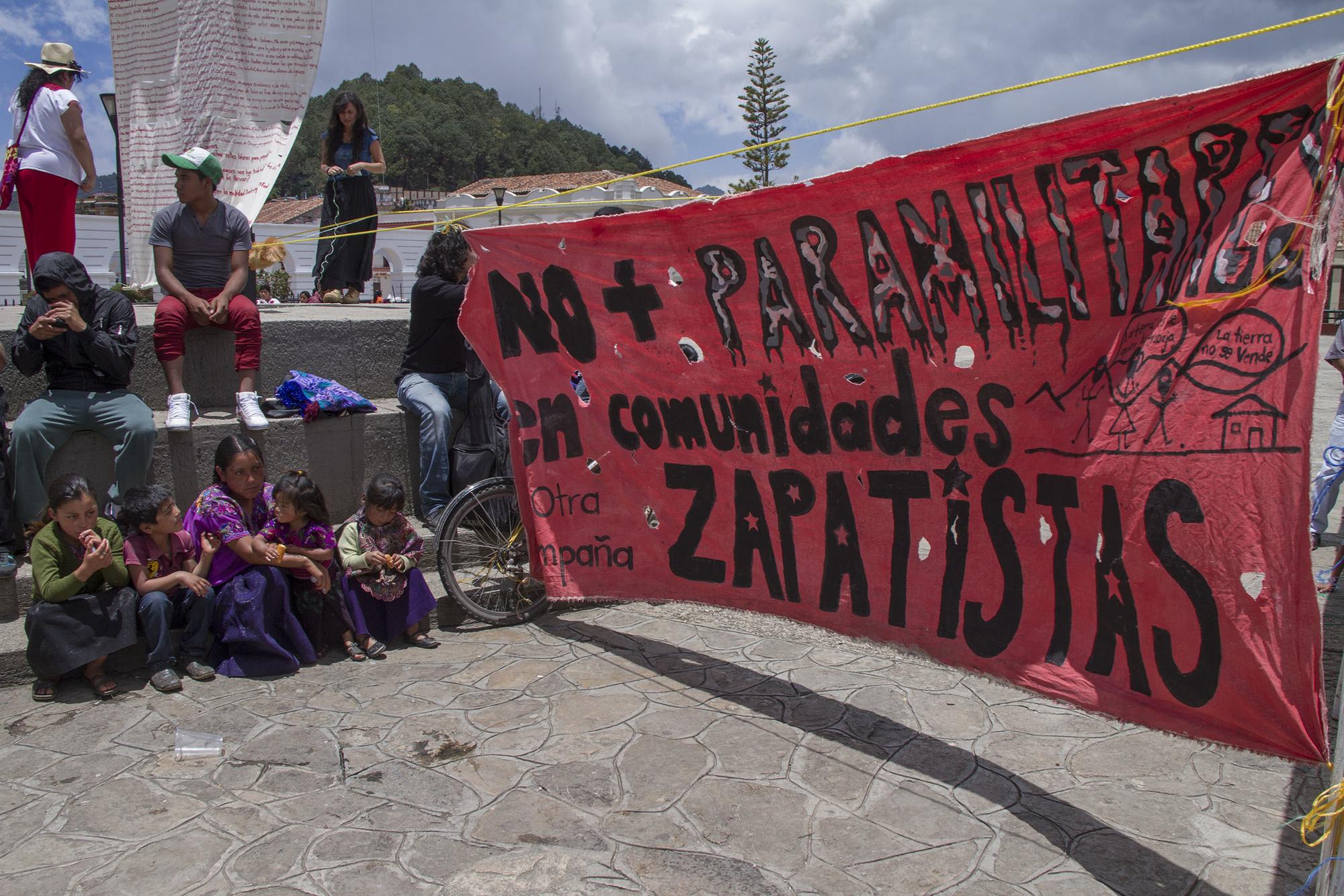
By: Luis Hernández Navarro
Chiapas is a powder keg about to explode. Violence multiplies alarmingly. Armed attacks by paramilitaries against Zapatista communities are frequent and intensifying. Organized crime groups organize levies (forced recruitment) of young people to swell their armies. Thousands of displaced people live in the bush or in makeshift villages. Motorized criminal gangs star in real pitched battles in San Cristobal to control markets and drug routes. Cartels fight with blood and fire for control of the border with Guatemala.
It is a diverse violence, fueled by the combination of ancestral conflicts and new disputes linked to land, trade and drug trafficking. Despite the presence of the Army and the National Guard, high-caliber weapons are obtained with astonishing ease. In the face of government inaction, paramilitaries, hitmen, self-defense groups (Pantelhó, Altamirano and San Cristóbal) and “private security” agencies are multiplying throughout the state.”
The paramilitary groups, sheltered by the authorities, have been associated with organized crime, which subrogates their services. They work double duty. On the one hand, they seek to keep at bay the processes of expansion of rebellious communities and the protests of peasants in struggle. On the other, they move undocumented migrants, move large volumes of drugs and engage in drug dealing, distribute pirate merchandise and indigenous pornography, traffic stolen cars and weapons. Now, as can be seen in the case of Chicomuselo, they also steal minerals.
Those gangs, which often control local transportation and routes in various regions, serve local politicians. The “new Chiapas family,” which is the recycled “old Chiapas family,” has become deeply intertwined with them. The same has happened with a part of the traditional indigenous chiefdoms, some of which have successfully ventured as polleros {migrant smugglers) and/or narcos.
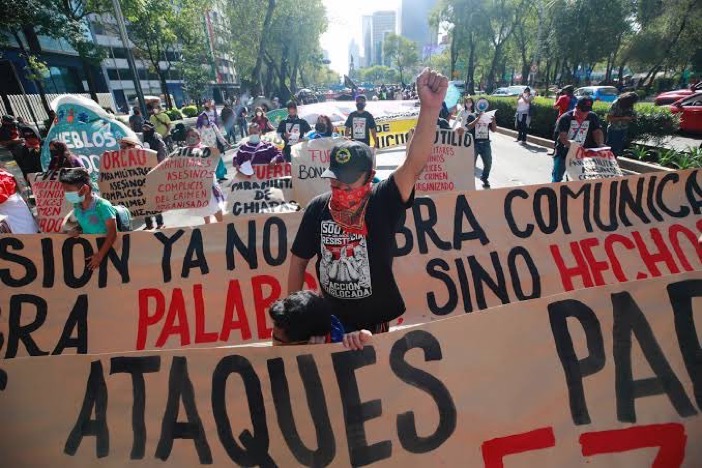
One of the central axes of this violence is the paramilitary aggressions against Zapatista support bases. (https://chiapas-support.org/2021/10/02/orcao-the-paramilitary-arm/). Just on Monday, May 22, as part of an aggression that lasted four days without the authorities intervening, the paramilitary group of the Regional Organization of Ocosingo Coffee Growers (ORCAO) shot the Tseltal Jorge Gilberto López Santis, from the Moisés Gandhi autonomous community, rebel municipality Lucio Cabañas. He is in serious condition. His diaphragm, large intestine, stomach and spleen were punctured. He hangs between life and death. Over the last few months, the ORCAO has attacked the rebels more than 10 times, with absolute impunity. It has burned coffee warehouses, schools and kidnapped indigenous peoples.
Among other things, the ORCAO seeks to dispossess the Zapatistas of lands that they recuperated in the 1994 Uprising, in part, to collect government support from the Sembrando Vida program. Their aggressions, perpetrated with the absolute complicity of the authorities, show the serious deterioration that exists in the state and send a very dangerous signal. It is not just another onslaught. The underlying conflict is at a critical point.
The situation is also very serious, among many other municipalities and localities, in Teopisca, Comalapa, Betania, the Las Choapas-Ocozocoautla [federal] highway, San Cristóbal, Frontera Comalapa, Trinitaria and Chicomuselo). Roadblocks in Teopisca are becoming more than frequent, due to the formal demand to dismiss Mayor Josefa María Sánchez and form a municipal council. Just last May 21, three people were injured in a shootout between state agents, who tried to arrest leaders of the movement, and peasants who defended them.
A little more than 120 kilometers away, on the Las Choapas-Ocozocoautla highway, on May 25 there were roadblocks (for five hours), gunshots and a trailer set on fire. Hooded men assaulted trucks and Coppel stores and set fire to small businesses. On February 8, something similar had just happened. At the height of Malpaso, the cartels fight over the transit of drugs, collection of protection money, passage of undocumented migrants, weapons and stealing gasoline (huachicól).
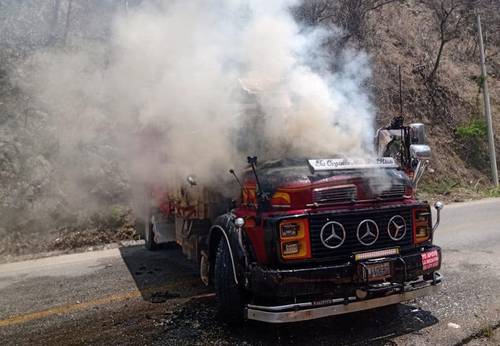
Last week was particularly tragic in Frontera Comalapa, where criminals dispute the territory, murdering innocents in the crossfire. Volleys of bullets, roadblocks, burned cars, caravans of artillery vehicles (the famous “monsters”), are part of the region’s usual landscape in recent days. In communities near Nueva Independencia, where El Maíz (a subsidiary of the Cartel Jalisco New Generation) operates, young people are recruited and given weapons to confront their rivals. Some 3,000 people who were displaced from their villages had to take refuge in the mountains and on the banks of the river.
According to the Fray Bartolomé de las Casas Human Rights Center, there is “acquiescence of the State,” because in the “El Jocote community there is a detachment of the Mexican Army. On the Paso Hondo-Frontera Comalapa highway stretch there is a detachment of the National Guard. And in the municipality of Chicomuselo is the largest barracks of the Mexican Army.”
This is no exaggeration. The Chiapas powder keg can explode at any time.
Twitter: @lhan55

Originally Published in Spanish by La Jornada, Tuesday, May 30, 2023, https://www.jornada.com.mx/2023/05/30/opinion/011a1pol and Re-Published with English interpretation by the Chiapas Support Comittee
Frayba: The opaqueness and inaction of the Mexican State is an imminent threat to peace in Chiapas
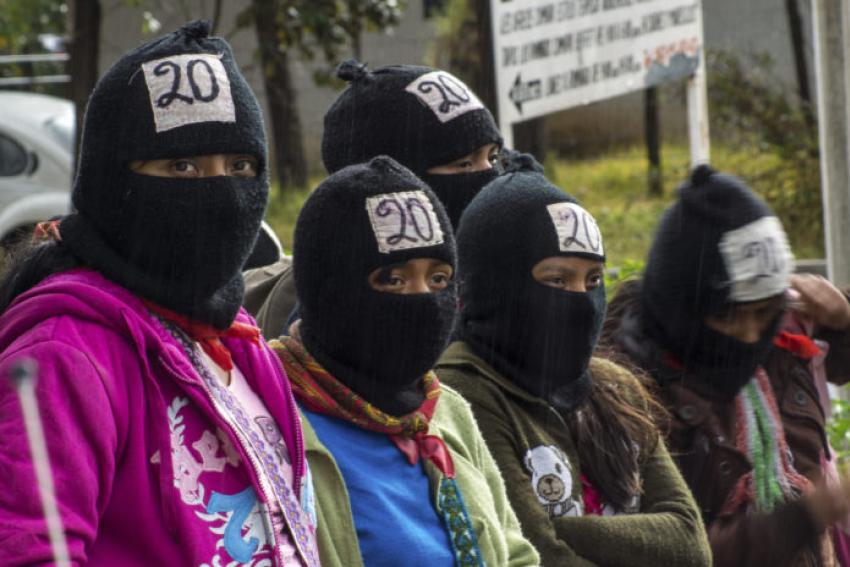
San Cristóbal de Las Casas, Chiapas, México
May 26, 2023
Bulletin No. 12
Tension in Zapatista territory
On January 1, 1994, the Zapatista National Liberation (EZLN, Ejército Zapatista de Liberación Nacional) took up arms, declaring war on the Mexican State, fighting for work, education, health, justice, land and freedom. After 12 days, and due to the pressure of national and international civil society, a ceasefire was decreed for the Zapatista peoples. After the San Andrés Dialogues, the Mexican government failed to comply with the agreements to reform the Constitution and fully comply with the rights of indigenous peoples. Since then, the EZLN has built its autonomy and self-determination within in its territory in a civil and peaceful manner. The EZLN is also a key actor for the advancement and exercise of the rights of indigenous peoples.
During these 29 years, the EZLN has been harassed and continuously attacked by the Mexican Army and groups related to the State. The strategies of war and counterinsurgency modify their methods of violence, in order to destroy and co-opt the resistance and emancipatory movements that are fighting for the respect of their rights, and in this territory for the collective rights that they claim as original peoples.
We have constantly documented and denounced the facts of violations of territory, autonomy and self-determination, aggressions, armed attacks and criminalization, among others, in all spheres of responsibility, such as the unpunished murder of teacher Galeano in 2014, which marked a new scenario regarding organizations allied with the three levels of government (federal, state and municipal).
In this six-year term of Andrés Manuel López Obrador, that has not been left behind. Attacks against the lands recuperated by the EZLN are constant. In some autonomous territories we have documented aggressions, threats and armed attacks, such as that of the Good Government Junta of Caracol 10 in Patria Nueva, where EZLN Support Bases have suffered serious human rights violations such as arbitrary deprivations of liberty, torture, forced displacement and several wounded by firearms.
At present, the Law for Dialogue, Conciliation and Dignified Peace is in force in Chiapas, in which the EZLN is an example and has had a continuous action in which it proposes, builds and resists in a peaceful way, being a watershed for many peoples who are for the defense of life and territory.
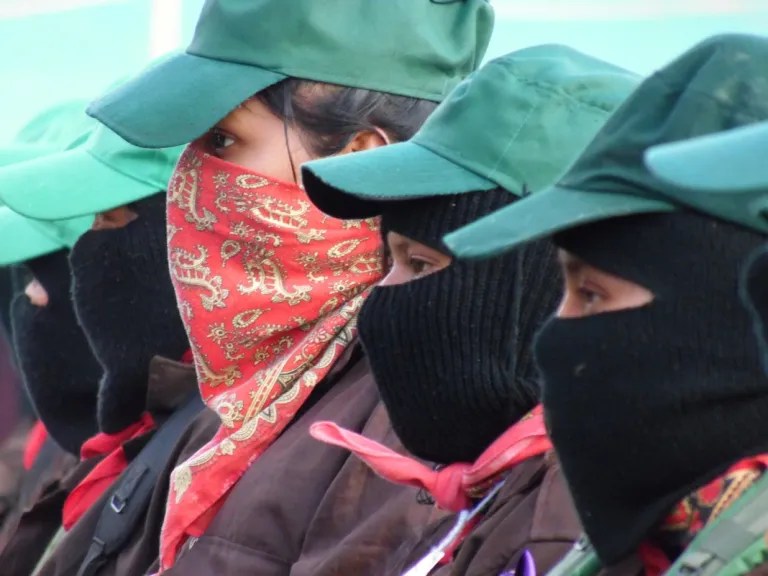
Of all these acts of aggression and attacks against the Zapatista movement, the State bodies that have jurisdiction and that must respect, guarantee and protect human rights have been informed with all documentary rigor, without having shown political will to address the urgent situation. From the Frayba we express our concern about the constant violence that the EZLN has received and that we see increase due to the active impunity generated by the Mexican government.
In one of its last communiqués of 2021, the Indigenous Revolutionary Clandestine Committee-General Command of the EZLN (CCRI-CG-EZLN) warned that Chiapas was on the brink of Civil War. Its perspective is a symptom of those who are living in Chiapas territory.
From the Frayba, we state that we live in constant insecurity, with high risk to life, which has led to an increase in extreme violence against the EZLN Support Bases, such as the violence committed on May 23 in the region of Moisés y Gandhi. This has expanded to other territories that are being wounded from the criminality that controls the lives of communities and towns such as that which takes place on the southern border of Chiapas.
In this context, we declare that our unavoidable duty is to stop this violence that has been growing and we see that it can be done with the organization of towns, communities, organizations, neighborhoods and districts; from their own roots and culture, to deactivate violence and build peace from below, betting on the possibility of the reproduction of existence where the good life is pondered.
It is urgent that the Mexican State do its job fully and immediately address the underlying problem in order to guarantee dialogue and peace in Chiapas, generating clear routes to achieve it.
We call on national and international solidarity to demand that the Mexican State act forcefully, so that the attacks against the autonomous political project of the EZLN and the generalized violence in the state of Chiapas cease immediately. We also ask the solidarity to show signs of support to the peoples who defend life, territory, Mother Earth and peace.
Originally Published in Spanish by Frayba, Tuesday, May 26, 2023, https://frayba.org.mx/la-opacidad-e-inaccion-del-estado-mexicano-es-una-amenaza-inminente-la-paz-en-chiapas and Re-Published with English interpretation by the Chiapas Support Committee
Shootings and roadblocks paralyze Frontera Comalapa, Chiapas
From the Editors
Between Tuesday and Thursday, alleged members of organized crime groups sustained shootouts and maintained intermittent roadblocks at different points on the highway located between the municipality of Frontera Comalapa, Chiapas, and the border with Guatemala due to the dispute over territorial control, residents reported.
They assured that one of the most critical points is located in the town of Nueva Independencia, popularly known as Lajerío, where during yesterday afternoon and evening the men who reside in the area fled into the mountains or to the bank of a river, because one of the cartels is recruiting them.
“They’ve picked up (kidnapped) a lot of people. The armed and hooded men are in the center of the community waiting for the night to take the men out and take them away. Almost all the houses (approximately 200) are empty,” said a resident of the region, who said that people are defenseless because there is no presence of public security forces in the area.
“We left the houses because (the gunmen) are coming in and taking out young people to recruit them. And there is no help to defend us. Today they started doing it and that’s why most of us left. In Lajerío there is the biggest problem and they say there are deaths.”
Other locals reported that this situation began on Tuesday, after the murder of a local transport leader; They assured that the blockades and skirmishes began that day among alleged members of the Cártel Jalisco Nueva Generación and the Sinaloa Cartel.
They indicated that since then there have been no classes in Frontera Comalapa and all activities were suspended. “The streets are desolate because people are afraid and sheltered in their homes,” warned one resident; “The authorities have not shown their face,” he claimed.
Those affected reported that there have been roadblocks in the town of Pacayalito, the exit to the municipality of Motozintla, located in the mountains of the state, as well as in the Tres Maravillas ejido, in the direction of Chicomuselo.
Also, in Sabinada, next to Guadalupe Grijalva, where several skirmishes have occurred, and in the detour of Nuevo México, Santa Rita and Paso Hondo (a few kilometers from the border with Guatemala), the exit to Comitán.
“Everything has been closed since Tuesday and although they opened for a little bit, there have been permanent roadblocks since Wednesday night,” they maintained.
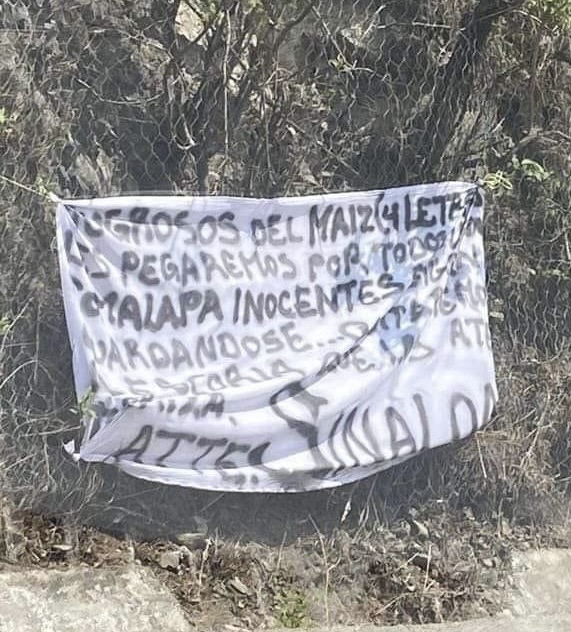
They added that in the municipality of Mazapa de Madero, located in the same area, there was also a shootout yesterday, “they burned a truck and left a narcomanta (narco-banner) addressed to the organization called Maíz; that it has no choice but to accede to what the cartel that dominates the border area wants.”
Meanwhile, in Chicomuselo, neighboring municipality of Frontera Comalapa, according to some residents the situation was also tense yesterday because since Wednesday the entrance was obstructed; “You can’t leave or enter.” In this context, it was reported that activist Fredy Milton Morales Zunun was detained, but hours later he was released.
On the other hand, at the request of the National Human Rights Commission, the State Secretariat of Security and Citizen Protection agreed to implement precautionary measures in the Nuevo Morelia ejido, in Chicomuselo, where alleged workers of a company, supported by armed men, have been removing barite extracted from a mine since last weekend.
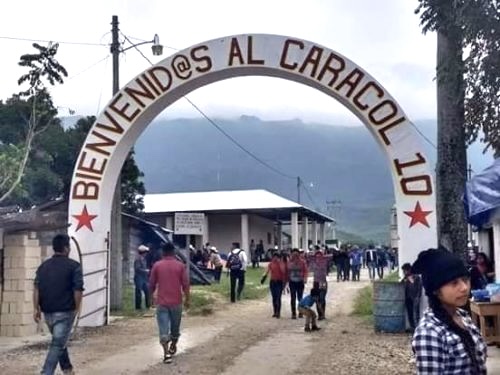
Frayba asked AMLO to guaranty security in Caracol 10
The Fray Bartolomé de Las Casas Human Rights Center asked President Andrés Manuel López Obrador to urgently guaranty “the life, security and physical and psychological integrity of residents of the Moisés y Gandhi region,” belonging to Caracol 10, where Gilberto López Sántiz, a support base of the Zapatista National Liberation Army (EZLN, Ejército Zapatista de Liberación Nacional) was shot and [seriously] wounded on the 22nd of this month.
Originally Published in Spanish by La Jornada, Friday, May 26, 2023, https://www.jornada.com.mx/2023/05/26/estados/026n2est and Re-Published with English interpretation by the Chiapas Support Committee
EZLN support base injured in armed attack on the Moisés y Gandhi community
On May 23, 2023, Jorge López Sántiz, an indigenous Tseltal member and support base of the Zapatista National Liberation Army (EZLN, Ejército Zapatista de Liberación Nacional) was admitted to the Dr. Gilberto Gomez Maza Hospital in the city of Tuxtla Gutiérrez, after public pressure derived from this Urgent Action.
Jorge’s current condition is grave. He is on ventilator support and medications to keep his heart functioning, because he was shot in the upper left side of his chest, which injured several organs. Given his health condition, he has the criteria for being placed in an intensive care unit, but the Hospital has no space in such unit and, therefore, he is in an area that is not adequate to guarantee the highly-specialized care that he requires.
We reiterate the demands enunciated in this urgent action and emphasize:
- The Mexican State is responsible for guarantying the life of the EZLN support base and providing the necessary attention.
- We urge the State to provide adequate attention in the Intensive Care Unit with instruments and equipment necessary for saving his life.
Despite petitions, the Mexican State has remained remiss given the violence in the community, the continuous attacks reveal the complete lack of fulfillment of its obligation to guarantee and protect human rights.
Mexico City, May 23, 2023
On the night of May 22, 2023, Jorge López Sántiz, an indigenous Tseltal member and support base of the Zapatista National Liberation Army (EZLN, Ejército Zapatista de Liberación Nacional) was the victim of an armed attack and his life remains at grave risk. He was shot in the high left side of his chest. Hours before, the Moisés y Gandhi autonomous community, Lucio Cabañas Autonomous Municipality (Ocosingo, Chiapas) reported the armed attack perpetrated by members of the Regional Organization of Ocosingo Coffee Growers (ORCAO).
According to documentary information received by the Executive Secretariat of the TDT Network, it stated that the events began at 4:32 p.m. when members of the ORCAO from the El Sacrificio community, municipality of Ocosingo, activated firearms whose record counted 130 small caliber shots and 15 high-caliber shots.
At 7:59 pm, ORCAO members from the 7 de febrero community also began to shoot from a coffee warehouse located on the side of the San Cristóbal–Ocosingo highway, at the Cushuljá crossroads. First, they fired 8 shots from a small-caliber weapon and 6 from a high-caliber one; then, they fired 18 shots from a high-caliber weapon and initiated a volley of shots that could not be counted.
Today, May 23, testimonies report that the shots against the Moisés y Gandhi Autonomous Community continue and that the public health care services have not wanted to receive Jorge López Santiz, wounded by a bullet, justifying that they do not have instruments and medical personnel to carry out the surgery and necessary care. This documentary information has been verified by civilian authorities of the Good Government Junta of New Dawn in Resistance and Rebellion for Life and Humanity, Caracol 10, the Rebel Seed Blooming, based in Patria Nueva, Lucio Cabañas Autonomous Municipality (official municipality of Ocosingo), Chiapas.
In view of these facts, we urgently demand:
- Urgent medical attention be provided to Jorge Lopez Santiz, injured by a bullet, for the purpose of saving his life and his physical and psychological integrity.
- Investigate and determine responsibility for the criminal act of attempted murder and armed attack perpetrated against the inhabitants of the Moisés y Gandhi community.
- Immediate cessation of armed attacks against the Support Bases of the Zapatista National Liberation Army (EZLN) of Caracol 10 by the ORCAO.
- Carry out the corresponding investigations in order to sanction and punish the persons responsible for the crimes indicated and the human rights violations against the EZLN support bases in Chiapas.

Originally Published in Spanish by the Red TDT, Tuesday, May 23, 2023, https://redtdt.org.mx/archivos/18337 and Re-Published with English interpretation by the Chiapas Support Committee
AMLO issues new decree so that mega-projects are considered as national security

By: Desinformémonos Editors
May 19, 2023
Mexico City | Desinformémonos
President Andrés Manuel López Obrador (AMLO) issued a new decree considering the federal government’s infrastructure projects to be national security matters, just hours after the Supreme Court of Justice of the Nation (SCJN) declared the invalidity and unconstitutionality of the accord that established the same terms and that the president published in November 2021. [1]
With the new decree, the works and operation of megaprojects such as the Maya Train and the Trans-Isthmus Corridor are established as [matters of] national security and public interest, which are protected despite the complaints of indigenous communities, activists, organizations and experts about the environmental and social impacts they will have.
The [new] decree was issued on May 18, the same day that the SCJN determined that the “Agreement declaring the federal government’s infrastructure projects and works as national security and of public interest,” published on November 21, 2021, was unconstitutional for violating the right to transparency and access to information.
According to the Mexican Center for Environmental Law (Cemda), the SCJN’s decision corrected “a situation of constitutional exceptionality” and obliged the environmental authorities of the federal executive to apply the provisions of the environmental legal framework, particularly in the General Law of Ecological Balance and Environmental Protection (LGEEPA).
Cemda recalled that since the presidential agreement was published in 2021, federal executive agencies such as the Ministry of Environment and Natural Resources (SEMARNAT) “began to ‘authorize’ projects without submitting them to the Environmental Impact Assessment Procedure (PEIA), as established by federal environmental law. “
The infrastructure projects that are now considered to be national security projects include the Maya Train | Tren Maya, the Trans-Isthmus Corridor and the airports in Palenque, Chiapas, and in Chetumal and Tulum, Quintana Roo.
Translator’s Notes
[1] The President of Mexico, Andrés Manuel López Obrador (AMLO), placed the Maya Train under the Army’s jurisdiction and declared it a matter of “national security” and “public interest” in 2021. That declaration was challenged and the challenge made its way to the Supreme Court, which declared it unconstitutional. In response, AMLO issued another declaration, this time placing not only the Maya Train as a matter of “national security” and “public interest,” but also the Trans-Isthmus Corridor and 3 airports related to the Maya Train.
Last month, the Supreme Court declared AMLO’s placement of the National Guard under the Army’s jurisdiction and control unconstitutional. So, it seems fair to say that AMLO and Mexico’s Supreme Court are at odds.
Originally Published in Spanish by Desinformemonos, Friday, May 19, 2023, https://desinformemonos.org/emite-amlo-nuevo-decreto-para-que-megaproyectos-sean-considerados-de-seguridad-nacional/ and Re-Published with English interpretation by the Chiapas Support Committee
 Chiapas Support Committee