Chiapas Support Committee
Home of the Compañero Manuel blog on zapatistas & mexico
Armed group loots barite in Chicomuselo and threatens residents
By: Elio Henríquez, Correspondent
San Cristóbal de las Casas, Chiapas
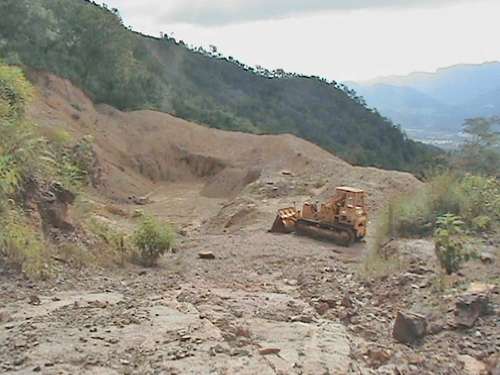
Unidentified individuals began to remove, with the support of armed men, barite extracted a few years ago by the Canadian company BlackFire Exploration Mexico from a mine located in the Grecia ejido, municipality of Chicomuselo, in the mountains of Chiapas, residents of the area reported, who indicated that the workers would be employees of a company whose name they do not know. [1]
“On Saturday, eight trucks entered and made a lot of trips with the barite that is piled up on a platform located on land belonging to the Nueva Morelia ejido (neighbor of Grecia); They say it’s going to take eight to 10 days, because it’s many tons,” they said.
“They were working all day and taking the material, supposedly to the town of Chicomuselo, the municipal seat. The community could not prevent them from entering because when they went to talk to us a few days ago, they were armed, supporting the mining companies so that we don’t oppose them,” they said.
The ejido members recalled that last Thursday armed men came to threaten them to let the trucks pass to remove the material and warned them: “If someone messes with us, you know what’s going to happen to them.”
They said one of the workers told them: “My company doesn’t have a name” and didn’t give them information or submit documents. “They bring violent people and we are peaceful people. We are asking the government to help us, because we are vulnerable and have no way to deal with them,” they said.
Given the entry of the trucks and the threats by force, the neighbors of Nueva Morelia held an assembly the previous Friday, in which they agreed to send a letter to President Andrés Manuel López Obrador asking that he intervene.
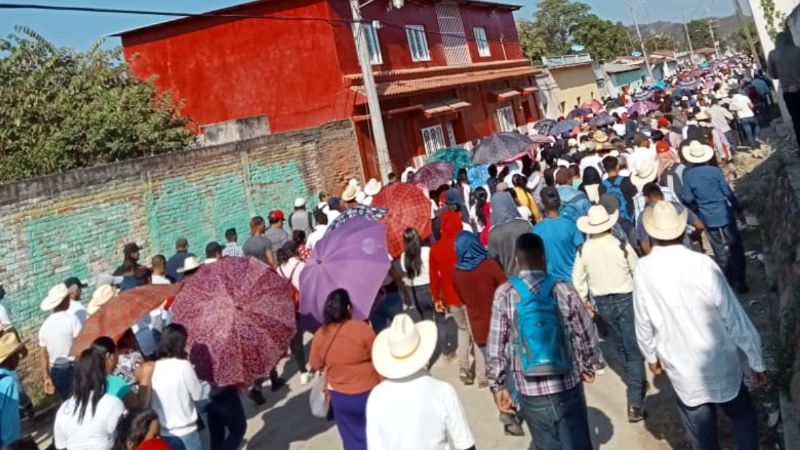
“We met in a general assembly in the Nueva Morelia ejido to express our disagreement with exploitation of the mine in the Grecia ejido. This looting affects a natural spring of water, where the drinking water that supplies our population comes from and that’s why the ejido totally rejects it (the arrival of strangers), because it would harm the health of our population,” they wrote in the document.
They added that “the mining group asked that the population not to get in its way, so it may move freely. We ask the three levels of government for their valuable intervention to solve this problem, since it harms our population, bringing pollution and diseases.”
In another letter they stated that: “the miners, together with organized crime, are taking the barite that is in the Nueva Morelia ejido,” so they asked “attentively to the Ministry of National Defense and the National Guard to arrest them in Chicomuselo and refer them to the Attorney General’s Office for the crimes that result, since mining is under federal jurisdiction.”
The problems for the inhabitants of Chicomuselo communities began 20 years ago, when the Caracol Mining Company began barite exploitation work at the La Revancha mine, located in the San Ramón neighborhood of the Grecia ejido, which borders Nueva Morelia, where the firm constructed warehouses, dormitories and a dining room for its employees.
Caracol left the area, apparently because it was bankrupt, and in 2006 sold its rights to the concession to Blackfire Exploration Mexico, which began working in the area that same year.
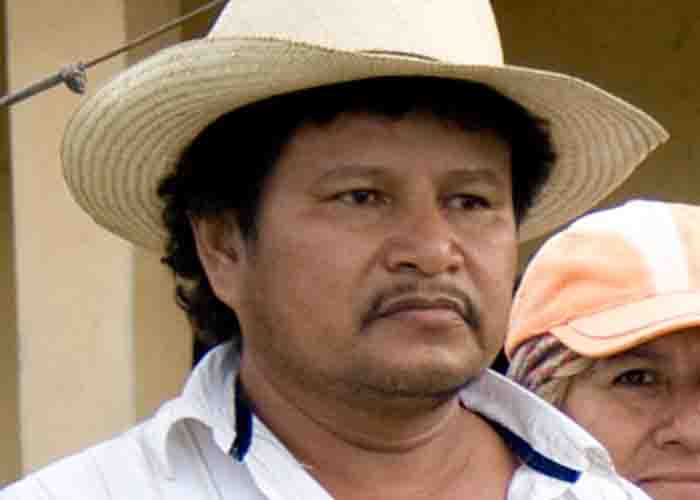
Amid protests by residents of Grecia and surrounding localities over lack of fulfillment of the Canadian consortium’s promises, retention of trucks and workers, Blackfire Exploration Mexico continued to exploit the mine until it was closed after the murder of Mariano Abarca Roblero, a leader opposed to the exploitation of deposits, perpetrated in the municipal seat of Chicomuselo on November 28, 2009.
Blackfire left the area afterwards, without it being officially known who bought the rights to the concession. Not even five years had passed when people began to arrive to harass inhabitants of the region to allow them to continue exploiting the mines to extract barite and remove the material that the Canadian company abandoned in San Ramón and Nuevo Morelia.
Last year the entry of alleged representatives of companies that bought the rights increased, so on several occasions campesinos in the area held them and then released them with the commitment that they would not return.
Faced with the resistance of the farmers, the mining representatives changed their strategy and were accompanied by armed men, allegedly members of criminal groups operating on the border with Guatemala.
About six months ago they entered Santa María, a neighboring town of Nueva Morelia, to extract barite without the inhabitants being able to prevent it. Even the local Catholic parish that played a prominent role in the protests against mining decided to suspend its mobilizations, so as not to risk its parishioners. [2]
“The resistance against the megaprojects has been dying down,” said one resident who requested anonymity. “The presence of organized crime is very strong. The alleged mining businessmen arrive arrogantly, with armed men, but they do not say the name of the company or present documents. The authorities of the communities have already been overwhelmed and do not have the power to contain them. In Santa Maria they have already finished with almost half of the hill,” he said.
Translator’s Notes
[1] A January 2023 march in Chicomuselo, called the “March for Life,” made up of campesinos and people of faith from the local parish demanded “an end to organized crime violence that seeks to impose mining on the region with the complicit silence of the authorities.”
[2] In their April Pronouncement, Bishops of the San Cristóbal de las Casas Diocese specifically stated that mining extraction was damaging the social fabric
Originally Published in Spanish La Jornada, Monday, May 22, 2023, https://www.jornada.com.mx/2023/05/22/estados/027n1est and Re-Published with English interpretation by the ˚Chiapas Support Committee
Zibechi: Rebel Health and Anti-Capitalist Movements

By: Raúl Zibechi
More than half a century ago, the Black Panther Party was probably one of the first organizations to implement a health care system alternative to that of the hegemonic system. The booklet “Medical Self-Defense. Black Panthers and Zapatistas,” not only reveals the similarities between the two health experiences, but details the achievements of the Black American Movement.
The Black Panther Party for Self-Defense was formed in 1966 after the uprising of the black community of Hunters Point in San Francisco, repressed by the National Guard with the same style of bayonets that fought against guerrillas in the Vietnam War, as recognized by the head of the operation.
The concept of “medical self-defense” was conceived as the defense against the medical and pharmaceutical device that reduced black communities to fields of experimentation, but also as the way of appropriating medical knowledge that reduces users to passive objects (patients), exercising material and symbolic violence against the most impoverished communities.
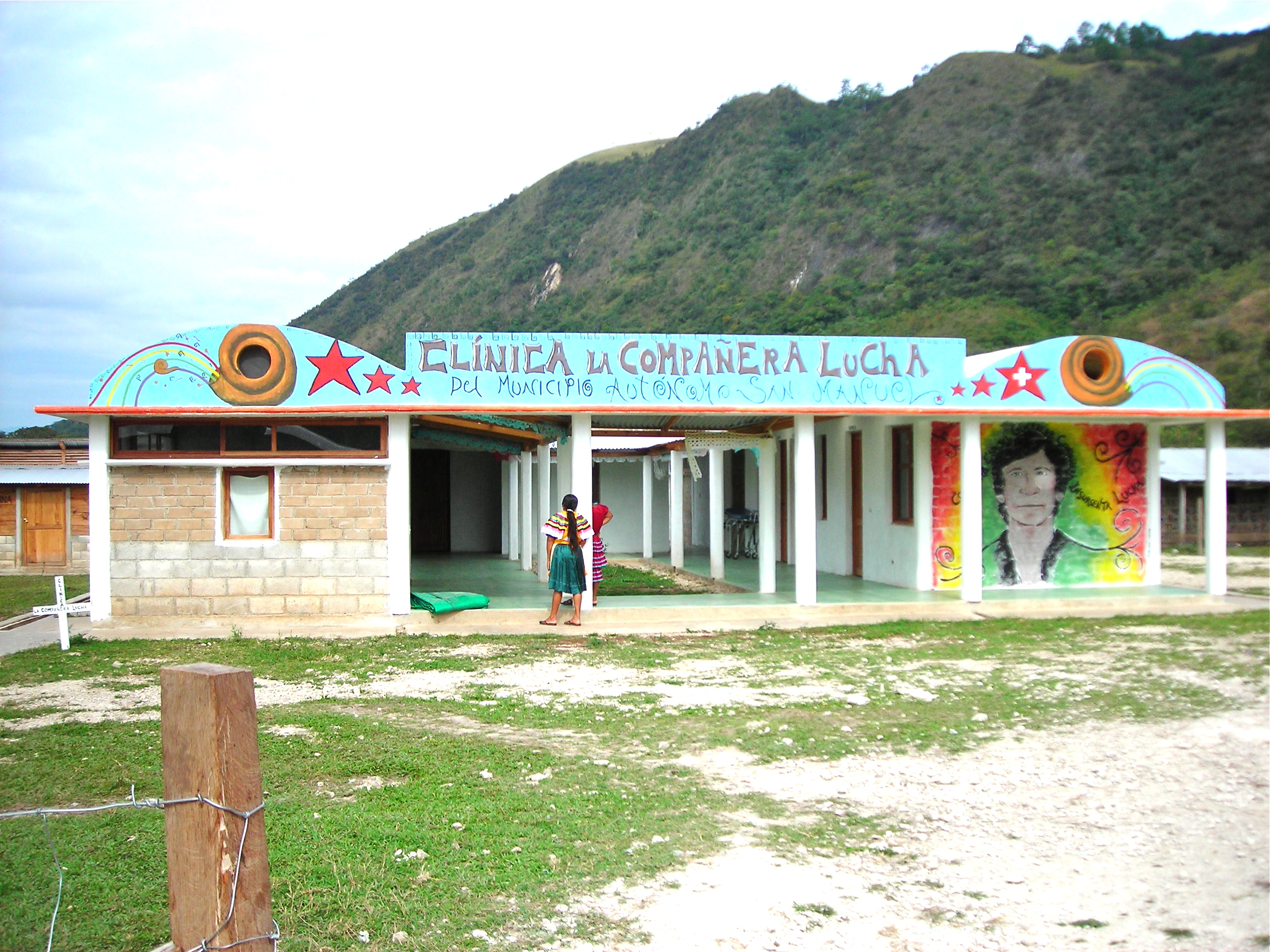
From 1968 the Panthers opened clinics in black neighborhoods in several large cities, such as Chicago, Seattle and Kansas City, Missouri, among the first, which they named as People’s Free Clinics, which expanded to thirteen cities. They were inserted into a broad radical care movement driven by the feminist health movement, among others. They were supported by volunteer medical personnel and were responsible not only for health but also for the education and organization of the population.
As part of their policy of self-determination of the Afro-descendant population, they decided that the communities would take health into their own hands, but at the same time they developed Survival Programs, highlighting primary schools, breakfasts, legal advice and free health, including a dental program, vaccination campaigns and housing cooperatives. They were very clear that it was not about welfare but about a step to the construction of power in the communities.

To equip the clinics, they counted on medical staff who donated radiology machines and provided various services, such as pediatrics, training activists as laboratory technicians and first responders. Thus, some Black Panther clinics managed to see a hundred patients per week.
One particular case is that of acupuncture. Two groups from the party traveled to China to receive training, which allowed them to learn acupuncture that they then practiced as a technique for treating addictions and post-traumatic stress. It was this movement that introduced acupuncture in the United States.
They organized community survival conferences that lasted several days as neighborhood parties and modes of collective protest, in which the history of black people was discussed and free clinics were promoted. They got a bus for prison visits for relatives and friends of the incarcerated, as well as thousands of free tests for sickle cell anemia that mainly affects black communities and that the government did not attend to at the time.
As the aforementioned work points out, “the Panthers had an enormous influence on health initiatives that go beyond the organization itself and its years of activity.”
I think this is a central issue. The influence of the Panthers transcends geographies and calendars, as is the case with the Zapatista movement. The achievements of the black movement are more than 50 years old and only in these times are we being able to recover them and appreciate their importance.
It is still too early to understand the transcendence of Zapatismo. We know that it has impacts all over the world, that autonomies grow in all corners of the Latin American continent and that its legitimacy and prestige go beyond Mexican borders. Even so, it will be years before we can assume that we are facing one of the revolutions that transformed the way people do things, the political culture of those below.

Originally Published in Spanish by Desinformemonos, Monday, May 15, 2023, https://desinformemonos.org/salud-rebelde-y-movimientos-anti-capitalistas/ and Re-Published with English interpretation by the Chiapas Support Committee
Chiapas court sentences the “Cancuc 5” to 25 years in prison
Bulletin No. 10
San Cristóbal de Las Casas, Chiapas, Mexico
May 17, 2023
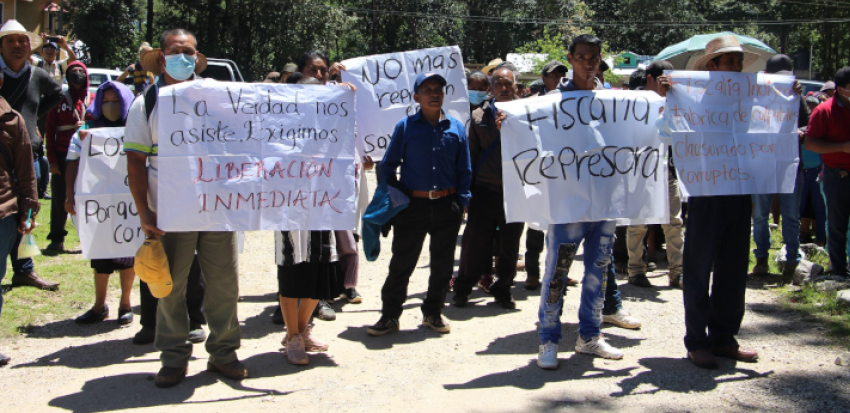
The judicial power of the state of Chiapas condemns the five indigenous Tseltals from San Juan Cancuc to 25 years in prison for defending their territory
The criminalization of indigenous people, a constant issue in Chiapas
From this Fray Bartolomé de Las Casas Human Rights Center, we denounce the criminalization of defenders of territory. The Chiapas government once again acts with impunity. Today, May 17, 2023, the Judicial Branch of the State of Chiapas found guilty Manuel Sántiz Cruz [1[, Juan Velasco Aguilar, Agustín Pérez Velasco, Martín Pérez Domínguez and Agustín Pérez Domínguez, five indigenous community defenders, of the Tseltal Maya people of San Juan Cancuc, arbitrarily deprived of their freedom for defending their territory, who were sentenced to 25 years in prison for a crime they did not commit.
To establish the sentence, the judge used legal criteria from 1993, that is, criteria from more than thirty years ago, despite all the legal reforms that have occurred in Mexico that should guarantee human rights. The judge gave probative value to the statements of the municipal police, when they should have been the first to be investigated, since the death occurred in the patrol car of the San Juan Cancuc municipal police. Another notorious fact was that he gave value to an altered death certificate.
On May 3, 2023, the five Indigenous Tseltals gave their statement before the Judge, where they mentioned that three of them were arbitrarily detained on May 29, 2022, in San Juan Cancuc, through a joint operation of the Municipal Police, the National Guard and the Mexican Army, to later be handed over to the Indigenous Justice Prosecutor’s Office, who first fabricated the crime of drug possession and then involved them in the homicide for which they were sentenced.
The last two stated that they were arbitrarily detained by members of the Ministry of Security and Citizen Protection and the Specialized Police on June 1, 2022, outside the State Center for Social Reintegration of Sentenced No. 5 (CERSS No. 5) of San Cristóbal de Las Casas, when they visited their compañeros and in retaliation for having witnessed the operation and arbitrary deprivation of liberty. None of these arbitrary elements were taken into account, so once again they give evidence of the constant action of criminalization towards the native peoples who defend the territory.
This case is part of a model of complicity that exists between municipal, state and federal authorities, along with judges and prosecutors to manufacture guilt and keep innocent people in prison, so the lack of access to justice is a burden of the Mexican legal system.
Frayba demands freedom and justice for the five indigenous Tseltals of San Juan Cancuc, since we have fully documented the existence of serious human rights violations, including due process of law, noting the ineffectiveness of the investigations of the State Attorney General’s Office, which are devoid of legal value, in addition to the partiality of the Judiciary that acted ignoring the clear evidence of the arbitrary deprivations of liberty, and that the five defenders of territory were targeted. Finally, we refer to the arguments of the United Nations Working Group on Arbitrary Detention, which mentions that widespread or systematic imprisonment or other serious deprivation of liberty in violation of the norms of international law may constitute crimes against humanity. [2]
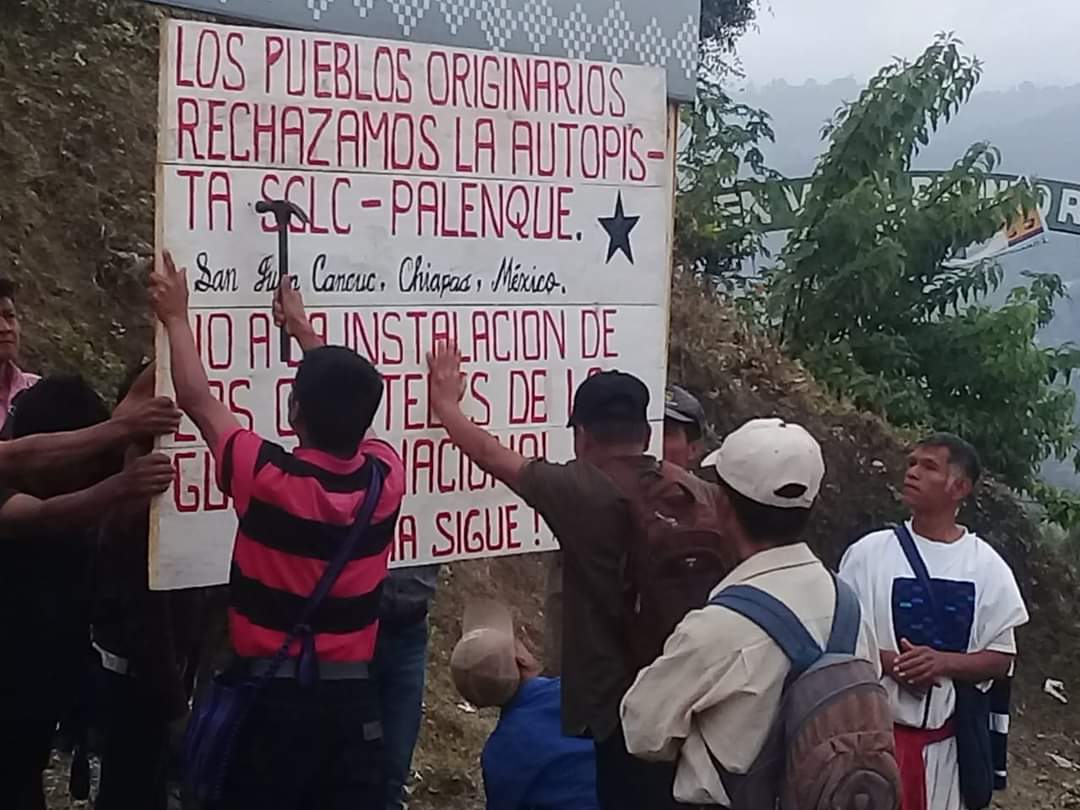
[1] Manuel Sántiz Cruz “has been president of the San Juan Evangelista Human Rights Committee, which promotes actions around defense of territory against construction of the highway stretch between San Cristóbal de Las Casas and Palenque. They are also opposed to the presence of the National Guard (GN, Guardia Nacional) in the municipality, as well as against the sale of alcohol and drugs in the municipal seat.” Click here to see article on the arrests.
[2] Opinion number 43/2021 of the United Nations Human Rights Council’s Working Group on Arbitrary Detention, adopted on September 10, 2021, regarding Adrián Gómez, Germán López, Abrahám López, Juan de la Cruz and Marcelino Ruiz (Mexico). https://www.dof.gob.mx/nota_d

Originally Published in Spanish by Frayba, Wednesday, May 17, 2023, https://frayba.org.mx/el-poder-judicial-del-estado-de-chiapas-condena-25-anos-los-cinco-indigenas-tseltales-de-san-juan and Re-Published with English interpretation by the Chiapas Support Committee
In Mexico, Mining Law Reform is “Half-Baked”
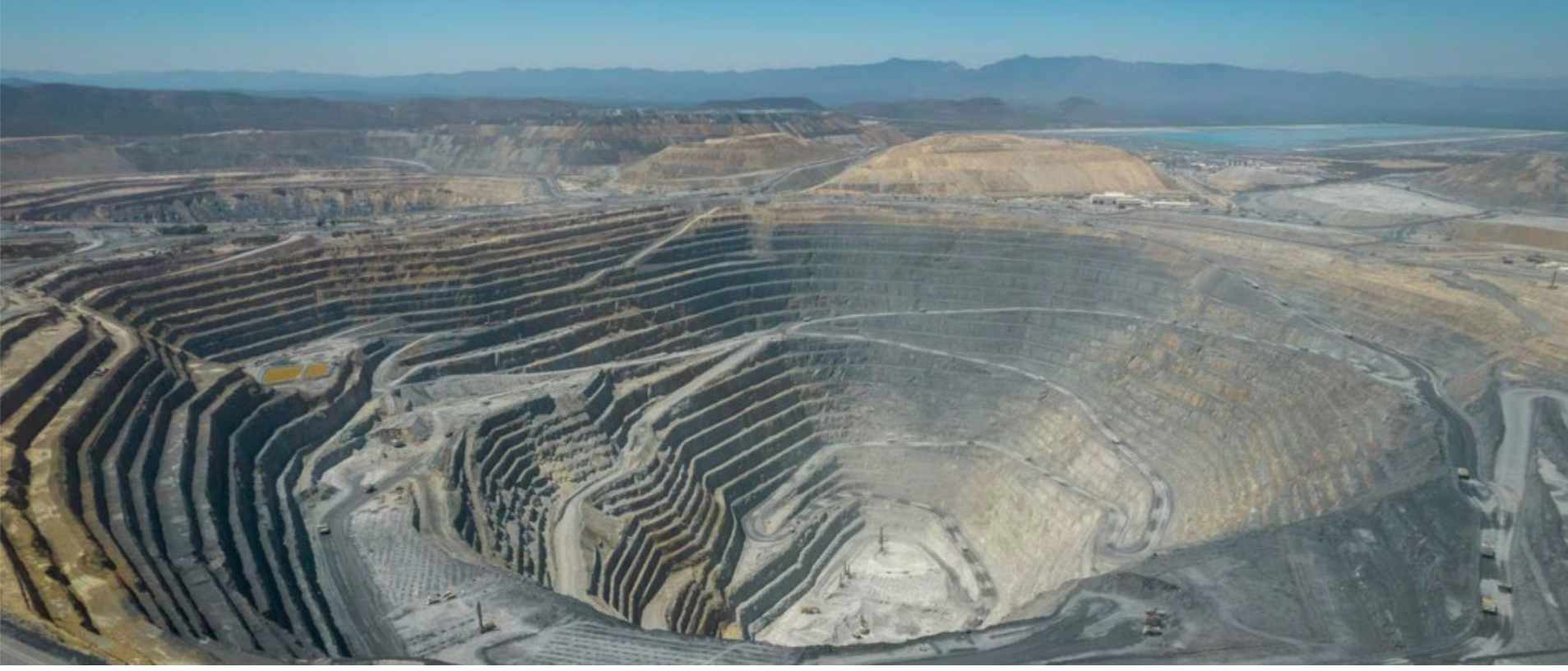
By: Renata Bessi
President Andrés Manuel López Obrador published, on May 8th in the Official Gazette of the Federation (DOF), the reforms to the Mining, National Waters, Ecological Balance and Environmental Protection, and Prevention and Integral Waste Management Laws, approved on April 28 by the Plenary of the Senate of the Republic.
While the changes were celebrated by many environmental activists and organizations, the agrarian lawyer who is part of the legal team of the National Indigenous Congress (CNI), Carlos González, classified the reforms as “half-baked.”
“There is no room for half-measures. A deep and committed policy is needed. It is necessary to commit ourselves in a serious and decisive manner. Because humanity and life on this planet are really at risk,” he declared during the International Gathering El Sur Resiste | The South Resists, at the Indigenous Center for Integral Training (Cideci), in Chiapas. [1]
One of the “half-changes” is the reduction of the duration of mining concessions from 100 to 80 years. The original text of the reform, sent by the Executive for approval by the Congress of the Nation, had previously provided for the reduction to 30 years.
“The President sent to Congress an initiative that, it must be said, contained important elements to restrict mining activity and to put limits on mining companies,” admits the lawyer.
However, the bill reached the Chamber of Deputies and was stopped. “Negotiations began with the Mining Chamber. Lobbyists from the Canadian government came. And the initiative was changed,” he says.
At this moment the President of the Republic is distancing himself from the legislative debate, he pointed out. “He got Covid-19 and the debate in the press was whether he had passed out or not, while this important mining initiative was being torn apart. They didn’t defend it, neither the president, nor those who represent him,” he added.
Contrary to the initial text, it was accepted that mining companies may continue to use the working water by simply giving “notice to the National Water Commission (Conagua) and that the rights for that water are granted” as stated in the text of the reform.

“When there is a mining operation, what happens is that the ground is broken, but when the earth is furrowed by water veins, these waters are released and this is the working water. And it is this water that the mining companies take advantage of and will continue to take advantage of without a concession,” explains González.
The percentage of the mining companies’ profit to be allocated to the communities was reduced from 10% to 7%. This percentage is on the amount that is fiscally proven by the mining companies. “Now we are going to ask if a cartel that is mining in the south of Jalisco, in Michoacán, in Colima, in Guerrero, in Oaxaca is going to pay taxes. They don’t even need a concession to operate,” the lawyer points out.
Another change is that concessions may include two or more minerals or substances, while the previous proposal allowed the mining of only one mineral. The objective was to have greater control over the production of resources.
The reform does not apply to concessions already granted, so only future permits will be subject to the new rules. Existing concessions total 120 million hectares, equivalent to 60% of the national territory.
More Control
The reform removed the preferential nature of mining over any other use or utilization of the land. Thus, the exploration, exploitation and processing of minerals will no longer be imposed over any other activity that the communities are developing in their territory, be it housing, agriculture or forestry. It also prohibits concessions in protected natural areas.
Another positive change was the end of the “free land” figure. Under the old law, “with the exception of the areas considered as mining reserves, which are very few, the entire national territory was considered free land. The first one to arrive and bid became a concessionaire,” explains Jorge Pelaez, coordinator of the Legal Clinic for Environmental Justice at the Ibero, a member of the Cambiemos la Ya campaign.
The coordinator explains that the Mexican Geological Service (SGM) is strengthened by granting it a monopoly on exploration to the detriment of private companies.
However, “the person who has information from which it can be inferred that in an unassigned or concessioned lot there are minerals or substances that are not strategic or reserved to the State, can present it to the Secretary (of Economy) so that it can determine the advisability of ordering the Mexican Geological Service to carry out the exploration,” says the text of the reform.
The SGM may enter into a collaboration agreement with such party for the exploration of the lot, with a term of up to five years. If it is determined that there are usable minerals, a bidding process may be carried out to grant the concession.
It also becomes mandatory to consult with the peoples and communities before granting concessions on indigenous territories. Lawyer Gonzalez maintains that what exists in terms of the right to free, prior and informed consultation is contradictory jurisprudence and case law.

“One day they favor the people, the next day they do not. They have turned it into the main right of our peoples. This is how they have presented it: the right to consultation over the rights that are substantive, the right to territory and the right to autonomy. The right to consultation is an adjective right. Its central purpose is to allow States and business corporations to reach an agreement with the peoples to implement policies that are in their interest,” analyzes the lawyer.
Mining companies will also have to submit to Semarnat a mine restoration and closure program, a requirement that did not exist in the old law.
Important for the economy?
The Cambiemos La Ya (Let’s Change it Now) campaign made a study in the public reports of the Ministry of Finance on the economic, financial and debt situation of the mining sector since 2019. “The contribution that the mining sector has to public finances is minimal,” says Beatriz Oliveira, who is part of the campaign.
In the year 2019, the percentage of tax collection of the mining sector with respect to the general collection in Mexico as a whole was 0.13%. In 2020, it was 0.32%. In 2021, 0.97%. “Mining in general, with all the tax contributions it makes does not reach 1% of all federal government revenues,” Oliveira argues.
In relation to income tax, in 2019, it contributed 1.41% of the total collected by the Mexican state. In 2020, 1.37%. In 2021, 2.86%. “There is also no substantive income tax contribution,” Oliveira comments.
A mining company pays to the public treasury per hectare, to have the right to mine, 8 pesos for the first year. Second year, 12 pesos. “That’s what the law says,” says Oliveira. The maximum is 176 pesos.
Poverty
As for what is considered local development, of the 21 municipalities that are classified as gold producing centers, in 10 of them the population lives in conditions that exceed the national poverty levels, as revealed by the data presented by Oliveira.
[1] They also also mentioned mining extraction as a factor causing social deterioration in the statement by Bishops of the San Cristóbal de las Casas Diocese, Chiapas.
Originally Published in Spanish by Avispa, Tuesday, May 16, 2023, https://avispa.org/en-mexico-reforma-a-la-ley-minera-hecha-a-medias/, Translated by Schools for Chiapas and Re-Published by the Chiapas Support Committee
Zibechi: The mind thinks with ideas, not with information

By: Raúl Zibechi
In a recent interview (https://bit.ly/3BuJeRP) the South Korean-born German philosopher, Byun-Chuk Han, points out: “We are very well informed, but somehow we cannot orient ourselves.” His arguments about the social consequences of the over-information we suffer had already been analyzed in his book Infrocracy, published a year ago.
Byun attributes to computerization many of the problems we suffer as a society. He says that the narcissistic ego turned inward “is the cause of social disintegration,” since “everything that unites and connects is disappearing,” neutralizing the possibility of considering ourselves a single society. The bottom line is that there are no longer “common narratives that bring people together.”
He distinguishes between truth and information, asserting that the latter is centrifugal and destroys social cohesion, while the true narrative holds it together. “Truth illuminates the world while information lives on the lure of surprise,” he says, because it generates a succession of “fleeting moments” that have the power to obscure reality and distort instead of informing.
The philosopher continues to provide arguments, such as the fact that now information does not enable the creation of a public sphere. I remember, not so long ago, that in critical situations people swirled around newspaper stalls, commented and shared the news in the public space. But now we no longer have common stories that guide and give meaning to our existence. There are also no rituals, and we barely have consumption and the satisfaction of needs, Byun shoots.
He believes that in the future “people will receive a universal basic income and have unlimited access to video games,” a form that state policy around the world is now taking, in a new version of “bread and circus.”

It can be said that this is not new, but the drift of half a century of increasing positioning of information technologies at the center of our lives. The Austrian physicist Fritjof Capra complements the German philosopher, as he explains in this sentence: “Information is presented as the basis of thought while, in reality, the human mind thinks with ideas, not with information” (The Plot of Life, Anagram, 1998, p. 88).
He recovers many concepts expressed by the American novelist Theodore Roszak in The Cult of Information. Treatise on High Tech, Artificial Intelligence and the True Art of Thinking, published in 1986, almost four decades ago. An important conclusion: “Ideas are integrative patterns that do not derive from information, but from experience.”
That is why the whole commitment of the system with our young people consists of limiting their life experiences and subjecting them to a constant bombardment of information that does not contribute anything, but creates a gigantic cloud of confusion. Consumerism, that “anthropological mutation” that Passolini mentioned half a century ago, is his main window to the world, except of course the fabric of his computer devices.
In this world of information overload there are no ideas, just as there are not in the tremendous flow of data on the Internet. Because ideas have always been dangerous, they are the ones that can give meaning to reality and lives, they are compasses to lay bare oppressions. Without ideas and without life experience, humanity is shipwrecked towards the abyss, just at the most critical moment in living memory, at least since the Black Death (1347-53), the remote origin of capitalism. [1]
Overwhelming us with information and blocking ideas is gain for the system, so I propose to think of the use made by those at the top of the Internet as an immense counterinsurgency policy. On the other hand, progressivisms use and abuse communication to offer an account of their supposed virtues, never to dialogue on an equal footing with ordinary people. They reproduce the systemic subject-object relationship, which they claim to combat, placing their own voters in a situation of passive recipients of their discourses.
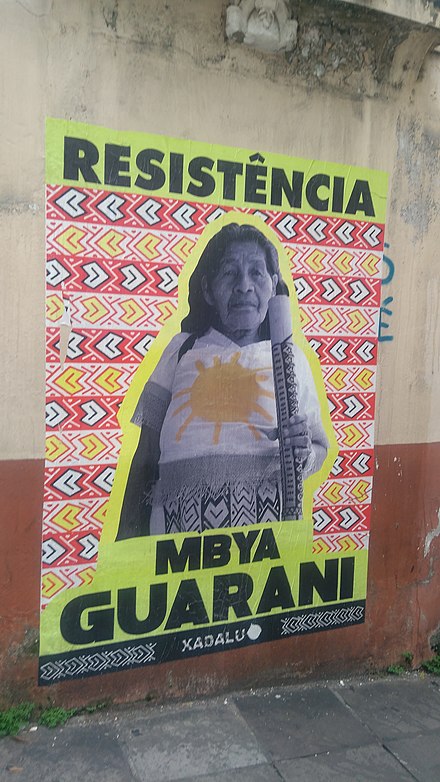
To protect the integrity of their communities, the Mbya Guarani in many villages regulate Internet connection schedules, so that their sons and daughters are not left defenseless in the face of the avalanche of data that they cannot order or hierarchize. In this way they refuse to expose themselves to the disorganizing power of social networks. There are many native peoples who do it, simply to defend themselves.
The long silence of the Zapatista Army of National Liberation, more than a year without issuing communiqués, can be understood as a refusal to enter the media circus that few already attend, and less understand. It is the silence of rage, and of dignity. The Fifth Declaration of the Lacandon Jungle (1998) explains silence as a weapon of struggle, and that “with reason, truth and history, one can fight and win… Permeating.”
[1] Ole J. Benedictow, La peste negra, 1346-1353. La historia se completa, Akal, 2011.
Originally Published in Spanish by La Jornada, Friday, May 19, 2023, https://www.jornada.com.mx/2023/05/19/opinion/014a1pol and Re-Published with English interpretation by the Chiapas Support Committee
Maya Train change causes discord in Nicolas Bravo

Text by: Arturo Contreras Camero, Pie de Página
MEXICO CITY – “We expected the train to pass through the town, to generate the sale of our products, we thought sales were going to grow, but now where they left it is not near the road, they put it in the jungle, it is a departure from the way we had left it,” says Sonia Méndez, an inhabitant of Nicolás Bravo [1] and an ejido member of Laguna Om.
In November 2022, the ejido members of Laguna Om, where the town of Nicolás Bravo is located, met to agree, together with FONATUR [2] and Army authorities, on where the Maya Train station would be built in that community. Courageous, they determined a place known as the old garbage dump. Thus, those who got off the train would arrive in the town, where its inhabitants hoped to benefit from the economic spill they could leave.
“It was just in June of last year that the consultations and measurements of the trace were made. The surveyors who had been in the AIFA – the Felipe Angeles International Airport – came, they made the projections of the line, they looked at those affected, they made measurements of the trees that were there, all that since July,” Sonia Méndez adds.
However, after the announcement of a couple of changes to the area that the train station would use, in February 2023, ejido authorities convened an assembly to approve a radical change to the location of the station. Instead of being close to the village, it would be far away, located in the jungle, suspiciously close to the Explorean Kohunlich hotel, owned by Grupo Posadas. [3] The decision caused a furor among the rest of the ejido members, who, since then, seek to publicize their case, which, they say, is full of irregularities.

On Monday, May 8, Pie de Página took the case to the daily conference of President Andrés Manuel López Obrador, to understand the motivations behind the change. The president’s response, however, did not calm the annoyance of the group of ejido owners, who ask that the democratic decision on the first location of the stop be respected.
“It had been agreed to place the station at a site, but it was more distant from the center, from the archaeological zone of Kohunlich, which is a very important archaeological zone,” López Obrador replied. “It coincides that this company that you mention has a hotel near Kohunlich. That has nothing to do with it. It’s that the station, we consider, would be or will be closer to the archaeological zone.”
Now, both residents and ejido members fear that the benefits that the Maya Train could represent for their community will no longer arrive, and instead, they will stay at the Explorean hotel, a resort with luxury bungalows, at which lodging is around $4,000 to $10,000 pesos per night under the all-inclusive concept.

A rigged process, they accuse
Sonia Méndez belongs to a group of ejido members who believe that the change of the station’s location obeys a spurious negotiation between the ejido commissioner, government officials and the hotel company. On November 6, 2022, an assembly was held to pay the affected ejido members for each of the square meters that would be used for the construction of the station.
“It was a legal assembly, but rigged,” says Lorenzo Vargues, another ejido member. “We were not allowed to reach an agreement with the majority of the ejido members; it seemed that the commissioner had already agreed with the construction management and we were told in assembly: take it or leave it. 110 thousand pesos per ejido member, at 24 pesos per square meter, the lowest payment in the entire Maya Train. “
Subsequently, in January, a couple of changes were announced to the expanse the station would occupy, a little larger than the initial one. Despite this, a higher payment for the increase in land was not considered. However, on February 12, the ejido commissioner convened an assembly to approve the change and the start of construction of the station in a completely different area than the one that had been agreed.
“How are we going to make a new agreement if the old one is not even approved! But that’s what the commissioner wanted, he wanted it to continue, with something that was not positive for the community,” says Lorenzo Vargues about that assembly.
The discomfort of half of the ejido members was such that the assembly had to be suspended. The ejido commissioner declared a recess and resumed the assembly on March 12. However, days before the date, with a low and select call, the commissioner summoned some ejido members to resume it on March 5.

“We went to the assembly, because of the call we had and we realized that the commissioner, wanting to restart the assembly, did not roll call, as if it were the one on February 12.” As he says it, Lorenzo’s voice quickens and rises in tone, as if affected by anger. Many of the ejido members left the assembly, not wanting to participate in what they consider arbitrary. However, despite the lack of a quorum, the ejido commissioner approved the change of location of the station.
It was paid attention to and there were agreements: governor of Quintana Roo
In the days following the spurious assembly, ejido members and neighbors of Nicolás Bravo demonstrated at the president’s event in the region as well as at Governor Mara Lezama’s events. They carried out road closures and sit-ins in front of the state government palace in order to be heard.
On the day the president was questioned about the case, Mara Lezama herself was present at the National Palace. From there, she assured that he had already talked with the dissatisfied ejido members and that an agreement had been reached with them, although that had not happened.
“It’s an important issue, because it’s a tourist stop and also an investment by the state government for the development of that area. The property is already bought, which belongs to the federation. And what they want is more development than the station that will be in Kohunlich, or very close to Kohunlich.
Well, in any case, it will also bring them development, but compañeros, fellow ejido members, were dissatisfied. A new assembly was held, in which there was no manipulation. They wanted the original agreement to be respected, but since there is a general interest, it was reconciled with them and they are going to build a community development center, which is not far away either, and that will benefit as well,” the governor said during the president’s conference.
Faced with the unrest, the residents of Nicolás Bravo now ask that in the area where the station was originally going to be built, a university, an ecotourism park for the inhabitants of the region who cannot afford the costs of the hotel and a handicraft market now be made.

“We said that we still want to create a tourist route in the southern part of town. We are the ones interested in exploiting this tourist aspect, as they do in the hotel,” says Lorenzo. From Explorean it is common to see tourists who make kayak tours through the turquoise waters of the Om Lagoon, or who travel its jungle trails by bicycle.
“We are not against the train; it’s a large and profitable project. We are against irregularities. We just hope that the governor will keep her word that we are going to rescue the south and that they are not just promises, because the population is very offended. We are going to continue insisting that they pay attention, that they assert the right of each one of us,” says Lorenzo with hope, still full of doubts about what is going to happen.
[*This note was produced by Pie de Página, part of the media alliance Red de Periodistas de a Pie.]
Translator’s Note
[1] Nicolas bravo is one of the towns visited by the El Sur Resiste | The South Resists Caravan. In the final “Pronouncement” from the International Gathering, they demand the revocation of the illegal March 5 Assembly.
[2] Fonatur is the Spanish acronym for the Fund for the Promotion of Tourism.
[3] Grupo Posadas is a hospitality company based in Mexico City. It owns, leases, operates and manages hotels, resorts and villas with its several different brands. As of 2020, the company operates more than 150 hotels with 24,000 hotel rooms.
Originally Published in Spanish by Chiapas Paralelo, Thursday, May 11, 2023, https://www.chiapasparalelo.com/noticias/2023/05/cambio-del-tren-maya-desata-la-discordia-en-nicolas-bravo/ and Re-Published with English interpretation by the Chiapas Support Committee
A Municipal agent, his daughter and son disappear, 300 meters from a military post in Chiapas

By: Isaín Mandujano
In the ejido Sinaloa, municipality of Frontera Comalapa, fear is lived, terror is breathed. irst it was the Ejidal Commissioner, Rolando Rodríguez Molares kidnapped and disappeared in September 2022; seven months later they came for the municipal agent, but now with his two children. They were taken and disappeared. Just 300 meters from a military garrison!
On April 27, around 9 pm, a group of armed men arrived in several vans and violently entered the home of the municipal agent of the Sinaloa ejido, Roberto Gómez Hernández, who was beaten and butted into one of the trucks.

Along with him they also took his two children, Josefa Gómez Cruz and Aric Adonay Gómez Cruz -both of legal age-, after both opposed the taking of their father.
It took 11 days for one of their relatives to file a complaint with the authorities; they were afraid to do so. Because in that community it has been recorded that demanding justice and the appearance of their relatives can also cost their lives.
Just this Monday, May 8, the State Commission for Searches for Persons (CEBP) opened file 231/2023 and issued the official file to try to find the whereabouts of the municipal agent and his two children.
Everyone in that community is afraid, everyone lives in terror. There are already nine people who have disappeared, including the ejido commissioner Rolando Rodríguez Morales, on September 20, 2022.

In fact, Roberto Gómez Hernández, as a municipal agent, had led a protest movement to demand the appearance alive of Commissioner Rolando Rodríguez Morales. But after everyone in that community being threatened, they stopped the protests and the relatives of the disappeared had to leave the community; now they live in forced displacement.
Last September, the municipal agent demanded that the ejido commissioner, Rolando Rodríguez Morales, appear alive.
There are many families in that community who have had to leave their homes, their farm animals, their land and everything, in order to look for a safe place away from that community, in which organized crime reigns.
What most outrages the community is that the kidnapping and disappearance of the municipal agent and his two children occurred just three blocks away from where there is a military regiment that the disappeared municipal agent had just demanded its installation to guarantee the safety of the population. But that night of April 27, they saw nothing or did nothing to prevent them from taking the three people.
Like the Sinaloa ejido, many other communities in that region live under the same terror, breathe the same fear, suffer murders, forced disappearances, forced displacements and opt for silence, having to silence all the atrocities they face.
Originally Published in Spanish by Chiapas Paralelo, Monday, May 8, 2023, https://www.chiapasparalelo.com/noticias/chiapas/2023/05/desaparecen-a-agente-municipal-su-hija-y-su-hijo-a-300-metros-de-una-partida-militar/ and Re-Published with English interpretation by the Chiapas Support Committee
The CIOAC attacks state police offices in Pichucalco

On Tuesday night, members of the Independent Central of Agricultural and Campesino Workers (CIOAC) [1], shot up and burned the offices of the state police and the State Attorney General’s Office (FGE) in Pichucalco, to protest the arrest of one of its members. A uniformed man was injured and a campesino apparently died in the scuffle. [2]
The version of the State Attorney General’s Office (FGE) is that through the Northern District Prosecutor’s Office, they began the corresponding investigations into the events that occurred on the night of this May 1, 2023 in the facilities of the Command of the FGE’s Investigative Police, with sub-headquarters in the municipality of Pichucalco, where an agent was injured, after a group of people identified as members of the organization called CIOAC, attacked the aforementioned place with firearms.
They pointed out that around 10:00 pm on Monday, the group of people carrying long and short weapons, entered the parking lot of the Command of the FGE’s Investigative Police with sub-headquarters in the municipality of Pichucalco, beginning to shoot at the staff of said offices, demanding the release of a detainee, who responds to the name of Rafael “N,” who had just been apprehended for his probable responsibility in the crime of Danger of Contagion and Spread of Diseases.
After this attack, an agent of the Investigative Police was injured, who has still not received medical attention, because the attackers are preventing the wounded from accessing medical personnel.
Elements of the Investigative and State Preventive Police went to the scene for the purpose of restoring order.
These incidents caused chaos and panic in the municipality, because in addition to the peasants, transporters adhered to this peasant organization were mobilized.
Unofficially, Floriberto Gómez Sánchez, a CIOAC leader in Pichucalco, was shot dead in the scuffle, and another person nicknamed El Pato was wounded.
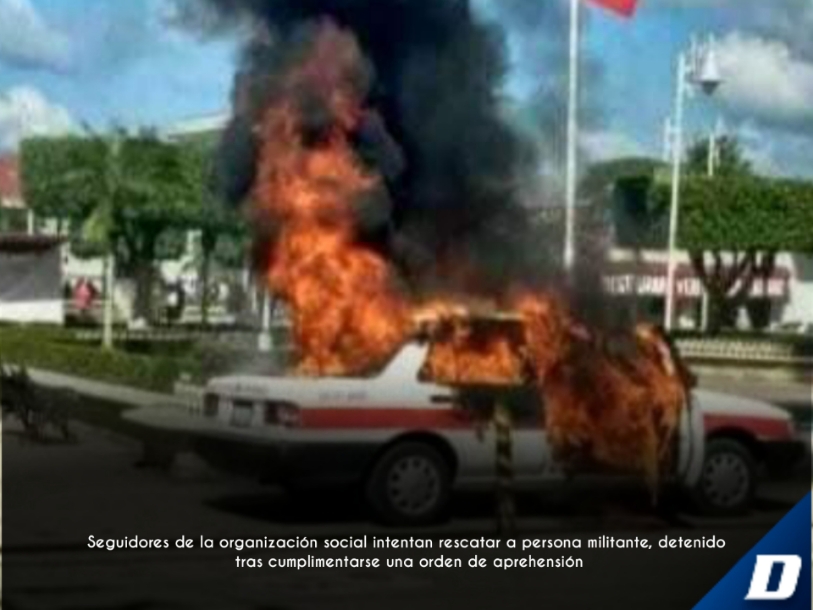
In response to these actions attributed to the police, they gathered to attack and burn the headquarters of the state investigative police and the state police in Pichucalco.
In addition to the National Guard, members of the Mexican Army mobilized tonight to Pichucalco to restore order and guarantee peace and security to the general population.
[1] For more information on Chiapas violence involving the CIOAC, click here.
[2] A day after this report, several local newspapers confirmed that Floriberto Gómez Sánchez died in the attack, as well as another CIOAC member, Ramón Trinidad, alias “El Pato,” with the same surnames as Floriberto. All articles confirm that a state police agent was injured, while one states that the CIOAC attacked with AR-15s.

Originally Published in Spanish by Chiapas Paralelo, Tuesday, May 2, 2023, https://www.chiapasparalelo.com/noticias/chiapas/2023/05/cioac-ataca-a-tiros-y-quema-oficinas-de-la-policia-estatal-en-pichucalco-para-rescatar-a-uno-de-sus-miembros-detenidos/ and Re-Published with English interpretation by the Chiapas Support Committee
U.S. Cartels control the fentanyl business
The majority of the profits from the sale of fentanyl stays in the U.S.

By: Jim Cason and David Brooks, Correspondents
Washington and New York
Reducing the epidemic of fentanyl addiction in the United States through a strategy focused on interdiction of drug trafficking from Mexico ignores that the business is controlled by US criminal groups within their own country, and distribution is carried out by local criminal groups in various cities, experts conclude and even federal government investigations in Washington.
The current public narrative nurtured by various media, federal authorities, legislators and other politicians is that Mexico is almost exclusively to blame for the more than 70,000 fentanyl overdose deaths, but Mexican cartels are only one part of an illicit fentanyl trade that is controlled, in large part, by Americans in charge of distribution networks in cities and regions, and who keep the vast majority of the profits.
No one doubts that reducing the supply of fentanyl crossing the border from Mexico into the United States could have some impact on the severe problems caused by the substance, but experts conclude that would not be enough to deal with the crisis.
“My research leads me to understand that this (fentanyl) is still a system in transition,” explains Peter Reuter, distinguished professor at the School of Criminology at the University of Maryland, in an interview with La Jornada.
Reuter, a well-known authority who has written extensively on illicit drug markets, warned that much remains unknown about the illicit fentanyl trade.
“What I do know is that for some years, heroin imported from Mexico was distributed in the United States by organizations with close ties to Mexican drug trafficking groups. The Sinaloa Cartel made money from wholesale within the United States and sometimes even approaching the retail market in some cities,” he said in the interview. “With fentanyl, I think there’s more distance; in other words, they (Mexican cartels) sell to the U.S. market from across the border and then they’re no longer involved.”
This analysis appears to have been confirmed by US Attorney General Merrick Garland himself this month when he announced indictments against 28 drug traffickers (including Los Chapitos), almost all linked to the Sinaloa cartel. “The traffickers of that criminal group move fentanyl from Mexico to the United States where it is sold wholesale to other organizations” within this country, he said.
The Sentencing Commission, an independent federal agency, reported in 2022 that 86.2 percent of those arrested for illegal fentanyl sales were U.S. citizens.
In his research, Reuter has found that fentanyl trafficking in the United States varies greatly by city. In some cities, local criminal gangs that used to sell heroin are now engaged in the fentanyl trade, while in others they are new traffickers. Moreover, indicating that there are different criminal organizations in this US market, fentanyl has replaced heroin in the country’s east, but much less in the west.
The Commission to Combat Trafficking in Synthetic Opioids, an official federal entity chaired by ultraconservative Republican Senator Tom Cotton and Democratic Representative David Trone, along with representatives from Congress, the DEA, the Pentagon, the intelligence community and many other federal agencies, concluded in a 2022 report that many of the profits from the sale of fentanyl in the United States do not return to the cartels in Mexico. Rather, it remains in the hands of local U.S. criminal organizations. “The total revenue from the export of fentanyl to the United States is likely between $700 million and $1 billion,” the authors of the commission’s report estimate. To put that in context, the market for all illicit drugs in the United States – including fentanyl, heroin, cocaine and others – is estimated at more than $100 billion a year.
On the other hand, it is very difficult to monitor fentanyl trafficking. The commission calculated that only three to five metric tons of pure fentanyl are required to satisfy illicit opioid use in the United States — an amount that fits in a shipping container. As Reuter notes, the United States imports more than one million metric tons of avocado from Mexico each year, and therefore, the commission “recognized the impossibility of reducing the availability of illegal synthetic opioids through supply-side efforts only.”

Reuter and his colleague, Professor Jonathan Caulkins of Carnegie-Mellon University, wrote an article in Scientific American this month concluding: “We need to reconsider enforcement goals in the fentanyl age.” They assess that the current strategy only leaves “compliance with the law to failure.” While there are calls to intensify maximum sentences for fentanyl supply and border control, it is hard to imagine these measures succeeding in reducing supply in the long run.”
Instead, they argue for measures to reduce corruption generated by the drug trade, go after Internet sellers, who often reach inexperienced users, and suppress ” dealers and open-air markets” that are directly responsible for this fentanyl crisis.
The two experts emphasize that: “re-imagining narcotics law enforcement in the fentanyl age should be a collective discussion conducted with open minds and few preconditions.”
Originally Published in Spanish by La Jornada, Friday, May 5, 2023, https://www.jornada.com.mx/2023/05/05/politica/003n1pol and Re-Published with English interpretation by the Chiapas Support Committee
Pronouncement of the International Gathering El Sur Resiste May 7, 2023
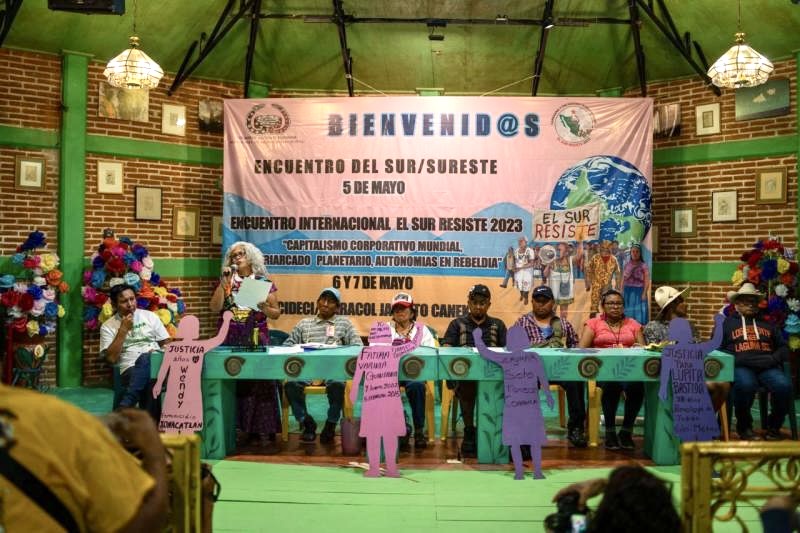
¡EL SUR RESISTE 2023/ THE SOUTH RESISTS! CARAVAN
INTERNATIONAL GATHERING OF THE SOUTH/SOUTHEAST
“Global corporate capitalism, Planetary patriarchy, Autonomies in rebellion”
CIDECI-UNITIERRA / CARACOL JACINTO CANEK
May 7, 2023
PRONOUNCEMENT
To the General Command of the EZLN
To the National Indigenous Congress
To the Indigenous Government Council
To the national and international organizations that struggle and resist
To the free, alternative, independent communications media or whatever they are called
To the peoples of Mexico and the world
From the Heart of the land where dignified rage was born, grew up and reproduces, the rebellious peoples of the geographies of the South-Southeast that walk the caravan El Sur Resiste/The South Resists 2023, Binnizá, Ayuuk, Nahua, Nuntajiyi (Nuntajuyi), Maya, Chol, Zoque, Tzeltal, Tojolabal, Tsotsil and mestizo peoples, convened by various organizations of this geography and by the National Indigenous Congress, toured the territories affected by the interconnected military megaprojects, the misnamed Maya Train and the Interoceanic Corridor. We arrived at the Zapatista territory of CIDECI-UNITIERRA / Caracol Jacinto Canek in San Cristóbal de las Casas, Chiapas, where we met with many other peoples and organizations of the original peoples and urban areas of the south southeast of the country and many other regions of our Mother Earth to share the pains, hopes and strategies of articulation, to learn from the struggles of other geographies and to continue weaving solidarity networks of resistance and planetary rebellion.
From April 25 to May 4, members of the El Sur Resiste Caravan traveled through communities and towns in eight states of the Mexican Republic; starting from the community of El Progreso, municipality of Pijijiapan, with a stopover in Tonalá, we toured the coast of Chiapas and crossed the Isthmus of Tehuantepec, from the Binniza community in resistance of Puente Madera, municipality of San Blas Atempa, passing through the rebel camp “Tierra y Libertad” in the place of the Aayuuk community of Mogoñe Viejo, municipality of San Juan Guichicovi both communities of the state of Oaxaca and reaching the Nahua community of Oteapan in southern Veracruz. From there, we started the journey towards the Maya territories of the Yucatan Peninsula, crossing the State of Tabasco through Villahermosa and the coastal community of El Bosque, devoured by the sea due to global warming, arriving at Candelaria, Campeche, and following the route to the community of Zakí, today named Valladolid in Yucatan and the community of Noj Kaaj Santa Cruz, today Felipe Carrillo Puerto in Quintana Roo, returning through Xpujil again in Campeche territory to return to Chiapas and meet the Zoque, Chol, Tsotsil, Tojolabal and Tzeltal peoples, with a stop in Palenque, crossing the region of Los Altos to reach our final destination, Jovel, today San Cristóbal de las Casas.
Throughout this journey, our hearts, feelings and thoughts were opened to listening and observing the multiple pains and destruction caused by the voracity of great world capitalism that we feel in our own body through the constant harassment of our caravan by the police and military bodies of the Mexican State.
In these times of global geopolitical re-arrangements where the big capitals of the Western and Asian blocs accelerate the process of this new stage of colonization war, disputing the territories of our planet, destroying Mother Nature, dispossessing, exploiting and expelling the peoples and murdering and disappearing those who oppose them, we see the complicity of states and organized crime in its various forms, all of them bloodthirsty.
We affirm that we are facing the greatest expression of the patriarchal power system inherited from thousands of years ago and installed in our lands for more than 500 years with the genocidal European invasion. We witness its devastating effects on our territories but we also feel with great force the resistance of our peoples, who have safeguarded our very existence as indigenous peoples.
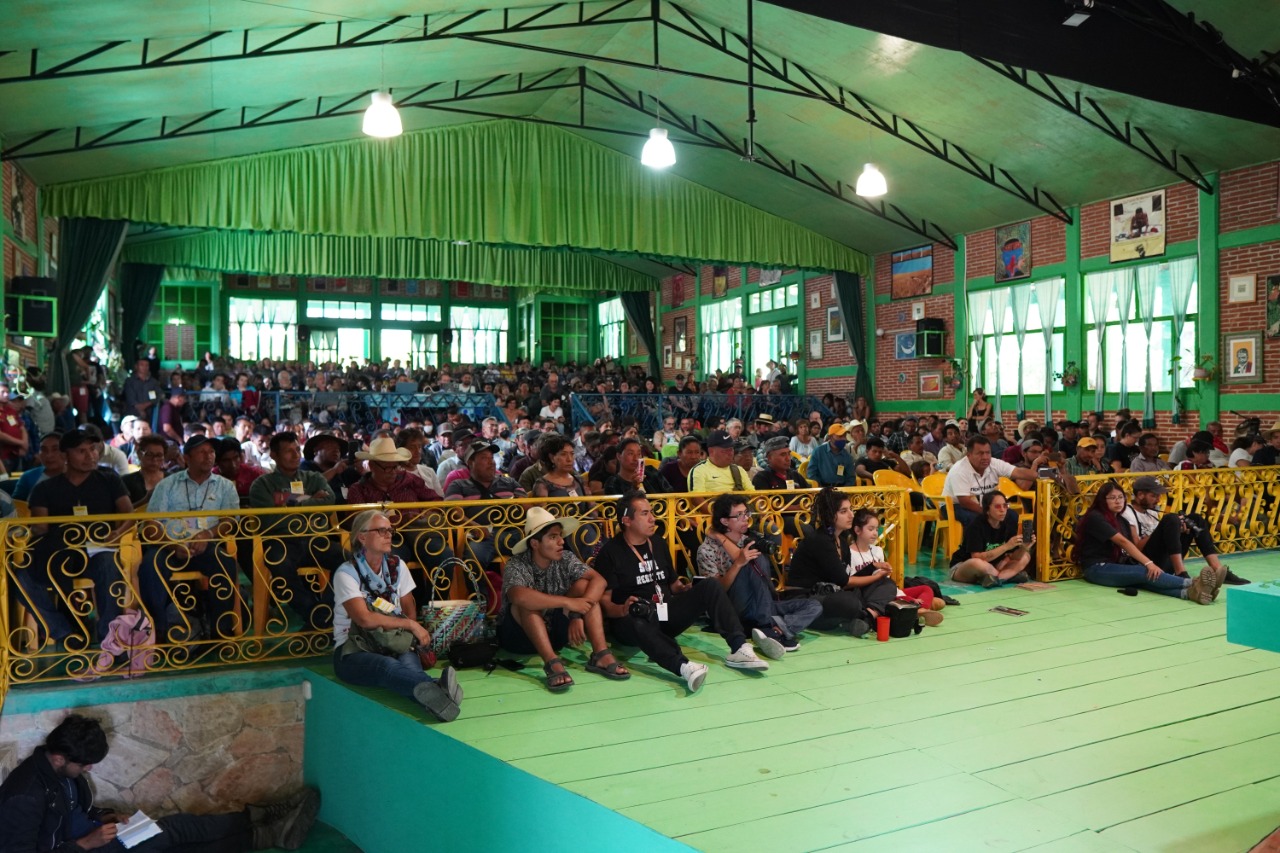
In this global re-arrangement, the Mexican Southeast and the Isthmus of Tehuantepec, play a strategic role in the interests of global corporations to link by land in just 200 kilometers the Pacific Ocean with the Atlantic and facilitate the transport of goods, hydrocarbons and other resources from the subsoil. The interoceanic corridor has been a place of transit since ancestral times of the commercial routes of the peoples, but in times of the colony and the dictatorship of Porfirio Diaz, as well as during the governments of the twentieth and twenty-first centuries they have tried to appropriate it without success, this by the historical resistance of the peoples of the region.
This self-appointed government of the fourth transformation is no different, since it contemplates the modernization of the ports of Coatzacoalcos and Salina Cruz, the construction of a highway and the modernization of the railroad for freight trains that will not only connect the two ports but also with the train they call Maya in the Yucatan Peninsula.
That is why we say that the Interoceanic Corridor, the misnamed Maya Train and the Morelos Integral Project in the center of the country are part of an interconnection and energy supply network for corporations that will operate in the south of the country and Central America, most of them with private and foreign capital.
A high voltage line will be installed and the expansion of the isthmus gas pipeline that they intend to connect with the new maritime pipeline that will bring fracking gas from Texas to our lands. This project will be built along the Veracruz coast, in the vicinity of the reef system, from Tuxpan to Coatzacoalcos and with another maritime branch to the new Dos Bocas refinery, also part of this megaproject.
This infrastructure reflects the deepening of a model, based on the extraction of fossil hydrocarbons, which accelerated during the twentieth century, in a way never seen before, the indicators of pollution and global warming, reinforced by supposedly clean energies in the hands of big foreign capital that does not represent any just energy transition for the peoples.
Indeed, the project not only contemplates the construction of these infrastructures but also the opening of new territories for the extraction of hydrocarbons, mining and the implementation of industrial and wind farms as well as the construction of new urban centers for workers semi-enslaved nationals, but mostly migrants who by order of the master of the North will be detained at the Isthmus, making this territory a new wall of human containment.

In the Maya territories on the Yucatan Peninsula and the states of Chiapas and Tabasco, a new territorial reorganization is developing to be placed at the service of the big tourism capital and big capital for industrial developments.
The Caravan witnessed the devastation of the jungle to make way for train tracks, hundreds of miles and millions of felled trees where deer and jaguar once walked. The flows of the sacred water are being modified with catastrophic consequences for the peoples who will be named in the future as natural disasters.
In Maya territories that were victims in the beginning of the 20th century of the Genocide promoted by the State during the Maya Social War, today the train and the megaprojects that are illegally imposed are part of the new genocidal practices.

The construction of that train, is accompanied by the installation of 21 stations and tourist development zones, photovoltaic wind parks, thermo-electric dams, breweries, pig farms, cultivation of palm, soy and other mono-crops, as well as big real estate developments, hotel complexes, shopping centers, casinos, restaurants and everything that’s necessary for the large masses of tourists that they expect will arrive on the peninsula, provoking dispossession, voracious extractivism and the destruction of the ways of life of the Maya peoples.
Both in the peninsula and in the Isthmus, through misinformation and false promises of well-being linked to the deceptive handling of concepts such as progress and development where social programs have played a fundamental role, due to fear of violence, separation from the community and the possible loss of social programs many people remain silent and do not organize, even knowing and seeing the growing violence and destruction of territories.
But the evils that come with these megaprojects of death are becoming more evident every day. All these infrastructure projects represent the dispossession of our territories for the benefit of big capital as part of a project operated by the Mexican armed forces (army, navy and national guard), in coordination with the police and migratory bodies and in collusion with the organized crime cartels and the consequent expansion of capitalist and patriarchal criminal economies.
We hear and testify that the first of the spoils is that of ancestry and communality, because when they strip us of the sense of belonging to Mother Earth, we stop feeling it, listening to it and feeling its pains. First, they strip us of our memory and our spirituality in order to be able to strip us of our way of life, our roots and the land, because whoever no longer sees in it a mother, but a commodity that can be bought and sold, gets rid of it without thinking about what those who only want to exploit it will do to it. They uproot their trees and poison them without caring about the destruction of our communities and our ceremonial centers, the pollution of the air, land and waters, springs, rivers, lagoons, seas and cenotes that are the waters of the bowels of our mother.
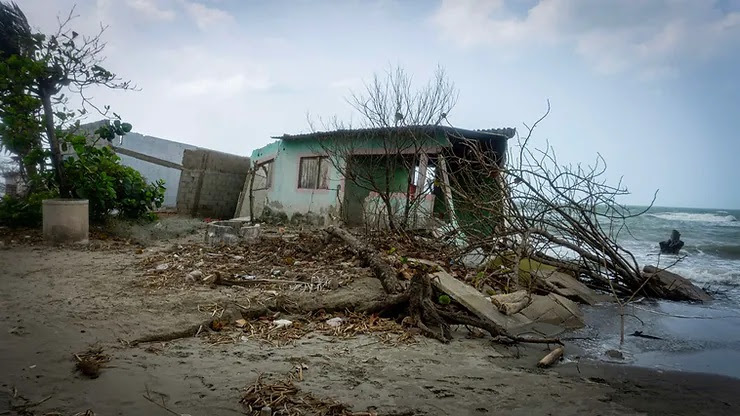
We saw how the sea is literally and tragically swallowing the community of El Bosque in Tabasco, as a consequence of climate change caused by global mega pollution, particularly by the energy model based on the extraction of hydrocarbons, which this government and big capital reinforce.
We also note the terrible increase of a culture of violence that has permeated the entire society from the communities to the neighborhoods of the cities with drug trafficking, extortion, the collection of floor rights (fees for protection), particularly affecting youth, women, migrants and defenders of the environment and human rights.
More and more young people from indigenous communities and poor neighborhoods of cities fall victim to drug trafficking networks, as one of the few “alternatives” to overcome in the midst of this disaster, self-destruct their brains with cheap drugs like crystal, become hitmen and end up murdered.
Particularly, we note the increase in gender violence from family violence to femicides with the terrifying figure of 13 women murdered daily in our country and a clear increase in repression against those who oppose megaprojects, defend the territory and denounce impunity and chains of complicity, repression ranging from threats, forced displacement, imprisonment, disappearances and killings.
More and more young people from indigenous communities and poor neighborhoods in cities fall victim to drug trafficking networks, as one of the few “alternatives” to overcome in the midst of this disaster, self-destruct their brains with cheap drugs like crystal, become hitmen and end up murdered.
Particularly, we note the increase in gender violence from family violence to femicides with the terrifying figure of 13 women murdered daily in our country and a clear increase in repression against those who oppose megaprojects, defend the territory and denounce impunity and chains of complicity and repression, ranging from threats, forced displacement, imprisonment, disappearances and killings.
We identified the racist policies, persecution strategy and stigmatization of the National Institute of Migration against our migrant sisters and brothers. Our compañeras and compañeros from Honduras, Guatemala and El Salvador were denied entry to the country.
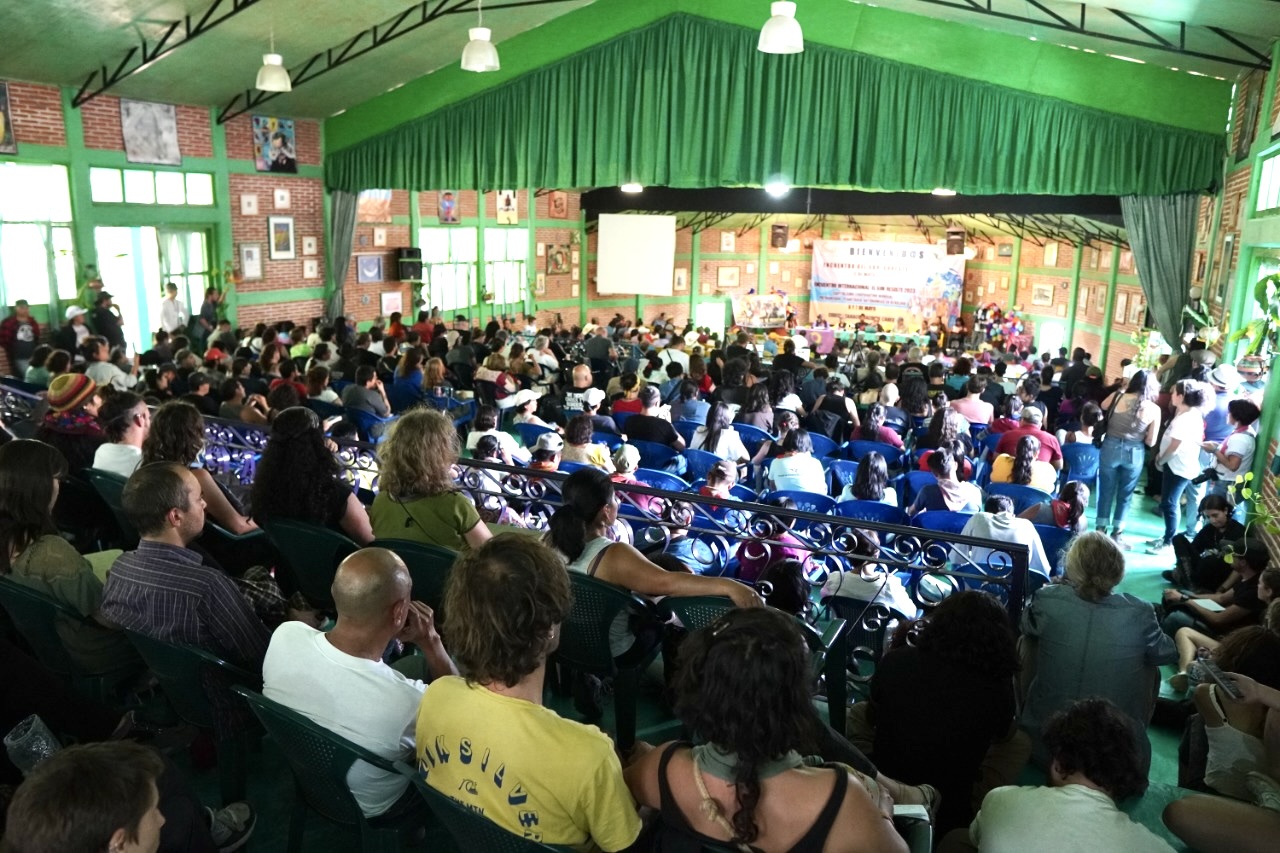
We note the systematic violation of the rights of indigenous peoples and particularly the right to self-determination and autonomy whose exercise is essential to rebuild from our ancestral cultural roots a free and dignified life based on communality from decision-making in assemblies, with full respect for women, LGBTQ+, for youth, children and the elderly and in harmony with nature.
We note the pressure of all government agencies, starting with the agrarian prosecutor’s office, so that the agrarian nuclei and indigenous communities pass to full control and thus end the social ownership of the land that represents the strength of our struggles.
But in contrast to all these calamities, the Caravan also allowed us to travel through hope and life, to encounter the countryside and its native seeds that are being protected by peasant hands. Feel the joy of rebellious music that excites hearts and inspires resistance. We enjoy art as a front of struggle that with its colors, sounds and excitement allows us to continue in the joyful rebellion.
The Caravan allowed us to meet the jungle that resists. Where the trees are cut down, life springs up again. We listened to the birds and their messages, drank the crystal-clear water from the wells and breathed the clean air of the countryside. We find peoples and communities that organize, resist and do not allow the dispossession or even the entry of companies into their territories. They also take measures to recover ways of life that build hopeful autonomies for humanity. On the other hand, we find rebellious cities that build collectivity and autonomy in the midst of urban monsters, where the love for land and territory flourishes again.
We offer to Mother Earth, we invoke the spirit of fire, water and air, recognizing that long struggles are sustained by the spirituality linked to territory and our ancestry. Knowing that we do not seek a final victory but that we fight just like our grandfathers and grandmothers did and before them, our ancestors and as our children and grandchildren will continue to do. As we reaffirmed in the 10 working groups of the South/Southeast meeting on May 5, we build other possible worlds by celebrating what we are harvesting and recognizing that our strength comes from memory and wisdom as struggling peoples. We have reflected that we resist through embracing the values of full and dignified life close to the land, such as the cultivation of our food, traditional medicine and the protection of our peoples through community guards.
We recognized that even in the midst of all the destruction of the capitalists there are many achievements that we are reaping: The first and most important thing is that after 500 years of attempts to exterminate us, we continue the organization from the community against dispossession, in the same way the lands recovered in different towns, the struggle of women for the recognition and exercise of their rights, the struggle for water, the release of political prisoners, the relocation of train stations in Mérida and Campeche, the establishment of zones free of extractive projects, the conservation of languages and traditional festivals and the construction of autonomies.
After the caravan and our internal gathering, 940 people from 40 indigenous peoples of the world, from 27 states of the Republic, from 30 countries and 10 autonomous regions gathered in the International Meeting “World Corporate Capitalism, Planetary Patriarchy, Autonomies in Rebellion.” We listened to the word of 5 speakers to analyze and study the geopolitical situation of the world, of Mexico, specifically of the south-southeast and the global south. We also heard the sharing of experiences of struggle from all these regions as well as proposals to continue the construction of autonomy.
The sisters and brothers of Abya Yala from Guatemala, El Salvador, Costa Rica, Honduras, Colombia, Ecuador, shared with us the situation they have to face and we verified that this predatory capitalist system is acting in the same way in all geographies where peoples still protect nature, culture and life itself. But in the same way we see the joy, strength and living organization of organized peoples.
Denunciations:
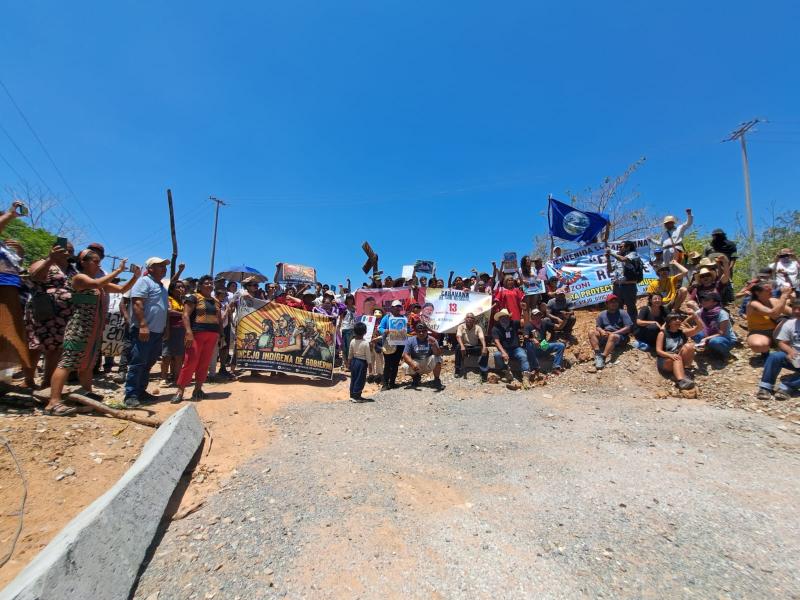
We denounce the violent eviction of the Tierra y Libertad camp as well as the imprisonment of 6 compañer@s perpetrated by the navy and state police on April 28, one day after the passage of our caravan. We demand that the government of Oaxaca and the federal government immediately cease the harassment against these defenders of land and territory and particularly in the case of the Tierra y Libertad camp on the Isthmus and the withdrawal of the arrest warrants against 17 members of the community of Puente Madera, San Blas Atempa, and the acquittal of compañero David Salazar linked to process.
We repudiate the racist immigration policy and violation of the rights of this government that prevented the entry of the daughter of comrade Berta Cáceres prohibiting her from flying to Mexico City, despite having all her papers in order, as well as the harassment against 7 Central American comrades at the border post of Tapachula, Chiapas.
We demand that the illegal assembly of March 5, 2023 in the Nicolás Bravo ejido, Quintana Roo, in which the final stop of the train misnamed Maya was illegally approved in favor of the Azcarraga group, owners of Televisa, and that will damage more than 100 Maya ceremonial centers be revoked!
We demand the cancellation of the eviction order of the community of Emiliano Zapata III, in the municipality of Candelaria, Campeche, promoted by the alleged owner Fernando Oropeza Arispe and ordered by a civil judge of first instance of the state of Campeche. In the same way, the cancellation of the arrest warrants of the community’s comrades.
Immediate cancellation of work on the train misnamed Maya, especially the illegal construction of section 7, the installation of the military casino and the tourist development in the community of Xpujil since despite the definitive suspension granted by a federal judge, SEDENA continues its construction in contempt of the federal order.
Stop the Agrarian Prosecutor’s pressure on communities and ejidos to convert socially owned lands to full domain, ending the collective lands of the country’s indigenous communities.
Urgent and immediate relocation of the El Bosque community in the municipality of Centla, Tabasco, who are environmentally displaced victims of global warming produced by the voracious extractive system that continues to plunder and deforest the territories.
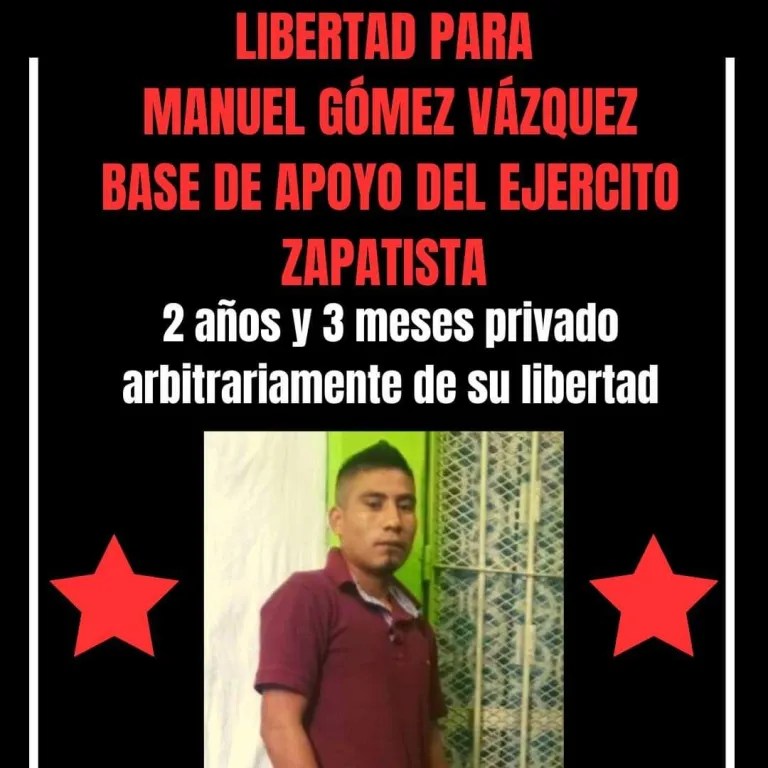
We demand the immediate release of all political prisoners in this country, political prisoners in solidarity with the voice of El Amate, Fidencio Aldama, the prisoners of Eloxochitlan de Flores Magón, Oaxaca, all those unjustly incarcerated for defending water and territories, and the compañero support base of the EZLN, Manuel Gómez Vázquez and, the revocation of the 50-year sentence against comrade Miguel Peralta Betancourt, persecuted politicians of Eloxochitlan.
We accompany and firmly join the demand of the relatives of victims of femicidal violence in Mexico to achieve truth, justice, reparation and non-repetition, not only for women who have been abused but particularly for children (daughters, sons, sisters and brothers), collateral victims of this infamous violence in this country that sows fear, Death and impunity. Neither forgiveness nor forgetfulness! Punishment of the guilty! (Facebook: @FeminicidiosCrimenesdelesahumanidad, @FatimaVariniaEnTuHonorYRecuerdo, @JusticiaParaLupitaBastida).
In the case of the Tila ejido, in Chiapas, we demand the execution of the sentence of the RAN favorable to the recovery of the 130 hectares that have been taken from them by the municipality.
We demand a presentation alive for the thousands of disappeared in the country, the community member Antonio Díaz Valencia and the lawyer Ricardo Lagunes Gasca who were disappeared due to a conflict between the community of Aquila, Michoacán and the Canadian mining company Ternium.
Justice for the 43 students disappeared in Ayotzinapa. Because they were taken alive, we want them back alive!
We affirm loud and clear and from our hearts to struggle and organize, that we will continue to meet and articulate with other struggles around the world.
Neither with the National Guard, nor with the navy, nor with the army. They will not stop us!
While you destroy, we construct.
El Sur Resiste Caravan and International Gathering
#ElSurResiste
Originally Published in Spanish by El Sur Resiste, Tuesday, May 9, 2023, https://www.elsurresiste.org/es/posts/pronunciamiento-del-encuentro-internacional-el-sur-resiste-7-de-mayo-2023 and Re-Published with English interpretation by the Chiapas Support Committee
 Chiapas Support Committee