Chiapas Support Committee
Home of the Compañero Manuel blog on zapatistas & mexico
Javier Sicilia on Mireles’ Arrest
THE CAPTURE OF MIRELES SHOWS THAT THE GOVERNMENT SEEKS CONTROL OF THE NARCO: SICILIA
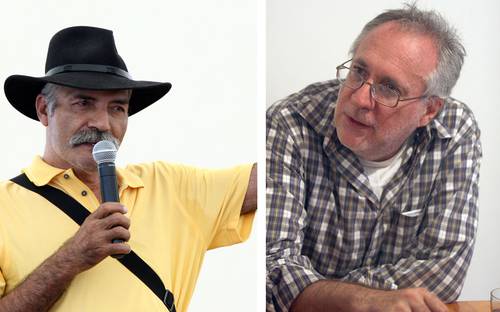
José Mireles (left) and Javier Sicilia (right)
[The disaster that Michoacán experiences is because the government has not even investigated punishing the authorities that are in collusion with organized crime, the poet Javier Sicilia (right) points out. In left image on the left, José Manuel Mireles during his visit to the Autonomous University of Mexico City, last May 29. Photo: María Meléndrez Parada and María Luisa Severiano]
By: Rubicela Morelos Cruz y Ulises Gutiérrez Ruelas, Correspondents
The arrest of José Manuel Mireles, ex spokesperson of the Michoacán self-defense groups (autodefensas), demonstrates that the federal government the PRI member Enrique Peña Nieto heads, is on the side of the criminals and that the only thing that it seeks with the alleged combat against organized crime “is to harmonize and again control the drug trafficking networks” in the country, asserted Javier Sicilia, leader of the Movement for Peace with Justice and Dignity.
At the same time, he called on intellectuals and organizations to demand his liberation, and demanded the removal of Alfredo Castillo, federal commissioner for the peace and development of Michoacán, “who has betrayed the citizens.”
He asserted that: “the disaster that Michoacán lives” is because the federal government has not even investigated punishing the authorities that are in collusion with organized crime; as of now it has not arrested La Tuta, leader of Los caballeros templarios, nor has it investigated ex governor Fausto Vallejo.
“Castillo has lied, has betrayed and has played against the citizens of that state, and is no longer functioning; it seems that he is on the criminals’ side. If Peña Nieto is really working for the people he ought to remove him (Castillo) and do deep investigations, starting with Vallejo.
In Cuernavaca, Morelos, Sicilia called on the intellectual class, organizations and the country’s social strugglers to jointly demand the liberation of Mireles, because “the only crime that he has committed, just like other social strugglers, has been to demonstrate against the State’s inefficiencies and corruptions.” He reiterated that the government criminalizes Mireles and treats him as a criminal, but in the future it can be any other social struggler or any Mexican that criticizes corruption.
Michoacán, he said, represents what the whole country is suffering: insecurity, violence and the operation of drug cartels with or without support from the authorities, because of which he requested coherence from the federal government, concretely the Attorney General of the Republic. “One cannot put Pancho Villa in prison and leave Vallejo without facing charges.”
Meanwhile, in Hermosillo, Sonora, Tomás Rojo Valencia, spokesperson for members of the Yaqui tribe that oppose the operation of the Independencia Aqueduct, visited Hermosillo to report on the conditions of Mireles’ seclusion in Federal Prison Number 11 (Cefereso), on the outskirts of the Sonoran capital.
He said that as social strugglers, many members of the Yaqui tribe identify with him (Mireles), because he confronts an attack from the spheres of power similar to what they have confronted for years: “a constant struggle to defend the rights of the population.”
He said that after gathering information about the case of the leader of the autodefensas, he will take the data to the government organs of the Yaqui people, and in a few days it will announce the position of that ethnicity about the criminal case that he confronts, for the alleged possession of weapons for the exclusive use of the Army.
———————————————————–
Originally Published in Spanish by La Jornada
Translation: Chiapas Support Committee
Thursday, July 3, 2014
En español: http://www.jornada.unam.mx/2014/07/03/politica/004n1pol
Zapatista News Summary for June 2014
JUNE 2014 ZAPATISTA NEWS SUMMARY
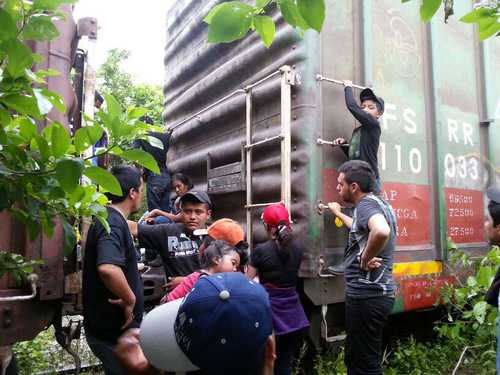
Migrants Boarding The Beast in Chiapas
In Chiapas
1. Sup Moisés Describes What Is Needed to Rebuild the Autonomous School and Clinic in La Realidad – In this communiqué Subcomandante Moisés describes in detail the materials and equipment necessary to rebuild the autonomous school and clinic in La Realidad that the CIOAC-H members destroyed in the May 2 attack in which Compañero Galeano was murdered. The communiqué is entitled A meeting in La Realidad a few days ago. Instructions for sending donations can be found here.
2. More CIOAC-H Attacks – Primero de Agosto, a pro-Zapatista Tojolabal community in the same region as La Realidad, denounced aggressions from the Independent Central of Agricultural Workers-Historic (CIOAC-H, its initials in Spanish) and another organization called the ASSI. The aggressions include provocations, threats, attempted murders, robbery and a land invasion. Those who murdered Compañero Galeano belonged to the CIOAC-H and the Zapatistas classified the organization as paramilitary. According to the denunciation, the paramilitary behavior continues.
3. Militarizing Mexico’s Southern Border: Chiapas – The Chiapas border with Guatemala has suddenly become an important issue! According to the Frayba Human Rights Center, complaints of human rights abuse have doubled since implementation of the new “security” program for Mexico’s southern border. Chiapas is Mexico’s southernmost state, bordering the Central American country of Guatemala. Militarization of this international border is the latest phase of the US-backed Drug War, allegedly designed to deter drug trafficking from Central America into Mexico. However, it is also aimed directly at deterring migration from Central America and officials report a sharp rise in the number of unaccompanied migrant minors and entire families fleeing the violence. Chiapas NGOs report that militarization has increased in Chiapas municipalities along the border, and there are Zapatista communities in those border municipalities. (See more below.)
4. US Ambassador Anthony Wayne Inspects Chiapas Border with Guatemala – For two days during the last week of June, the US Ambassador to Mexico, Anthony Wayne, flew over portions of the Chiapas border with Guatemala and met with commanders of the Mexican Army and Navy regarding security on that border. He also visited the large migrant detention center (capacity 2,500 per day) and learned that Mexico has detained and deported 10,505 minors in the past year. The ambassador’s visit dramatizes the importance this issue has taken on and the importance of Mexico’s southern border.
In other parts of Mexico
1. Jose Manuel Mireles, Self-Defense Leader, Arrested – In April, we reported that leaders of the various self-defense groups from 20 Michoacán municipalities signed an agreement with the federal commissioner for Michoacán, Alfredo Castillo, and other government officials to “demobilize” and register their weapons. The deadline set for the demobilization was May 10. Not all of the self-defense leaders supported this agreement. In other words, the federal government divided the leadership. So, some of the self-defense members have registered their weapons and joined the rural police; while others have not. One of the self-defense leaders that did not register his weapons or join the rural police is Doctor Jose Manuel Mireles. Instead, he criticized the government’s role in Michoacán. Soon after he led a group of armed autodefensas into the small town of La Mira, federal police and members of the Mexican Army and Navy arrested Mireles and 69 others (later reports say 82) accompanying him for carrying their unregistered weapons.
2. Guerrero’s Community Police Suffer Internal Division – On June 21, one community police agent died in a confrontation between the two opposing factions in a struggle for control of the San Luis Acatlán House of Justice. The Regional Coordinator of Community Authorities-Community Police (CRAC-PC, its initials in Spanish) suffered a serious internal division this year, which some attribute to the government’s interference in this autonomous project. Details here.
3. The FPDT in San Salvador Struggling to Defend its Land Again! – The People’s Front in Defense of Land (FPDT, its initials in Spanish) is once again facing the threat of losing some of its farmland to urban development and a new airport in Mexico City. On June 1, the ejido assembly approved a measure that would permit converting agricultural lands into private property, thus opening the door to a new Mexico City Airport and the Ciudad Futura (Future City) Project. The ejido Commissioner is a PRI member and the FPDT emphasized the “irregular and illegal” nature of the assembly and said it would take legal action as well as engage in social protests. The FPDT is remembered for the valiant defense of its land and marches with machetes raised from 2001 to 2002, after the federal government’s first effort to construct the new airport on Atenco’s land.
In the United States
1. 52,000 Unaccompanied Migrant Minors – The tragedy of children attempting to migrate without a parent or other adult relative has overwhelmed US immigration facilities; and those are only the children that get caught! The Pew Research Institute reports the following percentages for the countries of origin of unaccompanied children apprehended between October 1, 2013 and May 31, 2014: 25 percent are Mexican, an equal percentage are Guatemalan, 29 percent are Honduran and 21 percent are Salvadoran. This is a dramatic increase of Central American children. The United States has agreements with Mexico for returning the Mexican minors promptly. That is not the case for the Central American minors. The US government must find housing for them while their immigration cases are processed. Many of the Mexican and Central American children are fleeing the violence of criminal gangs and drug traffickers, trying to reunite with parents that are working in the United States. Many have asylum claims. Immigration reform would grant relief to others, but the US government seems incapable of reforming that obsolete system.
_________________________________________
Compiled monthly by the Chiapas Support Committee.The primary sources for our information are: La Jornada, Enlace Zapatista and the Fray Bartolomé de las Casas Human Rights Center (Frayba).
We encourage folks to distribute this information widely, but please include our name and contact information in the distribution. Gracias/Thanks.
Click on the Donate button at www.chiapas-support.org to support indigenous autonomy.
_______________________________________________________
Chiapas Support Committee/Comité de Apoyo a Chiapas
P.O. Box 3421, Oakland, CA 94609
Tel: (510) 654-9587
Email: cezmat@igc.org
http://www.chiapas-support.org
http://www.facebook.com/pages/Chiapas-Support-Committee-Oakland/
https://compamanuel.wordpress.com
Dr. Jose Manuel Mireles and 69 more arrested
[On Friday, June 27 around 5:30 PM, members of the federal police and the Mexican Army arrested Doctor José Manuel Mireles and 69 other autodefensas that were accompanying him, in the administrative district (tenencia) of La Mira. Around 30 federal trucks arrived in the place. Mireles was transported to the Port of Lázaro Cárdenas, 15 kilometers from La Mira. The day before, Mireles led a hundred armed men that entered La Mira, just 15 kilometers from Port Lázaro Cárdenas, a strategic place for Los caballeros templarios. Below is an editorial that appeared in La Jornada regarding the hypocrisy of his arrest. And the United States government continues giving beaucoup bucks to Mexico to fight the Drug War in Michoacán and elsewhere in Mexico when it’s obvious that the Mexican government is fighting the people instead of the drug traffickers!]

Mireles arrested! Photo: La Jornada
MIRELES: PARTISAN JUSTICE
The arrest of José Manuel Mireles, ex member of the Council of Autodefensas of Michoacán, occurred yesterday at the hands of federal forces, constitutes a clear example of the partisan application of justice and distortion of the state of law that state has endured in recent months and that has sharpened beginning with the federal government’s intervention in the Michoacán scenario and the virtual annulment of state sovereignty.
It’s noteworthy, in the first place, the lack of consequence of a federal government that announces zero tolerance to armed civilian groups just weeks after it used them to pursue and abate the alleged ringleaders of criminal organizations. With respect to that, it’s appropriate to remember the participation of self-defense groups –according to what Mireles himself related– in the operation that led to the death of Nazario Moreno, El Chayo, supposed founder of the Knights Templar (Los caballeros templarios).
It is significant that, a little before his capture, Mireles and his men had advanced and taken control of La Mira, located in Lázaro Cárdenas municipality.
To start, it is certainly undesirable that the State permits the uncontrolled presence of armed groups of citizens, even less in such an explosive and violent atmosphere as Michoacán. But in this case the official discourse ignores –because it thus appears to suit its interests– that the presence of those groups is a consequence, not the cause, of an annulment of the legality originally provoked by the tolerance and passivity of the very same authority faced with the behavior of the criminal organizations that operate in the referenced state, which obliged diverse sectors of the Michoacán population to take up arms to defender themselves. That omission was aggravated by a governmental strategy that, far from restoring the peace and the state of law, it multiplied the factors for tension and rancor in the territories in conflict, first by permitting the proliferation of self-defense groups and later undertaking a campaign of criminalization and persecution against some of them, which began with the unjust incarceration of Hipólito Mora and now continues with the capture of Mireles Valverde.
In that sense, the accusations against the leader of Tepalcatepec –violations of the Federal Firearms and Explosives Law– appear as a masquerade of justice to give formal support to the capture of a personage whose true “fault,” according to what one can see, has been to maintain a posture less complacent towards the government than the other self-defense leaders, and to systematically reject the Enrique Peña Nieto administration’s actions of registering and disarming of civilian guards implanted in Michoacán.
For the rest, the continuation of the violence and deepening of the institutional and political crisis in the state, and the fact that the criminal organizations that operate there have not been dismantled or their businesses substantially affected, end up making right those who, like Mireles, have criticized the uselessness governmental actions and have pointed them out as a way of demobilizing the sectors of society that decided to rise up against organized crime.
In sum, the capture of the founder of the Michoacán autodefensas is one more exhibition of the erratic conduct, slanted and murky of the federal government in Michoacán, and could also result in a counterproductive maneuver for the government: if the federal authorities do not quickly begin a police or military operation –similar or larger than it launched against Mireles– to dismantle the criminal organizations that operate in Michoacán territory, society will have ample reason for questioning the alleged legalistic zeal of Peña in that state.
———————————————————–
Originally Published in Spanish by La Jornada
Translation: Chiapas Support Committee
Saturday, June 28, 2014
En español: http://www.jornada.unam.mx/2014/06/28/opinion/002a1edi
Guerrero: the siege against the CRAC-PC
GUERRERO: THE SIEGE AGAINST THE CRAC-PC
By: Luis Hernández Navarro

Community Police of Guerrero
Relentlessly pursued by the government and internally divided, the community police and the systems of community justice of Guerrero are living through a grave crisis. Arbitrary arrests of its leaders have happened one after another, the formation of rural police sponsored by the government and grave aggressions of one group against the other.
One week ago, on June 17, Guerrero’s ministerial police detained and brutally beat the spokesperson of the Council of Ejidos and Com munities Opposed to La Parota Dam, Marco Antonio Suástegui Muñoz. He is pointed to as the one probably responsible for “the commission of different illicit acts.” Recently, Marco Antonio organized a self-defense group in the rural Acapulco zone, with the support of the Regional Coordinator of Community Authorities-Community Police (CRAC-PC).
This weekend, deputies from the PRD, Citizen Movement and Heladio Aguirre, will intervene in favor of the community police leader of Olinalá, Nestora Salgado. Comandanta Salgado is unjustly detained in the Tepic women’s federal prison and has been the victim of serious violations of his rights.
On June 20, 18 communities of the Sierra received in the municipality of Leonardo Bravo, with flowers and a fiesta, the first generation of the state’s rural community police. This new armed force is a presidential initiative to stop the expansion of the authentic community police.
One day later, the CRAC-PC faction led by Eliseo Villar Castillo attempted to violently takeover the historic seat of the San Luis Acatlán House of Justice, in which its detractors participate. At least one community police agent died.
The Eliseo Villar group has the support of Governor Angel Aguirre. The relationship between the two is close. The journalist Sergio Ocampo tells that the governor declared that Eliseo supported him in his campaign, gave him a calf, is his friend and now he’s going to reciprocate. That’s how he did it. His faction, besides having open doors in different government offices, he receives around one million pesos per month.
The conflict has a historia behind it. In 2013, the CRAC suffered a strong implosion. The internal cohesion cracked and different groups and leaders disputed the leadership of the movement and interlocution with the State. The currents attacked each other furiously and launched grave accusations in each other’s faces: paramilitaries, agents of the government and traitors. The essence and direction of the original project was lost.
In its 19 years of life, the CRAC has suffered three ruptures. The first, with the group that vindicated itself as “founding peoples,” founded the Union of Peoples and Organizations of the State of Guerrero (Upoeg, its initials in Spanish) in 2010, was expelled from the Coordinator, and in June and September 2013 it unsuccessfully tried to takeover the San Luis Acatlán House of Justice. The second, also in 2013, was the product of the clash between the communities of Tixtla, Olinalá and Ayutla, which followed a more radical dynamic of social mobilization. And the third, resulted from a severe fracture inside the leadership team of the House of Justice.
The state government’s intervention has been a key factor in the development and exacerbation of the internal contradictions of the Coordinator. The authorities seek to domesticate it anyway possible, take away its autonomist edge and impose its agenda by virtue of financial cannon shots and repression. The local and federal governments desire to disappear by any means the spaces of resistance to the mining invasion in the zone. Curiously, all the parties in the fight admit that the government foments the internal quarrel.
The tragic confrontation last June 21 is the latest link of the third rupture. Originally its protagonists made up part of the same group. In fact, it was their dispute with the leadership team of the Upoeg that opened the door for Eliseo Villar to lead the CRAC. The fear that people from the Upoeg would come to the front of the Coordinator led them to promote a hard personage to confront them, overlooking their traditions. Eliseo was that figure: a police agent without a long community trajectory.
The fracture inside this group was produced when Eliseo Villar installed an agenda very pragmatic and very tied with the state’s interests, confronting a sector of majority communities in San Luis Acatlán, advised by Valentín Hernández Chapa and Pablo Guzmán.
According to Abel Barrera, Eliseo’s agenda at the front of the Coordinator is guided by the search for support to productive projects, increasing the economic resources that the state government gives them and obtaining money for the construction of the houses of justice, armament and uniforms. This orientation had as a final result that the most political theme, the theme of how to strengthen a security model of the peoples from their own cosmovision and autonomy, was blurred. Villar began to manage that resource without transparency or rendering accounts. His opponents accuse him of diverting 740,000 pesos. Additionally, he refused to struggle for the freedom of imprisoned community leaders.
His detractors removed Eliseo Villar in an assembly held on March 31, 2014. The deposed coordinator denied the validity of the act and said that his adversaries were a minority.
Those who failed to recognize Villar –Abel Barrera explains– are part of a mixed coalition of advisors, coordinators, commissioners and ex commissioners –historic leaders of the Costa-Montaña region–, who have greater clarity about the original sense of the project. Their axes of action consist of having coordinators truly subordinate to assembly decisions, naming the police in the communities, respecting and complying with internal rules, and promoting the re-education of those who commit crimes.
The governmental siege on the community police of Guerrero advances. The Eliseo Villar group’s attempt to take overthe historic San Luis Acatlán House of Justice is no more than the latest play to achieve it.
Twitter: @lhan55
———————————————————–
Originally Published in Spanish by La Jornada
Translation: Chiapas Support Committee
Tuesday, June 24, 2014
En español: http://www.jornada.unam.mx/2014/06/24/opinion/027a1pol
The Death of SupMarcos, a blow to revolutionary pride
THE DEATH OF SUP MARCOS, A BLOW TO REVOLUTIONARY PRIDE
By: Raúl Zibechi
The illuminating farewell of Subcomandante Marcos

Artwork by Emma Gascó in Diagonal
The farewell communiqué of Subcomandante Insurgente Marcos, read in the early morning of 25 May in the Caracol of La Realidad, in front of thousands of bases of support and people in solidarity from around the world, in which he announced his death and reincarnation (unburying, in the words of EZLN,) is one of the strongest and most powerful texts he has released in the twenty years since his public appearance on January 1, 1994.
The murder of the teacher Galeano in La Realidad on May 2, by members of the Independent Central of Agricultural Workers and Campesinos – Historic (CIOAC-H), an organization that became a paramilitary group thanks to the counterinsurgent social policies that buy people and whole groups, precipitated a process of change that had been underway for some time. The massive silent march of 40,000 Zapatista supporters on December 21, 2012 in the major cities of Chiapas, and the subsequent Escuelita of ‘Freedom according to the Zapatistas’ were some of the axes of these changes that we could appreciate.
The third part of the communiqué of May 25, titled The Change of Guard, recounts very briefly the four internal changes that have been in process during these two decades. The first one mentioned is generational, the most visible change, since half of the Zapatistas are less than 20 years old and “were young or were not born at the beginning of the uprising.”
The second is that of class “from the enlightened middle class to the indigenous campesino.” And the third is that of race: “from mestizo to a purely indigenous leadership.” These two changes have been manifested for some time with the constant and increasing emergence of comandantes and comandantas at various public appearances of the EZLN. But the appearance of Subcomandante Insurgente Moisés, with the same military rank as Marcos, undoubtedly marked a turning point that is now complete, leaving Moisés as the spokesperson of the movement.
Marcos’ farewell communiqué emphasized that the most important of the changes was in thinking: “from revolutionary vanguardism to ‘ruling by obeying;’ from the taking of Power from Above to the creation of power from below; from professional politics to everyday politics; from the leaders, to the peoples.”
Finally, there was the issue of gender, as women moved from marginalization to direct participation, and the whole movement passed “from mocking the other to the celebration of difference.”
As can be seen, the anti-vanguardism goes hand in hand with the set of changes that can be summarized in the fact that the bases of the movement command and the commanders obey. There isno longer any doubt over who are the subjects. Somehow, these changes reduced the visibility from outside of the preponderant role already played by Moisés, whose figure was already standing out in his communiqués linked to the escuelita, but who now takes on his full relevance.
The EZLN completes a long lasting turn towards the common people, of huge strategic depth.
Thus, at a complex juncture in which the national Mexican government and the government of Chiapas launched a major offensive against the Caracoles and Zapatismo as a whole, –as part of the recovery of state power from the autodefensas (self-defense forces) in Michoacán and the Community Police in Guerrero– the EZLN completes a shift to the common people, which is long lasting, and of huge strategic depth, showing what those from below are capable of doing.
The media figure of Marcos disappears, appealing to the middle class and the mass media, the prominent personality capable of dialogue with intellectuals from around the world and of doing so on equal terms, being supplanted by the indigenous and campesinos, common and rebellious people. It is a political and ethical challenge of enormous magnitude, which places the analysts, the old left and the whole of the academic world against the wall. From now on, there will be no illustrious speakers but rather indigenous and campesinos.
“Personally –writes Marcos– I don’t understand why thinking people, who assert that history is made by the people, get so frightened in the face of an existing government of the people where ‘specialists’ are nowhere to be seen.” The answer he gives: “Because there is also racism on the left, above all among that left which claims to be revolutionary.”
Very strong! Very wise and very necessary! Zapatismo does not dialogue with the system’s politicians, or with those on the right or the left. It speaks to those of us who want to change the world, to those of us who aspire to build a new world and, therefore, decide not to walk the path of the institutions but to work below, with those from below. And we find that one of the major difficulties in these spaces is arrogance (pride), individualism, which it defines as perfectly compatible with vanguardism. With this step, the Zapatistas set the bar very high, higher than any political force has ever set it. Finally, individualism and vanguardism are two central expressions of Western culture; ways of doing things related to Colonialism and patriarchy, both of which we need to let go of in everyday life and in politics.
Originally Published in Spanish by Diagonal (Madrid) on June 14, 2014
English Translation: UK Zapatista Solidarity Network
Editing: Chiapas Support Committee
Chiapas: militarization and looting threaten Indigenous
Below is an interview with Victor Hugo López, Director of the Frayba Human Rights Center in Chiapas. It gives a good overview of the current situation the Indigenous Peoples are facing.
CHIAPAS: MILITARIZATION AND LOOTING THREATEN INDIGENOUS
By: Nancy Flores
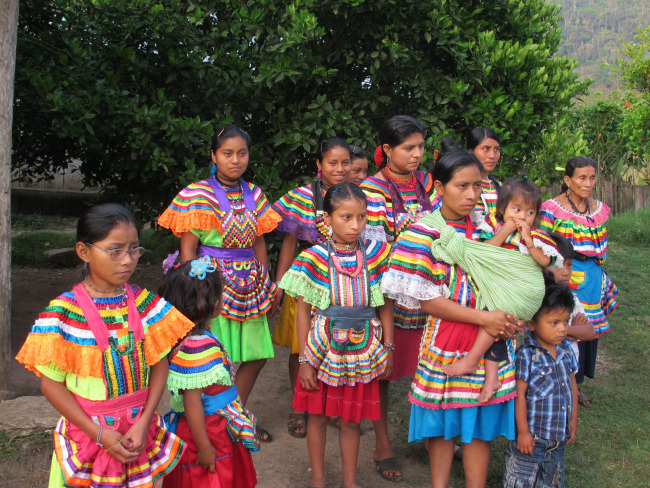
With the “war” against drug trafficking, Chiapas was once again militarized. Tensions among the EZLN, the bases of support, civil society in general and the government have increased together with the criminalization of peaceful protest. In an interview, Victor Hugo López –director of the Frayba Human Rights Center– points out that the militarization has also increased dispossession of the state’s natural, mineral and energy resources.
During the PAN government of Felipe Calderón Hinojosa, members of the Mexican Army and Navy occupied rural roads and indigenous communities of Chiapas little-by-little but overwhelmingly. Today, still with a pretext of drug trafficking, military personnel have zones under their control that had been liberated during the presidency of Vicente Fox Quesada as an example of the “governmental will” to pacify the region.
Thus, the maximum achievement of the “Calderón War” in that state of Southeast Mexico was not exterminating organized crime, but repositioning military personnel to the point that the current situation is comparable to that which it lived in two decades ago, when the Zapatista National Liberation Army (EZLN) rose up.
In an interview with Contralinea, the director of the Fray Bartolomé de las Casas Human Rights Center (Frayba), Victor Hugo López, explains that, although “spectacular scenes of violence” and confrontations in the streets have not been seen in Chiapas, the strategy of the “war” against drug trafficking did have serious repercussions in the communities. In principle, because it achieved a repositioning of the Mexican Army and Navy in different indigenous territories and at all the border points of the state, characterized by its misery and marginalization.
The young human rights defender remembers that one of the conditions that the Fox administration attended to in order to maintain dialogue with the EZLN was demilitarization: some of the most important military zones were eliminated, he says. Nevertheless, “this situation was lost with the Calderón strategy: while members of the Army patrol and put up checkpoints throughout the territory, members of the Navy take custody of the border points, including that of Guatemala.”
Currently, he exposes, members of the Mexican Army are present in different rural communities and roads in which they had not previously been seen. “They are making rounds again; they are even making operations of disarming. Sudden, they say, discreet [operations], but they are just touching the border or the line of fire here in Chiapas. This is serious, because it seems to me that they are not measuring the possibility of once again registering an [armed] confrontation.”
Victor Hugo López observes that the anti-drug strategy had other grave repercussions in Chiapas. One of these refers to the state security policy, because now the state police are at the command of the soldiers.
He also refers to the criminalization towards society as a whole. He gives as an example the operations of mixed units (military personnel accompanied by state and municipal police). These, he indicates, are the ones that have been committing the greatest number of arbitrary detentions of young people (men and women) in the streets simply for their appearance; they also commit abuses and torture.
In that same sense, the laws were hardened and forms of violence and mechanisms for human rights violations were legalized: “for example, although arraigo was eliminated in Chiapas and it was publicized as an achievement of the previous government, the Attorney General’s [security] houses, where people are disappeared, tortured and illegally detained, have increased.”
And despite the fact that the police-military operations as much as the legal modifications have been justified as a strategy against drug trafficking, the human rights defender observes that the sale and consumption of all kinds of drugs and alcohol are not regulated.
“In contradiction of the discourse of combatting drug trafficking g and organized crime, we have seen the exponential proliferation of cantinas where indiscriminate consumption of drugs and even human trafficking has been authorized and is even being promoted in different communities, because in some cases the owners are the mayors.”
Victor Hugo López warns that the conditions to maintain a state of insecurity are being created. An example of that is the alliance between the governments of Mexico, the United States and Guatemala: “the argument is that the organized crime and drug trafficking groups do not operate between Chiapas and Guatemala; but these policies have hardened the measures not against crime, but against the population.” Particularly, he points out, against the migrants.
To us, the protection of the border, the reinforcement of security and the combat against organized crime have meant greater social control and a greater index of repression against the population as a whole. And that has impacted in a way to appear invisible, but present. It is very present here in the cases that we receive every day of arbitrary detentions.
“In the Frayba we are receiving today an average of between 900 to 1000 cases in general; but 3 years ago we received from 400 to 500 cases. Now, of those 900 to 1,000 cases, some 400, in other words 40 percent, have to do with themes of criminalization, access to justice, arbitrary detention, arbitrary deprivation of life, torture and legalization. In our analysis, we see that they are effects of the strategy of the war against drug trafficking and organized crime: we could say that 40 percent of those cases are derived from that strategy.”
Megaprojects, the other threat
Despite the evidence Frayba gathered with respect to the increase in human rights violations, the federal and state governments assure that those rights are respected in Chiapas. Those discourses not only seek to conceal the situation the communities confront, but also to promote foreign investment in the region.
Victor Hugo López explains that: “the Mexican State has done an impressive lobbying job at the international level of being a guarantor, promoter and of respecting human rights in Mexico, and concretely in Chiapas, in the indigenous populations; for that it has ratified, signed and proposed all kinds of laws, regulations, conventions and protocols that can generate protection of that discourse. Mexico is a promoter of the Universal Declaration of the Rights of Indigenous Peoples and once again began saying that it had to legislate and approve the San Andrés Accords. In Chiapas we have local laws like the indigenous law, a law for the protection of woman, etcetera. Then they have created all the legal-judicial scaffolding to be able to maintain in front of world governments and foreign agencies that they are guarantying conditions of respect, promotion and protection of human rights and that, therefore, the levels of life, social security, tranquility and peace are guarantied in our state.”
He adds that recently 12 members of the European parliament have visited Chiapas wanting to know the human rights situation, but, above all, to ascertain the security conditions the zone offers for investment.
“What they are saying is that the Mexican government is impelling or re-impelling projects for investment, ecotourist projects, for the companies that extract minerals and petroleum resources, saying that in Chiapas it is all the scaffolding of respect and promotion of human rights that guarantee security in their in vestment.”
The director of the Fray Bartolomé de las Casas Human Rights Center says that a map is being identified of social conflict in the state provoked by the megaprojects of private investment. One of those conflicts, he details, is that of the Agua Azul zone,. In the area of the cascades, the campesinos are opposed to the governmental proposals for creating an ecotourist center.
“We see that the insult to the communities that defend their territories is being impelled again because they come in a decided manner to impel the projects that they have promised. And we have been able to corroborate it in this sense, because there is a security-investment-human rights conjoint that it is selling outside the country. They [foreign representatives] are coming to see if what they are selling is true. Then without a doubt it awaits us at this time and from her on once again processes of tension in which the communities will oppose those projects that come in a decided way to impose themselves.”
Within this context, Victor Hugo López warns that there is another actor in the territorial struggle: the National Crusade Against Hunger. This, he assures, has operated as a counterinsurgency mechanism: “the only thing that the Crusade seeks is to divide the communities, generate greater dependency and increase the conditions of extreme poverty in the state.”
Frayba: 125 years of Advocacy
On March 18, the Fray Bartolome de las Casas Human Rights Center turned 25 years old. Founded by the late Samuel Ruiz García – then Bishop of the Diocese of San Cristóbal de las Casas, Chiapas-, today is considered one of the most important Mexican organizations for the defence of the individual and collective rights.
With respect to these 2 and a half decades of work, its current director, Víctor Hugo López, reflects: “It has been 25 years of existence of the Center for human rights, but more than 500 years being influenced by indigenous peoples who have been insistent in generating proposals and alternatives to the crisis of the state and the system”.
The Frayba Center much appreciates that there are five autonomous regions, five good government juntas, which have the lowest rate of human rights violations. “They are people who have managed to cope with this system of structural violence and its consequences. “In this context is that we reach these 25 years: we recognize that the Frayba would not have had this success if it wasn’t thanks to the influence of these political actors and the subject that is the indigenous people”.
He adds that people who have known of the project and have collaborated on it are also fortunate in being in Chiapas territory. “Is a land where meaningful and highly visible contrasts arise: the undeniable wealth of energy, natural resources, but also the cultural wealth of policy proposal that we have been seeing born from the region, and that stems not only from 1994, but also from recognizing more than 500 years of history, with a major player which are the indigenous peoples.”
“We feel fortunate that our origin is essentially indigenous. The indigenous populations in Mexico are part of the population where violence and the violation of human rights come to impressive levels. In other words, if many mexicans are faced with the issues of corruption, discrimination and injustice, for indigenous peoples this type of violence is magnified, by their condition of being poor, indigenous people and peasants.
Víctor Hugo López mentions that violence in Chiapas has many fronts: Although the most visible is the image of the territory occupied by the military, there is territory occupied and cordoned off for “development” projects that are dividing communities.
However, he says, those conditions and those natural strains of the system are generating proposals and alternatives. Therefore, although for 15 years the state has been living what he calls a war against the population, there have been alternatives constructed mand of these autonomous, proposals of alternative justice models, reconstruction of the social fabric which, no doubt, can be guides in addressing the issues facing the current state of Mexico.
In Chiapas, there have been violent situations that subsequently reproduced their strategy or their effects at national level, such as the massacre of Acteal in 1997, which had a global impact: 45 people and four that were not born yet were massacred in a community. Today, the country has seen similar massacres that have occurred in different contexts and in various territories, including Michoacán, Tamaulipas and all states who are facing the strategy against organized crime.
At risk, 20 percent of the biodiversity of Mexico
Chiapas owns 20 percent of the biodiversity of Mexico and is the second nationally in biodiversity, this is accoriding to data from the state government, headed by Manuel Velasco Coello, the Green ecologist party of Mexico.
According to the official information, some of the most important natural resources are: 10 river basins and two of the largest rivers of the country: Grijalva and Usumacinta; 266 kilometers of coastline, two canyons; It has seven of the nine most representative ecosystems in the country and 46 protected areas (among these, Montes Azules biosphere, El Triunfo, La Encrucijada, La Sepultura, El Ocote and Lagunas de Montebello).
Currently, the local administration plans to exploit these resources through the “ecotourism” projects. Announcing that Chiapas will host the 2014 adventure tourism fair, this past May 12th is became known that the state administration is to “prepare a comprehensive plan of development of tourism in the region north and the jungle, having an axis starting at the city of Palenque and its archaeological zone. This plan will provide investment in infrastructure, signage, training and promotion, which will allow to consolidate tourist routes in the forest and other regions of the state.”
Four days later, the federal and state governments designated as “priority need” to carry out a formal territorial designation of the Selva Lacandona, Montes Azules biosphere reserve and protected natural areas:
“The government of the republic and of Chiapas expressed his conviction that territory is top priority to provide the necessary conditions for the full development of the Lacandona community and the adjacent towns to improve the quality of life of their inhabitants in accordance with the legal framework, favouring the consolidation of the protected natural areas and the sustainable development of these areas. Also, in accordance with the provisions of the general law of ecological balance and the protection of the environment, in its article 46, the letter says ‘in protected natural areas the foundation of new centers for populations will not be permitted’, you won’t be able to regularize the existing unauthorized settlements within the Montes Azules biosphere reserve, or any other protected area. Therefore no plan for compensation can be carried out since no resources will be allocated for those purposes.
————————————————————
Originally Published in Spanish by Contralinea
Translation: Chiapas Support Committee
June 17, 2014
En español:
Securing Mexico’s Border with Central America
SECURING MEXICO’S BORDER WITH CENTRAL AMERICA

Central American migrants on the train known as “The Beast.”
By: Mary Ann Tenuto-Sánchez
As the current wave of immigrant women and children from Central America brings more public attention to the issue of migration, we take a look at what’s happening to Mexico’s southern border with Central America.
In 1994, the Zapatista National Liberation Army drew the world’s attention to Chiapas, Mexico’s southernmost state, with an uprising of indigenous peoples. It also drew tens of thousands of members of the Mexican Army, Navy and federal police to the state. Although the Zapatistas put down their weapons and opted to live autonomously from the official governments (local, state and federal), meaning that the Zapatistas govern themselves in non-violent resistance, a counterinsurgency war continues to this day and the conflict zone remains heavily militarized.
Despite all that militarization, drugs and other illicit goods are smuggled into Mexico from Central America through Chiapas. Central Americans and others also cross into Chiapas on their way through Mexico to the United States to seek employment and a better life, free of the poverty and violence in their countries. These migrants have become the focus of political wars over immigration between a divided and dysfunctional Congress and the White House. Let’s take a look at what the governments of both the US and Mexico are doing about Mexico’s southern border.
A “porous” border in need of “security”
In December 2010 El País, a mainstream Madrid newspaper, published an article about the Chiapas border with Guatemala after receiving a document from Wikileaks revealing great concern by US diplomats (from the US Embassy in Mexico City) with respect to drug trafficking across a border they termed “porous.” [1] They also reported the lack of security forces to deter not only drug trafficking, but also human trafficking and arms smuggling. [2] Four months after this diplomatic “discovery” of the border between Chiapas and Guatemala, Mexico announced two new Army bases in Chiapas.
Apparently the new Army bases did not constitute enough militarization to satisfy the Obama administration. Following the July 23-24, 2013 visit to Mexico of then Homeland Security Secretary Janet Napolitano, La Jornada, Mexico’s progressive daily newspaper, reported that the United States would “act” on Mexico’s southern border. No specifics were given. It seems that La Jornada relied upon a Mexican government website for information that agreements were reached concerning its southern border. All reference to the southern border was removed from the website a few days later, apparently because the Obama administration wanted to keep the agreements secret, at least for a while.
The Los Angeles Times soon reported some of the specifics. According to the Times, the US will, at least in part, finance “high-tech biometric kiosks” that record fingerprints, photos and other identifying information of those applying for temporary visitor and work permits; in other words, those attempting to cross with permission. The same article reported that the Mexican government also plans to set up “internal control stations” and strengthen security near popular migration routes. Another article reported that the Obama administration was considering support (of the economic variety) for a three-tier security ring to protect Mexico’s southern border.
The rationale
While the public rationale for further militarization of the border region talks about protecting the human rights of Central American migrants and deterring drug trafficking, at least part of the motivation for greater security is that the number of Central American migrants who enter the United States without permission has increased, most of them escaping from extreme poverty and an inability to provide food for their families; others escaping recruitment and violence by criminal gangs. The logic of the United States government appears to be that it’s cheaper and easier to stop Central Americans at Mexico’s southern border with Guatemala and Belize than at the US border with Mexico.
Central American migrants are easy prey for corrupt immigration officials, powerful street gangs and drug traffickers who extort money from migrants and/or their families on their travels through Mexico. According to the Times article, 10,000 Central American migrants have disappeared each year in Mexico since 2008. Yet, it is often the immigration authorities that tip off criminal gangs as to the migrants’ whereabouts. Once immigration authorities tip off the criminal gangs, migrants fall victim to rape, torture, extortion and even death. So the question is whether pouring money and equipment into a corrupt system would benefit the migrants or deter drug trafficking.
The emphasis of the Times article is on migrant crossings in the southwest corner of Chiapas, where Central Americans cross the Suchiate River and then make their way north to Arriaga, Chiapas, to hop on the infamous freight train known as The Beast, (La Bestia) or the Train of Death, bound for Mexico City and points north. The difficulties encountered on this journey by the migrants, mostly from Honduras, Guatemala and El Salvador, come alive in Sin Nombre, an excellent film produced by Diego Luna and Gael Garcia Bernal.

Mexico’s border with Central America
As can be seen from the above map, Mexico’s southern border extends from the Pacific Coast of Chiapas to the Caribbean, where the Mexican state of Quintana Roo shares a border with Belize. The Mexican states of Tabasco and Campeche also share some of the border with Central America.
The “integral security project”
Current Mexican president Enrique Peña Nieto has said through his Interior Minister, Miguel Osorio Chong, that Mexico will not build a wall, but rather an integral security project. Details of that integral policy and the three-tier security ring were announced in March 2014 and are now being implemented. First, the new plan contains both land and sea containment belts. There will be three vigilance belts that make use of radar, police and military actions, as well as intelligence (for locating and disarticulating criminal gangs). The vigilance belts are intended to be a barrier to illegal activity. Personnel from the Army and/or Navy; state and municipal police; ministerial, customs, migratory and agricultural agents will participate at the “points of containment.” According to Osorio Chong, these agents from the three levels of government will be mixed together at the points of containment so that they can watch each other and denounce corruption from inside.
The first containment ring will be implemented at key points of Chiapas. The second tier will be in Tabasco and the third on the Isthmus of Tehuantepec. Chiapas NGOs belonging to the Network for Peace state that: “… on May 14, Phase II of the Southern Border Operation was initiated in five municipalities of the state of Chiapas, located in the conflict zone, and in which members of the Secretary of National Defense, the Mexican Navy, the PGR (Attorney General), PF (Federal Police), INM (Immigration officials) and state and municipal police participate.” The statement continues: “We reject the policies and strategies of militarization and criminalization of social protest in the southern border states of Mexico, and especially in conflict zones, which make the indigenous communities vulnerable, principally the women and small children.”
The governments call it “security,” but in reality it’s additional militarization of an already highly militarized state.
—————————————————————–
[1] According to the Mexican government, the southern border has 370 informal entry points and 50 equally irregular passes for vehicles.
[2] The El País article in Spanish can be found at:
—————————————————–
Mary Ann Tenuto-Sánchez
Chiapas Support Committee
June 16, 2014
San Salvador Atenco, in struggle again!
ATENCO, IN STRUGGLE AGAIN
By: Blanche Petrich
![FPDT members demonstrated on the principal plaza of Atenco against the soil use change of their lands. Photo: Javier Salinas]](https://chiapas-support.org/wp-content/uploads/2014/06/atenco-1.jpg)
FPDT members demonstrated on the principal plaza of Atenco against the change of soil use on their lands. Photo: Javier Salinas
Three hours was enough for an ejido assembly in San Salvador Atenco, last Sunday, June 1, to open the door to the sale and purchase of the lands that in the last 15 years the local campesinos fiercely defended. A “spurious and totally illegal” assembly, according to how the leaders of the Peoples Front in Defense of Land (FPDT, its initials in Spanish) classify it, which quickly dispatched of an 11-point agenda; particularly point seven, the big apple of discord among the ejido owners, was resolved without debate, in 15 minutes.
This change modifies the ejido’s property regime to “full dominion,” which concludes the system of community lands that was won in 1922, in the heat of the agrarian struggles. It was voted on by a show of hands and without ballots that would clear up doubts about the legitimacy of the decision.
This change removes the legal impediment so that the National Water Commission (Conagua) and the developers that promote the Future City (Ciudad Futura) megaproject may buy the ancient lands that have been in dispute for 14 years.
The FDPT “will not permit it,” Ignacio del Valle, Hermenegildo Márquez and Martha Pérez, representatives of the campesino resistance movement, set forth in an interview. What follows, they report, will be a combined strategy: legal battle in the courts, “to throw out the agreement” and, from below, demonstrations of resistance. “It is the same struggle ever since we confronted Vicente Fox. They didn’t take their finger off the issue. We didn’t either,” Del Valle affirms.
–Are we going to see the machetes in the streets again?
–We never put the machetes away. But they are not a threat of a sign of challenge. They are a warning: we will defend ourselves at all cost.
–Ignacio, could you have entered the assembly, as an ejido owner?
–Yes.
–Why didn’t you do it?
–I wasn’t able to, the commissioner ordered placing walls and filters, with police dressed as civilians wearing white shirts. They provoked our people; there were blows. They did not permit entry to many ejido owners that are in opposition. What we did was to avoid provocation as well as confrontation.
Among the proofs for declaring the official record of the cited assembly null are videos in which one sees the ring that formed with husky men, foreign to the community, with a military haircut, that shout: “Out, out!” when the FPDT column approaches. Some exhibit posters with words charged with a threat: “Nacho (alluding to Ignacio del Valle) you are responsible for any confrontation.” “Nacho, spy of the CCH.” “Nacho, you were guilty of the confrontations on May 3 and 4, 2006.” “América del Valle (his daughter) stop living at the expense of the people.”
–Doesn’t the ejido assembly have mechanisms for controlling the registration and the list of attendees?
–“It did have –responds Márquez, who left the position of commissioner in October of last year–; there is a vigilance committee, but now they control it. If we had been able to enter, we would have demanded a role call. That would have ended that spurious assembly. But we couldn’t.”
Del Valle adds: “Everything, everything was illegal; from the place they selected for holding the assembly, a hall for fiestas, property of their relatives. We suspect that they brought in with anticipation the people that don’t belong to the ejido, maybe since the previous night, in order to reach a quorum in the roll call. They bought the rest of the votes with Soriana cards and cash.”
The men in the ring were wearing a shirt with the legend “Peace and Progress.”
Martha Pérez, who took up residence in Atenco years ago and that made up part of the group of women that assumed command of the FPDT when the men were prisoners, in the offensive of then governor Enrique Peña Nieto, comments that for each one of the conflicting gangs, “peace and progress” means very different things: “To them it means keeping quiet, respecting the government’s line. They receive gifts in exchange, because the government takes advantage of their need.”
–Can you identify them?
–Yes. Some are youths from neighboring towns, who also came as part of the provocation plan when erasing our ejido house mural was ordered in December. We know them. Many are Antorchistas that nestled in neighbor towns around 20 years ago and now, in front of their leader Yolanda Solís, are penetrating Atenco. We identified a lot of municipal police dressed as civilians and employees of the municipal council.
It is alleged that within the ranks of those promoting the sale of lands they had measured well the forces of the FPDT. Since weeks ago, Trinidad Ramírez, Del Valle’s wife, keeps close to the laundry place on her patio a little book where she has record of the helicopter flyovers, of the state and federal police patrols, soldiers and even marines that kept the town under strict vigilance the previous days. Other eyes and ears make a similar list of who enters and leaves the Del Valle’s home, which has been converted into an operations center for the FPDT ever since they lost the house of culture the municipal president, Idelfonso Vega Silva, snatched from them.
They hold the mayor responsible: “He was behind all that. He has passed himself off promoting the idea that we are savages, violent and that we oppose everything. And it’s clear that we oppose the sale of the land. We have not equivocated,” Del Valle says.
Martha Pérez maintains that the change in the legal regimen of the ejido lands “not only affects the ejido owners, but also all the rest. We already saw the mock up of the Future City Project. It looks beautiful on the Internet. But it’s an invasion to us, a life change that we don’t want, with those giant condominiums, those business centers. One must remember that all of that was a lake before that by the way dried up. And our grandparents, our ancestors, knew how to take advantage of that disaster. With a lot of effort they worked and concerted those lands into a fertile zone, very beautiful. Future City now talks about a system of lakes, but not natural ones, but rather with wastewater from the Federal District aguas, treated waters. Isn’t it absurd? And in the face of all that, where do we stay, the people?”
For now, the Atencans opposed to the sale of lands prepare for what they call “the legal battle.” Paradoxically, because there is a deep distrust among them for the legal institutions ever since the state and federal police violently invaded the town, resulting in two dead youths; they arrested hundreds of people, tortured them, raped almost all the women arrested and sentenced their principal leaders to more than 100 years, in a legal decision that was reversed four years later.
“We have many elements to annul what was done in the assembly, to throw all that out. We know that visitors from the Agrarian Prosecutor have been promoting the purchase of lands and even so we will go with them wherever may be necessary. We will go to the tribunals. We have always exhausted the legal part, although the law has deceived us many times,” Del Valle comments.
Neither Del Valle nor Hermenegildo Márquez lives exclusively from the land. But they and their families identify and live as campesinos.
Hermenegildo has one hectare (2.47 acres). Two months ago he planted asparagus on contract with a company for export to the United States. “The plant is already big, in two months it will start to produce and it is a project that I have for 10 years. I am not going to leave.”
Ignacio has been late in planting. The well was closed on his land; he now depends on the rains. In these days he’s going to plant corn, at the end of the month, barley.
“We plant –he concludes– so that the people that are discouraged may see that defending the land, defending our identity as campesinos, indeed makes sense. And it’s worth a lot of pain.”
———————————————————–
Originally Published in Spanish by La Jornada
Translation: Chiapas Support Committee
Sunday, June 8, 2014
En español: http://www.jornada.unam.mx/2014/06/08/politica/002n1pol
SCI Moisés: A Meeting in La Realidad a few days ago
ZAPATISTA NATIONAL LIBERATION ARMY, MEXICO
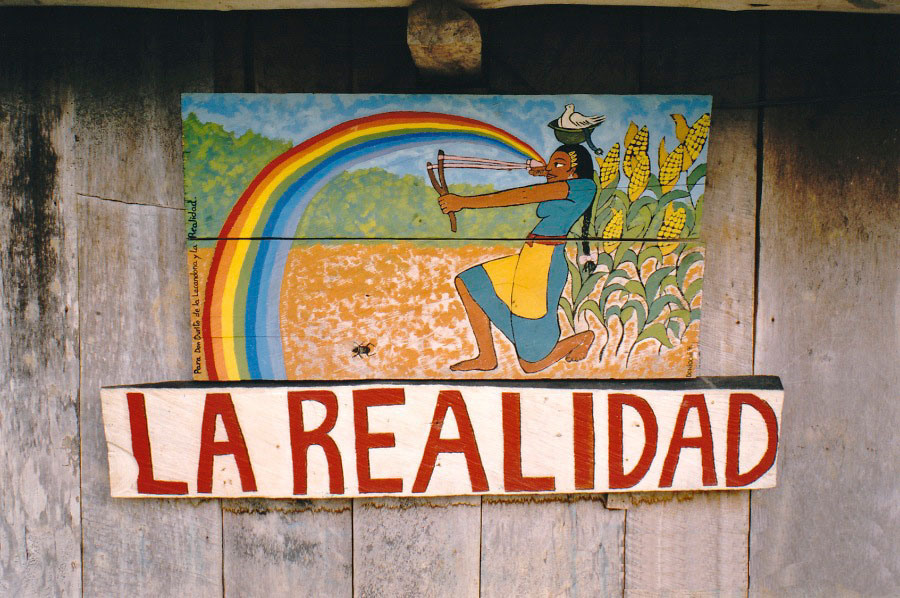
A meeting in La Realidad a few days ago
June 2014.
For: The Sixth in Mexico and the world
Compañeras and compañeros of the Sixth in Mexico and the world: Brothers and sisters of Mexico and the world:
I want to tell you about a meeting that we had in La Realidad a few days ago.
The Zapatista compañeras and compañeros of La Realidad say that the three levels of capitalist governments who destroyed their autonomous school, autonomous clinic, and the hose that brings water to the compañeras and compañeros wanted to destroy the Zapatista struggle then and there.
It should not be forgotten that when the first Aguascalientes was destroyed, the Zapatistas built five more.
It has not been forgotten that the humble houses of the autonomous authorities of the Autonomous Zapatista Municipality in Rebellion (MAREZ) of Tierra y Libertad in 1998 and the MAREZ autonomous headquarters of Ricardo Flores Magón in the caracol of Garrucha were destroyed by Roberto Albores “Croquetas,” when he was governor of poor Chiapas—poor because of the bad governments.
But the MAREZ continue their path, and are even stronger now.
It should not be forgotten that we Zapatistas said: with or without the government, we will carry out our autonomy, our indigenous rights and culture.
All of the political parties and all of the branches of government -legislative, executive, and judicial- told us to go to hell, thinking that with that the seed would not germinate. On the contrary, it grew, became strong, and is present in the actions and practice of the Zapatista communities themselves, where the people rule and the government obeys.
The compañeros bases of support in La Realidad said they would rebuild their school and clinic with the materials that nature provides.
So I said to the compañeros of La Realidad: let me write to the compas of the Sixth in Mexico and the world.
And so that the compañeros would understand why, I explained: what if we are accused of environmental destruction? Because we would need to cut down trees for wood and use palm for the roof, and the capitalist governments say that they are the ones protecting the environment.
And then I thought: Now why did I say that.
They begin a list of instances of forest destruction by lumber companies who have permission from the bad governments of Chiapas and of Mexico.
Pirate lumber companies, the compas say, though legal in the governments’ eyes, because they themselves are behind them.
The wood is purchased in parts, or pieces, says one guy, Salomón, from Las Margaritas. They buy them as planks, slabs, and joists. People from the ejidos of Momón, San Francisco, Vicente Guerrero, La Victoria, Pachán, and the Ejido Tabasco, all in the municipality of Las Margaritas, sell them. Also from San Miguel and Carmen Pataté, in the municipality of Ocosingo, and all over Chiapas.
In order to calm the discussion that was generated by my comment that, “the capitalist governments will blame us for environmental destruction,” I tell the compañeros and compañeras that we could take care of this problem if I write to the compas of the Sixth in Mexico and the world; maybe they can organize themselves and get ahold of some money to buy materials.
And the bases of support answer me—well, this isn’t going to be the end of the problem—and say: okay compañero, write them and we’ll wait and see what they can get together.
I asked them: “How much money do you need for construction?”
“Jeez! That we don’t know,” they say.
Another says, “Bring the calculator, we’ll figure it out.”
Somebody brings the calculator. They start doing the math, but then the compa says:
“Maaaaan this piece of crap doesn’t have any battery left!”
In the meantime, I am watching an older man, and I hear him say quietly:
“One fourth and a little bit,” and he counts using the fingers on both hands.
Suddenly he looks up at me:
“Done, compa,” he says.
“What?” I reply.
“Yes, I have the number. For a two-story building, 19 meters by 7 meters wide, that is 19×7, we’ll need: 2000 cement blocks, 50 half metal rods, 400 metal rods of three-eights length, 60 sacks of lime, 520 sacks of cement, 100 kilograms of mooring wire, 400 kilos of wire rod, and 84 sheets of galvanized metal 3 meters in length.
Another compa interrupts and says, “Why don’t we just tell them the total cost for these two-story buildings?”
“Agreed,” says another.
And then a chorus of voices, “Agreed!”
The total comes to $200,209 [Mexican pesos]. Two hundred thousand two hundred nine pesos.
The bottom floor should be for the children’s school, and the top for the clinic.
This is in order to use the space well.
This is only for the buildings. That’s not counting the health equipment, the thermometer, Baumanometer (to measure blood pressure), Otoscope, etc., and also the medicine.
The meeting ends.
Well ,compas of the Sixth, that is what I wanted to tell you. You see if you are able to gather any money together.
From the mountains of the Mexican Southeast.
Subcomandante Insurgente Moisés. Mexico, June 2014. In the twentieth year of the war against oblivion.
Farewell ceremony of Sub Marcos
THE FAREWELL CEREMONY OF SUB MARCOS
By: Luis Hernández Navarro

Nothing is lost. All is transformed.
The public reappearance and farewell of Subcomandante Marcos marks the end of an epoch in the Zapatista struggle. For a little more than 20 years the personage has been a central actor on the national public political scene. At once beloved and hated, admired and vilified, his passage through Mexican politics has provoked the most inflamed passions. Now, that participation comes to its end. Through his voice the EZLN will speak no more.
Throughout these two decades the rebel spokesperson has been the most recognized national political figure on the left outside the country. His writings have been translated into the most diverse languages. Some of the world’s most influential progressive intellectuals are adhered to the calls that Zapatismo has made. Every year, thousands of young people coming from the most diverse countries visit the communities in rebellion in Chiapas. Those who want another world that assume being Zapatistas are not just a few.
In the communiqué “Between Light and Shadow,” in which he announces his goodbye, Subcomandante Marcos affirms being a changing hologram and in a similar way, a buffoon, a distractor, a character. He was a creation that now comes to its end. His existence all these years –he tells us– was a big maneuver to give the project of life of the indigenous communities time to flourish.
We’re talking about a creation of the Indian peoples, about a project of autonomy that is neither electoral nor armed. A project which advances “in construction, still unfinished for sure, but already definite about what we are.” A project in which, “instead of dedicating ourselves to training guerrillas, soldiers and squadrons, we prepare promoters of education and health, and went building the basis of the autonomy that the world now marvels.” A project that renounces revolutionary vanguardism and substitutes for it mandar obedeciendo (to govern obeying); that promotes the construction of power from below, the abolition of professional politicians, the full participation of women and the celebration of difference.
Today, on the board of Zapatista politics there is a new game. “Between light and shadow” he remembers, as they announced in the days prior to publication of the Sixth Declaration of the Lacandón Jungle and the Other Campaign (Sexta declaración de la selva Lacandona y la otra campaña), which is still lacking what is missing, in other words, that the soccer game suspended because of an illegitimate goal against the Zapatistas is resumed.
The sports metaphor comes from the EZLN. In a letter directed to Massimo Moratti, president of the FC Internazionale de Milan, a little before the proclaiming of the Sexta, the rebels explained the significance of the “it lacks what’s missing,” in the “Postscript: P.S. in the tone and volume of a sports announcer – The Sup, using the tactics of the Uruguayan Obdulio Varela in the final against Brazil (World Cup, Maracanã Stadium, Rio de Janeiro, 7/16/1950), ball in hand, having traveled as if in slow motion (since May of 2001), from the Zapatista goalpost. After complaining to the referee about the illegitimacy of the goal, he puts the ball in the center of the field. He turns around to look at his compañeros and they exchange glances and silences. With the scorecard, the bets and the entire system against them, NO ONE has any hope for the Zapatistas. It starts to rain. A watch reads almost 6. Everything appears ready for the game to resume…”
That game that now resumes has Subcomandante Moisés –an indigenous commander– and a new generation of combatants at the front. Their route is that of the Sexta declaración (Sixth Declaration), which is considered “the most audacious and most Zapatista of the initiatives that we have launched as of now,” which has permitted meeting their current traveling compañeros. It is, well, a meeting that is going to dispute “below and to the left,” on the court of anti-capitalism and the radical critique of the political parties (and of the commercial communications media, which it disrespectfully defines as “for pay”).
The disappearance of the Marcos character–he tells us– is not the product either of his physical maladies or his death. The news that circulated about his grave afflictions and his death “were rumors encouraged because it was convenient that way.” His terminal illness was the “last big trick of the hologram.” In good time it may be like that, and that the personage behind the personage, he with the blue, green, brown, honey or black eyes, enjoys perfect health.
The trick was successful. It deceived us a lot. At least it generated restlessness; also weighing. Nevertheless, one must not belittle –at the risk of committing a great injustice– that the reaction of many people was one of great and genuine concern for the health of Marcos. Many prayed for his speedy recovery; there was no lack of impartial offerings of assistance. It would be wrong to underestimate that wave of solidarity.
The assassination of Juan Luis Solís, Galeano, cannot be seen at the margin of the aggressions against the social movement. It is a grave warning about what they want to do against the Zapatistas. The government divided the community police of Guerrero, incarcerated several of its leaders and threatens to disarm them. In Michoacán, it domesticated and fragmented the autodefensas, and threatened to incarcerate their dissident leaders. Why is the State going to permit the EZLN to maintain its autonomous project and continue armed?
The massive and energetic mournful mobilization of the rebels this weekend is not only an expression of their rage, pain and longing for justice, but also a preventive response to the temptation de Los Pinos (the presidential palace) of recuperating en Chiapas authority that it considers exclusive. It is a warning of what the State would confront if it continues on the route of confrontation.
The public disappearance of Subcomandante Marcos, his ritual death and his transformation into Subcomandante Galeano, are a moving homage to his compañero, assassinated by paramilitaries of the CIOAC-H as part of the State’s war against Zapatismo and the Indian peoples. Faced with a left that has shamefully condemned its dead and disappeared to oblivion, the rebels scoff at death making the memory of the dead live. Like all true farewell ceremonies, it is also a commitment for life.
———————————————————–
Originally Published in Spanish by La Jornada
Translation: Chiapas Support Committee
Tuesday, May 27, 2014
En español: http://www.jornada.unam.mx/2014/05/27/opinion/018a1pol
 Chiapas Support Committee