Chiapas Support Committee
Home of the Compañero Manuel blog on zapatistas & mexico
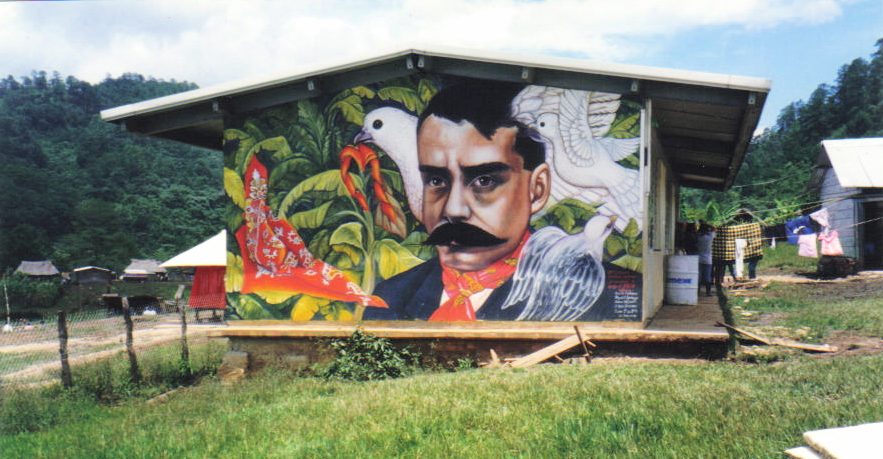
Xi’ Nich distances itself from conflict in the Lacandón Community Zone
XI’ NICH DISTANCES ITSELF FROM THE CONFLICT IN THE LACANDÓN COMMUNITY ZONE

Photo from ARIC-ID and Lacandón Community mobilizations in Ocosingo
** It classifies it as a violent organization and differs with its methods
** Its leader Gabriel Montoya, is responsible for the massacre in Viejo Velasco, it points out
By: Hermann Bellinghausen
The Xi’ Nich (The Ants) organization, made up of indigenous communities in the northern Lacandón Jungle of Chiapas, distanced themselves from the protests of the Jungle’s different organizations because of the agrarian conflict in the Lacandón Community Zone (CZL, its initials in Spanish) and the incarceration of the CZL advisor, Gabriel Montoya Oceguera, who Xi’Nich considers the intellectual author of the Viejo Velasco Massacre in 2006, while placing responsibility for the material execution of that violent attack that left eight dead and two disappeared on the Lacandón comuneros and the sub-comuneros of Nueva Palestina.
Before what recently occurred in that region of Chiapas, Xi ‘Nich points out, “a dozen organizations and human rights defenders, including the Diocese de San Cristóbal de las Casas, have issued statements in favor of peace and reconciliation of the parties in the conflict.” In that regard, the Indigenous are in agreement; but not the following part: “they sign and vouch for the movement directed by Montoya Oceguera, a leader that defends the political and economic interests of the Lacandóns and personal interests.”
Eight years ago –Xi’Nich adds to its interlocutors of the Diocese– “you condemned the massacre; it surprises us, it angers us that you ask with cries for the liberation of Montoya Oceguera, principal orchestrator of the Viejo Velasco Massacre, as well as the liberation of the comuneros of Nueva Palestina incarcerated for violent acts” like the 2006 massacre and “kidnappings” like that of Julia Carabias this year.
Xi’Nich defines itself as an organization in resistance and part of the National Indigenous Congress (Congreso Nacional Indígena, CNI), composed of Chols, Tzeltals and Zoques. “We have been very respectful and in solidarity –the Network for Peace expresses, to the independent organizations and the authorities of the diocese– in defense of the rights of the indigenous peoples.” It distinguishes the differences of the different actors in the current conflict. “We know the long history of crimes and outrages against our peoples on the part of the Lacandóns and the sub-comuneros of Nueva Palestina, with the approval of the governments.” And it asks: “What interest is there in reviving an agrarian conflict supposedly resolved?”
Such conflict dates from 38 years ago, and was falsely “resolved” in March de 2006 when Governor Pablo Salazar Mendiguchía and the Secretary of Agrarian Reform (SRA), represented in Chiapas by Martha Cecilia Díaz Gordillo, “drum and cymbal” announced “the end” of the problem, and delivered 10 checks to the CZL for a total of 172 million pesos, for the benefit of 25 communities, including those that are now to be evicted, belonging to the ARIC Union of Unions Democratic. On that occasion Flor de Cacao, Ojo de Agua Tzotzil, San Jacinto Lacanjá and Viejo Velasco were “strangely” left out. On November 13 of that year, the latter (Viejo Velasco) “was massacred.”
The comuneros and sub-comuneros of the CZL “did not act alone” in the “criminal and savage acts,” because “the State has protected them, and it has responsibility, as the state’s Attorney testified at the time.” Besides, Xi’Nich points to the residents of the Tzeltal community of Nueva Palestina as “the region’s most violent group,” which “has burned dozens of people alive,” among other cases in Flor de Cacao in 1976, and they have participated in the eviction and relocation of more than 20 communities before 2005. That, “with the intervention of Montoya Oceguera, then the Government delegate (2000-2006) in Benemérito de las Américas (Marqués de Comillas). “Now he has as a reward being an advisor of the Lacandóns,” “for having massacred the Viejo Velasco community.”
Xi’Nich sets itself apart from the CZL. “We do not share nor do we support their struggle, nor are we part of their movement. They have used our name in their struggle; they have used blackmail, violence, force and roadblocks. We roundly condemn these violent methods.”
The organization expresses support for the three communities threatened with relocation and is in solidarity with the Zapatistas, condemning the death of professor Galeano in La Realidad one month ago.
Click here for more background on this issue.
———————————————————–
Originally Published in Spanish by La Jornada
Translation: Chiapas Support Committee
Saturday, June 7, 2014
En español: http://www.jornada.unam.mx/2014/06/07/politica/015n1pol
ARIC-ID and the Lacandóns paralyze Ocosingo
ARIC-ID AND THE LACANDÓNS “PARALYZE” OCOSINGO
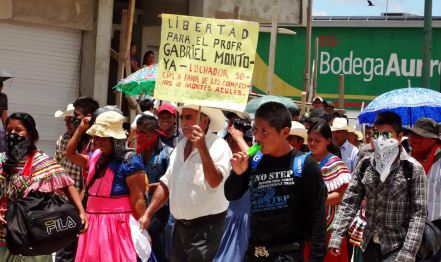
Mobilization in Ocosingo
During the month of May, much attention was focused on Chiapas because of the La Realidad paramilitary attack in which Compañero Galeano was brutally murdered, as well as the subsequent homage to Galeano, the disappearance of Marcos as the EZLN’s spokesperson and his reappearance as Subcomandante Insurgente Galeano. There was, however, another big story in Chiapas that took place in May. Thousands of indigenous and campesinos blocked key highways, usually filled with double decker tourist buses and giant Coca Cola trucks, shut down all government offices and hung “CLOSED” signs on the doors of big national chain stores… and, no, they weren’t Zapatistas. They were members of ARIC-ID [1] and the Lacandón Community Zone (LCZ).
In April, a report appeared about an agreement between the Lacandón Community and the ARIC-ID to legalize 3 of ARIC-ID’s communities situated inside the Montes Azules: San Gregorio, Ranchería Corozal and San Salvador Allende. Two other related events took place at the end of April: a Tzeltal was elected president of the Communal Wealth of the LCZ; and, a biologist, Julia Carabias, working in the Lacandón Jungle and inside the Montes Azules reported her own 2-day kidnapping by masked men she could not identify.
Apparently, all of this transpired in late April and early May. On May 15, state government authorities detained and arrested Gabriel Montoya Oseguera, an advisor to the Lacandón Community Zone. Just a couple of days before, the state government had announced that it intended to evict and “relocate” the 3 ARIC-ID communities, despite the historic agreement between ARIC-ID and the Lacandóns. Four days after Montoya Oseguera’s arrest, on May 19, roadblocks appeared on all the major highways leading to and from the municipal capital (county seat) of Ocosingo; only intermittent passage was permitted. ARIC-ID members and Lacandón Community members also shut down all municipal, state and federal government offices, as well as large national chain stores and the Telcel office in the city of Ocosingo, leading the city’s mayor to declare that Ocosingo was “paralyzed.”
In a statement issued following a May 19 meeting in Ocosingo, the majority opinion of the Lacandón Community Zone made the following demands (among several others):
1. Regularization (legalization or titling) of San Salvador Allende, Ranchería Corozal and San Gregorio;
2. Vacating the Tzendales and Chajul Biological Stations, currently occupied by Julia Carabias Lillo and “environmentalist” NGOs; and,
3. The release of Gabriel Montoya Oseguera.
The roadblocks and closures lasted about a week before state officials invited the 2 organizations to appear in Tuxtla Gutiérrez, the state capital, for dialogue. When representatives of ARIC-ID and the LCZ arrived at the Government Palace for “dialogue,” 22 were arrested and placed in the El Amate State Prison. To no one’s surprise, they were released the next evening after the organizations agreed to “suspend” the roadblocks and mobilizations that were paralyzing Ocosingo. A table for dialogue will also take place in Mexico City with Montoya Oseguera’s defense team, as well as a discussion table where organizations from the LCZ will have the opportunity to fully express their frustrations with what’s taking place inside the zone.
That should be an interesting discussion. According to statements issued to local Chiapas media from both ARIC-ID and the LCZ, they believe that the alleged kidnapping of Julia Carabias is a simulation; in other words, they don’t think it actually happened. They believe that it is connected to the opposition of the group of “environmentalists” around Carabias to the election of a Tzeltal president, rather than a more docile Lacandón, to the LCZ’s governing body, which is called the Communal Wealth (Bienes Comunales). They assert that there was a disturbance during the election, when an outside group erupted into their assembly, and they blame the environmental interests.
[Click here to read the history of the Lacandón Community Zone]
When it created the Lacandón Community Zone, the government offered the Chols and Tzeltals settled within the Zone a choice of relocating to certain towns within what it called the “Lacandón Community.” The Tzeltals were offered land in Nueva Palestina and the Choles in Frontera Corozal. Some accepted and some didn’t. However, the Chols and Tzeltals that relocated to those two communities did not have the same rights as the Lacandóns. The government granted them the right to the land as members of the Communal Wealth of the Lacandón Community (the legal governing body), but in order to maintain control in only one group -the most docile, the Lacandóns- it was established in the communal statutes that the president of Communal Wealth would ALWAYS be a representative of the 66 Lacandón families.
As time passed, population growth resulted in the following imbalance: a 2010 census indicates that 40% of the comuneros are Chols, another 40% are Tzeltals, and only 20% belong to the 66 Lacandón families and their descendants. [2] Consequently, for approximately the last 10 years, in the assemblies of the Lacandón Community Zone, these two groups have been demanding more land and want to make decisions inside the assembly.
The Lacandón Community apparently changed its statutes regarding leadership of the Communal Wealth (Bienes Comunales) and, in May, elected a Tzeltal man. They also reached agreement on accepting the legalization of the three ARIC-ID communities within the Montes Azules. And, according to reports from Chiapas, the majority view of the Lacandón Community assembly is that they want Julia Carabias and the environmentalists working with her to leave the Tzendales and Chajul biological stations inside the LCZ. [3]
The “environmentalists”
The Chiapas government has not accepted the result of the recent election of a Tzeltal president to guide the LCZ, its interests apparently linked to various groupings and interests lumped into the term “environmentalists.” According to documents published in the Chiapas press, the environmentalists include: the Natura Mexicana, the NGO founded by Julia Carabias, the Ford Foundation, the Mesoamerican Biological Corridor and the state and federal governments, which, as ARIC-ID points out, receive some of their funding from US-AID. [4] The majority report from the LCZ is in agreement. There is dissent from some members of the traditional Lacandón families that live in Nahá, Metzabok and Lacanjá Chansayab. According to the report from Angeles Mariscal in Chiapas Paralelo, it is only members of those 66 Lacandón families that have benefitted from the money paid to them from funds controlled by the environmentalists.
The blockage of Ocosingo highways and shut down of government offices for days became a huge story in Chiapas. The highways that were intermittently blocked brought all travel in eastern Chiapas to a frustrating crawl. Some of the actors in this drama (both the Lacandóns and the residents of Nueva Palestina) have played the role of villains vis a vis the Zapatista and other indigenous communities in the Jungle. Nonetheless, it would appear that they are entering a new stage, and assuming it is sincere, the position of wanting the “environmentalist” NGOs to vacate the bioprospecting stations would probably be welcomed by the Zapatista communities. And, finally, among the roads blocked were those giving access to La Garrucha and San Manuel. Therefore, we’ll follow the story and see how it unfolds.
———————————————————————–
By: Mary Ann Tenuto-Sánchez. Chiapas Support Committee
[1] Rural Association of Collective Interest-Independent and Democratic (Asociación Rural de Interés Colectivo Independiente y Democrático), a campesino (peasant) organization in the Lacandón Jungle of Chiapas
[3] Attachment in Voces Mesoamericanos:
http://vocesmesoamericanas.org/2014/05/23/zona-lacandona-la-movilisazion-sigue/
[4] Attachment in Voces Mesoamericanos: http://vocesmesoamericanas.org/2014/05/23/zona-lacandona-la-movilisazion-sigue/
Zapatista News Summary for May 2014
COMPAÑERO GALEANO MURDERED IN LA REALIDAD ATTACK; MARCOS DISAPPEARS AND BECOMES SCI “GALEANO”

Marcos wearing eye patch with skull.
The assassination of José Luis Solís López (Compañero Galeano), the EZLN’s response, the national and international protests that followed, the day of homage and the disappearance of the personage called Marcos have dominated the news this month. We’ll attempt to summarize events about which hundreds of thousands, possibly millions of words have been written in many languages…
On May 2, 2014, members of the Independent Central of Agricultural Workers and Campesinos Historic (CIOAC-H, its initials in Spanish), as well as members of the Green Ecologist Party of Mexico (PVEM) and the National Action Party (PAN) attacked civilian Zapatista support bases in the Zapatista Caracol of La Realidad. They first attacked some Zapatista bases that were arriving in the Caracol with stones and clubs. Next, they destroyed an autonomous school and clinic, most likely to draw the Zapatistas out of the offices in which they were meeting. They were meeting to resolve a dispute between the Good Government Junta and the CIOAC-H over a truck owned by the Junta that had been retained by the CIOAC-H. Two members of the Frayba Human Rights Center were present at the meeting and were eyewitnesses to the events.
Upon hearing the attack, the Zapatistas came out of the meeting. Compañero Galeano, a Zapatista support base and teacher at the Zapatista Escuelita, was attacked with clubs, machetes and firearms. According to the EZLN communiqué, Pain and Rage, he was brutally and intentionally murdered in a planned and premeditated military-style attack. Another 15 Zapatistas were injured, some seriously. Subcomandate Moisés cancelled all scheduled public events, including the meeting with indigenous peoples and organizations of the National Indigenous Congress and the homage that they had prepared for compañero Don Luis Villoro Toranzo, as well as participation in the Seminar “Ethics in the face of Dispossession,” that was being organized by artists and intellectuals in Mexico and the world. The Escuelitas were also suspended.
The Good Government Junta turned the matter of the murder and attack over to the EZLN’s commanders, the CCRI-CG.
The commanders went to La Realidad and on May 13 released the first results of their investigation in the Fragments of La Realidad I communiqué. They also announced a day of homage to Galeano on May 24.
In Mexico and throughout the world, students from the Escuelitas and adherents to the Sixth organized letters of support denouncing the attack and murder. In the United States a national sign-on letter circulated that also called for protest actions. In the Bay, we held a successful Rally at the Mexican Consulate in San Francisco.
Marcos made an appearance in La Realidad at the May 24 homage. He left and returned a few hours later in the wee hours of May 25 and announced the disappearance of the personage known as Marcos in Between Light and Shadow. He will be known as Subcomandante Insurgente Galeano from now on so that Galeano lives! The significance of this change means that Subcomandante Moisés will be signing those communiqués and will be the EZLN’s spokesperson. Thus, the EZLN will have an Indigenous man as the public face of the collective that is the EZLN.
Also on May 24, Subcomandante Moisés issued a communiqué with more information about the investigation into the crimes in La Realidad. The English translation can be read on Enlace Zapatista.
On May 28, Sup Moisés issued a communiqué with an update on the Little Schools, the need for Peace Campers (campamentistas or international observers) in La Realidad and the need for materials (money to buy them) to replace the autonomous school and clinic in La Realidad.
On May 30, Sup Moisés announced August 2 and 3 as the dates for the “Sharing with Indigenous comapñer@s of the National Indigenous Congress. He also announced that dates for the first and second levels of Escuelitas Zapatistas would be made public very soon.
——————
Zibechi: Social policies, ethics and the Zapatistas
SOCIAL POLICIES, ETHICS AND THE EZLN
By: Raúl Zibechi

Banner at May 22 Rally at Mexican Consulate in San Francisco
Behind the cowardly murder of the teacher Galeano in La Realidad are the so-called “social policies” inspired in the “fight against poverty” sketched by the World Bank four decades ago, after the United States military defeat in Vietnam. Those policies are one of the axes of the counterinsurgency and of the asymmetric wars designed by the Pentagon for destroying anti-systemic movements.
The key character in the social policies was Robert McNamara. President of Ford first, Secretary of Defense between 1961 and 1968 and later president of the World Bank between 1968 and 1981, he understood that wars are not won with weapons or with sophisticated technologies. In that sense he was against the grain of the dominant thinking among the military and he dedicated all his efforts to implementing new counterinsurgency methods.
With McNamara, the World Bank (WB) was converted into the principal center of the world’s thinking and analysis about poverty and acquired theoretical and political stature, displacing the problem of the distribution of wealth, considered until then –at least on the left– as the hard core of all social, economic and political problems.
As Michael T. Klare pointed out in La guerra sin fin (Barcelona, Noguer, 1974), [1] “the principal purpose of counterinsurgency work should be limited to influencing people’s behavior and conduct.” The social policies were changing through time. From the initial concerns, centered on demographic growth and family planning, they moved towards urbanization of the peripheral barrios and later towards cooptation of the popular organizations.
After the experiences of Pronasol in Mexico and of Prodepine (Proyecto de Desarrollo de los Pueblos Indios y Negros del Ecuador), [2] the social policies and programs were focused more and more on cooptation and domestication of social and popular movements through “organizational strengthening” (explicit policy of the WB), acting directly on the movements’ leaders and bases. The “fight against poverty” transforms dynamic and combative movements into hierarchical organizations to make the counterinsurgency war functional.
A gamut of actions were deployed that range from workshops and formation courses to monetary transfers and the lending of services for the purpose of breaking apart entire popular organizations. Of course, counterinsurgency was not talked about, but rather “empowerment” of the poor, about “participation,” about “mobilization,” and even “autonomy,” when at the end of the 1990s the movements were dodging the barriers of state control.
In that period the World Bank stopped managing the social and work programs so that the movements managed them. Those suited to managing the social policies are those coming from the left and from the movements, because they know them from inside, dominate the rules and methods, they know who to interest, with which leaders to establish relationships and in what way to approach them. In the whole region, be it under progressive or conservative governments, it’s usually former leftists that are at the front of the ministries of social development.
Zapatismo is the only rebel movement that refuses to receive social programs. “We are not beggars,” Subcomandante Insurgente Moisés said at the homage to Compañero Galeano. As the Zapatistas don’t bow down to the government’s charity, disguised as the fight against hunger, the counterinsurgency policy converts what were popular organizations into paramilitary groups for confronting poor against poor. The objective of the asymmetric war is that the Army arrives to “pacify,” (or keep the peace) with blood and fire.
Upon placing dignity at the steering wheel of command, the EZLN works so that the peoples and communities are not converted into an object of state charity, but rather into subjects of the construction of a different world. If they were to accept social policies, the Zapatistas would be undermining the autonomies. Constructing in this way, based on collective efforts, is more dignified than extending their hand to receive crumbs. Zapatismo has made collective dignity their political line and emancipatory horizon.
The old political culture says that dignity is not sufficient for defending oneself from the bullets and death of the system; that they lack material resources for confronting the repressive apparatuses and for constructing socialism. Those resources would be in the State; therefore, the old political culture proposes occupying the State as a shortcut towards a new world. That culture does not admit that that path was already traveled in many places and that it doesn’t lead to the new world, but rather a world of corruption.
By rejecting the social policies Zapatismo bets on the collective work of the peoples as the engine for change. The new world cannot be built except by expropriating the means of production and exchange from the appropriators. But it’s not reduced to that. The new world is the fruit of work, not of handouts. On the recuperated land and factories, collective works are the creators of the new.
Zapatismo has opted for peace, not war. It does not accept the poor confronting the poor. This is, also, an ethical option turned into a method for making politics. In some way, Zapatismo aspires that those of below not let themselves be manipulated by those of above. To the old culture that is something impossible, which is resolved by converting vanguards into subjects. It would also seem impossible that those from below construct the new world with their efforts alone, with dignity, as we were able to verify in la escuelita.
Even so, a third and definitive question remains: ¿how is the new world defended from armed aggressions? It depends on what we are capable of doing in each place, in each moment. The answer is everyone.
—————————————————–
Translator’s Notes:
[1] The English publication is: War without end (New York, Vintage Books, 1972)
[2] Development Projects for the Black and Indian Peoples of Ecuador
——————————————————————
Originally Published in Spanish by La Jornada
Translation: Chiapas Support Committee
Friday, May 30, 2014
http://www.jornada.unam.mx/2014/05/30/opinion/022a2pol
MOISÉS: News about Escuelitas and Request for Sharing
ESCUELITA, PEACE CAMP, SHARING AND RECONSTRUCTION
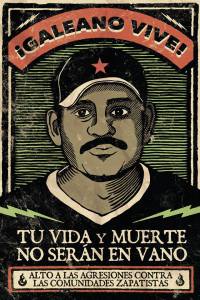
Compañero Galeano
ZAPATISTA NATIONAL LIBERATION ARMY
May 27, 2014.
To the compañeras and compañeros of the Sixth in Mexico and the world:
To the brothers and sisters of the National Indigenous Congress and the indigenous peoples of our country:
Compas:
Greetings from Subcomandante Insurgente Moisés, I want to communicate a few things to you:
First. THE LITTLE SCHOOL. Compañer@s of the Sixth in Mexico and the world. We want to let you know that for now, we think that we will continue with the work of the little school, with the first grade for those who haven’t attended yet, as well as second grade for those who passed. It’s just some who passed the first grade and can go on to the second, not everyone because some did not fully honor their commitment as students. Later we’ll let you know the dates for the next first grade course of the Little School. Same for second grade, but that’s not for everybody.
Second. PEACE CAMP. _Compañeras_ and _compañeros_ of the Sixth in Mexico and the World. We want to let you know that we have received some words and ideas from the FRAY BARTOLOMÉ HUMAN RIGHTS CENTER about putting a Civil Peace Camp in the community of La Realidad, where the crime against our Compañero Galeano took place. We have already told Frayba that we welcome this idea, where you could be witnesses, observers, and listeners, given that the situation is not yet resolved. The murderers are still free and their strength and impulse to do whatever they feel like is fueled by alcohol, and some are known to have used drugs as well. The Zapatista compañeras and compañeros bases of support have to go back to their homes; they can’t be at the Caracol all the time because they have to work to sustain their families. So this civil peace camp is very important. In this regard, we ask you to coordinate with the Fray Bartolomé Human Rights Center. According to what they tell us, the first camp will be installed on Wednesday, June 4, 2014.
Third. THE EXCHANGE. We are also going to reschedule the exchange with the brothers and sisters of the National Indigenous Congress, but we will communicate this separately.
Fourth. RECONSTRUCTION. As you know, the paramilitaries at the service of the bad governments destroyed the school and clinic that belong to the Zapatista bases of support. So just as we unburied Compa Galeano, we have to rebuild the school and the clinic. The compañeras and compañeros support bases in La Realidad have already found a new place to build. So we invite you to contribute construction materials if you are able so that we can rebuild the school and the clinic.
This is so that the bad governments understand that no matter how much they destroy, we will always build more. That’s what happened when Zedillo destroyed the Aguascalientes in Guadalupe Tepeyac, and we built 5 Aguascalientes for the one that they destroyed.
Finally, I want to say that I have been seeing what the paid media has been saying happened in reality in La Realidad. And I see that what the now defunct Sup Marcos said was right: they neither listened nor understood.
Those above don’t understand that we didn’t lose anything; on the contrary, we recuperated a compañero. And those on the outside don’t understand that they in fact did lose something, because now they don’t have a window through which to see us, much less a door through which to enter.
They don’t hear the sound of pain and rage is growing there where they are. They don’t hear that they are now alone.
And they accuse the independent media of being part of the Zapatistas and being paid by the Zapatistas, as if telling the truth of the reality in La Realidad was paid work and not a duty. But we see clearly that this is just their anger because the paid media were left out of reality.
Because as Zapatistas, if we have any money, we build life, we don’t destroy truths. Not like the bad governments, that use money to build lies and destroy lives.
From the Mountains of the Mexican Southeast,
Subcomandante Insurgente Moisés. Mexico, May of 2014. In the twentieth year of the war against oblivion.
——————————————————————
Originally Published in Spanish by Enlace Zapatista
Wednesday, May 28, 2014
En español: http://enlacezapatista.ezln.org.mx/2014/05/29/escuelita-camp-of-peace-sharing-and-reconstruction/
Marcos: Between Light and Shadow
BETWEEN LIGHT AND SHADOW
In La Realidad [Reality], Planet Earth
May 2014
Compañera, compañeroa, compañero:
Good evening, afternoon, or morning, whichever it may be in your geography, time, and way of being.
Good very early morning.
I would like to ask the compañeras, compañeros and compañeroas of the Sixth who came from other places, especially the compañeros from the independent media, for your patience, tolerance, and understanding for what I am about to say, because these will be the final words that I speak in public before I cease to exist.
I am speaking to you and to those who listen to and look at us through you.
Perhaps at the start, or as these words unfold, the sensation will grow in your heart that something is out of place, that something doesn’t quite fit, as if you were missing one or several pieces that would help make sense of the puzzle that is about to be revealed to you; as if, indeed, what is missing is still pending.
Maybe later – days, weeks, months, years or decades later – what we are about to say will be understood.
My compañeras and compañeros at all levels of the EZLN do not worry about me, because this is indeed our way here: to walk and to struggle, always knowing that what is missing is yet to come.
What’s more, and without meaning to offend anyone, the intelligence of the Zapatista compas is way above average.
In addition, it pleases and fills us with pride that this collective decision will be made known in front of compañeras, compañeros and compañeroas, both of the EZLN and of the Sixth.
And how wonderful that it will be through the free, alternative and independent media that this archipelago of pain, rage, and dignified struggle – what we call “the Sixth” – will hear what I am about to say, wherever they may be.
If anyone else is interested in knowing what happened today, they will have to go to the independent media to find out.
So, here we go. Welcome to the Zapatista reality (La Realidad).
I. A difficult decision.
When we erupted and interrupted in 1994 with blood and fire, it was not the beginning of war for us as Zapatistas.
The war from above, with its death and destruction, its dispossession and humiliation, its exploitation and the silence it imposed on the defeated, we had been enduring for centuries.
What began for us in 1994 is one of many moments of war by those below against those above, against their world.
This war of resistance is fought day in and day out in the streets of any corner of the five continents, in their countryside and in their mountains.
It was and is ours, as it is of many from below, a war for humanity and against neoliberalism.
Against death, we demand life.
Against silence, we demand the word and respect.
Against oblivion, memory.
Against humiliation and contempt, dignity.
Against oppression, rebellion.
Against slavery, freedom.
Against imposition, democracy.
Against crime, justice.
Who with the least bit of humanity in their veins would or could question these demands?
And many listened to us then.
The war we waged gave us the privilege of arriving to attentive and generous ears and hearts in geographies near and far.
Even lacking what was then lacking, and as of yet missing what is yet to come, we managed to attain the other’s gaze, their ear, and their heart.
It was then that we saw the need to respond to a critical question.
“What next?”
In the gloomy calculations on the eve of war there hadn’t been any possibility of posing any question whatsoever. And so this question brought us to others:
Should we prepare those who come after us for the path of death?
Should we develop more and better soldiers?
Invest our efforts in improving our battered war machine?
Simulate dialogues and a disposition toward peace while preparing new attacks?
Kill or die as the only destiny?
Or should we reconstruct the path of life, that which those from above had broken and continue breaking?
The path that belongs not only to indigenous people, but to workers, students, teachers, youth, peasants, along with all of those differences that are celebrated above and persecuted and punished below.
Should we have adorned with our blood the path that others have charted to Power, or should we have turned our heart and gaze toward who we are, toward those who are what we are – that is, the indigenous people, guardians of the earth and of memory?
Nobody listened then, but in the first babblings that were our words we made note that our dilemma was not between negotiating and fighting, but between dying and living.
Whoever noticed then that this early dilemma was not an individual one would have perhaps better understood what has occurred in the Zapatista reality over the last 20 years.
But I was telling you that we came across this question and this dilemma.
And we chose.
And rather than dedicating ourselves to training guerrillas, soldiers, and squadrons, we developed education and health promoters, who went about building the foundations of autonomy that today amaze the world.
Instead of constructing barracks, improving our weapons, and building walls and trenches, we built schools, hospitals and health centers; improving our living conditions.
Instead of fighting for a place in the Parthenon of individualized deaths of those from below, we chose to construct life.
All this in the midst of a war that was no less lethal because it was silent.
Because, compas, it is one thing to yell, “You Are Not Alone,” and another to face an armored column of federal troops with only one’s body, which is what happened in the Highlands Zone of Chiapas. And then if you are lucky someone finds out about it, and with a little more luck the person who finds out is outraged, and then with another bit of luck the outraged person does something about it.
In the meantime, the tanks are held back by Zapatista women, and in the absence of ammunition, insults and stones would force the serpent of steel to retreat.
And in the Northern Zone of Chiapas, to endure the birth and development of the guardias blancas [armed thugs traditionally hired by landowners] who would then be recycled as paramilitaries; and in the Tzotz Choj Zone, the continual aggression of peasant organizations who have no sign of being “independent” even in name; and in the Selva Tzeltal zone, the combination of the paramilitaries and contras [anti-zapatistas].
It is one thing to say, “We Are All Marcos” or “We Are Not All Marcos,” depending on the situation, and quite another to endure persecution with all of the machinery of war: the invasion of communities, the “combing” of the mountains, the use of trained attack dogs, the whirling blades of armed helicopters destroying the crests of the ceiba trees, the “Wanted: Dead or Alive” that was born in the first days of January 1994 and reached its most hysterical level in 1995 and in the remaining years of the administration of that now-employee of a multinational corporation, which this Selva Fronteriza zone suffered as of 1995 and to which must be added the same sequence of aggressions from peasant organizations, the use of paramilitaries, militarization, and harassment.
If there exists a myth today in any of this, it is not the ski mask, but the lie that has been repeated from those days onward, and even taken up by highly educated people, that the war against the Zapatistas lasted only 12 days.
I will not provide a detailed retelling. Someone with a bit of critical spirit and seriousness can reconstruct the history, and add and subtract to reach the bottom line, and then say if there are and ever were more reporters than police and soldiers; if there was more flattery than threats and insults, if the price advertised was to see the ski mask or to capture him “dead or alive.”
Under these conditions, at times with only our own strength and at other times with the generous and unconditional support of good people across the world, we moved forward in the construction – still incomplete, true, but nevertheless defined – of what we are.
So it isn’t just an expression, a fortunate or unfortunate one depending on whether you see from above or from below, to say, “Here we are, the dead of always, dying again, but this time in order to live.” It is reality.
And almost 20 years later…
On December 21, 2012, when the political and the esoteric coincided, as they have at other times in preaching catastrophes that are meant, as they always are, for those from below, we repeated the sleight of hand of January of ’94 and, without firing a single shot, without arms, with only our silence, we once again humbled the arrogant pride of the cities that are the cradle and hotbed of racism and contempt.
If on January 1, 1994, it was thousands of faceless men and women who attacked and defeated the garrisons that protected the cities, on December 21, 2012, it was tens of thousands who took, without words, those buildings where they celebrated our disappearance.
The mere indisputable fact that the EZLN had not only not been weakened, much less disappeared, but rather had grown quantitatively and qualitatively would have been enough for any moderately intelligent mind to understand that, in these 20 years, something had changed within the EZLN and the communities.
Perhaps more than a few people think that we made the wrong choice, that an army cannot and should not endeavor toward peace.
We made that choice for many reasons, it’s true, but the primary one was and is because this is the way that we [as an army] could ultimately disappear.
Maybe it’s true. Maybe we were wrong in choosing to cultivate life instead of worshipping death.
But we made the choice without listening to those on the outside. Without listening to those who always demand and insist on a fight to the death, as long as others will be the ones to do the dying.
We made the choice while looking and listening inward, as the collective Votán that we are.
We chose rebellion, that is to say, life.
That is not to say that we didn’t know that the war from above would try and would keep trying to re-assert its domination over us.
We knew and we know that we would have to repeatedly defend what we are and how we are.
We knew and we know that there will continue to be death in order for there to be life.
We knew and we know that in order to live, we die.
II. A failure?
They say out there that we haven’t achieved anything for ourselves.
It never ceases to surprise us that they hold on to this position with such self-assurance.
They think that the sons and daughters of the comandantes and comandantas should be enjoying trips abroad, studying in private schools, and achieving high posts in business or political realms. That instead of working the land and producing their food with sweat and determination, they should shine in social networks, amuse themselves in clubs and show off in luxury.
Maybe the subcomandantes should procreate and pass their jobs, perks, and stages onto their children, as politicians from across the spectrum do.
Maybe we should, like the leaders of the CIOAC-H and other peasant organizations do, receive privileges and payment in the form of projects and monetary resources, keeping the largest part for ourselves while leaving the bases [of support] with only a few crumbs, in exchange for following the criminal orders that come from above.
Well it’s true; we haven’t achieved any of this for ourselves.
While difficult to believe, 20 years after that “Nothing For Ourselves,” it didn’t turn out to be a slogan, a good phrase for posters and songs, but rather a reality, the reality.
If being accountable is what marks failure, then unaccountability is the path to success, the road to Power.
But that’s not where we want to go.
It doesn’t interest us.
Within these parameters, we prefer to fail than to succeed.
III. The handoff, or change.
In these 20 years, there has been a multiple and complex handoff, or change, within the EZLN.
Some have only noticed the obvious: the generational.
Today, those who were small or had not even been born at the beginning of the uprising are the ones carrying the struggle forward and directing the resistance.
But some of the experts have not considered other changes:
That of class: from the enlightened middle class to the indigenous peasant.
That of race: from mestizo leadership to a purely indigenous leadership.
And the most important: the change in thinking: from revolutionary vanguardism to “rule by obeying;” from taking Power Above to the creation of power below; from professional politics to everyday politics; from the leaders to the people; from the marginalization of gender to the direct participation of women; from mocking the other to the celebration of difference.
I won’t expand more on this because the course “Freedom According to the Zapatistas” was precisely the opportunity to confirm whether in organized territory, the celebrity figure is valued over the community.
Personally, I don’t understand why thinking people who affirm that history is made by the people get so frightened in the face of an existing government of the people where “specialists” are nowhere to be seen.
Why does it terrify them so that the people command, that they are the ones who determine their own steps?
Why do they shake their heads with disapproval in the face of “rule by obeying?”
The cult of individualism finds in the cult of vanguardism its most fanatical extreme.
And it is this precisely – that the indigenous rule, and now with an indigenous person as the spokesperson and chief – that terrifies them, repels them, and finally sends them looking for someone requiring vanguards, bosses, and leaders. Because there is also racism on the left, above all among that left which claims to be revolutionary.
The ezetaelene is not of this kind. That’s why not just anybody can be a Zapatista.
IV. A changing and moldable hologram. What will not be.
Before the dawn of 1994, I spent 10 years in these mountains. I met and personally interacted with some whose death we all died in part. Since then, I know and interact with others that are today here with us.
In many wee hours of the morning I found myself trying to digest the stories that they told me, the worlds that they sketched with their silences, hands, and gazes, their insistence in pointing to something else, something further.
Was it a dream, that world so other, so distant and so foreign?
Sometimes I thought that they had gone ahead of us all, that the words that guided and guide us came from times that didn’t have a calendar, that were lost in imprecise geographies: always with the dignified south omnipresent in all the cardinal points.
Later I learned that they weren’t telling me about an inexact, and therefore, improbable world.
That world was already unfolding.
And you? Did you not see it? Do you not see it?
We have not deceived anyone from below. We have not hidden the fact that we are an army, with its pyramidal structure, its central command and it decisions hailing from above to below. We didn’t deny what we are in order to ingratiate ourselves with the libertarians or to move with the trends.
But anyone can see now whether ours is an army that supplants or imposes.
And I have already asked Compañero Insurgente Moisés’ permission to say this:
Nothing that we’ve done, for better or for worse, would have been possible without an armed military, the Zapatista National Liberation Army. Without it we would not have risen up against the bad government exercising the right to legitimate violence, the violence of below in the face of the violence of above.
We are warriors and as such we know our role and our moment.
In the earliest hours of the morning on the first day of the first month of the year 1994, an army of giants, that is to say, of indigenous rebels, descended on the cities to shake the world with its step.
Only a few days later, with the blood of our fallen soldiers still fresh on the city streets, we noticed that those from outside did not see us.
Accustomed to looking down on the indigenous from above, they didn’t lift their gaze to look at us.
Accustomed to seeing us humiliated, their heart did not understand our dignified rebellion.
Their gaze had stopped on the only mestizo they saw with a ski mask, that is, they didn’t see.
Our authorities, our commanders, then said to us:
“They can only see those who are as small as they are. Let’s make someone as small as they are, so that they can see him and through him, they can see us.”
And so began a complex maneuver of distraction, a terrible and marvelous magic trick, a malicious move from the indigenous heart that we are, with indigenous wisdom challenging one of the bastions of modernity: the media.
And so began the construction of the personage named “Marcos.”
I ask that you follow me in this reasoning:
Suppose that there is another way to neutralize a criminal. For example, creating their murder weapon, making them think that it is effective, enjoining them to build, on the basis of this effectiveness, their entire plan, so that at the moment that they prepare to shoot, the “weapon” goes back to being what it always was: an illusion.
The entire system, but above all its media, plays the game of creating celebrities who it later destroys if they don’t yield to its designs.
Its power resided (now no longer, as it has been displaced by social media) in deciding what and who existed in the moment when they decided what to name and what to silence.
But really, don’t pay much attention to me; as has been evident over these 20 years, I don’t know anything about the mass media.
The truth is that this SupMarcos went from being a spokesperson to being a distraction.
If the path to war, that is to say, the path to death, had taken us 10 years, the path to life required more time and more effort, not to mention more blood.
Because, though you may not believe it, it is easier to die than it is to live.
We needed time to be and to find those who would know how to see us as we are.
We needed time to find those who would see us, not from above or below, but face to face, who would see us with the gaze of a compañero.
So then, as I mentioned, the work of constructing this character began.
One day Marcos’ eyes were blue, another day they were green, or brown, or hazel, or black – all depending on who did the interview and took the picture. He was the back-up player of professional soccer teams, an employee in department stores, a chauffeur, philosopher, filmmaker, and the etceteras that can be found in the paid media of those calendars and in various geographies. There was a Marcos for every occasion, that is to say, for every interview. And it wasn’t easy, believe me, there was no Wikipedia, and if someone came over from Spain we had to investigate if the corte inglés was a typical English-cut suit, a grocery store, or a department store.
If I had to define Marcos the personage, I would say without a doubt that he was a colorful ruse.
We could say, so that you understand me, that Marcos was Non-Free Media (note: this is not the same as being paid media).
In constructing and maintaining this character, we made a few mistakes.
“To err is human,”[1] as they say.
During the first year we exhausted, as they say, the repertoire of all possible “Marcoses.” And so by the beginning of 1995, we were in a tight spot and the communities’ work was only in its initial steps.
And so in 1995 we didn’t know what to do. But that was when Zedillo, with the PAN at his side, “discovered” Marcos using the same scientific method used for finding remains, that is to say, by way of an esoteric snitching.
The story of the guy from Tampico gave us some breathing room, even though the subsequent fraud committed by Paca de Lozano made us worry that the paid press would also question the “unmasking” of Marcos and then discover that it was just another fraud. Fortunately, it didn’t happen like that. And like this one, the media continued swallowing similar pieces from the rumor mill.
Sometime later, that guy from Tampico showed up here in these lands. Together with Subcomandante Insurgente Moisés, we spoke to him. We offered to do a joint press conference so that he could free himself from persecution, since it would then be obvious that he and Marcos weren’t the same person. He didn’t want to. He came to live here. He left a few times and his face can be seen in the photographs of the funeral wakes of his parents. You can interview him if you want. Now he lives in a community, in…
[There is a pause here as the speaker leans over to ask Subcomandante Insurgente Moisés if it would be okay to mention where, to which the response is a firm “No.”]
Ah, he doesn’t want you to know exactly where this man lives. We won’t say any more so that if he wants to someday, he can tell the story of what he has lived since February 9, 1995. On our behalf, we just want to thank him for the information that he has given us which we use from time to time to feed the “certitude” that SupMarcos is not what he really is, that is to say, a ruse or a hologram, but rather a university professor from that now painful Tamaulipas.
In the meantime, we continued looking, looking for you, those of you who are here now and those who are not here but are with us.
We launched various initiatives in order to encounter the other, the other compañero, or the other compañera. We tried different initiatives to encounter the gaze and the ear that we need and that we deserve.
In the meantime, our communities continued to move forward, as did the change or hand-off of responsibilities that has been much or little discussed, but which can be confirmed directly, without intermediaries.
In our search of that something else, we failed time and again.
Those who we encountered either wanted to lead us or wanted us to lead them.
There were those who got close to us out of an eagerness to use us, or to gaze backward, be it with anthropological or militant nostalgia.
And so for some we were communists, for others Trotskyists, for others anarchists, for others millenarians, and I’ll leave it there so you can add a few more “ists” from your own experience.
That was how it was until the Sixth Declaration of the Lacandón Jungle, the most daring and most Zapatista of all of the initiatives that we have launched up until now.
With the Sixth, we have at last encountered those who can see us face to face and greet us and embrace us, and this is how greetings and embraces are done.
With the Sixth, at last, we found you.
At last, someone who understood that we were not looking for shepherds to guide us, nor flocks to lead to the Promised Land. Neither masters or slaves. Neither leaders or leaderless masses.
But we still didn’t know if you would be able to see and hear what we are and what we are becoming.
Internally, the advance of our peoples has been impressive.
And so the course, “Freedom According to the Zapatistas” came about.
Over the three rounds of the course, we realized that there was already a generation that could look at us face to face, that could listen to us and talk to us without seeking a guide or a leader, without intending to be submissive or become followers.
Marcos, the personage, was no longer necessary.
The new phase of the Zapatista struggle was ready.
So then what happened has happened, and many of you, compañeros and compañeras of the Sixth, know this firsthand.
They may later say that this thing with the personage [of Marcos] was pointless. But an honest look back at those days will show how many people turned to look at us, with pleasure or displeasure, because of the disguises of a colorful ruse.
So you see, the change or handoff of responsibilities is not because of illness or death, nor because of an internal dispute, ouster, or purging.
It comes about logically in accordance with the internal changes that the EZLN has had and is having.
I know this doesn’t square with the very square perspectives of those in the various “aboves,” but that really doesn’t worry us.
And if this ruins the rather poor and lazy explanations of the rumorologists and Zapatologists of Jovel [San Cristobal de las Casas, Chiapas], then oh well.
I am not nor have I been sick, and I am not nor have I been dead.
Or rather, despite the fact that I have been killed so many times, that I have died so many times, here I am again.
And if we ourselves encouraged these rumors, it was because it suited us to do so.
The last great trick of the hologram was to simulate terminal illness, including of the deaths supposedly suffered.
Indeed, the comment “if his health permits” made by Subcomandante Insurgente Moisés in the communiqué announcing the events with the CNI [National Indigenous Congress], was the equivalent of the “if the people ask for me,” or “if the polls favor me,” or “if it is god’s will,” and other clichés that have been the crutch of the political class in recent times.
If you will allow me one piece of advice: you should cultivate a bit of a sense of humor, not only for your own mental and physical health, but because without a sense of humor you’re not going to understand Zapatismo. And those who don’t understand, judge; and those who judge, condemn.
In reality, this has been the simplest part of the character. In order to feed the rumor mill it was only necessary to tell a few particular people: “I’m going to tell you a secret but promise me you won’t tell anyone.”
And of course they told.
The first involuntary collaborators in the rumor about sickness and death have been the “experts in Zapatology” in arrogant Jovel and chaotic Mexico City who presume their closeness to and deep knowledge of Zapatismo. In addition to, of course, the police that earn their salaries as journalists, the journalists that earn their salaries as police, and the journalists who only earn salaries, bad ones, as journalists.
Thank you to all of them. Thank you for your discretion. You did exactly what we thought you would do. The only downside of all this is that I doubt anyone will ever tell any of you a secret again.
It is our conviction and our practice that in order to rebel and to struggle, neither leaders nor bosses nor messiahs nor saviors are necessary. To struggle, one only needs a sense of shame, a bit of dignity, and a lot of organization.
As for the rest, it either serves the collective or it doesn’t.
What this cult of the individual has provoked in the political experts and analysts “above” has been particularly comical. Yesterday they said that the future of the Mexican people depended on the alliance of two people. The day before yesterday they said that Peña Nieto had become independent of Salinas de Gortari, without realizing that, in this schema, if one criticized Peña Nieto, they were effectively putting themselves on Salinas de Gortari’s side, and if one criticized Salinas de Gortari, they were supporting Peña Nieto. Now they say that one has to take sides in the struggle going on “above” over control of telecommunications; in effect, either you’re with Slim or you’re with Azcárraga-Salinas. And even further above, you’re either with Obama or you’re with Putin.
Those who look toward and long to be “above” can continue to seek their leader; they can continue to think that now, for real, the electoral results will be honored; that now, for real, Slim will support the electoral left; that now, for real, the dragons and the battles will appear in Game of Thrones; that now, for real, Kirkman will be true to the original comic in the television series The Walking Dead; that now, for real, tools made in China aren’t going to break on their first use; that now, for real, soccer is going to be a sport and not a business.
And yes, perhaps in some of these cases they will be right. But one can’t forget that in all of these cases they are mere spectators, that is, passive consumers.
Those who loved and hated SupMarcos now know that they have loved and hated a hologram. Their love and hate have been useless, sterile, hollow and empty.
There will not be, then, museums or metal plaques where I was born and raised. There will not be someone who lives off of having been subcomandante Marcos. No one will inherit his name or his job. There will not be all-expense paid trips abroad to give lectures. There will not be transport to or care in fancy hospitals. There will not be widows or heirs. There will not be funerals, honors, statues, museums, prizes, or anything else that the system does to promote the cult of the individual and devalue the collective.
This figure was created and now its creators, the Zapatistas, are destroying it.
If anyone understands this lesson from our compañeros and compañeras, they will have understood one of the foundations of Zapatismo.
So, in the last few years, what has happened has happened.
And we saw that now, the outfit, the character, the hologram, was no longer necessary.
Time and time again we planned this, and time and time again we waited for the right moment – the right calendar and geography to show what we really are to those who truly are.
And then Galeano arrived with his death to mark our calendar and geography: “here, in La Realidad; now; in pain and rage.”
V. Pain and Rage. Whispers and Screams.
When we got here to the caracol of La Realidad, without anyone telling us to, we began to speak in whispers.
Our pain spoke quietly, our rage in whispers.
It was as if we were trying to avoid scaring Galeano away with these unfamiliar sounds.
As if our voices and step called to him.
“Wait, compa,” our silence said.
“Don’t go,” our words murmured.
But there are other pains and other rages.
At this very minute, in other corners of Mexico and the world, a man, a woman, an other, a little girl, a little boy, an elderly man, an elderly woman, a memory, is beaten cruelly and with impunity, surrounded by the voracious crime that is the system, clubbed, cut, shot, finished off, dragged away among jeers, abandoned, their body then collected and mourned, their life buried.
Just a few names:
Alexis Benhumea, murdered in the State of Mexico. Francisco Javier Cortés, murdered in the State of Mexico. Juan Vázquez Guzmán, murdered in Chiapas. Juan Carlos Gómez Silvano, murdered in Chiapas. El compa Kuy, murdered in Mexico City. Carlo Giuliani, murdered in Italy. Aléxis Grigoropoulos, murdered in Greece. Wajih Wajdi al-Ramahi, murdered in a Refugee Camp in the West Bank city of Ramallah. At 14 years old, he was shot in the back from an Israeli observation post. There were no marches, protests, or anything else in the streets. Matías Valentín Catrileo Quezada, mapuche murdered in Chile. Teodulfo Torres Soriano, compa of the Sixth, disappeared in Mexico City. Guadalupe Jerónimo and Urbano Macías, comuneros from Cherán, murdered in Michoacan. Francisco de Asís Manuel, disappeared in Santa María Ostula. Javier Martínes Robles, disappeared in Santa María Ostula. Gerardo Vera Orcino, disappeared in Santa María Ostula. Enrique Domínguez Macías, disappeared in Santa María Ostula. Martín Santos Luna, disappeared in Santa María Ostula. Pedro Leyva Domínguez, murdered in Santa María Ostula. Diego Ramírez Domínguez, murdered in Santa María Ostula. Trinidad de la Cruz Crisóstomo, murdered in Santa María Ostula. Crisóforo Sánchez Reyes, murdered in Santa María Ostula. Teódulo Santos Girón, disappeared in Santa María Ostula. Longino Vicente Morales, disappeared in Guerrero. Víctor Ayala Tapia, disappeared in Guerrero. Jacinto López Díaz “El Jazi”, murdered in Puebla. Bernardo Vázquez Sánchez, murdered in Oaxaca. Jorge Alexis Herrera, murdered in Guerrero. Gabriel Echeverría, murdered in Guerrero. Edmundo Reyes Amaya, disappeared in Oaxaca. Gabriel Alberto Cruz Sánchez, disappeared in Oaxaca. Juan Francisco Sicilia Ortega, murdered in Morelos. Ernesto Méndez Salinas, murdered in Morelos. Alejandro Chao Barona, murdered in Morelos. Sara Robledo, murdered in Morelos. Juventina Villa Mojica, murdered in Guerrero. Reynaldo Santana Villa, murdered in Guerrero. Catarino Torres Pereda, murdered in Oaxaca. Bety Cariño, murdered in Oaxaca. Jyri Jaakkola, murdered in Oaxaca. Sandra Luz Hernández, murdered in Sinaloa. Marisela Escobedo Ortíz, murdered in Chihuahua. Celedonio Monroy Prudencio, disappeared in Jalisco. Nepomuceno Moreno Nuñez, murdered in Sonora.
The migrants, men and women, forcefully disappeared and probably murdered in every corner of Mexican territory.
The prisoners that they want to kill in “life:” Mumia Abu Jamal, Leonard Peltier, the Mapuche, Mario González and Juan Carlos Flores.
The continuous burial of voices that were lives, silenced by the sound of the earth thrown over them or the bars closing around them.
And the greatest mockery of all is that with every shovelful of dirt thrown by the thug currently on shift, the system is saying: “You don’t count, you are not worth anything, no one will cry for you, no one will be enraged by your death, no one will follow your step, no one will hold up your life.”
And with the last shovelful it gives its sentence: “even if they catch and punish those who killed you, we will always find another, an other, to ambush and on whom to repeat the macabre dance that ended your life.”
It says, “The small, stunted justice you will be given, manufactured by the paid media to simulate and obtain a bit of calm in order to stop the chaos coming at them, does not scare me, harm me, or punish me.”
What do we say to this cadaver who, in whatever corner of the world below, is buried in oblivion?
That only our pain and rage count?
That only our outrage means anything?
That as we murmur our history, we don’t hear their cry, their scream?
Injustice has so many names, and provokes so many screams.
But our pain and our rage do not keep us from hearing them.
And our murmurs are not only to lament the unjust fall of our own dead.
They allow us to hear other pains, to make other rages ours, and to continue in the long, complicated, tortuous path of making all of this into a battle cry that is transformed into a freedom struggle.
And to not forget that while someone murmurs, someone else screams.
And only the attentive ear can hear it.
While we are talking and listening right now, someone screams in pain, in rage.
And so it is as if one must learn to direct their gaze; what one hears must find a fertile path.
Because while someone rests, someone else continues the uphill climb.
In order to see this effort, it is enough to lower one’s gaze and lift one’s heart.
Can you?
Will you be able to?
Small justice looks so much like revenge. Small justice is what distributes impunity; as it punishes one, it absolves others.
What we want, what we fight for, does not end with finding Galeano’s murderers and seeing that they receive their punishment (make no mistake this is what will happen).
The patient and obstinate search seeks truth, not the relief of resignation.
True justice has to do with the buried compañero Galeano.
Because we ask ourselves not what do we do with his death, but what do we do with his life.
Forgive me if I enter into the swampy terrain of commonplace sayings, but this compañero did not deserve to die, not like this.
His tenacity, his daily punctual sacrifice, invisible for anyone other than us, was for life.
And I can assure you that he was an extraordinary being and that, what’s more – and this is what amazes – there are thousands of compañeros and compañeras like him in the indigenous Zapatista communities, with the same determination, the same commitment, the same clarity, and one single destination: freedom.
And, doing macabre calculations: if someone deserves death, it is he who does not exist and has never existed, except in the fleeting interest of the paid media.
As our compañero, chief and spokesperson of the EZLN, Subcomandante Insurgente Moisés has already told us, in killing Galeano, or any Zapatista, those above are trying to kill the EZLN.
Not the EZLN as an army, but as the rebellious and stubborn force that builds and raises life where those above desire the wasteland brought by the mining, oil, and tourist industries, the death of the earth and those who work and inhabit it.
He has also said that we have come, as the General Command of the Zapatista National Liberation Army, to exhume Galeano.
We think that it is necessary for one of us to die so that Galeano lives.
To satisfy the impertinence that is death, in place of Galeano we put another name, so that Galeano lives and death takes not a life but just a name – a few letters empty of any meaning, without their own history or life.
That is why we have decided that Marcos ceases to exist today.
He will go hand in hand with Shadow the Warrior and the Little Light so that he doesn’t get lost on the way. Don Durito will go with him, Old Antonio also.
The little girls and boys who used to crowd around to hear his stories will not miss him; they are grown up now, they have their own capacity for discernment; they now struggle like him for freedom, democracy, and justice, which is the task of every Zapatista.
It is the cat-dog, and not a swan that will sing his farewell song.
And in the end, those who have understood will know that he who never was here does not leave; that he who never lived does not die.
And death will go away, fooled by an indigenous man whose nom de guerre [war name] was Galeano, and those rocks that have been placed on his tomb will once again walk and teach whoever will listen the most basic tenet of Zapatismo: that is, don’t sell out, don’t give in, don’t give up.
Oh death! As if it wasn’t obvious that it frees those above of any responsibility beyond the funeral prayer, the bland homage, the sterile statue, the controlling museum.
And for us? Well, for us death commits us to the life it contains.
So here we are, mocking death in reality [La Realidad].
Compas:
Given the above, at 2:08am on May 25, 2014, from the southeast combat front of the EZLN, I hereby declare that he who is known as Subcomandante Insurgente Marcos, self-proclaimed “subcomandante of stainless steel,” ceases to exist.
That is how it is.
Through my voice the Zapatista National Liberation Army no longer speaks.
Vale. Health and until never or until forever; those who have understood will know that this doesn’t matter anymore, that it never has.
From the Zapatista reality,
Subcomandante Insurgente Marcos. Mexico, May 24, 2014.
P.S. 1. Game over?
P.S. 2. Check mate?
P.S. 3. Touché?
P.S. 4. Go make sense of it, raza, and send tobacco.
P.S. 5. Hmm… so this is hell… It’s Piporro, Pedro, José Alfredo! What? For being machista? Nah, I don’t think so, since I’ve never…
P.S. 6. Great, now that the colorful ruse has ended, I can walk around here naked, right?
P.S.7. Hey, it’s really dark here, I need a little light.
(…)
[He lights his pipe and exits stage left. Subcomandante Insurgente Moisés announces that: “another compañero is going to say a few words.”]
(a voice is heard offstage)
Good early morning compañeras and compañeros. My name is Galeano, Subcomandante Insurgente Galeano.
Anyone else here named Galeano?
[the crowd cries, “We are all Galeano!”]
Ah, that’s why they told me that when I was reborn, it would be as a collective.
And so it should be.
Have a good journey. Take care of yourselves and take care of us.
From the mountains of the Mexican Southeast,
Subcomandante Insurgente Galeano
Mexico, May 2014.
Gustavo Esteva: La Realidad is ours
LA REALIDAD IS OURS
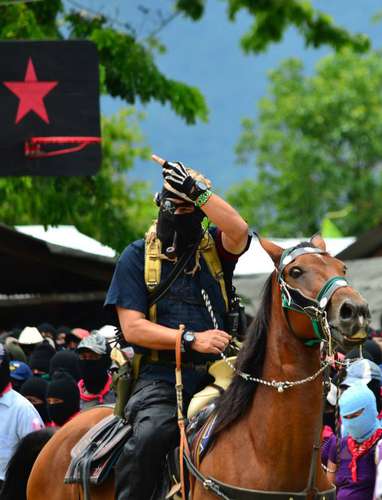
Marcos wearing a black glove with bones painted on it in white
By: Gustavo Esteva
This Saturday we were able to see, with complete clarity, what that other politics is.
The caravan from San Cristóbal, with dozens and dozens of vehicles of all sizes, was a serpent of many kilometers. After the very long trip, not immune from tension and tribulations, they arrived in La Realidad, a teeming reality of Zapatista support bases that had arrived from everywhere to defend what is theirs and to show the vigor of the response.
The Caracol’s esplanade was filling up little by little. When no one would fit any longer and the sun began to shrink, Subcomandante insurgente Marcos appeared on horseback. On his left hand he wore a black glove with bones painted in white. Instead of his usual weapon he was carrying a machete on his back. Subcomandante Insurgente Moisés and Comandante Tacho arrived next. All of them, the milicianos as well as the insurgents and the comandantes, wore the right eye covered; so that we could imagine how the world is seen from the left.
The voice of Sup Marcos greeted everyone from Radio Insurgente. Subcomandante Moisés next reported about the results of their investigations of the attack on La Realidad and the assassination of Teacher Galeano. He asked not to fall into the provocations of the paramilitaries. Tacho as well as Moisés insisted that the Zapatistas do not seek revenge but justice. The indignation and rage have to be directed against the capitalist system and its political expressions, not against those confused brothers that let themselves be bought and manipulated by the government.
In the afternoon, we listened to the words of the Indigenous Revolutionary Clandestine Committee- General Command of the EZLN (Comité Clandestino Revolucionario Indígena-Comandancia General del EZLN), in the voice of Comandante Tacho. The communiqué, read by Subcomandante Moisés, described in every detail the links between the paramilitaries of the Cioac-H and the government of Chiapas and the chains of relationships and complicities that involve municipal presidents, governors and ex governors. He also related the series of harassments and armed attacks that that same organization has carried out recently against the Zapatistas.
Finally, everyone sang the Zapatista Hymn and a long and moving procession was organized to visit the tomb of the teacher Galeano. A little later, the complete audio of the communiqués and the information began to circulate through the free media.
While this was occurring in La Realidad, in more than a hundred cities in Mexico and the world the creativity and entirety of those who shared the pain and rage of the Zapatistas for the atrocious assassination of Galeano was demonstrated publically and transformed into organization and mobilization.
In Oaxaca, for example, there were as many that went on the caravan as those that stayed to organize a political day of homage in the capital’s principal plaza and adopted the slogan “La Realidad is ours” with a double proposition: assuming as their own the pain and indignation for the death of Galeano and recognizing that a similar war exists in the state. In the public pronouncement at the end of the political day of homage they pointed out with clarity: “Today, in Oaxaca, collectives, adherents of the Sexta and diverse organisms of civil society have met to demonstrate our decision and commitment to get organized not only for resisting the violence from above and below that spreads among us, but also to assume a commitment to transformation. By placing ourselves in solidarity with the Zapatistas, we are also asserting in our own spaces and organizations to confront without fear that wave of violence and to convert this difficult circumstance into the opportunity for realizing profound changes… With the construction of autonomy from the social base, with the ability to link ourselves together in a common pledge instead of our political and ideological differences, confident in the known capacity for struggle of the Oaxacan people, today we call to everyone to congregate in this common pledge of profound transformation.”
Ten years ago, Arundhati Roy anticipated what is happening: “Not only is another world possible,” she pointed out “it is underway. If one listens with attention on a quiet day, one can hear its breathing.” This Saturday, in La Realidad, we entered it. It is already among us. The thing is to multiply it everywhere, in its thousand different forms.
That is, very concretely, what is now being attempted. Adherents to the Sixth (la Sexta), students of La Escuelita, and the millions in Mexico and in the world that continue finding in the Zapatistas a source of inspiration, seem decided to employ these dates as un detonator similar to that of the Uprising.
We’re dealing with a new cycle of organization and mobilization to resist, stop the horror and to practice, each in their way, in their place, the new forms of doing politics. Today, like yesterday, we’re also talking about defending the Zapatistas and Zapatismo as a political initiative, at the side of Subcomandante Insurgente Galeano.
———————————————————–
Originally Published in Spanish by La Jornada
Translation: Chiapas Support Committee
Monday, May 26, 2014
En español: http://www.jornada.unam.mx/2014/05/26/opinion/016a1pol
Marcos Announces His Disappearance
SUBCOMANDANTE MARCOS ANNOUNCES HIS DISAPPEARANCE
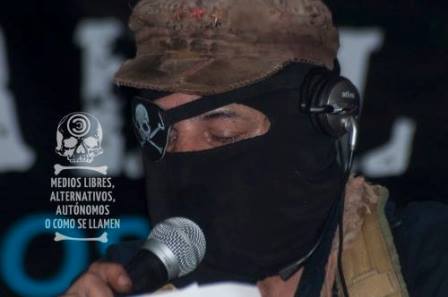
The Sup in La Realidad wearing the black eye patch with a pirate skull design on it.
At 2:08 AM this morning, Subcomandante Marcos announced that starting at that moment he ceases to exist. In a press conference before the free media that attended the homage to Galeano, the Zapatista assassinated in the Zapatista com munity of La Realidad, the military chief of the Zapatista National Liberation Army (Ejército Zapatista de Liberación Nacional, EZLN), indicated: “if you permit me to define Marcos, the personage, then I would tell you without hesitating that it was a motley one.”
After more than 20 years at the front of the political-military organization that rose up in arms on January 1, 1994, Marcos announced his relief. He indicated that after the Zapatista Escuelita courses last year and the beginning of this year, “we realized that now there was a generation that could follow the example, that could listen to us and talk to us without waiting for a guide or leadership, or seeking submission or follow-up.” Then, he said, “Marcos, the personage, was no longer necessary. The new stage in the Zapatista struggle was ready.”
In the emblematic community of La Realidad, the same one in which last May 2 a group of paramilitaries from the Independent Central of Agricultural Workers and Campesinos Historic (CIOAC-H), assassinated the Zapatista support base Galeano, Subcomandante Marcos appeared in the wee hours of the morning before representatives of the free communications media, accompanied by six comandantes and comandantas of the Comité Clandestino Revolucionario Indígena and Subcomandante Insurgente Moisés, to whom last December he announced as his elevation to the command.
“It is our conviction and our practice that to reveal oneself and struggle neither leaders nor caudillos, messiahs or saviors are necessary. To struggle one only needs a little bit of shame, and a whole lot of dignity and much organization, the rest or is useful or not to the collective,” said Marcos.
With a black patch with the design of a pirate skull covering his right eye, the Zapatista spokesperson up to now remembered the early morning of January 1, 1994, when “an army of giants, in other words, of indigenous rebels, went down to the cities to shake up the world with their step. Barely a few days later, with the blood of our fallen still fresh in the streets, we realized that those from afar did not see us. Accustomed a looking on the indigenous from above, they do not lift their view to look at us; accustomed to seeing us humiliated, their heart did not comprehend our dignified rebelliousness. Their view had been stopped at the only mestizo that they saw with a ski mask, in other words, they didn’t look. Our chiefs then said: ‘they only see how small they are, let’s make someone as small as them, so that they see him and so that they see us through him.’”
That was the birth of Marcos, fruit of “a complex maneuver of distraction, a terrible and marvelous magic trick, a malicious prank of the indigenous heart that we are; the indigenous wisdom challenged modernity in one of its bastions: the communications media.”
The note about the conference, signed by the “free, alternative, autonomous media or however you say it,” announced in diverse portals of alternative communication like Radio Pozol, Promedios and Reporting on Resistances, recreates an atmosphere of applause and vivas to the EZLN after the Commanders’ announcement.
The figure of Subcomandante Marcos strolled in to the world from the first hours of January 1, 1994. The image of an armed man with red cheeks and an R-15, and decked out in a tan and black uniform covered by a wool chuj (vest) from Los Altos of Chiapas, face covered with a ski mask and smoking a pipe, was the front page of the most influential newspapers on the planet. In the days and weeks afterwards his comunicados charged with irony and humor, defiant and irreverent came to be known. Some white pages written on a writing machine and were literally snatched up by the national and international press. Twenty years and more than four months later, Marcos announces the end of this stage.
“It’s hard to believe that twenty years later that ´nothing for us´ it would turn out not to be a slogan, a good phrase for signs and songs, but a reality, La Realidad,” said Marcos. And he added: “if being consequent is a failure, then incongruence is the path of success, the route of power. But we do not want to go there, it does not interest us. Within these parameters, we prefer to fail than to triumph.”
“We think,” he said, “that it’s necessary that one of us dies in order that Galeano Lives. Thus we have decided that Marcos must die today.”
“At 2:10 AM, Subcomandante Insurgente Marcos came down forever from the platform, turned out the lights and next is heard a wave of applause from the adherents to The Sixth (La Sexta), followed with a bigger wave of applause from the Zapatista bases of support, milicianos and insurgents,” they reported from La Realidad.
Faithful to his ironic style and to his traditional postscripts, the personage of Marcos ended: P.D. 1 Game Over. 2. – Check Mate. 3. – Touché. 4. – Mhhh, Is Hell like this? 5. – In other words, can I now walk around naked without the motley clothes? 6. – It’s very dark around here, I need a little light…”
————————
[A new communiqué follows this Desinformemonos article. It is called Entre La Luz y La Sombra. In the communiqué the figure of Marcos dies and becomes Subcomandante Insurgente Galeano so that Galeano lives. It’s very long. The English translation is out. You can read it here. You can read it in Spanish here. ]
————————————————————————-
Originally Published in Spanish by Desinformemonos.org
Translation: Chiapas Support Committee
Sunday, May 25, 2014
http://desinformemonos.org/2014/05/adios-al-subcomandante-marcos-nace-galeano/print/
Subcomandante Marcos at Homage to Galeano
SUBCOMANDANTE MARCOS REAPPEARS AT THE HOMAGE TO GALEANO IN LA REALIDAD

Marcos (on horse) at homage to Galeano in La Realidad
** Thousands participated in the ceremony; more data was given about the murder of the Votán
** Moisés reiterated that the EZLN’s struggle is peaceful: “If they provoke, we don’t”
From the Editors
The Internet portals of dozens of media and digital radios related to Zapatismo reported yesterday that Subcomandante Marcos was present, together with the other chiefs of the Zapatista National Liberation Army (Ejército Zapatista de Liberación Nacional, EZLN), among them Subcomandante Moisés and Comandante Tacho, in the esplanade of the Tojolabal community La Realidad, municipio of Las Margaritas, during a homage to the teacher José Luis Solís López, Galeano.
Before thousands of sympathizers coming from various states and different countries, many of them graduates of the “escuelas zapatistas,” (Zapatista Schools) Marcos and the EZLN’s other chiefs approached the scenario on horseback, wearing –like all the other milicianos that stood guard– an eye patch, over the traditional hood, a red ribbon on the left side and a black one –a sign of mourning– on the right. Sup Marcos was also wearing a black glove with bones painted in white and a machete instead of his traditional rifle.
A few moments later, medias like Radio Zapote, Radio Pozol or Chiapas Paralelo circulated a photograph through the social networks.
Galeano, a leader of the Zapatistas bases that was assassinated with blows and shots on May 2 by groups related to the Green and Institutional Revolutionary (PRI) parties, and armed men from the Independent Central of Agricultural Workers and Campesinos Historic (CIOAC-H), they denounce.
Thousands of milicianos and social bases from the five Zapatista Caracoles and authorities of the Good Government Juntas went to the ceremony in his memory. Only community and alternative communications media were admitted. According to what was advertised in the call, published days before, the media of the commercial press were not invited nor would they be received.
At the moment of his first appearance, after years of absence in the EZLN’s official acts –during which also proliferated all kinds of rumors about sicknesses–, the historic spokesperson of Zapatismo only greeted “the independent, autonomous or however you say it media” and advised that in the future there would be an Internet network so that they would be able to publish their information. He indicated that the ceremony would start “after sunset.”
Subcomandante Moisés spoke next. He provided new data about the circumstances of the assassination of Galeano, teacher and leader to whom the Zapatistas bases now grant the level of a Votán. He pointed out that among the reports they have, and that they had previously denounced about how Solís López was ambushed, surrounded, beaten and shot, there were woman involved. He said that they know whom it was “that struck him with a machete and that dragged the body.”
The Juntas and the Fray Bartolomé de las Casas Human Rights Center accuse members of the CIOAC-H –that share territory en La Realidad with Zapatista bases–, members of the PRI and the Green Party as authors of the aggression, in which another 15 residents were injured.
In a previous communiqué, the EZLN maintained that the attack was “planned with anticipation, militarily organized and carried out with treachery, premeditation and advantage.” The bulletin, signed by Marcos, denounces that the aggression is inscribed “in a climate created and encouraged from above.”
In that same text, the rebel chief expressed that pain and rage are “what make us now wear boots again, put on our uniforms, wear our pistol and cover our face.” The assassination of Galeano provoked that the EZLN would cancel a gathering planned as homage to the recently deceased philosopher Luis Villoro, foreseen for the end of this month.
Moisés concluded his message asking that the adherents to the Sixth Declaration of the Lacandón Jungle (Sexta Declaración de la Selva Lacandona) not forget that “our struggle is civilian and peaceful.” According to the media referred to above, he urged: “using the rage against the system and not against these people with a bad head and that don’t think, who only want to comply with orders of the bad government.” He concluded: “If they provoke, well they are the ones that do it, we don’t. We are strugglers.”
After that brief presentation, the commanders withdrew. There was no more information coming from La Realidad during the rest of day. The digital radios Pozol and Frecuencia libre of Chiapas, Tlayuda and Autonomía Rebelde of Oaxaca, K Huelga, Regeneración and Zapote of DF and Zapateando of Veracruz linked with each other to transmit the event in La Realidad.
———————————————————–
Originally Published in Spanish by La Jornada
Translation: Chiapas Support Committee
Sunday, May 25, 2014
En español: http://www.jornada.unam.mx/2014/05/25/politica/013n1pol
Zibechi: The change from below in Venezuela
THE CHANGE FROM BELOW IN VENEZUELA
By: Raúl Zibechi
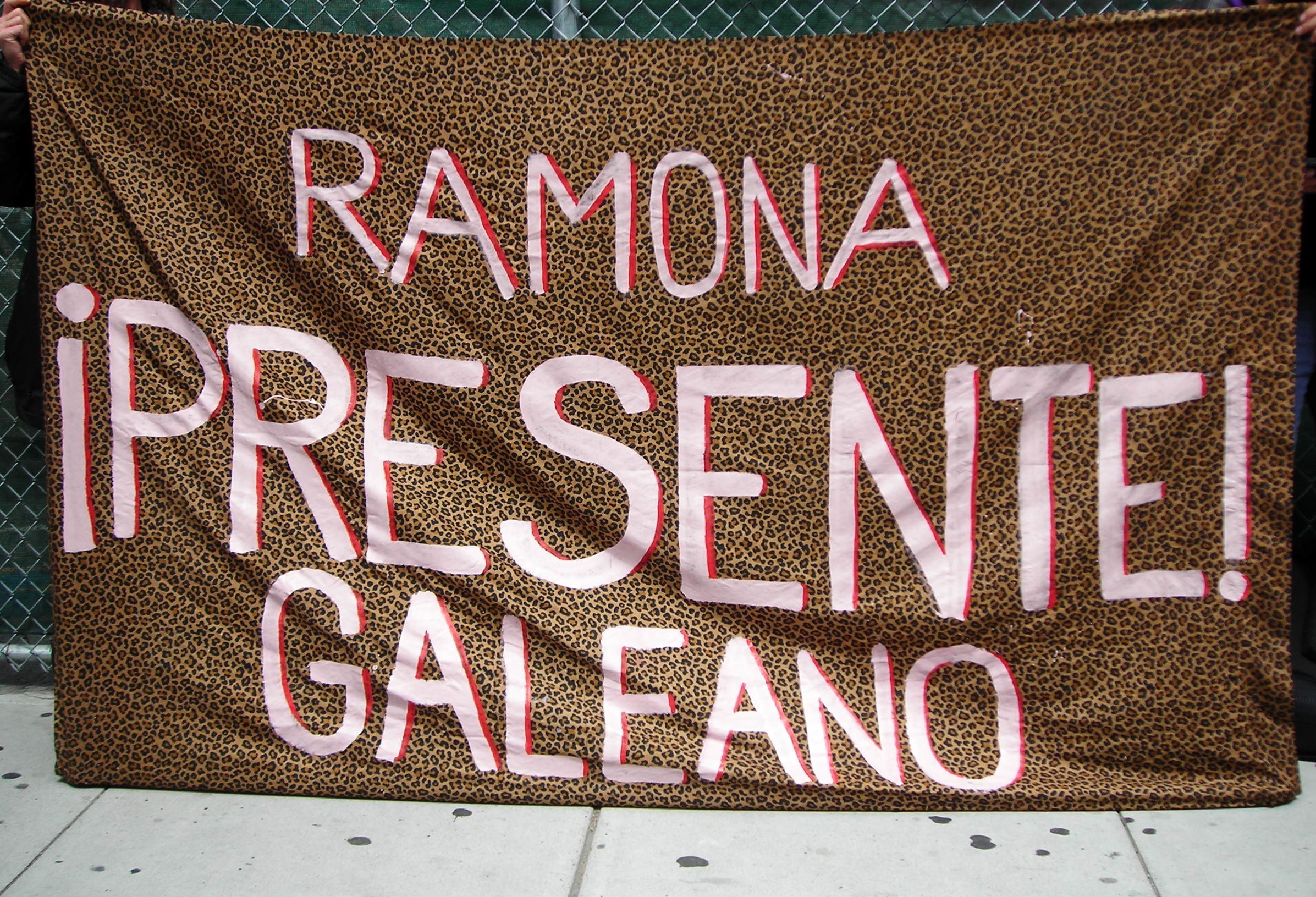
A Banner at May 22 Rally in front of Mexican Consulate in San Fran cisco
Now that the media waters have calmed down, we are able to talk about the profound transformations in Venezuelan society, that kind of long-term change called on to reconfigure societies. It cannot be strange to us that the big media don’t pay attention to these movements, but rather focus on news that vanishes without leaving a trace. More striking is the scarce attention that the analysts and a good part of party members grant them, probably because they consider that politics (with a capital P) are reduced to what happens in the proximity of government palaces.
We consider the experience of Cecosesola (Cooperative Central of Social Services of Lara State), a network of 60 communities with its epicenter in the city of Barquisimeto (2 million inhabitants) but with a presence in four states of northwestern Venezuela. The cooperatives are dedicated to agricultural production, small-scale agro-industries, health services, transportation, a funeral parlor, savings and loan, mutual aid funds and distribution of food and articles for the home.
The scope of the undertaking is not minor. They have 20 thousand associates in their group, 1,300 workers that are paid the same salary (which they call an advance or “anticipo”), almost 4,000 participate in the more than 300 annual meetings of the network, from weekly meetings to experiences (vivencias) in which everything is discussed, from the price of the products at the markets to management of the integral cooperative health center.
The three big family markets in Barquisimeto sell 600 tons of fruits and vegetables per week, 35 percent of the consumption of a large city like that, where 500 associates work. There are 250 boxes and they supply some 200,000 people each week. It is not a marginal undertaking, but rather the major point for the sale of food in the city, much more important than the supermarkets. Three aspects seemed outstanding to me.
There are no cameras or private guards, only “community vigilance.” Despite the tense lines that there are all over the country, those that form in the Cecosesola’s markets are serene and in solidarity. The morning that I participated in the center’s market, there were lost shoes in the disturbance that formed at the entrance. When the megaphone reported that fact, the shoes appeared in a few minutes. That’s what happens even when wallets and objects of value are lost. Despite not having vigilance, the “flights” (what capital judges as robberies) are only about one percent, compared to 5 percent in the supermarkets.
The prices are different. The fruits and vegetables have only two prices, so that the buyer can fill a sack with the most diverse foods and it’s weighed all together, simplifying the accounting. A weighed or average price is set. But what’s most notable is that the periodic assemblies of associates set the prices. The assemblies are open, in which the producers explain the costs and share the data with the other cooperative members, eliminating the intermediaries. This democratization of prices, costs and margins restores the market to the “transparency” that Fernand Braudel considered as the principal characteristic of pre-capitalist markets.
The third question is that the enormous network does not have management or leaders. They decide everything among all; thus the large number of meetings. Cecosesola defines itself as “an organization in movement,” part of a process of “personal and organizational transformation through wider participation from everyone.” Trust, conviviality, integration, shared emotions, substitute for formal statutes and positions at different levels.
At the time for explaining their way of doing things, they say that: “the only formal organizational instance is a flexible and changing group of ‘meetings’ open to he or she that wants to incorporate, without distinction as to their origin. We’re talking about meeting spaces that don’t obey a previous design, which are created and disappear according to the needs of the moment.” The logic is not one of accumulation (to grow, gain power or prestige) but to endure over time. They have lasted 40 years.
For eight days I participated in a dozen spaces, from meetings of rural producers and of the March 8 (8 de Marzo) production cooperative of pastas (where a young man declared himself a feminist), to meetings of the accounting office and of the health center. Rotation is the rule, the debate frank and direct, the learning is constant and the collaboration permanent.
There were 55 people in the health center’s weekly assembly forming an enormous circle. The center attends to 200,000 consultations annually. The construction of the building demanded three years of debates to decide on the structure. Three floors open to the city, without walls that block communication, lots of air, large collective spaces where the users and their children do yoga, physical and spiritual exercises, and converse while looking at the mountains.
In the assembly there were nurses, office workers, personnel from maintenance, the kitchen and cleaning, and even six or seven doctors out of the 60 that work at the health center; everyone discussing as equal to equal. There were criticisms because of errors, which were debated serenely. It is not easy to incorporate the doctors, but apparently they are softening. A female doctor participates in the markets as a cashier, a place that the office workers also occupy as they consider the vegetable space as the most agreeable.
Cecosesola is a cultural revolution in movement. I heard purchasers at the markets sense community although they never went to a meeting. They don’t receive anything from the State. They finance everything themselves. They teach us that it is possible to produce and live another way, based on other values than the hegemonic ones, which one can create and manage large spaces that capital dominates, with complete autonomy. One of the slogans of Cecosesola is: “Constructing here and now the world that we want.”
————————————————–
Originally Published in Spanish by La Jornada
Translation: Chiapas Support Committee
Friday, May 16, 2014
En español: http://www.jornada.unam.mx/2014/05/16/opinion/020a2pol
 Chiapas Support Committee