Chiapas Support Committee
Home of the Compañero Manuel blog on zapatistas & mexico
Zapatista Killed in La Realidad Confrontation
ZAPATISTA KILLED in CONFRONTATION with the CIOAC-H in LA REALIDAD
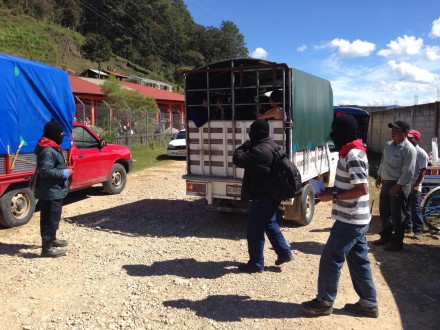
Photo taken in La Realidad by Isaín Mandujano for Proceso
[The Chiapas Support Committee compiled this information from a number of online articles. We emphasize that the Zapatistas have not issued a report and, therefore, we do not have their word. We have not been able to find a report from the Frayba Center either.]
A confrontation between bases of support of the Zapatista National Liberation Army (EZLN, its initials in Spanish) and of the Independent Central of Agricultural Workers and Campesinos-Historic (Cioac-H), in La Realidad, left one Zapatista dead and 13 injured from the Cioac-H. These facts do not seem to be in dispute. However, we do not know how many Zapatistas were injured. The confrontation allegedly occurred last Friday, May 2.
It also seems undisputed that the conflict originated when members of the Cioac-H retained a farm truck belonging to the Zapatistas that was used to transport their members. It is, however, not clear exactly when that may have happened. Apparently, the Zapatistas retained some Cioac-H members in retaliation for taking the truck and the confrontation occurred when other Cioac-H members went to La Realidad to negotiate their release. The Zapatistas retained the leader of the Cioac-H group and, in retaliation, the Cioac-H members cut off the water supply to the Zapatistas.
It would seem important here to remember that anti-Zapatistas calling themselves the Cioac-Democratic were the ones that assaulted Catholic nuns and medical personnel in February. The national Cioac organization stated that the assailants were not part of the national organization and were just using that name. We have no information about the group calling itself the Cioac-H.
Stay tuned for more details.
Zapatista News Summary for April 2014
APRIL 2014 ZAPATISTA NEWS SUMMARY
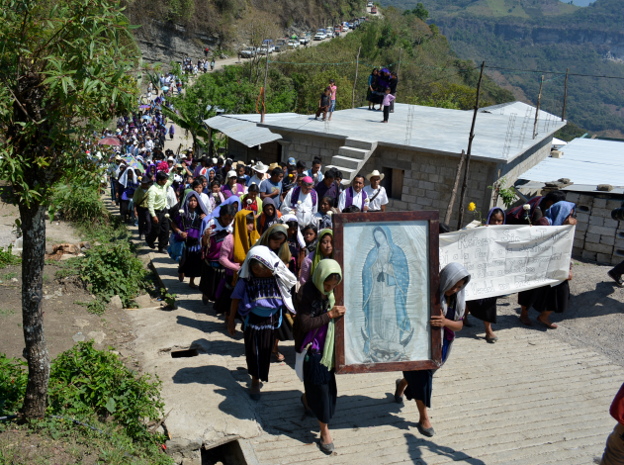
Displaced families return to the Puebla ejido
In Chiapas
1. Zapatistas Release 2nd Issue of Rebeldía Zapatista – The Zapatistas have released another edition of the Rebeldía Zapatista magazine. The Zapatista bases that participated in the Escuelitas give their impressions of the students. An editorial by Subcomandante Moisés is the only part of the magazine published online. You can read his editorial comments here.
2. Homage to 2 Zapatista Supporters Murdered Near Agua Azul – On Saturday, April 26, residents of San Sebastián Bachajón ejido (SSB), adherents to the EZLN’s Sixth Declaration of the Lacandón Jungle, gave homage to Juan Vázquez Guzmán, murdered April 24, 2013, and Juan Carlos Gómez Silvano, murdered on March 21, 2014. Both men were leaders in SSB’s struggle to defend their lands from government efforts to take that land away; in other words, against dispossession. SSB has been resisting the government’s efforts to take its lands in order to benefit powerful interests. Tourism interests are those that have dominated previous reports and analyses from Chiapas. However, at the homage to the two fallen leaders, the SSB folks raised the specter of another powerful interest – Walmart!
3. International Campaign in Support of San Sebastián Bachajón – Between April 24 to May 6, Zapatista Solidarity groups are sponsoring an international campaign in support of San Sebastián’s struggle to defend its land and in honor of its 2 murdered leaders. It involves watching a 13-minute video about the struggle. The video is posted on YouTube. It is in Spanish with some English subtitles (click the cc box at the bottom of the screen for English subtitles).
4. Displaced Return to Puebla Ejido – On April 14, the 17 Catholic families displaced last August from this ejido in Chenalhó municipality by the dispute over a piece of land with the Evangelical majority, returned to the Puebla ejido accompanied by Felipe Arizmendi Esquivel, the Bishop of San Cristóbal de Las Casas, and Eduardo Ramírez Aguilar, the Secretary of Government, as well as by representatives of non-governmental organisms and civilian observers. The Bishop stated that it was a return “without justice,” and asked: “to continue supporting the “returnees,” because it’s not over, not only as to material issues, but above all in security, stability, harmony and reconciliation.” The Fray Bartolomé de las Casas Human Rights Center was one of the organisms accompanying the Catholic families.
In other parts of Mexico
1. Self-Defense Groups and Government Sign Agreement – Early this month, leaders of the various self-defense groups from 20 Michoacán municipalities signed an agreement with the federal commissioner for Michoacán, Alfredo Castillo, and other government officials to “demobilize” and register their weapons. The deadline set for the demobilization is May 10. Castillo said: Those who want to continue patrolling the towns of Michoacán will have to become part of a new statewide rural police force. All current self-defense group members, however, will be allowed to keep their weapons, regardless of whether they join the police force, as long as they register them with the Army and keep them at home. Castillo said: “Beginning May 11, any [armed] person not registered, not uniformed, will be arrested.” He said the deadline date would allow authorities time to vet and train those who want to join the rural force and to re-train and purge municipal police forces of officers with known or suspected criminal ties. Meanwhile, the self-defense groups had some demands of their own and some provisions are included in the agreement regarding the release of self defense members who are in prison simply for carrying weapons. There are also provisions for financial support for widows and children of victims of the struggle against organized crime in Michoacán. The United States government has poured untold billions into the “drug war” and little, if any, progress was made to protect ordinary citizens from the criminal groups until the self-defense groups formed and ran the criminals out of the communities. We’ll see what happens after May 10! For an analysis, here’s an article by Luis Hernández Navarro.
2. United Nations Special Relator on Torture Visits Mexico – The United Nations (UN) special relator on torture, Juan E. Méndez, began a visit to Mexico in the last week of April. The not-really-shocking, but very sad, headline is that complaints about torture increased by 500% during the Calderón administration. This is attributed to the use of the Armed Forces in public security and the legal figure of arraigo (lengthy detention without charges). He has not yet visited Chiapas.
3. North American Defense Heads Meet in Mexico – Robert D. Nicholson, Canada’s Minister of Defense; Charles Timothy Hagel, US Secretary of Defense, as well as General Salvador Cienfuegos Zepeda, Mexico’s Secretary of Defense, and Admiral Vidal Francisco Soberón Sanz, Mexico’s Secretary of Navy met together in Mexico. They discussed their mutual concerns about threats from transnational organized crime and ways to improve mutual efforts… at least that’s what the press reports said.
_________________________________________
Compiled monthly by the Chiapas Support Committee.The primary sources for our information are: La Jornada, Enlace Zapatista and the Fray Bartolomé de las Casas Human Rights Center (Frayba).
We encourage folks to distribute this information widely, but please include our name and contact information in the distribution. Gracias/Thanks.
Click on the Donate button at http://www.chiapas-support.org to support indigenous autonomy.
_______________________________________________________
Chiapas Support Committee/Comité de Apoyo a Chiapas
P.O. Box 3421, Oakland, CA 94609
Tel: (510) 654-9587
Email: cezmat@igc.org
http://www.chiapas-support.org
http://www.facebook.com/pages/Chiapas-Support-Committee-Oakland/
https://compamanuel.wordpress.com
A Possible Walmart Connection to San Sebastián Bachajón Dispossession?
RENDER HOMAGE TO DEFENSE OF LAND LEADERS MURDERED in CHILON, CHIAPAS

Juan Carlos Gómez Silvano, regional coordinator of adherents to the Sixth Declaration in Chilón and murdered on March 21, 2014
** They say the attempt to dispossess plots of land is for a toll road and a supercenter
** “Our struggle is peaceful, but we demand respect,” say the ejido owners and adherents to the Sixth
Photo: provided by the Gómez Silvano family. Juan Carlos Gómez Silvano, regional coordinator of the Sixth in Chilón and executed with more than 20 gunshots last March 21 on the road to his community, Virgen de Dolores.
By: Hermann Bellinghausen
Tzeltal ejido owners of San Sebastián Bachajón, in Chilón, Chiapas, adherents to the (EZLN’s) Sixth Declaration of the Lacandón Jungle, rendered homage this Saturday to two leaders assassinated in recent months, “fallen in defense of their people and their territory,” Juan Vázquez Guzmán and Juan Carlos Gómez Silvano.
In the message read today in the community of Nah Choj, the Indigenous expressed: “We know that capitalism doesn’t rest day or night in order to dispossess us of our culture and of Mother Earth, because it wants to make businesses and a lot of money that goes into the pocket of the big impresarios. The only thing that capitalism leave us is poverty, misery, violence, prison and death; it wants to kill our hope and our way of life so that only capitalist life, individualism and the law of the strongest exist.”
They remembered that Juan Vázquez Guzmán “understood the traps of the bad government and capitalism and because of that he embraced the struggle even more and the love for his people grew, working without rest for the liberation of political prisoners and for the defense of the lands. He dreamed about his people free of the oppression of capitalism. Juan was not afraid of doing work for his people; he was always a brave compañero that struggled for his community to live well.”
The night of April 24, 2013, he was assassinated at the door of his house “by the bad government, to try to quiet the voice and hope of our organization,” the ejido owners maintained; “as they also did last March 21 to Juan Carlos Gómez Silvano,” who was the regional coordinator, “still young and with a lot of participation in the organization.
“Our struggle is peaceful, but we demand that the three levels of the bad government respect our people, because we are not going to remain seated watching how they continue violating our rights,” they emphasized.
The Tzeltal community of the Northern Zone denounced: “the contrivances and corruption of ejido commissioner Alejandro Moreno Gómez, his vigilance councilman Samuel Díaz Guzmán and the former ejido commissioner Francisco Guzmán Jiménez, who are accomplices of the government’s dispossession and are not content with what they have done. They want to continue dispossessing more lands to make way for the toll road from San Cristóbal de las Casas to Palenque and for an Aurrerá (owned by WalMart)[1] supercenter in Bachajón, because they are government puppets and have done it completely behind the community’s back for personal interest.”
Lastly, they pointed out that the situation in the country “is more difficult all the time for the communities and for the peoples. They want to accelerate the privatization of our territories and exploiting them for the million-dollar benefit of the few; it is a lit that it is for progress and development, because it is only a pretext for taking our lands away from us. They are death projects.” Therefore, they called “to struggle organized and to defend the life of our peoples,” and they greeted “the peoples and communities of Mexico and the world in resistance against the capitalist megaprojects of dispossession.”
Meanwhile, dozens of solidarity organizations of France Francia, Italy, Germany, Belgium, the United Kingdom and Spain demanded from the Mexican government gobierno “the return of communal lands to the San Sebastián Bachajón population; respect for the rights of these Tzeltal indigenous peoples over their lands and territories; respect for their right to free determination and their search for alternative ways of life.”
[1] Aurrerá is a chain of supercenters for one-stop shopping in Mexico that is now owned by WalMart!!
—————————————————————————–
Originally Published in Spanish by La Jornada
Translation: Chiapas Support Committee
Sunday, April 27, 2014
En español: http://www.jornada.unam.mx/2014/04/26/politica/013n1pol
Rebel Zapatista: The Word of the EZLN
Editorial 2: Rebeldia Zapatista: The Word of the EZLN
Editorial by Subcomandante Insurgente Moisés for the second edition of the magazine Rebeldia Zapatista: The Word of the EZLN.

Compañeras and compañeros of the Sixth and the Zapatista Little School:
Here we continue to recount the words of the compañeras and compañeros, families, guardians, and teachers about how they saw and evaluated their students in the Little School.
As we say here in these rebellious lands, there is no rest; one must continue to work hard.
We mention this because there is another round of work coming up, with the compañeras and compañeros of the National Indigenous Congress. So you see, it’s true; there is no rest.
Even when there is a break from these tasks, it is used to work to sustain one’s family, but also to think, study, and make plans for the struggle.
This is important because of the simple fact that the neoliberal capitalists do not take a break from thinking about how to extend their domination into infinity.
As the compañeras and compañeros say in one of the “sharings” that we have had here: in just 19 years we have thrown off the bad system of 520 years of domination, and we now hold our own freedom and democracy in our hands. And we are just a few thousand women and men who govern our own communities; imagine if we organized with the other millions of people in the countryside and the city.
As the same compañeras and compañeros say, this is thanks to the fact that we have organized ourselves and understood what dignity and resistance really mean. We no longer resign ourselves to the leftovers, handouts, or crumbs thrown to us amid deception after deception by the bad government.
As the Zapatista people say, our great great grandparents, our great grandparents, and our grandparents were never given anything to eat. On the contrary, what they produced was taken away from them and they were given a few crumbs to eat that day so that they could return to work for the boss the next day. That’s how they went through life: exploited by the boss and the bad government. Why would we think that the bad government is different now, that it is good, when it is made up of the grandchildren and great grandchildren of those same exploiters, and who are the worst sell-outs of our time?
That is why the new bosses are foreigners, that is, if we let them be—if we, the poor men and women of the countryside and the city, resign ourselves to this.
It is time for the poor of the countryside and the city to organize —time for the peoples of the countryside and the city to take their destiny into their own hands. That is, it is time for the people to govern themselves instead of being governed by a few individuals up there who are just trying to get rich. It is easy to see and easy to confirm in practice that this is the only reason they are there.
That is why the compañeras and compañeros of the Zapatista bases of support organized themselves and dreamed and worked together to determine their own destinies, and this destiny is now visible. Their manner of governing themselves as peoples and communities is totally different; they rule as a people and their representatives obey, that is, their government obeys. This is true change, not just a change of colors or logos.
Who says this can’t be done, compañeras and compañeros of the Little School? It can be done, because it is the people themselves deciding, in organized fashion, what they want in all aspects of their lives.
Why are we afraid to let the people decide for themselves how they want a new life to be? How can we not fear the great atrocity committed by the three levels of bad government in deciding our future against the good of our peoples? This is where the compañeras and compañeros of the EZLN say that the people must have the power of decision over their own lives, because they make decisions for the good of the people and not to benefit their own vices. And if they make a mistake, well then they correct it. But the three levels of bad government have no ears to hear or eyes to see, they refuse to acknowledge any error within their world of domination and deceit. Let’s leave that world, leave them alone to see if they can survive, stop allowing ourselves to be exploited, and a whole string of etceteras.
The compañeras and compañeros of the Zapatista communities have provided an example.
That is why we are continuing to share here the words of the compañeras and compañeros bases of support of the EZLN.
And this will continue and keep going.
Subcomandante Insurgente Moisés.
Mexico, April 2014. Twentieth year of the war against oblivion.
Originally Published in Spanish at:
http://enlacezapatista.ezln.org.mx/2014/04/24/editorial-2-rebeldia-zapatista-la-palabra-del-ezln/
Translated by El Kilombo Intergaláctico
Raúl Zibechi on Community Self-Defense
DEFENDING OURSELVES COLLECTIVELY AND IN THE COMMUNITY
By: Raúl Zibechi
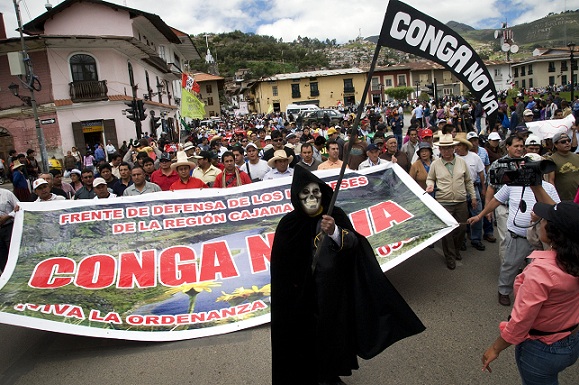
The Grim Reaper joins protest against the Conga Mine
The world situation is very grave. When the flames of civil war in Syria have still not been put out, the crisis underway in Ukraine threatens to elevate the tension, expecting that new fronts will open in the global conflict. The South American region postponed, for now, a greater escalation in Venezuela thanks to the dissuading presence of the Unasur.
Nevertheless, we must look at ourselves in the Syrian mirror, or perhaps in the Mexican mirror, to comprehend that none of those options can be discarded in the most acute period of the hegemonic transition. Permanent war substitutes for State coups, since the imperial think tanks seem to have comprehended that the peoples come out strengthened from the dictatorial regimes, like the ones imposed in the 1960s and 1970s.
Now they seek to break the social fabric by stirring up prolonged internal conflicts, with the objective of leaving societies exhausted, divided and incapable of self-managing their issues. It is the method of breaking nations in the period of “accumulation by dispossession” (David Harvey) and of the “fourth world war” (Subcomandante Marcos), through the appropriation of the communal wealth and the destruction of life.
Faced with this panorama the movements cannot count on the State’s protection, because of having been neutralized by the pressure from the multinationals and imperialism, or indeed because of supporting with conviction their strategies. Meanwhile, we must think about the need to create and multiply spaces, conscience and organization for community defense.
We have before us a good fistful of forms of community self-protection among the Indian peoples, campesinos and also among popular urban sectors, where this task is more complex. These organizations often ignore the existence of similar others otras in other countries or regions, with which they cannot mutually enrich each other, learning from their successes and errors, and thus improving the modes of confronting such a complex period.
The Indigenous Guard of the Nasa in Cauca (southern Colombia) stands out. Its members are elected in an assembly by the communities and serve for two years, being able to be re-elected. The guards (both male and female) are in the vast majority young comuneros, they are armed with staffs of command and not only protect the communities (in their own territories as well as through their deployment in marches and protest actions) but they also exercise the work of education and support for community justice.
The Indigenous Guard has been capable of rescuing authorities kidnapped by the paramilitaries and the guerrilla, appealing to the mass mobilization of the communities. They have also disarmed the armed forces’ war installations within their territories and they work to impede violence from entering into their spaces destroying the communities.
The campesino rounds were born in Northern Perú at the end the 1970s to combat the cattle thieves. Within a few years they extended to a good part of the country, since they achieved reducing the thefts and almost extinguishing them. Acting rotationally, the campesinos make nighttime vigilance rounds, showing that families are no longer isolated but rather communities in construction.
Over the years the rounds aimed at works of construction of services to the comunidades. They implemented their own justice at the margin of corrupt state justice and, when the internal war between the Armed Forces and the Sendero Luminoso was triggered, they isolated the violent ones at the cost of thousands of deaths. In recent years, the campesino rounds play a decisive role in the resistance to mining, particularly in front of the Conga Gold Mining Project, in Cajamarca Province. They are known as “guardians of the lakes.”
In the cities we also count on a fistful of experiences of community defense, in tune with the brigades of the Acapatzingo Community Housing in Mexico City’s Iztapalapa delegation. An outstanding case happens in some Buenos Aires villas, with a long tradition of popular organization, as much for demands from the State as for organization and defense of daily life.
In Villa de Retiro, the Independent Villa Current and the Popular Dignity Movement erected the House of Women in Struggle, a space of formation, debate, collective organization for survival and also for defense against macho violence. Those that make up the women’s self-defense groups hold training workshops, which are “an tool for organizing, re-grouping and direct action that can give answers in the face of determined situations, as well as accompaniment and advice to women,” according to what the movement reasons.
They intervened in several cases in the face of aggressors making the situation visible and acting in groups, with discipline and decision, to stop the aggressor and reached the point of inducing him to abandon the barrio. In the Bajo Flores villa the Amazons acted years ago, mothers that mobilized against attackers and drug dealers, becoming referents for other women.
So, different organizational experiences exist among the three social sectors that confront the current model: indígenas, campesinos and popular urban sectors. Each one has its own ways as a function of the reality that they confront. Some use arms; others opt for favoring the multitude. But in all the cases we see a powerful decision of placing the body to defend the community collectively.
Somehow, these practices interconnect below and they learn from one another, although much slower than one would wish. Although in their group the number of people and communities involved in community defense are still very few, they mark a path because, at any moment, they will have to travel to other communities that can only count on their own forces when the systemic chaos rises dangerously.
———————————————————-
Originally Published in Spanish by La Jornada
Translation: Chiapas Support Committee
Friday, April 18, 2014
En español: http://www.jornada.unam.mx/2014/04/18/opinion/036a1pol
Narcos, Self-Defense Groups and the Mexican Government
MICHOACAN: THREE ULTIMATUMS ON THE TABLE
By: Luis Hernández Navarro

Dr. José Manuel Mireles, a leader of the Self-Defen se Groups in Michoacán
To disarm or not to disarm, at the heart of the current dispute in Michoacán. The United States pressures (Mexico) to demobilize the autodefensas (as the armed civilian self-defense groups are referred to in Mexico), the federal government summons them to relinquish their weapons and autodefensas demand that, before delivering one single gun, the authorities comply with a series of conditions. The three have put their ultimatums on the table. May 10 is the zero hour.
The pulse-rate has been rising since the beginning of the year. On January 9, the US State Department warned “its citizens about the risks of traveling in Mexico due to threats to integrity and security that transnational criminal organizations (TCO) represent in that country. US citizens have been the targets of violence, like kidnapping, assault and robbery at the hands of TCOs in various states.” Michoacán was burning.
The government response was quick. Five days after the US communication, the Secretary of Governance (Interior Minister), Miguel Ángel Osorio Chong, summoned the self-defense groups to return to their places of origin and reincorporate into their daily activities, while federal forces, in coordination with state authorities, were put in charge of the security and protection of Tierra Caliente’s residents.
The armed civilians didn’t pay much attention. On January 12, after a two-hour fight, they took over the community of Nueva Italia, a critical point in the offensive against los caballeros templarios. One of the fightersthat participated in the battle turned to the Secretary of Governance: “Let Osorio Chong come to disarm us (…). He’s never going to come but may attempt it” (El Universal, 14/1/14).
One who understands well and speaks few words. So that there is no doubt about the message from Uncle Sam, on January 17, one week after the alert to its citizens about Mexico, Secretary of State, John Kerry, said he was “worried” about the emergence of militias to combat the Michoacán narcotraficantes and prepared to try being useful in any way possible.
Stability in Michoacán is important to Washington. Since that Mexican state divides one of the key corridors for the transport of merchandise between the Pacific and the Gulf of Mexico, formed by the stem from the Port Lázaro Cárdenas and the Kansas City Railroad. A privileged trade with China has been established from there. Two of every three avocados that are consumed in the United States are grown in Michoacán and exported, principally by six big transnational packing companies with US capital. The Michoacanos are the second largest community of Mexicans on the other side of the Río Bravo; 4 million live there and send more than two billion dollars per year to their state.
On February 27, one month after Kerry’s statements, the annual report that Washington elaborates on human rights in the world warned about the “worrisome proliferation” of self-defense groups in several states of the Mexican Republic, especially in Guerrero and Michoacán.
Despite seeing some incongruences in the admonition of Uncle Sam, José Miguel Vivanco, executive director for the Americas of Human Rights Watch (HRW), saluted the document: It seems to me –he affirmed– that the report on the point about the autodefensas, which reflects in trustworthy terms the growth of this phenomenon and the vacillating and contradictory attitude of the Mexican Executive, is unobjectionable.” “The autodefensas –he added weeks later– are a cancer that Colombia has suffered for several decades. It is very easy to fall into this kind of model where a Frankenstein is generated that no government can control afterwards.” [1]
The issue was a motive for concern not only for the Obama administration, but also for the big foreign investors. That was clear on January 23 at the World Economic Forum at Davos, when the ghost of the armed civilian groups in Michoacán appeared to President Enrique Peña Nieto. The president, who arrived at the annual fiesta of the Masters of the Universe presuming to approve a new cycle of neoliberal reforms, when he butted heads with Klaus Schwab, executive president of the Forum, over questions about the armed civilian groups. The president answered by offering to incorporate the autodefensas into security tasks (La Jornada, 1/24/14).
He then began a concealed bid to demobilize the militias and oblige them to put down their weapons, which quickly provoked strong clashes. On February 14, in the community of Antúnez, the Army killed three civilians that resisted being disarmed. The federal government saw itself obligated to postpone the measure. The issue has been a motive for permanent conflicts and a flood of statements from public officials, announcing the imminence and obligatory nature of the measure.
On April 6, the autodefensas responded by marching into 15 towns and organizing a motorized caravan. Through the voice of Doctor Mireles, they again said that they cannot be disarmed. “Without weapons any fool on a bicycle will kill us,” the spokesperson said in the community of Nuevo Urecho. Simultaneously they increased their demands: the freedom of at least 100 of their prisoner compañeros; eliminating or arresting 20 mid-level Templario commanders; legalizing and granting a legal personality to the autodefensas; integrating its members into the state police and restoring the state of law in Michoacán. They set the time period for having favorable solutions as Mothers Day (May 10th in Mexico).
The violent clash between the autodefensas and the federal government seems more probable every day. The three ultimatums on the table are the third call that it announced.
———————-
Translator’s Note:
[1] The issue of the self-defense groups (also referred to in Spanish as comunitarios or autodefensas) must be understood within its local context. These groups are not, as HRW is quoted as suggesting in this article, the same as the autodefensas of Colombia, who fight against the leftist Revolutionary Armed Forces of Colombia (FARC). The autodefensas of Michoacán fight against an organized crime group called the Knights Templar (Los Caballeros Templarios). Here is what one trustworthy source from Mexico says about the Templarios:
“When it comes to states such as Michoacán however, somehow the mainstream media, academia, and many solidarity activists have ignored the paramilitary tendencies of organized crime cartels. The people of Michoacán have struggled to survive and persevere in the face of a violent onslaught by three different cartels: La Familia Michoacana, the Zetas, and now the Knights Templar. Michoacán is known worldwide for marijuana cultivation and trafficking, but with a growing trend towards marijuana decriminalization and legalization in the United States of America, today the Knights Templar cartel has now diversified into the production and trafficking of methamphetamine. In a globalized marketplace for cheap labor, land, and natural resources, cartels throughout Mexico have also diversified into a much more profitable industry, which is the use of coercion through violence in order to gain territorial control. Today the Knights Templar cartel continues to harvest terror with the precision of a military death squad and engages in an international drug smuggling operation. The cartel, however, has also quietly been engaging in private security roles in the interest of illegal natural resource extraction strategies employed by corporations, banks, and political oligarchies.”
http://elenemigocomun.net/2014/04/breaking-curse-forgotten-places/
———————————————————–
Originally Published in Spanish by La Jornada
Translation: Chiapas Support Committee
Tuesday, April 15, 2014
En español: http://www.jornada.unam.mx/2014/04/15/opinion/019a1pol
Resumen de Noticias Zapatistas – Marzo 2014
RESUMEN DE NOTICIAS ZAPATISTAS – MARZO 2014

En Chiapas
1. Partidiario Zapatista asesinado cerca de Agua Azul – El 21 de Marzo, Juan Carlos Gómez Silvano, 22, fue emboscado y asesinado mientras conducía su camioneta. Fue atacado con más de 20 disparos. Gómez Silvano fue el Coordinador de los adherentes a la sexta del EZLN en el Ejido San Sebastián Bachajón (SSB). Vivía en la comunidad de la Virgen de Dolores en un terreno que adherentes de la sexta recuperaron en 2010 y participaron en la construcción de la autonomía. L@s residentes de la zona dicen que el ejército mexicano y la policía estatal constantemente l@s acosa y amenaza con desalojo. SSB ha estado resistiendo los esfuerzos del gobierno para tomar sus tierras con el fin de beneficiar a los intereses poderosos. Esos intereses planean desarrollar proyectos de turismo lujoso y alojamiento para l@s élites en las cascadas de Agua Azúl como parte de un corredor turístico de Agua Azul a Palenque y desplazaría de sus tierras a las comunidades indígenas. La carretera de peaje es también muy disputada.
2. Zapatistas anuncian planes para Mayo/Junio – El 31 de Marzo, el EZLN anunció sus planes para el comienzo del verano a través del sitio web, Enlace Zapatista: 1) un intercambio con los pueblos nativos del 26 al 30 de Mayo (sólo con invitación); 2) el 31 de Mayo en Oventik habrá una presentación de las conclusiones del intercambio con los pueblos originarios (abierto al público); 3) el 1 de Junio en Oventik, habrá un homenaje a Luis Villoro (también abierto al público); y 4) del 2 al 8 de Junio, en Oventik y Cideci, un seminario sobre “Ética frente al despojo” que se llevará a cabo con la participación de escritores e intelectuales. El seminario será abierto al público.
3. El Centro de Derechos Humanos Frayba celebra su 25 aniversario – El Centro de derechos humanos Fray Bartolomé de las Casas celebra el 25 aniversario de su fundación este mes. El Obispo Samuel Ruiz fundó el centro Frayba en marzo de 1989. Desde entonces, ha ganado importancia nacional en la promoción y defensa de los derechos humanos y los derechos colectivos de los pueblos indígenas. Su importancia, en una situación de guerra de “baja intensidad” en marcha contra los Zapatistas y sus simpatizantes, es enorme. Un artículo sobre el centro Frayba que proporciona más detalles acerca del trabajo actual y antecedentes del centro.
4. Continua la violencia en el Ejido Puebla – Según información documentada por el centro Fray Bartolomé de las Casas de derechos humanos (Frayba), la casa de Normelina Hernández López y Macario Gómez Arias en el ejido Puebla, en el municipio de Chenalhó, fué quemada totalmente. Se trata de una familia católica que fue desplazada por la fuerza el 23 de Agosto de 2013 junto con otras 17 familias, siendo un total de 100 personas, mismas que actualmente se encuentran viviendo en la comunidad de Acteal, Chenalhó. Unos días antes, el 7 de Marzo de 2014, a las 6:30 am, José Cruz Gómez encontró una puerta calcinada en las instalaciones de la iglesia católica en el mismo ejido. Estos hechos se produjeron a pesar de la presencia de aproximadamente 30 miembros de la policía preventiva del estado.
Frontera sur de México
1. Anuncian planes de seguridad para la frontera sur de México – La comisión nacional de seguridad en México ha dado a conocer un esquema general de su plan de 3 niveles para reforzar la seguridad en la frontera sur con Guatemala (y una pequeña frontera con Belice). El primer nivel será en la península de Yucatán y Chiapas, con otro en Tabasco y también en el Istmo de Tehuantepec. Cada nivel será un “cinturón de contención”. La seguridad estará tanto en tierra como en el mar y se apoyará en el uso de radares y trabajo de inteligencia. Cada nivel tendrá puntos de control formados con miembros del ejército ó marina, policías estatales y federales, así como agentes de varias agencias gubernamentales. La característica más interesante del plan es la “mezcla” de personal. Se dice que el propósito de estas unidades “mixtas” es para evitar la corrupción. Se espera que pronto haya más detalles. Los puntos de vigilancia en Chiapas se ubicarán en las zonas de Huixtla, Suchiate, Arriaga, Trinitaria, Comitán, Benemérito de las Américas y Palenque.
En otras partes de México
1. Fuerzas federales desarman a policía comunitaria de Santa María Ostula – El 19 de Marzo, unos 40 miembros de la armada mexicana desarmaron a 14 policías comunitari@s que vigilaban la ciudad de La Placita, hasta hace unas semanas un bastión de la delincuencia organizada. Esta acción dejó indefensa a la policía comunitaria. En respuesta, alrededor de 1,500 habitantes de la ciudad de Santa María Ostula y los municipios de Aquila, Chinicuila y Coahuayana, junto con 300 policías comunitarios y autodefensas, cerraron la Carretera Manzanillo-Lázaro Cárdenas durante dos horas en la base naval de la marina mexicana y el puesto de control en La Placita. Exigieron la devolución de las armas confiscadas. La acción de la marina contra los guardias de la comunidad de Ostula forma parte de la ofensiva del gobierno federal para desarmar y desmovilizar a las autodefensas en Michoacán. Pero también es uno más en la ofensiva para golpear y desarticular a los sectores más politizados de la movilización indígena y ciudadanos en Michoacán, aquell@s que luchan por los derechos históricos y que se enfrentan a los grandes intereses, como las empresas mineras transnacionales.
2. La relación entre los grupos de autodefensa y el gobierno: confusa – Este mes, las autoridades mexicanas arrestaron a Hipólito Mora, uno de los principales líderes de los grupos de autodefensa de Michoacán, conocidos como autodefensas, por presuntamente participar en un doble asesinato. Las autoridades también desarmaron al resto de las autodefensas leales a Mora y reinstalaron a un alcalde que había sido removido debido a supuestas conexiones con el crimen organizado. Mora está en prisión, acusado formalmente de esos crímenes mientras su abogado apela al auto de formal prisión. Entre tanto, grupos de autodefensa siguen expulsando a los miembros de los caballeros templarios de pueblos en Michoacán en compañía de las fuerzas de seguridad federales. La Jornada informó que los grupos de autodefensa han recuperado ahora el 25 por ciento de Michoacán.
3. México anuncia que eliminó a un jefe narcotraficante por segunda vez! – El 9 de Marzo, las autoridades mexicanas anunciaron haber al líder de la organización criminal caballeros templarios, Nazario Moreno González y que esta vez estaba realmente muerto. Los Templarios son un grupo que nació de la Familia Michoacana, grupo criminal del que Moreno González fue también la cabeza. En Diciembre de 2010, las autoridades mexicanas anunciaron la muerte de Moreno González ocurrida durante un enfrentamiento con La Familia cerca de Apatzingán, Michoacán. Se le conocía como El Chayo y El más loco. Hubo rumores persistentes de que estaba vivo y se le veneró como a un santo por aquéllos cercanos a los caballeros templarios. Parece que en realidad esta vez han acabado con él, pero no dice mucho de la credibilidad de los informes del gobierno. Las autoridades también anunciaron que mataron a Enrique Plancarte Solís, conocido como El Kike, el presunto jefe financiero de los caballeros templarios.
_________________________________________
Compilación mensual hecha por el Comité de Apoyo a Chiapas.
Nuestras principales fuentes de información son: La Jornada, Enlace Zapatista y el Centro de Derechos Humanos Fray Bartolomé de las Casas (Frayba).
_______________________________________________________
Conversations on Autonomy

CONVERSATIONS ON AUTONOMY

FRIDAY, APRIL 11, 2014 – 7:30 PM to 9:30 PM
SOLE SPACE
1714 TELEGRAPH AVENUE, OAKLAND, CA 94612
Requested donation: $5.00 (No one turned away for lack of funds)
Refreshments
The Chiapas Support Committee (CSC) is convening the first in a series of four community gatherings to discuss, dialogue and learn together about autonomy and the struggles for autonomy. These gatherings are inspired by CSC members, others that attended the Zapatista Escuelitas and, in report backs, from community members who expressed a strong interest in on-going discussions regarding Zapatismo and Autonomy.
———————————————————-
Chiapas Support Committee/Comité de Apoyo a Chiapas
Tel: (510) 654-9587
Email: cezmat@igc.org
http://www.chiapas-support.org
http://www.facebook.com/pages/Chiapas-Support-Committee-Oakland/
https://compamanuel.wordpress.com
EZLN Announces Activities for May and June 2014
The EZLN Announces Activities for May and June 2014
Zapatista National Liberation Army
Mexico

March 2014
To: The Sixth in Mexico and the World
From: Subcomandante Insurgente Moisés
Compañeras, compañeros and compañeroas of the Sixth:
We send greetings from all of the Zapatista men and women of the EZLN
We want to let you know about our next steps:
1. Native Peoples: During the week of May 26 to 30, 2014, in one of our Caracoles, we will have an initial exchange with brothers and sisters from different native peoples and indigenous organizations. During this exchange, we will all share our ways of thinking and histories of struggle and resistance as indigenous peoples. For this initial exchange, we are inviting particular organizations and native peoples from Mexico, including: the Kumiai, Rarámuri, Náyeri, Wixárika, Odam, Nahua, Zoque, Coca, Purépecha, Hñahñu, Mazahua, Amuzgo, Ñuu Savi, Me’phaa, Ñuhu, Totonaco, Popoluca, Binnizá, Chinanteco, Mazateco, Ikoot, Chatino, Afromestizo, Triqui, Maya Peninsular, Tzotzil. Tzeltal, Chol, Zoque, and migrants.
In the future, we will invite other native peoples from Mexico and the world. This exchange is a closed event and is ONLY for the native peoples and organizations that are explicitly invited. Those people who have not been invited will not be allowed to enter.
2. On Saturday, May 31, 2014, in the Caracol of Oventik, we, along with some of our indigenous brothers and sisters, will present the conclusions from our initial exchange and a circulate a declaration about how we will proceed in our struggle against the dispossession we suffer and for our indigenous rights and culture. This event is open, all are invited, and whoever wants and is able to may attend. This will begin at approximately 1400 hours.
3. On Sunday, June 1, 2014, also in the Caracol of Oventik, we will have a modest homage to our deceased compañero: Don Luis Villoro Toranzo. This event is open, all are invited, and whoever wants and is able to may attend. It will be at approximately 1400 hours, and will include the participation of the comandantas and comandantes of the Indigenous Revolutionary Clandestine Committee- General Command of the EZLN, writer Juan Villoro, and Subcomandante Insurgente Moisés.
4. From Monday June 2, 2014 through Sunday, June 8, 2014, in the Caracol of Oventik and at the CIDECI facilities in San Cristóbal de Las Casas, there will be a seminar—that is, some talks—on the theme of “ETHICS IN THE FACE OF DISPOSSESSION.” This event is also in honor of our compañero Don Luis Villoro Toranzo. The seminar is open, all are invited, and those who want and are able to may attend.
The seminar will begin with a session in the Caracol of Oventik on June 2, 2014, at a time yet to be confirmed, with the participation of the EZLN. The seminar will continue on June 3 in CIDECI-UNITIERRA-Chiapas, in San Cristóbal de Las Casas, Chiapas, Mexico.
This seminar is organized by the EZLN, CIDECI-UNITIERRA-Chiapas, and collectives of students from the Zapatista Little School in Mexico and the World. The following artists and intellectuals will participate, among others: Carlos González, John Berger, Dr. Pablo González Casanova, Dr. Adolfo Gilly, Dr. Immanuel Wallerstein, Neus Espresante, María de Jesús de la Fuente de O’Higgins, Gustavo Esteva Figueroa, Juan Villoro, Dr. Raymundo Sánchez Barraza, Dr. Paulina Fernández Christlieb, Hugo Blanco Galdós, Raúl Zibechi, Dr. Marcos Roitman, Dr. Sylvia Marcos, Dr. Gilberto López y Rivas, Greg Ruggiero, Karla Quiñonez, Dr. Carlos Antonio Aguirre Rojas, Corinne Kumar, Dr. John Holloway, Magdalena Gómez, Dr. Luisa Paré, Dr. Alicia Castellanos Guerrero, Maestra Ana Lydia Flores Marín, Dr. María Eugenia Sánchez Díaz, Dr. Eduardo Almeida Acosta, Julieta Egurrola, Dr. Arturo Anguiano Orozco, Dr. Fernanda Navarro, Beatriz Aurora, Efraín Herrera, Antonio Ramírez Chávez, Gloria Domingo Manuel “Domi,” Dr. Márgara Millán, Servando Gajá, Lic. Bárbara Zamora López, Malú Huacuja del Toro, Dr. Sergio Tischler Visquerra, Dr. Jérôme Baschet, Dr. Ángeles Eraña, Maestra Mariana Favela, Profesor Enrique Ávila, Claudia Aguirre, Alejandro Varas Orozco, Rosario Hernández, Manuel Rozental, Vilma Almendra, John Gibler, Dr. Eckart Boege Schmidt, Pablo Reyna Esteves, Roco, Guillermo Velázquez, Moyenei Valdés, Hebe Rosell, Amparo Sánchez “Amparanoia,” Modesto López, Marta de Cea, Nicolás Falcoff, Óscar Chávez, Sergio Rodríguez Lascano, and a few more who have not yet been confirmed.
5. During this seminar, the EZLN will announce a proposal for a new initiative for the National and International Sixth.
6. Over the next few days we will be announcing more details about these events.
Also, I wanted to let you know that, if his health permits, Subcomandante Insurgente Marcos will be present and may participate in some of the public events.
That’s all.
From the Mountains of Southeastern Mexico,
Subcomandante Insurgente Moisés
Mexico, March 2014, the 20th year of the war against oblivion
Originally Published in Spanish by Enlace Zapatista
Zapatista News Summary for March 2014
MARCH 2014 ZAPATISTA NEWS SUMMARY
In Chiapas
1. Zapatista Supporter Murdered Near Agua Azul – On March 21, Juan Carlos Gómez Silvano, 22, was ambushed and murdered while driving his small truck. He was hit by more than 20 shots. Gómez Silvano was the coordinator of adherents to the EZLN’s Sixth Declaration in the San Sebastián Bachajón Ejido (SSB). He lived in Virgen de Dolores community on land that Sixth adherents recuperated in 2010 and participated in the construction of autonomy. Residents of the area say that the Mexican Army and state police constantly harass them and threaten eviction. SSB has been resisting government’s efforts to take its lands in order to benefit powerful interests. Those interests plan to develop tourism luxury accommodations for wealthy elites at the Agua Azul Cascades as part of a large tourist corridor from Agua Azul to Palenque. The San Cristóbal-Palenque Toll Road would connect that corridor to tourism sites throughout the Chiapas and would take land away from indigenous communities. The toll road is also highly disputed. You can read the complete article on Gómez Silvano’s murder, as well as some background on the Plan Puebla-Panamá and the tourism project on our blog.
2. Zapatistas Announce Plans for May/June – On March 31, the EZLN announced its plans for the early summer via its Enlace Zapatista website: 1) An exchange with Native Peoples from May 26-30 (invitation only); 2) On May 31 in Oventik there will be a presentation of conclusions from the exchange with Native Peoples (open to the public); 3) On June 1 in Oventik, there will be a homage to Luis Villoro (also open to the public); and 4) From June 2-8, in both Oventik and Cideci, a seminar on “Ethics Facing Dispossession” will take place featuring many writers and thinkers. The Seminar is open to the public.
3. The Frayba Human Rights Center Celebrates 25th Anniversary – The Fray Bartolomé de las Casas Human Rights Center celebrated the 25th anniversary of its founding this month. Bishop Samuel Ruiz founded the Frayba Center in March 1989. Since then, it has attained national importance in the promotion and defense of human rights and the collective rights of indigenous peoples. Its importance in a situation of an on-going “low-intensity” war against the Zapatistas and their supporters is huge. An article about the Frayba Center provides more detail about this important Center’s current work and background.
4. Violence Continues in the Puebla Ejido – According to information documented by the Fray Bartolomé de las Casas Human Rights Center (Frayba), the home of Normelina Hernandez Lopez and Macario Arias Gomez in the Puebla ejido, in Chenalhó Municipality, was completely burned. They are a Catholic family that was forcibly displaced on August 23, 2013 together with 17 other families, a total of 100 people, who are currently displaced and living in the community of Acteal, Chenalhó. A few days before, on March 7, 2014, at 6:30 AM, José Cruz Gomez found a door in the Catholic Church’s facilities in the same ejido burned. These acts occurred despite the presence of approximately 30 members of the State Preventive Police.
Mexico’s Southern Border
1. Announce Security Plans for Mexico’s Southern Border – Mexico’s National Security Commission has released a general outline of its 3-tiered plan to beef up security on its southern border with Guatemala (and a small border with Belize). The first tier will be on the Yucatán Peninsula and in Chiapas, with another in Tabasco and also on the Isthmus of Tehuantepec. Each tier will be a “containment belt.” Security will be on both land and sea and rely on the use of radar and intelligence work. Each tier will have control points staffed by members of the Army or Navy, state and federal police, as well as agents from various government agencies. The most interesting feature of the plan is the “mixed” staffing. The purpose of mixed staffing is said to be in order to avoid the corruption of officials. It assumes that they would watch each other and report corruption. More details are expected soon. Vigilance points in Chiapas will be located in the zones of Huixtla, Suchiate, Arriaga, Trinitaria, Comitán, Benemérito de las Américas and Palenque.
In other parts of Mexico
!. Federal Forces Disarm Community Police in Santa María Ostula – On March 19, some 40 members of the Mexican Navy disarmed 14 community police that were guarding the town of La Placita, until a few weeks ago a bastion of organized crime. This action left the community police defenseless. In response, one day later around 1,500 inhabitants of the town of Santa María Ostula and the municipalities of Aquila, Chinicuila and Coahuayana, together with 300 community police and autodefensas, closed the Manzanillo-Lázaro Cárdenas Highway for two hours at the Mexican Naval Marine Base and checkpoint in La Placita. They demanded the return of the confiscated weapons. The marines’ action against the community guards of Ostula forms part of the federal government’s offensive to disarm and demobilize Michoacán’s autodefensas. But it is also one more in the offensive to hit and disarticulate the most politicized sectors of the indigenous and citizen mobilization in Michoacán, those that struggle for historic rights and that confront the big interests, like the transnational mining companies.
2. Relationship of Self-Defense Groups and Government: Confusing – This month, Mexican authorities arrested Hipólito Mora, one of the main leaders of Michoacán’s self-defense groups, known as autodefensas, for allegedly participating in a double murder. Authorities also disarmed the rest of the autodefensas loyal to Mora and reinstated a mayor that had been removed because of alleged connections to organized crime. Mora is in prison, formally charged with those crimes while his lawyer appeals the decision to formally charge him. Meanwhile, self-defense groups continue driving members of the Knights Templar out of towns in Michoacán in the company of federal security forces. La Jornada reports that the self-defense groups have now recuperated 25 percent of Michoacán.
3. Mexico Announces That It Killed Drug Boss A Second Time! – On March 9, Mexican authorities announced that they had killed the leader of the Knights Templar criminal organization, Nazario Moreno Gonzalez, and that this time he was really dead. The Knights Templar are a spinoff from La Familia Michoacana of which Moreno Gonzalez was also the head. In December 2010, Mexican authorities announced the death of Moreno Gonzalez in a raid and shootout with La Familia near Apatzingán, Michoacán, the gang’s alleged stronghold. He was known as El Chayo and El más loco (the craziest). Rumors persisted that he was alive and he continued to be revered as a saint by those close to the Knights Templar. It appears that they actually killed him this time, but doesn’t say much for the credibility of government reports. Authorities also announced that they killed Enrique Plancarte Solís, known as El Kike, the alleged financial boss of the Knights Templar.
_________________________________________
Compiled monthly by the Chiapas Support Committee.The primary sources for our information are: La Jornada, Enlace Zapatista and the Fray Bartolomé de las Casas Human Rights Center (Frayba).
We encourage folks to distribute this information widely, but please include our name and contact information in the distribution. Gracias/Thanks.
Click on the Donate button at http://www.chiapas-support.org to support indigenous autonomy.
_______________________________________________________
 Chiapas Support Committee