Chiapas Support Committee
Home of the Compañero Manuel blog on zapatistas & mexico
Chiapas Human Rights Center Celebrates 25 Years
THE FRAYBA IS ONE MORE ACTOR INSIDE A LIBERATING PROCESS: VICTOR HUGO LÓPEZ

Ethno-sociologist Andrés Aubry and Bishop Samuel Ruiz García, during the presentation of a Fray Bartolomé de las Casas Human Rights Center report, in April 2006.
** The NGO’s director recognizes the role of Bishop Samuel Ruiz, the center’s founder
** The largest number of denunciations it receives now are from women “hooked” by usurers
By: Hermann Bellinghausen, Envoy
San Cristóbal de las Casas, Chiapas, March 28, 2014
“The Frayba is one more actor inside a liberating process,” points out Víctor Hugo López, director of the Fray Bartolomé de las Casas Human Rights Center. He makes it clear that the defense of guarantees is an action of commitment, and as much their violation as the denunciation and action in search of justice is essentially political. After a quarter of a century in non-stop activity at the state level, the Frayba’s influence and range has a national and international reach.
Bishop Samuel Ruiz García, the founder in 1989 and the center’s first president, “favored its independence from the Church hierarchy in 1996,” López recognizes. But the constructive role of the historic bishop of the indigenous diocese of Chiapas gave the Frayba a participative and educational character in the same communities. “Don Samuel formed many of the current human rights promoters, and they constitute invisible network of observation and denunciation that documents, telephones, comes to our door and guides us in the communities; people committed to their own liberation.”
He admits: “Today we have all fronts open, defense of territory, militarization and paramilitarization, justice,” and what he calls “structural violence” derived from inequality and poverty. He offers an unexpected example. Currently, the largest number of denunciations that the Frayba receives are from women “hooked” with loans from stores like Elektra or from illegal “loan sharks” that, protected in government offices, frequently public servants, grant loans and charge stratospheric interest. “Let’s say, they give 20,000 pesos to the women, and they have to repay 100,000.” The number of reports of sexual assaults, intra-family and gender violence also increases. “That is the case with teachers that abuse or violate minors, but the authorities hide them, and if they feel pressure they make an arrangement with the teacher and change his place.”
Does that mean that “political” issues are no longer the center’s principal work? he is asked. “Everything is political,” he answers. Poverty, structural violence and bureaucratic corruption seem as political to him as counterinsurgency, induced division, electoral manipulation, judicial persecution of innocents, the executions of representatives, or the evictions.
Upon evaluating the current state of the armed conflict, which has largely determined Frayba’s work since 1994, he exposes: “Here we think that the State has not forgiven the Zapatista National Liberation Army for the declaration of war. In Chiapas, all of the constitutional reforms, social policies and programs, including the (Nacional) Crusade Against Hunger, have a counterinsurgency function. Maybe in other places they function as a palliative, but here they always operate to stir up the conflict. The crusade against hunger has, just in Ocosingo, some 1,000 committees,” he illustrates. Those committees, coordinated by Martín Longoria, ex PRD member with a counterinsurgency trajectory in the region, “stipulate that their members are not in resistance, have their papers in order and do not maintain any autonomy; thus, they are added to those that are in officialist (pro-government) ranks, or those coopted with public resources at whatever price.” The backers “oblige them to fight their brothers that are in any form of resistance: recuperation of land, not paying for electricity, opposition to highways or tourist centers.”
He recognizes that the panorama in the communities has had “a complex evolution.” The situation “is not black and white, there is a strong social antagonism directly promoted by the State.” And cites two current events: “The attack on 10 de Abril, a community of the Caracol of Morelia, on January 30, by members of the CIOAC-democratic, could have been avoided. Prior to the acts, a group from the Frayba interviewed with officials in the government palace, and warned them that the Zapatistas were not going to permit people that suddenly have official roles to take their land away; that the agrarian authority was giving the green light to a provocation. They told us that there was a commitment not to attack or invade. They broke it within a few days.”
He remembers the role played by former Secretary of Government, Noé Castañón León, linked directly to the conflicts in some Zapatista communities; in others he even “recommended” expelling those that were in resistance (San Sebastián Bachajón, Venustiano Carranza). “Today, the state government attempts to present the community conflicts as between private parties and minimizes them in the voice of the new secretary, Eduardo Ramírez Aguilar.”
The Frayba today
López delineates the Frayba’s functioning, which has varied in the course of years. Today, as strange as it may seem, its basic function is not defense, but rather the strengthening of the organizational processes and the work of orientation with affected individuals, involving victims in their own defense. “We did not take the lead in the Alberto Patishtán case, he made his own strategies. But we helped to make his struggle visible, we were a platform for his defenders.” He adds an astounding reality: “There are some 11,000 cases in the country of indigenous prisoners that could be similar. They have to learn to get organized and defend themselves.” He also clarifies that the Frayba “maintains the litigation of unresolved “historic cases:” the massacres of Acteal, the Northern Zone and Viejo Velasco Suárez.
“To work within the context of Chiapas it is necessary to know the actors.” He mentions the number of times that in recent years alleged “comandantes” or “junta members” have presented themselves in Frayba’s offices with writings directed to the governor demanding something. “At times with seals of some good government junta, or signatures of ‘the commanders.’ Although the seals could be identical to those of a caracol, the falsification was recognizable. And the authentic Zapatistas don’t act like that.” It’s appropriate to wonder how many of these fakers arrive before governors or federal commissioners and make them believe that they were Zapatistas.
The Frayba, which maintains contact with the five rebel caracoles, only divulges denunciations and statements authenticated by the Juntas. López emphasizes that they (the Juntas) have very efficient documentation teams, “they support the denuncias with convincing evidence,” but they always try to avoid the public denunciation; “they prefer to conciliate with the other parties.”
Co-optation is a tradition in Chiapas. The government has pressured, besieged, threatened, courted, spied on, infiltrated and attacked the Frayba throughout the years. “To the current Secretary of Government, who different from his predecessors shows disdain, we would be organized only to ‘boycott’ the state government.” That’s how much the official mentality has advanced in the comprehension and respect of human rights. But the Frayba does not stop evolving and it deepens its prints on the communities.
———————————————————-
Originally Published in Spanish by La Jornada
Saturday, March 29, 2014
Translation: Chiapas Support Committee
En español: http://www.jornada.unam.mx/2014/03/29/politica/012n1pol
The Plan Puebla-Panama Is Changing Chiapas
[This article has been updated to reflect the opening of the Palenque International Airport and an additional murder in the Agua Azul region (Juan Carlos Gómez Silvano), which is reported in the post below this*]
THE PLAN PUEBLA-PANAMA IS CHANGING CHIAPAS
By: Mary Ann Tenuto-Sánchez
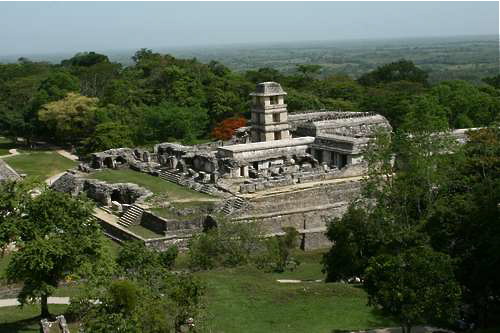
The Palace at Palenque Archaeological Site, Chiapas, Mexico
Vicente Fox took office as president of Mexico in December 2000. Not long afterwards, social organizations in Mexico and Central America learned about an ambitious plan called the Plan Puebla-Panama (PPP), a virtual corporate wish list of “development” projects. It instantly became controversial because it threatened to displace people, damage the environment and sell off the region’s natural resources to transnational corporations. It was also severely criticized for its failure to consult with those affected and for the secrecy of its plans. Organizations formed in Mexico, Central America, the United States and Europe and joined together in an international network to oppose the PPP.
The Plan Puebla-Panama encompassed the southern (and heavily indigenous) Mexican states of Puebla, Veracruz, Tabasco, Oaxaca, Guerrero, Chiapas, Yucatan, Campeche and Quintana Roo. It also encompassed the seven Central American countries of Guatemala, El Salvador, Honduras, Nicaragua, Costa Rica, Belize and Panama.
The purpose of the PPP was to develop the infrastructure needed for a dramatic expansion of trade via the North American Free Trade Agreement (NAFTA) and the Central American Free Trade Agreement (CAFTA). Free trade agreements establish the legal structure for trade, while the PPP was to develop the infrastructure. The eight initiatives of the Plan were: 1) sustainable development; 2) human development; 3) prevention and mitigation of natural disasters; 4) promotion of tourism; 5) facilitation of trade; 6) highway integration; 7) energy interconnection; and 8) integration of telecommunications services.
In Chiapas the PPP initially envisioned at least 10 dams on various rivers, including the Usumacinta, Jataté and Lacantún, sweatshops in the central part of the state and mass tourism from the state’s Pacific Coast to the Usumacinta River.
Resistance to the PPP appeared to be successful. The PPP got a bad reputation and a public relations firm was employed to clean up its negative image. This led some to wrongly assume that the PPP was dead.
An important function of the PPP was to obtain financing for infrastructure projects, such as new or improved highways, bridges, ports and airports that would facilitate transportation for business ventures. Apparently the PPP was overly ambitious and could not find enough financing. The strong resistance coupled with the lack of financing signaled the demise of the PPP as originally proposed. But, that demise did not stop the infrastructure projects, and for about five years the projects for which funding was available continued without any mention of the PPP.
In June 2008, the heads of the affected countries and the governors of the nine Mexican states involved met together in Villahermosa, Tabasco for the 10th Tuxtla Summit on the Plan Puebla-Panama. They all agreed to rename it the Mesoamerica Project and to reduce the 100 development projects to 5 mega-projects: electricity, highways, telecommunications, cybernetic information and health. The addition of a social aspect (health) to the project may be to soften the impact of its more controversial aspects, like electricity and highways, both of which imply the displacement of indigenous people and environmental damage.
Some of the infrastructure projects that have been completed in Chiapas are:
1) Puente Chiapas – A bridge over the lake created by the Malpaso hydroelectric dam near the Chiapas border with Veracruz, which completed the highway connecting a large Gulf of Mexico port to the Pacific Highway in Chiapas and cut the travel time between Mexico City and Tuxtla Gutierrez to around 12 hours.
2) Puerto Chiapas – What was formerly known as Puerto Madero, a natural harbor on the Pacific Coast, was dredged and made into a deep-water port for shipping raw materials out and bringing in cruise ships full of tourists.
3) Angel Albino Corzo International Airport – A new international airport located in Chiapa de Corzo, near the state capital of Tuxtla Gutiérrez, facilitates both business travel and tourism.
4) Tuxtla-San Cristóbal Highway – A new toll road that whisks tourists from the new airport near Tuxtla to the colonial tourist Mecca of San Cristóbal de las Casas in one hour. It also facilitates commerce between the two rapidly growing cities.
5) Puente San Cristóbal – A bridge between two mountains that completed the toll road between Tuxtla Gutiérrez and San Cristóbal de las Casas.
All of these infrastructure improvements facilitate commerce, attract investment and pave the way for elaborate tourist development. None of them has met with significant opposition.
One infrastructure project that has generated controversy and prolonged resistance is the construction of a toll road between San Cristóbal and the city of Palenque, the jungle city located a couple miles from the internationally famous archaeological site with the same name. The toll road will cut through numerous indigenous villages and territories, some of them Zapatista. Resistance to the toll road has resulted in violent confrontations between pro-government and pro-Zapatista groups, unjust imprisonment, torture and one death in the Mitzitón ejido, situated where the toll road begins.
The strongest resistance has been and will continue to be directed towards the massive development project the toll road is intended to facilitate: the Palenque Integral Center, known as the CIP for its initials in Spanish. This tourist project includes expansion of the small Palenque airport to accommodate international flights. Construction at the airport began several years ago and was completed in February 2014. The airport’s expansion is not the controversial part of the CIP project. It is the plan for development of a tourist corridor, approximately 35 miles long, between the Agua Azul Cascades and the Palenque archaeological site that is disputed.
A number of large ejidos (collective farms), some of them containing communities of Zapatistas and their supporters, are located within that 35-mile corridor. In addition to the Agua Azul Cascades and the Palenque Ruins, the Misol Ha Waterfall and the Agua Clara area for swimming and camping are also within the corridor. The Palenque site is an archaeological wonder left to us by the ancestors of the modern-day Mayas that inhabit this part of the state. The Agua Azul Cascades are a series of turquoise blue waterfalls that cascade down a mountain surrounded by lush green jungle.
The CIP project contains an elaborate plan to convert the area surrounding the Agua Azul Cascades into a “world-class resort destination.” The government plan includes a Boutique Hotel, a European 5-Star Hotel, a Conference Center with golf course, and a Lodge overlooking the waterfall at Bolom Ajaw, a Zapatista community on land reclaimed in 1994. But of course, one would have to helicopter into the Lodge at Bolom Ajaw due to its remoteness!
The Agua Azul area has become a flashpoint of conflict between pro-government communities (in favor of luxury tourist development) and pro-Zapatista communities (opposed to that kind of development). The controversial project proposed for Agua Azul has already generated three deaths, numerous violent conflicts, political prisoners, death threats and torture. The state government argues that these tourist projects will bring jobs and income into a very poor state, while Zapatista supporters and their allies argue that the volume of tourism envisioned will damage the environment, their food security and their traditional way of life; that is, their culture. In a state where two-thirds of the population is indigenous and that indigenous culture is one of the tourist attractions, this is an important debate.
* This article was originally written in November 2013 for educational background information. It is included in the recently published book “Mayan Whitewater: Chiapas & Belize” by Greg Schwendinger and Rocky Contos.
Indigenous Zapatista Supporter Murdered in Chiapas
ASSASSINATE YOUNG INDIGENOUS LEADER IN CHILON, CHIAPAS
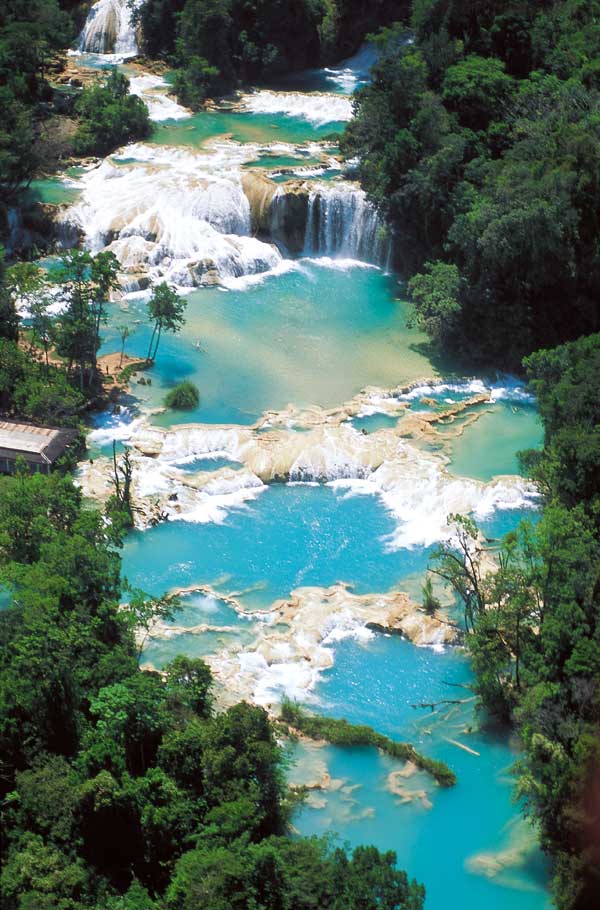
The Agua Azul Cascades, near San Sebastián Bachajón
By: Hermann Bellinghausen, Envoy
San Cristóbal de las Casas, Chiapas, March 22, 2014
Juan Carlos Gómez Silvano, adherent to the Sixth Declaration of the Lacandón Jungle from Chilón municipality, was assassinated this Friday on a dirt road in the same location. According to versions picked up by La Jornada, the indigenous man received at least 20 shots.
Koman Ilel, an alternative media of this city, pointed out that Gómez Silvano, a 21-year old Tzeltal campesino, “participated in the construction of autonomy on land recuperated from the Virgen de Dolores plot” in the municipality and was the regional coordinator of the Sixth Declaration, convoked by the Zapatista National Liberation Army (EZLN, its initials in Spanish). His community is organized in resistance with the San Sebastián Bachajón ejido.
According to the local press, Gómez Silvano was allegedly traveling alone in a small Nissan farm truck. His body was found at the Chapapujil crossing, near the municipal capital of Chilón. According to “unofficial” versions of the state’s judicial authorities, the Public Ministry agent Octavio Bautista Martínez arrived at the crime scene to pick up the body of the young indigenous leader, but a large group “of masked people” had taken it away “to bury it.”
For its part, Koman Ilel remembers that less than a year ago Juan Vázquez Guzmán, a leader of the Sixth from San Sebastián Bachajón, was executed, also in the capital of Chilón. “Why do they murder them?” the informative note asks, and exposes that the San Sebastián Bachajón ejido “has maintained a strong struggle against the dispossession of its territory for years.”
It points out that: “different actors, among which are found the municipal, state and federal governments; transnational companies (Norton Consulting) and paramilitary groups impel legal and illegal strategies for accomplishing one of the region’s most ambitious projects, part of the Plan Puebla-Panamá: the Palenque Integrally Planned Center, a network of infrastructure and services that seeks to join together natural and archaeological attractions for an elite tourism,” converting the indigenous population “into servants,” in their own communities.
One of the government strategies for securing territorial control, adds the information from Koman Ilel, “has been the cooptation or intimidation of ejido authorities, as well as legal persecution and selective murders of those that are opposed to being dispossessed, as is the case with the compañeros Juan Carlos Gómez Silvano and Juan Vázquez Guzmán.”
The Green Ecologist Party of Mexico currently governs both Chilón and Chiapas. The authorities have been complicit or remiss, at least, faced with the aggressions systematically suffered by the ejido owners in resistance. Mayor Rafael Guirao Aguilar, for sure, also presides over the state’s Green Chiapas Foundation, which supports his fellow party member Governor Manuel Velasco Coello.
—————————————————————-
Originally Published in Spanish by La Jornada
Translation: Chiapas Support Committee
Sunday, March 23, 2014
En español: http://www.jornada.unam.mx/2014/03/23/politica/017n1pol
Indigenous Peoples from 5 Mesoamerican Countries Form Front Against Mining
AGAINST THE IMPERIALISM AND NEOCOLONIALISM OF MINING COMPANIES, THE CURRENT BATTLE OF THE PEOPLES
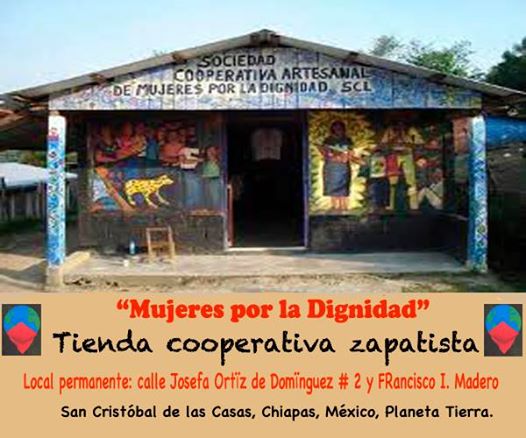
A New Store for Zapatista Women’s Cooperative
** Organization is required to win, NGO’s from several countries point out in Puebla
** Emissaries from Mexico, Panama, Guatemala, Honduras and El Salvador expose abuses of transnationals
By: Rosa Rojas
Tlamanca, Puebla, March 15, 2014
The struggle against extractive mining “it’s not only for our life, but also an anti-imperialist struggle and against neo-colonialism that is imposed on the peoples with the servile attitude of the neoliberal governments and the agreements on free trade and on protection for foreign investment,” according to what was made clear here today after the exposure of particular cases of problems with mining companies that communities from different states of the country confront, as well as those in Panama, Guatemala, Honduras and El Salvador.
It was also clear that to make a front against this “fourth colonization,” organization of the peoples is necessary, their taking of consciousness about what environmental destruction means, which is at the same time the basis for sustaining their life; and mobilization and unity in local, regional, national and international action, because we’re battling “against a monster” multi-formed, transnational, which when it suffers a defeat in any place changes for social reasons, even its nationality –a Mexican mining company sells its concession to a Canadian one, which in turn transfers it to an Australian one– without changing its essence: the rapacity of capital.
The Encuentro of Peoples Against the Extractive Mining Model was organized by the Communities in defense of land and life, the Tiyat Tlalli Council, the Mexican Network of Those Affected by Mining, the Mesoamerican Movement Against the Extractive Mining Model, the Center of Studies for Rural Development (Cesder, its initials in Spanish) and the School of Economics of the Autonomous University of Puebla. This Saturday, representatives of the organizations and nations cited above, environmentalists, indigenous peoples and campesinos from Morelos, Chiapas, Oaxaca, Puebla, Guanajuato, and Guerrero and of the Wirrarika (Huichol) people of Jalisco, Nayarit, Durango, Zacatecas and San Luis Potosí (that are only one people, despite the state borders) paraded to the podium.
In some cases, like in Carrizalillo, Guerrero –in the High Mountains of that state–, the battle has already lasted for eight years and the damages to the population’s health and to the environment caused by the Canadian mining company Gold Corporation are manifested in skin and bronchial diseases, congenital deformities, premature births that spill over into the death of 68 percent of those born prematurely, destruction of 11 of the town’s natural springs due to the explosions that the mining company carries out, use and contamination of millions of liters of water per day, and all of that topped of with the cherry of the Federal Prosecutor for Environmental Protection’s (Profepa) “clean industry” certification to the mining company.
In other cases, one of the participants explained, like in El Huizache, in the sierra of Lobos, Guanajuato, the fight is barely beginning; although the exploration work has been advancing, contracting some of the zone’s small property owners that are happy to have work in a place where agriculture is not prodigious, but they have become alarmed because of what they see coming if the concession delivered for an open slash deposit is put into effect. There is a mining tradition in the state –but underground–, thus many people don’t understand the alarm that the new type of industrial mining that approaches has awakened.
Omayra Silvera, of the Coordinator for the Defense of Natural Resources from the Comarca Ngäbe Buglé, of Panama, reported that she comes from an indigenous people that “have made the government tremble” with their mobilizations of more than 6,000 people, including the Inter-American Highway blockage, from border to border, from February 1 to 5, 2012, whose government repression left two dead, hundreds injured, prisoners, and women raped, but the support from international organizations of women, churches and university members “obliged the government to sit down at the negotiating table.”
Said dialogue, she said, resulted in winning the expediting of a special law on the part of the Panamanian Congreso, on March 26, 2012, which cancelled 25 mining concessions and 147 hydroelectric dams that had been granted on indigenous territory of the Ngäbe Buglé, which encompasses 6,968 square kilometers. But the struggle isn’t going to end there, “we are still at the brink of war because they published that a company is going to enter to exploit the Cerro Colorado (Red Hill),” which is one of the largest copper deposits in the world, “because if we remain with our arms crossed, who is going to listen to us?” Omayra asked, in the midst of an ovation from the attendees.
Hermila Navarrete, from El Salvador, related that since 2005 they have not let the Canadian mining company Pacific Ring enter, and that the struggle of the Association of Friends of San Isidro Cabañas led to the government of Mauricio Funes, of the Farabundo Martí National Liberation Front, to expedite a decree that promises that there will be no mining concessions in its administration, which has accepted a complaint before the International Center for Settlement of Differences Relative to Investments for more than 300 million dollars, and the threat of the United States government no to deliver part of the Millennium Funds.
The mine in question, El Dorado, Navarrete indicated, is for gold, silver and uranium. The capital is no longer Canadian, but rather Australian, since Oceana Gold bought the concession.
The representative of the Maya people of Guatemala mentioned that in this “fourth colonization” that our peoples confront, “Guatemala, like Mexico and Central America, is conceded” to transnationals, and that his organization has given birth to “a peaceful struggle of prevention,” promoting more than 80 consultations with the peoples, with many other municipalities; in other words, close to a million people have been consulted that have said “no to mining.”
He also pointed out that as part of the resistance struggle town councils have been constituted in all of western Guatemala, and there are more than 3,000 centers of resistance and struggle in the country, which has cost them “legal cases, criminalization, political prisoners, deaths…” He reported that a few days ago the Chuj, Acateco, Cojtí Plurinational Government was constituted, and on a national scale they have the Council of Huitzilense Peoples and they are part of the Mesoamerican Movement Against Extractive Mining.
Juan Almendarez, from the Mother Earth Movement of Honduras, emphasized that the struggle against extractive mining is anti-colonialist, anti-imperialist and geostrategic, because in his country “mining has never been separated from the Army and police.”
—————————————————————————–
Originally Published in Spanish by La Jornada
Translation: Chiapas Support Committee
Sunday, March 16, 2014
En español: http://www.jornada.unam.mx/2014/03/16/politica/010n1pol
Ostula: Autonomy, Self-Defense, Natural Resources and Narcos
The community recuperation of Xayakalan on the Michoacán Coast is about their lands, guards and autonomy
All kinds of interests cross each other within their territory: the governments seek to implement highway projects that facilitate the shipment of merchandise and stimulate tourism at the beaches; the mining companies want to exploit the vein that originates in San Miguel de Aquila; the small property owners want to plant their lands or subdivide and sell them; and, the drug traffickers have an important point for circulation of their merchandise here.

Self-defense forces (autodefensas) enter Xayakalan, Michoacán
By: Adazahira Chávez
Organization of the Nahua community of Santa María Ostula, Michoacán, in its struggle for land, was renewed in February of this year. Later, in June 2009, the comuneros activated their Policía Community Police and took back the place known as La Canaguancera (renamed Xayakalan). They confronted a wave of murders and disappearances —especially against members of the traditional guard of the communal wealth (commission)— that established a climate of terror and obliged the displacement of entire families.
But they are returning now and, as they declared in 2009, assert that they will not abandon their lands. Recently, accompanied by self-defense groups from Tierra Caliente, the community guards re-entered their territory —many of them, like their commander Semeí Verdía, were exiled— and the displaced comuneros also returned to Xayakalan, which continues in a legal dispute with the small property owners of La Placita, who invaded it four decades ago. The urgent task, they point out, is to construct the assemblies and to work the lands that gave them sustenance and that they had to abandon.
The task does not look easy, and the Nahuas know it. They tell that all kinds of interests cross each other within their territory: the governments seek to implement highway projects that will facilitate the shipment of merchandise and stimulate beach tourism; the mining companies want to exploit the vein that is born from San Miguel Aquila; the small property owners want to plant their lands or subdivide and sell them; and the drug traffickers have an important circulation point here for their merchandise. In this state —according to the denunciations that the comuneros have made for years— many times these actors are the same subjects. And the comuneros of Ostula are the owners of this coveted land.
Rich land, dispossessed [stolen] land
The communal capital de Ostula and its 22 administrative districts encompass more than 28,000 hectares (approximately 69,000 acres) of Aquila Municipality, one of those of greatest marginalization in Michoacán. The Nahuas have populated the portion of their territory that extends to the Michoacán Coast little by little.
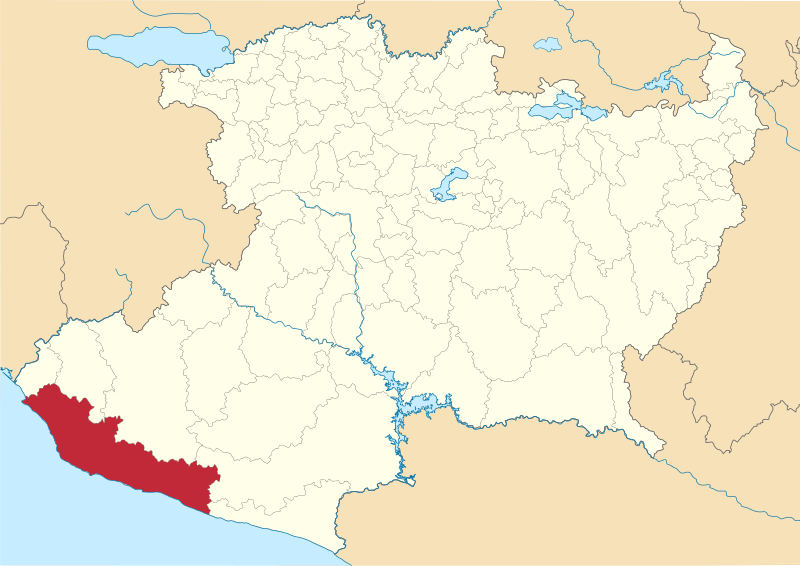
Municipality of Aquila, Michoacán, which lies along the Pacific Coast, is in red.
The lands corresponding to the district of Xayakalan, the comuneros report, are located inside of their land titles that in the 18th Century were the very first and also inside of the Presidential Resolution that recognized part of its territory in 1964. Despite that, they confront agrarian litigation over some 700 hectares that six small property owners of La Placita invaded “not only for the planting of papaya, mango and tamarind, but also to sell it to the highest bidder” in spite of precautionary measures in favor of the indigenous. The Commission for the Defense of the Communal Wealth of Ostula points out that some of those invaders are heads of organized crime in the region.
Aquila’s land has an abundance of minerals (silver, zinc, gold and copper), besides iron deposits, which the Ternium, Sicartsa and Metal Steel companies currently exploit, and it contributes one fourth of the national production. The vein that runs through San Miguel Aquila —a community from which members of the traditional guard and the comuneros also had to leave due to conflicts with the mine and with organized crime— arrives in the lands of Ostula, and the Argentine company Ternium has in sight its future exploitation. Ternium is the owner of half of Peña Colorada, the mine in Ayotitlán, Jalisco, which has also provoked persecutions against leaders of the Nahua comuneros like Gaudencio Mancilla.
Inside of this invaded territory pass not only the rich mineral veins, but there are also beaches with animal species in danger of extinction. There, they contemplate the expansion of the Coahuayana-Lázaro Cárdenas Highway, and even the construction of a port for transporting the materials that Ternium extracts from San Miguel Aquila.
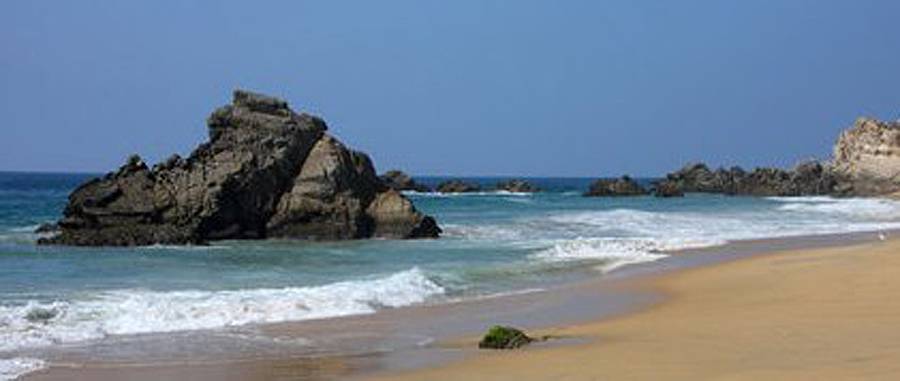
Pristine beach in Aquila Municipality, Michoacán.
On June 13 and 14, 2009, the National Indigenous Congress published the Ostula Manifesto, which vindicated the right to self-defense. After several fruitless attempts at negotiation and upon feeling mocked by the government, the comuneros took back the lands of Xayakalan in 2009, established their community guard “to care for the territory that belongs to us” and around 250 people, belonging to 40 families, settled here.
Los comuneros decided not to participate in the 2011 official (national) elections, just like their Purépecha brothers of Cherán, Pómaro and Coíre, in rejection of the authorities’ lack of efficiency and the divisionism that, they denounced, the political parties promote.
The response to their challenge was deafening. In the last three years, 32 residents of Ostula were brutally murdered or disappeared. The executions in 2011 of the leaders Trinidad de la Cruz Crisóstomo, known as don Trino or el Trompas, in charge of the community guard, and of Pedro Leyva stand out. The Navy bases —that were established after 2009— did not help to stop the wave of violence. Judicial authorities did not resolve even one single crime. Bullets from the “goat horns” (AK- 47s) populated the crime scenes, and the threatened families fled.
Few residents stayed in Xayakalan, but those displaced occupied themselves with planning their return and the reconstitution of their autonomous organization, which was concretized this 2014. On February 8, “a group of comuneros of Santa María Ostula, in coordination with self-defense groups from the municipalities of Coalcomán, Chinicuila and from the capital of Aquila, took control of the tenancy of Ostula,” they reported in a public document.

Xayakalan
Coincidentally, since that day “groups of federal ministerial police and members from the public ministry, in a totally illegal way, have been threatening the comuneros that live in Xayakalan with evicting them.” For the indigenous it is “the continuation of the grave conditions of an undeclared war that Ostula has lived through precisely since it resolved to guard the lands of Xayakalan, on June 29, 2009.”
This February 10, a federal Army platoon attempted to disarm the community guard and the self-defense groups that were supporting them, but residents made the soldiers return the weapons. On February 13, more than 1200 comuneros in an assembly decided to formally reorganize the Community Police. Now, efforts are centered on strengthening community decision mechanisms, reconstructing the material base for their organization and survival —food and scarce resources— and on maintaining security within their territory. Despite the years of terror, they indicate to Ojarasca from Ostula, “the people respond to their ancestral organization.”
——————————————————–
Originally Published in Spanish by Ojarasca #203
La Jornada Supplement, March 2014
Translation: Chiapas Support Committee
En español: http://www.jornada.unam.mx/2014/03/08/oja-costa.html
Raúl Zibechi: Reclaiming the Strategic Debate
RECLAIMING THE STRATEGIC DEBATE

By: Raúl Zibechi
It seems evident that we are before a turn of history. What happens in the next few years, added to what is already happening, will have a long-term effect. What we do, or what we stop doing, is going to have some influence on the immediate fate of our societies. We know that it is necessary to act, but it is not clear that we are capable of doing it in the appropriate direction.
The recent events in Ukraine and Venezuela intensified the sensation that we are facing decisive moments. This juncture reveals that violence will play a decisive role in the definition of our future: war between states, struggle between classes, violent conflicts between the most diverse groups, from gangs to drug trafficking organizations. As happened in other periods of history, violence starts to decide junctures and crises.
Violence is not the solution, and the longer we are able to postpone it the better. “Without violence we will not be able to achieve anything. But violence, as very therapeutic and efficient as it may be, does not resolve anything,” Immanuel Wallerstein wrote in the preface of Frantz Fanon’s book Black Skin, White Masks. Being prepared for violence, but subordinating it to the objective of social change, is part of the necessary strategic debates. (Emphasis added.)
I mention the question of violence because of what’s happening in Venezuela and the Ukraine, in Bosnia, South Sudan, Syria and more places all the time. Like it or not, the conflicts are not being resolved in voting booths, but rather in the streets and in the barricades, by means of insurrectional arts that the right is learning to use for its purposes, supported by the big Western powers, the United States and France in an emphatic place. What’s called democracy languishes and tends to disappear.
I never tire of reading and reproducing the view that the journalist Rafael Poch sent from Kiev’s Maidán Square: “In its most massive moments some 70,000 people have congregated in this city of 4 million residents. There is a minority among them of several thousand, perhaps four or five thousand, equipped with helmets, rods, shields and bats for confronting the police. And inside of that collective there is a hard core of perhaps 1,000 or 1,500 purely paramilitary people, disposed to die and to kill, which represent another category. This hard core has made use of firearms” (La Vanguardia, 2/25/14).
Multitudes protesting and small decided and organized nuclei confronting state apparatuses that usually lose all restraint. They succeed for three reasons: because there are tens of thousands in the streets that represent the sentiment of a part of the society, which legitimizes the protest; because there is a “vanguard” often trained and financed from the outside; and because the regime is not in any condition to repress them, either because of weakness, a lack of conviction or because it has no plan for the following day.
That the right may have photocopied the revolutionaries’ ways of doing things and uses them for their own ends, and that they count on abundant support from imperialism, doesn’t make the central question: how to confront situations in which the State is overwhelmed, neutralized or used against those from below?
My first hypothesis is that the anti-systemic forces are not prepared to act without the state umbrellas. Almost all of the continent’s progressive governments were possible thanks to direct action in the streets, paying a high price for putting one’s body on the line, but that dynamic remains very far away and is no longer the patrimony of the movements. Putting one’s body on the line stopped being the common feeling of protest ever since the state shield reappeared with the progressive governments.
The second is that confidence in the State paralyzes and morally disarms anti-systemic forces. To my way of seeing, the worst consequence of this confidence is that we have disarmed our old strategies. This point has two sides: on the one hand, it’s not clear what kind of world we’re struggling for, when state socialism stopped being a projection for the future. On the other hand, because it is not up for debate whether we affiliate with the insurrectional thesis or the prolonged popular war, in other words the European and Third World types of revolution.
I don’t want to linger on the electoral question because I do not consider it a strategy for changing the world, not even a way of accumulating forces. I understand that there are better and worse governments, but we cannot take the electoral path seriously as a revolutionary strategy. In sum, we are not debating the how. Meanwhile, the right does have strategies, in which the electoral plays a decorative role.
Between insurrection and popular war, Zapatismo inaugurates a new path, which combines the construction of non-State powers defended by the communities and support bases with weapons in hand, with the construction of a new and different world in the territories that those powers control.
It can be argued that we’re dealing with a variable of the popular war sketched by Mao and Ho Chi Minh. I don’t see it that way, beyond some formal similarity. I believe that the radical innovation of Zapatismo cannot be comprehended without assimilating the rich experience of the indigenous movement and of feminism, on a crucial point: they do not struggle for hegemony, they do not want to impose their ways of doing. They just act; and the rest decide whether or not to accompany them.
There is a trap in this argument. One cannot “struggle for hegemony” because it would be transmuting it into domination, something that the triumphant revolutions quickly forgot. Hegemony is attained “naturally,” to use a term related to Marx: by contagion, empathy or resonance, with ways of doing that convince, create and enthuse. It seems to me that reclaiming the strategic debate is more important for changing the world than the endless denunciations against imperialism. It’s still necessary to sign manifestos, but it’s not enough.
————————————————————————————-
Originally Published in Spanish by La Jornada
Translation: Chiapas Support Committee
Friday, March 7, 2014
En español: http://www.jornada.unam.mx/2014/03/07/opinion/025a1pol
Venezuela: Cubs of Reaction
Luis Hernández Navarro speaks out on Venezuela
Venezuela: cubs of reaction
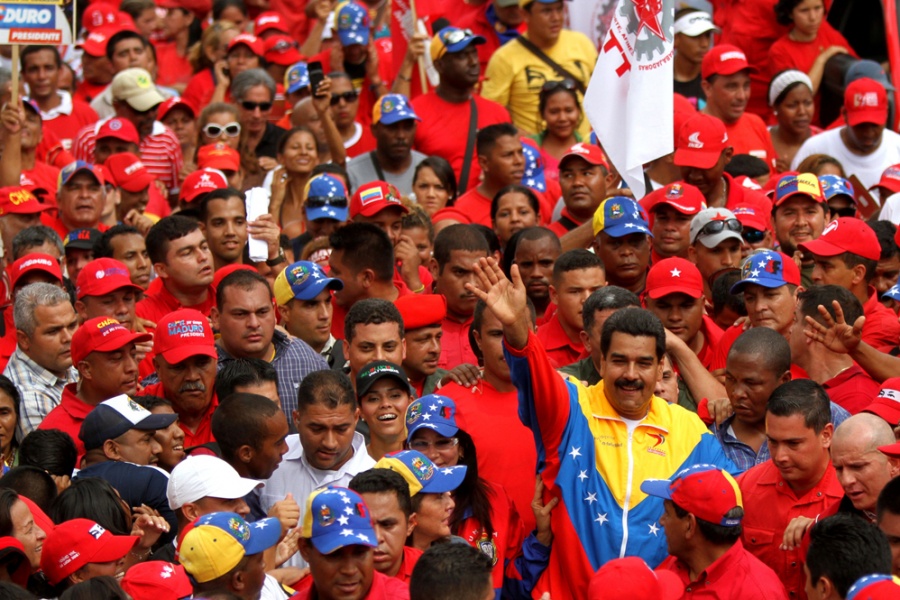
Venezuela Celebrates May Day 2013
By: Luis Hernández Navarro
Lorent Saleh is a 25-year old Venezuelan youth, with flaming language, who studied foreign trade. He is one of the visible heads of the coalition that seeks to overthrow President Nicolás Maduro. He directs Operación Libertad (Operation Freedom) organization, which locates Cuban Castro-communism as the principal enemy of Venezuela.
Lorent began his task against the Bolivarian Revolution in 2007. Since then he has not let up. He organizes hunger strikes that campaigns as Chávez lies. Although he abandoned the classroom years ago, he still introduces himself as a student leader. And, although he has no known employment, he travels around Latin America to try to isolate the Maduro government.
The young Saleh has good friends in diverse countries. In Colombia, for example, the Nationalist Alliance for Freedom and Third Force, neo-Nazi groupings, protect and promote him (El Espectador, 21/7/13).
Vanessa Eisig is a pleasant 22-year old blond woman, who wears glasses and describes herself on her Twitter account as a “warrior for light and bigamous, married to my career and to Venezuela.” She studies communications in the Andrés Bello University and confesses that, by participating in the protests, she feels that she makes history.
Vanessa is a member of United Active Venezuela Youth (JAVU, its initials in Spanish). It demands “the removal of the usurper Nicolás Maduro and all of his cabinet.” The organization has a white right fist as its emblem, which –the young woman says– “is a sign of resistance and of mockery at socialism.”
JAVU, which impels the Operation Freedom initiative, has performed a relevant role in the current disturbances that take place in Venezuela. Founded in 2007, the organization defines itself as a youth resistance platform, which seeks to overthrow “the pillars that sustain a government that scorns the Constitution, wounds our rights and delivers our sovereignty to the orders of the decrepit Castro brothers.”
In its comunicado of February 22 of this year, JAVU denounced that: “foreign forces have militarily besieged Venezuela. Their mercenaries attack us in a vile and savage way. Their objective is to enslave us.” Getting their freedom, they point out, is vital “defending the nation’s sovereignty, expelling the Cuban communists that are usurping the government and the Armed Forces.”
JAVU is inspired and has a close relationship with the Otpor, which in Spanish signifies Resistance, and with the Center for the application of non-violent actions and strategies (Canvas). Otpor was a student movement created in Serbia to remove the government of President Slobodan Milosevic in 2000, which received financing from US government agencies. Canvas is the new face of Otpor.
The guru of those groups is the philosopher Gene Sharp, who vindicates “non-violent” action to overthrow governments. Sharpe founded the Albert Einstein Institute, the promoter of the so-called revolutions of colors in countries that are not similar to the interests of NATO and Washington.
Cables distributed by Wikileaks made public that Canvas –present in Venezuela since 2006– elaborated for the opposition of that country a plan of action, in which it proposes that the student groups and “the informal actors are the ones capable of constructing an infrastructure and exploiting their legitimacy” in the struggle against the government of Hugo Chávez.
The relationship between JAVU, Otpor and Canvas is very tight. As Marialvic Olivares, a member of the extreme right group confessed: “the international organizations that are supporting us at this time always have been at our side, not only in questions of protest, but also in questions of formation, and us with them we have always been at their side. We are not ashamed, we are not afraid to say it.”
But the links between the young Venezuelan student leaders and the think tanks and agencies in cooperation with the right go far beyond the alliance with Otpor/Canvas. Different US foundations have openly financed the dissident movement. They have also counted on support from the Partido Popular of Spain and with the youth organization of Silvio Berlusconi in Italy.
It is the case of the young lawyer Yon Goicoechea, a brilliant star of the 2007 protests and that now is studying for a masters degree at Columbia University, after affiliating with the party of Henrique Capriles and abandoning it when they didn’t give him a deputy position. In 2008 he was generously compensated for his commitment to struggle against Hugo Chávez. The Cato Institute awarded him the Milton Friedman Prize for Freedom, a grant of half a million dollars.
Another force that has played a relevant role in the attempt to depose Maduro is the March 13 University Social Movement, a student organization that acts in the University of the Andes. Its more known leader is Nixon Moreno, an old student of political sciences, accused of raping Sofía Aguilar, now a fugitive and exiled in Panama.
Those youths know what they do: promote political destabilization. They receive international financing. They are active members in the ranks of the ultra-right and anti-communism. They are xenophobes. They are linked with Nazi and conservative organizations in several countries. And they march elbow to elbow with politicians of the radical right like Leopoldo López, María Corina Marchado and Antonio Ledezma.
Despite receiving all this support, Lorent Saleh of Operation Freedom, laments: “We are tremendously alone.” They are partly right. They don’t awaken sympathy or solidarity among Latin American youth. To the contrary, they arouse mistrust and repudiation. And it is how the holder of the pen sees them. Their cause has nothing to with the ideas of the 1968 Mexican student-popular movement. Not in vain do the combative Chilean students repudiate them publically. To them, the cubs of reaction are unpresentable.
———————————————————-
Originally Published in Spanish by La Jornada
Translation: Chiapas Support Committee
Tuesday, March 4, 2014
http://www.jornada.unam.mx/2014/03/04/opinion/021a1pol
EZLN Governs 250,000 Indigenous Mexicans
EZLN Governs 250,000 Indigenous Mexicans
Over the course of twenty years, the Zapatista insurgents have founded schools, hospitals, coffee exporting cooperatives, and even banks. Their model has also inspired the growth of community police forces, forest guards, and resistance movements around Mexico. However, they still have work to do in terms of justice and openness to the world.

Zapatista Community Store
By: Laura Castellanos*
Morelia Caracol, Chiapas – In the wooded heart of Chiapas, the highest authority in the Zapatista region (or Caracol) of Morelia meets to discover the motives of our visit and decide whether we can enter or not. Known as the Good Government Board (Junta de Buen Gobierno, or Junta), the group is made up of three young women, two older women, and three men – none of whom receive a salary.
Dressed largely in traditional indigenous clothing, they all write down our names in their notebooks. Unlike the majority of images seen of the Zapatistas, the committee members do not have their faces covered. However, they are wary of our presence, and a serious-looking young woman of about seventeen years old asks us why we are here. Our answer is that we had previously witnessed the Zapatistas’ rupture of relations with the state and federal governments – and the subsequent creation of autonomous forms of government, justice, education and healthcare – and that we want to report on their progress.
According to a confidant close to the EZLN, there are around 250 thousand Tzeltales, Tsotsiles, Tojolobales, Choles, Zoques, and Mames (Maya ethnicities) living under the system of self-management in the twenty-seven Autonomous Zapatista Rebel Municipalities (MAREZ, their initials in Spanish). They represent twenty-one percent of the indigenous population of Chiapas, which stands at around 1,141,499, according to INEGI (the National Institute of Statistics and Geography).
On January 1st 1994, as NAFTA went into effect, the EZLN rose up against the Mexican government, demanding land, food, work, healthcare, education, housing, justice, and equality for the nation’s indigenous population. Twenty years later, the movement is sharing its achievements with the world, such as four regional hospitals equipped with operating rooms – found on the border with Guatemala, in Los Altos, in Tzotz Choj and the Lacandón Jungle (where the hospital is specialized in reproductive and sexual health) – and dozens of municipal clinics. In addition, 1,100 midwives and 1,500 herbalists have been trained.
Central Figures
In the field of education, Bruno Baronnet – doctor of social sciences from the Colegio de México and the Sorbonne University in Paris – recorded the presence of more than 500 primary and secondary schools “in resistance”, where 1,500 educators teach and from which 45,000 youngsters have graduated. Author of the book “Autonomy and Indigenous Education: The Zapatista Schools of the Lacandón Jungle in Chiapas,” Baronnet emphasizes that these youngsters go on to serve their communities in terms of healthcare, education and communication, whether as authorities in an ejido (collective farm) or an autonomous municipality.
The Zapatistas have also created two banks – one of which is the Autonomous Bank of Zapatista Women (BANAMAZ) – along with dozens of ecological farming cooperatives, animal farms, community shops, brick factories, bakeries, and handicraft workshops. On top of this, they produce medicinal herbal products and export coffee to Italy, Germany, France, and Greece.
Francisco Bárcenas is the author of twenty books about indigenous communities, one of which is titled “Autonomy and Indigenous Rights in Mexico.” He believes that, since the EZLN uprising, indigenous communities have moved from being marginal figures to central figures in politics, saying “indigenous people have been responsible for the most important struggles in Mexico and Latin America in the last twenty years.”
However, he also points out that “the quality of life and respect for the rights of indigenous people is the same as it was twenty years ago, and in some cases worse, though this does not depend on the Zapatistas but on government policies.”
The Caracoles
The five Zapatista Caracoles (La Realidad, Morelia, Roberto Barrios, La Garrucha, and Oventic) were created in 2003. In the Oventic Caracol, one militant explained his own understanding of Zapatista autonomy as follows: “we don’t accept help from the bad government. All that we have comes from our own hard work and effort and our aim is to ensure the welfare of everyone.”
One example of this philosophy is that both Zapatistas and non-Zapatistas are treated in the autonomous health institutions. A civilian source told me that the small hospital in Oventic – with emergency services; surgeries; and gynecology, ultrasound, dental, optical, and endoscopic services – has attended to “PRI supporters, AMLO sympathizers, and even soldiers.”
The creation of the Caracoles came in response to the legislative rejection of the San Andrés Accords by all Mexican political parties in 2001. These accords would have constitutionally recognized the right of indigenous communities to autonomy, justice and equality. The fruit of seven years of negotiations between the government, intellectuals and indigenous organizations, its rejection was incredibly disenchanting. However, the EZLN took matters into its own hands, creating the Caracoles as a representation of the right to autonomy that had been constitutionally denied to indigenous communities.
The regions were formed from 27 autonomous municipalities, dispersed along a corridor that occupies a third of the state of Chiapas – including the border area with Guatemala, Tzotz Choj, the wooded area of Los Altos, and the Lacandón Jungle.
Each Caracol is independent and has its own rules, but each one decided that a citizens’ assembly would elect members of the Junta. Members of the Junta deal with internal and external conflicts and coordinate cross-community cooperation. There is no hierarchy between them, no wages, and total transparency regarding their activities. Nonetheless, through their work in the cooperatives, communities usually give the representatives corn or subsidize their transportation.
The Juntas are normally made up of twenty-four people, though this number depends on the Caracol – as does the length of time they serve, which can be around three years, with rotation every week or two. The way in which the Juntas coordinate with other community representatives also varies.
Mariana Mora, author of the book “Decolonization of Politics: Zapatismo, Autonomy, and Indigenous Peoples” which will soon be published, affirms that the EZLN “transformed political work into an ethical one.” Examples of this transformation can be seen in the collective decision-making, empowerment of youngsters and women, and lack of government support with the foundation of the Caracoles.
Marcos Arana, investigator from the Centre of Training in Ecology and Health for Country Workers (CCESC), says that it’s necessary for these communities to open up to the outside world in order to share their achievements as, up to this point, they “have been closed to doing.”
The major challenge for the Caracoles is their system of justice. At the Zapatista School of August 2013, a militant pointed out that there was insufficient infrastructure and a lack of programs for the reforming and retraining of murderers, rapists, and thieves. In a video, recorded for and shared with EZLN sympathizers, the Zapatista says: “Who is going to look after them? Who is going to feed them? Who is going to care for them when they’re sick? That’s why they sometimes escape.”
The Zapatista Effect
One of the pillars of the Zapatista struggle is Convention 169 of the UN’s International Labor Organization, signed by Mexico, in which collective indigenous rights are demanded, including: territory; consultation; free decisions; autonomy; and freedom from discrimination.
The EZLN had an impact on several autonomous indigenous processes after 1994. One of these was the growth of community police forces, starting in 1997 and now present in dozens of municipalities in Guerrero and Michoacán. Another was the creation of forest guards like those found in Cherán, Michoacán.
It also inspired communities, united in the National Network of Resistance to the High Costs of Electrical Energy, resisting payments to the Federal Electricity Commission (CFE) in sixteen states. Equally, projects of ‘monetary resistance’ drew inspiration from the EZLN, such as those involved in creating the alternative ‘Tumin’ currency in Espinal, Veracruz.
Resistance has also spread as a result of the increasing encroachment into Mexican territory of multinational corporations. For example, popular struggles have fought to defend land and natural resources and fight against so-called ‘Mega-Projects’. The Mexican Movement of Dam Victims and in Defense of Rivers (MAPDER), the Network of Mining Victims and other civil society groups have all recorded 55 community conflicts against such projects.
Bárcenas adds to the list of struggles influenced by the Zapatistas, including those of “the Yaquis in defense of water; the Nahuas, Wixaritari, Mixtecs, and Zapotecs against mining companies; and the Zapotecs, Ikoots, and Kiliwas against wind-farming companies”, among others.
An influence seen a lot recently in the news is that of civilian self-defense groups (autodefensas). When the EZLN rose up in 1994, they appealed to Article 39 of the Mexican Constitution, which says “The People have, at all times, the inalienable right to alter or modify their form of government.” This appeal helped to spread the idea of popular right to the armed path and to self-defense.
From October 2011 to December 2013, civilian guards emerged against organized crime, appealing to Article 39, in a dozen municipalities of Michoacán, as well as in 11 indigenous municipalities of Guerrero.
In the rest of the world, the Zapatista ideology gave fuel to the growing alter-globalization movement against neoliberalism – a forerunner of the ‘Indignados’ movement in Europe and the Occupy movement in the USA.
The Struggle Continues with the Coming Generation
On the morning of December 21st 2012, prophetically marked by the Mayan Calendar as the end of time, 40,000 ski-masked Zapatistas appeared in the municipal capitals of San Cristóbal de las Casas, Ocosingo, Altamirano, Las Margaritas, and Palenque. According to the press, two thirds of the protestors were youngsters. Marching through the streets in silence, the EZLN showed the next generation of Zapatistas off to the world.
On that day, Subcomandante Marcos wrote a communiqué, saying: “Did you hear? It’s the sound of your world collapsing. It’s the sound of ours resurgent. The day that was day, was night. And night will be the day that will be the day.” With these comments, the EZLN reaffirmed its presence, reminding the world that it is still fighting to overturn the current world order and it will soon succeed.
* Laura Castellanos is the author of Corte de Caja, a book about her interviews with Subcomandante Marcos in December 2007 and January 2008.
—————————————————————————————–
Originally Published in Spanish by El Universal
Thursday, January 2, 2014
Originally translated and adapted by Oso Sabio
http://ososabiouk.wordpress.com/2014/02/18/ezln-governs-250000-indigenous-mexicans/
Adapted and edited by the Chiapas Support Committee
New Zapatista Magazine – Rebeldía Zapatista
New publication: Rebeldía Zapatista: The Voice of the EZLN
MARCH 1, 2014
Editorial by Subcomandante Insurgente Moisés for the first edition of Rebeldía Zapatista, the Word of the EZLN

Front Cover of Rebeldía Zapatista
We rebellious Zapatistas, along with our mother earth, are threatened with destruction in our Mexican homeland. Both above and below the earth’s surface, the bad governments and bad rich people, all neoliberal capitalists, want to commodify everything they see.
They want to own everything.
They are destructive; they are murderers, criminals and rapists. They are cruel and inhuman, they torture and disappear people, and they are corrupt. They are every bad thing you can imagine; they do not care about humanity. They are, in fact, inhuman.
They are few, but they decide everything about how they will dominate countries that let themselves be dominated. They have made underdeveloped countries into their plantations, and made the underdeveloped capitalist so-called governments of those countries into their overseers.
This is what has happened in Mexico. The neoliberal transnational corporations are the bosses, their plantation is called Mexico, the current overseer is named Enrique Peña Nieto, the administrators are Manuel Velasco in Chiapas and the other so-called state governors, and the badly named municipal “presidents” are the foremen.
This is why we rose up against this system at dawn on January 1, 1994.
For 30 years we have been constructing what we think is a better way to live, and what we have built is available for the people of Mexico and of the world to see. It is humble but healthily determined by tens of thousands of men and women who decide together how we want to autonomously govern ourselves.
Nothing hides what we do, what we want, what we seek; it is all in plain sight.
The bad government on the other hand, that is, the three bad powers and the capitalist system, do everything behind the people’s back.
We are sharing our humble idea of the new world that we imagine and desire with compañeros and compañeras from Mexico and all over the world.
That is why we decided to have the Zapatista Little School.
The Little School is about freedom and the construction of a new world different from that of the neoliberal capitalists.
In addition, it is the people themselves, that is, the bases of support, who are sharing these ideas, not just their representatives. These people, not their representatives, are the ones who will say if they are doing well or if the way that they are organized is working well. That way others can see if things are really like the people’s representatives say they are.
This great “sharing” between all of us, compañeros from the city and the countryside, is necessary because we are the ones who must think about how the world we want should be. It can’t just be our representatives or leaders who think about and decide how that world should be, and they certainly can’t be the ones who say how we are doing as an organization. It is the people, the base, who must speak to this.
You can tell us if this has helped those who attended.
As you will read in the writings in this edition of our magazine REBELDÍA ZAPATISTA, this process has helped the compañeros and compañeras who are bases of support to meet good people from other parts of Mexico and all over the world. This is important because in Mexico there is no government that recognizes the indigenous people in this country. The government only remembers them come election time, as if they were electoral paraphernalia.
It is only through organization and struggle that the bases of support have defended themselves for 30 years now.
The bases of support have done everything possible, and everything that seemed impossible, over these 30 years and this is what they are sharing.
We worked to create the Little School so that the words of the compañeras and compañeros who are Zapatista bases of support could reach much further. With the Little School, their voices carry thousands and thousands of kilometers, not like our bullets on January 1, 1994, that only went 50 meters, or 100 meters, and maybe some 300 or 400 meters. The teachings of the Little School cross oceans, borders, and skies to reach you, compañeras, compañeros.
We rebellious indigenous know that there are other indigenous rebellions that also know what neoliberal capitalism is about.
There are also rebellious brothers and sisters who are not indigenous but who write to share in this edition what they think and how they view this system that is destroying planet earth. That is why we include the words of our anarchist compañeras and compañeros in this edition of the magazine.
Well, compañeros of the Sixth, it is good that those who came saw with their own eyes and heard with their own ears what is happening here, and they left ready and willing to communicate this to those who couldn’t come.
In this first edition of the magazine we will begin to share some of the words and ideas of our compañeras and compañeros who are Zapatista bases of support, families, guardians and teachers, about how they viewed the students at the Little School. Throughout the first editions of our publication we will share the evaluations made by the Little School teachers, votanes, families, and coordinators from the zones of the five caracoles.
Just as you have talked about or published what you lived, heard, and saw in our Zapatista territory, here you can read how we saw and heard those who came and raised the flag of ZAPATISTA REBELLION.
Subcomandante Insurgente Moisés
Mexico, January 2014, 20 years since the beginning of the war against oblivion.
——————————————————————
Originally Published in Spanish by Enlace Zapatista
March 1, 2014
Translated by El Kilombo Intergaláctico
Zapatista News Summary for February 2014
FEBRUARY 2014 ZAPATISTA NEWS SUMMARY

In Chiapas
1. Catholic Nuns Assaulted in Attack on Zapatista Community – During the first two days of February, reports started to come out about a January 30 attack on the Zapatista community of 10 de Abril (April 10th) in which there were serious injuries to several Zapatistas. The aggressors/attackers were from the November 20 ejido in another municipality and called their grouping the CIOAC-Democratic. When 10 de Abril called for medical personnel from the San Carlos Hospital in Altamirano to bring help, the attackers detained the medical personnel and their vehicles, including an ambulance. The aggressors also put their hands all over several nuns in a search for whatever was in their pockets, and ultimately took money and papers out of their pockets. Apparently, the Frayba Human Rights Center notified the Chiapas government of the “urgent” situation and it did nothing. This incident is one of many geared towards dispossessing the Zapatistas of their recuperated land and is part of the “low-intensity” counterinsurgency war. You can read a report here. The national CIOAC organization stated that the aggressors from November 20th are not members of, nor are they affiliated with the national organization.
2. Government Pressure to Privatize Communities in Resistance – Early in February La Jornada issued a series of reports on the northern jungle zone of Chiapas that uncovered government maneuvers used to pressure landholders into privatizing their land. One measure used is to condition Procampo funds on privatization. Procampo is a program that gives cash benefits to peasant farmers. It is funded through the Inter-American Development Bank and designed to offset the negative effects of NAFTA. While many of these communities are in resistance, meaning they do not accept money or programs from the government, there may be a minority living within these same communities that is not in resistance. They DO accept Procampo. Thus, the conditioning of Procampo money on the community agreeing to privatize causes further division within a community. The communities in resistance are supportive of the EZLN in various degrees. Privatizing land is another way to dispossess indigenous communities supportive of the Zapatistas of their land and to foster further political divisions. One report also included an update on the Viejo Velasco Massacre fallout.
3. San José El Porvenir Also Opposes San Cristóbal-Palenque Toll Road – Last month, Los Llanos, a Tzotzil community in the rural part of San Cristóbal de las Casas Municipality, obtained a temporary injunction against construction of the San Cristóbal-Palenque Toll Road until there is a decision on the case. We posted a translation of the news article on our blog. The toll road is one of the infrastructure projects envisioned within the Plan Puebla Panamá (now renamed the Mesoamerica Project). Its purpose is to facilitate tourism. Now, another Tzotzil community affected by the toll road, San José El Porvenir, has announced its opposition to the superhighway and its agreement with Los Llanos. San José El Porvenir is located in the municipality of Huixtán.
4. They Inaugurate Palenque International Airport – On February 12, Mexican President Enrique Peña Nieto and Chiapas Governor Manuel Velasco Coello attended the inauguration of the Palenque International Airport in Chiapas. The opening of this airport represents the completion of another key infrastructure project of the Mesoamerica Project for facilitating tourism and commerce in the Northern Zone of Chiapas. It is anticipated that the airport will receive the first Interjet flight on March 13. Of interest was a statement from the (federal) assistant secretary of Transportation and Communications, Carlos Almada López, about the Palenque-San Cristóbal Toll Road. Almada said that the preliminary design for the superhighway would be finished in May and that will determine the project’s specific trajectory and timetable. After this inauguration it was revealed that the federal government will provide $18 billion pesos for highway construction in Chiapas in order to further facilitate tourism and commerce.
5. Displaced from the Puebla Ejido Return to Acteal and Land Returned to Church – The people displaced from the Puebla ejido extended their stay in Puebla to harvest their coffee fields until February 6. Members of social organizations continued to accompany them. Although they received insults and threats, the harvest was successful. Many of the 98 displaced individuals are members of Las Abejas of Acteal, an adherent to the EZLN’s Sixth Declaration. The displaced have set the following conditions for a permanent return to the Puebla ejido: 1) recognition of the Catholic Church’s ownership of the plot of land in question; 2) recognition and reparations for the damages, to the community for the destruction of work on the church and for the destruction of homes;” and 3) reparations for “personal damages for the robberies and destruction” of personal belongings inside their homes.The land on which the church was being re-built was returned to the Diocese of San Cristóbal de las Casas on February 26.
In other parts of Mexico
1. Amnesty International Human Rights Abuse in Mexico – The Secretary General of Amnesty International (AI), Salil Shetty, visited Mexico from February 15-18. He said that Mexico projected a false image of respect for human rights. While it passes many important laws in that regard, grave human rights violations continue to occur and some of the data even indicate a crisis. Among the grave concerns are the forced disappearances, attacks on journalists and human rights defenders and the abuse of undocumented migrants. What all these violations have in common is the impunity of the perpetrators. He also expressed concern about the self-defense groups (autodefensas). You can read AI’s report “Human Rights Challenges Facing Mexico” here.
2. Santa María Ostula Issues Denunciation And Gets Help From Autodefensas – On February 24, Santa María Ostula posted a comunicado/denunciation on the Enlace Zapatista website. Ostula declared its autonomy in 2009 and is part of the National Indigenous Congress and an adherent to the EZLN’s Sixth Declaration of the Lacandón Jungle. One of the communities the autodefensas visited this month is Santa María Ostula and its village of Xayakalan. According to the denunciation from Santa María Ostula, its residents, together with the autodefensas, took control of Santa María Ostula. Then, on February 10, a Mexican Army platoon entered Ostula and disarmed both the local community police and the autodefensas. The weapons were returned after they convinced the Army that they would be murdered if they were without weapons. 31 members of the autonomous region have been murdered since 2009. On February 13, Santa María Ostula reorganized its community police and, in coordination with the autodefensas, took over the nearby town of La Placita. That is where the people live that murdered the 31 comuneros. The comunicado and several news reports state that some of those living in La Placita are heads of the local drug cartel. The alleged cartel members fled before the community police entered the town. The denunciation states that ever since February 8, federal ministerial police have come to Ostula threatening eviction and it asks national and international civil society to be alert to these threats.
3. Joint DEA and Mexican Navy Operation Nabs El Chapo Guzmán – On February 22, Mexican marines and DEA agents raided an apartment in Mazatlan, Sinaloa, Mexico and took alleged drug kingpin Joaquin “El Chapo” Guzmán Loera into custody. He has been placed in a maximum security prison. The United States wants him extradited. While much will be made of his capture and imprisonment as a major victory in the Drug War, the reality is that someone will replace him and the drugs will continue to flow. You can read the story of his capture in the Los Angeles Times.
4. Obama Attends North American Summit in Toluca – On February 19, US President Barack Obama attended the North American Summit of NAFTA leaders in Toluca, Mexico. He spent a total of 8 hours in Mexico with the Canadian Prime Minister and the President of Mexico. The visit was expected to be mostly about the Trans-Pacific Partnership (TPP); in other words, about trade. While some agreements that facilitate trade were reached, the general impression was that Obama was preoccupied with events in the Ukraine and Venezuela.
—————————————————
 Chiapas Support Committee