Chiapas Support Committee
Home of the Compañero Manuel blog on zapatistas & mexico
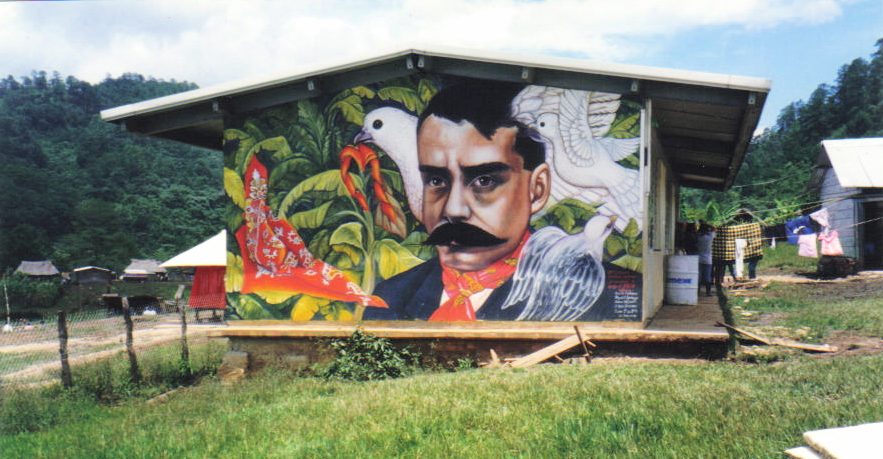
Zapatista News Summary for July 2014
ZAPATISTA NEWS SUMMARY for JULY 2014

In Chiapas
1. Sup Moisés Reports On Fundraising to Rebuild the Autonomous School and Clinic in La Realidad – In a July 18 communiqué entitled Almost 5 Times, Subcomandante Moisés reports that fundraising for rebuilding the autonomous school and clinic in La Realidad has yielded almost 5 times the amount they estimated it would cost. CIOAC-H members destroyed the school and clinic during the May 2 attack in which Compañero Galeano was murdered. They will use additional funds to buy equipment and supplies for the school and clinic. The original amount requested was only for construction materials.
2. Zapatista Exchange with the National Indigenous Congress (CNI) – The Zapatistas will hold an “exchange” with the National Indigenous Congress (CNI, its initials in Spanish) in La Realidad between August 4 and 8. That meeting is not open to all Zapatista supporters. A report from the Exchange will be given on August 9 in La Realidad, which is open to all Zapatista supporters. August 9 is the anniversary of the Juntas. In a July 7 communiqué, Sup Moisés gave the initial report on fundraising and also asked for solidarity to house and transport CNI members. He later reported in the Just so you know comunicado that some of the funds raised for the reconstruction will be used to support the exchange with the CNI.
3. Las Abejas Speaks out on Palestine – In its July 22 statement, Civil Society Las Abejas (The Bees) sent the following message to the Palestinian people: “While the bad Mexican government foments aggressions and designs strategies to break the social fabric in our communities, our brothers and sisters in Palestine are massacred by the government of Israel. Perhaps Palestinian men and women, children, and elders do not know of Acteal or of our struggle, but we feel your suffering and pain in the deepest part of our hearts, as when parents see their sons or daughters mutilated by Israeli bombs and bullets, or when boys and girls have their parents killed and become orphans. We do not understand how any human being or the Israeli government can be so evil as to not respect life! Is it not true that there exist international laws to condemn this type of war that murders innocent people? We know that it is not enough to pray, but from Acteal we pray for life and the protection of boys and girls, men and women, and female and male elders of the Palestinian people. We ask God to stop the massacre in Palestine and to touch the hearts of men and women throughout the world, so that together we can demand that the Israeli government stop killing innocent people.” On the 22nd of each month, Las Abejas issues a statement in commemoration of its members that were massacred on the 22nd of December 1997.
Mexico’s Southern Border
1. Peña Nieto Announces Southern Border Strategy in Chiapas – On July 7, Mexican President Enrique Peña Nieto inaugurated a new Customs Station at Playas de Catazajá, Chiapas., and announced two types of immigration cards for Guatemalans; one card is for a temporary work permit, the other is a 72-hour visitor’s permit limited to border states. He did not say how many work permits would be available. Otto Perez Molina, President of Guatemala, was with Peña at the event. Peña also announced the five elements of his Southern Border Strategy: formal and ordered passage; greater security; protection and social action in favor of the migrants; regional co-responsibility and inter-institutional coordination. Apparently, the strategy includes placing 10 sentry posts on the border and creating a Border Police, similar to the US Border Patrol, but specific details of the plan were not revealed. A short time later, Humberto Mayans was named the “Czar” for the southern border. Part of the strategy is to deter migrants from hopping freight trains that carry them through Mexico towards the US.
2. Merida Initiative Has Funds For Immigration Project – Two days after Peña announced the elements of his strategy for the Southern Border, the US made known through its embassy in Mexico that there were funds available in the Merida Initiative to support Mexico’s efforts to control immigration on the southern border.
3. US State Department Advisor Thomas Shannon Inspects Chiapas Border with Guatemala – For two days in mid-July, Thomas Shannon, Counselor to John Kerry at the US State Department, visited the Tapachula portion of the Chiapas border with Guatemala. He visited the Century XXI (Siglo XXI) Immigration Station in Tapachula, reportedly the largest one in Latin America (capacity 2,500 per day). He also visited a migrant shelter and met with activists and human rights defenders, who made a proposal: give the migrants visas to travel through Mexico, thereby making their journey less dangerous. He said he was interested in learning about the situation of the unaccompanied child migrants. Shannon’s visit to the Chiapas border just 2 weeks after Ambassador Anthony Wayne’s visit in June dramatizes the importance this issue has taken on and the importance of Mexico’s southern border.
In other parts of Mexico
1. Jose Manuel Mireles, Self-Defense Leader, Formally Charged and Held In Prison – On July 6, a judge issued the formal indictment against Mireles and the 3 guards arrested with him, meaning that they must stand trial for carrying firearms for the exclusive use of the Army and for the charge of simple possession of marijuana and cocaine. They were remanded to federal prisons while awaiting trial. The defense team maintains that the charges are false and that Mireles is a political prisoner. Javier Sicilia said that the arrest of Mireles demonstrates that the government is on the side of the criminals. Mireles’ wife maintains that the illegal weapons Mireles was allegedly in possession of are registered with the government. In other words, she seems to be alleging that not only are the charges false, the weapons were planted. Recently, Mireles issued a letter from prison to the autodefensas, in which he alleged that Alfredo Castillo, the Federal Commissioner for Michoacán, came to Michoacán to repress and lock people up. He termed the commissioner an executioner and said he lies and betrays. Mireles also urges the self-defense groups not to make agreements with Castillo and not to talk to him. Finally, he urged them not to fight among themselves.
_________________________________________
Compiled monthly by the Chiapas Support Committee.The primary sources for our information are: La Jornada, Enlace Zapatista and the Fray Bartolomé de las Casas Human Rights Center (Frayba).
We encourage folks to distribute this information widely, but please include our name and contact information in the distribution. Gracias/Thanks.
Click on the Donate button at www.chiapas-support.org to support indigenous autonomy.
_______________________________________________________
Chiapas Support Committee/Comité de Apoyo a Chiapas
P.O. Box 3421, Oakland, CA 94609
Email: cezmat@igc.org
http://www.facebook.com/pages/Chiapas-Support-Committee-Oakland/
EZLN: Just so you know
JUST SO YOU KNOW
ZAPATISTA NATIONAL LIBERATION ARMY
MEXICO
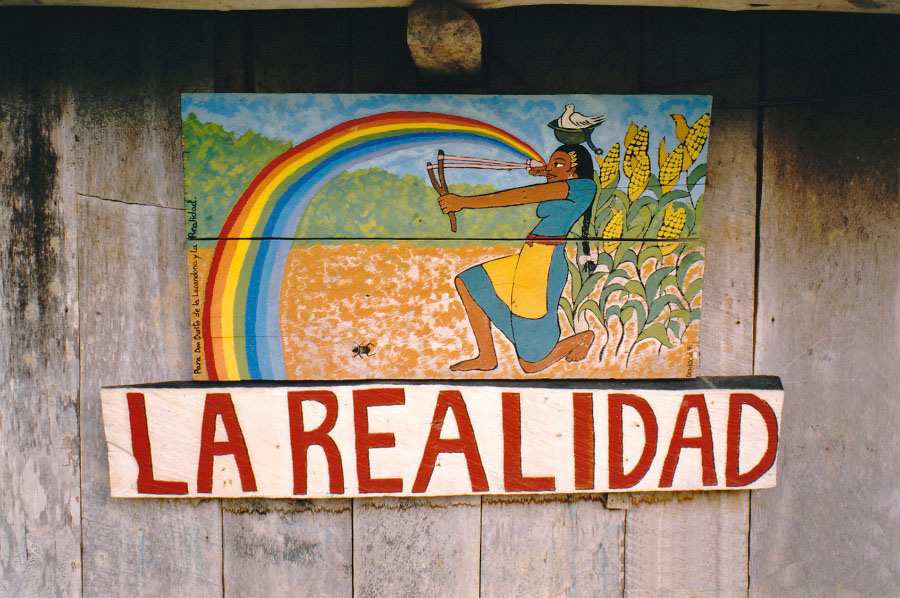
July 2014.
To the compañer@s of the Sixth in Mexico and in the world:
To all those who supported us in the reconstruction of the school and the clinic that belong to the compañeros of La Realidad:
Compañer@s:
Greetings from the Zapatistas.
We want to inform you of the following:
1. Upon hearing that the National Indigenous Congress still lacks adequate funds to travel to the exchange in the Caracol of La Realidad, the Zapatista compañeros and compañeras from the community of La Realidad have decided to use part of the $958,646.26 Mexican pesos that they received for reconstruction in La Realidad to support this travel.
2. According to the accounts the CNI sent us, they need approximately $200,000 (two hundred thousand pesos). They already have a part of this from donations sent by musicians, compas of the Sixth in Mexico and the world, and other good people who have supported them without any self-interest. But they don’t have sufficient funds to cover the rental costs of the trucks that will take them to CIDECI in San Cristóbal de Las Casas, Chiapas, which is where we are going to pick them up to bring them to Zapatista Reality [La Realidad].
3. The Zapatista bases of support in La Realidad are the ones who received the support you all sent for the reconstruction of what the CIOAC-Historic destroyed, so we consulted them about this budget problem that the compañeros and compañeras of the CNI are having. We consulted the bases of support because that money belongs to them, not to the EZLN; we just function as their voice to ask for and receive support, which we hand over to them as it arrives. In other words, we as the EZLN cannot decide what to do with that money. We explained to the Zapatista compas of La Realidad that this money was given to support their community reconstruction, and that if it is to be used for something else we have to consult them. We can’t act like the bad government who says the money is for one thing and then uses it for another. So that’s what we explained.
4. The compas in Zapatista La Realidad got together and decided to contribute $59,000 (fifty-nine thousand pesos) to support the National Indigenous Congress’ travel to the exchange that we will hold here soon. They agreed to offer this support, and they told us to let you know about this agreement so that there wouldn’t be any deceit or misunderstandings.
5. So, according to the last report that we gave you, there remain $899,646.26 (eight hundred ninety-nine thousand, six hundred and forty-six pesos and twenty-six cents Mexican pesos). We still have to see if more comes in, but we will let you know.
I also want to tell you that we have finished the construction work for the exchange with the brothers and sisters of the indigenous peoples, and we are now putting on the finishing touches in order to have everything ready to joyfully receive our invitees.
Next comes the construction of the new school and clinic, which will also be undertaken with joy. Because what those above destroy, we below will rebuild.
That’s all the information I have for you for now.
From the mountains of the Mexican Southeast,
Subcomandante Insurgente Moisés.
Mexico, July 2014. In the twentieth year of the war against oblivion
————————————————————————————–
Originally Published in Spanish by Enlace Zapatista
En español: http://enlacezapatista.ezln.org.mx/2014/07/25/para-que-sepan/
Zibechi: A glance at the one percent
A GLANCE AT THE ONE PERCENT
By: Raúl Zibechi

The Rising Sun is the 10th largest yacht in the world. Originally built in 2006 at a cost of $200 million for Oracle CEO Larry Ellison, it is now owned by music mogul David Geffen.
The current crisis is deepening social and economic polarization between a small handful of multimillionaires and a good part of humanity that is drowning more and more all the time in poverty and desperation. The rich get richer every day, something that we know through dozens of works that have been published in recent years. Nevertheless, the wealthy of financial accumulation are different from the other stages of capitalism, when hegemony corresponded to productive capital.
They are prison dogs, “large predators” as Fernand Braudel defined them. In this period of the descent of United States imperialism and of geopolitical chaos, they have acquired an additional profile: they are warriors, the type of cruel mercenaries of the worst civil wars; they don’t obey rules or have the least respect for human beings. The economist Michael Hudson, who knew them up close, emphasizes that they profess feudal values and seek to set the working population back to debt servitude.
The master’s thesis of Marco Bulhões Cecilio, who is part of the team of the Brazilian economist José Luis Fiori (The Global and geopolitical power of capitalism, within the framework of the Federal University of Río de Janeiro), points out that “in the current financial system, the biggest winners are the elite of the management class and not the shareholders.” As we have pointed out on other occasions, the bourgeoisie has been bifurcated between property owners and the managers of capital, who are those that make the decisions and are situated in echelons where the money flows.
Cecilio’s thesis recuperates the work of Braudel on the period of “accelerated accumulation of wealth,” and submits some of his ideas to severe scrutiny, among them that which postulates that the market economy and capitalism are opposed.
Among the class of managers that make enormous profits for themselves, he places for example some presidents (CEOs) of big corporations, who earned in full crisis remunerations up to 162 million dollars, like Stanley O’Neal, of Merrill Lynch. He is an exceptional case, in a medium where many executives earn more than a million dollars annually. In 2007, the corporation paid bonuses to its executives of 4 billion dollars and in 2008 Wall Street corporations paid 18 billion dollars to its executives, when the government saved the financial system.
Continuing with the remunerations, in 2014 the consultant Robert Walters studied the fixed medium salaries of executives in 27 countries, in particular those that have more than 12 years of experience. Without including the bonuses, after the 2008 crisis, a financial director (CFO) receives 360,000 dollars annually in Shanghai, scarcely on top of their colleagues in New York and London. In São Paulo the same position receives 250,000 dollars annually. The accounting managers, situated in the lower part of the echelon, obtain around 100,000 dollars (Valor, 12/2/14).
But there is a second question as important as that of income. The profile of this group indicates that 80 percent are white males, graduates of elite universities, prepared for a ferocious competition, which has not the least fidelity to anything that is not theirs. A poll by the Brazilian consulting firm Talenses, among 620 high level executives of São Paulo, revealed that for directors and managers the decisive factor at the time of deciding where to work is feeling challenged, and the remunerations and bonuses only appear in second place (Brazilian Human Resources Association, 1/29/14).
Challenges are what motivate them most, the conquest of new achievements, the permanent challenge to go beyond. They change companies constantly: only 6.6 percent of those interviewed have more than 10 years in the same company, 29 percent have between two and five years and 52 percent less than two years. Changing companies is part of the challenge for these executives that are between 24 and 40 years old. The high salaries seek to retain them.
As Braudel points out, they are people that have the privilege of being able to choose, have freedom of movement, don’t cling to previous activities, and don’t specialize in only one activity so that they can enter games inaccessible to others. They have access to privileged information that permits them, on the one hand, to elude controls, and on the other to appropriate for themselves the innovations that are almost always born in the base of society, much of the time economizing on technological development.
“Long term parasitism,” he calls that vital attitude; an active, destructive and obliterating parasitism. This way of behaving, this business culture, has enormous similarities with what the military think tanks promote. Today more than ever, the armies act like the CEOs of the financial sector, and vice versa.
In The Search for Power, William McNeill synthesizes these characteristics brilliantly: “Our only significant macro-parasites are other men, who, by specializing in violence, show they are capable of insuring life without having to produce the food and other things they consume” (Siglo XXI, 1988, Preface). He continues emphasizing that the changes in the weaponry of armies look like genetic mutations of microorganisms for “opening new geographic zones for exploitation, or destroying some limits through the exercise of force inside of the same society that hides them.”
Financial capital and armed forces (state or quasi-state) are the big parasite-predators that behave like plagues swindling humanity. It is the logic of the one percent, which won’t change of their own will. As we know, one cannot negotiate with plagues. One stops them or they destroy us. It is necessary to have clarity about the modes of the one percent. But we must recognize that we still don’t have a strategy for stopping them.
————————————————-
Originally Published in Spanish by La Jornada
Translation: Chiapas Support Committee
Friday, July 11, 2014
En español: http://www.jornada.unam.mx/2014/07/11/opinion/023a1pol
The State organizes violence in Chiapas: TPP
THERE HAS BEEN STATE VIOLENCE AGAINST THE ZAPATISTAS, the PERMANENT TRIBUNAL of the PEOPLES CONCLUDES
By: Hermann Bellinghausen, Envoy
Mario Landeros Cárdenas, state leader of Xi’Nich
San Cristóbal de Las Casas, Chiapas, July 19, 2014
In El Limonar community, in the jungle north of Ocosingo, they held a pre-hearing this Friday of the Permanent Tribunal of the Peoples (TPP, its initials in Spanish), an international instance that will culminate its México chapter next November, when “it will denounce and make visible to national and international public opinion the grave human rights violations that the State committed,” unpunished as of this date.
The tribunal considers that there is sufficient evidence “to presume the commission of crimes against humanity” by the Mexican State, which “identified certain populations that constituted or were able to constitute a social base for the Zapatista National Liberation Army (EZLN, its initials in Spanish) and, based on that, defined an ‘internal enemy,’ the object of a counterinsurgency strategy that included thousands of Tzotzil, Tzeltal, Chol and Zoque civilians, belonging to Las Abejas, Xi’nich [1], sympathizers and the EZLN’s support bases.”
The pronouncement emphasizes that State violence was not directed “only against combatants, but also against the non-combatant civilian population, including children,” which “demonstrates that the only factor common to all the victims was their belonging to determined organizations,” and shows that these acts were committed “with the intention of destroying such groups totally or partially.”
Witnesses and survivors of acts of great violence in Chol communities of the Northern Zone participated in El Limonar (Jolnixtié Sección I, Miguel Alemán, Usipá, El Limar, Saquil, Susuclumil, Masojá Shucjá, Masojá Grande y Chuctiejá); Tzotziles of Chenalhó, members of Civil Society Las Abejas of Acteal, and those displaced from Viejo Velasco, all “victims of the war strategy of counterinsurgency and of extermination contemplated in the Chiapas 94 Campaign Plan and implemented by the Mexican government at the start of the EZLN’s armed uprising, which yielded as a consequence dozens of forced disappearances, murders, forced displacements, sexual violence and massacres: crimes against humanity that continue unpunished,” exposes the pronouncement of the pre-hearing.
The pre-hearing was convoked by 50 national and international popular, student, social and human rights organizations, as well as the 74 organisms that make up the National Network of Civil and Human Rights Organisms All Rights for All, the Network of Community Radios (AMARC, its initials in Spanish) that groups together 35 radio projects, the 42 organizations from the National Campaign Against Forced Disappearance in Mexico, and Chiapas Peace Network, made up of 10 organizations.
Alejandro Cerezo Contreras, Alejandro de Jesús Martínez Martínez, and the Tzeltal arrangers Carlos Núñez Ruiz and Juan Méndez Gutiérrez, Joel Heredia and Rubén R. García Clark participated as national judges. They decided that the three cases examined “are framed within social and political struggles of the peoples and communities for the recognition and vindication of the identity and indigenous rights.”
The tribunal resolved that: “violations were committed to the human rights of the indigenous peoples in the Northern Zone, Viejo Velasco [2] and Acteal, by conduct that derived from the behavior of paramilitary groups like Paz y Justicia, or residents of the Nueva Palestina community, or in Chenalhó, always “organized by federal, state and municipal authorities.” [Emphasis supplied.]
The Mexican State “is obligated to integrally repair the damages,” the tribunal determined. It recognized in the declarants firmness, dignity, certainty of their memory, and a search for justice and truth. It also recognized “their bravery before the threats that can emerge after pre-hearings.”
Finally, the TPP said it observed with concern the events in the La Realidad community, “where José Luis Solís López (Votán Galeano) was extra-judicially executed, signifying the continuity of the counterinsurgency policy in Chiapas.”
[1] Xi’nich means “The ants” in Chol, a Mayan language. It originated as an indigenous Catholic campesino organization, similar to Las Abejas (the Bees). Its members lived in Viejo Velasco.
[2] For background on the Viejo Velasco Massacre in Chiapas, please see: https://compamanuel.wordpress.com/2014/02/05/murder-in-the-lacandon-jungle-background-on-viejo-velasco-massacre/
————————————————————————————
Originally Published in Spanish by La Jornada
Translation: Chiapas Support Committee
Sunday, July 20, 2014
En español: http://www.jornada.unam.mx/2014/07/20/politica/017n1pol
EZLN: Almost 5 times
ALMOST 5 TIMES
ZAPATISTA NATIONAL LIBERATION ARMY
MEXICO
 July 2014.
To the compañer@s of the Sixth in Mexico and the world.
Dear Compas:
Zapatista greetings to all those who supported our compañero and compañera bases of support. We send an embrace to all those who helped generate funds for the reconstruction of the school and clinic in the Zapatista La Realidad that were destroyed by the bad governments via their paramilitaries from the CIOAC-Historic.
Today, July 18, 2014, we want to give you an updated report of the funds generated to date. Since the last report we sent, more money has come in which hadn’t arrived before due to lack of adequate means to send it. For example, our compas of the Sixth in Europe had problems getting the money here, but they resolved that issue and those funds have now arrived in full. The same happened to other compas and collectives in Mexico and in the world.
So here is the total amount, including what we reported in June, of what has, to our knowledge, been raised. Some of it is not actually here yet but is in good hands and sure to arrive safely.
From collectives from all over the world, a total (including the $344,612 that we listed in the last report) of: $937,922.26 (nine hundred thirty-seven thousand, nine hundred twenty-two pesos and 26 cents).
From individuals from all over the world, a total of: $20,724.00 (twenty thousand seven hundred twenty-four pesos). All together, this comes to a total of $958,646.26 (nine hundred fifty-eight thousand six hundred forty-six pesos and twenty-six cents).
The strength of your collective efforts together with individual contributions has raised five times the amount budged for the reconstruction. That is, the amount is almost quintuple what we asked for, which is $200,209.00.
This doesn’t include the money we are told will be raised at the concert to be held tomorrow, July 19, 2014, at the SME-Coapa sports complex, where musicians in struggle will perform, including Ideología Vigente, MC Lokoter, Sonora Skandalera, El Aarón, Barricada Sur, NARS MC, Mexikan Sound Sytem, Su Merce, To Ciuc Libre, Sound Sisters, Kori Fyah, Los Zopes, Resistencia de México. You’ll have to forgive me if the names aren’t exactly right, because we’re looking at them on a poster on twitter; it says that the music starts at 11:30 and ends at 7:30. That is, there will be 8 hours of musical resistance.
With these funds the compañeras and compañeros of La Realidad Zapatista will be able to buy both supplies and medicines.
In the name of our compañeras and compañeros bases of support of the EZLN, all we can say is thank you for your conscientious struggle and support.
With this support it is clear that the “big heads” that say we are alone and forgotten are mistaken.
Soon we will begin reconstruction work and then it will be clear that those who are against us did not manage to destroy or detain the struggle for a new world. The newly constructed school and clinic are going to be even better than they were before.
And so it goes, compañer@s of the Sixth, because those of us who say we are below and to the left and part of the anticapitalist Sixth have to be good and decided in what we are doing.
Look at the compañero Galeano: he wasn’t murdered because he stole or because he didn’t pay his debts in dollars or euros to the capitalists. He didn’t steal and he didn’t have any debts to anyone even in his own town. On the contrary, people owed him money.
He was murdered for being below and to the left and anti capitalist.
Those who carried out the murder are still free, only a few of those who planned the murder are in jail. Justice has not been done.
We are remembering him these days because we are in meetings about the exchange that is coming up with the compañer@s of the National Indigenous Congress. As we were going over the list of coordinators, his name came up and all of the compañer@s who were there, upon hearing the compañero Galeano’s name, shouted “presente!”
Thus the work goes on and the struggle continues.
There is little time left to support the compañeros of the National Indigenous Congress in their travel to the exchange.
But each person’s art of struggle will help us find a way.
So, onward compañer@s.
Because the anticapitalist struggle below and to the left continues.
That’s all for now. We will keep you updated.
From the mountains of the Mexican Southeast Subcomandante Insurgente Moisés. Mexico, July 2014. In the twentieth year of the war against oblivion.
En español: http://enlacezapatista.ezln.org.mx/2014/07/20/almost-5-times
Tribunal Investigates Chiapas Massacre
THEY WILL TAKE THE VIEJO VELASCO MASSACRE TO THE PERMANENT TRIBUNAL OF THE PEOPLES
By: Hermann Bellinghausen
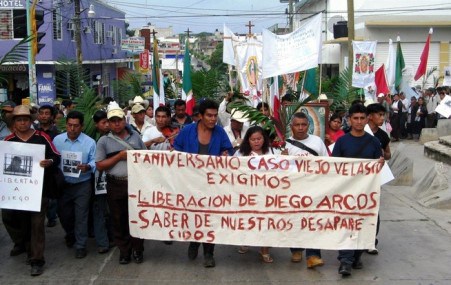
Palenque March for the Freedom of Diego Arcos
San Cristóbal de Las Casas, Chiapas, July 16, 2014
The Permanent Tribunal of the Peoples (TPP, its initials in Spanish) announced in a press conference the pre-hearing With Justice and Peace We Find Truth, which will be held Friday in El Limonar community, in the northern part of the Lacandón Jungle.
The event “seeks to construct another justice from the collective memory of the peoples in the face the impunity promoted by the Mexican State.” Survivors, witnesses and relatives will present especially the case of the Viejo Velasco Massacre, occurred in that zone eight years ago and that remains unpunished.
Diego Moreno Vázquez, representing family members of the victims and the massacre’s survivors, confirmed that the case will be presented at the TPP’s pre-hearing. That deadly attack “came to a head in the context of the struggle for agrarian rights inside of the so-called ‘Lacandón Community’ during the government of President Vicente Fox Quezada; despite the denunciations about harassment and threats of eviction that the communities were suffering, the government didn’t do anything to avoid these grave acts.” The mode of the aggressors’ behavior “is framed within the counterinsurgency strategy implemented by the government since 1994, with putting its Chiapas 94 Campaign Plan into effect, when the Zapatista National Liberation Army (EZLN) rose up in arms.”
The Chol representative exposed: “Eight years after the massacre the family members continue demanding justice, punishment of the intellectual and material authors of these grave acts and our right to know the truth about what happened, as well as the whereabouts of our disappeared family members. The only thing that the Mexican government has done is to continue nourishing the impunity.”
He remembered that the attack occurred on November 13, 2006: “Some 40 people from the community of Nueva Palestina, very well armed, some with uniforms of the military or Public Security, violently entered Viejo Velasco.” 300 members of the Sectorial Police accompanied them with high-powered weapons “known as ‘goat horns’ and R-15s.” At times, other authorities accompanied them. “They all surrounded the community to later enter homes and steal our relatives’ belongings.”
Filemón Benítez Pérez, Antonio Mayor Benítez Pérez, María Núñez González and Vicente Pérez Díaz (the latter from the aggressor group) died in the acts. Four more were disappeared: Mariano Pérez Guzmán, Miguel Moreno Montejo, Pedro Núñez Pérez and Antonio Peñate López. The survivors fled into the mountains and afterwards were given refuge in the neighboring Nuevo Tila community.
Moreno Vázquez adds: “Faced with the lack of justice we took on the task of looking for our disappeared and on July 6, 2007 with a Civilian Observation Commission we toured the route that goes from Paraíso to Viejo Velasco and we found two bones, which turned out to be from Miguel Moreno Montejo, my father, and Pedro Núñez Pérez. The government said that our family members ‘had grabbed their backpacks and had left for the north.’ It wasn’t until November 2011 that they delivered the remains to us and we gave them a Christian burial.”
Mariano Pérez Guzmán and Antonio Peñate López remain disappeared. The displaced “are borrowing lands or working in different places.” Four Nuevo Tila residents “continue with (pending) arrest warrants, accused of the death of our family members, while to the contrary, they received those displaced that day.”
They run the same risk as Diego Arcos Meneses, who stayed in prison for almost a year “accused of the death of our family members, being that he is a health promoter, like I am, who only offered support” to the displaced.
See also: https://compamanuel.wordpress.com/2014/02/05/viejo-velasco-massacre-7-years-later/
—————————————————————
Originally Published in Spanish by La Jornada
Translation: Chiapas Support Committee
Thursday, July 17, 2014
En español: http://www.jornada.unam.mx/2014/07/17/politica/021n1pol
Zibechi: Financial capital loots Rio de Janeiro
FINANCIAL CAPITAL LOOTS RIO DE JANEIRO

By: Raúl Zibechi
In less than a decade Río de Janeiro has suffered three large events that modify its features: the Pan American Games in 2007, the World Cup in 2014 and the Olympics in 2016. Financial capital takes advantage of that succession of sports mega-events in so short a time to remodel one of the most beautiful cities in the world, where it obtains enormous profits and provokes irreparable damage to the poor.
This month the Rio Popular Committee of the Cup and the Olympics launched the fourth dossier titled Mega-events and Human Rights Violations in Río de Janeiro (comitepopulario.wordpress.com). Throughout the 170 pages it analyzes the principal consequences that the events are having on the city and its population, at the same time that it reveals those who benefit from the million-dollar works that the FIFA and the International Olympic Committee, among others, impose.
“The sports mega-events mark the return of the most violent form of contempt for housing rights in the city,” can be read at the beginning of the dossier. We’re talking about a “social cleansing” that consists in relocating the poor to open opportunities for businesses of the large corporations, in “noble” zones like Barra da Tijuca, Jacarepaguá and the historic center, while it moves them to far away zones where they must begin their lives over again from nothing. As of now almost 5,000 families are displaced from 29 communities, with another 5,000 threatened with eviction.
The Cup Committee supports the desolate communities with studies and analysis, but its members also put their bodies on the line to resist the bulldozers that knock down homes. Women are at the head of the resistance, like Inalva Britos, in Vila Autódromo, and Alessandra in Providencia Hill. In the popular barrios the women sell food in the neighborhood or they make artesanía, a strategy for survival that they will not be able to continue in the desolate “barrios” of the Mi Casa Mi Vida program. Resisting is a question of life.
Río is the city most affected by real estate speculation. The price of housing rose 65 percent between 2011 and 2014 compared to an average of 52 percent in Brazil. The price of rent rose 43 percent, compared to 26 percent in São Paulo. The list of works is impressive: two stadiums (Olympic and Maracaná), the Olympic Village and Port Maravilla; six light train lines, expansion of the metro and of the freeways or rapid urban highways: all financed with public money.
Just the remodeling of Maracaná in Río demanded 1 billion 50 million reals (470 million dollars). The public works budget increased 65 percent since the 2010 budget, reaching the astronomical number of 1 billion 500 million dollars just for public works on the World Cup and the Olympics. The principal beneficiaries are the large construction companies: Odebrecht, OAS, Camargo Corrêa and Andrade Gutierrez, coincidentally, those that make large contributions to the political parties in electoral campaigns.
Odebrecht has completely remodeled Maracaná, which also manages the enclosure. It (Odebrecht) also shares with Andrade Gutierrez the construction and management of the Olympic Village, management of Olympic stadium with OAS, and even 20 large public works in Río de Janeiro, hundreds in the 12 cities that are World Cup seats, including new airports and hotels. Just the new Terminal 3 at Guarulhos Airport (São Paulo) had, as of now, a cost of 1 billion 500 million dollars.
None of this can be done without repression. The Army’s occupation of the Complexo da Maré (130,000 inhabitants in 16 favelas), until the World Cup ends, is hardly the action the population knows best. This week, the government of Río state reported on the incorporation of eight new armored vehicles for the Special Operations Battalion (BOPE, its initials in Spanish), which will be used in the “pacification of the favelas” operations(O Globo, 24/06/14).
In the four months prior to the Mundial, the Secretary of the State of Río reported 4,250 compulsory admissions of homeless people, who are transported to a shelter 70 kilometers from the city’s center, where, according to the dossier of the Cup Committee, they are lodged in precarious conditions and suffer torture practices.
“Río de Janeiro is becoming a more expensive and unequal city all the time,” the dossier of the Cup Committee points out. A fractured, conflictive city as happened at the recent Carnaval, when more than 70 percent of the 14,000 garbage collectors went on strike. After eight days of harsh conflict and disqualifications, one of the categories of low-paid workers obtained a 37 percent increase in their base salary, which is still barely 500 dollars. Despite the pressures, the enormous encampment of 4,000 people organized by the MTST (Movimiento de Trabajadores Sin Techo) three kilometers from the Itaquerão Stadium.
While half of the World Cup is still in dispute, demonstrations have decreased and the number of people mobilized is less than in previous weeks. Even so, the protests are far from disappearing. The success of the days in June 2013 is not forgotten; they stopped the increase in tickets for urban transportation, but in reality they were questioning the city model that capital is imposing with support from a broad coalition of parties.
A recent MTST communiqué, which maintains an encampment of 400 people in front of the municipal chamber demanding affordable housing, assures that its struggle did not begin with the World Cup, nor will it end with when it’s over. “We reaffirm that the big legacy of the World Cup was the real estate speculation and urban exclusion.”
After July, when the ball stops rolling and the fires of the media artifice die out, Brazilians will return to their everyday life, paying abusive prices for very bad transportation. The resistance to the recent urban extractivism begins.
———————————————————–
Originally Published in Spanish by La Jornada
Translation: Chiapas Support Committee
Friday, June 27, 2014
http://www.jornada.unam.mx/2014/06/27/opinion/021a1pol
ACNUR wants Mexico to consider refugee status for minor migrants
ACNUR WANTS MEXICO TO CONSIDER MINORS TRAVELING TO THE U.S. AS REFUGEES

A Honduran child rests under the train, in Arriaga, Chiapas, waiting to board The Beast. Photo: Alfredo Domínguez
By: Blanche Petrich
** They cannot be forcibly returned to their country if there is a risk: commissioner
** From January to June they have deported 8,239 without the knowledge of Comar: Francisco Sieber
The United Nations High Commissioner for Refugees (Acnur) mobilizes in Mexico to assure that the Mexican government guaranty the right to protection of those Central American children and adolescents, the majority Hondurans, who because of the risky conditions and violence that obliges them to emigrate towards the north, alone or accompanied, merit obtaining refugee status.
In an interview, the Acnur official for protection in Mexico, José Francisco Sieber, reported that in the last 18 months (2013-2014) the Mexican Commission for Aid to Refugees (Comar) recognized 56 minors as refugees.
It is barely a drop in the ocean. Last semester alone 11, 265 Central American children were “rescued” (according to the official lexicon) and processed by authorities migratory. Some 8 mil 239, were deported without passing through the Comar.
Faced with the high number of children deported, Sieber insists on “a fundamental point” of the international right of displaced children: “the right of not being forcibly returned to their place of origin if their life or their security is at risk.” Also, faced with the crisis of minors detained in United States border cities, the country has the same obligation as the region’s other states: protecting and giving refuge if their security is threatened in case of being repatriated.
Acnur report soon
In March of this year the Acnur office in the United States published a report on the new lines of displacement of the Central American population towards that country and the situation of the unaccompanied minors detained in border cities. Titled Niños en fuga (Children on the run), the report emphasizes the urgency of strengthening access to asylum and other forms of protection. A similar report with investigations of the United Nations officials about child migrants that cross through Mexico will be published soon.
In the stories collected in this field investigation, Sieber indicates, “we observe that there are more and more elements of violence in their narrative all the time; the children comment that there are situations of extortion, homicides, threats, attempts at recruitment into criminal groups, like gangs, and those are factors that caused their exit.”
That obliges the region’s governments to extend their protection practices. The challenge, in this case for the government of Mexico, which is the transit country, “is to identify the cases in which the minors effectively cannot return to their places of origin because they can confront risks to their security.” Those are the cases where the right to refuge must be applied.
“We are not saying that violence is the only reason for these rising flows. Reasons for migration are multiple. But we do say that violence appears with greater frequency in dialogues held by our officials with the children and, above all, with the adolescents, the majority coming from Honduras. We are hearing many and very diverse references to different forms of violence. That worries Acnur and makes us mobilize and work with the authorities to take measures that would permit responding to this situation.”
Challenge: distinguishing between migrants and refugees
–Given the circumstances in which the displaced are moving, how do you differentiate between those who emigrate because of economic causes, like poverty, and those who do it fleeing from violence?
–That’s why I speak of the challenge. There are situations where many of the children could have, as the best solution based on their best interest, family reunification in the country of origin. However, there could be others that no longer can return and that, therefore, should be considered refugees.
–Is it adequate to treat the petitions for refuge case-by-case when one is talking not about a migratory flow, but rather of a mass exodus? In the 1980s, with the mass arrival of Guatemalans that were fleeing from the war, the focus was not on individual asylum, but rather on refuge to entire communities. Would it not be applicable to the emergency that is experienced now?
–At the moment, what we see is that response mechanisms for the cases that seek international protection as refugees do exist. Another big challenge is that people know about these proceedings and they understand that they can access them. Not all of them have knowledge of the existence of an office like the Comar.
“The difference is that now not only do we have a legal framework of international refugee law, but also a Mexican law on refugees that is innovative in certain aspects like that of complementary protection.”
–Are these mechanisms sufficient to impede the Mexican State from deporting those who need protection?
–Exactly. And this is a fundamental point. There is a principle in international refugee law that protects them against any measure of forced return. If the person is recognized as a refugee, he or she is under the protection of this legal principle, and cannot be returned to their country of origin.
–We see in the Honduran press that in recent weeks there had been record numbers of children and women deported, after being detained in Mexico. Did these people have guarantees against forced return?
–What we see is that to the extent that a person does demonstrate to the Mexican authority the need for protection in the face of these situations of violence, of persecution, the person must automatically be channeled to the Comar. Effectively, we’re seeking that the people that are indeed at risk be listened to in a confidential manner within the context of an interview, and that they express the reasons for which they no longer want to return to their country of origin and to decide if this person is going to be considered as a refugee.
–Then what happened with these deportees of recent weeks, or that are being deported right now?
–As is known, Mexico is familiar with this migratory flow, which is not new. There is a situation where high numbers enter its territory for the purpose of reaching the United States. In two cases, migrants or refugees, they use the same ways. We must be careful because not all are refugees. Therefore, we insist on the challenge of identifying who is really a refugee.
–What is the situation in the United States, in the detention centers on its southern border, where there are still tens of thousands of children, some with their mothers, trapped in a legal proceeding? President Barack Obama has asked his Congress for discretionary ability to deport them. How does Acnur intervene in those cases?
–It is the same challenge: the identification of cases that do merit protection of the right to refuge. It’s the same for all countries. We’re talking about international refugee law. There are two other principles of international law: one is the prevalence, the observance of the superior interest of childhood, and the second is the right of the child, of the adolescent, to be consulted, to participate in the decision, to have their voice heard in the hearings and proceedings.
———————————————————–
Originally Published in Spanish by La Jornada
Translation: Chiapas Support Committee
Thursday, July 10, 2014
En español: http://www.jornada.unam.mx/2014/07/10/politica/013n1pol
Moisés Reports on Zapatista Reconstruction Account
RECONSTRUCTION ACCOUNT
ZAPATISTA NATIONAL LIBERATION ARMY
MEXICO
July 2014.
To the compas of the Sixth in Mexico and the World:
To all those who have cooperated or contributed to the reconstruction of the clinic and school in La Realidad:
The Zapatistas send you greetings.
We want to let you know how things are going with the collection of funds for rebuilding the school and clinic destroyed by paramilitaries in our Zapatista Reality.
As of today, July 3, nearly a month after we announced the request for support for this construction, we have received:
From collectives: the total generated by various collectives is $344,612.50 [Mexican pesos].
From individuals: the total generated from various individuals is $20,724.00 [Mexican pesos].
Here you can see clearly, as we already know, that things are better done collectively because what results is bigger, better, and happier.
The overall total is $365,336.50 (three hundred seventy-five thousand three hundred thirty-six pesos and fifty cents).
This is the report of the total amount generated through the task of acquiring the funds for construction, in accordance with the budget laid out by the Zapatista compañer@s of the community of La Realidad.
More was generated than had been budgeted; we had said we would need $200,209.00 and $365,336.50 was collected. Do the math and you will see the difference. The extra amount we will use to buy equipment and medicine.
So we want to thank all of you for your efforts. We know that you organized yourselves and put on events to raise money, that you even made tacos and held dance parties and concerts and sold things to generate funds.
To all of you, those who organized events and those who participated, we send many thanks for your support.
Right now the compañer@s bases of support are looking for the expert carpenters who will build and finish the construction in order to see which and how many materials they need to buy.
I see that there is already movement stirring around the construction.
And this is in fact a time of movement. I am told that the compañer@s here are already hard at work readying the place where they will meet with the compañer@s from the National Indigenous Congress [CNI].
There is already news coming in about the work being done to support the travel of the compañer@s from the CNI to and from the exchange they will have here.
We have been asking ourselves: How many exchanges will we have with the compañer@s of the CNI? How will we support them with their travel costs? These are the questions we ask ourselves; I see the compañer@s scratching their heads and pulling out their hair from so much thinking. But we know that all of you will support the CNI from your own realities so that they can get to CIDECI in San Cristóbal de Las Casas. From there our Zapatista chauffer-ologists will take over in order to bring them here to La Realidad; that part will be up to us.
So compañer@s of the Sixth, scratch your heads also and be careful not to pull your hair out, but above all send us your ideas for how you can help the compañer@s from the National Indigenous Congress travel to the exchange that we will have with them and the EZLN compas and bases of support. The first round of this exchange will be August 4-8.
We are going to ask the compas who work on the Enlace Zapatista webpage to make a special section called something like, “Exchange to support the exchange of the CNI.” There you can send your ideas and share the efforts that you are making or planning to help the CNI communities who are invited to this first exchange get here. This is how we are going to remember and cherish the memory of our CNI compa, DAVID RUIZ GARCIA, whose name we have given to this first exchange.
This way you can get ideas from each other on what to do, because there is little time left. This section will also serve to show us who is acting the fool, because we remember that some said that they didn’t support the Zapatista communities because they didn’t like the now defunct SupMarcos. Now that he is gone we can see that it wasn’t really about him at all, but that it was and is because those who made those comments do not like that the people, the communities, rule themselves; they want the people to obey them. They want to give the people orders to vote for this or that soccer team or political party, which is really the same thing when both are bought and paid. Here we can see clearly that educated people also harbor racism. That is, racism exists in the heart, even when the head is highly educated.
Oh, and another thing: compas of the independent, alternative, free, or whatever-you-call-it media, remember that you are invited to come after the exchange ends, on Saturday August 9, 2014, to hear and carry far and wide the word of the indigenous people who are participating. And perhaps this time we can do the press conference or whatever-you-call-it that we left pending last time. All of the Sixth is invited also.
That is all we wanted to tell you, compañer@s.
From the mountains of the Mexican Southeast,
Subcomandante Insurgente Moisés. Mexico, July of 2014. In the twentieth year since the beginning of the war against oblivion.
Mireles: “I am a political prisoner”
“I AM A POLITICAL PRISONER,” MIRELES VALVERDE MAINTAINS

José Manuel Mireles behind bars with head shaved
By: Sanjuana Martínez, Special to La Jornada
Doctor José Manuel Mireles Valverde laughs, cries, gets emotional when his lawyer Talía Vázquez Alatorre tells him about the shows of support that he is receiving because of his arrest, and laughs loudly when he finds out that people are shaving their heads as a sign of solidarity. Next, with firmness and conviction, recognizes that prison, was a foreseen scenario in his activity as an autodefensa and puts out the definition of his situation: “I am a political prisoner.”
Prisoner number 5557 of the Federal Center for Social Re-adaptation (Cefereso, its acronym in Spanish) 11 located in Hermosillo, Sonora, after federal judge Armando Wong dictated an order of formal prison against him in criminal cause of action 137/2014, together with his three escorts Javier Reyes Magaña, Salvador Mendoza García and Gerardo López Casillas, for the alleged crimes of “carrying firearms for the exclusive use of the Army and (crimes) against health, in its category of narcomenudeo with the specific charge of simple possession of marijuana and cocaine.”
Crimes that, according to his defense, are false: “We are against the order for formal prison for two things: one, for grave due process violations and other, because of the declarations of the public officials that place him as a political prisoner,” Talía Vázquez Alatorre says in an interview with La Jornada, who tells the details of her one-hour visit to her defendant in prison.
Doctor Mireles’ defense team prepares the amparo [1], the appeal and, at the same time, a complaint to the Inter-American Commission on Human Rights (IACHR): “We have 15 working days to go against the order of formal prison, while the case continues, but we seek to arrive at international instances like the IACHR, where we already initiated the necessary steps.”
Alfredo Castillo did not comply
According to the papers of statements for resolving the legal situation of Doctor Mireles, to which La Jornada has had access, the lawyer Salvador Molina Navarro makes an allegation about obedience to the law and the justification for the autodefensas based on an analysis presented by the el academic Jaime Cárdenas, where they argue the “non-chargeability” against those processed due to the fact that they belong to a known “social movement” like the autodefensas of Michoacán.
The defense considers that the doctor and his three escorts are victims of as “illegal arrest,” realized without an arrest warrant and without being treated as a case of being caught in the act or of urgency, which contravenes Article 16 of the Constitution. They argue that Doctor Mireles Valverde suffered “acts of torture” and a judge’s omission exists by not investigating the facts, besides he was not permitted to make an allowed call to a defender inside then time limit set by law and the evidence the authorities presented was “planted,” which makes them false and illegal.
They point out that “torture, like that of which the accused were victims, including since their detention, is aggravated even more on the person of José Manuel Mireles Valverde, because he was blindfolded for no reason or justification, making him believe that they would throw him into the, even impeding his immediate communication as is his inalienable right, annuls each and every piece of evidence that the Public Ministry (district attorney’s office) would be able to gather in the investigation stage,” says the text of allegations in favor of Doctor Mireles, which consists of 55 pages.
Among the arguments presented, is the “legitimate defense,” personal and collective, due to the fact that the government has not guaranteed security in Michoacán.
“From here the state of necessity in which society is found to lack legal security on the part of State forces. The lack of legal security in which the inhabitants of different sectors of the population are found is evident; they are found unprotected before attempts against their integrity, as much physical as patrimonial, because of the of organized crime organizations. As a consequence of that and as a reaction to an attack on their physical and patrimonial integrity, they find themselves in complete necessity of defending themselves and their property collectively. From there, one can infer the result of the conduct that is employed to safeguard the property of the population, by seizing control of any means of defense that may be feasible, to repel the aggressions of their transgressors.”
The defense insists that Doctor Mireles is a “political prisoner” due to the fact that it has been officials like the Commissioner for Security in Michoacán, Alfredo Castillo, and the Secretary of Governance, Miguel Ángel Osorio Chong, who have declared that the detainee is a prisoner for not having complied with the May accords.
The lawyer Talía Vázquez specifies: “The one who did not comply with any of the accords was Castillo. He did not release the 517 prisoners from the self-defense groups, in Michoacán alone; nor did he free Hipólito Mora before May 10. And, above all, he did not comply with the arrest of La Tuta and neither did he re-establish the state of law. Nothing happened. The one who broke the pact was Alfredo Castillo and not Doctor Mireles. That also shows that he is a political prisoner.”
————————-
[1] According to Wikipedia, a recurso de amparo in Mexico is a legal procedure to protect a person’s human rights.
———————————————————–
Originally Published in Spanish by La Jornada
Translation: Chiapas Support Committee
Monday, July 7, 2014
En español: http://www.jornada.unam.mx/2014/07/07/politica/015n1pol
 Chiapas Support Committee