Chiapas Support Committee
Home of the Compañero Manuel blog on zapatistas & mexico
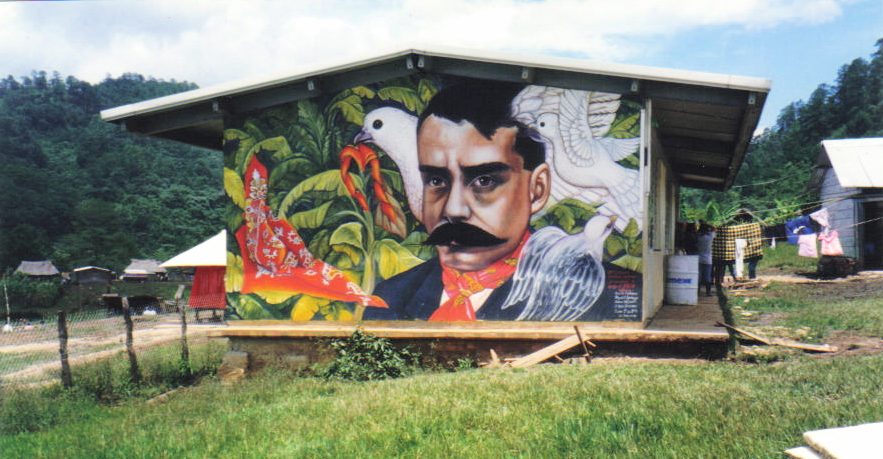
Celebration of Life: A December of Resistance and Rebellion

SIXTH COMMISSION of the EZLN
Mexico
November 2019.
To the women who struggle all over the world:
To the National Indigenous Congress-Indigenous Governing Council:
To the National and International Sixth:
To the Networks of Resistance and Rebellion or whatever you call them:
To all those who feel called to any of these activities:
Compañeras, compañeros, compañeroas:
Sisters, brothers, hermanoas:
The EZLN’s Sixth Commission invites you to the:
Celebration of Life: A December of Resistance and Rebellion
Including the following activities:
“Puy Ta Cuxlejaltic” Film Festival
Second Edition
To be held December 7-14, 2019, at the following locations:
Caracol Jacinto Canek (in CIDECI, San Cristóbal de las Casas, Chiapas, Mexico)
Caracol Espiral digno tejiendo los colores de la humanidad en memoria de l@s caídos (Spiral of Dignity Weaving the Colors of Humanity in Memory of the Fallen), (in Tulan Ka´u, on the San Cristóbal de las Casas-Comitán de Domínguez highway, halfway between those two cities, 40 minutes from either one, driving prudently).
Program and participants to be announced at a later date.
Register to attend at the following address:
segundofestivalcine@ezln.org.mx
-*-
First CompArte for Dance: “Dance Another World”
To be held December 15-20, 2019 at:
Caracol Jacinto Canek (in CIDECI, San Cristóbal de las Casas, Chiapas, Mexico)
Register to participate or attend at the following addresses:
participanteprimercompartedanza@ezln.org.mx
asistenteprimercompartedanza@ezln.org.mx
-*-
Forum in Defense of Territory and Mother Earth
To be held December 21-22, 2019.
The National Indigenous Congress, which is organizing this event with the support of the EZLN’s Sixth Commission, will provide details.
To be held at:
Caracol Jacinto Canek (in CIDECI, San Cristóbal de las Casas, Chiapas, Mexico).
-*-
NOTE: The following event is only for women who struggle:
Second Gathering of Women Who Struggle
To be celebrated December 26-29, 2019, at:
The Semillero “Huellas del Caminar de la Comandanta Ramona” (In the Footprints of Comandanta Ramona) in the Caracol Torbellino de Nuestras Palabras (Whirlwind of our Words), Tzots Choj zone (community of Morelia, MAREZ [Autonomous Zapatista Municipality in Rebellion] 17 de Noviembre), the same place where the First Gathering was held, it’s the official municipality of Altamirano.
Register at the following email:
estamosaprendiendo@ezln.org.mx
Note: ONLY women who struggle will be allowed to enter the semillero (seedbed), which is the site of the gathering (they can bring boys under 12). NO MEN PERMITTED at the site. Oh well. The Zapatista Women Coordinating Committee will provide details at a later date.
-*-
Celebration of the 26th Anniversary of the Beginning of the War Against Oblivion
To be held December 31-January 1, 2020, at:
Caracol Torbellino de Nuestras Palabras (Whirlwind of our Words), Tzots Choj zone (community of Morelia, MAREZ 17 de Noviembre).
Register at the following email:
visitante26aniversario@ezln.org.mx
-*-
That’s all for now.
From the mountains of the Mexican Southeast,
Subcomandante Insurgente Moisés
Sixth Commission of the EZLN
Megaprojects and rights
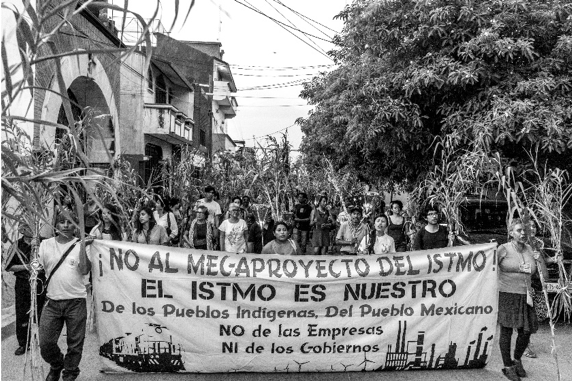
No to the Megaproject of the Isthmus! The Isthmus is ours, the Indigenous Peoples, the Mexican People, Not the Companies, Not the Governments!
By: Carlos Fazio
Heir of the megaproject of the Isthmus of Tehuantepec of Ernesto Zedillo (1996) –then renamed the Plan Puebla-Panamá (Fox, 2001), the Mesoamerican Initiative (Calderón, 2008) and the Special Economic Zone of the Isthmus (Peña Nieto, 2016)–, the Interoceanic [Trans-Isthmus] Corridor of Andrés Manuel López Obrador seems destined to reproduce the same neoliberal logic.
The 1994 North American Free Trade Agreement (NAFTA) made up part of the legal-political framework for capital’s class domination. Since then, the corporate rights derived from the imposition of NAFTA meant a profound rupture of the Welfare State’s social contract, and the rights of the poor and the workers were devastated by “predatory private tyranny” (Chomsky said), which also demolished, via regulatory violence, the hierarchy and the normative pyramid of the system of protection for human rights.
NAFTA was not designed to promote the social good; nor an agreement between the people of the three countries of North America to take advantage of the mutual benefits of the exchange of products and services based on de their comparative advantages. It was a pact that elevated the legal status of big investors and, simultaneously, linked and subordinated the economic power of the State to corporate interests, thus eroding the State’s commitment and options for protecting the citizens. A central purpose of NAFTA was to disarm the original peoples in order to dispossess them of the tools of identification, expression, culture, resistance and transformative capacity that national sovereignty and the existence of a legitimate State can offer them. The disarming of the Mexican State versus corporate interests acquired tragic characteristics, upon becoming a promoter and certifier of the private operations of investors. Particularly grave was the accelerated dismantling of the 1917 Constitution, which had introduced social rights and the subordination private property rights to the common interest.
The structural violence of the capitalist system –the accumulation of wealth of a minority at the expense of poverty and the environmental and cultural destruction of the peoples– was incorporated into the treaty in a transversal way. The counter-reform of Constitutional Article 27, which modified the ownership of ejido and communal land, supposed an expropriation of rights and guarantees about the use and belonging of land and natural assets. Those practices were presented as sought-after development policies, but were really actions of dispossession that were subsequently provided legal coverage.
Under the logic of counterinsurgency, neoliberal regimes used state, paramilitary and criminal violence to generate terror and fear, as part of a strategy to control territories and populations; a scheme of institutional violence that utilized extrajudicial summary executions, forced disappearances, systematic torture, forced population displacement and land appropriation to impose economic policies that respond to the interest of the plutocracy and attack the rights and interests of the majority poor people.
As part of a process of “power diversion” −a transformation of the state apparatus that, at the same time reinforced, privatized and updated a tremendous punitive capacity−, the State, in a historic reactionary turn, abandoned all concern for the well-being of the population, abolished the public sphere, liquidated society and installed a criminal and mafia-like social-Darwinism, violating each and every one of the historic conquests of the peoples.
That savage regression in the exercise of power consisted in the use −on the part of governments, political representatives and de facto powers− of the economic, political, cultural and legal-institutional capacities of the State for the purpose of satisfying or benefiting plutocratic interests against or to the detriment of the public and general interest of the population, and at the expense of neglecting the minimum conditions of the reproduction and development of social life and of subjecting the exercise of individual and collective rights of the bulk of the citizenry to economic dynamics alien to their interests. The priority function of the State was reformulated to become the organizer and/or executor of the dispossession and expropriations, of the transformation and destruction of the productive structure and of the implementation of massacres, repressions and numerous violations of rights necessary for breaking the community social fabric. In Article 2, the Constitution recognizes the rights of the indigenous peoples to self-determination and autonomy, including the right to free and informed consultation, although inadequately. In any case, when Mexico recognizes international treaties, it should be understood that the State has the obligation to recognize said rights beyond the contrary constitutional restriction. The instruments where they establish those rights are Convention 169 of the International Labor Organization (ILO) on indigenous and tribal peoples and the United Nations Declaration on indigenous peoples. Those guarantees must be recognized today in an effective way, in regard to political autonomy, the ownership of their lands and being consulted about the megaprojects that can affect them directly, like the Interoceanic Corridor and the so-called Maya Train.
———————————————————–
Originally Published in Spanish by La Jornada
Monday, October 21, 2019
https://www.jornada.com.mx/2019/10/21/opinion/024a2pol
Re-Published with English interpretation by the Chiapas Support Committee
A great disorder under the skies
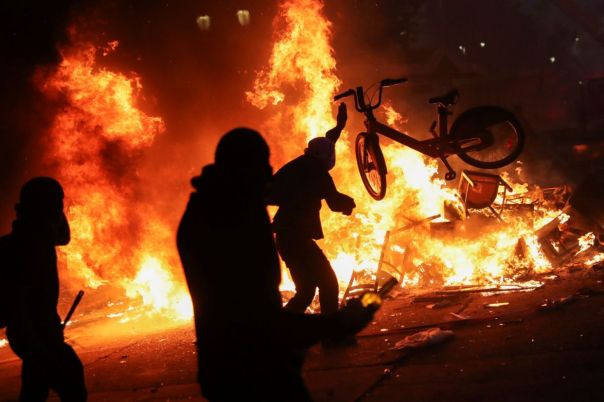
Daily protests in Santiago, Chile after a rise in the cost of public transportation. Photo: Edgard Garrido/ Reuters.
By: Raúl Zibechi
The increase in the cost of bus fare in Santiago, Chile was 30 pesos (720 pesos equal one dollar), raising the cost to 830 pesos. It’s evident that the popular reaction was not because of the $0.04 per ticket, but rather was due to very deep causes that have a name: neoliberalism/ extractivism/ accumulation by dispossession.
The Quito Uprising was, formally, against the end of the fuel subsidies, which always make food prices more expensive and prices rise. The original peoples and the workers took advantage of the gap opened by transport carriers, who don’t have popular interests but corporate ones, for throwing themselves into the jugular of the model.
In both cases, and in many others, what’s happening is that the peoples are fed up with an inequality that doesn’t stop growing under governments of the most diverse signs. Because the inequality is structural and is closely tied to the extractive model, which is summed up in social polarization, increasing poverty and concentration of power in the financial elites and big multinational companies.
The gigantic popular mobilizations in Quito, Santiago and Port-au-Prínce, not to mention Barcelona, Hong Kong and Paris, show two things that are guiding the situation: the power that popular mobilization has acquired, capable of configuring deep political turns, and that collective actions transcend governments, questioning a model that produces misery below and luxury above.

Protests in Port-au-Prince, Haiti. Photo: The Nation.
To be more precise: June 2013, with 20 million Brazilians in the streets of 350 cities, was a cry against inequality that buried the governability of Lula by the government not having comprehended the depth of the cry. December 2017 was key, but in an opposite direction, since it buried the conservative and classist governability of Macri.
However, these assessments continue being general and don’t touch the core. Walking through the streets of Quito these October days, where the sticky smell of smoke from burned tires remains, forces you to reflect. The exchanges with people from the most diverse movements, rural and urban dissipate the fog of the systemic confusion in which we move.
The first assessment is that women and youth played a decisive role in the uprising, which overflowed to the historic leaders. They starred in the largest march of women in the history of Ecuador, contributing the knowledge of reproduction and the care of life, adding lucidity to the fervor of youth without diminishing the combativeness.
The second [assessment] is the difference between an organized uprising and a spontaneous explosion. The Confederation of Indigenous Nationalities of Ecuador (Confederación de Nacionalidades Indígenas del Ecuador (Conaie) is a community-based organization, very well structured, and that’s why it had the capacity to get the provocateurs out of the marches, including the masked ones. That’s something that is not being possible in Chile, where police agents systematically infiltrated the demonstrations and encourage looting, which turns the population against the protests.
The third [assessment] is that the uprising was possible thanks to the rural communities in the first place. They provided what was necessary to ensure permanence for 12 days in distant Quito. Two forces stood out: the communities of the central sierra, to the north and to the south of the capital, and the Amazonian peoples, whose arrival organized as an indigenous guard was decisive in the final days final.

Pro-Independence protests in Barcelona, Spain. Photo: El Pais.
There was also an important presence of urban communities, the poor neighborhoods where the young people played an active and decisive role. A sector of the urban middle classes overcame the racism promoted by the media and supported the original peoples with water and food.
Finally, there is the interpretation of what’s happening. Among the different analyses, I believe the most profound is the one that Juan Cuvi and his colleagues write, in a work entitled “The exhaustion of a social control model” (El agotamiento de un modelo de control social). This model was born in the early 2000s with Lucio Gutiérrez and was developed throughout the decade of Rafael Correa.
In effect, the model is in crisis, but nothing is seen that can replace it in the short term. That’s why the chaos is underway, which will last for an unpredictable time, until the forces capable of overcoming it mature. We must think in terms of decades, more than of years and, even less, compress the changes underway to electoral times. Nor can we think that what’s coming is necessarily better that what expires.
A great disorder, as Mao Zedong pointed out, can be something positive. A great order is the social cemetery capital needs to continue accumulating. Disorder isn’t enough to modify things. The system counts on social protest social for redirecting it towards its interests, taking advantage of the confusion that may be functional, if we don’t find ways of converting the current situation into a scenario favorable to the peoples.
———————————————————–
Originally Published in Spanish by La Jornada
Friday, October 25, 2019
https://www.jornada.com.mx/2019/10/25/opinion/020a2pol
Re-Published with English interpretation by the Chiapas Support Committee
They demand breaking up the armed groups in Chenalhó
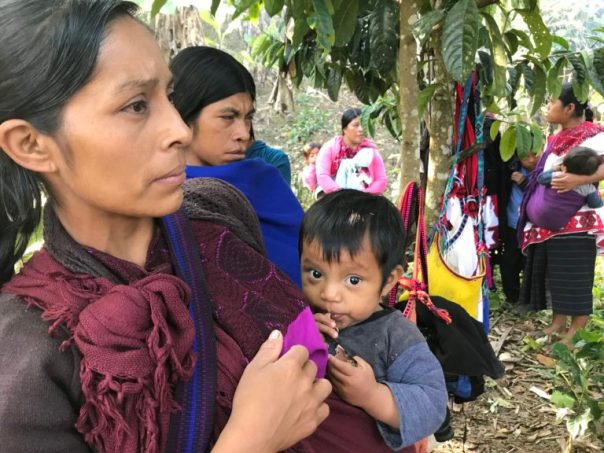
The Displaced of Chalchiuitán Photo: Ángeles Mariscal
By: Isaín Mandujano
From this community in the Chiapas Highlands, indigenous people from a dozen communities that experienced a massive displacement in 2017, today asked the state and federal government to break up the civilian armed groups that operate in Chenalhó municipality that terrorized them for two years with their weapons and patrols in the region.
Just two days after the two-year anniversary of the murder of the indigenous Tsotsil Samuel Luna Girón, which triggered an armed attack on the residents of Chalchihuitán, on the part of civilian armed group in Chenalhó, today his widow, family members, friends and compañeros of the man riddled with shots, asked for justice and punishment of the murderers and that the government comply with the corresponding indemnifications for all the damages that they caused them, by not having guaranteed the security of those who suffered forced displacement.
Elicia Gómez García, Samuel Luna Girón’s widow, recalled that October 18, 2017, when a group of armed men murdered her husband in front of her and their children, and began to evict them from their homes and burn the houses, as well as those of others neighbors and relatives.
All of that derived from the dispute over territorial limits between the municipalities of Chenalhó and Chalchiuitán, where the comuneros of both places fought each other over some lands where Tsotsil comuneros of both localities grow coffee and corn. This is an agrarian conflict that has several decades now.
It was in October 2017, when more than 5,000 residents of some 11 Chalchiuitán communities bordering on Chenalhó, were obliged to leave their homes and take refuge in the mountains, while some were able to reach other communities or the municipal capital. The displaced had to leave 11 communities.
From the end of October until December, the 5,023 indigenous people, men, women, elderly and children, survived in precarious conditions, in overcrowded conditions, suffering cold and hunger. Some 12 people died of diseases, or because of not having food to give to their children. The dead were the weakest ones, newborns and elderly.
María Pérez Paciencia, from one of the nine communities abandoned on that occasion, recalled the miserable conditions that they had to endure for two months given the indifference of the state government of Manuel Velasco and the federal government of Enrique Peña Nieto. And although there were no conditions for returning, little by little they were returned to their homes, with the permanent threat of being attacked.
Javier Luna Girón, said that the civilian armed groups in the region that forced them to leave their homes continue operating with impunity, and that their dead continue without having justice.
Ausencio Pérez Paciencia, said that two years have already passed and they continue waiting for the payment the state and federal governments promised the 5,000 displaced for everything that they lost: crops, backyard and farm animals, household goods, burned houses that have not been reconstructed and many other material damages that they suffered.
Marcos Pérez Gómez lamented that the state and federal governments have just deceived the population, that these civilian armed groups that are patrolling the roads they continue terrorizing them, that they enter the cornfields (milpas) to intimidate the campesinos of Chalchiuitán. The government has not dismantled them and they have operated since 1997 when they organized as a paramilitary group to perpetrate the massacre of 45 campesinos on December 22, 1997 in Acteal, Chenalhó.
——————————————————————–
Originally Published in Spanish by Chiapas Paralelo
Wednesday, October 16, 2019
Re-Published with English interpretation by the Chiapas Support Committee
The strength of the insurrection in Ecuador
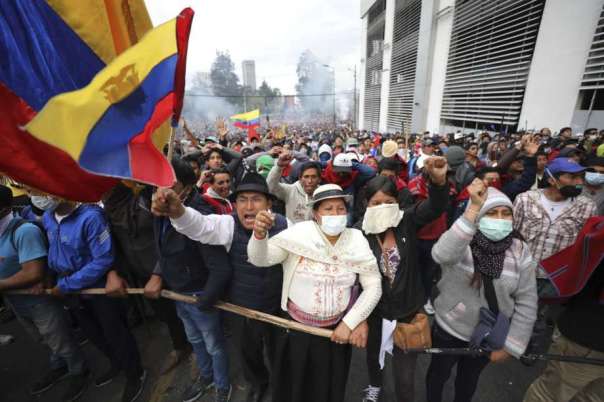
Ecuador Protests
By: R. Aída Hernández and Juan Illicachi*
On October 13, after 12 days of social mobilizations, the government of the President de Ecuador, Lenin Moreno, repealed Decree 883, known as the big package, which eliminated the subsidy for gasoline and promoted a series of reforms that affected the least protected sectors of Ecuadorian society. Since October 2, a broad citizen movement headed by the Confederation of Indigenous Nationalities of Ecuador (Conaie), the Workers Unitary Front (Frente Unitario de Trabajadores, FUT) and the Federation of Indigenous Evangelicals of Ecuador (Feine), called a national strike, taking the streets of the principal cities of Ecuador. This citizen mobilization took place in response to the austerity measures decreed by President Moreno Garcés, following the guidelines imposed by the International Monetary Fund (IMF) as conditions for a new 4.2 billion dollar loan. The repeal of Decree 883 was a victory of the coalition of indigenous and popular organizations, which showed in recent weeks the capacity for resistance that the organized people can have.
But the stop of the gasoline subsidy was only the tip of the iceberg of a series of structural reforms that are in Moreno’s inkwell, which include several points that directly affect the most impoverished sectors of the country, and specifically indigenous territories. Among the FMI’s recommendations is a tax reform to make direct foreign investment favorable, reducing taxes on foreign companies while promoting mining and oil extraction by transnationals. This reform would respond to the successful resistance actions of the indigenous movement indigenous against extractivism. Last spring, the residents of Girón, in the province of Azuay, said “no to mining,” in order to protect the Quimsacocha nature reserve, affecting the Canadian company INV Metals. Meanwhile, the indigenous organizations of the Intag region, in northern Imbabura province, declared that zone free of mining and demanded the exit of the extractive companies. Faced with the defense of life and territory, the interests of big capital try to impose with the force of law, maintained with legitimized violence.
The pseudo-left president Lenin Moreno, who had been Vice President during the two terms of Rafael Correa (2007-09 and 2009-13), under- estimated the capacity of the peoples’ resistance, by betraying all his campaign promises and imposing the neoliberal program, which the IMF has wanted to establish on the continent. To the state of exception that the government declared on October 3, which expanded military and police powers for repression, the Conaie responded, declared its own state of exception, demanded the withdrawal of governmental forces from its communities and warned that they would be subjected to indigenous justice in case of violating its jurisdictions. At the same time, the articulation of urban and rural political forces, even the evangelical population, showed the convoking power of the indigenous movement in Ecuador and obliged the government to sit down and negotiate. Together with the repeal of Decree 833, it was agreed to install a commission formed by the government and social sectors to make a proposal that permits balancing the economy.
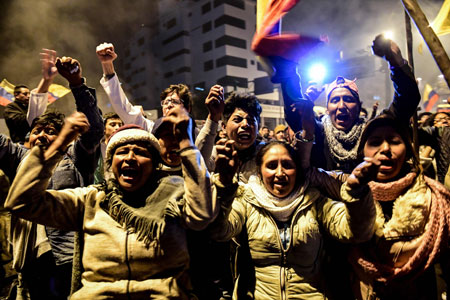
Protesters celebrate victory in Ecuador.
However, the balance of human rights violations committed during those 12 days of mobilizations is pending. The government responded with all the force of its repressive apparatus against the peaceful demonstrations because, according to official numbers, 485 demonstrators were arrested just between October 3 and 6, and the death of 5 more was reported, among them a leader of the Conaie, from the province of Cotapaxi.
The chronicle of the events of October 11, in which one of the authors of this text was present, gives a sample of the violence that the government used against the organized people, whose consequences must still be evaluated. On the ninth day of mobilization: indigenous and mestizos, students and workers, women and men, old and young, from the countryside and the city, marched peacefully towards the National Assembly, and were attacked with tear gas bombs for more than four hours. Then the most delectable strategies were used to ambush the protesters and after a while of suspending the attacks, in the middle of rivers of people, who were demanding justice, three vehicles with food appeared. Those present, lined up to take water, bread, rice and soft drinks, and a break, after hours of marching and receiving aggressions. No one knew where the food had come from, but around 4:20 pm, they heard shots from the tear gas bombs, which took the demonstrators by surprise. The people shouted: “They betrayed us!” and “They paused until they were resupplied with ammunition!” and “We’re not armed, don’t attack us!” Several questions emerge: Did the space turn into the field of attack? Can you say, a concentration camp of attack on the protest? What is clear is that the police and the Ecuadorian armed forces were used infamously and excessively against the people, generating violence and death. The exact number of injured and detained is not known, but the Ombudsman’s Office reported that this week’s events have been the most violent in recent years.
It’s pitiful that it is the governments that come to power with a supposedly leftist agenda, which is supposed to prioritize social welfare policies, who impose the extractive megaprojects that dispossess the indigenous peoples, as well as structural reforms that affect the poorest. The victory of the Ecuadorian popular movement is an example of what can be achieved articulating alliances and using peaceful civil resistance. The Mexican government would do well to learn from the Ecuadorian reality the consequences that wanting to impose on the peoples extractive projects that threatened life and territory can have.
* R. Aída Hernández is a social anthropologist and feminist activist. Ciesas She is a professor and researcher at the Center for Advanced Studies in Social Anthropology (CIESAS). Juan Illicachi is a former rector of the Intercultural University of Nationalities and Indigenous Peoples Amawtay Wasi and Kichwa leader of a grass roots organization of the Conaie.
———————————————————–
Originally Published in Spanish by La Jornada
Wednesday, October 16, 2019
https://www.jornada.com.mx/2019/10/16/opinion/018a1pol
Re-Published with English interpretation by the Chiapas Support Committee
The Mexican government apologizes to indigenous women raped by the Army in 1994
“THEY PUNISHED US TO PUNISH ZAPATISMO”
By: Angeles Mariscal
The soldiers recognized them, when on June 4, 1994, Ana, Beatriz and Cecilia González Pérez and their mother Delia Pérez attempted to cross the checkpoint that the Mexican Army put up in the ejido Jalisco, municipality of Altamirano. They even called one of them with the nickname by which she was known in her community. To the Secretary of National Defense (SEDENA, the Spanish acronym) they were members of the Zapatista National Liberation Army (Ejército Zapatista de Liberación Nacional, EZLN) and punished them for that by raping them.
They detained them and for two hours, by means of sexual torture, attempted to force them to say they were members of the armed group, and to inform on other individuals. Those were months in which the Mexican Army was occupying indigenous areas of Chiapas to disarticulate the insurgent movement.
They resisted, and upon being released, criminally denounced the acts, submitted to examinations that showed the tumultuous rape, but the case was assumed by Military Justice, and was closed denying justice. They then appealed to the Inter-American Commission on Human Rights (IACHR), a body that in 2001, after analyzing the case, presented an in-depth report, declaring the international responsibility of the Mexican State, demanding that it punish those responsible, and that it repair the damage to the aggrieved.
The IACHR concluded that rape of the González Pérez sisters, “was committed for the purpose of intimidating the three women because of their alleged links to the EZLN.” However, the Mexican State evaded its responsibility for 25 years, until this October 18, when it initiated the justice process.
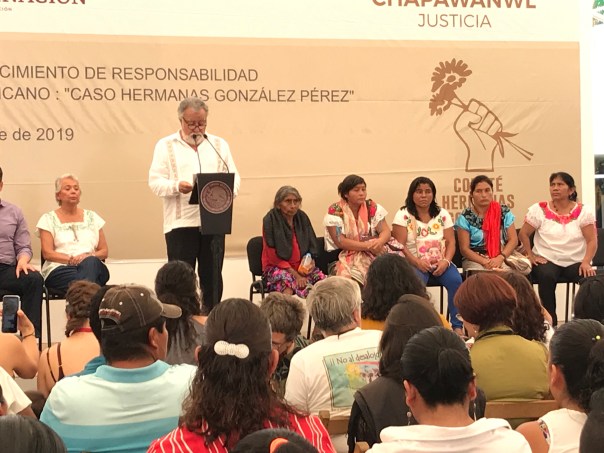
In the public square of the city of Ocosingo, in the voice of Interior Secretary Olga Sánchez Cordero, the Mexican government apologized to the Gonzalez Pérez sisters, before 500 people, among them public officials and residents of the region.
“Today, in the name of the Mexican State, I apologize for the lack of investigation and search for justice (…) it’s essential to recognize the impact of war on the bodies of women, direct offenses that cross through a triple structural violence in this case: for being women, for being indigenous and for being poor,” Sánchez Cordero said.
The Under Secretary of Human Rights, Alejandro Encinas, was also at the public apology event. He maintained: “you cannot ignore the context in which the terrible offenses of this case occur. They start with the 1994 armed conflict against the indigenous communities and peoples, who were demanding the recognition of the most basic rights: work, land, shelter, food, health care, education, independence, freedom, democracy, justice and peace. The 500 years of exploitation and marginalization were not enough: the voice of the peoples was silenced with blows (…) the sexual torture committed on the part of the State against the González sisters, had the objective of repressing, intimidating and humiliating,” he recognized.
Mexican Army, the big absence
The public apology had a big absent, representatives from the SEDENA, the institution that the sisters locate as their torturers. Ana, Beatriz, Celia and their mother Delia, demanded for all these years that military leaders were the ones who should acknowledge the acts, the ones who should apologize and be brought to justice.
“Those who in reality committed the harm didn’t come. What we want is a real justice. I want to demand justice, so that the soldiers ask us for public forgiveness. When Zapatismo happened in 1994, they punished us in order to punish Zapatismo,” Celia, who was only 16 years old when the acts occurred, pointed out.
Her sister Ana added: “this act of public in reality is not an act of public apology because we said clearly that we wanted representatives of the SEDENA to be present so that they could ask us for public forgiveness, because they were the ones who committed the offenses. This public forgiveness is not complete.”
In indigenous culture it is the one responsible for the offense who must ask for forgiveness, because it is the identification of this before the community.
Ana insisted that they reject the presence of soldiers in indigenous zones. “We don’t want the soldiers in our towns, because the government says that they are the ones who protect us, but it is the opposite; they are the ones who do us harm.”
“What happened to us, the rapes, happens in many parts of Ocosingo and Altamirano (indigenous regions of Chiapas where the EZLN has a presence), and no one ever makes it known,” Celia emphasized.
“This is happening today, it’s as if a garbage truck came, and it came to collect all the garbage. I say to you that when the government does an abuse or a rape, speak up and don’t keep quiet.”
The González Pérez sisters also spoke the name of those who died in 1994, at the hands of the Mexican Army. “The reason and the cause for which the Zapatistas died were because there is a lot of poverty, a lot of oblivion towards the indigenous peoples, and they were fighting against this.”
Among the agreements that Olga Sánchez Cordero, Alejandro Encinas and the sisters and their mother signed today, is to continue the investigation for bringing the implicated soldiers to [legal] process.
However, they insisted that this process not be individualized, and it is assumed that the rape was not an independent or autonomous act that the soldiers committed, bur rather an institutional action that obeyed a strategy of war against the EZLN.
The apology, a vindication of their dignity
For the González Pérez sisters and their mother, the act of forgiveness had a meaning beyond their person; it was the vindication of their dignity in front of their community. Therefore, they asked that this event be carried out in the municipality of Ocosingo, the most important city in the Tzeltal indigenous to which they belong.
After the rape, when the family and the community to which they belonged learned about it, they were rejected, and were forced to leave the place. “It was on the one hand because of the community’s fear of the repression on the part of the military that was occupying them, but also because of the way in which women are configured in indigenous communities, and the value they place on virginity. By losing it in the rape, they were seen as ´the soldiers’ women´ or prostitutes,” explained Gloria Flores Ruiz, the lawyer for the indigenous women.
Nevertheless, the three sisters and their mother understood that members of the EZLN and indigenous communities as a whole were also aggrieved in the rape. “Forgiveness is experienced not only towards their person, but also as a forgiveness that the aggrieved women deserve, but also the Zapatista women. Forgiveness is experienced in a feeling, individual, communitarian, political,” she explained.
Therefore, in the agreement with the Mexican government, the aggrieved also asked the Mexican government for a public apology in favor of the community as a whole, and in favor of the Zapatista population.
——————————————————————-
Originally Published in Spanish by Chiapas Paralelo
Friday, October 18, 2019
Re-Published with English interpretation by the Chiapas Support Committee
Saint Greta and the day after

Greta Thunberg
By: Hermann Bellinghausen
It is in the nature of contemporary media and social networks that we waste time among the weeds to avoid the important. The forms of self-deception, pretexts and procrastination fill our hands, disguised as likes and dislikes, ceaselessly interrupted by owners and advertisers making sure that our ideas and actions are fragmentary, effective, emotional, satisfying like a treat (in Ignacio Ramonet’s terms), fleeting, forgettable, replaced by the next and the next until nausea or numbness. Sometimes the impact is bigger. The Nordic saga of Greta Thunberg, the student who one day decided to skip school and save the world, generated a massive and ongoing wave of responses, especially from youth, to talk and demand, protest, disrupt.
These kids, from the First and Second worlds, who in effect have three meals a day, go to the dentist and may be white, although not necessarily (the Swedish factor is secondary), are provoking media impact in the guilty metropolises, even if it makes us itchy and we talk about the children of Syria and La Montaña of Guerrero, let’s see how fucking privileged kids cry, they lack the leather to tie their straps.
That said, wanting to waste time with memes, hashtags and opinions on the fly, happy to suspect that there is something fishy, nobody fools me, who is behind it, to see what prince put in the sailboat, what “green” company wants to unseat coal and oil.
Greta matters, regardless of her merit in opposing the parliament and right-wing philosophers in France, Fox News, the large extractive and warlike companies, their think tanks and last but not least, the holders of the planetary political power Putin, Trump, Bolsonaro and company. She also added the irritations, boasts, and disdain of left and radical thinking in the First, Second and Third worlds, including proud “ethnics” of any denomination. What unanimity! The Swedish girl whose clinical history is public (the new Assange?) gave a media dimension to the central claim of our time, took it to European parliaments, to the exasperating UN assembly, echoing in the streets of more than a hundred cities after infesting high schools and youth clubs.
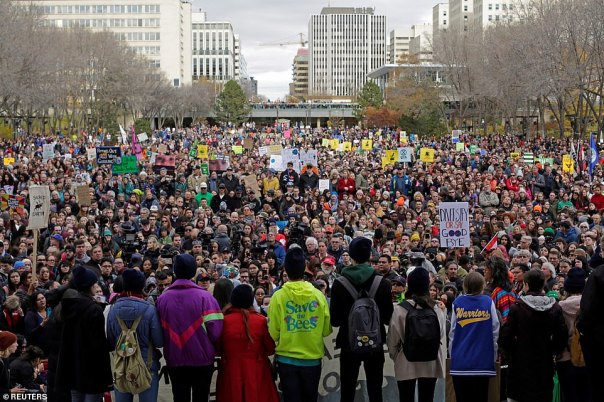
Greta Thunberg rally in Edmonton, Alberta, Canada yesterday October 20, 2019.
The planet is dying, at least as we knew it. That is, in the conditions that made it habitable, unique in the galaxy, the habitat of all civilizations. The problem is not whether Greta is Joan of Arc (which she is), or whether we like it or not. There are alternatives of consciousness, struggles and resistances of greater depth and eloquence, but instead of turning to them and acting, we suck our finger of candy on candy, of indignation on indignation. The one that brought us is taking us and we are still wasting time.
You don’t like what children do? Hey, there are alternatives for adults. It stands out for its clarity and forcefulness Extinction Rebellion (ER), a new direct resistance movement, originated in London, which as of October 7 carries out actions in 60 cities (I fear not ours) that really challenge corporations , governments and their police. They are killing it. Their impeccable reasoning is what we should discuss now. Their logo, an hourglass, tells us: “time is running out”. Are we going to keep saying goodbye to jungles and glaciers between tears and prayers? As David Bowie recites: “I demand a better future.”
The world is going through a mass extinction event, ER argues. It is estimated that between 30 and 40 thousand species become extinct every year. The ongoing destruction process is caused by human activity. Such catastrophic loss of biodiversity is likely to generalize a collapse of ecosystems that would leave the planet uninhabitable for humans: “Something’s happening. You know it, you feel it. It calls you to be a part. ”
ER says: “We are reaching a point of no return. Governments do nothing. Neither do businesses. It is not a distant apocalypse. People suffer and die in the world right now. Whole species disappear. And it will get worse. The time to act is today. It is happening to others. Soon it will be you and the ones you love. Don’t count on us, or Greta, to do it for you. Look inside yourself and rebel. ER calls to peacefully occupy the centers of power and close them until the governments act for the climatic and ecological emergency. “Leave your desk, invite your boss, turn off the television, put the cell phone aside. Take to the streets. Respect the existence or expect resistance. ”
———————————————————–
Originally Published in Spanish by La Jornada
Monday, October 7, 2019
https://www.jornada.com.mx/2019/10/07/opinion/a10a1cul
Re-Published with English interpretation by the Chiapas Support Committee
Indigenous peoples reject the Maya Train, the Trans-Isthmus Corridor and exploitation of water
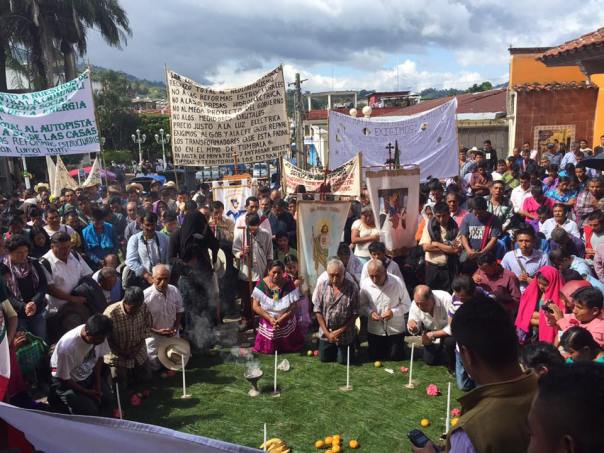
Modevite ceremony and demonstration in Chiapas.
By: Chiapas Paralelo
Different Chiapas indigenous organizations met in the “First Regional Gathering in Defense of Water Agua and Mother Earth” held in Chilón, for the purpose of expressing their indigenous resistance to the colonial invasion, and, at the same time, denouncing the strategy of the capitalist system and its logic for the dispossession of their territories.
With the slogan “Water for life, not for the transnational,” the organizations denounced that since 527 years ago they have struggled against dispossession, plunder and extermination. Now, they also struggle against the megaprojects that place in danger the conditions of existence of different life forms, as well as proposing and constructing sustainable alternatives for the care of their common house.
Given that, they mentioned that aware of the importance of the defense of land and territory, for the purpose of preserving and rescuing their knowledge, they have found different processes of struggle and resistance to converge in defense of their territory, because of which they shared their experiences in the exercise and recognition of the free determination of the original peoples.
“Others from different latitudes we weave alliances with other brother peoples to prevent the dispossession of our natural commons, since mining, geo-parks, hydroelectric dams, extraction of hydrocarbons and the privatization of water are underway as an indispensable means to carry out these megaprojects,” they explained.
One of the themes was the commercialization of water for the benefit of beer and dairy companies and, in the case of San Cristóbal de Las Casas, Chiapas, the exploitation of the vital liquid for Femsa Coca Cola company, which has generated a grave water and health crisis for the population.
Therefore, the organizations confirmed that authorities of the three levels of government are subject to the interest of the transnationals, while they generate diseases and death with the destruction of territory and community life, as well as the devastation of the planet’s ecosystems, all for their economic and political interest.
“They are the ones responsible for the planet’s climate change that puts humanity and other living beings of our common house at risk,” they said.
Therefore, they withdrew their struggle for defense of territory and self- determination of the peoples in search of community government, such as a human right to consultation with the communities and peoples of the world faced with the megaprojects imposed by the system like: the Maya Train, the San Cristóbal-Palenque superhighway, the Trans-Isthmus Corridor, the Morelos Integral Project, the new airport, the refineries and the Special Economic Zones.
Therefore what they demanded is respect for the conventions established in international agreements. Convention 169 recognizes the right to consultation in Articles (6, 15, 17, 22, 27 y 28) of the ILO and the United Nations Declaration on the Rights of Indigenous Peoples, enjoying a broad consensus at the international level with approval by 143 countries.
“The struggle of the Native peoples and their example have been fundamental in the construction of peace and the search for community reconciliation in the different regions of the state, the country and the world,” they said.
Also, the different organizations recognized the organization of the municipalities of Chilón and Bachajón, in the management of their self- government and appropriation of the human right to water forming the Movement in Defense of Water of Chilón (MODEA).
At the same time, they sympathized with the Bachajón Mission and the Movement in Defense of Life and Territory (MODEVITE).
Finally, they emphasized the organizational struggles in defense of the Quenvo Cuxtitali Reserve, Colonia 14 de Septiembre, the articulation of the Council of the Northern Zone, the defense of the María Eugenia Mountain Wetlands and La Kists and the struggle of the Zoque people against Santa Fe Mining Company (Carlos Slim), against the geo-parks, hydroelectric dams, as well as denouncing the repressive actions against the compañerxs of the Colonia Maya, San Cristóbal de las Casas.
——————————————————————
Originally Published in Spanish by Chiapas Paralelo
Sunday, October 13, 2019
Re-Published with English interpretation by the Chiapas Support Committee
Since the start of 4T, repression against indigenous peoples increased, Marichuy denounces in Spain
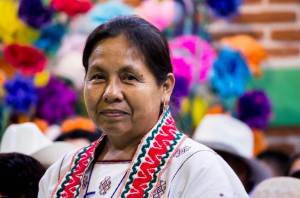
María de Jesús Patricio, spokeswoman for the Indigenous Government Council for Mexico.
By: Armando G. Tejeda
Madrid
María de Jesús Patricio, Marichuy, is on tour through Basque and Spanish cities with the charge from the National Indigenous Congress (Congreso Nacional Indígena, CNI) of denouncing the “increase in repression, murders and harassment” against the original peoples ever since Andrés Manuel López Obrador arrived in the Presidency of Mexico. The denunciations of the former pre-candidate to the Presidency also include the National Guard, which she points out as mainly responsible for the repression, especially for promoting energy projects in places like the Isthmus of Tehuantepec, Morelos and the territory through which the Maya Train will pass.
In an interview with La Jornada, Marichuy ratified these accusations that she exposes at the forums she attends and warns that in the next general assembly of indigenous people, between November and December, resistance strategies will be decided to face the “very grave” situation, she affirms, in which their communities are found.
–What leads the CNI and you to make this tour outside of Mexico to denounce what happens in Mexico?
–It is to report the real situation that our indigenous peoples experience, since what is said in the media and what those above say, among them the President of Mexico, is not what happens below. We want it known that there are many dead, there are disappeared, there are aggressions toward people that organize to defend their territory. We are living in a state of war declared towards the peoples because of wanting to introduce megaprojects that will only bring territorial destruction to entire peoples and communities. It is a dispossession that the government carries out through repressive forces, such as the Army, the police, but also groups of the narco that surrender to the interests of the corporations.
–According to you, the repression has intensified since López Obrador assumed power, even worse than with the PRI?
–Yes, that is exactly what we are seeing. It is said that it is a government of the left dice and that all is well, but it isn’t. Below we are worse than before, because they have murdered our CNI compañeros and councilors and that had not happened before. To the peoples, war has been declared in order to impose those megaprojects. In fact, we believe that the National Guard was put in place to repress, not to take care of the communities, and to consummate the agreements necessary for executing the megaprojects. So, all that about change is a lie. The change for the peoples went backwards. Besides it holds consultations with the peoples, simulated and rigged, in which it offers assistance, gifts, to condition the result of the consultation.
–In case that the community votes in favor, what would happen?
–It’s that sometimes information is paid for so that it comes out in the media that the consultations were done, but in reality it’s not so. It’s not something that the communities say, but rather something for which the corporations are paying.
–You assert that the National Guard is responsible for the repression and attacks on the CNI. Could you point out for exactly what attacks and what kind of violence has been exercised against you with the National Guard?
–It’s just in the places where there is more organization to prevent what the corporations establish, like the wind farms. They have told us that the National Guard has hit the people who resist; specifically, on the Isthmus, but I don’t remember the name of the town.
–How do you know that it’s the National Guard? Are they in uniform? Do you know them?
–Because they always wear like a bracelet with an NG. And it’s happening like that on the Isthmus, in Puebla, in Chiapas.
–And those attacks, in exactly what have they consisted?
–They have told us that there have been blows; there have also been some deaths, but there is no certainty of who they were. For example, the murder of Samir Flores was a little after a government visit in the zone in which there was a demonstration against the thermoelectric plant. And it was obvious to us that it was a message for the one who raises her voice to not say anything. They also murdered four councilors in Guerrero and other CNI delegates. And that didn’t happen before.
————————————————————–
Originally Published in Spanish by La Jornada
Saturday, October 12, 2019
https://www.jornada.com.mx/2019/10/12/politica/008n2pol
Re-Published with English interpretation by the Chiapas Support Committee
Mexico, trapped between the migrant flow and US policy
African migrants protest during UN visit

Some 200 African men, women and children mobilized in Tapachula, Chiapas to demand the delivery of humanitarian visas that allow them to travel through Mexican territory. Photo: Afp.
The United Nations High Commissioner for Refugees, Filippo Grandi, visited Mexico during the latter part of September to observe the situation of migrants and asylum seekers. Interviewed prior to leaving Mexico, Grandi viewed Mexico as trapped “between double pressure:” on the one hand, an unprecedented migratory flow coming from Central America and other countries (Africans, Cubans, Venezuelans and Nicaraguans), “who are not only requesting asylum,” and on the other hand a response from the North, limiting access to U.S. territory.
Grandi was asked about Mexico’s response to these pressures, which has been to accept the US policy called the Migrant Protection Protocols (MPP). According to the US Department of Homeland Security, this policy requires that certain foreign individuals entering or seeking admission to the US from Mexico –illegally or without proper documentation– may be returned to Mexico to wait outside the US for the duration of their proceedings, where Mexico will provide them with all appropriate humanitarian protection for the duration of their stay. That policy has caused thousands of asylum seekers to have to reside in extremely dangerous cities on Mexico’s northern border.
Grandi emphasized that the UNHCR is not involved in the MPP and does not endorse the policy. However, he knows that there are many people requesting asylum and they are forced to live in very dangerous situations. There are kidnappings, human rights violations and manipulation from criminal groups in the area. Grandi recommended more resources for the COMAR at the northern border and an easing of procedures for asylum.
Grandi at Mexico’s southern border
Several days before the above interview, Grandi was in Tapachula, Chiapas, very close to Mexico’s southern border for the inauguration of the new installations of the Mexican Commission for Assistance to Refugees (COMAR). According to a report from Isaín Mandujano in Chiapas Paralelo, African migrants arrived at the COMAR’s new offices in Tapachula, where they tried to deliver a letter to Filippo Grandi. All was going well until Yadira de los Santos, federal delegate of the National Migration Institute (INM), its initials in Spanish) made an appearance at the site. This angered the African migrants and activist human rights defenders, who started to protest against the federal official. Spirits rose when federal police intervened and began struggling with the migrants.
Paul Mananga Ntoto, one of the few African migrants that speaks Spanish, demanded that the UNHCR and the COMAR intervene so that the exit letter be given to them right away so that they can continue on their way. The migrant from the Central African Congo reproached the treatment that all the migrants from his country have received up to now; they remain stranded in this southern border city of Mexico. The activist and migrant defender, Luis Rey García Villagrán, questioned the violation of the human rights of the migrants that enter our country and asked that they be taken care of immediately.
UNHCR officials came out to attend to the migrants that were protesting and then a woman migrant threw herself on the tires of Filippo Grandi’s truck in order to receive attention.

African migrants protest during UN visit.
Grandi emphasized that Chiapas is the state in Mexico that receives the highest number of requests for asylum and that Chiapas will increase its response capacity faced with the increase in asylum requests. “We must work together to respond efficiently and quickly, and also justly, respecting the rights of those who have to flee,” Grandi said during the inauguration of the new space of the Mexican Commission for Refugee Assistance in Chiapas, Mexico, supported by the UNHCR.
Africans in Tapachula throw barricades and chairs

Young African migrants march..
Apparently, officials of the COMAR and the UNHCR did not act quickly enough to satisfy the African migrants’ concerns about delay. Approximately a week later, after marching to demand delivery of the document that would permit them to move freely through Mexico, more than 200 young African migrants threw barricades, tents and chairs placed in the central park of Tapachula, Chiapas for the celebration of what’s called the Regional Security Fair.
In the morning, migrants came out of the 21st Century Migratory Station, located in the northern part of that border city, where they have maintained an occupation for more than 45 days, and they walked to the center of Tapachula. They reached the central park, where they found the city hall surrounded with metal barricades, a stage, tents and chairs, so in order to advance towards the esplanade they threw what they found in their way, while some agents observed.
One of them threatened to throw a metal barricade at the circle of police, who launched tear gas, which caused the confrontation with the young Africans. The action of the young migrants from different African countries provoked a confrontation with the police that were guarding the area. Thankfully, no injuries were reported.
In conclusion, all of the above calls into question the deliberate cruelty of the US policy named the Migrant Protections Protocols, which creates long delays for migrants seeking asylum in a country without the existing infrastructure to accommodate them.
—————————————————
The Chiapas Support Committee compiled this article from news recent reports in Chiapas Paralelo and La Jornada.
 Chiapas Support Committee