Chiapas Support Committee
Home of the Compañero Manuel blog on zapatistas & mexico
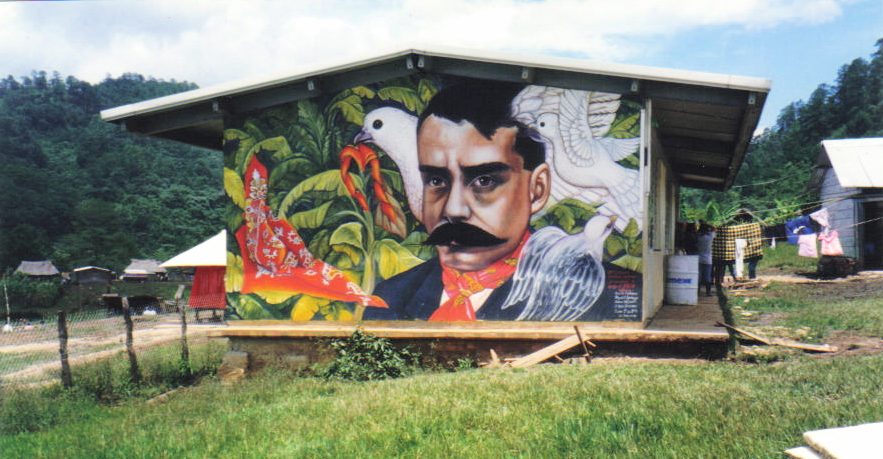
La Caracola and the color of the Earth
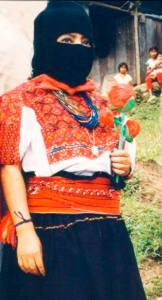
Comandanta Ramona
By: Carlos Fazio
In February, the Zapatista women announced from the mountains of the Mexican southeast the suspension of the Second International Meeting for Women in Struggle, scheduled for next March in their regional territories. One of the reasons given was that due to the “capitalist megaprojects of destruction” of “the new bad governments” (Mayan Train, plan for the Isthmus of Tehuantepec, planting trees for timber and fruit merchandise, mining, large food companies) and the reactivation of the attack by the paramilitaries, they could no longer provide “security” to women who would attend from other parts of Mexico and the world. They affirmed: “Capitalism comes for everything and wants it no matter at what cost.”
According to the communiqué, the “capitalists” want to “destroy” the Indigenous peoples and turn their lands into merchandise, completing “what Carlos Salinas de Gortari left pending that he couldn’t do because we stopped him with our uprising.” Implicitly, the expression “our uprising” refers to the peasant-indigenous insurrection of January 1, 1994 and the role of women in the political-military organization that became known as the Zapatista Army of National Liberation (EZLN).
The period that goes from the uprising to the present marks a line of continuity that links the comandantas of the clandestine era with the girls who were born in the autonomous territories under a siege of military and paramilitary annihilation, the ones who today are the protagonists of active resistance to the the renewed onslaught of big capital with its predatory extractive megaprojects and its covert war to dispossess territories and natural resources and for new markets and semi-enslaved labor.
Since then, also, the discursive construction of the inequality of the Zapatista women went from the initial triple marginalization based on social class (poor), ethnicity (indigenous) and gender (woman), derived from the use of power in society (as domination, repression, exclusion and prejudice against the Other), to an empowerment that is reflected in the living conditions of the new generation of comandantas. It should be noted that when the Zapatistas affirm that “their skin is the color of the earth”, they reflect their respect for something inseparable from the indigenous worldview: Mother Nature.
Twenty-five years after the armed uprising and the Revolutionary Laws of Women in 1994 – which questioned the foundations of the patriarchal order in Indigenous communities and vindicated a female “we” within a “collective” environment that included men – the discourse from victimization has developed towards resistance and respect. The participation of the Zapatistas as militia, insurgents and in communication tasks – for example on the radio, as a way to break the silence – has produced a new counterhegemonic discourse based on two key words: freedom and dignity.
Thus, when in their statement of February 2019 they say they want to take away their land so that tourists come and have their big hotels and restaurants; or to turn them into farms producing precious wood, fruit and water; or in mines to get gold, silver, uranium and other minerals, they add: “They want to turn us into their peons, into servants who sell our dignity for a few coins every month. Those capitalists and the new bad governments who obey them think that what we want is money. They don’t understand that what we want is freedom. […] They don’t understand that what they call “progress” is a lie, that they can’t even provide safety for all of the women who continue to be beaten, raped, and murdered in their worlds, be they progressive or reactionary worlds […] in Zapatista territory, not a single woman has been murdered for many years. Imagine, and they call us backward, ignorant, and insignificant.”
They add: “Maybe we don’t know which feminism is the best one, maybe we don’t say “cuerpa” [a feminization of “cuerpo,” or body], maybe we don’t know what “gender equity” is. In any case that concept of “gender equity” isn’t even well-formulated because it only refers to women and men, and even we, supposedly ignorant and backward, know that there are those who are neither men nor women and who we call “others” [otroas] but who call themselves whatever they feel like… What we do know is that we fought for our freedom and now we have to fight to defend it. We didn’t rise up in arms to return to the same thing. We haven’t been resisting for 25 years in order to end up serving tourists, bosses, and overseers. […] Our dignity has no price. […] We’re going to fight with all our strength and everything we’ve got against these mega-projects. If these lands are conquered, it will be upon the blood of Zapatista women. […] We are going to receive them (paramilitaries, the national guard) with our struggle and then we’ll see if they learn that Zapatista women don’t give in, give up, or sell out.”
They are also clear that the urgency, today, is not Reform or Revolution, but, literally, the struggle for life; survival. That is to say: resistance and rebellion. That is why, since last December, La Caracola, a network of Zapatista women, was born to articulate their struggles against patriarchy, capitalism and colonialism; patriarchy understood as a system of domination, depravity, devastation and death, which gave rise to the capitalist system.
———————————————————–
Originally Published in Spanish by La Jornada
Monday, September 9, 2019
https://www.jornada.com.mx/2019/09/09/opinion
Re-Published with English interpretation by the Chiapas Support Committee
Autonomous Municipalities and 40 years of resistance

Bishop Samuel Ruiz. Photo: AP
Juan Trujillo Limones
“We clearly told the government in 1994 that the people are going to rule in Chiapas,” commented the indigenous Tojolabal Aurelio on that summer morning, while he mixed the cement for repairing the wall of the secondary school in Vicente Guerrero autonomous municipality. Last August 17, the Zapatista National Liberation Army (Ejército Zapatista de Liberación Nacional, EZLN) communicated the creation of seven new Caracoles and four new autonomous municipalities. How is this process understood in the recent history of Chiapas? It’s about a reality that comes from decades of social transformations that interlace politics, religion and the indigenous campesino world. Remembering it is to understand autonomy.
Between 1968 and 1978 a catechist movement was consolidated in the Highlands (los Altos) of Chiapas with the entry of liberation theology. Social mobilization was proof of that, starting with the religious networks woven in the communities and organization of the 1974 Indigenous Congress. [1]
Campesinos of the land seekers movement autonomously won and defended their rights through peaceful struggle. The incorporation of extensions of land into the ejido system permitted the defense of communal land. Thus, communal authorities were established that, by distributing lands, not only allowed equal rights, but also assemblies for balancing the communities against internal and external conflicts.
The social organizations that formed were directed and often created by a group of catechists. On other occasions, it was not necessarily indigenous religious people, but rather highly politicized people with defined objectives and goals.
In the Tsotsil zone of los Altos, like also in the Tojolabal, Tseltal, Zoque and Chol regions of the Lacandón Jungle, the mobilization led thousands of indigenous to struggle for land in organizations like ANCIEZ, OCEZ, CIOAC or Quiptic ta Lecubtesel [2], despite repression from ranchers, landholders, finqueros (estate owners) and governments through their white guards, police and armies.
Although during the decades of the 70s and 80s the governments closed off institutional paths of struggle for land and other rights, the mobilizations of organizations sought, in the beginning, peaceful and autonomous forms for improving the prevailing undignified living conditions.
The response from the state and federal governments was to apply palliative containment measures to the campesino demands and, in most cases, counterinsurgency measures, repression and incarceration of indigenous religious and social leaders.
The “preferential option for the poor” was a radical effort by the San Cristóbal Catholic Diocese to support thousands of communities. The indigenous translated it as a struggle for life that was balanced with ideas about salvation and liberation. The political line of the indigenous religious [leaders], although some could not or would not see it or try to stop it, was drawn towards the transformation of social structures.
This required that the actions would travel beyond their borders to enter the region’s Ladino cities. In the municipal capitals and in Tuxtla [Gutiérrez] are where the procedures of legalization, distribution, purchase and sale of land were found. The diocese had to articulate a political line and it adopted more radical positions for the defense of rights and recuperation of lands. It was not a temporary statement or decision; rather, it was a struggle backed by the impulse of the suffering campesino reality. The arbitrary actions of the government and the finqueros (estate owners) were premeditated ones that resulted in incarcerations, attacks and massacres. The government sought to disqualify social organizations and the diocese so that they would abandon this path.
Between 1968 and 1988, indigenous language and culture were the channels with which the Maya worldview (cosmovisión) appealed to the diocese, activists and guerrillas. The politicization of the indigenous peoples came not only with the impulse of the 1974 Congress, but also and fundamentally with the demand for land and the hope to free themselves from the power and domination of the estate system that, although degraded, still had strength.
At the end of the decade of the 80s, the institutional paths had been closed, because they were just filters that exhausted social struggles. To strengthen the communities, Bishop Samuel Ruiz understood that it was essential to have deacons (who would carry out almost all the priestly work). By 1993, there were 7, 822 catechists and 422 candidates from 2, 608 places. A little later, there were already 311 permanent deacons, whose process consolidated the birth not only of the native church, but also currently, the autonomous one.
The 1994 armed uprising of the EZLN and the gradual installation of autonomous municipalities are only the effects of complex forms of exercising freedom and life through civilian, ejido, spiritual and military authorities that come from more than 40 years of insubordination and popular resistance. The current summer dawn, with seven new Juntas de Buen Gobierno (Good Government Juntas), supposes a new stage in the indigenous history of Mexico.
NOTES:
- The 1974 Indigenous Congress was organized by the Catholic Diocese of San Cristóbal de las Casas after the governor of Chiapas asked Bishop Ruiz to organize a celebration in honor of the anniversary of Fray Bartolomé de las Casas, the first bishop of San Cristóbal, who advocated against enslaving the indigenous peoples. Bishop Ruiz invited leftist organizers from cities in other Mexican states do outreach for the Congress in the indigenous communities and, later, to hold capacity building workshops during the Congress. Some of the organizers stayed afterwards to work with indigenous communities on establishing campesino organizations that would advocate for the needs of their constituencies.
- Quiptic ta Lecubtesel is the Tseltal name of a large and influential campesino organization in the Cañadas (Canyons) of the Lacandón Jungle east of the city of Ocosingo; its founding came shortly after the 1974 Indigenous Congress. Quiptic later became part of ARIC, ANCIEZ, and then the EZLN. In English Quiptic ta Lecubtesel means United for our Strength!
————————————————————
Originally Published in Spanish by La Jornada
Saturday, August 7, 2019
https://www.jornada.com.mx/2019/09/07/opinion/020a2pol
Re-Published with English interpretation by the Chiapas Support Committee
The third expansion of Zapatismo
 THE EZLN ANNOUNCED THE EXPANSION OF ITS ZONE OF SELF-GOVERNMENT.
By: Raúl Zibechi
August 23, 2019
Despite being surrounded by the Mexican Army, the support bases of the Zapatista National Liberation Army (EZLN) have managed to break the military, media and political siege that weighed over them. In a communiqué released August 17 and signed by Subcomandante Moisés, an indigenous man converted into the spokesperson of the Zapatista movement after the symbolic “death” of Marcos, the EZLN announced from the mountains of the Mexican southeast the creation of seven new “caracoles” and four autonomous municipalities, which are referred to as “centers of autonomous resistance and Zapatista rebellion.”
We are facing the third organizational push of the Mayan peoples that make up the EZLN. The dates are 1994, 2003 and 2019. In the first one, they announced the creation of the Zapatista rebel autonomous municipalities, in the midst of electoral fraud and the chaos installed with the government of the historic Institutional Revolutionary Party (PRI). In the second, they opened five caracoles to exercise autonomy, when the Mexican parliament, including both the parties of the right and those of the left, rejected what they had already negotiated and signed with official delegates.
The 27 autonomous municipalities (initially there were a few more) overlap the official municipalities and in them group together representatives of the communities within their zone of influence. The Caracoles, for their part, articulate their regions and are home to the Good Government Juntas, which are in charge, on a rotating basis, of governing half a dozen municipalities (on the average) and hundreds of communities.
The Zapatista zone is not homogeneous. In the communities and in the municipalities (that are self-governed through autonomous councils), Zapatista and non-Zapatista families co-exist, with the particularity that they [non-Zapatistas] also go to the clinics and health centers created and directed by the Zapatistas, and that they prefer the autonomous justice that the Good Government Juntas administer, which doesn’t charge them and are not corrupt, as is the case with the State’s justice.
The non-Zapatista families benefit from federal government assistance and also from the state government of Chiapas, with food, housing materials and social plans, which now the government of Andrés Manuel López Obrador has amplified with assistance projects, like Planting Life (Sembrando Vida) or Youth Constructing the Future. The Zapatistas not only do not receive these plans, but, because of the influence of the women, do not drink alcohol, since they consider that it promotes macho violence.
The Caracoles are “windows to see inside us and so that so that we may see outside,” while the Good Government Juntas “function through principles of rotation, revocation of mandate (recall) and accountability” and are “true networks of the power of below,” in which the municipal councils are articulated. They have become forms of power where “the rulers become servants,” as the sociologist Raúl Romero recalls (La Jornada, 8-17-19).
JUMPING AHEAD – The most important thing about the announcement of last August 17 is that several of the new centers are beyond Zapatismo’s traditional zone of control, while others border it and reinforce the presence that it has had in the region since the 1994 Uprising, when it recuperated hundreds of thousands of hectares from the large landholders. Now the Zapatista centers [autonomous municipalities] add up to 43.
As Luis Hernández Navarro, La Jornada’s director of opinion points out: “the expansion of Zapatista autonomy into new territories contradicts the rumor of the alleged desertion of its social bases as a result of the assistance programs.” They realized hundreds of assemblies, “unfolding as a social-political force, through peaceful sui generis mobilizations, which changed the field of confrontation with the State, taking it to the terrain in which the communities are the strongest: the production and reproduction of their existence.” (La Jornada, 20-08-19).
The next step is the call to society to contribute in the construction of the new spaces, besides the call to urban collectives to create an “international network of resistance and rebellion,” warning those who participate that they renounce “hegemony and homogeneity.” In addition, they summon intellectuals and artists to festivals, gatherings, seedbeds of ideas and debates.
A NEW POLITICAL CULTURE – The most interesting aspect of this expansion of Zapatismo consists of the ways in which they did it, the how of their political action. Because it reveals a culture contrary to the hegemonic, anchored as it is in state institutions or in NGOs and in the affirmation of the crack between those who rule and make decisions and those who obey and comply.
In the communiqué that Moisés signed, as well as in previous Zapatista literature, there is a clear departure from vanguardism, but also from the hierarchical culture of the parties. It was the women and the young people who left their communities to dialogue with other communities, and they soon understood “how it is only understood among those who share not only pain, but also history, indignation and rage.”
The central role was that of women: “Not only do they go in front,” explains Moisés, “to mark the path for us and (so that) we would not get lost: also on the sides so that we would not deviate; and behind so that we would not delay.” They embody community culture, which places the collective ahead of the individual, dignity and worldview ahead of material advantages. That’s why the governments that think –like AMLO’s, but also the other progressives– that with economic plans they can make entire peoples give up their identities are wrong.
It’s about a political culture that can only be understood in community terms. Those who visit Zapatista regions are often surprised when they address their main “enemies,” the PRI bases, as “PRI brothers” or, now in relation to the government party, as “partisan brothers.” A few of those brothers are the ones who now took the step of rejecting the charity from above to become Zapatistas: the way they found to remain being Native peoples.
Aug 23, 2019Raúl Zibechi
———————————————————
Originally Published in Spanish by Brecha
Friday, August 23, 2019
https://brecha.com.uy/la-tercera-expansion-del-zapatismo/
Re-Published with English interpretation by the Chiapas Support Committee, Oakland CA
The Zapatista Caracoles
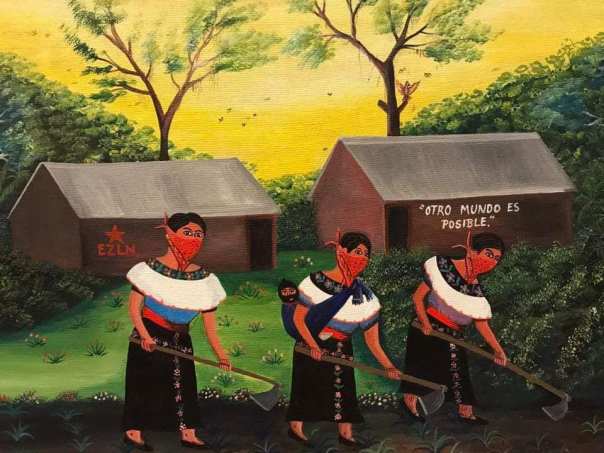
Another world is possible.
By: Raúl Romero*
On December 19, 1994, the general command of the Zapatista National Liberation Army (EZLN, its initials in Spanish) announced that as a result of the campaign called “Peace with Justice and Dignity for Indigenous Peoples,” and with the support of the local population, they took control of 38 municipalities in the state of Chiapas. The capture was made without confrontation, and respecting the “cease-fire” that ruled at that time.
The civilian population of these municipalities was given the task of renaming them according to their beliefs, cultural practices, and of choosing their own authorities. The rebel conscience was noticeably remarkable.The people chose names like General Emiliano Zapata, Freedom of the Mayan Peoples, Ernesto Che Guevara, Lucio Cabañas or Magdalena de la Paz. With them, the territories that estate owners and ranchers (finqueros) formerly owned were given new meaning.
The new municipalities became governed by the Political Constitution of the United Mexican States of 1917, the Zapatista Revolutionary Laws of 1993 and the laws of the municipality itself. Thus were born the Zapatista Rebel Autonomous Municipalities (Marez), which practice self-government through autonomous councils. The EZLN would only be responsible for offering protection against military or paramilitary attacks. “Armies must be used to defend, not to govern. The job of an army is not to be a police or public ministry agency, ”the Zapatistas said through their spokesperson.
In 2001, the EZLN gave the Mexican State one last chance to recognize their right, and [the right] of all indigenous peoples, to self-government. Thousands of people took to the streets across the nation to support the demand. For their part, the entire political class, including the “left” parties, turned their backs on the original peoples of Mexico: the San Andres Accords on Indigenous Rights and Culture were rejected and the path of dispossession and looting was thus paid.
The Tzotziles, Tzeltales, Mames, Choles, Tojolabales and Zoques peoples organized around the EZLN, said that the time of asking and demanding ran out, and that it was time to put it in practice.
After communicating the total suspension of any contact with the federal government and with the political parties, on August 9, 2003, the creation of five Zapatista Caracoles and their respective Good Government Boards were announced.
The Caracoles replaced the Aguascalientes, built in 1995 for the purpose of being meeting points between the cultures of the Zapatista peoples and the other cultures of Mexico and the world. The Caracoles have a similar function, that of “windows to see us inside and for us to see outside,” that of “megaphones to get our word out and to hear the ones far away,” say the rebels in the southeast.
For their part, the Juntas de Buen Gobierno (Good Governance Boards or, simply, Juntas) operate through the principles of rotation, revocation of mandate (recall) and accountability. They are true networks of power from below. In them the municipal councils, which group together the community authorities, are articulated. This is how that emancipatory form of power is woven, in which the rulers become servants, people that will govern by obeying the people.
Anyone visiting Zapatista territory can perceive the achievements of this exercise of self-government. The Zapatistas have dedicated their efforts to giving themselves a roof over their heads, land, work, health, food, education, democracy, freedom, justice, culture and information. But since its origins, the EZLN was clear: their struggle is not for the benefit of the Zapatistas, nor is it only for indigenous peoples, it is a struggle for everyone.
The Zapatista Caracoles and the Juntas de Buen Gobierno are a contribution of the Mayan peoples to the struggles for emancipation. The dialogue that they establish between the particular and the universal, opens a place in history right next to the communes, the soviets, the committees, the workers’ councils, the free municipalities.
Now that the Zapatista Caracoles and the Juntas de Buen Gobierno are 16 years old, they face new challenges and threats, including those of a President who one day tells them they are not adversaries or enemies, and the next day calls them liars and betting on violence.
But those peoples that historically were despised and dealt with violently, exploited and oppressed, now know the freedom that comes with self-government, and are willing to defend completely their new world project. Hopefully it is not necessary, and hopefully also that the long and slow walk of the Caracol (snail) finds the freedom to continue enlightening us.
* Sociologist
Twitter: @cancerbero_mx
———————————————————–
Originally Published in Spanish by La Jornada
Saturday, August 17, 2019
https://www.jornada.com.mx/2019/08/17/opinion/015a2pol
Re-Published with English interpretation by the Chiapas Support Committee, Oakland, California
EZLN: Images of the Rupture of the Siege II (and last) from August 17, 2019
Sup Galeano’s Note: Here should be photos in video from the different CRAREZ that were created with the rupture of the siege from August 17, 2019. It’s probable that this video may be eliminated by Mr. YouTube, who demands that ads are placed to publicize it, due to the fact that it’s set to music with a song by Ana Tijoux (Chilean-French) and Shadia Mansour (Palestinian), entitled “We the South.” It says that you must pay “the author’s royalties” or accept ads. Of course we are not going to place ads, and if we don’t have payment for the water vats in the new Caracol Tulan Kaw, well we have even less to pay royalties to the author. The Sixth Commission does not “monetize” its videos (besides, of course, that the “traffic” on our channel is like that of Holy Week in the DF), so, I don’t think that Mr. YouTube becomes less rich, or that Ana Tijoux and Shadia Mansour lose artistic quality and “followers,” if we accompany their rebelliousness with ours.
Perhaps it would be better that Mr. YouTube, instead of “taking down” the videos that the band plays music and it goes with any theme because, as Zapata didn’t say: “the music belongs to she who sings-dances-hums-hops-mumbles-shouts out-lifts” it (in her own way, lo dice Shadia Mansour says it in the rap that, in Arab, sings in this song: “music is the mother tongue of the world”), best it should work well its damn algorithm (ah! “The crooked lines of YouTube”), because you start looking for, for example, videos of the sherry bottles to greet Armando Vega Gil’s memory, or the ska of Los de Abajo, or of Salón Victoria, or songs of Jijos del Mais, or Van T, or Mexican Sound, or LenguaAlerta, or Lirica, or Ely Guerra, or Keny Arkana, or the Batallones Femeninos, or the maestros Oscar Chávez and Guillermo Velázquez and Los Leones de la Sierra de Xichú, and, suddenly, you are in videos of rodeos, or cock fights, or of Maluma giving classes on respect for women, or on makeup (“now we are going to show how you do makeup to take a selfie ´without makeup´”).
And it’s not that you are fussy, after all, as Inodoro Pereyra said (or was it Mendieta?): “the world is wide and alien”; it’s because, around here, the bandwidth is like Trump’s IQ; that is, a misery.
The above being said, we clarify: if YouTube “tosses” the video (as it already tossed that of the Princesa Mononoke because, it says, the Ghibli studios prefer to put themselves on the side of the system in struggle against nature), because of the music that it carries, well here we put up the same images, but without the music, and there you will put the audio that goes. By the way, here I annex the translation, from Arab to Spanish, of the part that Shadia Mansour raps (based on the contribution of the user qmqz in the official video of that song):
“(Give me the microphone) Music is the mother tongue of the world. She supports our existence. She protects our roots. She unites us from the great Syria, Africa to Latin America. I’m here with Anita Tijoux. I’m here with those that struggle, and not with those who sold you. I’m here with the cultural resistance. From the beginning, and until the victory forever. I am with those who are against, with those who collaborated, with those who are not on our side. A while time ago, I have calculated, that I decided to invest in Banksy after Ban-Ki bankrupted himself (note from Supgaleano: perhaps she refers to Ban-Ki Moon, who, as Secretary General of the UN when she was recording this song, “bankrupted himself” and didn’t condemn the terrorist actions of the Israeli government against the Palestinian people). As the saying goes: “the situation need to be balanced but in reality the situation must be stopped.” For every free political prisoner, an Israeli colony gets bigger. For every greeting, a thousand houses reverberate. They use the press so that they can benefit themselves. But although my pain is disapproved, reality is imposed.”
And, you know what? Anyway, with or without YouTube, with or without ads, the Palestinian people and the Mapuche people will be free. Ten, a hundred, a thousand times they will win.
And if Mr. YouTube, as part of the “fuck the Zapatistas now” campaign, takes down our complete account, well too bad, we will go back to the old times of the Zapatista Intergalactic Television System, “the only television that is read” (Permit Number 69, pending in the Good Government Juntas –solicited since 1996 but the caracol (snail) goes very slowly–).
From the mountains of the Mexican Southeast,
Los Tercios Compas, [1]
Sixth Commission of the EZLN.
September 2019
[1] Los Tercios Compas is the name of the EZLN’s media team
——————————————————————
Originally Published in Spanish by Enlace Zapatista
Sunday, September 1, 2019
Re-Published with English interpretation by the Chiapas Support Committee
The EZLN published actions “to break the military siege”

By: Elio Henríquez
Tuxtla Gutiérrez, Chiapas
The Zapatista National Liberation Army (EZLN, its initials in Spanish) published videos that show the placement of large wooden hand-painted signs in the seven new caracoles and four new Zapatista rebel autonomous municipalities that were recently created in Chiapas.
“These signs and the statement we are making are to break the military siege that Andrés Manuel López Obrador extended with his National Guard,” said a Zapatista that appeared in one video.
One of the scenes published took place in Caracol 10, in the New Town of Patria Nueva (on recuperated land), in the official municipality of Ocosingo, on August 17.
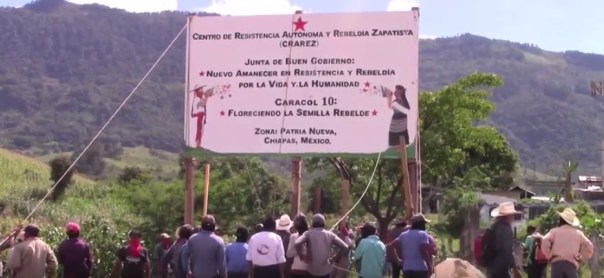
Caracol in Patria Nueva
On the sign [above] it reads: “Center of Resistance and Rebellion Autonomous Zapatista (Crarez). Good Government Junta New Dawn in Resistance and Rebellion for Life and Humanity. Caracol 10 – Flowering the Rebel Seed, Patria Nueva Zone, Chiapas.”
————–
VIDEOS: http://enlacezapatista.ezln.org.mx/2019/08/31/imagenes-de-la-ruptura-del-cerco-i/
Photos: http://www.pozol.org/?p=17385&fbclid=IwAR2-GSlAnA1En0Amgdhw8fS0XK3bLRiU1QdCOrqde1WBOa4biG82DTMbMFU
——————————————————–
Originally Published in Spanish by La Jornada
Sunday, September 1, 2019
https://www.jornada.com.mx/2019/09/01/politica/008n4pol
Re-Published with English interpretation by the Chiapas Support Committee
Sonata for Violin in G Minor: MONEY

“The devil’s finest trick is to persuade you that he does not exist.” ― Charles Baudelaire in “The Generous Gambler”
- The Eighth Passenger Nowhere, or everywhere. A drowsy train drifts off to its own purr. It isn’t coming from or going to anywhere in particular. Or at least not anywhere that matters. A dismal population whose haggard lives seem to hang by a thread nod off on board. In the last car, seven bored, grubbily dressed and solitary passengers, their lives as wretched as their clothes, shift irritably in their seats and lament their situation.
“I’d do anything to turn my luck around,” one says. They were speaking a universal language and the other six passengers nod in silence. Just then the long and battered train enters a tunnel, intensifying the shadows and hiding the passengers’ faces. The door opens and an eighth passenger walks in. The passenger’s clothes practically scream, “I’m not from around here,” but they sit down without a word. The tunnel stretches out the darkness.
A thunderous crack interrupts the silence, like a dry branch breaking but without a storm to blame. A pair of blazing eyes appears in the darkness: “I don’t think I need to introduce myself,” the fiery gaze hisses, “You have all conjured me in one way or another and I’m responding to your call. Make a wish: you pay with your soul. Name your price.”
The first passenger chooses health, to never get sick again. “Done,” Satan responds, picking up the healthy soul and throwing it in his bag.
Another passenger chooses wisdom, to know everything. “Done,” the devil murmurs, picking up the wise person’s soul and tossing it in his bag.
The third passenger opts for beauty, to be admired. “Done,” says the king of hell, tossing the beautiful one’s soul in his bag.
The fourth asks for Power, to rule and be obeyed. “Done,” Lucifer says under his breath, the soul of the new ruler added to his bag.
The fifth wants “pleasure,” to awaken passion at will. “Done,” the demon replies with a contented smile. The hedonist’s soul disappears into the devil’s bag.
The sixth passenger sits up straight and pronounces the desire for fame, to be widely recognized and praised. “Done,” Satan declares without a pause, and the famous soul takes its place among the other prisoners.
The seventh passenger practically sings the request for “love.” “Dooooooone,” the evil one replies with a guffaw, and the lover’s soul goes into the depths of the bag.
The fallen angel looks impatiently at the eighth passenger who hasn’t said anything and is merely scribbling in a notebook.
Lucifer addresses the passenger, asking sweetly, “And what is your wish, traveler? You can have anything you want. All I ask in exchange is your transient soul.”
The eighth passenger stands up and whispers, “I am Money. I’ll buy all seven souls of those wretches who believed in you and I’ll buy you, too, to have you at my service and under my orders.”
And “the great dragon, that old serpent, called the Devil, and Satan, which deceiveth the whole world” (Revelation 12:9) smiled cunningly and, before getting into the bag of sold-out souls himself, condemned the passenger, “Let it be so, Master Money, but in your very essence lies your own destruction and your fortune today will be your fall from grace tomorrow.” Money took the bag and exited the last car of the train as the train pulled out of the tunnel.
Behind them darkness stretched ahead until it reached daylight…
-*-
- On Crisis and Responsibilities
“When there is a crisis, buy low and wait for the crisis to pass in order to sell high. If there is no crisis, provoke one via war. To get out of a crisis, provoke another war. War, as Clausewitz did not say, is the way to get in and out of crisis by other means (nuclear wars included). Don Durito de La Lacandona. Beetle and Ph.D. in Jungle Economy
If the devil’s finest trick is to persuade you that he does not exist, then one of the foundations of the capitalist system is to convince you that money can solve anything. Money is the lord and master of governments and the basis for their respective projects to go down in history as great Transformers. But…
Well, here I was going to try to explain that a global economic crisis is coming, but I don’t really know much about political economy and besides, reality is explaining that point with better arguments and in a more pedagogical format than I could have. Even so, we have to take into account what else is coming.
We should point out that what is coming is not the current administration’s fault, nor that of past administrations. What is commonly known as the “government of Mexico” has only one responsibility: to believe and make the rest of us believe that they have some way to ease the pain of what’s coming—note that they don’t even pretend anymore to be able to stop it. The “bad decisions” that one sector of the unenlightened right attributes to the government of the 4T[i] (the most commonly cited is the cancellation of the plan to build a new airport in Texcoco) have nothing to do with what is coming. The underlying message of this particular fragment of the actually existing right, which feels deceived and resentful, is “We’d be better off without López Obrador,” a motto that is neither original nor true.
Any other candidate who landed in the presidential office (Meade, Anaya, el Bronco, or Ms. Xerox[ii]) would have faced the same “adverse global environment” (that’s what big capital’s think tanks call it) and come out defeated and looking for someone to blame. Any of them would have done exactly what the current government is doing: lie and cook the books. I am of course speaking from and for the perspective of the original peoples, but I’m sure other sectors could give their own grim accounts of whether or not they have benefitted from the political economy of the supreme leader, not to mention his social policies and egregious failure in fighting crime.
In any case, the displeasure shown by this particular sector of the right is amply compensated for by the total satisfaction from the rest (and the majority) of the right, not to mention big capital’s absolute delight with the administration’s policies that lay the groundwork for the explosion and escalation of the crisis that is coming.
The truth is (and I imagine this claim will bother them even more than if we had just said they’re all the same) that the current situation would be exactly the same under the administration of any of those presidential hopefuls. Any one of them would have begun with a celebration of him or herself, solemnly declaring a new cycle of hope, jobs, and prosperity for the entire territory south of the Río Bravo [Rio Grande] and to the west of Guatemala and Belize. Any one of them would have distributed the same handouts, although under different names and slogans. Any one of them would have reneged on more than a few campaign promises and chalked up any criticisms to bitterness and envy. Any and all of them would have called for unity and patriotism, prostrating themselves before the plans, threats, and insults blabbered by the current overseer of that brutal and turbulent country to the north, and attributed their errors to an “adverse international environment.”
All of them, just like the current administration, would base their governing agenda on money. The only difference is that the current administration thinks its fictitious “fight against corruption” is more than enough to earn praise that actually corresponds to others [otros, otras, otroas]: “But the 4T doesn’t steal!,” they’ll say. Even in that respect one could equivocate, as all those lovers of nuance will be able to read in another text someday…well, if it is ever published. But for now I’m going to point to a few facts upon which there can be no equivocation, facts which require that one take a clear position. For this task I haven’t resorted to the social networks and their “fake news,” nor to the press columns written for or against (each more pathetic than the next), nor to the press tagged as “fifi,[iii]” (I had to stop using Proceso as a source after a burp from the supreme leader erased an entire history of investigative journalism unmatched in other press outlets).[iv] Thus I have limited myself to the facts and declarations reported by the government itself on its own webpages (including what has been said in public events and morning press conferences), and to reports by the “supportive” [uncritical] press.
This is in addition, of course, to an “in situ” investigation in our own environment: rural Chiapas. One could legitimately express doubt about what we report from that investigation—perhaps it’s all just a ploy to sabotage the supreme leader. Go right ahead, doubt us! But if you want to address those doubts you can do one of two things: investigate whether or not what we say is true, or wait and see what happens. The disadvantage of the former is that any journalist who investigates the veracity or falsity of what you’ll read below will join the ranks of the “conservatives”[v] (even if that journalist “nuances” the account by playing down the brutal reality of what is happening here). With regard to the second option—waiting to see if time proves us right or wrong—well, look, the truth is that “time” is exactly what those above don’t have. In any case, while you should feel free to doubt our version of what is happening here, doesn’t it seem suicidal to doubt the reality that you yourself see and experience?
Facts:
– Take the festive tone of the supreme leader in his meetings with the representatives of economic power in Mexico and the world compared to the irritated and intolerant tone he takes upon hearing the demands or reproaches of ordinary people, especially ordinary people from the countryside. Sure, you can try to “nuance” that, but reality will correct you on a daily basis. His courtship of the representatives of money borders on the obscene, even when it doesn’t translate into the support he’s seeking. With regard to ordinary people, well, the supreme leader “doesn’t pay anybody to beat up on him.”[vi]
– Take the imposition of a tyrant’s own enmities and affinities. Sure, I get that everybody has their likes and dislikes, but nothing gives anyone the right to impose those preferences on everybody else. When the president says so-and-so is a such-and-such, that has an effect on the population, and as the murder of Samir Flores demonstrates, the desire to please the supreme leader leads to crimes and distortions. Only tyrants seek copies of themselves among the governed, with predictable consequences for that nation.
– Take the treatment of migrants. Look around and you could say to yourself, “Tragic! In what kind of country do those horrors take place?” But the truth is that they happen here in the “Republic of Mexico.” What’s more, what comes out in the “supportive” press on the subject barely offers a glimpse into the nightmare imposed on Central American migrants on the southern border. Yes, and also on Africans, on people from the Caribbean, on Asians…. and on Mexicans. Tell me, how do you distinguish between a person from Chiapas and one from Guatemala, Honduras, or El Salvador? Whether they have papers or not? Okay, go ask the INEGI [National Institute of Statistics and Geography] or the INE [National Electoral Institute] how many Mexicans in southeastern Mexico don’t have papers. Or is it whether they can sing the national anthem? The immigration agents don’t even know the national anthem, and apparently neither does the president, which is why he’s so willing to be Trump’s doormat. That other aspiring candidate for 2024, Marcelo Ebrard[vii], says that they are abiding by the law, but there is no law that says “everyone of short stature and dark skin who doesn’t speak Spanish or speaks it with an accent will be detained and required to show documents proving Mexican citizenship. These arrests may be carried out by the military, police (including traffic police), or immigration agents and do not require the presence of a translator, human rights defender, or any other potential obstacle to the ability of the president to comply with the quota of arrests dictated by his friend Donald Trump.” Fine, don’t believe this “fake news”; look in the press “supportive of the 4T.” Did you check? Okay, now try to “nuance” the nightmare.
– Take the servile, ass-kissing tone and behavior taken in front of the US government. We’ll talk more about that later but honestly, I don’t remember a Mexican government who has publicly groveled so shamelessly before a foreign government. If your argument justifying such indignities is that the supreme leader won a raised-hand referendum in a place where he had recently distributed government handouts, well good luck.
– Take the defeat of secularism. With the support of the catholic clergy, religion first waded into state affairs during the era of the “bad” Salinas, Carlos Salinas de Gortari, progressing through the administration of Zedillo who sanctioned it by playing dumb, then through Vicente Fox’s genuflections and Felipe Calderón’s prudish sanctimoniousness to arrive at the indefensible militant religiosity of the current president. What is left of the nation will pay dearly for this defeat… and not on an extended payment plan like you can get in Elektra stores.[viii]
– Take the implementation and acceleration of megaprojects and the destruction of the original people’s territories. The argument that always gets dragged out about these projects being too far along to stop construction now didn’t seem to matter in Texcoco. The supreme leader himself has justified the megaprojects, and his finger-pointing disqualification of the opposition to the Morelos thermoelectric plant cost our compañero Samir Flores Soberanes his life. In the crime section of the newspaper that’s called “setting someone up.” It doesn’t matter what is said to try to evade or justify it, the government is responsible for his death. Go ahead, “nuance” that one: the president didn’t pull the trigger. Yeah well, neither did Trump of course.
– Take this administration’s policies encouraging individualism and challenging the community. This administration has argued that distributing aid (cash) on an individual (rather than collective) level is more effective, since it will help “fight corruption.” First of all, if there is corruption within particular peasant organizations, NGOs, etc., then the government should say so: who, where, and how much. Omitting these details amounts to complicity (if you have any doubts about that, ask Robles[ix]). If this administration doesn’t have any qualms about denouncing journalists and media outlets from its pulpit—“I’m not one to keep things secret,” as the president says—then he should be able to state clearly, for example: “the CIOAC leadership—and it must be clarified which of all the CIOACs, the murderous one or one of the others—is skimming this much off the top of the cash distribution program. Enough of that, let them keep what they already swindled and let’s start this over right.” Or, “In such-and-such daycare in such-and-such place, the people in charge are eating all the cornflakes and drinking all the milk that’s supposed to be for the kids.” Or, “in this other daycare there are a bunch of children who were born out of sin and lust (wedlock), and our Lord and Savior said that one should not lie down with anyone with whom one does not have a pact of non-aggression and sensible frigidity.” (I think that’s called “marriage.”)
Now, in the case of the countryside, the problem isn’t just individualized distribution. I mean, if the cabinet members and their aids that work on these issues have no imagination and can only conceive of either distributing to organizations or to individuals, fine, I get it, they are politicians after all. But to choose a bank as the mechanism for distributing the “blessings” of the government of the “Fourth Transformation”! What this amounts to, for the rural aid program “Sembrando Vida” (“Sowing Life”)[x] for example, is that the most direct beneficiary of the program is the intermediary—the coyote or “middleman”—in this case, Banco Azteca, which belongs to the Grupo Elektra.[xi]
The supreme leader claims that the pay-out to campesinos who join the program is $5,000.00 pesos. That’s false. A campesino can get a maximum of $4,500.00 pesos (and in some cases only $4,000.00).
Supposedly the reason that you can only get $4,500.00 is because the other $500 go into a savings account, the destiny of which is unclear. Those receiving aid are told that the funds will be “for the elderly” or that they will be used in the future to bring the goods—lumber and fruit—to market. But just think: cedar and caoba trees need about 30 years to grow before they are “marketable”, that is, until it’s profitable to cut them down and sell them. But the president’s term ends in 5 years. If my math is right, that means it will take another 4 presidential terms before what is planted in the coming year (the plants are still in the greenhouse phase) will be marketable. Presumably, the beneficiaries will receive $4,500 pesos every month for the next 29 years. Therefore, the Bolsonaro-Macri-Moreno who is already waiting in the wings to relieve the current administration from the storm will either commit him or herself to maintaining this program, or the program’s real purpose is to ensure peasant support for a single political party across multiple presidential administrations.
The issue is that through this money transfer, the bank retains 500 pesos (and in some cases, one thousand pesos, with the argument that peasants ought to save) for each “sower of life”. The supreme leader’s functionary in charge of this program has said there are as many as 230,000 “beneficiaries”. That comes out to 115 million pesos per month at the disposal of that bank. You can consult your favorite economist to find out what banks do with the savings of their account holders.
Now, in some branches of that “selfless” and “philanthropic” institution which is Banco Azteca, peasants are told that they will only be given $4,000 pesos “so that they learn to save.” If all beneficiaries had this same “instinct” to save (such a valued quality in the culture of money), then the government would be withholding 230 million pesos per month, multiplied by 12 months per year for 5 years starting in October of this year. But let’s just assume that’s not the case, and that only 115 million pesos per month is set aside as “savings” (that’s 1.38 billion pesos per year, which comes out to 6.9 billion pesos in what’s left of this presidential term). Now, if at the end of this presidency and in the presidential and legislative elections in 2024, God forbid this same supreme leader or someone from the same party were not to win, the “beneficiaries” would quickly turn into the “victims”: they’ll have 2.5 useless hectares of land [the size of the plot peasants are paid to plant under the “Sembrando Vida” program] because they won’t be able to cover the cost of having lost their animals (if they planted over their pasture), or their cornfield (if they planted trees on “reclaimed” agricultural fields).[xii]
Furthermore, the supreme leader (with the blessing of his “nuanced” advisers) is carrying out a new “agrarian reform” based on the program initiated by the “bad” Salinas (Carlos Salinas de Gortari). The requirement for joining the “Sembrando Lata” [Sowing Conflict] program in ejido communities is that the “rights holders” (the ejido members who have land rights) cede two hectares of that land to “solicitors”. This means that the new agrarian reform of the 4T involves taking land from those who have the least and “redistributing” it. In addition to the fact that this has created a new form of corruption, it has also divided party-affiliated communities [who receive aid] all the way down to the family level, pitting children (“solicitors”) against parents (“rights holders”), fights that can escalate into death threats.
In the Highland region of Chiapas, where there are small population clusters and land is measured in small plots called “tareas” rather than “hectares”, the situation would be comical if it weren’t tragic. Campesinos in this context use the same piece of land (“tarea”) to plant corn, then beans, then a vegetable crop. In addition to the fact that almost no one owns 2 full hectares, if they plant what that idiot of a president wants, their little plot of land will be unusable for subsistence farming for the next 20 or 30 years. Apparently that’s irrelevant, since what matters are the monthly cash transfers that that peasant receives.
There are more stories that you won’t believe because you of course have better information and statistics. For now I’ll just say this: the equation that states that “x amount of money = y number of hectares planted” is false. The party-affiliated peasants receiving the aid often pretend to prepare the soil for planting, or “lend” each other hectares when the president’s project manager comes around, or they just cut a deal with that manager: “You just write down that I’m carrying out the greenhouse phase and that I have the two hectares required, and I’ll give you a cut of my $4,500.”
And even so, hundreds of communities have rejected the program because, as they themselves say, “We’re not going to work as peons for the government. The land belongs to us, not to that plantation owner-turned-government.” But surely the supreme leader has other statistics, and we are just in one small portion of one small state of the Republic. So let’s follow the money:
According to Grupo Elektra’s web page, every Elektra store has a Banco Azteca branch inside. That is, when a peasant goes to the bank to collect his hand-out-that’s-not-a-hand-out, the person behind the counter is wearing a shirt with the logos of the bank and the 4T. As should be expected, the person recommends both a savings account and an insurance package to the peasant: “You never know what could happen. For example, your motorcycle could get stolen…What?! You don’t have a motorcycle?! Don’t worry, today is your lucky day—I’ve always said that lucky people sometimes don’t realize what they’ve got. Look, here we have this powerful machine, 125 cubic cm engine, Italika brand (a Grupo Elektra affiliate), and you can take it home today. Yes, today! And just for being you, I’ll throw in the helmet. Are you single? You are?? I’m surprised, someone as handsome as you… But anyway, look, a passenger fits comfortably on this bike. You’ll see, all the ladies are going to want you to take them for a spin. Now it’s better to buy this as a package so you can save yourself some hassle, you know what I mean? So I recommend that you go ahead and open your account here at the bank, get the insurance with it (it’s obligatory to open the account), buy the bike on a payment plan and get insurance on it in case it gets stolen or breaks down. You can home today on your motorcycle, helmet and all.”
All this is real. A Zapatista compa accompanied his party-affiliated brother-in-law and witnessed everything I’ve described. Of course, names have been omitted to protect the impunity… oh sorry, I mean the presumed innocence of the supreme government. And, as for the motorcycle? Well, we don’t know, the compa had to take public transportation back home because his brother-in-law, after paying for the motorcycle and the insurance, spent everything he had left on cases of beer. And they didn’t both fit on the motorcycle: it was the beer or the compa. The beer won. The Zapatista compa came back angry: “He’s not even single! He’s married to my little sister and they’re going on their fourth kid. Just wait until my sister finds out—then he’s really going to need that insurance.”
The principle shareholders of Grupo Elektra are: Hugo Salinas Price, Esther Pliego de Salinas, and Ricardo B. Salinas Pliego (the first two are the parents of the third).
Mr. Hugo Salinas Price is a confessed tax evader, a confessed strikebreaker, and a confessed sponsor of far-right activities (such as MURO, the paramilitary arm of El Yunque[xiii]), all this according to his own book, My Years with Elektra (Diana Press, 2000). In it, one can read the following: “Sadly, when the conditions of life are better, the people have time and resources to think of participating in uprisings concocted by trouble-makers. When life is hard, the people are more concerned with holding on to what they have than with causing a ruckus.”
This is the Grupo Elektra that was chosen by the supreme leader to manage the cash transfer cards of the 4T’s “social policy.” More information can be found in Álvaro Delgado’s article on the subject in Proceso, edition 2208 from February 24, 2019. Oops! I said I wasn’t going to cite that heretical and demonic weekly. Ok, but you can do like I did and get a copy of the book. And, believe me, it will give you chills. Or talk to Álvaro Delgado…but don’t let the supreme leader find out.
-*-
A complex crisis is brewing, what in the bunkers of capital is known as a “perfect storm.” This vessel we call “planet Earth” has been almost entirely dismantled and is being kept afloat by the same mechanisms that are destroying it. This stupid deadly cycle of destroying in order to rebuild what’s been destroyed is hidden behind false evidence that has slipped into our common sense. The fundamental belief in the power of the individual, a belief that was born with the rewriting of human history, has created the myth that the individual is capable of anything.
The catch, hidden behind the myth of individuality, is that it absolves the system of its responsibility for its lethal consequences. Human beings, civilizations, languages, cultures, arts and sciences waste away, digested in the stomach of the machine, and the system’s responsibility is transferred to the individual. It is he or she who is the victim and the executioner. The murdered woman is responsible for the blows she receives, the rape she suffers, her disappearance and her death. She is a criminal for having been victim of a crime and she’s a criminal for having spoken out against that crime. The same is true for children, the elderly, and people of different genders, cultures, languages, colors and races.
But don’t pay any attention to us. Consult your favorite economist instead (and if they work for the government, be sure to tell them everything will be “off the record”). Perhaps they’ll tell you that political economy is a science that operates based on laws, on causes and effects, and that it doesn’t respond to will, tantrums, or fits from behind the pulpit; that political economy pays no mind to polls and it doesn’t watch the morning press conferences; that political economy says that if a given set of conditions occurs (the causes), then a given phenomenon will be produced (the effect). Once you get bored with all the numbers and formulas, ask them: are we headed for a crisis? If you see that the economist takes out an umbrella (even though you are indoors) and apologizes, saying “well, there never were any guarantees,” then you have several options. You could solemnly declare their statements to be fake news and then blather on about the mafia of power and the Illuminati, accusing the economist of being a conservative. You could ask the economist where they got their umbrella and whether they had any in lavender (to each their own). You could cling tightly to the closest religion. Or, you could ask the economist if there is a solution, a way out, a fix.
The economist will respond with a bunch of formulas and statistics. Wait patiently for them to finish, and then instead of saying that you didn’t understand any of what they said, ask them to summarize the answer. The economist might then respond, “The situation is very difficult, it would necessitate…” (a new torrent of formulas and statistics).
Or perhaps they’ll simply say: “No, not in this system.”
(To be continued…Huh? Oh, there isn’t more? But I was just getting warmed up… Definitively not? Well, fine…just a few notes from the Cat-Dog and that’ll be it, then…)
From the mountains of the Mexican Southeast
Sup Galeano tacking on some words from the Cat-Dog,
Mexico, August 2019.
From the Notebook of the Cat-Dog:
– The problem with money is…you run out of it.
– When difference encounters another equally significant but distinct difference, it embraces and celebrates it. Difference doesn’t seek a mirror, but rather something much more complex, more human: respect.
– Nature is a rubber wall that accelerates the velocity of the rocks we throw at it. Death doesn’t return in the same proportion, but rather much stronger. There is a war between the system and nature, and that confrontation does not accept nuance or cowardice. Either you’re with the system or with nature. Either you’re with death or with life.
Woof- meow.
The Cat-Dog, changing tactics, casts languid eyes up at the moon, who doesn’t have a damn clue what’s going on.
Videos attached at: http://enlacezapatista.ezln.org.mx/2019/08/15/sonata-para-violin-en-sol-menor-dinero/
TRANSLATOR’S NOTES
[i] AMLO has deemed his own governing project the “Fourth Transformation,” supposedly on par with historic events such as Mexican Independence (1810), a period of reform in the mid-19th century, and the Mexican Revolution (1910).
[ii] Margarita Zavala, wife of ex-president Felipe Calderón, who ran as an independent candidate in 2018, was accused of illegally using hundreds of thousands of photocopied or fraudulent voter identification cards in order to accumulate the number of registered voter signatures needed to appear on the ballot as an independent candidate. Although the National Electoral Institute approved her independent candidacy, public outcry forced her to drop her run for president.
[iii] The term with which López Obrador tags any media outlet that critiques his administration. It would be something like calling them “bourgie,” but he uses the term universally for critique from any direction.
[iv] In a July 22, 2019 morning press conference, López Obrador accused Proceso magazine of being unfairly critical toward his administration and of having been complicit in the past with the PRI and PAN.
[v] López Obrador commonly tags any criticism from any source or sector as “conservative.”
[vi] Famous phrase (“no pago para que me peguen”) from Mexican President José Lopez Portillo in the 1980s in reference to the media when he cancelled government advertising contracts with publications critical of his administration, including Proceso Magazine. https://www.nytimes.com/1989/12/04/business/the-media-business-mexican-papers-want-to-keep-tie-with-state.html
[vii] Currently López Obrador’s Secretary of Foreign Affairs.
[viii] Appliance and electronics retail chain known for offering payment plans with extremely high interest rates and abusive terms, which according to Forbes Magazine targets low income customers (https://www.forbes.com/profile/ricardo-salinas-pliego/#2085d88b1346).
[ix] Rosario Robles is the highest-ranking official in former Mexican President Enrique Peña Nieto’s [2012-2018] cabinet to be accused of large-scale corruption as part of the Estafa Maestra (Master Fraud) scandal. She is being held in preventative custody pending trial.
[x] AMLO’s program for rural Mexico consists of monthly cash handouts to peasants to plant commercial (and invasive) trees across one million hectares of the country, starting in the southeast.
[xi] Grupo Elektra is the business group that owns both Banco Azteca and the Elektra stores. López Obrador’s government is running its rural aid program through cash transfer cards issued by Banco Azteca, franchises of which are located inside Elektra stores. Banco Azteca and Elektra are both owned by Salinas Pliego, a member of López Obrador’s Business Advisory Council.
[xiii] An ultra-rightwing semi-clandestine Catholic political organization in Mexico with heavy influence inside the PAN (National Action) party. https://nacla.org/article/building-city-god-mexico%27s-ultra-right-yunque
The Mexican State will assume responsibility for the Acteal Massacre

Abejas de Acteal outside the National Palace
Alejandro Encinas, assistant Secretary of Human Rights, Population and Migration of the Interior Ministry (Secretaria de Gobernación), reported that he would assume responsibility for the Acteal Massacre, which happened on December 22, 1997, which left 45 people dead, among them 4 babies.
Encinas reported that he reached an agreement with representatives of Civil Society Las Abejas of Acteal, and that after months of talks were able to finalize agreements, among them a friendly solution and reparation of the damage.
After almost 22 years, the federal government will investigate and guaranty no repetition, with adherence to the standards of the Inter-American System of Human Rights.
It’s appropriate to point out, the Interior Ministry clarified that the agreements reached with this group, do not affect those of the other group of Acteal victims who have resorted to the Inter-American Commission on Human Rights (IACHR) for resolution of the case.
The Commission admitted the case on November 1, 2010, in its report Number 146/10, the victorias considered that with all the evidence they have presented in the case, they have left sufficient evidence to point to the Mexican State as responsible for the Acteal Massacre and that it will fulfill its obligation for the violations committed in Acteal.
Therefore, they asked that, as soon as possible, they deliver the in depth report on Case 12.790 Manuel Sántiz Culebra and others (Acteal Massacre), to stop the impunity.
Las Abejas pointed to a paramilitary group created with the implementation of the counterinsurgency strategy, for the purpose of attacking the Zapatista National Liberation Army (EZLN, its initials in Spanish), based on the document named: “Chiapas 94 Campaign Plan,” designed by the Secretary of National Defense (SEDENA) in 1994 and that went into effect starting in 1995, opened fire on December 22, 1997 on a church in the Acteal community, occasioning the death of 45 people and 4 babies.
Finally, Juan Vázquez Luna, president of Las Abejas of Acteal, denounced the destruction of three homes of members of the organization in the barrio Río Jordán, in the Miguel Utrilla district of Los Chorros, in Chenalhó, Chiapas.
According to the denunciation, at approximately 4:54 pm on August 11, a group of 200 people from the Miguel Utrilla district, headed by their authorities, sympathizers of the Green Ecologist Party of Mexico (PVEM, its initials in Spanish) “violently attacked” four families and “destroyed their houses.”
——————————————————————-
Originally Published in Spanish by Chiapas Paralelo
Sunday, August 25, 2019
Re-Published with English interpretation by the Chiapas Support Committee
Zapatismo, a dream that encompasses the world

Another world is possible
By: Luis Hernández Navarro
One after another, the same in los Altos (the Highlands) of Chiapas as in the Northern Zone, different hand-painted signs on wooden boards or sheets of metal eaten away by the patina, some with images of indigenous women with a paliacate over the face, warn: “You are in Zapatista territory in rebellion. Here the People rule and the Government obeys.” They are signed by the Good Government Juntas.
Signs, in many ways similar to those placed on roads to welcome travelers to a federative state, mark the limits of the territory self-governed by the Zapatista peoples and their de facto jurisdiction.
As Raúl Romero remembered in these pages, their origin dates back to two distinct moments: the formation of the Zapatista rebel autonomous municipalities (municipios autónomos rebeldes zapatistas, Marez), within the framework of the rebel offensive of December 1994 against the electoral fraud of Eduardo Robledo; and, the 2003 foundation of the first five Good Government Juntas (Caracoles) in order to exercise de facto autonomy without asking permission.
What’s novel about this process is that, according to what Subcomandante Moisés announced, new boundaries and nomenclatures were established in Chiapas. The rebels just announced that they created, apart from the government authorities, 11 new Zapatista centers of autonomous resistance and rebellion (Crarez, their Spanish acronym): seven of them are Caracoles and the other four are autonomous municipalities (municipios). So, now there are 43 Zapatista centers.
Part of these self-government bodies rose up for the first time on the thousands of hectares occupied at the beginning of 1994, and distributed to work for the collective benefit. Their jurisdictions are differentiated by the complexity of the problems that each one of them had to resolve. Two books give an account of this process: that of Paulina Fernández Christlieb, Justicia autónoma zapatista: zona selva Tzeltal; and Luchas “muy otras”, by Bruno Baronnet, Mariana Mora and Richard Stahler-Sholk.
The expansion of Zapatista autonomy to new territories contradicts the version of the supposed desertion of its social bases as the result of assistance programs such as Sembrando Vida (Sowing Life) or Jóvenes Construyendo el Futuro (Youth Constructing the Future). Obviously, in a process as countercurrent as the one that they have impelled for 25 years, there are sympathizers that stand aside. But, central to evaluating it is the impulse and general tendency that follows. The recent foundation of another 11 Crarez makes it clear that the insurgent magma not only survives, but also grows exponentially, while it constructs unprecedented routes of autonomy.
The EZLN called its new campaign “Samir Flores lives.” Samir was the Náhuatl blacksmith, director of Radio Amiltzinko and leader of the Permanent Assembly of the Peoples of Morelos, which opposed the Huexca construction of the thermoelectric plant. He was murdered on February 20. His crime has not been clarified.
The new Zapatista campaign bears great similarities to previous offensives. It was processed and agreed upon (as was done with the armed uprising) in multiple community assemblies. It broke the government siege, unfolding as a social-political force, through peaceful sui generis mobilizations, which changed the field of confrontation with the State, taking it to the terrain in which the communities are the strongest: the production and reproduction of their existence.
Instead of demanding solidarity from allies, friends and collectives that struggle, it calls for constructing a new political initiative with them. It proposes to the National Indigenous Congress-Indigenous Government Council (Congreso Nacional Indígena-Concejo Indígena de Gobierno) undertaking a forum in Defense of Territory and Mother Earth, capable of articulating a response to the megaprojects and the dispossession, open to those who struggle for life.
It calls upon urban Zapatista archipelago to form an International Network of Resistance and Rebellion, not centralized, but that would work in the distribution of the histories of below and to the left. It announces bilateral meetings with groups, collectives and organizations with real work in their regions. It proposes that intellectuals and artists participate in festivals, gatherings, seedbeds and fiestas.
Limiting themselves to being hosts, it suggests to parents of disappeared and prisoners, and to the organizations that work with them, to those who fight for sexual diversity and the human rights defenders, to meet in Zapatista land to share nightmares, pains and horizons. And, already on the right track, it announces that the Zapatista women will convoke a new gathering of women that struggle, only for women.
As Subcomandante Moisés explains it, the creation of the Zapatista peoples’ self-government spaces is the result of political work, mainly of women and youth. But, also, of the accumulation of meetings and seedbeds that they organized in which “their imagination, creativity and knowledge became more universal, in other words, more human.” They learned, according to their words: “that a dream that doesn’t encompass the world is a small dream.”
————————————————————
Originally Published in Spanish by La Jornada
Tuesday, August 20, 2019
https://www.jornada.com.mx/2019/08/20/opinion/017a1pol
Re-Published with English interpretation by the Chiapas Support Committee
CNI: the indigenous rebellion reaches 24 states

Zapatistas, promoters of the National Indigenous Congress since 1996.
By: Zósimo Camacho
The anticapitalist indigenous struggle extends throughout national territory. The left opposition to the “fourth transformation” adds hundreds of communities of 179 municipalities in 24 states. The CNI reiterates that its struggle is peaceful, although its territories are now in dispute and under fire from paramilitaries
There are 89 nations, tribes and indigenous peoples –with hundreds of communities– ascribed to the Indigenous Government Council (Consejo Indígena de Gobierno, CIG) and the National Indigenous Congress (Congreso Nacional Indígena, CNI).
The CNI’s own document entitled “Regions of the Indigenous Government Council. Preliminary distribution,” gives an account of the growth of the anticapitalist indigenous organization at the dawn of the new six-year presidential term. Today it has a presence in 179 municipalities of 24 states of the Mexican Republic. It is the most numerous movement of Indian peoples since the Revolution.
That it has grown in recent months and years is natural, according to Gilberto López y Rivas, doctor of anthropology from the University of Utah master in anthropology from the National Autonomous University of Mexico (UNAM, its initials in Spanish) and the National School of Anthropology and History.
He explains that the processes of dispossession against the indigenous peoples have sharpened and the communities have had to strengthen their resistances by supporting each other. He argues that the struggle of the peoples is profoundly anticapitalist, because it is precisely capitalism that is dispossessing them of their mountains, their waters and their minerals. For them, their opposition to the system is a matter of survival, he says.
Cristian Chávez González, a member of the CNI’s Coordination Commission, details the reasons for the organization’s growth in recent months. He explains that in previous years the Congress had suspended its meetings because for the first time the communities were barely understanding that they were facing: an extreme violence executed by state armed groups (police corporations of the three levels of government and the Armed Forces) and non-State armed groups, among them, the drug trafficking groups.
“They changed the paradigms of the struggle, of the perpetrators of the human rights violations, the searches, the dispossessions, the repressions. At the interior of the peoples that make up the CNI, and now the CIG, a reorganization was occurring; they were re-articulating themselves given a new situation for which no one, either collectively or individually, was prepared.”
Now that they have understood what is occurring, the peoples, tribes and nations again meet with each other periodically to continue constructing their national organization and to accelerate the articulation of responses and resistance.
The incorporations of the communities into the CNI and the CIG are not only declarations of ascription. The peoples, tribes and indigenous nations that join the CNI and the CIG deepen their resistances, strengthen their own governments and construct, according to the context of each community, autonomic structures. Confrontation with the Mexican State is not uniform. According to the means they have, there are communities that maintain cooperation with the formal of the three levels of government. Others have broken any kind of contact and maintain a total resistance.
“Being in the CNI is for us the way to achieve our dreams and vindicating our rights to have our own way of governing and deciding on what we want to do. Many of the communities already had their own organizations before, but the CNI is our big house,” says the Me’phaa councilor (concejal) of the CIG, Amador Cortés Robledo, who is also a member of the CIPO-EZ (Concejo Indígena y Popular Emiliano Zapata), whose communities in the low Mountains of Guerrero are under siege from the narco-paramilitary groups Los Ardillos and Los Rojos. (Contralínea 644, 3 de junio de 2019.)

Assemblies and organization among Purépechas in Michoacán.
The states with the highest number of communities that are members of the CNI are Oaxaca, with towns in 46 municipalities; Chiapas, 23; Guerrero, 16; Veracruz, 15 and Puebla, 11 municipalities. They are followed by Yucatán, nine; Sonora, eight, Chihuahua and the State of Mexico, with communities of seven municipalities each; Jalisco, five, and Baja California and Mexico City with four each. Campeche, San Luis Potosí and Tabasco, with three per state; Morelos and Sinaloa, two, and Colima, Durango, Guanajuato, Hidalgo and Quintana Roo, with communities in one municipality for each state complete the list.
For a complete list of the 89 nations, tribes and peoples to which these hundreds of communities in 179 municipalities belong see: https://www.contralinea.com.mx/archivo-revista/2019/08/02/cni-la-rebeldia-indigena-alcanza-24-estados/
The strength of the indigenous organization, according to María de Jesús Patricio Martínez, councilor of the Nahua peoples of Jalisco and spokeswoman of the CIG, is that isolated individuals cannot join. “People cannot join alone; only complete communities. They decide to join the CNI after talking about it to make a decision.”
Regarding what the motives are that impel the communities to join the CNI, the traditional doctor emphasizes in particular the dispossession and destruction of territory. “The communities are the guardians of the territories, which are sacred, they have no value in pesos. That’s why we join together, like the brothers that we are, to resist and oppose the death projects that only benefit the one that has money, capital.”
The work of María de Jesús is precisely to carry the message and make the organization grow. “The objective right now is to reach all the communities, especially all those most distant that have never been in the National Indigenous Congress. We want to listen to them and outline for them what the CNI is; telling them that we seek to connect with all the other communities in order to support each other and together we become strong for stopping all this dispossession and everything that is coming at our peoples.”
The CNI was constituted on October 12, 1996 with the peoples “that rose up. We walk in struggle. We are determined for everything, up to death. But we don’t bring war drums but rather flags of peace. We want to get together as brothers with all the men and women that by recognizing us, recognize their own roots,” as the declaration of that date says.
The first congress was held in Mexico City as a proposal of the Zapatista National Liberation Army (Ejército Zapatista de Liberación Nacional, EZLN) to all the country’s original peoples to participate in the Special National Forum on Indigenous Rights and Culture. Comandanta Ramona attended representing the Zapatista rebels. At the end of her speech she pronounced the phrase: “Never more a Mexico without us,” which was adopted as the CNI’s slogan.
The organization emerged after the dialogues between the EZLN and the federal government that resulted in the San Andrés Accords, names that for having been signed in San Andrés Sakamch’en de los Pobres or San Andrés Larráinzar. The Mexican State did not fulfill those agreements and, afterwards, the EZLN would point out that it would implement them de facto in their support base communities. Indigenous peoples in other regions of the country have also adopted them.

Community round in Cherán, Michoacán
The peoples that form the CNI assume that their maximum authority is the general assembly, where all people have a voice and a vote; and –they assure– they are governed by seven principles: 1) serve and don’t serve yourself; 2) construct and don’t destroy; 3) represent and don’t supplant; 4) convince and don’t conquer; 5) obey and don’t command; 6) go down and not up, and 7) propose and not impose.
The Second National Indigenous Congress was held in 1998, also in Mexico City. Among the decisions the one that stood out was to impel, together with the EZLN, the National Consultation for the Recognition of the Rights of the Indigenous Peoples “and the end of the war of extermination.” The objective was to promote the approval, on the part of the federal Legislative Power, of the San Andrés Accords.
The third National Indigenous Congress took place in Nurío, Michoacán, in 2001. It was the last one in which the EZLN, as well as the Indian peoples from other regions of the country bet on dialogue with the three levels of government and the three powers so that they would fulfill the San Andrés Accords and recognize indigenous rights and culture.
The fourth National Indigenous Congress was held in San Pedro Atlapulco, State of Mexico, in 2006. The principal result was the CNI’s adhesion to the Sixth Declaration of the Lacandón Jungle, which ratifies the movement as anticapitalist and on which is pointed out that the peoples would exercise autonomy de facto.
Finally, the fifth National Indigenous Congress was held in October 2016 in San Cristóbal de las Casas, Chiapas. This meeting resulted in the creation of the Indigenous Government Council for Mexico (Concejo Indígena de Gobierno para México, CIG), of which María de Jesús Patricio Martínez is the spokeswoman and the one who enrolled as a pre-candidate to the Presidency of Mexico in the name of the CNI and the EZLN.
In fact, it was a re-launching of the organization with two results: the growth of the organization and a broadside against the formal and behind-the-scenes powers like never before in their history. Several of their communities are confronting organized crime.
Carlos González, a Nahua councilor from Jalisco, points out that what the CNI communities resist today is “occupation, dispossession of territories and destruction of their cultures, languages and forms of government.” He points out that it’s a war that the peoples are experiencing; the results are forced displacements, dispossession of natural resources, expropriations and pollution of their territories, but also deaths, disappearances and injuries.
Just since the current government began, 12 indigenous leaders, adherents to this organization, have been murdered, two more since publication of “The ‘war’ against the National Indigenous Congress.”
“The Earth is being destroyed mercilessly. The survival of the indigenous peoples is tied to the conditions for human life in the country and in the entire world.”
The lawyer specializing agrarian law explains that the CNI is the space that the indigenous peoples have constructed to articulate at the national level forms of political struggle based on mobilization, community organization and, even, the legal-judicial defense of territories.
For Carlos González, the current struggle of the indigenous peoples goes beyond “lopezobradorismo” (the López Obrador government). It is not a struggle centered on his administration, because the conditions of dispossession and exploitation come from some time ago. You struggle against a system more than against a government. That is, “we have it more difficult.”
The activist Efrén Cortés Chávez agrees: “It’s not a problem against Andrés Manuel, but against a system [neoliberal] that was implanted in Mexico 40 some years ago and in the world some 60 years ago. And that’s what the Zapatista Army has planned when it says that the overseer has changed but the estate owner (finqueros) is the same. If the problem were only López Obrador, it would be easier. We must be clear in that Andrés Manuel is going to be [in office] 6 years, but the current system of production, of consumption and of exploitation has been going on for several decades.”
A social struggler, decisive politician and a survivor of the El Charco Massacre in Guerrero, Cortés Chávez considers the growth of the CNI “very important” and the initiative of the indigenous peoples to create the CIG “very valid.” “All these initiatives are a response; they are part of the struggle for survival, because capitalism destroys everything: it destroys nature and it destroys the peoples.”
For his part, the anthropologist Gilberto López y Rivas clarifies that the current resistance of the indigenous peoples is not to a government of the left. “We are making a resistance against a neoliberal capitalist government, which utilizes a rhetoric of supposed ‘fourth transformation’ that is nothing more than a simulation.”
On the other hand, according to the anthropologist, “the struggle that the CNI and the EZLN are waging is a legal struggle, legitimate and that represents a project to protect Mother Earth, a project of life, that protects territories, that struggles against these simulations of the false left, this new government that impose projects dispossession.”
He warns that, once again and as in each six-year term, the Zapatistas and the peoples of the CNI, have “everything against them:” the mass information media, the economic-business power groups, the state and municipal governments and the federal government “with the management of welfare programs” and a new style that confuses, because it transforms various elements of the exercise of power but that turn out to be superficial “while the substance remains intact.”
Carlos González warns that the struggles are sharpening. He forewarns against the supposed consultations that the federal government carries out to legitimize previously made decisions.
“The ‘right to consultation’ is a hoot, a big lie. The indigenous peoples should not be consulted about projects they want to impose on them. What ought to be done is to construct a new relationship between the Mexican State and the peoples where they have the freedom to decide what their development priorities are and what projects should be carried out in their territories.”
Therefore, he warns that the communities will reject all types of consultations: from those that Andrés Manuel López Obrador’s government has carried out, without any kind of rigor or methodology, to those that could comply with the standards set forth in Convention 169 of the International Labor Organization (ILO). They will not consider legitimate any consultation that proposes dispossessing them of their territories and that threatens their cultures and identities.
For his part, the researcher attached to the Morelos Center of the National Institute of Anthropology and History (INAH, its initials in Spanish), Gilberto López y Rivas classified de “crucial” the indigenous struggle as “crucial” to the Revolution and the international left.
“They represent the struggle of all humanity that wants to prevail over the neoliberal craziness. The struggle of the indigenous peoples is against a capitalism of death and destruction; a capitalism that ends human civilization, like it is ending the millions of species of the animal and plant kingdoms. The indigenous peoples are the conscience of the world.”
————————————————————
Originally Published in Spanish by Contralinea
August 2, 2019
Re-Published with English interpretation by the Chiapas Support Committee
 Chiapas Support Committee