Chiapas Support Committee
Home of the Compañero Manuel blog on zapatistas & mexico
Las Abejas of Acteal: Violence against Tzotzils continues 25 years after the massacre
By: Sare Frabes
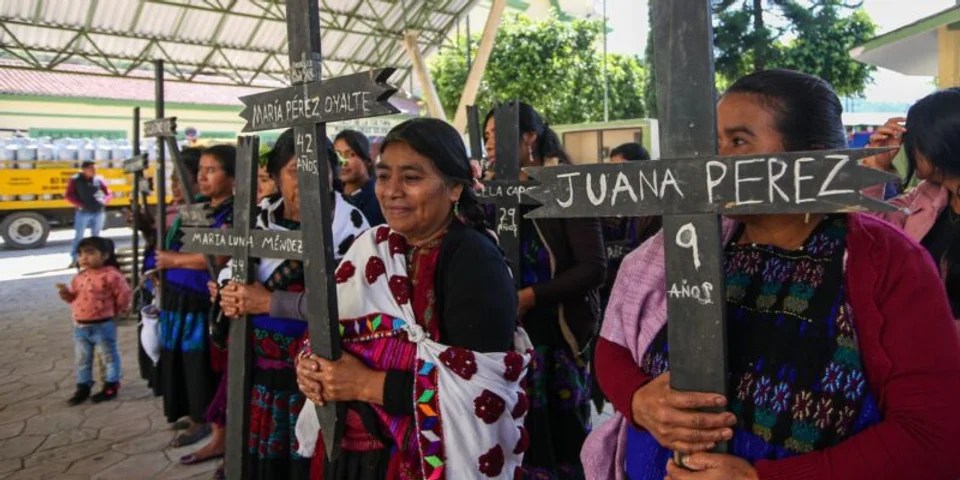
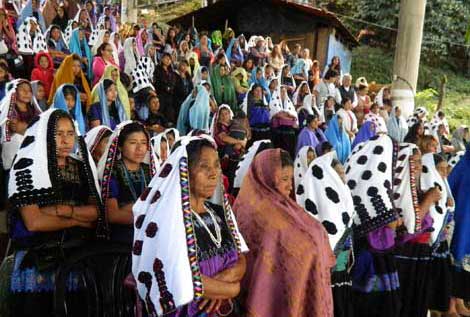
Last Thursday (10), days before the 25th anniversary of the Acteal Massacre, members of the Civil Society Organization Las Abejas de Acteal demonstrated peacefully to denounce the violence that different communities are currently experiencing in the municipality of Chenalhó, in the Chiapas Highlands.
It was in front of the Chenalhó municipal offices where the indigenous Tzotziles protested against the criminalization of and aggressions against their members. This is the case of families in towns such as Campo Los Toros and Bach’en, who, for the simple fact of belonging to their organization, at different times during 2022, have had their water and electricity services cut.
The Tzotzil organization pointed out that the aggressions come from partisan people from different communities within Chenalhó municipality who violate the rights of Las Abejas families due to their work of denouncing the Acteal Massacre as a State crime.
“We come here in the municipal seat of Chenalhó, to warn the municipal president Abraham Cruz Gómez and his entire city council, not to follow the example and path taken by his predecessor in 1997,” they said during the protest.
Las Abejas contextualized that in October 1997 a commission warned the then PRI municipal president of Chenalhó, Jacinto Arias Cruz, about the paramilitary aggressions against his organization, who ignored the complaints and accused the Indians of “being provocateurs and of being Zapatistas.”
“This mayor of Chenalhó, instead of praying for peace and cooling violence, his paramilitaries were burning houses and firing their high-caliber weapons against Las Abejas whom he later massacred on December 22,” they said about the actions of the mayor who was arrested after the massacre and released in 2013.
Las Abejas de Acteal emphasized that, as in the past, the current events are cases of emergency and gravity, “which can constitute situations of forced displacement as have occurred in the Río Jordán neighborhood of the Miguel Utrilla Los Chorros neighborhood and in the Puebla neighborhood.”
At the same time, they blamed these actions on “PRI and Cardenista paramilitaries who have now switched to the Green Ecologist Party and remain unpunished. They are also bothered by our resistance and rejection of the bad government’s welfare programs.”
That’s why they demanded that the municipal president of Chenalhó and the municipal council authorities restore services to families who have been suffering from the deprivation of their basic rights for months. “The reasons for the cuts of water and electricity made by the partisans, have not only happened in the communities already mentioned, but it has become a recurrent practice to exert pressure and aggression to our peaceful struggle and resistance,” denounced the organization through a statement read at the demonstration.
Denunciations
One of the aggressions indicated is about the imprisonment, on October 14 in the Puebla neighborhood, of Francisco Arias Cruz, a member of Las Abejas who was deprived of his freedom for eight hours and was released after the imposition of a fine of 10 thousand pesos.
Another reported case is that of the Nuevo Yibeljoj community. This town was founded in 2000 after the relocation of families from Las Abejas who were displaced in Camp X’oyep, due to the counterinsurgency war in Chiapas.
According to Las Abejas, in 2008, a group of people from the community were co-opted by government officials to cause division among families. Derived from this situation, the dissident group resorted to procedures to modify the name of the community and currently “denies the recognition and respect of the rights of our comrades to make use of the space to build their meeting house and autonomous school exclusively for Las Abejas,” said the Tzotzil organization.
The indigenous Tzotzils pointed out that the municipal president, as well as his agents use strategies of wear and tear [intended to cause exhaustion in the communities in resistance]. “For example, they schedule a date and at the hour of the meeting they leave us in the lurch, and that has happened time after time. The last time the municipal president canceled an appointment for the case of Nuevo Yibeljoj, he argued that there was a problem in Santa Martha, but in reality, it’s that he has no will to bring peace to Chenalhó,” they said.
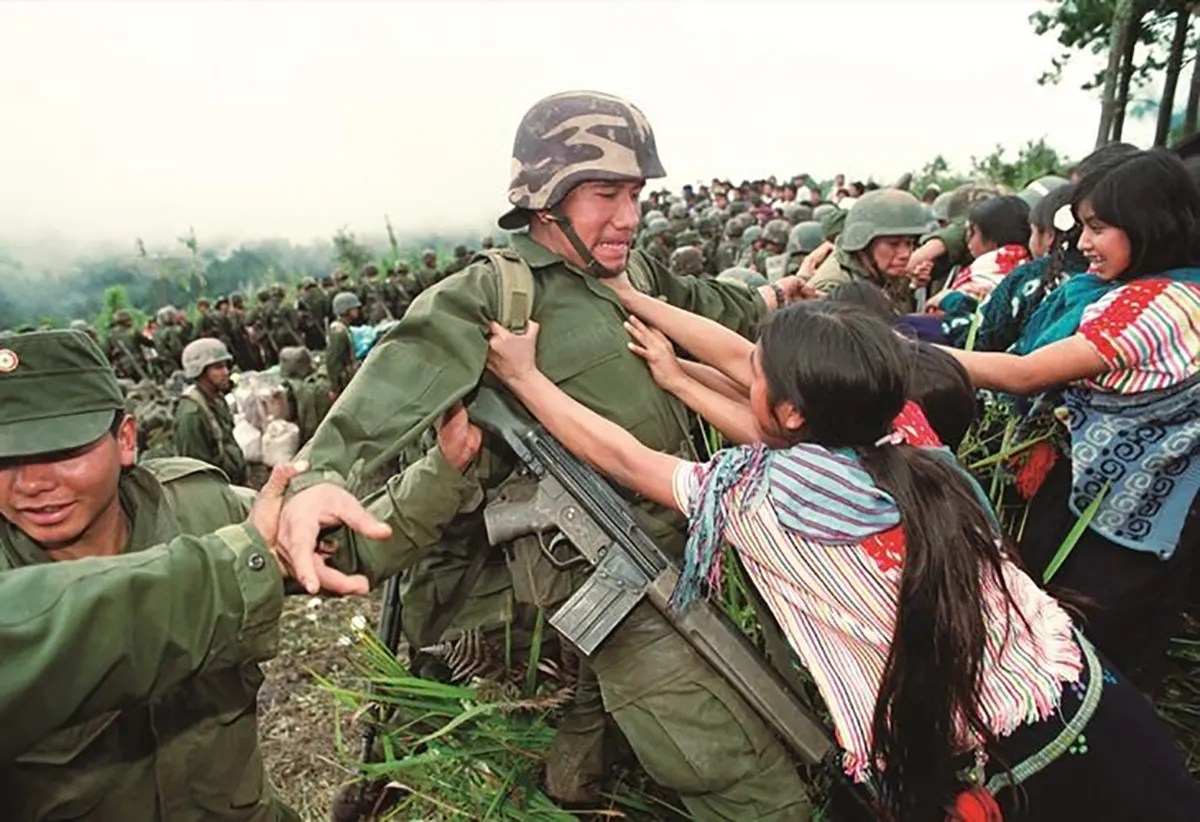
Las Abejas de Acteal detailed that since the 1997 Massacre, the people of Chenalhó were divided as a result of the counterinsurgency war of the Chiapas 94 Campaign Plan in the context of the Zapatista Uprising.
The indigenous Tzotzils pointed out that, from then on, the Chenalhó municipal council, “which previously served as authorities who watched over life and had the responsibility of maintaining the respect and balance of all its inhabitants, has now become the simple servant of the bad governments and delivers its people into the hands of Death.”

Originally Published in Spanish by Avispa Midia, Sunday, November 27, 2022, https://avispa.org/abejas-de-acteal-a-25-anos-de-la-masacre-continua-violencia-contra-tzotziles/ and Re-Published with English interpretation by the Chiapas Support Committee
Please consider making a donation to the Chiapas Support Committee in support of our work for the Zapatistas. Just click on the donate button. We appreciate every donation and will thank you from the bottom of our hearts.
The Peruvian oligarchy overthrew President Castillo

By: Manolo De Los Santos*
June 6, 2021 was a date that shocked many in the Peruvian oligarchy. Pedro Castillo Terrones, a rural teacher who had never been elected to public office, won the second round of the presidential election with just over 50.13 percent of the vote. More than 8.8 million people voted for Castillo’s program – which included sweeping social reforms and the promise of a new constitution – against far-right candidate Keiko Fujimori. In a dramatic turn of events, the historical program of neoliberalism and repression, transmitted by former dictator Alberto Fujimori to his daughter Keiko, was rejected at the ballot box.
Since that still incredulous day, the Peruvian oligarchy declared war on Castillo. They turned the next 18 months into a period of great hostility for the new president, attempting to destabilize his government with a multi-pronged attack that included a major use of legal warfare. Calling for “throwing out communism,” the National Society of Industries (the oligarchy’s main business group) devised its plan to make the country ungovernable by Castillo.
In October 2021, recordings were made public revealing that since June 2021, this group of businessmen, along with other members of the Peruvian elite and leaders of right-wing opposition parties, had been planning a series of actions that included financing protests and strikes. Groups of former military personnel, allied with far-right politicians like Fujimori, began openly calling for Castillo’s violent ouster, threatening government officials and leftist journalists.
The right wing in Congress joined these plans and tried to remove Castillo twice during his first year in office. “Since my inauguration as president, the political sector has not accepted the electoral victory that the Peruvian people gave us,” Castillo said in March 2022. “I understand the power of Congress to exercise oversight and political control; however, these mechanisms cannot be exercised through the abuse of the right, proscribed in the Constitution, ignoring the popular will expressed at the polls,” he emphasized. It turns out that several of these lawmakers, with support from a right-wing German foundation, had also been meeting to see how to amend the constitution in order to quickly remove Castillo.
The governing class of the Peruvian oligarchy could never accept that a rural teacher and peasant leader could be brought to the presidency by millions of poor, black and indigenous peoples who saw in Castillo the hope of a better future. However, in the face of these attacks, Castillo became increasingly distant from his political base. He formed four different cabinets to appease business sectors, increasingly yielding to right-wing demands to dismiss left-wing ministers who challenged the status quo. He broke with his party, Free Peru, when he was openly questioned by its leaders. He asked the already discredited Organization of American States for help in seeking political solutions, rather than mobilizing the country’s main peasant and indigenous movements. In the end, Castillo fought alone, without support from the masses or the parties of the left.

The final crisis for Castillo erupted on December 7. Weakened by months of corruption allegations, left-wing infighting and multiple attempts to criminalize him, Castillo was eventually overthrown and jailed. He was replaced by his vice president, Dina Boluarte, who was sworn into office after Congress removed Castillo with 101 votes in favor, six against and 10 abstentions.
The vote came shortly after the country received the televised announcement that Castillo would dissolve Congress. He did so preventively, three hours before the start of the session of Congress in which a motion of dismissal for “permanent moral incapacity” due to the allegations of corruption that are being investigated was to be debated and voted. Castillo also announced the start of an “exceptional emergency government” and the convening of a constituent assembly in nine months. He said that, until the constituent assembly was installed, he would rule by decree. In his last message as president, he also decreed a curfew starting at 10 p.m. This, like its other measures, was never implemented. Hours later, Castillo was overthrown.
Boluarte was sworn in before Congress while Castillo was detained at a police station. Demonstrations erupted in Lima, but none massive enough to reverse the coup, which had been almost a year and a half in the making, the last in Latin America’s long history of violence against radical transformations.
The coup against Pedro Castillo is a major setback for the current wave of progressive governments in Latin America and for the popular movements that elected them. This coup and Castillo’s arrest are a stark reminder that Latin America’s ruling elites will not cede any power without a fierce struggle to the end. And now that the dust has settled, the only winners are the Peruvian oligarchy and its friends in Washington.
* Manolo De Los Santos is the Executive Co-director of People’s Forum and a member of the Tricontinental Institute of Social Research.
The article was produced by Globetrotter

Published in Spanish by La Jornada, Friday, December 9, 2022, https://www.jornada.com.mx/2022/12/09/opinion/025a1pol and Re-Published with English interpretation by the Chiapas Support Committee
From Ricardo Flores Magón to Julian Assange I
By: Carlos Fazio
100 years have elapsed between the death of Ricardo Flores Magón in the Leavenworth Penitentiary, in Kansas, USA, on November 21, 1922 — where he was serving a 22-year sentence for the crime of anarchism, but formally sentenced for violation of the Espionage Act and the Enemies Act— to the solitary confinement Julian Assange now faces in Belmarsh Maximum Security Prison in London, England, awaiting extradition to the U.S. to face charges of conspiracy and espionage.
This period marks the interval between the nascent US empire of the late 19th and early 20th centuries, and its current decline as hegemon of the capitalist system, with one constant: the factional use of US class justice, with the consequent violation of the rule of law and freedom of speech and press.
At the end of the 19th century, weakened by war debts and disputes among liberals, the bourgeois-democratic Mexican state gave way to an oligarchic-dictatorial one, led by Porfirio Díaz, who administered the country as a capitalist reserve for his Mexican and foreign friends. His 35-year dictatorship (1876-1911) developed communications, electrification, transportation, industry and large-scale agriculture through concessions to foreign and national commercial interests, and the use of salaried and forced labor, even company stores. As a veritable praetorian guard of private capital and the state, the elite rural police (los rurales) patrolled the country, while a strong army crushed strikes.
Towards the end of the Porfiriato an important industrial proletariat was emerging with growing class consciousness, which led dozens of mining, railroad and textile strikes between 1906 and 1908. They were stimulated by the illegal Mexican Liberal Party (PLM), officially organized in 1905 by the anarchists Ricardo and Enrique Flores Magón and Antonio Díaz Soto y Gama, who radicalized anti-clericalism in favor of democracy, and advanced their demands in a peasant and proletarian classist direction, while creating a political-military organization with an anti-imperialist revolutionary ideology, which promoted armed revolts in several states of the country.

Although repressed with great costs to human life, the strikes and these unsuccessful armed actions played a major role in the military victories that ousted Díaz from power in 1910-11. (The strike at the Cananea mine, Sonora, near the US border, repressed by rangers and 2,000 Mexican soldiers, left nearly 1,000 dead, a toll similar to the slaughter of federal troops during the Río Blanco-Orizaba textile strike in Veracruz.)
Through the clandestine newspaper Regeneración, the PLM —also known as the party of the Magonistas– circulated its reformist program in Mexico and the southern U.S., a significant part of which would be incorporated into the 1917 Constitution. The program called for an eight-hour workday, a minimum wage, an end to child labor and an end to latifundia. Its rallying cry: Land and Liberty, was taken up by Emiliano Zapata, a small farmer who had been dispossessed of his land in Morelos. Along with the slogan “the land for those who work it, the Magonistas advocated the protection of the rights of Mexican migrants in the U.S., the end of Washington’s interference in Mexico’s internal affairs and a single presidential term.
In this context we can situate the revolutionary leader Ricardo Flores Magón, born in San Antonio Eloxochitlán, Oaxaca, in 1874, and who emigrated at a young age to Mexico City, where he studied at the National Preparatory School and the National School of Jurisprudence. He was not yet 20 years old when he participated in a student protest against Diaz’s third re-election. His audacity was great when he denounced that the dictator had lost his memory with respect to his famous motto of no re-election and that, due to his obsession to perpetuate himself, the workers were threatened and the peasants lulled with pulque and mezcal to be herded like cattle to the polls. This audacity resulted in his first imprisonment in the galleys of the Belén Jail. [1]
At the age of 27, after dabbling in journalism in El Demócrata [2] as proofreader, and another imprisonment, along with his brother Jesús and Antonio Horcasitas, Ricardo Flores Magón founded Regeneración on August 7, 1900, a publication considered a precursor project of the Mexican Revolution, as well as a reference for the working class of the time in Mexico, USA and Europe, and an emblem of anarchism and Mexican socialism at the beginning of the 20th century. Regeneración was published for 18 years, most of it from exile in the USA, with interruptions forced by censorship, persecution and tyranny. Several times the police destroyed its printing presses, and its editors were jailed.
On February 5, 1901, Ricardo Flores Magón participated in the first Liberal Congress in San Luis Potosí, thus linking himself to the budding political organization of which he became the undisputed leader: the Mexican Liberal Party. At the Congress he expressed his famous statement: “The Díaz administration is a den of bandits.” On his return to Mexico City, the repression of the liberal movement reached him, and on May 21 he was arrested along with his brother Jesús. On October 7, Regeneración published what would be its last issue in Mexico.
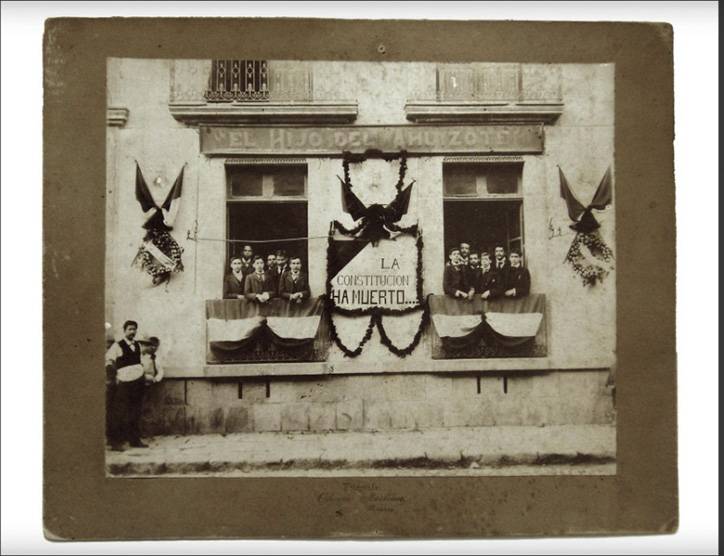
After his release from prison, on April 30, 1902, Flores Magón joined the editorial staff of El Hijo del Ahuizote, a satirical publication loaded with political criticism and an anti-re-electionist theme, which through caricature functioned as a double-edged sword: to both inform and to mock the Porfirian dictatorship. On February 5, 1903, a banner was hung from the offices of El Hijo del Ahuizote with the lettering La Constitución ha muerto (The Constitution has died). In the photograph of the moment appears Ricardo Flores Magón. On April 16, the offices of the publication were seized and its editors, among them Ricardo Flores Magón, were incarcerated.
Notes:
[1] The official name of the prison was the National Jail. It stood in Mexico City from 1862 to 1933.
[2] El Demócrata Fronteriza (The Border Democrat) was founded in 1896 by Justo Cárdenas to defend the interests of Mexicans in Texas.

Originally Published in Spanish by La Jornada and republished by La haine, November 3, 2022, https://www.lahaine.org/mundo.php/de-ricardo-flores-magon-a English translation by Schools for Chiapas and Re-Published by the Chiapas Support Committee.
Argentina: the real face of the right

A La Jornada Editorial
An Argentine court sentenced Vice President Cristina Fernández de Kirchner to six years in prison and disqualified her “in perpetuity” from holding public office in a case of defrauding the State for the alleged irregular award of 51 road works carried out in the province of Santa Cruz between 2003 and 2015, when Fernández was first lady (2003-2007) and president (2007-2015), A ruling that will surely be appealed and whose final outcome may take years.
In the immediate term, the political motivations and procedural cleanliness of the sentence are rude and unconcealable. From the outset, the so-called “road cause” violates the principle of not judging the same crime twice, since in 2015 it was prosecuted and dismissed by the same judge who years later, with the arrival of the ultra-neoliberal Mauricio Macri to power (2015-2019), decided to reopen it. In addition, as the defendant has pointed out for years, the prosecution did not present a single piece of evidence linking it to the contracts in question, and it cannot even be attributed administrative responsibility in the awarding of the works, since legally this falls not on the head of the Executive, but on his chief of staff. Regarding the approval of the budget, it is the power of Congress.
To the grotesque distortions of justice in this particular case are added the well-known right-wing political leanings of the Argentine Judiciary, the inability of a large part of its representatives to separate their ideologies and group interests from their judicial work and the absolute lack of dissimulation with which they operate in favor of de facto powers and characters of Macrismo.

Just in October, a meeting of judges, prosecutors (some of them involved in the trial against Cristina Fernández) and officials of the Macri government of Buenos Aires was unveiled at the estate of a British billionaire in the tourist mecca of Bariloche. This revelation was shamefully silenced by the mass media, whose maximum exponent, Grupo Clarín, is the greatest promoter of lynching against Kirchnerism since almost two decades ago, this movement tried to end the neoliberal looting that plunged the country into the greatest crisis in its history.
For all these reasons, Cristina Fernández refers to the corrupt structure of courts and prosecutors’ offices as a “judicial party,” that is, “a parastatal system that decides on the whole of Argentines outside the electoral results.” The mechanism to which the Peronist leader alludes, lawfare (use of judicial and legislative machinations to depose leaders uncomfortable to the interests of the oligarchies), has become the contemporary substitute for the coup d’états perpetrated by the right in the last century. It has already caused the illegal expulsion of Fernando Lugo in Paraguay and Dilma Rousseff in Brazil, and is now being applied more and more aggressively to bring down Pedro Castillo in Peru. In Mexico there is a double precedent of the attempt to remove the immunity of Andrés Manuel López Obrador in 2005 and the judicial validation of the electoral fraud committed to impose Felipe Calderón in the Presidency in 2006.
Although the conviction against Fernández de Kirchner can be challenged and the process is expected to take years, the sentence issued yesterday constitutes irrefutable confirmation that the Argentine oligarchy has no ethical or legal scruples in the effort to impose its interests, and is willing to derail transformation projects by any means, however moderate. A trait it shares with the right wing in much of the world.
Originally Published in Spanish by La Jornada, Wednesday, December 7, 2022, https://www.jornada.com.mx/2022/12/07/opinion/002a1edi and Re-Published with English interpretation by the Chiapas Support Committee
Ricardo Flores Magón: Living Thought
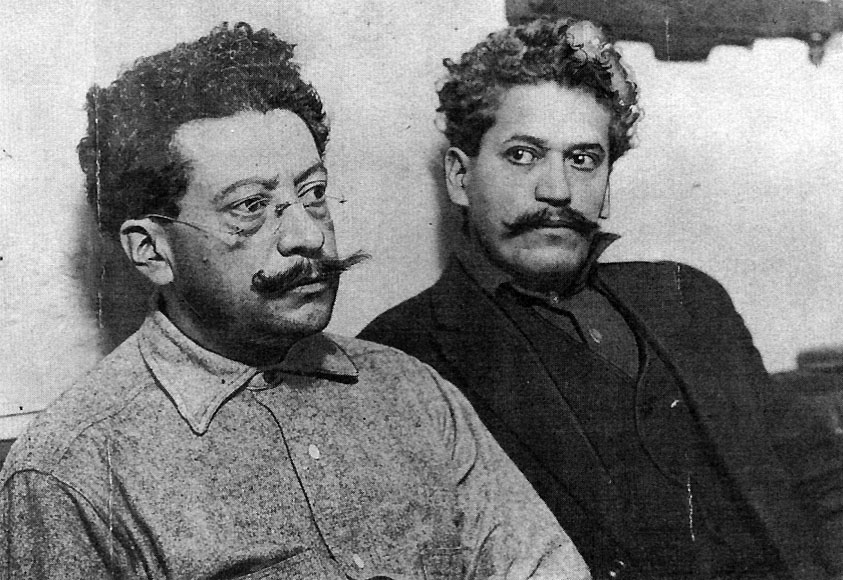
By: Raúl Romero
In his history classes, professor emeritus at the UNAM Juan Brom used to say that it was a credit to the student movement of 1999-2000 that they named the main auditorium of the Faculty of Political and Social Sciences after Ricardo Flores Magón. The gesture was not minor and Brom knew it: it was not merely a homage from a generation that defended free education to the most important anarchist intellectual of the Mexican Revolution; it was, at the same time, a reappropriation of space, a plebian resignification, a rupture with the hegemonic history, and also perhaps, a sign of the advance of libertarian thought and action among social movements.
The first time Ricardo Flores Magón was taken to jail he was only 19 years old. At that time, the anarchist had moved with his family from his native Oaxaca to Mexico City and was studying at the National School of Jurisprudence. It was the spring of 1892, and people were moving, agitated, as if with the arrival of the season the outdated organism of Mexican society had been shaken, he would write in Apuntes para la Historia (Notes for History). My first prison. Ricardo Flores Magón described the anti-reelection movement against Porfirio Díaz, in which the student movement played a key role: At that time, we students were the idols of the people. The fact is that Ricardo Flores Magón and his brother Jesús, along with dozens of members of the student movement were arrested for participating in the protests. Fortunately, the massive popular mobilizations that followed their arrest saved them from being shot, as happened to so many others at that time.
The theoretical and practical contributions of the Magón brothers, and of other members of the Mexican Liberal Party (PLM), such as Práxedis Guerrero or Librado Rivera, have been widely studied from different standpoints. Particularly noteworthy is the link between the native communities and Magonism, a link that would not only be marked by the birthplace of Flores Magón, San Antonio Eloxochitlán, Oaxaca, populated mainly by Mazatec communities, but that would develop in the very formation of the PLM itself, as Benjamín Maldonado has pointed out in his text El Indio y lo Indio en el Movimiento Magonista (The Indian in the Magonista movement). On the nuances and debates of this link, it is worth reviewing the interesting conversation Ricardo Flores Magón and the national indigenous movement, recently held at the Institute of Social Research of the UNAM (https://bit.ly/3EolUGm).
Although the anarchism of the group led by Ricardo Flores Magón has had a profound impact on the political, cultural and intellectual life of Mexico, it should also be noted that from the beginning, and due to the very characteristics and conditions in which it developed, it was a transnational movement, with repercussions even beyond Mexico and the United States.
It is also among the youth movements where “Magonismo” has flourished with the greatest vigor. This libertarianism has taken root where anti-authoritarian, counter-cultural and anti-statist positions converge. Since the 1970s, whether promoting newspapers, magazines, libraries, radio stations, cooperatives, in the countryside and in the city, dozens of organizations and collectives have reproduced and nurtured Magón’s ideology in the struggle against the State and capital. In the 1990s, with the outbreak of the Zapatista rebellion and its frontal critique of the State, anarchist ideals also gained ground among hundreds of young people who wanted to build emancipatory alternatives against and beyond the State.
In September 1911 the PLM would launch a decisive manifesto: The storm is intensifying day by day: Maderistas, Vazquistas, Reyistas, Cientificos, delabarristas [1] call out to you, Mexicans, to leap to defend their faded banners, protectors of the privileges of the capitalist class. Do not listen to the sweet songs of those sirens, who want to take advantage of your sacrifice to establish a government, that is, a new dog to protect the interests of the rich. Up with all of you; but to carry out the expropriation of the goods held by the rich! The document would conclude with the slogan “Land and Liberty,” which Emiliano Zapata and the Liberation Army of the South would later make their own.

Almost a century later, the link between Zapatismo and Magonismo would be claimed by the EZLN, when the neo-Zapatistas named one of the autonomous rebel municipalities on land recuperated in 1994 as the Ricardo Flores Magón autonomous rebel municipality, located in the Tseltal zone of the Lacandón Jungle, near the Montes Azules Biosphere Reserve.
One hundred years after his death, the thoughts and actions of Ricardo Flores Magón live on with those who struggle from below, against and beyond the State.
* Sociologist
Note:
[1] Those referred to are: Francisco Madera, Emilio Vazquez Gómez, Bernardo Reyes, the Científicos (scientists) and Francisco León de la Barra
Originally Published in Spanish by La Jornada, Sunday, November 20, 2022, https://www.jornada.com.mx/2022/11/20/opinion/015a2pol with English interpretation by Schools for Chiapas and Re-Published by the Chiapas Support Committee
They demand the freedom of 15 women prisoners in the San Cristóbal prison
Throughout Mexico, women are protesting violence against women and patriarchy with marches and other actions. This protest is relevant to Chiapas.
By: Isaín Mandujano
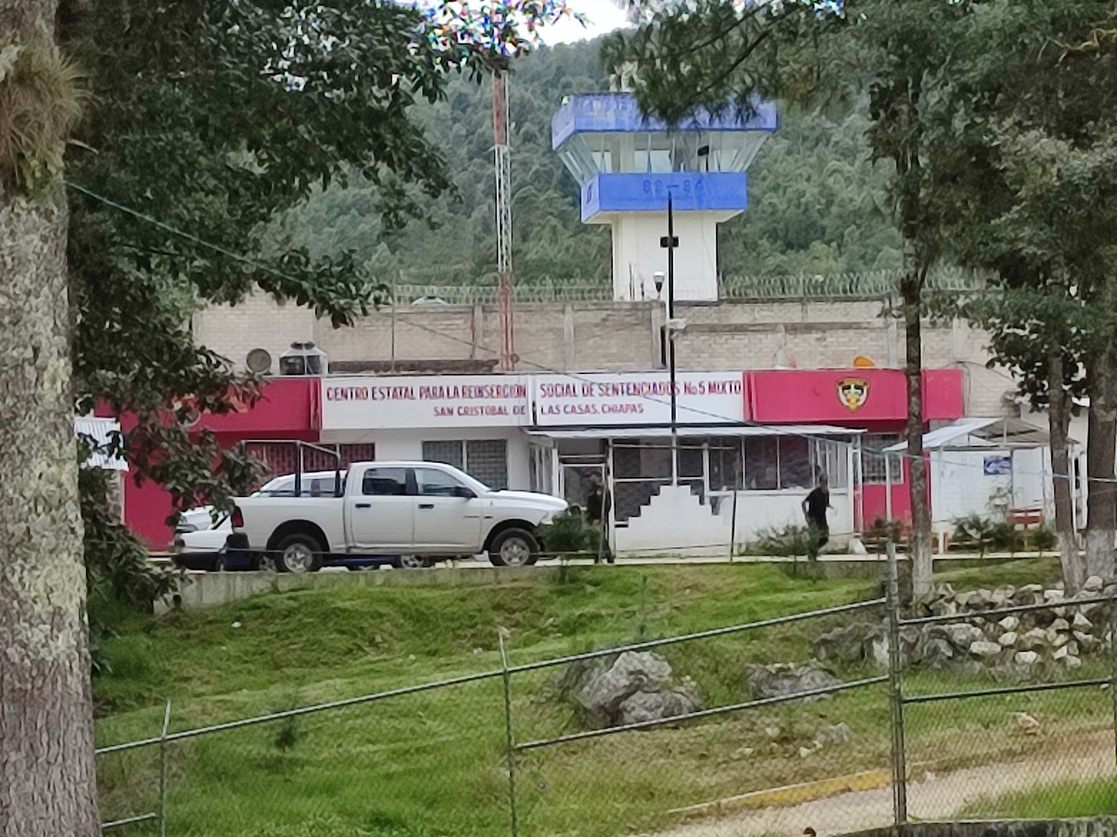
The Cereza Collective, a civilian organization for the legal support of women in Chiapas, today demanded the freedom of 15 women prisoners in the San Cristóbal de Las Casas state prison, who they said faced trials plagued with irregularities, such as the fabrication of crimes and some of them lacked translators at the time of their trial.
Patricia Aracil and a group of women activists and lawyers who form the Cereza Collective announced the names of 15 women secluded in state prison Number 5 in San Cristóbal de Las Casas municipality, who have clearly faced processes that show they were “victims of a sexist and patriarchal judicial process.”
In the framework of the activities of the International Day of Elimination of Violence against Women that is claimed on November 25 of every year, this Wednesday the Collective spoke out about 15 women prisoners.
Aracil and her compañeras who have visited that prison since some years ago, pointed out that each and every one of these women, have suffered violence from impoverishment, inequality, discrimination, racism, mistreatment and torture by their partner, followed by a violent arrest, the majority accused of crimes they have not committed or that derived from having to make economic decisions to sustain their children.
They are women who were involved forcibly by their partner, often even with threats and brutal violence that places them in a physical and emotional state of impossibility of escaping that situation with an insurmountable fear.
“Because in addition, it is their and their children’s lives that are at real risk. This also happens many times in the prosecutor’s office, forcing them to sign self-incriminating statements,” said the activist.
She said that these women have had to face a critical situation of femicidal violence and that in order to survive they have had to face that situation with very low possibility, they were able to save their lives in self-defense, because it is very difficult to defend themselves in that unequal battle against sustained violence and get out alive.
“A violence that local authorities still consider intimate family matters where we should not get involved, where the voice of women, when they can escape momentarily and ask for help from neighbors, authorities and institutions, is questioned and blamed,” she said.
She said that in Chiapas, judges continue to issue arrest warrants irresponsibly, continue to judge with a lack of gender, intercultural and human rights perspectives, continue to give convictions “as a rule” in the first instance, because it seems to be a pact with the prosecution, making up not only for the lack of adequate investigation, but becoming accomplices of the violence and human rights violations against women committed by prosecutors to incriminate them.
She explained that there is no justice for women in Chiapas. Therefore, she demanded that the State’s Judicial Power review the women’s cases and give them freedom.
“We demand that it be investigated and judged with a gender, intercultural and human rights perspective. We demand that the FGE stop constructing crimes against women, stop torturing and obstructing investigations. We demand the right to truth and justice, to transformative justice,” Aracil said.
She said that after reviewing each of these cases, she concluded that: “all of them are innocent and have experienced femicidal violence, mistreatment, inhuman treatment or torture in detention and in the prosecutor’s office.”
“It is necessary to combat corruption and impunity in the Attorney General’s Office, as well as the fabrication of crimes and acts of torture against women, a change in the justice system towards the human rights of women, girls and indigenous peoples is necessary,” said the lawyer.
She added that in addition, “judicial independence is fundamental for access to justice in Chiapas, the “norm” of conviction, contrary to the right to justice, must be eliminated.”

Originally Published in Spanish by Chiapas Paralelo, Wednesday, November 23, 2022, https://www.chiapasparalelo.com/noticias/chiapas/2022/11/exigen-libertad-de-15-mujeres-presas-en-el-penal-de-san-cristobal-de-las-casas/ and Re-Published with English interpretation by the Chiapas Support Committee
The Interoceanic Corridor and the National Popular Interest
By: Gilberto López y Rivas
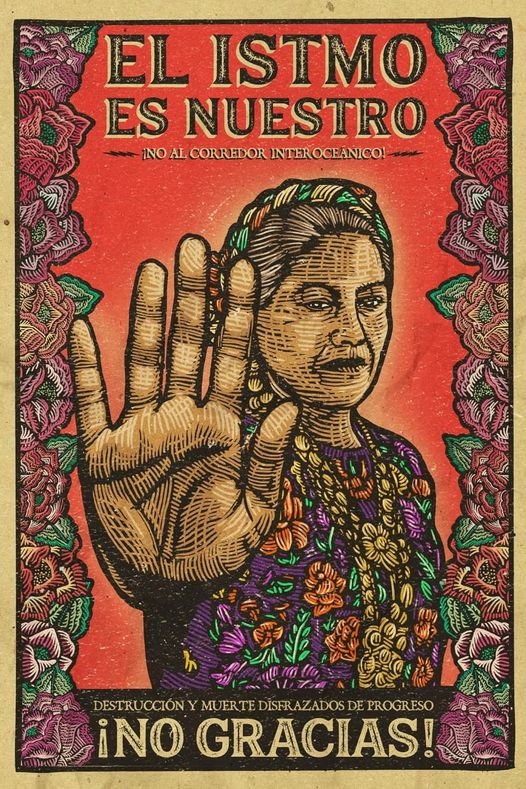
The recycled mega-project of the Tehuantepec Interoceanic Corridor –whose origins lie in the regional development program of the Ernesto Zedillo government, and whose distant origins lie in the damaging McLane-Ocampo Treaty (1859)– continues its slow but relentless advance, despite the opposition and resistance of multiple local, regional, national and international organizations and collectives that have exposed the serious damage that this monstrous project will cause to the environment, to the peoples who inhabit the disputed territories, and to the whole socio-political-cultural fabric of the 33 municipalities of Veracruz, 46 of Oaxaca, 14 of Chiapas and 5 of Tabasco.
Let us remember that this is an comprehensive project and, consequently, it’s not simply the passage of goods from one ocean to another through a multimodal railroad, but also includes the modernization of the ports of Coatzacoalcos and Salina Cruz, a parallel network of highways, 10 agro-industrial and industrial parks or corridors for the chemical, petrochemical, oil and gas industries, petrochemicals, petroleum, refineries, wind farms, hydroelectric dams, automotive and machinery assembly plants, manufacturing of other products, gas and oil pipelines, timber plantations, and high voltage power lines, as well as hotel infrastructure, services and communications for luxury tourism. All this with tax subsidies and the guarantee of basic services to investors.
From a geopolitical perspective, the Isthmus of Tehuantepec megaproject is strategic for the interests of the United States in the economic and military control of Mexico, in its hegemonic implications of dominance over the rest of Latin America and the Caribbean, and in its repositioning vis-à-vis other emerging or competing powers such as China, Europe and Japan. According to the Latin American Observatory of Geopolitics: One of the challenges of this moment concerns the hegemonic dispute between the United States and China, in which powers of nearby heights, such as Russia, are also participating. In this context, the control of space, seas, territories, routes and the elements defining positions of advantage or vulnerability, the conditions for establishing alliances, coalitions or alliances are of vital importance. Those strategic transit territories such as Suez, Panama and the Isthmus of Tehuantepec are crucial to consolidate the balances or asymmetries of world power and become rigorously guarded territories, even militarily.
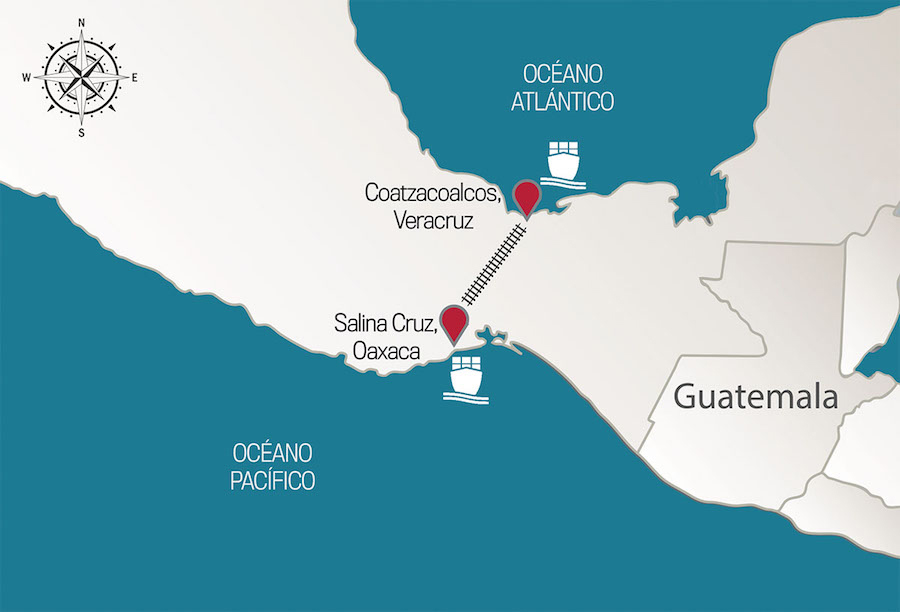
It’s no coincidence that, as we anticipated more than a year ago, militarization was imposed in this case, through the handover of the administration of the Isthmus megaproject to the Mexican Secretary of the Armed Marine Corps, the military structure organically closest to the United States, and which, by the way, met last September with the Marine Corps of the United States to sign other collaboration agreements without passing through the scrutiny of the Senate. They agreed to strengthen ties and strengthen the sharing of personnel, training and logistics and troop transport operations by means of an agreement signed by the commanders of both naval forces.
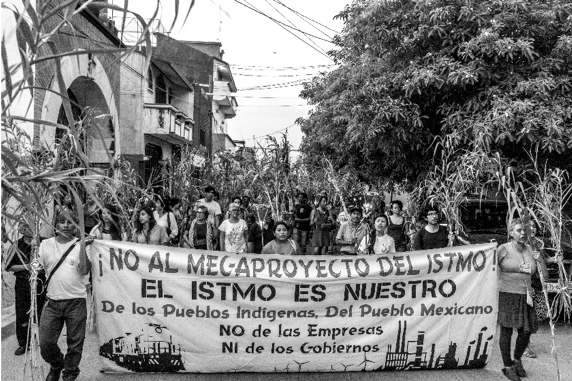
Miguel Ángel García Aguirre, founder and general coordinator of Maderas del Pueblo del Sureste, A. C., and other organizational efforts in defense of Los Chimalapas, as well as the main promoter of the National and International Campaign #El Istmo Es Nuestro (#The Isthmus Is Ours), has insisted on the special significance of the Isthmus for the country, since “it possesses ten different natural ecosystems, which to date are home to more than 10 percent of the biodiversity of the entire planet, It also possesses the most important compact forest massifs -climate regulators and oxygen producers- that still persist in our national territory, the most outstanding massif being the bioregion of Los Chimalapas, and naturally producing 40 percent of all surface water runoff (rivers and streams) in Mexico.”
Resistance against this project began in 1997 and was reactivated in 2019 with the The Isthmus is Ours campaign, whose main purpose is to prevent this triple and severe attack: against nature, indigenous and black peoples, and national sovereignty. More than a hundred organizations and social movements, NGOs and academic collectives, artists and personalities joined this campaign expressing their total rejection of the Comprehensive Development Program.
Originally Published in Spanish by La Jornada, Sunday, December 4, 2022, https://www.jornada.com.mx/2022/12/04/opinion/011a2pol English translation by Schools for Chiapas and Re-Published by the Chiapas Support Committee
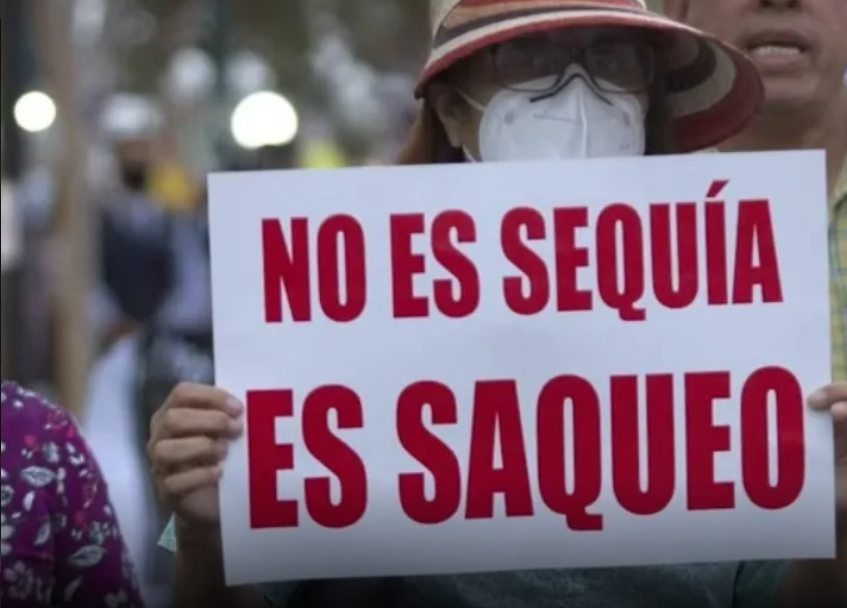
It’s not drought, it’s dispossession
By: Raúl Romero
The water crisis that shakes Monterrey, in the state of Nuevo León, generated constant social expressions of discontent throughout this year. In June, marches and other forms of protest in the northern state became the focus of national and international press attention. While ordinary people organized and demanded solutions to the water shortage, Governor Samuel García, of Movimiento Ciudadano (Citizen Movement), and his wife Mariana Rodríguez let themselves be seen carefree and even offensive on social networks: at the same time that people lived through one of the worst water crises, they published photos relaxed in the pool or leaving to shower. Its banality was not a “communication problem” or a “politically incorrect” message, it’s a common practice among juniors: exhibiting the luxuries of their opulence to differentiate themselves from impoverished sectors.
In the state of Querétaro, also during May and June 2022, different social organizations began to articulate to express their rejection of the “Water Law,” approved by the Congress of PAN majority, which reinforces the process of privatization of water through concessions, measurement and collection for up to 40 years. The articulation process led to the creation of the Network in Defense of Water and Life (Redavi), created on May 21, with the aim of organizing the rejection of the aforementioned law. Among the demonstrators who for several weeks held meetings, meetings, marches, rallies, flyers and more, were students from the Autonomous University of Querétaro, environmental activists, members of the San Francisquito neighborhood, the Agua que Corre Festival, the Bajo Tierra Museo Collective and the indigenous communities of Santiago Mexquititlán, Chitejé de Garabato and San Miguel Tlaxcaltepec.
Under the slogan “The water belongs to the people, dammit!”, the Redavi managed to get its call to reach more inhabitants of the state, while specialists and the national and international press began to place Querétaro among the states where water conflicts occur. As proof of the above, it is enough to point out that the EJAtlas-Global Atlas of Environmental Justice tool, which is responsible for mapping the different socio-environmental conflicts around the world, integrated the entry “Aggression, arbitrary detentions and criminalization of the protest against privatization of water in Querétaro” (https://bit.ly/3OXG0fJ).
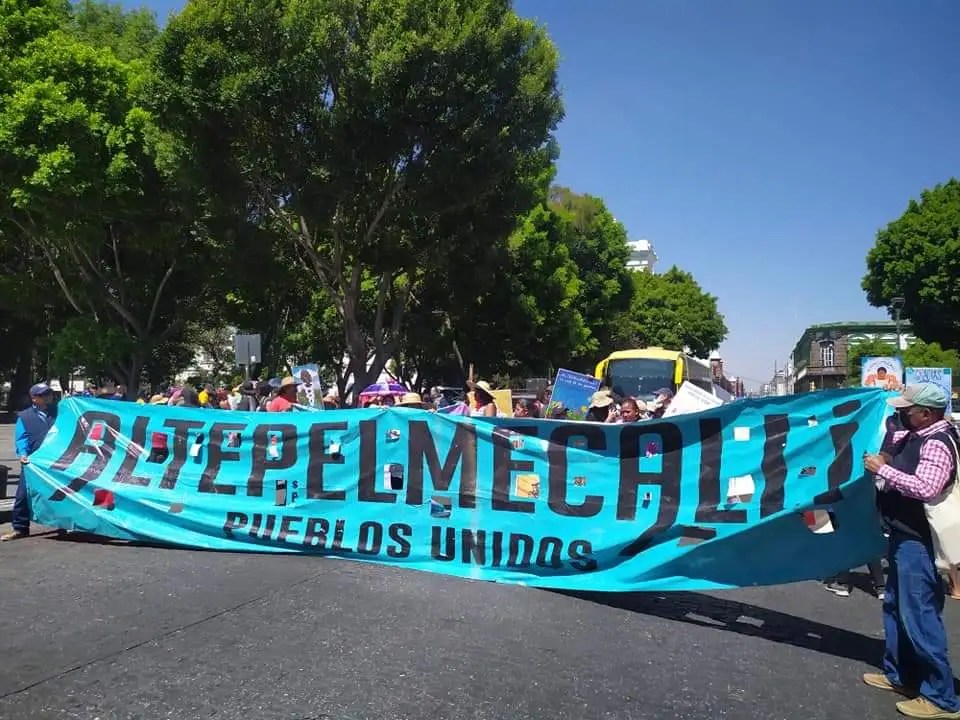
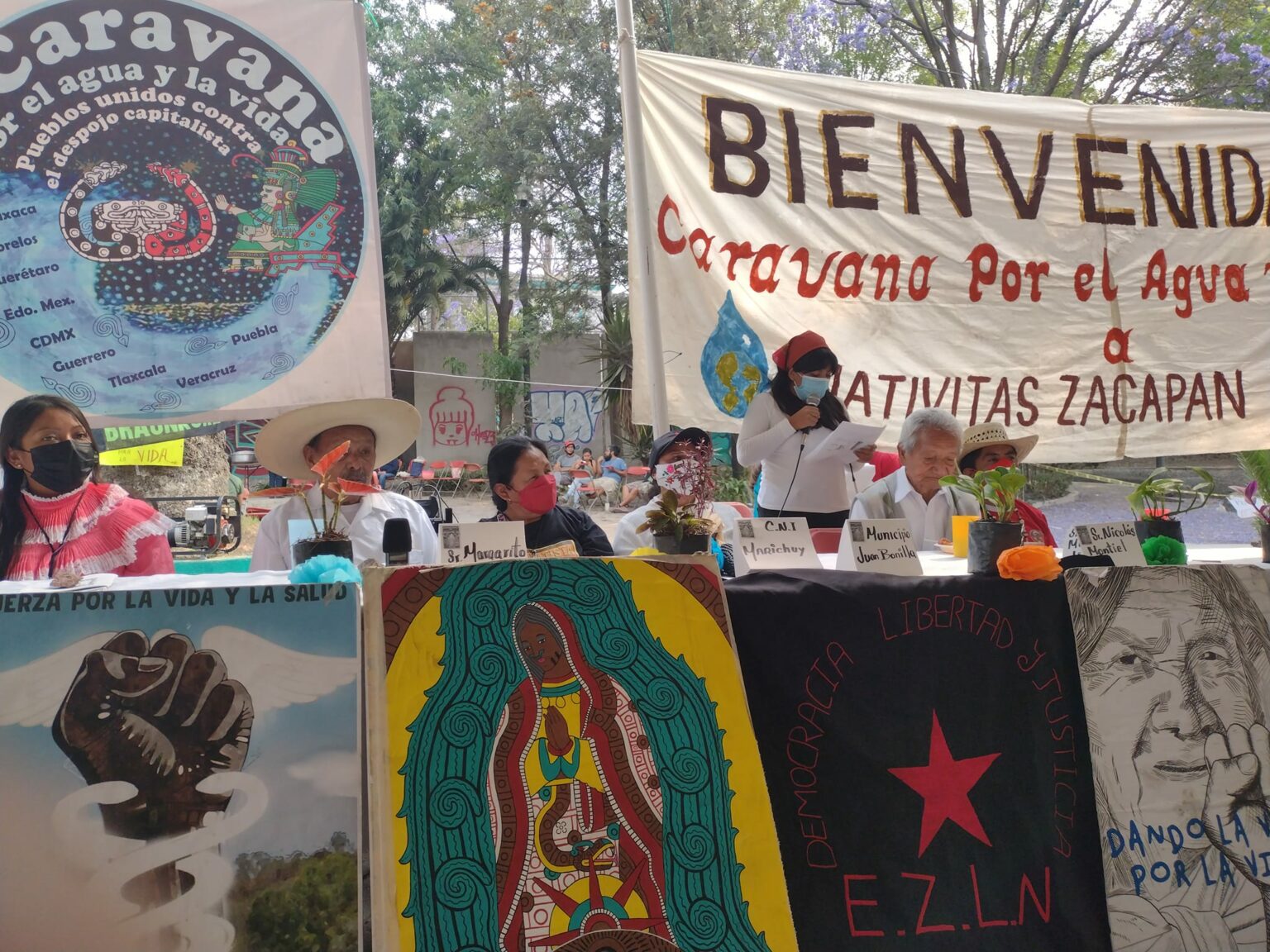
As a result of the Caravan for Life and Water, the peoples united against capitalist dispossession, and with the aim of strengthening their process of articulation, different organizations and peoples met in the National Assembly for Water and Life. No more dispossession or pollution! The assembly took place on August 27 and 28 in the community of Santa María Zacatepec, in the municipality of Juan C. Bonilla, Puebla, very close to the old Altepelmecalli or house of the peoples, popular experience of occupation of a Bonafont plant that was later reclaimed by the National Guard and delivered to the transnational corporation. Organized in working groups and through generative questions, attendees shared experiences of dispossession and resistance, outlined a national diagnosis, in addition to planning joint actions and a second assembly in 2023. In particular, it highlighted the terror that communities are experiencing because of organized crime groups and the permanence of old groups of the local caciques, but now attached to the new ruling party or its allies.
Mobilizations for the right to water and against megaprojects that overexploit it are all over the country, as we have already analyzed in these pages (https://bit.ly/3B4UZPd). While state governments ignore, despise and even repress those who fight for water, in the federal spheres, particularly in the National Water Commission (Conagua), tensions and contradictions are aggravated by the abrupt departure of the deputy director of that agency, or by the alleged acts of corruption with which an official of this commission would have benefited with concessions to the Mexico Group of Germán Larrea.
“We, the Lenca people, are ancestral custodians of the rivers, also protected by the spirits of the girls who teach us that to give our lives in multiple ways for the defense of the rivers is to give our lives for the good of humanity and this planet,” Berta Cáceres told us in 2015, before she herself gave her life in defense of the rivers of humanity and of this planet. Let us learn from the Lenca people, from Berta Cáceres, and from so many other peoples and people who, by defending water, defend the life of humanity and the planet.
As the slogan says: The water belongs to the people, dammit!
*Sociologist
Originally Published in Spanish by La Jornada, Sunday, December 4, 2022, https://www.jornada.com.mx/2022/12/04/opinion/012a2pol and Re-Published with English interpretation by the Chiapas Support Committee
The lefts in the face of Dora Maria Téllez
By: Raúl Zibechi
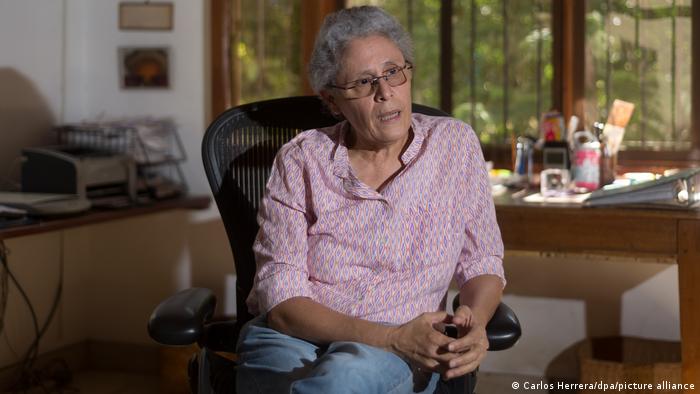
Some time ago, Mónica Baltodano commented that the repression of the Daniel Ortega and Rosario Murillo dictatorship is even worse than that of Anastasio Somoza, against whom the Sandinistas took up arms. I confess that Monica’s statement left me frozen and I thought it was exaggerated. When we followed the case of Dora María Téllez, the pieces of the regime were put together.
Last weekend her brother, Oscar Téllez Argüello, reported that Dora María would receive the title honoris causa from Sorbonne University, in Paris, France, “in recognition of a life of dedication to the defense of social justice and democracy.” From prison, she sent the message that the title, which journalist Carlos Fernando Chamorro received in her name, is dedicated to political prisoners committed to freedom in their country.
“My sister expresses to you, in addition to her gratitude, her firm determination to continue the struggle despite the torture and inhuman prison conditions to which political prisoners are subjected. She hopes that this recognition will serve to highlight and create more and more awareness about the importance of denouncing every day more and more forcefully the atrocities of the Ortega-Murillo regime, which has subjected an entire people to a regime of absolute silence and terror,” says her brother Oscar.
Dora María is a prisoner in El Chipote since June 2021, accused of “treason against the country.” “There is no light even to distinguish the toothpaste on the brush,” Chamorro explained about the cell where Tellez, 67, https://bit.ly/3ielV8l, survives. Accepting the title on behalf of the prisoner, Chamorro called on leftist movements and governments in Latin America to raise their voices against the Nicaraguan regime and said, “You cannot justify a dictatorship in the name of the left. “
Therein lies the crux of the problem. If we are now not witnessing a broad campaign for her freedom and a denunciation of the Ortega-Murillo regime, it is precisely because the left and progressivism are not interested. Because they only look at power; they bet everything on power, and for the sake of power they sacrifice ethics and dignity. It has its logic: if power is everything, the rest has little importance, since it is subordinated to the greater objective.
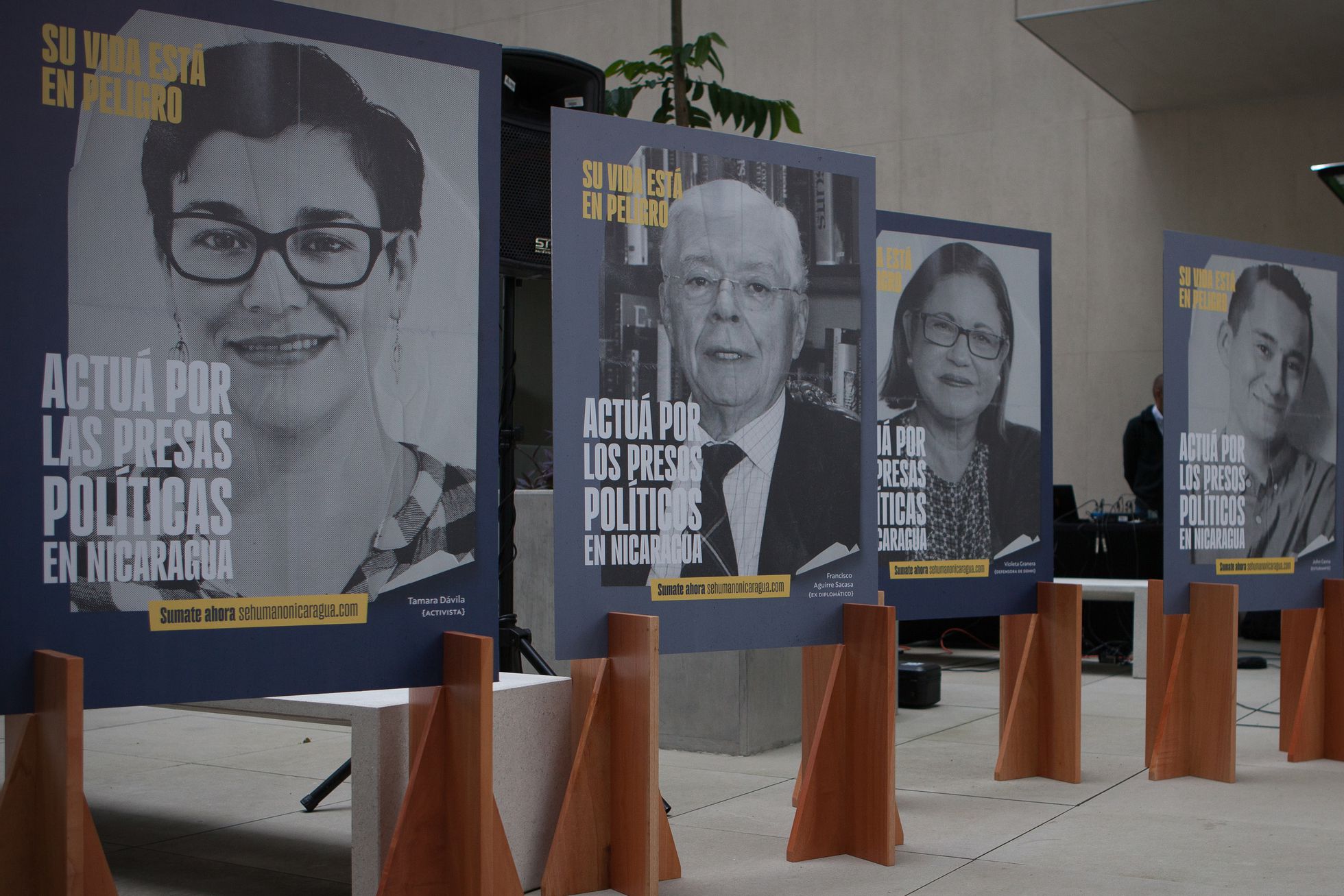
Dora Maria makes them uncomfortable. Because of her dignity. Because of her perseverance. Because she did not give up, sell out, or give in. The left, however, is not bothered by the regime because it does not want to look in that mirror, in any mirror that will restore its obsession with power. That left that cackles “coup” every time it’s dealt a political setback, that accuses the right of its own limitations, prefers to look the other way when it comes to Nicaragua and the political prisoners tortured in the name of a “revolution,” which only exists in its imagination.
The lefts of the world owe an enormous theoretical and political debt because they never looked Stalinism in the face, as if that regime had not emerged from the very bowels of the Russian revolution. Understanding how this ferocious and criminal regime headed by Stalin was arrived at, obviously requires looking in the mirror, drawing serious conclusions that cannot consist of placing all the blame on the enemy, as is always done from that sector.
Today’s progressivism does not usually accept criticism, since it accuses the person who formulates it of being the right. For the same reason, it cannot make self-criticisms either. Without this collective exercise, it is impossible to promote change. I do not know of any Latin American progressive president who has said where he went wrong, what the mistakes or deviations were, but they always accuse others (whether the right, the empire or the movements that supported them) for the resounding failures they harvest.
Some presidents in the region are calling for the freedom of Dora María Téllez. I think it’s necessary to do so. But it’s not enough. We must condemn and isolate the Ortega-Murillo regime for repression and crimes, because although the regime says otherwise, it has a deep alliance with the United States and the Nicaraguan right. To not so is to be complicit.
In a recent article, Baltodano denounced the closure of all the spaces and freedoms, that thousands of persecuted Nicaraguans have had to go into exile and that almost 3,000 organizations were closed, which “demonstrates in a reliable way, the will of the regime to stay in power with guns and bullets” (https://bit.ly/3GRvp3T). That’s why in the November municipal elections the FSLN had no real opponents and declared itself the winner in the country’s 153 municipalities, despite an abstention of more than 80 percent.
Obsession with power, clinging to state control, repression of dissent and lack of self-criticism, link this left that calls itself democratic, with its Stalinist past. We already know that the right is worse, perhaps much worse. But always, more dangerous than the wolf, is the one who disguises himself with the skin of the lamb.
Originally Published in Spanish by La Jornada, Friday, December 2, 2022, https://www.jornada.com.mx/2022/12/02/opinion/015a1pol/ and Re-Published with English interpretation by the Chiapas Support Committee
Given the increase of gender violence in Chiapas, women and girls marched on 25N

By: Orsetta Bellani
Estefanía Martínez Matías was 22 years old, she was studying nursing and worked at a clothing store in Tuxtla Gutiérrez to pay for her studies. Her lifeless body was found on November 5 on the side of a road in the southern part of the Chiapas capital, after a mobilization called by her family members and friends in front of the government palace. Six days before, the young woman had left her house to go to a fiesta from which she did not return.
For her and the other women victims of violence in their homes, in the streets, in their workplaces and in the prisons where they are held, today, on the occasion of the International Day for the Elimination of Violence against Women, marches were held in Chiapas cities, such as San Cristóbal de las Casas, Tuxtla Gutiérrez and Comitán.
According to the Attorney General’s Office of the State of Chiapas, from January to October 2022, 39 femicides were registered. Civil society organizations, however, have other data. “Doing an analysis of newspaper articles, we found at least 53 cases that have all the characteristics to be considered femicides. If a woman is killed by her partner, or when the note says that it was an assault, but in the photos, we observe that the victim has signs of sexual violence, we immediately consider it as a systemic sexual femicide,” says Karla Somoza Ibarra, director of the Feminist Observatory against Violence against Women of Chiapas.
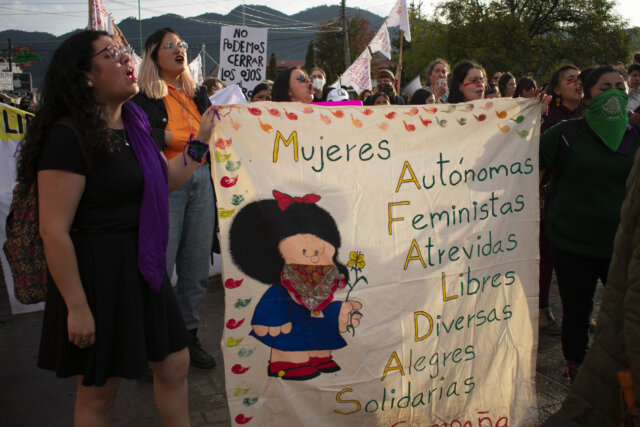
Thanks to the struggle of organized civil society, in 2016 the Gender Violence Alert was declared in seven municipalities of Chiapas, which managed to reduce cases of femicide in cities such as Tuxtla Gutiérrez and San Cristóbal de las Casas. However, at a general level in the state the problem is increasing: according to the Citizen Observatory of Chiapas, in September 2022 there was a 24 percent increase in femicides compared to the same month in 2021 and Chiapas currently ranks fifth nationally for this crime.
Gender violence, explains Somoza, is something that women begin to experience when they are children, and the concern of the demonstrators goes towards them. “The forms of violence experienced by girls and adolescents are expressed in harassment and sexual violence in their schools, homes and streets, disappearances, trafficking and femicides,” write the self-convened and organized women of San Cristóbal de las Casas in the statement they read at the end of their mobilization. They point out that in Chiapas there are large numbers of girls forced to marry or continue with unwanted pregnancies as a result of rape and that, so far this year, 345 girls and adolescents have disappeared in the state, almost eight per week.
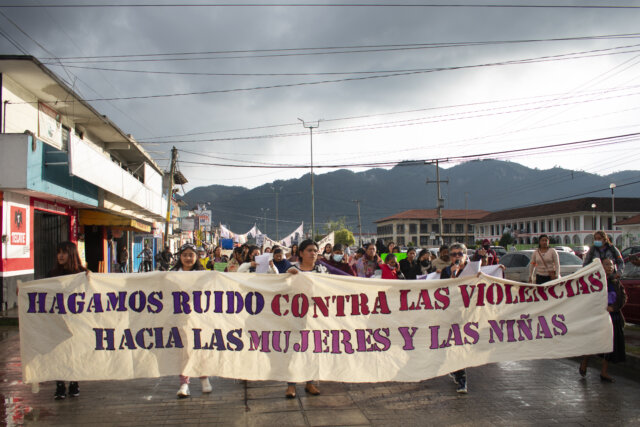
“Most of the minors who disappear in Chiapas are indigenous women between 12 and 17 years old, so we could say that the population with the highest risk of disappearing in the state are adolescent women,” Jennifer Haza, general director of the Melel Xojobal civil association, said in an interview. “We think that they may be victims of trafficking for sexual exploitation, and that in the case of girls from 0 to 6 years old it may be through illegal adoptions,” he says.
Melel Xojobal has been registering cases of missing children and adolescents since 2019, based on the files that the Prosecutor’s Office publishes on its portal Have you seen her? carrying out a work of systematization that the authorities do not do. In fact, the organization points out inconsistencies between the data that the Prosecutor’s Office has on its website – where 632 files of disappearance of minors appear in 2021 – and those of the National Registry of Disappeared Persons, which counted 51 cases in the same year.
The lack of articulation is perhaps the main problem that civil society organizations and marchers detect in the justice authorities. “In general, I think the Women’s Justice Centers – which are the ones that serve women and girls in the Prosecutor’s Offices – are an excellent public policy. However, there are many coordination problems within these prosecutors’ offices, which also don’t have staff who speak the language of many of the women arriving. The number of public ministries (district attorneys) is minimal, and that’s why they dismiss and divert cases with any excuse, and their headquarters are so small that they don’t even know where to place their staff,” says Somoza Ibarra of the Feminist Observatory against Violence against Women of Chiapas.
Girls, adolescents and women participated in the march this November 25 and demanded a life free of macho violence and justice for all victims of femicides. They also demanded that the authorities act to prevent the aggressions.
Originally Published in Spanish by Desinformémonos, Friday, November 25, 2022, https://desinformemonos.org/frente-al-incremento-de-la-violencia-de-genero-en-chiapas-mujeres-y-ninas-marcharon-en-ocasion-del-25n/ and Re-Published with English interpretation by the Chiapas Support Committee
 Chiapas Support Committee