Chiapas Support Committee
Home of the Compañero Manuel blog on zapatistas & mexico
Elect new president in Oxchuc; armed group irrupts and leaves one dead

By: Isaín Mandujano
One person died and a civilian armed group irrupted, after the indigenous people of Oxchuc came to blows, following the voting by a show of hands, where the Community Electoral Body of Oxchuc Municipality (OECMO, its initials in Spanish) declared Enrique Gómez López the winner, as the new municipal president of the only indigenous municipality in the state governed under an internal regulatory system.
It should be remembered that this elective process emerged as a result of the exercise of self-determination and self-government, established in Article 2 of the Political Constitution of the United Mexican States, expressed through the indigenous consultation, where the community General Assembly is the highest body that determines the way to carry out the process of renewing municipal authorities.
On January 23, 2019, the State Congress of Chiapas published in the Official Gazette of the State of Chiapas Decree 135, which empowers the Institute of Elections and Citizen Participation of the State of Chiapas, so that within a period of 90 natural days, it may convoke, assist and, where appropriate, organize the election of municipal authorities in the municipality of Oxchuc, Chiapas, as well as qualify the election and expedite proof of majority through the election regimen by an internal normative system.
On April 13, 2019, the first election of municipal authorities was held in Oxchuc municipality, under its own Internal Normative System, by means of raised hands at a single assembly in the central plaza of the municipal seat in which the citizenry of the Tzeltal municipality participated.
The General Assembly decided to renew its municipal council on December 15, 2021, through voting by raised hand in the municipality’s central plaza. Oxchuc’s elective process emerges as a result of the exercise of self-determination expressed through the indigenous consultation. The community general assembly is the highest body that determines the way in which its process of renewing municipal authorities will be carried out.
Around 14,000 people coming from 129 communities and 23 neighborhoods (barrios), a total of 142 locations that the General Assembly recognizes make up Oxchuc municipality participated in this election.
After holding the assembly in the central plaza and electing by a show of hands between two proposed candidates, Hugo Gómez Santiz from San Cristobalito and Enrique Gómez López from Benito Juárez, that same afternoon supporters of Hugo Gómez Santiz rejected his defeat and accused the community electoral body of favoring Enrique Gómez López.
Residents of 142 communities and the different neighborhoods in Oxchuc, gathered in the central square to elect their new municipal authorities by a show of hands, according to the indigenous normative system. Although, everything was going well until, of the 10 candidates, only the two strongest to compete for the municipal presidency remained: Hugo Gómez Sántiz and Enrique Gómez López. However, the situation got out of control for the community electoral body after calling for the vote by a show of hands registered Enrique Gómez López as the winner, which did not please his opponents.
That was when the shouts of rejection began. Later, stones, bottles, chairs, rockets and other devices flew, where supporters of Hugo Gómez Santiz ran around and threw supporters of Enrique Gómez López out of the plaza. After the brawl, several people were injured, but another person was dead; his name is Pedro Santiz López, a native of the Ts´ununilja (Media Luna, in Spanish and Half Moon in English) community.
What caused the greatest fear was the appearance of an armed civilian group that came out of the crown with high-caliber weapons pursuing sympathizers of Enrique Gómez López.
Supporters of Enrique Méndez López said that this is a paramilitary group named Los María Tulukes; others pointed out that they are members of the Sentimiento de la Nación {Sentiment of the Nation). What’s certain is that they are linked, they said closely to candidate Hugo Gómez Sántiz.
Images and videos started to circular of the armed group firing shots. Into the air, while supporters of Hugo Gómez Sántiz opened the way for them to advance toward the area where Enrique Gómez López’s supporters had withdrawn.
As of this afternoon, the State Attorney General’s Office and the Secretariat of Security and Citizen Protection have not provided an official report about what happened, despite being present.
They condemn violence

Photo: Armed Group in Oxchuc
In that regard, the Institute of Elections and Citizen Participation (IEPC) of Chiapas, lamented the violent events that were generated and interrupted the development of the Single Community General Assembly for the election of municipal authorities through a show of hands.
Acts of violence are not part of, nor should they accompany any democratic exercise, therefore this Electoral Body rejects the events that altered order and peace. In that sense, we demand that the competent authorities investigate and sanction the deeds in accordance with the Law, they reported.
The IEPC added its respect for the decision of the people of Oxchuc to elect their municipal authorities through their internal regulatory system, which was carried out for the second time in the history of this municipality, but it reiterates that the success of said system requires that the different political groups reach agreements and consensus that will give viability to these exercises.
Regarding the information disseminated in various communications media and social networks, which indicate closed results between two candidates to the municipal presidency, the IEPC will be attentive to the result of the decision that, based on its self-determination and self-government, the Community Electoral Body of Oxchuc (OECMO) sends in the coming days, to be in a position to decide what is appropriate for the renewal of municipal authorities in said municipality, it added.
Decisions of the municipality’s highest decision-making body, which is the Community General Assembly and OECMO, must be made with responsibility and objectivity, so as to contribute to the peace and social order of the municipality. We ask the various government bodies to guarantee the integrity and life of the members of the Community Electoral Body, and to establish order and social stability in the municipality as soon as possible.
Nominations to the municipal presidency according to the guidelines approved by the General Assembly corresponded to 5 men and 5 women, presented to the Single Community General Assembly.
==Ω==
Originally Published in Spanish by Chiapas Paralelo
Wednesday, December 15, 2021
Re-Published with English translation by the Chiapas Support Committee
Imperialism, migration and the international working class
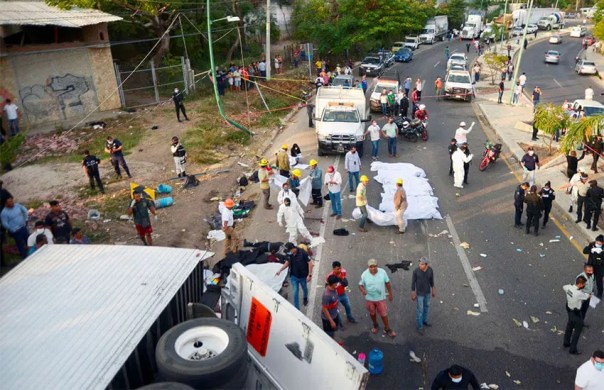
Above is a scene from the aftermath of a semi-trailed packed with migrants overturning on a highway in Chiapas, leaving 56 dead and at least 100 injured.
By: Raúl Romero*
“We migrants are not criminals, we are international workers,” sang the more than 200 migrants who arrived after 7:00 pm on December 14 at the facilities of the National Migration Institute (INM, its initials in Spanish) in Polanco. The contingent arrived there to join the demonstration, called by Mexico City collectives, in memory of the 56 migrants who died as a result of the trailer overturning in Chiapas. [1] Accompanied by at least another 200 people in solidarity and residing in Mexico City and a batucada, [2] the group decided to move, causing astonishment among Polanco neighbors and workers, towards the offices of the same INM in the streets of the National Army. There, they lit candles, placed floral offerings, made a roil call and observed a minute of silence for the deceased. During their movement another significant slogan was constantly intoned: The borders are stained red, because the working class is killed there.”
Mexico knows that international working class well. For decades, millions of Mexican women and men have crossed the border to the United States (US) in search of better jobs and incomes. More recently, thousands of people from this country have also decided to go to the US, with or without documents, due to the increase in violence. It is estimated that 36 million Mexican migrants now live in the neighboring country; in other words, 10 percent of the total population of that nation. As reported in these same pages, remittances from Mexican migrants have become the country’s main inflow of foreign currency in 2021, even above tourism, oil and agri-food exports, and foreign investment.
The migratory phenomenon is not particular to America. We’re dealing with a global one that has been getting worse in recent decades. The neoliberal globalization process that implied the reorganization of life and work on an international scale made mass migrations necessary for the production process. The international working class that comes out of underdeveloped nations and regions because of plunder and dispossession, becomes cheap labor for the imperial centers; workers without rights or benefits, threatened with being denounced and expelled for any complaint or protest. That’s why the populations of countries in Africa, the Middle East, Eastern Europe and Central and South America seek to reach nations such as Germany, the United States, Russia, Saudi Arabia, France and the United Kingdom, to name a few. These phenomena of mass displacements of the “reserve army” from the peripheries to the centers and from the south to the north, also occurs from the countryside to the city, because the megalopolis and the development zones seem to be the model of territorial reorganization that drives capital.
At the same time, some countries that expel migrants from Central and South America and also from Africa, have socio-environmental devastation as a common denominator, as a result of the role that was imposed on them in the production system: the extraction of resources and the supply of raw materials. Likewise, they are characterized by having a large development of criminal economies, not only in the drug market, but also in the illegal extraction of minerals, illegal arms trafficking, human trafficking, etcetera.
“We’re here because you were there,” read a banner at a mobilization of migrants in 2003, in Spain. The slogan summarizes well the historical character and the relationship between colonialism, imperialism and the recent phenomena of mass migration.
From those without papers (los sans papiers) in France, to the caravans in Central America, the international working class is facing obstacles that hinder its transit. Because of the institutionalized racism and exacerbated nationalism that derives into xenophobia, the international working class has to face the militarization of borders and repression all over the world, as well as the multiple violence of the million-dollar business of human trafficking.
Now that the government of Mexico accepts reproducing the immigration policy imposed by the most conservative sectors of the United States, even reaching the point of starting to demand a visa for people coming from Ecuador, Brazil and Venezuela, it’s worth remembering our past and present as migrant peoples. Now that Mexico turns the “National Guard into a kind of surrogate Border Patrol, internalizing the United States immigration policy,” as Luis Hernández Navarro wrote, it’s necessary that our peoples and organizations deploy all their solidarity with the international working class and against imperialism.
[1] Recent articles on migration/immigration have been propelled by the December 9 accident in Chiapas (shown in the photo above) that claimed the lives of 56 migrants and injured many others. For details see: https://mexiconewsdaily.com/news/55-migrants-killed-and-more-than-100-injured-in-tractor-trailer-accident-in-chiapas/
[2] Batucada is a style of samba music heavily influenced by percussion instruments, with Afro-Brazilian rhythms.
==Ω==
Originally Published in Spanish by La Jornada, December 26, 2021
https://www.jornada.com.mx/2021/12/26/opinion/013a2pol
Re-Published with English interpretation by the Chiapas Support Committee
Migration, the business
Luis Hernández Navarro
In Tres Veces Mojado (Three times a Wetback), Los Tigres del Norte, those essential chroniclers of the migrant feelings and experiences, sing and tell the story and the sacrifices of a Salvadoran in search of the American dream. The song, composed by migrant Enrico Franco Aguilar, says: “Three borders I had to cross/undocumented I walked through three countries / three times I risked my life/and for this they say I’m a wetback [1] three times over…” (https://bit.ly/3oOVAyC).
The piece, practically a hymn for those who exercise their right to flee from Central America, tells of the enormous suffering that must be endured to cross borders without papers. “In Guatemala and Mexico, when I crossed over/twice I was saved from becoming a prisoner/ The same language and color, I reflected/How is it possible that they call me a foreigner,” the corrido [2] goes.
The drama of the Central American migrants, as exemplified in the song, is more serious than that of Mexicans in the United States. Before arriving at their final destination, they must traverse Mexico, suffer extreme hardship, hostility and extortion by the police, and expose themselves to assaults and kidnapping, and— for the women —to rape.
Shamefully, opinions in the country that the migrants damage communities, that they are delinquents and criminals are widespread. They blame Hondurans, Guatemalans, Salvadorans and now, Haitians for the insecurity that is experienced. They treat them in the same way in which many U.S. citizens treat our fellow countrymen that cross the border.
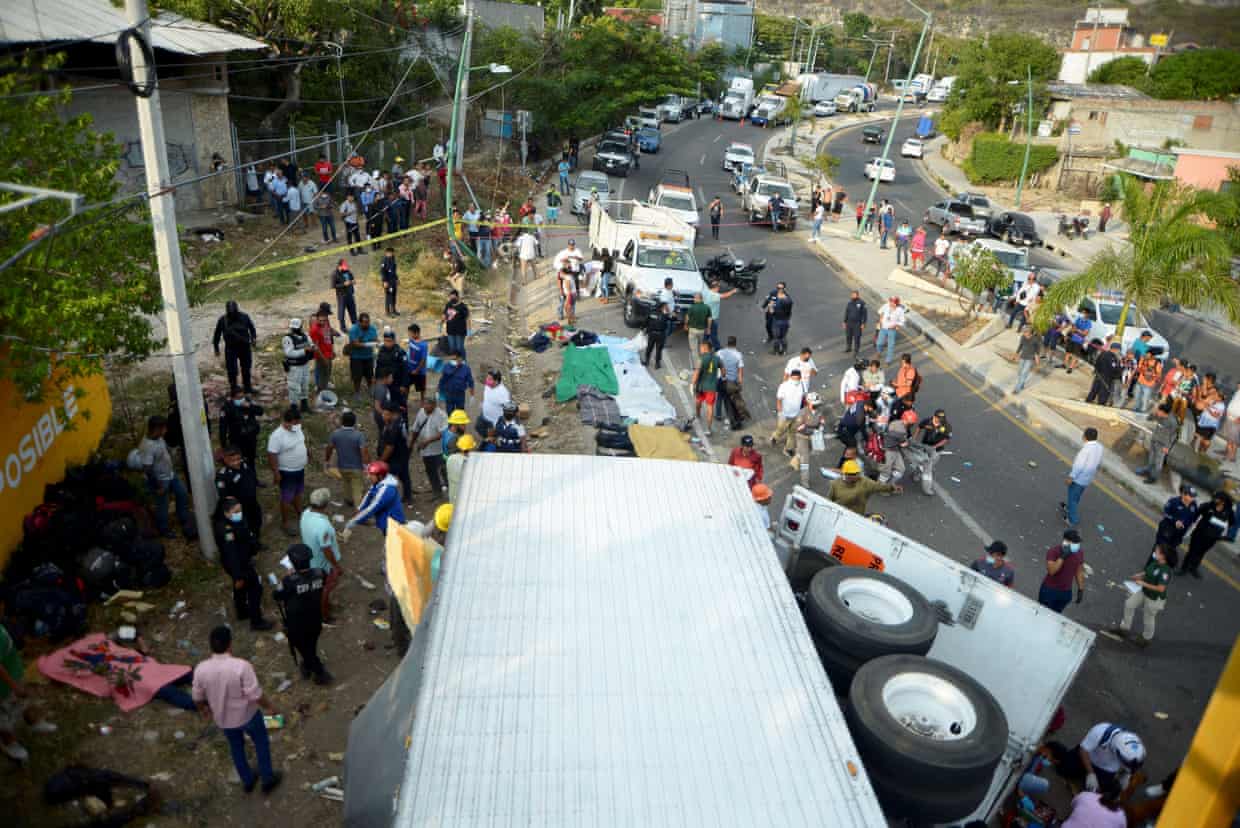
Migrating is a mixed experience. Those who make the decision to go and make their life outside of their national borders leave behind violence, insecurity, poverty, hardship, and oppression, and seek to make their dreams a reality. Poverty is not the only thing that forces one to migrate. The emigrant wants to live. However, frequently, their dreams transform into nightmares. The tragic accident in Chiapa de Corzo, Chiapas in which at least 55 migrants died, travelling in an overcrowded trailer at the service of a mafia of human traffickers, is the demonstration of how this flight to a better life sometimes ends in misfortune.
As Alberto Pradilla has narrated, the victims had to pay the smugglers 11 thousand dollars per adult and 4 thousand per minor, in order to be transferred from the border to Houston, Texas.
Matteo Dean, a young researcher of the labor world, tragically deceased, explained the semantic limitations of the term “migrant” and how these language limitations express the ineptitude at handling this hot potato. “Upon writing the word migrant —he warned — most computer text editing programs indicate an error. The spell-check explains that there are the words immigrant or emigrant. The absence of the word ‘migrant’ from the semantic framework is not a coincidence. The limitations of a language? Maybe, or maybe just the limits of a language that still is not capable, and does not want to be capable of explaining, and recognizing, a real phenomenon —that of the migrant.”
Migration is as much a colonial heritage as a product of neoliberalism. Its effect has modified human boundaries. The geography of capital is not a geography with clear lines between the center and the periphery. There is more and more periphery in the center and center in the periphery. A study of the current migratory flow cannot stop at a north-south approach because it is no longer possible to trace precise, absolute boundaries. There is a continuous geographic redefinition. The borders of exploitation are reproduced in the transnational space. Crossing the Mexican territory, citizens of the most diverse nations and regions of the planet seek to arrive surreptitiously to the United States — besides Central Americans, Brazilians, Haitians, Chinese and Korean, also from Congo, Cameroon and Sierra León.
The border is a system of gates that is filled or emptied depending on the necessities of the labor force and the pressures to lower its cost. The key that locks the entry to the land of promise for many, opens it for others. In the United States the working class not only has two sexes, but many nationalities. Available to work more hours for less salary and without social security, undocumented workers make it possible for the great masters of empire to prosper, and the work that others don’t want to do is carried out. The emigrating workers in the metropolis, John Berger affirms, are immortal — they are always interchangeable. They have only one function: to work.
Guatemala is a huge warehouse in which drugs, weapons, pirated items, stolen cars, and human beings are stockpiled, a business for criminal gangs with networks of complicity among Guatemalan and Mexican authorities. They are vertically integrated. Their merchandise enters Mexico through a porous border of 965 kilometers. In the 20 Chiapas municipalities nestled in that territory, they have infrastructure, organization and relationships to move the products to their destination with impunity.
In Mexico, militarized routes and borders force undocumented people into the hands of smugglers and organized crime. According to the National Immigration Institute, this year 225,000 people were detained, 35 thousand in operations targeting trailers. Many more have crossed this way.
Mexico’s southern border is experiencing a humanitarian crisis. It is not the result of some conspiracy. It is the result of having turned the National Guard into a sort of Border Patrol surrogate, internalizing U.S. immigration policy.
[1] Wetback is a derogatory term used to describe undocumented persons living in the United States. The term initially referred to Mexicans who crossed the border by swimming or wading across the Rio Grande.
[2] Corridos are traditional Mexican ballads that usually narrate a story or historical event.
==Ω==
Originally Published in Spanish by La Jornada on Tuesday, December 14, 2021
https://www.jornada.com.mx/2021/12/14/opinion/019a1pol
English Translation: Schools for Chiapas
Re-Published by the Chiapas Support Committee
CIDE and the Acteal Massacre
By: Luis Hernández Navarro
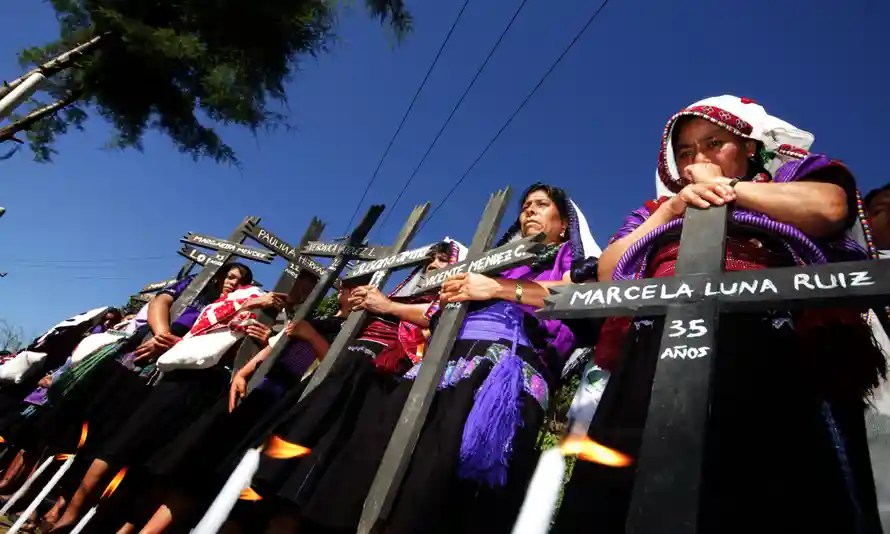
Repeating it is inevitable. One more anniversary of the Acteal massacre approaches, in which 45 indigenous people from the municipality of Chenalhó, Chiapas, were savagely murdered by paramilitaries. The massacre is a wound that cannot heal. The murderers were released and the intellectual authors were never tried.
Protected by soldiers and authorities, the perpetrators of the slaughter went to great lengths with their victims. Embarking on an action of purification, they proposed eliminating the pukuj (a kind of demon in Tsotsil), and the worms that contaminated the village. To give themselves courage and not fail in their work, they prepared with liquor, drugs, prayer and ceremony. They said, “blood purifies,” and made ready to celebrate the extermination.
That December 22, 1997, some 350 people were praying on the terrace of a coffee field that served as their refuge, next to the local Catholic chapel. It was their third day without a single bite to eat. They believed that fasting and praying served peace. They were mostly elderly, women and children. They were part of Las Abejas (The Bees).
At almost 11 in the morning, they began to hear shots. The bullets of the AK-47 went through the planks of the wall and hit the image of the Virgin of Guadalupe; also, the bodies of many of her believers. The children cried. The worshippers tried to flee and hide. It was a frightening hail of bullets, told one survivor.
At around 6 in the afternoon, the murderers returned to celebrate their feat. That day there was a party. During those hours, police and their bosses remained scarcely 200 meters away, while several government agencies denied that anything had happened. Already in jail, Pedro, a young Tseltal paramilitary, with tears in his eyes for so many dead children, said to his boss Tomás Pérez, “But I did not fail you, sir, I did my job.”
An initial investigation revealed the direct participation of military and ex-military personnel in the crime. Among others, 105 elements intervened: the retired Brigadier General, Julio César Santiago Díaz; Mariano Arias Pérez, a private from the 38th Infantry Battalion; Pablo Hernández Perez, a former soldier that led the massacre, and Sergeant Mariano Pérez Ruiz. The Public Security police protected and delivered uniforms to the paramilitaries. Jacinto Arias Cruz, municipal president of Chenalhó and leader of the PRI, handed out the weapons. Some of the direct participants were jailed. They never turned in their weapons.
After years of the massacre being in political and legal lethargy, interrupted only by the living memory of the victims, the case returned to the national political agenda as of the 2006 presidential elections. An ambitious official operation set in motion the rewriting of the history of the State crimes to exonerate the intellectual authors in the eyes of public opinion.
One day before the 9th anniversary of the massacre, the political association Alternative Citizen 21 and the Center for Economics Research and Teaching (CIDE) reported that they had assumed the defense of 75 Acteal detainees and were calling upon the Supreme Court of Justice of the Nation (SCJN) to establish new parameters of action in the case. The Center’s Division of Legal Studies justified its involvement in the case as an example of the abysmal state of the administration of justice.
Curiously, in a country in which the prisons are full of innocent indigenous people, victims of power, the educational institution was involved in the defense of the Acteal paramilitaries who killed members of Las Abejas. The initiative was accompanied by a noisy media campaign, the central role of which was carried out by a professor of CIDE, a defender of the paramilitaries, at that time an electoral ally of Felipe Calderón, and years later a superdelegate of the 4T in Morelos, and author of the exculpatory story of the assassins: Hugo Eric Flores Cervantes.
August 12, 2009, arguing that the murderers did not receive due process, the SCJN decided to release 20, who were plainly identified by the families of the victims, under the claim that the Attorney General of the Republic’s Office fabricated evidence to incriminate the prisoners. On February 2, 2012 it ordered the release of seven more. It never resolved whether the paramilitaries were innocent or guilty, because the court did not impart criminal justice, that is, it never got into the merits of the case, but rather only resolved an injunction on second hearing. At least 4 of the 11 ministers that were part of the (including the current Senator Olga Sánchez Cordero) owe their post to the former president, Ernesto Zedillo, the head-of-state when the massacre took place.
Today there is unrelenting violence in Aldama and Chalchihuítan, with deaths and displaced people, as a consequence of the release of the material assassins of Acteal. The paramilitaries of Chenalhó that over the years have attacked the residents of these municipalities are the same ones that killed the members of Las Abejas de Acteal 24 years ago, or family members of the murderers. Rosa Pérez, former municipal president of Chenalhó, a key figure in the reactivation of the civilian armed groups, is family of those who perpetrated the massacre. Abraham Cruz, until recently the municipal treasurer, is the son of the pastor who blessed the guns of the murderers. (https://bit.ly/2Xle8q7).
At CIDE, there are excellent teachers and brilliant and committed students. But, as the case of Acteal demonstrates, that does not obviate the fact that the center has been used for what it was used for.
==Ω==
Originally Published in Spanish by La Jornada on Tuesday, December 21, 2021
https://www.jornada.com.mx/2021/12/21/opinion/017a2pol
English translation: Schools for Chiapas
Re-Published by the Chiapas Support Committee
Neoliberal culture shows cracks, but has not been defeated
Latin American progressivism has failed to promote a left, alternative and radiant replacement in that region

García Linera thinks that Colombia has rebelled against the enslavement of the north’s neoliberalism. Photo: Marco Peláez
By: Luis Hernández Navarro / Part 2 of 2
One of the great weaknesses of Latin American progressivism and something that explains its partial defeats is the lack of a popular left, alternative and radiant culture, with new axes for organizing daily life, affirms Álvaro García Linera.
For him, despite the electoral triumphs and progressive ideas in the region, neoliberalism, despite its triumphs, has established a common sense, which goes beyond who the ruler is, he exposes in a talk with La Jornada about progressivism, the left, the right and popular culture. Next, the final part of this interview.
–It would seem that in countries like Chile, [1] El Salvador and Ecuador the right has achieved not only winning elections, but also the imaginary of the middle and popular sectors. How do we explain this phenomenon?
–And not only there…
“Even in progressive experiences, the neoliberal imaginary as mass culture has not been completely dismantled. Evidently, there have been moments of breakdown, of stupor and of cognitive openness in some places, but 40 years of neoliberalism have settled a common sense, which goes beyond who the ruler is, whether the State should protect you. It has settled on other kinds of personal expectations.
“Progressivism is not the overcoming of neoliberal culture. It is a process of struggle against that culture. With ups and downs, it has made progress in other aspects, but in this –and in others– it has not even given battle. There are cases in which it’s not even present as a partial struggle against neoliberal culture. There, neoliberal rule is almost absolute.
“Just that it’s a tired dominance. It’s no longer axiomatic, it presents doubts. In the ‘90s, neoliberalism fulfilled a series of life axioms, which people assumed without question, as if they were something of nature. Today, in progressive experiences, but also in countries like Colombia, El Salvador, Guatemala, in Europe itself, it’s a discourse that begins to walk lame, to stumble, bump into the stands, it’s clumsy when climbing, when walking down the street. It’s starting to show cracks.
“In countries where progressivism has triumphed, those cracks have been taken advantage of to try to promote, also with stumbles, a new culture, still partial, of medium breath. But I feel that, sooner than later, that new culture is also going to emerge in other places.”
–Where would it be emerging?
–Colombia has been what was Chile in the ‘90s. In the 21st century it has become a country in which, with Walt Disney franchises, the promotion of its artists, the overwhelming North American military presence and the imaginary that they are the continuation of Miami in Latin America, the United States would consolidate a model.
“It’s about a model in which a neoliberalism of the South, subordinated, a vassal of the North’s neoliberalism functions successfully. In which US representatives meet with Colombian businessmen and politicians. In which Colombian universities are open to the North Americans. In which its popular culture is being recognized by Hollywood.
“But look: there has been a gigantic mobilization of repudiation against all that. Certainly, it has not been able to transfer it into the politics. And that is an experience of how collective action must have a strategy for being able to radiate a political event. But, even there, in what is the new Chile of the 2020s, there has been a tremor, a cracking. I trust that this will continue in the rest of the countries on the continent.
–In the ‘60s and ‘70s, the Latin American left had a formidable cultural potency. Its musical, literary and graphic production were exceptional. Where is progressivism’s cultural work?
–That left culture has fed the political force, the cadres and the knowledge of the reality of progressivisms. The left of the ‘60s has not given rise to progressivism, but has nourished it and has given it an internal temperament. A species of internal tensors, small but very solid.
“I give the example of Bolivia. The emergence of the indigenous-campesino has nothing to do with the left of the ‘60s. Nothing. What’s more, to the left of the ‘60s indigenous-campesinos were second-class actors, the petty bourgeoisie that was going to see how the workers made revolution. The campesino emergence is born from other sectors, from other experiences.
“At the time of the great collective insurrections, this Left, marginalized by neoliberalism, with an urban presence, powerful in the ‘60s, ‘70s, re-emerges in the ‘80s and ‘90s. And then it’s called by progressivism, as part of its cadres, in the ambit of the compressed moments of the previous ideological battles that surrender to electoral victories.
“I am convinced that, ideas are always won, although it may only be partially, before winning electorally. And, there, the old left, the old cadres helped in a compressed moment. They knew how to understand that it was time, they didn’t wait. Some did and they stayed in their cubicle, hoping that socialism or communism would come. But another part joined in. They understood that there was the popular. And those cadres helped to think and enrich, both the effort and the political discussion.
“But the new progressivism has not had either the time or the lucid gaze to expand this leftist culture. It has done it very slowly or in some cases has not done it at all.
“I don’t know if Bolivia is too extreme an example. The paradox has been that in the 1960s and ‘70s there was a left-wing middle-class culture. But the Indians made the revolution in the 2000s, not the middle class. The middle class joined in. That speaks of the radicality of the process, of an indigenous and popular emergence, either plebeian, or from below.
“It’s like another world, in which the taco vendor becomes a minister, and then returns to selling tacos. He isn’t the type that becomes rich and lives in Pedregal in a mansion because of being a social leader.”
–Has a new left culture emerged?
–One of the errors of progressivism, in which I place Bolivia, is not having had enough time to produce a new left culture with this indigenous imprint. No longer the old one.
It cannot be the previous one coming from that radicalized middle-class gaze. Because now, there is the commoner in the street. But, even so, we have not had the time and the ability to create a culture.
“That’s why I said that neoliberal culture has not been defeated. We have opened cracks. It has indentations. It has slits. But it has not been replaced by a new cultural framework.
“When are you going to be able to dismantle the neoliberal cultural framework? When you have a popular culture of the left, alternative and radiant, with new axes for organizing daily life.
“That is one of the great weaknesses of progressivism and something that explains its partial defeats. Because, if it had been achieved, you would have had a long-term cycle, of three or four decades at least. But there has been a wave of 15 years, and, now, another rebirth. I’m not sure that it will have a life of another 15 or 20 years. No.
“The great debate about the new cultural structures for organizing daily life is not yet on your side. You still don’t have a left culture on the continent, a popular, radical culture, with triumphant left narratives.”
[1] Chile held the second round in its presidential election process last Sunday, December 19, 2021. The winner was the 35-year old candidate of the left, Gabriel Boric, a former leader of student protests against the right-wing government.
==Ω==
Originally Published in Spanish by La Jornada
Sunday, December 12, 2021
https://www.jornada.com.mx/2021/12/12/politica/008e1pol
Re-Published with English interpretation by the Chiapas Support Committee
In the US, not in Spain, the central command of the Latin American right
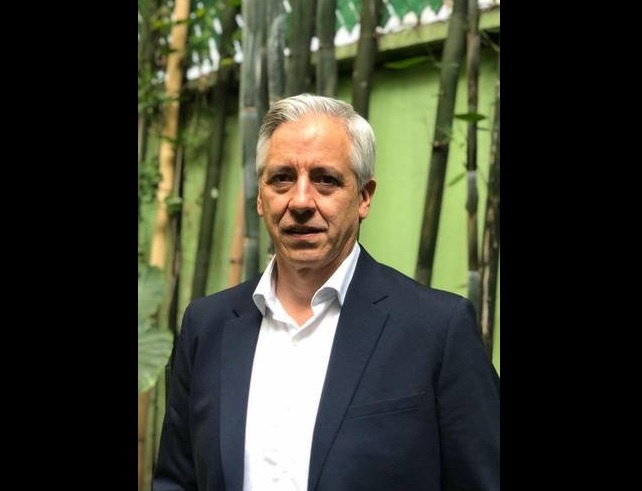
Save exceptions, Latin American armies are ones of caste, García Linera indicates. Photo:‘La Jornada’
By: Luis Hernández Navarro/Part 1 of 2
The conservative command of the Latin American right is in the United States, not in Spain. Vox [1] is small and clumsy. In exchange, Washington promotes a series of basic values: market, individuality, institutionalism against social convulsions and wealth as life’s objective, affirms Álvaro García Linera.
The Vice President of the Pluri-National State of Bolivia between 2006 and 2019 is one of the most prominent intellectuals of the contemporaneous left. His extensive and suggestive intellectual production is the fruit of a political commitment that landed him in prison for seven years and a solid political formation.
On his return to Mexico, the country where he studied mathematics at the Autonomous National University of Mexico (UNAM, Universidad Nacional Autónoma de México) and where he was isolated as a result of the coup against him and President Evo Morales, he spoke with La Jornada about the difficult relationship between progressivism on the continent and the middle classes, the project of the right in the area and the excessive confidence that the governments of national-popular inspiration have had towards their armies.
–Of what does progressivism in Latin America consist?
–Progressivism has a wide spectrum, but it shares common things. The first thing is that there are new political forces that burst onto the political scene, in criticism of the old traditional political system, which had been bolted to State structures for 40 years, and in other countries for 50 or 70 years.
“The second thing is a vindication of the popular, of its presence, of its rights. It seeks a modification of the composition of the distribution of the national economic surplus between capital and labor, in favor of the popular and labor sectors. And a recuperation of the role of the State as manager, administrator or amplifier of the commons and collective rights. That is what’s common about progressivism.
“Starting with that you have, from more moderate views that meet this minimum common denominator and stay there, to more radicalized progressivisms, which propose the productive role of the State, through nationalizations of certain strategic sectors of the economy. And mobilization, as a way of managing administration of the State.
“These three elements: the consistent presence of the State, social democratization in the management of what’s public and modification of the class composition of State leadership, would be the most radicalized progressivism.”
–Is it a project different from that of social democracy, that of the old revolutionary nationalism, that of communism and that of national liberation?
–There are no sharp ruptures. In some cases, it’s the continuation of the national-popular of the ‘50s. Middle-class elites committed to the popular are the ones who make certain decisions, as happened in the 1940s, ‘50s and part of the ‘60s in Latin America. But in other cases, no. In other cases, it’s a substantial rupture.
“The presence of Indians governing, in the case of Bolivia, broke with any continuity with revolutionary nationalism or with the national-popular of the 1950s. Although there is continuity in terms of a role of the State, it is a modification in the class composition. It’s the serf becoming the master. There you have a 180 degree turn in the composition of the State.”
The same interests
–Does the Latin Americana right have a project?
–It always has a project: fundamentally, protecting its interests. The question is whether it has an expansive, seductive, universalist project, as it came to have in the 1980s, when neoliberalism on a world level was presented as the answer to the crisis of the welfare state in countries of the north. And it was presented as the necessary conclusion to the collapse of the experiences with real socialism.
“Not today. Today is: let’s return to privatizing, to deregulating work, to opening markets and concentrating wealth in the rich who are going to spill it on the poor. But, doing it in a war, in a crusade against those who oppose it: communists, indigenous rebels, migrants (depending on what country you are in), the populism of the rulers, the empowered unions.
“Now, the discourse has lost its universality. It no longer seduces you, but rather seeks to impose on you. Its content is the same: defending the rich through that recipe book with four axes, but now based on a holy war against the infidels of this political-economic creed. It’s a discourse that comes to impose, no longer to convince.”
–Is the organizing center of the Latin American right the face of José María Aznar or of Vox, in Madrid?
–No. Vox is still small and clumsy. Its colonial mentality doesn’t allow it to understand the Latin American reality, beyond nonsense such as demonstrating civilization to Latin Americans. Today, only pure racists from the continental political life receive that story. They are grateful, every time they have lunch and cross themselves, having a foreign surname and a lighter skin color than the rest of their compatriots.
“The conservative command is still in the United States. It is very powerful. It does it through USAID, the State Department and the institutions that promote human rights and support entrepreneurship. The strength of this discourse remains there. Not in its extreme version, because North Americans are the Empire of the last 100 years. They are more intelligent that the extinct and cadaverous Empire that the Spanish oligarchy represents.
“The North Americans have more skill. They promote a series of basic values: market, individualism, institutionalism against social convulsions, wealth as a life objective. There is the main strength, the command of the continent’s conservative sectors. And it’s a local creation of each country, how all those elements are wrapped in more democratic or more authoritarian discourses.
“The authoritarianism and racialized speech of the Latin American right emerge more as an instinctive reaction to a series of risks they see with the emergence of populisms and progressivisms. What Vox is doling is attempting –on that neoconservative, authoritarian and racialized right– to put together a kind of Iberian-American coordination, an international-continental kind. But it’s very clumsy. There, the North Americans give it lessons on how to get to know local realities in order to have a greater impact.”
Gramsci’s Transformism
–How do you explain the romance and divorce between the middle classes and progressivism in Latin America?
–Predictable, but not obligatory. Gramsci called this transformism, in one of his viewpoints. How sectors of the middle or upper class, not as a class, but as radicalized groups, in certain moments of political crisis can feel attracted by the emergence and novelty of the popular. But with time, –says Gramsci–, the call of class is given. You go back and forth from where you started. It’s predictable, but should not be something mandatory.
“You have to see how progressivism didn’t do enough to delay transformism, so that the vicious circle of going and returning to their place of origin is not completed. Each country has its own path to transformism.
“The middle classes are becoming politicized, they organize, debate, discuss. But it’s not a politicization of the left, like what took place in the 1970s. We have a politicization of the middle classes with a conservative logic, which makes it even more difficult for you to reverse it.
“Progressivism is having a problem with the middle sectors. Also, in the coming decades the United States is going to have racialized fundamentalist sectors as active political subjects.”
–What relationship has been established between the Army and the progressive governments?
–An excessive confidence. In progressivism we have believed that respecting institutions, promoting the presence of the popular, was sufficient. But, save exceptions, the Latin American armies are caste armies. Some more than others, the commanders have been commanders of caste. And if they are not of a real, visually verifiable caste, they are of an imaginary caste.
“In order to have the loyalty of the armed forces to the processes of democratization of wealth and of the rights that progressivism carries forward, it’s not enough to promote a participation of the popular in the mechanisms for selection of promotion in the commanders, nor is a respect for it as an institution enough.
“In progressivism we have not made a substantial reform of the military doctrine inherited from the cold war years, in which the enemy of the institution is the internal enemy, camouflaged, but the internal enemy. We have not finished eradicating that doctrine in our minds. This is one of the pending tasks and one of the risks of any radical progressive project on the continent.”
[1] Vox is a far-right political party in Spain.
==Ω==
Originally Published in Spanish by La Jornada
Saturday, December 11, 2021
Re-Published with English interpretation by the Chiapas Support Committee
Thank You
Zapatista Sixth Commission
Coordinating Team for the Journey for Life: Europe Chapter

December 14, 2021
To the organizations, movements, groups, collectives, original peoples and individuals from the different geographies of the land today known as “Slumil K´ajxemk´op”.[1]
From the Zapatista Extemporaneous [La Extemporánea][2] delegation:
Compañeras, compañeroas, compañeros:
Hermanoas, sisters, and brothers:
We send you warm greetings from the mountains of southeastern Mexico and can report that all of the compañeras and compañeros from the airborne delegation who visited you all in each of your geographies during the months of September, October, November, and December of 2021 have returned to their respective towns and positions.
As of 9:34 PM Zapatista time (8:34 PM Mexico time) on December 14, or 3:34 AM on December 15 Slumil K´ajxemk´op time, everyone had arrived at their respective villages, towns, and positions.
Each of us returned in one piece and in good health. We are all moved and touched by the days and nights that you allowed us to share with you, and we return with a life-long wound in our hearts which we will not allow to close.
It is now time for us to review our notes to inform our towns and communities of all that we learned and received from you: your histories, your struggles, your resistance, your indomitable existence, and above all, the embrace of humanity we felt from each of your hearts.
Everything we brought you came from our people. Everything we received from you is for our communities.
For all this–for your hospitality, your fellowship, your word, your listening, your gaze, your food and drink, your lodging, your company, your history and for the collective embrace from the heart that you are–we say:
Kiitos
Danke schön
Hvala ti
Благодаря ти
Gràcies
Děkuju
Grazie
Hvala vam
Tak skal du have
Ďakujem
Aitäh
Eskerrik asko
Merci
Diolch
Grazas
Σας ευχαριστώ
Köszönöm
Thanks
Go raibh maith agat
Paldies
Ačiū
Ви благодарам
Takk skal du ha
Dziękuję Ci
Obrigada
Mulțumesc
Спасибо
Хвала вам
Tack
Teşekkürler
Thank you,
SLUMIL K´AJXEMK´OP!
We will be in communication with you again soon, because the fight for life is not over. We still have so much to learn from and share with you.
See you soon, compas.
From the mountains of southeastern Mexico,
In the name of the Zapatista Extemporaneous [La Extemporánea]
Subcomandante Insurgente Moisés Coordinator Mexico, December 2021
Notes:
[1] See the EZLN’s renaming of Europe: https://enlacezapatista.ezln.org.mx/2021/04/20/421st-squadron/
[2] See the EZLN’s August 17, 2021 communique for an explanation of the use of “La Extemporánea” [The Extemporaneous]: https://enlacezapatista.ezln.org.mx/2021/08/17/only-500-years-later/
En español: https://enlacezapatista.ezln.org.mx/2021/12/15/gracias/
The military industrial complex

Above: Mexico’s president, Andrés Manuel López Obrador, inspects work on the Maya Train with military personnel.
By: Raúl Romero
On January 17, 1961 upon concluding his term as president of the United States, Dwight D. Eisenhower delivered a speech about which much has been written since that time. On that occasion, the outgoing president reported on the power that the military-industrial complex had acquired: In government councils we must guard against the acquisition of undue influences, whether sought or unsought, by the military-industrial complex. Circumstances do and will exist that will make it possible for powers to emerge in undue places, with disastrous effects.
By the military industrial complex, Eisenhower referred to the link between the military system, the armaments industry and the government, a complex that involved the work of more than 3.5 million people, as well as a multi-million budget that represented more than the net income of all US companies in those years. The military-industrial complex, built with the argument of national defense and world peace, began taking shape after the Second World War.
The influence of this powerful alliance between industries, militaries and rulers, Eisenhower signaled, was total: economic, spiritual and “palpable in every city, in every state congress, in every department of the federal government.” In addition, the military-industrial complex also involved the reproduction of capital, development of military technology and the U.S. imperialist expansion.
Although the alliances between industry, rulers and militaries date back a long time and have different approaches, according to the conditions and characteristics of each country, the military-industrial complex classification helped to understand some of the dynamics of militarism and militarization, and also facilitated the understanding of the consolidation and expansion of the power elite in the U.S.
Five years before Eisenhower’s speech, Charles Wright Mills analyzed in his book, The Power Elite (1956) the changes in the U.S. elite and concluded that for its time, it was composed primarily of an alliance between warlords, top corporate bosses, and the political directorate. The warlords, explains Mills, got ahead by filling political vacancies, gained and were given more and more power to make decisions of the most serious consequences, or to influence them. Mills also warned about the role of publicity and technology in the complex, the reason for which some specialists prefer to use the term military-industrial-media and technology complex.
More than half a century has passed since the warnings issued by Mills and Eisenhower. Their prognosis came true: the military-corporate complex is in force today and with a decisive weight in the internal and external politics of the United States. It matters not whether the government is controlled by Democrats or Republicans, the military elite remain in power, making many from decisions or even making up wars to guarantee the reproduction of capital. But their survival has also implied their adaptation. The weapons and the enemies have changed, and that’s why today the military industrial complex builds technologies of surveillance, control and destruction while manufacturing a narrative of new threats, such as terrorism, organized crime and migrants.
Today in Mexico the Army wins more and more influence in every sphere, be it the political, economic and even the ideological, it’s worth recuperating the reflections with respect to the category of the military-business complex to try to understand the phenomenon.
First of all, we must look at the renewed alliance between government, military and industrialists in 2006 and then reoriented in 2018 toward the extractive sector, of infrastructure and energy, whether it be in the construction of the Santa Lucía airport, of the Maya Train (Tren Maya) [1] or of the Interoceanic Corridor, to mention two of them. Furthermore, defining these projects and works as national security reveals the importance of this alliance in the country’s current project. It is also necessary to observe if this alliance does or does not have to do with the interests of the U.S. military industrial complex, or if it has its own interests.
On the ideological plane, it’s necessary to pay attention to measures ranging from the return of obligatory service and the military passbook, to the broad publicity strategy that places the Army as a repository of patriotic values and the defense of the nation.
Likewise, two possible scenarios should be noted, both of which are counterproductive for society: the possibility that this alliance is merely the germ of a new elite, or the possibility that the old elite reclaims the State apparatus, a scenario in which an Army with that power would mean an even greater threat to the progressive, democratic and revolutionary forces.
When the military are predominant members of the power elite, Mills reflected, what they seek is expansion. Hopefully we still have time to shut them down.
[1] See also, “Militarizing the Maya Train”: https://chiapas-support.org/2021/04/01/militarizing-the-maya-train/
==Ω==
Originally Published in Spanish by La Jornada on Sunday, December 12, 2021
https://www.jornada.com.mx/2021/12/12/opinion/014a1pol
Translated by Schools for Chiapas and Re-Published by the Chiapas Support Committee
Ominous silence of the Mexican Government in the face of attacks on Zapatistas
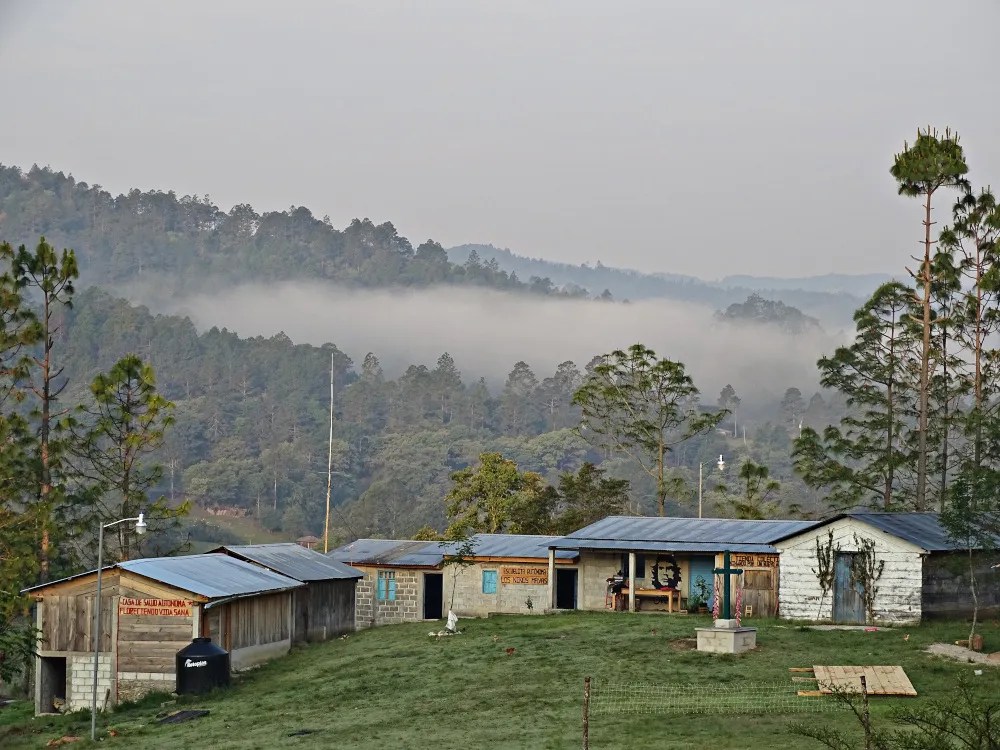
New attacks against Nuevo San Gregorio Autonomous Zapatista Community
Violence towards the Zapatista autonomous communities has been constant and has escalated as part of the “La Extemporánea” delegation concludes its Tour for Life in Europe.
The Good Government Junta “New Dawn in Resistance and Rebellion for Life and Humanity” of Caracol No. 10 Blossoming the Rebel Seed) in the Patria Nueva Zone, has denounced new aggressions, harassment, and acts of surveillance that from the end of November to December 6 of this year the “Group of 40” has carried out against the Zapatista community of Nuevo San Gregorio, belonging to Lucio Cabañas autonomous municipality, official municipality of Huixtán, Chiapas.
Yesterday the Group of 40 raided the community to work the lands where support bases of the Zapatista National Liberation Army plant and cultivate their food, in addition to grazing cattle. They have pointed out that:
“These invaders set about creating a 50-meter-long trench for the water well that is the source of support and sustenance for the cattle collective of our Zapatista compañeros and compañeras, in order to cause the watering place for their animals to dry up… they are making an attempt on the lives of the animals that have been a sustenance in the struggle of our compañeras and compañeros for years with resistance and rebellion. The water well also feeds the fish collective, a 2×3-meter pond. The two collectives are now at high risk of collapse. It’s worth mentioning that the collectives’ areas are great sources of support and sustenance in our struggle for life. Not to do any harm, but these invaders continue to harass us and invade our territories.”
The dispossession, harassment, threats and surveillance of the Nuevo San Gregorio community began at the end of 2019. Today, the inhabitants have been left without being able to harvest the corn they had planted. The Group of 40 have cut timber and fruit trees on the land recuperated in 1994. Of the 155 hectares, only 10 hectares are in the hands of the community, undermining the development of their political and food autonomy, and their right to collective territorial property.
The Good Government Junta has denounced this series of violent acts, including the illegal and arbitrary detention of autonomous authorities. Therefore, we urge the Mexican State, which has had full knowledge of the facts since March 2020, to implement actions to put an end to the violence that is often sustained by community, municipal and state authorities, with full respect for the land and territory belonging to the EZLN within the framework of the San Andres Accords, the Law of Harmony and Pacification, ILO Convention 169, the United Nations Declaration on the Rights of Indigenous Peoples and the Declaration of the American States.
==Ω==
Originally Published in Spanish by the CDH Frayba on December 7, 2021
English interpretation by Schools for Chiapas and Re-Published by the Chiapas Support Committee
The Chinese Dragon and Latin America
The Chinese locomotive advances nonstop. Already the main driver of the global economy. And according to a report of McKinsey Global Institute, it has surpassed the United States as the richest nation on the planet (https://mck.co/2ZdpRxc).

By: Luis Hernández Navarro
The consulting firm’s report analyzes the national balance sheets of 10 countries, which hold more that 60 percent of the global income. It documents how the net wealth in the world passed from 156 billion dollars in 2000 to 514 billion dollars in 2020. It concludes: the Asian giant generated 50 percent of the growth of its net wealth in the last 20 years.
Despite the pandemic, China is the only major economy that did not suffer a recession in 2020. In fact, it grew 2.3 percent. According to the experts, between 2021 and 2025 it will reach an average annual growth of 5.7 percent. Right on track, last year it overtook Washington as the primary trading partner of the European Union (EU.) According to the World Economic Forum, it is poised to be the primary trading partner for Latin America and the Caribbean in less than 15 years.
The great eastern dragon is key to Latin America’s economy; it’s a voracious consumer of foods, minerals, metals, and fuels produced in the region. The trade exchanges, financial aid and investments of the country have been central in enabling the area, beyond the political leanings of its governments, to face the challenges of growth.
According to Alicia Bárcena, executive secretary of the Economic Commission for Latin America and the Caribbean (Cepal), the cooperation between China and Latin America and the Caribbean offers an opportunity to reduce the global asymmetries and support an inclusive transformational economic recovery that promotes sustainable development (https://bit.ly/3oST3m1).
Although the Asiatic giant has restricted its lending in the hemisphere (https://bbc.in/3cy9rCu), it is increasing rapidly in other sectors: trade, direct investment, development cooperation, and even cultural activities. In the context of the pandemic, research and development agreements have been intensified, more than anything in the pharmaceutical realm. Their focus (without abandoning other sectors) is on advancing logistics, services, telecommunications and transportation. Nothing indicates that this trend is going to disappear.
The Asian nation is Latin America’s second most important trading partner, ahead of the European Union. Now it represents 15% of trade in the region. Simultaneously, it is third as a source of investment in the economies of the region. Between 2015 and 2020, private and parastatal companies invested some 7 billion 850 million dollars in the hemisphere. Countries like Chile have had since 2006 a free trade agreement with the homeland of Mao Tse-Tung. And Peru became the favorite destination for investment from Chinese companies on the continent.
According to the Center for China-Mexico Studies (Chechimex), the colossus of the east has 138 infrastructure projects in Latin America, with approximately 94 billion dollars in investments that has generated 600,000 direct jobs (https://bit.ly/3kT1L2g).
The growing Chinese presence in an area of traditional U.S. influence is meeting with growing concern in Washington. The empire has sought to contain and administer the impact of the eastern power and circumscribe it to the economic sphere. At the same time Peking has been cautious and has made clear that its intention is to expand its economic frontiers.
It has to do with businesses, investments, and loans not conditioned to acceptance of the dogma of development, ideological considerations, or strictly political criteria. They always speak of cooperation and mutual aid.
In an interview with La Jornada, the former president of Bolivia Evo Morales explained the relationship this way: China supports development without blackmailing us, and without imposing conditions on us. The United States supports, but in exchange for privatization of natural resources and basic services, in addition to imposing the fight against drug trafficking. China, on the other hand, gives you credit without placing any conditions on you. This is the profound difference. The same with Russia and other countries. In my experience, we are fighting with an empire, but not with other powers. We are well balanced. (https://bit.ly/3DHg3ub)
In a brief videotaped message broadcast at the summit of the Community of Latin American and Caribbean States last September, the Chinese president, Xi Jinping, offered help to the countries of Latin America and the Caribbean to contribute to their prompt recovery from the pandemic and to advance their socioeconomic development. The relations, he indicated, have entered into a new era characterized by equality, mutual benefit, innovation, openness and well-being for the peoples. His country, he said, is inclined to work in a coordinated fashion to create opportunities in the region and construct a shared future. According to Enrique Dussel Peter, one of the most knowledgeable on the relation between China and Latin America, the video message is no small detail.
The strength of China’s presence in the region means, plain and simple, that there is no viable process of Latin American integration without it. The dragon of the orient has arrived in the region to stay.
==Ω==
Originally Published in Spanish by La Jornada
Tuesday, November 23, 2021
https://www.jornada.com.mx/2021/11/23/opinion/025a2pol
English Translation by Schools for Chiapas
Re-Published in English by the Chiapas Support Committee
 Chiapas Support Committee