Chiapas Support Committee
Home of the Compañero Manuel blog on zapatistas & mexico
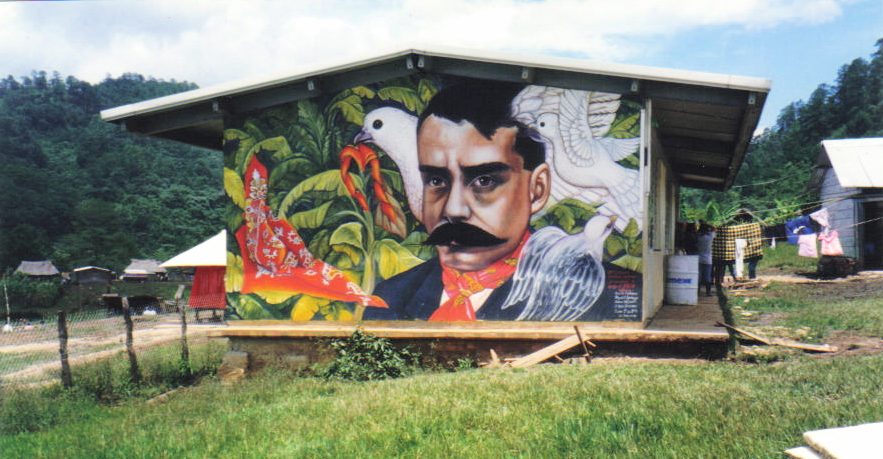
Ya se mira el horizonte…of the common and non-property
The horizon of the common and non-property is already in sight.
By Juan Trujillo Limones | Ojarasca in La Jornada
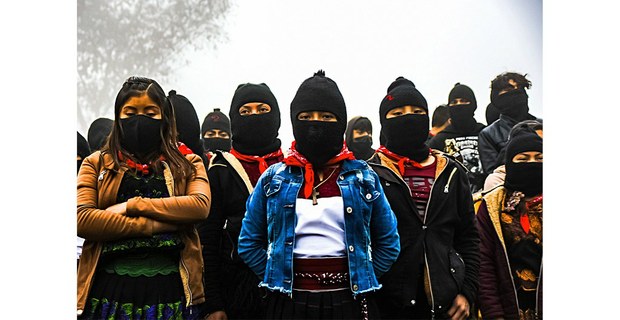
Oventic, Chiapas, January 1, 2026. “We are confirming that we will continue this struggle, but with the common good in mind, where we don’t want private property, because that is what has caused us to be divided,” declared the spokesperson for the Zapatista Army of National Liberation (EZLN), Subcomandante Insurgente Moisés, in the early hours of the morning and before the popular dance held to commemorate the 32nd anniversary of the 1994 indigenous uprising.
The fog thickened and the temperature dropped; the boots of a hundred militiamen and women in green caps descended the mountain like columns of serpents towards the basketball court. The rhythmic thud of their batons echoed through the mountains that shelter this community. This is the profound mystique of this rebellious space of the Tsotsil Maya people, where their persistent determination to preserve their struggle, culture, memory, and language resides.
The Sixth Commission of the EZLN had just come from the meeting “Seedbed of Pyramids, of Stories, of Loves and, of course, Heartbreaks,” held between December 26 and 30 of the previous year at the CIDECI in San Cristóbal de Las Casas. Here, in the thick fog, Subcomandante Moisés prepares to communicate with his army and support bases: “In 1994, the bad governments, the wicked, and the rich of the capitalist system closed the doors, the windows, and every crack to us. We had to resort to violence.”
Historical memory is invoked, also to address the injustice and impunity surrounding the femicides in Ciudad Juárez, and to touch upon the wound of the 43 disappeared students of Ayotzinapa. However, the special emphasis is placed on the new Zapatista strategy of struggle, undoubtedly centered on the concept of community, the common. And now, not only with its focus on komon a´tel b’a kalajtik (our common work in our milpa) for life, but also to reinforce the common use of the land in an attempt to detach the sense of private property from the collective consciousness of the Zapatista indigenous people. It is about the eradication of individualism as a political practice and a horizon of struggle.
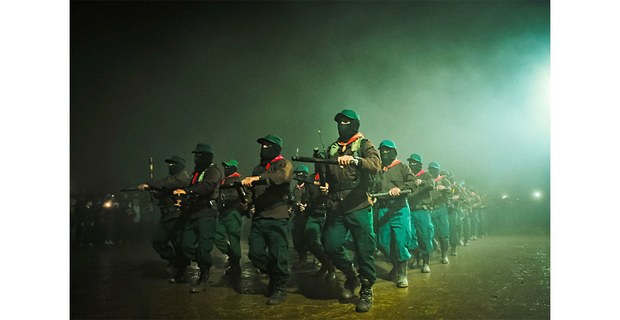
Before militiamen, support bases, and members of civil society and activists, Subcomandante Moisés reinforced his criticism of President Claudia Sheinbaum’s government: “It is not true what those who are foremen of these bad governments are doing, whose bosses who are the bankers and transnational businessmen. They are the ones who govern; everyone else is a foreman, a steward, a supervisor who obeys. So it’s not true that there is a fourth transformation here in Mexico. There is a fourth transformation of how they are going to improve how we are going to be dominated, trampled on, plundered, exploited, so that slavery returns—that is the fourth transformation.”
The strong criticism of the Mexican government stems from the welfare programs that have been distributing money to various social sectors of the population since 2019. These programs, such as Sembrando Vida, have even led to the division of communal and ejido land, although not the land recovered by the rebels in 1994, which represents an intervention that destabilizes families and communities.
The Zapatista perspective views the distribution of government resources as handouts and leftovers. Thus, Moisés stated that it is a “double-edged sword,” because on the one hand they give cash, and on the other hand they use it to maintain themselves in power in a State that reproduces the logic of capital accumulation and the dispossession of land from farm workers and Indigenous people. “(The government) that gives directly to the people, that is, (they) confirm that the municipal and state governments were stealing (the money) and that they want to stay in power,” Moisés explained.
While male and female militia members and international visitors listened attentively to the spokesperson of a movement that perhaps holds the most radical position within the indigenous movement in Mexico, he attempted to articulate the strategy “with the horizon of the commons, where we don’t want private property, because that’s what has made us the way we are, divided. The capitalist system has injected us with individualism.” This is nothing more than the expansion of capital through the neoliberal model, whose economic policies remained intact under the last two “progressive” governments.
The Zapatista strategy, which even proposes transcending the concept of private property to generate a new framework for peaceful coexistence among those who are not Zapatistas, aims to transform this paradigm, which is enshrined in the legal framework of the Mexican liberal state.
Dawn arrived with fireworks that exploded and illuminated the sky and mountains in this Tsotsil community, but not before inviting the Zapatista communities and their support bases to a series of music, art, and political gatherings that will be held throughout 2026. Amidst the capitalist lightning and storms that batter indigenous peoples and warn of a collapse, the Zapatista concepts of the commons and non-ownership are unfolding as the horizons to be reached in the next 10, 30, 50, and even 120 years.
_______________________________
Puedes leer la versión original publicada por La Jornada en su suplemento Ojarasca aquí.
You can read the original in Spanish, published by La Jornada in their supplement, Ojarasca here.
Translated by the Chiapas Support Committee.
_____________________
VIII. The Common against Mortal Boxes and Pyramids. An assembly of chiefs.
*
Himno Zapatista | Zapatista anthem (Listen to the Himno zapatista here.)
The horizon is already in sight
Zapatista fighter
The path will be marked
For those who follow behind
Let’s go, let’s go, let’s go, let’s move forward
So that we may prevail in the struggle
Because our homeland cries out and needs
All the effort of the Zapatistas
Men, women, and children
We will always make the effort
Peasants, workers
All together with the people . . .
Ya se mira el horizonte
Combatiente zapatista
El camino marcará
A los que vienen atrás
Vamos, vamos, vamos, vamos adelante
Para que salgamos en la lucha avante
Porque nuestra Patria grita y necesita
De todo el esfuerzo de los zapatistas
Hombres, niños y mujeres
El esfuerzo siempre haremos
Campesinos, los obreros
Todos juntos con el pueblo . . .
The word “common” is not just any word: 32 years after the Zapatista uprising.
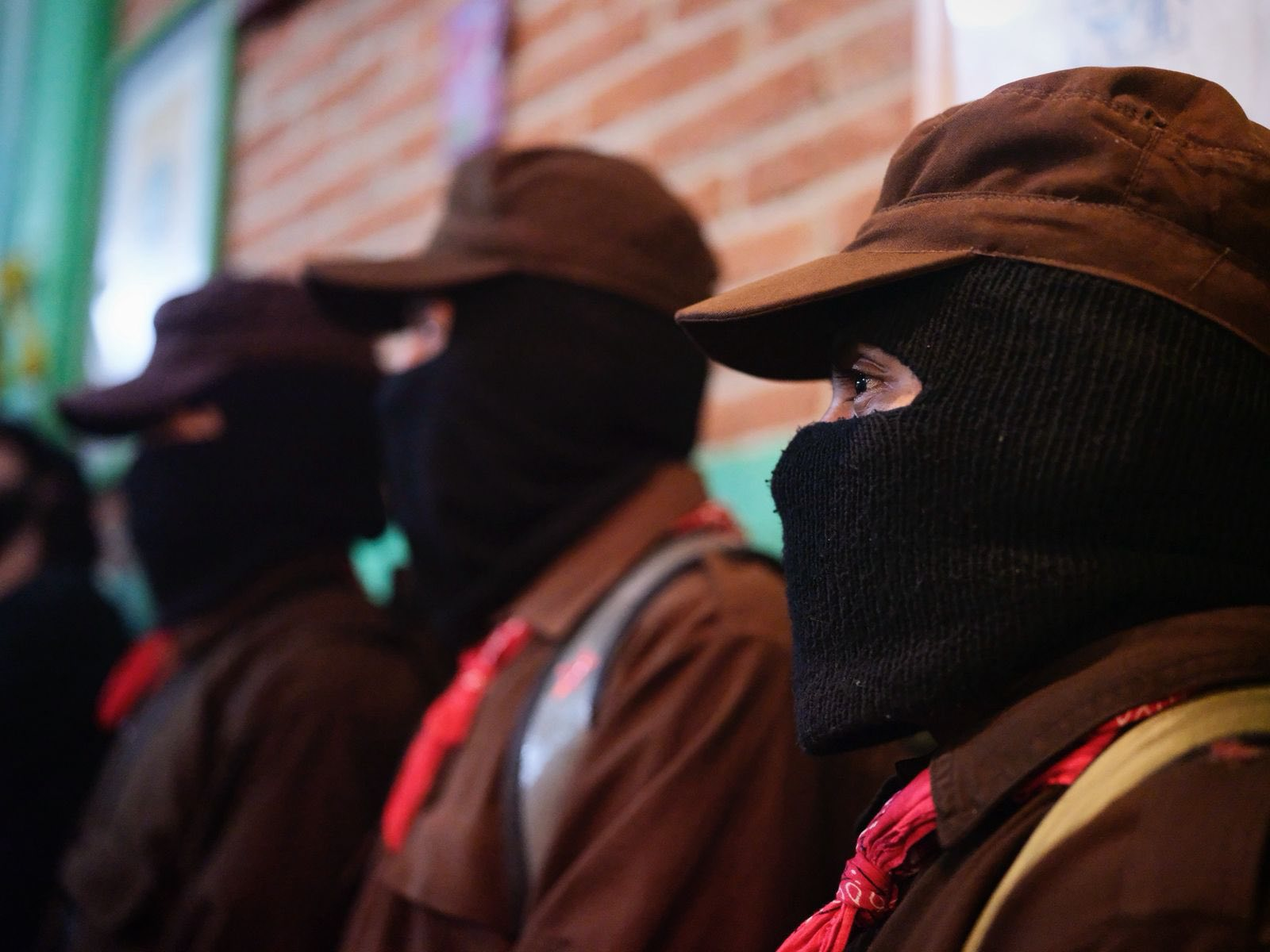
By Andrea Cegna | Desinformémonos | January 2, 2026
“The word ‘common’ is not just anything,” declares Subcomandante Insurgente Moisés from the stage in Oventic, Caracol II, during his speech commemorating the thirty-second anniversary of the start of the Zapatista revolution. The EZLN leader adds: “It is much more difficult and much greater than that of ’94. Because it means uprooting the capitalist system. It means removing from our minds what they have forced upon us.” And he immediately clarifies the scope of this break: “We don’t want to be owners. I’m not just talking about the land, but about everything. We no longer want ‘mine’ or ‘I.’ What we mean by ‘the common,’ perhaps some will say it’s madness. Yes, we can accept that: madness. But for everyone, not just for a few.”
In the mist that since morning has enveloped one of the best-known headquarters—also due to its proximity to San Cristóbal de Las Casas—of neo-Zapatismo, the central event of the celebrations opens a spatial-temporal crack. When the EZLN General Command takes the stage, the mist lifts, the music stops, and in the distance, the sound of the militia’s staffs can be heard, which, as part of the opening, burst forth in front of the stage, marking the rhythm of the night.
The EZLN is an army that wants to build peace, is tired of war, wants life and not death, and precisely for this reason it is anti-capitalist: capitalism as a systemic element of the destruction of life, in all its forms, in the name of the obsession of accumulating wealth. Moisés says it without mincing words: “That is why we say and confirm that we will continue in our political, ideological, and peaceful struggle. Because we do not want death. We want life. But we want a life that we decide for ourselves, not one decided by those above us.”
And he adds: “We will always be peaceful. And if they don’t allow us to be, we will defend ourselves as our fallen comrades taught us thirty-two years ago. We are like them. And like them, we are ready and willing.” “We have a great responsibility, comrades. And we are going to do it because there is no other option.”
An intense, emotional, and lengthy speech, which shows the growth of Moisés, called upon about a decade ago to take the place of one of the most iconic revolutionary figures of the modern world: Marcos. A courageous decision by the EZLN, which revealed a distinct and complex nature, deeply rooted in the worldview of the indigenous peoples, but not solely in that.
Constructing a new relationship with life
Marcos has not disappeared and has reappeared these days at CIDECI in San Cristóbal, intervening on several occasions in the “seedbed,” which in Italian could be translated as a word related to the world of agriculture and not to debates and seminars, and which in the Zapatista conception is a space for training that sows seeds to harvest anti-capitalism. Marcos spoke again in the form of a narrative, a choice made years ago to be able to communicate with the indigenous communities and make the analyses of the revolutionary vanguard—which on November 17, 1983, gave life to the first camp—understandable and replicable.
In addition to the narrative read on December 29, Marcos added twelve points. “The crucial question is: is it possible to construct a geography and a calendar, a spatial-temporal eruption, in which another logic of production and relationship with nature allows—mind you: allows, not necessarily creates—a new form of relationships between living beings, considering nature as the whole of which humanity is only a part?” he says in the seventh point.
In the last point, he returns to the war: “The ‘failures’ and ‘dysfunctions’ of the system are not failures or dysfunctions: they are an essential part of a war machine that advances by conquering through destruction and annihilation, only to then rebuild and reorder social relations. Social programs like Sembrando Vida and its “welfare” equivalents do not fail or are incomplete: they fulfill their function and role in the war of conquest. With historical myths, recommendations, and advice to young people, the elders urge them to face the storm with a toothpick and demand that they be grateful for life. It’s actually a small stick, but I think you understand it as a toothpick. In the Zapatista communities, facing the present and thinking about the future, they return to their own history.”
The EZLN, today, proclaims and practices a political space where property and the pyramid are set aside, not to be replaced by new elites
But looking at the EZLN solely through the lens of its political and theoretical leadership is a mistake that has been repeated time and again. Because what Zapatismo truly calls into question is not only capitalism as an economic system, but the pyramid of power that makes it possible: the idea that someone must be at the top and someone at the bottom, that command is concentrated and life is reduced to obedience. The pyramid is the symbol of this world order, just as private property is its material foundation.
The Oventic fog lifts around 11 p.m., just as the EZLN Command takes the stage and neo-Zapatista militia members occupy the center of the basketball court at Caracol II. Earlier, for hours, theatrical performances and marimba music filled the afternoon; the communal dining hall provided food; in another corner of the Caracol, beef broth was distributed free of charge. This is not mere decoration: it is concrete politics. Collective organization, care, daily life that functions without a market and without vertical command.
Building autonomy from below
The Common, as Moisés affirms, is the radical questioning of both foundations of capitalism: property and the pyramid. Questioning property means breaking with the idea that land, labor, time, and life can be appropriated. Questioning the pyramid means rejecting the accumulation of power and its separation from the communities. The EZLN, today, proclaims and practices a political space where property and the pyramid are set aside, not to be replaced by new elites.
It’s not about rhetoric, but about daily organization. The strength of the EZLN lies in its ability to build autonomy from below: in community assemblies, in the Caracoles as spaces of coordination and not command, in the rotation of responsibilities, in the collective control of decisions. It is there that the pyramid is emptied, because it finds no place to take root. It is there that politics ceases to be representation and becomes shared practice once again.
Zapatismo is no longer fashionable today. It is outside the mainstream media, outside the constant narrative, and there are those who lose their bearings or file it away as a myth of the 1990s. But precisely away from the spotlight, it continues to resist: forced migration, the advance of organized crime, militarization, the reassuring narrative of the central government and the media that speak of development and pacification while dispossession and violence advance in the territory. The EZLN survives not because it has become an icon, but because it is a living political process, capable of reorganizing itself and resisting the passage of time without abandoning its principles. In this sense, Zapatismo is neither a nostalgic memory nor a closed chapter: it is a revolution that does not seek to seize power, but to dismantle it. And precisely for this reason, it remains unsettling. And necessary.
_________________________________________________
Read the original in Spanish here at Desinformémonos. Snap translation by Chiapas Support Committee.
Interview with Raúl Romero: 42 years of the EZLN, “one of the hearts of the anti-capitalist movement”
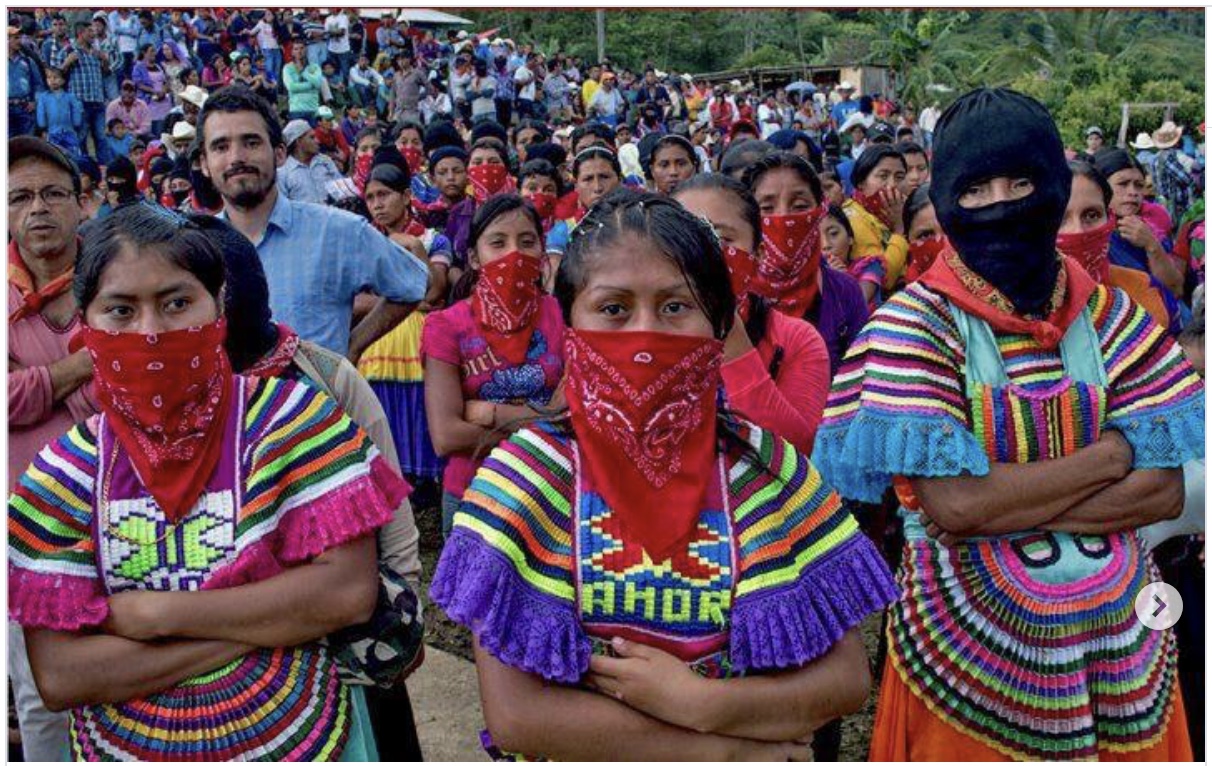
Interview: A sociologist and activist closely linked to the Zapatista movement through academia, journalism, and activism, Raúl Romero reflects on the current strength and relevance of the Zapatista National Liberation Army (EZLN), which, fueled by new practices related to the commons and non-ownership, is celebrated its 42nd anniversary in November 2025.
Written by: Sergio Arboleya at Zur
The Zapatista Army of National Liberation (EZLN) recently celebrated 42 years of existence, founded on November 17, 1983, when a group established a camp in the Lacandón rainforest to begin the first stage of organizing the movement with indigenous communities of Chiapas.
This silent network burst onto the global stage just over a decade later when it rose in arms on January 1, 1994, to demonstrate its radical opposition to the start of the North American Free Trade Agreement (NAFTA), signed by Canada, the United States, and Mexico, then governed by Carlos Salinas de Gortari, a political emblem of the Institutional Revolutionary Party (PRI).
Since then, the EZLN has shaken the global political scene by proposing an ideology that, contrary to the long tradition of Latin American guerrilla organizations, did not aim to seize control of the state apparatus but – in the words of the intellectual John Holloway, who masterfully defined it in a resounding phrase – “to change the world without taking power.”
Three decades ago, in a continent dominated by neoliberal administrations, the emergence of Zapatismo represented an innovation capable of outlining a new horizon for the collective social imagination, spreading its ideology and methods while always emphasizing that in specific territories, it was the local communities that should lead their processes, “each in their own way.”
The magnetic figure of Insurgent Subcomandante Marcos (now a Captain, in another unique demonstration that here the leaders “descend” instead of continuing to rise in the structure), with his remarkable literary skills, broadened the subjective base of the movement and facilitated its penetration, transcending physical and ideological borders.
However, Zapatismo was not merely an aesthetic movement; it involved far more daring and extreme political stances, such as generating “The Other Campaign,” capable of circumventing electoral logic and running counter to the approach adopted by the wave of self-proclaimed progressive governments that reshaped the map of Latin America 10 years after that Chiapas uprising. Although it never remained static, since that moment in the regional calendar, the EZLN and its base have gone through different phases that, broadly speaking, could be described as a certain withdrawal from the international stage and a profound retreat into the indigenous communities. During this period, they strengthened the National Indigenous Congress (CNI, which they had fostered since 1996), with which they attempted to participate in the 2018 presidential elections, supporting the candidacy of the Nahua woman Marichuy. In those elections, Manuel López Obrador ultimately prevailed, becoming the first center-left president (with all the caveats that might be added) in the country’s history.
This kind of withdrawal from international political discourse did not prevent the creation of the Zapatista Little School (2013) nor, a couple of years later, the announcement of “The Storm,” another metaphorical figure used to explain, with sharp precision and without euphemisms, the scope of the new global era. In the same vein, they called for the exercise of critical thinking in the face of the capitalist hydra and also for the formation of “seedbeds” capable of gathering autonomous experiences in different regions of the world.
The pandemic context and the siege by paramilitary groups led to greater isolation, which was reversed externally when, at the end of 2021, the Journey for Life was launched. This included a trip on the ship La Montaña as part of a larger delegation bound for Europe, with future stops planned for other continents. Since last December, this has been followed by the International Meetings of Rebellions and Resistances, where the focus was both on moving towards “the day after” and on conducting a public self-criticism of the political organizational model. This led to the creation of a new model, which Subcomandante Insurgente Moisés summarized as dismantling the pyramidal structure of the Good Government Councils and the Zapatista Rebel Autonomous Municipalities. These bodies are to be replaced by Local Autonomous Governments, the Collective of Zapatista Autonomous Governments, and the Assembly of Collectives of Zapatista Autonomous Governments in the 12 regions that make up this territory.
Sociologist Raúl Romero, who participated in one of the panels held during these meetings between the end of 2024 and January 2nd of this year, highlights these aspects of Zapatismo’s approach to “understanding the dynamic nature of the constant change taking place in the communities, structural changes that occur based on their control of the territories.”
“Zapatismo today, at a global level, is one of the hearts of the anti-capitalist movement at a time when the world has shifted significantly to the right and is experiencing what some would describe as a civilizational crisis.”
In a conversation with Zur from Mexico City, the intellectual and activist quotes Rosa Luxemburg and emphasizes that “in Zapatismo there are three main characteristics that coincide greatly with what happened in the Paris Commune: First, there is the destruction of the state apparatus to create a form of popular self-government based on assembly-based decision-making and their own governmental structures. Second, there is a destruction of the state’s repressive apparatus and, in its place, a popular army with its community authorities built by this autonomous government of the communities. And third, and perhaps most importantly, the recovery of the territories as means of production that allow for the material and cultural reproduction of life, which is what sustains everything else.”
Raúl Romero, an academic technician at the Institute for Social Research and a professor at the Faculty of Political and Social Sciences of the National Autonomous University of Mexico, is a frequent columnist for the Mexican newspaper La Jornada, co-coordinator of the book “Local Resistances, Global Utopias” (2015). He is responsible for the recently launched “Thinking Together About Alternatives,” among other professional activities; Romero emphasizes that Zapatismo, “from its consolidated territory and its armed organizational structure, engages in dialogue with the indigenous peoples of Mexico and the world.”
Drawing on his knowledge and commitment as part of several collectives of adherents and sympathizers of the autonomous ideas that have emerged from Chiapas, he believes that “Zapatismo today, at a global level, is one of the hearts of the anti-capitalist movement at a time when the world has shifted significantly to the right and is experiencing what some would describe as a civilizational crisis.”
And elaborating on this scenario, he points out: “Precisely in the face of this crisis of the liberal management of capitalism, which claimed certain ideas that were lies but were accepted as truth, such as liberal democracy, human rights, and discourses about progress and science, while particularly in Latin America, progressive movements failed to deliver for the popular sectors, the fascist approach emerges, which is completely retrograde, anti-rights, and even operates with a logic of eliminating populations and applying models of accumulation by dispossession, extractivism, the degradation of territories, and confrontation with indigenous peoples. Therefore, in this situation of wars, climate crisis, and the rise of the right wing, Zapatismo is positioning itself as an anti-capitalist left-wing reference point that allows it to offer not only a discourse, a practice, and a theory, but also a conceptualization of the world.” To elaborate on this point within the context of a conversation whose fragments were broadcast on the program Después de la deriva (After the Drift) in Buenos Aires, Raúl resorts to a powerful metaphor that seems to draw from the rich metaphorical tradition inherent in the EZLN itself, asserting: “While Zapatismo has always been committed to viewing and building its work from the autonomy of its territories, it has never stopped dreaming of a vision as vast as the world, and therefore I believe it is not a localist or nationalist movement, but an internationalist one.”
How much do you think the concept of non-ownership impacts the Zapatista movement’s international positioning?
I consider it one of the boldest and most innovative proposals because it stems from understanding the recovered territories as territories that can be shared with other non-Zapatista communities, even those who were previously opposed to them, so that they can work the land together. This idea has also led to other initiatives, such as the construction of a hospital operating room currently underway in Zapatista territory, in which both Zapatista and non-Zapatista communities are participating. This redefines the idea of radicalism, which the Zapatistas say they arrived at after consulting with their elders and ancestors, asking them how they had survived exploitation, contempt, and domination by local bosses and landowners in the past. They responded that they found common ground when they escaped the plantations and went to live in the mountains and the jungle.
Can this position be interpreted as a response to the practices of progressive governments that promoted individual land ownership?
In Mexico, we currently have a government that could be classified as progressive, a very watered-down, second-generation progressivism that lacks the same impetus and radicalism as others, such as those of (Hugo) Chávez and Evo (Morales). The Mexican government under Claudia Sheinbaum, in addition to having a framework of extractivist megaprojects and militarization, launched the “Sembrando Vida” program, which they present as the Mexican version of “good living.” This program consists of allocating resources so that farmers can plant timber and fruit trees, often from army nurseries, and in exchange, they receive a subsidy for their crops. However, one of the requirements of this social program is that farmers and Indigenous people register two hectares of private property in their name, which represents a continuation of the neoliberal agrarian reform aimed at further privatizing land, contrary to the logic of communal ownership. This leads many of these young people to sell their land to new landowners and use the money to pay the coyote, the person who smuggles them into the United States. But there, they encounter a terrible immigration policy that expels them, and they return directly to Mexico landless, indebted, and easy prey for organized crime.
Precisely, from countries like Colombia and Ecuador, among others, there are warnings about drug trafficking groups occupying territories that were part of the networks of autonomous indigenous communities. What is happening with this phenomenon in the region influenced by Zapatismo?
While drug trafficking is one of the most important sources of income for these networks in Mexico, today organized crime groups have human trafficking as their main business, as part of the new phenomenon of global exodus, something that is combined with a terrible crisis of missing persons. Currently, in the country, we have nearly 140,000 missing persons, about 500,000 murdered, around 1 million displaced people, and 13 femicides every day. In this context, since 2018, there has been a greater presence of organized crime groups in indigenous communities, and with it, the emergence of young people from these communities with problems of addiction to synthetic drugs. In this context, Zapatismo finds itself in a kind of bubble, in a kind of peace zone, since in its territories there are no forced disappearances, no drug trafficking, no human trafficking, none of these horrors that occur in the rest of the country because it has managed to protect itself through organizational and community work, just as also happens in Ostula in Michoacán and in communities in Guerrero belonging to the Emiliano Zapata Indigenous and Popular Council.
______________________________________
Raúl Romero Gallardo is a Mexico City-based sociologist, Latin Americanist, and academic technician at UNAM Social Research Institute. He teaches at the Faculty of Political Sciences, as well as at UNAM. As a Zapatista sympathizer and anti-capitalist militant, he is a Red Universitaria Anticapitalista member. He co-coordinated the book Resistencias locales, utopías globales (2015) and writes frequently for the Mexican newspaper La Jornada. His topics of interest include anti-capitalism, social movements, autonomies, socio-environmental resistance, emancipatory processes, and criminal economies.
Para leer la entrevista en español, haga clic aquí en ZUR. To read the original version in Spanish, click ZUR here.
10th CompArte Zapatista : Rebel Culture with Community | Aug 30 at Peralta Park in Oakland

The 10th CompArte: The Emiliano Zapata Community Festival
The Chiapas Support Committee invites you to celebrate our stuggles and movements for peace, justice & in solidarity with the Zapatistas at the 10th CompArte zapatista, The Emiliano Zapata Community Festival!
The 10th CompArte zapatista will be held on Saturday, August 30, 2025, 2:00-5:00 pm, at the Peralta Hacienda Historical Park in Oakland, California.
CompArte will feature poets, son jarocho, social justice music and speakers giving updates on crucial movements for land justice in Mexico and on the Zapatistas. There will be tamales, community vendors and artesanía Zapatista to enjoy the afternoon.
Bring a blanket, snacks (NO alcohol or drugs) and your-workers, neighbors, friends and family to enjoy an afternoon of rebel culture in a community of communities with beautiful words, sounds and art.
Featured Performers
Ayodele Nzinga, Oakland Poet Laureate
Francisco Herrera, justice music sin fronteras
Josiah Luis Alderete, poeta pocho, Medicina portal-keeper
Elizabeth Jiménez Montelongo, La raíz artist & poet
Dúo Madelina y Fernando | Latin America canción nueva/New Song
Jaraneros de la Bahía | Son jarocho music!
Sara Borjas, Xicana poet
Mo Sati, Palestinian poet
Plus other artists & performers!
Live Painting: Daniel Camacho | Art Display Hussam Hamad
Local community vendors:
Annette Oropeza “Adoro Jewelry,” Xochitl Guerrero “Taller Xochicura Art,” Cafe y Rebeldía (zapatista coffee), Medicine for Nightmares Bookstore, Elizabeth Jiménez Montelongo Art
CSC offering: Artesanía zapatista!
The 10th CompArte zapatista is organized by the Chiapas Support Committee in partnership with the Peralta Hacienda Historical Park in Oakland, California.
Please join us for an intimate gathering of community, good words and music at the 10th CompArte zapatista in Oakland on Saturday, August 30, 2-5 pm at Peralta Park.
***
Donate to uplift the work of the Chiapas Support Committee
¡Gracias! Thank you!.
Rebel art & the justice that comes from below
By Gloria Muñoz Ramírez

“The EZLN has plenty of ideas about what an organized and free people looks like. The problem is that there isn’t a government that obeys you, but rather a bossy government that ignores you, that doesn’t respect you, that thinks Indigenous peoples don’t know how to think, that wants to treat us like bare-foot Indians. But history has already given them back and shown them that we do know how to think and that we know how to organize ourselves. Injustice and poverty make you think, they generate ideas, they make you think about what to do, even if the government doesn’t listen to you,” said Major Moisés, in a 2003 interview with this journalist.
More than 20 years later, the now Subcomandante Moisés, the highest-ranking military commander within the Zapatista structure, continues to explain, alongside the Captain, the horizon of their struggle. Many theories have been put forward about the more than 30-year public history of the predominantly Mayan army that challenged the powers that be in January 1994. But nothing can be understood without the daily practice of their struggle. Autonomy, or however each person defines it, is a difficult internal construction and often invisible to the outside.
During the recent Rebel and Reveal Art Encounter, convened by the EZLN in rebel territory and at the CIDECI (Center for Research, Development and Comprehensive Training — Centro de Investigación, Desarrollo y Capacitación Integral) in San Cristóbal de las Casas, among many other performances, the play “Nature Reveals and Rebels,” was featured. In this performance, very young Zapatista men and women, disguised as pumas, bees, roosters, trees, peacocks, butterflies, fish, penguins, snails, tigers, pumas, lions, macaws, bears, zebras, turtles, and other natural beings, staged the defense of Mother Earth.
In approximately one hour, in addition to the message about non-property and the Common to face each anti-capitalist challenge, the internal organization of hundreds of communities was deployed to make the play happen. The actors are surely from different communities. How were they chosen? How did they get to the rehearsals? What difficulties did they face? What happened in the communities during the rehearsals? Who created the costumes? How many hands made them? What if there was no money? How long did they rehearse their lines? Did they laugh a lot? Paulo Freire would surely have jumped for joy. Autonomous organization in its splendor to raise awareness both internally and externally.
“It’s a work of young Zapatistas, which they invented because they said, ‘No one listens to us, and maybe this way they’ll listen to us, understand what we want, the future we want for ourselves, our children, and those who follow,” explained Subcomandante Moisés at the start of the enormous wildlife-parade that occupied the Caracol Jacinto Canek esplanade.
The same work was carried out at the CIDECI center in San Cristóbal de las Casas, where the Zapatistas denounced the presence of the National Guard and the Pakal Rapid Response Forces (FRIP, Fuerzas de Reacción Inmediata Pakal) in the vicinity of the second meeting venue on April 19, 2025.
The justice that comes from below.
A few days later, following artistic demonstrations by Zapatista communities and other regions around the world, an arbitrary incursion by members of various police forces and the National Guard took place in a community with Zapatista support bases.
The events, reported by the Fray Bartolomé de las Casas Human Rights Center (Frayba), are as follows: “On April 24, 2025, around 3:30 p.m., in the community of San Pedro Cotzilnam, official municipality of Aldama, Chiapas, Vicente Guerrero Autonomous Region, in a strong joint operation with around 39 vehicles from the National Guard, Mexican Army, Pakal Rapid Response Forces, the Ministerial Intelligence Investigation Agency, the State Preventive Police, the Secretariat of Security and Citizen Protection of the Federal Government, accompanied by two vehicles with armed civilians, carried out searches without judicial warrants in the homes of Zapatista support base families. They violently broke into the houses, detaining the Tsotsil compañeros José Baldemar Sántiz Sántiz, 45 years old, and Andrés Manuel Sántiz Gómez, 21 years old, and then the convoy continued towards the municipality of San Andrés Larráinzar.”
After 55 hours of being reported missing, Frayba documented that the two Zapatistas were brought before the Control Court and Trial Tribunal of San Cristóbal de Las Casas, accused of aggravated kidnapping. The arrests were carried out without judicial authorization and, according to Frayba, they received cruel, inhuman, and degrading treatment. State forces also raided homes, stole belongings, and sowed panic.
And this is where the Zapatista autonomous justice system comes in, and the fateful story takes another turn. While countless national and international pronouncements were made demanding the release of the two detainees, the autonomous authorities carried out their own investigation. This was, once again, a demonstration of their daily work, sometimes visible, as on this occasion, but mostly unannounced. Once again, it was Subcomandante Moisés who explained what had happened, but not before clarifying that in Zapatista zones “attacking the life, liberty, and property of others is prohibited… And in the case of murder, kidnapping, assault, rape, forgery and robbery, these are serious offenses. In addition, there are offenses against drug trafficking, its production, and consumption. Also, drunkenness and other offenses are determined to be common offenses.”
The Zapatista investigators confirmed that their two companions were innocent, but since there had indeed been a kidnapped person, they delved into the matter until they found two perpetrators. After their confessions, they were detained by the autonomous authorities, respecting their human rights, and later handed over to Frayba. But not before determining where the body had been buried, since they had not only kidnapped a man, but also murdered him.
“The government at all three levels knew all of this, but did nothing. Instead of immediately releasing our innocent compañeros, they dragged their feet and proposed an exchange of prisoners. This way, they could bribe the media and sell them the story that it was all the work of state and federal justice. And they could also keep what they stole from the poor indigenous people who suffered their attack,” Moisés said in a statement.
In the early hours of May 2, the confessed murderers were handed over to Frayba, and the human rights center channeled them to official authorities. That same day, with no choice, they released Baldemar and Andrés. Frayba and the mobilization, of course, did their part.
The outcome not only highlighted the prevailing lack of justice, but, above all, the ethical, courageous, and forceful exercise of a movement that remains a global benchmark.
The question of what the Zapatistas are doing could be answered by what happened in the last 15 days, between April 13 and May 2, 2025.
__________________________________________________________________________
Rebel art & the justice that comes from below by Gloria Muñoz Ramírez was published in the original Spanish by Ojarasca, a supplement of La Jornada, available here.
Chiapas, case study of a criminal-state complex

By Lucie Cabins
(For the Chiapas Support Committee: May, 2025)
“Impunity is not the result of a weak or deficient state, but rather it is actively provided to the gamut of armed groups who commit crimes and acts of terror against citizens, migrants and the poor. The provision of impunity to armed actors who are politically aligned with capitalism is part of a modern nation states’ raison d’etre “
—Dawn Paley, Drug War Capitalism p.17
In Drug war capitalism, Dawn Paley provides an in-depth account of how state militarization, justified by the so-called war on drugs, allowed capitalism to penetrate into territories that had been relatively inaccessible in northern Mexico, Guatemala, Honduras and Colombia. She explains how military and paramilitary forces were nurtured to clear the territory for transnational capital. Activists who resisted displacement by capitalist transnationals were disappeared, arrested and assassinated, and often accused of participating in criminal gangs.
The analysis developed in her book, published in 2014, is useful insight into events unfolding in the Mexican Southeast in recent years, as the region becomes a target of capitalist investment through a series of “megaprojects” that include the “Maya” Train, the Trans-Isthmic Industrial Corridor, gas pipelines, the Palenque-San Cristobal highway, and a projected industrial corridor along the Mexico- Guatemala border, promoted by Sheinbaum and the new governor of Chiapas. The area has until recently been somewhat outside of the plunder zone of capitalist enterprise, due to a number of factors including the difficulty of access to remote, often mountainous areas, the persistence of communal land ownership which makes it difficult for corporations to take control of the land, and an anti-capitalist ethos and way of life exemplified by the Zapatista territories.
In Chiapas today, we can see the deployment of state military forces throughout the state, purportedly to control crime, taking control of public space, deployed against those who resist destruction and displacement of their communities, thus laying the groundwork for exploitation and resource extraction by capitalist transnationals.
False arrests of activists, impunity for crimes against population
On April 24, 2025, two Zapatista support bases José Baldemar Sántiz Sántiz and Andrés Manuel Sántiz Gómez, were kidnapped, their homes violently ransacked and their possessions destroyed and stolen, without warning or warrant, by a combined operation involving 39 vehicles including elements of the Mexican Army, the National Guard, (a branch of security originally created by AMLO to counter the corruption of the military, but later absorbed into the military) and the Pakales, a special ops force created with much fanfare by the recently elected governor of Chiapas, presumably to fight crime.
Two days later, the authorities revealed that the Zapatistas had been incarcerated in San Cristóbal de las Casas, concocting a blatant lie that the men were arrested in their vehicles while attempting to flee from the authorities, who discovered weapons and white powder in their vehicle. The Zapatistas were charged with aggravated kidnapping of Pedro Díaz Gómez, but then released without charges following an expeditious international campaign initiated by Fray Bartolome de las Casa Human Rights Center (FRAYBA) and an independent investigation conducted by the Zapatistas, which led to the apprehension and confession of the actual perpetrators of the crime that the Zapatistas had been charged with. The Zapatistas handed the perpetrators over to FRAYBA, to ascertain that their human rights had not been violated, and FRAYBA subsequently delivered them to the authorities, who incarcerated them and released the falsely accused Zapatistas. (For an extraordinary account of the Zapatista process that led to the apprehension of the criminals see Innocent on Enlace Zapatista )
This incident represents a brazen use of the state security forces against the indigenous resistance movement in Chiapas. It may signal a new phase in government terrorism deployed against the indigenous resistance of Chiapas, and in particular, against the zapatistas under the façade of a war against crime.
Impunity in the service counterinsurgency
In the Aldama area itself, where the Zapatistas were kidnapped, local campesinos were subjected to constant attacks by highly armed groups between 2018 and 2022 over territorial disputes in which the government refused to intervene despite countless appeals. While land disputes are nothing new in Chiapas, the possession by the aggressors, of high-caliber automatic weapons was a new development that has emerged in tandem with the rise of cartel wars in the state.
Following a pattern of government criminalization of activists, Cristóbal Santiz Jiménez, a spokesperson for the 115 displaced community members which included Zapatista families, was imprisoned for two years on trumped-up charges. The authorities tried three times to get him to cop a plea, and he refused. (personal communication with Cristóbal Santiz) It took an intervention by the Inter American Commission on Human Rights to get the authorities to take measures to protect the 115 families displaced by the violence.
The fabrication of crimes against land defenders is one of the many fronts of government attack on indigenous communities, and the increasing frequency of attacks in recent years correlates with the extraordinary wave of criminality that has hit Chiapas, just as the government prepares the way for capitalist industries to penetrate the area. Since early 2024 there have been 93 documented attacks against human rights defenders in Chiapas. The pattern is clear: impunity for criminal violence perpetrated by a complex web of cartels, paramilitary forces, old and new, often in the service of local elites, and state “security” forces presumably deployed to fight crime. The violence cocktail intimidates people from speaking out, inhibits mobility, ruptures the social fabric of communities, and generally weakens the ability of organized local populations to fight against the projects that decimate their communities and ways of life. Statistics on the rise of violence in Chiapas have been in the headlines for years, and the figures are astonishing: FRAYBA reports, between only January of 2023 and June of 2024, 15,780 persons (mostly indigenous peasants) displaced from their homes by violence, From December 1, 2018 to June 2024, (during the term of Morena Party Rutilio Escandon as governor) the state prosecutor’s office recorded 6,147 cases of homicides, 177 femicides; 78 kidnappings; 943 sexual abuses; 18,550 robberies (to homes, businesses, public roads and transportation); 319 extortions; 5,795 drug dealing; more than 40,000 people forcibly displaced. And this does not include the vast numbers of crimes that are not reported for fear of reprisals. Chiapas is now one of the most violent states in Mexico .
Two examples, amidst thousands of cases, point to the systemic forces at work in the recent crime surge. The town of Nueva Morelia not far from the border area became a ghost-town in May 2024 as thousands of inhabitants fled their homes following the massacre of a family that had been organizing against illegal mining by the Sinaloa Cartel. The cartel had begun to illegally exploit a mine previously run by a Canadian mining company, Blackfire Exploration, that had been successfully shut down years before (following the corporation’s implication in the murder of an anti-mine activist). A relative of the murdered family recently stated that no authority has approached him about any ongoing investigation into the massacre. Then-president AMLO implied, with no evidence, that the murdered family was implicated with organized crime, which has been denied by residents of the town. Residents believe that the government wants to reopen the mines and is taking advantage of the violence perpetrated by the organized crime wars to silence the population that has been fighting against the reopening of the mines.
Last year, the beloved, outspoken priest, Marcelo Pérez Pérez, was assassinated on the streets of San Cristóbal in broad daylight on his way to deliver mass, having already fled his previous parish due to constant threats against his life for denouncing organized crime, drug trafficking and criminal violence. Like so many land defenders and human rights activist, Pérez had been falsely charged on ludicrous claims that he participated in the disappearance of 19 people. The spectacular murder of a man of the cloth rattled the population of the state like no other crime could and signaled that there were no limits to the impunity that organized crime enjoyed. Six months on, the investigation is in limbo, making it clear that the government is in no hurry to pursue the case.
A friend of mine active in the diocese from Pérez’s previous parish told me that although Pérez did not speak about it publicly, he was very supportive of her involvement with the National Indigenous Congress. She also told me that when he frequented the villages in his parish, a group of women would surround him in order to protect him, whereas in San Cristóbal, he had no official protection despite his high profile and the threats against him. “We indigenous know how to protect our people” was how she proudly put it.
Former president Andrés Manuel López Obrador and, previous governor of Chiapas, Rutilio Escandón cynically denied the spiraling violence that in just a few years transformed Chiapas from being a state with relatively low visibility of organized crime to one of the most violent states in the country, rampant with criminal gangs. (Calling them “narco” is by now a misnomer as drugs are only one of the many businesses involved: migrant trafficking, control of public transit, sex trade, “protection” rackets on local businesses, extortion of all sorts– any activity where a buck can be made through intimidation. As a frequent visitor to San Cristobal since 2016, it was shocking to find in recent years that I was unable to travel around the state, to be warned not to go out at night, and to hear the rounds of machine gun fire emanating from the central marketplace a few blocks from downtown, where various police entities are always stationed. In one incident in San Cristobal, a turf war at a different marketplace led to a four-hour standoff terrorizing and imperiling residents who were caught in the crossfire. The National Guard and the police, routinely seen on the streets of this town, took four hours to show up to the scene of the shootout. Collusion between criminals and cops was obvious.
The extraordinary rise in violence in the state has been widely attributed to a turf war between the Sinaloa Cartel and the Jalisco Nueva Generación, involving ancillary indigenous Chamula Cartel and the Guatemalan cartels, as well as many other local criminal groups, old and new.
Narco-Governance
The stakes are high. Chiapas is traversed by three major drug and human trafficking routes. Migrants fleeing violence in their home countries who enter through the Guatemalan border pay exorbitant amounts to be transported to the U.S, not always making it alive. The traditional coyote system was taken over by the cartels sometime around 2004-2005, and the region was, until recently, under the control of the Sinaloa Cartel, with the clear cooperation of immigration authorities, without which it would not be possible to move such large amounts of drugs, money and people. Recent incursions by the Jalisco Nueva Generación Cartel (CJNG) , apparently facilitated by allies in the Chiapas State Attorney General’ s office and the Office of Public Security (see below), have “de-stabilized” the criminal activities on border areas, wreaking terror on the population. The CJNG has established alliances with local gangs and recruited people into the organization using the carrot of employment and money, and the stick of violence and terror. Reports of forced recruitments into the criminal gangs, locals being forced to set up blockades to prevent the police or rival gangs from entering an area, or being used as human shields in shootouts between rival gangs, extortion of taxi drivers, blackmail have become a part of the daily life in the border area.
The violence has spilled over into other areas and the presence of narcos is sometimes literally paraded in the streets. Although there is no evidence for direct participation of cartels in violence related to long-standing land disputes and struggles over municipal power, the infusion of high-caliber automatic weapons in so many instances seems more than likely to be fueled by crossovers between the rise of organized crime, the remnants of paramilitary forces established in the 90’s to fight Zapatismo, and the sicarios (hitmen) used by local elites to grab land and power. As we know from the history of the Zetas and other gangs, military trained hit men become guns for hire, whether for cartels or for corporate forces seeking power in the area. Hitmen in the service of drug cartels can just as easily serve interests of local elites, including land disputes, and can eventually serve as “security” to defend corporate property, as occurred, for example, in the Isthmus of Tehuantepec, where the wind farm corporations routinely hired sicarios known to be involved in organized crime as security in the face of a disgruntled local population. In another part of Mexico, a land activist recounted that when she was kidnapped by hitmen from organized crime following a successful land struggle against a local capitalist, she was taken to a room in a municipal government building and told to leave the country (personal communication).
Some have labelled this meshing of government and organized crime a new form of state, a “narco-governance.” In any case, the collusion between criminal groups and government officials, from the level of the municipality to the governor’s office and beyond, is practically a basic banality. From taxi drivers to the mechanic who repairs my VW, to campesinos in the villages I visit, nearly everyone I talk to in Chiapas acknowledges the involvement, at all levels of official government, with organized crime. The most obvious evidence of the collusion is the astonishing impunity of organized crime that has allowed the proliferation of forced recruitment, assassinations, extortion, blackmail, kidnappings and murders that occur daily throughout the state.
Although positive correlation between foreign investments and criminal hegemony has been documented, uncontrolled violence created by fragmentation and infighting between criminal gangs can be bad for business. In particular, uncontrolled gang war over territorial control in Chiapas is bad for the transnational capital the state wants to attract for its “development” plans in Chiapas. These plans, which came to the fore under Andrés Manuel López Obrador and have been bolstered by the new president Sheinbaum, who has added the development of industrial corridor along the border with Guatemala to the catalog of megaprojects, in order to appease US antagonism towards migration.
Enter the new governor of Chiapas, Eduardo Ramírez Aguilar (ERA). The day of his inauguration he announced with much fanfare the formation of an elite special operations force, the Pakales, named after a powerful Mayan ruler known, fittingly, for his extensive construction projects.
To the alarm of human rights groups, ERA named Álvaro Cuauhtémoc Serrano Escobedo to head the Pakales. Escobedo is a former Federal Police commander who resurfaced following years of absence from government service during which he was sought for arrest by the Federal Attorney General’s Office for his role in a 2015 raid on a presumed criminal compound, during which dozens of civilians were massacred and the scene of the crime covered up by police.
The roster of appointed public security functionaries in Chiapas reads like a who’s who in human rights violations. Jorge Luis Llaven Abarca, newly appointed State Attorney General, has been linked to the rise of the CJNG while he served under former governor Rutilio Escandón. His appointment was publicly denounced by numerous human rights groups based on a record of torture and other human rights violations during police operations in Chiapas while he was prosecutor of the Homicide Unit. He was implicated in the death by torture of Luis Ignacio Lara Vidal in 2005, as well as the detention and torture of members of La Otra Campaña in San Sebastián Bachajón. As far back as 2002, the National Human Rights Commissions recommended an investigation based on its review of allegations of torture of human rights defender Noe Jimenez Pablo, which was ignored. Jimenez Pablo was murdered in 2019.
Gabriela Zepeda Soto, head of the Secretariat of Public Security since 2018 under former governor Rutiolio Escandon, belongs to the power group associated with Abarca and has also been denounced for colluding with the cartels. Head of the Secretariat of Public Security (SSP) Oscar Alberto Aparicio Avedano, a buddy of Serrano, (and trained, incidentally, by the DEA) presided over a dramatic increase in violent crime while in charge of Public Security in Chihuahua when the state was in the midst of cartel wars. He helped create the Immediate Reaction Force of Zacatecas (FRIZ) when he served as Undersecretary of Police Operations in this state, a unit that has been publicly linked to criminal acts ranging from the disappearance of people to homicides.
Pax narca

During the inauguration of the Pakales, the governor declared a commitment to fight crime without ever mentioning the cartels or “organized crime” despite it making daily headlines and bearing on the minds of nearly everyone in Chiapas. The Pakales unit was launched in a highly publicized campaign announcing “Zero Tolerance for Crime” and was splashed all over billboards on the main highways and in urban centers, featuring Ramboesque figures purporting to free the population from criminal terror. Masked men and women riding open vehicles, their fingers on triggers of automatic weapons, began to sweep the state. Their missions have led to scores of spectacular arrests, including dozens of police officers, in some cases leaving towns practically without a police force. The decrease in crime since their deployment has provided a welcome respite for many from the criminal terror that prevailed. However, rather than a significant attempt to root out the source of crime as the official narrative proclaims, evidence points to a “pax narca,” a deal the governor has brokered with and between organized crime groups, inside and outside the government. No significant leaders have been arrested and there has been a notable lack of armed opposition by organized crime even in areas with high presence of armed cartel operatives, despite their formidable firepower and hundreds if not thousands of members. (Friends in San Cristóbal found the idea that a convoy of Pakales could ride into Chamula and arrest dozens of “criminals” without inciting a massive shootout risible, given common knowledge of the firepower and ferocity of the Chamulan cartel.) There have been minimal seizures of the prolific amount of drugs or high-powered weapons that circulate through the state. All of this points to a non-aggression pact between the state and criminal groups, or perhaps more aptly, between different branches of a criminal-state complex whom the Pakales serve by harassing and intimidating campesinos and challenging community control of their territories.
The government’s “development” plans in the region.
On the same day the Pakales were inaugurated, the new governor announced the construction of the San Cristobal Las Casas-Palenque highway, a project that had been floated by the Chiapas governor in 2013, but abandoned by 2016 following the mobilization of organized indigenous communities who would have been displaced by the project. ERA said the new highway would pass through Chilón and Ocosingo, both sites of extreme violence in recent years. He also announced that his administration would promote the construction of a “southern industrial border,” (echoing announcements by his staunch supporter President Sheinbaum) referring to it as an “opportunity” in response to the demands of the US government to contain immigration, as it would provide jobs for migrants who would no longer be driven to continue north.
The connection between these two announcements the day of the inauguration was ominous. It has become clear in recent months, and particularly with the spectacular arrest of the two Zapatista support bases, that the Pakales are being used to intimidate and harass indigenous communities, to challenge their autonomy and to deter them from resisting the intrusion and destruction of their communities. Predictably, by April, there were accusations, reported by FRAYBA, that the Pakales’ sweeps were committing abuses against residents, including arbitrary detentions, torture, and excessive force. During visits to rural communities in February, I heard many accounts of the Pakales’ sweeps. With a pretext of seizing stolen vehicles, the Pakales confiscated motorcycles and trucks used by campesinos with no link to criminal activities. One campesino from a mountain town explained to me that since the Pakales came around, he could no longer ride his motorcycle to his milpa. He didn’t have the vehicle paperwork up to date (the case of many people in Mexico) which meant the Pakales would impound it and take it to Tuxtla, many hours away and difficult to get to even if he could eventually prove ownership. I heard of people staying home to avoid encountering the Pakales, not because they had anything to hide but because they were afraid to get harassed or extorted.
In my travels to remote communities, I found villages and neighborhoods that had organized to keep out the “narcos,” for example, by instituting curfews and night watches to prevent outsiders from passing through, and by searching backpacks of students in the schools, since the pattern is that of narco infiltration into villages often begins with recruitment of youth to sell drugs. For many in rural areas, far from being a source of new security against crime, the Pakales have meant yet another state institution that harasses, threatens and steals from them. I heard accounts of several towns where the Pakales don’t dare enter because community authorities stop them. In one case, women in the community blockaded the town entrance.
Militarization is no solution
It is tempting to want to call on the forces of the state to intercede as protection from rampant criminalization that seems impossible to fight, and to laud their presence in the streets. But it is clear that bolstering state security has never had lasting results, quite the contrary. It was President Calderón’s war on crime that actually triggered the worst wave of organized crime in the country’s history, paving the way for corporate invasion and impunity. AMLO’s National Guard, supposedly conceived to fight police corruption, is now just one more corrupt police force to contend with. The Pakales are no different. They are part of a ferocious rise in militarization that is affecting all areas of public life in Mexico, from the Maya Train to the airport, backed by the staunch support of Sheinbaum. They are being deployed against the organized communities and land defenders struggling to protect (often indigenous) communities from the death machines of capitalism. In Chiapas, protection for the people and the earth means defending the ways of life and self-organization of the communities in whatever way possible.

Enero Zapatista | Tending to our dreams from below: Rooted in zapatismo

Enero Zapatista 2025
Tending to our dream from below:
Rooted in Zapatista Principles
A group of individual activists, community-based organizers and collectives based in Oakland, San Francisco and other parts and cities of the Bay Area have organized the second annual Enero Zapatista, “Tending to our dreams from below: Rooted in the Zapatista Principles,” a month-long series of gatherings and forums with art, poetry, music, discussions of land justice, sovereignty and solidarity from Chiapas to Palestine. (See Enero Zapatista calendar below.)
Cine Libre: Short FIlms & Reportback from Palestine

Starting on Saturday, January 4, 2025 (6:30-9:30pm), Enero Zapatista will kick off the month of actitives with “Cine Libre: Short Films & Reportback from Palestine.” featuring a series of short films by Palestinian artists and film-makers that probe the inersections of art, culture and resistance in the mulfaceted struggles facing the Palestinian people under brutal occupation, facing genocide and the seige of Gaza now in its 15th month. A member of the Chiapas Support Committee, who attended as part of a Sexta Grietas del Norte delegation an international gathering in Palestine, will be giving a reportback. Cine Libre will be held at the Medicine for Nighmares Bookstore & Gallery in San Francisco. Click here for more information.
Alma de Mi Alma, Rouh il Rouh, Iyolilis noyolilis, Soul of my Soul: Enero Zapatista Poetry Night

Join us for a very special night of music and poetry centering the struggles for liberation that unite us from Chiapas to Palestine. Featuring poets and musicians from across the Bay Area: Arnoldo García, Camellia Boutros, Dina Omar, Evelyn Donaji Arellano, Josiah Luis Alderete, Leora (Lee) Kava, Leslie Quintanilla, Lorene Zouzounis, Lubna Morrar, Mo Sati, Sara Borjas, Sara O’Neil, and Stevie Redwoo
Soul of my Soul will be space to remember and commemorate our martyrs in the struggle for liberation in Palestine. May we honor memory and imagine other worlds by finding connection and inspiration in the Zapatista’s principles, the Palestinian people’s steadfast resistance to occupation and the Zapatista’s call for solidarity in our common struggles.
Enero Zapatista 2025 Calendar
To view the Enero Zapatista 2025 schedule online visit their Instagram blog @enerozapatista.bayarea.

Rightwing violence rising with impunity against Zapatista communities

Send messages, photos, videos and art in solidarity with the Zapatista communities and to denounce the State violence and government-backed paramilitary and narco gang attacks on the Zapatistas, demanding justice and a dismantling of the paramilitary and narco gangs to: porchiapaz@gmail.com
A report by the Chiapas Support Committee
The Zapatistas have maintained autonomous self-government in their territories in Chiapas ever since the successful and unexpected uprising of 1994. Last year, for the third or fourth time since that uprising, the Zapatistas announced a major restructuring of their organization of autonomy. They explained that the system of juntas and municipal zones had resulted in an overly hierarchical structure, and they were abolishing the juntas and inverting the pyramid of power so that the communities had more decision-making power at the base. The new governing entities, called Local Autonomous Governments, (Gobierno Autónomo Local or GALS) have been created at the community level. Traveling through Chiapas these days one see signs for GALS everywhere in Zapatista territories.
The Zapatistas contend that the new structure inverts what had evolved into a pyramidal structure. Formerly, communities would send representatives to the municipalities, then from the municipalities, representatives would be sent to the juntas at the caracol/zone level. Decisions made at the junta level would then go back down to the communities. The establishment of the GALS was to provide structure by which certain decisions would be made directly in communities themselves. We do not know what areas of decision-making are being relegated to the communities, but in a recent trip to Chiapas by members of the Chiapas Support Committee (CSC), we had several conversations that led us to believe that the new structures had reactivated and remotivated compas in the communities. For example, in one Caracol, since the restructuring, many more young people have been volunteering as health promoters, perhaps because they were motivated by discussions in their community GALs.
This major restructuring is remarkable, though not atypical of the Zapatistas, who have reinvented themselves several times over their 30 years of self-government. It is the only revolutionary, anti-capitalist organization that regularly, self-consciously, takes on the task of studying and restructuring their power structures. These recent changes were the result of years of discussions at the community level.
One other important change has been the consolidation of the ethos of the commons ” lo común” and a commitment to “non-property” (la no propriedad). The changes have enabled Zapatistas in mixed communities to work together with their non-Zapatistas neighbors. The collective working of the land was singled out as an area of “the commons” to be developed. As long as they weren’t paramilitaries or working with organized crime, neighbors of Zapatistas would be invited to collaborate on working the land, with the proceeds to be shared amongst them. In the past, Zapatistas could not work together with non-Zapatistas, even though in many cases they lived next to each other in villages where the population was mixed. There are a number of places in Zapatista territory where people have left the organization for various reasons, not necessarily, and not even preponderantly because they disagreed with the principles of Zapatista community, but because they wanted more freedom to do things like attend state schools or travel. (Zapatistas can only attend their own Zapatista schools, they are not allowed to go to official state schools).
CSC believes this restructuring is a very positive change that will lead to new collaborations. The Chiapas Support Committee recently submitted a proposal to the Zapatistas to collaborate with Zapatista communities to bolster their autonomous health system. More on that when we hear back from the compas
ATTACKS AGAINST ZAPATISTA COMMUNITIES
Zapatistas have been suffering increasing attacks from criminal groups attempting to take over their lands. Earlier this year, the two remaining Zapatista families in Nuevo San Gregorio were forced to relocate after years of attempting to defend themselves against constant aggression by armed groups. More recently, in the community of 6 de Octubre, gunmen have entered Zapatista land and are threatening the families and beginning to build homes on the Zapatista’s land. These alarming developments occur with complete impunity, despite repeated denunciations and appeals for justice.
The security situation in Chiapas has been deteriorating for years now, most notably since Covid. The presence of organized crime has reached every corner of Chiapas. There have been turf wars between the infamous Sinaloa and Jalisco Nuevo Generación drug gangs and a plethora of smaller well-armed criminal groups sprouting all over the state. For a while there was confusion about the allegiances of armed groups who called themselves “autonomous,” who claimed to be protecting the local campesinos and, in some cases, even stated their support for the Zapatista “brothers.” By now it is clear that most of them are just another group fighting for power and wealth at the expense of the communities, most likely supported by local caciques with connections to organized criminal groupings. Disappearances, beatings and jailing of activists and anybody who speaks out have dramatically increased under the governance of the so-called 4th Transformation, inaugurated by former president Andrés Manuel López Obrador of the MORENA party. Despite the constant reporting of incidents, AMLO has continued to insist that Chiapas is safe, that the violence is in-fighting between different indigenous groups. There has been little or no response from the State to bring criminals to justice at any level of government.
On the national front, AMLO’s party won the recent elections by a landslide, having won over much of the so-called left. He was very clever in apportioning out economic advantages to particular sectors, like students and the elderly, winning over huge swathes of the population. Although his rhetoric claims to be critical of neoliberalism, his acts speak all to the contrary. His successor and protege, Gloria Scheinbaum, looks to be just more of the same.
In the Southeast of Mexico, in particular, it is very clear that the capitalist compulsion to transform all social relations into money relations to the benefit of the capitalist class is the main agenda of the MORENA Party. The Morena administration has perpetrated massive devastation of the natural environment, including some of the most important forests in the Americas, through his obsession to construct the cynically-named “Maya Train.” AMLO’s policies and social programs, such as the so-called Sembrando Vida, have wreaked havoc in indigenous communities and caused the disintegration of traditional forms of indigenous life that prioritized community and agriculture. The National Guard, a new military formation that AMLO created supposedly to assist in protecting people from organized crime, is now clearly just another player in the criminal gang landscape and seems to be deployed primarily in the harassment and abuse of immigrants. In San Cristóbal, they patrol downtown regularly but whenever there is a shooting event, like the time the market was held hostage by gunman for four hours, the National Guard is nowhere to be seen. (The same is true of federal and municipal policing entities). AMLO has handed over to the military powers over civilian life unprecedented in Mexico, notably handing over to them the management of the new airport and the Maya Train.
MORENA’s strategies are designed to pave the way for big capital to enter the area and exploit the “natural resources,” including the labor pools available in the area–from peasants displaced from their lands to make way to natural resource exploitation, to the waves of migrants crossing the Guatemala border. International capital has been invited to join the party. The Zapatistas and other like-minded indigenous communities such as those belonging to the Congreso Nacional Indígena, (CNI, National Indigenous Congress), are in their way. Because in order to turn these largely indigenous areas into fodder for capitalist exploitation, the communities that have inhabited these lands despite 400 years of colonization, must be torn apart.
LATE BREAKING NEWS:
CSC announces here our horror at the assassination in plain daylight of Father Marcelo Pérez Pérez as he was on his way from one mass at the Iglesia de Cuxtitali to another at the Iglesia de Guadalupe in San Cristóbal de las Casas (Sunday, October 20, 2024). Father Pérez was known for his public defense of Indigenous and labor rights and for his open criticism of organized crime. He had to move to San Cristóbal from his native Simojovel due to threats against him by organized crime in that area. This brazen assassination of a beloved priest in broad daylight on the streets of San Cristóbal is unprecedented and indicates a new level of violence on the part of organized crime.
____________________________________________
This report was written by members of the Chiapas Support Committee.
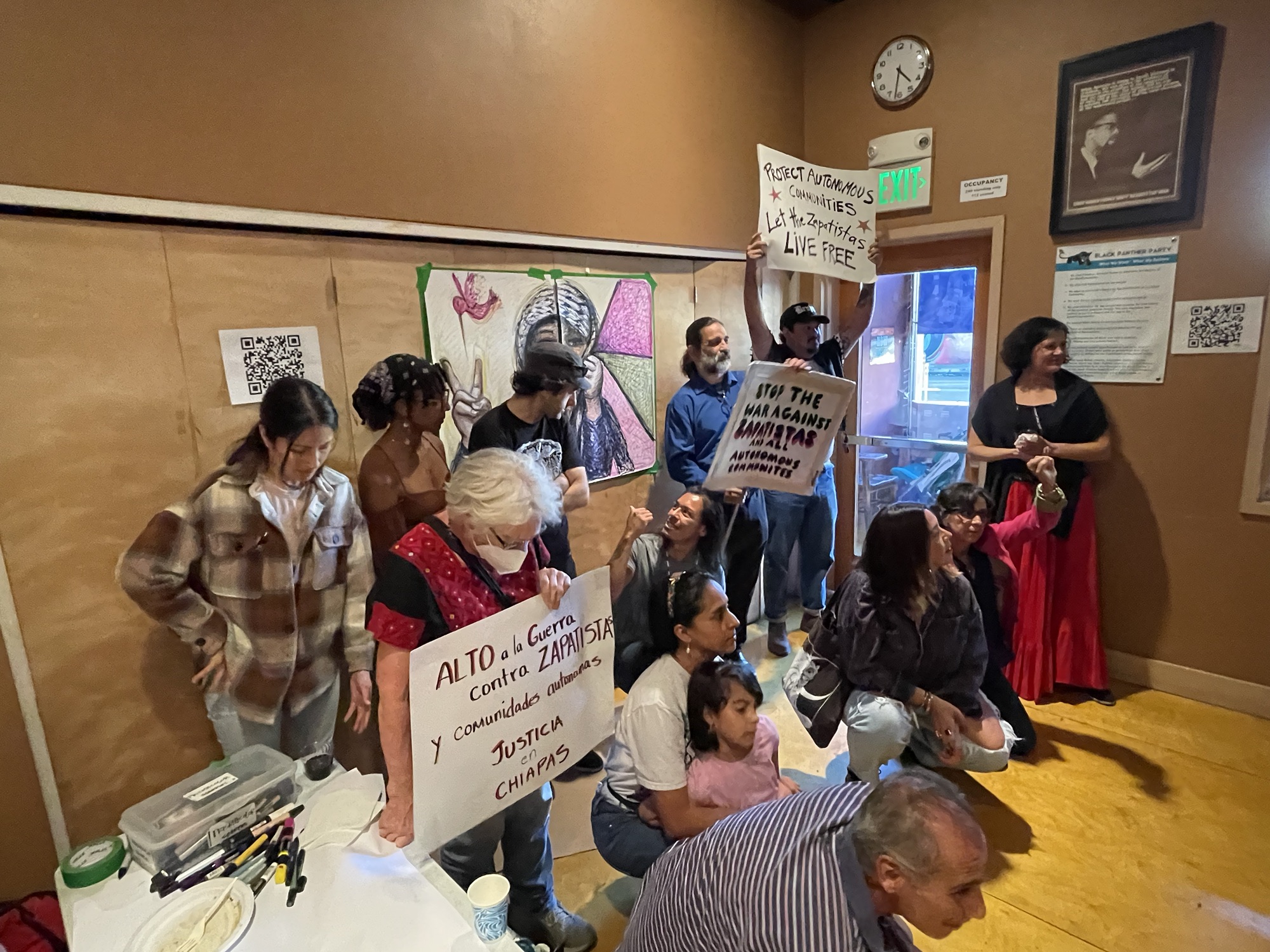
PLEASE TAKE ACTION: Send messages, photos, videos and art in solidarity with the Zapatista communities and against the State and government-backed narco and paramilitary violence against the Zapatista communities. Send them to porchiapaz@gmail.com
CompArte : The Emiliano Zapata Community Festival | Oakland 2024
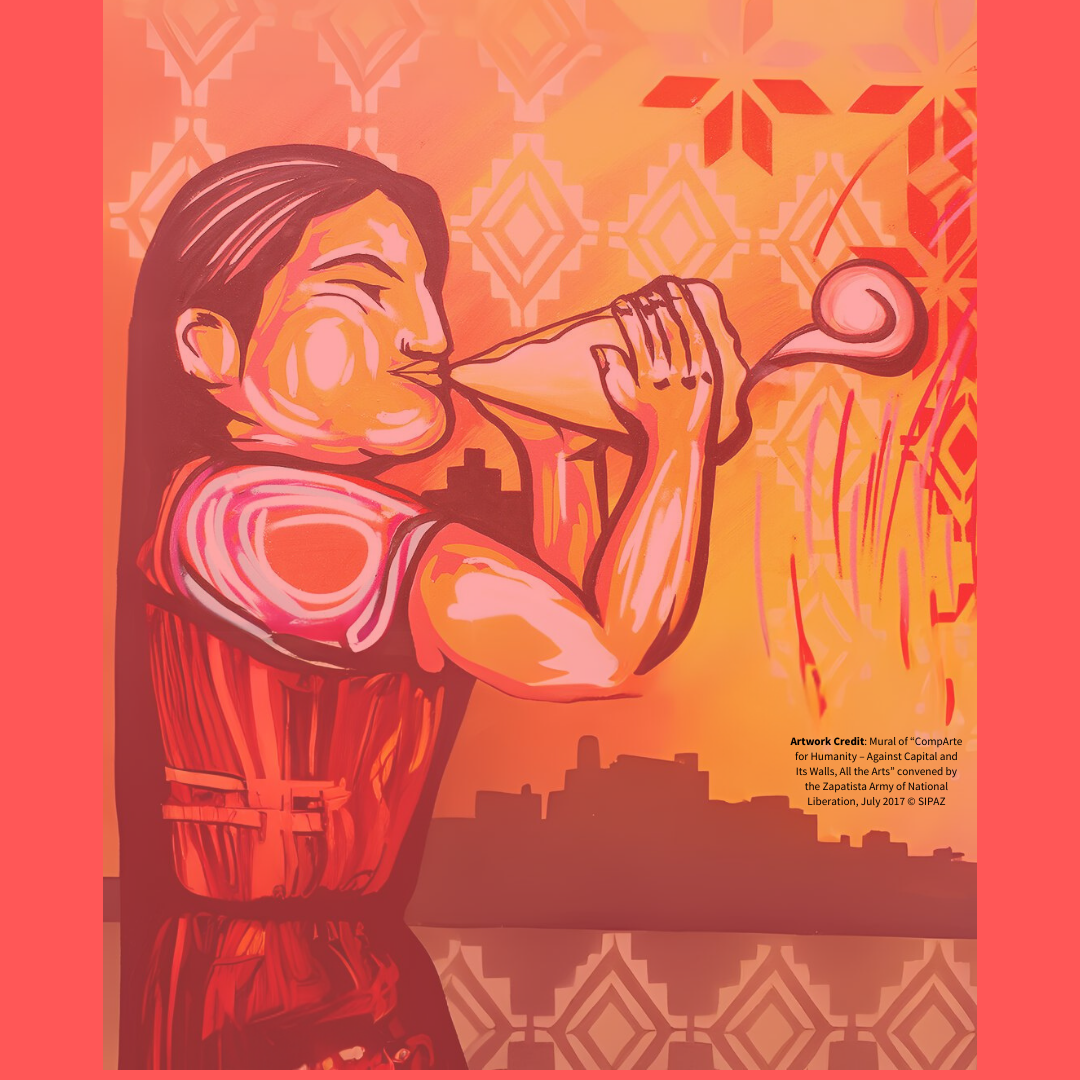
The Chiapas Support Committee presents the ninth annual CompArte: The Emiliano Zapata Community Festival to celebrate our movements and struggles for justice, peace and in solidarity with the Zapatistas and the Palestinian liberation struggle against genocide and occupation.
On Saturday, October 19, 2024, from 2:00-5:00pm (doors open at 1:30pm), at the Eastside Cultural Center (2277 International Blvd, Oakland, CA 94606), our commuity will gather to enjoy music, poetry, art and each other’s company and weave our dreams together in the sounds and rhtyhms of our movements.
CompArte started in the summer of 2016, when the CSC joined the Zapatistas’ call to convene justice artists and culture-maker warriors for liberation to bring their art, music, graffitti, music of all genres, dance, movement, film, theater and poetry together to join in the fight against capitalism. CompArte has been held every year since then and during the pandemic, the CSC held three sessions of CompArte on-line drawing in a local, regional, national and international audience sharing their work through the screens. CSCS has held ComParte at the Omni Commons, Peralta Park and with the support of the Eastside Arts Alliance over the last two years at the renown Eastside Cultural Center.
CompArte artists & performers
POETS
Persis Karim is a poet, essayist and editor as well as professor. She teaches Comparative and World Literature at San Francisco State University, where she also serves as the director for the Center for Iranian Diaspora Studies. She is the editor of three anthologies of Iranian diaspora literature and has written numerous articles about Iranian diaspora literature and culture. Her poetry has been published in national publications such as Callaloo, Green Linden Press, Porter Gulch Review, Caesura, Nowruz Journal, The New York Times, and Reed Magazine. She has just completed co-directing/co-producing her first film, “The Dawn is Too Far: Stories of Iranian-American Life,” which is a documentary about Iranian Americans in the San Francisco Bay Area. Read and listen to Persis Karim poems: The Seed Collector’s Daughter, Comprehension, and Pomegranates
Mo Sati was born in Palestine, grew up in a refugee camp in Jordan, and now lives in Oakland. Mo is a poet, a writer, a playwright, and an artist. He participates in activist and cultural events nationally and internationally sharing insights about life as a refugee uprooted from his homeland. His poetry, writings, and artworks tell stories of the people of Palestine living under occupation. His work personifies emotions drawn from the day-to-day struggles of resistance to oppression as Palestinians fight to unshackle themselves from decades of military occupation. Mo’s play, a satire, “The Ice Cream War” will be presented by the Eastside Arts Alliance in a stage reading on Friday, October 25, 2024, &;00pm at the Eastside Cultural Center. You can also hear Mo read his poetry accompanied by saxophonist Daniel Heffez here. Follow Mo Sati’s work on Instagram here.
Darius Simpson is a writer, educator, performer, and skilled living room dancer from Akron, Ohio. He received an MFA in Creative Writing-Poetry from Mills College. Darius was a recipient of the 2020 Ruth Lilly and Dorothy Sargent Rosenberg Poetry Fellowship, a 2023 National Endowment for the Arts Fellowship, and is the author of Never Catch Me (Button Poetry, 2022). He hopes to inspire that feeling you get that makes you frown and slightly twist up ya face in approval. Darius’ poems have appeared in POETRY Magazine, The Adroit Journal, American Poetry Review, Tinderbox Poetry Journal, and others. Darius believes in the dissolution of empire and the total liberation of all oppressed people by any means available. Free the People. Free the Land. Free All Political Prisoners. You can read work by Darius Simpson here.
MUSIC
AntiFaSon is a Son Jarocho project, a musical guest on Ohlone territory (aka Oakland). They amplify anti-capitalist, anti-colonial, anti-fascist and anti-extractivist feminist themes in Son Jarocho songs that form part of the larger history of Afro-Indigenous land, water and campesinx struggles. AntiFaSon will be performing with Corazón de Cedro. Follow AntiFaSon on Instagram: @somosantifason
Corazón de Cedro is an all-femme Son Jarocho and Arabic folk musical project based in San Francisco, California. The group’s arrangements explore the connection between Arabic and Mexican folk musical traditions through the Arabic oud, the jarana Jarocha, zapateado and more. Corazón de Cedro aims to serenade the diasporic heart through melodies, rhythms and poesia that speak of love, resilience, and our shared struggle for collective liberation. Featuring special duet by Evelyn Donají & Camellia Boutros. Corazón de Cedro will be performing with AntiFaSon. You can connect with Corazón de Cedro on Instagram here.
Davíd de la Gran writes: Un Musico Pobre. A community oriented musician/ composer of Garifuna-Caqchiquel-Ladino descent buscando su lugar y su voz en este mundo and finding it only by looking within. Davíd de la Gran on Instagram here.
Mónica María Fimbrez’s music reflects her Californian roots mixed with traditional, earthly and contemporary sounds of Latin America. A vocalist, multi instrumentalist and composer, her songs are innovative and expressive of a world where cultures coexist, where fear is transformed by compassion, where we learn to truly love ourselves, and where we view the world from an empathetic and holistic state of mind. Read more about Mónica María here and on Instagram.
Francisco Herrera Theologian, Cultural Worker, Singer-Songwriter, Francisco Herrera has produced seven albums (includes two children’s music in Spanish), writes scores for film and theater, working with producers like the late great Saul Landau. He has shared the stage with the Jon Fromer, Pete Seeger, Emma’s Revolution at mass actions as School of America’s Watch (up to 22,000 people), and the Battle for Seattle, with over 250,000 people shutting down the WTO in 1999 and massive demonstrations across the country. In 1987, Francisco shared the stage with Joan Baez and Jessie Jackson before 10,000 people there to bring attention to the brutal attack on Vietnam Veteran and Peace Organizer, Brian S. Willson, after the Navy Commander at Concord Naval Weapons Station gave the order to run over the protestors. However, Herrera’s most common place is not on big stages. He was actually at the small Nuremberg Peace Action when Brian was run over by the train. So close, in fact, that he was subpoenaed as the witness closest to Brian, David and Duncan. He can be found in intimate gatherings of women recovering from domestic violence, day laborers organizing for a universal wage, children becoming bilingual (Spanish/English), Interfaith groups shutting down private prisons; always performing uplifting and energizing songs that move, teach and inspire. His Latest album Honor Migrante crosses physical and musical borders to expose the grace and beauty of the migrant community as all of us with a rocking sound that brings together regional music from Mexico and the U.S. with a “Chicano Soul” style that permeates his eclectic choice of music. Learn more about Francisco Herrera online here.
Duo Madelina & Feña features multi-instrumentalist composer and writer Fernando Torres and multi-faceted puertorican Singer/interpreter and political activist Madeleine Zayas. Their eclectic repertoire is rooted in the Nueva Canción/Nueva Trova tradition of entertaining and educating about culture and pressing social issues.
Madeleine Zayas Born and raised in San Juan, Puerto Rico, Madeleine Zayas is a Latin American singer/interpreter, dancer and choreographer and architect based in Oakland. She was co-founder of Buena Trova Social Club in 2012 and lead singer and co-artistic director of Madelina y Los Carpinteros since 2014. Madeleine has performed in San Juan, Puerto Rico, many U.S. Cities, and Santiago, Chile, and has shared stage with Wilkins, Cheo Feliciano, Inti Illimani, John Santos and Holly Near. She believes in art and cultural activism as a positive force of communication and a tool for social change.
Fernando Feña Torres is a Chilean exile, musician, composer and poet, journalist and founding ex member of Grupo Raiz. Fena is an expert in folkloric multi-instrumentalist. He began his musical career as a young boy inspired by the socialist government of Salvador Allende A former political prisoner and exiled into the U.S., he has collaborated with Teatro Campesino and has performed in Bay Area and internationally along with artists such as David Byrne, Pete Seeger and Holly Near.
To listen to Madelina y Feña’s new song for Gaza click here Would You
Listen to Madeleine Zayas in a live performance: https://www.youtube.com/watch?v=7j5JOiLPVfM
ART
Daniel Camacho is a prolific painter and muralist. He paints mobile murals that can be and displayed at cultural gatherings, picket lines and marches and meetings. Camacho studied visual arts at the Escuela Nacional de Artes Plásticas in San Carlos, National Autonomous University of Mexico in Mexico City and Painting and Sculpture at the National Institute of Fine Arts in Mexico City. He currently teaches Mexican and Latinx art to elementary and middle school students in the Bay Area. Daniel’s mural and bas relief work can be seen on different walls of Oakland’s Fruitvale District and in the Oscar Grant Plaza next to the Fruitvale BART Station. Follow Daniel Camacho’s art and work on Instagram here.
CompArte: The Emiliano Zapata Community Festival organized by the Chiapas Support Committee with the support of the Eastside Arts Alliance.
The normalistas denounce: The AMLO presidency is about to conclude leaving the Ayotzinapa case “in the air”

Students from Ayotzinapa Normal denounced the six-year Presidencial term limit of Andrés Manuel López Obrador “is about to conclude leaving in the air” the disappearance of the 43 classmates who on the 26th of September will mark 10 years without truth and justice despite it being one of the federal governments campaign promise to solve the case.
“We speak against all irregularities within the processes corresponding to the investigation, as we condemn and repudiate the flagging of this event by the political parties, since at the beginning they committed themselves by filling the mothers and fathers of our 43 colleagues with hope for the prompt response to this State crime, leaving much to owe.“ said the normalistas in a statement.
Normalistas from the Ayotzinapa College will not rest until they find the absolute truth and the punishment with the full weight of the law for those found guilty.
“Governments come and go and the only thing that changes is the color of the chains that bind us to impunity for every event that the Mexican people have,” students added.
The students reaffirmed their support for the parents of the 43 missing students and assured that they will not rest until they find “the absolute truth and the punishment with the full weight of the law for those found guilty.”
The full statement follows:
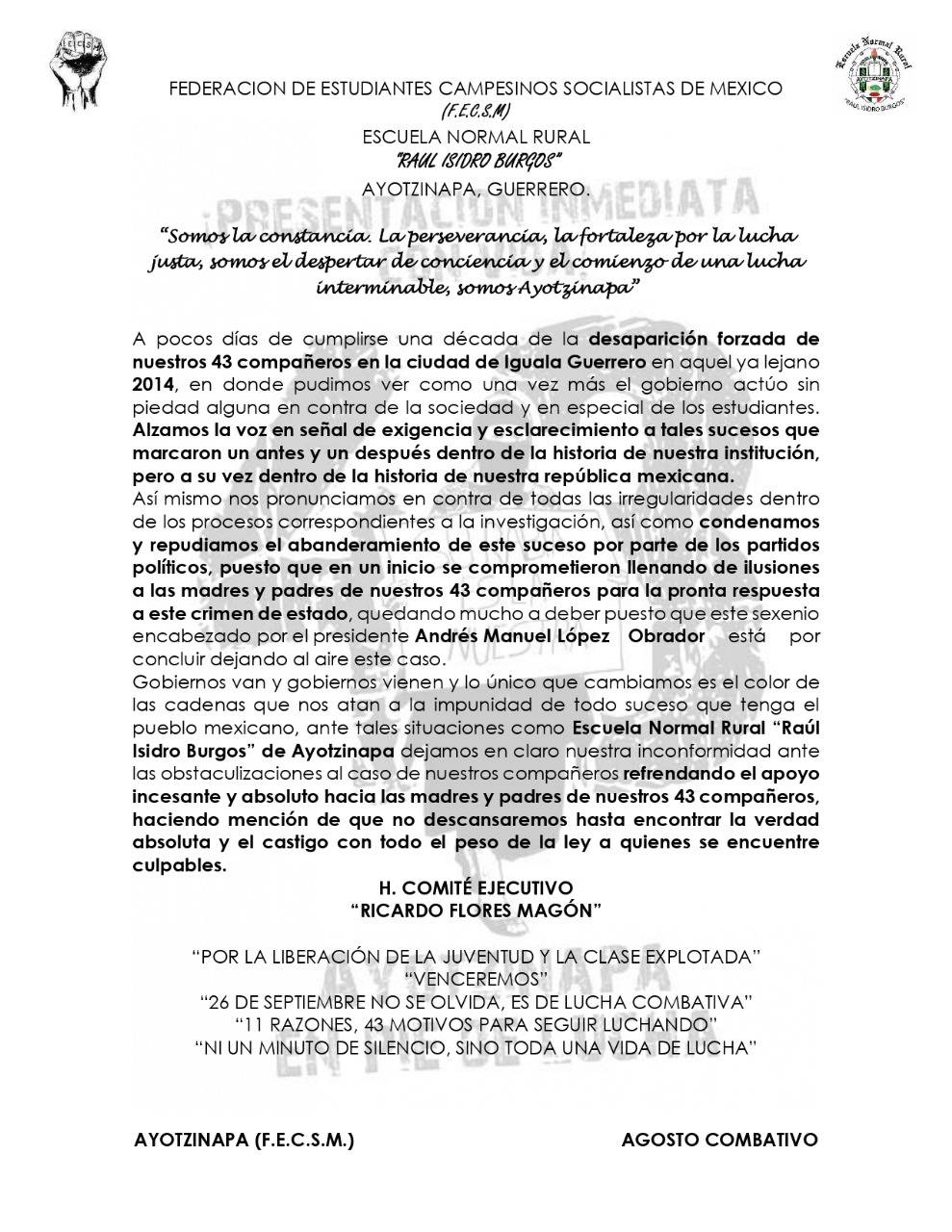
FEDERATION OF SOCIALIST FARMER STUDENTS OF MEXICO
(F.E.C.S.M)
RURAL TEACHER’S COLLEGE
“Raúl Isidro Burgos“
A few days before the 10th anniversary of the forced disappearance of our 43 colleagues in the city of Iguala, Guerrero, in that distant 2014, we are seeing how once again the government acted without any mercy against society and especially against the students. We raise our voices in demand and clarification of these events that have marked a before and after in the history of our institution, but at the same time within the history of our Mexican republic. Likewise, we speak out against all the irregularities within the processes corresponding to the investigation, as well as condemn and repudiate the using of this event by the political parties, since at the beginning they promised to fill the mothers and fathers of our 43 colleagues with hope for a prompt response to this state crime, leaving much to be done since this six-year term headed by President Andrés Manuel López Obrador is about to conclude, leaving this case in the air.
Governments come and go and the only thing that changes is the color of the chains that bind us to impunity for every event that the Mexican people have suffered. In situations such as the “Raúl Isidro Burgos” Rural Teachers’ College in Ayotzinapa, we make clear our dissatisfaction with the obstacles to the case of our colleagues, reaffirming our unceasing and absolute support for the mothers and fathers of our 43 colleagues, underscoring that we will not rest until we find the absolute truth and punish those found guilty with the full weight of the law.
H. EXECUTIVE COMMITTEE
“RICARDO FLORES MAGÓN”
“FOR THE LIBERATION OF YOUTH AND THE EXPLOITED CLASS”
“WE WILL WIN”
“SEPTEMBER 26TH IS NOT FORGOTTEN, IT IS A COMBATIVE STRUGGLE”
“11 REASONS, 43 REASONS TO CONTINUE FIGHTING”
“NOT A MINUTE OF SILENCE, BUT A LIFETIME OF STRUGGLE”
AYOTZINAPA (F.E.C.S.M.) COMBATIVE AUGUST
____________________________
Translated by the Chiapas Support Committee. Originally published by Desinformémonos, August 22, 2024. Click here for the original.
 Chiapas Support Committee