Chiapas Support Committee
Home of the Compañero Manuel blog on zapatistas & mexico
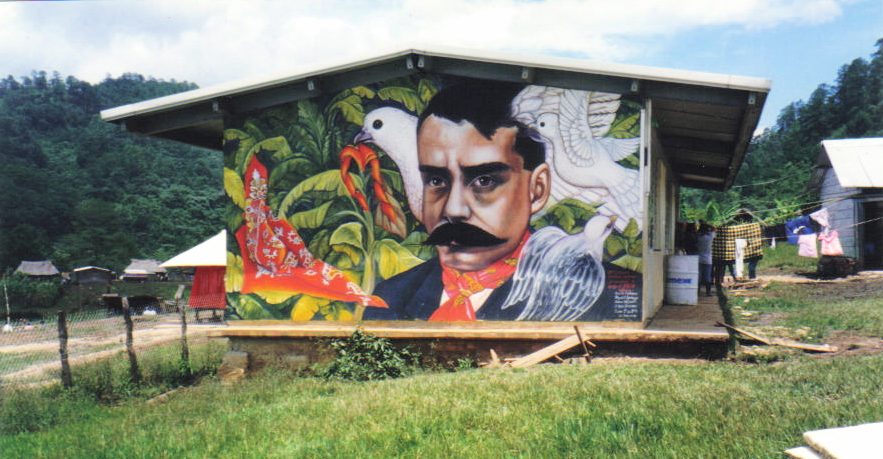
EZLN: twenty-five years

By: Adolfo Gilly
One morning 25 years ago, January 1, 1994, we saw an unusual spectacle appear on television: an indigenous army, emerging from the shadows of that New Years night, was taking the city of San Cristóbal. They were many, looked very poor and were opening a new era in the history of this country and its peoples. Its name was and continues being Zapatista National Liberation Army (Ejército Zapatista de Liberación Nacional): EZLN.
They said then who they were and what they wanted and were proposing, and since then they have not stopped saying, from the first Declaration of the Lacandón Jungle to the presidential campaign of Marichuy and the Indigenous Government Council.
They then used a language that today, a quarter of a century later, is good to remember. On February 1, 1994, in a letter to the state of Guerrero’s 500 Years of Indigenous Resistance Council, they explained their existence in what was actually a manifesto directed to the entire country. Its singular language appeared far from conventional political discourse:
There was so much pain in our heart, era our death and sorrow was so much that it no longer fit, brothers, in this world that our grandparents gave us to continue living and struggling. So great was the pain and the grief that it no longer fit in the heart of a few, and it was overflowing, and the pain and sorrow were filling other hearts, and they filled the hearts of the oldest and wisest of our peoples, and the hearts of young men and women were filled, all of them brave, and the hearts of the children, even the smallest, were filled.
The discourse was then directed to the past:
We talked to each other, we looked inside ourselves and we looked at our history, we saw our greatest parents suffer and struggle, we saw our grandparents struggle, we saw our parents with fury in their hands, we saw that not everything had been taken away from us, that we had the most valuable thing, which made us live, […] and dignity lived in our hearts again, and we were still new, and the dead, our dead, saw that we were still new and called on us, again, to dignity and struggle.
That voice continued speaking between religion and myth, history, grievance and pride, prayer and communion:
We leave behind our lands, our houses are far away, we leave everything, we take off our skin to dress for war and death, and we die in order to live. Nothing for us, for everyone everything, what is ours is our children’s. We all leave all of us.
Now they want to leave us alone, brothers, they want our death to be useless, they want our blood to be forgotten among the stones and dung, they want our voice to be extinguished and they want our step to become far away once again. […]
Don’t abandon us, don’t let us die alone and don’t leave our struggle in the vacuum of the great lords. Brothers, may our path be the same be the same for everyone: liberty, democracy, justice!
* * *
The Zapatista National Liberation Army (Ejército Zapatista de Liberación Nacional) celebrates in these days its 25 years of life. Besides its history, it has its social organization, its language and its politics.
Nothing can be done in Chiapas, in the vast world of the indigenous peoples and in the national indigenous movement, as long it isn’t old-style state indigenismo, without taking into account the EZLN’s presence, without dialoguing with the Zapatista National Liberation Army, its politics and its history, its proposals, its resistance and its existence.
———————————————————————
Originally Published in Spanish by La Jornada
Monday, December 24, 2018
https://www.jornada.com.mx/2018/12/24/politica/010a1pol
Re-Published with English interpretation by the Chiapas Support Committee
Towards the 25th anniversary of the EZLN

EZLN Comandantes celebrate!
By: Magdalena Gómez
January 1, 2019 will be the 25 anniversary of the public emergence of the Zapatista National Liberation Army (Ejército Zapatista de Liberación Nacional, EZLN). The challenge to the Mexican State, on the day the North American Free Trade Agreement begins formal operations, permeated our roots and mobilized the indigenous peoples of our country as never before, placing their agenda on the nation’s agenda. It also gave hope and meaning to many activists and movements in the world that were looking for how to orient the compass of the Left in neoliberal times.
While it’s impossible to reconstruct the EZLN’s trajectory and contribution in a few lines, suffice it to say that a first important step was the massive social demand for a ceasefire that it achieved from Salinas de Gortari on January 12, 1994, the unilateral ceasefire and the Zapatista respect for said decision. That factor being important, however, it cannot be ignored that the State has waged war against Zapatismo by many means, and not exactly peaceful.
A key moment was the February 9, 1995 betrayal, when then President of the Republic, Ernesto Zedillo, converted into the Public Prosecutor, broadcast on national television the alleged identities of the Zapatista leadership and the issuance of arrest warrants, while the Army was advancing in Chiapas against the territory its bases occupied. The stigma of Esteban Moctezuma derives from this. As the then Secretary of the Interior (secretario de Gobernación), he was received in Chiapas days before in a supposed and discrete dialogue plan.
The crisis unleashed on February 9 derived into the passage of the Law for Dialogue, Negotiation and Dignified Peace in Chiapas, which says in its first article: “This law has as an objective establishing the legal bases that will promote dialogue and conciliation for reaching, through an agreement of concordance and pacification, the just, dignified and lasting solution to the armed conflict initiated on January 1, 1994 in the state of Chiapas. For purposes of this law, the EZLN will be understood as the group of persons that are identified as an organization of Mexican citizens, mostly indigenous, who disagreed for various reasons and became involved in the conflict referred to in the preceding paragraph.”
Starting from that context, the route was defined for the dialogue, whose first negotiating table produced the San Andrés Accords on indigenous rights and culture, signed on February 16, 1996 and after a series of crises, now into the Fox presidency and with the Zapatista expression of conditions for sitting down again with the government, the indigenous counter-reform was promulgated in 2001 with which the EZLN considered that the State kicked over the board and ruined the possibility of resuming the dialogue that had been suspended since September 1996.
From 2001 to date, Zapatismo has constructed its autonomy in Chiapas, developing different areas of work through autonomous government bodies, as well as its own health and education systems through collective work, with everyone’s participation, women, men, young people and children. We’re talking about Good Government Juntas (Boards), an experience emblematic beyond national borders that they systematized and shared in the Escuelita Zapatista. They have also organized different seminars about the capitalist hydra, as well as the CompArtes and the ConSciencias, among others.
The most recent political experience was the accompaniment of the National Indigenous Congress (Congreso Nacional Indígena, CNI) in the decision to name an Indigenous Governing Council (Consejo Indígena de Gobierno, CIG) with men and women representatives from each one of the peoples, tribes and nations that comprise it, and this council proposes to govern this country. And it will have as its spokesperson an indigenous woman from the CNI, in other words, she will have indigenous blood and know her culture, and she would be an independent candidate to the Presidency of Mexico.
We know the result of this experience, faced with the State’s rules: Marichuy did not reach the required number of signatures, however her tour achieved the articulation of networks that are maintained around the anticapitalist option. They also gave an account of the deepening deterioration in the country and of the virtual war against the peoples promoted from the State. The EZLN has reiterated the statement about the transmutation of the rulers in the historical figure of the overseers: They are good defenders of the interests of their bosses to plunder the natural riches of our country and the world such as land, forests, mountains, water, rivers, lakes, lagoons, air and the mines that are guarded in the bosom of our Mother Earth, because the boss considers everything a commodity and thus they want to destroy us completely. The bosses are not present for the official part, not in the new government or its projects, both elements to suppose a change of direction in that trajectory that threatens the life of the peoples.
We can glimpse the Zapatista message with these elements this coming January 1.
———————————————————–
Originally Published in Spanish by La Jornada
Saturday, December 22, 2018
https://www.jornada.com.mx/2018/12/22/opinion/017a1pol
Re-Published with English interpretation by the Chiapas Support Committee
El dolor de Acteal (Acteal’s Pain)
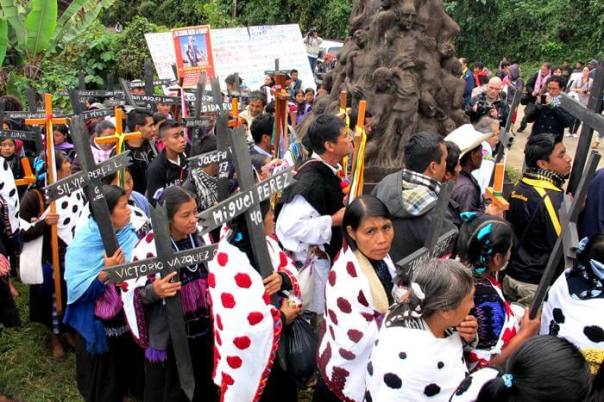
Acteal survivors carry crosses with the names of those massacred.
By: Luis Hernández Navarro
A young woman carries in her hands the photograph of a little six-year old girl framed in wood. It’s a portrait of Silvia Pérez Luna. In the lower part can be seen the date of her birth and death: 1991-1997.
Silvia was one of the 45 people savagely murdered by paramilitaries in Acteal, Chiapas, on December 22, 1997. The victims, 7 men, 21 women and 15 children (one of them less than one-year old), were praying for peace in a small chapel. The murderers finished off the wounded and opened the wombs of the pregnant women.
The image of Silvia’s portrait of her family member is part of the protest in which relatives of the Acteal martyrs (themselves also victims) and family members belonging to the civil society organization Las Abejas (The Bees) participated last December 8. That day, in Tuxtla Gutiérrez, Rutilio Escandón was sworn in as governor of Chiapas.
That day, as they have done for almost 21 years, they denounced that Acteal is a crime against humanity perpetrated by the Mexican State, in which justice has not been done, those responsible for the acts have not been punished and the truth has not been clarified.
They also remembered how, to the country’s shame, on August 12, 2009, the Supreme Court of Justice of the Nation considered it more important to point out a technicality than to defend justice and it ordered the release of 29 paramilitaries sentenced to prison.
Also coinciding with the 21st anniversary of the massacre, a timely and shocking book about it was just published: “El dolor de Acteal, Una revisión histórica,” (Acteal’s Pain, A historical review) 1997-2014, written by Mónica Uribe M, a specialist in religious issues.
Despite being a work that rigorously utilizes the tools of the sociology of religion, history, anthropology and political science, its reading provokes a strong emotional impact. The pain, indignation, rage, anguish and horror that it generates is summarized on its cover: a reproduction of the painting The Scream (El grito), from the painter Edvard Munch.
To analyze what happened in Acteal, Monica Uribe uses documentary sources that are almost unknown or only partially utilized. Among others, there is the civil complaint that a group of 11 victims filed (contrary to the opinion of Las Abejas) in United States court against former president Ernesto Zedillo. It accuses him of criminal association to execute the Acteal Massacre and for its subsequent cover-up.
The book delves into the pages of the balance sheet of the special prosecutor for crimes committed in the procurement and administration of justice in the state and for the town of Acteal. Therein is included the statement rendered by one of the tragedy’s principal actors, the then [federal] Secretary of Governance, Emilio Chuayffet. In his responses, the official makes it clear that Ernesto Zedillo knew, since one year before, about the imminent violence, through the government’s institutional channels, as well as through the national press, besides the fact that the actors in the Chiapas conflict approached him to report and warn him about the possible consequences of the situation.
In the balance sheet is included Chuayffet’s telephone conversation integrated into the case record in which, according to the document, the co-responsibility and scheming about the facts with Liébano Sáenz, President Zedillo’s private secretary is evident.
El dolor de Acteal includes an interview conducted a little more than a year ago with Alejandro Vázquez, who, at the time of the massacre, was a second archivist sergeant, belonging to the National Defense Staff, and who worked directly for the chief of the assistants to the Secretary of Defense, Enrique Cervantes Aguirre. According to his testimony, the general secretary worked on Sunday, December 21, 1997, which was unusual. That day, he was attentive to the communications from Chiapas and instructions from the Presidency, via the red telephone. He was the one responsible for picking up the phone and taking part of the call.
According to Lieutenant Vázquez, they were told that they should keep quiet and they also had to work the next day. In Acteal –he assures– “personnel from the Military Police Brigade participated, as well as logistic services personnel coming from different military zones, not from Chiapas, dressed as civilians and whose backgrounds inside the Army were negative.”
Beginning with copious documentation, El dolor de Acteal exposes the informative maneuvers of several intellectuals and of Hugo Eric Flores (the leader of Social Encounter) to elaborate an account of the facts that was convenient for the power, discards that the massacre had a religious matrix and concludes that “Ernesto Zedillo is the one ultimately responsible for the events in Acteal.”
The survivors of the massacre in Chenalhó demand that the new president listen to them, like he did to the families of the 43 that disappeared from Ayotzinapa. 21 years later, Acteal still awaits justice.
———————————————————————————
Originally Published in Spanish by La Jornada
Tuesday, December 11, 2016
https://www.jornada.com.mx/2018/12/11/opinion/016a2pol
Re-Published with English interpretation by the Chiapas Support Committee
Be the dream! Support Zapatista parents & children build schools
Join us in a solidarity action: Be the dream!
Support Zapatista parents & children build schools
 Dear Friends & Supporters of the Chiapas Support Committee,
Our warmest wishes to you in this season of holidays filled with joyous struggles for justice and dignity.
And in the season’s spirit of generosity, solidarity and community, we invite you to join us in honoring the Zapatistas on the 25th anniversary of their uprising by making a donation to support Zapatista parents and children in Chiapas build schools.
Solidarity is not just a sentiment; solidarity is direct action: Join us in walking side by side with the just movements and struggles of our indigenous sister-brother communities in Mexico.
We are asking you to uplift and be part of the Zapatista dream by making solidarity today and click on the donate button to make a donation now to support the Zapatistas’ work to build an autonomous secondary school system.
Your donation will go directly to training secondary school teachers from the four autonomous Zapatista municipios (counties) that comprise the Caracol of La Garrucha. And your donations will also help fund the construction of four classrooms, one in each of the four middle schools to be constructed (in the municipality belonging to the Caracol of La Garrucha. Donate now by clicking here!
25 Years of Zapatista Work for Justice & Liberation
On January 1, 1994, the day the U.S. began implementing NAFTA, the tri-national “free” trade agreement between the U.S., Canada and Mexico, the world woke up to the first rebellion saying NO to the global neoliberal capitalism led by the indigenous-led EZLN, the Zapatista Army of National Liberation, from Mayan lands in Chiapas. The 1994 Zapatista uprising was a historic and organized NO from below to capitalism so that their deep YES to building communities of caring for the land and her peoples could thrive.
And ever since the Zapatista dream of justice and liberation has moved, united and connected many Indigenous and non-indigenous communities, organizations and movements in Mexico and across borders to dream and build the world where the exploited and oppressed, the excluded and the ignored have first voice, where all working and indigenous peoples live and are in control of their lives and communities. As the Zapatistas celebrate their landmark anniversary, they have been constructing a better future for their children.
The Chiapas Support Committee (CSC) is committed to supporting the construction of a better future and we’re asking you to join us in that commitment by making a generous donation to make dreams come true.
Zapatista Year 24: Coffee, Marichuy, Women’s Power
The year 2018 began with an important January visit from Mario Luna, International Representative of the National Indigenous Congress (Congreso Nacional Indígena, CNI in Spanish) and the Indigenous Council of Government (Consejo Indígena de Gobierno, CIG). Luna’s visit was part of the West Coast portion of a US tour sponsored by the Sexta Grietas, a US-based network of collectives and individuals who adhere to the EZLN’s Sixth Declaration of the Lacandón Jungle and support the CNI-CIG.
The CSC is a member collective of the Sexta. We arranged meetings with local organizations and media interviews. We also hosted a public gathering at the Omni Commons in Oakland, where art from the Zapatista communities was on display. This tour was successful and laid the groundwork for future cross-border organizing work with the CNI-CIG in the US.
The tour was inspiring and critical to the organizing work of the CNI-CIG, of which the Zapatista National Liberation Army (Ejército Zapatista de Liberación Nacional, EZLN or Zapatistas) is a member organization. The campaign of María de Jesús Patricio Martínez (Marichuy) as an independent pre-candidate to the presidency of Mexico organized indigenous peoples into the CIG, and non-indigenous people into collectives and groups in support of the CIG.
The Zapatistas took creative solidarity action to oppose the virulent attacks on migrant workers and communities in the U.S. They donated hundreds of pounds of Zapatista coffee and asked members of the Sexta to sell it and give the money raised to support migrant rights organization leading the struggles and movements for justice and against policing and deportations.
The Chiapas Support Committee took up the Zapatista solidarity proposal and sold Zapatista coffee at events and gatherings, donating all the money raised from Zapatista coffee sales to a local immigrant women’s organization. The CSC also co-sponsored the showing of “Dispatches from Resistant Mexico” at Film Night, at the Omni Commons and hosted Duamuxa for a musical canción nueva report back from a solidarity delegation to Palestine.
One of our Board Members worked with a group of Bay Area women to the “First International Gathering of Women that Struggle,” sponsored by the Zapatista women and held March 8-10 in the Caracol of Morelia, Chiapas. After everyone returned from Chiapas, we sponsored “Zapatista Women Inspire the World,” a May 18 report back from the Women’s Gathering with film shorts and a panel of women who attended that amazing event offering their perspectives. Some 8,000 women from all over the world attended the Zapatista Women’s Gathering. Then in August, we presented our 3rdannual CompArte cultural festival with a mix of poets, artists and musicians.
Waffles & Zapatismo
We continue to offer a free space for critical reflection and solidarity, open to the community, for learning and dialogue about Zapatismo. We call this space “Waffles & Zapatismo.” The W&Z classes enable us to connect with new people and learn what others are doing to build justice and community.
We ended the year of 2018 by celebrating the 25th Anniversary of the Zapatista Uprising with a special end of year fundraiser that featured a film screening of “Corazón del Tiempo (Heart of Time),” a love story in times of Zapatista resistance. All the proceeds from this film gathering and your generous donations will be sent to the Zapatista Caracol of La Garrucha for the construction of four autonomous Zapatista middle schools (more on this later).
Marichuy: Women’s Power, Women Leadership
2018 was an incredible year of Zapatista organizing and resistance in Mexico that inspired and guided our work here, too. Throughout her campaign as an independent pre-candidate to the presidency of Mexico, María de Jesús Patricio Martínez (“Marichuy”), the spokesperson and representative, organized both indigenous and non-indigenous peoples into the Indigenous Governing Council (CIG, its initials in Spanish) and into collectives and support groups. The EZLN and CNI-CIG further solidified their work and invited all to organize against capitalism and for autonomous community. The Zapatistas also held several joint meetings in Chiapas this year, which included not only those of us in the national and international Sexta(Sixth), but also the new groups and collectives that formed in support of the CIG and Marichuy’s campaign.
After the Women’s Gathering, the Zapatistas held a seminar of critical thinking, the cultural festival of resistance, CompArte III, and the First Film Festival, which they announced would be an annual event. The CNI held an assembly in October to discuss organizing proposals and decided to send them to the communities for consultation.
The EZLN-CNI-CIG will end the year with a celebration for the 25th Anniversary of the Zapatista Uprising in La Realidad on New Years Eve as they prepare for more resistance, more solidarity and deep community.
Take Solidarity Action: Support the Zapatistas Secundarias!
The most exciting news we received came in October, when the Caracol of La Garrucha sent us a request for support of their project to construct four secondarias (middle schools), one in each of the four autonomous municipalities that comprise the Caracol. The La Garrucha region has never had a middle school in any of its municipalities and it has long been a dream of the parents to give their children an autonomous middle school education.
You can make that dream come true with a generous donation to the La Garrucha Education Fund. Details of the project are in the online fundraising appeal we initiated in October and can be found here.
You can mail your donation (see address below) or give a donation now by clicking here Solidarity Action Giving. We are a 501(c)(3) non-profit and an all-volunteer collective, so every donation we receive is important to us and to the communities in La Garrucha.
In solidarity,
Carolina Dutton, Chair, on behalf of the Chiapas Support Committee Board
Alicia Bravo, Arnoldo Garcia, Roberto Martinez, Jose Plascencia, Laura Rivas-Andrade, Amanda Stephenson, Mary Ann Tenuto-Sánchez
Chiapas Support Committee
P.O. Box 3421
Oakland, CA 94609
The Maya Train will destroy the last lung of the Mexican Southeast
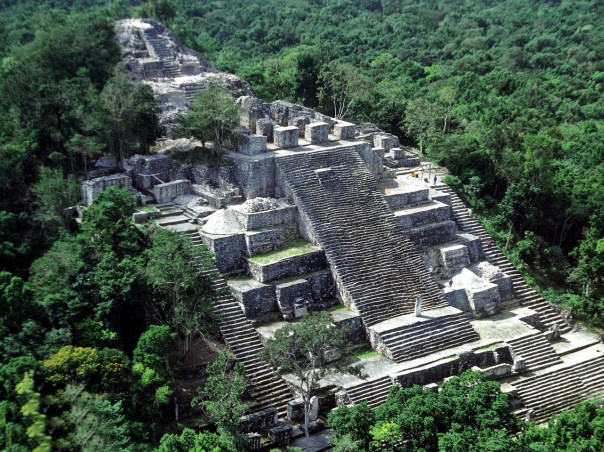
The Calakmul Pyramid.
By: Chiapas Paralelo and León Ávila
León Enrique Ávila, a professor at the Intercultural University of Chiapas (UNICH, its Spanish acronym) indicated that the “Tren Maya” {Maya Train) project that will run through 5 states of the country will imply a significant destruction of the jungles in Mexico.
Ávila, in his participation in the seminar organized by Otros Mundos A.C en San Cristóbal de las Casas, expressed that one of the 10 projects that President Andrés Manuel López Obrador designated as “priorities,” like the Maya Train, could have an important ecological consequence.
“We must recognize that from Palenque to Mérida and Valladolid there are already lines of the Maya Train that were created under the Porfiriato (the presidential regime of Porfirio Díaz). But between Cancún, Tulum, Sian Ka’an, Bacalar, Calakmul and Escárcega, it’s a totally new line, which implies a significant destruction of jungles in Mexico” he said.
The researcher warned that the proposal for the “Maya Train” to cross the Calakmul Reserve [1] right in the middle would have the consequence of breaking it in two. In addition to other problems in the nature reserves, he added: “the Lacandón Jungle has been deforested to plant corn. The other reserve in the region that will be affected is Sian Ka’an. [2] The train has to pass right through the middle of that reserve.” (See map below.)
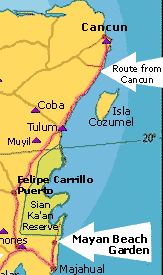
“The impacts will be very strong. Simply by breaking the reserve apart from the highway with another train, the animals are going to have a problem of connectivity and of movement. If simply with the highway extension an emblematic place for bats that are now clueless around the highway was damaged, imagine the impact that a train is going to have!”
Ávila said that with this project the Selva Maya (Mayan Jungle) will be divided in two, imposing a dividing line and condemning it to extinction.
The 70% of the plant species in the world are now in danger [according to the International Union for the Conservation of Nature – IUCN].
Then the worst thing that Mexico could do in the face of this conjuncture of collapse would be to support these kinds of proposals that lead to ecocide and the extermination of life.
“The problem is not only that the railroad’s routes imply cutting down thousands of trees. The other problem is the economic development associated with the railroad and it is what we don’t see. It’s a large real estate project that includes resorts, shopping centers, residential lots, large-scale hotels, and territorial rearrangements,” he said.
The academic affirmed that the work of the Nacional Fund for Tourism Promotion is directed towards the 15 million American tourists that visit Cancún every year, so it would be a lie to say that it’s Mexicans who would travel on the “Maya Train.” [3]
Translator’s Notes:
[1] From Wikipedia: The Calakmul Biosphere Reserve is located at the base of the Yucatán Peninsula in Calakmul Municipality in the state of Campeche, Mexico. It borders on the Guatemalan department of El Petén to the south and occupies 2,792 square miles and includes about 12% of the sub-perennial jungles of Mexico. Established in 1989, it is one of Mexico’s largest protected areas and covers more than 14% of the state. The important archaeological site of Calakmul one of the largest-known Maya sites, is located inside of this Biosphere Reserve.
[2] From Wikipedia: Sian Ka’an is a biosphere reserve in the municipality of Tulum, in the state of Quintana Roo, Mexico. It was established in 1986 and became a UNESCO World Heritage site in 1987. The vast majority of the Sian Ka’an Biosphere Reserve lies in the municipality of Felipe Carrillo Puerto. Part of the Sian Ka’an is on land and part is on the Caribbean Sea, including a section of coral reef. It is connected to protected areas to the north of it that protect coastal areas and archaeological sites.
[3] There is little doubt in this translator’s mind that the Maya Train is a key to opening up the Mundo Maya (Maya World) to mega-tourism, which will not only result in environmental damage, but also possible dispossession and displacement of Native and campesino peoples.
——————————————————————
Originally Published in Spanish by Chiapas Paralelo
Sunday, December 2, 2018
Re-Published with English interpretation by the Chiapas Support Committee
The historical meanings of the Kurdish revolution

Women’s Self-Defense Forces in Rojava
By: Gilberto López Y Rivas
The revolutionary experience of the Kurdish people, who have implemented, particularly in Rojava (northern Syria), what is called Democratic Confederalism, together with the autonomic governments of the Zapatista Mayas of the EZLN in Chiapas, constitute highly advanced alternative emancipatory processes worldwide. Democratic Confederalism is based on community autonomies of various levels, on participatory democracies of sectors, peoples and cultural groups of society, on ecological sustainability and on the woman as the subject of transformation with decision-making ability in all political, military, social and economic ambits.
The Kurdistan Workers Party (PKK), which encourages this cause and comes from an orthodox Marxism and a struggle of more than 40 years, abandons the idea of a national State, criticizes both real socialism and all the existing governments. The PKK maintain that the State holds the seed of capitalism and that freedom and State can never coexist, since it develops the power of a minority over the rest of the population.
Just like in the EZLN’s project of multiethnic and religious tolerance, in the Democratic Confederalism of northern Syria, the Kurds coexist with Arabs, Assyrians, Turkmens, Chechens, Circassians, Muslims, Christians, Yazidis and other doctrines and sects, beginning with a mutual coexistence and fraternity among peoples. In the Social Contract of the Democratic Federation of Northern Syria, it “guarantees the equality of all peoples in matters of rights and duties, respect for human rights statutes and preservation of national and international peace.”
This founding document institutes that the Democratic Federation is based on the collectivization of land, water and energy resources; it adopts a social economy and ecological industry; the wealth and natural resources are public property; it does not permit exploitation, monopoly, or reification of women; it supports social and health coverage for all individuals. It reiterates that women will enjoy their free will in the democratic family, constructed on the basis of a common egalitarian life and that young people are the driving force of society and their participation in all areas must be guaranteed. Cultural oppression and assimilation, extermination and occupation are considered a crime against humanity and resistance to these practices is legitimate. Within the Federation education is free at all levels, with primary and secondary education being compulsory; while the rights to work, health and housing are insured.
The politico-social system of the Federation is based on the formation of communes, social institutions, unions and assemblies being the common fundamental organizational form of direct democracy, the instances for management and decision-making, while the assemblies are the social units that represent the people, in which they debate and decide at the level of towns, neighborhoods, cities, districts, regions and cantons.
In Turkey, Democratic Confederalism operates through the Democratic Party of the Peoples and the Democratic Society Party, both of which participated victoriously in the elections of more than 100 municipalities, until the Turkish government declared them terrorists with an emergency law and occupied governmental apparatuses with their delegates. This State coup produced a great repression that imprisoned more than 10,000 men and women, who today are part of the numerous political prisoners of Kurdish origin. Since 2016, Turkish aviation and artillery bombed nine Kurdish cities, and its army occupied the city of Afrin, in northern Syria by blood and fire. As of this date, they are preparing for an offensive against two other Rojava cantons.
In Iraq, the Kurds maintain a relative autonomy, with self-governments and parties that support the idea of establishing a national state. However, the influence of Democratic Confederalism in Iraqi cities is felt in the Democratic Solution Party, while in the liberated mountainous regions that cover territories in Iraq, Turkey and Iran, Democratic Confederalism is established, and guarded by guerilla self-defense groups.
In Iran, people are organized through the Free East Kurdistan Party, the Democratic Society Party and the Free Life Party, brutally repressed by the confessional government of the ayatollahs. Here in Iran, guerilla self-defense forces of men and, separately, women also operate.
The Kurdish revolution seeks above all else the inner transformation of individuals. It’s about eradicating patriarchal, classist and racist ideology in order to achieve the liberation of society and the end of capitalism and imperialism.
———————————————————–
Originally Published in Spanish by La Jornada
Friday, November 30, 2018
https://www.jornada.com.mx/2018/11/30/opinion/022a2pol
Re-Published with English interpretation by the Chiapas Support Committee
A qualitative leap in the storms
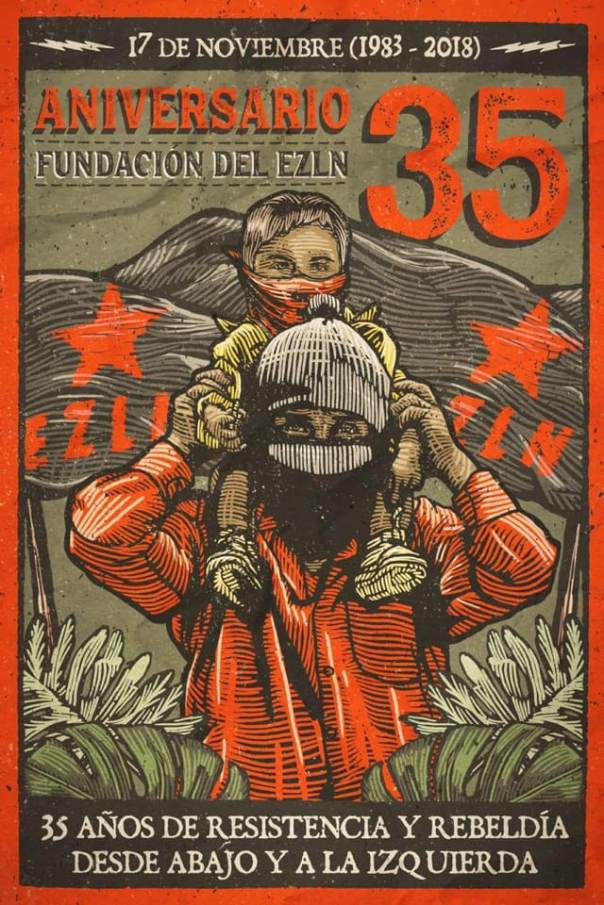
35th Anniversary of the EZLN’s Founding.
By: Raúl Zibechi.
“We are entering a new normal. Things are not like they were 10 years ago.” Phrases don’t belong to any intellectual, but rather to someone really important: the chief of a California county’s firefighters. They integrate the reporting of the Hispanic-American journalist Gustavo Arellano about the most recent and devastating fires, which can serve as an introduction to the chaotic world into which we are entering
The most experienced firefighters of that state assure that they had never seen anything like it. Some 10,000 buildings burned in the small city of Paradise, there were nearly 1,000 disappeared and the dead approached 100. Specialists assure that there is no longer a fire season, as there has been until now, because they happen throughout the year.
To climate change is added the disastrous urbanization of rural areas. One hundred million dead trees in California in only four years of draught (2011-2015), to which is added the brutal real estate speculation that has urbanized rural areas, an impressive “colonization of the countryside”.
Can we imagine what it would be like if hurricanes and tsunamis would stop being something exceptional or temporary to become “a new normal?” Add that most of the big cities of the southern world don’t have safe drinking water and their inhabitants have to buy it, when they can, so as not to get sick. The 20 million inhabitants of Delhi live 10 years less because of air pollution, 11 times higher than that permitted by the World Health Organization.
We are entering the moment in which the storm becomes daily, aggravated by a new political conjuncture in which the Trumps and the Bolsonaros form part of the new decoration. Even the mediocre French president Emmanuel Macron, declared that the world will be “doomed to chaos” if the decadent European Union doesn’t find a proper direction.
If it’s true, as the Brazilian philosopher Marcos Nobre says, that Bolsonaro was the candidate of the collapse and “needs the collapse to maintain himself,” we must reflect on this argument. In my view, the new conservatism (some call it “fascism”) as well as progressivism, are the bitter fruit of the collapse and have broad futures ahead. As was evident in Brazil, Lula and Bolsonaro are complementary and everyone will be able to reach similar conclusions in their own country. I believe it’s necessary to reflect on what we understand by collapse, those whom it will affect and how we could get out of it.
In the first place, making it clear that the collapse underway is a creation of those above, the dominant class or the richest one percent, to overcome a situation of extreme weakness due to a lack of legitimacy with respect to the rest of humanity. The collapse is a policy of above to control and discipline those below and, eventually, enclose them in real concentration camps, without wire fences but surrounded by fields with glyphosate, mono-crops, mega-projects and open pit mining.
I vehemently reject the idea that the collapse is a natural process or one of nature, and I insist on its character as a political project that reduces the planet’s population in order to stabilize the domination. This plan is also externalized in natural phenomena, but its starting point is the dominant class.
The second question is that it principally affects the popular sectors, native peoples, Africans liberated from slavery, rural families and the urban peripheries. Those of us below are superfluous in this world of accumulation by theft, because as has already been said we are the major obstacle to converting la nature into merchandise.
Those above attack us, but not because of ideological reasons, because of racism or femicidal machismo, but they use these instruments of domination and control to lubricate their illegitimate and often illegal enrichment. They turned violent to accumulate.
The third thing is that it doesn’t matter if these processes occur under conservative or progressive governments, since they cannot control accumulation by theft, which certainly does not convert them into innocents. South American progressivism has drowned because of the violence and corruption that the big megaprojects generated, more than because of the actions of the right.
As the leftist journalist Leonardo Sakamoto points out, the aberration of building a hydroelectric dam such as Belo Monte (in the middle of the Amazon), with its inevitable sequel of “violence against the indigenous populations, slave labor and human trafficking,” was the fruit of Lula’s developmental arrogance. Megaprojects are not “errors” but the core of progressivism.
Finally, this new reality disables our old strategies and forces us to build “arks” (or however each one wants to call the spaces of autonomy and self-defense) that we need to not shipwreck and die in the storm.
———————————————————–
Originally Published in Spanish by La Jornada
Friday, November 23, 2018
https://www.jornada.com.mx/2018/11/23/opinion/020a1pol
Re-Published with English interpretation by the Chiapas Support Committee
Displaced return to Chavajebal

Residents of Chavajebal flee violence.
By: Elio Henríquez
San Cristóbal de las Casas, Chiapas
The more than 1,700 indigenous people displaced from the community of Chavajebal, El Bosque municipality, for fear of being attacked by an armed group, returned to their homes this Saturday, after leaving on November 7, residents of the municipal capital reported.
They said that the return came after Friday, the two groups –one of Zapatistas and the other of militants of political parties– reached an agreement during a 10-hour meeting held in Simojovel, with the mediation of parish priests of Simojovel and El Bosque, Marcelo Pérez Pérez and Elder López Velasco, respectively, as well as the Fray Bartolomé de Las Casas Human Rights Center.
“At 7 o’clock in the morning this Saturday the first groups that were in the municipal capital of El Bosque”, located in the north of Chiapas, began to return to Chavajebal, residents reported. “At 11 o’clock all those who were in that capital had already left in trucks.”
They said that the only ones that by agreement of the parties did not return are some 30 residents pointed to as having participated in the October 24 ambush in which were murdered Miguel Pérez López, president of the ejido commission of Chavajebal and the comunero Carmelino de Jesús Ruiz Álvarez, as well as in the murder of Mateo Jiménez Sánchez, which occurred on November 7 and provoked the displacement.
“The return took place this Saturday in an atmosphere of tranquility, and it is therefore expected that there will be no problems,” said the residents consulted.
One hundred decide not to return
Other people, separately, assured that a group of around 100 residents who are sheltered in the community of San Pedro Nixtalucum decided not to return to the community because security conditions do not exist, and because neither the state authorities or the municipal authorities of El Bosque participated in the negotiations.
“This group disagrees with the agreement that was signed and therefore would remain displaced,” they said.
————————————————–
Originally Published in Spanish by La Jornada
Sunday, November 25, 2018
https://www.jornada.com.mx/2018/11/25/estados/026n2est
Re-Published with English interpretation by the Chiapas Support Committee
Indigenous groups reject Maya Train (Tren Maya) plan and vote
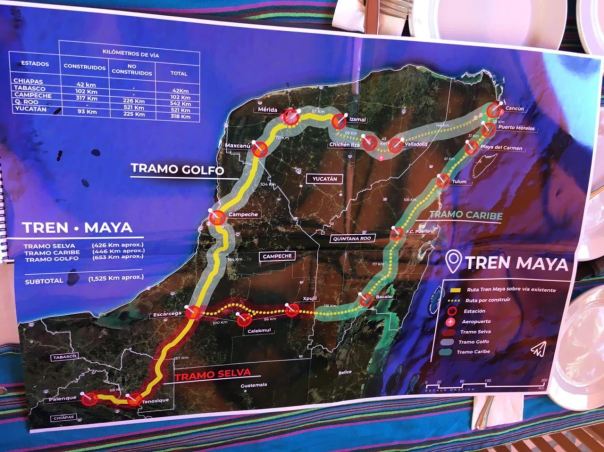
This map shows Tren Maya’s stations in Chiapas, Tabasco and on the Yucatán Peninsula.
By: Luis A. Boffil Gómez
Mérida, Yucatán
More than 80 indigenous groupings are opposed to the Tren Maya (Maya Train) that president-elect Andrés Manuel López Obrador promotes, because they consider that it will not bring and benefits for the zone’s natives, and the rejected the national “consulta” (vote) regarding it.
In a communiqué, they repudiated the vote foreseen for November 24 and 25 [1] about the Maya Train and other initiatives of the next government. “That no person outside the Yucatán Peninsula may seek to decide what can be done or not be done in our territories, just as we will never attempt to decide what will be done with their property, rights and possessions. A real consultation for the indigenous peoples must comply with the guiding principles: prior, free, informed, in good faith and culturally adequate,” they indicated.
They emphasized that during the Enrique Peña Nieto government they followed the Maya Train megaproject “and from that moment we disapproved of it, disliked it, because it violates the indigenous rights of which we are subjects and are consecrated in our Political Constitution.”
They hoped, they added, “that with the change of administration the indigenous communities would be visible to the Federation and that it would reconsider the ways for attempting to put the Maya Train megaproject into effect, but we realize with displeasure that in the new administration the story will not change and the justice expected will not come to the indigenous peoples of Mexico.”
They assured that the work has already started, “and proof of that is that they already have budgets, bids, designs and even a start date, and no one has agreed to absolutely anything with us.
“The Maya Train mega-project will not bring us benefits of regional development, it is not planned for us, the common people; it’s a tourist project that will only benefit the rich and the foreigners. We, owners of the lands, will only see it pass since stations are not contemplated in most of our towns, and are only considered for points of tourist interest that big capital has already captured.”
Among the signers are the Regional Indigenous and Popular Council of Xpujil, Collective of Maya Communities of Los Chenes, Muuch Kambal, Conhuas Ejido, Calakmul and the Indigenous Collective of Halachó.
[1] The results of the Consulta will be announced later today, November 26, 2018.
—————————————————————————–
Originally Published in Spanish by La Jornada
Thursday, November 22, 2018
https://www.jornada.com.mx/2018/11/22/politica/005n2pol#
-*- -*- -*-
And, check out this article below!
Despite rejection, López Obrador announces that construction of the Maya Train (Tren Maya) will begin on December 16
Published by Chiapas Paralelo
*This project has an estimated completion of four years.
President elect Andrés Manuel López Obrador declared that construction will begin December 16 with a public budget of 6 billion pesos, but before that, they will hold a consultation to know the opinion of the citizenry, according to what Animal Político published.
López Obrador visited Mérida, Yucatán at a meeting with governors involved in the Maya Train’s trajectory. Among those present were the governor-elect of Chiapas, Rutilio Escandón Cadenas, and the ex-governor, interim governor and senator for Chiapas, Manuel Velasco Coello.
The work will start on December 16 with an inaugural ceremony in Palenque, Chiapas.
Said train would have a route in Cancún-Tulum-Bacalar-Xpuilt-Escárcega-Candelaria-Palenque. On the other hand, with the extension the new route would be Palenque-Candelaria-Escárcega-Campeche-Mérida-Valladolid-Cancún.
However, López Obrador announced that on November 24 and 25 a vote will be held about the project in order to know the citizens’ opinion, although, he didn’t explain if the result would influence continuing the project.
“This month we are going to carry out a wide-ranging citizen consultation (vote) to ask Mexicans, not only inhabitants of the southeast, but all Mexicans for their opinion on this Maya Train project,” López Obrador said.
The consultation
Rogelio Jiménez Pons, AMLO’s designee as the next director of the National Fund for Tourism Promotion (Fonatur), detailed that the first work on the Maya Train would be to open the passage for fauna and complementary infrastructure.
Pons explained that the project would try not to displace people from their communities, to the contrary, they will seek that they participate in the project.
He also affirmed that the vote would be held in the native languages of the zones involved. With respect to the national vote, he did not give more details, the news outlet reported.
The Maya Train could travel up to a speed of 150 kilometers per hour, according to Rogelio Jiménez Pons’ predictions.
The supposed “acceptance” of the peoples
The president-elect declared in September that communities, ejidos and small property owners accepted the execution of the Maya-Peninsular Train project; however, he did not say which ones, or how and when they were consulted.
According to information from the newspaper Reforma, AMLO would have assured: “there are already consultations, the people want this for the southeast, because, if we look at the map, in the last 30 years development has centered on the Riviera Maya and the rest of the southeast remained abandoned.” He said this without delving into the way in which citizens close to the project were informed.
In August, Subcomandante Galeano (formerly Marcos) of the Zapatista National Liberation Army (EZLN) said that the principal projects of López Obrador are going to destroy the territories of the original peoples: the million hectares in the Lacandón, the Maya Train, or the corridor on the Isthmus that they want to make, among others.
In that regard, the National Network of Civilian and Human Rights Organizations “All Rights for All” (RedTDT), which carries out projects in the zone without a process of free, prior and informed consent and consultation said that the Maya Train project repeats the same model of imposition and discrimination.
The Civil Society Organization Las Abejas of Acteal communicated that in the Andrés Manuel López Obrador government, the policy of looting and destruction of territories will continue, because the Maya Train project represents a project that destroys Mother Earth.
The Maya Train has an estimated route of 2400 kilometers in the Mexican southeast, 42 kilometers of them through Chiapas. AMLO said that the road that is already built on the limits between Chiapas and Tabasco would be enabled. This stretch is also used by thousands of migrants seeking to reach the United States.
——————————————————————
Originally Published in Spanish by Chiapas Paralelo
Tuesday, November 13, 2018
Re-Published with English interpretation by the Chiapas Support Committee
EZLN, CNI-CIG Communiqué to the Mapuche people
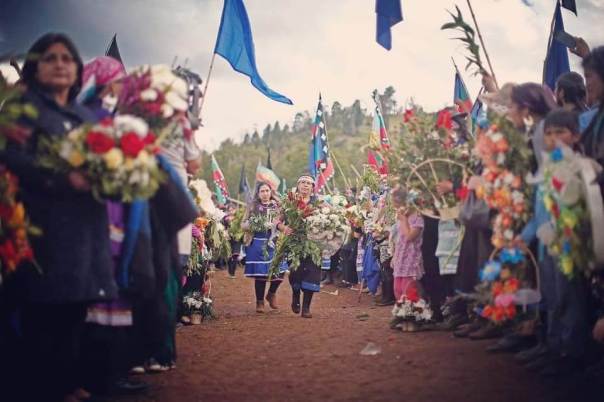
Funeral for the young Mapuche Camilo Catrillanca, murdered by the Chilean military’s Jungle Command. Photo: Desinformémonos.
Communiqué:
To the Mapuche people
To the Chilean people
To the original peoples of America
To the International Sixth
Brothers and sisters of the dignified Mapuche people,
The pueblos, nations, tribes and neighborhoods that make up the National Indigenous Congress (CNI), the Indigenous Government Council (CIG) and the EZLN jointly embrace with solidarity the family of the Mapuche compañero Camilo Catrillanca, who was murdered during an operation of a tactical group of Chilean Carabineers that occurred on November 14, 2018 in the community of Temucuicui in the Araucanía region. We are familiar with the century-long struggle that the dignified Mapuche people have made to defend their forests and rivers, as well as the repression and assemblies that the police forces of the bad Chilean government effectuate on Mapuche territories to end the defense of life.
The peoples, nations, tribes and neighborhoods of the CNI, the CIG and the EZLN condemn the cowardly attack of the bad Chilean government and its Chilean police forces. We demand that the repression and criminalization against the Mapuche peoples that defend their territories cease. We also demand that the death of the Mapuche comunero Camilo Catrillanca not go unpunished. We reiterate our respect and solidarity to the Mapuche people. We salute your dignified struggle for the defense of life and territory.
SINCERELY,
November 2018
For the integral reconstitution of our peoples!
Never more a Mexico without us!
National Indigenous Congress – Indigenous Government Council
Zapatista National Liberation Army
En español: http://enlacezapatista.ezln.org.mx/2018/11/24/comunicado-al-pueblo-mapuche/
 Chiapas Support Committee