Chiapas Support Committee
Home of the Compañero Manuel blog on zapatistas & mexico
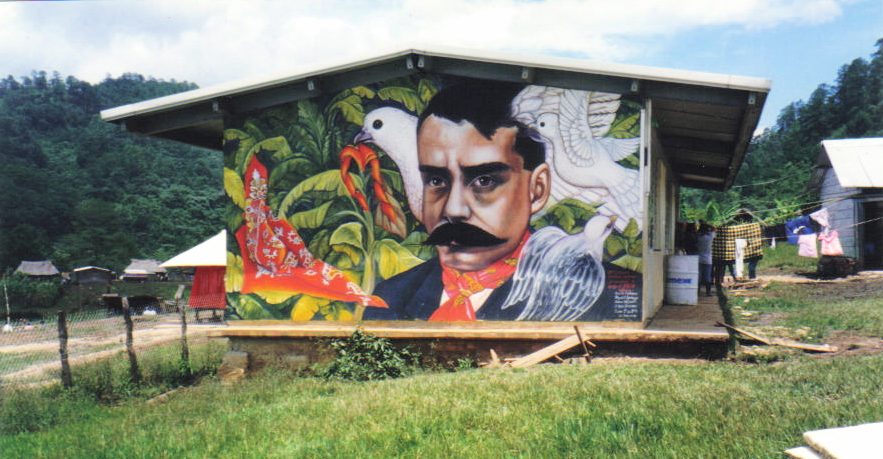
Invitation to the celebration of the 25th Anniversary of the Zapatista Uprising and to a Gathering of Networks

ZAPATISTA NATIONAL LIBERATION ARMY
MEXICO
November 17, 2018
To the individuals, groups, collectives and organizations of the CIG Support Networks:
To the Networks of Resistance and Rebellion or whatever they’re called:
To the National and International Sixth:
Considering that:
It’s early morning.
Considering that:
It’s cold.
Considering that:
In that hinge of time, where it’s neither day or night, neither inside or outside, neither shadow or light, you find yourself without sleep, in that uncomfortable vigil that makes you vulnerable to memories, the piercing memory of what was done and undone, the long count of omissions and the short count of what was realized.
Considering that
You ask yourself, no without reason, what comes of all that…
Because you are still trying to assimilate that “Everything is impossible the day before” that listens-reads in that disconcerting nano-mini-micro footage of the self-styled “cinema for reading.” A film (?) 30 years canned (literally: in a can of sardines) and presented in that impossible cinema, signed by an equally disconcerting beetle with knight-errant airs, and whose title (of the film, it’s understood): “The 69th law of dialectics” is not very rational either. A film without image or sound, and composed by a single phrase. Leaving all the weight to the imagination of the one who attends its projection?
In the end, everything seems absurd here… here? Where the hell is it? But he doesn’t have much time to locate himself, because they hurry him:
“Come on then,” the little girl says to him.
You have no idea what to expect—it could be anything at this point—but you’re guided out of the absurd movie theater, once again by the little girl leading you by the hand, though now you’re surrounded by a whole band of kids, mostly little girls in their wool skirts and colorful blouses, barrettes fruitlessly pinned into unruly hair. You begin to walk with them up the natural slope of the mountain, through the mud, rocks, and fog, picking out the path, always the path.
At the foot of the wall, where there is just a smattering of old, worn posters and graffiti, you intuit a kind of spiral, like a pathway leading toward the inside of a caracol1…or toward the outside. Every step is like a station: the fake happiness of the fake happy family; the Grand Finale as simulation; the screen’s provocation as an impossible bridge.
The omnipresent, indestructible, unquestionable wall continues to insist that thinking is not allowed, that everything is as it is and that’s it—the only thing left to do is settle in wherever and however you can. Eternity is just that, after all: eternal. The present moment may change, but its frivolous and superficial logic is permanent and anything else is impossible. What’s more, it’s impossible that you would think, imagine, or dream that anything else is possible.
You walk. You remember.
The little girl had asked if the films that nobody watches cry, which is just another way of asking about all the pain and rage in the world that is ignored and unknown—because of the blindness and deafness imposed by the wall. I mean, who asks a question like that? She does, that and many other questions, including questioning the very existence of the wall. The wall…you look at it more closely now: it’s taller than you can see, taller even than what you can see through your binoculars, so enormous it’s not even worth measuring. Measure for what? Its construction is solid, its appearance impeccable—well, not quite.
If you step back a bit you can see that the wall is full of both cracks and graffiti, so many that you can’t really tell them apart. Only up close, from a shortsighted perspective, does the wall seem solid. From up close you can’t even read the gigantic graffiti scrawled across the rough surface:
“Though the path will be long, we’ll continue on”: the little girl reads the graffiti on the wall that doesn’t say anything itself, mutely resigned to the successive administrations who send work crew after work crew to erase or cover over that writing, to silence and exterminate it.
“I hadn’t even seen it,” you apologize.
“Understandably,” the little girl responds, and adds, “but here we still are, keeping on.”
How far from the wall do you have to be to be able to see it? You think you just thought this to yourself, but the little girl responds, “Far.”
“But how far?” you insist.
“Like 500 years away,” she answers, smiling maliciously.
As if by coincidence, the words of a rap begin to keep pace with the footsteps of the kid gang who walk with you:
“We came from so far, far in every possible sense In silence, we came with strength From afar, each of us carrying the weight of our walk Singing light amidst the ruins of a burned-out world.*
Is that sound coming from inside or outside? Is that the soundtrack of your anachronic, absurd, and irremediable trip?
-*-
Partly out of shame and partly out of curiosity, you now examine the graffiti more closely. A recent tag, with small, hurried letters, reads:
“Basic Lessons of Political Economy:
One: Capital does not know how to read. It does not pay attention to social networks, media, polls, votes, referendum, videos, government programs, good or bad intentions, moral lessons, laws, or reason. Capital only knows how to add, subtract, multiply, divide, and calculate percentages, interest rates, and probabilities.
Two: Capital only cares about profit, the highest and the fastest profit possible. Like all predators, capital has a good nose for blood and destruction, because these imply money, lots of money. War is a business, the best business.
Three: Capital has its own judges, police, and executioners. In the world of the wall, these inquisitors are called “markets.”
Four: The markets are the bloodhounds of the great hunter: capital. In the world of the wall, capital is god and the markets are his disciples. The police, armies, prisons, mass graves and forced disappearances are his faithful followers.
Five: One cannot tame, educate, reform, or subordinate capital. One can only obey it…or destroy it.
Six: Ergo, what this world needs are heretics, scarlet witches, magicians, and sorcerers. With the heavy load of their original sin, rebellion, the wall will be destroyed.
Seven: Even so, what happens next has yet to be seen: if what comes after capital will put up another wall, or instead open doors and windows, the bridges this world needs and deserves.
The graffiti and cracks continue, up and down over hills, valleys, and ravines. The caracol retracts into its own shell, with a few very small communities and scattered houses peeking out over the highway. A sign alerts you: “You are now in Zapatista territory. Here the people rule and the government obeys.”
You ask yourself: What is it that keeps these people alive, against all odds? Are they not the eternal losers, always on their knees while others build governments, museums, status and “historical triumphs”? Are they not the victims of every possible catastrophe, the cannon fodder of every revolution staged to save them from themselves? Are they not strangers in their own land, the object of mockery, disdain, handouts, charity, government programs, “sustainable” projects, and revolutionary programs, proclamations, and directives? Are they not the irremediably illiterate who must be educated, led, ordered, ruled over, subjugated, subordinated, dominated, and c-i-v-i-l-i-z-e-d?
Why don’t they obey when they are told what to say and how to say it, where to look and how, what to think and not think, what to be and cease to be? Why don’t they lower their gaze in the face of all these threats, both those that promise annihilation and those that promise salvation (which is really the same thing)? Why are they smiling?
And why did they assign you a whole kid gang as guide while you’re here? In fact, where are they taking you now, after that torturous walk along the wall? Are they taking you to what made possible that childish laughter, that is, those children’s lives? The response is a few words: “Look how things are: we had to cover our faces in order to be seen, cease to have names in order to be named, gamble the present in order to have a future, and in order to live…we had to die.”
What is being built here? Where is their unease, anxiety, sense of defeat? Where is their bitterness at their own inferiority? Why the obsession over land, their insistence on defending it, taking care of it, keeping it? And why so much dance, music, color, noise, so many visits and exchanges, such effort and determination in the sciences and arts? Why do they do things their way and shrug at the rest? Don’t they realize they lost?
Wait a second. Lost? Who? Clearly not these people!
“We’re still here, continuing on,” reality scrawls across the wall.
-*-
And here you are, with one foot in one reality and the other in another: that which is being built in the mountains of southeastern Mexico under the disquieting flag of freedom by people so small, so normal, so common, so like any other [otro, otra, otroa], so priceless and so without price.
“Zapatista communities” they are called and they call themselves.
Without realizing it you find yourself in front of another sign. This one looks old, or maybe new, or maybe timeless:
Welcome to Reality (La Realidad)
-*-
Considering the foregoing (that is, during the last 25 years), the National and International Sixth, the National Indigenous Congress, the Indigenous Government Council, and those who supported, support and will support the CNI and the CIG, are invited to:
First – A Gathering of Networks of Resistance and Rebellion, of Support for the CIG, or however they’re called. It is to be held at the “Footprints of Memory. Subcomandante Insurgente Pedro fulfilled” Center, (on recuperated land near the town of Guadalupe Tepeyac, MAREZ San Pedro de Michoacán”) to be celebrated from December 26 to 30, 2018, with the following agenda:
– Results of the internal consultation derived from the meeting in August 2018 . – Analysis and evaluation of the current situation of their worlds . – What’s next?
Arrival and registration, December 26, 2018: Analysis and discussion tables on December 27, 28 and 29, 2018. Closing: December 30, 2018.
The email for registration as a participant in the gathering is:
redesdic18@enlacezapatista.org.mx
Second – The celebration of the 25th anniversary of the start of the war against oblivion: December 31, 2018 and January 1, 2019, in Zapatista La Realidad, headquarters of the Caracol “Mother of the seashells of our dreams,” Border Jungle Zone.
The email to register as an attendee in the celebration of the 25th anniversary of the Zapatista Uprising is:
aniversario25@enlacezapatista.org.mx
We await you because, although the path will be long, here we will continue.
From the mountains of the Mexican southeast,
Subcomandante Insurgente Moisés | Subcomandante Insurgente Galeano
Mexico, November 17, 2018.
(*) Keny Arkana. “Lejos”, en L’esquisse 3.
Join us for a screening of Corazón del tiempo (Heart of Time)
Corazón del Tiempo | Heart of Time
Thursday, December 6, 2018 – 7-10 PM (Doors open at 6:30 pm
Omni Commons Ballroom, 4799 Shattuck Ave., Oakland, CA 94609
Requested Donation: $5-$15 (Sliding Scale, No one turned away for lack of funds)
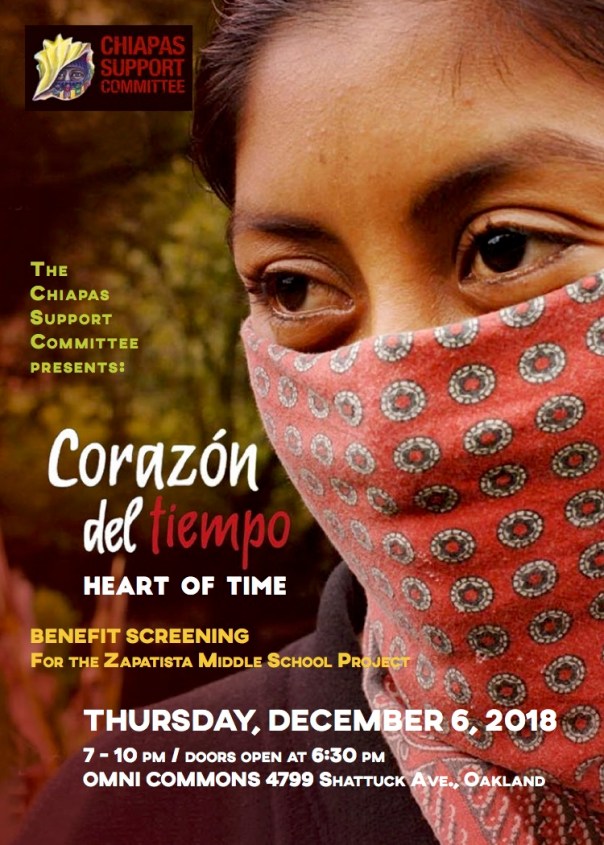
Corazón del Tiempo | Heart of Time is an award-winning feature film about love in the time of Zapatista Resistance. Things get complicated when Sonia, a Zapatista civilian supporter living in an autonomous community, falls in love with Julio, an insurgente (rebel fighter), because she is already promised to Miguel, a young community leader. The film shows how the community deals with this romantic dilemma. Spanish with English subtitles. It was filmed in a Zapatista community in the heart of the Lacandón Jungle of Chiapas, Mexico. The actors are all non-professional Zapatista actors who uncovered their faces and opened their communities for the world to see.
This event celebrates 25 years of Zapatista resistance and is a fundraiser for the La Garrucha Education Project that is building 4 autonomous middle schools in the Zapatista Caracol of La Garrucha. You can help Zapatista children receive an autonomous and decolonized education by attending this event! Food, Art and Zapatista artesanía (crafts) available. Artesanía from Zapatista women’s cooperatives make great Holiday gifts!
JUST CONFIRMED: Emory Douglas, long-time Minister of Culture of the Black Panther Party will speak on Art and Politics!
For more information, please contact the Chiapas Support Committee at enapoyo1994@yahoo.com and/or visit the Facebook page: https://www.facebook.com/events/710090142706908/
EZLN bases of support are in forced displacement
SOCIAL ORGANIZATIONS DENOUNCE: EZLN BASES OF SUPPORT ARE IN FORCED DISPLACEMENT
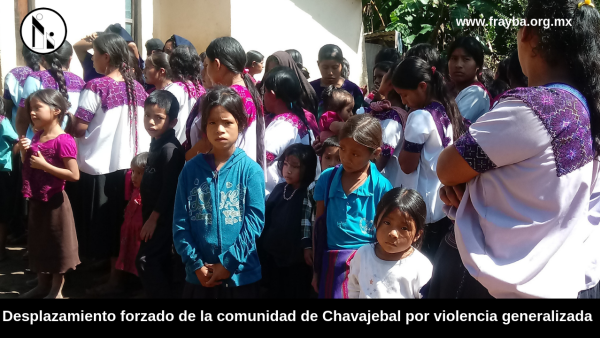
Photo from Frayba Human Rights Center.
Organizations and civil society collectives denounce escalation of generalized violence provoked in the Highlands (los Altos) of Chiapas. Faced with the indifference and inability at all levels of government, the situation becomes more acute and the armed actions of paramilitary groups are permitted. The development of violence is linked to partisan interests in collusion with the State, without forgetting the presence of organized crime in the zone.
Around 7 o’clock at night on November 7, almost the entire population of Chavajebal, El Bosque municipio, began a forced displacement. This happened after the series of events reported below.
Last October 24, four people from this community were ambushed while returning from the municipal capital of El Bosque by car. The ambush resulted in result left two people dead, Miguel Pérez López, the Ejido Commissioner, and comunero Carmelino de Jesús Ruiz Álvarez; one person injured, Manuel Ruiz Jiménez, a municipal agent; and Andrés Méndez Hernández was injured and remained unconscious for 4 days. The two survivors are from the Alianza (Alliance) group, linked to the Morena political party.
In the absence of investigation by the government agencies that are supposed to administer justice in Chiapas, the Alliance group detained 18 members of the PRI and 3 civilian members of the Zapatista National Liberation Army (EZLN) in a community jail.
On November 7, 2018, when approximately 300 people were participating in a community meeting, they heard a detonation and then bursts of gunfire. A woman was injured and a man was killed. The gathering dispersed to seek shelter.
Faced with rumors of armed aggressions, during that night 1,764 people forcedly displaced themselves, looking for paths to the municipal capital, other communities and towards the mountain, among them, all the community’s Zapatista support bases (civilian EZLN members) forcedly displaced into the mountains. Some 50 PRI members locked themselves in their houses but also displaced later. The Morena and PRI partisans mostly gathered in the municipal capital of El Bosque.
The municipal and state governments only provided humanitarian aid in the municipal capital, leaving vulnerable the rest of the people displaced and dispersed in the mountain and in other communities in different municipios. In communities like Tierra Caliente the population itself offered them food, shelter and protection.
No one se dares to return to Chavajebal for fear of aggressions from armed groups that have acted in the region. They abandoned their houses and the animals are starting to die due to a lack of food. It is also the season to harvest the coffee, at risk of being lost, which could cause famine for the next year if the problem is not resolved soon.
The administration of conflicts by the State in the Altos region has resulted in human rights violations against the population of original peoples, in neighboring municipios like Chalchihuitán, Chenalhó, Aldama, Simojovel and Bochil, among others, close to autonomous Zapatista territories. Because of the risk of continued deepening and expanding of generalized violence, the resolution of the problem must be based on dialogue and not on militarization.
Therefore, organizations and collectives of civil society urge: 1) Implementing conditions for dialogue between the parties; 2) Adopting effective measures for guarantying the life and personal integrity of the displaced population personal of the Chavajebal community; 3) Urgently implementing the necessary and pertinent precautionary measures for the purpose of respecting, guarantying and protecting the life and integrity of the families from the Chavajebal community, municipio of El Bosque, upon their return; 4) Guaranty free and social peace in their communities; 5) Generating an independent, autonomous, efficient research process, for truth and justice linked to the criminal acts related to the murders that happened on October 24 and November 7, 2018 in the community of Chavajebal, municipio of El Bosque.
Those organizations and collectives that signed the Urgent Action are listed on the following Fray Bartolomé de las Casas Human Rights Center A.C (Frayba) website:
[1] Chavajebal is also known by its Spanish spelling, Chavajeval, and for the massacre that took place there and in the neighbor community of Unión Progreso on June 10, 1998.
—————————————————————-
Originally Published in Spanish by Pozol Colectivo
Saturday, November 17, 2018
Re-Published with English interpretation by the Chiapas Support Committee
The “drug trafficking economy” in Mexico generates $600 billion per year

Personnel from Mexico’s Defense Ministry (Sedena) take custody of 26 million dollars confiscated from a drug cartel in Sinaloa. Photo: Notimex.
By: Roberto González Amador
A “drug trafficking economy” has been consolidated in Mexico. Each year it generates a gross income on the order of 600 billion pesos, a number that doubles sales of the pharmaceutical industry. The data are part of an investigation into a new development strategy for the country, in which 477 university professors and researchers all over the country participate, promoted by José Luis Calva, of the National Autonomous University of Mexico.
“The resources that organized crime moves through trafficking drugs represent an amount that adds up to the sales of several industries that operate legally in the country,” José Luis Calva explains in an interview with La Jornada.
This week the manifesto “We reconstruct our nation” (Reconstruyamos nuestra nación) was presented, with which con the National Council of University Students (CNU) presents 20 volumes of the collection Mexico 2018-2024: New development strategy. One of those volumes addresses the issue of the drug trafficking economy, as professor Calva calls it.
In a chain that goes from the plants to the local market in the streets, he explains, this “narco economy” generates income to between 800,000 and one million Mexicans that work in that kind of activity. The numbers, because of the very criminal nature of the activity, move in a range that can seem broad, but which is close to reality and that show the magnitude that this activity has reached in the economy, he says.
He cites figures from the US State Department Estado to assert that in the sphere of organized crime: “the sale of illegal drugs generates a gross annual income on the order of 600 billion pesos for Mexican cartels.”
The same source references, Calva explains, that the Mexican drug cartels receive between 19 and 39 billion dollars annually coming from the United States.
To put the number in perspective, family remittances represent an income from foreign currency on the order of 22 billion dollars a year for Mexico, according to numbers from the Bank of Mexico.
“But these cartels also sell drugs in Europe and in Asia, in addition to trafficking in Canada and different Latin American countries. Their trans-nationalization has reached such a dimension that Europol found that Mexican organized crime groups have become global market coordinators in cocaine trafficking in European and US markets and in the production and trafficking of synthetic drugs for the US, European and Asian markets,” José Luis Calva adds.
Hence, he says, the enormous financial ability of the Mexican drug cartels, not only for their accelerated process of capital accumulation, but rather for corrupting officials and infiltrating the structure of all three levels of government.
The first volumes of the Mexico 2018-2024; New development strategy collection were presented Wednesday and Friday of this week in the University House of Books, in the Roma district. On the same days of the following weeks new deliveries will be announced. Information is available at: https://consejonacionaldeuniversitarios.org/
———————————————————–
Originally Published in Spanish by La Jornada
Sunday, November 11, 2018
https://www.jornada.com.mx/2018/11/11/economia/017n1eco
Re-Published with English interpretation by the Chiapas Support Committee
Autonomy, insubordination and the radical Mapuche movement in Chile

By: Gilberto López y Rivas
César Enrique Pineda’s book, The Wallmapu [1] burns: autonomy, insubordination and the radical Mapuche movement in Chile, UNAM-CIALC-Bajo Tierra editions (2018), [2] is singularly relevant within the ambit of research about social movements, original peoples and autonomic processes. It constitutes a rigorous, founded, committed and achieved theoretical-empirical effort to penetrate one of the continent’s most congruent experiences of indigenous struggle: the Arauco-Malleco Coordinator (CAM, its initials in Spanish), the movement of the Mapuche people that, between 1997 and 2003, promoted a process of disputing ancestral lands and the vindication of self-determination and autonomy, in an intense confrontation with the Chilean State, big landowners and transnational corporations.
The work, Pineda points out, proposes to “recuperate, systematize and narrate the history… [of] an extremely controversial collective actor for the Mapuche movement itself, as well as for the Chilean intelligentsia; a subject demonized in the communications media, categorized as terrorist, a radical or subversive group by the State and Chile’s dominant groups.” It attempts to “understand the complex processes of the production of rebelliousness and insubordination, as well as its subsequent stabilization and discipline,” since the Chilean State, responds to this movement “with an aggressive and sophisticated process of disarticulation, containment, social and repressive counterinsurgency that, between 2003 and 2009, would provoke the contraction and weakening of the Mapuche mobilization and, subsequently, the close of the cycle of struggle for land and autonomy.”
The book begins with a prologue from our colleague Raúl Zibechi, which is, in itself, a recognition of Pineda’s valuable contribution: “a work of years,” he says, “in which direct experience, knowledge of the people, communities and geographies, is one of the more notable aspects of a committed and absolutely neutral investigation.”
Pineda clarifies the testimonial component of his work, “which is explained from a socio-historical approach constructed from long and numerous interviews carried out with Mapuches in prison and with activists interviewed in their communities, which is contrasted and put in dialogue with that expressed by various Chilean historians and specialists.” To that is added extensive research in newspapers and the corresponding theoretical interpretations that provide the analytical basis of what was investigated, “from within, from the social struggle, from the perspective of those below.”
Starting with different autonomic processes in Latin America, we agree in the sense that: “the dispute for land, territory and the natural wealth, as well as for self-determination, social self-regulation and autonomy, are the decisive struggles of our time.” At the same time, in that “the original peoples are the heart of numerous anti-systemic alternatives and that, in the last 20 years, have demonstrated an enormous capacity as subjects for construction of an alternative project and resistance in the face of dispossession, contempt and internal colonialism.” Proof in our country is that which constitutes the political process that the Zapatista National Liberation Army initiated, beginning in 1994, and its permanent proposals for the articulation of anticapitalist struggles.
Likewise, the final reflections are very proper in the sense that: “the frameworks of kinship, relationships, affective, ethno-productive, spiritual, symbolic and material, based on the ‘community’ social form, are being activated and updated with indigenous political projects, like resistance and stoppage of invasive expansive relations of the social form of ‘capital’, but also as emancipatory aspiration and practice.” There is total agreement that, in contemporary autonomic processes, the subjects that champion them suffer “true metamorphoses” in their social relations, which empower them, as subjects of change, like “other” political subjects.
As a parallel, his warning about not idealizing these processes is beneficial. “Many times, the author points out, the organizational fabric of these movements is crossed by ideological colonialism, by numerous subaltern contradictions, by dangerous limits and errors; and on occasions, by sectarianisms, essentialisms and fundamentalist millenarianisms; by a profound fragility of their structures versus war, repression or cooptation.” Regarding the latter, it’s possible to observe, also in our country, organizations and intellectuals that have opted for supporting the neo-indigenist policy of the next government, which will be concretized with the National Institute of Indigenous Peoples.
In an academic environment dominated by pointillist and extractivist production, it’s gratifying that books are published for the struggle below and to the left.
[1] The Wallmapu is the name given to the territory the Mapuches have historically inhabited in parts of Chile and Argentina.
[2] Arde el Wallmapu: autonomía, insubordinación y movimiento radical mapuche en Chile,
———————————————————-
Originally Published in Spanish by La Jornada
Friday, November 2, 2018
https://www.jornada.com.mx/2018/11/02/opinion/018a2pol
Re-Published with English Interpretation by the Chiapas Support Committee
Red ‘n’ Blues Benefit Concert
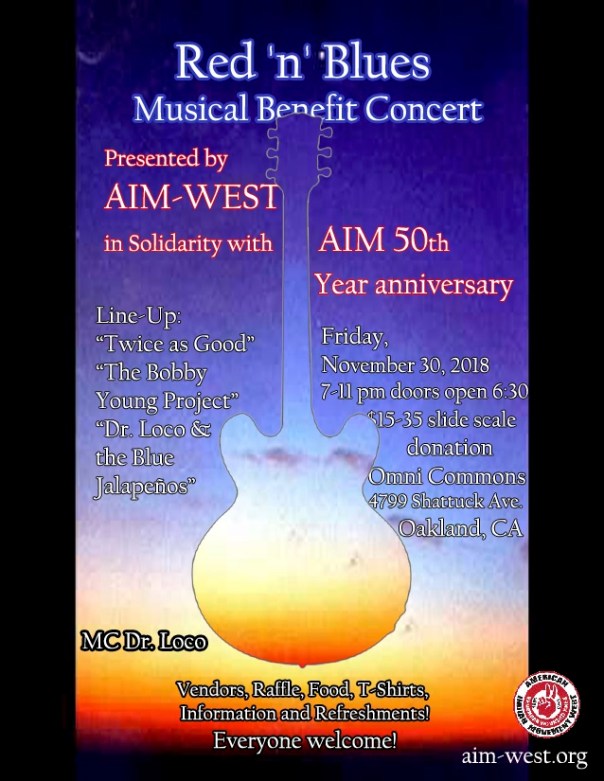
The Chiapas Support is endorsing this concert and we’ll be there to support our brothers and sisters of AIM-West.
Chomsky: Central Americans flee from horror the US created
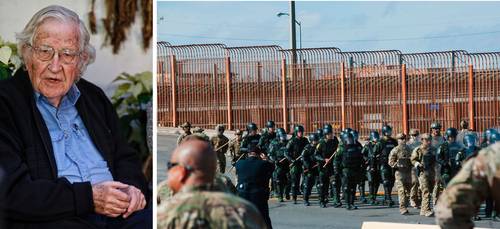
The US linguist, philosopher and political scientist Noam Chomsky condemned the “farce” that the sending of troops along the border with Mexico to contain thousands of migrants that flee poverty and repression represents. Photo: Marco Peláez and Afp.
From the Editorial Staff
Members of the Migrant Caravan are fleeing from the misery and the horrors the United States created, the linguist, philosopher and political scientist Noam Chomsky pointed out in an interview with Democracy Now, in which he emphasized that after the State coup in Honduras, in 2009, that nation became: “the world’s murder capital.”
Amy Goodman, interviewing the academic emeritus from the Massachusetts Institute of Technology (MIT) on the program, emphasized that as President Donald Trump intensifies his attacks and threats against the caravans of Central American migrants that advance towards the United States border with Mexico, his government imposed new sanctions on Cuba and Venezuela, and National Security Advisor, John Bolton, catalogued both nations, together with Nicaragua, as a “troika of tyranny.”
The US intellectual pointed out that such language “immediately reminds us of George Bush’s ‘axis of evil’ speech in 2002, which set the basis for the invasion of Iraq, the worst crime of this century, with horrendous consequences for that nation,” and emphasized that “Bolton was behind that.”
For Chomsky it’s interesting “to see this furious hysteria together with another campaign of amazing propaganda” that Bolton and his colleagues promote about “the caravan of poor and frightened people that flee from the severe oppression, violence, terror and extreme poverty in three countries: principally Honduras, in second place Guatemala and in third place El Salvador, not Nicaragua, incidentally.”
He said that it’s about three countries the United States subjected since the regime of Ronald Reagan (1981-1989). When “Reagan’s terror wars devastated particularly El Salvador and Guatemala, and in second place Honduras, Reagan attacked Nicaragua, but it was the only country that had an army to defend the population. In the others, the armies were State terrorists, backed by the United States.”
The principal sender of migrants is Honduras, which had with Manuel Zelaya a “moderately reformist” president (2006-2009), and overthrown by means of a State coup, condemned by the entire hemisphere, with the exception of the United States. Moreover, Barack Obama (2009-2017) “refused to call it a military coup,” since doing so would oblige him to withdraw financing to the military junta.
Members of the coup called some fraudulent elections, although Obama “praised Honduras for carrying out an election, advancing towards democracy and so forth. Now the people flee from the misery and horrors for which we are responsible,” he added.
In this “farce,” said Chomsky, “the world is looking with absolute amazement: the poor, the miserable, families, mothers and children flee from terror and repression, for which we are responsible, and in response we send thousands of troops to the border. The soldiers outnumber the fleeing children… they are scaring a large part of the country into believing that we are right on the verge of an invasion, as you know, of Middle East terrorists financed by George Soros, and so on.”
It’s a sort of “reminiscence of something that happened 30 years ago,” he said, upon remembering that: “in 1985 Ronald Reagan adjusted his cowboy boots” to call “a national emergency, because the Nicaraguan Army was two days away from Harlingen, Texas, about to overwhelm and destroy us. And it worked.”
In the so-called “troika of tyranny,” just like with the “axis of evil,” they insert nations that “simply don’t obey US orders,” he said, and he warned: “Colombia, for example, has the hemisphere’s worst human rights record in years, but is not part of the troika of tyranny.”
———————————————————-
Originally Published in Spanish by La Jornada
Tuesday, November 6, 2018
https://www.jornada.com.mx/2018/11/06/politica/002n1pol
Re-Published with English interpretation by the Chiapas Support Committee
Zapatistas render homage to Gael García Bernal in the Caracol of Our Lives Film Festival
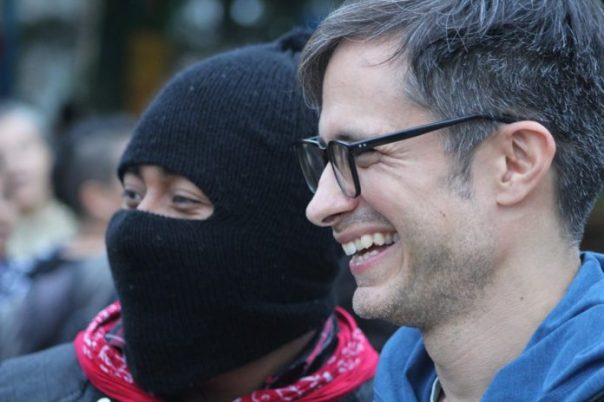
Photo: Radio Zapatista
By the Editors
On the second day of the Puy ta Cuxlejaltic (Caracol of Our Lives) Film Festival in the Caracol of Oventic, rendered homage to Gael García Bernal, Pamela Yates, Ilsa Salas, Marta Ferrer, Rocío Martínez Ts’ujul, Concepción Suárez and Inti Cordera, directors that participate in the Ixmukané category.
Two small Zapatistas were the ones in charge of delivering the recognition to Gael García Bernal for his participation in the Puy ta Cuxlejaltic Film Festival, convoked by the EZLN, which is being celebrated from November 1 to 9 in the Caracol of Oventic, in the Chiapas Highlands.
Subcomandante Galeano announced the attendance of some 4,000 Zapatistas, inside of which are girls, boys, women and men of all ages.
The second day of the festival started with a series of documentaries produced by the “Tercios compas,” a collective that was born in 2014 facing the need to have truthful information and analysis in the Zapatista communities. It’s a large collective of Zapatista communicators that have as their objective breaking the information circle producing materials for their own communities.
Afterwards, the documentary Semillas de Guamúchil, was presented, directed by Carolina Corral, a documentary work that emerge from an investigation carried out by the anthropologist Rosalva Aída Hernández with women prisoners of the Atlacholoaya Prison, in Morelos. The project resulted in the book Bajo la sombra del guamúchil (Under the shade of the guamúchil tree): stories of the life of indigenous and campesina women in prison, the creation of the Sisters in the Shadow Editorial Collective, a radio series and this documentary.
During the day, in the “Pie cinema Maya” installed in the esplanade of the Caracol of Oventic, the little girl called Defensa Zapatista and the little boy called Pedrito, accompanied by other girls and also Esperanza Zapatista, Amado Zapatista, Pablito Zapatista and their reinforcements, Yanileth Zapatista, Adelaida Zapatista, Elaide Zapatista and Subcomandante Insurgente Moisés, gave their “respects,” commemorative clappers and the “Caracol of our lives” to the collectives that make fiction and documentary film.
“As the situation is now in our country an d in the world, life is one of the most fragile things there is… also the Caracol that we are going to deliver,” Subcomandante Insurgente Galeano said.
The following collectives were also honored in the Festival: Oaxaca Cine, Ocote Sign, Water Eye Communication, Koman Ilel, La Marabunta Filmadora, Espora Kolectivo, Paliacate, Aragón Beacon, Eastern Beacon, Indigenous Videographers of the Southern Border Project, Solidarity Collective, SubVersiones, La Sandía Digital, Itinerant Audiovisual Camp.
————————————————-
Originally Published in Spanish by Somoselmedio
Saturday, November 4, 2018
Re-Published with English interpretation by the Chiapas Support Committee
Support autonomous education in Zapatista Territory!
EZLN: “At least 4,000 masked people” at the initiation of the “Caracol of our Life” Film Festival

Chiapas, Mexico, November 1, 2018
Today begins the film festival: “Puy Ta Cuxlejaltic” (Caracol of our Lives), whose first edition will be held in the Zapatista Caracol of Oventik, in the mountains of the Mexican Southeast (with alternate projections in the CIDECI of San Cristóbal de las Casas, Chiapas), from November 1 to 9 as the Sixth Commission of the Zapatista National Liberation Army (EZLN) announced last October 4.
In the festival convoked by the indigenous rebel Chiapanecos you will be able to see films in categories like: Ah, do you fall? Falling and getting up; Dreaming Reality; The storm; Yesterday, Today; Resistance and Rebellion; Sing, Weave, Dance, Play, Count that memory; Meanwhile, there above; No pardon, no oblivion; “We greet you, always”; Look in the Mirror. There were also special sections: Infantile Correspondence and Ixmucané. The original peoples made the different films that will be presented, and there will also be national and international filmmakers.
“This First Film Festival “Puy Ta Cuxlejaltic,” is FUNDAMENTALLY designed for the Zapatista original peoples, for their eyes and the eyes of the people who work in or around fiction film and documentary film,” el Subcomandante Galeano reported in a comunicado. “A Zapatista audience of at least 4,000 masked people are expected in the first days,” the Chiapas insurgent indicated, who will be able to see the films in the movie theaters: Emiliano Zapata 3D Children’s Cinema and the Comandanta Ramona Film Hall; in the Caracol of Oventic, Chiapas.
For the others attending the Film Festival, the organizers report that it is the “Pie Cinema Maya” (where no cars are allowed), it is outdoors and can hold more than 10,000 moviegoers. “The exhibitions there depend on whether it rains or not, and must be seen when it gets dark. That’s why that mega hall will only be used for some exhibitions from 1800 hours (6 PM) onwards,” they point out.
There will also be, thanks to the support of citizen artists, musical activities, theatre, dance, photographic exposition and storytelling, in pavilions installed around the “Pie Cinema Maya,” the former Subcomandante Marcos adds in his comunicado, and they announce the e-mail for attendees to register: festivalcine@enlacezapatista.org.mx
EZLN: “Look and listen from/to below”
“Looking is a way of asking, we, the Zapatistas, say. Or of seeking,” argued Sub Marcos in February 2013, in the comunicado THEM AND US. VI. – GAZES 1. – Looking to impose or looking to listen. “And it’s in the looking where the other appears. It’s in the gaze where fears nests, but also where respect can be born. If we don’t learn to look at each other, what is the meaning of our gaze, our questions: Who are you? What is your story? Where are your pains? When are your hopes?” the Zapatista spokesperson questioned.
In the comunicado THEM and US VI – Gazes, Part 2: Looking and listening from/towards below, the now Sup Galeano wondered: Can we still choose towards where and from where to look? And he pointedly described the sufferings of a working class increasingly exploited and despised.
In the message THEM AND US, VI – Gazes. Part 3: Some other looks, the Zapatista spokesperson stressed that the view from/towards below: “It doesn’t want to convince you yes or no; it doesn’t want to co-opt you; it doesn’t want to recruit you; it doesn’t want to direct you; it doesn’t want to judge-condemn-absolve you; it doesn’t want to use you; it doesn’t want to tell you what you can or cannot do; it doesn’t want to give you advice, recommendations, orders; it doesn’t want to reproach you because it doesn’t know, not because it does know; it does not despise you; it doesn’t want to tell you what you should or should not do; it doesn’t want to buy your old car, your face, your body, your future, your dignity, your will; it doesn’t want to sell you something…”.
“The look that we provoke with this will no longer be that of pity, pain, compassion, charity, alms. There will be joy in those who are like we are, but courage and hate in the Big Bosses. They are going to attack us with all their means,” the then Sup Marcos shared in the comunicado THEM AND US. VI. – Gazes. Parte 5: Look at the night in which we are. (From the new moon to the crescent quarter.) “Yes, I told them. They looked at each other, but said: “We want to look and see ourselves as what we are although we don’t know nor do they know what we are. We want them to look at us. We are ready and willing, we are ready for the Big Bosses,“ abounded the Insurgent about the look.
—————————————————
Originally Published in Spanish by Pozol Colectivo
Thursday, November 1, 2018
Re-Published with English interpretation by the Chiapas Support Committee
EZLN, CNI and CIG: Joint communiqué rejecting the new airport and supporting migrants
Joint Communiqué from the CNI, CIG, and EZLN Rejecting the NAIM (New International Airport of Mexico) and in Support and Solidarity with Migrant Populations
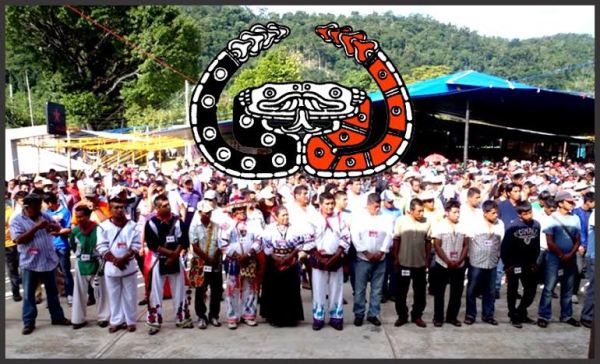
October 26, 2018
To the People of Mexico:
To the People of the World:
To the National and International Sixth:
To the CIG Support Networks:
To the communications media:
The peoples, nations, tribes, and barrios of the National Indigenous Congress (CNI) and the Zapatista National Liberation Army (EZLN) respectfully address the Mexican people and the original peoples and campesinos that wage dignified resistance against the megaproject of death they call the New International Airport of Mexico (NAIM). These peoples have sustained hope without giving up, giving in, or selling out, and they are a light for all of us who dream and work to build justice.
We also respectfully address those who have been forced to seek in other lands what was stolen from them in their own geographies; those who migrate in search of life, as well as those who, without self-interest and in their own ways, times, and means, support those migrants.
-*-
We have seen, experienced, and closely followed the struggle of the peoples of Texcoco Lake and the surrounding areas. We have witnessed their determination, dignity and pain, which have also been ours. We have not forgotten the repression in May 2006 that included sexual torture; the unjust imprisonment of compañeros and compañeras of the Frente de Pueblos en Defensa de la Tierra (People’s Front in Defense of the Land) and of the national and international Sixth; and the murders of our compañero Ollin Alexis Benhumea and 14-year-old Francisco Javier Cortés Santiago. Vicente Fox and Enrique Peña Nieto gave the order for this repression with the full approval of the entire political spectrum from above, including those who today claim to represent “change.”
-*-
Today, with complete disregard for our rights as original peoples, the bad governments claim to consult the Mexican people as to whether they prefer the airport be built at the Texcoco Lake site or in Santa Lucía, but we know that both, through their so-called aerotropolis [1], imply environmental devastation, dispossession of adjacent territories and the commodification of community life. Both options further turn our country into the necessary link for the free flow of transnational capital, facilitating the entry and exit of commodities and the exploitation of everything we have for the benefit of the few. Both options are aimed at setting us more firmly on the path of death that today threatens all of humanity. Both more firmly entrench neoliberal capitalism as our people’s executioner.
The government should not be asking us where to put the new airport. In the face of the millions of people suffering displacement, poverty and repression; the thousands forced to migrate because of the destruction wrought across the world; and our Mother Earth who can no longer withstand the disease imposed on her by capitalism, had they any shame at all, the question would be whether or not we agree to continue down this path that is leading us all toward death, war, and extermination.
We know they won’t ask that question, though, because their path is mandated by the powerful ones who actually rule over them. The NAIM is not the only missing piece in their plan to disfigure the country and shape the tragedy that is only just beginning. Thus our word and our call is to continue to organize ourselves in resistance and rebellion, which is our struggle for life.
We original peoples cannot vote in favor of our own extermination. As much as the bad government might pretend to carry out a referendum (committing fraud, buying votes and deceiving the people of Mexico), this attack on freedom and on the territories that sustain life will not be carried out in our name.
The CNI-CIG and the EZLN reiterate our unequivocal rejection of the construction of the New Mexico City Airport, whether it be built at Texcoco Lake or anywhere else. This project will strengthen big capital and benefit a few tycoons like Carlos Slim, Carlos Hank Rhon, Bernardo Quintana, and Hipólito Gerard Rivero (Carlos Salinas de Gortari’s brother-in-law), or whatever name the capitalist hydra takes on; all of their wealth is based on the suffering and exploitation of millions of us below. This project, like all the other mega-projects imposed in our geographies, is aimed at taking from us what is ours, at the cost of the life of whoever resists.
We recognize, respect, and salute the struggle of all those who, in walking their autonomy, decide whether to participate or not in the so-called referendum on the NAIM, and we call on everyone to unite efforts, to grow and strengthen our unity across our diversity from below in order to stop the destruction of our indigenous, campesino, and urban territories.
-*-
These so-called “megaprojects” are nothing but another element of the system’s war against everything, sowing violence, destruction, and death all over the world and forcing populations to migrate in search of the life that was denied them in their places of origin.
This is the situation of those who today migrate from their Central American territories, who are being attacked, harassed, and slandered on orders from the big boss in an attempt to feed hatred toward difference and extract even more profits from the tragedy it has provoked.
The system pursues today what it provoked yesterday.
Our own tomorrow hovers in the painful steps of these “migrants” if we do not organize ourselves in defense of life.
We have long supported, respected, and maintained solidarity for these sisters and brothers and will continue to do so, however limited our capacities.
Now as before, we will share with these migrants the little that we have in our communities, homes, paths, and territories, and they can count on our encouraging word and dignified rage to ease their path and help them to carry on.
The world does not belong to any flag.
It belongs to all of us who we make walk with our work, who make it flourish, who sow life where the system harvests death; who, like the relatives of those absent from Ayotzinapa, walk the world in search of truth and justice; in other words, in search of life.
Attentively,
October 2018
Never Again a Mexico Without Us
National Indigenous Congress
Indigenous Governing Council
Zapatista National Liberation Army
[1] Aerotrópolis is the idea that the most significant money to be made through the New Mexico City Airport project lies not in the construction contracts for the airport itself, but rather in the larger-scale and longer-term construction of roads, housing, hotels, and industrial and business parks around the airport, as well as plans to link the NAICM to the New Port of Veracruz and other highway megaprojects throughout the country. See http://www.eluniversal.com.mx/columna/salvador-garcia-soto/nacion/aerotropolis-el-gran-negocio-del-aeropuerto
 Chiapas Support Committee