Chiapas Support Committee
Home of the Compañero Manuel blog on zapatistas & mexico
74 Armed attacks against families displaced from Aldama, Chalchihuitán and Chenalhó
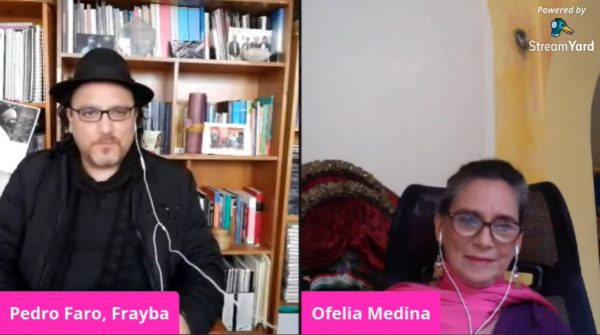
Presentation of the public letter: “Stop the violence in forcibly displaced communities in Chiapas.” Photo: Frayba.
By: Yessica Morales
In the state of Chiapas there are a total of 10,113 victims of forced displacement, paramilitary violence and armed criminal groups that are protected by officials of the state and municipal governments, moved by dark interests and dispossession.
The Fray Bartolomé de Las Casas Human Rights Center AC (Frayba), presented “Preserving life, a public letter: Stop the violence in forcibly displaced communities in Chiapas,” with the participation of Pedro Faro, director of the Frayba, and Ofelia Medina, actress and activist, with the objective of placing forced displacement into evidence, specifically in the Chiapas Highlands (los Altos).
Therefore, they announced that in the month of June and the few days of July, the Permanent Commission of 115 Comuneros and Displaced Persons of Aldama municipality reported 74 armed attacks [1] in San Pedro Cotsilnam, Yetón, Tabak, KoKo’, Xuxch’en, Tselepotobtic, Chivit and the town of Aldama, the municipal seat.
Medina read the letter written by the Frayba and the Trust for the Health of the Indigenous Children of Mexico A.C. (Fideicomiso para la Salud de los Niños Indígenas de México A.C. (FISANIM or Fideo). She expressed her utmost concern about the acts of violence and the urgency in which the people in the situation of internal forced displacement from Aldama, Chalchihuitán and Chenalhó municipalities are living.
Consequently, the organizations demanded justice and a stop to the violence that the Civil Society Las Abejas of Acteal, the Permanent Commission of the 115 Displaced Comuneros of Aldama and the Autonomous Committee of the Internally Displaced Chalchihuite denounced.
“We see with fear that the constant escalation of violence seems to have no end and in recent months the attacks with high-caliber firearms are daily. Previously they fired from distant barricades, now the shots are directly at the campesinos and comuneros when they are going to their crops,” Medina said.
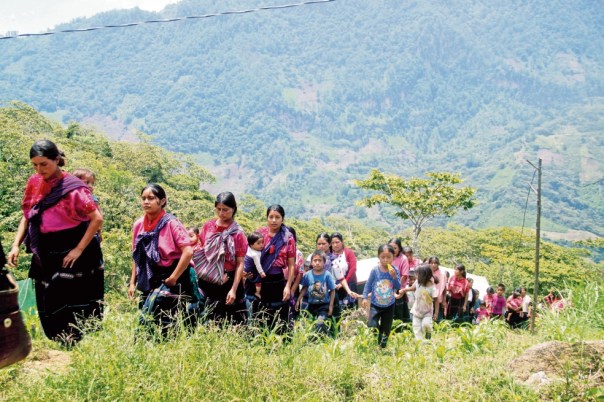
DISPLACED INDIGENOUS WOMEN of ALDAMA. PHOTO: MARÕA DE JES/S PETERS
There are currently a total of 2,036 people who are victims of forced displacement in Aldama municipality. That’s why the CNDH issued recommendation No. 71 /2019 regarding the human rights violations of personal integrity and the superior interest of children, to the detriment of the indigenous communities in Aldama municipality, as well as the loss of life of 3 victims.
The Autonomous Committee of Chalchihuite Internally Displaced denounced 8 attacks in Kanalumtik, at the Tsamtechen and Tseleltik points, the Pom community in the Chacojton section, Cruz Cacanam in Chalchihuitán, and at the Las Limas community limit with Chenalhó.
In the case of Chalchihuitán there are 1,237 people who are victims of forced displacement, the CNDH issued recommendation 87/2018 regarding the victims of internal forced displacement in different communities within Chalchihuitán and Chenalhó municipalities.
They also have Precautionary Measure No. 882-17 from the Inter-American Commission on Human Rights in favor of 10 Maya Tsotsil indigenous communities in Chalchihuitán and one in Chenalhó, which have been forcibly displaced since November 2017.
Regarding Civil Society Las Abejas of Acteal, they revealed the threats and intimidation that the 31 people displaced from Los Chorros experience constantly, besides the inefficiency of the state and municipal authorities of Chiapas, to put a stop to the violent actions in Chenalhó. Thus, Las Abejas of Acteal has precautionary measure CEDH/VARSC/MPC/ 069/2020 from the State Human Rights Commission (CEDH) in file CEDH/ 805/2019.
“The state and municipal officials have extensive knowledge of all of the above, but their response has been scant, slow, inadequate and inefficient since the situation gets worse every day,” the activist said.
In addition, the State Council for Integral Attention to Internal Displacement in the state of Chiapas has not complied with its commitment. They also know that the food emergency among the families in the situation of forced displacement is increasingly more serious.
“As human rights organizations we see the need for the State Executive Commission for Attention to Victims for the State of Chiapas to carry out urgent work to attend to the victims of forced displacement in Chiapas,” Medina said.
On the other hand, the organizations of the displaced communities have had countless meetings and agreements with state and municipal authorities; they have made trips to Mexico City to consult with authorities of the Ministry of Interior, deputies and senators.
Officials from the Undersecretary of Human Rights, Migration and Population have visited the zone, and have held meetings with municipal and state authorities, as well as with representatives of the displaced and the Frayba.
“To date there has not been a solution to the violence,” the actress added. Last May 26, FISANIM and the Frayba stated the urgent need for attention to the displaced communities; due to the pandemic they are in a state of high risk, because of the lack of health infrastructure and a food crisis.
Both human rights organizations demand a stop to the paramilitary violence in Chiapas, and that they recognize, urgently take care of and prioritize the food emergency that the people in internal forced displacement from the communities of Aldama, Chalchihuitán and Los Chorros, Chenalhó suffer.
“We launched this letter and those who are listening to us may join us in signing this letter in order to place into evidence the displacement, but also the efficiency with which the government has already effectively and thoroughly gone to the root of these critical situations that are happening to the communities and the peoples of Chiapas, due to generalized violence and paramilitary violence,” the director of the Frayba commented.
Finally, Ofelia Medina said that we must join in this petition for justice and dignified treatment in accordance with national and international standards. The treatment given to displaced persons in the State is inhumane and undignified, and therefore something must be done.
“There are many proposals, let’s unite the organizations. I am pleased to state that, thanks to the support of Civil Society, that since the conference I gave in San Cristóbal, we have already joined together to bring an offering to the families of the 115 comuneros of Aldama,” she concluded.
[1] Due to the increasing violence against these displaced families, the Chiapas Support Committee is extending our Campaign for Las Abejas: End the Famine until the end of July in order to raise additional funds for food.
——————————————————————-
Originally Published in Spanish by Chiapas Paralelo
Wednesday, July 8, 2010
Re-Published with English interpretation by the Chiapas Support Committee
Chenalhó paramilitaries fire at displaced Maya Tsotsils

Mayor of Chenalhó ambushed, his driver killed
Mayor of Chenalhó attacked, his driver killed
By: Hermann Bellinghausen
The National Guard just dismantled the barricades of the paramilitary-style civilian armed groups of Chenalhó, Chiapas, last May 31; the [paramilitaries] have returned, and so have the shots they fire at the displaced families of Aldama and Chalchihuitán who have lived in shelters and other people’s houses for many months. [1] There had been 65 barricades located in Santa Martha, and they extended to the neighboring municipality of Aldama. Some dated back many years.
In this context, the mayor of Chenalhó, Abraham Cruz Gómez, suffered an attack Monday night [July 6] in which he was injured. His driver, Efraín Pérez, died when he was transferred to San Cristóbal de Las Casas. The aggression was perpetrated near Las Minas community, in San Juan Chamula.
The mayor, from the PVEM, was returning from an official meeting in Tuxtla Gutiérrez. An agreement had been signed on June 4 between the Tzotzil municipalities of Los Altos of Chiapas, in the presence of the Undersecretary of Governance, Alejandro Encinas. However, in recent days, Cruz Gómez “accused” the neighboring municipality of Aldama of “not complying with the agreements,” and thus justifying the attacks that followed. The only aggressor gang has been the one from Chenalhó, and it has never been disarmed.
On May 27, the Fray Bartolomé de Las Casas Human Rights Center (Frayba) pointed out that it was fundamental that violence “provoked by ‘civilian armed groups with a paramilitary cut’ that come from decades of impunity” be deactivated in these territories.
Repeated testimonies of displaced families from both Aldama and Chalchihuitán confirm that in the last week, beginning June 29, the shootings against people in forced displacement are almost every day. The permanent commission of 115 comuneros and displaced persons from Aldama denounced that the place of attack was and is Tojtik, in Santa Martha, where shots are fired with high-powered weapons at the community of Tabak, in Aldama.
In recent days the attack points multiplied in the T’elemax, Colado and Chino sites. Transported in cars and small trucks, the armed Chenalhó attackers entered the 60-hectare territory in dispute with Aldama (the origin of the problem) and fired shots at San Pedro Cotzilnam community, in Aldama. Additionally, cars and passersby, as well as Tabak were attacked from Tulantik, Chenalhó. The Chalchihuitán displaced are victims of a border conflict that has been unresolved for 40 years.
Yesterday, while the president of uses and customs of Aldama, the PRI member Adolfo López, distanced himself from the attack on Cruz Gómez in a press conference, the displaced persons reported new shots from the Santa Marta sector at 6:20pm.
[1] The displaced referred to are members of Las Abejas – They are facing famine. You can help here: https://chiapas-support.org/2020/06/26/campaign-for-la-abejas-end-the-famine/
———————————————————–
Originally Published in Spanish by La Jornada
Wednesday, July 8, 2020
https://www.jornada.com.mx/2020/07/08/politica/016n1pol
Re-Published with English interpretation by the Chiapas Support Committee
This is how they protect themselves from Covid-19 in Zapatista territory
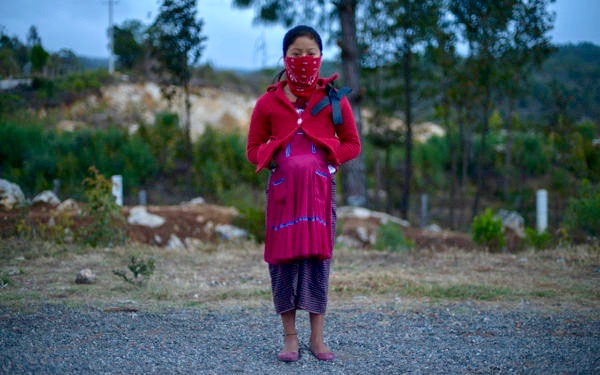
Teopisca, Chiapas. Young Zapatista woman at the international Women’s Gathering in the Caracol of Tulan Kau.
How do the Zapatistas protect their territory from the coronavirus? With a diffuse and extensive territory, the EZLN has bet on prevention and lack of physical movement of the inhabitants.
Text: Orsetta Bellani
Photo: Isabel Mateos
OCOSINGO, CHIAPAS. Doctor Luis Enrique Fernández Máximo learned about the red alert of the Zapatista Army of National Liberation (EZLN) through the Internet. He left the Zapatista autonomous clinic of the community of Las Tazas, where he works, and bought a card that allows him to connect to the web even in the area of the Lacandón Jungle where there is no signal. Since he left Tlaxcala to work with the NGO Sadec (Community Health and Development) in this community, the young doctor discovered that not only did he love the simple life and the nighttime silences of the jungle, but that his real need for connection to the internet is that of a couple hours a week.
It was March 16th 2020, and in Mexico there were only 82 positive cases of coronavirus. Luis Enrique Fernández read on his cell the communiqué from the EZLN:
“Given the serious and scientifically proven risk to human life presented by COVID-19 or “Coronavirus”; given the frivolous irresponsibility and the lack of seriousness shown by the bad governments,” writes the Revolutionary Indigenous Clandestine Committee (CCRI) General Command of the EZLN.
“Given the lack of accurate and timely information about the spread and severity of the virus and the lack of a coherent plan to confront it. Given that our commitment as Zapatistas is to struggle for life. We have decided: to declare a red alert in all of our towns, communities, barrios and in all Zapatista organizational bodies.”
Upon reading the statement, the young doctor thought that the EZLN would invite him to leave their territory. That’s what was done with the other four doctors and dentists from Sadec, who work in four communities of Palenque and Ocosingo. However, that was not the case. His stay was allowed in order to support the only “health promoter”(fem), as those Zapatistas who heal people with plants and western medicine are called.
When the EZLN took up arms in 1994, it reclaimed more than 150 thousand hectares of land, where it constructed systems of government, justice, education and health totally autonomous from the state; this in regions where neither teachers, nor doctors nor lawyers ever arrived. It did this with the solidarity and support of national and international collectives and organizations, among them Sadec. Since 1995, Sadec has collaborated in medical consultations in some autonomous communities, and in training courses for community health promoters, many of whom are, in turn, educators of their own colleagues.
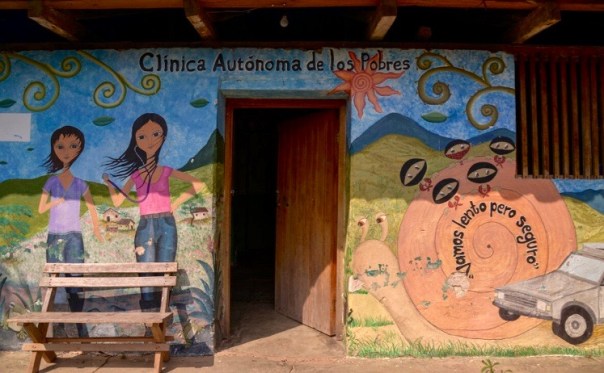
Las Tazas, Chiapas. Autonomous Clinic of the Poor in the community of Las Tazas.
Joel Heredia, the founder of Sadec, says that they learned that health is much more than the absence of sickness; and it has to do with “the ability to feel like waking up, walking, laughing, going to the milpa. Health means that your heart is content, that you feel good about yourself and others.”
At the time the the Red Alert was declared, the EZLN closed all of its Caracoles and the Centers of Resistance and Rebellion (CRAREZ); Paralel to the declaration of a red alert, the EZLN closed the Caracols and the Centers of Resistance and Rebellion; similarly, the “administrative centers” that are the seats of its government and of its largest and most equipped clinics. The health promoters were trained in the prevention of Covid-19; after which they were sent to their own communities, the most remote as well, where there are small autonomous “houses of health.”
“It is a clearly strategic approach: to not have mobility to prevent the spread of the virus, and to have the capacity to provide seasonal, local care at each point where there is a health promoter,” Joel Heredia explained. It surprises me that they haven’t set up an “autonomous Covid Center” to isolate suspected cases. I suppose that making the cold calculation of the costs and benefits that they assume that it wasn’t worth trying to provide care, given the high risk of contagion amongst health personnel; instead they focused on community preventive action. Without a doubt, knowing that in balance, this carries some cost, as people with other illnesses are not being treated.”
The element that most complicates this strategy is that the territory under the influence of the EZLN is not clearly delineated. In it, Zapatistas live side by side with partisans, and it becomes very difficult for the autonomous authorities to exert strict health controls.
“When the coronavirus arrived in Mexico, in the community of Arroyo Granizo the Zapatista authorities called together the whole population, both Zapatista and partisan — in order to discuss safety measures,” Joel Heredia explained. It worked for a few days, and then the ability to maintain vigilance was lost, mostly because of the migrant people who returned.”
As in many corners of the world, one of the greatest concerns of the EZLN is the reception of migrants returning to their communities after losing their jobs in the northern maquilas or on the beaches of the Caribbean. The recommendation of the Zapatista Command is to put them in quarantine.
“We know that the brothers and sisters of some communities, who come from outside, have been isolated. After 15 or 30 days, they re-join their families,” says Comandante Tacho in an WhatsApp audio that was broadcast among the EZLN support bases. “The care you have taken is the right thing to do. This way we are sure that we are avoiding a contagion that could come from outside. We don’t want it for anyone, but we have to take the necessary precautions so that we all come out of this alive confronting this disease that has spread so much in various parts of the world.”
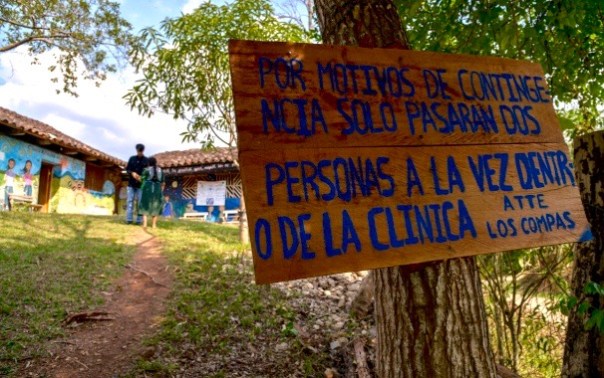
Las Tazas Clinic. The sign read: Because of the emergency only 2 people can enter the clinic at the same time. Sincerely, The Compas.
The Autonomous Clinic of the Poor | La Clínica Autónoma de los Pobres
The autonomous clinic of Las Tazas opened in 1995; and it is located in the zone of Dolores Hidalgo, one of the new Zapatista caracoles announced a little more than a year ago. It is a clay building painted blue, with murals of women with stethoscopes, plants, and covered faces. A plastic banner hung from the outside wall describes the symptoms of the new coronavirus and its preventive measures. Outside a poster warns of the new rules. “For contingency reasons, only two people at a time may enter the clinic. Signed, the compas.”
The Autonomous Clinic of the Poor has a pharmacy; consultations are free, but the medicines have a cost. It also has a dental clinic and a doctor with an ultrasound and doppler machine. The Zapatista health promoter (fem) and the doctor on rotation from Sadec attend to patients every day of the week, afternoon and morning. Prior to the health emergency caused by the pandemic, they also made house visits. They receive some ten patients a day, people from Las Tazas as well as eight other communities.
The service that the autonomous clinic provides is essential to the population of the zone, Zapatista and partisan alike; now the the Rural Medical Unit of the IMSS (Mexican Institute of Social Security) in Las Tazas only opens three days a week, and in the month of May, the doctor only arrived a few days.
“Many people that come to the autonomous clinic had already been at the IMSS clinic, and they arrive asking us if the diagnosis of the other doctor is right,” says Luis Enrique Fernández of Sadec.
Every twenty days, Luis Enrique takes a shift at the autonomous clinic of Las Tazas with Juan Carlos Martínez Vásquez. This is another young doctor originally from Mexico City that, before arriving in the Lacandón Jungle, had no knowledge of Zapatista thought and practice. Although the health promoter helps him with translation, his biggest difficulty is communication in Tseltal, since a good number of the patients don’t speak Spanish.. Thanks to the health promoter, Juan Carlos Martínez came to know the medicinal plants and learned what they don’t teach in universities — to treat the person and not the disease. “If you were to see a promoter speak with a patient one day, it is truly the most human approach that you would get,” he says.
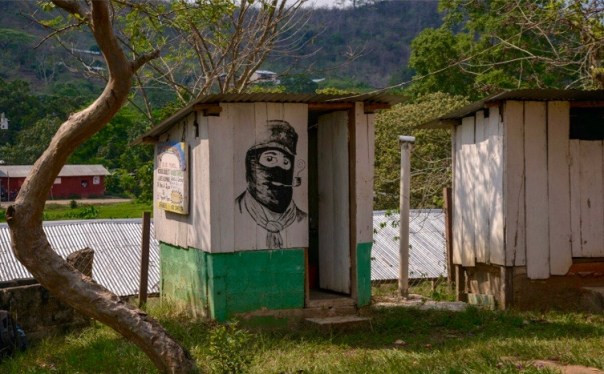
Las Tazas Autonomous Clinic of the Poor.
So far, six patients with symptoms of Covid-19 have come to the Las Tazas clinics, and are sheltering in their homes. The most severe cases would have to be transported to the Respiratory Attention Center opened by the Secretariat of Health in Ocosingo. This is located three hours away.
According to Joel Heredia, founder of Sadec, in Ocosingo and Palenque, attention in the public health system paradoxically improved with the pandemic. “Before, the hospitals didn’t have intensive care areas or ambulances because the people who most needed them were indigenous women who had complications during childbirth.”
“This pandemic let us see the vulnerability of the whole world, even the municipal president or a deputy. It’s not a good thing about the pandemic, but rather the terrible thing about the pandemic,” Heredia concluded.
——————————————————————
This article was originally published in Spanish, on July 4, 2020 by Pie de Pagina. https://piedepagina.mx/asi-se-cuidan-del-covid-19-en-territorio-zapatista/ This English interpretation has been re-published by Schools for Chiapas and re-published with permission by the Chiapas Support Committee
The San Mateo del Mar Massacre
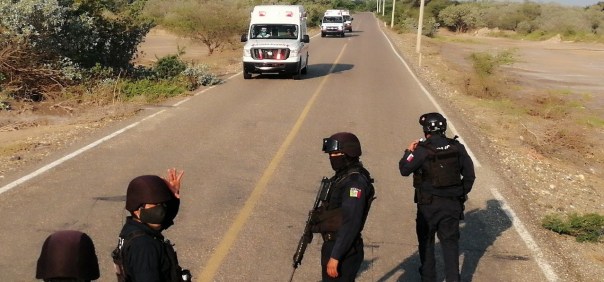
Ambulances arrive at the scene of the massacre in San Mateo del Mar.
By: Luis Hernández Navarro
San Mateo del Mar is in mourning. On Sunday, June 21, a criminal group killed 17 residents, including two women, together in the municipal agency of Huazantlán del Río to hold an assembly. The masked killers ambushed them in the Reforma District, using machetes, gasoline, sticks, stones and firearms. Not content with the attack, they burned several of their victims. Although people called the National Guard and it came, it withdrew when the attack began.
It’s not the first violent attack that defenders from the assembly suffer. Filemón Villalobos, a Huazantlán substitute municipal agent, was just murdered on May 3, without the crime being clarified or justice being done.
San Mateo del Mar is an Ikoot (Huave) municipality with high marginalization, in which live 15,000 inhabitants (6,000 of them in the municipal capital), surrounded with lagoons and seas. It’s located on a narrow bar that separates Lower Lagoon from the Gulf of Tehuantepec, with only a single dirt road for communication. Strong winds hit the region and the entire municipality between October and March. Most of its population is dedicated to fishing (https://bit.ly/31oPLfW).
The municipality has suffered agrarian conflicts for more than 60 years. They were accentuated during the previous decade. Large wind energy companies want to take over that territory. Unlike other communities, in 2008 San Mateo rejected the installation of wind turbines, which individualize possession of land. It opposed the entry of the Preneal wind megaproject. And, together with San Dionisio, it impelled the expulsion of Mareña Renovables, which sought to install more than 100 windmills on the ecologically fragile Barra de Santa Teresa, sacred Ikoot territory (https://bit.ly/31o1yva.
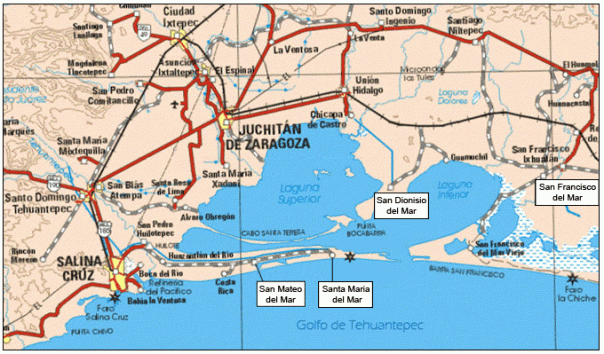
San Mateo del Mar is located on the bar that separates the Lagoon from the Gulf of Tehuantepec.
Since 2017, San Mateo has suffered an electoral political conflict that threatens its internal normative system. The nuclei of residents who head the resistance characterize the aggression they suffer as “a war against the people and their maximum decision-making body, the assembly of the municipal capital and the municipal agencies, presided over by their civic-religious traditional authorities.”
Until that year, municipal authorities were elected by rotation, according to the territorial division of the town and its agencies. However, starting then, as a result of pressure from a citizen who demanded his right to be elected an authority despite not having served in the system of responsibilities, the State Electoral Institute and Citizen Participation of Oaxaca ordered holding elections through a list of candidates. A candidate was imposed with support from business by means of an enormous electoral fraud against the assembly, buying votes. However, the spurious municipal president could not carry the staff of command, nor carry out the duties in city hall, although he disposed of the budget.
In 2019, the de facto powers headed by the impresario Jorge Leoncio Arroyo Rodríguez, repeated the fraud. Now in the administration, they quickly dealt out large public works contracts and the administration of municipal funds. Like his predecessor, Bernardino Ponce, the new municipal president also cannot attend to the responsibilities of his position in the municipal palace.
As victims of the attack report, the builder Camerino Dávalos, Sofía Castro Ríos, Anabel Sánchez Hernández, Emanuel Bustillo (commander of the Only Front of Agencies) and Roberto Rueda Velázquez, among others, make up part of the power group embarked on the war against the assembly,
Additionally, organized crime has encamped in some municipal agencies. They began their activities with the theft of copper cable from the high voltage power line in Santa Cruz. The local bad guys are merely one island of a larger criminal archipelago, which was established and expanded in Juchitán and Salina Cruz with the arrival of Gabino Cué in the governorship of Oaxaca. Drugs, kidnapping, piracy, migrant trafficking and extortion are some of the businesses to which they are dedicated.
On June 23, President Andrés Manuel López Obrador made a diagnosis about the massacre’s origin. “It is –he said– a confrontation over the municipal government; on the one hand there are residents of the municipal capital and residents of communities. It usually happens that in the city halls when there are elections and someone from the municipal capital remains the municipal president; there is discontent in the communities because it is felt that what support arrives in public works or the budget is only applied in the capital and is not distributed in the rural communities.”
In this case, however, the nature of the conflict is different. Those attacked, besides belonging to the municipal capital, also represent other agencies. The massacre is part of the offensive of the behind-the-scenes regional powers, functional to the wind power industry, to dismantle or weaken the organized nuclei that are opposed to the megaprojects and articulate the defense of their territory, natural resources and worldview, and that have advanced in an alliance with their neighbor Santa María. The issue is aggravated due to the construction of the inter-oceanic corridor.
The San Mateo del Mar Massacre must not remain unpunished. There is an urgent need to provide precautionary measures to the community. The town’s mourning must find truth, justice and reparation of the damage.
———————————————————–
Originally Published in Spanish by La Jornada
Tuesday, June 30, 2020
https://www.jornada.com.mx/2020/06/30/opinion/019a1pol
Re-Published with English interpretation by the Chiapas Support Committee
Pedro Uc, language and territory
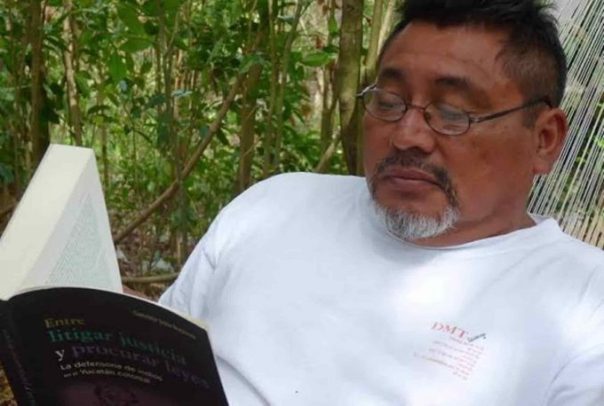
By: Luis Hernández Navarro
Pedro Uc Be is by far one of the most important indigenous intellectuals in Mexico. Maya born in the community of Buctzotz, Yucatan, 90 kilometers northeast of Merida, he is, simultaneously, poet, educator, theologian, translator of the Bible and popular organizer. He has won three awards for poetry and one for narrative.
Last December 16, he and his son were threatened with death. “Now we’re fed up with you, get out of here in 48 hours or we kill you and your old lady together with the pigs of your honorary children,” they told them in WhatsApp messages. “Now you’re going to stop sucking or your people are dying, you are affecting a lot of local people with your blowjobs and your defense of territory.”
Pedro was born in 1963 in the bosom of a campesino family, monolingual in Maya. His grandparents were slaves on a cattle-ranching estate in Buctzotz. He learned Spanish in his community’s public primary school. He continued his instruction in a Presbyterian seminary in Merida, where he trained in theology. Upon finishing, he traveled to San José, Costa Rica, where he took more theology courses and a bachelor’s degree in education in the area of social sciences. He continued studying literary creation in Mayan language at the State Center for Fine Arts in Merida.
In Costa Rica “the scales fell from his eyes,” upon entering into contact with a different church than the one he knew, and with liberation theology. Later on, upon collaborating with Samuel Ruiz and the Diocese of San Cristóbal, he approached Indian theology and became its promoter on the Yucatan Peninsula. In this way, he rediscovered his history, his language and his values. That caused them to run him out of the church.
Starting in 1985, he visited communities on the Yucatan Peninsula; first, to teach workshops on Indian theology and on Liberation theology. Following his expulsion from the church, he gave workshops on human rights with a focus on indigenous law on identity and territory. Since then, more than 35 years have passed in which Pedro has toured the majority of the region’s communities. He has firsthand knowledge of them, from top to bottom.
The teacher Uc Be was initiated into poetry and narrative in Mayan out of necessity and impotence. Reading books about philosophy and economics led him to discover the reasons for marginalization, poverty and the flattening that the poor suffer. The finding caused him a pain that obliged him to name things with the written word in Mayan, narrating what he experienced from work with the communities.
Pedro speaks Mayan. He always has, just like his family. At the end of the seminar he joined a team of specialists that was working on the translation of the Old Testament into Mayan. He participated in the project for two years. The experience allowed him to understand very important things inside the language. He began to translate other texts and write his own. From there, he discovered the philosophical thought that exists in the Mayan language and he realized the enormous wealth that it has.
In 1992, the so-called celebration of the 500 years since the discovery shook him. He responded by turning to the communities to denounce the event. He participated actively in the big national march on October 12 of that year in Mexico City. The experience marked him. Two years later, the Zapatista insurrection impacted him again. His closeness with Samuel Ruiz allowed him to be informed about the uprising and to comprehend its nature. At the beginning of 1996 h became involved in the National Indigenous Congress (CNI, its initials in Spanish). He then turned to constructing autonomy and self-determination in the region, and to building a peninsular organization capable of becoming the backbone of the resistance and reconstitution of the peoples as peoples.
Since 13 years ago, with the arrival of the Mennonites to the region and the cutting down of thousands of acres miles of jungle and planting of transgenic soybeans, Pedro has been committed to the defense of land and territory. The “modernizing” offensive in the region, sponsored by the governments, walked hand in hand with the devastation and dispossession caused by photovoltaic wind farms, pig farms and “green” tourism.
To confront the entrepreneurial invasion, in 2918 Pedro and his compañeros founded the Assembly of Defenders of Maya Territory Múuch Xíinbal. The organization, born of decades of community work, has deep roots, possesses an indisputable regional authority and representativeness, and has harvested important victories against different megaprojects.
The construction of the Maya Train is, according to the poet, a continuation of the assault against the indigenous lands and territories of previous projects. For him, it is an imposition not consulted with the communities. It’s a big grab, in the sense that it dispossesses the peoples of many thousands of acres of land and also of their language and ways of life. The death threat against Uc and his son is a direct result of his active opposition to this colonizing project (https://bit.ly/37RdNRZ).
In talking about his struggle against the Maya Train, Pedro Uc says: “Yes, as Monsiváis says, we are about lost causes. We are accustomed to losing. But it’s not about wining; it’s about struggling. We don’t want to collaborate in our own murder. We want to struggle to avoid it. That is what is in our hearts.”
———————————————————–
Originally Published in Spanish by La Jornada
Tuesday, June 23, 2020
https://www.jornada.com.mx/2020/06/23/opinion/018a1pol
Re-Published with English interpretation by the Chiapas Support Committee
Campaign for Las Abejas: End the Famine
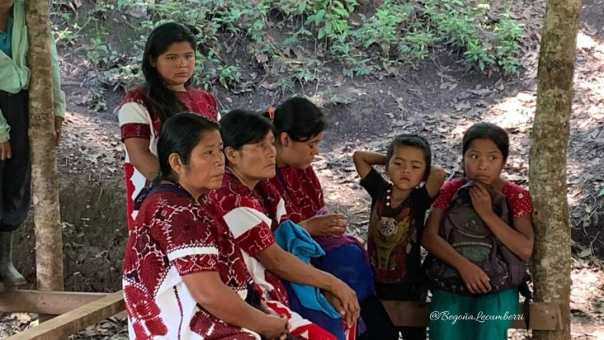
Displaced women and children of Las Abejas of Acteal.
Dear Friends and Supporters,
There is a deepening humanitarian crisis in the Highlands of Chiapas; it involves 3,304 members of Las Abejas of Acteal. We are asking you to join the Chiapas Support Committee in supporting the indigenous people under attack.
For several years, “armed civilian groups” (read: paramilitary groups) have mounted armed attacks against Tsotsil Maya people in the Highlands. These attacks have forcibly displaced members of Las Abejas. They live in crowded conditions in borrowed houses and have been subjected to relentless violence from these paramilitaries.
When armed violence occurs these displaced families flee for safety in the mountains, living outdoors or in caves. Paramilitaries have burned, destroyed and/or shot-up the homes of several families. Living in desolation, the Tsotsil are now facing starvation.
The displaced Tsotsiles are without access to their lands. As a result they cannot plant and harvest their corn, beans, fruits and vegetables. As of today, they have no ability to go out to work anywhere and cannot harvest their coffee, which is one of their main sources of income during the year. And thus, according to the Fray Bartolomé de Las Casas Human Rights Center (Frayba), in the midst of a global pandemic, these displaced persons are on the verge of a famine. These indigenous families belong to Las Abejas in Chenalhó, Chalchihuitán and Aldama municipalities.
The Frayba is asking those of us in international civil society to make a donation to purchase food for the women, children and men of Las Abejas (The Bees, in English) who are displaced from their homes and fields and risk famine.
About Las Abejas | The Bees
Las Abejas of Acteal is an indigenous and Catholic campesino organization in the Highlands of Chiapas belonging to the National Indigenous Congress-Indigenous Governing Council (CNI-CIG).
In an incident so horrific that it shocked the conscience of the world, a paramilitary group called Red Mask (Máscara Roja) attacked Las Abejas members on December 22, 1997 in the community of Acteal while they were praying for peace in a chapel. The Red Mask paramilitaries massacred 45 women, children and men in a murderous episode so depraved that it reminded many of the prolonged civil war in Guatemala, right across the border from Chiapas. The alleged motive for the massacre was retaliation for the refusal of Las Abejas to contribute money for the purchase of weapons to use in an attack against the Zapatista National Liberation Army (Ejército Zapatista de Liberación Nacional, EZLN).
Survivors of the Acteal Massacre were able to identify the killers and, consequently, 81 members of the paramilitary group were sentenced to long prison terms. The evangelical churches to which many of the killers belonged were determined to obtain their release in order to clear the names of their church members and, one supposes, the names of the churches involved. These churches were ultimately successful and the killers were released after serving approximately 10 years of their sentences.
End the famine: dismantle the paramilitaries
Members of the “civilian armed group” currently shooting at La Abejas are thought to be some former members of Máscara Roja who were not identified and sentenced to prison, their children, the children of those who were sentenced and, perhaps, even some of those released. Human rights organizations are demanding that the Mexican government dismantle the current armed group. To date, both the Chiapas state government and the Mexican federal government have failed to take action.
Meanwhile, Frayba says that the current situation of forced displacement poses a grave risk to both the life and health of the displaced, who are struggling to survive with a constant lack of food, no medical attention and the emotional damage caused by the permanent fear and despair of being under attack. Children, women and the elderly are the most vulnerable.
For more information, please see the article by Chiapas journalist Isaín Mandujano on our blog.
Join us in supporting Las Abejas of Acteal!
Please join the Chiapas Support Committee in making a generous donation to purchase food and address the health needs of displaced members of Las Abejas. To make a donation via PayPal, just click on the donate button on our website. (Monthly PayPal donations are also appreciated.) Venmo: @Enapoyo1994. You can also send a check or money order payable to the Chiapas Support Committee to:
Chiapas Support Committee
PO Box 3421
Oakland, CA 94609
Las Abejas of Acteal is a critical organization in the struggle for Indigenous Rights in Chiapas and in the CNI-CIG nationally. Chiapas Support Committee members and the folks we work with in Chiapas will thank each donor from the bottom of our hearts.
In solidarity, peace and justice,
Chiapas Support Committee
Arnoldo Garcia
Carolina Dutton
Roberto Martinez
Jose Plascencia
Evette Padilla
Caitlin Manning
Jason Bayless
Mary Ann Tenuto Sanchez
Federal judge suspends work on Section 1 of the Maya Train
FEDERAL JUDGE ORDERS SUSPENDING WORK on the PALENQUE-ESCÁRCEGA SECTION of THE MAYA TRAIN UNTIL the PANDEMIC ENDS
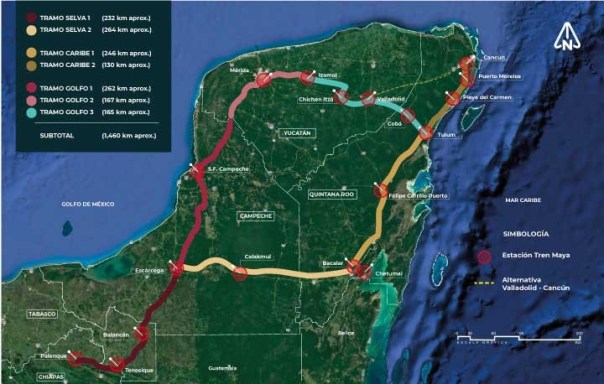
The Maya Train as new infrastructure for connecting the agro-industrial and tourist-real estate capitals on the peninsula. Courtesy: Gasparello and Quintana
By: Isaín Mandujano
A federal judge in Chiapas today granted the definitive suspension to indigenous Ch’ol facing the Maya Train project, for the Palenque-Escárcega section, and therefore the National Fund for Promotion of Tourism will have to stop any work relative to that first section, as long as the pandemic lasts.
The non-governmental organization Indignation, Promotion and Defense of Human Rights A.C (hereafter, Indignation AC), which in legal matters represents diverse indigenous Ch’ol communities in Palenque, Salto de Agua and Ocosingo, announced that with this decision the federal government is ordered to abstain from carrying out acts tending to execute the project called the “Maya Train” on Section 1, which runs from Palenque to Escárcega.
The amparo suit filed before the Second District Judge for Amparo and Federal Criminal Trials in the state of Chiapas was resolved last Monday, June 22, when the court granted a definitive suspension to a group of people belonging to the Ch’ol people from the communities of Palenque, Salto de Agua and Ocosingo municipalities, who found protection against said project.
That civilian body said that on May 7 members of several Ch’ol communities presented a request for amparo against the President of the Republic, the Secretary of Federal Health and the Director General of the National Fund for Promotion of Tourism (FONATUR) because of the issuance of both the Secretary of Health’s April 6 agreement and the April 23rd Decree signed by the President of the Republic.
The continuation of the project called the “Maya Train,” as well as other administration projects, was decided in that agreement, despite the pandemic derived from Covid-19. Therefore, in the request for amparo they argued violations of their right to health, as well as effects on the environment and to their rights as indigenous communities.
That very same May 7, the Second District Judge for Amparo and Federal Criminal Trials in the state of Chiapas decided to grant the provisional suspension, pointing out, among other things, that continuing with work on the so-called Maya Train put the health of the Ch’ol communities of those municipalities at risk, as well as their rights to a healthy environment.
Next, magistrates of the Collegiate Court in Administrative Matters located in Tuxtla Gutiérrez revoked said provisional suspension, “with the implausible argument that the risk of Covid-19 infection to the Ch’ol Maya community derived from work on the train constituted a future act of uncertain realization.”
However, on June 22, “after having deferred the incidental hearing five times because of FONATUR’s refusal to provide information that the Court requested, the Second District Judge for Amparo and Federal Criminal Trials in the state of Chiapas decided to grant a definitive suspension to members of the Ch’ol communities.”
After this judicial decision, the non-governmental organization Indignation AC said, there is now an obligation both for FONATUR and for the companies that won the bidding on that section “to stop all work corresponding to any work that other than maintenance of the existing tracks, until the amparo lawsuit is not resolved.”
Indignation AC explained in a letter that the judge, in order to justify said suspension, reasoned that members of the “self-recognized indigenous communities, inhabitants of the community where the project called the Maya Train will have impact, specifically in the municipality of Palenque, could suffer an affectation to its legal sphere, concretely in its right to health.”
Since the execution of the Maya Train project currently collides with the national health phenomenon caused by the Covid-19 virus, whose existence and dynamic spread is recognized by the “Agreement establishing extraordinary actions to address the health emergency generated by the SARS-CoV2,” which establishes, among many measures, social distancing of at least one and a half meters, and in which it recognizes that its spread is closely related to social interaction”
The judge pointed out that if the Maya Train project were carried out, the fundamental right to health could be exposed, because “it collides with the right to the health of the complainants -and also with the collective-“ given the prevailing health phenomenon in the country, recognized at the national, state and municipal levels, which constitutes a notorious fact, insofar as the diverse General Agreement of March 31, 2020 recognizes the existence of the pandemic and the need to establish social distancing measures.”
Indignation AC indicated that the definitive suspension has the effect of “stopping any activity relative to the implementation of the project, except that related to maintenance of the tracks, until the amparo lawsuit is definitively resolved.”
It said that this suit for amparo has derived information that shows that the project named the Maya Train “is illegal and lacks legal support, as for example the absence of an environmental impact statement on the project, as well as irregularity in the bidding process, in addition to violations of the rights of the Native peoples.”
For this reason, members of the communities warned that they have decided to expand the demand for amparo (protection and suspension) pointing out these violations, which will oblige the Federal Judicial Power to analyze the essence of the project starting with what said communities claim.
——————————————————————-
Originally Published in Spanish by Chiapas Paralelo
Tuesday, June 23, 2020
Re-Published with English interpretation by the Chiapas Support Committee
The Maya Train doesn’t respond to the material and cultural needs of the Palenque population
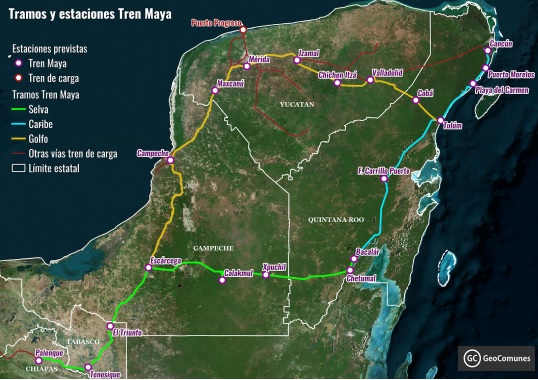
The Maya Train as a new connective infrastructure for the agro-industrial and tourist-real estate capitals on the peninsula. Courtesy: Gasparello and Quintana
By: Yessica Morales
*In the months following the election of López Obrador, they announced data on the megaproject promoted from the Executive; it was the subject of a National Consultation on November 24 and 25, 2018. Of the 946, 081 participants, 89.9 % voted in favor of the project, although before said Consultation, the president came forward to affirm that construction of the Maya Train would begin December 16, 2018. A year and a half later, the Master Plan and the executive projects are still not known and no environmental and social impact evaluations have been released.
Giovanna Gasparello, a Doctor of Anthropology who carried out a research investigation that is ongoing, identifies the possible social impacts of the Maya Train megaproject in three indigenous regions: Northern Chiapas, the east of Bacalar in Quintana Roo and the Maya Jungle in Calakmul, Campeche.
The investigation centers on a diagnosis of the current situation in the territory studied, focusing on the situation of inequality and social segregation, the product of neglect of the population’s fundamental rights. As well as the forms of territorial use and productive activities in the zone; dispossession of land and culture; insecurity and violence determined by the criminal economy; the development of tourist activities; organizational processes, social and cultural structures.
Gasparello reminds us that the megaproject is one of the Executive Priority Projects and Programs led by Andrés Manuel López Obrador. It foresees the construction of a 1,525 km-railway line across the states of Chiapas, Tabasco, Campeche, Yucatán and Quintana Roo, and the operation of a train powered by biodiesel to transport both cargo and passengers.
Therefore, according to official documents and declarations, the line will promote the transportation of gasoline and products consumed in the tourist zone called the Riviera Maya in northern Quintana Roo. Additionally, it will detonate tourist development by facilitating access to poorly connected areas and enhancing the connection between different mass tourist attraction sites with others in development.
The focus of the investigation is on social, cultural and economic processes that interest the municipality of Palenque and the regional space in which it is included.
About 40% of the region’s territory is considered natural area, mostly primary and secondary rainforest; bodies of surface water abound, the result of seasonal flooding from the Usumacinta River, creating particular and delicate ecosystems.
In addition, two of them are protected as Ecological Conservation Zones and under the RAMSAR category: the “Catazajá Lake System” and the “La Libertad Wetlands.” The Palenque National Park is located in connection with the archaeological zone; the Agua Azul Cascades Flora and Fauna Protection Area encompass 2,580 hectares of Tumbalá municipality.
Most of the active economic population is occupied with primary activities. The tertiary activities carried out in the city of Palenque are becoming increasingly important. Among the primary activities, livestock dedicated to the production of milk and beef stands out, and Chiapas is the third largest producer of beef nationwide.
The eastern part of the municipality is inhabited to a great extent by indigenous peoples and land tenancy is ejido. The main productive activity is agriculture for self-consumption in the milpa and parcel rotation system.
At the same time, regarding commercial crops, the main crop is corn, followed by African palm, whose oil is used in the food and cosmetics industry, although the justification for promoting this crop is due to the fact that it was related to the possible conversion of the paste into biodiesel.
The National Council for the Evaluation of Public Policies (CONEVAL) revealed in 2010 that 33.5% of the population is in a situation of extreme poverty, which means a high degree of marginalization.
Gasparello finds that the drug trafficking routes show a daily panorama of assaults, kidnappings, femicides, executions and forced displacement, elements of reflection in the analysis of the reality of several states.
Additionally, the routes of the illegal economy, the mafia control of territory and violent acts draw invisible maps. Palenque has the peculiar characteristic of being a geographic border; it is a short distance from the state border with Tabasco and a just a few miles separate it from the southern border with Guatemala.
The migration route from the Petén in Guatemala is the oldest; migrants cross through Marqués de Comillas, Benemérito de las Américas, Palenque and Playas de Catazajá, to climb on and move with The Beast, the cargo train that arrives in Veracruz passing through Tabasco.
Also, the Salvadoran criminal group Mara Salvatrucha was controlling human trafficking in Palenque, charging migrants for access to the roof of the cargo train and controlling the migratory route stretch from Pakal Na to Arriaga, according to the research study.
The migrants that travel through this route are Africans, Arabs, Chinese, Haitians and Cubans. The corruption of the police and immigration agents who extort them is notorious, as is the practice of community members who charge a fee to let them pass through the community.
In 2014, the United Nations Office against Drugs and Crime registered that Chiapas is one of the states most vulnerable to human trafficking, in particular women, for the purpose of sexual exploitation.
Members of the Casa de la Mujer in Palenque report that local women or migrant women come to their offices beaten and tortured, with documents showing the complaint to Mexican legal authorities, with the promise of follow up and justice, which never comes. A constant in these cases is that the aggressor is involved in drug themes.
Regarding the incidence of intentional homicides, in 2016 the Chiapas Citizen Observatory denounced 24 homicides corresponding to indices of 20 intentional homicides per each 100,000 inhabitants. Starting that year and for the three successive years the indices has remained stable.
The author says that kilometer 0 of the megaproject is located in the Pakal Na district, near the Palenque International Airport. The land is federal and that’s why it has been designated as an urban development nucleus projected for the train.
President Andrés Manuel López Obrador headed an official act on December 16, 2018 that he called the “Ritual of the Original Peoples to Mother Earth for the Maya Train’s Consent” and laid the first stone, officially starting the megaproject.
Currently, around 7,000 people live in the district, it develops along the highway and the train tracks. The old central park strip for small planes is located just at the crossroads between the two roads and next to the railroad station, operated by the Isthmus of Tehuantepec Railroad Company.
Those interviewed in Pakal Na said that each house used to have a well, starting with the connection aqueduct’s water network and they denounced problems in the water supply. The drainage network is not connected, no section is connected to the others and all discharge into vacant ground, canyons, streams and onto public roads.”
On the other hand, regarding electricity those interviewed denounce frequent cuts, perhaps due to the low power of the transformers in the face of an increase in consumption, they affirm that the Maya Train engineer promised the remodeling of the supply system for water and electric power. Finally, a good part of the streets are not paved.
Gasparello points out that during the Covid-19 emergency the Nacional Fund for Promotion of Tourism (FONATUR) announced the start of the construction on the first section of the train, which goes from Palenque to Escárcega [Campeche].
In this stage, FONATUR declared, 850 people would be employed in setting up work camps along with the expected number of indirect jobs; it anticipated mobilizing 2,975 people in the middle of phase 3 of the pandemic, “which evidently… increases the risk of accelerated infection in our municipality and thus the probabilities of death,” reads the text of a court filing against this action.
On May 8, 2020 the response to the demand for a suspension filed by members of the indigenous Maya Ch’ol people in the municipalities of Palenque, Salto de Agua and Ocosingo was made public. It pointed out the violation of the rights to health and life that the start of construction work on the megaproject implies.
On November 15, 2019, almost a year after the start of the project, they announced the call for the consultation process with indigenous peoples who are within the project’s area of influence, regarding participation in the implementation of the project, as well as in the just and equitable distribution of the benefits.
The process resulted in approval of the Maya Train; the percentage in favor was 92.3 % of the total of 100, 940 voters; those who voted YES correspond to 2.78 % of the 3,344,522 persons who inhabit the 84 municipalities where the consultation was held. Sources interviewed said that the traditional authorities and the instances of indigenous collective representation were not invited or recognized.
The researchers say that the analysis they carried out evidenced the continuity of the Maya Train project in the region with the project of the Palenque-Agua Azul Integrally Planned Center (CIPP), also directed by FONATUR. This tourist project includes the construction of a complex regional system of infrastructure for connectivity and lodging for the purpose of developing tourist activity in the region and exploiting the economy tied to the sector.
The Maya Train project proposes reactivation of the CIPP, although it has not explicitly been mentioned yet, the study’s author said. The decree authorizing construction of the San Cristóbal-Palenque highway axis makes clear the connection to the railway project.
Lastly, Gasparello states that Chiapas has shown conflicts and violence in the implementation of any megaproject that doesn’t respond to the material and cultural needs of the local population.
——————————————————————————-
Originally Published in Spanish by Chiapas Paralelo
Monday, June 8, 2020
Re-Published with English interpretation by the Chiapas Support Committee
Tzeltal families displaced for two years demand returning to their communities

Those displaced in Chilón demand justice!
By: Isaín Mandujano
TUXTLA GUTIÉRREZ, Chiapas (apro)
Two years after the forced displacement of which they were victims, some 59 indigenous Tzeltal families from two communities in the municipio de Chilón, demanded that the state and federal governments intervene immediately to put an end to the precarious conditions in which they have lived after being dispossessed of their houses and their inherited wealth.
By means of a letter, leaders of those displaced from Carmen San José and San Antonio Patbaxil communities in the municipality of Chilón, denounced that they have been victims of the injustice and ineptitude of local, state and federal authorities, who have not been able to give adequate attention or provide concrete solutions in actions that contribute to the safe return of the displaced families.
The remembered that as of this Monday (June 8) they have been dispossessed from their homes and lands because of the armed group called “Pechtoneros,” a criminal group from the Pechtón Ic’osilja community in Chilón.
This is a group, they said, which to date has not been dismantled, despite the denunciations made and the initiation of investigative notebooks in the local district attorney general’s office, as of today no advances in this work have been presented to the victims.
And, local authorities have not executed the precautionary measures issued, although we know that they continue sending their reports as if everything is in order.
They denounced the lack of commitment of the different levels of local, state and federal government to resolve the problems of the forced displacement of the 34 families from the community of Carmen San José, as well as the 25 families from San Antonio Patbaxil, municipality of Chilón, Chiapas.
Demands
They warned about the vulnerability of displacement in which the communities of Juan Sabines and Tsubute’el in the municipality of Chilón and the community of Santa Cruz in the municipality of Sitala are found, due to the harassment and threats from armed groups.
They also denounced the lack of responsibility on the part of the Attorney General of Justice to give timely follow-up to the investigative case records and the execution of the orders of apprehension, as well as informing the victims about this follow-up and the non-implementation of the precautionary measures issued to the displaced families.
They stated their concern for the displaced families who are living in inhumane conditions due to the lack of a dignified place to live, the lack of economic resources to acquire food and necessary products, as well as those needed to care for their illnesses.
“Before the Covid-19 pandemic that today afflicts the country, the displaced are groups vulnerable to the lack of spaces to respect a healthy distance,” they said.
They demanded that the state and local government authorities intervene and facilitate the prompt return of the families displaced from the communities of Carmen San José and San Antonio Patbaxil.
They asked that they effectuate the execution of the arrest warrants against the aggressors and the effective implementation of the precautionary measures that the CNDH and the CEDH issued to those displaced since they are vulnerable due to the denunciations they have made.
As well as the restitution of the damages caused by this forced displacement and of which they have been victims for two years and practically forgotten by the local government, but above all they demanded justice, health, food and education for the displaced families.
Those displaced announced this Monday that the peoples and groups in situations of forced displacement should not be victims of the State’s justice system, which prevent advancing in the search for solutions and not achieving justice with strict adherence to collective rights.
They pointed out again that Chilón has been the scene of great Collective Rights violations, of which the Community Government has been both a witness and a victim.
——————————————————-
Originally Published in Spanish by Proceso
Tuesday, June 9, 2020
Re-Published with English interpretation by the Chiapas Support Committee
The invasion of African palm into the Lacandón Jungle
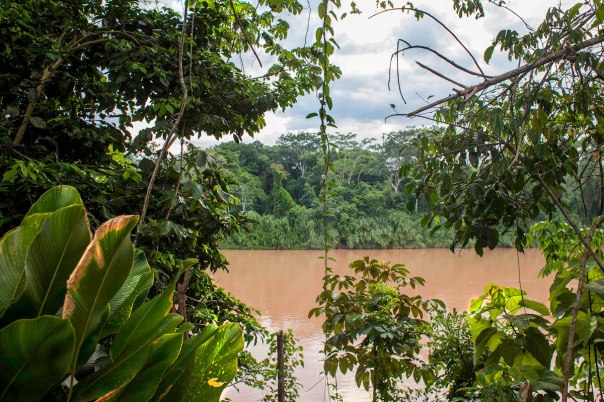
Photo of the Montes Azules Biosphere Reserve, Chiapas..
By: Mongabay Latam
In Boca de Chajul, a small community of Marqués de Comillas municipality, in Chiapas, Rafael Lombera has seen large expanses of the Lacandón Jungle disappear and it has been principally —he says— due to the custom of exploiting natural resources and because of cattle ranching. Today one of the causes is the cultivation of African palm.
When you travel to Chajul, and to the entrance of this small town, you observe signs at the sides of the road that read: “Environmental Services Payment,” a Mexican government program that promotes conservation on private properties or on ejidos. That’s how sections of the jungle dispute the landscape with the parcels planted with African palm.
In the municipality of Marqués de Comillas, according to a study of the National Institute of Ecology, are the only stretches of land in Mexico with flood forests because in the other states, like Tabasco, they have disappeared.
Rafael Lombera’s huts are raised by large wooden supports that allow the passage of waters from the Lacantún River when it comes out to flood its surroundings. This jungle corner is the gateway to the Montes Azules Biosphere Reserve; flora and fauna researchers come there all year. It’s also the region where palm planting began in Mexico, in the middle of the last century.
Changes in the jungle
Most of the area conducive to palm-culture is in southeastern Mexico (two million hectares, according to the federal government), a region to which Chiapas belongs, which has the agricultural and climatic conditions to extend up to 400,000 hectares of palm plantations, a crop destined to satiate the needs of foreign and national markets that demand biodiesel and oils for the food industry.
Rafael Lombera, who has lived in this region since he was a child, just over four decades ago, notices changes in the dynamics of the jungle. He has a clear opinion about what is the biggest threat to one of Mexico’s largest natural reserves: “the jungle is being cut down to sow African palm.”
The cultivation of African palm has been driven by both the state and federal governments. State officials say they do it on land where there is no longer any jungle, land that had already been used for cattle ranching.
In 2017, estimates from the Chiapas Secretariat of the Countryside were that there were around 64,000 hectares planted in the state; the goal is to reach 100,000. For this, the Chiapas government promoted the creation of four palm nurseries that, according to the Institute for the Promotion of Tropical Agriculture, are the largest in Latin America.
Until 2013, the Agro-food and Fisheries Information Service (SIAP, its initials in Spanish) calculated that 44 % of the palm planted in Chiapas was in jungle areas.
Fields without life
The researcher León Enrique Ávila, a specialist in African palm and a professor at the Intercultural University of Chiapas, said that the planting of palm in the state does not include an effective environmental control.
Antonio Castellanos, a researcher at the Multidisciplinary Research Center on Chiapas and the Southern Border, with six years of work with palm producers in the ejidos, said that one of the conditions for receiving support (financial aid) from the Mexican government “is to commit to planting it only as a mono-crop.” Where there is African Palm, there is no more flora.
For Leon Avila the sensation he gets when traveling palm areas is like being in a “desert of silence where there is no longer noise at dawn.” He has walked the region for years and says he has seen how that plant has changed the dynamics of the flora, fauna and communities.
The people who used to live from their crops and the products that the jungle offered them —explained the specialist— now anxiously await the date on which the owners of the factories pay the palm growers and they, in turn, distribute paychecks to their day laborer employees.
The researcher agrees with Antonio Castellanos: the principal flaw is in the fact that the crop has been introduced as a mono-crop. And according to the specialized publication Gloobal, “the thousands of hectares of African palm imply not only maintaining deforestation but also increasing the CO2 and increasing water pollution with agro-chemicals in regions of high biodiversity, such as the biosphere regions (Montes Azules) and the Lacandón Jungle.”
The reality that contradicts the speech
According to the Bank of Mexico, the country imports around 462,000 tons of palm oil per year, which is equivalent to 82 % of the quantity that its industries consume. Therefore, 200,850 hectares are required to produce the supply of oil for the internal market.
The conditions are set for the crop to advance because there are programs that promote the planting of de African palm in the state governments, in the federal government and in foreign funds.
Bárbara Linares Bravo, a researcher at the College of the Southern Border (Colegio de la Frontera Sur, Ecosur), learned about productive reconversion with the arrival of African palm in the Tulijá Valley in northern Chiapas. She observes a strong change that is eradicating productive and self-consumption customs with the arrival of international and national support for propagating palm cultivation.
“The expansion of this crop, paradoxically, in contrast to the discourse of sustainable development that justifies it, increases the social and environmental contradictions,” Linares Bravo pointed out.
The advance of African palm crops in the Chiapas jungle is developed under three commitments the country made with international actors. One of them is the Mesoamerica Project, with 10 adhering nations (Belize, Guatemala, El Salvador, Honduras, Nicaragua, Costa Rica, the Dominican Republic, Colombia, Panama and Mexico) and its Mesoamerican Biofuels Program, within which Mexico established its productive reconversion program.
Additionally, Mexico has 10 palm oil extraction plants; seven are in Chiapas and all are private. Producers organize around them and do what’s necessary to “clean” their lands and earn money —for example— 5,000 pesos ($277 dollars) per month for the all of the corn crop they planted for sale and for consumption, in order to receive up to 35, 000 pesos ($1,862 dollars) each month for the mono-crop, according to the testimony of José Baldovinos, palm grower of Boca de Chajul.
Ant deforestation
Baldovinos has planted 27 hectares with African palm near Boca de Chajul and is ready to add another six. This cultivation permitted facing the medical expenses that he had when his two parents were gravely ill.
Like thousands of residents miles of Marqués de Comillas and the jungle region, Baldovinos came from Michoacán in 1972 in a small plane that landed on a rural road or simply in a clearing among the vegetation. “It was pure jungle then, but has been changing drastically,” he remembers.
The indiscriminate practice of cattle ranching and African palm cultivation began within the ejidos in the 1970s. Fallow lands (“acahuales”) proliferated. They are some spaces of jungle where the ejido owners cut, wait a couple of years and then enroll those lands in financing programs for African palm, thus dodging the “obstacle” that there is jungle. They cut to pave the way to the crop that is profitable for them.
A source from the Chiapas government requested anonymity told Mongabay Latam that currently the main cause of deforestation in the jungle is the logging of “clandestine companies” that work at night.
It is the ant advance of palm in the tropical region that covers most of southern Mexico. According to the testimonies collected by Mongabay Latam, this is how palm crops have grown in Veracruz, Quintana Roo, Tabasco, Oaxaca, Guerrero and Chiapas (the states with soils suitable for growing palm) on lands for cattle ranching, pasture lands, “acahuales” or clandestinely deforested jungle sites.
Exit for residents
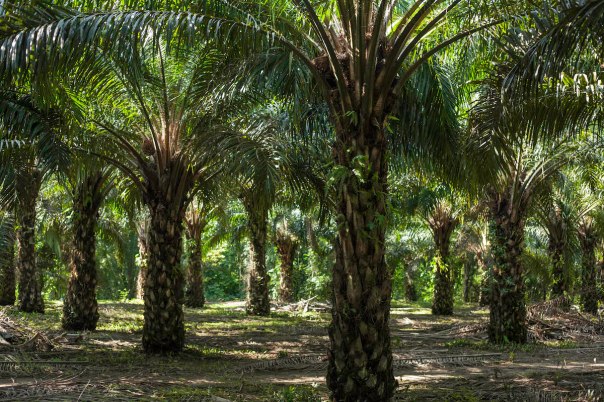
The Africana Palm plantation in Boca Chajul, located on the border with Guatemala, Lacandón Jungle, Chiapas. Photo: Moysés Zúñiga Santiago.
African palm, according to the testimony of Rafael Lombera and José Baldovinos, is the crop that offers the opportunity to get out of poverty to all the campesinos who own small portions of land that are increasing their profits exponentially.
Baldovinos has been a farmer for more than 65 years and only now achieved economic peace of mind. He earns 30,000 pesos per month without major efforts when the rest of his life, working other crops like beans, corn or chili, achieved a minimum part with maximum effort.
The equation is simple: in the Environmental Services Payment program the Mexican Government pays 300 pesos per year per hectare of jungle (in 2017) and one hectare planted with palm in the productive age generates a profit of 100,000 pesos per year.
Rafael Lombera, who is an ejido owner in a jungle section that more people manage, assures that: “the people are getting desperate and are cutting down the jungle to plant palm.”
It’s a logic that runs through the jungle region of Chiapas that stretches along the border with Guatemala, where there are parcels of land that add up to 4,000 hectares, and that supply the factory of the Sustainable Oils Company, according to researchers calculations.
And in Mexican territory there are also producers who monopolize up to 1,000 hectares or small property owners who just begin —like don José in the beginning— to accumulate their first extensions of land. “This is how it’s changing from jungle to palm,” said don José Baldovinos, owner of one of the town’s largest houses.
“The future is palm,” lamented Rafael Lombera, with a lottery game in his hands in which figure photos of animals and vegetables he took inside that jungle thicket that raised up in front of him on the other side of the Lacantún River.
——————————————————————-
Originally Published in Spanish by Mongabay Latam
Thursday, February 13, 2020
México: la invasión de la palma africana en la Selva Lacandona
Re-Published with English interpretation by the Chiapas Support Committee
 Chiapas Support Committee