Chiapas Support Committee
Home of the Compañero Manuel blog on zapatistas & mexico
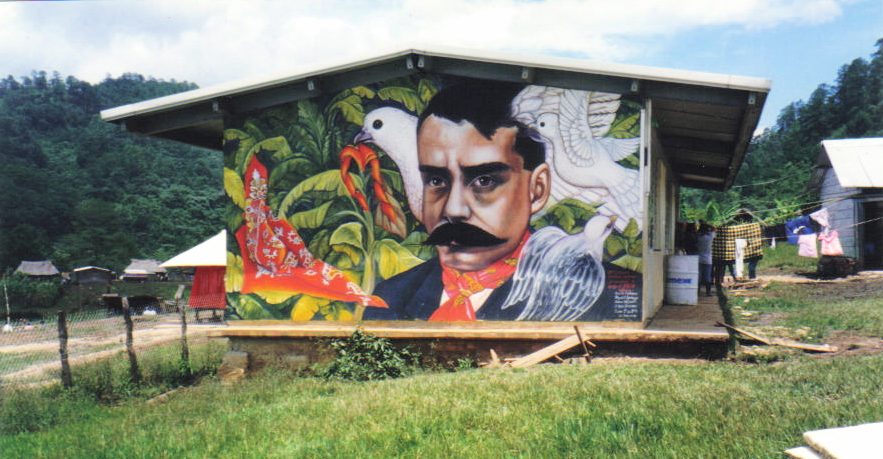
The 4T and the yes or yes for the Train they call Maya
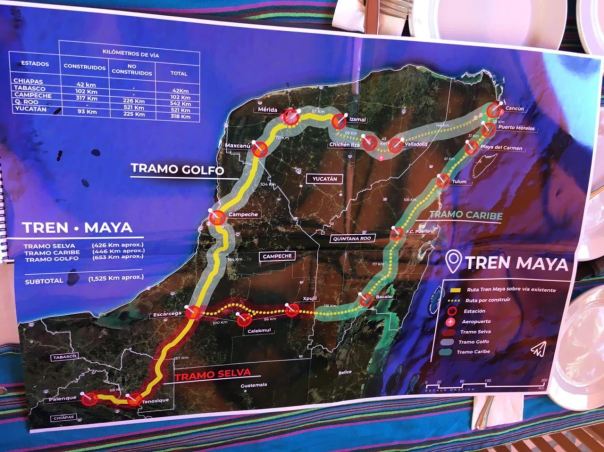
This map shows Tren Maya’s stations in Chiapas, Tabasco and on the Yucatan Peninsula.
By: Magdalena Gómez
The final phase of the meteoric consultation organized by the federal government around the Train that they call Maya will take place on December 14 and 15. There are several substantive considerations that supporting the irregularities of said process. In the first place, an alleged consultation will be held only about a train project, despite multiple evidence that it’s about a plan that entails more than a train and that will imply the construction of real estate and tourist development poles around the stations that are planned on the route through five states: Chiapas, Campeche, Tabasco, Yucatán and Quintana Roo.
Throughout a year mainly Fonatur, with help from the Agrarian Prosecutor’s office, has made efforts and pressures against the ejidos that they should contribute lands for said poles, and both agencies have even stated that more than 90 percent of the ejidos involved have already accepted. They have also peddled the proposal that they be part of the trusts that will be formed and thus be investors instead of selling their land. In the logic of half truths they have enunciated in the call to the so-called consultation that: “the project seeks the integral development of southeastern Mexico and the Yucatan Peninsula starting with territorial planning, preservation of the environment, inclusive economic development, social wellbeing and the protection of tangible, intangible heritage and the historic identity of the peoples of the region.” There is no evidence of such paths.
Thus we have that in the first phase, called informative, they have carried out their formula of regional meetings, at the end of November, in which they have explained to attendees, who they name generically authorities, the goodness of the train. Without conditions for dialogues and agreements, as they point out, for defining distribution of benefits. No environmental impact studies or opinions around the area’s archaeological sites have been distributed. Supposedly, during the next two weeks said authorities would deliberate with their communities to express their posture on December 14 and 15.
A central element of the governmental strategy to ensure the yes or yes to the train, is the definition of the subject of right of the indigenous consultation, it summoned them and added: “As well as the general citizenry of said states, to participate in the indigenous consultation process and day of participative citizen exercise [vote].”
Consequently, “the indigenous communities will be able to participate in both consultations, as ethnicities and as citizens, the head of Fonatur said ( Reforma, 29/11). For his part, Arturo Abreu Marin, the federal delegate in Quintana Roo, pointed out: “Those who attend the public consultation that the National Institute of the Indigenous Peoples will carry out for the Maya Train will have to have roots in the community to consult, regardless of whether they are indigenous or people with blue eyes.”
It’s important to linger on the implication of this criterion. It cost many years of struggle of the world’s indigenous peoples to achieve the recognition of collective rights as peoples, independently of the paradigm of the rights of individuals. They are embodied in international instruments. For that matter, the Maya people have their territory in the five states of the train’s route; it is in that zone where the ancestral foundations of their culture, the archaeological vestiges and the ecosystems that have sustained their relationship with nature are established. It is the indigenous authorities, not the ejido authorities and the citizenry in general, who should be consulted centrally and with whom the project’s terms and implications should really have prior agreement.
The “citizen strategy” is underway, members of Morena and the governors promote participation in favor of the yes vote because they say that their President promotes the train and it will bring jobs and progress to the southeast.
Evidently the computation criteria will be quantitative. Is one community one vote and one person another? Some collectives, organizations like the National Indigenous Congress and Maya communities are defining the rejection of the project. They consider it a joke and gave solid arguments; we are not facing a prior, free, informed or culturally appropriate consultation and they will surely deploy the legal resources and resistance within their reach, but they face a government that like the federal exerts a disproportionate use of its political strength with the support of the governors. For both cases there will be only one question: Does the Maya Train go, yes or no? Those who have considered genuine the will of listening to the indigenous peoples didn’t imagine that yes or yes strategy was being prepared for the Maya Train. Or with their epochal translations: It goes because it goes and I get tired. Hey, the peoples also get tired.
————————————————————
Originally Published in Spanish by La Jornada
Tuesday, December 10, 2019
https://www.jornada.com.mx/2019/12/10/opinion/020a1pol
Re-Published with English interpretation by the Chiapas Support Committee
A WHALE IN THE MOUNTAINS OF THE MEXICAN SOUTHEAST

Sixth Commission of the EZLN
Mexico
December 2019
To the National Indigenous Congress-Indigenous Government Council:
To the people, groups, collectives and organizations of the national and international Sixth:
To the Networks of Resistance and Rebellion:
To film-lovers everywhere:
Considering, first and only, that:
A WHALE IN THE MOUNTAINS OF THE MEXICAN SOUTHEAST
(Creatures and their Creators)
You have no idea how you ended up here in this place, though it seems it’s becoming something of a habit… “The traditions and customs of city folk,” you remember the late Sup Marcos saying. You also remember how annoying he found those sarcastic comments…well, not just those comments. The afternoon has given way to evening. You stop, noticing in the distance a red, five-pointed star at the top of a mountain, with an enormous sign with so many letters that you can’t make out its message. Even more distant, you can make out the blue-gray silhouette of a braying horse with huge, illuminated letters that state, laconically: “TULAN KAW ZAPATISTA.”
At the entrance, the girl who guided you through that first impossible movie theater and her gang of kids approach you. You’re not sure whether to run, pretend not to know them, or freeze and see what happens. Any semblance of a strategy collapses because the girl takes you by the hand and chastises you: “Late again.”
You all cross through a wide flat space that appears to be set up like a county fair. You take a winding route through dozens of different “stations,” each booth with its own light-and-sound show, people dressed up as monsters, circus performers, and trapeze artists; over here there’s someone teaching art, and over there you can hear music, singing and dancing. People crowd together at their favorite “station”, laughing and shouting with delight and surprise, and, of course, taking selfies. At the edge of the path through the stations there’s a huge screen. You’re about to say, “Looks like a drive-in theater,” but a nearby sign reads: “Walk-In Theater. Tonight: Cantinflas and Manuel Medel in Águila o Sol[i]. Tomorrow: Piporro and Pedro Infante in Ahí viene Martín Corona[ii].”
The girl leads you through the zigzagging path. Up ahead, a strange being like a cat or a dog is flanked on both sides by other girls and boys all talking at the same time.
You try to make out what they’re saying, but just then you see a huge banner with the face of…Boris Karloff?[iii] made up like the monster from Frankenstein, with a coffee cup in one hand and a half-eaten sweet bun in the other. The banner’s text repeats an ancient truism: “Nothing like coffee and a snack to bring you back to life.” Farther on another sign reads: “Maxillofacial Surgery. Get your best face and an irresistible smile!” with images of the monster from Alien from the series’ various prequels and sequels. You instinctively evaluate the cheeks from each version and shudder.
Amidst lots of brightly colored lights there is a long mess hall (you can make out signs reading “ZAPATISTAS” and “WELCOME”). You’re about to say that it’s a bit chilly and that a hot coffee and a snack wouldn’t hurt when you see on one of the walls another banner with Edward James Olmos’ face announcing, “Soft-boiled sushi. Origami classes. Pest control. Bow ties. Gaff & Company.” Higher up, as if suspended from the ceiling, there’s an animated image of the geisha from Blade Runner. You pause for a moment trying to guess how such a novelty is possible, but the crowd behind you pushes you forward.
Almost at the end of the winding route of “stations,” there’s a table with a large model of what appears to be a future construction and a sign reading “Theater Project” with a collection box labeled “Anonymous Donations.” Behind an artisan shop nearby you see an image of a Facehugger advertising scarves and sleep eye-masks for sale.
Before you lies a path studded with lights and the silhouette of a large red star, and amidst some rubble, apparently placed there on purpose, flash images of a dystopian backdrop. The flickering lights barely illuminate the forest around you and the mountain above. Instead of individual trees, it’s as if the Zapatistas had strung the entire mountaintop with lights and the trees were merely branches on that great, hulking pine.
You decide that it would be best to turn around; nothing normal happens in Zapatista territory… at least, not to you. Every time you’ve come you’re left feeling somewhat discontent with and skeptical of yourself, and it takes you several days of your regular routine in the city to feel normal again. So you take a few steps back, looking for an opportunity to turn around without the boys and girls seeing you…
But then you see it, and stop dead in your tracks.
You tell yourself you’ve seen everything – that’s what the internet and its bandwidth are for – but what you’re seeing now is so illogical that… Well, you grab your cell phone and try to take a panoramic photo but you realize immediately that it’s impossible. You would need a satellite to capture the whole scene, because it’s clear that all of it is part of a puzzle and that to put it together you’d have to walk… and close your eyes.
But when you open your eyes, it’s still there, an enormous structure. A sort of huge hangar that, in seeming defiance of the laws of physics, extends back until it gets lost in the trees and the moist mountain surface. It’s like a galley whose figurehead is a red, five-pointed star. You wouldn’t be surprised if, in your peripheral vision, tons of small windows opened and dozens, hundreds, thousands of oars came out… and if inside, “writing in the sea [iv],” was the one-armed man of Lepanto.[v] It looks like a galleon, or a whaling ship… No, more like a lost whale who, trying to swim against the current, up the mountainside, has taken a rest among the trees and people—a lot of people, of all sizes and all colors. Even though most of them have their faces covered, their clothes are like a kaleidoscope moving around the great whale, absurd here in its stopover halfway up the mountain, just as everything that happens here is absurd.
No, it didn’t occur to you that this might be the “Pequod,”[vi] but rather the legendary whale from Moby Dick with which Gregory Peck[vii] and Herman Melville were obsessed.
You’ve seen several signs that say “Film Festival,” but you haven’t seen any references to John Huston’s film or Melville’s novel. Then you remember something the Zapatistas once said: “We are speaking for another time. Our words will be understood in other calendars and geographies.” Even so, you are willing to respond with “Call me Ishmael”[viii] if anyone asks your name, but then you notice three large banners covering one side of the structure. On the middle banner, embroidered with images of rope and spears, you read:
Trempülkalwe
“That’s the Mapuche language, Mapudungun,” you hear someone explain to someone else. A little above that line the banner reads “MARICHEWEU! Ten, one hundred, one thousand times we will win.” As if to ratify that statement, ten, one hundred, one thousand masked people swarm around you, Zapatista young people, men, women, and otroas—the rowers on this paradoxical and good-spirited old galley—whose very existence, whose lives, seem to point to a triumph over a past that promised them nothing but death and oblivion.
You encounter this Mapuche cry of resistance and rebellion here in the mountains of the Mexican Southeast. Why does Zapatismo greet that original people in this manner in these lands? Why the effort to take an ancestral history of resistance and rebellion from the continent’s southern tip and plant it here in these mountains—a place called “Tulan Kaw” (“strong horse” in Tojolabal and Tzeltal)—creating an irrational and anachronistic link between two resistances and rebellions with the same objective, the defense of mother earth?
You’re trying to decipher that puzzle when the kid gang pushes you into the belly of the whale…okay, fine, the auditorium. Inside there are lots of wood benches arranged in tiers following the slope of the mountain, and a stage with tables, three screens (the Zapatista version of 3D), speakers, and a bunch of cables spilling out like entrails.
“Wait for us here. We’re going to go get some popcorn,” the little girl tells you. You start to say that you didn’t see any popcorn vendors but the kid gang has disappeared, exiting the belly of the whale…okay, okay, the auditorium. While you wait you look around the inside of the building. There are beings of all sorts on the benches, and on stage are people who, you assume, make films. They are talking about film as if responding to questions that, as far as you can tell, nobody has asked… at least, nobody you can see. Or maybe they’re just talking to themselves.
The little girl and her gang come running back in, all carrying bags of popcorn. The little girl gives you a bag and explains, “I only put a little bit of salsa on them so you wouldn’t get a stomach ache.” The entrance of the kid gang serves like a signal and the rest of the crowd leaves en masse. The people on stage heave a sigh of relief. One confesses, “Phew! Now I remember why I chose to work in film!” Another says, “This is like a horror film mixed with a thriller and a science fiction flick. I fear the screenplay holds nothing good in store for me.” And another adds, “To be honest, I didn’t know how to answer her, she just had too many questions.” “True,” says still another, “it’s like being on trial but without a defense attorney… and knowing you’re guilty.”
The little girl whispers in your ear, “If SupGaleano comes looking for us, you tell him that we’ve been here the whole time, that you brought the popcorn yourself from the city and shared it with us. Even if he’s angry, don’t give in, stay firm! Resistance and rebellion, you know.” Just then you hear over the loudspeaker: “Please report any information or tips on the location of one cat-dog, wanted for theft of strategic material from the office of the General Command. The suspect tends to travel in the company of a gang of kids who… okay fine, forget the kids, but the cat-dog is unmistakable.” The aforementioned, with what you could swear is a mischievous smile, burrows into the little girl’s lap.
You are weighing the wisdom of lying to a Subcomandante when everyone comes back in with fragrant bags of popcorn and takes their seats. From the stage, someone says, “Nobody has any frivolous questions? I mean, to get back to normalcy and make everyone believe that this is a film festival like any other.”
“Would you look at that,” you say to yourself, “a film festival where explanations, reason, and reflection are expected. As if a great big question mark had appeared on the screen and everyone (todas, todos, todoas) was expecting…what are they expecting? The little girl responds with a confession, “See, the thing is, we’re all kind of happy that these people who make film came here, because what if they are sad or their hearts anxious because they don’t know where these things they created ended up? It’s a good point, right? So we invited them to come and tell us if they are okay, or not okay, or depends. Maybe they’ll even start to dance and eat popcorn and their hearts will be glad,” the little girl says with her mouth full and her cheeks stained bright with salsa.
It seems like there’s an intermission, so everyone, including you, leaves the building. To your surprise, there is now a mobile popcorn vendor outside, followed by a long curving line of kids waiting their turn, like a comet with a trail of lights. It looks like there’s another vendor a little ways off, and you can make out another still further away. You get in line and once you have your bag of popcorn you stare in wonder at the absurd movie theater with its rebellious inclinations, challenging all logic and the law of gravity itself…
The mythical Mapuche whale, Mocha Dick, swimming up the mountain, with all these people in its wake… “and mid most of them all, one grand hooded phantom, like a snow hill in the air,” (Moby Dick. Herman Melville, 1851).
The irreverent cetacean as part of the jigsaw puzzle.
Film as something more, much more, than a movie.
As if all this were just part of a bigger jigsaw puzzle, you see a giant poster announcing a dance festival, another about the defense of territory and mother earth, another about an international gathering of women who struggle, another about a birthday, and signs, lots of them, signaling bathrooms, showers, internet, supplies, “a world where many worlds fit,” the Junta de Buen Gobierno (Good Government Council), the Zapatista Autonomous Municipality in Rebellion, the Information and Vigilance Commission… at this point you wouldn’t be surprised to run into Elías Contreras, sitting and smoking outside a hut with “Investigation Commission” inscribed over the doorway.
You detect a lot of loose pieces. There are some people who can only be differentiated from the locals because they have a nametag that reads “National Indigenous Congress” and, of course, they don’t have their faces covered. There are also “citizens” or “city folk,” which is what Zapatismo calls those who live or at least survive in the city. You’re exasperated to realize there are and will be many more pieces. It’s as if Zapatismo has set out to challenge humanity with enigmas…or with the silhouette of a world, another world.
It’s as if your life mattered to someone you don’t even know. Someone for whom you may have done much, or a little, or nothing, but who takes you into account in any case. It’s as if only now do you realize that this “Caracol of Our Lives” includes you and yours…ten, one hundred, one thousand times over.
This piece of the puzzle, film, like life, takes place inside a whale injured on both sides, swimming upstream in the mountains of the Mexican Southeast…
But that’s impossible… isn’t it?
-*-
Given the above, the EZLN’s Sixth Commission invites the men, women, otroas, children, and elders of the Sexta, the CNI, and the Networks of Resistance and Rebellion around the world, as well as those film fanatics who can and want to come, to the Film Festival:
“PUY TA CUXLEJALTIC (“Caracol of Our Lives”)
The second edition of which will be held in the Zapatista Caracol of Tulan Kaw, in the mountains of the Mexican Southeast, December 7-15, 2019.
The film schedule and festival activities will be posted at the Festival.
From the mountains of the Mexican Southeast,
SupGaleano, Chasing after the most terrible mutation of Xenomorph: the Cat-Dog. What? Well, because he stole my popcorn. And film without popcorn is like… how can I explain it? Like tacos without salsa, like Messi without a ball, like a donkey without a rope, like a penguin without a tux, like Sherlock without Watson, like Donald Trump without Twitter (or vice versa)… what? Okay, that was another bad example.
Mexico, December 2019
[i] Águila o Sol (1937): One of the first films starring Mexican comic Cantinflas.
[ii] Here Comes Martin Corona (1952): Mexican comedy Western starring Pedro Infante.
[iii] Stage name for William Henry Pratt [1887-1969], a British actor who played Frankenstein’s monster in the original 1931 film.
[iv] To row. [v] Miguel de Cervantes, whose lost use of his left arm after a suffering a gunshot wound in the naval Battle of Lepanto against the Ottoman fleet.
[v] Miguel de Cervantes lost an arm in the Battle of Lepanto and thus became known as the one-armed man of Lepanto.
[vi] The fictional 19th-century whaling ship that appears in the 1851 novel, Moby Dick.
[vii] Peck starred in John Huston’s 1956 film Moby Dick as Captain Ahab.
[viii] Chapter One of Moby Dick begins with the words «Call me Ishmael,» as narrated by the only surviving crew member of the Pequod.
What is the gringos’ interest in Sonora: drugs or lithium?
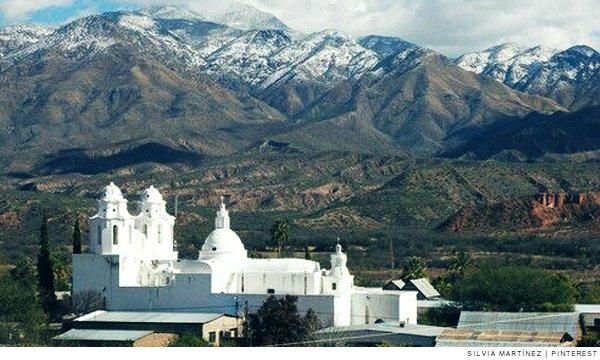
Bacadéhuachi, Sonora. Photo: Silvia Martínez
By: Zosimo Camacho
Will the United States soon stay on the sidelines of the world’s largest exploitation of lithium? Even when this deposit is a few kilometers beyond its southern border? Today, the largest lithium deposit on the planet in the process of being exploited is found in Sonora, Mexico, coincidentally in the direction where women and children of the LeBaron family were massacred.
The unspeakable crime, which occurred last November 4, generated a worldwide scandal and a motive for tension between the Mexican government of Andrés Manuel López Obrador and the US government of Donald Trump. Hurriedly, the latter proposed initiating a war of extermination against the Mexican cartels. The government of Mexico did not accept such a proposal, although it had to admit, “in a sovereign sense,” the participation of the United States in the investigation of the facts. It’ necessary to remembers that members of the Mormon community to which the Le Barons belong have dual nationality: Mexican and US.
So, on Monday November 11, a caravan of 50 FBI suburban vehicles entered Sonora, with an undetermined number of agents, to carry out investigations of the bloody attack. The Mexican government has warned that all the investigative work is done in the presence and with the consent of Mexican authorities. It has also pointed out that members of the FBI cannot carry weapons in Mexico.
Members of the LeBaron family have traveled to Washington to speak with the president of the United States. By means of a letter they have asked that the United States consider the Mexican drug cartels as “terrorists.” Already in the US Congress the Republicans are lobbying for an initiative to approve such a proposal and Trump has announced that he will send another similar initiative.
It’s worth emphasizing that the US legislation justifies the action of troops and agents, both open and covert, wherever there may be terrorist organizations. And it doesn’t even consider it necessary to have the agreement of the governments of those countries.
On the other hand, lithium has become one of the world’s most coveted minerals. It is already the cause of one of the biggest disputes between the economic (and military) powers. As is known, lithium is the main element for the manufacture of batteries and other cell phone accessories, computers, automobiles, electric cars, spaceships, submarines… It is linked to scientific-technological and military development.
Whoever ensures the supply of this mineral will also ensure victory in the arms, economic, scientific and technological race that today has five pointers: the United States and China at the top and Russia, Israel and the United Kingdom in a close second block.
The State coup in Bolivia, where probably the world’s largest untapped reserves are found, may be the result of this dispute, as Bolivia’s deposed president, Evo Morales, has already said.
Last August 30, the powerful Mining Technology group revealed which are the 10 largest lithium mines in the world. In the list, titled the “Top ten biggest lithium mines in the world,” appears the Sonora Lithium Project in unquestionable first place, with proven and probable reserves of 243.8 million tons. https://www.mining-technology.com/features/top-ten-biggest-lithium-mines/
It reports: “The Sonora Lithium Project, located in Sonora, Mexico, is the largest lithium deposit in development.” and it adds: “it is proposed that Sonora be an open pit operation that is developed in two stages with a first production capacity of 17,500 tons per year of lithium carbonate. The second stage would double the production capacity to 35,000 tons per year.” Thus, it’s estimated that they will be able to extract all the mineral wealth in 19 years.
The other nine lithium deposits in the process of exploitation are in Thacker Pass (Humboldt, Nevada, United States), with proven and probable reserves of 179.4 million tons; Wodgina (Port Hedland, Western Australia), with 151.94; Pilgangoora (Pilbara, Western Australia), with 108.2; Earl Grey (Greenstone, Forestania, Holland, Western Australia), with 94.5; Greenbushes (Western Australia), with 86.4; Whabouchi (James Bay, Quebec, Canada), with 36.6 tons; Pilgangoora (Pilbara, Western Australia), with 34.2; Goulamina (Bougouni, Mali), with 31.2 tons, and Arcadia (Harare, Zimbabwe), with 29.8 million tons.
The project in Mexican territory is already very advanced. The concession was granted during the six-year term of Enrique Peña Nieto and exploitation will begin in 2020. But who will exploit it? As we said, Sonora Lithium is located in the municipality of Bacadéhuachi, in Sonora’s High Sierra, in the same region where the LeBarons were attacked and where the presence of drug trafficking has been for decades. Who controls this region is the armed wing of the Sinaloa Cartel: Gente Nueva, Los Salalzar faction.
The company that will exploit it is named Bacanora Minerals. Its headquarters is in Canada; it is listed on the London Stock Exchange but has capital from the governments of… Oman and China. This company has no other businesses or presence in any other part of the world.
Last October 15, the investment of the Chinese company Ganfeng Lithium in Bacanora Lithium was completed. It bought 29.99 percent of the company’s shares and Wang Xiaoshen, Vice President of Ganfeng, was immediately named director of Bacanora Minerals.
It is estimated that the Sonora Lithium Project, with 100,000 hectares, has a value of 1 billion 253 million dollars.
In quiet and under the noses of Uncle Sam, the Chinese are preparing to exploit the most important open pit lithium deposit. The massacre gave a pretext for Donald Trump to put a foot in Sonoran territory. By declaring the cartels “terrorists,” he could put both feet.
Perhaps they are not the oil deposits that the devil wrote for us. With apologies to Ramón López Velarde, the lithium deposits are now revealed as the ones that could attract more demons.
Author: Zósimo Camacho @zosimo_contra
————————————————————
Originally Published in Spanish by Contralinea
Wednesday, November 27, 2019
Re-Published with English interpretation by the Chiapas Support Committee
Nation and national State

A world where many worlds fit.
By: Gilberto López Y Rivas
Discerning about nation and national State and their transformations with neoliberal capitalist globalization necessitates a defining approach to these multi-meaning concepts of the social sciences. The nation would be that stable human community, historically emerged as the form of imposing bourgeois hegemony, that is, its political, economic, social, ideological and cultural predominance over a territory that attracts as the scope of its production and internal merchandise market, including the labor force, also implanting an internal colony on heterogeneous populations in their national ethnic composition.
The national states, in turn, understood as legal-political organizations that have a territory, a bureaucratic-administrative apparatus, an official language, an army and a common currency are formations whose origin and consolidation are related to the preponderance of positive law about what’s usually practiced, the separation between positive and moral law, between art and religion, between religious and political power, between domestic and public economy, as well as the implementation of new principles of legitimacy through a hegemonic system and correlation of classes that are embodied in legal systems (constitutions), citizenship and the feeling of belonging to a national State that gives rise to a determined majority nationality.
The fact that the State is that space where the public life of the subjects is articulated doesn’t mean that all the inhabitants of a territory find representation in their institutions. That’s why it’s so important to distinguish State and nation, as two dissimilar, and, at the same time, complementary concepts. While the former is derived from political, legal and administrative needs and from monopoly needs of “legal” violence to establish the order that a capitalist society requires for its reproduction, the nation is that historical-social construction that gives identity to the State, but exceeds it by being made up of denied subjects considered “the non-nation”.
In capitalism, although the State pretends to be an impartial computer processor of life, it is embodied in institutions and agents belonging to a social class immersed in an instrumental rationality: the exercise of the power to impose its system of exploitation and domination. The national State plays a fundamental role as a coercive political instrument that imposes a double task: to centralize-unify and to centralize-standardize.
Despite being that national formation that, through cultural patterns of the dominant class, also gives identity to official history, the educational institutions, foundational myths, referential imaginaries, language, political borders and “patriotic symbols” retake something of the dominated, because this identity would not achieve the legitimacy that the State requires to maintain itself and get through recurrent crises. Other social and ethnic expressions coexist with histories, traditions, languages and their own identity affiliations that play a decisive role in the forging of nations, with their resistances and struggles of a nature, in many cases, contra-hegemonic. The subject acting in the formation of nations is constituted by classes; that is, by the class struggle. It’s not possible set aside the political will of the different classes in the emerging and subsequent evolution of nations.
Thus, it is necessary to distinguish between statist nationalism and popular nationalism (patriotism), rooted in the very history of nations. We refer to two contradictory and confronted processes. One is the role of the bourgeoisie as a political and military hegemonic force, that is, state, over specific territories, while the other sociopolitical force is that formed by the exploited and dominated classes, sectors of intellectuals and subaltern socio-ethnic entities, immersed in a permanent process of subsisting and prevailing.
In this way, nations can become “bourgeois nations” in socio-historical states of a new type: sheep people. Assuming the criticism of the of the socialist experience in its authoritarian and autocratic variants, the nation could be built and consolidated starting from a system of national hegemony of the oppressed and exploited classes that generically constitute the people, in their classist connotation. With this foundation, forging, from below, a national project, a national unity governed by an unprecedented political ordering of a legal-state nature, constituent, that installs a new relationship with the people, with the peoples, as ethnic entities, with territory, their natural and strategic resources, conquering, in fact and in law, the popular national sovereignty.
This means, in sum, dreaming about the utopia of a nation that is really democratic.
———————————————————–
Originally Published in Spanish by La Jornada
Friday, November 29, 2019
https://www.jornada.com.mx/2019/11/29/opinion/022a1pol
Re-Published with English interpretation by the Chiapas Support Committee
Feminists and original peoples orient our steps

Feminists and Mapuches march in Antofagasta, Chile. Photo: Sandra Cuffe.
By: Raúl Zibechi
The streets of Santiago, Chile remain occupied by thousands of people who don’t abandon them, despite the repression and not because of the pact signed between the government and the opposition to demobilize the protests. We’re talking about the “Agreement for peace and the new Constitution,” which does not guaranty either one or the other and is a showing that politicians continue turning their backs on the population.
On November 14, all the parties of the left and the right, with the exception of the Communist Party, signed an agreement that foresees that in April 2020 a plebiscite will be held in which the population will decide if it wants a new Constitution and if the conventional ones will be half parliamentary and half elected or if everyone should be elected. It also requires that it will take two thirds to approve the agreements.
On the left, the Socialist Party, the Party for Democracy, the Democratic Revolution and the Broad Front signed it, from which dozens of leaders fled who thought that: “it’s essentially contrary to the demands that the different and diverse demonstrations have enunciated in the streets of Chile.”
As is happening in the principle conflicts throughout Latin America, feminists and Native peoples have been the ones who have named the facts most clearly and forcefully.
A communiqué from the Feminist Coordinator 8M rejects the impunity and assures: “this agreement saves a criminal government that has ruled with bloody hands from its own crisis.” It blames President Sebastián Piñera for deaths, mutilations, sexual political violence, torture, kidnappings and disappearances.
The feminists assure that the call for a constituyente in these conditions “is for a new Congress tailored to the parties, tailored to those who caused this crisis and who have administered the precariousness of our lives. They argue that the ultimate goal of the agreement is to remove them from the streets to “become spectators once again.”
The Mapuche world is expressed through three organizations, at least: the Mapuche Territorial Alliance, the Koz Koz parliament and the Mapuexpress information collective.
This collective makes a recap of the damage provoked by the repression, highlighting sexual violence and torture. Therefore it emphasizes that the “peace agreement” was signed within the context of State terrorism, through application of the Internal Security Law of the Pinochet dictatorship. The greatest risk is that the political-business forces that supported the dictatorship and became the majority of Parliament in the democracy end up being the ones who write the new Constitution.
With that name, the Mapuche Koz Koz Parliament commemorates the historic gathering that the Mapuche communities held in the zone of Panguipulli (province of Valdivia) shortly after the end of the war of Chilean military occupation of the territory. Its communiqué assures that the agreement “bets on demobilization and moves away from the possibility of real change.”
It values that it would deal with confusing social movements, since “it only seeks to create a base to continue usurping power.” The Territorial Alliance, for its part, calls to construct an assembly of nations and movements, which can be similar to the indigenous and popular parliament of Ecuador, since it proposes itself as a space for permanent articulation among social organizations.
In my view, the irruption of Native peoples and feminists is modifying the old political culture with greater depth than any ideological debate. The impact is very high and not easy to measure. It offers us a clue that the Mapuche flag is the one most waved on demonstrations and that now no one accepts depending on hierarchical organizational structures, or bends before strong men (caudillos).
Anti-patriarchal women and indigenous peoples teach us the value of collective leadership, rejecting left-wing caciques, the parties and vanguardism.
The priority for organized and mobilized people is the construction of their own secure spaces, with face to face relations of mutual trust, which is of greater importance than abstract programs that have little utility, since when the time comes to put them into action, those same caudillos who wrote them set them aside. The open councils are going in that direction.
As the speeches of Silvia Rivera Cusicanqui, Rita Segato, María Galindo and Women Creating teach, as well as sectors of the Conaie and of Ecuadorian women, there is an explicit rejection of the macho-vanguardist culture of investing all forces to annihilate the enemy.
Since the Zapatista Uprising we debate whether we have to occupy the State to change the world. They ran the debate. An anti-patriarchal and anti-colonial way of doing politics is being born.
———————————————————-
Originally Published in Spanish by La Jornada
Friday, November 22, 2019
https://www.jornada.com.mx/2019/11/22/opinion/024a2pol
Re-Published with English interpretation by the Chiapas Support Committee
Militarization in Mexico Advances with a Red Zone in the South-Southeast
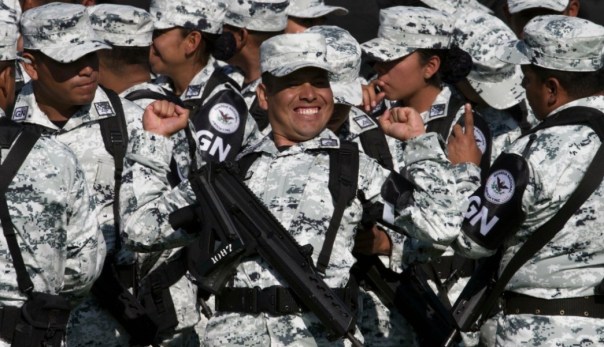
Mexico’s National Guard
By: Eugenia Lopez
Translated by El Enemigo Común
Militarism in Mexico is increasing. President Andrés Manuel Lopez Obrador, along with the commander of the National Guard Luis Ramirez Bucio, at an August 13th press conference shared a document titled “The Situation of the National Guard” detailing the process and deployment of troops within the newly created National Guard.
More than 230,000 total troops
Federal officials announced that the new military police has been deployed throughout the entire Mexican territory, with 58,602 troops under the command of the new force, distributed to 150 General Coordinations.
In addition to these troops are 123,465 military troops from the Secretariat of National Defense (SEDENA), 13,461 from the Marine Secretariat (SEMAR) in permanent deployment for public security tasks, 14,852 troops from the Federal Gendarmerie Forces and 20,584 troops from the Federal Police in “voluntary” transition to the National Guard.
The total amount will be 231,964 troops that will be patrolling throughout the entire nation.
Military Training
The training received by the troops within the National Guard is being conducted with the guidance of the Army and the Marines. “SEDENA and SEMAR are taking lead of the National Guard, accompanying its strengthening.” Declared the Mexican President during the press conference.
In terms of training, Luis Rodriguez Bucio clarified that a course for veterans entering the National Guard has been designed, as well as a course for new personnel. In addition they informed the public that in order to train new troops courses are being developed by the Heroric Military College, as well as in the Military Sargeants School.
With regards to the course materials covered, Bucio clarified that it would be “Primarily Human Rights, attention to victims of crimes, gender perspective, and culture of legality”. With this information the officials assure that the government in turn intends for train troops who can guarantee peace and security for the Mexican population.
Many organizations and diverse sectors of civil society however have little confidence in the initiative.
“The country’s armed forces are created for war, not for public security, and they have committed serious civil abuses with generalized impunity” affirmed the organization Human Rights Watch in a communique.
“They have also not accomplished reducing violence in Mexico and it is possible that in fact, they have been a key factor which has contributed to the drastic increase in homicides these past years.” Added the international organization.
According to a study conducted between January 2007 and June 2017 by the Mexican Commission for the Defense and Promotion of Human Rights (CMDPDH), the armed forces, the Army and the Marines were the security institutions which had participated in the most serious violations to human rights such as torture, disappearances, and executions.
Luis Ramirez Bucio U.S. Army School of the Americas Graduate
It is important to note that the now commander of the Nacional Guard Luis Ramirez Bucio is a graduate of the U.S. Army School of the Americas (today named the Western Hemisphere Institute for Security Cooperation) located at Fort Benning in the state of Georgia in the USA.
This school has trained tens of thousands of troops from throughout Latin America in tactics for counter insurgency, torture, espionage, and intelligence. Its graduates have participated in all of the counterinsurgent operations carried out in Latin America during the last 8 decades.
More state and municipal police with military training
Lopez Obrador declared that the 150 coordinations with reach their total complete amount of 266 by next year.
He also clarified that in addition to the National Guard at a federal level, the government wants to increase the the number of state and local police in the entire country. The new recruits will receive training by the Army and the Marines.
“There is a funding packet which is for security, and what we are proposing is that this fund, which is approximately 10 billion pesos for States and municipalities be used to contract additional recruits and that we reach and agreement so that SEDENA and SEMAR help us in the training of these new recruits. So that this way in act together in a coordinated fashion, and we strengthen the presence of security elements.” Clarified the president.
Red Zone in the South-Southeast
In terms of the distribution of the troops throughout the national territory, Luis Ramirez Bucio clarified that the bulk of the General Coordinations are located in the south and the southeast of the country as well as in Mexico City and the State of Mexico.
In Chiapas there are 11,958 troops distributed within four coordinations; in guerrero there are 10,732 troops in seven coordinations; in Oaxaca there are 10,445 troops in nine coordinations, and in Veracruz there are 13,702 troops in eight coordinations.
We can also see that in the Yucatan Peninsula which includes the states of Tabasco, Chiapas to Campaeche, Yucatan and Quintana Roo, which represent relatively low crime rates a total of 27,052 troops have been deployed.
In comparison, states with much higher crime rates, which are experiencing open war situations within criminal organizations received a much lower amount of troops: 4,053 arrived in Durango, 6,401 arrived in Sonora, 7,279 arrived in Chihuahua, 5,550 arrived in Baja California, and 4,535 arrived in Nuevo Leon.
All of this indicates that the newly created National Guard will be used more to ensure the development of mega-projects driven by the current administration, as well as to surveil the indigenous communities resisting to conserve their territories, rather than to protect citizens.
In fact in Chiapas, the Zapatista National Liberation Army (EZLN) announced this past 17th of August that they have created 11 additional Centers for Autonomous Resistance and Zapatista Rebellion (CRAREZ)
“Regardless of military patrols, regardless of the National Guard, regardless of the counter-insurgency campaigns disguised as social programs, regardless of the oblivion and devaluation, we have grown and become stronger.” Assured the EZLN.
The Trans-Isthmus Corridor in Oaxaca and Veracruz and the Maya Train on the Yucatan Peninsula are priorities within the current president’s agenda, as well as hundreds of other mining, hydroelectric, wind energy, and other development projects throughout the South-Southeast of the country.
——————————————
Originally Published in Spanish by Avispa
Sunday, August 25, 2019
https://avispa.org/avanza-la-militarizacion-de-mexico-con-foco-rojo-en-el-sur-sureste/
Re-Published with English interpretation by El Enemigo Común (The Common Enemy)
Consultation for the Maya Train will start December 14
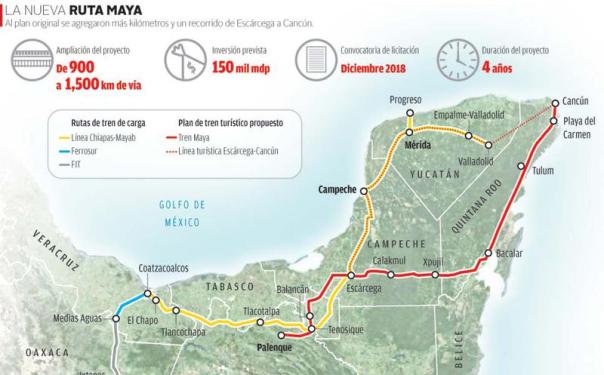
Route of the Maya Train.
By: Chiapas Paralelo
* It will be the National Tourism Fund and the Secretary of the Treasury who will analyze the final cost, but it is estimated that the figure will be between 120 and 150 billion pesos. It’s worth remembering that, according to what the institutions say, 90 percent of the investment will come from private investment and the remaining 10 percent from public resources.
The Government of the Republic, through the Official Newspaper of the Federation, reported on the process of consulta (voting) with the indigenous communities close to the Maya Train project. In Chiapas, it will be held December 14 in Palenque.
Rogelio Jiménez Pons, Director of the National Fund to Promote Tourism (Fondo Nacional de Fomento al Turismo, Fonatur), reported that negotiations with owners of ejidos close to the tracks of the Maya Train have been complicated in recent months, and therefore they have postponed times for the start of construction.
Fonatur detailed last July that the consultation for populations close to the Maya Train would be held no later than this October. However, that didn’t happen.
Chiapas will be the first state to hold both the information and also the voting phases, since the Chol and Tseltal communities will be consulted in Palenque about this project, with an assembly on November 29 and the execution of the vote on December 14.
Given that, they invited the authorities and institutions representative of indigenous municipalities and communities belonging to the Maya, Ch’ol, Tseltal, Tsotsil and other indigenous peoples, from the states of Chiapas, Tabasco, Campeche, Yucatán and Quintana Roo, located in the area of influence, as well as the general citizenry of said states, to participate in the Process of Indigenous Consultation and Day of Participative Citizen Exercise About the “Maya Train Development Project.”
The process of Consultation with indigenous communities will be held from November 15 to December 15, 2019, through Regional Consultation Assemblies. The day of the participatory exercise [vote] will be December 15, 2019.
The federal government commented that this process of consultation has the objective of establishing a dialogue with the indigenous peoples and communities for the purpose of receiving their opinions about the “Maya Train Development Project,” as well as agreements with the indigenous peoples and communities that are in the Project’s area of influence, with respect to their participation in the implementation of said project, as well as in the just and equitable distribution of the benefits.
Before executing the consultation, authorities decided to establish 15 regional assemblies, which would be held on the days of November 29 and 30, where they will deliver an executive summary of the project in question and the community consulted will have the right to request additional information at any stage of the consultation procedure.
It will go to a deliberative stage, in which representatives of the indigenous communities could hold assemblies or meetings with their members for the purpose of reflecting on the information received and constructing proposals, suggestions or approaches about the “Maya Train Development Project.”
The Maya Train intends to travel 1500 kilometers in 5 states of the country, on its route it will pass through: Cancún-Tulum-Bacalar-Xpujil-Escárcega-Candelaria-Palenque. On the other hand, with the extension the new route would include Palenque-Candelaria-Escárcega-Campeche-Mérida-Valladolid-Cancún.
The schedule of information meetings and voting days can be found at the following link (in Spanish): https://www.chiapasparalelo.com/noticias/chiapas/2019/11/consulta-por-tren-maya-iniciara-el-14-de-diciembre/
——————————————————————-
Originally Published in Spanish by Chiapas Paralelo
Sunday, November 17, 2019
Re-Published with English interpretation by the Chiapas Support Committee
Invitation to a Gathering in Defense of Territory and Mother Earth
“Our fight is not for power, our fight is for saving Mexico.”
To the peoples of Mexico and of the world:
To the national and international Sixth:
To the CIG support networks:
To the press:
Capitalism is a world economic system that has, since its birth, operated against human life and our Mother Earth. Its logic of accumulation and profit can only be reproduced through the ever-increasing exploitation of human labor and permanent dispossession of the land and territory of all of the peoples of the world, especially original peoples.
In its current neoliberal phase, capitalism takes on ever more monstrous forms, declaring open war against humanity and the earth, our mother. Its current economic model is based on the global reach and dominance of financial capital over peoples, nations, and entire continents. Sustained by massive military and extractive industries, this system’s insatiable logic of capitalist accumulation and consumption is fueled through real or fictitious wars, the proliferation of organized crime, as well as foreign invasions and coup d’états, putting the very conditions for human existence on the planet at risk.
Furthermore, the current system has intensified the patriarchal organization it inherited from previous systems and civilizations, becoming a violent enemy not only of humanity in general but of women and our mother earth in particular. That is, the exploitation of and deep structural violence against women are characteristic of capitalism, although they were born before it. Private property, the basis of the capitalist system, can’t be understood or explained except as part of a patriarchal system of domination over women and the earth.
The capitalist system dominates Mexico and all other countries of the world, and not even those governments that proclaim themselves to be leftist or progressive can escape the reality of a destructive system that is driving humanity toward the abyss. Thus a clear anti-capitalist and anti-patriarchal defense of human life, of our peoples’ territories, and of the earth are urgent.
As part of this immense task, we invite you to a:
Forum in Defense of Territory and Mother Earth
To be held December 21-22, 2019, in the Caracol JACINTO CANEK (CIDECI in San Cristobal de las Casas, Chiapas, Mexico), centered on the following discussion topics:
- A Diagnostic: Environmental Devastation and the destruction of Mother Earth under contemporary capitalism
- Increasing Aggressions: The dispossession of indigenous, rural, and urban territories; the dispossession of common resources; wars of occupation; extractivism; and organized crime
- Capitalism and Patriarchy: Structural violence against women and mother earth
- Our Struggle for Life: The construction of anticapitalist and anti-patriarchal alternatives
Sincerely,
November 2019
For the Full Reconstitution of Our Peoples
Never Again a Mexico Without Us
National Indigenous Congress / Indigenous Governing Council
Zapatista National Liberation Army
Detention of migrant children will set a record
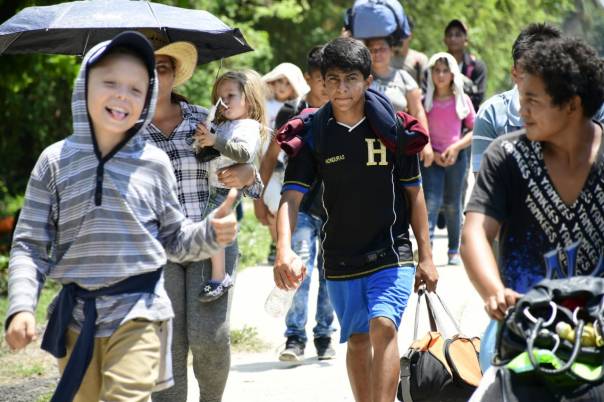
Children in migrant caravan. Photo: Darinel Zacarías
Mexico’s National Human Rights Commission (CNDH) expressed to the Inter-American Commission on Human Rights (IACHR) the lack of protection and attention to child and adolescent migrants and warns that this year the number of detentions of migrant children will set a record.
In general, the National Migration Institute (INM) reported that from January to August 2019, 97,537 people have requested immigration procedures. Of that total, the largest percentage is from Guatemala, followed by Honduras, El Salvador, Cuba and Nicaragua.
The authorities contemplate Chiapas as the principal entrance for migrants to the country; given this, Edgar Corzo Sosa, Fifth Visitor General of the CNDH, explained to the maximum authority about the issue that it’s necessary to exhort the governments of Mexico, the United States and the Central American countries to adopt actions so that the dignity and superior interest of childhood and adolescence prevail in the context of migration.
Given that, Corzo Sosa warned that this year would be the one that has detained the greatest number of girls, boys and adolescents. Since last July childhood events reached 38,581, which represented an increase of 21% with respect to the previous year, emphasizing that 8,744 were unaccompanied minors, and thus it is estimated that the number will exceed the number of detentions in the last five years.
Corzo Sosa indicated that as regards the child migrant that passes through Mexico, it is appreciated with concern that the practice of admitting and maintaining the girls, boys and adolescents continues, both accompanied and unaccompanied, in migrant enclosures, while being necessary to give priority to alternatives, under the consideration that detention should always be the last resort to consider.
Additionally, the National Commission stated its concern about the continuing practice of admitting and maintaining unaccompanied underage minors in migratory stations, which has been observed in the verification visits that are made on a daily basis to the migratory enclosures, in spite of the recommendations and precautionary measures that those places are not adequate for child migrants to stay in-
“They go against the legal norms for the protection of childhood and from a human rights perspective there is no justification for that vulnerable group to remain detained because of lacking documents to travel in the country” the Fifth Visitor said.
Similarly, he proposed that there be a pronouncement between the Universal and Inter-American Human Rights Systems on migrant children, in which the Rapporteurs for Migrants and the Committee on Migratory Workers, of both the UN and the IACHR participate, and that can expand to other international organisms. He also expressed the approval of the CNDH for the initiative to establish a regional or transnational Mechanism that supervises and supports the elaboration of public policies on migrant children in the region.
——————————————————————-
Originally Published in Spanish by Chiapas Paralelo
Tuesday, October 1, 2019
Re-Published with English interpretation by the Chiapas Support Committee
Mexico’s historic rescue of Evo

[Mexican] Chancellor Marcelo Ebrard received the ex president of Bolivia, Evo Morales, at the stairs of the Mexican Air Force plane that transported him from Cochabamba. The former Vice President, Alvaro Garcia Linera also appears in the image. Photo: Alfredo Dominguez.
From the first hours of the State coup perpetrated in Bolivia last Sunday, November 10, the government of Andrés Manuel López Obrador offered refuge to the cornered president, who, after announcing his resignation to avoid the assault against him from deriving into a blood bath, left La Paz for the Chimoré Airport and a few hours later informed the Mexican government of his acceptance of its offer.
With the South American country plunged into violence and anarchy, the Secretary of Foreign Relations (SRE) immediately initiated an extremely complex task to achieve that some instance of command would extend safe conduct to Morales Ayma and García Linera to abandon their country. At the same time, the Mexican Air Force (FAM, its initials in Spanish) prepared an airplane for the uncertain round trip.
With Bolivia in chaos and with its neighbors governed by rightwing regimes hostile to Evo, the obstacles were almost insurmountable. The Argentina of Macri and the Chile of Piñera were not willing to permit the airplane that was to bring the refugees to Mexico to cross through its airspace, and the Brazil of Bolsonaro was ruled out from the start.
Only Peru authorized the flyover, in a way that the FAM’s small reactor arrived in Lima in the early hours of Monday and, after refueling, headed to Bolivian territory. But when it was about to enter Bolivian airspace, it was denied a flight permit, so it had to return to the Peruvian capital.
During several hours of negotiations se logró the required authorization was achieved, with which the plane could take off again and land at the Chimoré Airport, where the deposed officials were located. There were hours of extreme tension and acute danger there and, due to the unusual reluctance of the Bolivian Air Force to permit takeoff. Meanwhile, Chancellor Marcelo Ebrard, with the help of Argentine president-elect Alberto Fernández, achieved that the government of Paraguay would permit the arrival of the FAM airplane in its territory. Finally, “by millimeters,” as Ebrard himself narrated, authorization was obtained from the coup plotters, the jet departed for Asunción to make an indispensable technical stop. When the takeoff for Lima was being prepared, the Bolivian military commanders denied the use of airspace and the Peruvian government, alleging “political assessments,” communicated that the plane could fly over Peru, but not make a stop in that country.
An effort described as “almost miraculous” by the head of the SRE made it possible for the authorities of Brasilia to open a route over their territory to go around Bolivia on the return trip. Then it was necessary to bypass Ecuador before entering international waters. At the end of a day and a half trip, the FAM Gulfstream landed yesterday, a little after 11 o’clock in the morning at the Benito Juárez Airport (Mexico City) with the guests safe.
Apart from the anger of the local right over the described rescue and over the granting of political asylum to the two Bolivian leaders –and to dozens of ex officials and adherents of the overthrown government who are still in the Mexican Embassy in La Paz–, between the day before yesterday and yesterday our country starred in an honorable page in the history of political asylum, a right that together with the principle of non intervention, respect for self-determination and the peaceful solution of conflicts, has come to be a fundamental pillar of the nation’s foreign policy.
It’s thus worth recognizing the admirable effort of the commanders and personnel of the Mexican Air Force, the capability and dedication of the SRE, its head and the Under-secretariat for Latin America and the presidential determination giving value to principles over difficulties.
————————————————————
Originally Published in Spanish by La Jornada
Wednesday, November 13, 2019
https://www.jornada.com.mx/2019/11/13/opinion/002a1edi
Re-Published with English interpretation by the Chiapas Support Committee
 Chiapas Support Committee