Chiapas Support Committee
Home of the Compañero Manuel blog on zapatistas & mexico
EVENTO HA SIDO CANCELADO CompArte: arte, cultura, música, poesía, zapatismo. 21 de agosto, Oakland

CompArte 2021: El Festival Comunitario Emiliano Zapata “Travies@s por la Vida”
En apoyo a los Zapatistas y “La travesía por la vida”
El Comité de Apoyo a Chiapas los invita al sexto festival anual CompArte Zapatista, El Festival Comunitario Emiliano Zapata. Se llevará a cabo el sábado 21 de agosto, 2021, en el parque de Peralta Hacienda, 2465 34th Avenue, Oakland, California.
To read this invitation to CompArte in ENGLISH, click here.
¡Conviva con nosotras, nosotros y nosotroas en una tarde de zapatismo el 21 de agosto en Peralta Hacienda! Nos reuniremos con espíritus revolucionarios para compartir arte y bailar entre nosotros, compartir historias y escuchar los latidos del corazón de los demás mientras celebramos nuestras luchas colectivas por la justicia social.
Nos reuniremos con el espíritu rebelde en nuestros corazones y, en nuestra unión, bailaremos en apoyo de las comunidades Zapatistas y sus luchas continuas por la autonomía y la autodeterminación.
También nos reuniremos para expresar nuestro apoyo al histórico viaje que han emprendido los Zapatistas, conocido como “La travesía por la vida”, donde el Escuadrón 421 junto con otros Zapatistas estarán recorriendo el continente europeo. Sin embargo, a diferencia de los españoles que hace 500 años llegaron a la puerta de Tenochtitlán y la quemaron por el amor al oro, las, los y loas Zapatistas se reunirán con los europeos de abajo para compartir historias, aprender de sus luchas y parar en la puerta de un imperio capitalista y conquistarlo, no por el amor al oro sino por el amor a la vida y la humanidad.
Nos uniremos para mostrar nuestra solidaridad, mientras las, los y loas Zapatistas le hacen saber al mundo que nunca fuimos conquistados, que el conocimiento indígena está vivo y floreciente, y que junto con nuestras luchas mutuas construiremos un mundo mejor.
Travies@s por la vida
Este año el nombre de CompArte: El Festival Comunitario Emiliano Zapata será “Travies@s por la Vida”. Mientras las, los y loas Zapatistas atraviesan el mundo, en su “Travesía por la Vida”, aquí en Oakland participaremos en nuestras travesuras por la vida.
¡Participaremos en buenas travesuras! ¡Travesura artística! ¡Travesura revolucionaria! ¡Travesura zapatista! ¡Travesura solidaria con la toma zapatista de Europa! Nuestras travesuras se concretarán en intervenciones artísticas, de danza, de poesía, de pintura, de escuchar, de compartir arte y de continuar la lucha.
Acompáñenos en la Peralta Hacienda mientras transformamos nuestra propia reliquia del colonialismo aquí en Huichin, en el territorio no cedido de los pueblos Ohlone, y creemos colectivamente un espacio en el que podamos compartir nuestras travesuras y compartir nuestros sueños “travies@s” de una vida diferente y un mundo más justo, entre nosotros.
CompArte 2021: Travies@s por la Vida será un espacio de comunidad, de familias, de todos en la lucha por unirnos y celebrar nuestros movimientos y el espíritu del Zapatismo. ¡Únase a nosotros para una tarde de arte, música y danza revolucionaria Zapatista!
Tendremos vendedores que ofrecerán arte, comida y otras artesanías. Escucharemos música, poesía y oradores. ¡Crearemos instalaciones de arte y participaremos en otras travesuras! ¡Participa!
Invitación a artistas:
Invitamos a artistas de todo tipo a que se animen a compartir su arte. Pedimos a los artistas que creen y presenten arte que hable de la comunidad, activismo, las luchas indígenas, Zapatismo, antirracistas y justicia social, o cualquier tipo de arte que celebre la vida o mejor aún, que apoye nuestras travesuras por la vida.
Los invitamos a comunicarse con nosotros en compartecsc@gmail.com y compartir algunas obras de arte con nosotros y nos comunicaremos contigo con más información sobre cómo participar en el día de CompArte el 21 de agosto.
Adicionalmente estás invitado a compartir tu obra de arte y arte-activismo a través de nuestro Instagram CompArte Zapatista. Envíenos un correo electrónico a compartecsc@gmail.com y publicaremos su poema, serigrafía, canción, pintura, actuación, fotografía, cualquier cosa en nuestra cuenta de IG. Etiquétanos @compartezapatista en tus publicaciones de IG y usa los hashtags: #comparte #zapatistart
Visita CompArte Zapatista Instagram
Comparte/camaradas compartan arte.
Usa los hashtags: #comparte #zapatistart
Para más información, visite el blog del Comité de Apoyo a Chiapas: http://www.chiapas-support.org
Redes sociales del Comité de Apoyo a Chiapas (CSC)
Correo electrónico: enapoyo1994@yahoo.com
Sitio web: www.chiapas-support
Facebook: https://www.facebook.com/CSCzapatistas
Instagram:CompArte Zapatista instagram
CANCELLED, due to COVID concerns. CompArte: Art, Culture, Music, Poetry, Zapatismo August 21, Oakland

CompArte 2021 The Emiliano Zapata Community Festival “Travies@s por la Vida”
In support of the Zapatistas and “La travesía por la vida” | Sat. August 21, 2021, 12:00-4:00pm in Oakland.
The Chiapas Support Committee invites you to the sixth annual CompArte Zapatista, The Emiliano Zapata Community Festival, being held on Saturday, August 21, 2021, 12:00-4:00 p.m. at the Peralta Hacienda Historical Park, 2465 34th Avenue, Oakland, California.
Haz click aquí para leer esta invitación a CompArte en ESPAÑOL.
Join us for an afternoon of Zapatismo on August 21st at the Peralta Hacienda! We will come together with revolutionary spirits to share art with each other, to dance with each other, to share stories with each other and to listen to each other’s heart[beat] as we celebrate our collective struggles for social justice.
We will gather holding the rebel spirit in our hearts, and in our togetherness we will dance in support of the Zapatista communities and their ongoing struggles for autonomy and self-determination.
We will also come together to express our support for the historic journey the Zapatistas have embarked on, known as “ La travesía por la vida” where the Escuadrón 421 along with other Zapatistas are journeying to the European continent. However, unlike the Spanish who 500 years ago stood at the door of Tenochtitlan and burned it down for the love of gold, the Zapatistas will meet with the European people to share stories, learn from their struggles, and to stand at the door of a capitalist empire and conquer it, not for the love of gold but for the love for life and humanity.
We will come together to show our solidarity as the Zapatistas let the world know that we were never conquered, that indigenous knowledge is alive and thriving, and that together with our shared struggles we will build a better world.
Traviesos por la vida | Mischief for Life
The name of this year’s Comparte: The Emiliano Zapata Festival will be “Travies@s por la Vida.” As the Zapatistas traverse the world, on their “Travesia por la Vida”, we, here in Oakland will participate in our travesuras por la vida, or for the english speakers, we will participate in Mischief for Life!
We will participate in good mischief! Artistic mischief! Revolutionary mischief! Zapatista mischief! Mischief in solidarity with the Zapatista takeover of Europe! Our travesuras will take the form of artistic interventions, of dance, of poetry, of painting, of listening, of sharing art, and of continuing the struggle.
Join us at the Peralta Hacienda as we transform our own relic of colonialism here in Huichin in unceded territory of the Ohlone peoples and collectively create a space where we can share our travesuras and share our “travies@” mischievous dreams of a different and more just world, with each other.
Comparte 2021: Traviesos por la Vida will be a space for community, for families, for all of us in the struggle to come together and celebrate our movements and the spirit of Zapatismo. Join us for an afternoon of revolutionary zapatista art, music, and dance!
We will have vendors selling art, food and other crafts. We will listen to music, poetry and speakers. We will create art installations and participate in other travesuras! Join us!
Invitation to Artists:
We invite artists of all kinds to join us in sharing your art. We are asking artists to create and submit art that speaks to community, activism, indigenous struggles, zapatismo, anti racists and social justice, or any kind of art that celebrates life or better yet, that supports our mischief for life!
We invite you to reach out to us at compartecsc@gmail.com and share some artwork with us and we will get back to you with more information on how to participate on the day of Comparte on August 21st.
Additionally, you are invited to share your art work and art-activism through our CompArte Zapatista instagram. Email us to compartecsc@gmail.com and we will post your poem, screenprint, song, painting, performance, photograph, anything on our IG account. Tag us @compartezapatista in your IG posts and use the hashtags: #comparte #zapatistart
Visit CompArte Zapatista instagram
Comparte/comrades share art.
Use the hashtags: #comparte #zapatistart
For more information, visit the blog of the Chiapas Support Committee: www.chiapas-support.org
Chiapas Support Committee Social Media
Email: enapoyo1994@yahoo.com
Website: www.chiapas-support
Facebook: https://www.facebook.com/CSCzapatistas
Instagram: CompArte Zapatista instagram
Most of those displaced returned to Chenalhó, authorities indicate
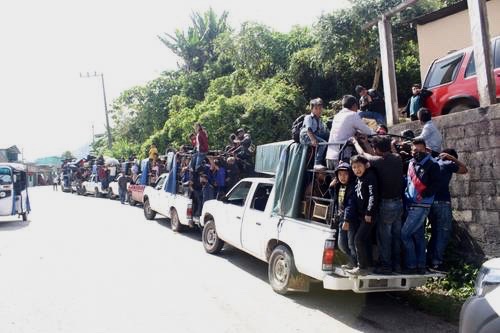
Indigenous people displaced from various communities in the municipality of Chenalhó, Chiapas, were transported back to their communities of origin, after spending two weeks in several shelters located in Acteal Centro. Photo: La Jornada
By: Elio Henríquez
San Cristóbal De Las Casas, Chiapas
Between 2,500 and 3,000 indigenous people displaced from communities in the municipality of Chenalhó that border on Pantelhó municipality returned to their homes, reported Alfredo Pérez López, director de civil protection for Chenalhó.
In an interview he said that the Tsotsils who were refugees in different parts of Chenalhó returned on Friday to the localities of La Esperanza, Quextic Centro y Poblado, Acteal Alto, Acteal Centro, Jabaltón and Canolal Centro, in the area bordering on Pantelhó.
He added that municipal authorities hired 60 to 65 vehicles to transport the indigenous people to their communities of origin, accompanied by agents of the National Guard and state police, as well as by members of the Mexican Army and officials of the municipal council.
Pérez López pointed out that after a call from Mayor Abraham Cruz Gómez, municipal agents from other localities collected corn, beans and other products to deliver to the returnees. “Everyone brought aid,” he emphasized.
He said that some people had already returned on their own, because they considered that there was security in their communities, in such a way that: “the majority of those displaced already returned to their homes.”
Pérez López said that several Pantelhó residents already returned, but at least 35 families remain refugees in Yabteclum community, in Chenalhó.
Sources from the Civil Society Las Abejas organization reported that members of that grouping who left places bordering on Pantelhó have not returned to their houses because they are afraid and are still refugees in Acteal, Chenalhó.
The Cáritas group of the Diocese of San Cristóbal de Las Casas reported that it continues delivering humanitarian aid to displaced persons who have not returned to the towns they left.
Data from civil organisms indicate that around 3,200 people from Chenalhó and Pantelhó abandoned their homes on July 7 and 8, after the El Machete People’s Self-defense group irrupted in the municipal seat of Pantelhó.
[…]
El Machete later reported that it intends “to expel the sicarios (hit men), drug traffickers and organized crime” from Pantelhó. In addition, it demanded the annulment of the June 6 elections in that municipality, which Raquel Trujillo Morales, of the Partido de la Revolución Democrática (PRD), won by a difference of more than 3,000 votes over the Partido Revolucionario Institucional (PRI). The group announced that it would elect its municipal authorities through the system of uses and customs.
Residents of the Pantelhó municipal seat, which has been occupied by police and soldiers since July 7, reported that activities started to normalize last week because several stores reopened and a lot of people started selling fruits and vegetables in booths on the street.
——-Ω——-
Originally Published in Spanish by La Jornada
Monday, July 26, 2021
https://www.jornada.com.mx/2021/07/26/estados/024n1est
Re-Published with English interpretation by the Chiapas Support Committee
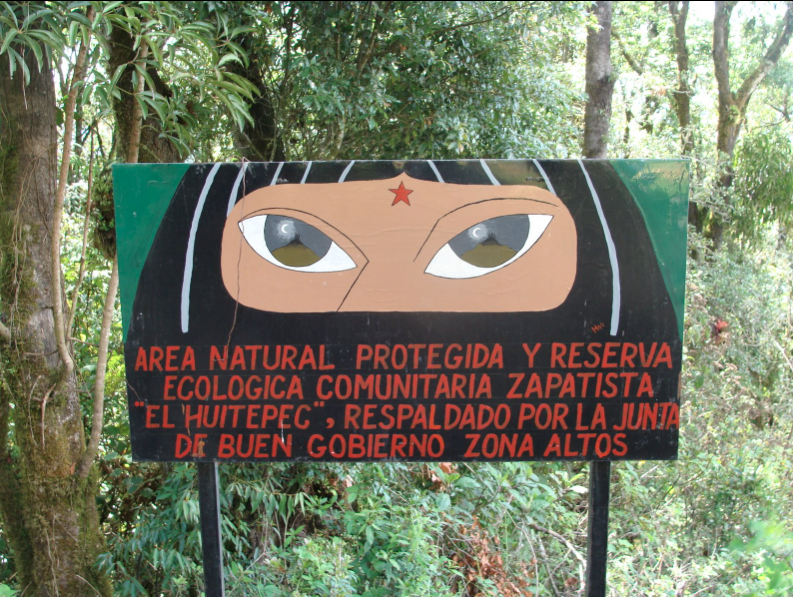
San Cristóbal officials promote the plunder of Zapatista Huitepec Reserve
By: Ángeles Mariscal
On Sunday, July 4, a group of individuals that call themselves “Guardians of the Huitepec Alcanfores Reserve,” entered into the zone of Huitepec, in San Cristóbal de Las Casas, where support bases of the Zapatista Army of National Liberation (EZLN) live. They intend to take possession of the site, with the argument that it will protect the ecosystem, even though the Zapatista communities have had these as conservation areas for 15 years.
The person promoting this initiative is mayor-elect Mariano Diaz Ochoa, who will occupy the municipal presidency for the third time, starting in October. He was mayor before from 1999 to 2001 and from 2008 to 2010.
Díaz Ochoa has been a vocal advocate of movements against the EZLN; in 1994, he headed the group called the the “Authentic Coletos[1] that tried to expel Bishop Samuel Ruiz García, who was a mediator in the armed conflict.
The mayor-elect also participated in the expulsion of human rights activists that arrived in San Cristóbal de las Casas, and when he was mayor in 1990, he along with his council declared actress Ofelia Medina persona non grata, for carrying out activities in defense of indigenous peoples in Chiapas.
Now, Díaz Ochoa is pushing the creation of the association “Guardians of the Huitepec Alcanfores Reserve,” and last Sunday called upon the population to enter the Zapatista reserve. When they arrived, they destroyed a building that the indigenous people have on site. The damage can be seen in this YouTube video: https://youtu.be/lNqKK1J2mRs
It is important to remember that the 102 hectares have been under the care of individuals from the EZLN that have lived there since 2006, who since then have taken actions to preserve the ecosystem.
The government wanted to declare this region a governmental protected natural area with the name “Huitepec-Los Alcanfores,” but the then UN Special Rapporteur on Indigenous Peoples, Rodolfo Stavenhagen, pointed out that this action violates the rights of indigenous peoples, which establishes that the creation of new ecological reserves in indigenous regions should only be done after consultation with the affected communities, and the government should respect and support the decision and the right of the indigenous peoples to establish community ecological reserves in their territories.
Now that he is back in office, Mariano Díaz Ochoa once again intends to initiate actions against the EZLN’s support base communities, the residents accuse.
[1] “Authentic coleto” is a term used in Chiapas to describe the families of status in San Cristóbal de Las Casas; it’s used with different connotations among those who “belong” and those who do not belong (in other words, the indigenous peoples).
—–Ω—–
Originally Published in Spanish by Chiapas Paralelo
Wednesday, July 7, 2021
Translation: Schools for Chiapas
Re-Published in English by the Chiapas Support Committee
Thousands of indigenous people show support for self-defense group in Pantelhó, Chiapas

Above Photo by Ángeles Mariscal – “Our struggle is not political, but rather for life,” people of Pantelhó.
By: Ángeles Mariscal
Pantelhó, Chiapas
The San José Buenavista Tercero community, located in the cañadas (canyons) of Pantelhó, became the meeting place for indigenous Tsotsil and Tseltal peoples who decided to arm themselves in order to stop the siege of organized crime, which they have experienced for years.
“It was a little while ago that we were thinking about getting together to talk about what we suffered,” explained Jeremías Pérez. He and his family were among the more than 3,500 people who, on the morning of Sunday, July 18, traveled on foot, and some in small trucks, the footpaths and roads of this fertile and paradise-like land, which had become a land beset by organized crime.
Hundreds tell about the horror stories they experienced. One of the commanders of the self-defense group explained that their assailants, people who still occupy positions in the Pantelhó municipal presidency, kidnapped his daughter when she was only 4 years old.
Dressed in olive green camouflage print clothing, with a squad-type pistol that hangs at his waist, and a radio through which he communicates, the commander cannot avoid that through the ski mask it is noticed how his eyes cloud up when recalling that event.
The assassination of the ex director of the Las Abejas de Acteal organization, Simón Pedro Pérez, last July 5, was what made them decide to try to expel their assailants from Pantelhó’s municipal seat, the place where they had found refuge. But the history of the formation of what are now known as the El Machete Self-Defense Forces of the People (“Autodefensas del Pueblo El Machete”), dates back many months.
They analyzed their situation, made visits to state government authorities, and delivered different documents asking for state government intervention to arrest their aggressors; the last letter asking for help was dated last June 26.
They wanted to solve the organized crime siege peacefully, because people like Simón Pedro and others, resisted the armed path as a solution. But they didn’t obtain an answer from the authorities that indicated to them they should abandon the path of self-defense groups.
Quite the opposite! Organized crime members were killing various community authorities and other leaders in the region. One of them was Enrique Pérez Pérez, who was ambushed at the beginning of this year when he was on his parcel of land. He was one of the founders of the self-defense forces and in his honor they placed a canvas with his image in the center of the meeting this Sunday.
So, little by little, in silence, they cooperated in donating the money they were getting from the sale of coffee; they bought weapons, uniforms, trained, designed the logo of their organization, which is now stamped on the black shirts they wear, on the canvas they placed at the entrance to San José Buenavista Tercero, and in the center of the town where the meeting was held that representatives of the Pantelhó communities attended to show their support for the self defense forces.
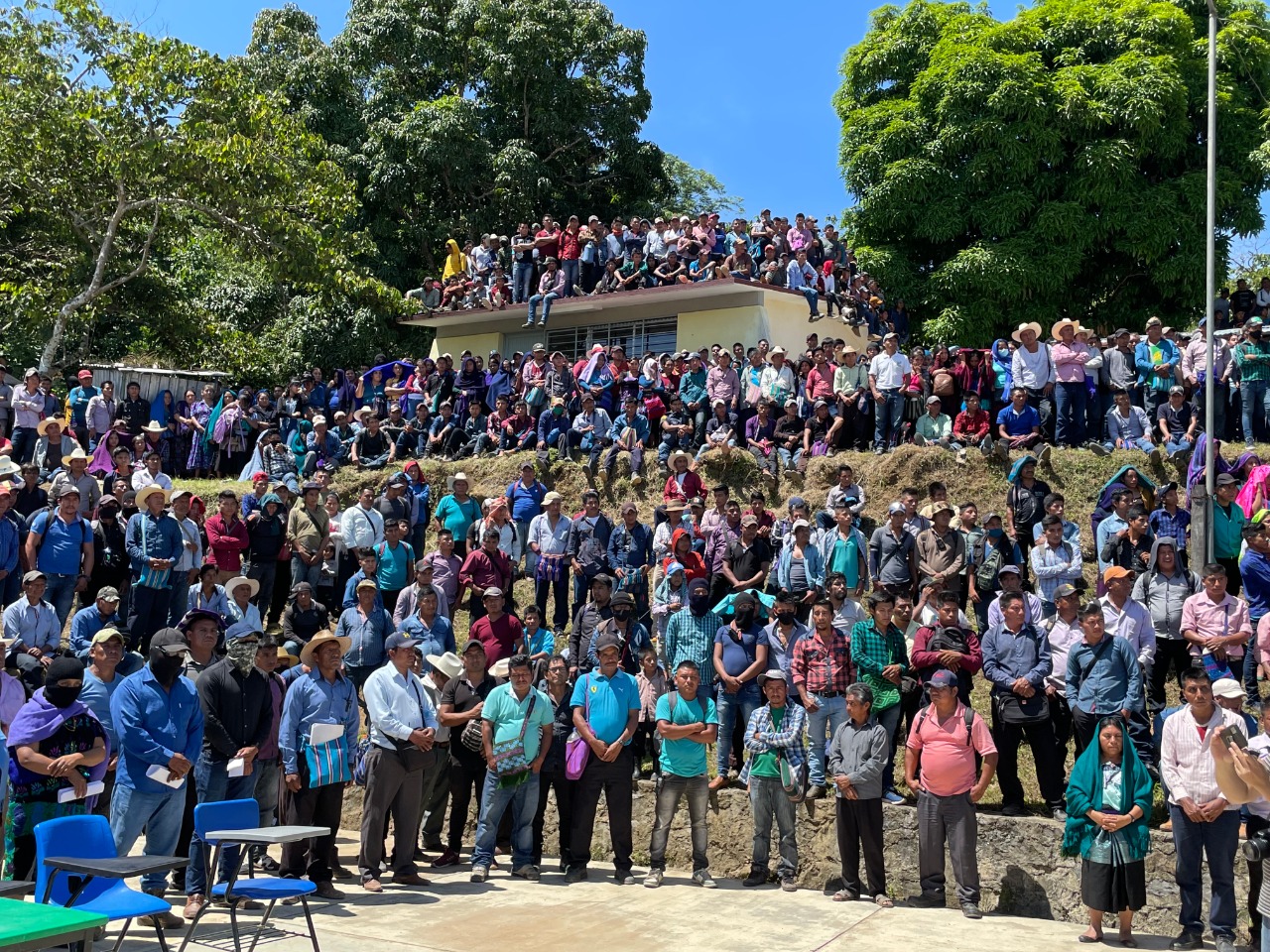
Residents of Pantelhó, Chiapas – Photo: Ángeles Mariscal
They began arriving in San José Buenavista Tercero in the first hours of this Sunday, July 18. Women with their traditional clothes of the Tseltal and Tsotsil ethnicities, men with calloused hands and leathery skin, tanned from working in the field, were positioned around the basketball court that occupies the center of town. There were more than 3,500 people coming from the 86 communities in Pantelhó.
Never had so many people met in the center of this small town, this day they only fit by placing themselves on roofs of the school and on some nearby buildings. It was important that they publicly show their support for the El Machete Self-Defense Forces. At the meeting, they also reiterated their decision to expel their own people who have besieged them, people involved with organized crime.
They invited journalists as witnesses and so that there was no doubt about the fact that their fight is not against the Mexican government, that it is not political, but rather “for life.” They also called on federal government authorities, who were represented at the meeting by Josefina Bravo, head of the Commission for Dialogue with the Indigenous Peoples of Mexico in the Interior Ministry.
After settling in and introducing themselves, their first action was to say a prayer in their maternal languages. The sound of prayers and supplications flooded the place and became an energy that vibrated.
Translation wasn’t needed to understand some words related to their petition to “God the Father,” “God the Mother,” that the violence ends and that the drug traffickers abandon this activity and find the path of life. The voice of the elderly man who guided the prayer broke, and tears came from some of the eyes of those present.
This region is strongly influenced by the teachings of Bishop Samuel Ruiz García, who formed what is known as the “native church,” recognized the knowledge and beliefs of the native peoples, and created an emancipatory doctrine that allowed them to question the Church and the situations of injustice in which they live, and to struggle “for the construction of the kingdom of God on earth.”
There are now people of different religious faiths in the region, but who retain the guidance of the emancipatory doctrines, which allowed them to organize to form self-defense forces, regardless of the religion they profess. Today all the people who were gathered together prayed together.
Later, one of the women leaders read the petition of the 86 communities of people of Pantelhó. They identified with first and last names those who they locate as their aggressors; many of them embedded in the municipal government apparatus. “Under the coordination of the mayor’s office, the municipal and sectorial police count on the participation of organized crime, which is the reason it has been of no use to demand justice,” they pointed out.
“During these years all the communities have been afraid, without the right to live in peace, without security, without justice (…) that’s why the indigenous peoples’ self-defense group rose up, for the purpose of defending the life and the rights of our brothers,” their communiqué points out.
They reported that they don’t recognize the authorities elected last June 6, because they also accuse them of belonging to organized crime. They announced that they will elect their new authorities next October 1 through the system of uses and customs and that the self-defense forces will be maintained until the siege and presence of the criminal groups is over.
After giving their word, they turned it over to Josefina Bravo. The official recognized that the Pantelhó region is part of an organized crime corridor that operates in Chiapas. She said that she would promote dialogue, that complaints will be investigated, and that she respects the decisions of the communities that organized their self-defense group.
——-Ω——-
Originally Published in Spanish by Chiapas Paralelo, Sunday, July 18, 2021
https://www.chiapasparalelo.com/noticias/chiapas/2021/07/miles-de-indigenas-mostraron-respaldo-a-autodefensas-de-pantelho-chiapas/
Re-Published with English interpretation by the Chiapas Support Committee
Chiapas, from paramilitaries to organized crime
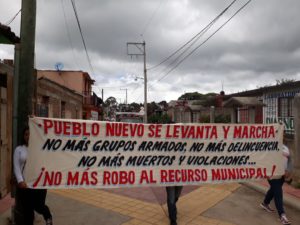
Above photo from a protest reads: “Pueblo Nuevo rises up and marches. No more armed groups, No more criminals, No more deaths and rapes… No more theft of municipal resources!”
By: Luis Hernández Navarro
In 2013, the successful businessman from Guerrero, Antonio Laredo Donjuán and his wife Mercedes Barrios Hernández, moved to the modest municipality of Pueblo Nuevo Solistahuacán, known as Pueblo Nuevo in Chiapas. They came from Cuernavaca. They acquired an enormous residence, established prosperous businesses and made friends with politicians and state police.
Solistahuacán means in the Náhuatl language: place of those who have weapons of steel. It is nestled in the mountains of northern Chiapas. Its terrain is rugged. The Señor de Esquipulas [1] is honored and members of the Seventh Day Adventist Church abound. Some 30,000 people live there, almost half of them indigenous. More than 50 percent of the villagers live in extreme poverty.
In spite of that, Don Toño and Doña Meche started a luxury car business and acquired multiple ranches, regardless of their price. He became good friends with the region’s mayors. He financed electoral campaigns in the municipalities of Rayón, Tapilula, Jitotol, Solusuchiapa, Juárez, Pueblo Nuevo and Rincón Chamula, in exchange for letting him appoint the police commanders. Politicians and those responsible for municipal and state public security would walk around his home to “say hello” (https://bit.ly/3equCYL).
But, five years after they settled in that corner of Chiapas, they were arrested. Interpol had been looking for them since 2008. The request came from the United States. The Office of Foreign Assets Control (OFAC) of the US Treasury Department designated the Laredos as members of organized crime, dedicated to the production and distribution of heroine from Mexico to the United States. They placed it in batteries and vehicle bumpers, as well as in cans of fruits and vegetables, and transported it to Philadelphia, Chicago, New York and Camden, New Jersey. Antonio, according to the Americans, was the main coordinator of the group. His wife Mercedes was accused of sending proceeds from the sales to Mexico.
Between 2013 and 2018 the Laredo Barrios couple operated a powerful drug trafficking network from a humble Chiapas municipality with impunity. Their wealth and power were inexplicable to the eyes of everyone. But that didn’t matter. They flourished under the protection of a vast network of impunity and protection, and of operators who plundered and subjected the region’s indigenous communities. They were arrested at the request of the United States, which also requested their extradition.
One of Don Toño’s great friends was the mayor of Pueblo Nuevo Solistahuacán when the couple came to live in the municipality, the then PRD member (and now a member of the Solidarity Encounter Party (Partido Encuentro Solidario, PES) Enoc Díaz Pérez (shown in photo below).
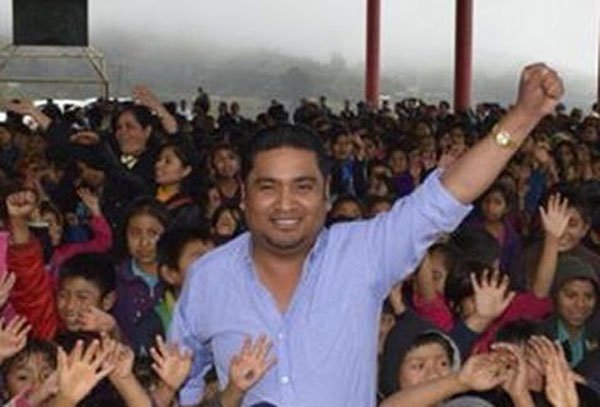
Enoc’s trajectory seems to be taken from a manual of exemplary lives. On two occasions he was held in El Amate, a Chiapas prison. In 2008, he was pointed out as the head of Los Cacheros, a criminal gang, accused of murdering three state and one federal police agents. The agents dared to capture the Díaz Pérez brothers, accusing them of raping a young woman from the town. Hours later, an armed group rescued them from the prison. The agents paid for their dare with their lives. Four years later, Los Cacheros became Los Diablos. They were dedicated to subduing rebel populations with firearms and irrupting in patron saint or Catholic fiestas (https://bit.ly/3hYd0Eq).
Despite his relationships, the state’s Congress disqualified Enoc in January 2015, when he and his men beat up and took several businessmen out of a restaurant. To his misfortune, he fell into disgrace with the powerful Secretary of Government of those years. The mayor was accused of torture, illegal deprivation of freedom, abuse of authority and criminal association. By then, an enormous house had already been built.
The story of the businessmen’s arrest could be part of a horror story. It reached Enoc’s ears that the businessmen had accused him of dealing in “chocolate” vehicles. [2] Angered, he ordered them to stop. Their captors announced to them that they would be executed and their bodies burned. Later, they were taken to an auditorium where, before 300 people, the mayor accused them of being “enemies of the people” and “hindering the development of the municipality.” (https://bit.ly/3wyoZ0A)
Along the way, Díaz Pérez created a paramilitary-style movement, which he named “Proyecto Amigo Revolucionario No. 7” (Revolutionary Friend Project No. 7) and tried to expand it into neighboring municipalities. He imposed control over the communities with executions and silent forced displacements. It happened like that, for example, in 2019, in the displacement of the residents of San Pedro Hidalgo, in the municipality of San Pedro Duraznal. The following day, the paramilitary group burned houses, looted belongings and occupied the lands of San Pedro Hidalgo and San Pedro la Grandeza communities. (https://bit.ly/3kbw30C). These cases are just part of many more.
Although he remained in violent control of the communities, Enoc reappeared in the last election as a candidate for mayor with the PES. With just a few days to go, a commando murdered 5 members of the PRD who were transporting electoral packets. According to a witness, members of the armed group said that this had happened because of not following orders from Díaz Pérez (https://bit.ly/3eaiLhf).
Curiously, the criminal group that violently controls the Pantelhó municipal government named Enoc as an advisor.
Stories like those of the Laredos and Enoc Díaz Pérez demonstrate the mutation and association of paramilitaries and organized crime with governmental protection in Chiapas; it advances against the organized peoples who defend their autonomy. Their weapons are made with much more than flint.
[1] The Señor of Esquipulas is also known as the Black Christ of Esquipulas, a large statue carved from wood depicting a Black Christ on the cross. It is located in a basilica in Esquipulas, Guatemala.
[2] Typically, these are cars bought in the US, driven to Mexico, but not registered there, because it costs a lot of money to register such a vehicle in Mexico.
——-Ω——-
Originally Published in Spanish by La Jornada, Tuesday, July 13, 2021
https://www.jornada.com.mx/2021/07/13/opinion/016a2pol,
Re-Published with English interpretation by the Chiapas Support Committee
Aerial Zapatismo

By: Hermann Bellinghausen
The first known attack of the Zapatista air force occurred at dawn of the century, January 3, 2000, on the outskirts of the Amador Hernández ejido, in the depths of the Lacandón Jungle. The second is about to start with the landing in some port of Europe an airborne contingent of the Zapatista National Liberation Army (Ejército Zapatista de Liberación Nacional, EZLN). Despite the two decades and a lot of other things that separate them, both operations share the same paradox: they are peaceful; their word is their weapon.
The contexts and objectives could not be more different, and, nevertheless, they point at the heart of the enemy, who in that remote Tseltal ejido close to the Perla River was represented by the federal Army after the sudden unjustified occupation of a property in the middle of the jungle established by cargo and assault helicopters, Vietnam War style, the same manuals. That occupation lasted several months and ended with the withdrawal of the invaders, a victory for the rebel communities. There were no physical casualties on either side, but the example was set. However poor the people are, they can successfully counterattack by air and for the air that they breathe.
The 2000 attack was reported like this in these pages: “The Zapatista Air Force today attacked the federal Army camp with paper airplanes. Some flew well and entered straight into the part of the dormitories hidden by vegetation and large black plastic tarps. Others missed their flight and fell just behind the sharp mesh [barbed wire fencing].
“The aircraft, white in color and letter size, carried a written message for the federal troops that have occupied the community’s land for almost five months now. Not only are the fence wires sharp: ‘Soldiers, we know that you sold your lives and souls because of poverty. I am also poor, like many millions are poor, but you are worse off because you are defending the one who exploits us, that is, Zedillo and his little group of rich men.’
“The protest of the region’s indigenous people against the military occupation of their lands on the edge of the Montes Azules, daily, persistent, almost unbelievable, has sought in many ways to make itself heard by the troops, who seem to exist on the other side of the sound barrier. This afternoon they attacked the airways, in typewritten sheets, originals and carbon copies, in the prehistory of reproduction techniques.
They made one version and another with their copies, to protect as much as possible their contingent of kamikazes in writing. The airplane is the bomb:
“‘We don’t sell our lives. We want to liberate our lives and those of your children, their lives and those of your wives, the lives of your brothers, the lives of your uncles, the lives of your papas and your mamas and the lives of millions of poor exploited Mexicans, we want to liberate your lives too so that there won’t be soldiers that repress their peoples because of orders from a few thieves.
“On other occasions, the federal Army troops covered their eyes or ears, under orders from their superiors, to not pay attention to the complaints, messages or imprecations from the indigenous people. Today, an officer tries to collect the airplanes that fell in the front line of combat, before the barricades of sacks and branches where the soldiers aim, with their helmets on. At least now they haven’t put on opera, as they have been doing for days, flavored and distorted, some select fragments of Carmen, La Traviata and William Tell so that nothing is heard.”
In 2021, a new generation of Chiapas Zapatistas attacks the heart of the Old World in their way, with small but eloquent symbolic events. A maritime advance team set foot on Iberian land in Galicia and is already going through France.
The new rebel “crazy idea” turns around the trapped political discussion in Mexico and its alleged extremes, and opens a scenario for the autonomic demands elaborated, and for the current tragedies in Chiapas to acquire international relevance and awaken anesthetized or hidden consciences in the different European countries.
As my relative Doctor Ricardo Loewe says, currently retired in Austria, a participant in Zapatismo during his good 40 years, the announcement and beginning of the tour through Europe “made many small and medium-sized collectives inspired or interested in Zapatismo appear like mushrooms.”
This occurs at a time of political anomie. In social networks, public squares and the communications media, they question rampant capitalism, racism, sexism, war itself, in Zapatista key.
The new sea-air-land operation will give rise to rallies, concerts, forums, marches, assemblies, appearances and debates on a minor but insidious scale, invasive for good dormant consciences and lofty bad consciences. It’s about saving the world, not like in the comics, but based on many transatlantic micro-histories of the world below that bets with more urgency than ever on another world where many worlds fit.
—–Ω—–
Originally Published in Spanish by La Jornada
Monday, July 12, 2021
https://www.jornada.com.mx/2021/07/12/opinion/a08a1cul
Re-Published with English interpretation by the Chiapas Support Committee
EZLN: The Extemporaneous and a National Initiative

ZAPATISTA SIXTH COMMISSION
Mexico
July 2021
To the Adherents to The Declaration for Life:
To the Europe of Below and to the:
To the National and International Sixth:
To the National Indigenous Congress-Indigenous Government Council:
To the Networks in Resistance and Rebellion:
To “The Hour of the Peoples Has Come” Collective:
From: Subcomandante Insurgente Moisés.
Compañeras, compañeroas, compañeros:
Sisters, brothers, others:
I greet you in the name of the children, women, binary people (otroas), elders and men of the Zapatista communities, and communicate the following:
First – We already have a strong Zapatista airborne company at 177 Zapatistas. It is made up entirely of native Mayas, of the Cho´ol, Tzotzil, Tzeltal, Tojolabal and Castile languages. We are born in the geography they call Mexico. Our ancestors were born and died in these lands. As the Mexican State does not recognize our identity and origin, and tells us that we are “extemporaneous” (as the Foreign Relations Ministry says, that we are “extemporaneous” Mexicans), we have decided to baptize this unit of Listen and Word “The Extemporaneous.”
According to what we see in the dictionaries, “extemporaneous” means: “that which is inopportune, inconvenient,” or “that is inappropriate for the time in which it happens.” In other words, that we are inopportune, inconvenient and inappropriate.
They had never before defined us so inadequately. We are happy that at last the Mexican State recognizes that this is how it considers the original peoples of this geography called Mexico. I believe that’s how it laments that he hasn’t annihilated us… yet; and that our existence contradicts the official discourse about the “conquest.” It is now understood that the Mexican government’s demand to the government of Spain, demanding that it ask forgiveness, is for not having exterminated us.
Of the 177 delegates, 62 of us still don’t have a passport. The Ministry of Foreign Relations is bound to the “inconvenience” that we represent. Despite the fact that we have demonstrated identity and origin, it continues demanding more and more papers. The only thing missing is that it asks the Central American governments to say that we are not citizens of those countries.
2 – The “La Extemporaneous” air transport company, with me at the helm, has been preparing since October 2020 and we have been in quarantine almost one month. It is composed of:
– Several groups of “Listen and Word,” indigenous Zapatistas whose existence and memory span the history of our struggle from the years before the uprising to the beginning of the Journey for Life.
– A female soccer team made up of 36 milicianas (who are also “Listen and Word”) who have taken the name and example of the late Comandanta Ramona, the first Zapatista to leave Chiapas, and they identify themselves as “Ixchel Ramona” and thus will go to the sports fields of Europe.
– The self-styled “Popcorn Command” is made up of 6 girls and boys who are from the “Play and Mischief” group. Like all of us, they have been preparing.
– The invasion’s coordinator group. They are the ones who will be in charge of organizing and in their case, reinforcing the “Listen and Word” groups that will be distributed in the 5 areas into which we have divided the European continent. They will also attend to the free and for pay communications media, participate in round table discussions, conferences and public events; and they will evaluate the development of the invasion.
With Squadron 421 we will complete the first Zapatista wave and we will begin the visits to those who invited us and, with attention and respect, we will listen to them. If you ask about it, we will talk about our little history of resistance and rebellion.
3 – A delegation will travel with us from the National Indigenous Congress-CIG, strong in 10 indigenous languages: Native Maya, Popoluca, Binizá, Purhépecha, Raramuri, Otomí, Naayeri/Wixarika and Nahua; as well as 3 brothers from the Peoples Front in Defense of Land and Water of Tlaxcala, Puebla and Morelos, 13 in all.
4 – Because it’s my turn to do the Journey for Life-Chapter Europe, I have entrusted Subcomandante Insurgente Galeano to take command in Mexico and to initiate, as soon as possible, contacts with the National Indigenous Congress-CIG, with the National Sixth, with the Networks in Resistance and Rebellion, with Non-Governmental Organizations in defense of Human Rights, with collectives of Victims of violence, family members of the disappeared and those related, as well as with artists, scientists and intellectuals, for the purpose of letting them know about a new national initiative and inviting them to organize for it. And thus open a front of struggle for Life in our country.
5 – In a few more days, which we will communicate to you in due course, we will start our trip. Now we are trying to vaccinate all of us so as not to bring health problems, and waiting for the so-called “third wave” of contagions in Mexico to go down a bit.
Then we’ll go to the Jacinto Canek Caracol, in San Cristóbal de Las Casas, and gather together there. From there we will move to Mexico City where the 177 delegates will go to the offices of the SRE that will tell us, face to face and in public, that we have no rights because of being “extemporaneous,” and that its “aspirationism” obliges it to delegate its responsibility to racist and ignorant bureaucrats; then, perhaps, Paris, France.
We’ll tell you the precise dates later, because it seems that, for the French government, we are also inopportune; also, of course, the new global wave of COVID 19. Too bad, it must be globalization.
6 – We are a little nervous but happy because it’s not the first time that we will do something without knowing what awaits us. We thank from now on the Europe of Below, the National Sixth, the Networks in Resistance and Rebellion, the solidarity NGO´s on this and the other side of the ocean, and “The Hour of the Peoples Has Come” collective for the economic and in kind support that will permit realizing the air travel. The cost of the maritime travel and of the passports (between 10 and 15 thousand pesos each one, and for the continuous round trips to our towns to fulfill the Mexican State’s ridiculous requirements for being “extemporaneous”), was fully covered by the EZLN and left us without reserve funds. But it did not represent for any of the delegates, any personal expense.
7 – Regarding the national initiative, of which SupGaleano is in charge, I’m just letting you know that it will start with our call to participate in the so-called “Popular Consultation” on August 1, [1] and to answer “Yes” to the question about whether or not something should be done to comply with the right to truth and justice of those who have been victims due to actions and omissions of the Mexican State (that, and nothing else, is what the question indicates that the Supreme Court of Justice of the Nation of the country that is called Mexico) elaborated. Those who up there above, in the “opposition” parties, resist the consultation, not only fear what will follow from it; it also terrifies them that the victims will recuperate their demands from the dastardly and perverse use that the ultra-right makes of their pain. Because the pain should not be an electoral business, and even less for such shitty purposes as the return to the government of those who are some of the ones mainly responsible for the violence and who before were only dedicated to accumulating paychecks and cynicism. That’s why the INE, which also considers we indigenous people as “extemporaneous” and denies us credential (ID card), is doing everything possible so that the consultation will fail, because it knows that it also has its part of the crime due to its exclusive policy for urban people with light skin.
You have to enter it, not looking towards above, but rather looking at the victims. You have to convert the consultation into an “extemporaneous” consultation. This is so that, independent of those above, a mobilization for a Truth and Justice Commission for Victims, or whatever it’s called, can start; because there can be no life without truth and justice.
That’s all for now,
From the Mountains of the Mexican Southeast,
For the extemporaneous Zapatistas!
Subcomandante Insurgente Moisés, still in Mexico, July 2021
Translator’s Note:
[1] The National consultation is about whether a past president can be brought to justice after leaving office for crimes committed while in office. The consultation will be conducted by the INE (National Electoral Institute).
—–Ω—–
Originally Published in Spanish by Enlace Zapatista
Friday, July 16, 2021
http://enlacezapatista.ezln.org.mx/2021/07/16/la-extemporanea-y-una-iniciativa-nacional/
Re-Published with English interpretation by the Chiapas Support Committee
Army enters Pantelhó but doesn’t arrest criminal groups; thousands of indigenous people escape
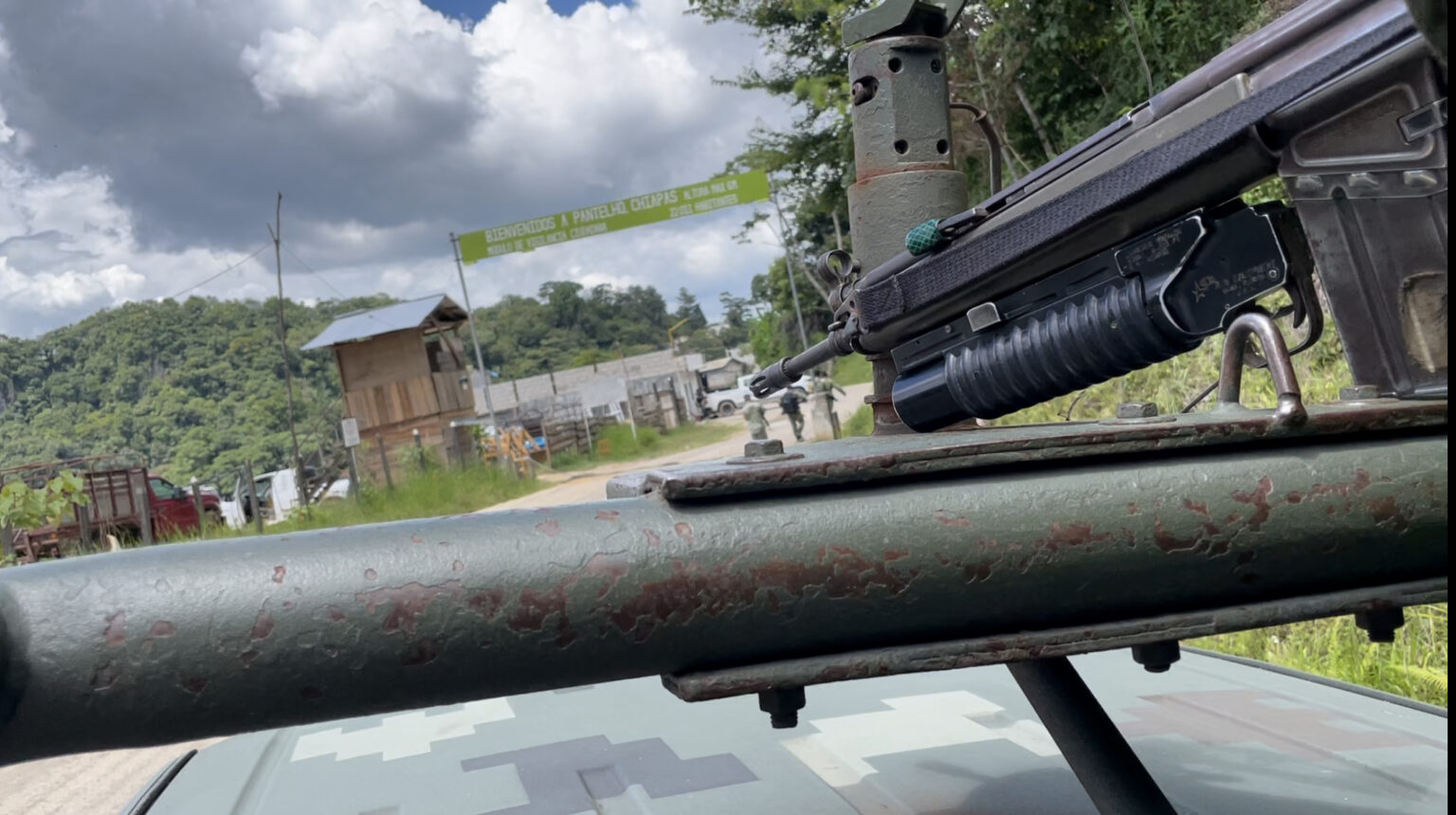
Above: The Armed Forces entered the municipal seat of Pantelhó Photo: Ángeles Mariscal
By: Ángeles Mariscal
July 12, 2021
Members of the Mexican Army and National Guard entered the municipality of Pantelhó, the place where indigenous Tsotsils, who define themselves as “peoples self-defense forces,” and on July 7 tried to expel groups linked to trafficking of illegal merchandise and humans, who take shelter in that municipal seat. Residents of this place and communities close to Pantelhó and Chenalhó abandoned their homes faced with the fear of being attacked. They point out that the criminal groups have not been arrested.
In the municipality of Pantelhó, the people don’t speak. Yésica and Gabriel are two of the few people that even remain in the municipal seat. On July 7, 2021, the group that call themselves “people’s self-defense” attempted to enter to remove the people they identify as members of organized crime, who for years have subjugated the population and murdered those who denounce them, among them the ex-president of Las Abejas de Acteal, Simón Pedro Pérez.
Both groups clashed for more than 30 hours until July 9th, when military personnel removed the blockades that impeded arrival and advanced to the presidential building of Pantelhó.
Yésica and Gabriel were locked in their house for three days, listening to bombs explode and shots from high caliber weapons, just a few blocks from where they live. They set out to the park upon seeing the military and reporters.
They managed to give an interview to this media outlet. But they only said that they don’t know what happened, they don’t know the reason for the clashes, that they don’t know what criminal groups there are in the area, and that they only want to live in peace.
A few meters from where they were giving the interview, a group of 20 hefty men, dressed in civil attire, some of them very young, observed them. Seeing that journalists were trying to speak with the people that remained in the area, they moved toward the place where Yésica and Gabriel were, whispered something to them, walked around the central park, and headed back again to the municipal presidency building.
Yésica y Gabriel then got up, and in low voices, asked us to erase the video of the interview, said that the group had threatened them, that they are being threatened, that they don’t want their faces to to appear, that they cannot talk about what is happening in the region, that the majority of the people left, but they preferred to wait because they don’t have family anywhere else, they explained before leaving.
This same group, who according to the residents, have threatened them, stationed themselves in the entry of the municipal presidency, where they handed the commander of the military detachment a document requesting the permanent presence of the armed forces.
“Our patience ran out”
On the street that goes from the entrance of Pantelhó to the center of the town, the houses are empty, the businesses are closed. In one of the side streets there are hundreds of large caliber gun shells lying on the ground, traces of explosives detonated, stones strewn about, the windows of some houses are broken, and on their walls there are traces of gunshots.
Last July 7, a battle took place in this region. According to a video communiqué sent three days later by a group of indigenous people who call themselves “the people’s self-defense,” since 2002 the municipal authorities have opened the door to organized crime.
They report that only one of the leaders was arrested in 2019, but now a relative of his occupies the municipal presidency, and her husband is the mayor-elect.
The “people’s self-defense” claim that they are living under a “narco-government,” which has left them with a toll of stories of indigenous people murdered for refusing to participate in illicit businesses, or for denouncing them; the most recent case was the murder of Simón Pedro Pérez, which occurred on July 5. “We are witnesses to the murders they have made of our grandparents, parents and children,” they point out.
“So we decided to enter the town of Pantelhó on July 7, 2021 at 4 am, we did not enter to attack the people, but to expel the hired assassins, the drug traffickers, the organized crime,” whose members took refuge in the municipal seat, they explain.
They say that they carried out this intervention, “because our patience has run out, because we do not see any hope in the federal and state governments.”
In the video communiqué they explain that for now they have temporarily withdrawn from the area, but that they will not disband until the criminal groups leave their region. They also expressed their distrust of the armed forces, because they believe they are protecting their aggressors who, they insist, are in collusion with the three levels of government.
In the street that goes from the entrance to Pantelhó to the center of the town, the houses are empty, the businesses closed. On one of the side streets there are hundreds of casings from heavy-caliber weapons lying on the ground, traces from the detonation of explosives, scattered stones, the windows of some houses are broken, and there are gunshot marks on their walls.
Abandoned towns
It is not only the municipal seat that remains semi-abandoned by the population. Inhabitants of nearby communities of Pantelhó and the neighboring municipality of Chenalhó also left the area.
The doors of the houses were suddenly closed, chickens and dogs were left outside, and clothes hung out on the patios. Those who were able left on July 6, but others have left in the days after, despite the fact that the armed forces removed the blockades that were in place to reach the area, settled in the municipal seat of Pantelhó, and did patrols of the region.
On one of these roads, located 10 minutes from the community of Acteal, thousands of large-caliber gun shells are also found on the ground — evidence of the confrontations that took place. These casings are from the shots fired by the military on July 8.
Rumors spread of the deaths of more than 20 people in these events, but none of the groups acknowledge having these casualties, neither the people they accuse of belonging to organized crime, nor the “people’s self-defense.” No one has seen people killed in the battles of recent days.
What can be seen on the roads are pickup trucks with indigenous people carrying the few belongings they managed to take out of their homes. Boys, girls, women and men are on board, they watch the road with fear, get out in a hurry and take refuge in churches, or in the towns where they believe they are relatively safe, and where doors have been opened to them.
“Don’t film, don’t film,” they beg us. They say they are afraid that their aggressors will recognize them in the videos that will be broadcast in the media. Only some, those who live farther away from the municipal capital of Pantelhó and the zone of influence where they find people who belong to criminal groups, agree to tell what happened.
Manuel Pérez Pérez and eight members of his family left the town of Quixtic in the municipality of Chenalhó on July 8 because “the bullets were passing over the roof of my house.
He says that the gunshots remind him of the Acteal massacre; he and his family are survivors of the 1997 massacre. “I have already lived through this violent situation, I live near the Pantelhó border and the bullets can be heard very close, we left because we are very afraid. I couldn’t take anything out, my chickens and turkeys were left behind,” says Manuel, an 83 year old man.
“For some time now they (armed groups) have been shooting, the situation has been getting worse and worse, then we started to be very afraid, because that is how it started in 1997. I feel that we are re-living what happened in 1997.
He, his family and some 200 other people found refuge in the community of Acteal, in the municipality of Chenalhó.
The journey to find refuge
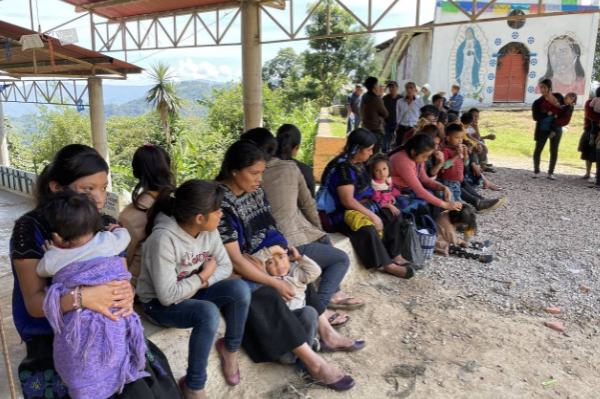
Thousands of indigenous people from Pantelhó and Chenalhó who were recently displaced from their communities by the violence, continue to look for a place of refuge. Those who have relatives in the city of San Cristóbal de Las Casas settled with them; but hundreds more called on civil society organizations to help them.
In an interview they said they are afraid to go to the shelter that the Chiapas government set up on July 10. “They can identify us (the people they identify as criminal groups), they can see us because many are with the government, and we are afraid they will kill us,” they insist.
They are seeking food, a place to spend the night, “and that they stop these groups that have threatened us for y ears; but we know that there have been no arrests, so they are still free… we cannot return to our homes,” one of them explains, who with dozens of other indigenous people received temporary shelter with a family who saw them lying down in one of the streets of San Cristóbal de Las Casas.
“What we are demanding is protection for all the people who have been displaced (…) they continue to leave the communities because there is a threat to their lives and their integrity, there is still no decisive action on the part of authorities to stop the violence,” explained Jennifer Haza, director of the organization Melel Xojobal.
The communities of Majomut, Acteal and Yacteclum among others, also received displaced indigenous peoples, but three days after their arrival food is already scarce, and they are looking for an organization that can help them get food.
Self-Defense Groups, a “desperate action”
Throughout the indigenous territories in the Altos of Chiapas — Aldama, Chalchihuitán, Chamula, Chenhaló, Pantelhó, among others, the activity of organized crime is increasingly more visible, Pedro Faro, director of Fray Bartolomé de las Casas Human Rights Center (Frayba) explains.
He refers to the fact that impunity is such that in Pantelhó the stolen cars are used by the municipal police, and the area has also become a human trafficking corridor.”There is marijuana planting and arms trafficking, there are many high-powered weapons for the exclusive use of the army, which makes us wonder who finances, who trains all these groups, who provides them with the park for all these shootings, to keep the region ravaged.”
Pedro Faro points out that the Mexican State has not acted to deactivate these groups, despite the denunciations made by the population.
In this context, the director of the humanitarian center believes that the formation of the “people’s self-defense” group is “a desperate action to get organized crime out of the place. We do not justify violence in any way, but in some moments, cases or situations, they leave the communities no other alternative but to exercise defensive actions,” as has already been seen in other states of the country.
However, he said: “I believe that it is time, now that the National Guard and the army have entered Pantelhó, it is time for them to carry out the legal investigation to locate the criminals, and to be able to dismantle this mafia network that has occupied the entire territory, who the communities have denounced directly with name and surname,” he said. This Sunday, authorities from 85 communities of Pantelhó sent a letter to the governor of Chiapas, Rutilio Escandón, in which they expressed their concern “about organized crime”; they demanded the removal of the current mayor, Dayli de los Santos Herrera, and the mayor-elect, Raquel Trujillo Morales. They announced that they will elect new authorities through the uses and customs (usos y costumbres) system.
——Ω—–
Originally Published in Spanish by Chiapas Paralelo
Monday, July 12, 2021
English translation: Schools for Chiapas
Re-Published by the Chiapas Support Committee
Pantelhó, narco-paramilitaries and indigenous self-defense

By: Luis Hernández Navarro
They executed Simón Pedro Pérez López at the market in Simojovel, Chiapas. The crime was the work of a professional. From a moving motorcycle, a hitman (sicario) shot him in the head with an accurate bullet. Helpless that July 5, his son watched as his father bled to death on the floor until he lost the last breath of life.
The 35-year old indigenous Tsotsil, father of seven children, Simón was a catechist in the parish of Santa Catalina, in Pantelhó. In 2020, he presided over the Board of Directors of Civil Society Las Abejas of Acteal, to which belong the victims of the December 22, 1997 paramilitary massacre, in which 45 people who were praying in a chapel were savagely killed. He was also part of the National Indigenous Congress (Congreso Nacional Indígena, CNI).
He was a good man, dedicated to defending human rights and to demanding justice. He had recently denounced the abuses suffered by residents of Pantelhó at the hands of a narco-paramilitary group dedicated to trafficking drugs, migrants and arms, as well as stealing cars. Just a few days before his murder, on June 26, communal authorities and agents of the municipality presented the Chiapas Secretary of Government, Victoria Cecilia Flores Pérez, a document that gives a detailed account of the relationships of the local authorities with criminal groups.
The one who controls the municipal presidency of Pantelhó has PRD membership. It’s not a new phenomenon. Without being the only one, that party in the state has served the paramilitaries for years (https://bit.ly/3yEDilR). He won three years ago, from the hand of Santos López Hernández, who was later put in prison for the crime of sexual abuse of two women officials of that municipal council. In his place they named Delia Janet Velasco Flores, wife of the mayor elected in the last elections with the initials of the Aztec Sun [as the PRD is called], Raquel Trujillo Morales (he says that they were divorced six months ago) https://bit.ly/3yJwMdo).
In 2019, inhabitants accused Raquel of usurping functions as municipal trustee, assaulting citizens and diverting more than 3 million pesos of public money to his benefit, in association with the treasurer. Since then, he is associated with the brothers Rubén and Daily Herrera to violently intimidate those who oppose him (https://bit.ly/3r05hto). The clan’s patriarch, Austreberto, is in prison for murdering two people in the municipality in April 2015 (https://bit.ly/3hXCcuy). In 2002 he wanted to name himself to be the local judge. H was the one who opened the door to organized crime.
The case of Simón Pedro is not the only one of a member of Civil Society Las Abejas killed in Pantelhó. In 2015, criminals murdered the catechist Manuel López. Despite the fact that the Chiapas attorney general’s office knew of the event, there was no progress in the investigation and the guilty parties were not punished.
With the support of gunmen from Campeche, Veracruz and Sinaloa, this group has won territorial control through terror, murders, disappearances, robberies, dispossession and forced displacement, carrying weapons and explosives for the exclusive use of the Mexican Army. He is no stranger to the criminal organization that operates in Chenalhó (https://bit.ly/2TMWejF) and the Chamula Cartel.
The violence unleashed by them inside the municipality was exacerbated within the framework of the last electoral contest. The Fray Bartolomé de las Casas Human Rights Center documented the murder of 12 people, including one child and one more disappeared, since March of this year. Countless residents have been displaced due to fear and the risk of losing their lives. Checkpoints, roadblocks and incursions of armed groups, in the company of police, are a daily occurrence. Different testimonies have revealed that members of the criminal group have driven National Guard vehicles (https://bit.ly/3e0nQZu).
In the midst of that climate of coercion, 11 Tsotsil parishes of the Diocese of San Cristóbal de Las Casas, headed by Father Marcelo Pérez Pérez, demanded postponing the June 6 elections in this municipality. “There is a silence in the municipal seat of Pantelhó. Nobody wants to say anything. They don’t leave the communities because they fear being murdered,” he warned after a meeting with pastoral agents. But no one listened to his warning.
Father Marcelo was not the only one to forewarn of the danger that lurked. It worries us, Chiapas bishops observed, that some power groups, linked to criminal activities infiltrate the political parties.
The straw that broke the camel’s back in the region was the murder of Simón Pedro Pérez Lopez, and that of being fed up with the pact of institutional impunity that protects the criminal group. Two homemade bombs were found in the home of the catechist’s murderers in the Nuevo Israelita community. Pushed to the extreme, on July 7 and 8 the El Machete Self Defense group of Pantelhó confronted the narco-paramilitaries and occupied the municipal seat to defend their lives. In this context, a convoy of soldiers and police was shot at while removing a road blockade.
The conflict escalated. Hundreds of indigenous Tsotsils sought refuge in secure places. The municipal seat of Pantelhó became a ghost town. Residents of the neighboring municipality of Cancuc blocked exits and entries. More than two thousand people are displaced in the region. The pretense of having a “sanitary cordon” to isolate Zapatismo and the indigenous struggles for autonomy by using narco-paramilitarism became a crisis.
Note
[1] The last sentence of this article summarizes the counterinsurgency strategy succinctly: the government strategy for containing “Zapatismo” so that it cannot spread has been to surround the indigenous communities with narco-paramilitaries.
———————————————————–
Originally Published in Spanish by La Jornada, Sunday, July 11, 2021
https://www.jornada.com.mx/2021/07/11/opinion/010a1pol
English interpretation by Schools for Chiapas and the Chiapas Support Committee
Re-Published by the Chiapas Support Committee
 Chiapas Support Committee