Chiapas Support Committee
Home of the Compañero Manuel blog on zapatistas & mexico
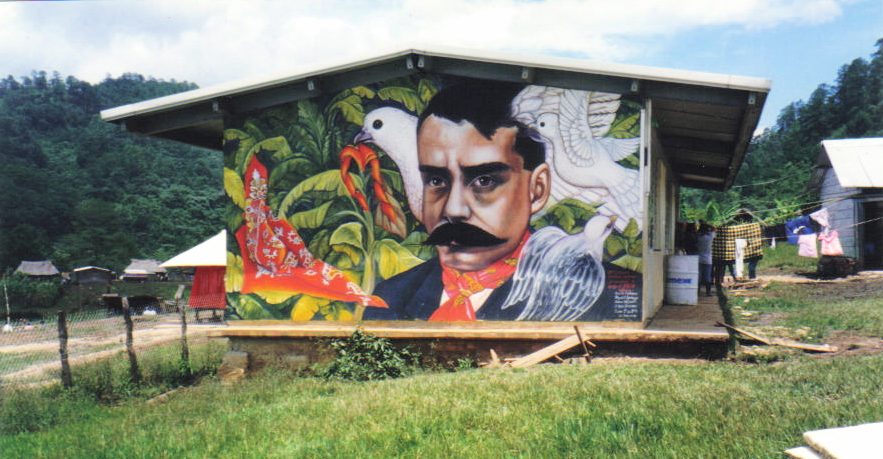
They murder the indigenous prosecutor in Pantelhó Case
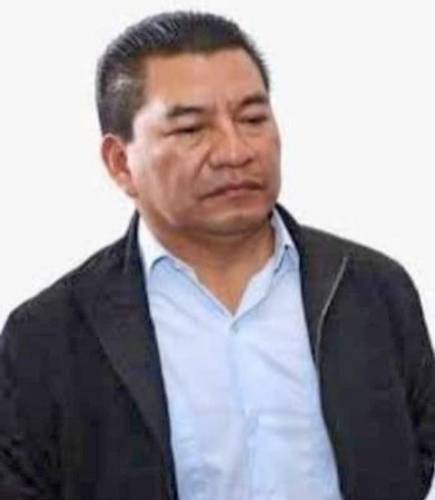
▲ El fiscal indígena Gregorio Pérez Gómez, asesinado a balazos la noche de ayer en San Cristóbal de Las Casas.
By: Elio Henríquez
San Cristóbal De Las Casas, Chiapas
The Indigenous Justice Prosecutor for the Chiapas Highlands region, Gregorio Pérez Gómez, who was in charge of the investigations into the recent acts of violence in the municipality of Pantelhó, was shot and killed murdered Tuesday night in San Cristóbal de las Casas, the State’s Attorney General (FGE) reported.
In a communication, the institution explained that: “we learned that this Tuesday at 8:55 pm, at the Prolongación Insurgentes, a dark gray Volkswagen model Gol vehicle with Chiapas license plates was found with six bullet impacts that wounded the driver, who lost his life at the place.”
It said that the victim was identified as the indigenous justice prosecutor Gregorio Pérez Gómez, a Tseltal from the municipality of Yajalón, located in the northern part of the state.
The communication pointed out that Pérez Gómez ”was the one in charge of investigations into the violent events that took place in the municipality of Pantelhó.”
The FGE and all of the district and material prosecutors lamented and condemned “profoundly and energetically the violent death of which Pérez Gómez was the object,” while they assumed “the firm commitment to investigate to the ultimate consequences, in such a way that this crime does not go unpunished.”
The place where the murder of Pérez Gómez was committed is close to his office.
——-Ω——-
Originally Published in Spanish by La Jornada
Wednesday, August 11, 2021
https://www.jornada.com.mx/2021/08/11/estados/025n1est
Re-Published with English interpretation by the Chiapas Support Committee
The mayor of Pantelhó resigns, accused of links to criminal groups
By: Ángeles Mariscal
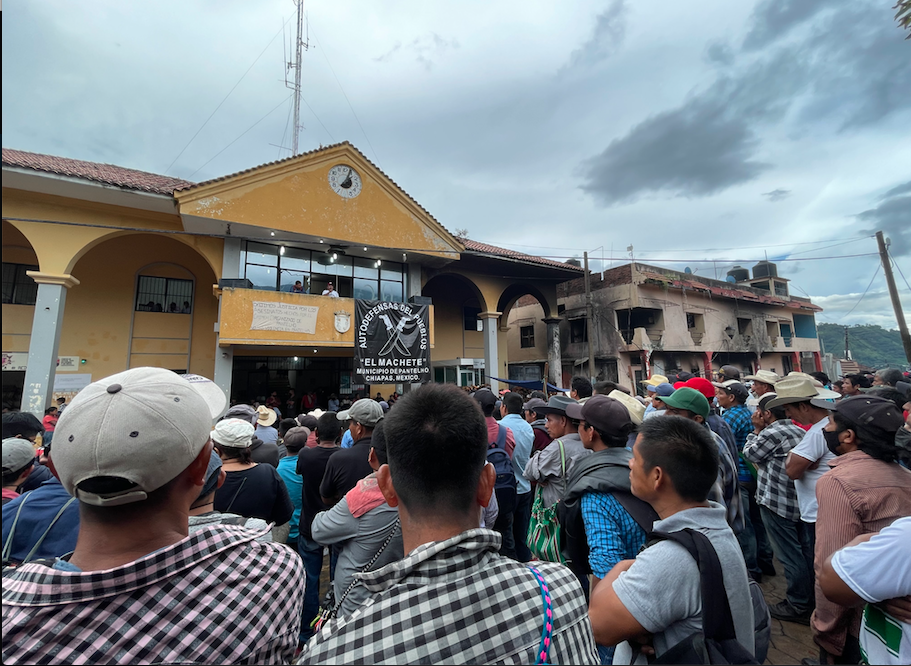
Delia Janeth Velasco Flores, municipal president of Pantelhó, resigned her office amid protests from the population of that municipality, who accuse her and her husband, Raquel Trujillo Morales, the municipal president-elect, of co-participating in criminal groups linked to drug trafficking.
Delia Janeth and the seven members of the municipal council presented their resignations at the request of the Chiapas Government, official sources reported. In order to be effective, the resignation must be processed before the state Congress; this body has not received the resignation document, so she legally still occupies the position.
The Chiapas Attorney General’s Office has not said whether it has initiated any investigation into the complaints against the mayor and her husband so that it can notify the Congress about this case, in order for that body to determine whether the mayor-elect meets the legal requirements to assume office.
Delia Janeth Velasco Flores’ term of office ends this October 1, 2021. Therefore, starting that same day, her husband Raquel Trujillo Morales, who contended for office with PRD [1] registration, would legally have to take office. Consequently, the Chiapas Attorney General must move forward with the investigations into the mayor-elect and his alleged link to illegal activities, in order to notify the Chiapas Congress and have that body determine if he can assume office.
Pantelhó residents also made a request to the Congress and to the state and federal oversight bodies, to audit municipal public resources because there is an allegation that they were used to arm and provide for criminal groups.
Last Friday they held the second day of the dialogues between Chiapas government officials and Pantelhó residents, who decided to form self-defense groups in order to expel people linked to drug trafficking from their municipality. In the meeting, the coordinator of advisors to the Chiapas government, Leonel Reyes, informed residents that Delia Janeth Velasco Flores “will no longer be president of Pantelhó,” without giving more details.
In the meeting between authorities and Pantelhó residents that was held in the municipal seat, currently in possession of residents of the 86 communities and 18 neighborhoods, the community authorities reported that they would elect new authorities via the indigenous normative system, known as usos y costumbres.
The municipality’s residents demand that Raquel Trujillo not assume the office of mayor. “We have an assembly on Monday to elect new authorities. Here we already warned that those people who have attacked the population no longer will be able to return, they should no longer govern,” warned Pedro Cortés López, coordinator of the Pantelhó commission of communities and neighborhoods.
Pantelhó is the indigenous municipality located in the Chiapas Highlands, which formed armed self-defense groups, and last July expelled the mayor and other people accused of participating in drug trafficking and [other] illicit activities from the municipality.
Residents accuse past, present and recently elected municipal authorities, as well as criminal groups, of the murder and disappearance of some 200 people from the place, among them the former president of the Las Abejas of Acteal organization, Simón Pedro Pérez, which occurred on July 5.
Notes
[1] Party of the Democratic Revolution (Partido de la Revolución Democrática, PRD)
——-Ω——-
Originally Published in Spanish by Chiapas Paralelo
Saturday, August 7, 2021
Re-Published with English interpretation by the Chiapas Support Committee
Indigenous Peoples, Narco-Violence and Paramilitarism
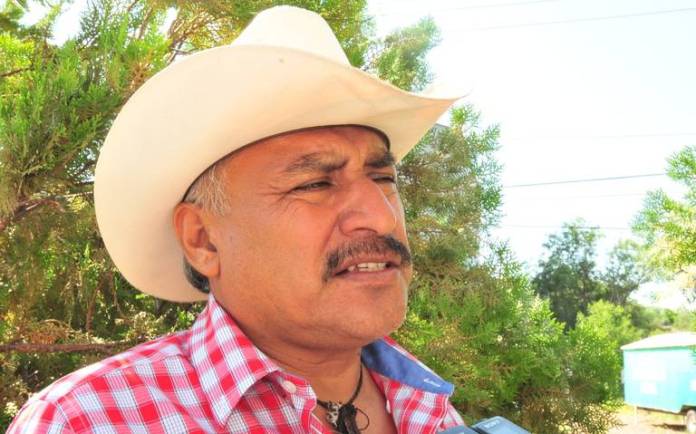
Above: Tomás Rojo, Yaqui defender of territory and the rights of his peoples.
By R. Aida Hernández Castillo
In the last two months, Mexico’s indigenous movement has lost two of its most lucid and committed defenders of territory and of people’s rights, the Yaqui leader Tomás Rojo and the Tsotsil activist, Simón Pedro Pérez López. Their deaths have been part of a continuum of violence exerted upon their territories, that have included forced displacement, disappearances, femicide, and the use of clandestine graves as part of a “pedagogy of terror” practiced by armed actors who are members of organized crime, of paramilitary groups, with the direct or indirect participation of security forces.
The way in which narco-violence has affected indigenous peoples has been little documented by the social sciences, and silenced by official reports about the impacts of extreme violence in the country. The risks involved in field research on these issues and cultural perspectives on indigenous peoples have prevented in-depth analyses about the way community fabrics have been affected by these many violent acts.
In other texts I have referred to these silences, such as the “multiple absences” of disappeared or murdered indigenous people.
Both the execution of Simón Pedro, member of the Association of Las Abejas de Acteal, and of the National Indigenous Congress (CNI) on this past July 5, and the forced disappearance and murder of Tomás Rojo one month before were preceded by decades of repression and paramilitarization in their communities, for which the Mexican state has direct responsibility. In the case of the Tsotsil leader, the Acteal Massacre, which occurred on December 22, 1997, was an antecedent that evidenced the state’s responsibility in the formation of paramilitary groups in the region. At that time we dealt with versions of the facts that tried to present the murder of 32 women and 13 men as “a product of inter-community feuds” by reconstructing the political history of the region and showing the state’s responsibility in the formation of indigenous political chiefdoms and in the training of paramilitary groups.[1] In this context, we denounce the existence of the militaristic transnational culture of death that crosses borders along with high-powered weapons, torture strategies and techniques of bodily mutilation.

Above: Simón Pedro, former president of Las Abejas of Acteal and a defender of the rights of his people.
Over this already complex framework, global narco-trafficking networks have been set up. The previous training that paramilitary youth have received has been of great use to the drug cartels now embedded in local power structures. The existence of the Chamula Cartel cannot be understood without the earlier formation of the “Institutional Revolutionary Community,” broadly analyzed by Jan Rus, who has documented the history of indigenous chiefdoms (caciques) that have made use of extreme violence to expel, murder and rape those who oppose their power.
In the same way, the murder of Tomás Rojo and earlier murder of his comrade Luis Urbano, have been preceded by multiple violent acts against the Yaqui people opposing the plunder of the aquifer with the construction of the Independence aqueduct. The disappearance of Yaqui youth forcibly recruited by organized crime, and who often end up in clandestine graves, has also played a part in the territorial control strategies used by armed actors with direct or indirect support from security forces.
Throughout the country far and wide, organized crime linked to the global weapons industry has embedded itself in indigenous communities, physically or culturally kidnapping a generation of young people, whose bodies many times end up becoming markers of territorial control for the cartels. Faced with this politics of death, the indigenous resistances have mobilized to defend the territory and denounce genocide on a national and international scale. The “Journey for Life,” initiated by members of the EZLN and the CNI in Europe, proposes confronting the militaristic culture of death with the linking of struggles for life.[2] The strategies of dispossession and death are global, so the resistances must be global.
* Doctor of anthropology, researcher at CIESAS.
[1] http://www.rosalvaaidahernandez.com/wp-content/uploads/2019/12/1998-LIBROS-La-Otra-Palabra-PDF.pdf
[2] https://www.caminoalandar.org/post/viaje-zapatista-por-la-vida-al-encuentro-de-los-pueblos-en-lucha
This article was published in La Jornada on July 18th, 2021. https://www.jornada.com.mx/notas/2021/07/18/politica/pueblos-indigenas-narcoviolencia-y-paramilitarismo/
English interpretation by Schools for Chiapas
Re-Published by the Chiapas Support Committee
Propose an election through uses and customs in Pantelhó
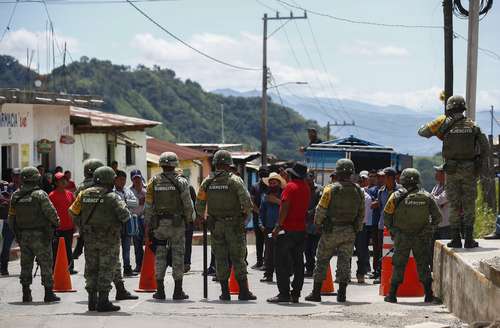
Yesterday morning, they initiated dialogue between the 86 indigenous communities and 18 barrios of Pantelhó and state and federal authorities, military personnel and members of the El Machete Self-Defense group, who guarded the site of the meeting.
By: Elio Henríquez
Pantelhó, Chiapas
Representatives of the 86 indigenous communities and 18 barrios (neighborhoods) in Pantelhó affirmed that during the first dialogue table with state and federal officials held this Tuesday they warned that: in that locality “the bad municipal councils will no longer have a place to govern,” because on October 1st “we will have our new authority” elected through the system of uses and customs.
Pedro Cortez López, coordinator of the commission of 20 people (municipal agents, presidents of ejido commissions and representatives of Catholic and Evangelical churches) named by the communities and barrios, assured that there is no room for the interim mayor, Delia Yanet Velazco Flores, nor the municipal president elect, Raquel Trujillo Morales, both PRD members.
Dialogue in the municipal seat of Pantelhó took place with the mediation of a commission of the Diocese of San Cristóbal, headed by Father Marcelo Pérez Pérez.
Among the points exposed in the dialogue by the so-called Commission of 20 it emphasizes that: “the government recognizes that there is a problem in Pantelhó, the existence of organized crime in the municipal council.” They also demanded justice for the victims of organized crime, to be recognized as original peoples and respecting the naming of authorities through usos y costumbres (uses and customs).
At the same time they demanded an audit of the Pantelhó county council headed by Santos López Hernández –a prisoner in the El Amate prison, accused of sexual assault– and of Velasco Flores that concludes September 30, and that the operation of cantinas and the sale of drugs is prohibited, and also that Velasco Flores resigns.
The private meeting took place in the Francisco Javier Soler Kindergarten, located five blocks from the central park from 11 am to 5 pm. Soldiers and state police agents were posted on both sides of the street, as well as residents.
Pedro Faro, director of the Fray Bartolomé de Las Casas Human Rights Center (Frayba), clarified that representatives of the El Machete Self-Defense group did not participate in the talks, only the authorities from the communities and barrios. “They are showing their faces and they endorse that the El Machete uprising responds to being fed up with the absence of the State, which led to 200 deaths in 20 years, in addition to the dispossession of numerous assets.”
Josefina Bravo, commissioner of the Interior Ministry for dialogue with the indigenous peoples, reported that they agreed that next Friday “we will meet to bring a response to the proposals,” in addition to the fact that we agreed to install thematic groups to address the six points raised.
In an interview, she added that at the end of the meeting members of the commission signed the request for the local Congress and the Superior Auditor of the Federation to review the accounts of the current municipal council.
When asked if the issue of the retention of a score of people on July 26 during the taking of the municipal headquarters, she responded that the Commission of 20 has no information. “We told them that it’s important to know in what state they are found.”
The local deputy Omar Molina Zenteno stated: “We head the six points and the agreement is that there will be another meeting on Friday to give specific responses to each point. Today we listened and received documents.”
Both Pedro Faro and Omar Molina said they didn’t know how many inhabitants have been displaced since July 7, when El Machete irrupted, and July 26, when around 3,000 occupied the mayor’s office and took control of the municipal headquarters.
——-Ω——-
Originally Published in Spanish by La Jornada
Wednesday, August 4, 2021
https://www.jornada.com.mx/2021/08/04/estados
Re-Published with English interpretation by the Chiapas Support Committee
Zapatistas join a mobilization of those Without Papers in France
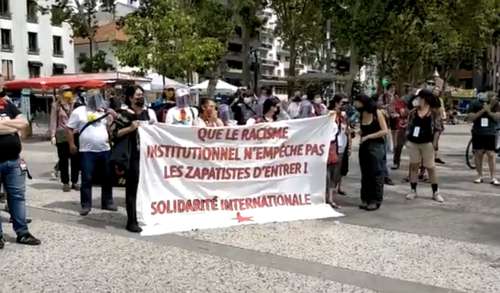
They gathered in the Montreuil neighborhood, in Paris, and toured various shelters.
From the editors of La Jornada
Yesterday afternoon in Paris, France, Zapatista Squadron 421 joined the mobilizations of those Sans Papiers (Without Papers), who demand the legal immigration status of thousands of people in France, Desinformémonos documented on its Twitter page.
At 2:00 pm local time, the Zapatistas accompanied collectives of the movement of undocumented migrants, who gathered in the Montreuil neighborhood to start a tour of three points of refuge and shelters (known as Foyer) for those “without papers,” where migrants coexist who, in the word of NGOs, are sheltered “in deplorable conditions.”
“In the name of all those without papers in France and Europe we owe the most to the Zapatistas,” said one of the movement’s spokespersons, after recalling the phrase: “the people govern and the government obeys” of the Zapatista National Liberation Army (Ejército Zapatista de Liberación Nacional, EZLN).
Accompanied with music, slogans and signs, the Zapatistas and the el Sans Papiers movement demanded from the free entry of all people and the legalization of the immigration status of thousands workers, most in cleaning and other services.
“The Zapatista tour will be completely anti-racist” and “[in] solidarity with the Zapatistas,” shouted the activists and collectives that accompanied the mobilization against institutional racism.
Squadron 421’s accompaniment of the Without Papers march happens after thousands of people in Europe have protested in front of French embassies to demand that the French government allow free entry to the more than 100 Zapatistas, defenders and members of the National Indigenous Congress (Congreso Nacional Indígena, CNI) who will join the Tour for Life on the continent.
Images from Paris can be seen at: https://twitter.com/Desinformemonos/status/1418949439004217348
——-Ω——-
Originally Published in Spanish by La Jornada
Sunday, July 25, 2021
https://www.jornada.com.mx/2021/07/25/politica/009n1pol
Re-Published with English interpretation by the Chiapas Support Committee
The Zapatista journey surpasses the anti-globalization movement
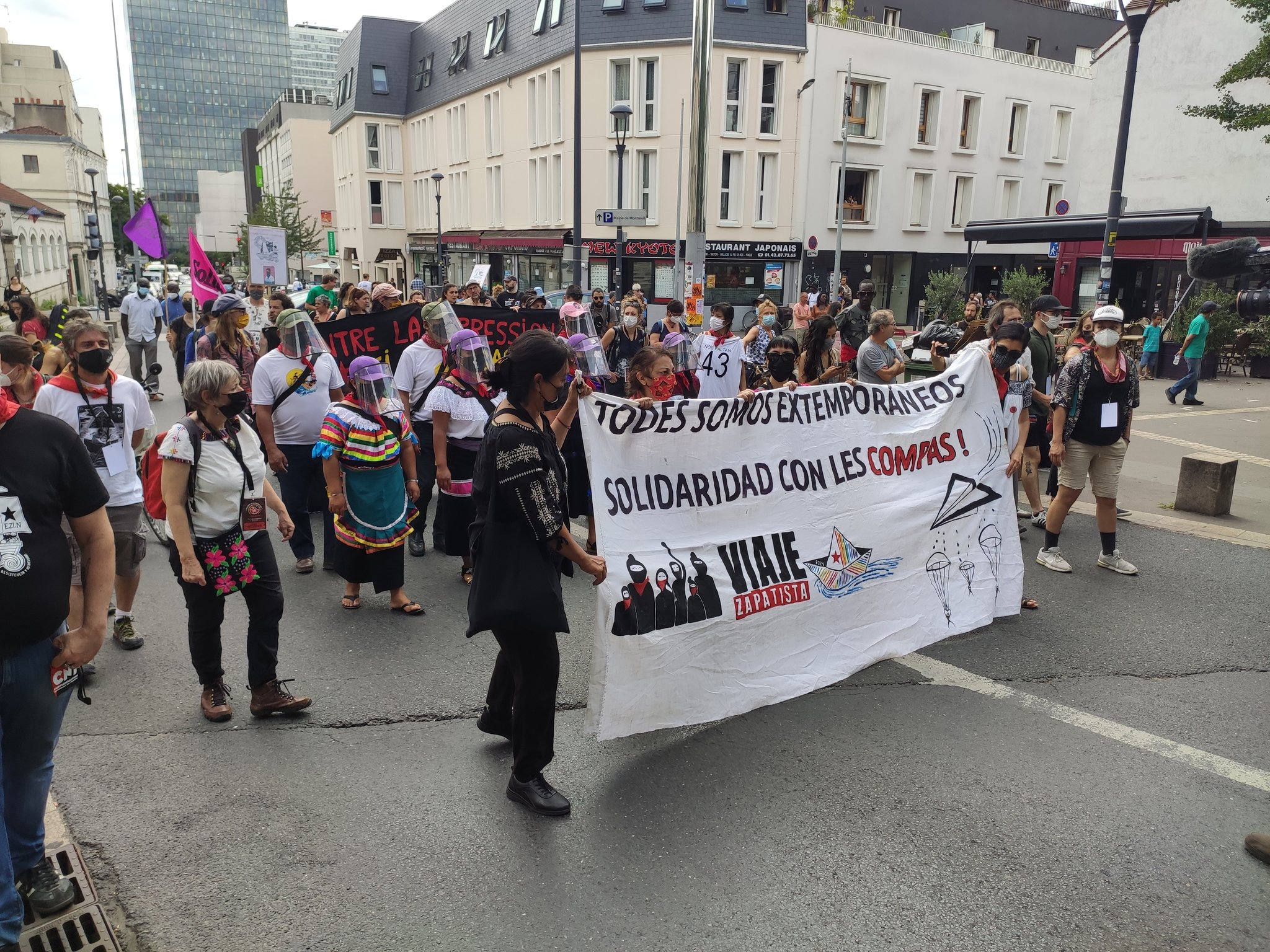
Above Photo: Squadron 421 marches in France.
By: Raúl Zibechi
I propose thinking of the Journey for Life that the EZLN organizes as improving upon the anti-globalization movement that took off in the 1990s, recuperating the traditions of internationalist mobilization, but at the same time, overcoming some of the limitations that allowed it to be neutralized.
At the end of the 1980s the movements against globalization started to hold meetings and gatherings on each occasion that there were summits of the World Bank, the IMF and other international bodies. In the 1990s, international co-ordinations were born, such as Via Campesina (1992) and the Association for the Appraisal of Financial Transactions (ATTAC, in 1998). That same year People’s Global Action against Free Trade and the World Trade Organization (WTO) were born.
In 1999 they organized large demonstrations in Seattle, where more than 50,000 demonstrators managed to abort the WTO meeting. Since then, each meeting of the G-7 or of other international bodies ran into a “counter-summit,” whose maxim expression took place in Genoa in 2001, where the movement suffered brutal repression.
The First World Social Forum was held in 2001 in Porto Alegre, which was replicated for years in different cities of the world. There were meetings of movements, NGOs and parties where heterogeneity and diversity prevailed below and a homogenizing tendency in the coordinating bodies.
As an excellent work from three members of Ecologists in Action (Luis González Reyes, Tom Kucharz and Beatriz Sevilla) points out, these meetings were “in the genesis of the next cycle of struggles, which was qualitatively and quantitatively more important: the indignant movement and the occupation of places that emerged between 2008 and 2011 in different countries” (https://bit.ly/2VaElvk).
The movement against globalization, the name that they prefer to that of de “alterglobalizador” or “altermundialista,” because capitalist globalization is “the only existing one,” failed to sustain itself over time, in large measure because a good part of its referents, especially after the 2008 crisis, chose to become embedded in the institutions, as happened with Syriza in Greece, with Podemos in Spain and in the Latin American countries where there were progressive governments.
Thus, the powerful struggles on Latin America, as well as 15-M on the Iberian Peninsula and the Arab Spring, were diluted between the counteroffensive of the right and the sterility of the parliamentary game. The truth is that those coordination and counter-summits, with which they responded to the summits of the system, disappeared from the political map.
To the contrary, the Zapatistas who convened the First Intercontinental Encounter for Humanity and against Neoliberalism, in 1996 in La Realidad, never stopped organizing international meetings during these 25 years, including the Escuelita that was much more than a meeting: a coexistence for learning in the Zapatista communities, autonomous municipalities and caracoles, among those from below.
I believe that the Journey for Life is the surpassing of the experiences I have just described, in a very brief and incomplete way, for several reasons.
The first is because it goes beyond the concept of “mobilization cycle” or “protest cycle,” a concept coined by the sociologist Sidney Tarrow to explain the accumulation of actions in a short time. Disorganization survives when a cycle ends, the crisis of the movement, its cooptation by the State or the political parties and the struggles decay until they almost disappear. Overcoming the cycle implies permanent organization, without rest, even where there’s no mobilization.
The second consists of going beyond reactive mobilization against governments and institutions, to presenting demands or impeding certain initiatives. We react to the agenda of power that, being necessary and indispensable to setting us in movement, by failing to create our own agenda, it leaves us as prisoners of the initiatives from above.
To my way of seeing things, this is one of the greatest weaknesses of the movements because that way they are not able to construct their own movement, which ends up with us making the system of domination functional again. The FMI and the World Bank have their agenda, they will manage it in their own way and with their own times, but we need our own times and agendas to be truly autonomous.
Lastly, the Journey for Life deepens anticapitalist ways against patriarchy and colonialism because they are gatherings among those below, in the everyday spaces of those who resist, paid for by those who struggle and not by NGOs and governments, to talk about our limitations and the way to overcome them.
I want to understand the journey as an immense collective hug, to make our communities stronger, facing the storm together.
——–Ω——-
Originally Published in Spanish by La Jornada
Friday, July 30, 2021
https://www.jornada.com.mx/2021/07/30/opinion/017a1pol
Re-Published with English interpretation by the Chiapas Support Committee
From the EZLN: First Results of the Popular Consultation

Zapatista Sixth Commission
July 31, 2021.
To the victims and the relatives of victims in Mexico:
To the organizations, groups, collectives and individuals that support the victims:
Here we present the first results of the Popular Consultation that have reached us:
1.- Until 1300 hours on July 31, 2021, the twelve Zapatista caracol centers and their respective Good Government Juntas have received the minutes of 756 towns, communities, places and ranches, from speakers of the Zoque Mayan languages, tojolabal, mame, tzeltal, tzotzil, cho´ol. They are from Zapatistas, CNI [Congreso Nacional Indígena, National Indigenous Congress] and supporters of political parties who gathered in community assemblies and who are “extemporaneous,” that is, they do not exist legally.
2.- The 756 communities of indigenous peoples declared “YES” in response to the question of whether or not they agree that everything should be done to support the fulfillment of the rights of the victims and their next of kin and of truth and justice.
3.- What we have noticed so far is that the INE [Instituto Nacional Electoral, National Electoral Institute] did not comply in many places with translating the question into the Mayan root languages. Nor did they explain what the consultation was about and, in several places, they only left the boxes strewn about, without explaining to the residents what they were for.
4.- The Zapatista peoples did the job of explaining the importance of participating in the Consultation and what was being asked. They did the same with members of parties and the CNI. And they did it in their mother tongue.
To our surprise, some communities who support political parties and where there are no Zapatistas, held and are holding assemblies, and they sent and are sending their results to the Good Government Juntas.
The political party supporters have also thanked the Good Government Juntas for the explanations and that they will go to polling stations tomorrow. And then they will tell us how many participated with their voter credentials.
The lack of representatives of the Mexican State and its institutions is being remedied by the extemporaneous ones, who translate in their native languages explaining the importance of the consultation and what is being asked.
Not only did no one from the INE come forward to explain. Neither did anyone from the ruling party step up—which is supposed to be the interested party in the Consultation because their overseer said so and didn’t even deign to try going to a community.
The only thing that the ruling party officials have done is to threaten the people saying that, if they do not “vote” in the Consultation, they are going to “cut off” their government support programs. This was the message they sent: if you don’t want to lose your paid support, go and vote “yes.”
In addition, the ruling party is lying because they tell them to just go and vote yes, because this is just about prosecuting former presidents.
Instead of explaining to people, they resort to threats and lying to them.
A minimum of self-love, respect and political work would have been enough.
And then they wonder why things are the way they are.
5.- Although we do not exist legally for the Mexican State, the thousands of indigenous families that are “extemporaneous” embrace in this way the thousands of families of the victims from the decisions made by the different levels of government all these years.
6.- Although we do not legally exist for the Mexican State, we ask you—victims, family members and organizations that support them—to accept this embrace from those who have been for centuries—Including current times—victims of “the decisions of the political actors” from all governments across the political spectrum.
When we have the full results, we will reach out to those who fight for truth and justice for the victims and their families.
With this action that we report to you now, the Zapatista peoples begin, on July 31, 2021, their participation in the National Campaign for Truth and Justice.
That’s all.
From the mountains of the Mexican Southeast.
Subcomandante insurgente Galeano.
Zapatista Sixth Commission for the National Campaign for Truth and Justice.
Mexico, July 2021.
________________________________________________
This communique was published in Spanish by Enlace Zapatista on July 31, 2021 and translated into English by the Chiapas Support Committee.
Haz clic aquí para leer el comunicado en español.
Click here to read the original in Spanish.
The Consultation, the past that is the present
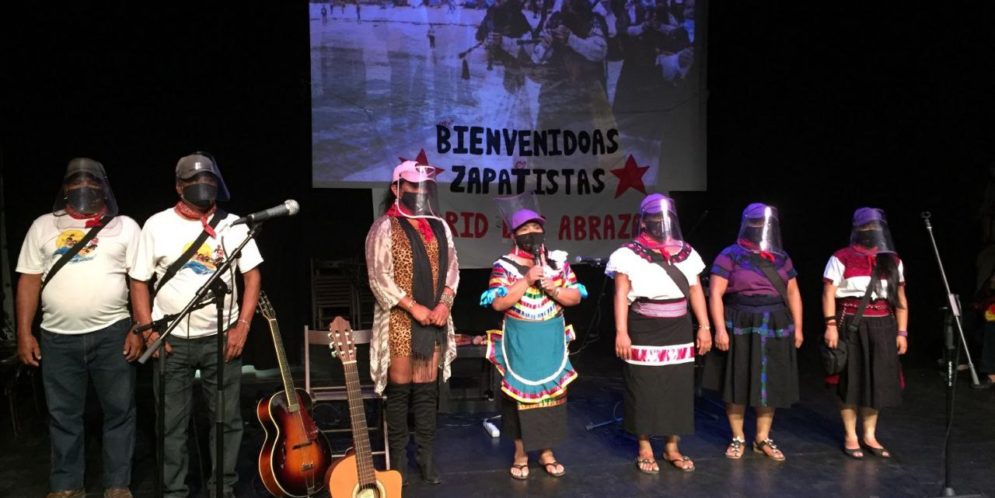
Squadron 421 on stage in Spain
By: Luis Hernández Navarro
The geography of Mexican horror had, at the end of the 20th century, a peak moment. Atrocity became a form of daily government. The terror established a new nomenclature. It was called Acteal and the Northern Zone of Chiapas, Aguas Blancas and El Charco, the Loxichas.
Atrocities were also baptized with names of victims, like the name of the teacher Magencio Abad Zeferino, an indigenous Nahua of the Olinalá region. Soldiers tortured him in the last days of 1996. “You will remember. We’re going to do the same thing to your son,” they told him, while they savagely beat him and gave him electric shocks. For that and other cases, the CNDH issued recommendation 100/97, about torture, disappearance, and arbitrary detentions by the Army in Guerrero (https://bit.ly/2UKXkNd).
Massacres, militarization, prison, extrajudicial executions, torture, forced sterilizations and police persecution were the constant of the last president to leave the ranks of the PRI in the last century, the prophet of neoliberal globalization: Ernesto Zedillo. Canal 6 de Julio (https://bit.ly/2UA3ccb) and Hermann Bellinghausen (https://bit.ly/3kR1sG8) baptized it “the invisible genocide.”
Chiapas, Oaxaca and Guerrero, among other states, were transformed into counterinsurgent hunting territory. Promoted by the State, paramilitaries flourished like mushrooms in the rainy season.
Dozens of military barracks were constructed in the most remote regions of the country. Overwhelmed, the soldiers irrupted in indigenous communities. Women became the spoils of war.
Decent people, public officials, armed forces and members of the Nacional Human Rights Commission, denied the existence of the war that didn’t have a name and that was executed through paramilitaries. Overall, they didn’t have to be held accountable to anyone for their atrocities (https://bit.ly/3iFJwLL). They called them “civilian armed groups.” In Chiapas, they were baptized with the most diverse names: Paz y Justicia, Opddic, Chinchulines, Primera Fuerza, Máscara Roja and MIRA.
Between 1995 and 2000, Paz y Justicia (Peace and Justice) in the Northern Zone of Chiapas murdered more than 100 indigenous Chols, expelled 2,000 campesinos and their families from their communities, closed 45 Catholic churches, and attacked Bishops Samuel Ruiz and Raúl Vera, stole more than 3,000 head of cattle and raped 30 women (https://bit.ly/3kQbjfp).
The high point of this offensive was the Acteal Massacre, a crime of State. On December 22 1997, paramilitaries savagely murdered 45 displaced persons belonging to the Las Abejas group, who were praying for peace in a chapel (https://bit.ly/3y410rR).
Outrage upon outrage, the massacres of Aguas Blancas, in June 1995, at the hands of police, and of El Charco, in June 1998, by the Army, were very painful moments for the people of Guerrero. Mourning, helplessness and anger prevailed. The mafia-like power linked to the soldiers, ministerial police and caciques showed its most bloodthirsty face. 17 campesinos were murdered in Aguas Blancas, 10 indigenous and an UNAM student in El Charco. Things didn’t stop there. The communities were harassed, and not just a few leaders of both movements were later disappeared or murdered.
Years later, now during the government of Felipe Calderón, after the disappearance and execution of the Mixtecos Raúl Lucas and Manuel Ponce, in 2009, the list of regional indigenous leaders murdered, mostly by criminal groups increased insanely, in what is a counterinsurgency of subrogation (https://bit.ly/3kOpLED).
The entire weight of the State (Zedillo said it) fell on the Zapotecs of San Agustín Loxicha, starting at the end of August 1996. An army of occupation was turned on the entire region. One after another, illegal arrests, torture, 22 forced disappearances, clandestine executions and illegal searches took place. Soldiers and police initially arrested more than 250 people, starting with the municipal authorities, accusing them of belonging to or collaborating with the EPR. Hundreds of judicial files were fabricated against indigenous people.
Despite this carnage, the intellectuals who benefitted during the six-year term of Zedillo with juicy contracts and who enjoyed privileged treatment with the president have wanted to present him as an apostle of democracy.
No authority was tried for those crimes. At most, it cost Rubén Figueroa and Emilio Chuayfett their jobs. Impunity was the name of the game. Even worse, the past wasn’t left behind. Without self-criticism, prominent figures in the Zedillo administration, like Esteban Moctezuma (Secretary of the Interior and of Social Development) and Olga Sánchez Cordero, in the Supreme Court of Justice of the Nation, who was appointed as a result of the presidential coup to reform the Judicial Power and appoint new ministers (https://bit.ly/2TB72Be), occupy prominent positions today.
Due to the horror of the Zedillo years, and for all the other horrors that have been experienced over the last half century, it’s important to participate in the August 1 Consultation [1] looking at the victims. Convert it into a mobilization in favor of a truth and justice commission that clarifies the multitude of offenses committed by the figures with power against those who struggle and resist.
[1] The August 1 national consultation is a national referendum in Mexico on whether or not past presidents can be tried for crimes committed in office after they leave office.
——-Ω——-
Originally Published in Spanish by La Jornada
Tuesday, July 27, 2021
https://www.jornada.com.mx/2021/07/27/opinion/017a1pol
Re-Published with English interpretation by the Chiapas Support Committee
EZLN: Why Yes to the Consultation and Yes to the question

July 2021
Summary: A call to participate in the Consultation with the victims in mind. Going to the polls. It is suggested that if you dislike or distrust the Supreme, and rightly so, and think that your participation would be used to legitimize those from above, or that that it is a rehearsal for a later consultation which would extend the mandate of the executive, or that is a waste (yet one more) of pay, or that what the Supreme wants is to negotiate with the exes to bring down the bad vibes a notch, or it’s demagoguery pure and simple, then don’t go to the polls.
Instead of this, it is proposed that you write a letter, either individual or collective and that you send it off to an organization of victims, telling them that you honor their pain and that you support them in their demands for truth and justice. Or, a newspaper column, a tweet, a comment on your blog, in your newsletter, on your Facebook, Instagram, or wherever. Or a painting, a song, a mural, a poem, a speech, a sonata, a pirouette, a figure, a play, some art. Or an article of analysis, a colloquium, a lecture, a conference, a seedbed. Or whatever occurs to you. And even more, to make your non-conformity clear, do it extemporaneously, say one or several days after August 1st, and continue it for the rest of the year and the following years. It is stressed that you must get organized because, without even knowing it, you make up part of the future and probable victims of “the political decisions made in the present and coming years by political actors” of the Mexican State. It is that or resign yourself to the fact that when you are the victim, the “political actor” responsible for preventing this from happening to you, of investigating, pursuing, and punishing the guilty parties, declares the you “asked for it,” that he condemns the act and of course, it will be investigated “to the ultimate consequences, regardless of who falls” — as your name, and your personal story, pass into a number and a statistic.
-*-
First: The Zapatista communities will participate extemporaneously in the so-called “Popular Consultation,” following the usos y costumbres of the indigenous peoples, with community assemblies. The results will be sent to the organizations of victims of violence, the search for the disappeared, and prisoners of conscience. Those who have the INE (National Electoral Institute) credential (in fact there are very few), will go to the polls. We ESPECIALLY call upon our indigenous sisters and brothers, organized in the National Indigenous Congress-Indigenous Governing Council to participate also, according to their times and ways, without losing sight of the victims, and holding present all of the murdered brothers and sisters and communities that have been victims of the decisions of those from above before and now, like the long history of plunder, of deceit, of mockery and of contempt, of destruction of territories and disappearance of indigenous languages and cultures.
Second: The question to be asked is not about the former presidents, or… not that alone. But rather all of the political actors — federal executives and their legal and extended cabinets; state and municipal governments; federal and local deputies, senators; judges and the entire justice apparatus; decentralized agencies, autonomous agencies (formerly the IFE and now the INE, the National Electoral Institute); the Army, Air Force and Navy; federal, state and municipal police.
Nor is it about judging or condemning anyone. It is about the rights of the victims, the right to justice and to truth.
The right to know why such actions and omissions were decided upon, which laws provided them with legal support. And, who were or are those responsible or irresponsible, from the highest to the lowest level. That would be the truth, and its consequence would be justice.
Neither one or the other are in question. The question is whether we are in agreement with supporting the victims who demand to know what happened, why, and by whom; and to demand justice.
When one puts a time period of “years past” it can be deduced that it includes up until the 31st of December 2020. And if the months of January to July of 2021 are “past,” well, that also.
Whether anything more than a simulation follows from these demands for Truth and Justice, will depend on the victims, their families and those that support them.
Third: the Risks. Yes, it is more than likely that both the government as well as the “opposition,” use the participation in the consultation and the result, either as a way of legitimizing its government policy, or as a plot to hide their guilt and evade justice. The number of “contemporary” participants, as well as the responses can be hijacked by either side. But that will only last for a while.
What matters to us is that the victims feel accompanied and encouraged in their painful journey. But their pace, their rhythm, their speed, their company and their destiny, is up to them and only for them to decide.
Yes, there is also the risk that the government uses this popular consultation to support those false “consultas” with which it has covered up the predatory nature of its megaprojects in the indigenous territories. Well, “consultations” those were not. They were shameless rides, with ridiculous results. Agreement was blackmailed and paid for, and even then, they failed in terms of participation. They were not prior, nor informed, nor free, nor according to the ways and times of the indigenous peoples. But in the event that someday indigenous peoples were consulted, they were well-informed of the pros and cons, BEFORE the megaprojects were implemented, ALL of those affected participated, etc. and the proposal for destruction of nature and the annihilation of the indigenous people as such won, then the conclusion would be that the work of explanation and convincing was lacking and we would have to continue insisting. In the meantime? Resistance and Rebellion.
Of course, this consultation could also be a sham…if we don’t turn it into something inopportune, unseemly, inconvenient, “extemporaneous.” That is, if we do not turn it into something more. Although you would first have to pull away what they are saying and arguing up above; and then later, continue with gatherings, forums, festivals, and support for the victims. A National Campaign for Truth and Justice: In short, “accompaniment,” not “direction.”
Fourth: Wouldn’t it be good if the Mothers Seeking the Disappeared in Sonora, the Trackers of El Fuente, Sinaloa, the mothers of the kidnapped Yaquis, the displaced of Pantelhó, the families of the disappeared in Guerrero, Guanajuato, Veracruz, Baja California Sur, Querétaro, Jalisco, Coahuila, Morelos and almost every state of the Mexican Republic, as well as the family members of the immolated migrants in México, the family members of the disappeared of Ayotzinapa, could meet with ….
… the families of the victims of the dirty war, with the families of infants with cancer and without medicine, with the women who were assaulted in Atenco, with the feminist movements that struggle against femicide and violence against women, with the defenders of the LGBTQ+, with the families of the ABC Nursery, with the family members of the deceased in line 12 of the Metro in Mexico City….
…with the family of Samir Flores Soberanes and those who organize to resist the Thermoelectric Plant in Morelos, with the communities that resist the plunder and destruction that are meant by the poorly-named “Mayan Train,” TransIsthmian Corridor, Santa Lucía Airport, open-pit and underground mining, with the organizations for political prisoners and disappeared persons, with the Abejas de Acteal, with the survivors of El Charco, with those close to Tomás Rojo and Simón Pedro, with so many organized and unorganized sorrows?
Think about that person that finds herself alone, looking for a loved one without any more strength than those of her womb and her heart, and in addition, she should suffer the mockery and the contempt of others, others that say that “she deserved it,” or “she had bad habits,” “you complain because you are part of the mafia of power,” or it is your fault for not educating her well.”
And they don’t even let her respond: “my daughter went on an errand to the corner and didn’t come back,” or “she went to a party,” or “my daughter is less than 10 years old,” or “my husband was coming from work and they killed him twice — once with bullets, and again with lies that he was a criminal,” or “instead of receiving a photo of my daughter/son graduating, they gave me the results of a DNA test and a bone fragment in a shred of clothing he wore that day, that afternoon, that night that since then, never ends.”
Or not even that: in no place, neither alive nor dead –disappeared.
Could it be that this is how she knows that she is not alone? Could it be that this is how she discovers that not only is she not the only one in pain, but that there are others who seek truth and justice?
Won’t she discover, in this way, the same that we, the Zapatista communities have? Namely: sorrows do not add up, but rather multiply when they meet.
The danger will not be that the government or the opposition uses these meetings to their advantage. Rather, it will be if this already organized pain is not respected and that they try to direct it in a way other than to achieve the truth and justice that every human being, independent of their race, color, culture, creed, gender, sexual orientation or preference, political affiliation or ideology, or social class, deserves and needs.
Because it is not enough to settle for mourning a new murder, a new disappearance, a new mass grave with bones and shreds of clothing. Public complaints suffocated by the scandal of the day are not enough. A statistic, a number, an omission is not enough.
That woman deserves to know the truth: What happened to her child and why. And she deserves not only to be accompanied in this search for truth, but also in the demand that those responsible for those crimes receive their punishment.
This geography called “Mexico” deserves to know the truth about what happened and is happening. And it deserves justice. Whether they be “chairos[1]” or “fifis[2],” neoliberals or neoconservatives, Pro-4T or anti-4T, or whatever dichotomy you can think of.
But nevertheless: if you decide that it doesn’t do any good to participate in this other consultation, well maybe it means that you are doing something more and better.
Fifth: The Middle Class and the Consultation.
As the native that I am of the middle class, I know that we are classified and pigeonholed according to interests from above. They classify us so much as middle class that we look like Spanish keys: there are fifteen sixteenths, a quarter, three eighths, nineteen twenty-seconds, a quarter-til-six-oh-my-god-how-late-it-is, and half middle-middle class — which is the last straw, and so on. “Did you see that one who thinks she is so thirteen sixteenths when she doesn’t even get to three eighths, poor thing?… and that other one, that overnight climbed almost fifty seventy-seconds, he’s probably a drug dealer… or worse, a politician.”
Or as the orthodox classify us — petit bourgeoisie. And here a similar system comes in, the nano bourgeoisie, micro bourgeoisie, quasi-petit bourgeoisie, self-proclaimed petit bourgeoisie, bourgeoisie in process, and bourgeoisie between blue and the middle of the night…yeah, the hot dog without mayonnaise, please. I, for example, don’t even get that. I am barely a “pequebú” (baby bourgeoisie). But as the deceased would say, “It all depends on the make and model of the phone with which you take your selfie.”
We also get blamed for the failures and deviations of the various political choices of the ideological spectrum, and none of their achievements.
I understand, and not infrequently, I share the irritation and indignation for the bickering that comes out of the latrine up there, for the thinly veiled insults, and for the attacks of people that being from the middle class, now call themselves the “vanguard” of the people or “enlightened” who guide and lead the flock. And who, as such, despise knowledge, intelligence, creativity, genius…and sense of humor. In addition to pretending that the sciences and art are militant in their political choice…or they are neither sciences or arts. In fact, my first reaction was to summarize our position like this: «From the government that holds raffles that are not raffles and Mayan trains that are not Mayan, now — the consultation that is not a consultation. You’d better get organized!»
But the idiotic and cynical opposition is also lurking. The sudden “realizations” of the former ruling criminals who, disparaging memory, now are champions of defense of human rights, of the indigenous communities, of the environment, and who criticize the government economic policies after they have had their fill of pillage and plunder. The supposed “opposition,” incapable of boasting any achievement, bets it all on the mistakes and follies of the government, which are not few. And of course, they bet on oblivion, on memory buried by the screaming on social media, the opinion columns, and the perverse management of information. Because the misnamed “fake news” is not only false news, it is the manipulation of information. The alchemy that makes them not credible, but digestible. And more than anything, into ammunition for the “heroic” combat on the social networks and the media.
And it could be that out of desperation, you elect one side or another.
But, if you manage to escape from that curse, even for a moment, direct your gaze at the victims.
If you are not one of the victims, just one more, and you haven’t formed a community police force, well, the odds are stacked against you and you would do well to prepare yourself.
If you don’t do it out of empathy and human sensitivity, at least do it for the sake of “today for you, tomorrow for me.”
Crime statistics might serve, certainly, to criticize a government policy; but more than anything they are a warning: “you’re next.”
Get organized. In this geography called Mexico, there could well be an organization of future and probable victims of “political decisions made by political actors” that is born.
Sixth: Participate in the so-called Popular Consultation. If you don’t want your feelings to be used by one or another, don’t go to the polls. Shout, scratch, paint, sing, make gestures, be silent, walk, run, stand still. You decide what and let the victims know. And do it after the 1st of August…all year long and for the years to come.
Or get together with others, and analize, discuss, and debate. If you want, write down in some kind of minutes or common letter, your unanimous or divided decision, and send it to an organization of families of victims. (I doubt that you don’t have one in your geography.) Remember that the INE does not count feelings, solidarities, brotherhoods or demands for truth and justice.
And your age doesn’t matter, whether you are extemporaneous or contemporary, if you are above, below, or in the middle, if you are “chairo” or “fifi,” if you like cumbia or rock, if you watch anime or westerns, if you are hetero o “ultimately what does it matter to you what I am or am not.”
Don’t do it because you support the government or because you oppose it. Do it if only to tell that woman that cries in the absence of her partner, her child, her sister, her mother, her family member, her acquaintance, her friend, her compañera, her love, that her tenacious search for truth and justice, her determination, her pain, her nightmare, do not go unnoticed by you.
Do it because maybe, under all of the classifications, flags, emblems and slogans, you are a human being.
From the mountains of the Mexican Southeast,
SupGaleano
Sans Papiers (Without Papers)
Neither contemporary nor extemporaneous!
[1] A pejorative word used to describe a stereotypical adherent of the left who holds leftist values and uncritically follows candidates or political personalities with a religious zeal. The expression has numerous twists in its etymology in Mexico, and came to refer to an AMLO voter in the 2005 election.
[2] Originally used to describe a person of the upper class who supported Porfirio Diaz, then came to mean an effeminate man who held the latest style. In AMLO’s usage the term has come to refer to the “conservative, two-faced puppets” of his opposition.
En español: http://enlacezapatista.ezln.org.mx/2021/07/25/por-que-si-a-la-consulta-y-si-a-la-pregunta/
Pantelhó residents take over municipal council headquarters

Control. In the early hours of this Tuesday, residents took control of the municipal council’s offices. Above Photo: Isaín Mandujano
By: Isaín Mandujano
PANTELHÓ Chiapas (apro)
In plain view of the Mexican Army and National Guard (NG), thousands of indigenous peoples from diverse communities came down from the mountains and together with residents of the municipal seat took over the plaza and headquarters of the municipal council, from where they said they would not permit the return of the Herreras nor entry into the town of the acting mayor and her husband, the mayor elect.
This Tuesday, without weapons, without the characteristic uniform, masked, with machetes or sticks in their hands, indigenous Tsotsils and Tseltals, many of them members of the El Machete autodefensas (self-defense group), started to arrive in the early morning to burn the houses of those who they consider make up a part or have links to the Herrera family and the “narco county council,” as they call it.
Pantelhó is made up of 86 communities in the entire municipality and 18 neighborhoods in the municipal seat, where today residents of the communities demonstrated their exhaustion against the political group that for almost 20 years maintained political control of the municipal council, election after election.
Residents went to the homes of Austreberto Herrera and his sons, Dayli de los Santos and Rubén Estanislao, which were vandalized and burned. They proceeded in the same way against other houses of civilian men and municipal police who they say have links to the Herreras, whom they accuse of murders and forced disappearances.
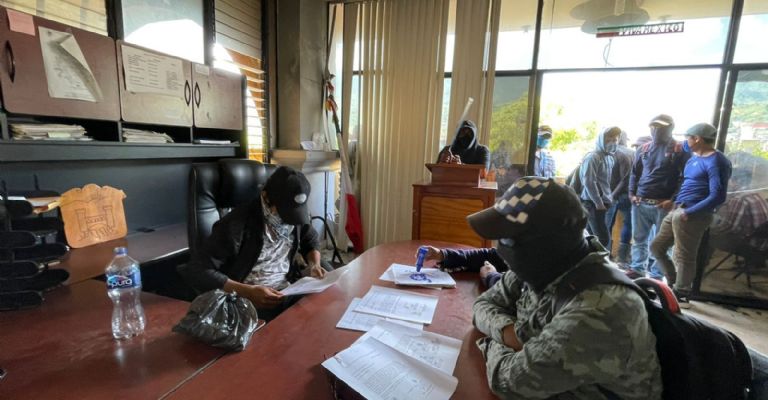
Photo: Isaín Mandujano
Yesterday, residents captured around 14 people and are keeping them retained, people who they accuse of being “accomplices” of the Los Herrera clan and of the PRD municipal council. Faced with the crowd, members of the Mexican Army and the National Guard had to retreat again to avoid a clash with the civilian population.
This is the second day in which residents of the communities took over the municipal headquarters where they were not able to go to protest for many years, because the Herreras and their civilian armed group, intimidated them, threatened them so that they would not demand public works or demand accountability from their municipal authorities.
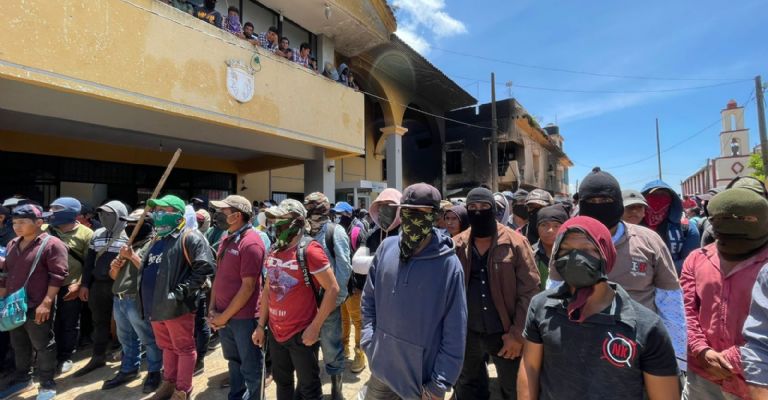
Photo: Isaín Mandujano
Today, the indigenous Tsotsil and Tseltal residents who rebelled against the Ladinos who controlled the town, said that they will not allow the current mayor, Delia Yaneth Velasco Flores, to return to her position and that nor will they allow the mayor elect, her husband Raquel Trujillo Morales, to take the oath of office as mayor.
They demanded that the resources of the municipal council that were diverted in the last three years be audited and that from now on the residents, who without threats, vote buying or vote coercion, will be the ones who elect their new authorities.
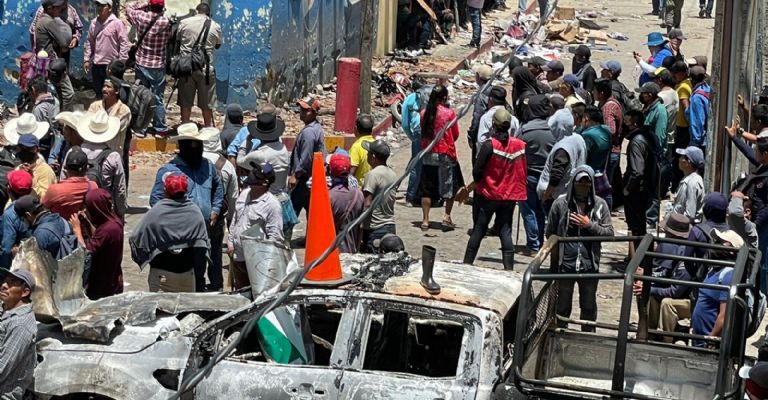
Photo: Isaín Mandujano
———————————————————-
Originally Published in Spanish by Proceso.com.mx
Tuesday, July 27, 2021
Re-Published with English interpretation by the Chiapas Support Committee
 Chiapas Support Committee