Chiapas Support Committee
Home of the Compañero Manuel blog on zapatistas & mexico
CNI-CIG obtains provisional suspension of presidential agreement on mega-projects
By: Isaín Mandujano
The National Indigenous Congress and the Indigenous Government Council (CNI-CIG) announced that a federal judge granted them a provisional suspension of the presidential agreement that declares the federal government’s public works and projects [matters] of public interest and national security.
At a press conference this Tuesday, they announced that the Second District Court in Matters of Civil, Administrative and Labor Suspension and Federal Trials in the State of Puebla granted the provisional suspension of the presidential agreement.
They pointed out that with this suspension: “the neoliberal Mexican government is provisionally prevented from executing the actions indicated in its illegal agreement, like declaring its projects [matters] of “Public Interest” and “National Security,” with which it reiterates: “with cynicism, its decision to trample on the rights of anyone, using its armed groups to do so.”
They argued that indigenous peoples and communities of Jalisco, Querétaro, Puebla, Morelos, Veracruz, Oaxaca, Campeche, Quintana Roo, Yucatán and CDMX, participants in the National Indigenous Congress (CNI, Congreso Nacional Indígena) filed a total of 17 lawsuits against the agreement of the President of the Republic that declares the federal government’s works and projects [matters] of public interest and national security, with which the federal public administration agencies are instructed to grant provisional authorizations for their execution.
It’s an agreement that ignores requirements established in the Constitution and in international conventions and regulatory laws; and thus violates the rights of the peoples for the purpose of enabling the imposition of infrastructure works and large mega-projects like the Interoceanic Corridor of the Isthmus of Tehuantepec, the Maya Train, the New International Airport of Mexico City and the Morelos Integral Project. [1]
They said that megaprojects facilitate: “a greater dispossession of Native peoples through reordering of territories, borders and populations of Mexico and Central America in favor of the geopolitical interests of the United States and large multinational capitals.”
They indicated that with the agreement of the bad federal government, they will also have all the facilities to repress the peoples who are opposed to their neoliberal policies.
“Despite the profound legal aberration that the agreement represents, in most of these lawsuits for amparos (suspensions) the judges have declared themselves incompetent, have rejected them outright or have asked us for various endless clarifications; in contrast to this negligent and complicit attitude of many judges,” they mentioned.
They explained that with this presidential agreement, the government of Andrés Manuel López Obrador will have the ability to protect its own business and also that of big capital that wants to continue dispossessing the territories of the Nation and its peoples.
Members of the Coordination and Follow-Up Commission of the National Indigenous Congress-Indigenous Government Council called on all the Native Peoples of Mexico: “to be attentive to the imposition of the megaprojects of death and the way in which the judicial power can act in the face of the decision of our peoples to defend their rights and their territories.”
[1] One legal obligation that the Mexican government is bypassing with what is termed its “agreement,” is the obligation it has to hold prior, informed, free and culturally appropriate consultations with indigenous peoples who are affected by proposed public works projects.
==Ω==
Originally Published in Spanish by Chiapas Paralelo
Wednesday, January 12, 2022
Re-Published with English interpretation by the Chiapas Support Committee
They document attacks on a Zapatista community in the Lacandón Jungle

Zapatistas of Nuevo San Gregorio
By: Isaín Mandujano
Today, a network of organizations, collectives and networks, adherents to the Sixth Declaration of the Lacandón Jungle, denounced the constant aggressions that an indigenous Zapatista community settled in the Chiapas jungle has been suffering from a group of armed civilians called “The 40 Invaders.”
After members of a group of 12 civil organizations adhered to the AJMAQ Network of Resistances and Rebellions carried out a third caravan to that indigenous Zapatista community to verify what happens there every day, they pointed out that it lives under attack, under threats from a civilian armed group.
It’s the indigenous Zapatista community of Nuevo San Gregorio, belonging to Lucio Cabañas Autonomous Municipality, Caracol 10, Flowering the Rebel Seed, Good Government Junta: New Dawn in Resistance and Rebellion for Life and Humanity, in the Patria Nueva Zone, territory that the EZLN recuperated in 1994, where girls, boys, men, women, and old ones live under permanent siege from the group of “The 40 Invaders.”
To the individuals, families, collectives, organizations, networks and communications media we extend this REPORT so that during the month of January you can contribute to the Campaign of dissemination of this document and information.
We ask you to join from your geographies, according to your ways, times and creativity, for the purpose of denouncing and letting the Zapatista families know that they are not alone. Also, to show our organization/articulation in the face of this War against the life and autonomies of the Zapatista peoples.
It’s an armed group whose main leaders are: Nicolás Pérez Pérez (former member of the Huixtán municipal council), his sons Roberto Pérez Huet and Alejandro Pérez Huet, Nicolás Mosan Huet, Alonso Bolom Ara and Nicolás Gómez Pérez.
On January 8 and 9, 2022, a third Caravan was organized, called by the AJMAQ Network of Resistances and Rebellions, to follow up on what’s happening in Nuevo San Gregorio community, where they were before on October 28, 2020 with the First Solidarity Caravan and on January 12, 2021 when a second Solidarity and Documentation Caravan took place.
They pointed out that after the uprising of the Zapatista National Liberation Army (EZLN, Ejército Zapatista de Liberación Nacional) on January 1, 1994, thousands of hectares of land “usurped by finqueros/estate owners, were recuperated by their legitimate owners: the Native peoples.”
Based on these events, the government and its paramilitary groups have persisted in designing and executing a War to once again dispossess and control the land and territory where the Zapatista peoples construct a collective and autonomous way of life.
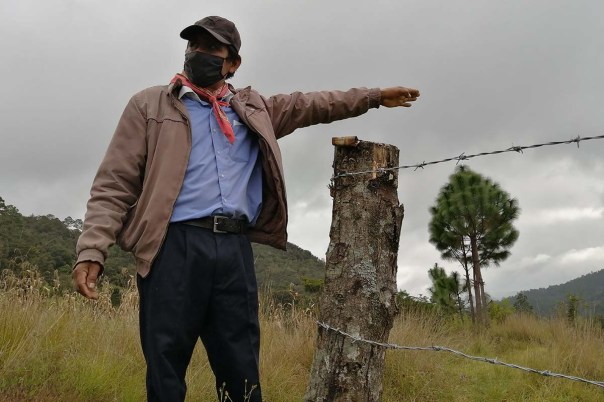
A video from the Ajmaq Network’s visit can be found here. There are 3 versions of the video. The #2 video has English subtitles.
They pointed out that Nuevo San Gregorio autonomous community comprises 155 hectares of recuperated land. Since November 2019, the 40 invaders began to intimidate and provoke by enclosing (fencing) workplaces and the autonomous secondary (middle) school, which has fruit trees and medicinal plants.
On February 27, 2020, the Nuevo San Gregorio community as well as the Good Government Junta attempted to establish a dialogue with the invaders making 3 concrete proposals to them: one, that the land be worked collectively; or two, give them one hectare per person; or three, divide the 155 hectares in half.
However, the invaders rejected these proposals. And from then-on the only thing that group has done is to provoke, attack and threaten the Zapatista bases.
“A concrete fact that clearly demonstrates that they don’t want the land because they need it to live, nor for a business, (but to go against the EZLN organization) is that all the invaders have their own land in the 4 communities to which they belong,” the activists said.
During 2020 and 2021, the invaders started with the fencing of the water storage tank that distributes [water] to the town, the electrification pole where the line for pumping water and the region’s tractor impede its movement.
The theft of garden vegetables, medicinal plants and fruit trees, threats to the Zapatista women and harassment of the men surrounded by invaders carrying sticks, machetes, batons and slingshots. In addition to monitoring and intimidating them at a distance, taking photos and video in the direction of Zapatistas in order to harass-besiege the families on their own land.
To date, January 2022, of the 155 hectares of recuperated land, the invaders have reduced the space and way of life, movement and production of the Zapatista families to three and a half hectares. They left the population center on half a hectare, leaving three scattered and fragmented hectares. Families, are currently found fenced-in and kidnapped on their own land.
The organizations, collectives and activists that participate in this 3rd Caravan of Solidarity, convoked by the AJMAQ Network of Resistances and Rebellions, gave an account of the documentation starting with testimonies and evidence of concrete facts about the acts of harassment, threats, destruction and dispossession towards the families and the Zapatista community of Nuevo San Gregorio.
They denounced that: “the constant criminal action of the group of 40 invaders, is in invading, fencing, kidnapping and killing the land and territory with barbed wire, which represents violating the right to the use and enjoyment of the land and territory that legitimately and in full exercise of right the Zapatista families have to forms of autonomous organization.”
Among the civil organizations participating in this civilian observation mission are: México Gruppen, International Forum of Denmark, Adherents to the International Sixth (Argentina), Women and the Sixth (Mexico City), the Zapatista Mix Network (Mexico City), the Anti-capitalist University Network (Mexico City), Economic and Social Development of Indigenous Mexicans (DESMI, AC), the Space of Struggle Against Oblivion and Repression (ELCOR), the Space for Women adherents to the Sixth (Jovel Valley), the Community Defenders (Jovel Valley), the Families of Prisoners in Struggle Collective, individual Adherents to the Sixth (Jovel Valley) and Promedios, as well as the AJMAQ Network of Resistances and Rebellions.
==Ω==
Originally Published in Spanish by Chiapas Paralelo, January 9, 2022, https://www.chiapasparalelo.com/noticias/chiapas/2022/01/documentan-ataques-a-comunidad-zapatista-en-la-selva-lacandona/ Re-Published with English interpretation by the Chiapas Support Committee
The Europe of Below and Aldama, Chiapas
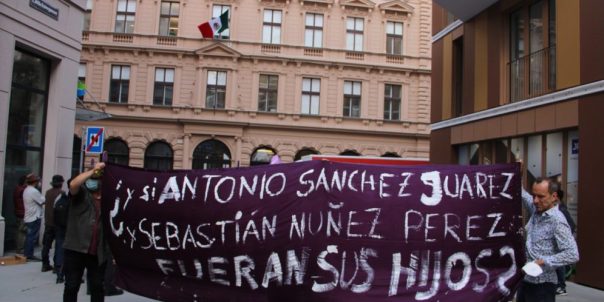
In the streets of Vienna, a protest to demand the return of two kidnapped Zapatistas.
By: Carlos Soledad*
The state of Chiapas has become powder keg. On September 11, [2021] for example, members of the paramilitary organization ORCAO kidnapped the Zapatistas Sebastián Núñez Pérez and José Antonio Sánchez Juárez, autonomous authorities of the Good Government Council of Patria Nueva. The Zapatistas asserted in a communiqué that: “The only reason the conflict did not escalate into a tragedy was because of the intervention of progressive parish priests, human rights organizations and the mobilizations and denunciations that were carried out in Mexico and, especially, in Europe.”
The case of the communities in the municipality of Magdalena Aldama, in the center of the state, in the Chiapas Highlands, is dramatic and very delicate; the situation hangs on a thread. These communities are inhabited by Bats’i vinik-antsetik, an indigenous Tsotsil people. For years they have been besieged by para-militarization. In the cables they send to civil society they report almost several times a day: “They have surrounded us with high-caliber gunfire […] the gunfire returns again […] high-caliber gunfire from armed groups.”
The conflict has been going on for a long time. In a presidential resolution of José López Portillo in the 1970s, the community of Santa Martha (Manuel Utrilla village) was given 60 hectares, which belonged to the municipality of Santa María Magdalena Aldama. Later, it was recognized that the owners were those of Aldama and in 1977 they agreed to respect the right of possession. However, the agreements were not respected and in 1997 Santa Martha demanded the return of that land. In 2009, the Unitary Agrarian Tribunal resolved possession in favor, again, of the 115 communal owners of Aldama.
However, in 2016, the Aldama communal landholders claim that the conflict intensified with the dispossession of lands during the government of Manuel Velasco Coello, and now under the government of Rutilio Escandón Cadenas […]. “We were dispossessed by people from the town of Manuel Utrilla (Santa Martha sector) in the municipality of Chenalhó. The 60 hectares have ancestrally belonged to the people of Magdalena Aldama. On those 60 hectares lived seven families who in 2016 were dispossessed and threatened at gunpoint, and took refuge in the communities of Aldama municipality. In 2016, the paramilitary group operating in Chenalhó was mobilized.
The organization La Voz del Pueblo de Tan Joveltik, from the communities of Magdalena Aldama, for months, has been denouncing para-militarization with very violent aggressions. The state government acts as a guest of stone, not saying anything, and suspiciously negligent. “The rain of bullets allows them to go about ‘clearing’ the land, ripping it away from its legitimate inhabitants. To what end? The most widely mentioned version is that it would be a strategic stretch for the illegal transfer of weapons, drugs and people, which is very widespread lately,” it is hypothesized in Ojarasca (shorturl.at/fgiqM).
Dozens of unidentified armed men enter Santa Martha at all hours, intimidating the people. In their latest communiqué, the communities of Magdalena Aldama point out that: “since 2016 we are a town that lives under the hail of gunfire by the paramilitary-style armed groups in Santa Martha, Chenalhó municipality.” Recently, there have been as many as 30 or 40 attacks in a single day. Since the beginning of 2020, armed aggressions have increased in intensity, affecting 12 communities and some 5,000 people. Last October, aggressions with gunshots started being committed on a daily basis. Now in the communities we can see bullet impacts on cars, machines and metal siding. Some 3,000 people have been displaced taking refuge from the bullets and bombs this November.
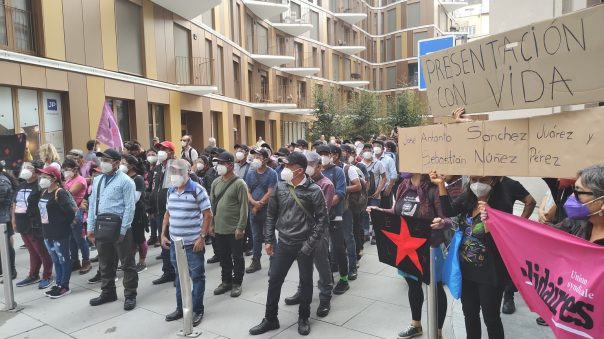
In Vienna, the protest to demand the return of two kidnapped Zapatistas.
In opposition to the situation of the communities of Magdalena Aldama, Europe from below and to the left has joined their demands. In a communiqué sent to the relevant state and federal authorities, supported by more than 40 European organizations such as Spain, Catalonia, Valencia, England, Austria, Belgium, Germany, Greece, Italy, Euskal Herria, United Kingdom, Switzerland, Portugal and Holland, they demand an end to the paramilitary aggressions, hold the three levels of the Mexican government responsible for the lives of the people of the communities of Aldama, demand justice for the region and the immediate and unconditional release of their comrade Cristóbal Santiz Jiménez.
Solidarity has spread like wildfire. The case of the aggressions against the communities of Magdalena Aldama has touched their hearts, and put European organizations on alert to denounce the attacks and demand justice before their own governments, and those of Mexico and Chiapas, so that the violence ceases and the scourge of paramilitarism in the region is put to an end.
*Sociologist specialist in migration.
This article was published in La Jornada on January 4th, 2022. https://www.jornada.com.mx/2022/01/04/opinion/012a2pol English translation by Schools for Chiapas and Re-Published by the Chiapas Support Committee
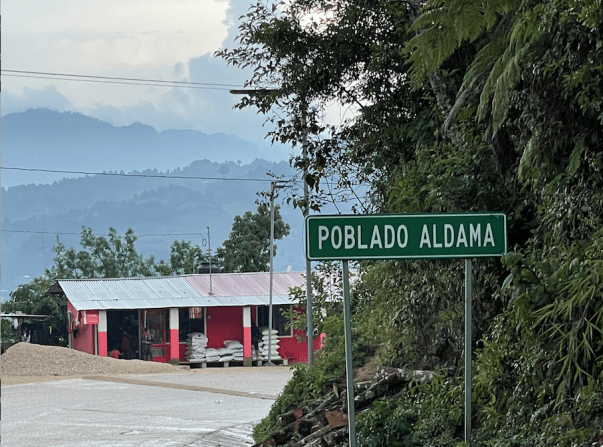
Paramilitaries murder a resident of Aldama and injure a Zapatista
By: Elio Henríquez
San Cristóbal de Las Casas, Chiapas
Lorenzo Gómez Ruiz, an indigenous resident of Aldama municipality, was shot to death this Monday by paramilitary groups in Santa Martha community, Chenalhó municipality, the Fray Bartolomé de Las Casas Human Rights Center (Frayba) reported.
In a communication, it announced that, according to the report from representatives of the 15 communal members of Aldama: “one of the projectiles that came from the point called Chalontic around 11:30 am, impacted Gómez Ruiz in the ribs when he was returning to his village, Juxton, after having been in the municipal seat.”
Due to the gravity of his injury, the Tsotsil man was moved to the Hospital of the Cultures, in San Cristóbal, where he died. [1] The Frayba pointed out that, according to said reports, the “new armed attacks come from different points in the Santa Martha sector.”
The Frayba recalled that just on Sunday, Javier Hernández de la Torre, a Zapatista support base, was shot and wounded by members of the same groups, and is convalescing in the Hospital of the Cultures. The indigenous man was injured by a bullet that entered “below his left eye; the bullet exited behind his left ear.”
It stated its concern about: “the constant armed attacks that the population experiences and it has the record that at 3.30 pm yesterday the residents of Chivit, Stzelejpotobtik, Yeton, Xuxchen, Tabac, Juxton, Coco’ and Stselej Potov communities, as well as the municipal seat of Aldama have received 49 armed attacks.”
The CNDH condemns the violence
The National Human Rights Commission (CNDH, Comisión Nacional de los Derechos Humanos) energetically condemned Sunday’s events in Aldama, [2] where Hernández de la Torre was injured.
The CNDH reiterated its concern about the violence in that zone and exhorted the Chiapas government, headed by Morena member Rutilio Escandón: “to guarantee the human right to life of individuals in the communities of Aldama and Chenalhó, to preserve the rule of law and to carry out with efficiency, opportunity and impartiality investigations that allow locating and prosecuting those responsible.”
The CNDH recalled that through the agreement of December 10, 2021, signed by the national body’s president, Rosario Piedra Ibarra, it exercised its power to attract the case of armed conflict in both municipalities, because of which it is conducting investigations to protect the rights of the victims.
[1] To support the Zapatistas and others in Aldama, please see our Emergency Appeal. It was written before we knew about the above murder, but it’s even more important now that we all take action!!
[2] See the letter from European collectives sent to federal and state officials in Mexico regarding the violence in Aldama!
==Ω==
Originally Published in Spanish by La Jornada
Tuesday, January 11, 21022
https://www.jornada.com.mx/2022/01/11/estados/021n3est
Re-Published with English interpretation by the Chiapas Support Committee
Emergency Appeal: Stand with the Indigenous & Zapatista Communities to Stop the Paramilitary Violence
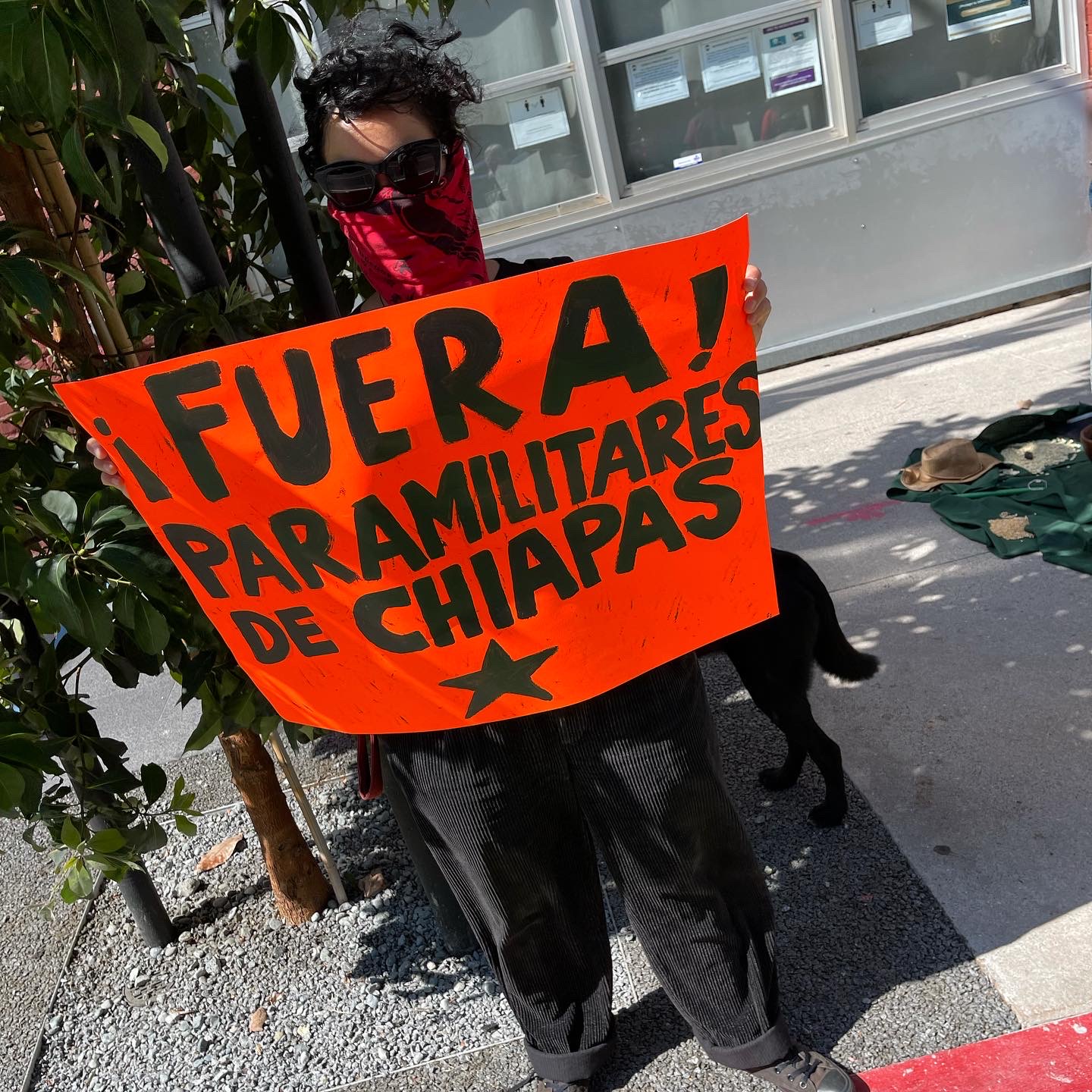
The Chiapas Support Committee is inviting you to join us in taking urgent action NOW to stand in solidarity with Indigenous and Zapatista communities in Chiapas. The Indigenous communities are being attacked by paramilitary forces in collusion with and support from the Mexican government.
Please join us in two actions you can take with a click of your mouse:
- Please send a message to the Mexican federal and Chiapas state governments: Tell them to stop the paramilitary attacks and to dismantle ORCAO and other paramilitary groups responsible for the violence, destruction, kidnappings, deaths and forced displacement of thousands of people in Chiapas. Send your messages to:
President of Mexico Andrés Manuel López Obrador: amlo@presidencia.gob.mx and gobmx@funcionpublica.gob.mx
Twitter: @lopezobrador_
Lic. Rutilio Escandón Cadenas, Governor of the State of Chiapas: secparticular@chiapas.gob.mx
Twitter: @RutilioEscando
Message to AMLO and the Chiapas Governor: It is urgent that you stop the paramilitary violence and dismantle ORCAO and all paramilitary groups. Your government must not collude with or support the paramilitaries. Every day the paramilitaries are shooting into the communities, burning down homes, stores, clinics, and schools. The paramilitary groups have kidnapped and tortured community leaders and members, wounding, maiming, and killing dozens of residents and community leaders; thousands more have been forced to flee for their lives into the mountains. Stop the paramilitary violence and dismantle all the paramilitary groups, now!
- Please join the Chiapas Support Committee and her members to donate as generously as you can to support the communities facing constant violence at the hands of paramilitary groups.
Click here to donate. All funds will be sent directly to the communities that are bearing the brunt of the paramilitary violence.
Please make a note in your donation that reads: I stand with the Indigenous & Zapatista communities against the paramilitary violence.
BACKGROUND + Urgent Solidarity Action Requested
In September 2021, the Zapatista Army of National Liberation (EZLN, Ejército Zapatista de Liberación) issued a dire warning that Chiapas was on the brink of civil war because of the ongoing violent attacks by organized paramilitary groups funded and supported by the Mexican government. The EZLN called on the Mexican government to stop the paramilitary attacks to prevent further bloodshed from taking place. The paramilitary groups have been carrying out a low intensity war against Indigenous and Zapatista communities that has flared up in recent months. In October 2021 alone, the paramilitaries carried out over 200 armed attacks on the indigenous communities.
On Sunday, January 9, 2022, the Fray Bartolomé de Las Casas Center for Human Rights (Frayba), based in San Cristóbal, Chiapas, issued an urgent warning that just in the last 72 hours there have been 36 armed attacks against the communities of Chivit, Stzelejpotobtik, Yeton, Xuxchen, Tabac, Juxton, Coco and the municipality or county capital of Aldama, Chiapas. At least one individual was wounded: In the early morning of Sunday, a family on their way to work their fields was shot at and the father was hit by gunfire.
Read the Frayba report of this round of paramilitary attacks and sign the Frayba letter denouncing the paramilitary violence, too, (in Spanish only at this time), click here.
And today, Monday, January 10, 2022, Frayba issued another call for urgent action after a paramilitary group attacked the community “16 de Febrero” in the autonomous municipality of Lucio Cabañas in Ocosingo, Chiapas, that supports the Zapatistas, beating members of a family with the butt of a firearm and abducted them. The paramilitaries disappeared a mother with her three-year old baby along with her 15 year old son and a six-year and 10 year old boys. Their whereabouts are unknown. Read Frayba’s urgent action and denouncement “Forced Disappearance of 4 Zapatista Support Bases of Caracol Patria Nueva, municipality of Ocosingo,” here.
Frayba also reported that in November 2021 alone, over 3,000 residents from Aldama were forcibly displaced, suffering over 47 attacks by the paramilitaries. ORCAO (Regional Organization of Ocosingo Coffee Growers) has been one of the main paramilitaries attacking Indigenous Zapatista communities, kidnapping and torturing Zapatista supporters and destroying homes and the livelihood of entire communities. The paramilitaries have forced over 5,000 people out of their towns and communities.
Tell the Mexican government:
End the paramilitary war | Disband all the paramilitary groups
The inaction and collusion of the Mexican government reinforces the paramilitary attacks and organization that have been intensifying over the last few months. The Mexican government is using the paramilitary-driven, low intensity war as part of its strategy to displace Indigenous peoples from their lands and territories and impose capitalist mega-projects that will undermine and ruin the ecology and natural world.
Chiapas is indeed on the brink of a new level of rightwing paramilitary violence that could erupt into a broader conflict that would be devastating for the region and Mexico.
We invite you to stand together with the Indigenous and Zapatista communities and push back against the state-sanctioned violence, demanding peace and justice and respect for the self-determination of the Zapatista communities building autonomous communities on their lands and territories.
Please join us by taking two actions today:
- Tell the AMLO Mexican government and the Governor of Chiapas to end the paramilitary violence and dismantle ORCAO and all the paramilitary groups: amlo@presidencia.gob.mx, gobmx@funcionpublica.gob.mx and secparticular@chiapas.gob.mx And
- Make a generous donation to support the displaced communities to live and rebuild their communities. Include a note that reads: I stand with the Indigenous communities against the paramilitary violence.
Communique in Solidarity with the National School of Anthropology and History
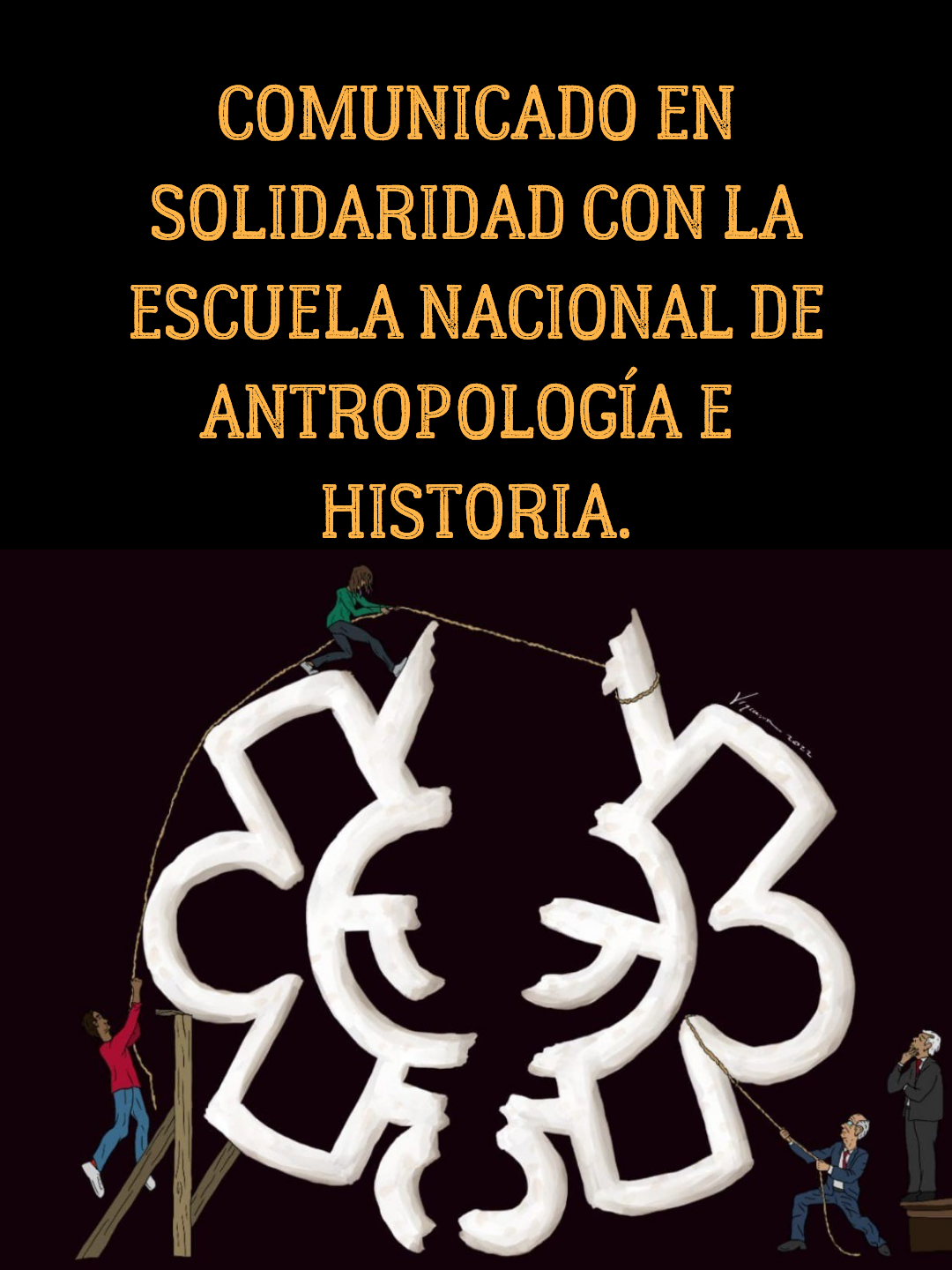
Assembly of the Indigenous Peoples of the Oaxacan Isthmus in Defense of the Land and Territory
(Asamblea de los Pueblos Indígenas del Istmo Oaxaqueño en Defensa de la Tierra y el Territorio, APIIDTT)
APIIDTT | 6 January, 2022
What is the relationship between ethnography and political action?
How can we make our work relevant to those we study with?
Militant ethnography implies a politically engaged and collaborative form of participatory observation carried out from within and not from outside of grassroots movements. Militant ethnography seeks to overcome the division between research and practice. Rather than generating strategic directives and/or general policies, collaboratively produced ethnographic knowledge aims to facilitate permanent (self) reflection by activists on the objectives, tactics, strategies and forms of organization of movements.—Jeffrey S. Juris
Given the recent events at the National School of Anthropology and History (Escuela Nacional de Antropología e Historia, ENAH) around the precarious, vulnerable and unequal working conditions experienced by teachers, administrators and researchers of this institution, the Assembly of Indigenous Peoples of the Isthmus in Defense of the Land and Territory (APIIDTT), expresses our strong solidarity with the actions taken by the ENAH General Assembly in defense of their labor and educational rights.
We are concerned by the statements made by the current Executive at the January 3 morning press conference. He stated that the budget increase destined for INAH is slated mainly for anthropological and archeological work specifically related to the advancement of priority megaprojects for his Administration. This underscores and demonstrates that he is interested in financially supporting the INAH and the ENAH only insofar as the anthropological, historical and archeological work serves the needs of the megaprojects of the government in power.
As peoples we realize that, on the one hand, there is systematic job insecurity, not only in the ENAH, where work tends to be precarious and subcontracted, which is a clear blow to all workers, as are the budget cuts in the name of austerity. On the other hand, there is an increase in the budget for large megaprojects that benefit the national and international political and business class.
The neo-developmental / neoliberal / privatizing onslaught launched by the government of the Fourth Transformation, with its policy of austerity, deals a hard blow to the working conditions of 350 professors and puts at risk activities that are essential to the functionality and academic quality for students in training at the ENAH. These policies are in stark contrast with the budgets delivered to the megaprojects that are considered a priority for the current government, such as the Interoceanic Corridor of the Isthmus of Tehuantepec or the Program for the Development of the Isthmus of Tehuantepec. This year (2022) the government has authorized 10 billion pesos for this large scale development project –six billion more than last year. As the peoples of the APIIDTT know, this megaproject amounts to the ethnocide of the 12 indigenous peoples that inhabit the region of the Isthmus of Tehuantepec.
APIIDTT is a grassroots communal organization made up of traditional, agrarian community authorities; assemblies of resistance; and collectives in Zapotec, Ikoots, Zoque and Mixe towns in the region of the Isthmus of Tehuantepec, Oaxaca. We have been in struggle for more than 15 years, defending the land, the territory and the rights of indigenous peoples, engaging in struggles against extractive megaprojects and the production of “green” energy. The researchers (professionals and students) from ENAH and other schools have provided unconditional collaboration and participation to our organization throughout the years of our struggle, collaborating in the tasks emanating from our assemblies and communities for collective defense of the land, territory and rights.
For this reason, we express our solidarity and support for the call of the ENAH General Assembly to improve working conditions and baseline of teachers and researchers, as well as the demand for a larger budget for the National School of Anthropology and History.
At the same time we call on students, teachers and researchers not to detach their struggle for better educational and working conditions, from the worthy processes of peoples’ resistance that are currently unfolding in the Isthmus region against the Interoceanic Corridor of the Isthmus of Tehuantepec; since the fight for labor dignity, a larger budget and free education for the ENAH and the anthropological sector, must at the same time be a fight for the immediate cancellation of the mega-projects of death promoted by the government of the Fourth Transformation.
SINCERELY:
Never Again a Mexico Without Us
Assembly of Indigeous Peoples of the Isthmus in Defense of the Land and the Territory
__________________________________________________________________________
Translated from the Spanish by the Chiapas Support Committee.
Read the original first published in Spanish, here: https://tierrayterritorio.wordpress.com/2022/01/06/comunicado-en-solidaridad-con-la-escuela-nacional-de-antropologia-e-historia/
From Europe they demand a stop to the violence in Aldama
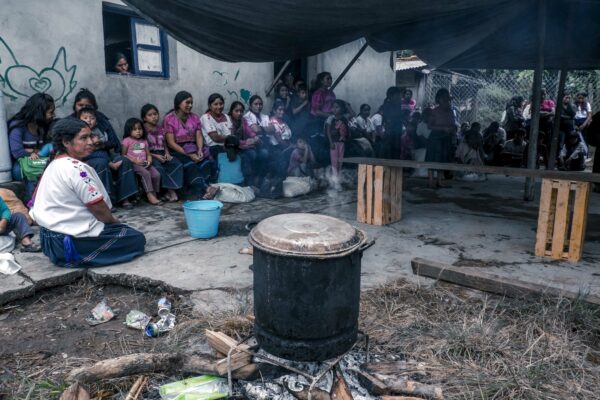
Above Photo: “We are a people who live under a rain of shots from the armed groups of a paramilitary nature.” Courtesy: Luis Enrique Aguilar
From: Yessica Morales, Editorial Staff
In 2018, the attacks with high-caliber firearms intensified. At that time, 2, 036 people were forcibly displaced into the mountains by an armed group, which attacked them at different points, from the towns of Yok Ventana and Saclum to the Santa Martha Sector, affecting 10 locations.
European organizations demanded a stop to the violence and paramilitary threats in the Magdalena communities in Aldama, as well as unconditional freedom for Cristóbal Santiz Jiménez, an indigenous Maya Tsotsil man, community defender and a representative of the Permanent Commission of 115 Comuneros and Displaced. He was arrested on March 14, 2020, by officials of the Specialized Police of the State Attorney General (FGE) while he was leaving his job in San Cristóbal de Las Casas.
In that sense, the communities live “under a rain of shots from armed groups of a paramilitary nature in Santa Martha, municipality of Chenalhó, The Voice of the People organization denounced last October 2021. Likewise, they pointed out that the violence responds to a territorial conflict over 60 hectares (roughly, 148 acres), inside of which lived 7 families who in 2016 were evicted and threatened at gunpoint.
In addition, the paramilitary armed group that operates in Chenalhó was activated in 2016. In 1997, the Agrarian Court had resolved possession in favor of the 115 Aldama comuneros (community members), an agreement that was not respected.
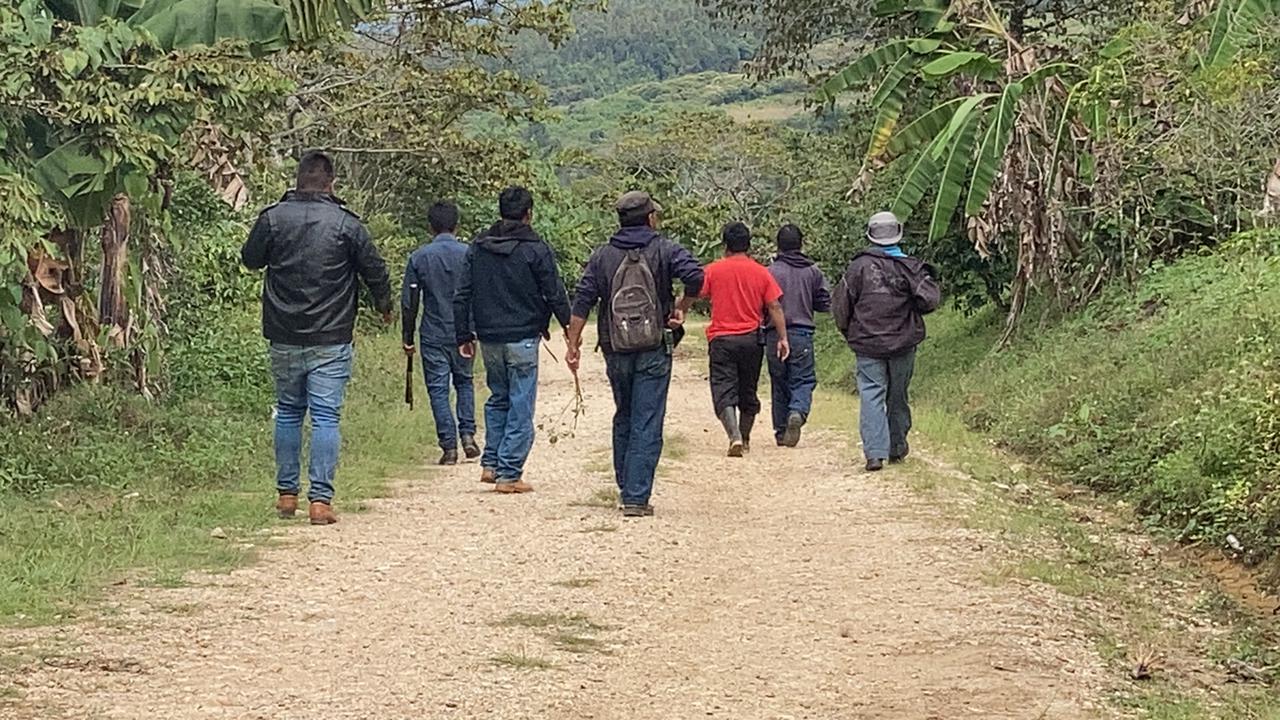
Above photo of Aldama by Isaín Mandujano
Since the beginning of 2020 and 2021 armed attacks have been increasing. This has affected 12 communities and around 5,000 people. In the month of October of last year, those attacks continued daily, even with intervention from authorities of the three levels of government.
It seems to be that it’s a war to which no one pays attention. On Sunday, October 10, a group of people belonging to the Santa Martha sector of Chenalhó, gave an ultimatum to the state government to solve this problem, the organization said.
Nevertheless, by the middle of the month there had already been 203 attacks directed at 9 Magdalena communities: Xuxch’en, Coco’, Tabac, San Pedro Cotzilnam, Yeton, Ch’ivit, Stzelejpotobtik, Juxton and the municipal seat. They were direct attacks on the houses where there are now bullet casings, broken sheet metal roofs, cars and machines with bullet impacts.
Precautionary Measures
The Inter-American Commission on Human Rights (IACHR) showed its willingness to visit Mexico, specifically Aldama, Chalchihuitán and Chenalhó municipalities, for the purpose of verifying the situation of the beneficiaries of the precautionary measures granted through Resolution 15/2018 on February 24, 2018 (MC-882-17) and Resolution 35/2021 on April 23, 2021 (MC-284-18), the Fray Bartolomé de Las Casas Human Rights Center (FRAYBA) announced.
For 3 years, 9 months and 20 days, the IACHR has asked the Mexican State to adopt precautionary measures to guaranty the lives and personal integrity of the inhabitants of 9 border communities in Chalchihuitán and one in Chenalhó. In the same area, the measures were once again granted de nuevo to the inhabitants of 12 communities in Aldama municipality, adjacent to Santa Martha community, Chenalhó municipality, in the face of the constant attacks of a paramilitary-style armed group.

The forced displacement of the Magdalena population began in May 2016, caused by attacks from paramilitary-style armed civilian groups coming from Manuel Utrilla, Santa Martha, Chenalhó municipality. Courtesy: Luis Enrique Aguilar.
The IACHR has shown that to date the ministerial investigations don’t have elements that permit indicating that the disarming and disarticulation of people belonging to the armed groups that operate in the affected areas have been achieved, despite the actions implemented, such as the arms exchange program and las de intelligence activities, which allow the cycles of violence to persist, including shootings and attacks with firearms that threaten people’s lives.
Therefore, the Commission lamented the deaths caused as a result of the acts of violence in the communities of these municipalities. However, given the risk factors that remain in the areas, it decided to maintain the precautionary measures in favor of 22 indigenous communities, requiring the Mexican State to adopt urgent security measures to protect the life and personal integrity of the residents.
Signing Organizations:
Asambea de Solidaridad con México. País Valencià, Estado Español Asociación Entreiguales València, Estado Español
Ass. Cafè Rebeldía-Infoespai Catalunya Ca
Saforaui País Valencià
Campaign for Psychiatric Abolition (CPA) England, London
Canopia Coop. V. Almedíjar, España
Caravana obrim fronteres Valencia España
Casa Nicaragua Bélgica, Liège
CEDSALA (Centro de Documentación y Solidaridad con América Latina y África) València (Estado Español)
Citizens Summons Alemania, Bonn
Ciudades Invisibles – Universidad del mar Egeo Grecia
Colectivo Acción Solidaria Austria, Viena
Colectivo Armadillo Finlandia
Comité de Solidaridad México Salzburgo Austria, Salzburgo
Confederación General del Trabajo (CGT) Estado Español
COOPERAZIONE REBELDE NAPOLI ITALIA
D-Zona República Checa – Praga
Ermuko komite internazionalistak Ermua País Vasco
Gira por la Vida Viena Austria, Viena
Global Women Against Deportations, UK
Global Women’s Strike (GWS), UK
Groupe écosocialiste de solidaritéS Ginebra Suiza
Grupo CafeZ Bélgica, Liège
Grupo Scout 105 Bentaya Islas Canarias – España
Jornal MAPA Portugal
Kaffe Libertad Kollektiv Hamburgo, Alemania
KOMUN.ORG Estado Espanyol
La milpa orto collettivo italia
La Roue Libre Suiza
Landworkers Alliance Cymru Gales, Reino Unido
Legal Action for Women, UK
Libero mondo italia
London Mexico Solidarity Londres – Reino Unido
Mut Vitz 13 Marseille Francia
Payday men’s network, UK
Perifèries del Mon País Valencià
Queer Strike, UK
Rede de Apoio Mútuo do Porto Porto, Portugal
Single Mothers’ Self-Defence, UK
Solidaridad directa con Chiapas Suiza
Spazio Vitale Odv italia
Taller Ahuehuete Estado Español
Tatawelo italia
Taula per Méxic Catalunya
TxiapasEKIN Euskal Herria
Women of Colour GWS, UK
Yoga Knowhow España-Netherlands-Suiza-Internacional
==Ω==
Originally Published in Spanish by Chiapas Paralelo, January 3, 2022
Re-Published with English interpretation by the Chiapas Support Committee
The Invisible fabric
Two Zapatista delegations of Maya descent visited Europe in 2021, and dedicated the majority of their journey to listening, and sharing words and experiences in intimacy. Here are some notes.

We believe the conscious, organized struggle undertaken by a colonized people in order to restore national sovereignty constitutes the greatest cultural manifestation that exists.
Frantz Fanon in The Wretched of the Earth
By: Daliri Oropeza
The first stage of the Journey for Life called by the Zapatista National Liberation Army ended in Madrid, with the return of the second delegation — La Extemporanea (The Extemporaneous), who traversed, as if weaving a vast spiderweb, three zones of the territory with teams of listening and word.
At a time in which there are media platforms upon which parties and personalities make policy, we hear barbarities like “indigenism is the new communism. And in an advanced democracy there is not even space to question history, nor truth, nor national unity,” as the president of the Community of Madrid, Isabel Díaz Ayuso said to the Board of Directors of the United States Chamber of Commerce in Spain.
In this super mediatized politics, the left fights with the more-left while the fascist right advances aggressively all over the world. There is an atmosphere of scandal and polarization in things said by politicians and rulers in front of vacuous right-wingers and illiterate media audiences that believe in fake news.
It is here that the Zapatista journey inserts itself, first with the silence of the Squadron 421 maritime delegation, which was a mirror for the movements in the territory that they renamed as Slumil K’ajxemk’op. The delegation also reflected that history can be navigated differently to broaden horizons:
“We are taking the [same] course as the one taken 500 years ago, in this case we take this course to sow life, and unlike 500 years ago, it is the opposite,” said Subcomandante Moísés when Squadron 421 left Isla Mujeres, on the boat La Montaña.
With the work of weaving listening and the word, La Extemporanea arrived in Europe. The delegation participated in a few public events during the Journey: the reception, the climate strike, the protest in front of the embassy in Vienna, for the two kidnapped Zapatistas, the protest on the river in Berlin, the altar for the Day of the Dead in Barcelona, and the farewell soccer game in Madrid (depicted in the above photo].
La Extemporanea discreetly distanced itself from the political noise. The Zapatistas bet on intimate gatherings, without media, photos, or recordings, and without journalists — just dialogue, sharing of knowledge and resistances, notes and meals. Ground-level strolls that re-screen the cement of the civilizational stories that we have been told. What the Zapatistas and the collectives said stays with those who participated. It goes underground.
As the Zapatista delegation, made up of 177 people, moved through, a fabric of exchange of realities resonated with the intention of understanding how all of us are tread upon by capitalism. A fabric that is invisible, porous, and is made through the exchange of languages, unique cultures, in sharing experiences, clothing styles, in asking questions, making foods, in seeing each other in the differences, in what angers us, and in the ways that we arrive at consensus.
What forms does this fabric take? The Zapatista women and men affirmed that they brought a seed, and what grows from that seed has yet to take shape. What remains clear is that the condition of Mother Earth, of the planet and life only gets worse with capitalism.
That invisible fabric was evident during the soccer match between the Zapatista team, Ixchel Ramona, against the Independiente de Vallekas. [1] It is in the resonance, in the creativity, in the participation and in the activism of European non-binary, women and men, that have the possibility of forming an alliance. They are people from more than 13 countries that have coexisted for more than a year, since the EZLN announced that it would make the Journey for Life.
In the sharing, companionship, sorrows, rage, militance, constancy and listening they find a thread, and in that thread the potential for moving into action, into the organization of an Insubordinate Europe, as the other Europe has been named, the Europe that does not surrender. It is now time to recall what happened, and to make a historical memory so that the narrative of the process is not lost, and to reflect on the horizon.
From the beginning of the tour, the Zapatistas announced that it would be a journey to the five continents, to share the knowledge of what they have put into action since the uprising, as well as their history as Tseltal, Tsotsil, Chol, Tojolabal and Mam peoples.
With this Journey, they leave one of the many seeds that they have sown in different ways and times to create invisible fabrics of resistances, horizons, and hopes in the face of this fucked-up world.
In “Black Skin, White Masks,” Frantz Fanon (we are remembering him 60 years after his death) concludes “It is through self-consciousness and renunciation, through a permanent tension of his freedom, that man can create the ideal conditions of existence for a human world. Superiority? Inferiority? Why not simply try to touch the other, feel the other, discover each other?”
Goal!!
[1] The soccer match between these 2 teams is depicted in the photo.
==Ω==
Originally Published in Spanish by Pie de Página
Tuesday, December 7, 2021
https://piedepagina.mx/el-tejido-invisible/
English translation by Schools for Chiapas, Edited and Re-Published by the
2021: A year of resistance for life in Latin America
By: Raúl Zibechi
The parliament of Chubut province in southern Argentina, approved a law in favor of mining in December, but had to annul it a week later faced with a mass insurrection of the population. It’s one of the greatest triumphs of the Latin American popular sectors, versus a provincial government and a national one, both progressive and extractive.
In four days of rage, a huge populace (insurrection) that burned down the government house in Rawson, the provincial capital, forced the governor to annul what the parliament approved in order to calm the protest.
In this way, Chubut joins the province of Mendoza, which in 2019 also managed to stop mining. Since last August, Chubut has faced a water emergency and there are water cut-offs in the main cities due to shortages.
In Chile, the year began with a sustained increase of peaceful Mapuche insurgency, which has not been worn down by the electoral processes. In the Temuco region, there is an exponential growth of land recuperations that led the Sebastián Piñera government to decree the military occupation of Wall Mapu, in a futile attempt to contain the struggle.
To get an idea of the magnitude of the movement, it’s worth saying that between January and April of 2020 there were 35 land recuperations by communities, but in the same months of 2021 the number climbed to 134 takeovers.
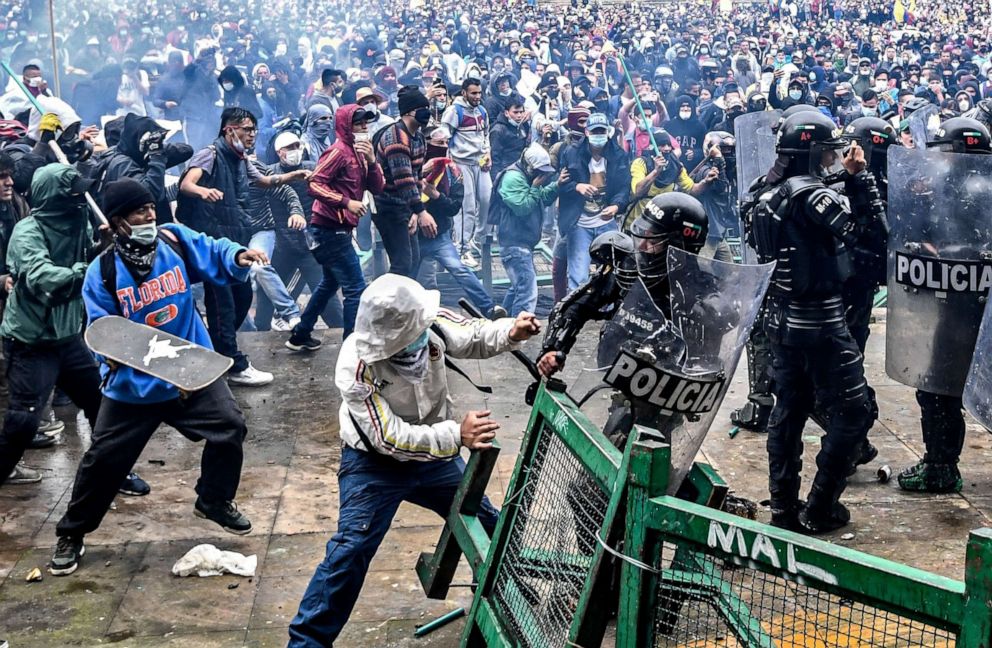
The most significant event of the year was the gigantic mobilization the Colombian people launched April 28. [1] On that date the union headquarters called a 24-hour strike, but young people overflowed the call. In fact, the stoppage lasted more than two months; with highways closed for weeks, like the strategic Pan-American Highway that regulates the movement of merchandise.
The demonstrations of millions of people covered hundreds of municipalities, paralyzing the country with massive actions and with the creation of “points of resistance,” where young people were gathered to liberate areas and make a safe daily life, in the face of the brutal repression of the Mobile Anti-Riot Squad (Esmad, its Spanish acronym).
The city of Cali, whose population is majority Afro-descendent, was the epicenter of the protest with 25 “points of resistance,” with the bringing down of statues of conquistadors and the erecting of anti-monuments such as Resist, emblem of the popular uprising.
There were dozens of dead and disappeared because of repressive action. But the real surprise came from below: in Cali, the Nasa indigenous guard was present. It traveled more than 100 kilometers to support the demonstrators, also pursued relentlessly by civilians who were armed by the police. They also created the “first lines” of urban youth self-defense groups, but there were also groups of mothers to protect their children, of priests and even of retired military.
The protests and rebellions buried Uribismo (Álvaro Uribe’s militaristic extreme right) that has governed Colombia with an iron fist since the beginning of the 20th century. They moved the center of the resistance from rural areas to urban ones; they placed youth without a future at the center of the political scenario and generated an intense politicization of society, whose vast majority calls for urgent change.
In the medium term, the fraternization between indigenous peoples and urban youth can open the doors to new relationships between sectors key to the design of emancipatory practices in the nation.
It should be emphasized that in the middle of the pandemic, the EZLN took the initiative to convoke the Journey for Life, with which it embraced the resistances of Europe during the months of September to December.
I argue that this tour represents a turnaround in international solidarity and in the way in which movements relate to each other. Large gatherings predominated until now, as did the four international gatherings, and spaces like the Sao Paulo Forum, featuring whites, males, academics, leaders of parties and movements, meeting in luxury hotels or at universities.
In December, the Awajún Autonomous Territorial Government was formed in northern Peru, with which there are already six Amazonian peoples, and some 150,000 people, who decided to walk the path of autonomy.
This year we have seen how the peoples are overcoming the ravages of the Covid-19 pandemic and of the governments that, on both the right and the left, take advantage of the crisis to deepen the model. Neoliberal governability is fading because of activism from below.
Everything indicates that 2022 will be a decisive year. I think that the big challenge for the movements consists of overcoming the up and down dynamics of mobilization, to construct organizations capable of giving continuity to the resistances.
[1] Wikipedia has a detailed report on the Colombian protests. See:
https://en.wikipedia.org/wiki/2021_Colombian_protests
==Ω==
Originally Published in Spanish by La Jornada, December 31, 2021
https://www.jornada.com.mx/2021/12/31/opinion/017a1pol
Re-Published with English interpretation by the Chiapas Support Committee
Indigenous anti-capitalist resistance and the Zapatista journey
By: Magdalena Gomez
Today, wherever we look at indigenous peoples, we will find the diversity of their resistance. Some, daily and punctual; others, strategic and long-range. At the same time, we will observe a similar pattern in the ongoing responses by the State that, in general, ignores the implication of respecting the collective rights of said peoples, especially in megaprojects that have already been declared to be of public interest and national security.
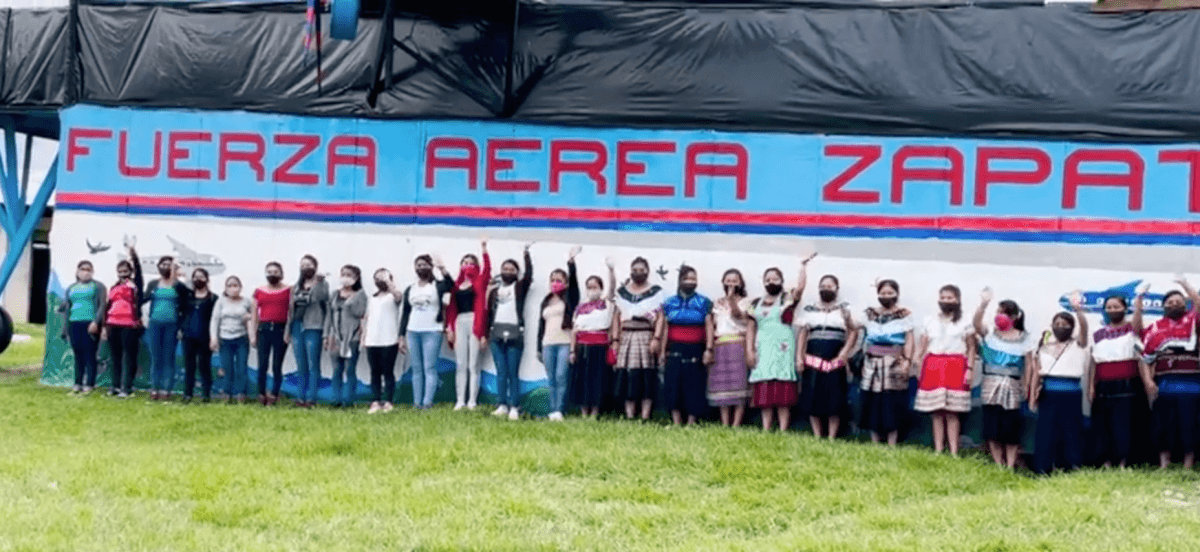
Locating the far-reaching resistance, I refer to the one initiated this year by the Zapatista National Liberation Army (EZLN), inviting the National Indigenous Congress (CNI) and the People’s Front in Defense of Water and Land of Morelos, Puebla and Tlaxcala. Let us remember the announcement in October 2020 of another of the Zapatista political initiatives, in this case to travel the world to listen and share ongoing struggles with their peers, according to their circumstances, against the common enemy that is capitalism, beyond the governments in turn. And they asked: “To whom does it matter that a small, tiny group of natives, of indigenous people, lives, that is, fights? Because it turns out that we live. That despite paramilitaries, pandemics, ‘megaprojects’, lies, slander and oblivions, we live. That is, we fight. And this is what we think about: that we continue to fight. In other words, we continue to live… we will walk or sail to remote soils, seas and skies, seeking not difference, not superiority, not affront, much less forgiveness and pity. We will go find what makes us equal…” (5/10/20).
That declaration was concretized and first Squadron 421crossed the Atlantic, from Isla Mujeres, in the ship called La Montaña and then, three months later, about 200 delegates arrived and toured Europe renamed as “unsubmissive,” not without stumbles and racisms that at the time were denounced around the apparent impossibility of obtaining a passport to start the journey because they were “extemporaneous” in their birth registration.
On December 14, Subcomandante Moisés gave an account of the safe return to the Zapatista communities in Chiapas and other states and above all they gave THANKS, yes, with capital letters, to the numerous European collectives that received, shared, fed, hosted and sheltered them, and pointed out that “now it’s time to review our notes to inform our peoples and communities of everything we learned and received from you: your stories, your struggles and your ‘unsubmissive’ existence. And, above all, the embrace of humanity that we receive from your hearts. Everything we brought you was from our villages. Everything we receive from you is for our communities.” The Zapatistas will already publicly share what they consider of this important and unprecedented experience, we can imagine what the stories will be in the communities. I am reminded of the testimony of our dear Ronco, Ricardo Robles (†), on the return to the Sierra Tarahumara of the Rarámuri delegation that accompanied the closing of the March of the Color of the Earth in the Zócalo of Mexico City, on March 11, 2001. With great surprise they reported that “we are many”; they were referring to people across the country and proudly added and “he mentioned us.” Whoever knows that people and that region will understand the dimension of that news. And two months later they met again in the mountains to analyze the indigenous counter-reform; El Ronco clarified that only among them and they concluded with one word: hope. Which can only emanate from the awareness that the road is long and they trust in their decision to fight, in their strength and resistance in the face of the adversities that they have suffered throughout history.
It is very clear that indigenous peoples do not use the same unit of measuring time as the political class does, they are not concerned about whether or not they are halfway there; on the other hand, we find that society in general and regrettably, does not care what happens to the peoples if they manage to co-opt or demobilize them in the name of the so-called development that they translate very well as dispossession. Their narrative is very different and they can agree that the current government is not identifiable with Gustavo Díaz Ordaz and, however, they do not forget that it has a thorn in its side with the unpunished murder of Samir Flores Soberanes, which still lacks clarification and is not from the past.
Thus, we have in view evidence that the problems of the peoples and of everyone are global, because capital has no nationality, if even a domicile, and they have already visited some European companies to learn that they must be held accountable for their participation in megaprojects in Mexican lands. This strategy is one more link in the resistance that in its soon to be 28 years of public presence, the EZLN has promoted under the anti-capitalist horizon.
==Ω==
Originally Published in Spanish by La Jornada on Tuesday, December 21, 2021
https://www.jornada.com.mx/2021/12/21/opinion/017a1pol
Re-Published with English interpretation by the Chiapas Support Committee
 Chiapas Support Committee