Chiapas Support Committee
Home of the Compañero Manuel blog on zapatistas & mexico
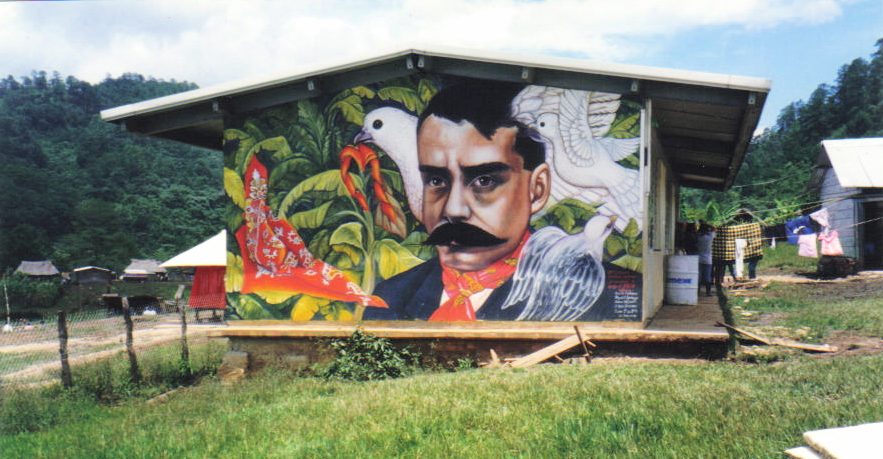
Don Pablo: the congruence of critical thought
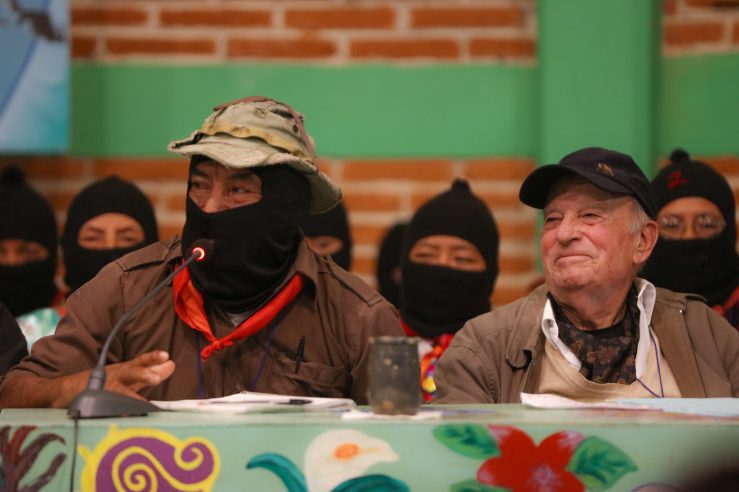 González Casanova with Comandante Insurgente Tacho at “The Walls of Capital, the Cracks of the Left,” convened in April 2018. Photo: Daliri Oropeza
This is a journey through Pablo Gonzalez Casanova’s theoretical approach, his creations at UNAM, and his closeness to social and indigenous movements after 100 years of existence.
Text and photos: Daliri Oropeza
MEXICO CITY – Comandante Insurgente Tacho speaks into the microphone about Pablo González Casanova as the Indigenous Revolutionary Clandestine Committee of the EZLN names him Comandante Pablo Contreras:
“During all these years, we have seen a compañero who has not tired, who continues to have the same fighting spirit, and for whom years do not matter, he cares about the lives of our people. And that compañero has not given up, that compañero has not sold out, that compañero has not given in. On the contrary, he continues to forge the struggle among all of us and for our Mexican people.
The auditorium of the then CIDECI (Indigenous Center for Comprehensive Capacity Development), now Caracol Jacinto Canek, is full. It is the climax of the seminar “The Walls of Capital, the Cracks of the Left” convened in San Cristóbal de las Casas in April 2018 by the Zapatista National Liberation Army (EZLN). There is a great silence of listening in the large hall that takes in, unexpectedly, the words of the comandante.
“That compañero we call Pablo Contreras, and as Subcomandante Moisés said so well: the gift is that we are going to give him more work, (…) that we are going to continue fighting, it not that it ends here, we are going to continue fighting, and thus, that comrade is going to join this great collective, this great team, of the Indigenous Revolutionary Clandestine Committee-General Command (CCRI-CG).”
At that moment the expectant silence broke into a long ovation. Each member of the Comandancia, from the little girl Esperanza Zapatista to the elders, raised their left hand to their foreheads in salute, and looking into his eyes to welcome, some firmly, with strength and conviction, and some with a tender embrace, the new member, who had just turned 96 years old. The salute of the comandancia was echoed and joined (by those of us there) for more than five minutes.
The insurgent sub-commander Moises had explained in a previous message in which he described how, to be part of the CCRI-CG, you don’t have to tell people how hard you work, or go from town-to-town campaigning. On the contrary. It is to work and for the people themselves to recognize your work and appoint you, to do more work. Without pay. To listen and to carry and share the word. To spend your birthday in the struggle.
“Those of us who are at the forefront of the struggle, it doesn’t matter to us where we spend it, the important thing is that we are doing work for the lives of our people, and that is clear to us,” said Tacho during the appointment. In that 2018 seminar, the EZLN along with the National Indigenous Congress, evaluated the process of Marichuy’s campaign, in which Don Pablo was very active in the Civil Association “The Hour for the Flourishing of the Peoples Has Come.”
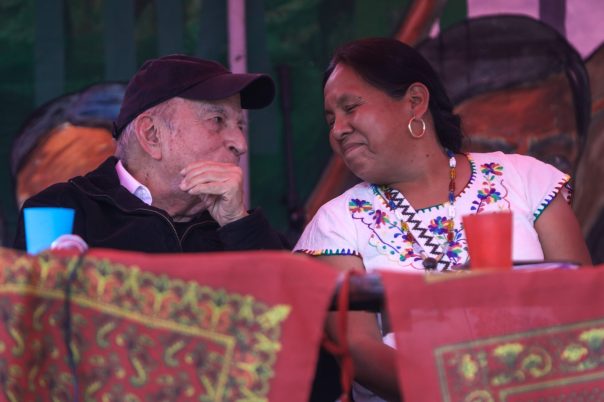 Don Pablo with Marichuy – Photo: Daliri Oropeza
Before even knowing that he would be named comandante, for the seminar, Pablo González Casanova gave a reflection on the transformation that Zapatismo has meant in Chiapas:
“It is that they do not want to have anything to do with the Indian peoples since the conquest: they do not understand that they think more deeply here than in any other region of the world. Or at least, to be modest, in very few regions of the world.
“This transformation of reality is a novel transformation in all fields, in art, philosophy, politics, discourse and the use of all resources, in literary and theatrical genres, a new world appears. What Zapatismo is building is a project that can save the human being and life on earth. Along with Cuba and Venezuela, [it is] one of the three projects with which Latin America is contributing to the survival of the human being.”
A sociology of the exploited
He was even a guest of Fidel Castro on several occasions, highlighting the speech he gave on May 1st in 2003 in Havana, in connection with the “Ya es de Abajo”(Now it is from Below) and a meeting of Artists and Intellectuals in Defense of Humanity and Against Neoliberalism.
Pablo González Casanova is an uncommon academic theorist. He studied accounting at the Escuela Bancaria y Comercial, master’s degrees in History at the Escuela Nacional de Antropología and the Colegio de México, and later a doctorate in Sociology at the Sorbonne in France. Upon his return, he began teaching and 15 years later, published one of his most important works: Democracy in Mexico.
“He formed his own view of sociological thought where he added an unorthodox view of Marxism, he put exploitation at the center, that is, class struggle and exploitation, where he also added North American Empirical Sociology and mathematics,” describes Luis Hernández Navarro, opinion coordinator of La Jornada, who has known Don Pablo closely for more than 30 years.
On that empirical part, Pablo González Casanova has been very close to social movements, indigenous, workers or students. He was an ally of the Cuban Revolution and since 1994, together with J’tatik Samuel Ruíz, bishop of San Cristóbal, thinker around the Zapatista uprising. He played a fundamental role from the formation of the National Intermediation Commission (Conai) to the San Andres dialogues onwards.
“For a long time, Don Pablo has insisted on this concept of the struggle for life as a central axis of the struggle of our times. This is another permanent aspect of his work, and when Alter-globalism emerged in Seattle in 1999, he played a fundamental role in searching for and thinking about this type of social movement. He encouraged them along with his friends: Samir Amin, Immanuel Wallerstein, François Houtart, who played a very important role in the world of Alter-globalism,” recalls Luis Hernández Navarro.
According to Guadalupe Valencia García, coordinator of Humanities at UNAM, “in Don Pablo we have an indefinable intellectual because of his complexity, because he is really a scholar, an intellectual, who is a citizen of the world in the broadest sense of the word because there is no subject, no problem that is not of his interest; human subject, social subject, subject that has to do with inequality, with justice, with dignity that is not of interest to him.”
Valencia has worked as a researcher and academic close to the sociologist since the 1980s. He was present in the front row at her appointments as director of the CEICH and now in her position as coordinator. For her, Pablo González Casanova is an intellectual of complex thought, complex gaze.
“Don Pablo is one of the greatest living Latin American intellectuals. According to Luis Hernández Navarro, he is the creator of a very rich and exceptional thought where socialism, democracy and national issues intersect with great originality and richness.
Gonzalez Casanova’s studies and inquiries begin with the history of ideas, passing through Sociology of Knowledge of French Thought on America when he studied in Paris. From there he moved on to Utopia, Modernity and Persecuted Thought. And this is the first stage of his thought, which his friend and colleague Raul Romero calls Sociology of Knowledge and History of Ideas.
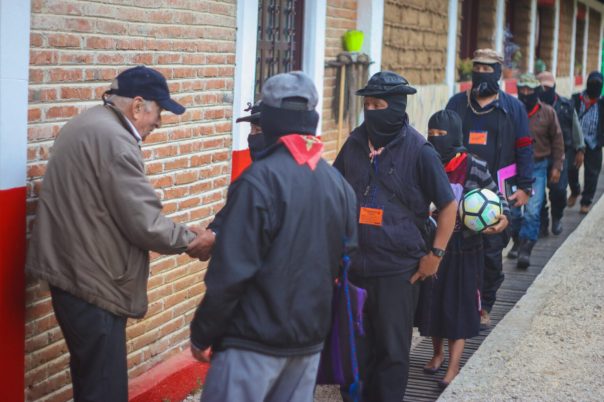 EZLN commanders greet the newly-appointed Comandante Pablo Contreras. Photo: Daliri Oropeza
A Tour of His Theories: From Sciences to Movements
In the 60s, Gonzalez Casanova turns to the Sociology of Exploitation and Studies on Democracy, in which evolves a key thesis in his postulates: the issue of Internal Colonialism. This theoretical proposal helps to explain domination, and not only the colonialism that comes from outside, but also inside a country, and how it is replicated among classes and ethnicities.
“Don Pablo helps to break with the dogmas of his time; he not only recovers Dialectical Analysis or Marxist Thought but also, in addition, incorporates Empirical Analysis, the Scientific Rigor he acquires in many universities in the United States and France, where he also is a professor-researcher and collaborator,” describes Raul Romero.
Throughout his theoretical proposal he has tackled lines of instigation from democracy, power, resistances, struggles, social movements, or Latin American liberation struggles.
In the late 80’s, early 90’s he adopts a theme of Systems Analysis where he had an important dialogue with Immanuel Wallerstein, with Samir Amin and François Autard of thinking of the World as a System, where Complexity Sciences and systems also impart Critical Thinking. He also builds knowledge about the World System, the way of thinking in anti-systemic movements, and alternatives for change.
Raul, who has closely followed Gonzalez Casanova’s research, affirms that “in this stage of his research he also develops one of his key books, the New Sciences and Humanities from the Academy to Politics, where he finishes developing this idea of how Critical Thinking also has to feed from the Sciences of Complexity, from a Scientific Revolution, he says, from the Techno Sciences and Nanotechnologies that help, that contribute to generate new organizational political alternatives.”
“He leaves that mark of turning UNAM into an intellectual center, a world intellectual node. This way, no longer as rector but as director of the institutions he directed, Political Science, the Institute and the Center. He is a great convener in addition to being recognized as a man who creates institutions, as an intellectual who in himself has a trajectory of impressive work. He also has a capacity for convening people that leaves a mark in collective works, and also has the moral recognition of all: academics, directors,” assures the coordinator of Humanities of the UNAM.
Don Pablo was the first doctor in sociology in Mexico. Thanks to him, sociology separates itself from law and philosophy, and finds its own way of looking at and proceeding to understand the world in a critical way, always with empirical rigor, which permeates UNAM according to his friend and colleague, Guadalupe Valencia.
CCH: A new way of learning
Pablo González Casanova is the founder of the College of Sciences and Humanities and its pedagogical model, with a vision for collective learning and collective intelligence.
In these schools, the center of pedagogical cultivation is in the Sciences of Matter, Life Sciences and Human Sciences, with a very multidisciplinary and integrative profile.
Luis Hernández, coordinator of Opinion for La Jornada and editor of Don Pablo, describes it as an initiative that seeks to be studied under the concept of linking theory with practice:
“An education that is not by rote but that centers readings, debates, and the participation of students in their own educational process by giving talks, conferences, and researching. A system of modules. What was once a real transformation,” he says.
According to Raúl Romero, researcher at CEIICH, “Don Pablo has a key weight in UNAM, and in the universities and in the educational sector not only for his innovation, I insist, as was the creation of the Colleges of Sciences and Humanities and the Open and Distance University, where one of his slogans, in his speeches as rector and later as his work plan, let’s say, was always ‘Better Education for More’.”
“Don Pablo is important and respected for many things…. One is for the institutional legacy he leaves behind: he is the creator of the CCH, which to this day is one of our treasures, in terms of teaching methods and in terms of the formation of a culture, of a new way of learning,” says Guadalupe Valencia.
From ’68 and ’99
Raúl Romero studied at the Colegio de Ciencias y Humanidades Sur. He says that among teachers and students his name was often repeated with respect as one of the founders. From there, he lived through the Strike at 99 at UNAM in defense of free education.
Guadalupe Valencia tells the anecdote that when the strikers entered the CEIICH, they arrived at the Humanities Tower II and went up to the fourth floor to evict them. They wanted to close the facilities. He recalls that they gradually closed first faculties, schools, then institutes and centers. He says that González Casanova was the director and he was told: ‘Don Pablo, the strikers are here’ and he said,” Guadalupe describes, “‘Open the auditorium, let the students in.’ And they came in and sat down to listen to him.”
“Bring books of what we do here,” said the researcher, and gave them some books: “Look, here we analyze the world, society, the country, inequality,” and he gave them some. “This is what we want to do here.” They listened to him, went to an auditorium, sat at a table looking at each other’s faces. They were quiet. They listened to him and they were evicted anyway. But they respected Don Pablo and thanked him for the books.
“He tried that dialogue because he also understood the deep reasons for the movement. That gesture of giving them the books stuck with me because it was not the director who came out to argue but to say: ‘Look at what you are trying to close’, ” says Valencia.
Raul emphasizes that González Casanova, in 1966, was appointed director of the Institute of Social Research of UNAM, with the movement that would culminate in 1968 and was rector of UNAM between 1970 and 1972. Students already recognized in his trajectory that he was someone close to the Student Movement of 1968. Most of the rectors of UNAM have been lawyers or doctors, that is why Don Pablo stands out in his administration, for being a young sociologist.
The ’68 movement for the Doctor of Sociology “is one of the most incredible stages of my life, it gave me the opportunity to experience the University with a very great depth” and the whole country, it was a difficult political moment, that crisis was appearing in young people around the world, it was expressed especially in the realm of universities, and ours was one of the universities that expressed that crisis with more force, with more presence of the student movement.
“I had the opportunity to see the University spirit,” says Don Pablo in a documentary.
He has to deal with very complicated situations as rector to continue keeping alive autonomy and free education, and apart from that, the radicalism from the social movements that were born there, from the perspective of Luis Hernandez Navarro, “he has to undertake a project of a mass university, in that context, in a university that is advancing in its democratization projects but in a very complicated moment for the country.”
“That Don Pablo, at that time still Director of the Center for Interdisciplinary Research in Sciences and Humanities, which he founded, supported or expressed his position against the increase of quotas at UNAM, meant that not only a Tradition of Latin American Critical Thought, was embodied in the figure of Don Pablo. But a tradition of a secular, public, scientific, critical, autonomous university, was also embodied in the figure of Don Pablo, who was accompanying or supporting the criticism that he himself founded, embodied in the figure of Don Pablo, and that a tradition of a secular, public, scientific, critical, autonomous university, also embodied in the figure of Don Pablo, accompanied or supported the criticism made at that time by the Student Movement,” says research sociologist Raúl Romero.
“Being the director, I was also a student, something I did a lot when he was rector, I never studied as much at the university as in that period full of marvelous accidents and creations,” narrates Gonzalez Casanova in a documentary.
“I have never taken classes with him but he is my teacher, literally, if I have any teacher in the world of social sciences, history, sociology, it is Don Pablo,” affirms Luis Hernández Navarro, emphatically.
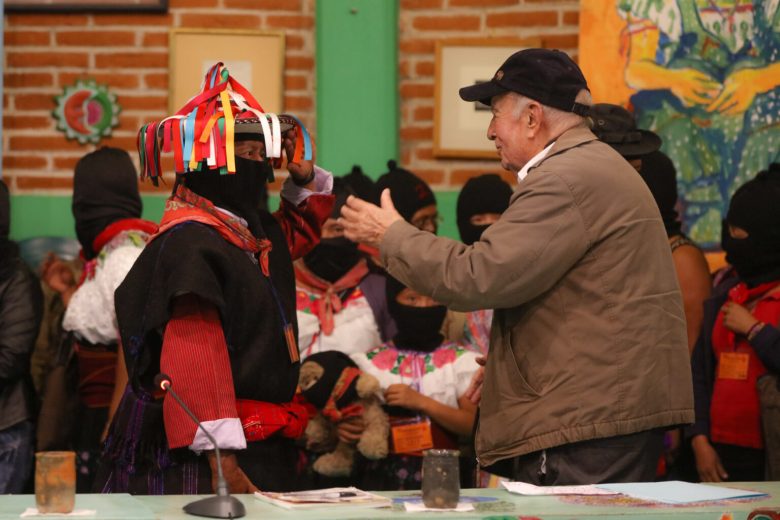 EZLN commanders congratulate the new commander: Commander Pablo Contreras. Photo: Daliri Oropeza.
His Congruency and the Theory of the Jungle
“The project that was born in these lands, which is a universal project, once they managed to be seen, and they did it by force, using force to be seen. Afterwards they have done everything possible, and I have clearly been here since 1994, they have done nothing more than struggle for a peaceful change,” Don Pablo told the Zapatistas before being named commander in the seminar “The Walls of Capital, the Cracks of the Left.”
“When the Zapatistas named him Comandante Pablo Contreras, well, it is the result of a mutual encounter from a mutual descent, I would say: “back and forth,” right? of enormous respect from the comandantes for him, from what can be seen from the outside. It is like the culmination of a process of encounter, convergence, natural feedback,” assures Luis Hernández Navarro, journalist and writer for La Jornada, who wrote the chronicle that day.
In his most recent inquiries, Don Pablo elaborates something he calls The Theory of the Jungle, which consists of recognizing the philosophical contributions of the indigenous peoples. Guadalupe describes it:
“Don Pablo is innovating, and in a very important way, when he recognizes in Zapatismo a Theory of Universal Nature, a Political Theory that he calls The Theory of the Jungle with a potential… not only with a potential of analysis but as an indescribable political power, to the extent that it grounds another way of looking at the world and of doing politics.”
“He is captivated by Zapatismo, really captivated intellectually, and I think he is captivated emotionally. He is a confirmed neo-Zapatista, and that leads him to act, right? In defense of Zapatismo, but also to theorize, and not so much to theorize as to understand and defend the idea that there is a theory of universal character: The Theory of the Jungle, which is based on an idea of power as a new form of democracy, where one rules by obeying, and where the “we” places itself above the individual, and where deliberation is advanced as a more complete form of democracy over representation,” that is how Guadalupe interprets it.
“The Theory of the Jungle, as he refers to what he did, is what the Zapatistas are formulating which he recognizes with theoretical value, and not only with propagandistic value or with political-ideological value, although it also has that. And in that sense, he is a great innovator and someone who dares to recognize what others cannot recognize,” says the humanities coordinator.
“Don Pablo says that the appointment from the Commanders was one of the greatest emotions he has ever experienced. He always says that he did his postdoc in the Lacandón [Jungle] and that is very interesting, because it shows that he is not only a professor, but a professor who keeps learning,” says Raúl Romero.
==Ω==
Originally Published in Spanish by La Jornada, Sunday, February 6, 2022, https://piedepagina.mx/don-pablo-la-congruencia-del-pensamiento-critico/
Translation: Schools for Chiapas, Re-Published by the Chiapas Support Committee
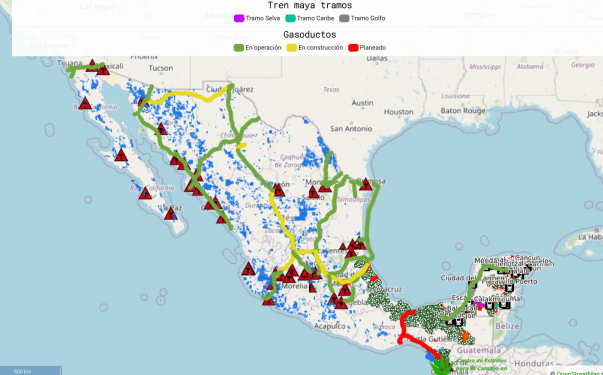
Mexico: cartography of war
By: Raúl Romero*
Visualize a map of México. To the north, place the Logistical and Industrial Corridor of the Treaty between México, the United States and Canada. Though the public information to the effect is still scarce and imprecise, Caxxor Group has already reported that it seeks to build and modernize ports, industrial parks, and a railroad as part of this corridor. The port of Mazatlán, in Sinaloa will be converted into a node that links the coast of Asia with that of Mexico. The information is complemented by the plans announced for the merger between the Canadian Pacific Railway and Kansas City Southern, which foresee connecting Canada, the United States and the Mexican cities of Matamoros, Monterrey, Mexico City and Veracruz, among others with 32 thousand kilometers of railway.
Now, on the same map that you are visualizing, place the Morelos Integral Project, which entails a gas pipeline, an aqueduct, and two thermoelectric plants in the middle of the volcanic axis, in the states of Puebla, Morelos and Tlaxcala. Also, in the center of the country, throw in the Felipe Ángeles International Airport.
Without forgetting the above, now look at the south and the southeast of the country. In the states of Oaxaca and Veracruz, locate a train, a freeway and two ports as part of the Inter-Oceanic Corridor which aims to connect the Pacific Ocean with the Atlantic Ocean by land. Very close to there, right next to Veracruz, is the site of the new refinery in Dos Bocas, Tabasco. Don’t forget to outline the Maya Train, with its highways and airport, in Chiapas, Yucatán, Quintana Roo and Tabasco.
Around all of these projects and megaprojects visualize the effects of the construction or modernization, as well as the operation, of hotels, bars, restaurants, wind farms, mines, pig farms, breweries, maquilas, industrial corridors, automotive plants, energy companies and much more.
On that same map, now identify the organized crime groups, those with national presence, such as the Sinaloa Cartel and the Jalisco New Generation, or those with state or regional presence, such as the Zetas, Gulf, Caballeros Templarios, Familia Michoacana, Santa Rosa de Lima, Unión Tepito, Los Rojos, Los Ardillos…
In this same geography, you can identify the more than 4 thousand 806 clandestine graves which, in October of 2021, Karla Quintana, Commissioner for National Search for Missing Persons reported to be found in practically the entire nation, with the exception of Querétaro and Mexico City. Include also the figures from the National Registry of Missing or Unaccounted For Persons: 97, 306 people throughout México. In particular, highlight Jalisco, Tamaulipas, and the state of Mexico, where the highest number of cases are registered. Put on this same map the more than 43 journalists, both men and women, assassinated between 2018 and July 2021 and recognized by the Secretary of the Interior (https://bit.ly/3o7JXSD). Add to this the six journalists that have been assassinated since then, including Margarito Martínez and Lourdes Maldonado.
In this cartography of war, find also the more than 68 defenders of human rights assassinated since December of 2018 as well, the majority of them, defenders of territory. In addition, include the femicides and trans-femicide.
If you want to see greater detail in the mapping, also put a prison city for the migrants in Tapachula, or the regions with a presence of paramilitary and narco paramilitary groups that every week attack the communities, like in Nuevo San Gregorio, in Zapatista Chiapas or in the Montaña Baja of Guerrero. You can also mark the states where politicians have been denounced for their collaboration with extractive industry or organized crime. Or those where fresh water reserves are plundered or contaminated or where there are forests being cut down.
The neoliberal capitalism that in Mexico has reached its most representative expressions in the infrastructure, energetic and extractive megaprojects, as well as in the criminal economies, is not only the legacy of the past, but continues in force and expanding.
If you, as I did, felt desperation after sketching this map, you are right — things are not going well and we should not fool ourselves. But don’t forget, that also in these same geographies we can outline a map of resistance and of hope. More on that in our next installment.
* Sociologist
==Ω==
Originally Published in Spanish by La Jornada, February 6, 2022, https://www.jornada.com.mx/2022/02/06/opinion/013a2pol
Translation: Schools for Chiapas, Re-Published by: Chiapas Support Committee
Search Commission tours Pantelhó to find the 21 missing residents
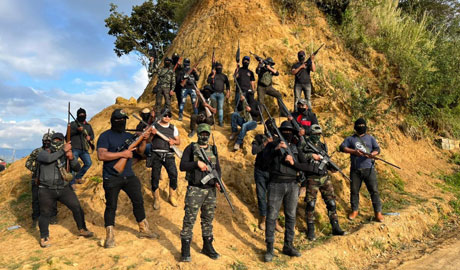
El Machete Self-Defense Forces of Pantelhó Above Photo from La Jornada
By: Elio Henríquez, Correspondent
San Cristóbal de Las Casas, Chiapas
Supported by National Guard agents and members of the Mexican Army, officials from the National Search Commission for Missing Persons went to the municipality of Pantelhó to try to locate 21 residents last seen when they were detained on July 26 in the municipal seat.
Official sources reported that the inspection, in which personnel from the State’s Attorney General’s Office (FGE) participate, started Tuesday [Feb. 8], without any results having been reported as of yesterday [Feb. 10].
Pantelhó residents affirmed that members of the municipal council and of the El Machete self-defense forces, including their commander, received representatives of the National Search Commission for Missing Persons with whom they toured some areas for at least 5 hours.
They reported that the official itinerary includes a visit to El Progreso ranch, the Guadalupe Victoria community and La Pelona Hill, in addition to the municipal seat.
Relatives of some of the missing commented that they did not participate in the visit because the authorities told them that there are no conditions for that.
The 21 missing inhabitants were detained and exhibited in the central park last July 26, when more than 2,000 residents of the 83 indigenous communities (Tsotsils and Tseltals) and the 18 neighborhoods of Pantelhó took possession of the mayor’s office, looted stores and burned houses to “throw the sicarios (hit men) out of the town.”
The presence of criminal groups in the region led to the formation of self-defense groups that appeared in public on July 7, and later at the integration of a municipal council named in August through uses and customs, endorsed by the local Congress and presided over by Pedro Cortés López.
==Ω==
Originally Published in Spanish by La Jornada, Friday, February 11, 2022 https://www.jornada.com.mx/2022/02/11/estados/029n2est
Re=Published with English interpretation by the Chiapas Support Committee
Neoindigenism and the 4T
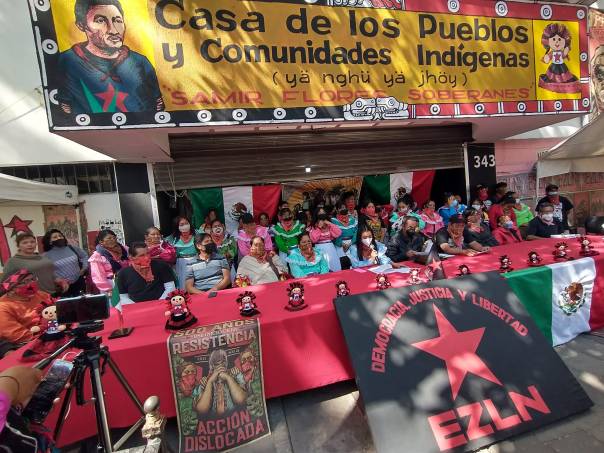
By: Gilberto López y Rivas
In these times of the Fourth Transformation (4T), [1] in which the head of the National Institute of Indigenous Peoples (INPI), Adelfo Regino, former advisor to the EZLN during the San Andres dialogue, criminalizes the Otomí community in Mexico City — who maintain an occupation of the institution’s offices and has converted them into the Samir Flores Soberanes house of the indigenous peoples and communities– it must be reiterated that there has been no substantial change in State policy since the founding of the National Indigenist Institute in 1948.
Today as in the past, and despite the fact that this director is Mixe, [2] the INPI, as a bureaucratic apparatus of the State, imposes indigenist policies on the peoples as an objectively oppressive, manipulative, and corrosive force and, now, carrying out counterinsurgency tasks and conflict management for the recolonization of the territories, in the name, once again, of progress and development.
In accordance with the Mexican experience, let us recall that the Latin American nation-states applied indigenist policies with the pretense of assimilating the Indian into the national culture, but in practice, they mediated their specific forms of political and cultural expression. Strictly speaking, the indigenism of yesterday and today seeks to erase cultural diversities from national societies and integrate indigenous peoples into the salaried sectors of the countryside and the city. The basis of this position is a kind of unilinear evolutionism in which ethnicity is the counterpart of historical development — the cultural burden that prevents Indians from passing from a caste situation with respect to the larger society, or with respect to complex or national societies, to a class situation — an idea expressed by the Mexican anthropologist Gonzalo Aguirre Beltrán.
As Ernest Gellner pointed out, the project of cultural homogenization based on the idea of one State, one nation and one culture, upon which the success of advancement of the capitalist system is based, propagates the idea that cultural homogeneity is a condition for the functioning and stability of governability. In this light, the dominant ideology has been well-served by the confusion created by these notions, that nation states sustained their policies of forced incorporation of the peoples, as well as through strategies of linguistic, religious, ideological, and educational standardization, against a prevailing reality that most nations are plurinational, multi-ethnic, and multilingual.
Despite the rhetoric that claims it’s trying to benefit the Indian, indigenism has been a contradiction in driving the independent paths of the peoples toward articulation with the equal and democratic national societies. Indigenism has operated from racial and cultural prejudices based on the supremacy of the European, the mestizo, and the national over the indigenous. It upholds a perspective which exacerbates the domination of a social group, which drives the governmental apparatus, and which attends to another social group that it assumes is incapable of fending for itself, and therefore, requires guidance. This cultural domination denies real access to decision-making in the political system and excludes from the government apparatus the indigenous people who practice autonomy as a form of resistance to recolonization.
Alongside the historical processes in which the legal framework and the political system were constructed, indigenous peoples have governed their lives and organized their communities through their own customs, even during the colonial period. As a form of resistance, the indigenous peoples fled from the reach of the conquerors and settled in territories that were often inhospitable, but at the same time inaccessible to the colonial yoke. It was not until the process of capitalist modernization that many of these peoples had new contact with the systems of political organization and institutions in effect in the metropolis. This contact meant a new confrontation. The expansion of the national, and of the legal framework that supported it, had to clash once again with the autonomy that was reproduced de facto within the communities. While in the past, forms of indigenous community organization such as the republicas de indios (Indian republics) [3] were maintained, in the context of the consolidation of the nation state, the indigenous communities and their ways of reproducing life were repressed by military means. The most tragic cases have been, without a doubt, the Caste War in the 19th century, [4] the bloody repression against the Yaqui nation and, in the 21st century, the renewed war against the peoples that today is being waged on the political and ideological fronts, but above all, repeatedly, on the military paramilitary front.
Notes:
[1] The 4T, short for the Fourth Transformation, refers to what Mexican President Andrés Manuel López Obrador (aka AMLO) calls his administration. He says the first three transformations in Mexican history were: Mexico’s War of Independence (1810-1821), the Reform War (1858-1861) and the Mexican Revolution (1910-1917. AMLO’s calls his administration a transformation because he promised to do away with privileges that have plagued Mexico in recent decades.
[2] The Mixe are an indigenous people inhabiting the eastern highlands of Oaxaca.
[3] Under the legal structure of New Spain, the Indian republics were formally separate and until the mid-19th century had somewhat of a protected status, in which the Spanish crown protected Indigenous land holdings and the communities were a subordinate part of the Spanish legal system. The concentration of indigenous peoples and retention of their communities were operationalized for assimilation into the Catholic Church.
[4] The Caste War of Yucatán (1847-1901) began with a revolt of the Yucatan Maya against the Hispanic population, as a result of land consolidation and dispossession of campesino (peasant) populations caused by the sugar cane boom.
==Ω==
Originally Published in Spanish by La Jornada, Friday, February 4, 2022
https://www.jornada.com.mx/2022/02/04/opinion/016a1pol
Translated by Schools for Chiapas and Re-Published by the Chiapas Support Committee
Farce and tragedy in the US
By: Miguel Tinker Salas* and Victor Silverman**
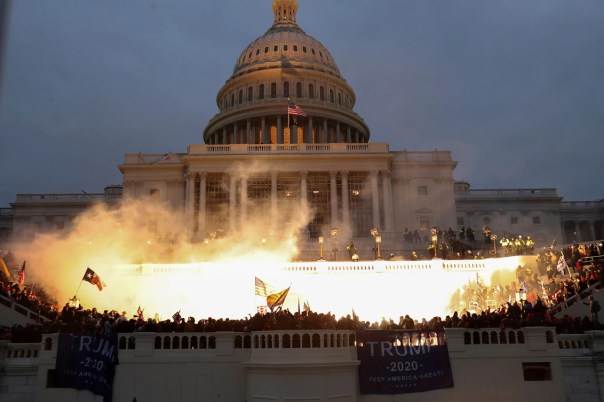
A year ago, we wrote an essay entitled “Coup d’ etat in the US” that analyzed the dramatic events of January 6 and the taking of the Capitol in Washington by followers of then president Donald Trump. One year later, we consider what has changed after the election of Joe Biden and what is anticipated in the US during 2022. Although we would like to be more optimistic, the situation that lies ahead doesn’t permit it. In the face of a Hollywood-style coup, which cost lives, the US lives between a farce and a tragedy.
At the end of a year, the iconic Q Anon Shaman is in prison (without his horns) and the demonstrators and right-wing paramilitaries who were waving flags of the confederate states have been dispersed. In the House of Representatives, a committee “investigates” the January 6 events, but after a year has not established guilt. The country’s Attorney General recently ordered the arrest of 11 people associated with the paramilitary groups, accusing them of sedition.
Today, a president of the Democratic Party occupies the White House and his “party” supposedly controls the House and the Senate, but the liberal agenda that Biden proposed has been paralyzed. In the country that for decades projected itself as the democratic model for the world, today its so-called democracy faces serious challenges. Biden has distinguished himself by his weakness. His administration has been incapable of mobilizing his own party or to ally with popular sectors to advance his agenda. Therefore, the progressive agenda that Biden promised, including an immigration reform that would benefit a million people, has remained stalled. If the polls are credible, the Republicans will most likely gain control of the lower chamber of Congress in the November 2022 mid-term elections and there will be a divided government in the US. That result opens the door for Trump, who could return as president in the 2024 elections. While recrimination predominates among the Democrats, the right, including the paramilitaries mobilize and gain political strength.
Biden is a faithful believer in the cult of consensus, the famous bi-partisanship between Republicans and Democrats that prevailed during the cold war. Biden and some Democrats don’t recognize that the United State has changed, bipartisanship has died, if it ever existed. The country is fractured, including class, racial, ethnic, regional, religious and cultural divisions; 74 percent of the Republicans still insist that Biden is an illegitimate president and that Trump won the election. In the states that they control, Republican governments have dismantled the electoral process trying to reduce the impact of the worker, Latino and Afro-descendent vote. A recent poll indicates that the percentage of people willing to resort to violence to achieve their political objectives has increased significantly. Historically, leaders of both political parties have manipulated these social fissures, but the context in which they operate has changed.
The crisis that US democracy faces is not a problem of personalities, it is rather a systemic condition. In the US, direct voting for president doesn’t exist, rather an electoral college created by slave-holding estate owners in the 18th Century prevails. This implies that changes in control of the Congress and the presidency depend on a small group of voters in some key districts and states. Consequently, although Biden won the popular vote by more than 7 million votes, if 43,000 more voters in just three states (Arizona, Georgia and Wisconsin) would have participated, Trump would be president. The system of power in the Senate is anti-democratic and in practice is used to veto the rights of the great majority. Senators of relatively small states, like Joe Manchin (West Virginia) and Kyrsten Sinema (Arizona) refuse to support a social agenda, highlighting the limits of democracy in the United States.
Trump manipulated social unrest, the product of neoliberalism, which had made life worse for millions of people, to win the presidency. Like in other parts of the world, globalization only enriched an elite. Biden and his advisors understood that reality, introducing himself as a progressive candidate who won the popular vote, even if not overwhelmingly. Assuming the presidency, he proposed legislation that broke with some of the existing schemes among some sectors of Democrats, including a 1.9-trillion-dollar economic rescue plan, and a trillion-dollar infrastructure project. His social agenda has not materialized.
In the beginning, Biden prioritized the pandemic and the number of people vaccinated increased. Omicron showed that the government had no plan in the face of the new variant. Biden also underestimated the inflation that was gradually increasing while wages remained frozen. Social discontent has become palpable, especially among working sectors. This occurs when the Federal Reserve has indicated that it plans to increase interest rates multiple times during what will be an electoral year. If the Democrats don’t achieve any success in the coming months, they will lose the House and the Senate.
Biden has completed one year as president, but the impact of January 6 remains palpable. If in 2024 Trump should lose the presidential election it’s probable that he won’t accept the results like he did in 2021. He would mobilize his base again. The extreme right that participated in the 2021 insurrection has grown in power, and now controls a large part of the Republican Party. What happens in the US makes us think of the famous expression of Karl Marx, the great events of history appear twice, once as farce and the other as tragedy.
*@migueltinkersalas Department of History, Pomona College
**@victorsilverman, Fulbright/GarcíaRobles Professor of US Studies, ITAM
==Ω==
Originally Published in Spanish by La Jornada
Tuesday, January 18, 2022
https://www.jornada.com.mx/2022/01/18/opinion/016a1pol
Re-Published with English interpretation by the Chiapas Support Committee
El Machete separates itself from the 21 missing residents
By: Elio Henriquez
San Cristóbal De Las Casas, Chiapas
The El Machete Self-Defense Forces of the People, an armed group, stated that it does not know the whereabouts of 21 residents detained 6 months ago in the municipal seat of Pantelhó, with the argument that they had ties to hit men (sicarios), a spokesperson for the group said.
According to their relatives, members of El Machete detained 21 inhabitants last July 26 and exhibited them in the central park of Pantelhó, and then took them to San José Tercero, the alleged bastion of the armed group.
But El Machete’s commander, who did not provide his name, said: “I can’t lie about where they are. The Search Commission is coming and who knows where they’re going to look for them. We don’t know where those 21 are. I can’t say anything until the Search Commission comes.”
He also reported that his compañeros arrested three residents on Wednesday who allegedly sold drugs in the municipal seat. “We put them in the can for one night, but today they are already going to the prosecutor’s office,” which “doesn’t do its job; that’s why we impose our own law. The government doesn’t watch over us.
“There are already several cantinas without authorization, but they sell drugs. We heard that months ago and yesterday (Wednesday) we clearly heard that there is a person in Pantelhó (who has) some 30 kilograms of cocaine and weapons.”
“We give the death sentence”
The spokesperson pointed out that: “if the prosecutor’s office doesn’t pay attention to us, I told them that I don’t know what is going to happen next because we give the death sentence. That is what happened yesterday, but we will only go where the bars are, where there are drugs; we entered a (cantina) and it came out positive: we found drugs, grams of crystal (meth) and images of Santa Muerte like the ones Los Herrera use, besides three or four ounces of cocaine.”
He maintained that El Machete members “don’t want rapists, murderers and drug traffickers, we want all of them to leave town. We don’t bother people. What they say, that an armed group entered again, is a lie, but we did not do anything violent yesterday; we went to see where there is evidence that they’re selling drugs.”
In addition to the 21 Pantelhó residents detained six months ago by El Machete, a group of sympathizers of the former mayor and cacique (political and economic boss), Roberto Pinto Kánter, has kidnapped [and held hostage] 27 indigenous people in Altamirano since last December 29.
==Ω==
Originally Published in Spanish by La Jornada
Friday, January 28, 2022
https://www.jornada.com.mx/2022/01/28/estados/025n3est
Re-Published with English interpretation by the Chiapas Support Committee
Violence returns to Altamirano, 27 kidnapped
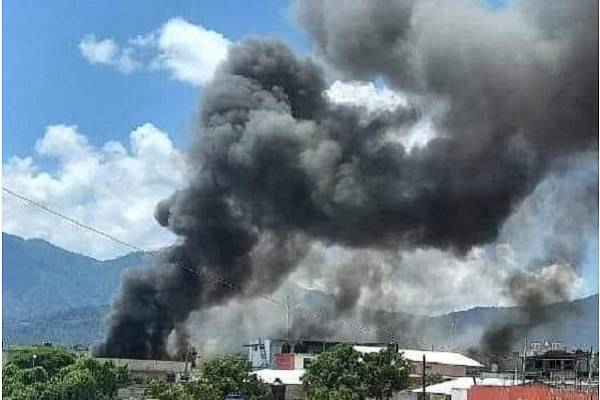
Above: Smoke from Altamirano’s municipal palace last September
After municipal offices were set on fire and ransacked, taxis were burned and people were kidnapped and held as hostages in the struggle to oust a former finquero family from municipal power last October, violence broke out again on December 29, 2021 in the Puerto Rico ejido, a community in Altamirano municipality, Chiapas, Mexico.
The Puerto Rico community was holding an assembly with Altamirano’s municipal council, when masked members of the Alliance of Social Organizations and Left Unions (ASSI) arrived carrying sticks, stones and guns. The ASSI members kidnapped 27 civilians and took them to a nearby community by the name of La Candelaria, also in Altamirano municipality, but apparently a community the ASSI members control, where they have held them as hostages since December 29. Two days later, another 12 were kidnapped; it’s unclear from news reports where the 12 were taken and whether they are still being held.
The response to the kidnappings was prompt and predictable. On the morning of Monday, January 3, 2022, thousands of Altamirano ejido owners blocked the three entrances to the town of Altamirano, which serves as the municipal seat, to demand that the state government intervene to obtain the release of the people being held and that the federal and state governments apply the rule of law in the municipality.
Road blocks were removed from all three entrances to Altamirano 2 days later, after a meeting with state government officials, who agreed to meet again with a commission of ejido owners and municipal authorities to find a way to liberate those being held hostage.
Ejido owners in the town of Altamirano have opposed the ASSI and its members for some time, alleging that it is a paramilitary group at the service of former municipal president Roberto Pinto Kanter. The October conflict was about preventing Pinto Kanter’s wife, Gabriele Roque Tipacamú, from succeeding him as municipal president. Those same ejido owners allege that Pinto Kanter finances and directs the ASSI, which they say is also responsible for kidnapping the child of an ejido owner and kidnapping and torturing ejido owners.
The ejido owners allege that Pinto Kanter used the ASSI to set fire to the municipal office building last September in order to destroy records he did not want an external body of auditors to see, but also so that he could blame the fire on the ejido owners. They also allege that the ASSI is involved in drug trafficking and organized crime.
State officials and the State Congress accepted the resignation of the Altamirano municipal president and her slate of municipal council authorities elected in the June 6, 2021 local elections, and in October 2021 the Congress appointed a new mayor and municipal council to stop the violence. With the December 29 kidnappings, however, it became apparent that the violence had not stopped.
As of January 9, the hostages had still not been released and a group of Tojolabal ejido members told a local reporter that they were no longer supporting the Altamirano ejido owners and the municipal council. They claimed that the new municipal council lacked the ability to govern and that Gabriel Montoya Oseguera had usurped authority.
Who is Gabriel Montoya Oseguera?
From writing about the Zapatista communities in the Lacandón Jungle of Chiapas, this writer recognized the name of Gabriel Montoya Oseguera. The first time that name popped up was back in 2006, a time when well-established indigenous communities located inside the Montes Azules Biosphere Reserve, including Viejo Velasco Suarez, were facing threats of eviction. Montoya Oseguera’s name appeared in a July 2006 report from the Fray Bartolomé de Las Casas Human Rights Center (Frayba) published in Biodiversidadla, which described him as a government delegate offering money, beer and vehicles in order to entice folks to peacefully abandon their land and communities.
The Viejo Velasco Massacre took place in November 2006. All residents of that community were either murdered, disappeared or displaced. Viejo Velasco community members belonged to the indigenous Chol organization Xi’ Nich (The Ants), an organization sympathetic to the Zapatistas. The XI’ Nich believes that Montoya Oseguera, who became an advisor to the Lacandón Community Zone (LCZ), orchestrated the Viejo Velasco Massacre. In other words, Xi’ Nich is accusing Montoya Oseguera of being the intellectual author of the Viejo Velasco Massacre. [1]
On May 15, 2014, when a Mexican scientist, Julia Carabias, reported her own two-day kidnapping, the Chiapas government arrested and jailed Montoya Oseguera. His arrest caused large protests by members of the LCZ and the ARIC-ID that paralyzed the city of Ocosingo. Montoya Oseguera was released several months later without being formally charged and, to date, we know of no one who has been charged and prosecuted in regard to the alleged kidnapping of Carabias.
Nor do we know of Montoya Oseguera’s whereabouts between his 2014 release from prison and his candidacy for municipal president of Altamirano in the Spring of 2021.
Importance of Altamirano
The town of Altamirano is the municipal seat of Altamirano municipality. The town is located a few miles up the road from the Zapatista Caracol of Morelia, a large ejido where two Zapatista Women’s Gatherings were held. It is one of the municipalities the EZLN took over during the 1994 Zapatista Uprising and is one of the entryways into the Lacandón Jungle. The road out of the town that leads to Morelia and other indigenous communities gradually slopes downward towards the deep Jungle and the Montes Azules Biosphere Reserve. Altamirano municipality also played an important role in the EZLN’s internal clandestine organizing before the 1994 Uprising.
During the struggle to oust Pinto Kanter and his wife, one of the first documents the Altamirano ejido owners sent to the state government asking for help was also sent to the EZLN.
The ejido owners wrote that: for some time, after the January 1, 1994 Uprising, “the indigenous peoples of Altamirano, elected municipal governments through democracy, clean and transparent.” However, they warned: “the caciques took control again and ended democracy in the election of its rulers.”
In its first video, the Altamirano Self-Defense group said it would not make public its name out of respect for the “EZLN brothers.” And, in his excellent 2-part analysis of the deteriorating social situation in Chiapas, Hermann Bellinghausen writes: “The emergence of self-defense groups, in principle on the side of the peoples and against crime, can be the product of the example of Zapatista armed resistance and the effectiveness of their autonomies, and not only of the historical perversities of local chiefdoms (cacicazgos). That would be the case of El Machete of Pantelhó, and maybe the self-defense groups announced in Simojovel and Altamirano.”
A recent local report on the electoral violence referred to Altamirano as a “bastion” of the Zapatista National Liberation Army (EZLN, Ejército Zapatista de Liberación Nacional); such a description is not uncommon. The actions of the ejido owners and the self-defense group evidence the strong Zapatista connection and influence.
The EZLN and Altamirano co-exist in the municipality. Violent conflict regarding Altamirano’s municipal council reverberates throughout the municipality’s communities, so it also affects the Zapatistas.
[1] Xi’ Nich – https://chiapas-support.org/2014/06/08/xi-nich-distances-itself-from-conflict-in-the-lacandon-community-zone/
By: Mary Ann Tenuto Sanchez 01-09-22
==Ω==
Published by the Chiapas Support Committee
Wednesday, February 2, 2022
Communiqué of the Indigenous Revolutionary Clandestine Committee-General Command of the Zapatista National Liberation Army
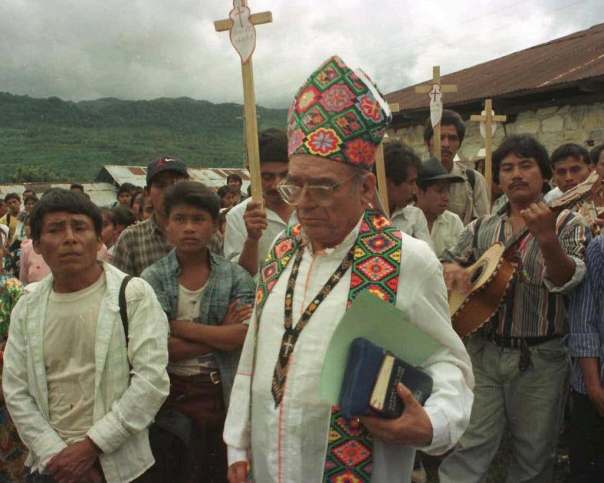
[Admin: Bishop Samuel Ruiz García died 10 years ago, on January 24, 2011. Below, we re-publish the EZLN’s communiqué issued upon his death with English interpretation.]
January 2011
To the people of Mexico:
The Indigenous Revolutionary Clandestine Committee-General Command of the Zapatista National Liberation Army expresses its sorrow for the death of the Bishop Emeritus Don Samuel Ruiz García.
In the EZLN, there are militants of different creeds and those without any religious beliefs, but the human stature of this man (and that of those, who like him walk on the side of the oppressed, the dispossessed, the repressed, the disdained), calls for our word.
Although the differences, disagreements and distances were neither few nor superficial, today we want to emphasize a commitment and a trajectory that are not only of an individual but of a whole current within the Catholic Church.
Don Samuel Ruiz García not only stood out in a Catholicism practiced in and with the dispossessed, with his team he also trained a whole generation of Christians committed to this practice within the Catholic religion. He not only worried about the grave situation of misery and marginalization of the indigenous peoples of Chiapas, he also worked, together with a heroic pastoral team, to improve these shameful conditions of life and death.
What the governments purposely forgot in cultivating death, was made a memory of life in the Diocese of San Cristóbal de Las Casas.
Don Samuel Ruiz García and his team not only strove to achieve peace with justice and dignity for the indigenous people of Chiapas, they also risked and still risk their lives, liberty and property on that road truncated by the arrogance of political power.
Even long before our 1994 Uprising, the Diocese of San Cristóbal suffered harassment, attacks and slander from the Federal Army and the state governments in office.
At least since Juan Sabines Gutiérrez (remembered for the massacre in Wolonchan in 1980), and up through General Absalón Castellanos Domínguez, Patrocinio González Garrido, Elmar Setzer M., Eduardo Robledo Rincón, Julio César Ruiz Ferro (one of the authors of the massacre of Acteal in 1997), and Roberto Albores Guillén (better known as “el croquetas” or “dog biscuits”), the governors of Chiapas harassed those in the Dioceses that opposed their massacres and the management of the State as if it were a Porfirian [1] hacienda.
Since 1994, during his work in the National Commission of Mediation (CONAI), in the company of men and women that made up the peace entity, Don Samuel received pressures, harassment, and threats, including attempts on his life by the paramilitary group called “Paz y Justicia” (Peace and Justice).
And as president of the CONAI, in February of 1995, Don Samuel also suffered the threat of imprisonment.
Ernesto Zedillo Ponce de León, as part of a diversionary strategy (as it is done today) to hide the serious economic crisis to which he and Carlos Salinas de Gortari have subjected the country, reactivated the war against the indigenous Zapatista communities.
At the same time that he launched the great military offensive against the EZLN (the same one that failed), Zedillo attacked the National Intermediation Commission.
Obsessed with the idea of finishing off Don Samuel, the then-president of Mexico, now employed by transnational corporations, took advantage of the alliance which, under the tutelage of Carlos Salinas de Gortari and Diego Fernández de Cevallos, had been forged between the PRI and the PAN.
In those days, in a meeting with the Catholic ecclesiastical leadership, the then Attorney General of the Republic, member of the PAN and fanatic of spiritualism and witchcraft, Antonio Lozano Gracia, brandished a document to Don Samuel Ruiz Garcia with a warrant for his arrest.
And they say that the Attorney General, a graduate of the Occult Sciences, was confronted by the rest of the bishops, among them Norberto Rivera, who came out in defense of the head of the Diocese of San Cristóbal.
The PRI-PAN alliance (later joined by the PRD and PT) against the progressive Catholic Church, did not stop there. Both federal and state governments sponsored attacks, slander and attempts against the members of the Diocese.
The Federal Army was not left behind. At the same time that it financed, trained and equipped paramilitary groups, it promoted the idea that the Diocese was sowing violence.
The thesis at the time (and which today is repeated by idiots on the left) was that the Diocese had trained the EZLN’s rank and file and leadership cadres.
A button of the broad sampling of these ridiculous allegations was given when a general showed a book as proof of the connection of the Diocese with the “transgressors of the law.”
The title of the incriminating book is “The Gospel according to Saint Marcos.”
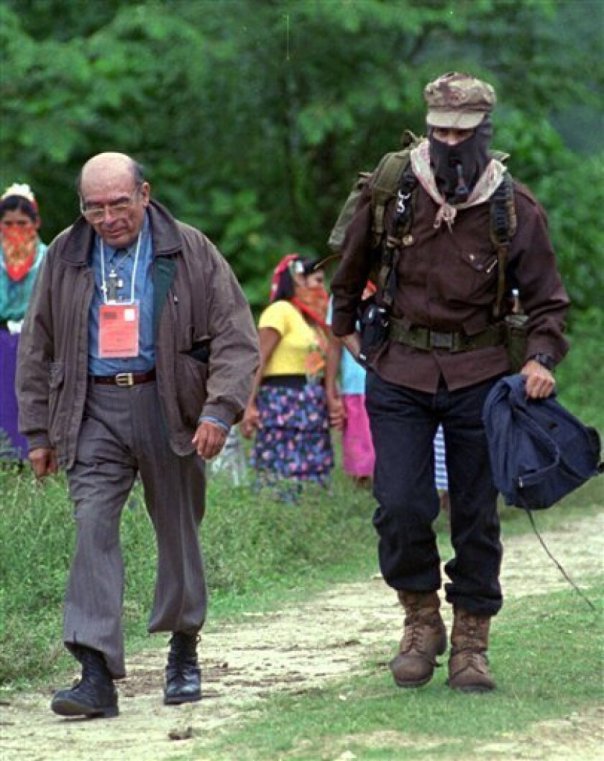
Above: Bishop Ruiz with Subcomandante Marcos
Still today these attacks have not ceased.
The “Fray Bartolomé de Las Casas” Human Rights Center (Frayba) continuously receives threats and harassment.
In addition to being founded by Don Samuel Ruiz García and having a Christian inspiration, the “Frayba” has as “aggravating crimes” a belief in the Integrity and Indivisibility of Human Rights, respect for cultural diversity and the right to Self-Determination, holistic justice as a requirement for peace, and the development of a culture of dialogue, tolerance and reconciliation, with respect for cultural and religious plurality.
[There is] Nothing more annoying than these principles.
And this annoyance goes all the way to the Vatican where there are maneuvers to split the Diocese of San Cristóbal in two, as a way to dilute the option of in, for and with the poor, into something more accommodating that washes conscience in money. Taking advantage of the death of Don Samuel, that project of control and division is being revived.
Because up there, they understand that the option for the poor doesn’t die with Don Samuel. It lives and moves throughout that sector of the Catholic Church that decided to practice what was preached.
Meanwhile, the pastoral team, and especially the deacons, ministers and catechists (Catholic indigenous people of the communities), suffer the defamation, insults and attacks of the neo- lovers of war. Power still longs for its days of lordship and it sees in the work of the Diocese an obstacle to reinstating its regime of gallows and knife.
The grotesque parade of characters of local and national political life in front of Don Samuel’s casket is not to honor him, but to verify, with relief, that he has died; and the local media pretends to mourn what in reality they are celebrating.
Beyond all those attacks and ecclesiastical conspiracies, Don Samuel Ruiz García and the Christians like him, had, have and will always have a special place in the dark heart of the indigenous Zapatista communities.
Now that it’s fashionable to condemn the entire Catholic Church for the crimes, excesses, commissions and omissions of some of its clergy…
Now that the self-styled “progressive” sector is so fond of mocking and deriding the Catholic Church in its entirety….
Now that it is encouraged to see in every priest a potential or active pede…
Now it would be good to turn and look down and find those that, like Don Samuel before them, distrusted and defied Power.
Because these Christians firmly believe that justice should reign in this world also.
And so it is that they live, and die, in thought, word, and deed…
Because while it is certain that there are Marciales and Onésimos in the Catholic church, there also were and are Roncos, Ernestos, Samueles, Arturos, Raúles, Sergios, Bartolomés, Joeles, Heribertos, Raymundos, Salvadores, Santiagos, Diegos, Estelas, Victorias, and thousands of religious and lay people who, being on the side of justice and freedom, are on the side of life.
In the EZLN, today, both Catholics and non-Catholics, believers and non-believers, we not only honor the memory of Don Samuel Ruiz García. We also, and especially, salute the consistent commitment of the Christians, and believers, in Chiapas, in Mexico and in the world, who do not remain in complicit silence in the face of injustice, nor paralyzed in the face of war.
Don Samuel is gone, but many remain, many others who, within and because of the Catholic Christian faith, struggle for an earthly world that is more just, a freer, and a more democratic, that is, a better world.
Cheers to them, for it is from their long nights that tomorrow will be born.
¡LIBERTY!
¡JUSTICE!
¡DEMOCRACY!
From the Mountains of Southeast Mexico
For the Indigenous Revolutionary Clandestine Committee-General Command of the EZLN.
Lieutenant Colonel Insurgent Moisés
Subcomandante Insurgente Marcos
Mexico, January 2011
[1] Porfirian refers to the presidencies (or dictatorship) of Porfirio Diaz (1877-1880,1884-1910). This time, while a period of tremendous economic benefit for some, was a time of debt peonage and rising social ills among the rural and poor populations.
=====
English translation: Schools for Chiapas
Republished in English by the Chiapas Support Committee
What to do
By: Gustavo Esteva
And yes, it’s the old question. But the answers are entirely different.
As usual, Raúl Zibechi hits the nail on the head when describing the impotence of social movements or the so-called left faced with current predicaments. He rounds-off the tracks that he opened in two recent articles (La Jornada, 1/14/22 and 12/31/21).
What has been called the left has been losing its reason and meaning along the way. In the 1950s, it began to place development, instead of justice, as the reason and destiny for its existence. In order to “make the revolution,” whose form changes continuously, it remained attached to the obsession of “taking power,” which in practice simply meant assuming the reins of government.
Organized groups still exist that aspire to the original purpose: establishing socialism, although the very idea of a socialist society was modified to increasingly resemble capitalism and even the model that defined development: the United States. The evolution of the Soviet Union was framed this way. Cuba has shown for decades its satisfaction of a duty fulfilled, by having education and health systems that surpass US systems in various ways.
In the last three decades what still calls itself the left has been in a permanent crisis of orientation and character. In general, it has accommodated to the dominant system and the democratic game. “Taking power,” to its militants, means winning elections and occupying public positions. They feel especially satisfied if the rhetoric of the interests they serve has a progressive tone, although it may never state that it opposes patriarchy or capitalism.
That left has played a decisive role in the dismantling and liquidation of social movements. When it cannot use them for its own purposes, it excludes them and limits them as much as it can and frequently manages to divide them, according to a pattern that has always characterized it.
For those and other reasons, as Zibechi rightly points out, in practice it’s impossible that social movements and those who are still active in something that claims to be “on the left” are able to unify and even coordinate their actions, in order to confront the dominant system and the waves of horror that it has unleashed today. To place them into a framework, Zibechi refers to the State of the World Forum that took place in San Francisco in 1995. There, a political orientation of the elites was defined in relation to a new social class, which the Zapatistas called “the disposables:” [1] people who no longer have use to them. They see them as “surplus population,” which they can do without but need to subject and control. In the face of challenges like these, relatively new, the Leninist answers to what to do, the ones that expect a group of intellectuals to guide “the masses,” have lost all meaning and sustenance.
The hope of a new world is no longer emerging from the “left” or from the social movements, but rather of well-organized common people who for mere survival or old ideals have set themselves in motion and are busy –once again Zibechi– constructing territorial autonomies and their own systems of self-government.
When the Zapatistas finish their internal evaluation, they will surely make public the results of their Journey through Europe. From what was known during its realization, the purpose of listening to a multitude of groups of all classes and conditions that came to receive them with enthusiasm and commitment and created the conditions for intense exchanges, was amply fulfilled.
Time and again the growing distance of the people from all forms of respect for what is still called the “State” and the disillusion with all governments, from the broadest ideological spectrum. Everywhere they are reporting the dangerous emergence of fascist-leaning groups, which link their threats to those posed by climate collapse and generalized crisis.
Time and again the voices of women were heard exercising new forms of leadership, taking radical initiatives of enormous value and very clearly contributing to the construction of autonomy that is spreading. A discussion about government begins. Should we continue using that word for forms of organization in which there are no longer rulers and ruled, because the people themselves direct their lives?
We are faced with radical uncertainty. The collapses underway and the criminal irresponsibility of the elites, who intensify their efforts to dispossess and destroy everywhere, put even the survival of the human species at risk.
In a very real sense, we must return from the future. Instead of continuing to imagine utopias, which inevitably are projections of perceptions of the dying world, we need to creatively transform the present. Instead of trusting in messiahs or in liberating cataclysms, we must trust in the capacity that all of us have when we put our hands to work. That’s where we are.
[1] Subcomandante Marcos used the term “disposables” in his 1997 essay: “7 loose pieces of the global jigsaw puzzle.”
==Ω==
Originally Published in Spanish by La Jornada
Monday, January 24, 2022
https://www.jornada.com.mx/2022/01/24/opinion/017a2pol
Re-Published with English translation by the Chiapas Support Committee
The 80 percent, without strategies and confused
By: Raúl Zibechi
One year after the Zapatista Uprising, during the State of the World Forum in San Francisco, in 1995, prominent members of the global elites commented on the strategies they have been designing.
As is known, because the subject has been published in books and in many media, Zbigniew Brzezinski (former National Security advisor in the government of US President Jimmy Carter and an ideologue of neoliberalism) presented his idea, the 20-80 Society, which has become the paradigm of the dominant classes, although they refuse to repeat it for more than obvious reasons.
He emphasizes that 20 percent of the global population is sufficient to sustain the economic system and that the remaining 80 percent will have no jobs, no opportunities, no future. The first sector is the one that participates in the system’s benefits: quality consumption, private health care and education, as well as jobs in high-tech companies.
Those at the bottom, that immense 80 percent, consume junk food, fill their bellies, but are not nourished, they are numb with entertainment that bewilders them and prevents them from understanding what’s happening around them. Those at the top read books and newspapers, attend universities, travel and have the ability to save. The rest just watch television, telenovelas (soap operas) and football games.
Bzrezisnki coined the term “tittytainment” (breasts plus entertainment, in the sense of the sleepiness of babies when they are breastfed), to account for how they treat the majorities of the world-system.
So far, a fairly well-known panorama of what’s happening in the world today, let’s say after the implosion of the Soviet Union. We can discuss the percentages (20-80 or 30-70), but it seems out of the question that the world is divided into these two sectors: those who sustain the system and those who are disposable.
The main problem is the one Carlos Fazio pointed out based on the analysis of the psychoanalyst Mattias Desmet (https://bit.ly/3K26qK6). I find that the so-called “dissident group” must be well below the 30 percent mentioned in the article. Hopefully, we are 10 percent, but it seems inappropriate to dwell on the question of percentages.
The central issue is whether there is a possibility of uniting, as Fazio points out, and what difficulties we face in doing so. I understand that there are various problems to overcome, structural as well as cultural.
The first difficulty has to do with the natural differences of the anti-systemic sector, highlighting the sexual and gender ones, the contradictions and disagreements between generations, people of color, geographies and cultures, which make it difficult to create an “us,” a collective identity or, instead, spaces of confluence between different and differences.
In second place, among those of us who define ourselves as anti-capitalists, we don’t have anti-patriarchal and anti-colonial consensus, which is why machismo and racism continue causing splits and ruptures. I know a few collectives that have broken up, literally, due to the macho attitude of some members.
The statist or state-centric political culture is the third difficulty to overcome. We cannot ignore the fact that adhesion to social policies –as an expression of statist culture– continues being majoritarian in the field of the 80 percent, among those below. To the contrary, the tendency in favor of autonomy and self-government is the minority one, even among movements that work in that direction.
Without naming names, we know important movements of peoples whose communities survive from cultivating drugs, which brutally contradicts the outlined objectives, since it converts them into hostages of drug trafficking and, therefore, of paramilitary groups and the State itself.
However, a major difficulty in acting together, which deeply divides movements and organizations, comes from the left. A central part of the bewildering entertainment is the political system, the electoral circus: bread and circus, said the Romans, which we can translate today as social policies and electoral campaigns.
==Ω==
Originally Published in Spanish by La Jornada, January 14, 2022
https://www.jornada.com.mx/notas/2022/01/14/politica/el-80-por-ciento-sin-estrategias-y-confundido/
Re-Published with English interpretation by the Chiapas Support Committee
\
 Chiapas Support Committee