Chiapas Support Committee
Home of the Compañero Manuel blog on zapatistas & mexico
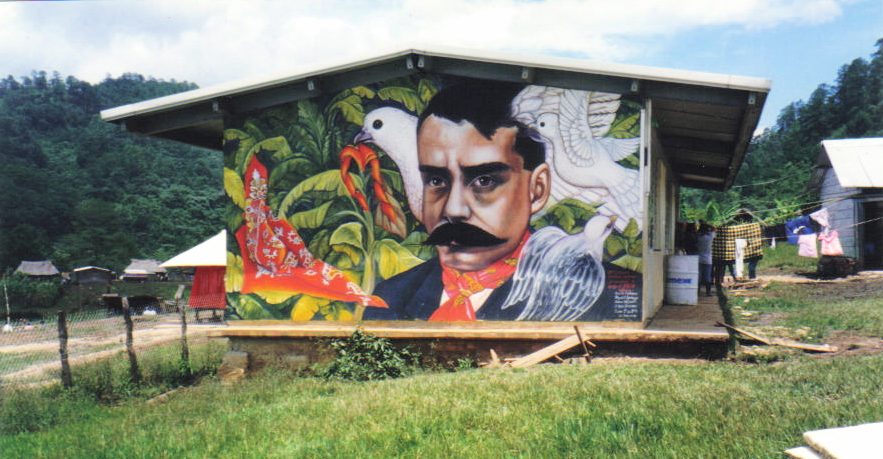
Altamirano, Chiapas: Mass kidnappings of opponents of the political machine
 The 10 drivers released on March 22 provided this photo of themselves to El Heraldo.
By: Isaín Mandujano
In the municipality of Altamirano a paramilitary group linked to the Pinto Kanter family, the PVEM and the Alliance of Social Organizations and Left Unions (ASSI) is massively kidnapping those who oppose the return of that political nucleus to the power it held for 12 years. Given this, the government of Rutilio Escandón has arranged for the release of some victims [on March 22, the government announced the release of 10 more truck drivers] and the state’s attorney general has opened investigative files, but has not reported the results.
ALTAMIRANO, Chiapas (proceso)
Kidnapped by a paramilitary group, 37 indigenous Tojolabals have suffered being deprived of their freedom for almost three months, as a result of the remnants of a political machine that for 12 years has maintained control of people who finally rebelled, in this region of influence of the Zapatista National Liberation Army (EZLN, Ejército Zapatista de Liberación Nacional).
In recent months, several mass kidnappings have kept Altamirano residents in suspense, immersed in a political conflict and victims of shock groups and armed civilians who, they accuse, are linked to or at the service of politicians who try to perpetuate themselves as local authorities.
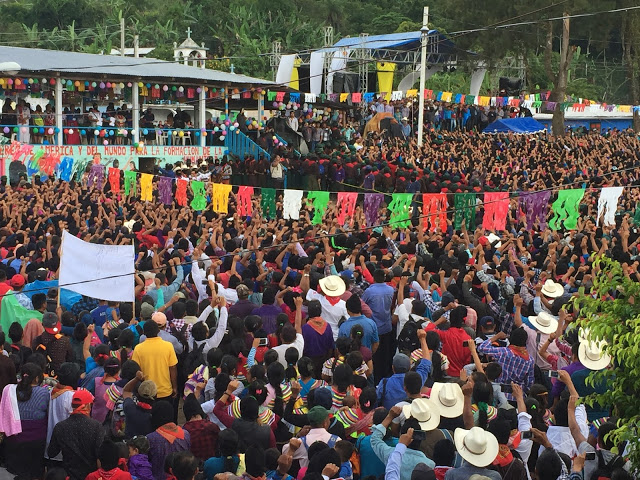
In the march on Sunday, March 13, organized by the EZLN in six Chiapas municipal seats, the one in Altamirano was unique, because the contingent of masked rebel men and women were joined by thousands of non-Zapatistas from the neighborhoods and districts, who denounced the crisis that they have experienced since August 14, 2021.
Armando Pinto Kanter, Amilkar Pinto Kanter, Roberto Pinto Kanter, their wives, their brothers-in-law, a cousin or relative of theirs, have served as municipal presidents since the ‘90s until 2021, when they were expelled from Altamirano.
The townspeople rose up against that, says ejido commissioner René Santiz Espinosa, one of the victims of a first mass kidnapping last August. Santiz maintains that they will not give in to pressure from armed civilian groups that seek to oblige the current municipal council to resign.
The rebellion against the town’s political bosses (the Pinto Kanter family) has led to this population living entrenched. Trucks with chains and men with radios in hand are at all of the town’s accesses as a control filter to avoid the entry of an armed group tied, they say, to those who previously held municipal political power in Altamirano.
 In the EZLN’s March 13 action against capitalist wars, Altamirano residents hold a banner demanding the release of those kidnapped.
In the Zapatista march on Sunday, the 13th, ejido residents and their ejido authorities endorsed the rebels’ demands. At the end of the march, residents of the town exposed in a meeting what they experienced for more than 12 years and the fact that they now suffer the kidnapping of members of their movement.
The ejido commissioner of Altamirano, Santiz Espinosa, was one of the first ones kidnapped on August 14, 2021. His kidnapping, as well as that of their other ejido compañeros unleashed the town’s ire. They released him in the first days of September [2021].
Now free and at the head of the citizen social movement, Santiz says that they were tortured and they held them several days without food, which is why he worries what the 37 indigenous members of the civil resistance called the August 14 Altamirano Citizens Movement who remain captives may now be suffering.
The armed group that keeps the indigenous people kidnapped demands 10 million pesos to release them and the resignation of the independent municipal council.
This is an excerpt from the report [about political kidnapping in various parts of Mexico] published in edition 2369 of the weekly Proceso [magazine] whose digital version you can purchase here.
==Ω==
Originally Published in Spanish by Proceso.com.mx, Friday, April 1, 2022, https://www.proceso.com.mx/reportajes/2022/4/1/altamirano-chiapas-secuestros-masivos-de-opositores-al-cacicazgo-283509.html
Re-Published with English interpretation by the Chiapas Support Committee
The Caravan for water and an environmentalism of the peoples
By: Raúl Romero*
Don Panchito turned 79 in January of this year. Doña Gloria is 62 and is an indigenous Nahua. Don Panchito and Doña Gloria live in the state of Puebla and are partners in life and struggle. Together they tell various stories of resistances in which they have participated. In recent decades they fought against the expansion of several highway sections that the precious governor Mario Marín promoted under the pretext of “detonating” the Hermanos Serdán international airport. They also fought against the privatization of water that the former PAN governor Rafael Moreno Valle undertook, a business that greatly benefited Grupo Hermes, of the Hank Rhon family.
For several years, Don Panchito and Doña Gloria have been part of the struggle against the Morelos Integral Project (PIM), in particular against the gas pipeline that passes through volcanic areas of Puebla and with which it is sought to carry gas to the thermoelectric plants iun Morelos. There they met Samir Flores Soberanes, their compañero in struggle, murdered in February 2020. The PIM, we must remember, is a project that would start to be promoted with Felipe Calderón, resumed in the six-year term of Enrique Peña Nieto and also promoted now by the government of López Obrador.
On March 22, 2021, Don Panchito and Doña Gloria heard on the radio that several people were blocking the accesses to the transnational Bonafont plant, in the municipality of Juan C. Bonilla, in Puebla, and decided to go to show solidarity with the mobilization. Doña Gloria explains the reasons for the takeover as follows: “We had a lot of problems with water, the wells no longer had a sufficient supply. They started to discuss it among the community and they saw that Bonafont was stealing water from them with the government’s permission. So, they started to organize and decided, on March 22, to occupy Bonafont.” With simple words, Doña Gloria makes the scope of their fight clear: “This struggle is not just for us, it’s for humanity,” and she concludes: “We know that they also steal water from them in Europe, we also tell them to run them out of there. Those businessmen, who are big capitalists, it’s necessary that they stop screwing around with our lands and our water.”
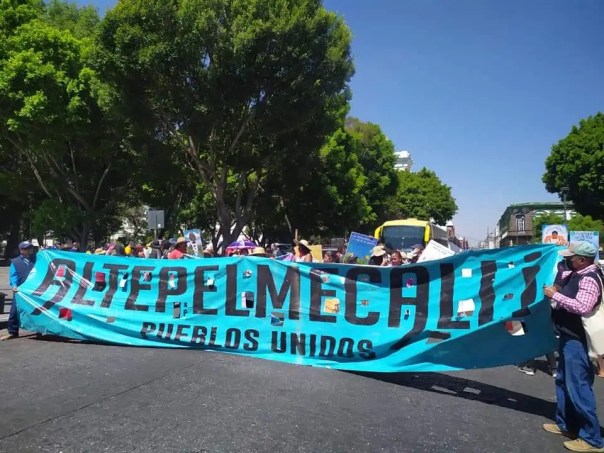
Adverse to the nationalist discourse that the federal government encourages, on February 15, 2022 the National Guard was sent to evict and dismantle the Altepelmelcalli, or House of the Peoples, a species of de community center that the occupants had constructed over the Bonafont ruins. The National Guard thus placed itself at the service of a transnational, of protecting private property, that of the plant over water, over the common good.
The occupation of the Atepelmelcalli on the National Guard’s part was a hard blow against the peoples and organizations that with so much effort and creativity maintained the occupation for 11 months and managed to stop the looting of water. But it wasn’t lethal. The seeds of rebellion were already planted.
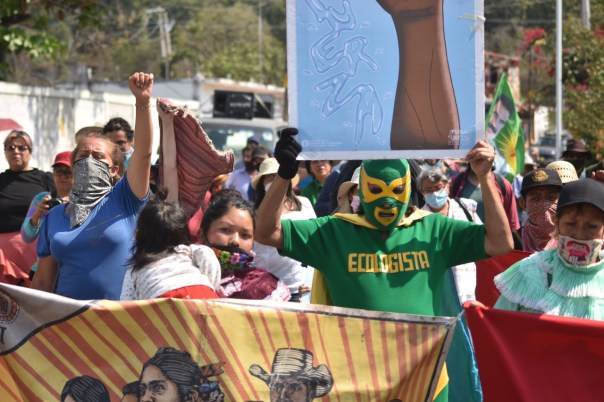
During various gatherings of peoples, communities and organizations in struggle that were held in the Altepelmelcalli, the idea of communicating, linking and making visible the various processes of defense of territory, water and life that exist in the country grew. The idea of promoting the Caravan for life and water was born like that. Peoples united against capitalist dispossession, an initiative that began last March 22 and that for 34 days will tour eight of the country’s states: Puebla, Veracruz, Guerrero, Querétaro, Morelos, Ciudad de México, Tlaxcala and Oaxaca. The entire initiative is self-managed, organized withy resources of the very same peoples and organizations that participate in this articulation and that also appeal to the solidarity of those who sympathize with the cause (http://caravana.pueblosunidosporlavida.org/).
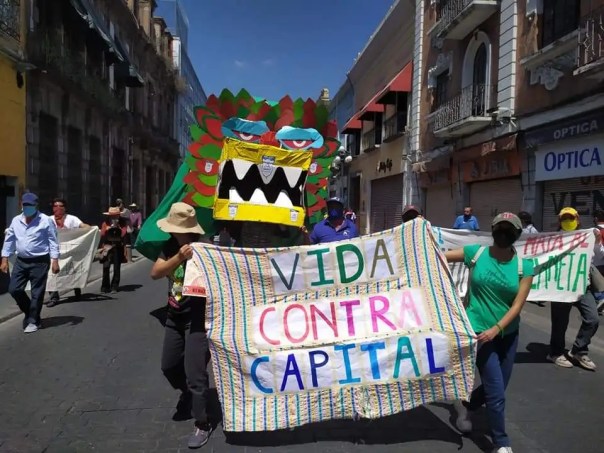
As its name says, the caravan is not against such or so government, it’s against capitalist dispossession and the governments that sustain it. It is against that destruction that they disguise as progress. The environmentalism of the peoples, which is constructed from below and to the left, invites us to change the questions: development for who and at what cost? It proposes a struggle of a civilizational nature, for humanity and the planet. It’s not limited to deciding if it wants to be dispossessed by national and transnational companies or by the State. It breaks with that scheme.
The environmentalism of the peoples, which in Mexico is composed principally of the resistances of Native peoples and of an important participation of women –to the extent that even in academia and in popular organizations they talk more and more about eco-feminisms–, has been struggling for centuries against dispossession and capitalist accumulation. If anyone wants to investigate “where they were when,” they will find that they have been struggling there for more than 500 years.
* Sociologist
Twitter: @RaulRomero_mx
==Ω==
Originally Published in Spanish by La Jornada, March 31, 2022, https://www.jornada.com.mx/2022/03/31/opinion/015a2pol
Re-Published with English interpretation by the Chiapas Support Committee
Let’s not get crushed by geopolitics

By: Raúl Zibechi
Geopolitics deals with imperial thoughts and ways of seeing the world, at the service of the most powerful states. It emerged that way and continues to be so, although some intellectuals persist in a sort of “left geopolitics,” or even “revolutionary.”
Geopolitics emerged at the beginning of the of the 20th century among geographers and military strategists from the North, who link geographic realities with international relations. The term appeared for the first time in a book by the Swedish geographer Rudolf Kjellén, titled The State as a way of life. US admiral Alfred Mahan developed the strategy of naval dominance, while Nicholas Spykman defined the regions of Latin America where the United States must maintain absolute control to guarantee its global dominance.
Geopolitics had a great development in Germany at the beginning of the 20th century, reaching great diffusion during Nazism. In Latin America, military men of the Brazilian dictatorship (1964-85), such as Golbery do Couto e Silva, were based in geopolitics to defend the expansion of Brazil, to finish occupying the Amazon and thus become the regional hegemon.
I’m not interested in delving into this discipline, but rather into its consequences on the peoples. If geopolitics deals with relations between states, and in particular with the role of those who seek to dominate the world, the great absent in this thinking are the peoples, the oppressed multitudes that are not even mentioned in their analysis.
A good part of those who justify the Russian invasion of Ukraine fill pages denouncing United States atrocities. One reminds us: “the United States carried out 48 military interventions in the 1990s and was involved in several endless wars, during the first two decades of the 21st century.”
He adds that in that period, the Americans “carried out 24 military interventions around the world and 100,000 aerial bombardments, and in 2016 alone, during the Barack Obama administration, they launched 16, 171 bombs on seven countries.”
The logic of these analyses says something like this: Empire A is terribly cruel and criminal; but Empire B is much less damaging because, evidently, its crimes are much less. Since the United States is an imperial machine that murders hundreds or tens of thousands each year, why speak out against someone who kills just a few thousand like Russia?
This is the creeping and calculating way of doing politics that doesn’t take human pain into account, that considers that the peoples are only numbers in death statistics, or considers them only as cannon fodder, as numbers on a scale that just measures corporate and state benefits.
On the contrary, those below place the peoples, classes, skin colors and oppressed sexualities in first place. Our starting point is not the states, nor the armed forces, nor capital.
We don’t ignore that there is a global scenario, expansionist and imperialist nations. But we analyze that scenario to decide how to act as movements and organizations from below.
In Imperialism, the highest stage of capitalism, written in 1916 during the First World War, Lenin analyzed monopoly capitalism as the cause of the war. But he didn’t take sides and strove to transform the carnage into a revolution.
That’s how Immanuel Wallerstein worked. His theory about the world-system seeks to comprehend and explain how political and economic relations function on a globalized planet, for the purpose of promoting social transformation.
These are useful tools for the peoples in movement. Because an understanding of how the system works, far from leading us to justify any of the competing powers, leads us to anticipate the consequences that it will have on those below.
Zapatismo names the systemic chaos that we are experiencing as “the storm” and also considers that it’s necessary to comprehend changes in the functioning of capitalism. Regarding the first, the conclusion is that we must prepare to face extreme situations that we have never before experienced. Have we ever thought that they can use atomic weapons in the coming years?
Regarding the second, although the Zapatistas don’t mention it explicitly as far as I remember, it’s evident that the richest 1 percent have kidnapped the nation-states, that the communications media doesn’t exist, but only intoxication and that electoral democracies are fairy tales, when not excuses for perpetrating genocides. Consequently, they don’t let themselves get entangled in state logic.
We’re facing dramatic moments for the survival of humanity. We must elevate our gaze and not let ourselves be dragged into the geopolitical quagmire. When the smoke is so thick that it prevents us from distinguishing light from shadow, let us trust in ethical principles to continue forward.
==Ω==
Originally Published in Spanish by La Jornada, March 26, 2022, https://www.jornada.com.mx/2022/03/25/opinion/015a2pol
Re-Published with English interpretation by the Chiapas Support Committee
Las Margaritas marches for unity, peace and harmony

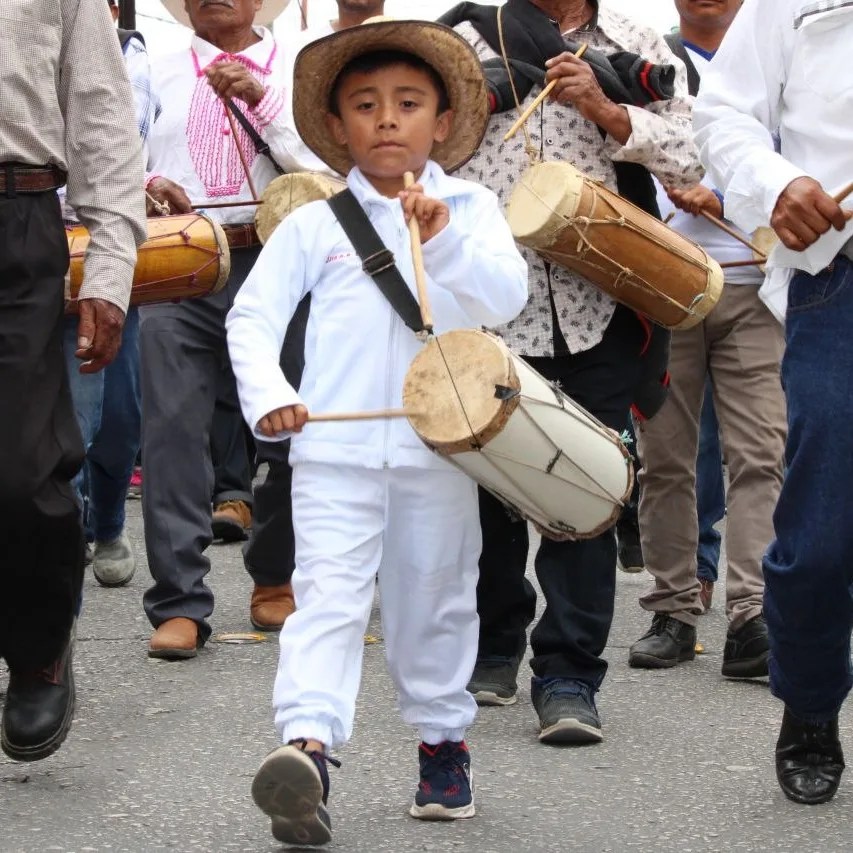
Several Chiapas news sources, Chiapas Paralelo and Pozol Colectivo, published reports about a pilgrimage that marched through the streets of the municipal seat of Las Margaritas on Sunday, March 20. After a February 24 confrontation between two “social organizations” that resulted in the deaths of 2 people and the injury of 8 others, different religious denominations held meetings for weeks and then announced the Alliance of Churches for Peace, composed of Presbyterian, Baptist, Pentecostal, Adventist and Catholic churches.
Faced with a wave of violence, residents of Las Margaritas came together to make a pilgrimage called “Voices in search of unity, peace and harmony,” and to issue a statement expressing their concern and urging people to “put themselves on the path of peace, overcome apathy and indifference and promote a new construction in which we are all co-responsible.”
They also invited the three levels of government to favor conditions of encounter and dialogue and to pay attention to urgent situations, such as health, insecurity and water.
So, what exactly happened on February 24? A Chiapas journalist, Isaín Mandujano, wrote a report for Proceso on the incident. A translated and amended version of his report can be read below.
=====
“MAYOR’S RESCUE” ENDS UP WITH 2 DEAD AND 8 INJURED BY GUNSHOTS IN LAS MARGARITAS
By: Isaín Mandujano
With sticks, stones and firearms, indigenous Tojolabals from two social organizations confronted each other this Thursday morning in the municipal seat of Las Margaritas, leaving 2 dead and several wounded.
On the morning of February) 24, Mayor Bladimir Hernández Álvarez and his closest collaborators were paying homage to the flag in the central square when they were advised that hundreds of members of the Independent Central of Agricultural Workers and Campesinos-Historical (CIOAC-H, its initials in Spanish), [1] led by Andulio Hernández, were approaching in order to detain him and complain about the lack of support for the members of this social organization.
The mayor and his collaborators entered the headquarters of the municipal council, when the campesinos from the CIOAC-H arrived immediately and took over the building to prevent the municipal officials from leaving until, under pressure, the president decided to receive a commission to dialogue with them.
The dialogue meeting of municipal authorities with campesinos that were demanding support for the countryside, as well as for the members and the families of that organization, was taking place when suddenly hundreds of campesinos from the Alliance of Social organizations and Unions of the Left (ASSI, Alianza de Organizaciones Sociales y Sindicatos de Izquierda), an organization founded by, Aio Hernández, the mayor’s father, arrived.
With sticks, stones and firearms, the ASSI [2] campesinos attacked the CIOAC-H campesinos who had taken over the municipal headquarters, in order to “rescue” the municipal president, who told them they intended to arrest him and take him away to a community.
After the attack, two men were dead, both members of the CIOAC-H, who accused members of the ASSI of having attacked it with high-caliber weapons.
The CIOAC-H, which came today to protest against the mayor and to demand support for the communities where they have a presence, is led by Andulio Hernández, son of the late Luis Hernández Cruz, former deputy and state leader of the Independent Central of Agricultural Workers and Campesinos (CIOAC).
Andulio Hernández is the first cousin of the current mayor Bladimir Hernández, because is the son of Antonio Hernández Cruz, who arrived today heading the ASSI. Antonio Hernández Cruz was a prisoner in El Amate prison as the one allegedly responsible for the crime of his brother Luis Hernández Cruz, who was riddled with bullets on May 4, 2017 in front of his house located in Barrio Los Magueyes in Comitán, a municipality close to Las Margaritas.
By telephone, José Antonio Vázquez Hernández, state leader of the CIOAC and leader of the Party of the Democratic Revolution (PRD, its initials in Spanish) separated his organization from this conflict and said that Andulio Hernández was expelled from the CIOAC “a long time ago.” They continue using the CIOAC name, but adding “Historical.” For José Antonio Vázquez Hernández there is only one CIOAC and not more, like others boast about.
Similarly, said Antonio Hernández Cruz, now leader of the ASSI and father of the current mayor, was expelled from the CIOAC since the 1990s’. Therefore, the two organizations in dispute today have nothing to do with “the true and only CIOAC.”
In the last municipal elections, Andulio Hernández supported the MORENA candidate, Jorge Luis Escandón, so that he would be re-elected as the one in charge of the municipal council, after a three-year-term as municipal president nominated by the PRD. But in those July 2021 elections, the candidate of the Social Encounter Party (PES, Partido Encuentro Social), Bladimir Hernández Álvarez, won.
They open an investigation
After the events, the State’s Attorney General (FGE, its initials in Spanish) through the Office of the Indigenous Justice Prosecutor, opened a record of attention against the person or persons who are responsible for homicide, injuries and damages committed to the detriment of a person or persons offended, as a result of the altercation between social organizations.
According to preliminary data, two people lost their life and eight were injured by firearms, after members of the Independent Central of Agricultural Workers and Campesinos (CIOAC) and the Alliance of Social Organizations and Left Unions (ASSI) had a confrontation.
Dozens of different caliber shell casings were found at the scene. There were material damages to six vehicles at the facilities of the Municipal Presidency and surrounding businesses. Members of the Las Margaritas police took control of the place and are guarding the area.
Notes
[1] It’s important to remember that the CIOAC-H is the “social organization” that murdered the EZLN’s Compañero Galeano in La Realidad in 2014! AND, the Zapatista Caracol of La Realidad is just down the road from the town of Las Margaritas.
[2] The ASSI is the “social organization” that kidnapped 53 people and continues to hold 34 people hostages in Altamirano. The ASSI has also been accused of involvement with organized crime.
==Ω==
Originally Published in Spanish by Chiapas Paralelo, February 24, 2022: https://www.chiapasparalelo.com/noticias/chiapas/2022/02/rescate-de-alcalde-termina-en-dos-muertos-y-ocho-heridos-de-bala-en-las-margaritas/
Re-Published with English interpretation by the Chiapas Support Committee
Maya Train: destructive, illegal and illegitimate
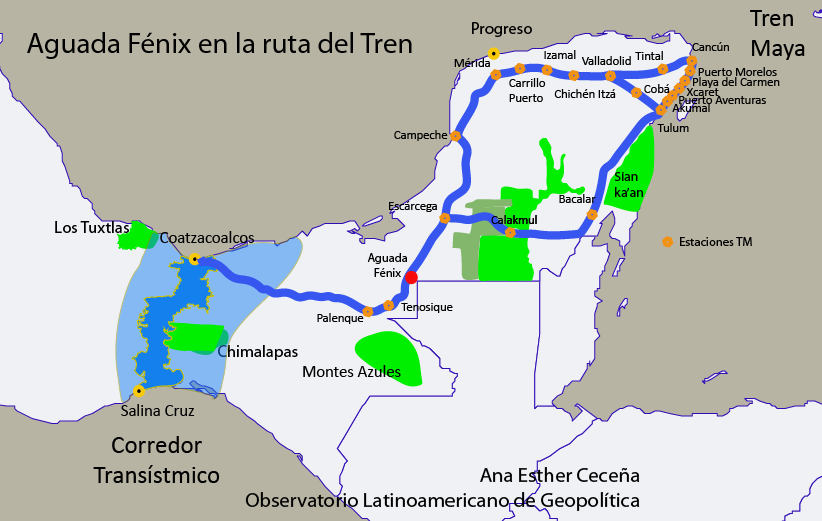 Court orders work to stop on Phase One, from Palenque, Chiapas to Izamal, Yucatán.
By: Silvia Ribeiro*
On March 9, 2022, a collegiate court granted a definitive suspension of the work on sections 1, 2 and 3 of the misnamed Maya Train, the sections that go from Palenque, Chiapas, to Izamal, Yucatán (phase 1). In response, the federal government announced that it would continue the work anyway, thus disobeying the court order and even worse, violating once again the rights of the indigenous peoples affected by these works.
Another outrage over this project that is not Maya, nor just a train. It is a huge project of capitalist reconversion of ancestral territories of the Indian peoples, who have been invaded and looted since the Conquest, but who continue resisting and defending their lands, ways of life and nature. A project to facilitate and subsidize the advance of pig factories, industrial and toxic agricultural plantations, commercial tourism, big energy companies and others that expel communities from their lands, poison their cenotes [1], pollute their crops and kill their bees.
Denouncing and stopping the train’s impacts is crucial because it leads to environmental impacts, deforestation, disruption of biodiversity and fauna, as well as water pollution. But the project is even more serious in its entirety since, as Grain called it, it’s not about the train, but rather about a multimodal monopolizing of territories.
The decision just issued, confirmed a previous one that granted an injunction (amparo) to the lawsuit that the Múuch’ Xíinbal Assembly of Defenders of Maya Territory filed in January 2021, claiming that the regional Environmental Impact Statement (approved in November 2020) and all work that it enables on those sections constitute “violations of the right to a healthy environment and their rights as original Maya peoples, among them [the rights] to information and to participate in the determinations that may affect their territory and natural resources, as the Escazú Agreement indicated, approved in the current administration” (https://bit.ly/3vYaoir).
The fourth district court then ordered the regional Environmental Impact Statement (MIA-R, its initials in Spanish) to be nullified and to stop work on Phase 1 of the Maya Train, based on the need to apply the precautionary principle, since “there is uncertainty about the true impact of the project in question, and therefore the balance of justice must lean in favor of nature, especially when considering that its impact has the potential to transcend future generations and not only those who live in the area, but even the entire world, in attention to the interdependence of global ecological systems.”
In April 2021, Semarnat appealed that sentence, in agreement with the position expressed in the MIA-R of phase 1 of the Maya Train, which recognizes that the impacts go far beyond the train, but that “Ethnocide can take a positive turn” (sic). See: Semarnat 2020, MIA-R Tren Maya page. 1329.
Now, the collegiate court has answered the appeal, confirming the definitive suspension, which orders that the work be suspended until the resolution of the substantive issue of the amparo filed by Múuch’ Xíinbal.
The government’s statements that say it will proceed with the work despite the court order, are even more serious in light of the fact that the organizations that filed the lawsuit, the Múuch’ Xíinbal Assembly of Defenders of Maya Territory and the Indignation, Promotion and Defense of Human Rights AC organization, have been harassed by the government as if they were defenders of territory and human rights, even calling them “far right organizations.”
Despite the fact that its members have even received death threats, the former director of Fonatur, Rogelio Jiménez Pons, in addition to numerous false accusations against the organizations, publicly exposed people who participated in amparos against the project, making them extremely vulnerable. Múuch’ Xíinbal placed responsibility on President Andrés Manuel López Obrador and on Jiménez Pons for whatever may happen to them (https://bit.ly/3CCk7MP). Also the Indignation Team, which has accompanied this and other indigenous organizations in the region involved in the legal defense of their rights for decades and also answered the falsehoods, advising the president “to get out of his helicopter” and find out who they are and the reality where they work (https://bit.ly/3KBtKOj).
The government’s spite for the legal sentence of suspension in favor of the indigenous organizations, together with the attacks and falsehoods about them in order to justify legal violation and the violation of rights, is even more serious within the context that Mexico occupies second place globally in the murder of defenders of the land and that have increased during the present administration, while 95 percent of them continue in impunity, including that of Samir Flores Soberanes, also harassed by the government (https://bit.ly/3KEPkkW).
It’s crucial to support Múuch’ Xíinbal and all the indigenous peoples and organizations that despite threats have been able to present lawsuits against this and other megaprojects, as well as condemning the government’s cynical attitude of even ignoring legal decisions in their favor.
* Grupo ETC Researcher
[1] Cenotes are natural sinkholes resulting from the collapse of limestone bedrock that exposes groundwater and are used as a water supply, especially on the Yucatán Peninsula of Mexico.
==Ω==
Originally Published in Spanish by La Jornada, March 12, 2022, https://www.jornada.com.mx/2022/03/12/opinion/017a1eco
Re-Published with English. Interpretation by the Chiapas Support Committee
Court confirms definitive suspension of the Maya Train on three sections

From the Editors of Desinformémonos
Mexico City | Desinformémonos
A collegiate court confirmed the definitive suspension of sections 1, 2 an d 3 of the federal Maya Train megaproject, granted in March 2021 by the Fourth District Court, the Múuch’ Xíinbal Assembly of Defenders of Maya Territory reported.
The suspension is the result of the amparo [1] that Múuch’ Xíinbal filed on January 20, 2021 against the megaproject for violations of the right to a healthy environment and to their rights as Maya peoples, and determines that the Environmental Impact Statement (MIA, its initials in Spanish) and the work on sections 1, 2 and 3 of the Maya Train “must remain paralyzed.”
The Múuch’ Xíinbal defenders criticized that despite the resolution in favor of the Maya communities, President Andrés Manuel López Obrador (AMLO) insists that the Maya Train will not stop,” which “evidences an authoritarian tendency that violates the separation of powers and violates the rule of law.”
They added that the permanent disqualifications that AMLO has made against those who oppose the megaproject “represent a violation of the defense of human rights, putting those who live in the affected indigenous communities at risk, given the context of high vulnerability in which the defenders of territorial and environmental rights in Mexico find themselves.
The definitive suspension of work on the Maya Train was confirmed by the Collegiate Court on Labor and Administrative Matters of the Fourteenth Circuit, with which violations of the rights of the Maya peoples with the imposition of the megaproject are once again recognized, such as the right to obtain information and to participate in decisions that can affect their territory and natural resources.
The complete communiqué from Múuch’ Xíinbal is attached to this article in Desinformémonos and can be read in Spanish here.
[1] An amparo is a legal action to stop, suspend or prevent an action from taking place. It is similar to an injunction in the US legal system.
==Ω==
Originally Published in Spanish by Desinformémonos, Thursday, March 10, 2022: https://desinformemonos.org/tribunal-confirma-suspension-definitiva-del-tren-maya-en-tres-tramos/
Re-Published with English interpretation by the Chiapas Support Committee
They release 9 of the 53 kidnapped in Altamirano
 Translation of the banner: August 14 Social Movement, composed of the union of barrios and ejidos, as well as social organizations and work groups say Enough of the kidnappings!
Violence continues to escalate and may have reached a critical juncture in Altamirano municipality, Chiapas, Mexico, regarding the kidnapping and prolonged detention of what has added up to 53 people.
Conditions within the municipality have prompted Chiapas business organizations, schools, associations and indigenous residents of Altamirano municipality, as well as the wives and relatives of kidnapped truck drivers and residents of Altamirano ejido to demand that the state and federal governments intervene to resolve the conflict. It is indeed puzzling why the governments have not acted sooner.
Since our last report on Altamirano, there have been more kidnappings, a cousin of the municipal president murdered and a 12-year-old girl shot and wounded. The 53 people kidnapped have been held as hostages in a post-electoral conflict that seems to have no end. There are also reports of the kidnapping of 20 truck drivers and their vehicles. This escalation of violence represents a shift in the political dynamic within the municipality and makes it more difficult for state authorities to find a solution that will end the violence.
The shift in political position occurred in the large Tojolabal community of Puerto Rico. The community previously supported residents of the Altamirano ejido in preventing the former municipal president’s wife from taking power and in replacing her with the current municipal council. Now, however, they no longer support the current municipal council or the residents of the town of Altamirano, which is the municipal seat. A spokesperson for the Puerto Rico community described the conflict as being about rejection of the municipal council and Gabriel Montoya Oseguera’s usurpation of the municipal president’s functions. They allege that the municipal council president doesn’t know how to manage the municipality.
 Gabriel Montoya Oseguera and María García López (in front)
On January 26, an assembly of the Puerto Rico community’s Tojolabal residents agreed to disown María García López, Altamirano’s municipal president, and Gabriel Montoya Oseguera, trustee on the municipal council, because of increased insecurity in the municipality. They are now in agreement with the folks in La Candelaria community, who supported the former municipal president, Roberto Pinto Kánter, and who kidnapped the original 27 people, apparently supporters of the municipal council.
On February 7, dozens of members of the Puerto Rico community kidnapped another 7 people, alleging that they were part of Montoya Oseguera’s “shock group.” They are also being held in La Candelaria, the community from which a spokesperson said: “In recent days, they attacked residents of the Tojolabal region and in response we organized and kidnapped seven more.”
On February 8, a 12-year-old girl was shot at a checkpoint outside the Puerto Rico community while traveling with her mother, a teacher, and younger brother in a public transportation vehicle, a colectivo) [1]. She was taken to a hospital in Tuxtla Gutierrez for treatment. According to a report in La Silla Rota, the colectivo in which the family was riding was in a line of vehicles waiting to pass through a checkpoint when a vehicle near them left the line to turn around. Those maintaining the checkpoint opened fire, apparently realizing that those leaving the line were from an opposition group. The public transport vehicle was caught in the crossfire and the girl was wounded.
The next day, El Heraldo de Chiapas reported the murder of Mariano “N,” a Tojolabal and a cousin of the municipal president. He was murdered on his way home to La Laguna community. No information was available as to any suspects. However, the Tojolabals warned of revenge, which caused the ejido owners in the town of Altamirano to close-off the town and place armed guards at the town’s entrances.

In the midst of all this, the Altamirano Self-Defense group [above photo] released another video in which they state clearly that they will not permit a non-indigenous person to become municipal president. Nor will they permit political bossism (caciquismo) or stealing from the poor. And they said they would defend the most marginalized and would also take “other measures” in case mestizos (non-indigenous) continue governing the municipality.
Chiapas residents demand government intervention
What stands out in this conflictive situation is the government’s inability to solve the conflict. There are two opposing political factions: the supporters of Roberto Pinto Kánter and the supporters of the municipal council. Kánter’s supporters are armed and organized. They belong to the Alliance of Social Organizations and Left Unions, known by its initials in Spanish as the ASSI, which is alleged to participate in organized crime, such as drug sales and distribution, as well as kidnapping and murder. ASSI members have turned the municipality of Altamirano into a combat zone with roadblocks and checkpoints, kidnappings and even murder, while state authorities seem unable to do anything.
According to a recent report in La Jornada, 6 collaborators of a grocery distribution business were kidnapped in Altamirano on February 7 and are still being held. The kidnappers also have the 6 heavy vehicles loaded with products to be distributed by those 6 collaborators. The report states that “business organizations, schools and associations asked the state and federal authorities to ‘immediately’ intervene to guarantee the physical integrity and release of 6 of the truckers kidnapped on February 7 ‘in the municipality of Altamirano by armed men, allegedly sympathizers of former mayor Roberto Pinto Kánter, of the Green Party’.”
 Kidnapping truckers in Altamirano. Photo: El Heraldo de Chiapas
A group of Tojolabals in Altamirano spoke out in a document against the kidnappings and detention of the 53 being held in La Candelaria; they state that not all residents of the Tojolabal zone are in agreement with the group that kidnapped 53 people and is holding them hostage. They further state that there are people from the Tojolabal zone detained in La Candelaria. They also demand the intervention of state and federal authorities and urge the communities involved in the conflict to dialogue with each other to solve this problem.
On February 20, El Heraldo de Chiapas reported that the wives of the kidnapped transport drivers also spoke out publicly and asked the state government and the president of Mexico to intervene to bring their husbands home.
According to a February 21 report in La Jornada, on around 500 people protested in the municipal seat of Altamirano, demanding the release of all those kidnapped and being held and calling on all sectors to sit down, dialogue, solve problems and construct peace. The protesters say they are part of the “August 14 Movement” and that they support the municipal council. Some of them are the folks who are blockading the entrances to the municipal seat, the town of Altamirano, to protect it from violent acts by the opposition group belonging to the PVEM (Green Party of Mexico), supporters of Roberto Pinto Kánter.
 Relatives of the kidnapped truckers briefly occupy the Diconsa warehouse in Ocosingo. Photo: El Heraldo de Chiapas.
El Heraldo reported that the protest moved from Altamirano to Ocosingo, where the protesters occupied the Diconsa warehouse [2] for an unspecified period of time, and then withdrew early on Wednesday morning, February 23. The protesters said that they were doing this to pressure the government to release the transport drivers and that this was just the beginning because thousands of people in Altamirano want those being held released and want peace in the municipality.
There are almost daily demands/pleas/polite requests, including videos from the hostages asking the governments to intervene for the purpose of obtaining the hostages’ freedom. Altamirano is not alone in experiencing violent conflict. Many of the municipalities in Chiapas are experiencing violence. Hermann Bellinghausen, writing for La Jornada, quotes Carla Zamora Lomeli, an academic doing research in Chiapas: “It’s clear that there is a dispute for territorial control among groups associated with organized crime.”
Bellinghausen also quotes from a soon to be released document from civil groups and observers: “The list of violent episodes, confrontations, murders and disappearances, grows every day throughout the state, as an expression of a clear, accelerated and, apparently, uncontrollable social decomposition. The large number of high-powered weapons for the exclusive use of the Army that circulate without any authority intervening is striking. Likewise, the presence of criminal groups, some of national relevance, that operate in absolute impunity is evident.”
The violence associated with social decomposition is not lost on tourists. According to the president of the Mexican Association of Travel Agents in Chiapas, the roadblocks, insecurity, assaults and shootings have impacted the spirit of visitors, and many tourists canceled their reservations.
Tojolabals switch sides again
 Former ASSI members announce at a general assembly in Altamirano that they left the ASSI and now support the ejido owners. Photo: Jlumaltik Organization
Another political shift in the Tojolabal region of Altamirano took place over the weekend of March 5 and 6, when former members of the Alliance of Social Organizations and Left Unions (ASSI, Alianza de Organizaciones Sociales y Sindicatos de Izquierda), announced their exit from this organization and their decision to join the ejido owners of Altamirano, in order to struggle together to demand justice for those detained for more than 2 months, who remain deprived of their freedom in the Tojolabal zone of Altamirano municipality. The ASSI is the organization holding the hostages in La Candelaria.
Importantly, their exit from the ASSI was announced in a general assembly. Altamirano ejido members, representatives of the August 14 Movement, authorities of La Laguna ejido and representatives of the municipality’s middle zone all agreed to work together and in coordination with the three levels of government to seek peace and tranquility.
This shift may have been what was needed, in addition to other protests from civil society, to obtain a show of “good will” from the ASSI. When relatives of the kidnapped drivers and the companies for which they worked protested in the state capital of Tuxtla Gutiérrez, government officials told them that they were working on the problem, but it was hard to solve because the problem was political. Yet, 9 hostages were released just 4 days after the political shift in the Tojolabal region.
However, according to the report in La Jornada, the ASSI allegedly released the 9 drivers as a “good will” gesture in order to get state authorities to attend to their demand to remove the current municipal council, thereby assuring that the struggle over the composition of the municipal council continues, as does the struggle to release the remaining detainees.
One of those released, a worker for the grocery distributor La Y Griega, said that the alleged sympathizers of Pinto Kánter still have in their possession 10 employees (truck drivers) and an equal number of vehicles.
According to La Jornada, in addition to the 10 drivers still being held, the ASSI is also holding 34 campesinos who support the current municipal council as hostages in La Candelaria ejido. [3]
Supporters of the municipal council march with the Zapatistas
On Sunday, March 13, the Zapatistas invited Altamirano residents to march with them against capitalist wars and add their demands to the march. They did, and a photo of that march is below.
 We demand from the state government that our compañeros be released immediately; they are kidnapped by a group from the ASSI organization that has La Candelaria as a base of operations.
Notes
[1] Colectivos (collectives) are the common means of public transportation in Chiapas. They are usually vans belonging to an association of drivers who maintain a garage, set a price and a schedule of stops. The vans have a station where they wait until all the seats are full before departing from the station. The prices are low and affordable.
[2] The Diconsa warehouse stores government grocery items for those enrolled in the “Opportunities” program. The warehouse supplies low-cost grocery items to community stores. At least in the rural areas of the Jungle, it competes with Zapatista warehouses and community stores.
[3] There have been different numbers used by various news outlets since the original 27 were kidnapped in December 2021. The numbers given by the released truck driver mean that there were 19 truck drivers kidnapped, not 20 as previously reported by the press.
By: Mary Ann Tenuto Sanchez 03-20-22, Published by the Chiapas Support Committee
The EZLN marches against the war in Ukraine; residents of Altamirano join in and add their demands
By: Ángeles Mariscal
Altamirano, Chiapas
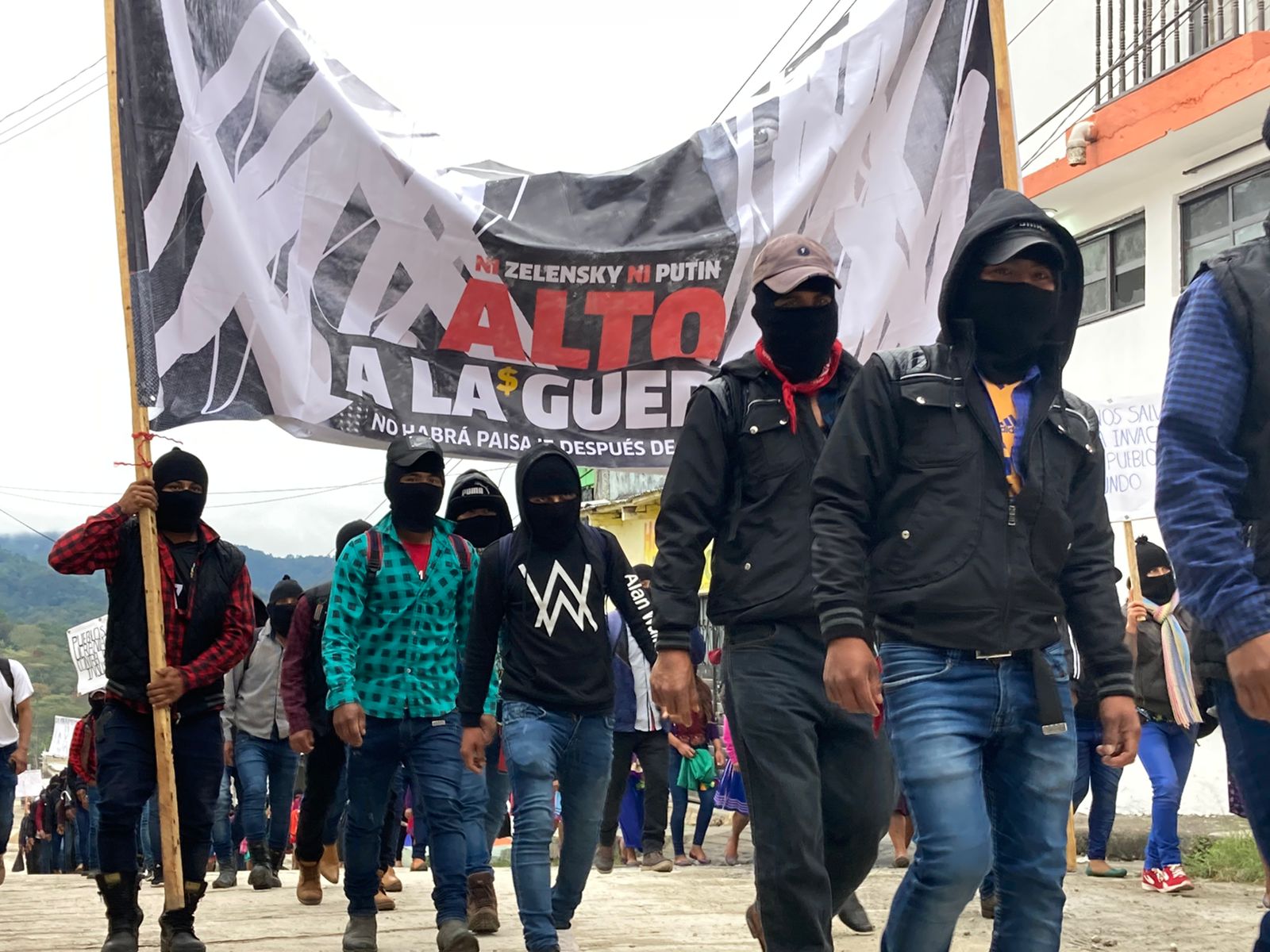
Thousands of members of the Zapatista National Liberation Army (EZLN, Ejército Zapatista de Liberación Nacional) demonstrated in six Chiapas cities, to protest against wars, and to show their solidarity with the people of Ukraine, who currently resist a Russian invasion.
This is the first massive appearance that the EZLN has made since 2012, when they appeared in different cities in silent marches, within the framework of the change of era according to the Maya calendar.
The demonstrations of thousands of masked people took place simultaneously in San Cristóbal de Las Casas, Ocosingo, Yajalón, Palenque, Las Margaritas and Altamirano municipalities, all located in regions where indigenous people of different Maya ethnicities are the majority.
It’s estimated that 20,000 members of the rebel group participated in the different municipalities, men and women who met the day before in their different meeting centers, from which they left to initiate the demonstrations in synchrony.
“Stop the wars of capitalism that murder and conquer the people of Ukraine for economic, political and ideological interests,” “Wake Up peoples of Mexico and the world because one day sooner or later they are also going to wage unjust wars against us, we must organize,” “Peoples of Mexico and the world, we Zapatista women, we say that your pain is our pain, so we make a call to organize our peoples as women, to organize each one in her geography and her calendar, to stop unjust wars, because we are the most affected because of being a woman and because of being mothers,” were some of the messages they carried.
Watch an awesome video of the Zapatista march in Altamirano where residents join in the march here.
IN ALTAMIRANO, thousands of non-Zapatista residents join the demonstration
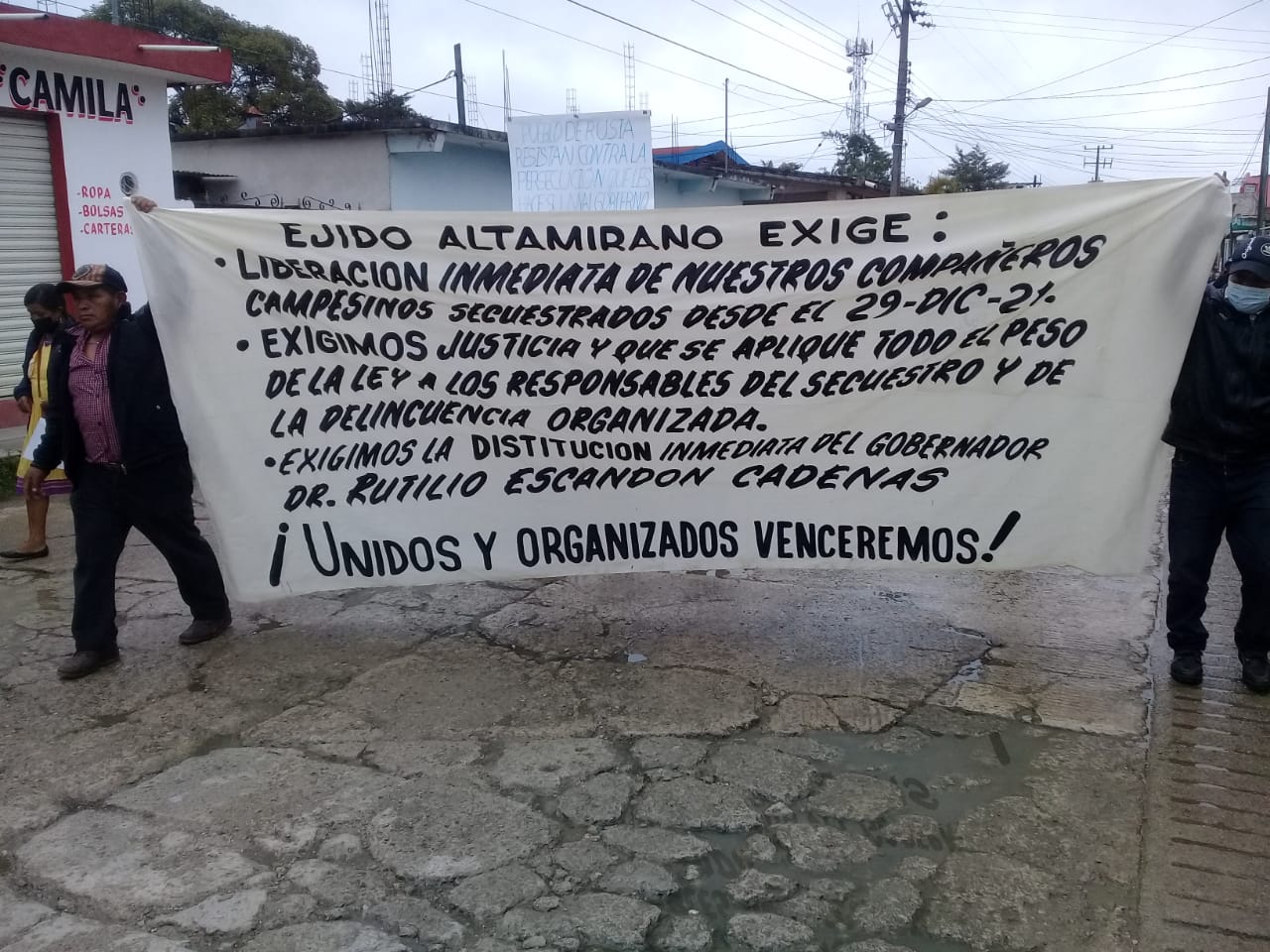
The day before the demonstration, in the municipality of Altamirano, located in the Tseltal and Tojolabal zone, the Zapatistas invited the local population to join the march. Thousands of them responded and added their demands related to the release of the 37 campesinos kidnapped since last December. [1]
Just last October, inhabitants of this municipality expelled Mayor Gabriela Roque Tipacamú, wife of Roberto Pinto Kanter, who previously and for two terms of office, had been municipal president, in a family political chiefdom (cacicazgo) in which cousins and relatives participated in order to control the municipal presence for twelve years. [2]
As a result of the expulsion of the Kanter family and the consolidation of an independent [municipal] government council, members of the Alliance of Social Organizations and Left Unions (ASSI, Alianza de Organizaciones Sociales y Sindicatos de Izquierda) -who residents accuse of being an armed group and a shock group that economically benefitted from the Kanter family governments-, kidnapped more than 50 residents, 37 of whom have been kidnapped since last December 29.
The residents of Altamirano marched together with the Zapatistas. They carried a banner on which they demanded thew release of the kidnapped campesinos, and the application of the law “to those responsible for the kidnapping and organized crime.”
They pointed out that the motive for the expulsion of the former mayors and the Kanter family, was also because during their time in office organized crime groups installed themselves in the municipality; in that period of time they carried out kidnappings, murders and set up drug sales and distribution businesses, which affected the area’s population.
Different from the other municipalities, the participation of Altamirano residents made the march called by the EZLN singular, because this is the first time that non-Zapatistas have joined in their marches.
In Altamirano, the EZLN has a seat called the Caracol of Morelia, “Whirlwind of our words,” and militants of this organization live in communities affected by the region’s general problem.
In this municipality, according to the people who demonstrated today, the independent government council has closed at least 200 cantinas and drug distribution centers in the municipal seat alone.
[1] Many articles written about the kidnappings in Altamirano use different numbers when referring to those who have been kidnapped. This may be because local residents give different numbers to reporters. In this case, the number of people kidnapped on December 29, 2021 is well-established at 27, not 37. For background info on the December 29 kidnappings, see: https://chiapas-support.org/2022/02/02/violence-returns-to-altamirano-27-kidnapped/
[2] For background on the removal of Kanter’s wife from the municipal presidency, see: https://chiapas-support.org/2021/11/08/a-tseltal-woman-is-the-new-mayor-of-altamirano-chiapas/
==Ω==
Originally Published in Spanish by Chiapas Paralelo, Sunday, March 13, 2022, https://www.chiapasparalelo.com/noticias/chiapas/2022/03/ezln-marcha-contra-guerra-en-ucrania-pobladores-de-altamirano-se-sumaron-y-anadieron-sus-demandas/ and Re-published with English interpretation by the Chiapas Support Committee
The Zapatistas and the invasion of Ukraine

By: Raúl Zibechi
The EZLN’s March 2 communiqué “There will be no scenery after the battle,” fixes the Zapatista position in the face of the Russian invasion of Ukraine, in a concise and forceful way, supported in the political ethic that characterizes the movement.
Unlike a good part of the Latin American left (parties, governments and intellectuals), the EZLN condemns the invasion, rejects Putin, big capital on “both sides” and places itself on the side of the peoples of Russia and Ukraine who resist the system. What’s most important about the first point in the communiqué is that it doesn’t take sides with any State, something that is customary in Zapatismo, but always with those from below.
Then it rejects Putin’s argument about “de-nazifying” Ukraine. On this point it contrasts with those who believe that Nazism can be eradicated from above, at the point of a gun, accepting the argument that the invasion has that objective when it’s no more than an imperialist act.
In our region there are many who support Russia quietly, with two arguments that they don’t dare to debate: they believe that there is a certain parallelism between today’s Russia and what used to be the Soviet Union and, on the other hand, they hold the strange idea of supporting everything that is opposed to US imperialism.
As some analysts have reflected, an unexpressed sympathy for Russia and in particular for Putin survives in Latin America. Years ago, one of them compared the Russian president’s speech in October 2014, with that of Lenin at the Finland station in April 1917, upon returning from exile (https://bit.ly/3CG2X0R).
Similar comparisons show the smallness of the aforementioned intellectuals who support progressivism. They simplify reality, insinuate continuities between two leaders and cloud the vision of part of the organizations from below by supporting, outside all ethical considerations, that everything that goes against the enemy must be supported.
The fourth and fifth points of the communiqué summarize the political option of Zapatismo. They don’t follow the big media or the “experts” to define politics, but rather they choose the path of “asking those, like us, who are engaged in the struggle for life in Ukraine and Russia.” It defines them as “relatives in resistance and rebellion,” which tells us that they feel like brothers and sisters to those who fight in any geography.
They support and encourage those who reject war, people who repudiate borders and national states and stand firm in their convictions. “Resisting is persisting and prevailing,” concludes the fifth point. Consequently, it makes a call to support those in Ukraine who resist the Russian invasion.
This point has raised criticisms in various geographies. Not a few insist that supporting the resistance, is the same as encouraging the Nazis, since the money that arrives could be diverted to the bad government of Zelensky or to the fascist squads that operate in Ukraine.
This way of analyzing the world, has profound repercussions on anti-systemic movements. In some way, it’s heir to the idea that there is a main enemy, against which any alliance is useful to bring it down. However, that is the same way that states and governments act, which don’t act based on ethics, but rather based on conveniences and interests.
The most serious thing is that it sets aside the human beings of flesh and bone who resist, below and to the left, any oppression, from wherever it may come. They will say that those who resist in Ukraine and in Russia are a minority and that they play the game of the right, as the defenders of progressivism usually say.
For one thing, dignity and ethics are not measured in numbers. These days, news is starting to appear about collectives and people who resist in Ukrainian cities and that the big media don’t reflect (https://bit.ly/35Ywwye). It’s those people and those collectives that we must support, without counting, without thinking about how many there are, because what guides us is not whether they appear on television news, but only and simply the ethics.
Regarding the argument of “playing the game of the right,” is about the most vulgar and abject idea of the many and perverse ones that circulate in the world. It means, neither more nor less, that all human action must adhere to calculations of expected profits andpossible losses. Is this not, perhaps, a profoundly capitalist way of looking at life?
To the contrary, the policy of defending life and supporting those who defend it, setting aside any calculation of interests; being guided by ethics, and nothing more than that, challenges the system because it doesn’t enter the profit/loss game, which is one of the principal tentacles of the capitalist hydra.
A politics guided by ethics can condemn us to loneliness. But if we trust in the nobility of the common people, we will achieve the energy and courage necessary to continue sailing against the current.
==Ω==
Originally Published in Spanish by La Jornada, Friday, March 11, 2022, and Re-published with English interpretation by the Chiapas Support Committee
Mexico: Cartography of hope and resistances
Marichuy in the Caracol of La Garrucha
By: Raúl Romero / II
In Mexico: Cartography of War (https://wordpress.com/post/chiapas-support.org/12897), we mapped out some urgent problems in our country. There were two points of departure: 1) The energy, extractive and infrastructure megaprojects that are being built in the national territory, and 2) The many incidents of violence that have been unleashed by the expansion of criminal economies. These phenomena have spanned different six-year terms, as well as the emergence of organizations that are resisting war and dispossession. Moved by different causes, these organizations are building pockets of resistance and sometimes even zones free from dispossession and organized crime, and although they are not exempt from harassment and persecution by the real and formal powers, they continue to build bridges and construct a cartography of hope.
Networks of solidarity with migrants extend throughout the nation. In Tenosique, Tabasco, there is La 72, a home-shelter for migrants promoted by the Franciscan Province of San Felipe de Jesús. It is named in memory of the 72 migrants murdered in 2010 in Tamaulipas, so La 72, in feminine form, is also a refuge-altar. In Veracruz there are Las Patronas, a group of women who for 27 years have organized themselves to prepare food and give it to migrants. The work they do is truly amazing, delivering up to 300 lunches a day. In Mexico City, you can find spaces such as Casa Tochán, or La Resistencia Café or the solidarity of the neighbors of the Santo Domingo neighborhood in Coyoacán. We must mention the work of the Jesuit Migrant Service, or La Pequeña Haití, a neighborhood of people of Haitian origin that was built in Tijuana. The work carried out by the Regional Network of Migrant Families, the Caravan of Migrant Mothers and the Mesoamerican Migrant Movement is worthy of note.
Facing the lack of efficient responses from the Mexican State to attend to the missing person problem, families have launched the search for their loved ones, with the most basic of resources. There are the Relatives in Search María Herrera; the Searching Mothers of Sonora; the Trackers of El Fuerte, en Sinaloa; the Voice of the Disappeared of Puebla, the Until We Find You Collective, in Guanajuato; the Families of Ayotzinapa, in Guerrero; the women of United Forces for Our Disappeared, in Nuevo León, Jalisco, Coahuila and in other states; the Solecito Collective, in Veracruz and a hundred more organizations that along with the other resistances are endowing this wounded society with dignity and hope.
The increase and brutality of patriarchal violence has also given rise to the strengthening and weaving of solidarity and resistance efforts among women. They are all over the country, accompanying, reflecting and building alternatives. Some examples are the Red de Feminismos Descoloniales (De-colonial Feminisms Network), which reflects, acts and networks with other organizations. There are also Las Siemprevivas, a women’s collective that accompanies cases of violence, disappearances and femicides. In some cases, they form cooperatives, such as the Vendaval bread cooperative or spaces such as the Volcana/ common space, bookstore and social center.
It is the indigenous peoples who maintain the most robust organizations. The Zapatista Chiapas, with its 43 autonomous entities (Caracoles, municipalities and Centers of Resistance and Rebellion), is one of the most advanced experiences of autonomy in the world. With the recovery of land that they have carried out throughout their existence, they have managed to create schools, hospitals, cooperatives, housing, communications media, and a long etcetera. The Tepehuana and Wixárika communities of San Lorenzo de Azqueltán, in Jalisco, also stand out, as they have defended their territory and created an autonomous clinic. The Nahua people of Santa María Ostula, in Michoacán, are also part of this creative resistance with the recovery of their territories and the strengthening of their community guard. There is also the town of Amilcingo which is resisting the Morelos Integral Project and which sustains the Samir Flores Soberanes elementary school and Radio Amiltzinko 100.7 FM.
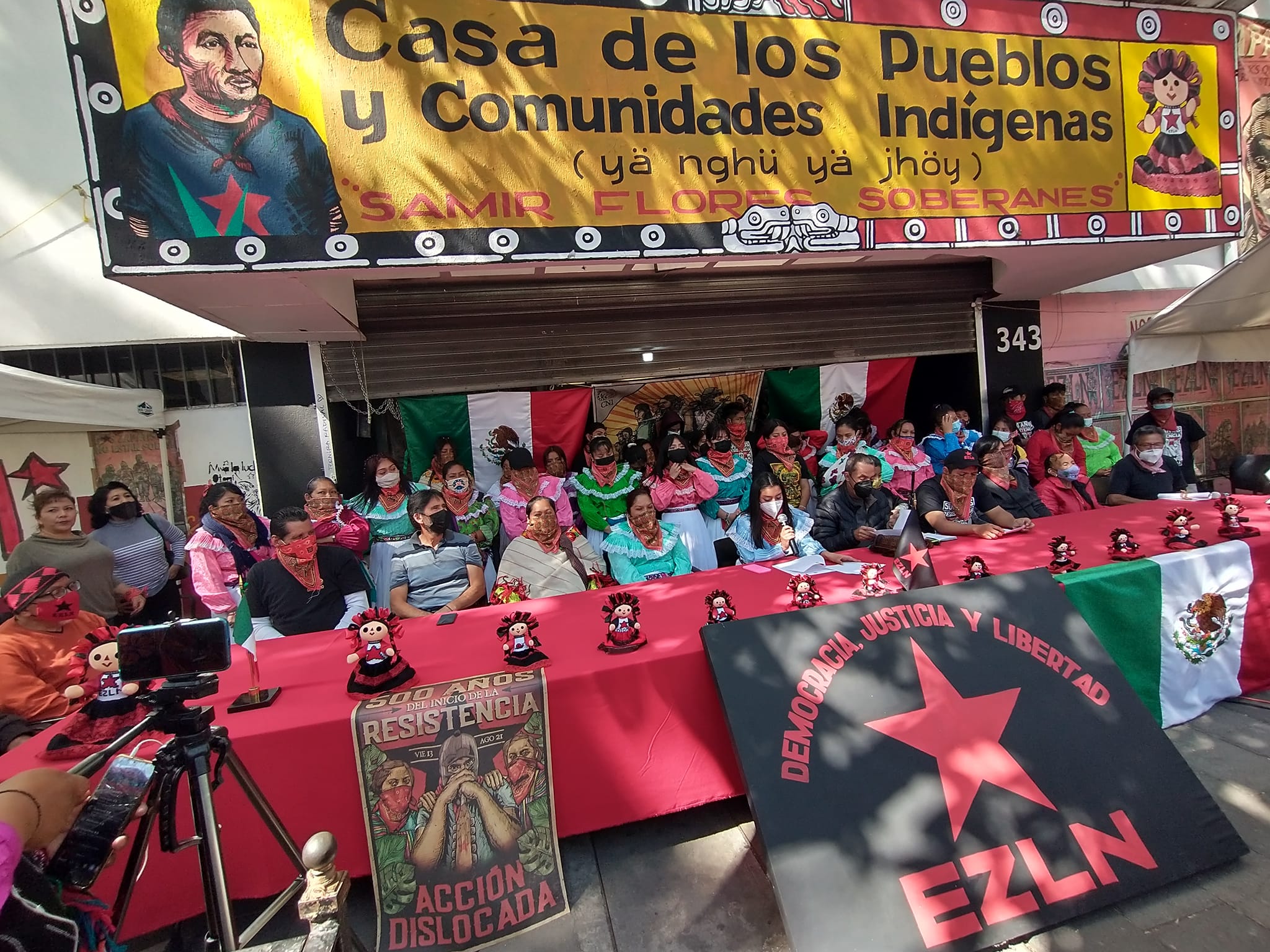
Above: Otomies occupied the INPI’s installations in Mexico City and it became the House of the Indigenous Peoples and Communities.
Many other experiences are yet to be mapped in this cartography, such as the efforts of cooperatives like La Imposible, La Carabina 30-30, La Ordeña, CACAO, or the collective housing work of the Organización Popular Francisco Villa de Izquierda Independiente (Francisco Villa Popular Organization of the Independent Left), of Tlanezi and Xochitlanezi, of the People’s Organized Resistance Front, of the Otomí Community in Mexico City, or the interesting initiative of Casa Temilco, in Amatlán, Morelos, or the work of the Street Brigade in Support of the Woman “Elisa Martínez.” What is important to highlight is that in the face of war and dispossession, which the system of domination and exploitation deploys in our country, there are a multitude of resistances. They are the territories where fundamental battles are being fought. As the vocal Zapatista Subcomandante Moisés says: resistance is becoming strong, tough, to responding to everything, every one of the attacks of the enemy, of the system, you see. That is creative resistance.
Twitter: @RaulRomero_mx
==Ω==
Originally Published in Spanish by La Jornada, February 27, 2022: https://www.jornada.com.mx/2022/02/27/opinion/014a1pol
English Translation: Schools for Chiapas
Re-Published by the Chiapas Support Committee
 Chiapas Support Committee