Chiapas Support Committee
Home of the Compañero Manuel blog on zapatistas & mexico
IACHR finalizes visit to Aldama and Chalchihuitán

By: Chiapas Paralelo
* “We thank the solidarity of the Inter-American Commission for this visit and we hope that your visit will work and will produce a real solution to the conflict and to living in peace,” the Aldama representative said.
* The Frayba has recorded seven murders in Aldama and one more in Chalchihuitán, another 10 people who passed away due to sickness and the conditions that derive from forced displacement (mostly elderly people, girls and boys). In addition, in both municipalities there are 5005 people who are in intermittent and/or permanent forced displacement.
The Inter-American Commission on Human Rights (IACHR) represented by the Commissioner and Rapporteur for Mexico, Esmeralda Elizabeth Arosemena Bernal de Troitiño, and Tania Reneaum Panszi, Executive Secretary, as well as personnel in charge of the precautionary measures, finalized their visit to Chiapas territory for the purpose of analyzing the Mexican State’s compliance with said resolutions.
Given that, representatives of the 22 Tsotsil communities of Aldama, Chalchihuitán and Chenalhó, together with personnel fr4om the Fray Bartolomé de las Casas Human Rights Center offered a press conference.
Silvia Santiz, representing the municipality of Aldama, recalled the implementation of precautionary measures 35/2021 by the IACHR in favor of 12 communities on April 23, 2021. In these measures, the Mexican State was required to adopt the measures necessary to protect and safeguard the life and physical integrity of the beneficiaries. However, she considered that there have been no conclusive advances in that regard.
Because of that, the population laid out its demands on the following eight points: (1) the immediate release of our compañero Cristóbal Santiz “a political prisoner,” (2) investigation, disarming, arrest and punishment of the aggressor group; investigative notebooks, (3) humanitarian aid, (4) a mixed operations base, (5) repair of the road from Cotzilnam to Xuxch’en and from Yeton to Cotzilnam, (6) hospital equipment for the wounded, injured and the general population. Ambulance. Medical attention for wounded and injured, physical and psychological rehabilitation, (7) shelter for displaced persons in the 12 communities, a new primary school for Tabac. New municipal agency for Tabac and Coco’. (8) communication radios and satellite telephones.
Those points were delivered and exposed to the three levels of government, but, Santiz mentioned that there has been no compliance, except for point 4.
The communities of Aldama, at the IACHR’s July 12 visit, expressed the situation in which they have lived for five years.
The risk that we have to life from armed aggression (…) They took a tour of our communities, visited the communities of Tabak and Coco, visited damaged houses, municipal agencies, schools, heard testimonies from children, women and elderly women regarding the situation of violence that exists, saw and heard from the voice of the people the violence, said Santiz.
In addition, during the delegation’s visit, the delegation met privately in the community of San Pedro Cotzilnam with victims of displacement, permanent, intermittently displaced, relatives of those murdered, wounded, women, girls and family members of political prisoner Cristóbal Santiz.
This visit is important, because the government has ignored and has simulated the situations in which we are living, because of which the IACHR became aware of these situations and the non-compliance with the precautionary measures, the representative concluded.
Simulation of the mechanism
For its part, the Fray Bartolomé de las Casas Human Rights Center considered that a simulation exists on the part of the Mexican State of the execution of the mechanism, thus maintaining the grace and urgent situation.
For Frayba, the IACHR representation verified the lack of investigation, disarming and punishment of armed groups that prevails in Chiapas, as well as the absence of effective measures to put an end to the aggressions with firearms, violence, and insecurity that the beneficiary communities are experiencing, keeping these acts in impunity and far from clarifying the truth and justice.
The root of the problem remains unaddressed, thereby violating the right to non-discrimination of indigenous peoples. The “humanitarian aid” offered by the Mexican State is insufficient and does not address the underlying issues faced by the displaced population, said Jorge Gómez, a lawyer for the Center.
Lastly, the Human Rights Center called on the Mexican State to comply with its international obligation to protect human rights and prevent human rights violations from continuing to be committed in the communities of Aldama and Chalchihuitán. Therefore, it’s necessary to set aside the attitude of simulation towards compliance with the precautionary measures granted by the IACHR.
==Ω==
Originally Published in Spanish by Chiapas Paralelo, Thursday, July 21, 2022, https://www.chiapasparalelo.com/noticias/chiapas/2022/07/cidh-finaliza-visita-a-aldama-y-chalchihuitan/ and Re-Published with English interpretation by the Chiapas Support Committee
Take Action: Pressure the Mexican government stop the paramilitary violence against Zapatista & Indigenous communities in Chiapas

Statement of Solidarity with the BAEZLN, FrayBa, and BriCOs
Turtle Island – United States of America
July 2022
To the Mexican General Consulates in the United States,
We, the everyday people from below, the children, mothers, and elders, Native and Indigenous, Afro-descendents, working and living in the U.S., as internally displaced, as migrants, as third generation Mexicans and as peoples of the global south, communities of color, the persecuted, the criminalized, the defenders of Mother Earth and humanity raise our voice through this letter to say Ya Basta! Enough Is Enough! Stop the Paramilitary Aggressions Against and the Criminalization of the Familias Bases de Apoyo del Ejército Zapatista de Liberación Nacional (BAEZLN). We are all witness to your government’s silence and negligence as a wave of repression mounts against those who resist the destruction of their ancestral territories. This inaction amounts to a campaign of complicity in the ongoing violation of human rights–not only in Chiapas, but across the many geographies that comprise Mexico. The Whole World is Watching.
To the families of the Bases of Support of the Zapatista Army of National Liberation (BAEZLN),
We want to express our respect and admiration for your resistance and rebellion against the intensification of low-intensity warfare and the counterinsurgency being waged against your communities across your geography.
To our compañeros/as/oas of the Centro de Derechos Humanos Fray Bartolomé de las Casas and the Brigadas Civiles de Observación (BriCos),
You are not alone, No Están Solxs! Your dignified work in documenting the ongoing aggressions against the BAEZLN communities waged by organized crime, militarization, megaprojects, and the criminalization of social movements is imperative in the struggle for peace and justice.
These combined efforts demonstrate a collective resilience that encourages us not to get tired, not to give up, and not to sell out. We reaffirm our commitment to the Zapatista struggle; the collectives and individuals of Turtle Island want to add our voices in vehemently denouncing the threats and intimidations against the Zapatista communities.
This past week, as the IACHR Inter-American Commission on Human Rights was in Chiapas, Mexico touring the Tzotzil communities of Aldama to evaluate the enforcement of precautionary measures in favor of Tzotzil communities, the attacks against Zapatista communities across the state of Chiapas continued.
Unfortunately, compañerxs, these violations against the communities continue to pile up and day after day, we find ourselves not denouncing one aggression, but rather adding to a litany of aggressions perpetrated against the autonomous BAEZLN (Zapatista Bases of Support) families whose struggle for life and dignity is threatened daily and with total impunity.
Therefore, today, and last week, and on into the future we join our comrades in Slumil K’Ajkemk’Op–Europe from below–in denouncing the threats against national and international observers of the Civil Observation Brigades (BriCO), the obstruction of the human rights defense work of the Frayba Human Rights Center by armed groups in the region, and the constant violence and acts of aggression, which go uninvestigated and unpunished under the federal and state administrations of Lopez Obrador and Rutilio Escandón, respectively.
As of the beginning of this month, the attacks continue on the population of Zapatista indigenous communities of Nuevo Poblado San Gregorio (Nuevo San Gregorio), a territory recuperated and collectively cared for since 1994 by the Zapatista Army of National Liberation (EZLN). In response to the grave violations of human rights (fencing off water sources, starving cattle, demolishing the collective fish farm), Frayba set up camps of Civil Observation Brigades to document the dangerous conditions in which the Zapatistas survive day by day.
A recent communication from Frayba affirms that to the last day, the presence of the observers WAS AN EFFECTIVE DETERRENT for physical aggressions against the community. However, due to consistent death threats, and in the face of increasing challenges to safely accessing the community, Frayba made the decision to pull the BriCo observers from the encampment.
In addition to this, just this past Thursday, July 14th, in another part of Chiapas, members of the Muculum Bachajón ejido, accompanied by Chilón municipal police and Civil Protection agents, burned the houses and displaced six Zapatista families from their homes in the community of “El Esfuerzo” in the Comandanta Ramona Autonomous Municipality.
The intentional abandonment and complicity of the Mexican State in allowing these conflicts to escalate in recent years endangers the life, integrity, and security of the Indigenous Zapatista communities like Nuevo Poblado San Gregorio (Nuevo San Gregorio), La Resistencia, Emiliano Zapata, the region of Moisés Gandhi, and now “El Esfuerzo.” While the actors and circumstances of each region are distinct, the factors that allow for this violence and territorial dispossession in all cases have several common threads.
In response to the urgent call to action by the Frayba Human Rights Center we demand that the Mexican State respect the defense of human rights in accordance with the international agreements it has signed and ratified!
We condemn the complicity of all levels of government in these ongoing agressions and demand thorough investigations into, and punishment of the perpetrators of these crimes and human rights violations!
We demand the immediate end to the aggressions against the peace and autonomy of the community of Nuevo San Gregorio, the armed attacks against the region of Moisés Gandhi, and the communities of La Resistencia and Emiliano Zapata and El Esfuerzo!
We demand the safeguarding of life and integrity for those who exercise their right to self-determination and autonomy within the framework of the San Andres Accords, ILO Convention 169, and the UN and OAS Declarations on the Rights of Indigenous Peoples.
We call on our compañeros/as/oas of the national and international community in solidarity with the Zapatistas to demonstrate for life and against death threats and aggressions by armed groups!
Signed:
Sexta Grietas Del Norte
Raíces Sin Fronteras
Chiapas Support Committee, Oakland
Schools for Chiapas
TAKE ACTION: Print this document and hand deliver to the closest Mexican consulate in your area.
Tell the Mexican government to stop the paramilitary attacks and violence | Prosecute and dismantle the paramilitaries!
We ask that you find your nearest Mexican Consulate in the U.S. here to hand deliver this statement. Submit it electronically to the President of Mexico, members of his Administration, the Government of the state of Chiapas and also with responsible human rights organizations and national commissions:
– Lic. Andrés Manuel López Obrador. Presidente Constitucional de México. Palacio Nacional-Plaza de la Constitución s/n. – 2° Piso. Col. Centro. Delegación Cuauhtémoc. Cd. de México CP: 06066. Fax. (+52) 55 5093-4800, 55 5093-5300 Exts. 4103/4882.800-080-1127 Atención Ciudadana. Correo: amlo@presidencia.gob.mx y gobmx@funcionpublica.gob.mx Twitter: @lopezobrador_
– Lic. Adan Augusto López Hernández. Secretario de Gobernación de México.Bucareli 99, Edificio Cobian. 1er. piso. Col. Juárez. Delegación Cuauhtémoc. Ciudad de México. C.P.06600. Fax: (+52) 55 5093 34 14. Correo: secretario@segob.gob.mx
– Lic. Alejandro de Jesús Encinas Rodríguez. Subsecretaría de Derechos Humanos, Población y Migración. Bucareli 99, Edificio Cobian. 1er. piso. Col. Juárez. Delegación Cuauhtémoc. C.P. 06600. Ciudad de México. Fax: (+52) 55 5128-0000 Ext. 33077 Correo: ajencinas@segob.gob.mx y projasm@segob.gob.mx Twitter: @A_Encinas_R
– Lic. Rutilio Escandón Cadenas. Gobernador Constitucional del Estado de Chiapas. Palacio de Gobierno del Estado de Chiapas, 1er Piso Av. Central y Primera Oriente, Colonia Centro, C.P.29009. Tuxtla Gutiérrez, Chiapas, México. Fax: +52 961 61 88088, + 52 961 6188056; Extensión 21120. 21122. Correo: secparticular@chiapas.gob.mx Twitter: @RutilioEscandon
– Lic. Victoria Cecilia Flores Pérez. Secretaria General de Gobierno en Chiapas. Palacio De Gobierno, 2o. Piso, Centro C.P. 29000 Tuxtla Gutiérrez, Chiapas. Conmutador: (961) 61 8 7460 Ext. 20003. Correo: secretariaparticular.sgg@gmail.com
– Dr. Alejandro Gertz Manero. Fiscal General de la República. Av. Insurgentes 20 de la Glorieta de Insurgentes, Col. Roma Norte, Cuauhtémoc, C.P. 06700, Ciudad de México. Correo: atencionfgr@fgr.org.mx
– Dr. Olaf Gómez Hernández. Fiscal General del estado de Chiapas. Libramiento Norte y Rosa del Oriente número 2010 colonia El Bosque, Tuxtla Gutiérrez, Chiapas, C.P. 29049, Tel (961) 61-72-300, Ext. 17258. Twiter: @FGEChiapas Correo: staff_secretarial@fge.chiapas.gob.mx
Human Rights Commissions
– Lic. Rosario Piedra Ibarra. Presidente de la Comisión Nacional de Derechos Humanos. Edificio “Héctor Fix Zamudio”, Blvd. Adolfo López Mateos 1922, 6°piso. Col. Tlacopac San Ángel.Delegación Álvaro Obregón. Ciudad de México. C.P. 01040. Fax: (+52) 0155 36 68 07 67. Correo: correo@cndh.org.mx Twitter: @CNDH.
– Lic. Juan José Zepeda Bermúdez. Presidente de la Comisión Estatal de Derechos Humanos. Avenida 1 Sur Oriente S/N, Edificio Plaza, 3er y 4to piso, Barrio San Roque C.P. 29000 TuxtlaGutiérrez,Chiapas. Conmutador: (961) 602 89 80; 961-60289-81 Ext. 206; Lada sin costo 01800-55-282-42 Fax: (961) 60 2 57 84. Correo: presidencia@cedh-chiapas.org
HASH TAGS
#PazEnNuevoSanGregorio
#AlertaZapatista
#TodxsConLxsZapatistas
#NosotrxsConLxsZapatistas
Wetlands invaders in Chiapas threaten officials

By: Elio Henríquez, Correspondent
San Cristóbal de Las Casas, Chiapas
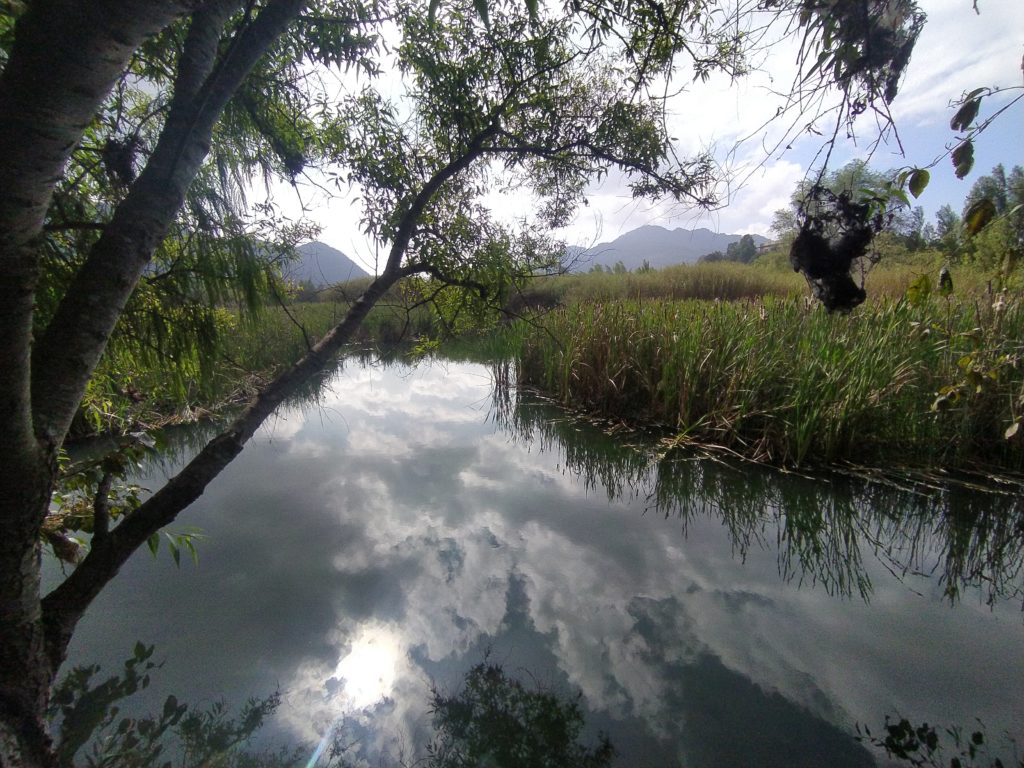
Individuals who have been filling in the San Cristóbal wetlands for several months attempted to retain and intimidate officials from the environmental sector of the three levels of government who were making an inspection because of complaints about “illegal acts,” reported Nicolás Gómez Velasco, a representative of the southern zone council, made up of different agencies and 14 districts (colonias).
In an interview, he commented that on Saturday, in the mountain wetlands of María Eugenia, a commission of around 10 officials from the Secretariat of Environment and Natural Resources (Semarnat), its state agency, the Federal Prosecutor for Protection of the Environment, the Environmental prosecutor for Chiapas and from directors of municipal ecology made an inspection for the purpose of presenting a complaint.
However, “as we were leaving the property, a truck arrived without license plates and the three occupants confronted the employees because they were told that they cannot build or fill in the wetlands. They arrived aggressively and crossed the unit, but to avoid being retained, the officials backed up about 100 meters, because they were blocking our way,” the environmentalist said.
“At the exit towards Comitán, about 500 meters from the property where the incident happened, between the Duraznal and Bienestar Social districts, both irregular, suspected gang members got together on motorcycles to intimidate us,” he added.
They denounce the collusion of municipal authorities
Separately, the Semarnat explained that the officials who went “to the illegal filling of wetlands and introduction of electric energy were intercepted by individuals on motorcycles and in an auto without license plates.”
The agency rejected “these types of violent acts” and called for order to prevail, especially to guarantee the integrity of federal, state and municipal officials, as well as residents.”
Gómez Velasco maintained that: “the municipal authorities are colluding with the violent groups that control the mountain wetlands territory of María Eugenia. They took advantage of the construction of a bicycle path to put light and drainage in a protected area.

Originally Published in Spanish by La Jornada, Monday, July 25, 2022, https://www.jornada.com.mx/2022/07/25/estados/029n2est and Re-Published by the Chiapas Support Committee
Coffee, the woodsman and the bear

By: Luis Hernández Navarro
Small coffee growers are upset and disappointed with the federal government. They reproach the federal government for unduly granting privileges to the transnational Nestlé. They are also angry that the government has refused to dialogue and agree with them on fundamental issues of the industry.
According to the Veracruz Commission of Price Monitoring for Coffee, made up of the five most important coffee associations in the state, the government’s alliances with the company opened the way for the placement of officials in Sader (Secretary of Agriculture and Rural Development) and the Secretary of Economy to promote and protect the interests of this and other consortiums.
Nestlé is the company most exploitative of small coffee producers in the world and gives the consumer inferior soluble coffee, with colors and flavorings, wrote Arturo García, the leader of small coffee growers and advisor to ejido commissaries in Guerrero in an open letter to President Manuel López Obrador.
The President dismissed the remarks made by the coffee growers. At the inauguration ceremony of the transnational’s new plant in Santa Rita, Veracruz, which began a year and a half late, he said: there are always complaints about milk and coffee, but they have not abandoned Mexico and Mexico will not stop supporting Nestlé.
Ten multinationals dominate food consumption in the world. Nestlé is the largest of them. In 2021, it employed 276,000 people. In its early days, it was established in Mexico as an importing company in 1930. Five years later, it built its first plant in Ocotlán, Jalisco. Nescafé, the world’s leading coffee brand, ranked third among the top 100 megabrands and topped the hot beverage brand category. It is sold in 190 countries.
Although it is well below other nations, the consumption of the aromatic beverage in Mexico has grown significantly during the last few years. It currently ranks 56th, with around 1.6 kilos per person per year, compared to 11.6 kilos in Finland. Sixty percent of the cups drunk are soluble coffee. Nestlé is by far its leading manufacturer. The confinement forced by the pandemic caused the trend in whole coffee bean consumption to slow down. Quality was sacrificed for convenience and speed in the preparation of the beverage.
Soluble coffee is made with lower quality varieties, mainly robusta, and other ingredients, including sugar and artificial flavorings. Its manufacturers do not hesitate to use defective, old, fermented, green, over-ripe or over-dried beans.
Robusta is a poor quality, low-priced variety (now $100 for 100 pounds), a mediocre bean. Three characteristics must be considered to appreciate a good coffee: body, acidity and aroma. Although Robusta beans have body, they lack acidity and a refined aroma.
Its production was almost nonexistent in the XIX century. It increased, above all, in the former French colonies, under the demand for lower prices and the expansion of instant coffee consumption. Roasters took it upon themselves to incorporate it into current blends, in new cheap brands, in order to lower prices at the expense of its quality. It was thus proven that, as an attendee to the National Coffee Convention in 1959 said, there is almost nothing that man cannot make a little worse and sell a little cheaper.
The cultivation of robusta has an advantage: its trees take two years from the time they are planted until they are harvested and produce more. In addition, it is planted at lower altitudes. On the other hand, Arabica coffee trees take four years to bear fruit.
Various people claim for themselves the title of inventors of instant coffee. However, a Belgian living in Guatemala, by the name of George Washington, was the first to conceive the idea of refining coffee crystals from the elaborated aromatic coffee. In 1910 he began to commercialize his G. Washington Refined Coffee. The First World War boosted the consumption of soluble coffees. The industry grew after the second global conflagration. However, it was in 1950, as a result of the soaring price of roasted coffee beans, when the demand for coffee powder increased. Although its production requires a large original investment, its elaboration costs less than a normal one.
Mexico is a country where high quality Arabica coffees are grown, many of them shade grown (preserving the environment and wild birds) and organic. It produces 4.5 million bags. Despite crises and adversities, those who plant, care for, harvest and process them are mostly poor farmers, many of them indigenous. It is an absurdity to replace their production with Robusta varieties destined to supply the manufacture of soluble beverages.
Jorge Castro, an old peasant leader from southern Sonora, used to tell the governors in office the fable of the woodsman and the bear.
A woodsman working in the forest,” he would say, “is suddenly attacked by a bear. He looks to the sides for help. He has no success. He is alone; there is no one to help him. Then he looks up to heaven and cries out: ‘Dear God, if you are not going to help me, at least don’t take the bear’s side.’”
A little more than 40 years ago, small coffee growers, organized into self-managed cooperatives, embarked on the adventure of building a fair market, commercializing beans grown without blood and without toxins, appreciated by consumers all over the world. With all due respect, like the woodsman in the story, if God is not going to support these farmers, one would hope that, at least, he would not be on the side of the bear.
==Ω==
Originally published in Spanish by La Jornada, Tuesday, July 19, 2022, https://www.jornada.com.mx/2022/07/19/opinion/014a2pol Translated by Schools for Chiapas and Republished by the Chiapas Support Committee
At least 850 families displaced by narco-violence in La Trinitaria and Frontera Comalapa

From the editors
At least 850 families from the municipalities of La Trinitaria and Frontera Comalapa, Chiapas, have abandoned their homes because of the dispute between organized crime groups [1] for territory, authorities of the affected communities reported, who requested the installation of a permanent military post and patrols.
At the same time, three agents from the National Institute of Migration (INM, its initials in Spanish) were retained by residents Monday on the highway stretch located between La Trinitaria and Comitán to demand the presence of police forces to combat insecurity and the trafficking of migrants, official sources reported.
They said that the agents were retained at 11:30 am and taken to a community, whose name was not specified, without being attacked.
In a declaration distributed this Tuesday, more than 20 localities reported that: “due to the insecurity in the ejidos Unión Lagartero, Nueva Libertad (El Colorado), and the Perla de Grijalva ejido, in La Trinitaria and the Selegua declaration, the ejidos Tamaulipas, Sinaloa and Los Laureles, in Frontera Comalapa, more than 850 families, each family made up of at least five people [that’s 4,250 people!], had to abandon their homes.”
That’s why they asked the Mexican Army to patrol day and night, since residents water their crops at all hours.
Likewise, they requested protection from soldiers for workers and farmers in the zone and for the La Frontera Dam, module 01, as well as for the users of irrigation district number 107 El Lagartero, and module 02.
Residents organize to defend themselves
The Bishop of the Diocese of San Cristóbal, Rodrigo Aguilar Martínez, affirmed that given the dispossession of property by organized crime groups, communities of La Trinitaria and Frontera Comalapa, where there were confrontations over the weekend, “they have started to organize to defend their homes and the territory.”
Meanwhile, concessionaires on different routes suspended public transport service between Comitán and Comalapa, because its residents demand, with a blockage on a stretch of the Pan-American Highway, the presence of soldiers and the installation of a permanent base for the Army and National Guard.
[1] See Article below regarding those arrested and for which national cartels they work.
==Ω==
Originally Published in Spanish by La Jornada, Wednesday, July 20, 2022, https://www.jornada.com.mx/2022/07/20/estados/027n4est and Re-Published with English interpretation by the Chiapas Support Committee
IN CHIAPAS, the 3 ARRESTED IN POSSESSION of ARSENAL FACE TRIAL
By: Gustavo Castillo
The Specialized Regional Control Prosecutor’s Office obtained from a control judge based in Chiapas an indictment against three alleged members of a criminal group for their probable responsibility in the crime of carrying a firearm for military use. Chiapas is one of the territories disputed by groups linked to the Jalisco Nueva Generación and the Sinaloa Cartels, federal authorities pointed out, although the office of the Attorney General of the Republic (FGR) did not specify to which criminal organization the accused belonged.
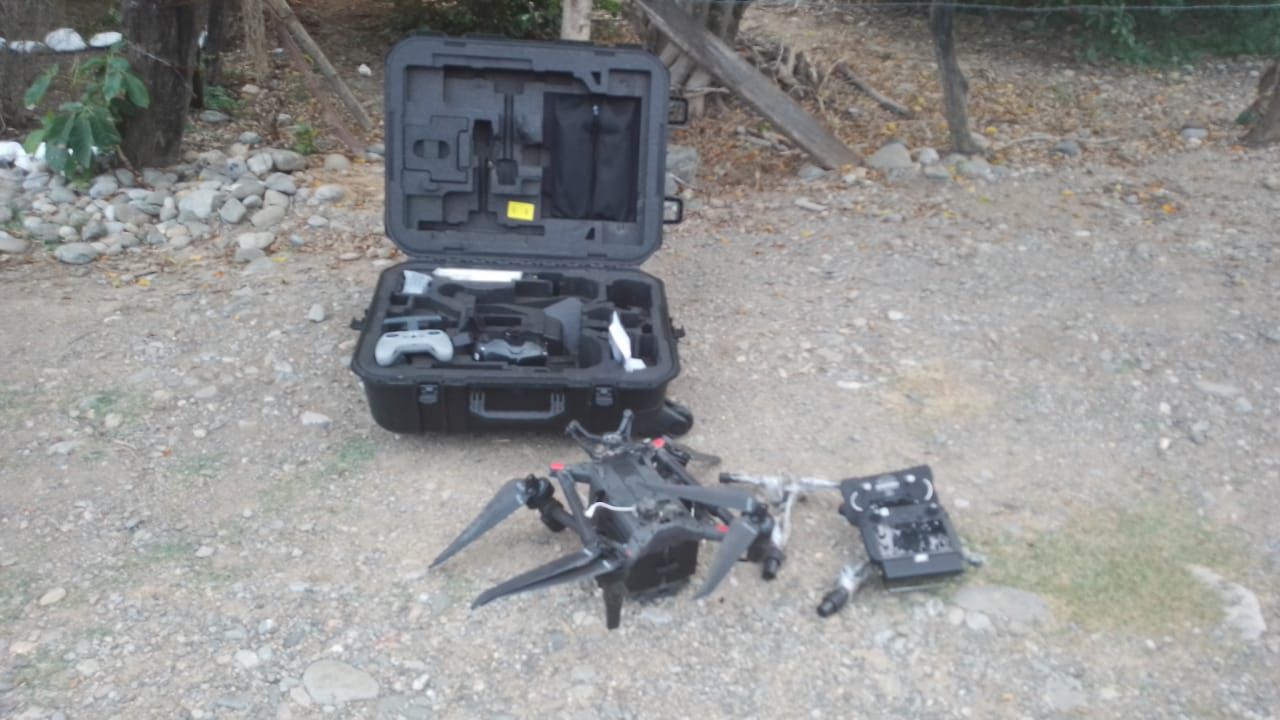
According to information from the Judicial Power of the Federation, the Public Ministry filed charges against Aristóteles Benítez Ríos, Miguel Ángel González Guajardo and Salustio Jorge Santiago. Members of the Mexican Army arrested the three in possession of 13 different caliber long arms, a Barrett rifle, 28 handmade explosive devices, nine grenades (seven fragmentation and two of different calibers), 71 chargers, 6 thousand 712 cartridges of various calibers, a drone and four tactical vests with ballistic plates, as well as vehicles, according to information from the FGR. In addition to being subject to criminal proceedings, the court ordered the precautionary measure of preventive prison.
==Ω==
Originally Published in Spanish by La Jornada, Thursday, July 21, 2022, https://www.jornada.com.mx/2022/07/21/estados/029n4est and Re-Published with English interpretation by the Chiapas Support Committee

Check out the Journal of Zapatista Thought & Horizon: https://chiapas-support.org/2022/07/21/new-grietas-a-journal-of-zapatista-thought-horizon%ef%bf%bc/
The IACHR asks the government to disarm groups in Chiapas
By: Elio Henríquez, correspondent
San Cristóbal de Las Casas, Chiapas
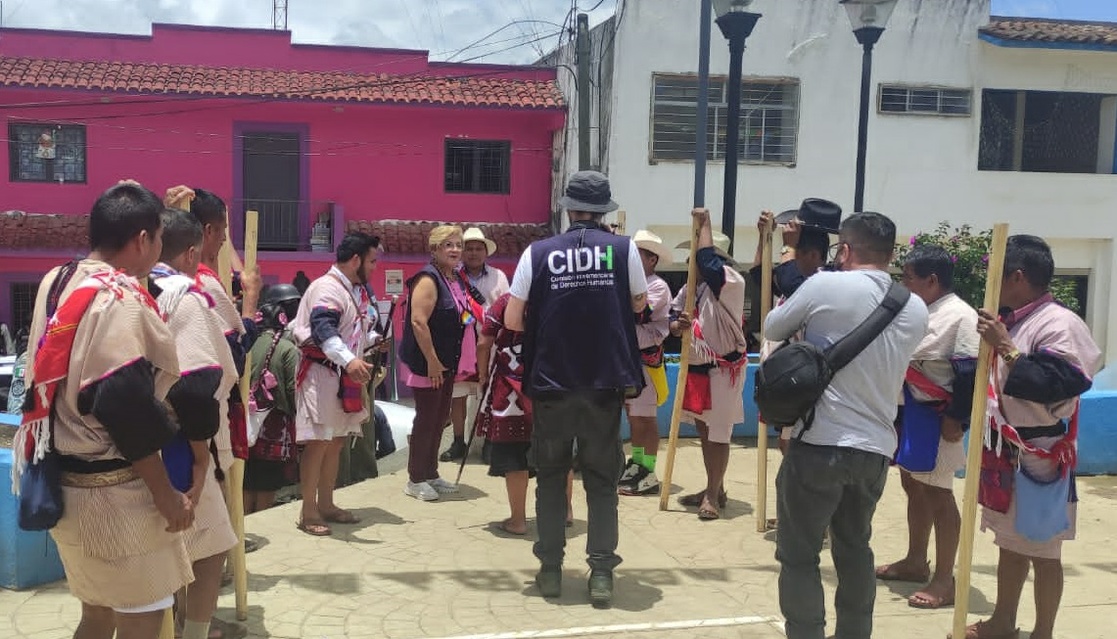
Persons displaced from Chalchihuitán municipality due to the violence derived from the conflict over boundaries with their Chenalhó neighbors, asked the rapporteur of the Inter-American Commission on Human Rights (IACHR), Esmeralda Arosemena, to intervene with the Mexican State so that the armed groups operating in that area are disarmed, the Fray Bartolomé de Las Casas Human Rights Center (Frayba) reported.
It added that the displaced – one thousand 200 in total, refugees in different localities and in the municipal capital – told her during a meeting held on Wednesday, that there is “a lack of interest from authorities in trying to solve the agrarian problem that worsened in 2017. “
It stated that they also asked the IACHR “to be their voice” to demand that the government attend to their requests to create the security conditions to return to their places of origin and to work their lands.
The Frayba pointed out that this Wednesday, on their second day of work for the Commission, the IACHR rapporteur visited, three of the nine Chalchihuitán communities that benefit from Precautionary Measure MC-882-17, whose residents are displaced because of the violence exercised by armed groups from Chenalhó.
It said that the rapporteur and her entourage visited “the houses affected by bullets from the armed groups” and families who have had to leave because of the threats against them.
She commented that two meetings were held in the municipal seat: one with the municipal president, Jerónimo Luna, and another with officials of the state government. The members of the mission had a meal with municipal authorities in the municipal capital and they returned to San Cristóbal in the evening.
The Frayba said that the IACHR rapporteur has scheduled meetings with state government officials in Tuxtla Gutiérrez for this Thursday.
==Ω==
Originally Published in Spanish by La Jornada, Friday, July 14, 2022, https://www.jornada.com.mx/notas/2022/07/14/estados/piden-a-cidh-que-gobierno-desarme-a-grupos-en-chiapas/ and Re-Published with English interpretation by the Chiapas Support Committee
New! Grietas: A Journal of Zapatista Thought & Horizon

Introducing Grietas: A Journal of Zapatista Thought and Horizons, a new journal published by the Sexta Grietas Del Norte Network
The first issue of Grietas journal, titled “Autonomy From Below and to the Left in the U.S.,” takes up the topic of autonomy in the United States from a variety of perspectives. Contributors, all active participants in local and regional movements for justice and in solidarity with Indigenous land struggles, reflect on past and current struggles for liberation, while offering glimpses of possible autonomous futures inspired by Zapatismo and the seven principles of leading by obeying.
The journal includes report backs of projects of the Zapatistas and the National Indigenous Congress of Mexico that Grietas network members have accompanied, as well as insights on Zapatista praxis, including education, women’s rights, and their journey across rebellious Europe in the latter half of 2021.
For more details, info and to order a copy, visit the Sexta Grietas’ website : https://sextagrietasdelnorte.org/grietas-001/
The rise of China and its impacts for the peoples
By: Raúl Zibechi
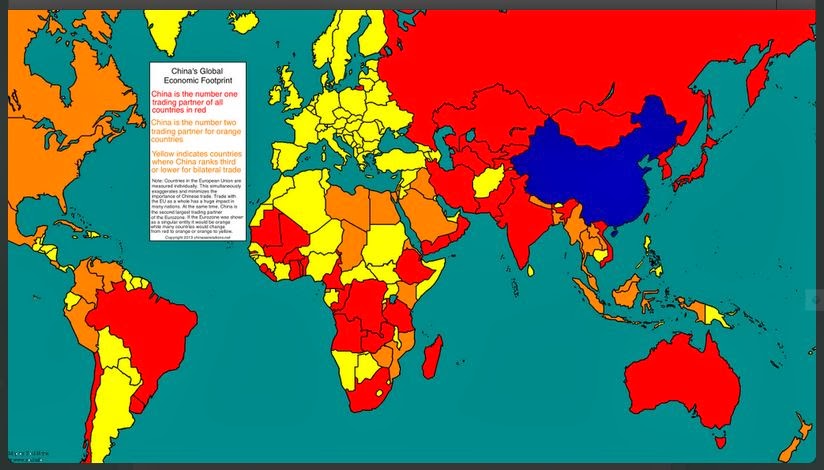
Despite deafening media and geopolitical noise that accumulates in these turbulent times, some issues seem certain: the decline of the Unites States and the rise of China are long-term structural trends that may take more or less time to materialize, but turn out to be, let’s say, inevitable.
The second issue that’s becoming abundantly clear, is that war between nuclear powers is more than probable, with all the terrible consequences that it will have for humanity and life on Earth. There has never been a hegemonic transition without war.
I’m not able to elaborate on these trends, but I would like to highlight that China’s dominance of the technologies of the ongoing industrial revolution (such as artificial intelligence, 5G networks and quantum computing, among others), represent something similar to the dominance by the US a century ago, of the scientific organization of work, the adoption of the technological advances of the epoch and their application to the art of war.
Some differences exist with respect to previous transitions, that is, the decline and the rise of great powers.
The first is that the declining power depends on the rising one, because their economies are intertwined. An example of that is the enormous frustration of the American company Boeing when China bought 292 commercial aircraft from its competitor Airbus. Boeing reacted by asking the Biden administration for a “productive dialogue” with China, because it cannot do without that market (https://bit.ly/3uGSnUg).
The Boeing communiqué says it all: “Sales of Boeing aircraft to China historically support dozens of thousands of American employees, and hope that requests and deliveries are quickly renewed.” But the US government imposed sanctions that include the maintenance and repair of Boeing aircraft, which prejudices one of its main companies.

The second difference is that we are facing a transition that involves regions and nations whose populations have different skin colors, that involves a history of colonialism and racism of the West against the East, of the North against the South. Nothing like that has happened in previous transitions.
The third difference is that there will not be a world hegemonized by China, nor by the US, nor by any other power. We’re heading towards a world fractured into two large blocks, with several regions and even continents oscillating between the two blocks.
As the transition will be resolved through wars, it’s important to note that: “China’s defense sector is developing new weapons more efficiently and between five and six times faster than the United States,” according to a high air force commander. China’s advantage lies in its industrial base and the scale of its research, while the main US exports are agricultural commodities and weapons.
Although the geopolitical question is important, and it will have to continue studying it in order to better understand a complex and constantly changing world, I’m interested in opening debate on the repercussions of a possible Chinese hegemony in social conflicts and in the kind of movements there will be in the future, from a perspective centered on Latin America.
A first aspect to take into account is that trade unions predominated under English hegemony, while mass unions predominated under US hegemony. To a large extent, as a consequence of the type of company and production that existed in both periods. The big Taylorist and Fordist company replaced the family manufacturing business, where the workers still controlled their times and modes of work.
The second aspect is that since the world revolution of 1968, the traditional labor movement stopped being the main subject in the anti-capitalist struggle, being replaced by native people, women who struggle and the black peoples, campesinos and those from the urban peripheries. Accumulation by dispossession and the fourth world war lead peoples, women and youth to struggle to survive, because they are condemned to disappear under this model.
The third aspect is that the kidnapping of the Nation-States by the large multinational companies and the richest one percent, means that the movements cannot reference that institution, nor demand from it nor occupy it, opening paths for the autonomies as necessary and possible.
Finally, it’s hard for me to imagine that there will be a single type of movement and a single way of walking, because the tendencies say that there will be different forms of organization and of action. What we do know is that the unified and “unitary” movements will not be emancipatory, because they cannot tune into a profoundly antipatriarchal and anticolonial era.
It will be the time for those who take a risk to create putting their bodies on. The line; and it will be bad times for those who look for manuals.
==Ω==
Originally Published in Spanish by La Jornada, Friday, July 15, 2022, https://www.jornada.com.mx/2022/07/15/opinion/019a2pol and Re-Published with English interpretation by the Chiapas Support Committee
Drug traffickers battle each other for more than 24 hours in the border municipalities of La Trinitaria and Frontera Comalapa, Chiapas
By: Ángeles Mariscal
Residents of ejidos and communities fled into the mountains. Mexican Army personnel arrived hours later, arrested three people and seized weapons.
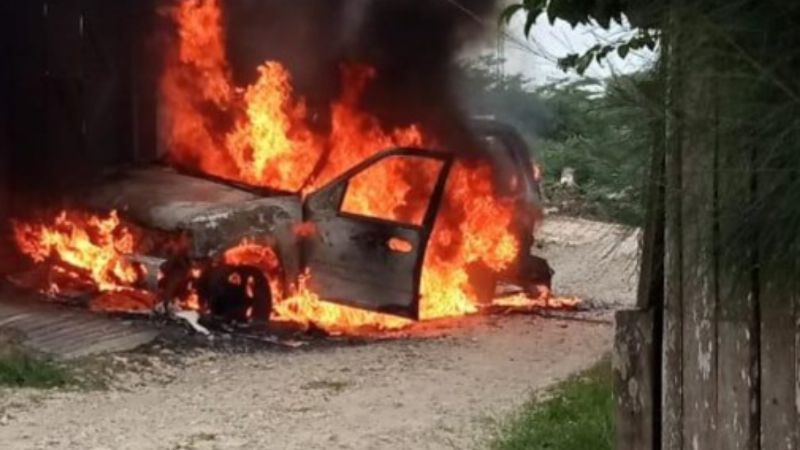
On Thursday, July 14, residents of the municipality of La Trinitaria, located about 80 kilometers from the border with Guatemala, reported that on the road that connects the municipality of Comitán, armed groups aboard several vehicles clashed with each other.
A day later, people from Frontera Comalapa, also located in this region, saw groups of armed people fighting in an area that includes several ejidos.
Some of the campesinos left on dirt roads to take refuge in the municipal seat, and other towns, to give notice to the authorities. By about noon on Friday, July 15, the clashes had led to road blockades in several sections, by armed people and vehicles.
“There is fear in the communities of San Jerónimo, Nicolás Bravo, Guadalupe Victoria, Tamaulipas and Sinaloa. There are helicopters flying over, there are drones, shots are heard everywhere,” were the reports of villagers to their relatives. The clashes continued until nightfall.
“Our family has already left, but they can’t get through because it’s stopped up in Chamic. Today they are going to stay in Tierra Blanca, to see if they can get through tomorrow. The situation is sad, look at it, because having land and leaving it for these degenerates. But hey, no way, you have to save your life. They are all already in Tierra Blanca, and many people are already leaving,” is the testimony of a woman.
This Saturday, the Ministry of National Defense (Sedena) reported through a statement that “during ground reconnaissance in the Sinaloa ejido, municipality of Frontera Comalapa, Chiapas, they were attacked by unknown persons, without military personnel being injured.”
In this municipality, the statement adds, three people were arrested: Miguel Ángel González Guajardo, 31 years old, originally from the State of Mexico; Aristóteles Benítez Ríos, 39 years old and Jorge Santiago Solustio, 42 years old, both originally from the State of Guerrero.
Sedena seized rifles, grenades, explosives, bulletproof vests, magazines and bags of marijuana from these people.
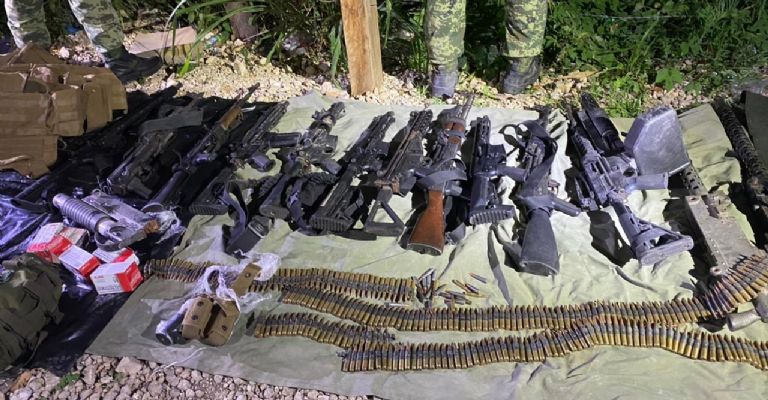
Sedena explained that hours later, a military convoy arrived in Primero de Enero community, in La Trinitaria municipality, and there it seized an armored vehicle that had “a turret adapted for a sharpshooter,” and 12 long arms (rifles) in its interior, as well as 2 machine guns, grenades, grenade launchers and different caliber cartridges.
Since July 2021, in this region of Chiapas known as “the border zone,” there is an increased presence of armed individuals who have sustained confrontations with other groups with these same characteristics; they have carried out roadblocks where they detain and, in some cases, kidnap local people.
Residents have denounced that there are at least one hundred missing persons in the region, kidnapped by one of these groups. This has motivated the forced displacement of families, who have had to take refuge in the municipal seats.
==Ω==
Originally Published in Spanish by Chiapas Paralelo, Saturday, July 16, 2022, https://www.chiapasparalelo.com/noticias/chiapas/2022/07/narcotraficantes-se-enfrentan-durante-mas-de-24-horas-en-municipios-fronterizos-de-chiapas-con-guatemala/ and Re-Published with English interpretation by the Chiapas Support Committee
Forced displacement of 6 Zapatista families in Chilón, houses and belongings burned
New attacks on Support Bases of the Zapatista National Liberation Army
- Six families from the town of “El Esfuerzo”, Comandanta Ramona Autonomous Municipality.
- The Federal and State Governments are oblivious in the face of permanent violence and dispossession against autonomous territories.
By: Elio Henríquez
San Cristóbal de Las Casas, Chiapas, Mexico
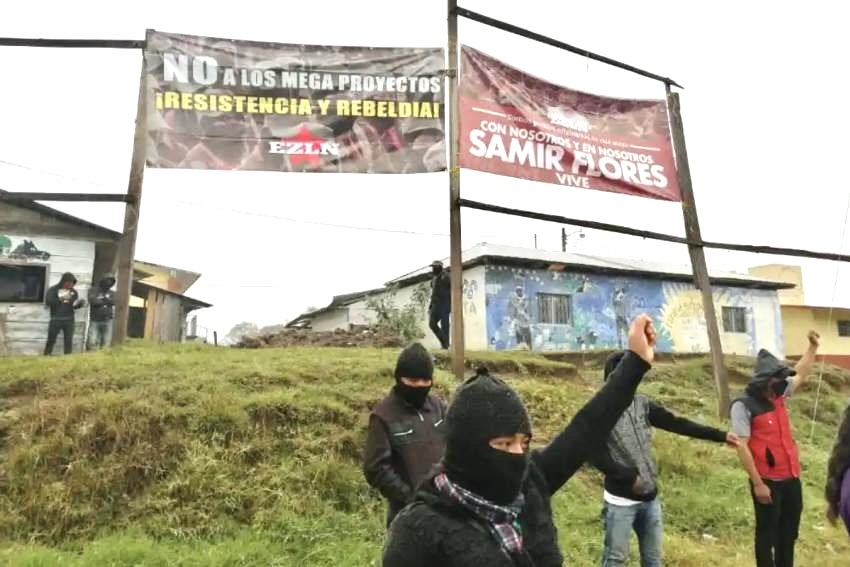
Ejido members of Muculum Bachajón, headed by the president of the ejido commission, along with municipal police and Civil Protection agents, burned houses and displaced 6 Zapatista National Liberation Army support base families in the community of El Esfuerzo, belonging to the autonomous Zapatista municipality of Comandanta Ramona, the Fray Bartolomé de Las Casas Human Rights Center (Frayba) denounced. In an urgent action, it reported that it has documented “the risk to the life and personal integrity” of the 6 Zapatista families.
“The negligence and complicity of the Mexican State is evident in placing the life, security and personal integrity of the autonomous population at high risk, which constitutes serious human rights violations,” it added.
It explained that on Thursday, July 14th, at approximately 8:00 a.m., Muculum Bachajón ejido members, directed by the president of the ejido commission, together with municipal police and Civil Protection agents, arrived at the town of San José Tenojí, municipality of Chilón, where they held a meeting.”
Frayba stated that “around 1:50 p.m. they violently entered the town of El Esfuerzo, displacing 6 Zapatista civilian support base families, in addition to setting fire to their homes and property.”
Frayba stated that the 6 families left their homes to “protect their lives and moved to the community of Xixintonil.” The ejido members stood guard until Friday, July 15, and at night they fired high caliber firearms,” it said.
The human rights center said that “there is a risk of losing 20 hectares of corn and beans that have not yet been harvested. El Esfuerzo has 54 hectares recuperated in 1994 by the Zapatista National Liberation Army (EZLN).”
It said that: “the facts put at serious risk the Autonomy and self-determination of the Peoples and indicate a serious violation of the right to security, life and personal integrity of the Zapatista families. The Mexican State, in accordance with articles 1 and 2 of the American Convention on Human Rights, has the obligation to respect the rights and liberties recognized therein and to guarantee their free and full exercise to all persons, without any type of discrimination”.
Frayba demanded that: “the rights of the autonomous territories be respected in the face of what today is a permanent and deepened impunity.” At the same time it made “a call to national and international civil society to speak out in defense of the land and territory, for the security and personal integrity of the Zapatista peoples, now of the people of El Esfuerzo. We demand that the Mexican State immediately cease aggressions against the Zapatista communities.”

This article was originally published in La Jornada on Sunday, July 17th 2022, https://www.jornada.com.mx/notas/2022/07/16/estados/ejidatarios-queman-casas-y-desplazan-a-familias-zapatistas/ and summarizes the report of Frayba https://frayba.org.mx/desplazamiento-zapatistas-el-esfuerzo. English interpretation by Schools for Chiapas, Re-Published by the Chiapas Support Committee
 Chiapas Support Committee