Chiapas Support Committee
Home of the Compañero Manuel blog on zapatistas & mexico
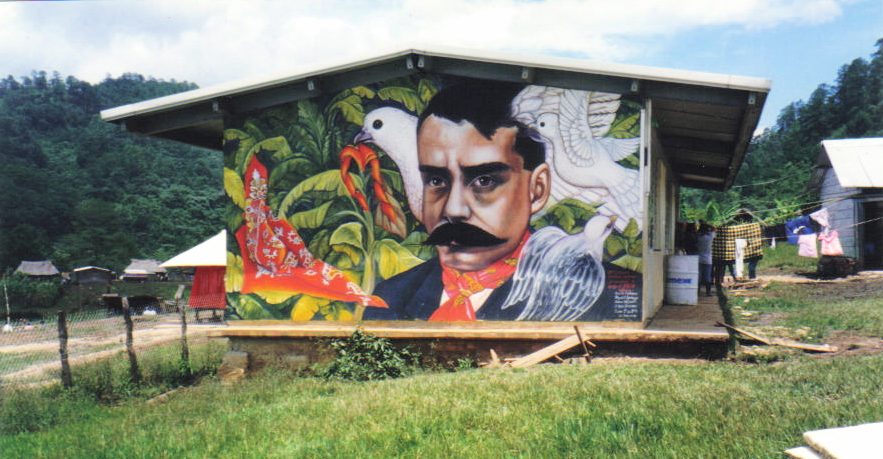
Resumen de Noticias sobre los Zapatistas – Septiembre del 2012
[Por favor, disculpe el retraso. Estábamos muy ocupad@s por la celebración el 14 de octubre.]
SEPTIEMBRE DEL 2012 RESUMEN DE NOTICIAS SOBRE LOS ZAPATISTAS
En Chiapas
1. Paramilitares causan desalojo de 2 comunidades Zapatistas: Comandante Abel y Unión Hidalgo – El 7 de septiembre, la Junta de Buen Gobierno en el Caracol de Roberto Barrios denunció que paramilitares invadieron y dispararon contra la comunidad Comandante Abel, una nueva comunidad de zapatistas que habían sido forzados a dejar la comunidad de San Patricio debido a ataques paramilitares por parte de miembros de Paz y Justicia. 73 personas huyeron de Comandante Abel hacia el bosque el 7 de septiembre cuando continuaban los disparos que empezaron el 6 de septiembre. Llegaron a San Marcos, una comunidad zapatista, el 9 de septiembre, donde se les dió refugio. Actualmente hay 27 zapatistas que todavía quedan en la comunidad Comandante Abel. Están rodeados por un grupo agresor armado de Unión Hidalgo y miembros de la policía preventiva del estado. El 8 de septiembre, 10 zapatistas fueron desplazados de Unión Hidalgo debido al constante hostigamiento y amenazas de muerte por miembros del PRI y PVEM. Están refugiados actualmente en la comunidad Zaquitel Ojo de Agua. ¡El resurgimiento de paramilitares miembros de Paz y Justicia es más que preocupante! Se debe en parte a la victoria del PRI y PVEM en las elecciones del primero de julio. El PRI ganó la presidencia de la república y el PVEM ganó la gubernatura de Chiapas. La Junta de Roberto Barrios publicó un comunicado de prensa el 30 de septiembre acusando al gobierno estatal de equipar a los paramilitares y la policía estatal para poder mantener el asedio contra los zapatistas.
2. Eco Mundial en Apoyo a los zapatista se expande y continua – En solo dos meses, desde la elección de un nuevo presidente de la república y nuevo gobernador de Chiapas, los ataques y amenazas contra comunidades zapatistas se han incrementado dramáticamente. La Campaña del Eco Mundial se ha expandido para incluir muchas comunidades zapatistas ahora bajo agresión, además del preso político zapatista Francisco Santiz López. Se puede encontrar información sobre la segunda fase de esta campaña, la cual consiste de acción directa, en la pagina web de la campaña:
http://sanmarcosavilesen.wordpress.com/
3. A Alberto Patishtan le diagnosticaron un tumor cerebral mientras la Corte Suprema aplaza su decisión – Está en marcha un esfuerzo para obtener una audiencia con la Corte Suprema para que Alberto Patishtan Gómez (o sus abogados) puedan demostrar su inocencia. El abogado de Patishtan logró una reunión con el presidente de la Corte Suprema Mexicana. El propósito de la reunión era presentar una petición para la creación de un mecanismo legal nuevo que abra un espacio para que Patishtan pueda demostrar su inocencia. La Corte Suprema tiene que decidir si se abrirá ó no este nuevo espacio. Su decisión ha sido pospuesta. Mientras tanto, Patishtan está en un hospital en la capital del estado donde le han diagnosticado un tumor cerebral que requiere cirugía.
4. Liberan de prisión a otro hombre involucrado en la masacre de Acteal – El 26 de septiembre, la Corte Suprema de México ordenó la libertad del preso Manuel Santiz Pérez, encontrado culpable de participar en la masacre de Acteal de 45 mujeres, niños y hombres el 22 de diciembre de 1997. La Corte usó el mismo razonamiento que utilizó en los casos anteriores: el álbum de fotos mostrado a los sobrevivientes y testigos era perjudicial y violó los derechos legales y el procedimiento criminal. Según un artículo publicado en La Jornada, este es el último de los casos apelado por parte de los que participaron en la masacre de Acteal. Vale notar que la Corte encontró el tiempo para liberar a un asesino confeso, pero no tiene tiempo para decidir si se oirá el caso de Alberto Patishtan o el caso de los miembros de la Otra Campaña en Tila.
En la frontera de Chiapas
1. Bases militares nuevas y 200 marinos de EEUU en Guatemala – El presidente de Guatemala, Otto Pérez Molina, anunció que Guatemala construirá tres bases militares nuevas para redoblar la lucha contra el crímen organizado (el tráfico de drogas, armas y personas). Dos de estas bases estarán cerca de la frontera con Chiapas; una en el Departamento del Petén (al otro lado del río Usumacinta de Chiapas) y otra en el Departamento de San Marcos. San Marcos colinda con la región sudoeste de Chiapas. Una tercera base estará localizada en Puerto Barrios (cerca de Honduras). Se ha reportado ampliamente que unos 200 marinos estadounidenses ya están patrullando la costa pacífica de Guatemala para interceptar el narcotráfico por mar. Las y los guatemaltecos están reportando que el país se está militarizando bajo el lema de la guerra contra las drogas; pero la militarización también está siendo usada contra los movimientos sociales.
En otras partes de México
1. Investigaciones del ataque contra dos agentes de la CIA sugiere conexión al cartel Beltran Levya – En septiembre, continuaron las investigaciones sobre el caso Tres Marías, el ataque contra un vehículo blindado de la embajada de los EUA en México. La procuraduría federal mexicana requirió que la detención sin cargos (arraigo) de 12 polícias federales continúe por 40 días más. La Jornada reportó que el FBI está llevando a cabo una investigación paralela de lo ocurrido, y ha ofrecido a los 12 agentes la “oportunidad” de convertirse de colaboradores en el ataque a testigos protegidos del gobierno estadounidense. Sus abogados dicen que han rechazado esta “propuesta.” Aunque no se ha publicado ningún informe final al respecto, parece ser que los oficiales estadounidenses ahora creen que el ataque lo perpetraron integrantes del cartel Beltran Levya como venganza por el asesinato de Arturo Beltran Leyva, ocurrido en diciembre del 2009.
2. El Departamento de Estado de los EUA recomienda inmunidad para Zedillo – El 7 de septiembre, el Departamento de Estado estadounidense anunció que recomendará inmunidad para el ex-presidente Ernesto Zedillo ante una Corte de Connecticut, en donde fue demandado por daños en el asesinato de 45 mujeres, hombres y niños el 22 de diciembre de 1997 en Acteal, Chiapas. El Departamento de Estado anadió que esta decisión se tomó con el fin de mantener las buenas relaciones con el gobierno mexicano.
3. 25.000 – 30.000 desplazad@s por narcoviolencia en Sinaloa – La Comisión para la Defensa de Derechos Humanos del estado de Sinaloa informó que entre 25,000 y 30,000 personas han tenido que huir de sus comunidades tras actos criminales relacionados con el tráfico de drogas durante estos nueve meses. La Comisión dió a conocer que 12 de los 18 municipios del estado están siendo muy afectados por esta violencia, con un promedio aproximado de 2,000 desplazados por municipio.
En los Estados Unidos
1. La Caravana por la paz concluye – El Movimiento por la paz con Justicia y Dignidad (MPJD), encabezado por el poeta y periodista mexicano Javier Sicilia, terminó su caravana por los estados unidos en Washington, DC el 12 de septiembre. La caravana de un mes viajó por 27 ciudades estadounidenses y recorrió 6,210 millas, tratando asuntos politicos estadounidenses en su ruta hacia Washington DC: 1) financiamiento estadounidense de una guerra contra las drogas en México a través de la Iniciativa Mérida; 2) tratamiento humano a los inmigrantes; 3) tráfico de armas hacia México; 4) blanqueo de dinero de la droga por bancos estadounidenses; y 5) la militarización de la política exterior norteamericana. Al concluir la caravana, Sicilia dió a conocer que se retirará del MPJD por dos meses para reflexionar sobre la pérdida de su hijo.
Ya Basta: the zapatistas eighteen years later
ya basta: the zapatistas eighteen years on
http://powderzine.com/content/ya-basta-zapatistas-eighteen-years
mary ann tenuto of the chiapas support committee speaks with i.t.a.
it has been eighteen years since the zapatista uprising. what is the situation like in chiapas today?
In a nutshell, what is occurring throughout Chiapas and especially in Zapatista territory is a struggle for territory. It is a struggle between the Zapatista and other campaign communities and the transnational corporations for land with resources. The corporate interests seek land and territory for mining, agro-fuel plantations, water and precious woods. The situation in some parts of Zapatista territory becomes more difficult every day. The Zapatistas are focused on constructing autonomous governance and projects, like education, health and production. The government, in collaboration with transnational corporate interests, is waging a low-intensity war against the autonomous governments. This has two sides to it: the softer side, whereby the government entices people and communities to leave the Zapatista movement with money and economic projects or health clinics; and the violent side, where violent evictions of Zapatistas from their communities are part of the counterinsurgency.
the board of good government in la realidad has made reports of a series of unprovoked attacks and threats of land dispossession made towards ezln members as late as august this year. who is behind these attacks and what are their motives?
In August, the Good Government Board (it is commonly referred to as “the junta”) of La Realidad denounced an attack on the Zapatista coffee warehouse near the San Carlos Ejido by members of two political parties, the PRI and the PVEM. These political party members put up a fence around the warehouse and cut off its electricity in an attempt to take the warehouse away from the Zapatistas, who store and sell their coffee products there. This is part of the low-intensity war against the autonomous communities. The PRI and the PVEM took power in the July 1 elections in Mexico and have been emboldened by their victory. The controlling factor is that the government does not punish the groups that attack the Zapatistas. They have impunity.
the uprising of january first nineteen, ninety four was a movement of indigenous campesinos revolting against neoliberal capitalism. what sparked this uprising and what were the conditions that led up to it?
The conditions that led up to the Zapatista uprising were, for the overwhelming majority of the Zapatistas, conditions of extreme poverty partially caused by a lack of land for growing the food with which to feed their families. Another cause was extreme racism against indigenous peoples in Mexico and Chiapas, which is now 80% indigenous. Plantation owners first enslaved the indigenous peoples and later used them as serfs. The state was still emerging from a form of feudalism with indigenous peoples as the serfs. 50% of indigenous children died before reaching 5 years of age because of malnutrition and a lack of health care. Armed private security guards working for plantation owners were stealing what little land the indigenous peoples had with violence. The government provided virtually no public services, like health care for example.
much has been made of the zapatistas’ usage of the internet at the time of the uprising which allowed them to connect with ngo’s across the globe who gave them support. did this lead to the initial success or is there more to it than that?
I think the usage of the Internet permitted the Zapatistas to spread the word effectively and continuously after the corporate media tired of Zapatista news and/or figured out that the Zapatistas were against their corporate interests and those of Wall Street. Perhaps the “more than that” has to do with their analysis of neoliberalism, previously not even heard of in some parts of the world. As the movement evolved, their construction of autonomy provided an alternative for changing the system or opting out of the system without an on-going violent revolution to take power; in other words, an alternative for the Left.
what were the original objectives of the ezln and how have these changed over time?
Initially, the Zapatistas made certain basic demands of the Mexican government: land, housing, jobs, education, health care, roads, electricity, sewage systems, etcetera; in other words, all the government services that the government had failed to provide. But, during the first year of the rebellion, the Zapatistas formed 38 autonomous municipios (municipalities) and in the peace talks that began in 1995, the first topic for discussion was indigenous autonomy for all indigenous territories of Mexico. An agreement was reached on that issue. It is known as the San Andrés Accords. The government of Vicente Fox presented it to the Mexican Congress, which did not pass the accords that were agreed upon. It watered them down to be almost completely meaningless. Since the congressional betrayal, the focus of the Zapatistas has been on their internal construction of autonomy.
does the ezln consider itself a marxist, anarchist or a unique type of movement. what is their basic ideology? how does this organization differ from others?
This is a question on which people don’t always agree. My personal perception of the Zapatista “ideology” is that it is a mixture of ideas and principles taken from various Mexican revolutionaries (Zapata, Villa, Flores Magón), liberation theology and some of the lessons from other Latin American countries and adapted to their specific situation of oppression and indigenous culture. Indigenous culture plays a dominant role. It would seem like their style of autonomous governance and direct participatory democracy is compatible with some anarchist principles, while their internal economy is socialist. I believe they adapted these various principles to their cultural values.
an internal uprising occurred within the ezln ranks in nineteen ninety three when a revolutionary law for women was implemented by women. how is life for women within the zapatista movement and how does it differ compared to women living in other similar communities?
Life for women within the Zapatista movement has changed. They are now allowed to vote in community assemblies, hold positions of responsibility in the Zapatista organization, attend school and women’s health care is a priority. These are big changes. They can also choose their own husband and decide how many, if any, children they want to have. The implementation of the Women’s Revolutionary Law has been easier in some Zapatista areas than in others. I don’t know how to compare it to non-Zapatista communities because in those I am familiar with women have those same rights because they are part of an independent campesino organization. In some traditional communities women do not have those rights.
the figure of subcomandante marcos looms over the zapatista movement; he is their revolutionary spokesman who himself is not an indigenous person. what occupies the subcomandante at present and what is he working on in twenty twelve?
I have no inside information about what “El Sup” is doing. However, the security of the Zapatista communities is a major concern now. The CCRI (the Zapatista movement’s commanders), which includes Marcos, is most likely focused on protecting the communities against an expected onslaught from the PRI. The CCRI is the Zapatista political/military governing body. (The good government juntas are the civilian governing bodies.) Marcos may also be involved in plans for January 1, 2014, their 20th anniversary!
in two thousand and three the good government committees (juntas de buen gobierno) were established in chiapas. how are these operate and how do they co-ordinate the autonomous regions?
The Juntas are the regional civilian government in the 5 Zapatista regions. They resolve disputes that cannot be resolved at the local level (community or municipal level). They resolve disputes between husbands and wives, land disputes, disputes between Zapatistas and non-Zapatistas. They also oversee the distribution of funds received from NGOs and collectives. They decide who is and is not permitted within Zapatista territory.
in two thousand and six subcomandante marcos, in the guise of delegado cero, toured mexico in what became known as the other campaign. what were the objectives of this campaign and how successful was it?
The objective of the Other Campaign was to form a national civilian campaign to politically support the EZLN and hold a meeting to decide on a new constitution for Mexico. It was timed to draw a contrast to the presidential electoral campaigns of 2006. Initially, the Zapatista delegation drew enormous crowds and many people joined. However, the police terrorism against San Salvador Atenco unleashed violent repression on one of the Other Campaign’s most active and admired members and put a stop to the Other Campaign tour. After the new president (Felipe Calderon) took power in December 2006, he sent the Mexican Army into the streets to perform police functions and that led to the violent and deadly “Drug War,” which made safe travel impossible for the Zapatita commanders. In the short term, I think the Other Campaign had some success in uniting folks who shared Zapatista ideas. However, in the long term, I’m not sure it accomplished what the Zapatistas hoped for: a large national social movement led by the Zapatistas to peacefully transform Mexico.
after all these years what do you see as the significance of the zapataista revolt?
The first and by far the most significant gain to the Zapatistas is the recuperation of somewhere between 750,000 to one million acres of land for distribution to land-hungry indigenous campesinos belonging to the Zapatista movement. This has enabled Zapatistas to have enough land on which to grow food for their families and thereby decrease malnutrition and death. There is also enough land on which to grow a cash crop to provide income with which to buy other basic needs. Although the communities are still poor, the horrendous conditions in which they previously lived have been somewhat alleviated. The second significant influence is the implementation of autonomy. Their construction of autonomous self-government provides the Left with an alternative to violent armed struggle for the purpose of taking power.
in what way have they influenced other movements and in which movements has their influence been felt? The Zapatista analysis of neoliberalism has inspired movements around the world, as well as their analysis of government, political parties, “democracy” and most recently wars. The Zapatistas are believed to have inspired the formation of a World Social Forum. They are clearly the inspiration for indigenous movements in Mexico and the entire American continent (both hemispheres). Their influence is seen in the US Occupy movement and the new #YoSoy 132 movement in Mexico. Many European movements have also been inspired by the Zapatistas and they maintain relations with many important movements around the world.
what are the challenges for the zapatista movement in the future and what changes do you anticipate?
The July 1, 2012 election returned the PRI to power. The PRI is expected to respond more violently to protest from social movements than the PAN has for the past 12 years. The PRI thinks it has a score to settle with the Zapatistas on whom it blames the 2000 election defeat of its 70-year rule in Mexico. Many in Mexico believe that the Zapatistas are in for a violent counterinsurgency against them under the PRI. I expect security to tighten in Zapatista communities and the need for national and international solidarity to increase.
———————-
mary ann tenuto, thank you for speaking with us and a shout out of solidarity from powder…
Summary of Current EZLN Conflicts

PRI and PVEM Groups Invade Zapatistas and Stir Up Agrarian Conflicts
** EZLN sympathizers have not gone through the process of titling their lands because of being in resistance
** To the land grabs by political parties are added paramilitary attacks
[The Good Government Junta in Oventic has suffered attacks Photo: Víctor Camacho]
By: Hermann Bellinghausen, Envoy
San Cristóbal de las Casas, Chiapas, October 4, 2012
The paramilitary upturn in Chiapas is accompanied by a substratum of alleged agrarian conflicts, the majority unfounded but stirred up by politicians from the parties and government officials, and directed against lands recuperated by the support bases of the Zapatista National Liberation Army (EZLN, its initials in Spanish), the majority occupied and worked by rebel communities since 10 or 15 years ago. In particular groups from the PRI, and recently the PVEM, using it as an electoral booty, invade or threaten to invade, plots of land and even Zapatista villages, taking advantage of the fact that they, by remaining in resistance, do not process any agrarian titling with the State, because they follow their revolutionary laws through the Good Government Juntas (Juntas).
An analysis to which La Jornada had access documents these “conflicts” and identifies the invader or aggressor groups: PRI, PVEM, PRD, PAN, or rather organizations like Paz y Justicia (and its derivations: Uciaf and Opddic), Orcao, Cioac or Aric. In one very recent denunciation, Las Abejas confirmed the reactivation of “Máscara Roja” (Red Mask) in Chenalhó, as it has identified the perpetrators of the Acteal Massacre in 1997. Other Campaign communities (Jotolá, Mitzitón, San Sebastián Bachajón) are also attacked through religious “conflicts” (Ejército de Dios) or ejidal differences.
This is the scenario that the PVEM-PRI alliance headed by Manuel Velasco Coello inherits, which shortly will govern the state. The major part of the paramilitary groups, agrarian invaders and municipal governments involved belong to their ranks.
In an analysis of the investigator Arturo Lomelí identifies the principal places (not the only ones) where offenses and unsolved crimes have happened in recent years, especially from 2010 to 2012. He points out in there that starting with 1994 between 250,000 and 750,000 hectares (there is no conclusive data) [1] were occupied en Ocosingo, Chilón, Sitalá, Yajalón, Tila, Tumbalá, Sabanilla, Salto de Agua, Palenque, Altamirano, Las Margaritas and Comitán, among other municipalities. Under the protection of the Zapatista rebellion, OCEZ, Cioac, ARIC, CNPA, OPEZ, Xinich, Orcao and Tsoblej, side by side with the Zapatistas, “recuperated” and founded new localities. In 2000, when leaders of said organizations were incorporated into the state or municipal government, “they were given the task of regularizing (legalizing) the plots of land and as the Zapatistas did not enter into those negotiations, the organizations claimed their plots of land.” These organizations are the electoral base of the parties –Lomelí maintains– and the dynamic of betrayal initiated by Pablo Salazar Mendiguchía was maintained with Juan Sabines Guerrero.
The conflicts involve the five Juntas. The Morelia Junta has been very busy. Primero de Enero community (Lucio Cabañas autonomous municipality) was invaded in August 2011 by Orcao members, who already had obtained lands thanks to the Zapatista Uprising. As in other cases, after 2000 they abandoned the agreement to “recuperate” and reached agreement with the government for programs and more of the Zapatistas’ land. Orcao has also advanced against Los Mártires (Lucio Cabañas).
Other communities and plots of Zapatista land under siege are Bolón Ajaw and Santa Rosalía. In Agua Clara (Comandanta Ramona autonomous municipality) “dangerous criminals operate, advised by the ex military Carlos Jiménez López.” In 2010, residents of Nueva Virginia, Jalisco and Getzemaní, members of the Cioac and the PRD “entered onto Campo Alegre recuperated land where the autonomous municipalities of Lucio Cabañas, Comandanta Ramona and 17 de Noviembre are working,” according to the same Junta. Besides, 33 Zapatista families were dispossessed of their rights in Aldama, and the attacks against the support bases in Olga Isabel and K’an Akil persist; they have even been shot at by “paramilitaries of Opddic,” which also have attacked the new 21 de Abril community.
The La Garrucha Junta denounced that the Puerto Arturo and San José Las Flores neighborhoods seek to take away 178 hectares of recuperated land from Nuevo Purísima (Francisco Gómez autonomous municipality) in Ocosingo. Also, aggressions and detentions of Zapatistas by paramilitaries in Peña Limonar, as well as plunder in Laguna San Pedro, violence in Casa Blanca and harassment in Toniná. Groups from Las Conchitas and P’ojcol (Chilón), as well as Guadalupe Victoria, “paramilitaries,” according to the Junta, members of Orcao and of political parties, violently occupied recuperated lands in Nuevo Paraíso (municipio Francisco Villa autonomous municipality).
In the Northern Zone, the panorama is alarming, according to what the Roberto Barrios Junta has been reporting. Last year, Zapatista lands in San Patricio (La Dignidad autonomous municipality) were plundered from Zapatista lands by villagers from Ostealukum, El Paraíso, El Calvario and Rancho Guadalupe (Sabanilla). The autonomous Zapatistas then founded Comandante Abel, but this September they were expelled, with support from the police and the state government, as well as from Unión Hidalgo. A few years ago, in Choles de Tumbalá (El Trabajo autonomous municipality), there were houses burned and persecution by members of Xinich-Official (official implying pro-government and anti-Zapatista).
The La Realidad Junta documented how in the Monte Redondo ejido (Frontera Comalapa), EZLN support bases of Tierra y Libertad autonomous municipality were plundered of milpas and coffee fields by people from the PVEM, PRD and PRI political parties that even sold plots of land to third parties. Other aggressions come from the PAN organization known as Aciac against Che Guevara community, and in Espíritu Santo by people from the PRD, Cioac and PRI. And in Veracruz (community), there were attacks on the warehouse belonging to San Pedro de Michoacán autonomous municipality.
Lastly, the Oventic Junta confronts a grave conflict in San Marcos Avilés (Chilón), where its bases have been attacked, expelled or robbed by “Greens,” and both PRD and PRI members. In El Pozo, Cruztón and Ts’uluwits (San Juan Apóstol Cancuc autonomous municipality), as well as in Zinacantán, the PRI and PRD members have not stopped harassing the Zapatistas.
____________
Originally Published in Spanish by La Jornada
English translation by the Chiapas Support Committee
Saturday, October 6, 2012
En español: http://www.jornada.unam.mx/2012/10/06/politica/017n1pol
Reactivation of Paramilitary Groups In Chiapas
[Editors’ Note: The conflict in Chiapas is intensifying with the re-emergence of paramilitary conflicts.]
Las Abejas Denounces the Reactivation of Paramilitary Groups in Chenalhó
** The organization reports that an indigenous Zapatista support base was shot one month ago
** It asserts that they re-grouped after the massive release from prison of those responsible for the Acteal Massacre
By: Hermann Bellinghausen, Envoy
San Cristóbal de las Casas, Chiapas, October 4, 2012
The civil society organization Las Abejas of Acteal denounced the re-activation of paramilitary groups in Chenalhó Municipality, in the same way that is occurring in the state’s Northern Zone. “The massive release of paramilitaries, in prison because of the Acteal Massacre, that goes from August 12, 2009 to the release of Manuel Sántiz Pérez last September 25, has favored their regrouping and they have now been revealed in coordination with those that were not judged, carrying firearms on the highways, the mountains, the path to the milpas and coffee fields.”
In Chenalhó communities “they display firearms anywhere,” add the accusers and announce that one month ago an indigenous Zapatista support base was shot: “The recent tragedy of last September 5, when a PRI member shot Manuel Ruiz Hernández in the back, near the plaza in Yabteclum, reveals the paramilitary actions and the presence of said armed groups.”
The Tzotzil organization, which maintains its independence with much effort for more than a decade, declared: “The governmental transition of Enrique Peña Nieto has unleashed violent acts that are a strategy of threats to counter social protest, not only against him, but it also goes against social organizations that denounce the injustices and human rights violations committed and developed by the governments.”
These actions are implemented “under the logic of counterinsurgency,” for the purpose “of creating division and community conflict until causing forced displacement, so that the same government may administer it, as Juan Sabines Guerrero has been doing against organizations in the Northern Zone (Tila, San Sebastián Bachajón) and other autonomous regions.”
This governmental attitude, Las Abejas abounds, “permitted the re-activation of the paramilitary group Paz y Justicia, in the Northern Zone, and Máscara Roja, en Chenalhó.”
“The State’s violent action is not limited to sowing fear: it continues the strategy of integral wear and tear with which it has harassed our pacifist organization since the times of Pablo Salazar Mendiguchía. It is painful for the government to accept its defeat in 2008, when Felipe Calderón Hinojosa and Sabines Guerrero divided our organization thinking that they were going to disarticulate us, but were wrong. What they did strengthened us and defined us as the organization that we currently are.”
Nevertheless, “the predators don’t stop harassing.” As already occurred in April 2010, “they have reactivated their delegates or messengers; they now disguise themselves as survivors to deceive people and they arrive at the houses of paramilitaries, of PRI members, of members of the so-called Las Abejas Civil Association and at ours. They invite forming a survivors group for negotiating an indemnification and requesting assistance programs in the name of the martyrs.”
The Civil Society Organization Las Abejas and the survivors of the massacre denounced individuals that say they are survivors, but are not: Juan Oyalté Paciencia, paramilitary of Tzajaluk’um; Vicente Oyalte Luna, PRI member of Acteal community; Pedro Vásquez Ruíz and Juan Pérez Pérez, members of Las Abejas Civil Association.”
To the government “it’s not enough to kill us, it now tries to buy our conscience,” Las Abejas concluded this Wednesday, who later emitted a communiqué from Acteal: “The government knows how to murder the unborn, boys and girls, women, the elderly and men. We are never going to exchange the blood of our martyrs for money or assistance programs. We will not permit the dignity of our massacred brothers to be sold, and we will not cease pointing out or crying out for ‘justice’ against the material and intellectual authors of the Acteal Massacre.”
————
Originally Published in Spanish by La Jornada
Friday, October 5, 2012
English Translation: Chiapas Support Committee
En español: http://www.jornada.unam.mx/2012/10/05/politica/023n1pol
Zapatista News Summary for September 2012
SEPTEMBER 2012 ZAPATISTA NEWS SUMMARY
In Chiapas
1. Paramilitaries Cause Displacement from 2 Zapatista Communities: Comandate Abel and Union Hidalgo – On September 7, the Good Government Junta in the Caracol of Roberto Barrios denounced that paramilitaries invaded and fired upon Comandante Abel community, a newly-founded community of Zapatistas supporters who had been forced to leave San Patricio community because of paramilitary attacks by members of Paz y Justicia. 73 people fled from Comandante Abel into the woods on September 7, when the shooting that started on September 6 continued. They reached San Marcos, a Zapatista community, on September 9, where they were given shelter. Currently, there are 27 Zapatistas remaining in Comandante Abel community. They are surrounded by an armed aggressor group from Union Hidalgo and members of the State Preventive Police.On September 8, 10 Zapatistas were also displaced from Union Hidalgo due to constant harassment and death threats by members of the PRI and PVEM political parties. They are currently sheltered in Zaquitel Ojo de Agua community. The re-emergence of the paramilitaries belonging to Paz y Justicia is more than alarming! This re-emergence is partially attributed to the victory of the PRI and the PVEM political parties in the July 1 elections. The PRI won the presidency and the PVEM won the Chiapas governorship. The Junta in Roberto Barrios issued a press release on September 30, accusing the state government of supplying the paramilitaries and state police in order to maintain the siege against the Zapatistas.
2. Worldwide Echo in Support of the Zapatistas Expands and Continues – In just two months, since the election of a new president and a new governor of Chiapas, the attacks and threats against Zapatista communities have increased dramatically. The Worldwide Echo Campaign has expanded to include many of the Zapatista communities now under attack, as well as for the Zapatista political prisoner Francisco Santiz Lopez. Information about the 2nd phase of this campaign, which consists of direct action, can be found on the campaign’s website: http://sanmarcosavilesen.wordpress.com/
3. Alberto Patishtan Diagnosed With Brain Tumor While Supreme Court Postpones Decision – The effort to obtain a Supreme Court hearing wherein Alberto Patishtan Gomez (or his lawyers) can prove his innocence is underway. Patishtan’s lawyer obtained a meeting with the president of Mexico’s Supreme Court. The purpose of such a meeting was to present a request for the creation of an innovative legal mechanism to open a space in which Patishtan could prove his innocence. The Supreme Court must decide whether to open such a new space. Its decision has been postponed. Meanwhile, Patishtan was placed in a government hospital in the state capital and has been diagnosed with a brain tumor requiring surgery.
4. Another Man Involved in the Acteal Massacre Released from Prison – On September 26, Mexico’s Supreme Court ordered the release from prison of Manuel Santiz Perez, convicted of participating in the Acteal Massacre of 45 women, children and men on December 22, 1997. The Court used the same rationale for this case as it did in the previous cases: the photographic album shown to survivors and witnesses was prejudicial and violated legal rights and criminal procedure. According to the report in La Jornada, this is the last of the cases appealed on behalf of those who participated in the Acteal Massacre. It is worth noting that the Court found the time to free a confessed killer, but not the time to decide whether it will hear Alberto Patishtan’s case or the case of the Other Campaign folks from Tila.
On the Chiapas Border
1. New Military Bases in Guatemala and 200 US Marines – The president of Guatemala, Otto Perez Molina, announced that Guatemala will build 3 new military bases to reinforce the fight against organized crime (the trafficking of drugs, arms, and humans). Two of these bases will be close to the Chiapas border; one in the Department of Peten (on the other side of the Usumacinta River from Chiapas) and one in the Department of San Marcos. San Marcos borders the southwestern part of Chiapas. A third base will be located near Puerto Barrios (close to Honduras). It has also been widely reported that 200 US Marines are now patrolling Guatemala’s Pacific Coast to intercept drug trafficking by sea. Guatemalans report that the country is being militarized with the rationale of fighting the drug war, but the militarization is also being used against social movements.
In Other Parts of Mexico
1. Investigation Into Ambush of 2 CIA Agents Suggests Connection to the Beltran Leyva Cartel – During September, investigations continued into the Tres Marias Case, as the attack on an armor-plated vehicle belonging to the US Embassy in Mexico is known. Mexico’s attorney general has requested that the detention without charges of 12 Federal Police agents be continued for another 40 days. Meanwhile, La Jornada reported that the FBI is carrying on a parallel investigation and offered the 12 police agents the “opportunity” to be converted from collaborators in the attack into the US government’s protected witnesses. Their lawyers say they declined the “offer.” Although no definitive final reports have yet been issued, it now appears that the US officials in charge believe the attack may have been perpetrated by members of the Beltran Leyva Cartel as “payback” for the murder of Arturo Beltran Leyva in December 2009.
2. US State Department Grants Immunity from Prosecution to Zedillo – On September 7, the US State Department announced that it would recommend immunity for former Mexican President Ernesto Zedillo to the Connecticut Court in which he was sued for damages in the murder of 45 women, men and children on December 22, 1997 in Acteal, Chiapas. The State Department said the decision was made in order to keep good relations with Mexico.
3. 25, 000 – 30,000 Displaced by Narco-Violence in Sinaloa – The state of Sinaloa’s Commission for Defense of Human Rights reports that between 25 – 30 thousand people have had to flee their communities because of criminal acts related to drug trafficking within the last 9 months! The state estimates that twelve of the state’s 18 municipalities are most affected by this violence, averaging approximately 2, 000 displaced from each municipality.
In the United States
1. Caravan for Peace Ends – The Movement for Peace with Justice and Dignity (MPJD), headed by Mexican poet and journalist Javier Sicilia, ended its US Peace Caravan in Washington, DC on September 12. The month-long Caravan toured 27 US cities and traveled a total of 6,210 miles, addressing 5 US policy issues along its route to Washington DC: 1) US funding of a Drug War in Mexico through the Merida Initiative; 2) humane treatment of immigrants; 3) arms trafficking to Mexico; 4) laundering of drug money by US banks; and 5) the militarization of US foreign policy. At the Caravan’s conclusion, Sicilia announced that he would take 2 months off from the MPJD to grieve over the loss of his son.
___________________________________
Compiled monthly by the Chiapas Support Committee.The primary sources for our information are: La Jornada, Enlace Zapatista and the Fray Bartolome de las Casas Human Rights Center (Frayba).
We encourage folks to distribute this information widely, but please include our name and contact information in the distribution. Gracias/Thanks.
Click on the Donate button of www.chiapas-support.org to support indigenous autonomy.
_______________________________________________________
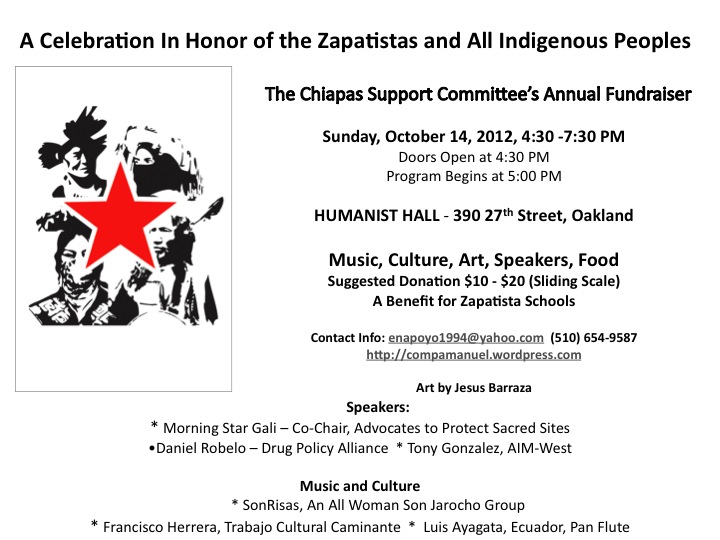
Resumen de Noticias sobre los Zapatistas – Agosto del 2012
AGOSTO DEL 2012 RESUMEN DE NOTICIAS SOBRE LOS ZAPATISTAS
En Chiapas
1. Recopilación de firmas para los zapatistas en San Marcos Aviles y Francisco Santiz Lopez. ¡Favor de añadir su firma! – Siguen las amenazas de violencia y desalojo contra bases de apoyo zapatista en San Marcos Aviles. Están pidiendo nuestro apoyo. Los zapatistas temen otro posible desalojo violento. Todos los cultivos, animales y materiales de construcción de los zapatistas han sido robados por miembros de los partidos políticos y no hay suficiente alimento para durarles hasta la próxima cosecha. Una campaña internacional esta en marcha para recopilar firmas en la Declaración en Apoyo a San Marcos Aviles y al preso político zapatista Francisco Santiz Lopez. Esperamos que usted tome una posición a favor de los derechos humanos y la libertad mandándonos su firma. Se puede encontrar la Declaración e instrucciones sobre como añadir su firma en nuestro blog:
2. Justicia retrasada para miembros del ejido Tila – Adherentes a la Otra Campaña Zapatista viajaron desde Tila en la zona norte de Chiapas hasta la Ciudad de México para estar presentes cuando la Corte Suprema dictó la decisión sobre su caso respecto a 130 hectáreas de tierra que el gobierno del estado de Chiapas y autoridades municipales les quitaron. Se esperaba una decisión el 2 de agosto, pero la corte dijo que tenia otros casos que iban a determinar antes y, por tanto, no decidieron sobre el caso.
3. La Juntas de Buen Gobierno de Morelia y La Realidad denuncian ataques – El 15 de agosto del 2012, las Juntas Zapatistas de Morelia y La Realidad denunciaron ataques. La Junta de Morelia acusó a miembros de la ORCAO de una serie de incidentes que involucraron armas de fuego y amenazas de muerte en la comunidad de Moises Gandhi. La ORCAO (Organización Regiónal de Cafeticultores Agrícolas de Ocosingo) también han fumigado las tierras de pastoreo en varias comunidades zapatistas. La Realidad denunció un ataque contra el almacén de café zapatista cerca del ejido San Carlos por dos partidos políticos, el PRI y el PVEM. Estos miembros de partidos políticos levantaron un cerco alrededor del almacén y cortaron la luz eléctrica en su intento de quitarles el almacén a los zapatistas, quienes allí guardan y venden sus productos de café.
4. Información actualizada sobre el caso de Alberto Patishtan – La campaña para obtener la liberación de Alberto Patishtan Gomez, un preso político y adherente de la Otra Campaña, a entrado a una nueva fase. Un abogado que se especializa en casos de violaciones de derechos humanos esta intentando obtener una reunión con el presidente de la Corte Suprema de México. El objetivo de la reunión es pedir la creación de un nuevo mecanismo legal para abrir un espacio donde Patishtan pueda demostrar su inocencia. Quines apoyan a Patishtan están pidiendo cartas dirigidas a la Corte pidiendo que se apoye este cambio. Su pagina web tiene la dirección y un ejemplo de la carta pedida:
http://www.redtdt.org.mx/d_acciones/d_visual.php?id_accion=224
En otros lugares de México
1. Dos agentes de la CIA fueron “emboscados” y heridos por miembros de la policía federal mexicana – El 24 de agosto , vehículos conducidos supuestamente por miembros de la policía federal mexicana persiguieron, detuvieron y dispararon repetidamente a quemarropa contra un vehículo de la embajada estadounidense con placas diplomáticas. Dos agentes de la CIA y un capitán de la marina mexicana se encontraban dentro del vehículo de la embajada EEUU. El vehículo estadounidense portaba el nivel de blindaje más alto disponible y, por eso, los ocupantes del mismo solo fueron heridos levemente. Los agentes de la CIA y el oficial de la marina se dirigian rumbo a un campo de tiro ubicado en un centro de entrenamiento naval secreto en el estado de México. El asalto ocurrió en el estado de Morelos, en la carretera Ciudad de México-Cuernavaca. Uno de los hechos sospechosos del asalto fue que los agentes de la policia federal estaban vestidos de civil. El fiscal general de México declaró que la policía federal se habia “confundido”. La Embajada de los EEUU lo denominó una “emboscada”. 12 de los 18 agentes federales involucrados en la balacera estarán detenidos sin cargos por 40 días bajo un concepto legal relativamente nuevo de “arraigo” hasta que la investigación sea completada. El Departamento de Estado de EEUU no hará ninguna declaración hasta que se complete la investigación, en la cual están colaborando autoridades estadounidenses y mexicanas. Según La Jornada, una de las hipótesis que están investigando es si miembros del crimen organizado estuvieron involucrados.
2. Cuestionamientos electorales desestimados – El 30 de agosto, el Tribunal Electoral mexicano desestimó todos los cuestionamientos que se habían registrado en contra de las elecciones presidenciales del 1 de julio, como si fueran basura. La decisión se firmó al siguiente día. Esto significa que Enrique Peña Nieto es oficialmente el presidente electo de la república mexicana y tomará posesión de su cargo el 1 de diciembre de este año. #YoSoy132 organizó un “Funeral para la Democracia” para expresar su inconformidad en el Distrito Federal, asi como en varios estados. Andrés Manuel López Obrador (AMLO) ha prometido que habrá desobediencia civil.
3. Asesinatos en México: ¡95.000 desde 2007! – Este mes, el Instituto Nacional de Estadística y Geografía mexicano (INEGI) dio a conocer la cifra de asesinatos en México desde 2007, el año cuando el Presidente Felipe Calderón sacó al Ejército Mexicano a las calles a realizar funciones de policía en el combate contra el crimen. El INEGI mencionó también que en el 2011 se cometieron 27,199 homicidios en México. Esto significa que 74 personas fueron asesinadas cada día, es decir 3 cada hora o uno cada 20 minutos, durante el quinto año de esta administración, lo que implica una cifra 160% más alta que el número de asesinatos cometidos durante 2006.
4. La Suprema Corte dicta 2 sentencias relacionados con la inmunidad castrense – El 21 de agosto, la Suprema Corte de Justicia en la Nación (SCJN) en México decretó inconstitucionalidad en una sección del Código Militar que permitía que soldados acusados de abusos en contra de civiles fueran juzgados en tribunales militares. El 30 de agosto, la SCJN dictó otra resolución repitiendo que la misma sección del Código es inconstitucional, y transfirió el caso de un miembro del ejército acusado de abuso infantil a un tribunal civil. Esto significa un paso importante para las víctimas de abusos de los derechos humanos perpetrados por soldados, y algo que l@s defensores de derechos humanos han esperado por mucho tiempo. Existen muchos más casos similares a este pendientes ante la SCJN. Una vez que sean resueltos, las limitaciones a la inmunidad castrense serán más claramente definidas.
En Los EEUU
1. La campaña de Sicilia viaja a través de los Estados Unidos -El Movimiento por la Paz con Justicia y Dignidad (MPJD), encabezado por el poeta y periodista mexicano Javier Sicilia, inició dentro de los Estados Unidos una caravana por la paz que arrancó en San Diego, California el 12 de agosto. Hasta el momento, la caravana ha viajado a través de los estados de California, Arizona, Nuevo México, Texas, Alabama, Mississippi y Georgia abordando 5 cuestiones de política de U.S. a lo largo de su ruta hacia Washington DC: 1) financiamiento estadounidense de una guerra contra las drogas en México a través de la Iniciativa Mérida; 2) tratamiento humano a los inmigrantes; 3) tráfico de armas hacia México; 4) blanqueo de dinero de la droga por bancos estadounidenses; y 5) la militarización de la política exterior norteamericana. Tras la visita de la caravana a El Paso, Texas, el consejo municipal aprobó una resolución pidiendo al gobierno federal estadounidense solidaridad con las víctimas de la violencia en México, una discusión sobre política de drogas de los Estados Unidos y un código de conducta para la venta de armas. En Phoenix, Sicilia se reunió con el Sheriff Joe Arpaio. Sicilia declaró después en una entrevista que creía que el sheriff era un “adicto al racismo”. El huracán Isaac impidió a la caravana su parada en Nueva Orleans. El itinerario de la Caravana por la Paz está publicado en nuestro blog: https://compamanuel.wordpress.com/2012/07/01/javier-sicilia-and-the-caravan-for-peace-us-schedule/
________________________________________
Chiapas Support Committee/Comité de Apoyo a Chiapas
P.O. Box 3421, Oakland, CA 94609
Tel: (510) 654-9587
Email: cezmat@igc.org
http://www.facebook.com/pages/Chiapas-Support-Committee-Oakland/86234490686
https://compamanuel.wordpress.com
Raúl Zibechi: The Peace of Extractivism
The Peace of Extractivism In Colombia
By: Raúl Zibechi
The struggle between the guerrilla and the State was a true war of classes in Colombia. The young campesino liberal Pedro Marín became Manuel Marulanda when the violence, started by the assassination of the head of the Liberal Party Jorge Eliécer Gaitán, April 9, 1948, forced him to flee into the woods to save his life. The Bogotazo, the popular urban uprising in response to the crime, was the epicenter of a war between conservatives and liberals that in 10 years reaped the life of 200, 000 Colombians.
Poor campesinos were not included in the National Front that in 1958 sealed the peace between the conservative power and the liberal “doctors” of the cities, because the war was made to steal their land and disorganizing them as a class. In order to survive they became guerrillas, created self-defense and, with time and disillusion, became communists. In 1966, the FARC was born from those confluences, opening a new stage in campesino struggles.
Military offensives failed and facing the territorial expansion of the armed organizations, two moments for negotiations were opened. Under the presidency of Belisario Betancur (1982-1986) there was a truce within the framework from which the Patriotic Union was formed, in 1985, in which the Communist Party was included. The new force obtained five senators, 14 deputies and 23 mayors, but in the following years was practically exterminated by paramilitaries, soldiers and drug traffickers. Thirteen deputies and 70 council members, 11 mayors and several thousand were murdered. During the government of Andrés Pastrana (1998-2002) a “zone for detente” was created at the Caguán River, which encompassed four municipalities and 42, 000 square kilometers. At the same time, in 1999 the government signed Plan Colombia with the United States, which subordinated Pastrana’s policy to it and inclined it to renew the war.
On this occasion, everything indicates that the general agreement for ending the conflict and the construction of a stable and lasting peace between the government of Juan Manuel Santos and the FARC, with the explicit possibility of “the abandonment of arms,” can put an end to the war. It is possible the other armed group, the ELN, will be incorporated into the negotiations.
The new relation of forces in Colombia, the region and the world make possible that an end to the 60-year war is coming.
The first is that Colombian society has changed profoundly in this half century. We’re dealing with a majority urban population, whose principal demand is not land, but housing, which desires the end of the conflict and participates in social movements that are impacting the principal cities, where the conservatives and liberals no longer govern. The second is that the dominant classes, whose best expression in these times is President Santos, accumulate now around the extractive model (hydrocarbons, mining and mono-crops), no longer by means of plundering of the campesino. The map of extractivism is one of armed conflict. Dedicating a part of the gigantic war budget to infrastructure works is urgent for lubricating the flow of commodities and to continue attracting investments.
The end of the conflict makes another war visible: the multi-nationals against the peoples. The Constitution of 1991 recognizes the ancestral territories of indigenous and Afro-descendents under the name “shields.” More than 600 indigenous shields have been created that occupy one third of the Colombian territory and are the zones of expansion of extractivism. The third question is the change in the relation of forces. The Colombian Armed Forces have been strengthened and have an elevated capacity for combat. The FARC have been weakened, they cannot win on the military terrain and they lost legitimacy. The economic, cultural and social changes moved the axis of the social conflict to the cities. In rural areas the FARC fell out with the indigenous, which are the principal force that resists the extractive model. The fourth are the new geopolitical winds. The South American countries do not want conflicts. Venezuela is more preoccupied by managing its economy. Brazil tends bridges to Colombian entrepreneurs and Brasilia seeks to consolidate the presence of Bogotá in the Unasur. The Mercosur countries, which can be expanded with Bolivia and Ecuador, gamble on winning the economic competition with those that belong to the Pacific Alliance (Mexico, Chile, Peru and Colombia).
The United States is repositioning its Armed Forces in the Pacific to contain China and does not seem in a position of opening new war scenarios in other parts of the world. It is possible that the Pacific Alliance, situated in the bilateral FTAs, begins to have a more active role in US diplomacy than Plan Colombia, without supplanting it as a “final solution” to its hegemonic decline. It will depend on who occupies the White House in January.
Finally, it must be understood that the principal enemy of Santos is not Hugo Chávez or the FARC, but rather Álvaro Uribe. As well as the soldiers that interceded in boycotting the previous peace processes, Uribe needs the war to stay afloat. Santos has, as Alfredo Molano points out in an excellent article titled Be Quiet! (El Espectador, 1º de setiembre de 2012), a demolishing argument: sending him on a DEA plane to the United States.
For the movements, the end of the war is not peace, but the continuation of the struggle in a more favorable scenario. In full conflict, confronting repression and death, they were capable of carrying out big mobilizations, like the Social and Communitarian Minga of 2008, impelled by the Nasa communities of Cauca, and of getting the Congress of the Peoples underway, where multiple collectives came together. Now they are prepared to continue, “walking the word,” defending their territories from the multi-nationals. The “peace of extractivism” approaches and with it comes a new cycle of struggles of those from below.
_________________________________________________________
Originally Published in Spanish by La Jornada
English translation: Chiapas Support Committee
Friday, September 7, 2012
En español: http://www.jornada.unam.mx/2012/09/07/opinion/021a2pol
Zapatista News Summary – August 2012
AUGUST 2012 ZAPATISTA NEWS SUMMARY
In Chiapas
1. Collection of Signatures for Zapatistas in San Marcos Avilés and Francisco Sántiz López! Please Sign On! – Threats of violence and eviction continue against Zapatista support bases in San Marcos Avilés. They are asking for our support. The Zapatistas fear another, and possibly violent eviction. All the Zapatistas’ crops, animals and building supplies have been stolen by political party members and there is not enough food to last them until the next harvest. A global campaign is underway to collect signatures on a Declaration in Support of San Marcos Avilés and Zapatista political prisoner Franciso Sántiz López. We hope you will take a stand for human rights and freedom by sending us your signature. The Declaration and how to sign is posted on our blog (below) at: https://compamanuel.wordpress.com/2012/08/30/please-sign-this-declaration-in-support-of-the-zapatistas/
2. Justice Delayed for Tila’s Ejido Members – Adherents to the EZLN’s Other Campaign traveled all the way from Tila, in the Northern Zone of Chiapas, to Mexico City to be present when Mexico’s Supreme Court issued a decision on their case concerning the 321 acres (130 hectares) of land that the Chiapas state government and municipal authorities took away from them. A decision was expected on August 2, but the Court said it had other cases to decide first and, therefore, did not rule on the case.
3. Zapatista Good Government Juntas of Morelia and La Realidad Denounce Attacks – On August 15, 2012, both Zapatista Juntas (Morelia and La Realidad) denounced attacks. The Junta in Morelia accused ORCAO members of a succession of incidents involving firearms and death threats in Moisés Gandhí community. The ORCAO (Regional Organization of Ocosingo Coffee Growers) members have also fumigated pastureland in several Zapatista communities. La Realidad denounced an attack on the Zapatista coffee warehouse near the San Carlos Ejido by members of two political parties, the PRI and the PVEM. These political party members put up a fence around the warehouse and cut off its electricity in their attempt to take the warehouse away from the Zapatistas, who store and sell their coffee products there.
4. Update on Alberto Patishtán Case – The effort to obtain freedom for Alberto Patishtán Gómez, a political prisoner and Other Campaign adherent, has entered a new phase. A lawyer specializing in human rights cases is attempting to obtain a meeting with the president of Mexico’s Supreme Court. The purpose of such a meeting is to request the creation of an innovative legal mechanism to open a space for Patishtán to prove his innocence. Patishtán’s supporters are asking for letters addressed to the Court supporting such a move. Their website provides an address and sample letter: http://albertopatishtan.blogspot.fr/2012/08/accion-carta-scjn.html
In Other Parts of Mexico
1. Two CIA Agents “Ambushed” and Injured by Mexican Federal Police – On August 24, vehicles allegedly carrying Mexican Federal Police pursued, stopped and repeatedly shot from close range at a US Embassy vehicle with diplomatic license plates. Inside the US Embassy’s SUV were 2 CIA agents and a Mexican Navy captain. The Embassy vehicle had the highest level of armored plating available and, therefore, the vehicle’s occupants were only slightly injured. The CIA agents and the Navy captain were on their way to a shooting range on a secret Navy training facility in the state of Mexico. The attack occurred in the state of Morelos, on the Mexico City-Cuernavaca Highway. One of the many suspicious facts is that the Federal Police were dressed in civilian clothing. Mexico’s Attorney General took the position that the federal police were “confused.” The US Embassy called it an “ambush.” 12 of the 18 federal police involved in the shooting are being held without charges for 40 days under the relatively new legal figure of “arraigo” until the investigation is complete. The US State Department is withholding any statement pending the completion of the investigation, in which the US and Mexican authorities are now collaborating. According to La Jornada, one of the lines of investigation is whether or not members of organized crime were involved.
2. Election Challenges Thrown Out! – On August 30, Mexico’s Electoral Tribunal threw out all challenges to the July 1 presidential election like pieces of garbage. The decision was signed the following day. This means that Enrique Peña Nieto is officially the president-elect of Mexico and will take office on December 1 of this year. #YoSoy132 held a “Funeral for Democracy” to protest the ruling in Mexico City, as well in various states. Andrés Manuel López Obrador (AMLO) has also promised civil disobedience.
3. Murders in Mexico: 95,000 Since 2007! – This month, Mexico’s National Institute of Statistics and Geography (Inegi, its initials in Spanish) released its figures on the number of murders in Mexico since 2007, the year when President Felipe Calderón sent the Mexican Army into the streets to perform the police function of fighting crime. Inegi also reported that 27,199 homicides were committed in Mexico in 2011. This means that 74 people died every day because of murder, three per hour or one every 20 minutes during the fifth year of this government, a portion 160 percent higher than the number of homicides perpetrated in 2006.
4. Mexico’s Supreme Court Issues 2 Rulings on Military Immunity – On August 21, Mexico’s Supreme Court of Justice ruled unconstitutional a section of the Military Code that permitted soldiers accused of abusing civilians to be tried in military courts. On August 30, the Supreme Court issued a second ruling that found the same section of the Military Code unconstitutional and transferred the case of a member of the military accused of child abuse to a civilian court. This is an important step for victims of human rights and other abuses by soldiers and a step long-sought by human rights advocates. There are several more cases involving this issue pending before the Supreme Court. Once all are resolved, the limits of military immunity will be more clearly defined.
In the United States
1. Sicilia’s US Campaign Travels Through the United Stateas – The Movement for Peace with Justice and Dignity (MPJD), headed by Mexican poet and journalist Javier Sicilia, started a US Peace Caravan in San Diego, California, on August 12. So far, the Caravan has traveled through California, Arizona, New Mexico, Texas , Alabama, Mississippi and Georgia addressing 5 US policy issues along its route to Washington DC: 1) US funding of a Drug War in Mexico through the Merida Initiative; 2) humane treatment of immigrants; 3) arms trafficking to Mexico; 4) laundering of drug money by US banks; and 5) the militarization of US foreign policy. Following the Caravan’s visit to El Paso, Texas, the City Council passed a resolution asking the US federal government for solidarity with the victims of violence in Mexico, a discussion of US drug policy and a code of conduct for arms sales. In Phoenix, Sicilia met with Sheriff Joe Arpaio. Sicilia stated in an interview afterwards that he believed the sheriff was “addicted to racism.” Hurricane Isaac prevented the Caravan from stopping in New Orleans. The Peace Caravan’s itinerary is posted on our blog: https://compamanuel.wordpress.com/2012/07/01/javier-sicilia-and-the-caravan-for-peace-us-schedule/
__________________________________________
Compiled monthly by the Chiapas Support Committee.
The primary sources for our information are: La Jornada, Enlace Zapatista and the Fray Bartolome de las Casas Human Rights Center (Frayba).
We encourage folks to distribute this information widely, but please include our name and contact information in the distribution. Gracias/Thanks.
Click on the Donate button of www.chiapas-support.org to support indigenous autonomy.
_______________________________________________________
Please Sign This Declaration in Support of the Zapatistas
Please Sign This Declaration to Support Justice for Zapatistas in San Marcos Avilés and Freedom for Francisco Sántiz López

We view with profound concern, and demand an immediate end to the continued acts of intimidation and aggression and the human rights abuses being committed against members of the Zapatista support base community in San Marcos Avilés, official municipality of Chilón, Chiapas, Mexico. We also call for the immediate liberation of the Zapatista political prisoner Francisco Sántiz López, who has been jailed since December 2011 in a flagrant abuse of justice.
Responding to the numerous denouncements and calls issued by the Zapatista Good Government Junta of Oventic and the community of San Marcos Avilés, we manifest in this declaration our solidarity with our brothers and sisters there, as well as with Francisco Sántiz López.
We are aware of the very serious new threats being made against the community of San Marcos Avilés by representatives of political parties in the area. Of particular concern are the open and blatant threats of displacement, physical violence, and the on-going climate of hostility promoted by these individuals. We consider such reprehensible aggression to be extremely serious in light of the events of September 2010, when vigilantes from the Green Ecologist Party of Mexico (PVEM), the Institutional Revolutionary Party (PRI) and Party of the Democratic Revolution (PRD), led by Lorenzo Ruiz Gómez and Vicente Ruiz López, attacked Zapatista support bases, displacing 170 people and destroying their property and crops.
In relation to the case of Francisco Sántiz López, a Zapatista support base from the Banavil ejido of Tenejapa, who was originally detained in December 2011 under false charges of having orchestrated a conflict in Banavil, we affirm the evidence collected by the Fray Bartolomé de Las Casas Human Rights Centre and recounted by several witnesses, that he indeed was not present at the location where the events took place on 4th December 2011. His false imprisonment and the continued refusal of local authorities to examine this evidence are, in our view, further indication that the judicial system in Chiapas is wielded as tool of political repression against those who struggle for justice.
In respect to current events in San Marcos Avilés, we demand
· An immediate end to all death threats, verbal and physical harassment, and threats against the property and well-being of the Zapatista Support Base members by elements of the political parties in the San Marcos Avilés ejido
· Protection for the life and safety of the Zapatista support base members of San Marcos Avilés
· Respect for the Zapatista Support Base community’s inalienable right to autonomy as indigenous peoples, as enshrined in the internationally recognized ILO Convention No. 169 and the UN Declaration on the Rights of Indigenous Peoples, both of which the government of Mexico has signed
In respect of the case of Zapatista support base Francisco Sántiz López, we demand his immediate and unconditional release, as well as a swift investigation and prosecution of the perpetrators of violence in Banavil, Tenejapa Municipality, Chiapas.
To our brothers and sisters suffering injustice and violence in Chiapas, we remind you that your struggle is not carried out in silence, nor is it invisible. Indeed, countless individuals, organizations, and communities from around the world remain vigilant regarding your situation and have joined an international campaign in solidarity with your struggle. For our part, from cities across the world we send you a warm embrace, to let you know that we know who you are and what you are fighting for, and to say that we will do whatever we can to support you. We will all continue to make an echo of your just demands, an echo that resonates with the collective heartbeat of the earth.
To watch a video message from the compas in San Marcos Avilés:
http://www.youtube.com/watch?v=rY-8CBt3Vkg
For further information please go to: http://sanmarcosavilesen.wordpress.com
Please send your signatures of support, including your and the name of your group, organization or collective (if you belong to one) and your town or country, to enapoyo1994@yahoo.com no later than September 18, 2012.
 Chiapas Support Committee