Chiapas Support Committee
Home of the Compañero Manuel blog on zapatistas & mexico
Esteva: Time for Hope
TIME FOR HOPE
By: Gustavo Esteva

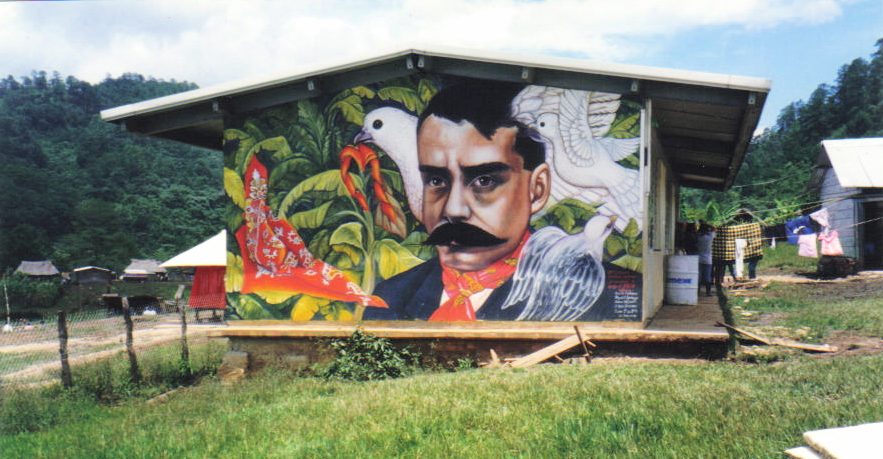
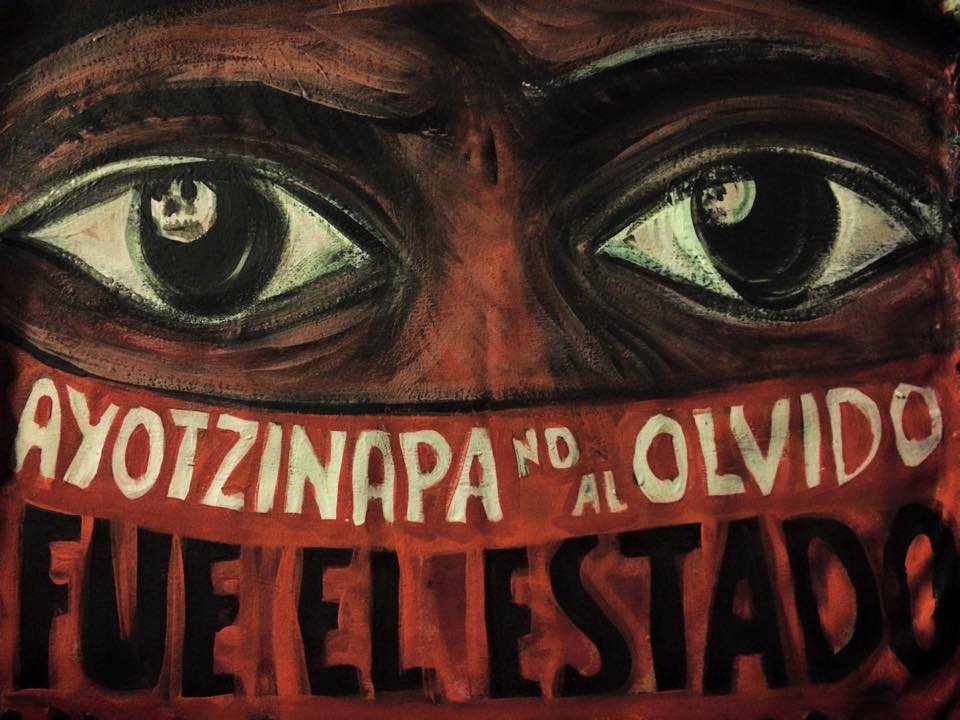
This painting was on display at the Festival in San Cristóbal: 2 Jaguars and a Black Panther.
The disappearance of a loved one is one of the worst evils that someone can suffer. It isn’t just the uncertainty that it provokes. It’s wondering every day if it won’t be happening to him what happened to many that have appeared, whose cadavers showed signs of savage and atrocious torture before being murdered. How to avoid desperation? How to confront serenely the mystery of evil, this overwhelming evil that pursues us?
In the last two years in Mexico one person disappears every two hours. Every two hours! We now have tens of thousands of families in that drama. There are many others whose loved ones were savagely murdered and millions of displaced. One third of the population has felt obliged to live outside of the country.
The family members of the Ayotzinapa students have permitted us to live together with them the drama that is profoundly moving and to experience at their side a form of response that isn’t sunk in desperation. They woke up millions, inside and outside the country. With surprising spirits, with as much courage as imagination, they don’t leave anyone at peace. They don’t want those that were asleep to go back to sleep, to return to indifference, to occupy oblivion, or those above to wash their hands.
Even the United Nations, with its hands and tongue tied by the structure and rules that define the organism, has had to react. The UN Committee against Enforced Disappearances not only just recognized formally that state of things. It has also criticized the Mexican government for the impunity that prevails in the face of those daily crimes and for not attributing the priority that is required to the search for the disappeared. It required investigating “all the state agents and organs that could have been involved, as well as exhausting all the lines of investigation.” The committee formulated a recommendation crucial to remembering the responsibility of the high commanders of those that commit the crimes.
A combination of blindness and cynicism persists in those who occupy the business of governing and in their friends and accomplices. Indifference, apathy or fear also persists in many people. Likewise, fervent adhesion to some charismatic leader and his cohorts persists, on the part of those that still believe that he could stop the horror first, and later follow the progressive path of other Latin American leaders. Although the discontent is more general all the time, even among the sponsors and beneficiaries of the current government, many don’t know what to do, others don’t consider the paths that don’t pass through the electoral exercise realistic, and still others are disposed to changing everything… so that nothing changes: may all those responsible for our drama be replaced; may they present sharp blows to the leaders and may there be a great clamor, but all that inside of the framework in effect, within the nation-State, representative democracy, the economic society, development, capitalism… They believe that it’s too illusory or dangerous to attempt anything else.
At the same time, the citizen mobilization expands and gathers strength and organic form. On February 5 two parallel initiatives got underway that on the path will be able to interlace for diverse longings. The agreement in their diagnosis of the current political crisis is impressive, although important differences are appreciated in the reaches and styles of their proposals. The two illustrate, each in its own way, the desire and capacity of giving organic form to the generalized discontent, to the resistance, to rebellion and to a transforming impetus. Instead of paralysis and desperation, the national drama is generating lucid brave and organized reactions.
One more of those initiatives will take form today, upon a multifaceted commission of university students, activists and members of the National Indigenous Congress being in installed in Cuernavaca. It proposes contributing to dialogue and agreement among the diverse cultures that we are. Its members are convinced that there will be no justice, peace and security in the country while the social order is not constructed on diversity. It’s about giving concrete meaning and efficacy to the idea that the Zapatistas formulated 20 years ago: we must construct a world in which many world fit.
The current effervescence has already permeated all social layers and even reaches the most isolated corners of the country. Our demons were let loose a long time ago and created this unsupportable state of things in which we are submerged. Now, the forces that will be able to conquer them have been set in motion, by serenely advancing in the national reconstruction. The genie escaped from the bottle and it will not be possible to put it back in. Thus, the hope of giving full reality to our emancipation is nourished every day.
———————————————————–
Originally Published in Spanish by La Jornada
Translation: Chiapas Support Committee
Monday, February 16, 2015
http://www.jornada.unam.mx/2015/02/16/opinion/021a2pol
U.N. Committee issues report on Mexico’s disappearances
U.N. URGES MEXICO TO CREATE AN ATTORNEY GENERAL’S UNIT AGAINST ENFORCED DISAPPEARANCES
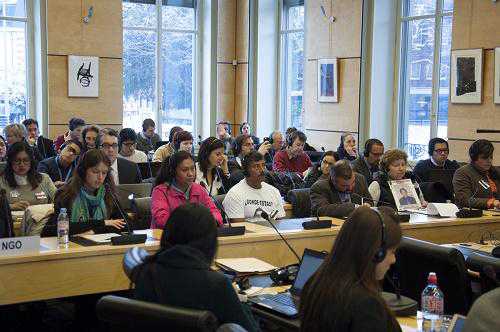
Parents of the 43 disappeared Ayotzinapa students testify at UN committee hearing.
By: Afp and Dpa (agencies)
Geneva. The UN Committee against Enforced Disappearances [1] recommended to Mexico the creation of a “an attorney general’s unit specialized in investigating forced disappearances,” an opinion published this Friday in Geneva points out.
Said unit would have to function “within the ambit of the Attorney General of the Republic (Procuraduría General de la República, PGR)” and count “on personnel specifically qualified,” as well as having “a strategic perspective at the national and transnational level” that nourishes “the work of searching,” the opinion adds.
México should “redouble its efforts” for attacking the problem of the “generalized” disappearances that the country experiences, the committee asked (of Mexico), after examining the Mexican case in the context of the disappearance and alleged murder of the 43 students.
“The grave case of the 43 students subjected to forced disappearance in September 2014 in the State of Guerrero illustrates the serious challenges that the State faces in matters of prevention, investigation and sanction of forced disappearances and the search for those disappeared,” it added.
On February 2 and 3, the UN committee examined Mexico within the framework of obligations emanated from the international convention against the forced disappearances and today it emitted a document with 50 points where it details its concerns and recommendations.
The ten independent experts that make up the Committee elaborated the opinion, which examined the case of Mexico at the beginning of this month.
The UN also asks for the creation of “a single registry of disappeared persons at the national level that permits establishing trustworthy statistics with views to developing holistic and coordinated policies directed to preventing, investigating, sanctioning and eradicating this aberrant crime.”
This registry is a demand that civil society made in Geneva during the summons of the Mexican government recently.
For the UN, the registry would have to “exhaustively and adequately reflect all the cases of disappeared persons, including information about sex, age and nationality of the disappeared person the place and date of disappearance,” and “including information that permits determining if it deals with a enforced disappearance or with a disappearance committed without any participation of state agents.”
The Committee also exhorts, that the registry contain “statistical data with respect to cases of forced disappearance even when they have been clarified” and “be completed based on clear and homogeneous criteria and updated permanently.”
It also asked for advancing “quickly” in the legislative process so that a law on enforced disappearances is adopted for all of the country, with the participation of the civil society organizations and the National Human Rights Commission (CNDH, its initials in Spanish). Mexico has pointed out that it hopes that that law is ready for June.
At the same time, it lamented the impunity that persists in numerous cases of enforced disappearance.
The Committee added that: “it notes with concern the lack of precise statistical information on the number of persons subjected to enforced disappearance, which impedes knowing the true magnitude of this scourge and makes it difficult to adopt public policies that permit fighting it effectively.”
Around 24,000 persons have disappeared in Mexico from 2006 to this date, sources from non-governmental organizations (NGOs) agree.
The Committee also referred to the enforced disappearances recorded in the decade of the 1970s during what’s called the “dirty war” and the absence of “significant advances” in the investigations, as well as the disappearance of migrants, many time with the participation of authorities, on their way through Mexico to the United States.
It also recommended that the cases of enforced disappearance of military personnel on the part of other military personnel be the exclusive jurisdiction of civilian tribunals, and not of military justice, to guaranty impartiality.
Mexico will have until February 13, 2016 (one year) to give the Committee information about the application of the points referring to the single list of disappeared persons, mechanisms for search, prevention and investigation of the disappearance of migrants.
Besides, it set February 13, 2018 as the time limit for offering “concrete and updated information about the application of all its recommendations.”
Translator’s Note on the definition of Enforced Disappearance
[1] “For the purposes of this Convention, “enforced disappearance” is considered to be an arrest, detention, abduction or any other form of deprivation of liberty by agents of the State or by persons or groups of persons acting with the authorization, support or acquiescence of the State, followed by a refusal to acknowledge the deprivation of liberty or by concealment of the fate or whereabouts of the disappeared person, which place such a person outside the protection of the law.”
Source: International Convention for the Protection of All Persons from Enforced Disappearance. http://www.ohchr.org/EN/HRBodies/CED/Pages/ConventionCED.aspx
————————————————–
Originally Published in Spanish by La Jornada
Translation: Chiapas Support Committee
Friday, February 13, 2015
Citizen groups propose new Constitution in Mexico
Proposal for a popular citizens convention to re-found Mexico

Promoters of the popular citizen constituent with Javier Sicilia, far left, and Bishop Vera, second from right.
By: Agencies
In Mexico City, Bishop Raúl Vera López, activists, clergy, members of campesino, union and social organizations and survivors of the violence that envelops Mexico presented the initiative of a Popular Citizens Convention, which will have to convoke a series of sessions throughout the country, and a March 21 meeting, to discuss the political reality and to formulate a new Carta Magna.
Within the context of the anniversary of the promulgation of the Mexican Constitution, the activists explained that the constant human rights violations are evidence that lamentably the Magna Carta “is dead;” therefore a new one must be formulated that responds to the interests and respects the social, economic and political rights of the citizens.
The Bishop of Saltillo and president of the Fray Bartolomé de las Casas Human Rights Center (in Chiapas), Raúl Vera, detailed that this initiative has “re-founding Mexico” as its objective, because this is a “ruined country” where violence and “impunity” excel.
Without political parties
Raúl Vera explained that the elaboration of a new Constitution must reach all the country’s corners and add all the social sectors. A new Congress must be established for that, “without political parties,” which have demonstrated that their interest is not in society.
The strategy for now is to carry out a series of sessions throughout the country. The organizers of the Citizens Convention will convoke a meeting next March 21 for discussing the country’s political reality with the 2015 (mid-term) elections in sight.
Throughout the last eleven months, the proposal’s promoters have maintained contact with citizens in 28 states of the country and with diverse organizations of migrants and Mexicans residing outside the country to support this initiative.
At the presentation, besides Vera López were the painter Francisco Toledo, Javier Sicilia, Father Alejandro Solalinde, the priest Miguel Concha, Gilberto López y Rivas, migrant defender Leticia Gutiérrez, as well as union representatives, among them Martín Esparza and members of diverse churches, at the start of the act remember the events that occurred more than four months ago in Iguala, Guerrero, the product of which 43 students of the rural teachers college at Ayotzinapa were disappeared.
—————————————————–
Published in Spanish by Chiapas Paralelo
Translation: Chiapas Support Committee
Friday, February 6, 2015
http://www.chiapasparalelo.com/?s=constituyente&submit.x=8&submit.y=7
Zibechi: Systemic chaos and transitions
SYSTEMIC CHAOS AND TRANSITIONS UNDERWAY

Yesterday’s mega-march in Chilpancingo, Guerrero’s state capital, in support of Ayotzinapa. Photo from La Jornada
By: Raúl Zibechi
Geopolitics helps us comprehend the world in which we live, particularly in turbulent periods like the current one, whose principal characteristic is global instability and a succession of permanent changes and fluctuations. But geopolitics has its limits for approaching activity of the anti-systemic movements. It provides us with a reading of the scenario in which they act, which is not a small thing, but cannot be the central inspiration of emancipatory struggles.
The way I see things, Immanuel Wallerstein has been the one that has succeeded in perfecting most precisely the relationship between chaos within the world-system and its revolutionary transformation by the movements. In his most recent article entitled “It is painful to live amidst chaos,” he emphasizes that the world-system is self-destructing with 10 to 12 powers coexisting that have the ability to act autonomously. We are in the midst of the transition from a unipolar world to another multipolar world, a necessarily chaotic process.
In periods of instability and crisis activity of the movements can most efficiently influence the world’s redesign. It’s a window of opportunity necessarily short in terms of time. It’s during these storms and not in periods of calm when human activity can modify the course of events; and therein is the importance of the current period.
Some of his works published in the collection El Mundo del Siglo XXI (The World of the 21st Century), directed by Pablo González Casanova, approach the relationship between systemic chaos and transitions toward a new world system (Después del liberalismo e Impensar las ciencias sociales, Siglo XXI, 1996 and 1998). In Marx and under-development, published in English in 1985, now three decades ago, he warns about the need to “re-think our metaphor for transition,” since the 19th Century we have been entangled in the debate between evolving ways facing revolutionaries for attaining power.
I think that the most polemic point, and at the same time the most convincing, is his assertion that we have believed that transition is “a phenomenon that can be controlled” (Impensar las ciencias sociales, p. 186). If the transition can only be produced as a consequence of a bifurcation in a system in chaotic situation, as the scientists of complexity point out, seeking to direct it is as much an illusion as a risk of re-legitimizing the order in decomposition if se accede to state power.
The above isn’t saying that we can’t do anything. To the contrary, “we must lose the fear of a transition that takes on the aspect of collapse, of disintegration, which is disordered, in a certain way can be anarchic, but not necessarily disastrous,” Wallerstein wrote in the quoted text. He adds that revolutions can do their best work by promoting the collapse of the system.
This would be a first form of influencing the transition: aggravating the collapse, exploiting the chaos. As the same author recognizes, a period of chaos is painful, but it can also be fertile. Moreover: the transition to a new order is always painful, because we are part of what is crumbling. Thinking about linear and calm transitions is a tribute to the ideology of progress.
After 1994 we began to know the second way of influencing the transition, which permitted us to enrich the previous considerations. We’re talking about the creation, here and now, of a new world; not as prefiguration, but rather as concrete reality. I refer to the Zapatista experience. I believe that both ways of influencing (collapse and creation) are complimentary.
Zapatismo has created a new world in the territories where it is settled. It is not “the” world that we imagine in our old metaphor of transition: a nation-State where a symmetric totality is constructed that seeks to be a negation to the capitalist one. But this world has, if I understood something that the support bases taught us during the Escuelita, all the ingredients of the new world: from schools and clinics to autonomous forms of government and production.
When the systemic chaos deepens, this new world created by Zapatismo will be an unavoidable reference for those below. Many don’t believe that the systemic chaos can be deepened. Nevertheless, we have in front of us a panorama of inter-state and intra-state wars, which add up to the “fourth world war” of capital underway against the peoples. These are some chaotic situations that we watch. That can coincide, within the same period, with climatic chaos in development and the “health chaos,” according to the WHO’s forecast of the next and inevitable expiration of antibiotics.
In history, the big revolutions were produced in the midst of wars and dreadful conflicts, as a reaction from below when everything was crumbling. During the cold war the hypothesis spread that the contestants would not use nuclear weapons that assured mutual destruction. Today there are few that would bet on that.
A new metaphor of the possible transition is being born before us: when the world-system begins to disintegrate generating tsunamis of chaos, the peoples will have to defend life and reconstruct it. Upon doing so, it is probable that they adopt the kind of constructions created by the Zapatistas. That’s what happened in the long transitions from antiquity to feudalism and from feudalism to capitalism. In the midst of chaos, the peoples usually bet on principles of order, like some indigenous communities of our time are.
Something like that is already happening. Some of the PRI families go to the clinics in the (Zapatista) Caracoles and others seek a just solution to their conflicts in the Good Government Juntas. The peoples have never passed in mass to systemic alternatives. One family does it one day, then another, and so on. We are transitioning towards a new world, in the midst of pain and destruction.
———————————————————–
Originally Published in Spanish by La Jornada
Translation: Chiapas Support Committee
Friday, January 23, 2015
En español: http://www.jornada.unam.mx/2015/01/23/opinion/021a2pol
Zapatista News Summary for January 2015
ZAPATISTA NEWS SUMMARY for JANUARY 2015

In Chiapas
1. EZLN Issues New Years Comunicado – We received the EZLN’s comunicado: “Words on its 21st Anniversary of the Beginning of the War against Oblivion” in English the first week in January. Sup Moisés read it to those in attendance at the New Years Celebration in Oventik. The comunicado focuses on the families of the 43 disappeared Ayotzinapa students and talks about the injustices in society and why we must rebel against and resist injustice.
2. Joint Declaration from the Festival – The National Indigenous Congress (CNI), the EZLN and adherents to the Sixth Declaration issued a Joint Declaration from the Festival of Resistances and Rebellions against Capitalism on January 8. Not surprisingly, it spells out the evils of capitalism and the environmental damage it causes to Mother Earth and to her Peoples. Also, it urges us to organize: “We invite you to continue walking with a small but firm step, to continue to meet, share, construct, and learn along with us, to weave the organization from below and to the left of the Sixth that we are.” A good summary of the entire Festival has just been published on Counterpunch, written by a good friend of the CSC.
3. San Sebastián Bachajón: Another Eviction and Another Recuperation – San Sebastián Bachajón (SSB) ejido owners denounced from the tourist center of the Agua Azul Cascades that at approximately 6:30 AM on January 9, more than 900 state and federal police evicted the compañer@s that were guarding the lands recuperated last December 21. The timing of these events is interesting. SSB recuperated their land as the Festival started and the government waited to strike back until it ended. On January 11 and 12, SSB launched a successful, although difficult, struggle to again recuperate the land that the government had taken away from them. It includes the ticket booth at the entrance to the Agua Azul Cascades, a large tourist attraction between Ocosingo and Palenque. It also includes a public security (state police) office and a government clinic that is not in use. At the same time, the Chiapas State Human Rights Commission asked the state government to take precautionary measures to assure that the human rights of SSB residents would be respected. Meanwhile, an International Caravan of adherents to the Sixth left Mexico City for SSB to act as observers. You can read their First Report here.
4. Mitzitón Files Legal Action Against Chiapas Superhighway Construction – On December 30, 2014, the Indigenous Tsotsil Town of Mitzitón filed a court petition for a protective order (injunction) to suspend the highway work that “the bad government seeks to construct on lands and Territories of Indigenous Peoples in our state.” Mitzitón is an adherent to the EZLN’s Sixth Declaration of the Lacandón Jungle. Its lands are located where the road from San Cristóbal to Comitán (also known as the Pan-American Highway) intersects with the road to Ocosingo and Palenque. The government plans to convert both roads into superhighways, which requires taking land away from a number of indigenous communities. Mitzitón announced the legal action in a communiqué to the Festival of Resistances and Rebellions against Capitalism.
In other parts of Mexico
1. Ayotzinapa Parents and Students Take Their Struggle to Geneva – Parents and student compañer@s of the 4 murdered and 42 disappeared Ayotzinapa students continue struggling to clarify what really happened on September 26 and 27. Several of the parents are in Geneva, Switzerland, to give testimony to the United Nations Committee Against Forced Disappearances today and tomorrow (February 2 and 3). Their legal representative from the Tlachinollan Human Rights Center in Guerrero is with them. Cases of forced disappearances from other states in Mexico are also represented, as the hearing is about investigating Mexico’s record on dealing with this crime.
2. Mexico’s Attorney General Declares the Students Dead – A large 8th National and International Day of Action in support of Ayotzinapa took place on January 26 without incident. Marches took place throughout Mexico. Roadblocks continue in Guerrero, although the government has started to crack down and arrest people for taking over tollbooths on superhighways. The citizen search for the students continues, students and parents continue visiting organizations asking them to join their movement to find the truth about what happened to the 43. Meanwhile, Mexico’s attorney general announced that the investigation is closed, thereby pronouncing the students dead. The Attorney General’s position is that members of the United Warriors Cartel murdered the students and incinerated their bodies in the Cocula garbage dump, then threw their ashes into the river. The government’s position is based on testimony from the criminals it arrested and the fact that DNA found at the garbage dump matched one of the students. The University of Innsbruck could not match any other ashes or remains from the dump to the students with preliminary DNA testing, but has agreed to conduct more tests using a new method. The parents object to closing the investigation and believe there are lines of investigation still to be explored; such as, the role, if any, of the Army, the ex governor of Guerrero and other government officials.
———————————-
Compiled monthly by the Chiapas Support Committee. The primary sources for our information are: La Jornada, Enlace Zapatista and the Fray Bartolomé de las Casas Human Rights Center (Frayba).
We encourage folks to distribute this information widely, but please do not alter the content and please include our name and contact information in the distribution. Gracias/Thanks.
Click on the Donate button at: www.chiapas-support.org to support indigenous land rights and autonomy.
________
Chiapas Support Committee/Comité de Apoyo a Chiapas, P.O. Box 3421, Oakland, CA 94609
The Shipwreck of the Mexican State
THE SHIPWRECK OF THE MEXICAN STATE
By Rafael Barajas and Pedro Miguel
Without drug money, the Mexican economy would collapse, which is why politics, economics and organized crime are entwined at the highest levels. That reality, underlying the students’ massacre, has led to a rare display of anger on Mexico’s streets.

Gold and silver plated guns with inset jewels, confiscated from cartel members in Mexico.
When a police force arrests 43 students and hands them over to organized crime, which kill them as a “lesson,” the police work for a narco-State that entwines organized crime and political power. The same police force also machine-gunned students, killing six and seriously wounding six more; it seized one student, tore the skin from his face, ripped out his eyes and left him lying in the street. This is a narco-State that practices terrorism.
These things happened in Iguala, the third-largest city in the state of Guerrero, Mexico. The police attacked a group of students from the Ayotzinapa rural teachers college and are accused of leading them to their deaths. Iguala’s mayor, José Luis Abarca, and his wife, María de Los Angeles, who have close links with a cartel in the region, are suspected of ordering this operation. They were arrested on November 4.
Mexico’s rural teachers colleges were established 80 years ago to provide high-quality rural teaching and give young teachers from poor backgrounds the chance to better themselves. But these aims, inherited from the revolution (1910-17), have clashed with the neoliberal economic model adopted since the 1980s. According to neoliberal logic, public education limits the scope to exploit education as a commodity, and the countryside harbors relics of the past (indigenous communities or peasant farmers who stand in the way of expanding export-focused agro-business). That is why Mexico’s 15 remaining rural teachers colleges are under threat, as is evident from budget cuts and the accusation by the media and politicians that they are “seedbeds for guerrillas”, according to the former secretary general of the ruling Institutional Revolutionary Party or PRI, Elba Esther Gordillo (1); havens for “good-for-nothings and delinquents”, according to a debate on Televisa (December 1, 2012); and “dens of organized crime,” as Ricardo Alemán wrote in El Universal, October 7, 2014.
The Ayotzinapa students are fighting for their college’s survival. They have added to meager state subsidies – $3.6 million a year to cover tuition, accommodations and medical care for just over 500 students, 40 instructors and six administrative staff – through fund-raising. The Ayotzinapa students kidnapped on September 26 had gone to Iguala to organize a fund-raiser. A police witness has revealed that the injured students were made to walk a long distance before being beaten, humiliated, doused with petrol and burned alive. All that remained were ashes, teeth and bone fragments.
Drug money oils the economy
Mexicans have grown used to news of decapitations, group executions and torture, but this story has aroused unprecedented indignation, leading to widespread protests in late November. This proof of terrorism stemming from the way power is shared by politicians and cartels raises troubling questions about the reach of Mexico’s narco-State and its capacity for repression.
It also exposes a structural problem: drug money makes the Mexican economy go round. A 2010 US-Mexican study estimated that the cartels are responsible for an annual cash flow of between 19 and 29 billion US dollars from the United States to Mexico (2). According to Kroll, the leading risk and security consultancy, the figure fluctuates between $25 and $40 billion (3). So the drug trade may be the main source of foreign currency revenue, ahead of oil exports ($25 billion) and remittances from expatriates ($25 billion). This money feeds directly into the financial system, which is the backbone of the neoliberal order. Stemming the flow would lead to the economic collapse of the country. Mexico and the narco-economy are mutually dependent.
The alliance between politics and drugs extends throughout the country. Entire regions – including the states of Sinaloa, Chihuahua, Michoacán, Guerrero, Tamaulipas, Veracruz and Oaxaca – are under the cartels’ control. They appoint civil servants and police chiefs and cut deals with state governors. Irrespective of the political affiliation of the state’s representatives, authority remains in the hands of organized crime. A few weeks ago, a video released by the Knights Templar cartel showed Ricardo Vallejo Mora, the son of the former governor of Michoacán, in relaxed conversation with Servando Gómez Martínez, known as “La Tuta”, the godfather of the criminal organization that runs this state (4). In these regions, organized crime takes its cut, and engages in kidnap, rape and murder with impunity. Inhabitants live in a nightmare, and in some states their only option has been to organize self-defense militias.
There are indications that the narco-state has infected the highest spheres of Mexican political life. No party or region is immune, especially the biggest: the ruling PRI, the National Action Party (PAN) and the Party of the Democratic Revolution (PRD). The cartels cannot operate without the cooperation of politicians and civil servants at all levels. Money plays a determining role in election campaigns, which also offer an effective means of laundering cash.
President Enrique Peña Nieto of the PRI has been in power since 2012, and there is no direct evidence linking him to organized crime. But during one of the most expensive election campaigns in Mexico’s history, the press revealed murky dealings amounting to several million dollars (5). The scandal made waves in Mexico, but the international community stayed silent. It is impossible to measure just how much money Peña Nieto spent to win the election. But on November 5, an electoral commission established that the PRI had spent more than 4.5 billion pesos ($330 million dollars), 13 times the legal limit (6)). The commission was unable to investigate many secret transactions that would have produced a higher figure. Officially, no one knows the source of this money, a worry in a country riddled with drug trafficking. In territories dominated by organized crime, the local cartels actively support the PRI (7).
Promises not kept
Promises to tackle drug trafficking effectively were a key part of Peña Nieto’s campaign; he guaranteed results within a year. That was three years ago. Many of the electorate hoped that the PRI’s policy would be more effective than that of its predecessor, led by Felipe Calderón, but its security plan is almost exactly the same: the US is watching to ensure its security doctrine is followed. So the murders have gone on. According to a federal government agency, the National Public Security System (SNSP), there were 57,899 intentional homicides during the first 20 months of Peña Nieto’s government (8).
The violence from organized crime tends to relegate the crimes of the state to second place, yet they are far from insignificant. The government claims that the Ayotzinapa killings were an isolated incident. Mexicans have good reason to think otherwise. Peña Nieto, during his time as governor of the state of México in 2006, ordered a crackdown on the citizens of San Salvador Atenco, who had long resisted the seizure of their land for the building of an airport. Many human rights violations were committed, including sexual assaults on female detainees. No charges have ever been brought.
Since Peña Nieto came to power, the prisons have been full of people whose only crime is to have fought for their rights, land or patrimony and defended their families against organized crime. This August, the Free Nestora committee, a defense organization for political prisoners, claimed that since December 2012 at least 350 people had been locked up on political grounds (9). In Michoacán, Dr. José Manuel Mireles, the founder of a self-defense militia, was arrested with 328 members of his group. In Guerrero, Nestora Salgado, 13 community police officers and four people’s leaders who opposed the construction of La Parota dam were also imprisoned. In Puebla, 33 people are behind bars for opposing the building of a highly polluting thermo-electric power station. In Mexico City, Quintana Roo, Chiapas and many other states, it is impossible to count the number of political prisoners. In the states of Sonora and Chiapas, citizens who protested about water privatization have been jailed, along with those who asked for fertilizer.
Since the start of Peña Nieto’s administration, the forces of order have employed dirty war tactics, reminiscent of the political repression in Latin America from the 1960s to the 80s. Nepomuceno Moreno, a member of the Movement for Peace with Justice and Dignity, was tortured and killed in the state of Sonora while taking part in a caravan for peace. In Chihuahua, assassins killed Ismaël Solorio and Manuelita Solis, who were defending water resources against Canadian mining companies. Atilano Roman, the leader of a movement for people displaced by the construction of the Picachos dam, was killed in the state of Sinaloa.
The atrocities in Iguala have increased popular anger, now visible in traditionally apathetic sectors. The survival of the regime is under threat in a previously unthinkable way. None of the PRI’s traditional weapons – co-optation, hostile media coverage, infiltration, provocation and defamation – have managed to contain it. Attempts to buy families’ silence, acts of repression, incitements to violence (10), the campaign against Andrés Manuel López Obrador, the main leader of the opposition left, trying to blame him for the violence against the students, and the mainstream media’s defense of the president, have only heightened anger and increased the desire for change.
The movement in support of the students and their families took unprecedented action on November 10 and blocked Acapulco’s international airport for more than three hours. This is a major tourist entry point to the country. It is likely that further action will follow, targeting Guerrero’s other major airports and motorways.
Mexico’s attorney general, Jesús Murillo Karam, repeated that Ayotzinapa was an isolated case on November 7 when he was asked if he believed it was a State crime. “Iguala is not the State,” he replied. But what happened there shows what this State has become.
——————————————————–
http://mondediplo.com/2014/12/04mexico
English Translation by George Miller
Editing for US: Chiapas Support Committee
Rafael Barajas and Pedro Miguel are journalists with La Jornada, in Mexico.
También en español: http://www.lemondediplomatique.cl/El-naufragio-del-Estado-mexicano.html
(1) La Jornada, Mexico, 6 August 2010.
(2) John T Morton, “Binational study of illicit goods” (PDF), US Department of Homeland Security, Washington, 3 June 2010.
(3) Quoted by Roberto González Amador in “Mueve el narco 40 mil mdd en México”, La Jornada,1 October 2009.
(4) “La cumbre Vallejo-La Tuta”; www.youtube.com
(5) Roberto González Amador and Gustavo Castillo García, “Indicios de lavado de dinero con las tarjetas de Monex”, La Jornada, 12 July 2012.
(6) “Caso Monex: PRI gastó más de 4 mil 500 millones de pesos en campaña de 2012”, Aristegui noticias,Mexico, 12 March 2012.
(7) See, inter al, “Denuncian amenazas del narco en Chihuahua para votar por el PRI”, Proceso, Mexico, 4 July 2012.
(8) “Los muertos con Peña llegan a 57 mil 899 en 20 meses; son 14 mil 205 más que en el mismo periodo de Calderón: Zeta”, 25 August 2014; www.sinembargo.mx
(9) Verónica Macías, “Denuncian más de 300 presos políticos en gobierno de Peña”, El Economista, Mexico, 20 August 2014.
(10) On 8 November, a group of “demonstrators,” clearly under police protection, tried to set fire to the National Palace, the seat of executive power in Mexico.
Esteva: Subjects of Change
SUBJECTS OF CHANGE
By: Gustavo Esteva
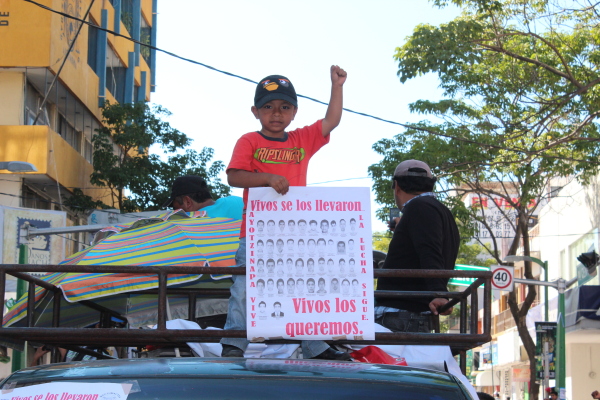
During demonstrations over Ayotzinapa, a young man raises a Zapatista (left) fist.
We already know what to do. Now we need an agreement about how to do it and with whom.
The political classes lost the little credibility they had because of Ayotzinapa. A consensus formed through long experience crystalized like this: only violence, corruption, impunity and incompetence come from above.
Another consensus emerged along with this: the institutions themselves are rotten, not only those that direct them. They are not at the service of the people, nor do they fulfill their functions. We need substitutes for them.
It also extends to a consensus that comes from perspective. In recent decades the political classes adulterated and finally dismantled what remained of the 1917 Constitution. We need another one. Or rather: a constituent mechanism that formulates the new social order from below.
To do that we must conceive how we get rid of what is and create democratic mechanisms of transition that forestall and contain the current disorder and violence.
There is no consensus about the way to do all that. Among those that share the conviction that we must remove the current functionaries and construct other institutions, some think that the only way of attaining it without violence is to stay within the current frameworks, through the electoral and party path. According to them, we would have to use ballot boxes to disqualify them. Any other way would be illusory or undemocratic and violent. Thus emerges a profound difference, because many other people consider that what’s illusory and undemocratic is to continue using ballot boxes, entirely inadequate for what is sought. What’s missing is to break with the current frameworks.
Within this debate, as in other questions, weighs an old tradition that centers the possibility of change on a leader or a handful of leaders. According to Luis González y González, since the XVIII century “a handful of people (politicians, intellectuals, capitalists and priests), who are the ones that principally distribute the bread, propose and dispose the path to follow,” are periodically installed in the leadership of Mexico. Those who have been responsible for social change, he maintains, “are a small number of directors, groups of eminent men, assemblies of notables, not masses without a face or local commanders.”
That vision of our history, which ignores the millions of ordinary men and women that gave their lives in the changes that occurred in the country, or that converts them into obedient masses, manipulated or controlled, forms a tradition in effect that has been updated in the era of globalization and the mass communications media. A leader or at least a party or a group continues being sought. They have to constitute the minority directorate, a disciplined and articulate leadership body. Without them we would fall into disorder and violence and the changes we seek would be frustrated.
A vigorous current attempts to break with that tradition and proposes reconstruction from below, by ordinary men and women, without leaders, luminaries, experts, vanguards or parties.
It is certain that a handful of men have assumed the representation of all Mexicans ever since the country was born. Morelos asserted that it was the nation’s sentiment to be governed by the creole minority. That sentiment prevailed among those who forged the new social order, expressed in the Constitution of 1824, marginalizing Indian peoples, which then represented two-thirds of the population and had been the principal champions of the revolution for Independence. In a similar manner, successive elites converted their own ideals and interests into the mold in which the national will should be molded. The ritual of elections, which was maintained even in times of the dictatorship to legitimize the social pact imposed from above, never achieved compensating for that absence of the majority. The general will cannot be reduced to a statistical grouping of individual votes to elect individuals or to define postures. “My dreams don’t fit into your ballot boxes,” the Indignados of Spain said well.
It is not a document that will reconstitute us as a nation or permit us to reconstruct the coexistence and social fabric, and was formulated with a social sense and patriotic ardor by the country’s better minds. As LaSalle said, constitutional questions are not issues of law but rather of power. We’re dealing with defining those who have it and how it is articulated and how it constructs the general will: above or below, with elections that delegate everything to a few… or without them, with autonomous governance.
Faced with the immense national tragedy, no assembly of notables can assume the transition and even less determine the new direction and the ways in which we reconstruct. The challenge consists of attaining that the very diverse social subjects that from below have been resisting dispossession and oppression are finally those that conduct the transformation. Far from representing the chaos and disorder, trusting in the wisdom and experience that they have been accumulating from below is the only alternative to the chaotic disorder that characterizes the national moment and will continue as long as we continue rendering social engineering from above.
In that transit, we also need certain people, perhaps a handful, that are moral guarantors of the transition, bind together a consensus and intellectually nourish change. The government would not be in their hands, but in the hands of the people that would watch, control and reconstruct the institutions. That way, democracy would be where it ought to be: where the people are. And they would be those who maintain the social order and would be a barrier to the current chaos and violence.
——————————————————————
Originally Published in Spanish by La Jornada
English Translation: Chiapas Support Committee
Monday, January 19, 2015
En español: http://www.jornada.unam.mx/2015/01/19/opinion/018a1pol/
First Report by International Caravan
BRIEF SUMMARY of EVENTS in the SAN SEBASTIAN BACHAJON EJIDO since the DECEMBER 21, 2014 RECUPERATION of THEIR LAND

The banner begins with: Adherents to the Sixth Declaration of the Lacandón Jungle and ends with: Support Ayotzinapa!
By: The “International Sixth Caravan”
On December 21, 2014, during the inauguration of the Worldwide Festival of Resistances and Rebellions Against Capitalism, in Mexico, compañeros [1] from the San Sebastián Bachajón ejido in Northern Chiapas, adherents to the [EZLN’s] Sixth Declaration of the Lacandón Jungle, announced that in the wee hours of that same day they had recuperated the lands dispossessed since February 2, 2011 by the government of Juan Sabines Guerrero and Noé Castañón León in complicity with the officialist (pro-government) ejido commissioner Francisco Guzmán Jiménez. They asked the participants in the Worldwide Festival for their support and solidarity in the defense of their recuperated territories.
Approximately 400 women, children, youths, men, and elderly peacefully took the common use lands of the ejido’s grant area, located at the border with Tumbalá municipality and near the entry to the Agua Azul Cascades eco-tourist center, a place in which the State Government of Chiapas and the Federal Government constructed a ticket booth administered by the National Commission for Natural Protected Areas (CONANP, its initials in Spanish) and the Chiapas Treasury Secretariat, as well as a Center of Attention to Civilian Protection Emergencies and an abandoned supposed office for medical consultations.
Their resistance against police and paramilitary repression has lasted for more than six years of struggle. During this stage they have had extra-judicial assassinations like those of Juan Vázquez Guzmán and Juan Carlos Gómez Silvano and the unjust incarceration of more than 120 compañeros. Three of them, Juan Antonio Gómez Silvano, Mario Aguilar Silvano and Roberto Gómez Hernández, still remain in prison, where the state has tortured them. The government’s acts of repression have not diminished their conviction to recuperate their lands; to the contrary, the pain suffered because of their fallen compañeros has only been strengthened their conviction:
“For all these injustices of the bad government that prefers to see us dead or in prison, living in misery and marginalization because it takes away our land to give to big corporations and corrupt politicians so that make themselves richer while our communities die of hunger… therefore as an organization our communities decided in assembly to recuperate today the lands that the bad government dispossessed.” (San Sebastián Bachajón Communiqué, December 21, 2014.)
In the days after the initial taking, they received several threats of eviction and repression from public forces and paramilitary groups that organized in cooperation with ejido commissioner Alejandro Moreno Gómez, and his vigilance, Samuel Díaz Guzmán. On December 30, representatives of the Chiapas government demanded that the Sixth ejido owners withdraw from the recuperated land, thus permitting a dialogue between them and the pro-government ejido members. This demand was accompanied by threats of eviction and apprehension in case they rejected abandoning the recuperated lands.
Faced with these threats, the compañeros of Bachajón continued to maintain control of the recuperated land while the tourist traffic flowed normally. Hundreds of compañeros with pasamontañas were watching the entrance to the Cascades, which didn’t seem to bother the tourists. They never realized that there were 24-hour guards hidden in the trees on both sides of the road, watching to see who was entering. It fell to each youth, elder, women and man to do guard duty for three consecutive days without sleeping, in turns of fifteen days total. In the 18 days of the recuperation the number of compañeros that came from different towns in the ejido increased to m ore than 500.
On December 30, between 40 and 50 individuals that ejido commissioner Alejandro Moreno Gómez paid and organized blocked the San Cristóbal-Palenque and the San Cristóbal-Chilón highways at the villages of Temó and Pamalhá not only to demand the intervention of public forces, but also to paint these events as an intra-community conflict that only involved the internal politics of the Bachajón community and not the interests of the government and the tourist companies.
On January 9, at 6:30 in the morning, more than 900 members of state and federal forces violently evicted the compañeros of the San Sebastián Bachajón ejido. During the attack, eight San Sebastián Bachajón residents were disappeared and three of them were kidnapped with the intention of arresting them but all of them got free. The ejido owners denounced the attack in a comunicado on the same day:
“The bad government through Government Secretary Eduardo Ramírez Aguilar joked that they already recuperated the ticket booth as if it were his property or territory, their real interest is to dispossess us of our land. They are some truly shameless and corrupt traitors to the country, but their bad politics doesn’t end out fight because we are not going to permit them to continue dispossessing us as they please. We’re going to continue our actions in defense of Mother Earth.”
The next day, the free media confirmed the occupation of the lands on the part of public forces and documented the presence of 10 police trucks, a lot of white trucks full of police in the area de los recuperated territory and two police trucks stationed at the installations of the Secretary of Security and Citizen Protection of the State of Chiapas.
The ejido owners denounced that accomplices of the state police threatened Compañero Jeremías Cruz Hernández and Francisco Jiménez Hernández from Xanil community, which is part of the ejido. These compañeros now fear for their lives.
In a communiqué released on January 10 the ejido owners said that: “the eviction doesn’t make our hearts sad but rather fills it with greater bravery to make the movement and the defense of land and territory stronger.” They also requested that all the solidarity compañeros remain pending (on hold) because they heard “strong rumors” that the police were pointing at their houses to arrest them and that they were getting organized to evict us from the seat of their organization in Nah Choj.
On January 11, the ejido owners again attempted to take back their lands. At 6:30 in the morning the compañeros took and blocked the Agua Azul crossroads. In response and from a distance of five hundred meters, the state police blocked the road with trees and shot rubber bullets at the ejido owners for twenty minutes from that barricade. The rubber bullets injured two people. One of the ejido owners, Juan Pérez Moreno, was injured in the left arm with a high-caliber bullet. The ejido owners remained firm before the attack and at 7:30 in the morning the police turn back.
The next day, January 12, a police helicopter flew over Xanil taking photos of the houses of the coordinators of the resistance. At the same time, groups of paramilitaries from Pamalha community headed by Manuel Jimenez Moreno and from Xanil headed by Juan Álvaro Moreno, Jeremías Cruz Hernandez and Francisco Jimenez Hernandez moved towards the dispossessed territory to present a possible strengthening of the police aggressions against the adherents to the Sixth. The “International Sixth Caravan in Support of San Sebastián Bachajón” arrived the same day to offer them support and thus avoid further attacks. The International Caravan includes members of different countries, including Colombia, France, the United States and Mexico.
At this time, the compañeros maintain a strong blockade, which yesterday converted from permanent to intermittent. They ask that we are on alert for more attacks on the blockade and that all of us spread the word about their dignified struggle through all possible different media.
[1] Compañero, as used here, refers to both men and women of all ages.
———————————————————————————-
Originally Published in Spanish by Koman Ilel, the Mirada Collective
Translation: Chiapas Support Committee
Thursday, January 15, 2015
For more information about the Chiapas Support Committee, please contact cezmat@igc.org
Joint Declaration from the Festival of Rebellions and Resistances
DECLARATION FROM THE FIRST WORLDWIDE FESTIVAL OF RESISTANCE AND REBELLION AGAINST CAPITALISM
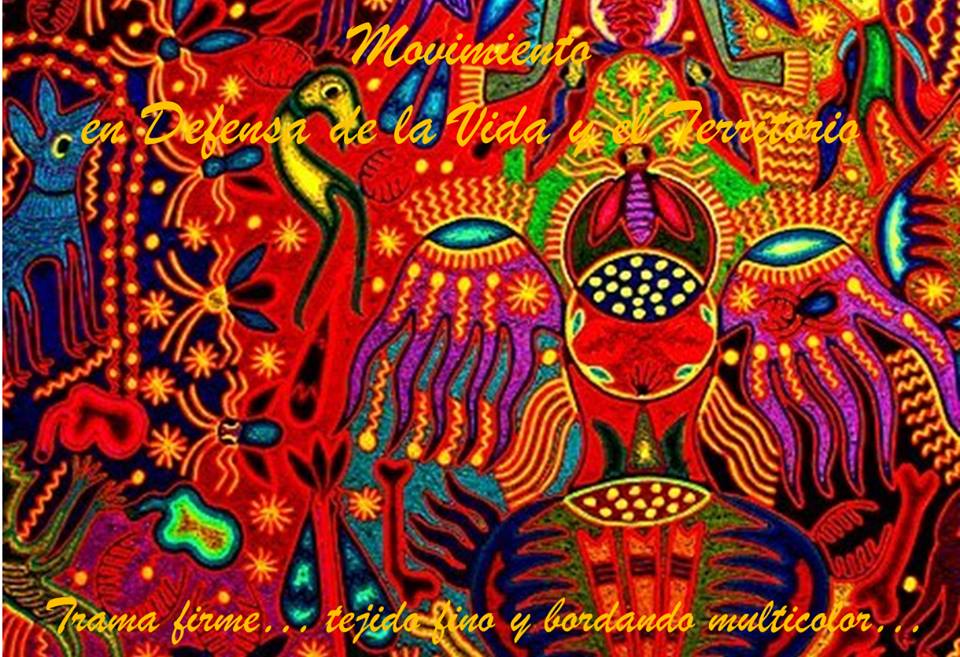
Movement in Defense of Life and Territory
To the peoples of the world:
From Chiapas, Mexico, we send out our word to all those women and men from below, in the countryside and the city, in Mexico and throughout the world, all those who sow resistance and rebellion against the neoliberal capitalism that destroys everything.
We met in the Ñahtó community San Francisco Xochicuautla, State of Mexico, on December 21, 22, and 23; in the Nahua community of Amilcingo, Morelos, on December 22 and 23; in the space of the Frente Popular Francisco Villa Independiente in Mexico City on December 24, 25, and 26; in Moncolva, Campeche, on December 28 and 29; in the Zapatista Caracol of Oventik, Chiapas, on December 31 and January 1; and in CIDECI in San Cristobal de las Casas, Chiapas, on January 2 and 3. We met to hold “sharings,” which means not only to share, but also to learn and build together. These were “sharings” that were grown from the deep pain and rage that belongs to all of us due to the disappearance and murder of the students from the Rural Teacher’s College Raul Isidro Burgos in Ayotzinapa, Guerrero. This was a criminal act that reflects the politics of death that the bad government and the capitalists have pushed into every corner of the country and the world. These missing students are our disappeared, and we, as the National and International Sixth, the National Indigenous Congress, and the Zapatista National Liberation Army will not cease to struggle until they are found.
The capitalists and their overseers in the bad governments have left destruction in each of our individual hearts and great destruction in the collective heart that we make up as peoples, mothers and fathers of the young people who were taken from us, and solidarity organizations, all determined to reconstruct life where the powerful have sown death and mourning.
In the indigenous communities that we comprise, we suffer attacks by the capitalist system through the blood and pain of our children, who are also the only possible future for this planet we call Earth. Amidst the distances and different colors that make up our being and our existence, we maintain the certainty that Earth is our mother and she is alive. And in order to keep her alive, justice must be a demand that is woven by the actions and convictions of those of us who comprise the world of below, those who do not aspire to govern that world but rather construct it along our path.
From the oceans, beaches, mountains, cities, and countryside, we build and rebuild alongside the assemblies, organizations, and collectives that in diverse autonomous forms weave spaces and forms of organization and solidarity that are capable of containing the capitalist destruction that does not distinguish between peoples and colors and in its chronic blindness only recognizes what feeds the same production dressed as permanent war, unjust markets, and colossal profits for a few. These are values alien to our peoples and against the ancient agreements made with our Mother Earth that give meaning and sense to life in the world, that give us freedom and dignity, dignified in living and defending life.
But the capitalists who say they are governing but really are only trying to dominate, administrate, and exploit, have a limit—a very large barrier—when they come up against the dignity of a person, a family, a collective, a society who they have profoundly damaged, from whom they have snatched and killed a part of their heart, thus detonating an explosion of rebellion that has illuminated the World Festival of Resistance and Rebellion Against Capitalism which we call “Where those above destroy, we below rebuild.” Because we are below; from below we understand the world, from below we care for it, below we look at one another and from there, together, we rebuild the destiny that we believe is our own until the powerful snatch it from us and only then do we learn, do we know, that what is really ours is that which we can construct or reconstruct where capitalism has destroyed.
The pain that is converted into dignified rage in the families of the murdered and disappeared students of the Rural Teacher’s College Raul Isidro Burgos is the pain that has kidnapped and disappeared us also, and thus we will never stop struggling until they are found, along with all of the murdered, disappeared, tortured, exploited, disrespected, and dispossessed brothers and sisters, wherever they may be in this savage capitalist geography, on whatever border of the world, in whichever prison.
The walk of the peoples of the world in the countryside and the city, each with their path, are led by the footprints of their own ancestors, paths that divide, intersect, and cross with ours until they find one direction, marked by a rebellious dignity that speaks so many languages and has as many colors as nature itself, woven from small embroideries that together construct what we need to be.
So, brothers and sisters of this suffering world that is nonetheless happy because of the rebellion that nourishes us: we invite you to continue walking with a small but firm step, to continue to meet, share, construct, and learn along with us, to weave the organization from below and to the left of the Sixth that we comprise.
Only from our rebellion and our resistance will the death of capitalism be born and a new world brought to life, a world for all of us.
San Cristobal de las Casas, Mexico, January 3, 2015
NATIONAL INDIGENOUS CONGRESS, ZAPATISTA NATIONAL LIBERATION ARMY, and the NATIONAL AND INTERNATIONAL SIXTH
——————————————————
Originally Published in Spanish by Enlace Zapatista
Raúl Zibechi: 2015, a critical and turbulent year
2015, A CRITICAL AND TURBULENT YEAR
By: Raúl Zibechi
2014 ends with Barack Obama’s decision to re-establish relations with Cuba, after a half century of the blockade and attacks on the island’s sovereignty. The joy that this news stirs up must be shaded. The rapprochement is produced at the moment in which the United States shows marked tendencies towards the provocation of conflicts and wars, as part of a strategy of creating systemic chaos in order to continue dominating.
The year that ends was one of the more tense and intense, since the White House unfurled a group of initiatives that can lead to war between countries that possess atomic weapons. The most critical case is that of Ukraine. Washington sketched a State coup on the Russian border, with the intention of converting Ukraine into a platform for destabilization and, eventually, military aggression against Russia. The US strategy is oriented to establishing a military, economic and political circle around Russia, to impede all approach with the European Union.
Among the gravest acts of 2014, we ought to remember that the United States did not lift a finger to impede the indiscriminate Israeli bombings of the Gaza Strip. White House policy in the Middle East is one of alarming hypocrisy. It endorsed some most dubious elections in Egypt, after a State coup against the first democratic government, which brought its unconditional ally, Abdel Fattah el-Sisi, to power.
The chaotic situation through which Syria, Sudan, Iraq and Libya travel is a clear example that a strategy of chaos has been designed, as various analysts have been denouncing, as a means for redesigning power relations in its favor. It continues being a mystery how the powerful Western military forces cannot abate the Islamic State, increasing suspicions that the terrorist organization uses the same strategy that the Pentagon impels.
In Latin America, the Obama administration’s silence about the massacres in Mexico calls attention. The White House is denouncing and persecuting Venezuelan government officials for much less.
The fact that the new escalation against the government of Nicolás Maduro is simultaneous with the approach to Cuba warrants non-stop attention. One seems obliged to ask: What intentions does the United States harbor with this new policy towards the island?
It is evident that there is not one United States policy towards Venezuela and another towards Cuba, or towards Mexico. The objective is the same: to continue ruling the Caribbean, Central America, Mexico and everything to the north of South America, the area where the United States does not admit challenges. To avoid it, all is valid. The war against the popular sectors in Mexico (with the excuse of drugs) was designed to impede a popular uprising, which was possible in the first years of the new century.
But in Mexico, the United States can count on a political class it trained and financed, loyal and submissive. That is something it cannot count on in Venezuela (where the opposition does not have the cohesion or the ability to lead the country), much less in Cuba, where the technical and political cadres cannot be managed by agencies of the Empire.
In Venezuela it is betting strongly for chaos, as was inferred from the kinds of actions that the most radicalized sectors of the opposition brought forward in the first months of this year. It is probable that the US will attempt to take the chaos strategy to Cuba, with all that implies: from the introduction of capitalist culture (in particular consumerism and drugs) to venal forms of electoral democracy used in the West.
Apparently, because it’s too soon to know if the White House is promoting a turn in its foreign policy, the intention exists of ranking the role of Latin America. The analysis of the Diario del Pueblo, points in this direction. The United States strategy of having influence in the Asia-Pacific Zone was a long night decision and it has now been realized. Now the United States moves its pieces towards other paths. The normalization of relations with Cuba is intended to eliminate the big stone in the way of its active participation in Latin American issues, and let slide a discrete adequacy in its failed strategy of returning to the Asia-Pacífico (Diario del Pueblo, December 19, 2014).
It’s certain that in his talk Obama made reference to the fact that the policy towards Cuba distanced the United States from the region and limited the possibilities of impelling changes on the island. Through Cuba, symbolically, the United States emphasizes its interest in the American community, the officialist (pro-government) Chinese newspaper concludes.
If it were certain that the potency aims its batteries towards America, we would be before a turn of large proportions, as it would also be evidencing the limited consistency of its foreign policy, which since 1945 has been focused on the Middle East and in the last two years was weighted towards the Asia-Pacific.
Anyhow, Latin Americans are facing new problems. In recent years the power of the United States provoked two successful State coups (Honduras and Paraguay), a high intensity war against a people (Mexico), put in check the governability of several countries (Venezuela and to a lesser extent Argentina) and now starts it against the continent’s largest company (the Brazilian Petrobras). It is certain and everyone must say it: the incompetence of some governments eases the task for them.
Everything indicates that 2015 will be a difficult year, in which the tendencies towards war, destabilization and systemic chaos will probably increase exponentially. That’s going to affect both the conservative and the progressive governments, between which there are fewer differences all the time. For the movements of those below and for those that we continue pledged to accompany, it’s incumbent on them to learn to live and to resist in scenarios with high-pitched storms. It is within them where the real navigating is forged.
———————————————————–
Originally Published in Spanish by La Jornada
Translation: Chiapas Support Committee
Friday, December 26, 2015
http://www.jornada.unam.mx/2014/12/26/opinion/016a1pol
 Chiapas Support Committee