Chiapas Support Committee
Home of the Compañero Manuel blog on zapatistas & mexico
Counter-tendencies of the US decline
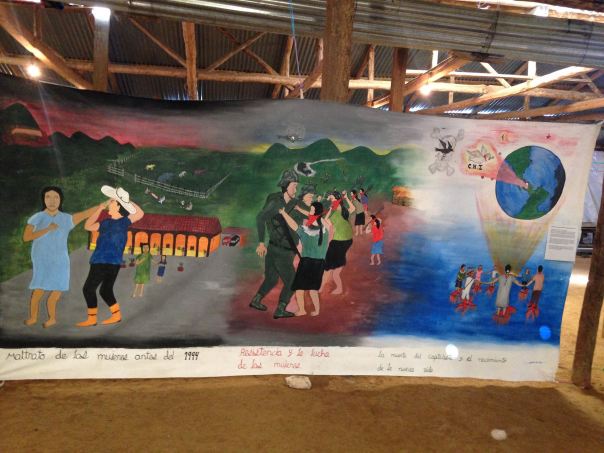
Resistance and Rebirth, Art from the Zapatista communities.
By: Raúl Zibechi
In periods of global systemic chaos it’s easy to confuse reality with desires, even more so when there are authentic facts that give rise to thinking that what we desired for a long time seems to be approaching imminently. However, problems appear here, optic deviations that lead us to erroneous conclusions. In some way, we all fall into simplifications that are ultimately shown to be incorrect.
We desire, or at least I desire, the end of this imperialist, colonial, patriarchal and capitalist system. But it would be wrong to believe that “laws” exist that lead the system to ruin. Let’s look at just a few years ago, when serious and well-documented analysts predicted peak oil, the peak of oil discoveries, which would inevitably lead to the end of a civilization based on hydrocarbons.
We thought that starting with the first decade of this century an unstoppable decline would begin and that prices would be so high that they would provoke abrupt and revolutionary changes. As we know, that is not happening. The United States has put itself at the head of extraction by hydraulic fracture (fracking), a very contaminating technique, and is breaking all records of production bringing prices to much lower levels than those of three or four years ago.
That’s just one example, among many. Those of us who were formed in Marx learned –thanks to the bad communicators and to the desire to believe them– that capitalism is condemned to disappear because of alleged laws that govern the economy and that will lead it to collapse. These debates took place a century ago and still survive. I don’t refer to those who are scanning the horizon and see clouds approaching, but rather to those who make forecasts from a desk guided by some theory.
I want to give two examples, one that endorses the thesis of the decadence of the United States and another that contradicts it.
The economist David P. Goldman maintains in a documented work in Asia Times, that the imposition of tariffs on steel and aluminum “doesn’t have any possibility of rejuvenating the industrial base of the United States. His analysis is overwhelming. He assures that starting with the decade from 2000 to 2010 there has been a decline in innovation and productivity in the US, because “venture capital stopped investing in the manufacturing industry.”
The cause is typically capitalist: aversion to the risks due to the fall in the rate of profit. China did the opposite because it’s not a savage capitalism but a State capitalism that is dedicated to protecting and subsidizing strategic industries so that the nation won’t be humiliated again, as happened with the three invasions that prostrated (the opium wars in the 19th century and the Japanese invasion in the 20th century).
Investments in cutting-edge technologies have fallen dramatically in the US, being barely one fifth of those that it had at the beginning of 2000. “The United State share of world exports of high technology have fallen from 20 percent in 1999, to a little more than 5 percent in 2014, while China increased from 3 to 26 percent in the same period,” Goldman points out (goo.gl/1yVxNy ).
He asserts that the United States never confronted a competitor like China. Washington limits itself to imposing taxes, like the one imposed on solar panels, but Beijing continues to gain sympathy by offering itself as a champion of free trade. The roles have been reversed and now the US is becoming, in the words of Goldman, “a producer and exporter of agricultural products and raw or semi-finished materials with an atrophied industrial base.”
The second analysis was published days ago in the newspaper El Economista and shows that the United States will become the first oil producer of oil starting in October, thereby displacing Saudi Arabia and Russia, and placing OPEP on the defensive. According to the International Energy Agency (IEA), thanks to fracking “the new US production will cover more than half of the world’s increase in demand for oil until 2023” (goo.gl/foDSzg).
With 10 million barrels per day, the US achieves solid energy independence and also becomes a big exporter. According to the IEA, in 2019 the countries that don’t belong to the OPEP (like Canada, the US, Mexico, Russia and Brazil, among others) will produce 60 percent of the world’s oil (goo.gl/1ywm16).
While Venezuela’s oil production falls to 1940 levels, that of the United States beats all historical records and, even more surprisingly, exports grow geometrically (89 percent in 2017), to the point that it is estimated that 40 percent of the demand of the Asian refineries will be covered with US oil (goo.gl/ecjQMp). From having been a country historically dependent on oil imports, it has become in a very few years the big global energy power.
At this point, it seems necessary to make some clarifications.
The first is that I believe that effectively the United States is a great power in decline. This is the principal aspect of the question. But the decline is not linear or rapid; it has counter-tendencies, like the one I point out above. This means that the transition towards the hegemony of China will be longer and more complex that what we could have anticipated years ago and, surely, along the way there will be agreements and crises, which will accelerate and slow down, at the same time, the la decline as well as the rise of new powers.
The second question is related to the modes of understanding and analyzing what is happening. It’s very common to fall into the temptation of eliminating data that contradict our forecasts and, above all, our desires. Up to a certain point it’s an inevitable tendency, but we must be on the alert in order to minimize this risk.
The third is that there are no “objective” laws capable of putting an end to this system of death. Only collective and organized human activity can, at the same time, restrain this barbarism and open cracks in the wall of domination.
———————————————————–
Originally Published in Spanish by La Jornada
Friday, March 16, 2018
http://www.jornada.unam.mx/2018/03/16/opinion/021a2pol
Re-Published with English interpretation by the Chiapas Support Committee
CNI & EZLN: “Call to the next step in the struggle”

BROTHERS AND SISTERS, COMPAÑERAS AND COMPAÑEROS OF THE COUNTRYSIDE AND THE CITY, OF MEXICO AND OF THE WORLD:
The National Indigenous Congress (CNI, its initials in Spanish), the Indigenous Government Council (CIG), the Civil Association “The time has come for the flourishing of the peoples” and the Zapatista National Liberation Army, address individuals, groups, collectives and organizations, peoples, barrios, tribes and nations that, in Mexico and in other countries that supported the initiative of attaining the registration of the CIG spokesperson, María de Jesús Patricio Martínez, as a candidate to the presidency of Mexico.
The hard and verifiable data that we have are:
The National Electoral Institute (INE) received 281,955 signatures; of those, 10,624 were captured on paper, not on the digital application. Of these, the vast majority corresponds to community assemblies. Under the INE’s own criteria, 94.5% of the signatures collected appear on the list of names. Helpers: Registered 14,117, active 5,704. With respect to the difference between registered and active, 8,413, in December 5,322 emails were sent to those who registered then as helpers but didn’t report any signatures, and 2, 137 answered back. Of those, 1,618 explained that they didn’t have an adequate cell phone, be it through the INE application or the cell phone camera. Average signatures per active assistant: 49.43 (data taken from the page of the sisters and brothers of Cryptopozol, who collected the information from November 3, 2017 until February 24 and 26, 2018, and can be consulted at https://criptopozol.github.io/avance_marichuy/
An approximate count (it’s not precise) of helpers by state is listed below.
Without state defined 4930
Aguascalientes 89
Baja California 251
Baja California Sur 69
Campeche 42
Chiapas 864
Chihuahua 188
Ciudad de México 3398
Coahuila 92
Colima 30
Durango 42
Estado de México 1070
Extranjero 105
Guanajuato 345
Guerrero 99
Hidalgo 179
Jalisco 1040
Michoacán 264
Morelos 274
Nayarit 63
Nuevo León 257
Oaxaca 242
Puebla 407
Querétaro 301
Quintana Roo 189
San Luis Potosí 197
Sinaloa 98
Sonora 149
Tabasco 48
Tamaulipas 69
Tlaxcala 94
Veracruz 367
Yucatán 151
Zacatecas 89
(Note: the final count does not coincide with registered helpers because, they tell us, some registered more than once, desperate because the INE did not respond to them in a timely manner and form).
-*-
Compañeras and compañeros, sisters and brothers:
As is evident, we did not achieve getting the number of signatures necessary to register Marichuy as a candidate to the presidency.
The explanations and evaluations about this fact, we think, ought to be the product of a serious analysis and a profound evaluation.
Obtaining the sufficient number of signatures would have permitted us to take advantage of that space to continue making visible the original peoples, their pains and struggles, as well as pointing out the criminal character of the system, to make us an echo of the pains and rages that team throughout national territory, and to promote organization, self-management, resistance and rebellion.
We didn’t achieve it, but we must continue on our path looking for other ways, methods and modes, with ingenuity, creativity and audacity, in order to attain what we want.
Our bet was never to take power; it always was and will be for self-managed organization, autonomy, rebellion and resistance, for solidarity and mutual aid and for the construction of a world with democracy, freedom and justice for all.
The initiative to form the Indigenous Government Council and propose its spokesperson, Marichuy, as a candidate to the Presidency of the Republic, launched by the Nacional Indigenous Congress, has completed one more stage. The first stage consisted of the decision that the Fifth National Indigenous Congress made, on its 20th Anniversary in October 2016, to consult with all its peoples and communities about the initiative before delineating it. The second stage consisted of the CNI’s internal consultation about the initiative to form the CIG and name its spokesperson between the months of October and December 2016. The third stage culminated in the CIG’s Constitutive Assembly and the naming, by consensus of said Assembly, of María de Jesús Patricio Martínez as its spokesperson, in the month of May 2017. The fourth stage consisted of the collection of signatures in favor of our spokesperson Marichuy, a process that we just concluded.
Our walking continues. And the fundamental difference with the prior stages is that now we are more original peoples walking together, and, MOST IMPORTANTLY, we are now more persons, groups, collectives and organizations oriented to seeking solutions within ourselves that, we know, will never come from above. This stage was characterized by involving more people and sectors, beyond the original peoples and the CNI, in a peaceful and civilian struggle, inclusive, with a just cause, with a horizon of the radical transformation of the reality we all suffer, with legal methods, legitimate and honest, and that is something that no member of the institutional political class can say.
Faced with the indisputable fact that we did not get the number that, by law, is needed to continue with that stage, an analysis and evaluation is imposed that, as was the entire process, will be collective, participative, inclusive, honest and truthful.
Because of all that, and because of more things for which there are no words:
First: We sincerely thank all the persons who, in Mexico and other countries, gave their signatures. For us, each one of them is an embrace and an admonition to continue and to not languish. We greet each and every one of you, and in response, we reaffirm our commitment to not be discouraged.
Second: We especially thank those who, with or without the figure of “helpers,” understood the scope of our initiative, made it theirs, and pledged time, resources and work on the way to creating, growing and consolidating collective and community, to be in the best situation to confront the storm that we already suffer.
Third: The Civil Association “The time has come for the flourishing of the peoples,” as well as the National Indigenous Congress and those who form it, the Indigenous Government Council and the Zapatista National Liberation Army, have initiated, at an internal level, a serious analysis and evaluation of this stage that ends.
Fourth: We think that this analysis and evaluation does not correspond only to us. We consider that, since it became a collective effort that far exceeded the horizon of the original peoples, we must consolidate what was achieved and maintain its longing to construct another way of doing politics.
Therefore,
WE CALL ON
Individuals, groups, collectives, organizations, nations, tribes, peoples and communities of the countryside and the city, indigenous and non-indigenous, in Mexico and in other countries, that were committed to this process and confronted it with work, dedication and honesty:
To make an analysis and an evaluation, taking into account the objectives that the CNI and the CIG made public at their opportunity, and, above all, considering the objectives that you traced, and that you send it to us at the following electronic address:
valoraciones@congresonacionalindigena.org
We also tell you that, parallel to these analyses and evaluations, the Civil Association “For the Flourishing of the Peoples,” the National Indigenous Congress, the CIG and the Zapatista brothers and sisters, will invite a series of public and open activities for those who were involved in the process, to give follow up and continuation to this struggle that, we know is just beginning. Those who convene these activities will announce them in due time.
We also invite you to, on your own initiative and according to your own criteria, modes and times, realize activities for analysis and evaluation about what is happening in Mexico and the world, because, as the CIG and the spokesperson Marichuy said again and again, our horizon doesn’t end on July 1, 2018, nor is it limited just to Mexico.
The resistance, rebellion and determination to construct a world where many worlds fit is international and is not limited by the calendars or by the geographies of those above who exploit us, despise us, rob us and destroy us.
Mexico, March 2018
NEVER MORE A MEXICO WITHOUT US!
NEVER MORE A WORLD OF DEATH AND DESTRUCTION!
NATIONAL INDIGENOUS CONGRESS
INDIGENOUS GOVERNMENT COUNCIL
“THE TIME HAS COME FOR THE FLOURISHING OF THE PEOPLES,” A. C.
ZAPATISTA NATIONAL LIBERATION ARMY
En español:
http://enlacezapatista.ezln.org.mx/2018/03/16/convocatoria-al-siguiente-paso-en-la-lucha/

The CIG: results of the irreverence
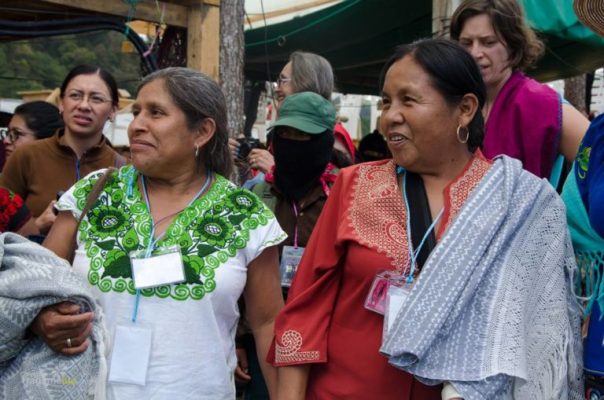
Marichuy at the 2018 Zapatista Women’s Gathering in Morelia, Chiapas.
By: Raúl Romero*
On February 19 the time period expired for turning in (INE) the signatures of citizens that supported the initiative of the Indigenous Government (CIG, its initials in Spanish) to the National Electoral Institute (INE). In its latest public report, the INE realizes that 266, 114 people signed so that the CIG’s spokeswoman, María de Jesús Patricio Martínez, would appear as an independent candidate to the Presidency of Mexico on the electoral ballots next July. Said report also indicates that more than 92 percent of the signatures received for Marichuy –as the spokeswoman is affectionately called– are real, legal and legitimate.
In different spaces an evaluation of what this stage meant for Mexican society has begun to be elaborated. The voices that classify the los initiative’s results as a “failure” would do well in learning to listen, a difficult but necessary quality, especially in times in which the noise and the disinformation are constant.
The evaluation of this stage necessarily must be given on several levels: at the internal level of the CIG and of the National Indigenous Congress (CNI), on the repercussions of the process on regional, state, national and international levels; on the internal and external factors that influenced the process and on the results, on the articulation and dialogue with different sectors and social organizations, on the ties woven between the struggles of the countryside and the struggles of the city, etcetera. Here we reflect on some of these points.
In October 2016, when the EZLN presented the proposal and the CNI made it theirs, the diagnosis was very clear: the capitalist war, that old acquaintance of the original peoples, had reached all corners of the country. Faced with such a situation, the pains of the original peoples remained as “one more among many others.” The light of the CNI was extinguished, and not because the peoples that belong to it were surrendering, but rather because the dispossession, contempt, exploitation and repression that they receive from those above were disappearing. It was time to go on the offensive, and the Council would be something like a Trojan Horse.
Today, 17 months later, the CNI not only continues existing, but also grew quantitatively and qualitatively. Hundreds of collectives, organizations, barrios, tribes, nations and original peoples responded to the call.
The Council talked, listened and embraced other pains. It dialogued with sectors from the countryside and the city, with young people, with women, with families of victims of femicide, of disappearance and of assassination; with migrants and also with organizations of men and women workers hombres. In a country perforated by mines and clandestine graves, with morale undone and normalized violence, the Council not only made the problems of the indigenous and non-indigenous visible, but also summoned us to a “combative re-organization.”
The national and international press served to draw the attention of thousand of people in Mexico and the world to the reality of our country. Many people observed how it went from “they do this to us” to “we’re going to do something.” Protest acquired the face of proposal, and more than one decided to come out of their “glass house” and support the initiative. In some of the more conservative local newspapers columns appeared that called to sign for Marichuy, while the international press sent its correspondents to document what was happening. The original peoples of Mexico, supported by thousands of individuals, were once again in the press, not because of folklore or because of a tourism invitation, but rather because they had the irreverence to talk about organization, self-government and anti-capitalism in a sphere that was almost rude. No one will be able to hide the echo that Council’s proposal had in the country and in the entire world.
In the cities, people of all ages joined the support networks: without money and with a lot of creativity, they set up tables for the collection of signatures, designed their own signs and flyers, and they went out and talked to other people like them. Many neighbors met each other for the first time, met talking about local problems, about expectations for 2018, about the discredited political class, about being fed up and about the despair.
A new generation of young anticapitalist militants was also born. The majority of them participated for the first time in a process of this scope. Others, also for the first time, negotiated or used their electoral credential. Among the millennial generation, the one that has been so vilified, the idea grew that another world is possible. Not only did they go to their schools or a their barrios to organize, but they also studied to become anti-capitalists and they also understood that much of the violence that they experience on a daily basis is not a private thing, but that machismo, patriarchy and racism are also pillars that maintain this system.
As if that were not enough in a country where the “institutional left” can no longer b distinguished from the right, where political discussion places corruption and transparency at the center of the “debate”; the Council talked about structural problems, about economic models, about the violence… the uncomfortable themes, those that are not touched above because they don’t sell and don’t generate votes, were made visible.
In November 2016, Subcomandantes Moisés and Galeano wrote that the initiative would not only signify a “testimony of non-conformity, but also a challenge that surely would find an echo in the many belows that there are in Mexico.” They also noted that what mattered “was the challenge, the irreverence, the lack of submission, the total break with the image of the indigenous object of charity and pity.” And that’s how it was. The CIG listened to the pains and wove rages that the resistances now utilize.
The metaphor of the “old mole” has often been used to describe what, like that little animal, advances underground, with patience and treasured wisdom, and that, at the least expected moment, irrupts towards the ground. Perhaps that is a good metaphor for describing what the CNI has done: with the wisdom of more than 500 years, many times resisting without being seen, had a presence where no one expected. In their irruption, they met others that also want to construct a world with liberty, justice and dignity. I have not the slightest doubt, the result of the irreverence is quite positive.
* Sociologist
———————————————————–
Originally Published in Spanish by La Jornada
Thursday, March 15, 2018
http://www.jornada.unam.mx/2018/03/15/opinion/023a1pol
Re-Published with English interpretation by the Chiapas Support Committee
A very special day
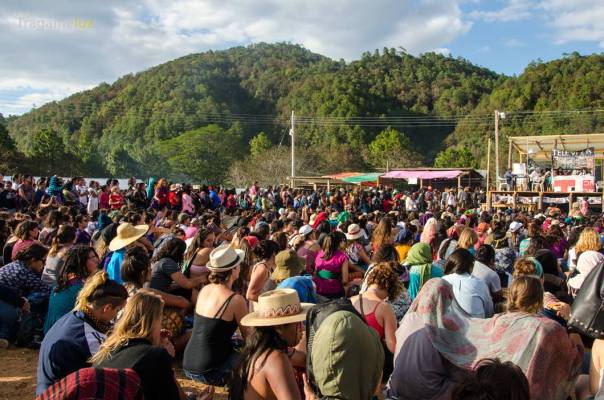
Women at the International Zapatista Gathering of Women that Struggle in the Caracol of Morelia, Chiapas, Mexico.
By: Gustavo Esteva
It was a very special day. They made it special.
There was the usual: the display of flowers, supplements and special programs, promises of change, the language of quotas, commercial banality… But the call for a women’s strike, which in Spain involved 6 million of them and extended everywhere, was a clear symptom of a point of flexion in the celebration of International Women’s Day. Its explicit, anticapitalist and anti-patriarchal message reflected the form in which women have been recuperating the historic meaning and radical nature of March 8.
It’s not a swallow, but rather the arrival of summer. It’s not an event, but rather a process. As Magdalena León, an Ecuadorian economist, remarked with vigor: “so far in this century feminist thought and action have accumulated novel experiences, searches, organizational fabric, ways of interpreting reality, resistances, proposals integral to ‘changing the world.’” They have made clear to what extent many discourses and postures that propose the inclusion of women without altering structural conditions can be used as “a guaranty of continuity and armoring the system.” The reach and complexity of the celebration “doesn’t stop being in dispute, but now with a clear hegemony of anticapitalist and anti-patriarchal feminism.” (https://www.alainet.org/es/articulo/ 191507).
“We must talk about feminisms in the plural,” observes Veronica Gago, a well-known Argentine author, very active in #Ni una menos (Not one less). Although feminist struggles are global, those of Latin America have gained prominence for the weight of “Villero feminism, community feminism, indigenous feminism and popular feminism,” terms that have “their own history, their genealogy and that share a link with social conflict.” “It’s not a strictly analytical, academic or institutional feminism.” In the current conjuncture, what has emerged is “a radical feminism that takes into account the dimension of struggles and rebellion, by framing the debate about women’s bodies and abortion and, at the same time, connecting these debates within the field of work and making life in general more precarious (insecure). One of the most important contributions of popular feminism is its discourse about the way in which insecurity affects life in social, political and economic terms, and the importance of this discussion in each territory.”
It was really remarkable. Marches everywhere, original and creative initiatives, the entire world shaken by the decision of women to put an up to here with the wave of violence and discrimination that they are suffering and to take a step forward, firm and determined, in their struggle forever. In Mexico, the struggle acquires a special meaning. Seven out of every 12 femicides that are committed each day in Latin America Latina take place in Mexico. The aggression is brutal and is accompanied by all forms of violence and exclusion.
One hundred years of feminist struggle have generated all sorts of changes in the laws and in reality, but the oppression is maintained. The woman receives less than the man in all categories. And it’s clear, now more than ever, that in capitalist society the woman will always be the second sex; that their struggle for liberation is the struggle to get rid of a regime that is the ultimate, the most violent, the most racist, the most sexist expression of ancestral patriarchy.
It was everywhere… but only in Chiapas was an international gathering held. Convoked by the Zapatistas, more than 2 thousand women, from 38 countries and from all over the Republic met in the Whirlwind of Our Words Caracol, in Morelia. It was the gathering of women that struggle.
Insurgent Captain Erika read what they conceived collectively in the inauguration of the gathering (encuentro), which quickly came into effervescence. The work groups, the rituals, the reflection and the fiesta multiplied. The tone was clear. It was time to say enough! and to resume the tradition of struggle. Someone remembered March 8, 1857, when 120 women died due to police repression of their march, which a couple of years later would flow into the first women’s union in the United States. They also mentioned the march of women socialists in New York in 1909 and especially that of March 8, 1917 in Petrograd, then the capital of Russia, in a mobilization that was the signal and starting point of the revolution.
It will be a long time before we know in detail what happened between March 8 and 11 in the Caracol of Morelia, how the whirlwind of words became the hurricane, how the light that was turned on in the Caracol will light all the corners of the world. For now we only know about the agreement. It’s about “living, and how for us (women) living is struggling, because we agree to struggle each one according to her way, her place and her Time.”
———————————————————-
Originally Published in Spanish by La Jornada
Monday, March 12, 2018
http://www.jornada.unam.mx/2018/03/12/opinion/018a1pol
Re-Published with English interpretation by the Chiapas Support Committee
Zapatista Captain calls on women to “struggle together against the patriarchal capitalist system”
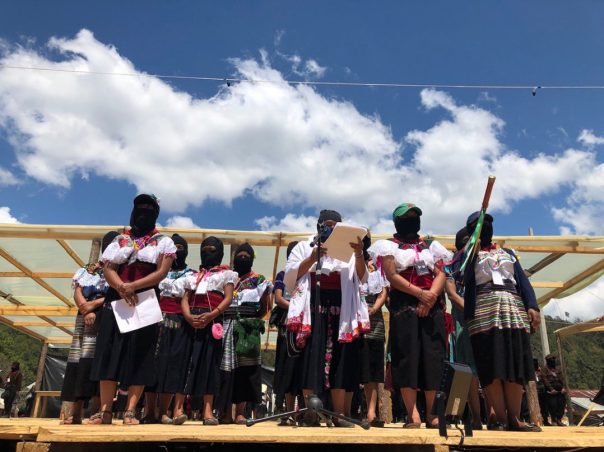
The Women’s Gathering in Chiapas. Photo: Gaby Coutiño
By: Isaín Mandujano
TUXTLA GUTIÉRREZ, Chiapas (apro) – Today, the Zapatista Captain Erika welcomed thousands of women that arrived from all the Caracols, as well as from other states and countries, and urged them to compete to see who is “the best (más chingona), prettiest or most revolutionary,” where nobody wins, or, “to agree to fight together, as different as we are, against the patriarchal capitalist system that is what is doing violence to us and murdering us.”
The masked woman, who sometimes worked as a servant in the city, where she suffered scorn and discrimination for being indigenous to later enroll in the ranks of the Zapatista movement, told attendees at the First International Political, Artistic, Sports and Cultural Gathering, of Women that Struggle what they have had to contend with, even among the ranks of the EZLN to gain the respect of the men.
Erika dedicated the event and sent words of solidarity to the family of Eloísa Vega Castro, the activist of the network of support for the Indigenous Government Council (CIG, its initials in Spanish), who died in the accident involving the independent presidential aspirant María de Jesús Patricio Martínez, last February 14 in Baja California.
“We waited until today to salute the memory of Eloísa, so that our embrace would be the biggest and would manage to reach far, to the other side of Mexico. And this embrace and this salute are large because you are all Zapatistas and from all the Zapatistas on this March 8, for that woman that struggled and now we miss: Eloísa Vega Castro. Our regrets go out to her family,” Erika said.
No man was permitted access to this event. The only men that are there are the Zapatista men that now do the jobs that women often do, like making food for all the attendees.
She also said that for these three days there would be uniformed Zapatistas women making rounds in the event. “Our work is going to be taking care of this place so that it’s only women and not let any man get in because we know that they are tricky.”
Then she told how difficult it has been to be in the struggle, since before the armed uprising and the 24 years of struggle they have already waged. She also told how before (the uprising) they had seen “little boys and girls, young people, adults and the elderly dying of curable diseases due to a lack of medical attention, good nutrition and education. But they also died because they were women and they died more.”
She shared that after working as a servant in the city, she knew that there was an organization that was fighting in the Lacandón Jungle, and that was how she began to participate as a support base, when she went out at night to study and returned at dawn, because at that time nobody knew about the struggle that the Zapatistas were making “because it was all clandestine.”
“But also I was born and grew up after the start of the War,” Erika said.
“I was born and grew up with military patrols surrounding our communities and roads, listening to the soldiers saying insults to the women just because they were armed men and we were are women,” she indicated.
She also remembered that they organized themselves as Zapatista women to struggle, because while they didn’t have education, they did have a lot of rage, “a lot of courage from all the insults they gave to us.”
According to her, she experienced the scorn, humiliation, mocking, violence, beatings and deaths because of being a woman, because of being indigenous, because of being poor and now because of being Zapatista.
And it wasn’t always a man who was exploiting her, robbing her, humiliating her, beating her, scorning her or killing her. There were also many times women that did it and still do it to other women.
That’s why, she added, they invited “everyone to talk to each other, to listen to each other and to stop gazing at each other and to celebrate.”
And in the context of this event, she said, you have two options: “We can choose to compete to see who is the best, who has the best word, who is the most revolutionary, who is most thoughtful, who is most radical, who is most well behaved, who is most liberated, who is the prettiest, who is the best, who dances the best, who paints the best, who sings well, who is more woman, who wins at sports and who struggles the most.”
Or, she said, “you can also all listen and speak with respect as women of struggle that give each other dance, music, film, video, painting, poetry, theater, sculpture, fun, knowledge, and that way feed your struggles that all of us have where we are.”
In other words, you have two paths: “We can compete among ourselves and at the end of the gathering, when we go back to our worlds, we’re going to realize that nobody won, or we can agree to struggle together, as different as we are, against the patriarchal capitalist system, which is doing violence to us and murdering us.”
—————————————————–
Originally Published in Spanish by Proceso
Thursday, March 8, 2018
Re-Published with English interpretation by the Chiapas Support Committee
The First International Gathering of Women that Struggle is ready

Zapatista Women’s Gathering begins in the Caracol of Morelia.
By: Isaín Mandujano
TUXTLA GUTIÉRREZ, Chiapas (apro) – Thousands of indigenous women from all the Zapatista Caracols, as well as from 27 states of the country and 34 countries of the world began to arrive this Thursday at the Caracol of Morelia, to participate in the “First International Political, Artistic, Sports and Cultural Gathering of Women that Struggle” to be held for International Women’s Day, March 8 to 10.
Everyone convoked by the Indigenous Revolutionary Clandestine Committee-General Command (CCRI-CG) of the Zapatista National Liberation Army (EZLN) “and in the name of the Zapatista girls, young women, adult and elderly women, alive and dead, council members, junta members, women promoters, milicianas, insurgents and bases of support,” they started to arrive today with their backpacks and will leave on Sunday, March 11.
Last December, in a communiqué signed by Comandantas Jessica, Esmeralda, Lucía, Zenaida and a girl named Defensa Zapatista, the EZLN called for this gathering to be held with “women that struggle, resist and rebel against the machista and patriarchal capitalist system.”
The convocation added: “We know well that the bad system not only exploits us, represses us, robs us and despises us as human beings, it also exploits, represses, robs and despises us again as women.”
And now, it continued: “we know because it’s worse, because now, all over the world they kill us. And the murderers, who are always the macho-faced system, don’t care if they kill us, because the police, the judges, the communications media, the bad governments, all those that are up above are what they are at the expense of our pains, they cover them up, hide them and even award them. But we are not afraid as it wants, or if we are, we control it, and we don’t surrender, and we don’t sell out and we don’t give up.”
Men were not invited to this event, the only ones that will be able to participate are the masked Zapatistas, but they will do everything that’s necessary so that the attendees at the event can play, chat, sing, dance, speak poems, and any form of art and culture that they have for sharing without shame.
“They -the Zapatista men- will be in charge of the cooking and cleaning and of whatever is needed,” as well as of vigilance on the outskirts.
At the end of January, the report was of about one thousand women coming from 27 states of the countries and 34 countries of the world, among them Germany, Andorra, Argentina, Australia, Bolivia, Brazil, Canada, Chile, Colombia, Costa Rica, Cuba, Denmark, Ecuador, El Salvador, Estado Español, United States, France, Greece, Guatemala, Honduras, England, Italy, Mapuche Nation, Cree and Ojibwa Nation, Navajo Nation, Sweden, Nicaragua, Basque Country, Paraguay, Peru, Puerto Rico, Dominican Republic, Switzerland, Uruguay, and Venezuela.
There were also more than 200 proposals registered for the in political, artistic and sports participations in different disciplines: music, dance, theater, circus, clown, poetry, story telling, book presentations, drawing, photography, cinema, football and volleyball.
According to the organizers, the women are expected to participate in workshops about gender violence, yoga for children, stencil, genetic clay, feminist manifestos, cooperative games, evaluation and use of menstrual blood, gender, theater, dance and painting as a means of healing, sensitization, agro-ecology, corrective violations, cloth sanitary napkins, production of personal hygiene articles, decolonizing hips.
There will also be workshops about the body and creative resistances, murals, women of color feminism, deconstructing genders, cyber-feminism, body work, workshop on self-massage, Reiki, abstract-figurative art, free writing, engraving, painting, creation of books starting from personal experiences, abortion, bio-construction, dance therapy, macrobiotic cooking, print making, humor and gender, aroma touch, reflexology.
There will also be talks about feminine lineage, the woman’s body, forms of resistance, human rights defense and promotion of culture, anti-machismo education, the experience of surviving violence, the women’s struggle in France and Italy, abortion, menstruation and deconstruction of the use of roles.
They will also analyze themes like femicides, the experience with struggle of the Mapuche people, machismo in the communications media, lesbian existence in times of patriarchy, feminism in Cuba, romantic love and the eroticization of gender violence, sexual violence in the Colombian armed conflict, violence towards the woman, racism, the anti-mining struggle, eco-feminism, indigenous and black feminisms, feminist economy and sustainability, as well as feminist human security.
———————————————————–
Originally Published in Spanish by La Jornada
Wednesday, March 7, 2018
Re-Published with English interpretation by the Chiapas Support Committee
Tillerson, Militarization and oil II
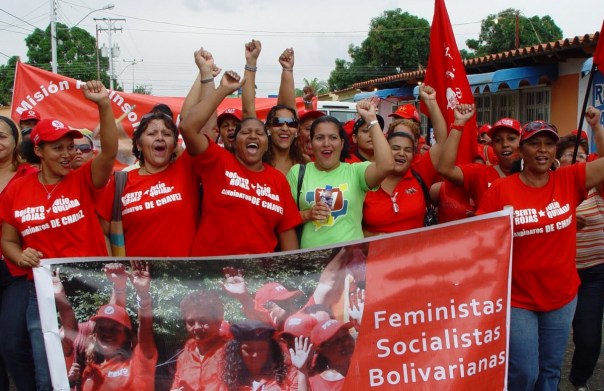
Women in Venezuela are equal under law. There is also a law to protect them from gender-based violence.
By: Carlos Fazio /II
If preparation for the violent plunder of Venezuela’s oil and other mining-energy, aquifer and biodiversity riches was one of the main hidden objectives of Rex Tillerson’s tour through various countries in Latin America, the other was to continue with the militarization of the subcontinent under the facade of the war on drugs and terrorism and the clandestine policies of regime change.
The “American War Machine,” as Peter Dale Scott calls it, answers to the “Deep State,” that is, to a secret parallel government organized by the military, police and intelligence apparatuses, financed by the criminal economy and integrated into the Wall Street financial and banking system, which is in charge of formulating and instrumenting the White House foreign policy and its open or secret operations for the benefit of the giants of the oil sector, like Exxon Mobil and Chevron. Not in vain, the Donald Trump cabinet is in the hands of a troika of generals: James Mattis (Defense), H. R. McMaster (National Security Advisor) and John Kelly (White House Chief of Staff).
Since the epoch of John F. Kennedy, and more profusely starting with the Clinton administration, high-ranking military and intelligence officials have become “partners” of industrial corporations, and through the lucrative business of war helped to extend the market system and open new “economic borders” to large manufacturers of arms and of security and technology sales, like Lockheed Martin, Boeing, General Dynamics, L-3 Communications, United Technologies and Booz Allen Hamilton Inc.
The problem with those corporations is that they need to feed themselves every day with new wars; that’s why they have to invent them. And that is also why all the wars are based on the deception and the manipulation of the masses –like the non-existent chemical weapons of mass destruction of Saddam Hussein in Iraq− and/or the systematic deceit through the mass media and the “internal archives” of the government of the United States (US).
A new factor exists in the conjuncture: the national security strategy of the Trump administration, announced on December 18, 2017, places fossil fuels (oil, gas, coal) as the essential decisive element to ensure the economic vitality of the US, its military strength and its geopolitical weight. Militarization of energy policy will be the axis of Trump’s national security policy, not only for obtaining “energy independence,” but also for confronting the “rival powers” (China and Russia) that challenge US supremacy and for achieving “total energy domination.”
The “results” of the Tillerson tour through the region respond to that dynamic. In the opening of markets variable, the most visible achievements occurred in Argentina, where the Macri government announced the creation of a rapid deployment force integrated by the armed forces for combating terrorism and drug trafficking (the return of the military to internal security functions) under the advice of the Southern Command, and the installation of a DEA “task force” in Misiones, which could configure a covert military base at a strategic site: the triple border with Paraguay and Brazil, in whose subsoil the Guaraní Aquifer is found, the second largest reservoir of sweet water in the world. In addition to that, briefly, we would add the creation of “intelligence fusion centers” among the Argentine armed and security forces with the DEA, the National Security Agency (NSA) and the Southern Command, like those that already exist in Colombia and Mexico.
Before Tillerson’s tour, the purchase of a sophisticated package of missiles and torpedoes made in the United States for the Mexican Navy had been announced, for 98.4 million dollars! The construction of a military barracks in Chicomuselo, Chiapas, was also reported, in a zone where the EZLN has a presence, to “care for the security of the southern border,” and the expansion of the naval base in Matamoros, Tamaulipas. Last January, the Mexican Navy participated in the Maritime Security Multinational Meeting in Miami, where it signed a letter of intent for joint protection of the waters of the Gulf of Mexico and of part of Central America and the Caribbean with the navies of Colombia and the US.
In the second variable: preparations for a direct or covert military intervention within the framework of the Trump administration’s “regime change” policies in Cuba and Venezuela, the advances are notorious; particularly as to the military ring around Venezuela. The Pentagon has achieved the installation of new military enclaves and the mobilization of troops and mercenaries on Colombia’s border zone with Venezuela, especially in the regions of Tumaco, Cúcuta and the Catatumbo of Northern Santander, which in a pincer operation are added US rapid deployment forces stationed in Aruba, Curacao and Honduras. The military encirclement policy is complemented with “humanitarian aid exercises” in Panama and the recent participation of Brazil and Peru in Operation United America under the Pentagon’s command. By way of a parallel, Tillerson himself encouraged an eventual dissidence within the bosom of the Venezuelan armed forces, which might culminate with a military State coup against President Nicolás Maduro.
In that context, the interests of the US arms and oil industries merge with those of the clandestine power parallel to the White House −that “Deep State” where the Pentagon, the CIA, the NSA and private companies like Booz Allen− interact and approach the possibility of an outcome like Iraq, Libya or Syria in Venezuela. If Donald Rumsfeld and Dick Cheney were the planners of that secret circle during the Bush administration and took us to war in Iraq, Generals Mattis, H. R. McMaster and John Kelly could be the ones responsible for turning the heart of South America into a new Vietnam.
———————————————————–
Originally Published in Spanish by La Jornada
Monday, February 26, 2018
http://www.jornada.unam.mx/2018/02/26/politica/021a1pol
Re-Published with English interpretation by the Chiapas Support Committee
Tillerson, Militarization and oil I
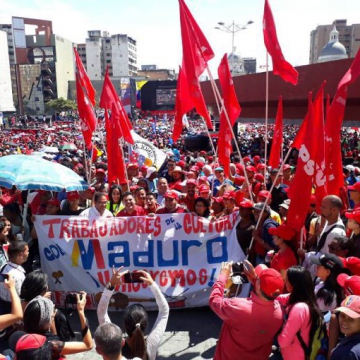
A demonstration in support of President Nicolas Maduro.
[Admin: This is the first of two articles (so far) about US Secretary of State Rex Tillerson’s Latin American tour.]
By: Carlos Fazio
In the context of a geopolitical dispute with extra-continental capitalist competitors (China, Russia, the European Union) that challenge the hegemony of the US empire in its traditional zone of influence, the recent tour of Secretary of State, Rex Tillerson, through Mexico, Argentina, Peru, Colombia and Jamaica [1] had a clear expansionist projection based on two principal axes: security and energy.
As a member of the transnational capitalist class, Tillerson, a former executive director of the United States private oil company Exxon-Mobil, the fourth largest oil company in the world behind the state-owned Aramco (Saudi Arabia), NIOC (Iran) and CNPC (China), wielded a “primitive mercantilist” approach (Jorge Eduardo Navarrete said it), as anachronistic as the Monroe Doctrine in which he based his speech at the University of Texas, in Austin, one day before his arrival in Mexico.
The “Tillerson model” of hemispheric relations embodies the traditional war diplomacy of Washington, now accentuated due to the structural crisis and crisis of legitimacy of the world capitalist system, characterized by William I. Robinson as the fusion of reactionary political power in the State, ultra-rightist, authoritarian and new fascist forces in civil society, and transnational corporate capital. A triangulation of interests that, under the Trump administration, is shaping a “global police State” of a new fascist cut.
In that context, the factions of big capital most prone to 21st century fascism are located in the speculative financial sector, the military-industrial-security-media complex and in the extractive industries, interlaced with high tech/digital capital.
Given the magnitude of the crisis of capitalism, its global reach, the social deterioration and the degree of ecological degradation that it generates, in order to contain the real or potential protests and/or rebellions, the dominant plutocracy has been promoting diverse systems of mass social control, repression and wars (open or clandestine), which are also used as tools for obtaining profits and to continue accumulating capital in the face of stagnation. Robinson calls it “militarized accumulation” or “accumulation by repression.”
Such categorization alludes to the Achilles heel of capitalism: over-accumulation, the growing gap between what is produced and what the market can absorb. If the capitalists cannot sell their products, they don’t make a profit. Given the enormous concentration of wealth –with its correlative levels of social polarization and unprecedented global inequality−, the transnational capitalist class needs to find profitable productive outlets for discharging enormous quantities of accumulated surpluses.
That’s why the energy and extractive complexes resort to the intensification and deepening of neoliberalism via the privatization of highway, seaport, airport and railroad infrastructure, and of oil pipelines, gas pipelines and electricity (for example, Pemex and the Federal Electricity Commission in the case of Mexico); as well as the super-exploitation of labor and lack of job security (subcontracting, outsourcing), and policies of total deregulation and greater subsidies to transnational capital.
Said policies of relocation of capital, re-industrialization and accumulation by dispossession or the plunder of territories and raw materials in dependent economies, have been occurring in Mexico, Central and South America through soft coups, the de facto imposition of a permanent state of emergency and the establishment of police states, whose supports are the militarization of civil society and different modalities of endless tactical wars, camouflaged as anti-drug wars or wars against “internal enemies” −the Mapuches under the (dis) government of Mauricio Macri−, with advanced armaments systems driven by artificial intelligence, including sophisticated monitoring, tracking, security and surveillance systemeIn that context it should be noted that in his speech at the University of Texas, Tillerson placed energy, particularly hydrocarbons (oil, gas and unconventional oils), as a nodal point of the renewed hemispheric strategy of the Trump administration. He put as the “model” the energy strength of North America; the opening (privatization) of the energy markets in Mexico, and the role of the United States as the provider of natural gas for new generators of electricity in the region.
In fact, Mexico –which since 2007 with the Merida Initiative heads the list of covert aid for military intelligence from the Pentagon and the CIA, after Afghanistan− is on the way to becoming an export platform for oil, natural gas and gasoline produced in the Permian Basin and Louisiana, towards the Asian market (Japan, China, India, South Korea and Taiwan), via the ports of Manzanillo and the Coatzacoalcos/Salina Cruz axis on the Isthmus of Tehuantepec, which will take advantage of the infrastructure installed by Pemex, which will give the energy corporations the advantages of less time and lower transportation costs than if they did it through the Panama Canal.
Given that hydrocarbons are a central component of the militarized neocolonial and “energy security” strategy of Donald Trump and the corporations of that sector –in key with the conservative restoration and the defense of its hegemony−, Petróleos de Venezuela (PDVSA, the fifth largest oil company in the world) was another central objective of Tillerson’s tour. That is why he instructed the collaborationist henchmen governments of Enrique Peña Nieto, Mauricio Macri, Pedro Kuczynski and Juan Manuel Santos about the new modalities that they will have to undertake faced with the intensification of the military, economic and financial circle against the constitutional government of Nicolas Maduro, including an eventual oil embargo as the new precipitator of a “humanitarian crisis” that would justify a multilateral military intervention.
[1] The Tillerson tour took place during the first week of February 2018.
——————————————————————
Originally Published in Spanish by La Jornada
Monday, February 12, 2018
http://www.jornada.unam.mx/2018/02/12/opinion/021a1pol
Re-Published with English interpretation by the Chiapas Support Committee
The Mayor of Oxchuc is removed and new municipal council elected
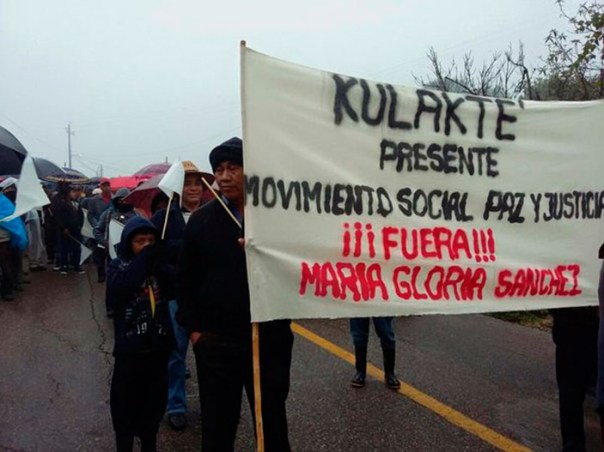
A protest sign in Oxchuc political conflict in which the Spanish words read: “Peace and Justice Social Movement María Gloria Sanchez OUT!!!”
By: Isaín Mandujano
TUXTLA GUTIÉRREZ, Chiapas (proceso.com.mx) – The State Congress took away her constitutional protection (immunity from prosecution) and removed María Gloria Sánchez Gómez from her elected position as mayor of Oxchuc, and also removed her entire county council; therefore, by means of a plebiscite the traditional authorities of that municipality today elected three men and three women to form the new municipal government council.
On Sunday afternoon, the Permanent Commission of the State Congress swore in the new Oxchuc municipal council made up of Petrona Sántiz Gómez, Soila López Gómez, Lilia Gómez López, Juan Sántiz Rodríguez, Manuel Gómez Rodríguez and Oscar Gómez López.
Last Friday, the Attorney General of the State of Chiapas (FGE, its initials in Spanish) asked the state Congress to remove the legal immunity from prosecution from the mayor and municipal council so that she can be investigated and called in to give a statement about the ambush that her adversaries suffered on last January 23, when they were attacked with firearms and three of them died. [1] Seventeen people were also injured in that armed attack.
Four days after that ambush, the FGE arrested Amílcar “N”, César “N” and Mario “N”, accused of being implicated in the crimes of homicide, attempted homicide, attacks against the peace and bodily and patrimonial integrity of the collectivity of the State. They were linked to the mayor and that was why the FGE asked the Congress to remove the legal protection from María Gloria Sánchez so that she could be called upon to give her statement about those violent incidents.
The Permanent Commission was erected as a jury of origin and approved to remove legal protection from the mayor after listening to her in a hearing.
The two local deputies, Santiago López and Fidel Álvarez, traveled to Oxchuc to be witnesses to the vote where, with the staff of command in hand, around 100 of the 115 communities, decided to elect their new authorities.
Through the process of uses and customs they elected Petrona Sántiz Gómez, Soila López Gómez, Lilia Gómez López, Juan Sántiz Rodríguez, Manuel Gómez Rodríguez and Oscar Gómez López as members of the new municipal council.
There are still eight months left of María Gloria Sánchez Gómez’s term of office, but she has not been able to govern from the municipal capital since 2015 when she was elected. [2] It is rumored that the now former mayor will go to court to challenge this process of removing her immunity from prosecution.
————————-
[1] For more on the armed attack, see: https://chiapas-support.org/2018/01/30/3-dead-in-oxchuc-chiapas-violence/
[2] That conflict turned deadly violent early in 2016. For more information, see: https://chiapas-support.org/2016/01/13/66-police-injured-in-oxchuc-chiapas-confrontation/
——————————————————-
Originally Published in Spanish by Proceso
Sunday, February 18, 2017
Re-Published with English Interpretation by the Chiapas Support Committee
 Chiapas Support Committee