Chiapas Support Committee
Home of the Compañero Manuel blog on zapatistas & mexico
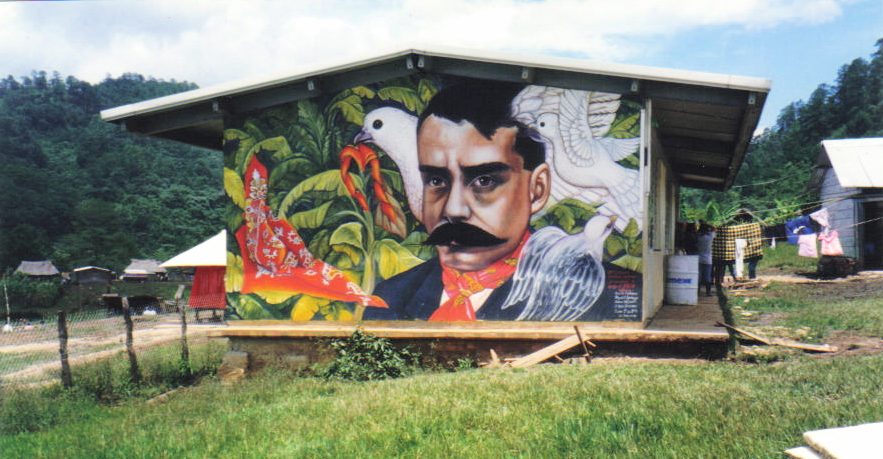
SupGaleano: From the Diaries of the Cat-Dog
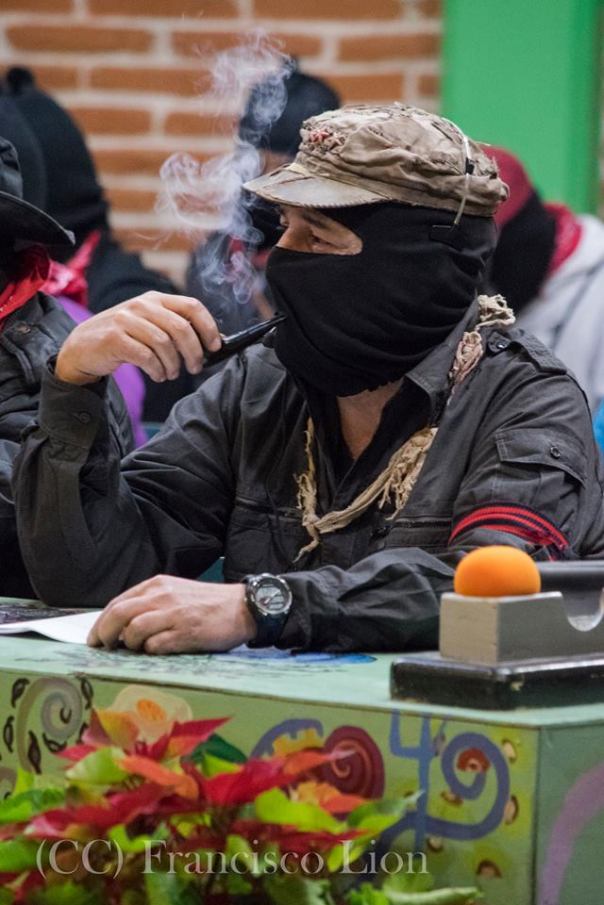
Subcomandante Insurgente Galeano at ConSciences
The EZLN’s Sixth Commission at the close of “Consciences for Humanity”: “From the Diaries of the Cat-Dog.” SupGaleano
From the Diaries of the Cat-Dog: the story of how two great detectives met, a fragment of what Elías Contreras and Sup Galeano talked about during the now not-so-mysterious case of the missing honeybuns, how Defensa Zapatista left the science of language in shreds, and some idle reflections from the Sup on the above subjects
December 30, 2017
Once again, good morning, good afternoon, good evening, good night,
First of all, we want to send an embrace to the Mapuche people who are still being attacked by the bad governments of the countries called Chile and Argentina. They have used legal ruses to again bring charges against Machi Francisca Linconao, along with other Mapuche men and women, proving once again that in this system, those who destroy nature are the good guys and those who resist, defending life, are persecuted, murdered, and imprisoned like criminals. Despite this, or precisely because of it, one word is sufficient to describe the struggle of the Mapuche people and all of the original peoples of this continent: Marichiweu—we will win, ten, a thousand times over and always.
Yesterday, one of the women scientists who spoke here told us about a contest to write the message that will be taken by spaceship to another planet, and that the reward for the winning message is a million dollars. The message that we propose, and which will most surely win, is: “Don’t let us come to your world. If we haven’t resolved the problems that we caused ourselves, we will make the same errors again. And in that case, we won’t come alone; we will bring a criminal system with us. We will be for your world an alien apocalypse, the much-feared eighth passenger that grows and reproduces itself through death and destruction.The motive for learning about other worlds should be the desire for knowledge, the necessity to learn, and respect for what is different, not the search for new markets for war nor for refuge from a murderous system.”
Please deposit the million dollars in the bank account of the organization named “The Time has Come for the Flourishing of the People” that supports the Indigenous Governing Council.
What I am going to read was going to be our contribution to the panel yesterday, but, like Pedrito, I was on the receiving end of a “gender equality” effort (knock on the head included) and “the women that we are” won the space. So here goes:
Doctor John Watson looks worriedly in the mirror. He brushes his hair to one side, then to the other, forward and then backward. He looks at himself straight on then studies his profile from the right, then from the left, and with a hand mirror from behind. He murmurs throughout this process: “Tortilla hair…why does she call me tortilla hair? Because of the color? The style? Maybe because of the gray that now competes with the brown? Or is it the way I wear it? Tortilla hair; that damned girl…”
He’s still in this process when Sherlock Holmes, consulting detective, suddenly jumps out of the hammock where he had been playing melancholy chords on the violin. Putting his coat on quickly, Sherlock urges the doctor:
“Quickly Watson, we don’t have much time.”
“Where are we going Holmes?” It’s cold already and the Junta [Good Government Council] says it’s going to get worse,” Watson says as he walks out the door of the small hut the autonomous authorities have provided them for their stay in the mountains of the Mexican Southeast.
Holmes doesn’t even bother to answer. He strides down the main street of the community toward the small building with a sign on the front reading “Vigilance Commission” and a mural behind it with vivid colors that bravely fight the humidity. Inside the building, a young indigenous woman is attentively focused on a computer monitor.
“Te´ oyot Tzeb” (“Greetings, señorita”), Sherlock Holmes says in his best Tzotzil. A few days have been enough for him to master the basics in order to be understood in the Mayan languages of these zones.
Watson is about to mock him when the young woman on the vigilance commission responds to him in perfect English: “Good Afternoon.” Her accent is not so much British as that of a Dubliner, Watson thinks.
Holmes ignores Watson’s sarcastic look and in impeccable Spanish asks,
“How can I find the person I am looking for?”
The young woman, indigenous, short, with long braids and lively black eyes, looks amused as she responds in perfect German:
“Und wie heißt diese Person?“ (“And what is that person’s name?“)
Holmes immediately catches on and asks in the French of an undocumented immigrant,
“Je ne connais pas son nom, mais sa profession est un enquêteur privé” (“I don’t know his name, but he’s a private investigator”)
“Non capisco niente” (“I didn’t get any of that”), says the young indigenous woman in the language of a rough and proud Italian neighborhood.
Doctor John Watson looks amused by Holmes’ predicament, but he is looking worriedly at the street, afraid that little girl is going to show up.
Sherlock Holmes is trying to think how to stay “private investigator” or “detective” in Russian, when Watson’s fears are realized.
Like a small hurricane, the little girl who calls herself Defensa Zapatista comes running down the street full of puddles and bursts in the door as Watson instinctively pats his hair and Sherlock is trying to decide whether to switch to Mandarin Chinese or Polish.
Defensa Zapatista hugs Sherlock shouting, “Hole-mase! Broomhead!”
Well, hug would be stretching it. The respective heights of Holmes and the little girl mean that he receives her hug around the knees.
The consulting detective looks disconcerted. In London the minimum height of a person with whom he comes into contact is 5’9”, although throughout this time in Zapatista territory he has had to lower that average to 4’11”. His experience with children, apart from distancing himself anytime he sees one and gesturing displeasure anytime he hears one crying, is almost nil. But for some reason, the taller detective likes Defensa Zapatista.
The little girl turns to the respected Doctor and blogger John Watson and throws her arms around his neck with a delighted “Waj-shton! Tortilla hair!” which does not delight the ex-military doctor.
Defensa Zapatista takes them both by the hand and pulls them toward the door: “Hurry, we’re going to be late!” The young woman of the Vigilance Commission, disappointed by the rather abrupt end of her linguistic internationalism, closes the 7 tabs on her browser that were open to Google Translate and returns to the blog she is reading about the activities of the Indigenous Governing Council spokesperson, María de Jesús Patricio Martínez. Holmes doesn’t need to hurry; for each one of his strides, the girl has to take several. Sherlock is holding in his right hand the small stick with which he is always poking around in the dirt and between the plants in search of insects. Watson purposely falls behind when he sees the so-called “cat-dog” bite the cuff of Holmes’ pants, probably to make him cut his stride and thus walk at the same pace as the little girl.
The girl stops suddenly and says, relieved, “We’re here.”
They’re at the pasture that serves, in addition to grazing land for the livestock collectives, as a soccer field for the teams that take turns working to widen and deepen the crack in the wall, as well as for festivals, dances, and celebrations, not to mention a training field for Defensa Zapatista’s as-yet incomplete team.
Watson, who still hasn’t learned his way around the small village where they spend the majority of their time, confirms unhappily that they have arrived at a pasture when he feels thick, warm cow shit underfoot.
Defensa Zapatista says, “You guys wait here, I’m going to go get the one-eyed horse,” and she runs off with the cat-dog behind her.
Just then an indigenous man of undefined age comes up to the British pair.
Sherlock Holmes sees him coming and with the precision and speed that he is known for, begins to construct a biographical sketch of the man. But before he can finish, the man says:
“Good morning Mr. Hole-Mase, Mr. Waj-shton. Don’t worry,” he says to Sherlock, “your tailor in London will be able to mend that rip without a problem. And I believe you’ll find some boots in your size in the Zapatista shoe store. You know how it goes here, sometimes it seems like there is nothing to do, but you should try not to smoke that pipe so much, it’s bad for your health. I recommend the violin over the pipe when the day gets long. And I warn you that in these lands they say all kinds of things about the women, it seems they get angry very quickly, especially Defensa Zapatista.”
Sherlock Holmes is speechless, and Watson turns to look at him with curiosity. Apparently the detective has been given a little of his own medicine.
Holmes snaps out of it and applauds with admiration, “Bravo! You’re right about almost everything, although allow me to demur on the question of misogyny.”
Watson, as usual, doesn’t understand anything that is going on.
It is the indigenous man who clarifies, as Holmes nods at each point:
“Elementary, my dear ‘Tortilla Hair’: the gentleman has donned his much-valued raincoat very quickly, and in the process tore slightly the left cuff. Someone who dresses as he does is clearly very careful with his things, so it is to be expected that he is thinking about going to the tailor to get the coat mended. That the tailor is in London is an easy guess, as the coat is half open and one can see the tag.
The nicotine stains at the bottom of his finger and on the palm of his hand reveal that he often smokes a pipe, as these are tracks left by the tobacco. About the boots—well those little ankle boots he’s wearing aren’t going to last long here, and one can assume that you have all thought about getting some boots like the ones we wear, made by insurgent cobblers and which can be purchased in the compas’ store.
Indeed, I forgot to say that Mr. Hole-mase is right-handed; he holds his pipe with his left hand because he uses his right to, for example, play the violin.
The violin, well, the way he is holding that small stick is the same as how Pablito, the Zapatista mariachi, holds the bow when he plays violin at our festivals, and the redness on the left side of his neck is because of the violin, either that or because some insect bit him there… or somebody gave him a hickey. That thing about talking badly about the women was just to see what he would do, but since he has male company, well, either he thinks poorly of women or just prefers men.”
Holmes applauds again. The indigenous man’s insinuation of homosexuality didn’t bother him a bit. But Watson is very defensive of his heterosexuality and tries to clarify:
“Pardon me, but Holmes and I are not a couple. That is, we are partners but not partners in the hickey-sense, but rather, I mean, that is, we have a… professional relationship.”
The indigenous man interrupts him: “Don’t worry Waj-shton, here we respect everyone’s preferences.” “I know,” Watson insists, “but this isn’t what it looks like, that is, not that I have anything against those kinds of relationships, I’m just clarifying that…”
Now Holmes interrupts him and nods respectfully, saying: “If I am not mistaken, you sir must be Elías Contreras, Investigation Commission.”
Watson takes off his bowler hat—with which he hopelessly tries to hide his “Tortilla hair,” and also nods in admiration.
Holmes adds: “Only someone like Elías Contreras could make that series of observations, reasoning, and deductions faster than me.”
Instead of accepting the praise, Elías Contreras smiles teasingly and says:
“Nah, the thing is that SupGaleano has some books about you two and they describe you—the pipe, the violin and all—and I saw your names on the visitor’s list in the Vigilance Commission office, and since you’re the only outsiders in the village right now, well..”
Watson puts his hat back on a little resentfully. But Holmes is beaming and happy to have run into the not-at-all-famous detective, the one they call the “eezeeelen investigation commission.”
“You are right, my dear Elías Contreras, or should I call you something else?” he asks extending his hand with affection.
“Elías is fine,” the Zapatista says as he offers them both a rolled cigarette, which both politely refuse. Sherlock speaks again:
“Do you know what? Something similar happened to me with Sir Arthur, who used to give me the drafts of the sorry chronicles of my discoveries, which he inexplicably attributed to doctor Waj-shton, here at my side.” Watson tries to protest but ends up just pulling his hat down a little further.
“And I saw how Sir Arthur embellished my work, unnecessarily in my opinion. And I say it was unnecessary because all I did was apply science to solve crimes.
And science and its explanation, my dear Elías, are far from the glamour attributed to them by novelists and regular people.
Furthermore, my work was full of errors, continuous and tiring experimentation, and serious and systematic study of the advances that are made in these fields in every corner of the world. Science and its application are difficult. Scientific rigor makes its implementation unexciting, and differentiates it from the intellectual laziness that is repeated in opinions, comments, and commonplace superstitions. For the same reason, when presented with the opportunity to study, some people opt for the poorly-named social sciences, or the humanities in general, which they think, erroneously, do not require the rigor, thoroughness, and complexity of scientific knowledge.
With regard to the arts, these demand not rigor in the sense of exactitude, but can, in contrast to the natural and hard sciences and the humanities, imagine not only other realities but also awe us with shapes, sounds, and colors that capture that imagination.
Perhaps that is why the arts are closer to the exact and natural sciences, as opposed to the so-called humanities. The looseness that a novel requires, for example, would be an unforgivable offense in the scientific realm and an outright violation of the ethical code that any scientist should include in their practice. But the problem that is always confronted sooner or later is that the fact of having adhered to a strict discipline in order to gain solid knowledge often leads those who practice science as a profession to take on a wretchedly pretentious attitude toward everybody else.
They tend to be arrogant and, not uncommonly, justify a certain frivolity and lack of common sense on their part with regard to daily matters. As if real life were a matter for us common folk, and that they [ellos, ellas, elloas], were above all that.
But sometimes despite the scientists themselves, the natural and hard sciences are indispensable, that much is undeniable. Any real and practicable possibility of getting out of the treacherous nightmare that is the current homogenous global system will have to have the natural and hard sciences as its principal foundation. And if it doesn’t, we’ll be stuck comforting ourselves with science fiction.”
Watson looks with surprise at Holmes as he thinks, “Incredible, Sherlock Homes is describing himself in a disapproving tone.”
Holmes notes Watson’s surprise and addresses him to clarify:
“You’re mistaken, Watson, I’m not being self-critical. Obviously that monologue is not my own; it has been assigned to me by SupGaleano. See, the Zapatistas think that recognition and a soft scolding will be better received by the scientific community if it comes from one of the best detectives in world history than if it comes from a masked nose who still uses the Dane Niels Henrik David Bohr’s model of the atom, describing it as “a little ball made of a lot of other little balls stuck together around which other little balls orbit.”
Sherlock Holmes shudders, in part due to the scandalous description of the atom, and in part because it seems that he has finally released the discourse imposed on him by Zapatismo and backed by “poetic license.” Elías Contreras, investigation commission for the eezeeelen, only spoke up with a “hmm.”
We know what happened next because Doctor John Watson took notes of what was said there—not with the intention of publishing it, but rather because it sparked his interest. Holmes would later be pleased at this, because what Elías Contreras said is still keeping him awake.
Sherlock Holmes took Elías aside, as Doctor Watson followed from a prudent distance. The little girl, accompanied by the the bark-meowing of the cat-dog, was busy trying to convince the one-eyed horse to get into position at the goal.
“Now we’re going to practice free kicks,” Watson heard her say, and he saw a little boy position himself, jokingly, under the bar that was supposed to be the goal.
Sherlock Holmes spoke in a murmur:
“My esteemed Elías, I come to you to see if you might have a case that requires the aid of my detective abilities. Of course, I promise to be discreet and claim no credit for myself should we be successful.”
Elías Contreras stopped and said in the same confidential tone:
“Well, in fact, yes. However, the problem that we are looking at is quite large and all we have is our minds in order to try to understand and address it. And then, well, what comes into my head I can talk about later with the compañeros and compañeras of the comité [Indigenous Revolutionary Clandestine Committee].”
“Excellent!” exclaimed Sherlock Holmes. “Abstract reflection requires extra effort that forces the brain to sublimate. Pay attention Watson, because now, I believe, we are about to encounter the biggest challenge for any detective: to solve a crime with only the tools of logic and scientific knowledge.”
Holmes looked as excited as could be. Watson couldn’t remember seeing him so excited since the case of “A Study in Scarlett,” which brought him fame and global prestige as a consulting detective.
Sherlock Holmes didn’t rush Elías Contreras. He lit his pipe, yes, but more in order to accompany Elías, who was rolling a cigarette, than out of a desire for the sharp taste of tobacco smoke in his mouth.
Elías Contreras began:
“All right: the problem is big but simple. We know the murderer, the victim, the weapon used, the timing, and the location of the so-called “scene of the crime”, that is, where the fuckery was carried out. So like the Sup says, we have the calendar and the geography.
The problem is big, though, because it’s all mixed up. And that’s where I don’t know if it’s all mixed up in reality or if it’s my thinking that’s confused.
So in this case, the crime was already committed, but it’s also being carried out and will be further carried out. That is, it’s not just some fuckery that already happened and that’s it, or that is happening now, but also something that is coming.”
Holmes looks even more interested, but he doesn’t interrupt Elías Contreras, who continues:
“So we have to find out what happened, what is happening, and what has yet to happen so we can to stop it from happening, because if it does, it’s going to be a tragedy so great you can’t imagine it.”
Sherlock Holmes waits for the the investigation commission to pause before venturing:
“I believe I understand: we have to understand the crime committed in order to understand the crime underway and thus be able to avoid another crime taking place: the greatest crime in the history of humanity.”
Elías Contreras nods and continues:
“The criminal doesn’t hide; on the contrary, it shows itself outright and brags about what it has done. It says that its crime of killing, destroying, and stealing was a good thing to bring itself into being. I think it is there, where it was born as a criminal, the point at which it developed its way of doing things, that we can learn how it carries out its fuckery and how it intends to do so in the future.”
“Of course,” interrupts Holmes, “we must reconstruct the genealogy of the crime which in this case, and if I understand correctly, is the genealogy of the criminal. But go on.”
“Okay,” Elías continues, “from there we see that the criminal became modernized, that is, it became a better criminal and is careful that no one finds out that it is a criminal; rather, it dresses itself up like a good guy, like it’s not plotting anything at all, just hanging around.
So it has partners in crime, and those partners in crime are responsible for being the pretty face for the criminal. But since what’s happening is so fucked up, these partners in crime have to come up with someone responsible. That is, their work is to blame somebody else.
So they go look for someone to blame for the tragedy. Sometimes it’s women who are guilty for not obeying, it is said, because they go around with skimpy clothing, or because they study and work, or even because they want to have “self-rule” over their own bodies and their path, to be autonomous, or maybe it’s because they think, and begin to act like they’re an autonomous municipality in rebellion.
But other times they blame those who have skin of a different color, or who have another way of being, like Magdalena who died fighting against the bad and those who carry it out, and who was a woman but like they say, God messed up and gave her the body of a man and Magdalena, well she didn’t hide it or accept it. She just didn’t give a fuck what other people thought; she was different, and since she had that other body she was other [otroa]. And she, or he, or s/he [elloa], fought to be what she was.
Brave, that Magdalena, she never gave in, never ever,” says Elías, his eyes filling up upon remembering the person who, in his own way, he loved and still loves.
Holmes and Watson maintain a respectful silence.
Elías composes himself and continues: “Well, they also blame us as indigenous people, saying that things are bad because we are not civilized and that we don’t allow progress, and so they put mines where there should be forests and lakes. And the thing is that we as peoples live where they pushed us to, because they stole everything and ran us off from where we were before. They also imprisoned and killed us, but here we are, still resisting. Before, the criminal didn’t want these lands, but now it does because now these lands are commodities too, they say; water can be bought and sold, as well as land, air, sunshine, trees, and animals, even the smallest ones; even what we use to make pozol is a commodity.
That’s what this criminal does, it makes everything into a commodity, even people, women, children, men, their dignity; and if something can’t be commodified, then the criminal isn’t interested because it can’t be bought or sold. But the problem isn’t exactly that, but rather that the criminal can carry out all this fuckery because it has a weapon called private property of the mode of production with which it runs its whole plan. So the problem isn’t that things are produced, but rather that there are some who have property which is used for that production and you only have your own labor for which they pay you, and badly, as a commodity. So the criminal destroys and kills thanks to its weapon of private property, and at the same time carries out all this fuckery so that that weapon can’t be taken away.
I don’t know how to explain it all exactly, even though I understand it perfectly well. I just don’t know the words in Spanish to explain it, or in the languages you use. But it’s more or less like I said: you have the criminal, you have the victim who is blamed for the crime in order to steal from them and fool others, and you have the weapon. And the crime scene is the whole world. That’s why I say everything is mixed up, because the world capitalist system provides everything: it creates the victim and then murders them, it provides the weapon that kills and destroys, and it provides the crime scene.
I talked about this all with SupGaleano when he committed the honeybun crime, and they punished him but now he’ll be charged with another crime because he took SupMoy’s phone. You think SupMoy isn’t going to realize that? But anyway, let’s get back to the problem because if we don’t stop the criminal, then the whole world will become its victim; not just people but everything—animals, plants, rocks, water, everything.
The other problem is that there is nowhere to lock up the criminal, so the only way to stop the crime is by destroying the capitalist system.
Of course, I’m not telling you everything we talked about. I mean, this isn’t the whole talk, but if I tell you everything then those who are listening and reading and watching this story are going to start nodding off or thinking about what they’re going to wear to dance at the festivities tomorrow because one year is ending and another starting, and maybe they think that the change in calendar will be enough to change things, but it’s not; in order to change things we have to struggle, a lot, everywhere and all the time, without rest.” Holmes and Watson remained quiet until Elías bid them farewell saying, “I have to go, take care and don’t be ashamed of other loves, if there is a tomorrow it will also be for, with, and because of them [elloas].” Elías looked at Watson and added, “If there’s no key to open the closet, break down the door. One has to come out without fear, like Magdalena. Or fearful but controlling it.”
Watson wanted to clarify again that he and Sherlock were not what it looked like they were, but Elías Contreras, eezeeelen investigation commission had already taken off down the road and the afternoon was drifting off to sleep, covered by the shadows of night that already promised to be cold.
There were a few days, not many moons ago, when the little girl Defensa Zapatista decided to express herself verbally only in colors. And not with expressions like, “this is blue,” or, “I felt orange” or things like that, but only by actually naming colors. All theories of language and discourse were threatened by the impertinence of a Zapatista indigenous girl.
One day she came to Sup Galeano’s hut and said, “yellow.”
The Sup didn’t even take his eyes off the computer screen, he just said: “in my jacket, right pocket.”
Defensa Zapatista went over to where the jacket was hanging and pulled a package of honeybuns out of the right pocket and ran out the door happily chirping, “purple.”
Despite what you might think, each color didn’t have a precise meaning. In order to understand Defensa Zapatista you’d have to take into account her tone, the context in which she spoke, where she was looking, the expression on her face, her gestures and even her body language.
One time she also said “yellow” while she was walking to school, as if she were on her way to the gallows. The Sup said that’s when he knew that Defensa Zapatista was a normal kid and not a cybernetic organism created by SupMarcos’ perverse mind to pester us all. The cursed inheritance of a Moriarty with an impertinent nose, the continuous and frustrating questioning packaged in the apparent innocence of a little girl barely a few feet high, a robot whose energy source was neither solar nor atomic but based in honeybuns.
One afternoon SupGaleano explained to Elías Contreras:
“She’s a child, no doubt about it. It’s totally normal that a little girl goes to school with all the weight, anxiety and desperation of someone marching into the slavery of letters, numbers, names, and dates. No one can say better than she can what it means to go to school, and I think the fact that she takes the cat-dog with her, albeit hidden in her book bag, is her way of clinging onto the world in which Defensa Zapatista is what she is—and I don’t have any idea what or who that is—but she is happy in that world and happy in her efforts to complete the team which, perhaps, is her way of saying “change the world.”
Because you can see that she does not dream of being a superhero, someone with superpowers or a Katana to cut down her enemies who, if you pay attention, are always masculine. You can see that she never talks about the goal she made with surprising technique and which has been passed off with other explanations. On the other hand, the late SupMarcos never stopped reminding everyone, usually in irrelevant contexts, that he had once made a goal in middle school. He never mentioned of course that he was always on the bench and that just once he was put in the game, when the coach was down a player, and he slipped and accidentally, as they say, “pushed the ball to the back of the net.”
Neither does Defensa Zapatista take on the role of defenseless princess waiting to be saved by masculinity astride a white horse. In fact, I think her relationship with Pedrito is just the inverse: she helps, orients, and rescues Pedrito, even if her method of knocks upside the head is not ideal.
No, Defensa Zapatista takes on her objective as something to carry out collectively and does not conceive of herself as a leader or a boss; in fact she has selected the position that shines the least—defense—and she does it in order to support the one-eyed horse playing goalie. Her job is to seek out and find who wants to join, who will play as a team and be not only a member of the team but also a bridge for others to join it. And when she values as equally important positions such as ball boy or the little dog or the cat-dog who run crooked and makes the only requirement the desire to play, that is her way of saying, “to want to struggle.”
In Defensa Zapatista we find not a new world, that’s true, but perhaps something even more terrible and marvelous: its possibility.
And when she talks in colors, perhaps she is trying out new forms of communication for that world that we can’t even imagine but that she already accepts as coming—not without the necessary and urgent struggle to bring it into being, from wherever it can be found, here into this reality that we are suffering through now. I can think of nothing more Zapatista than what this little girl’s efforts symbolize.
SupGaleano was commenting all this to a silent and attentive Elías Contreras when Defensa Zapatista appeared in the doorway of the hut with a ball in one hand and the cat-dog in the other and asked, “Pink?”
“We’re coming, we’ll catch up with you,” the Sup answered her. Defensa Zapatista just nodded and said “Black” as she ran out the door.
Elías Contreras asked the Sup: “What did she say?”
“Beats me,” answered the Sup as he debated whether to put on his Inter Milan jersey (which apparently the Chinese have bought), the Atlanta one (which is not in that player market called UEFA), or his Jaguars of Chiapas jersey (who knows where they are), all of which he found in the trunk left by the late SupMarcos. Finally he put on his EZLN T-shirt, the one worn in 1999 when a team of Zapatista support bases debuted at the “Palillo Martínex” stadium at the Sports Complex in Mexico City, a game in which they made only a single goal and which the late SupMarcos summarized thus: “We didn’t lose; what happened was that we didn’t have time to win. So, what’s missing is yet to come.”
“The truth is I just guess what she’s trying to say. Sometimes I’m right, sometimes I’m wrong. That is, I apply the scientific method of trial and error. Let’s go Elías, I think we have to go to the pasture because there’s a team to fill out. It can take a while, yes, but someday there will be more of us,” SupGaleano added as a kind of apology.
The one-eyed horse was already in the pasture stubbornly munching that same plastic bottle. Pedrito was arguing about something with the little girl, the cat-dog was trying in vain to bite the flashy ball that good ole Vlady had given to Defensa Zapatista, and two absurd figures lingered off to one side of the supposed soccer field. Nobody noticed, but a complicit smile passed between Broom Head, Tortilla Hair, Elías Contreras, and SupGaleano, as well as a slight nod of greeting.
Defensa Zapatista laughed as the cat-dog jumped up and down trying to take the ball away from her. The cold had lifted and the afternoon turned warm.
And everything that I narrated here occurred on whatever calendar, but in an exact geography: the mountains of the Mexican Southeast.
I testify: The cat-dog Ruff-meow. Thank you. From CIDECI-UniTierra, SupGaleano Mexico, December 2017
Indigenous activist murdered in Cherán, Michoacán
ORGANIZED CRIME “BEHIND THE MURDER” OF CHERÁN ACTIVIST

Photo of the activist Guadalupe Campanur on the front page of La Jornada
By: Ernesto Martínez Elorriaga
Cherán, Michoacán
Guadalupe Campanur Tapia, 32, “was very active in the community rounds, in the work of the forest guards and in the cultural workshops. And finally, she was a good woman,” remembers Margarita Tapia Capiz, her mother. The last time that she saw her daughter was last Sunday.
The body of a strangled woman was found Tuesday in a plot of land located 17 kilometers from Cherán, between Santa Cruz Tanaco and Carapan, at the side of the highway. It was a surprise to all the people of Cherán. No one imagined that that the cadaver was Lupita, as they found out. They knew that it was she because she was carrying identification, commented an uncle that refused to give his name.
Salvador Campanur, the former mayor, leader of Cherán and relative of Guadalupe, commented that it’s probable that organized crime is behind the murder, after remembering that she has had serious conflicts with the neighbors in Santa Cruz Tanaco, “but it’s not the time to talk.”
He commented that they observe Cherán from outside, “from the bad government, organized crime and the political parties;” they seek any detail to take over this community that governs itself under the principle of uses and customs; that is, it doesn’t have a mayor elected at the ballot box, but rather by a council designated in the communal assembly.
“There are no police, but rather a community round that guarantees security one hundred percent inside of the community, but outside of the town there is no control.”
People met in small groups on the municipal plaza personas and commented in a soft voice on the murder of the activist, who disappeared last weekend, but was not reported to the authorities because on occasions did guard duty with the community round or met with groups from the four neighborhoods of Cherán, Tapia Capiz commented.
Mario López Hernández, one of the council members of this Purépecha municipality, said that they didn’t want to talk much about the murder until the delegation from the Attorney General of the Republic (PGR) concludes the investigations. “We know that Guadalupe was kidnapped or “lifted up” (levantada), but we don’t have more details and we don’t know if anyone accompanied her.”
Pedro Chávez, president of the high council, said that although they don’t have indicia of threats, they don’t discard that crime is behind the homicide. “We don’t want to get ahead of ourselves, we are waiting for results from the PGR and the state attorney general, but we are also investigating.”
He said that it was a hard blow to the community to know that a compañera with the characteristics of Guadalupe “was found in that way on the outskirts of our territory; then the alert was definitely turned on, it worries us because we are vulnerable to situations of this kind.”
In April 2011, the town of Cherán faced organized crime that had looted its forests. Since then it disowned the municipal authorities that were colluded with the woodcutters and disarmed and fired the police. “Many interests were affected and they are not in agreement with how we do things,” Salvador Campanur said.
“Guadalupe was an “autodefensa,” part of the round the same as all the collectivity. We continue with the bonfires and we have four barricades at the accesses to the town. She participated in security and in social work. Whoever attacked her is provoking the whole community and they want us to say something, that’s why we’re on alert, despite the fact that we guaranty the tranquility within our territory there is insecurity outside of it, and Guadalupe’s death is a message from organized crime and from other fronts that are dedicated to dispossession,” Salvador Campanur emphasized.
“The same ones participated in defense of the forests as in the community round, but we also saw here in the delivery of supports to the most vulnerable groups, that’s why the attack of which she was the victim and that cost her life was (directed) against all of us,” said María Hurtado, a member of the council.
Guadalupe lived on one of the seven blocks at the center of Cherán. A humble home that she shared with her mother Margarita Tapia and her father Rubén Campanur, as well as her brothers Florentino, Juan and Francisco, all of them campesinos, although they also participate in the community rounds, which are nothing else than the Cherán police.
Of the approximately 18,000 inhabitants of Cherán, hundreds of them work in the United States; it has even been one of the indigenous municipalities that exported the largest number of people to the neighbor country of the north. Jesús, Gloria and Bertha, the brother and sisters of Guadalupe work on the other side of the border.
There is only a wooden table with a white cloth, flowers, a photo of her and a crucifix in the small room where Guadalupe’s body was waked. There is only sadness and pain among her closest beings, who at times come out of the two or three rooms onto the small patio to get a little sun on this cold day.
———————————————————-
Originally Published in Spanish by La Jornada
Saturday, January 20, 2018
http://www.jornada.unam.mx/2018/01/20/estados/023n1est
Re-Published with English interpretation by the Chiapas Support Committee
Massacre in Cacahuatepec, Guerrero
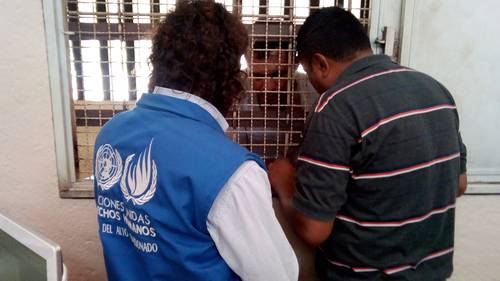
A representative from the Mexico Office of the United Nations High Commissioner for Human Rights observes Marco Antonio Suástegui in prison.
By: Luis Hernández Navarro
State police arrested Marco Antonio Suástegui Muñoz with excessive violence. They took him to a hill close to the community of La Concepción, in Cacahuatepec, with his head covered with a T-shirt, and they beat him up. As if he had been sentenced to receive a medieval punishment, they beat him with the shaft of a moringa tree (drumstick tree) and warned him: “Now you are going to get fucked, we are going to paper you.” They demanded that he shoot a firearm, until he was unconscious.
Marco Antonio Suástegui is the spokesperson for the Council of Ejidos and Communities Opposed to the La Parota Dam (Cecop, its initials in Spanish). Just a few days before the police apprehended and tortured him, the community discovered two pistoleros contracted to assassinate him. Community Police from the Regional Council of Community Authorities (CRAC) that operates in the region, protected in Law 701, discovered them and took them prisoner.
One of the hired guns had multiple names and identities, all false. The community police found credentials on him with the names of Alejandro Liborio, Guillermo Marin and Ivan Soriano, which accredited him as a soldier, as president of the Vigilance Council of the Communal Wealth of Cacahuatepec and as a lawyer. He was also carrying a weapon.
Mauro Gallegos Salgado, commissioner of Parotilla village, and Antonio Morales Marcos (second commissioner of La Concepción) contracted the killers to commit the crime. The latter showed Alejandro/Guillermo/Ivan several places for ambushing Marco Antonio. The gunmen had no luck because Suástegui always went accompanied by the community police.
The community police discovered the hired killer and arrested him. His associate Alejandro Moctezuma Trujillo suffered the same fate. Three other accomplices fled. However, they did not spend much time as prisoners. In a disproportionately lethal operation, more than 200 state police, federal police and soldiers, supported by a helicopter, liberated them last January 7, while they captured, beat and tortured Marco Antonio and another 38 campesinos and extra-judicially executed three community police. Enraged, the security forces attacked journalists. They mistreated them, took away their equipment, damaged a car, prevented them from taking photos and blocked their access outside of the conflict zone. The photographer Bernardino Hernández took a beating.
Ever since the resistance to the La Parota Dam began in 2003, governmental authorities organized and financed groups in favor of the project linked to the PRI, some armed. They used them to legitimize the aggression of public forces in Cacahuatepec. Just hours before the arrival of soldiers and police in La Concepción, PRI members, headed by Commissioner Alejandro Melchor, had ambushed various community police that pursued a young man who had urinated in front of their police station. The two Cacahuatepec attacks left eleven dead.
The Mexico office of the United Nations High Commissioner for Human Rights condemned the acts and established that there are elements to affirm that state security forces wounded the fundamental rights of the residents.
Although the Federal Electricity Commission planned construction of the La Parota Dam in 1976, it’s not until the presidential term of Vicente Fox (2000-06) that the hydroelectric project begins to land. But it isn’t lucky. In 2003, comuneros, ejido owners and residents that get their water supply from the Papagayo River reject it. The dam –the opponents found– was only going to function at 19 percent of its capacity four hours a day, and, the concessioner of the work was going to have control of the water. In exchange, 25,000 people would be displaced due to the flooding of their lands, and another 70,000 affected. Marco Antonio Suástegui summed up the reasons for his opposition to the dam: “We never asked for this project. We didn’t ask for money. It’s not economically viable, it’s not environmentally sustainable and it’s not socially acceptable.”
La Concepción, a village in the rural area of Acapulco is one of the principle bastions of those opposed to the construction of La Parota. Government authorities have legally pursued their leader, Marco Antonio Suástegui, all the time. He was incarcerated in 2004 and 2014, accused of kidnapping, attempted homicide, robbery, breaking and entering, dispossession, rioting, sabotage and more. In 2014, he led a struggle against the gravel company that was exploiting the Papagayo River, extracting sand and gravel from its bed. The latest attempt to assassinate him, his most recent incarceration and the police violence against La Concepción are not gratuitous. It’s about “cleansing the land” of resistances in order to re-launch the hydroelectric project.
Those opposed to La Parota are not alone. In February 2006, in a meeting between the Cecop and the EZLN in the context of the Other Campaign, held in Agua Caliente, Guerrero, then Subcomandante Marcos (now Galeano) said to the dam’s opponents: “According to our way of thinking as indigenous Mayas, the Papagayo River also runs through the mountains of the Mexican southeast. So we want to warn Vicente Fox and his yellow and black (a reference to the PRD) arm, Zeferino Torreblanca, that if the Army attacks these lands, it will also have to attack the mountains of the Mexican southeast” (https://goo.gl/6wBSXX). Last January 9, almost 12 years after those words, María de Jesús Patricio, spokesperson of the Indigenous Government Council and the National Indigenous Congress sent in the name of these organizations, their support and solidarity faced with the cowardly aggression the Cecop suffered.
Today it would seem that, just like it did in 2006 with Atenco, the government wants to take advantage of the electoral campaign to lay siege to the Cecop, criminalize its leaders and start a war to impose, by blood and fire, the hydroelectric project. It must not be permitted.
———————————————————–
Originally Published in Spanish by La Jornada
Tuesday, January 16, 2018
http://www.jornada.unam.mx/2018/01/16/opinion/017a2pol
Re-Published with English interpretation by the Chiapas Support Committee

EZLN: anniversary message
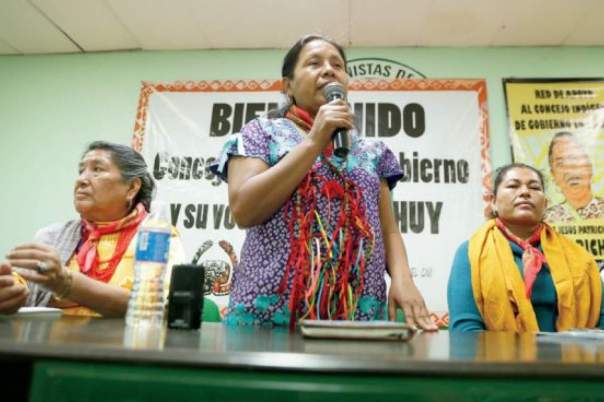
Marichuy on an organizing tour in Mexico.
By: Magdalena Gómez
The General Command of the Zapatista National Liberation Army (Ejército Zapatista de Liberación Nacional) issued a message last January 1; I will emphasize some aspects of it. It repeats and bases the call to organization from below, which has been its axis and conviction ever since the State “kicked over the board,” as they pointed out in 2001, after the failure to comply with the San Andrés Accords, which ruined the possibility of resuming the dialogue, suspended since September 1996. On the part of the Zapatistas, they have set the example, as they pointed out: “During these 24 years we have been constructing our autonomy, developing our different areas of work, consolidating our three levels of autonomous government, formalizing our own health and education systems, creating and strengthening collective work, and in all these autonomous spaces is where the participation of all the women, men, youths and children counts.” They refer to the Juntas de Buen Gobierno (Good Government Juntas), an emblematic experience that reaches beyond national borders, which was systemized and shared in the Escuelita Zapatista (Zapatista little school), which brought us together as students with a repeated call to get organized. The full evaluation of that effort, although not shared in its entirety, convinced them to seek other ways; that is inferred from the different seminars on the capitalist hydra, the two Comparte and Conciencia festivals, parallel to the complex activities of their own government spaces.
They also gave an account of the deepening deterioration in the country and of the virtual war against the peoples promoted from the State. Among other factors it was noted that: “they have provoked more contradictions and confrontations between communities and municipios, and they make sure that problems are not resolved in a good way, but rather by means of violence, which is why they continue to maintain, protect and equip paramilitary groups, because the bad governments want us to kill each other among brothers of the same people… Everything that’s happening shows that there is no longer government in our towns, municipalities, states and in our country.” They abounded in signaling what they have been realizing about the transmutation of the rulers into the historic figure of the overseers: “They are good defenders of the interests of their bosses to plunder the natural riches of our country and the world, like the land, forests, mountains, water, rivers, lakes, lagoons, air and mines that are guarded in the bosom of our Mother Earth, because the boss considers all of it merchandise and so they want to destroy us completely, in other words, kill off life and humanity.” The recent approval of the Homeland Security Law was referenced: “And yet they make us believe that it’s to combat organized crime, when in reality their idea is to keep us under control, quiet, divided, threatened, with more violence and impunity towards the peoples… We are not lying when we say that we have more than 500 years of exploitation, repression, contempt and dispossession.” In this context they reaffirmed their full support for the Indigenous Government Council, and once again they disclaimed that it’s about an electoral project, a question that continues without being understood: “They make fun of us a lot, that Compañera Marichuy doesn’t know how to govern, isn’t going to give us anything… Let’s organize so that Compañera Marichuy and the Indigenous Government Council can make their tour in the country, although she doesn’t get enough signatures to be a candidate. Because the signature is not the one that struggles, is not the one that is going to organize us… So go ahead, Compañera Marichuy, walk, jog, and when you may need run and stop and then continue, nothing else is left for us to do now.”
Aware that they are sailing against the current, they came out in front of what is starting to take shape in some sectors that attempt to evaluate this process only around whether or not registration is achieved: “Now is not the time for backing out, for getting discouraged or tiring, we must be firmer in our struggle, keep our words firm and follow the example that the compañeros and compañeras that have already died left us: not surrendering, not selling out and not giving up.”
Days before, Subcomandante Galeano, in the second edition of ConSciences, affirmed respect for the council members: “There are no luxuries for them, no private airplanes, no reporters from the pool assigned. Some say that they are collecting signatures so that the spokesperson Marichuy will be an independent candidate to the Presidency of the Republic. I don’t know if they are collecting signatures. They say they are collecting pains, rages, indignations, and that there is no cybernetic application for collecting that, or low, medium, or high-end cell phone that supports those terabytes. They only have their ears and their heart. Their word is invariably the same: ‘organization’, ‘resistance’, ‘rebellion.’”
Such are the axes of their struggle for life, that’s what it’s about, no more no less.
————————————————————
Originally Published in Spanish by La Jornada
Tuesday, January 09, 2018
http://www.jornada.unam.mx/2018/01/09/opinion/018a1pol
Re-Published with English interpretation by the Chiapas Support Committee
Patriarchy, Mother Earth and feminisms

Zapatista Women during ConSciences in CIDECI.
By: Raúl Zibechi
Caring for the environment, or Mother Earth, is a women’s thing, according to a recent study in the Scientific American, a magazine published at the end of December, which points out that “women have surpassed men in the field of environmental action; in all age groups and countries.
The article titled “Men resist green behavior as unmanly,” came to that conclusion after having realized a broad survey among 2,000 American and Chinese men and women. The study asserts that for men attitudes as fundamental as using a canvas bag to make purchases instead of plastic is considered “unmanly.”
The work is focused on marketing for the purpose of getting the men to feel masculine even buying “green” articles, with which it comes to the painful conclusion that: “men that feel secure in their manhood feel more comfortable buying green.”
However, it manages to trace some behaviors that permit going a bit further, in thee sense of comprehending how patriarchy is one of the principal causes of the environmental deterioration of the planet. Donald Trump is no exception, by denying climate change and encouraging destructive attitudes, from wars to consumerism.
I propose three views that can be complementary and that affect the world of men, not so that we adopt politically correct attitudes (with their doses of cynicism and double speak), but to contribute to the process of the collective emancipation of the peoples.
The first is related to war capitalism or the accumulation by dispossession / fourth world war that we currently suffer. This shift in the system, which has accelerated in the last decade, not only provokes more wars and violence but also a profound cultural change: the proliferation of the alpha males, from the domineering chiefs of great and powerful states, to the arrogant males of the neighborhoods that seek to mark their territories and, of course, “their” dominated and, above all, the women they dominate.
Acquiring geopolitical muscle permits being positioned in this period of decadence of the hegemonic empire. That is complemented by the appearance of countless little alpha macho men in territories of the popular sectors, where drug dealers and paramilitaries seek to substitute for the priest, the commissioner and the “father of the family” in controlling the daily life of those below.
The second view is insinuated in the cited study, wherein it concludes that: “women tend to live a more ecological lifestyle,” since “they waste less, recycle more and leave a smaller carbon footprint.”
This relates directly to reproduction, which is the blind spot of revolutions, committed to an extreme production to, supposedly, surpass the capitalist countries. Industrial production and the industrial worker have been central pieces in the construction of the new world, from Marx onward. In parallel, reproduction and the role of women have always been given less consideration.
We are not able to combat capitalism or patriarchy, nor take care of the environment or our children, without installing ourselves in reproduction that is, precisely, the care of life. I understand that reproduction can also be a men’s question, but that requires an explicit policy in that direction, as the comandantas (female commanders) that convoke the women’s gathering in the Caracol of Morelia point out.
As the comunicado says convoking the First International Gathering, Political, Artistic, Sports and Cultural of Women that Struggle, the Zapatista men “will be in charge of the kitchen and cleaning and of what is needed.” https://chiapas-support.org/2018/01/05/zapatista-women-convoke-international-womens-gathering/
Are those tasks perhaps less revolutionary than being standing on a stage “giving the line” (as we say in the south)? They give us less visibility, but they are the obscure tasks that make the big actions possible. To involve ourselves in reproduction, we men need a strong exercise to limit our ego, even more if we’re dealing with a revolutionary ego.
The third view is perhaps the most important: what can we heterosexual and leftist males learn from feminist and women’s movements?
The first would be to recognize that women have advanced much more than us in recent decades. In other words, being a little more humble, listening, questioning, learning to stand aside and being quiet so that other voices are heard. One of the questions that we can learn is how they have stood up without vanguards or hierarchical apparatuses, without central committees and without the need to occupy the state government.
How did they do it? Well organizing each other, among equals. Working with the inner patriarchy: the father, the well-spoken leader, or the boss. This is very interesting, because women that struggle are not reproducing the same roles they fight, since it’s not about substituting a female oppressor for a male oppressor, nor an oppressor of the left for an oppressor of the right. That’s why I say that they advanced a lot.
The second question we can learn is that politics, by and large, in well-lit and media scenarios, with programs, strategies and grandiloquent speeches, is no more than the reproduction of the dominant system. Women have politicized daily life, cooking, the kitchen, the care of children, the arts of weaving and healing, among so many other things. Believing that all this is of little importance, and that hierarchies exist between one dimension and another, is similar to women continuing to look to alpha males to emancipate them.
Surely there are many other issues that we can learn from women’s movements, which I don’t know about or that we still must discover. What’s important is not having the answer already prepared, but engraving in each other the simplicity humility in to learn from this wonderful movement of women that are changing the world.
————————————————————
Originally Published in Spanish by La Jornada
Friday, January 5, 2018
http://www.jornada.unam.mx/2018/01/05/opinion/013a2pol
Re-Published with English interpretation by the Chiapas Support Committee
CIG Members visit Oakland January 17
Update: We have just received word that Myrna Dolores cannot accompany Mario Luna on this trip due to some unforeseen conditions in Mexico. Therefore, Mario Luna will speak on behalf of the CNI-CIG at our Wednesday welcoming gathering in Oakland.

Join us to welcome CIG members on January 17!
¡SPECIAL OAKLAND GATHERING with MEMBERS of the CIG!
WEDNESDAY, JANUARY 17, 2018 – 7-10 PM
OMNI COMMONS
4799 SHATTUCK AVE., OAKLAND
Mario Luna Romero and Myrna Dolores, members of the Indigenous Government Council, will be at the Omni Commons.
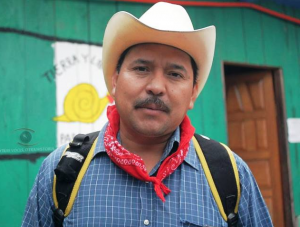
Mario Luna Romero
Mario Luna Romero is a Yaqui activist from the state of Sonora, Mexico. He organized Yaqui communities to protect the Yaqui River from a development project. The Yaqui River is the Yaqui’s place of Creation and an important place for protecting the survival of the Deer Dance. The Yaqui River is the backbone of their culture. He was imprisoned for his activism and, when released, went to the UN and made visible the need for Indigenous Rights in Mexico. He has been the delegate for Vícam to the National Indigenous Congress (Congreso Nacional Indígena, CNI) since 2007, a council member on the Indigenous Government Council (Consejo Indígena de Gobierno, CIG) and the Coordinator of the CNI-CIG’s International Affairs Commission. He will speak about the struggles they are facing in Mexico.
AND
Bio for Myrna Dolores: Yoreme of Sonora
I was born in Benito Juárez on April 7, 1976. I have lived most my life in Buaysiacobe, Etchojoa. Both places are in the State of Sonora, in the Mayo indigenous region.
For twenty years, I have been a distance-learning teacher of basic education for high school students, and four years ago I came to work in my village Buaysiacobe, where I am a teacher. I was also chosen as a candidate for commissioner, which was ultimately taken from me, but that allowed me to meet people and provide them with social support through a group called “Women in Movement.”
In 2015, I was notified I would need to undergo an evaluation under the new educational reforms, which I have resisted ever since. This led me to reaffirm my conviction of struggle. I had previously collaborated with the National Indigenous Congress (CNI), indirectly through its delegates, mainly in defense of territory. This was in addition to my being politically left, without belonging to political parties.
On April 30, 2016, the town of Cohuirimpo, one of the eight Mayo towns of Sonora, named me a CNI councilor, and that helped me embrace the struggle for territory that the people have been sustaining for some decades. My people, as well as others from the region, have fought alongside the CNI since its formation in a discontinuous and isolated manner with a few delegates, without realizing major achievements other than to transmit their ideals among a few.
I am part of the CNI because I am a of the left, because I am a woman, because I am a minority in struggle, because I am Yoreme (indigenous Mayo), and because the fight
of the CNI is for the only thing that is worth fighting for: life and continued existence of the indigenous peoples of Mexico.
Regarding the goal for the US tour, I would love to be able to tell the world that women are the immediate victims of a system in crisis—one that oppresses those who represent families and these in turn also tend to oppress their constituencies. That women should strive to get to know each other and confront potentialities using that which traditionally does not correspond to us: the struggle for territory. As it is the earth that is the closest to us, and what distinguishes us is the ability to be Mothers: bearers of life.
Galeano: Trump, Occham’s razor, Schrodinger’s cat and the Cat-Dog
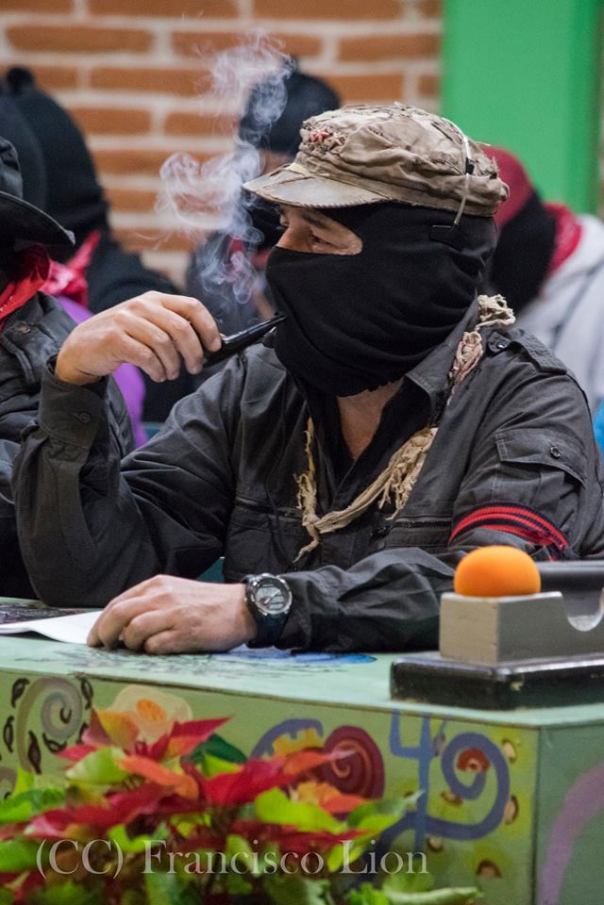
Subcomandante Insurgente Galeano in CIDECI.
Good morning, afternoon, evening, and early morning again
Perhaps someone remembers that the late Sup Marcos insisted that the capitalist system could not be understood without the concept of war. Of course, supposing that it is a concept. He said that war was the motor that had first permitted the expansion of capitalism and later its consolidation as a global system, besides resorting to it to face its recurrent and profound crises.
Oh, I know, what else could you expect from a soldier. But I must point out, as a way of vindication, that he did not limit war to military war. Perhaps a re-reading of the correspondence that he maintained with Don Luis Villoro Toranzo in 2010 and that was made public at the beginning of 2011 could help us understand that. In the first of those public missives, he examines minutely the apparent inefficiency of the so-called “war against drug trafficking” initiated by the fan of warlike video games, Felipe Calderón Hinojosa. And I say “apparent inefficiency” because, in effect, in view of the results, it was and is inefficient for combatting organized crime, but was effective for sending the military to govern de facto in several regions of the country called “Mexico.”
I bring it up because, unlike the deceased, in my opinion, capitalism can be studied as a crime.
Bringing it up in this way would demand scientific knowledge of matters that could appear distant from what is traditionally known as “social sciences.”
In the end, catalogue to your liking this theoretical deviation, perhaps the product of an unfinished correspondence course of a private detective, in that distant epoch in which the mail did not refer to electronic accounts and nicknames, and that when you put the address, you put the zip code and not the no la I.P. or protocol of the Internet; an epoch in which you could study, also by correspondence, anything from a locksmith course to one of pilot aviator, passing by, of course, “how to have a body like Charles Atlas without going to the gym and in just a few weeks,” which I didn’t need to take because my beautiful and well-shaped legs are evident (arrrrrroz con leche).
Finally, put me in the archive of any of the “isms” that may be on hand in the social networks, and avoid concluding that the social sciences will remain incomplete while they don’t include criminology among their tools, since crime is also about, forensic science.
-*-
But I continue talking about a crime, a crime that is explained from different perspectives.
Take a recent example: the earthquakes and the consequent misfortunes.
We could ask about the construction conditions. We suppose that there was and there is a scientific study of the subsoil, calculations of the resistance of materials, and things like that. Those who have made science their vocation, profession and life, can tell us that this is the case; that the sciences can give us the elements for avoiding or at least reducing the risk that buildings collapse.
In other words, in a seismic zone and with a history of earthquakes, one would hope that buildings would be constructed talking that into account. I mean, it would not be anything serious if a building were constructed and afterwards they prayed that no earthquakes occurred that would bring it down.
I don’t know, perhaps the scientists could answer the key question, which is not, of course, why there are earthquakes, but why people die under the shambles of buildings that should be built to resist earthquakes.
But, according to the analysis in vogue, it all depends.
So, as the neophilosopher of science said, the “intellectually formidable” (according to the press that he made his), the citizen without party José Antonio Meade Kuribreña, we’re going “to move in a scheme in which the question is not valid.” In other words, we’re not going to ask who is responsible, by commission or by omission, for those buildings collapsing and hundreds of people dying. No, what we’re going to ask is why it trembled. Then we will be like this, always following that postmodern organic intellectual, on another question: Why do tremors or earthquakes occur or, as is said, when the soil abandons its apparent resignation and moves?
No, if you wait for a scientific explanation, you wait in vain. The valid explanations are the ones that have more followers, listeners, sympathizers and militants. Science has long since lost all popularity contests.
Then, it depends on what scheme those explanations are given.
Let’s go to one of them, Mr. Alberto Villasana, who defines himself, with exemplary modesty, as a “Catholic theologian, Philosopher and International analyst. An expert on Church-State relations, an author of 12 books, 3-time winner of the National Journalism Award,” which his 15, 600 Twitter followers would ratify.
Don’t laugh, that amount far exceeds the attendees, participants and listeners in this gathering.
With respect to the September 19, 2017 earthquake, the illustrious and enlightened Villasana wrote: “This without a doubt a warning from God, a very special grace to Mexico, to prepare us for everything that is coming…“
How did he know? Well, it turns out that Villasana assures at the time of the earthquake he was performing an exorcism on someone possessed by 4 demons. “During the exorcism, the infestators declared that the September 19 earthquake is part of God’s warning before the great punishment,“ he published in his article. Besides the earthquakes, there would be huracanes and volcanic eruptions. According to the theologian, the punishments would be: “for having approved abortion in the same city where the Mother of God appeared in 1531.” According to Villasana, the earthquake, under those arguments, would be a warning to Mexicans. On his Twitter account, he published the image of the rubble of the monument to the Virgin: “The monument to Mother Significant collapsed: in the city where they approved abortion.”
Despite his undisputed wisdom, Villasana is not original. In November 2016, the Italian newspapers pointed out that the priest Giovanni Cavalcoli, who is known for his career as a theologian, made the following statements on Sunday, October 30, the same day that a 6.5-magnitude earthquake shook the central region of Umbria: the seismic shocks are a “divine punishment for the offense to the family and to the dignity of matrimony, above all because of homosexual civil unions.”
The scheme on which this explanation depends has more followers:
Just a few weeks ago, in this December 2017, Cardinal Emeritus Juan Sandoval Iñíguez placed responsibility on women and LGBT community (loas otroas) for organized crime violence and for the earthquakes and floods.
As the platform for such a scientific explanation, Sandoval Iñíguez, convoked a so- called “Great Act of Atonement” that, as I understand it, is like a meeting of Unconscious for the Deity, but with more power to convoke that this one in which we are found. The event was in the so-called Blue Stadium in Mexico City, which, incidentally, has a better location than the CIDECI.
Not to vary, there were also masked men there. But, unlike those who convoke us, who are devoted to talking bad about capitalism, the masked men of Sandoval Iñíguez flogged themselves until bleeding. In other words those are indeed whippings and not the existential ones that crowd together in the social networks.
Between whipping and beating, but careful that blood would not splash, the cardinal emeritus declared that the right to decide and sexual diversity are sins, and that violence from drug trafficking and the earthquakes are punishment for those sins: “The Lord and our God, before a greater punishment comes, sends us temporal punishments or paternal corrections by means of nature that is your work and is governed by your providence. Will it be pure coincidence September 19 in this city?”
The “Great Act of Atonement” event was convoked by a kind of association that could well be called: “The time has come for the sinners to march.” In other words as he says: against those who support the Indigenous Government Council and its spokesperson.
Over there I read that, among those who summoned, there are “public figures,” they say, like Esteban Arce, Manuel Capetillo and Alejandra Rojas. I don’t know how public these people are, I only know that the mother of Esteban Arce must be very remembered among the LGBT community.
In the act, which we now know was not to exorcize the football team that has that stadium as its headquarters (oh well, “all past Cruz Azul was better”), the neoscientist Sandoval Iníguez said: “This is an act of redress, in which we come to make a confession of guilt, to recognize our sins before the Lord and to ask him for mercy and forgiveness. We come to say: Lord, we have sinned against you and committed the evil you hate; forgive your people and set aside the punishment we deserve. We have sinned against you, above all with the most tremendous, most grave and most cruel crime of abortion practiced throughout our country, at times with the consent of iniquitous laws and on occasions hidden, furtively, but always with cruelty, treachery and advantage against the innocent, the defenseless.”
According to press reports, very close to where se azotaban las “brotherhoods of encrusted and flagellant penitents of Taxco” (as they call themselves), signatures were collected to support the ex panista Margarita Zavala in her project of being an independent candidate to the presidency of the republic.
Against the current, and in a different scheme, regarding the recent natural misfortunes, Pope Francisco pointed out: “I think that the Devil punished Mexico with a lot of anger mucha because the Devil doesn’t forgive Mexico that it (pointing to an image of the Virgin of Guadalupe) has shown her son there. It’s ny interpretation. In other words, Mexico is privileged in martyrdom for having recognized and defended his mother.“
So there you have: divine punishment or diabolic punishment. Choose your scheme of explanation about one reality.
“They are mere opinions,” you will say or the influencers closest to your bandwidth.
Ok, ok, ok. But the problem is that decisions are made based on those opinions: there are those who ask for divine forgiveness or embrace pain as privileged martyrdom … and there are those who organize to demand truth and justice.
I’m not going to make firewood from the heavy cross carried by Mrs. Margarita Ester Zavala Gómez del Campo de Calderón (who, disrespectfully and far from all political correctness, the Zapatistas call “La Calderona,” and of whom I, who have always shone for my good manners and for being politically correct, let go).
And I clarify that I pointy out that it’s “Gómez del Campo” to bring to mind the murder of the infants of the ABC Nursery, which occurred on June 5, 2009 in the state of de Sonora, and was managed, among others, by Marcia Matilde Altagracia Gómez del Campo Tonella, exonerated because of being a relative of La Calderona. The memory of that crime is not extinguished, thanks to the fact that the families continue demanding truth and justice.
And I name her as “de Calderón,” because referring to her with her maiden name would be pointing out that she lives as a concubine with the psychopath. Y, as far as my limited studies of Canon Law permit, being a concubine is a sin. Ergo, that would bring us more earthquakes to punish us for the guilt of those who sign in support of her candidacy.
On the other hand, I will make a brief reference to the principal saboteur of her political career, (her concubine, if we pay attention to those who get angry because of naming her by what is his last name according to Catholic, Apostolic and Roman laws), Felipe Calderón Hinojosa.
Mr. Calderón Hinojosa was, 10 years ago, the titleholder of the federal executive power in Mexico. “President,” I believe that they used to say to him. Well, 10 years ago, on the occasion of the floods that devastated the state of Tabasco, the then supreme commander of the army, air force and navy, declared that the responsibility for the more than 125,000 people that had lost their homes and had to take refuge in shelters, was… that of the moon and a cold front.
-*-
The National Action Party competes with the Institutional Revolutionary Party, not only because of the ridicule into which their pre-candidates fall. No, the National Action Party, now with the ballast called the Party of the Democratic Revolution, also disputes the PRI’s complicity in the crime.
If you note in the eyes of Ricardo Anaya, pre-candidate of the PAN-PRD-MC, a demented shine, don’t attribute it to a possible affectation in the area of the brain responsible for decency (indeed, if there is one). It’s the product of a partisan formation of cadre leaders. Ricardo Anaya makes up part of that generation of partisan cadres that grew up as such in the midst of corruption, cynicism, betrayal, fanaticism, intolerance, arrogance, nepotism, ignorance, cretinism… ok, I think I’m describing more than a pre-candidate, but now I’m referring to the alliance of the PAN, PRD and MC called “For Mexico, out front”… and, well, there is an abyss out front. So there you have it.
Along with Acteal and Ayotzinapa, another name refers us to unpunished crime: the ABC Nursery, in Hermosillo, Sonora, Mexico.
And in the six-year term of that consistent thinker who is called Vicente Fox, the PRI, PAN and PRD are allied for the crime called “Atenco,” in May 2006, which included, besides murder, sexual assault on women.
So, everything seems to indicate that the great elector, who certainly doesn’t need the National Electoral Institute, demands evidence of criminality to decide. On their altar, these party proposals offer the blood of women, children, young people, the elderly… and the LGBT community.
And to confirm it, political proposals of the most rancid right arrive in the different posts of murderers that the global political system offers periodically.
Although there are examples in Argentina, Chile, Brazil, the United Kingdom, the Spanish State, Israel, Honduras, Nicaragua, Russia, and you can add the geography you wish, there is one that synthesizes the fateful times to come: Ronaldo Trump.
Besides his undeniable ability and sapience for managing his Twitter account, Ronaldo Trump has defined with transparent clarity the victim to immolate: women, LGBT folks (otroas), infants, immigrants, the environment, and you could continue detailing specificities but, finally, you will come to the same conclusion that I have: the victim is the entire planet, including the humanity that inhabits it.
Although Ronaldo has shown signs of serious mental problems, he has solved the basic equation that every ruler must face: what must I do to stay in power? Occham has been useful and he has opted for the simplest response: a war.
To obtain a war he proposes walls, changes of embassies, provokes diplomatic incidents and thus begs, implores: “give me a war, I ask you! Where it is doesn’t matter. And the bigger the better.” And then, going back centuries, Ronaldo Trump takes Nero’s lyre and sings: “We don’t want to fight, but by Jingo, if we do, we have the ships, we have the men and also the money.”
Yes, a war. Or a crime, it depends.
War or crime, it’s a misfortune as never before in the history of humanity.
As if the world as we know it will collapse.
-*-
And since we have referred to video games, imagine that we have the dream of any video addict: a cybernetic interface that permits us, simultaneously, to have the strategic perspective, tactics and that of the first person. Something like a combination of real-time strategy, role-playing, the first person or first person shooter, and the other that I don’t know what it’s called but it’s like in the third person. Anyway, if someday it is created, don’t forget to buttress yourself with the rights of intellectual authorship.
Now, suppose you are enclosed inside an ideal spherical room. The inner surface of the sphere, which you can see, is a large curved screen, with 5K technology, omled or as it is said, and in which, simultaneously and with dizzying speed, information packages are presented to you. Not only images, also sounds, smells, tactile and pleasing sensations; and, well, also, not to discriminate against the esoteric, extrasensory perceptions.
You can think, with a high degree of certainty, that you are in the real world, that you live in that world, that’s where you were born, grew up, reproduced, and, God forbid, but it’s a hypothetical situation, die.
You are happy or unhappy there. The machine is so efficient that it even provides the parameters for defining happiness and unhappiness. Moreover, it also offers an explanation of that world and, if you prefer, of a spiritual world, a consolation for the day on which, I already said God forbid, you die.
So there you are, in the machine that we will call, with prudent impresarial calculations, “the cat-dog’s machine” (all rights reserved).
In what it is, in other words, simulating life or living (because the machine also gives you the criteria to distinguish between “what’s real” about the machine and “what’s virtual” that the same machine produces to give you a point of reference).
Well, suppose that at any time inside of the machine, you are doing what you are supposed to do. In that, who knows from where, a person appears that has nothing to do with anything. You, of course, are a modern person, understanding of the technological limitations and you attribute that irruption to an irregularity in the machine’s complicated software or in its complex hardware. You wait patiently for the irregularity to be solved, that is, you look for the reset button, but the person remains there and, when you least expect it, that person tells you:
“One moment, don’t anyone touch anything, and nobody can leave. This is the scene of a crime.” You doubt. You don’t know whether to complain in support or put a package of popcorn in the microwave, because perhaps it’s about a new episode of “Law and Order, Special Victims Unit” (background music).
But something doesn’t fit because it’s not the detective that appears, but rather another woman. Yes, the machine has given her the pattern that indicates: “woman.” But the above-mentioned wears an embroidered blouse, her stature is smaller than the average that the same machine has inculcado as “average stature,” her complexion is of dark color, we say the color of the earth. The machine gives you the information that you have: “indigenous, or also self-named “originaria,” her geographic location is in the middle region of North America called Mexico, zero or minimal level of school studies, access to technological advances between 0 and 0.1, monolingual although there are cases in which she manages two or more languages, mortality rate, well above average, life expectancy, well below average; cultural persistence, centuries; therefore, indefinite age.
With that information, you now begin to edit the report to support, of course, getting bogged down at the same time with popcorn, because it’s not about wasting the Valentina sauce that covers them:
“Dear programmers, I beg you to solve this flaw because it’s not possible that one (uno, una, unoa) is here perfectly fulfilling the functions that have been assigned to me, and suddenly something so premodern appears. Hurry because the new season of “To the right, the best of possible worlds” is about to start” and the promotional materials are already here. Signature”
The feminine irruption in question has the bad taste of changing the fashionable joke of “I come from the future and…” followed by something ingenious. Oh, don’t worry, the machine also tells you what is and what is not “witty.” Because the, let’s say, original (native) woman now says: “I come from the past and this movie is not a movie and I saw it.” Then you realize that the woman is not alone, there are others that resemble her, although now that they oblige you to look at them you see that they are the same but different. There are also men, well males. And they don’t lack those who are neither one nor the other.
With respect to the programming, those strange beings, anachronistic and, needless to say, irreverent, start sniffing and there is even one who has taken out, who knows from where, a magnifying glass. You are about to applaud, because you think that the machine has been updated and now you can produce a virtual reality inside the virtual reality, but the woman that now the machine labels as “indigenous” without any nuance, studies you in detail. Of course you have the right to feel uncomfortable when, after placing the magnifying glass over the eyes, she says: “Another victim, that the team of rapporteurs writes down.”
“Yes they have a team of rapporteurs, which suggests sugiere some kind of uncatalogued organizational form,” the machine tells you, a little to make yourself useful and another little to give yourself time to self-review your programming.
The group of indigenous people that, you now realize, are a minority but make noise as if they were a majority, meet ti deliberate and, after a while that the machine cannot count or offer a parameter of comparison, decree:
“It’s all here: the victim, the killer, the murder weapon and the crime scene.”
Then you realize that the spherical screen rather resembles a concave wall, and you see, not without becoming alarmed, a little girl, accompanied by a strange being that the machine is incapable of labeling and conforms to a “cat-dog; a mythological being of unknown origin; there is no data that confirms its real existence, virtual that it, but real in the machine, in other words, you understand me don’t you? Well, it depends; probable habitat: the mountains of the Mexican Southeast.” Cfr: “There will be a time,” editions in Spanish, Italian, English, Greek, German, Portuguese, etc”
Well, what alarms you is that the little girl and the so-catalogued “cat-dog” are pointing to a crack in the machine; in other words, in the sphere, that is in the wall.
Now you doubt something that the machine has always avoided until now, between going to review the warranty conditions or running to look at the crack.
Because it turns out that the crack, its possibility, questions not only the machine’s programming but rather its very existence.
Then you feel that you are prisoner in the same paradox as Schrodinger’s cat.
The machine links you quickly to Wikipedia and there you read:
“Erwin Schrödinger outlines a system that is sistema formed by a closed and opaque box that contains a cat inside, a bottle dof poisonous gas and a device that contains a single radioactive particle with a 50% probability of disintegrating at a given time, so that if the particle disintegrates, the poison is released and the cat dies. At the end of the established time, the probability that the device has been activated and the cat is dead is 50%, and the probability that the device has not been activated and the cat is alive has the same value.”
Of course, you no longer follow those parts of quantum mechanics because you feel a slight tremor run through your body.
The machine says “terror” so that you identify that sensation. Because the machine had already labeled that sensory perception, but always, at least until now, had presented it as alien: terror had always been in the other.
All the evidence, all the solid evidence that gave you certainties, values, reasoning and judgment, starts to vanish.
You don’t know if you are alive or dead vivo, there is a 50% probability of one or the other, and you shudder, but not because you are about to find out your existential condition, but rather because of the question that the crack poses, like who it says moves the discussion:
“Is another world possible?”
“It is,” responds the little girl that now carries a ball under one arm and, over her head, something that could be a cat… or a dog.
You, of course, are a person with knowledge and self-apply “Occham’s razor” interpreted as the simplest explanation is probably the most correct. Then you say to yourself: “I am dreaming.”
What do you do while you decide whether you’re in a dream or a nightmare? Do you look at the crack or continue doing what you were doing when that irreverent and disobedient noise appeared?
For this what originally was a group of indigenous people, is now a larger collective: there are people of all colores, some who wield a hammer and smile complicitly when he heads to the wall where, oh, oh, it seems that they want to make the crack bigger.
And there are those who dance, and who paint, and who imagine a frame for the shot, and who write hastily, and even sing, and there is one who is weighing a microscope to see whether to throw it at the spherical wall or if it’s better that the scalpel will have to do it to the crack.
And, just a moment, where did that marimba come from?
And now they are playing football and the little girl, who to save explanations, hangs a badge that reads: “Defensa Zapatista” asks you what your name is, and then you understand that that she is not asking for your name-name, but your position for a supposed team that wasn’t complete.
And you already feel the terror that has taken over your whole being, because your intuition tells you that in reality the little girl is asking:
“And, what about you?”
From the CIDECI-UniTierra, Chiapas,
SupGaleano.
Mexico, December 2017
FROM THE NOTEBOOK OF THE CAT-DOG: THE MYSTERIOUS CASE OF THE DISAPPEARED BISCUITS
Elías Contreras is a Zapatista compañero who has the job of the investigation commission, a detective; in other words, he’s like a lookout. Elías Contreras is deceased, just like Sup Marcos and they worked together to look for bad and evil. Elías now works at times with SupMoy, although every so often he chats with Sup Galeano.
Este brief summary should help you understand what occurred one afternoon this December in the EZLN’s General Command, where Subcomandante Insurgente Moisés quoted the aforementioned Elías Contreras.
“Elías,” said Sup Moy after responding to the militar salute from the investigation commission, “there is a problem.”
Elías Contreras said nothing; he just took out a little bender and a few strands of tobacco, and dedicated himself to forging a cigarette while he listened to Sup Moy:
“It’s in then region’s cooperativa store. They say that some merchandise is missing, that it disappeared. They asked me if someone could support. Are you in charge?”
Elías Contreras only uttered a sound like “mmh,” and left without saying a word. The person in charge of the store just greeted Elías with a gesture, as he was balancing the monthly account.
What was it that disappeared then,” preguntó Elias asked while he looked distractedly at the DVDs that were for sale, the majority of them with the seal of ellos con el sello de “Los Tercios Compas.” “The biscuits,” said the man in charge without taking his eyes off the notebook where he suffered with the accounts.
“And how do you know they’re missing,” Elías asks while he checks out the shelf.
“Because nobody buys them, they were always there, like free.”
“And if nobody buys them what’s the problem?”
“The vigilance commission,” the one in charge sighed resigned, “the count has to be exact; if not, well we must replace or punish.”
Elías Contreras snorted and leaned over to pick up a few strands of black tobacco at the foot of the counter.
He left.
“Sup,” he said when he was now at the door of Sup Galeano’s house.
“Elías,” the Sup responded without looking away from a screen wired to an old laptop computer.
“It’s fucked up,” the Sup wants to clarify, “the screen is broken, but the processor and everything else is fine, so I connected it to this monitor. I just adapted the keyboard, but I can’t find the mouse.”
He turned in his wheelchair and looked at Elías.
“The biscuits,” the investigation commission said.
“They’re all gone,” the Sup said, “Defensa Zapatista and her dog… or cat… or whatever it is ate them.”
“But I have some pinole bread that the male insurgents made. How do you know that the male insurgentes made it? Well because it rose; when the women insurgents make it, it’s flattened.”
Elías rolled a cigarette passed the matches to the Sup for his pipe.
“And now,” Sup Galeano asked after waiting for Elías Contreras to light his cigar.
“Well they’re going to set you to doing the storekeeper’s accounts; of course, in addition to replacing the money. But I didn’t come for that. There is a thought that I want to talk to you about…”
A few hours later, Elías Contreras, investigation commission of the EZLN, left Sup Galeano’s house and stopped a moment to see the evening already give in to the shadows of the night.
With the flashlight he lit the way to the general command of the ezetaelene. Now at the door, without entering, he saluted and said: “The Sup, some biscuits.”
Sup Moy smiled and said to himself: “Well, someone had to do those accounts.”
In the general assembly it didn’t go badly for Sup Galeano, but not good either. After “self-criticizing him” for eating junk food and not eating well (they told him that the biscuits that they make in the CIDECI bakery are better), the authorities gave him the worst dieron punishment that there currently is in the community: doing the accounts of the cooperatives.
The Sup lit his pipe upon leaving the assembly and, while he was heading to the cooperative “As the women that we are,” he said to himself: “well, it could be worse, in different times they would have sent me to clean the paddock.”
He did the accounts quickly, not because he knew mathematics, but because he did them with the cell phone that he “borrowed” from the comandancia when Sup Moy called him to scold him. Nor was it a great cell phone, it was one of those “low end” ones that wasn’t useful for capturing the signatures that the first world INE set as requirements on aspiring third-world candidates, but the calculator did work for addition and subtraction.
He found Elías at the foot of the Ceiba tree, such as they had been.
The odors of both tobaccos intermingled with the silences. Dialogue between the deceased, deaf and dumb dialogue.
Neither of the two remembers who asked: “How much time?” but they know that both answered in unison: “a little, very little.”
I testify:
The cat-dog
———————————————————————————–
Originally Published in Spanish by the Editor of Proceso.com.mx
Thursday, December 28, 2017.
Re-Published with English interpretation by the Chiapas Support Committee
Zapatista women convoke International Women’s Gathering
CONVOCATION of the FIRST INTERNATIONAL GATHERING of POLITICS, ART, SPORTS, and CULTURE for WOMEN in STRUGGLE

Zapatista women convoke International Women’s Gathering.
Communiqué of the Indigenous Revolutionary Clandestine Committee, General Command of the Zapatista National Liberation Army
Mexico
December 29, 2017
To the women of Mexico and the World:
To the original women of Mexico and the World:
To the women of the Indigenous Governing Council:
To the women of the National Indigenous Congress:
To the women of the national and international Sixth:
Compañeras, sisters:
We greet you with respect and affection as the women that we are—women who struggle, resist, and rebel against the chauvinist and patriarchal state.
We know well that the bad system not only exploits, represses, robs, and disrespects us as human beings, but that it exploits, represses, robs, and disrespects us all over again as women.
And we know that things are now worse, because now all over the world we are being murdered. And there is no cost to the murderers—the real murderer is always the system behind a man’s face—because they are covered up for, protected, and even rewarded by the police, the courts, the media, the bad governments, and all those above who maintain their position on the backs of our suffering.
Yet we are not fearful, or if we are we control our fear, and we do not give in, we don’t give up, and we don’t sell out.
So if you are a woman in struggle who is against what is being done to us as women; if you are not scared (or you are, but you control your fear), then we invite you to gather with us, to speak to us and listen to us as the women we are.
Thus we invite all rebellious women around the world to:
The First International Gathering of Politics, Art, Sport, and Culture for Women in Struggle
To be held at the Caracol of Morelia, Tzotz Choj zone of Chiapas, Mexico, March 8, 9, and 10, 2018. Arrival will be March 7 and departure on March 11.
If you are a man, you are listening or reading this in vain because you aren’t invited.
With regard to the Zapatista men, we are going to put them to work on all the necessary tasks so that we can play, talk, sing, dance, recite poetry, and engage in any other forms of art and culture that we want to share without embarrassment. The men will be in charge of all necessary kitchen and cleaning duties.
One can participate as an individual or as a collective. You can register at this email: encuentromujeresqueluchan@ezln.org.mx Include your name, where you are from, if you are participating as an individual or a collective, and how you want to participate or if you are just coming to party with us. Your age, color, size, religious creed, race, and way of being don’t matter; it only matters that you are a woman and that you struggle against the patriarchal and chauvinist capitalist system.
If you want to come with your sons who are still small, that’s fine, you can bring them. The experience will serve to begin to get it into their heads that we women will no longer put up with violence, humiliation, mockery, or any other fucking around from men or from the system.
And if a male over 16 years of age wants to come with you, well that’s up to you, but he won’t get past the kitchen here. He might be able to hear some of the activities and learn something though.
In sum, men can’t come unless a woman accompanies them.
That’s all for now, we await you here compañeras and sisters.
From the mountains of the Mexican Southeast,
For the Indigenous Revolutionary Clandestine Committee—General Command of the Zapatista Army for National Liberation and on behalf of all the girls, young women, adult women, and women elders, living and dead, councilwomen, Good Government Council women representatives, women promotoras, milicianas, insurgentas, and Zapatista bases of support,
Comandantas Jessica, Esmeralda, Lucía, Zenaida and the little girl Defensa Zapatista
Mexico, December 29, 2017
Originally Published in Spanish by Enlace Zapatista
 Chiapas Support Committee