Chiapas Support Committee
Home of the Compañero Manuel blog on zapatistas & mexico
Reconstructing hope
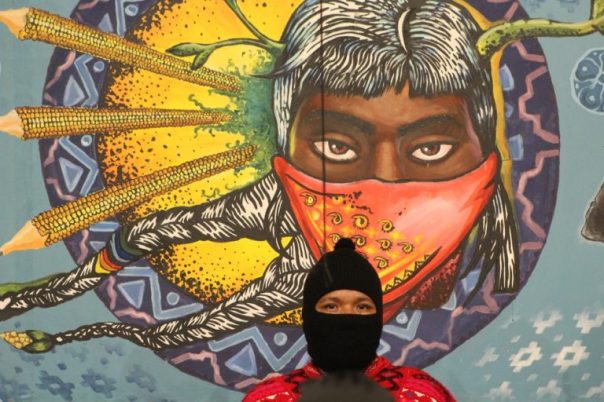
Photo from the EZLN Roundtable April 5-15.
By: Gustavo Esteva
How do we contend with the mood that is spreading, molded by the mixture of fear and false hopes instilled by the verbal incontinence and theater of the candidates and political parties?
The oppressive repetition of the horror seems to be accustoming us to it. Each day we learn of a new aggression in Myanmar, Palestine, Syria…. Daily we add data to the obscene accounting of our assassinated, kidnapped, tortured, and disappeared which makes Mexico one of the most violent countries in the world. Each day we learn of new pains of our countrymen in the face of ethnic cleansing now practiced with migrants across the world: millions of those who are on the del otro lado [U.S. side of the border] no longer dare to complete daily activities for fear of deportation; hundreds of thousands that do not know the country they were born in discover they no longer belong to the society where they have spent all of their lives.
This month horrific information was added to the daily news of climate change. A very respectable group of scientists warned, with very solid foundation, that the increase in ultraviolent radiation is seriously impacting all life on the planet, and of course, human beings. They have identified the cause: the irresponsible experiments of military geo-engineering that converts the climate and the planet into a weapon to be used in the war being waged. (Marvin Herndon, et. al., Journal of Geography, Environment and Earth Science International,14 (2): 1-11, 2018).
The country that we had has been undone before our eyes. Little is left of it. Capital, with the enthusiastic complicity of the political classes, reigns free in the social reality. The mask of the dominant regime has fallen and thanks to Mr. Trump is more and more difficult to deny its nature and characteristics, its racism and sexism.
Added to the gravity and extent of the economic crisis, that has a growing majority of Mexicans under the so-called poverty line, is the daily dispossession, almost always violent, of land, water, territories, rights, everything that we had achieved over centuries of social struggle. This barbaric and destructive process has been realized with the enthusiastic complicity of the political classes, while the deterioration of all institutions persists.
For capital, the entire population was seen as, actual or potential, labor. A few decades ago it created a disposable class: those people it has no possible use for, now or in the future. What we are experiencing now is a mechanism that disposes of those “disposable,” not just expelling them from the economic system or from their lands, but also eliminating them in physical terms.
This situation principally affects the poorest, but also, increasingly, the middle classes, whose number is continually reducing. The economic threat in general combines with the criminal violence to generate a fear each time more general and intense, which the mainstream media continually makes worse.
It’s easy to understand, in these circumstances, that many people resort to well-known defense mechanism of denial. Closing our eyes serves as the first line of defense against the anguish provoked by what occurs, that in many cases leads to desperation. Candidates are employing that moment of fragility, that psychological refuge, to insert their promises. They vaguely warn of the approaching catastrophes and then suggest that the solution is within everyone’s reach: just vote for the right person the first of July.
Not one of the threats underway, many of them completed now, will disappear after that date. They will continue to advance and deepen the processes that they produce. To fall for those immoral promises is just another form of denial, it’s not daring to see the gravity of our predicament, it’s not wanting to recognize what is evident: no change of functionaries will resolve the problems that we are facing.
What’s needed is great strength to confront with feet firmly on the ground what happens. It is what the Indigenous communities demonstrated in October 2016, when they timely recognized the danger of extinction to which they were exposed and they decided to take the offensive. It is an offensive currently underway that has achieved what they wanted in this period and in a few days will enter into a new phase.
The key to what is coming is our capacity to recuperate hope as a social force. We need to trust our own capacities to reconstruct society from below and to make unnecessary the rotten apparatuses of the market and the state. We need, above all, to fight against the patriarchal condition of all institutional apparatuses along with the attitudes and practices that form the dominant regime which are deeply internalized in all of us. All of this seems at times very small, even insignificant, and at other times seems colossal. The important thing is that it is always within our reach. For that reason, it is possible to reconstruct hope, which is the essence of popular movements.
Translated by Center for Convivial Research and Autonomy
La Jornada, April 23, 2018
<http://www.jornada.unam.mx/2018/04/23/opinion/025a2pol>
—
Manolo Callahan
Center for Convivial Research and Autonomy
Paramilitary Fire
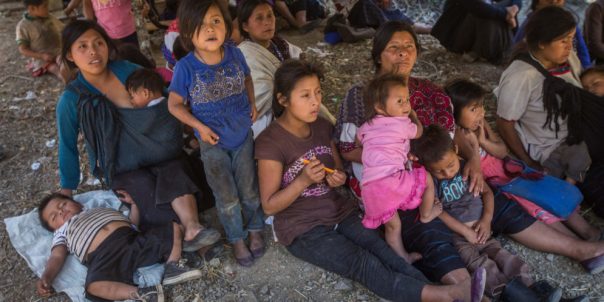
Some of those displaced by paramilitary attacks in Aldama, Chiapas, Mexico.
By: Gloria Muñoz Ramírez*
Tzotzils from different communities within the municipality of Aldama, Chiapas, have been under fire from gunshots for more than a week and the government does nothing. The lives of men, women and children are in danger. Fear lives among them from sunrise; it doesn’t go away because they hear the shots all day. Now the live in the mountain “to protect themselves from the shooting and some have had to flee to the municipal capital and other places.”
The denunciation that the Fray Bartolomé de las Casas Human Rights Center (Frayba) makes, an organism that warned since the first days of April about the intensification of the violence in Los Altos. The weapons, like more than 20 years ago, are shot from Chenalhó, a region in which the federal government armed and trained paramilitary groups to fight the Zapatistas in the first years of the insurgency. Later came the vino la Acteal Massacre and the promises of a disarming that never happened.
Just last December a new humanitarian crisis was unleashed, caused by violence induced between the peoples of Chalchihuitán and Chenalhó because of a land conflict that the government did not resolve and, in fact, it promoted. Hundreds of indigenous peoples paid the consequences and fled into the mountains in order to save their lives.
It’s about, says the Frayba, old agrarian conflicts that have been administered according to political interests, “in an electoral environment of manipulation and control to operate renewed counterinsurgency strategies” and in which they reactivate “civilian armed groups, with a paramilitary cut, linked to organized crime networks,” who attack communities with firearms with the permission and protection of Chiapas authorities.
What has to happen so that the emergency is recognized in the communities of Koko´, Xuxchen, Cotsilman, Tabak and the municipal capital of Aldama and effective measures are activated to stop the violence and displacement? What has to happen so that once and for all the armed groups in the region are disarticulated, disarmed, arrested and punished? Why doesn’t the state government conduct a thorough investigation? Is it just inefficiency or do they have an interest in the growth of violence?
For now, it is urgent to care for the hundreds of displaced and apply “preventive actions to avoid that other communities are forcibly displaced due to armed aggressions in the region.” It’s urgent to change the order of things in Chiapas. Last April 2, the bullets hit one adult and two minors that were going to plant corn. How many more do they want?
*Gloria Muñoz Ramírez publishes a weekly column in La Jornada on Saturdays called “Los de abajo” (Those below). You can email her column in Spanish at: losylasdeabajo@yahoo.com.mx
She also publishes the newspaper “Desinformémonos.”
—————————————————-
Originally Published in Spanish by La Jornada
Saturday, April 28, 2018
http://www.jornada.unam.mx/2018/04/28/opinion/013o1pol
Re-Published with English interpretation by the Chiapas Support Committee
Prohibited thinking?
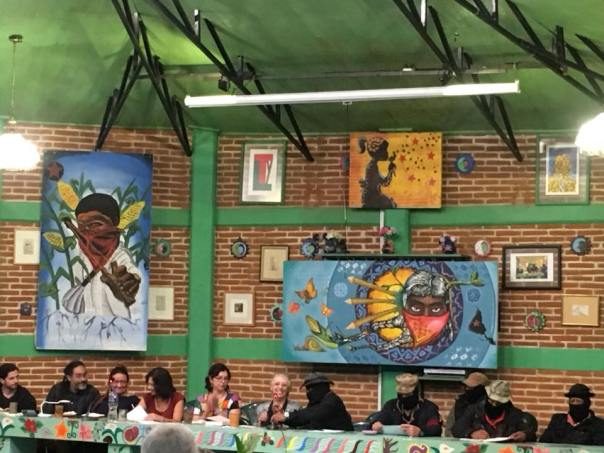
Women speak about Ayotzinapa during the Zapatista Round Table in Chiapas.
By: Gilberto López y Rivas
The seedbeds-roundtables organized by the EZLN, like the one that takes place this week in San Cristóbal de las Casas, Chiapas, constitute spaces open to critical thinking about what occurs in Mexico, –and in the planetary ambit–, with the imposition of neoliberal globalization based on social war, dispossession and systemic violence and characteristic of a process of re-colonization of our countries.
We remember, in this direction, one of the theses on anti-systemic struggles of the late Subcomandante Insurgente Marcos, which I consider necessary to assume in its depth and present timeliness: “One cannot understand and explain the capitalist system without the concept of war. Its survival and its growth depend primarily on war and on everything that is associated with it and that it implies. By means of it and in it, capitalism dispossesses, exploits, represses and discriminates. In the stage of neoliberal globalization, capitalism makes war on all of humanity. (Escritos sobre la guerra y la economía política. México, Pensamiento Crítico Ediciones, 2017, p. 275)”
The analysis of the electoral conjuncture underway makes sense when it is based on this context of militarized and criminal capitalist globalization, in which procedural democracy collapses and enter into a crisis with no return, characterized by the loss of legitimacy and credibility of the states responsible for carrying out, monitoring and sanctioning the alleged legality of those elective processes.
The entry of two known electoral criminals as supposedly independent candidates to the Presidency of the Republic is one more demonstration of the palpable institutional deterioration of the Mexican State, gravely worn out by that “unrecognized armed conflict;” that is, the war that Felipe Calderón initiated and Enrique Peña Nieto continued.
The decision of the judges of the Electoral Tribunal of the Judicial Power of the Federation (TEPJF) to endorse the registry of Jaime Rodríguez Calderón, alias El Bronco, on the electoral ballot for the Presidency, is especially grotesque and defies all legal logic, when evidently his citizen support signatures were fraudulently obtained; many were apocryphal or simulated; thousands of others didn’t even present voter credentials. He also used public resources for his campaign, other resources of unknown or suspicious origin, from ghost companies; he didn’t report millions of pesos to the INE, and, as if this were not enough, officials of his failed state administration participated in the collection of signatures. Also, the adulterated and illegal manner of obtaining citizen support, the origin and exercise of Margarita Zavala’s monetary resources, have been very questioned, and, it’s clear, both characters of the national picaresque do not resist a judicial investigation, at least, for alleged electoral and fiscal crimes.
María de Jesús Patricio Martínez’ campaign for citizen support, at the other equidistant pole, put into evidence the moral illegality of the professional political class and that of the partidocracy, and it demonstrated a paradox of neoliberal times, the anti-systemic is the only one capable of acting with honesty and based on ethical principles, respecting legality and the rules of the game, while the governmental institutions violate their own laws and regulations, act with discretion, according to their class interests, and they are the principal enemies of the system of capitalist representative democracy. The electoral process, consequently, will be marked by what is already seen as a State election, which, in the Mexican case, is characterized by a deviation of power; in other words, by its criminal character. That means that the de facto powers, the dominant mafia groups that sustain it, will be the ones that will ultimately decide who can guaranty the continuity of the system of the prevailing capitalist exploitation-domination and will use repressive apparatuses available to the State, both legal and clandestine, to try to impose their candidate.
On the other hand, the proposal of the National Indigenous Congress and the Zapatista National Liberation Army, to form an Indigenous Government Council, whose purpose is the reconstitution of the original peoples, the establishment of alliances with the country’s exploited and oppressed, forming territorial networks of support and organization, coincides fully, with another of the theses of the late Sub Marcos: “great transformations do not start above or with monumental and epic events, but rather with small movements in their form and that appear irrelevant to the politician and the analyst above.” (Ibid. p. 276)
In this war against humanity, in which the very survival of the human species is at play, the original peoples of all the continents constitute the socio-ethnic sectors best prepared to confront it due to their forms of organization and making decisions with a collectivist tendency, which, in many cases, carries with it the formation of self-government and the adoption of redistributive and self-sustainable economies, and, above all, of taking care of Mother Earth; their resistances in defense of the territories besieged by capitalist corporations, in which organized crime directly threatens not only territories but also the existence of indigenous culture and the very life of the members of the original peoples.
Particularly in Latin America, the indigenous peoples are in permanent struggle against the new latifundistas (large landowners) and their modern white guards (private police), now with the uniform of security companies; against the consortia that attempt to seize seeds and introduce transgenic varieties; against the mining companies that poison all the surrounding environment with mercury and cyanide, contaminating rivers and underground currents; against the privatization of water; against the highway megaprojects, wind farms, tourism and hydroelectric projects; in sum, against everything that the political class that aspires to govern in the name of democracy and progress supports.
The struggle continues. There is life after July 1.
———————————————————–
Originally Published in Spanish by La Jornada
Friday, April 20, 2018
http://www.jornada.unam.mx/2018/04/20/opinion/018a2pol
Re-Published with English interpretation by the Chiapas Support Committee
González Casanova becomes Comandante Pablo Contreras
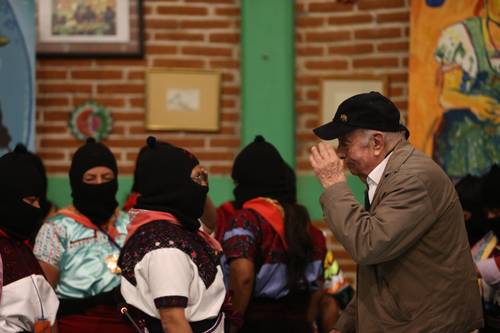
Visibly moved, Doctor González Casanova responded to hugs from the Zapatistas. Photo: Daliri Oropeza
By: Luis Hernández Navarro
San Cristóbal de Las Casas, Chiapas
Starting yesterday, Doctor Pablo González Casanova, 96, is “Comandante Pablo Contreras” of the Indigenous Revolutionary Clandestine Committee of the Zapatista National Liberation Army (CCRI-EZLN, its initials in Spanish).
The naming was made public in the midst of a prolonged and emotive ovation from attendees at the roundtable discussion “Looks, listens and words: prohibited thinking?” which is being held at the Indigenous Center for Integral Training Fray Bartolomé de Las Casas-Universidad de la Tierra (Cideci-Unitierra) in San Cristóbal de Las Casas, convoked by the Zapatistas.
The rebel agreement was announced to the ex rector of the Autonomous National University of Mexico (UNAM) by Comandante Tacho. For being Zapatista –the Tojolabal assured– one must work and he has worked for the life of our peoples. He has not tired, has not sold out and has not given in.
Previously –in a beautiful and basted intervention in which he made an evaluation of the campaign of the spokeswoman of the Indigenous Government Council, María de Jesús Patricio, for obtaining the registry as an independent candidate to the Presidency of the Republic– the writer Juan Villoro narrated how last February 11, on the esplanade of the Palace of Fine Arts in Mexico City, don Pablo celebrated his number 96 birthday, in the final act of support for the indigenous Nahua.
Rector of the left
González Casanova, Villoro remembered, is the only rector of the left that the UNAM has had. That day at Fine Arts, he added, he gave us a lesson in youth and rebellion and showed himself as an authentic dean and man of judgment.
Preparing the surprise, Subcomandante Moisés narrated how the Zapatistas are trained as organizers giving and y supervising tasks. If things go well, the commander said, the Zapatista is rewarded with more work.
It was then when Comandante Tacho spoke and began to explain, in the third person, the merits and virtues of don Pablo. Juggling the numbers he concluded that, despite the age difference, the Zapatistas and González Casanova are contemporaries. In passing he remembered the name with which almost one year ago, during the seminar “The walls of capital, the cracks on the left: the hourglass and the organized world of the fincas,” he was baptized by the rebels “Pablo Contreras.” And already put on track, he announced his naming as part of the CCRI-EZLN and finished: the gift that we are going to give him is more work…
One year before, during the gathering “The walls of capital,” Subcomandante Galeano presented him as a man of critical and independent thought, who is never told what to say or how to think, but who is always on the side of the peoples. That’s why, he explained, in some Zapatista communities he is known as Pablo Contreras. And he added that one of the rebel municipalities was baptized with his name.
Immediately after Tacho’s words announcing the naming of the new comandante, the members of the command and the CCRI present in the presidium stood up and started to salute don Pablo militarily with the left hand and to give him a warm hug, while the crowd applauded standing for about 10 minutes and unexpectedly started to chant: “Goya, goya, cachún, cachún, rah, rah, rah! Goooooooya! Universidad!”
Don Pablo, who began his speech at the seminar greeting the audience in Tzotzil and explaining that greeting is to recognize the other and he continued vindicating Zapatismo as a universal contribution to the struggles for liberation, responded to the military salute and the hugs, visibly moved, with more greetings and hugs.
Just last March 1, at the presentation of a work of his in the International Book Fair of the Palace of Mining, González Casanova answered the question of what his recipe is for living with so much intellectual force: “Struggling and loving.” This April 21, now as a comandante of the CCRI-EZLN, he reaffirmed his vocation to struggle and love.
———————————————————–
Originally Published in Spanish by La Jornada
Sunday, April 22, 2018
http://www.jornada.unam.mx/2018/04/22/politica/009n1pol
Re-Published with English interpretation by the Chiapas Support Committee
EZLN: The system will not permit the triumph of AMLO; the capitalist hydra is crazed

The former Subcomandante Marcos added that despite warnings, the “institutional” left is sure that it will triumph during the upcoming July 1 elections. Photo: Daliri Oropeza/Cuartoscuro
By the Sin Embargo Editorial Staff
Capital will not permit the triumph of Andrés Manuel López Obrador, candidate of the alliance “Together We’ll Make History,” in the next presidential election, Subcomandante Galeano assured during the round table “Looks, listens, words: prohibited thinking?”
He added that: “the capitalist hydra is crazed, it’s going for everything and everyone.” And he stressed that despite the fact that López Obrador will offer “a respite from capital, that respite won’t be possible.”
Mexico City, April 18
The Zapatista National Liberation Army (Ejército Zapatista de Liberación Nacional, EZLN) affirmed that the “powers that be” would not permit the triumph of Andrés Manuel López Obrador, candidate of the alliance “Together We’ll Make History,” in the current presidential electoral process.
Subcomandante Galeano revealed the warning during the roundtable “Looks, listens, words: prohibited thinking?” that was held at the Indigenous Integral Training Center (aka Cideci) of the University of the Earth in San Cristóbal de las Casas, Chiapas.
Galeano added that: “the capitalist hydra is crazed, it’s going for everything and everyone.” Therefore it will not permit a triumph “like the one Andrés Manuel López Obrador seeks to head.”
And he reiterated that capital “is going for everything and is not going to permit Lulas, Dilmas, Kirchner, Correas, Evos, or López Obrador, or whatever anything is called that offers a breather.”
The former Subcomandante Marcos added that despite the warnings, the “institutional left” is sure that it will triumph in the upcoming July 1 election. And he emphasized that despite the fact that López Obrador offers “a respite from capital,” “that respite is not going to be possible.”
Galeano pointed out that his reflections derive from what his compañeras, compañeros, sisters and brothers of the networks and of other organizations face.”
On the other hand, he judged that the EZLN has never called for abstention, but rather for an electoral boycott against the National Action Party (PAN), in Querétaro during 2006, and this sought to pressure for the “liberation of some brothers that were prisoners and they released them.”
Finally, he said that the EZLN’s proposal has been organization of the peoples that make up the country.
————————————————————–
Originally Published in Spanish by Sin Embargo
Wednesday, April 18, 2018
http://www.sinembargo.mx/18-04-2018/3409234
Re-Published with English interpretation by the Chiapas Support Committee
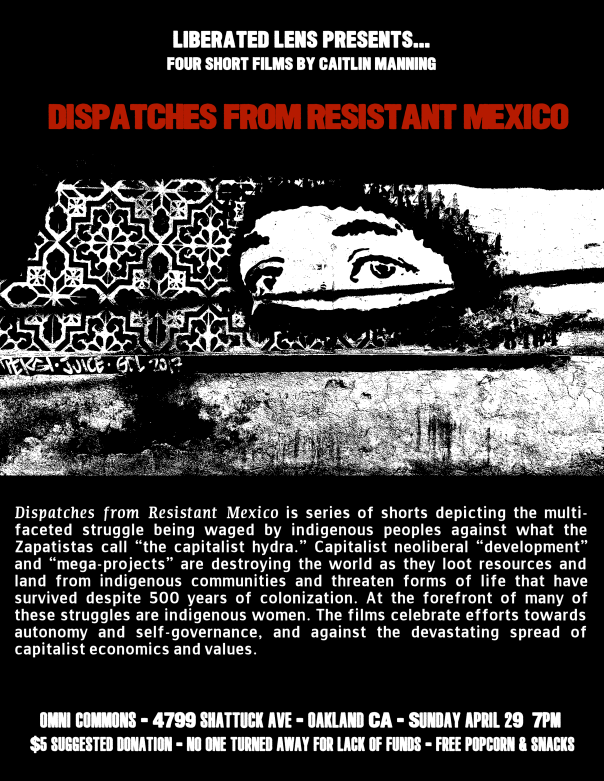
Dispatches from Resistant Mexico
THE CHIAPAS SUPPORT COMMITTEE IS CO-SPONSORING THIS EVENT – WE HOPE TO SEE YOU THERE!
EZLN: They reward the cheaters, they punish the just (Marichuy); do they now see that we were not from Salinas?

Marichuy with Galeano at the Roundtable discussion “Looks, Listens, Words: prohibited thinking?”
Subcomandante Galeano, before Marcos, of the Zapatista National Liberation Army (Ejército Zapatista de Liberación Nacional, EZLN), defended Marichuy’s campaign that did not meet the number of signatures necessary for run as a candidate to the Presidency, but she did obtain that 94 percent of the signatures that she presented (281, 955) were validated by the INE, which contrasted with the irregularities with which Jaime Rodríguez Calderón, “El Bronco,” and Margarita Zavala Gómez del Campo presented… and are still on the July 1 electoral ballot for.
What Marichuy did, said the EZLN subcomandante, was to exhibit and undress the electoral political system as one that rewards the cheater and punished the just.
By the Editorial Staff / Sin Embargo
Mexico City, April 17 (SinEmbargo)
Subcomandante Marcos, now Galeano, of the Ejército Zapatista de Liberación Nacional (EZLN), accompanied the presidential aspirant María de Jesús Patricio, better known as Marichuy, exhibited, during a roundtable discussion, Mexico’s electoral system upon indicating that despite the irregularities that other independent candidates committed, they will be on the ballot.
Within the framework of the First Session of the Roundtable discussion “Looks, listens, words: prohibited thinking?” the subcomandante asserted that if their candidate achieved anything it was undressing the electoral system that awarded candidacies to Jaime Rodríguez “El Bronco” and Margarita Zavala, because their irregularities are on the ballot thanks to the decision of the Nacional Electoral Institute (INE, its initials in Spanish) and because the Electoral Tribunal of the Judicial Power of the Federation (TEPJF), which he accused are at the service “of the political team of Enrique Peña Nieto to elect his successor.”
“Marichuy didn’t falsify any signature, however others like ‘El Bronco’ did falsify them, and they rewarded them with the candidacy. Those that violated all the laws remained […] What Marichuy did was to exhibit and undress the electoral political system in Mexico,” Galeano said.
At the gathering held in the city of San Cristóbal de las Casas, in the state of Chiapas, the political leader of the EZLN affirmed that if Marichuy was left out of the contest it was because she didn’t reach the necessary signatures, which she did obtain legally, different than the other candidates.
“After it was demonstrated that there is no decency in the electoral process, Marichuy was left out.”
Subcomandante Galeano criticized the “left” of Andrés Manuel López Obrador that is drunk celebrating a victory it still doesn’t have” and has not realized from where the fraud is coming without having a plan “B.”
He also reacted to the voices that point to the Zapatista movement as an instrument of the former President of Mexico, Carlos Salinas de Gortari, and against those that opined that the vote for Marichuy would divide the vote of the left.
“It was already demonstrated that we are not part of the power’s mafia, that Salinas doesn’t manage us, in this case he mishandled us. We are romantics and dreamers, what movement can do that, I don’t know, that the direction, the initiatives and the imagination come from its people, in those who make it up, there were people that tabled, obstructed passage, knocking on doors,” he said.
“If we are a creation of Salinismo, why didn’t the unnamable bad guy move his people to collect signatures, why didn’t he use his influence so that they legally put you on (the ballot) like they illegally put ‘El Bronco’ on,” Galeano added.
“If it’s all a play to divide the vote, why didn’t the system move to achieve registration? The truth is that there is no place for Marichuy, there is no place for the original peoples,” he concluded.
Marichuy didn’t gather the necessary number of signatures to run for president, but 94 percent of the signatures that she presented (281, 955) were validated versus other independent candidates that even received fines because of irregularities.
Gathering the 866,593 signatures (1 percent of the average number of registered voters in each state) that independent candidates need to enter the presidential race turned out to be problematic for the CNI.
Throughout its campaign on behalf of the candidacy of “Marichuy,” the Congress argued that the mechanism for collecting signatures discriminates strongly against the indigenous communities, which constitute the core of its support base.
Signatures are provided through an application of the National Electoral Institute, but many who live in indigenous communities don’t possess mobile phones, much less devices that are connected to the Internet. In Mexico, Internet users represent only 60 percent of the population, according to data from the World Bank.
Not being on the ballot is not the end. The Movement that María de Jesús Patricio represents, the first indigenous woman that attempted to present herself as a candidate to the Presidency of Mexico, backed by the Zapatista National Liberation Army, has not stopped.
———————————————————–
Originally Published in Spanish by Sin Embargo
Tuesday, April 17, 2018
http://www.sinembargo.mx/17-04-2018/3408604
Re-Published with English interpretation by the Chiapas Support Committee
Galeano: The left is drunk and doesn’t see the fraud coming
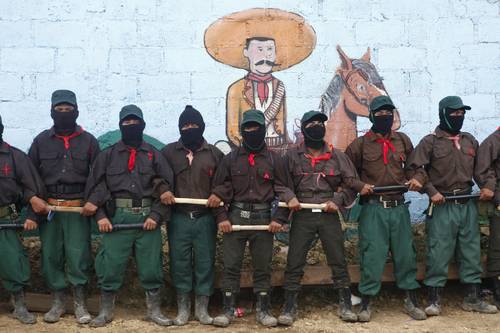
In a 2017 image, Members of the Caracol of La Garrucha prepare to receive the presidential candidate Marichuy.
By: Elio Henríquez
San Cristóbal de Las Casas, Chiapas
Subcomandante Galeano, of the Zapatista National Liberation Army (Ejército Zapatista de Liberación Nacional, EZLN), asserted that the institutional left: “is so drunk celebrating a victory that it still doesn’t have in hand, that it doesn’t realize where the fraud is coming from and doesn’t have a plan B.”
He added that with the acceptance of Margarita Zavala and of Jaime Rodríguez El Bronco as independent presidential candidates, “they are marking where the fraud is going.”
“The INE, an employment agency”
During the first session of the round table “Looks, listens, words: prohibited thinking?” that is being held in this city, he said that the result of the mobilization of the Indigenous Gobierno Council (CIG, its initials in Spanish) and its spokesperson María de Jesús Patricio Martínez, Marichuy, to collect the number of signatures that would permit her to participate as an independent presidential candidate,” exhibited the National Electoral Institute (INE) for what it is: an employment agency and a political talent scout, and if you are decent you cannot enter.”
Subcomandante Galeano added that, at the same time, the Electoral Tribunal of the Judicial Power of the Federation “is for endorsing or correcting the INE’s blunders. In the discretion of that body, the institute committed the miscue of not inserting a El Bronco (as a candidate), and the tribunal resolved it.”
He assured that the EZLN’s prognosis “was that the required number of signatures were not reached” –more than 800,000– for the registry of her candidacy; “our calculation was upwards of 100,000, concentrated in the center of the country.” Finally, the electoral institute validated 266, 395 signatures in her favor.
Seated together with Marichuy and other members of the Zapatista command, as well as with Mercedes Olivera, Márgara Millán and Sylvia Marcos, participants in the gathering, he underscored: “Another thing that we saw that you did in that mess, is that you pointed out to everyone where the fraud is going.”
Galeano stated that Marichuy’s tour with the proposals of the CIG and the National Indigenous Congress (CNI) “not only did not legitimate the political system, but rather undressed it and showed it for what it is, with more effectiveness than a seedbed,” it also caused the schizophrenia of the political class to be exhibited.”
———————————————————–
Originally Published in Spanish by La Jornada
Tuesday, April 17, 2018
http://www.jornada.unam.mx/2018/04/17/politica/012n1pol
Re-Published with English interpretation by the Chiapas Support Committee
Water and indigenous peoples
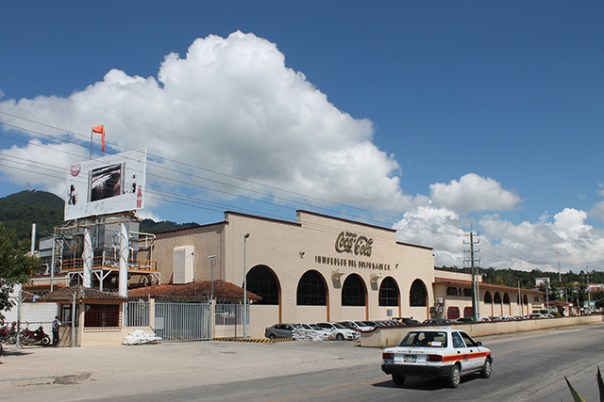
Coca Cola plant in San Cristóbal de las Casas, Chiapas, Mexico. Bottling plants are sucking the water away from indigenous Chiapas communities.
By: Francisco López Bárcenas
Last March 22 we celebrated World Water Day, so declared by the United Nations Organization to foment awareness in humanity about the importance of the vital liquid for the continuity of life on the planet. It is for nothing less. Water is an element that only exists on planet earth and is also indispensable for all life, because without it life is unimaginable. Contrary to this reality, capital has managed to convert it into merchandise, a good coveted by private companies so they can offer it to those who have the money to buy it. That is generating many of the conflicts in Mexican society because, before satisfying the necessities for life, it is used to feed industry, maintain the big agricultural cattle emporia, and for the export and extraction of minerals, hydrocarbons and gas from the Mexican subsoil.
From another point of view, to the indigenous peoples, besides being indispensable for life, or perhaps because of that, water contains sacred elements, because in its natural state, whether in places where it flows, through the rivers and ravines where it runs or the seas where it arrives, it’s linked to myths about origin and communication with their gods, so much so that in the pre-Hispanic epoch the priests administered it, a fact that, with the necessary transformations, is preserved today. This situation clashes openly with the mercantile use that has been its fate in recent years because of capital, a situation that openly confronts them, because many of the indigenous peoples inhabit sources of watersheds, to the extent that in the 12.4 percent of the national territory that indigenous peoples occupy 24.69 percent of all the country’s water is captured. Consequently, it is in the indigenous territories where more conflicts are presented over the use and enjoyment of the vital liquid.
Paradoxically in all the legislation on indigenous rights that has been issued in our country, not one piece of legislation exists that refers to their right of access to and enjoyment of water. What may be most related to this matter is in the provision of the second article of the Political Constitution of the United Mexican States, which in its Section VI of its part A, determines that, as part of their autonomy, indigenous peoples have the right “to the use and preferential enjoyment of the natural resources of the places that the communities inhabit and occupy, except those that correspond to strategic areas, in the terms of this Constitution.” Given that water is a natural resource, the indigenous peoples that live inside the country’s watersheds have the preferential right to the use and enjoyment of those waters, a right that the authorities violate daily by extending concessions for use to private parties without even notifying them (the indigenous peoples).
The right does not remain as a preference for their use and enjoyment in front of third parties. Articles 15 and 16 of Convention 169 of the International Labor Organization (ILO) on indigenous peoples, prescribes that the rights of indigenous peoples about the natural resources must be specially protected, which includes the obligation of state authorities to create mechanisms so that they participate in the utilization, administration and conservation of said resources, in this case water; besides, when the resources belong to the State, as in the Mexican case, adequate procedures must be established for consulting them before exploration or exploitation of said resources are undertaken or authorized; as well as participating in the benefits that such activities report, and perceiving an equitable indemnification for any damage that they may suffer as a result of those activities.
Several centuries ago, it was established in the Laws of the Indies: “that where there were regions and a proposal to found populations and some people want to do it, they were given lands, urban plots and waters” establishing “that lands would not be given or sold to the Spaniards with prejudice to the Indians, but rather that they were left with all the remaining lands belonging to them, and the waters and irrigations for their seed orchards and so that they can water their cattle, distributing to them and giving them what they would need.” Now, on the occasion of World Water Day, the UN’s representation lamented that: “for a long time, the world has resorted in the first place to constructed infrastructure or ‘gray’ for improving the management of water resources. By doing so, it has frequently set aside traditional and indigenous knowledge that adopts more ecological approaches.”
The Spanish State was right and the UN was right, but we must not only take advantage of the knowledge of the indigenous peoples in the management of water, we must also fully recognize their rights. Not only would they win with this. We would all win.
———————————————————–
Originally Published in Spanish by La Jornada
Thursday, March 29, 2018
http://www.jornada.unam.mx/2018/03/29/opinion/014a1pol
Re-Published with English interpretation by the Chiapas Support Committee
The “minimum spaces for surviving” are closed In Central American towns

Members of the migrant caravan narrate their struggle and their stories during a meeting with authorities and the cultural community of the country’s capital, where they have been staying since three days ago. Photo: Carlos Ramos Mamahua
By: Blanche Petrich
Their stories are similar and different. In their cities or towns, in Honduras or El Salvador, the minimum spaces for surviving are closed to them. They killed one woman’s uncle for being homosexual. They killed another woman’s brother because the family, poor and hard working, didn’t want to pay more extortion to the gangs. To some Hondurans it’s because: “we have a president that governs very badly and orders the army to pursue us.” To another, who only lacked one month to finish high school, her mother threw her out on the street: “I prefer to know you from afar than to see you dead.”
The migrant caravan, which began its journey towards Mexico City on March 25 and that has been in the capital for three days, was received yesterday at the Casa Citlaltépetl Refuge by the Secretary of Culture, Eduardo Vázquez, and the president of the capital’s Human Rights Commission, Nashieli Ramírez, to dialogue with some members of the cultural community and indigenous collectives, desirous of seeing them in person and listening to them. In that exchange of words, tears came from both sides.
This caravan organized by Pueblo sin Fronteras (People without Borders) “will go down in history for two reasons,” maintained the leader of the MesoAmerican Migrant Movement, Marta Sánchez. “First, because it made Donald Trump end up being naked before Mexicans and it made President Enrique Peña Nieto dare to tell him his truths. Second, because it gives us the opportunity, as activists, to place our struggle so that this government doesn’t continue doing the dirty work for the United States, arresting migrants before they reach the northern border.”
Among the 1,800 undocumented Central Americans that began their annual Víacrucis Migrante (Migrant Way of the Cross) in the middle of Holy Week is a group of young transgender women, like Marjori Alexandra or Roxi. They have become friends along the way and share the same tragedies. Maras, police and organized crime have made hate crimes a new sport.
In front of poet David Huerta, filmmaker Paul Leduc, immigration expert María Luisa Capella, La Jornada writers Pedro Miguel and Hermann Bellinghausen, actress Dolores Heredia, journalist José Reveles, anthropologist Lucina Jiménez and dozens of representatives of indigenous collectives of residents in the city, they told the avatars of the road, stopping in shelters and occasionally bumping into threatening immigration authorities. Two hundred children are also traveling with them.
That collective of 1,800 migrants, said Rubén Figueroa, an activist that has facilitated the reunion of hundreds of families in recent years, is only a fraction of which enters through the border every day. It is estimated that there are between 2, 500 and 2, 700 daily. They advance hidden in the brush, hidden and trafficked in trailers, where they are sometimes asphyxiated. Thousands of others are brutally deported and sometimes they disappear without leaving a trace. There are more than 70, 000 names that don’t appear on any paper, 10 years ago, because the government of Mexico doesn’t even have an effective mechanism to look for them.
We are here because of solidarity, and also because of shame: Leduc
Before their stories, Paul Leduc responded after listening to them: “We are here because of solidarity, but also because of shame because we must recognize that the reception in Mexico cannot be idealized; they are not going to find the answer they need here.”
Cuauhtémoc Cárdenas Batel, whose father founded the Casa Refugio 19 years ago to honor Mexico’s asylum policy that his grandfather implemented, General Lázaro Cárdenas, to receive Spanish and Jewish refugees, expressed: “many of us do want you to be here, who don’t want our country to be the guard dog of the United States.”
Seated a half meter from Cárdenas, an elderly Triqui woman held up a leaf of paper that proclaimed that same thought: “Our country is your country.”
Of the contingent that left Tapachula, (Chiapas) a little less than half continued their path towards the north. A few more stayed in cities through which they passed to seek there a secure destiny. And between 600 and 700 others will still remain in Mexico City while they define their next steps.
Meanwhile, according to Anahí, a young woman migrant that has learned to change her two-year old baby’s diaper very fast and on her knees, civic organizations provide them with a place of rest, food and care. There are three families that travel together, from the same sector of San Salvador, with their small children and with an uncertain future. “We didn’t expect to see so much help, so many people determined to fight for us. Thank you, many thanks for not discriminating against us for being migrants,” she concluded.
———————————————————–
Originally Published in Spanish by La Jornada
Wednesday, April 11, 2018
http://www.jornada.unam.mx/2018/04/11/politica/013n1pol
Re-Published with English interpretation by the Chiapas Support Committee
 Chiapas Support Committee