Chiapas Support Committee
Home of the Compañero Manuel blog on zapatistas & mexico
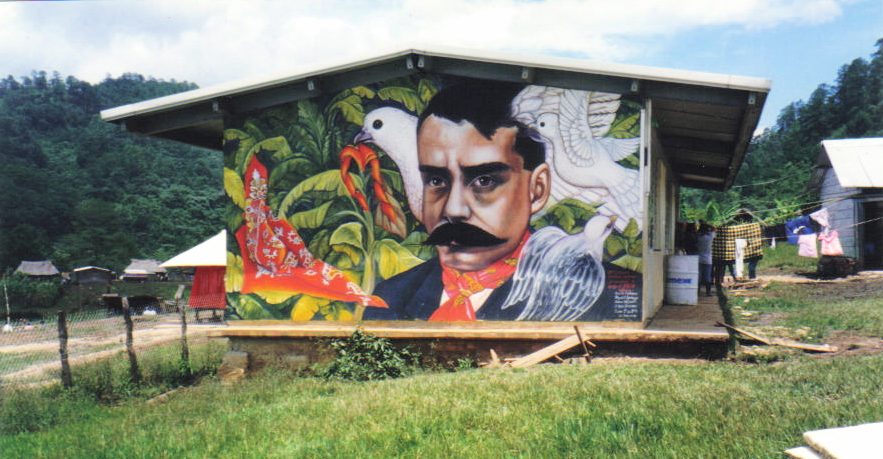
CNI-CIG-EZLN Statement: SAMIR LIVES, THE STRUGGLE CONTINUES!
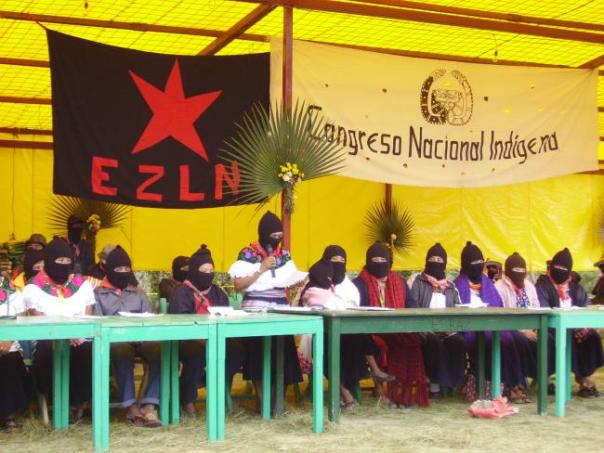
STATEMENT OF THE THIRD NATIONAL ASSEMBLY OF THE NATIONAL INDIGENOUS CONGRESS, THE INDIGENOUS GOVERNMENT COUNCIL AND THE EZLN
To the peoples of the world
To the organizations and collectives in resistance and rebellion
To the networks of resistance and rebellion
To the national and international Sixth
To the communications media
Almost 100 years after the assassination of General Emiliano Zapata, the Ayuuk, Binizza, Chinanteco, Chol, Chontal, Guarijío, Maya, Mayo, Mazahua, Mazateco, Mixteco, Nahua, Nayeri, Otomí, Popoluca, Purépecha, Raramuri, Tepehuano, Tlapaneco, Tojolabal, Totonaco, Tzeltal, Tsotsil, Wixárika, Yaqui, Zoque and Quichua (Ecuador) peoples being together to celebrate the Third National Assembly of the National Indigenous Congress and the Indigenous Government Council, we are in pain and rage faced with the war against our peoples, the murder of Compañero Samir, dead for defending the land and his people. From our national assembly we send a combative embrace in solidarity with his family and the community of Amilcingo, Morelos. We send a solidarity embrace from the CNI-CIG and the EZLN, where the compañero will always be a lighted candle.
The neoliberal regime killed Samir; we don’t know if it was the government, the impresarios, their criminal cartels, or if it was the three together. The offerings that AMLO made, not to those below, but rather to the owners of money and power, the veiled threats against those who defend life, laid the foundation for the basis of the murderous assassination. It is, in the case of the new head of the federal executive, the promise of delivering to the entrepreneurs and the top military men what neoliberal capitalism and its bad governments that come and go have not been able to take away from us. He offers the entrepreneurs putting land at their disposal with the supposed new Agrarian Development Law, to finish dismantling collective property and collective organization, calling shameless robbery and destruction “development,” militarily threatening our peoples with his National Guard and reconfiguring our country.
What those above call “transformations” have always meant to our peoples that we put up the deaths in function of the interests of the oligarchies and of those who have the power, which are each time smaller and larger, who don’t stop living from the oppression, exploitation and destruction as always.
The so-called “Fourth Transformation” follows the same path as its 3 predecessors, although with more brutality and cynicism, if possible.
In the War of Independence it was the local exploiters, the children of the European invaders, who took power and distributed our lands, trying to make the existence of our peoples invisible on the basis of the liberal discourse that is the discourse of Power until this very day.
In the Reform our communal lands, sacred to us, were proscribed to deliver them to the same looters, the Reform laws and the subsequent laws about uncultivated lands and colonization promoted the growth of the big haciendas under the regime of Porfirio Díaz. [1]
During the Mexican Revolution, while political power was distributed above, those of us below defended and watered the land with our blood. While Madero and Carranza were betraying and assassinating Zapata, our peoples were demanding a radical and profound social and agrarian transformation that never came.
Thus, in each “transformation” the exploitation, dispossession, discrimination and contempt against our peoples increased and recurred.
We have no doubt that this new stage of government deepens neoliberalism and the forced integration of our country into the imperial orbit of the United States, therefore, it has faithfully committed to give continuity to the macroeconomic policies of the previous governments, establishing an austerity and fiscal restrictions that have not been seen since the government of Miguel de la Madrid: guarantying the autonomy of the Bank of Mexico, respect for foreign investments and the promotion of free trade. It goes against us and against our territories; it goes in favor of extermination of our peoples in every corner, and for that it tends a war that we suffer today with mourning and courage. We see ourselves in this general assembly and in the conjunct of our sorrows we see that it’s a war made of many wars functioning together, as if it were one.
Today it is Francisco I. Madero, who betrayed Zapata, the greatest inspirer of the discourse of the new federal executive, admirer of liberal and neoliberal development that is exterminating our peoples.
In reality, the self-named “Fourth Transformation” started with Miguel de la Madrid Hurtado, deepened with Carlos Salinas de Gortari, his war of conquest continued with Ernesto Zedillo Ponce de León, Vicente Fox Quezada, Felipe Calderón Hinojosa and Enrique Peña Nieto; and now it continues with the term of Andrés Manuel López Obrador and the Movement of National Regeneration Party. For the original peoples the only “true change” is the increase in lies, deceptions, persecutions, threats, incarcerations, dispossession, murders, ridicule and contempt, human exploitation and the destruction of nature; in sum: the annihilation of collective life that we are.
What those who orchestrate the destruction of the world need is what the peoples have, and we are going to defend it from their capitalist transformation with our resistance and rebellion, although, as we are seeing, we face the military scheme of domination and repression that capital has as a standard, and that the same applies to police bodies, the military, shock groups, drug cartels and paramilitaries.
The bad federal government stands upon the ravages left by decades of neoliberalism, deepening the contempt and racism in order to be able to dispossess the original peoples. It looks for indifference and directs itself to such indifference to ask if you are in agreement or not with the destruction that is seen as “progress.” In other words, its supposed consultas are no more than the harvest of hatred and fear left by neoliberal capitalism. That harvest is called “democracy.”
Faced with all the projects aimed at the dispossession and destruction of our territories and cultures, we state that the citizen and popular consultas, and even those that are organized under the protection of Convention 169 of the ILO, have as the purpose validating said megaprojects and dress them up with a false legitimacy. We denounce that the consultas that the National Institute of Indigenous Peoples currently organize around the 2018-2024 Nacional Development Plan, the Maya Train or the Trans-Isthmus Corridor are a simulation for its validation. Our peoples, in the exercise of their fundamental rights of autonomy and territory say NO to the policies and the megaprojects of dispossession, death and destruction, as well as the consultas that the bad governments organizes to obtain the consent of our pueblos to said policies and said megaprojects.
The neoliberal government that Andrés Manuel López Obrador heads has its sights set on our peoples and territories, where, with the National Institute of Indigenous Peoples, a network of cooptation and disorganization is extended, which opens the path to a war that has an industrial name, made of projects and violence, which, together with the other wars and war networks, spread a dark web of death on the country’s original peoples of the country.
The Morelos Integral Project, for example, consists of 2 thermoelectric plants, gas pipelines and aqueducts that seek to dispossess the indigenous Nahua peoples of the Popocatépetl Volcano of the states of Morelos, Puebla and Tlaxcala of land, water, security, health, identity and campesino life. The force of the State and of the Elecnor, Enagas, Abengoa, Bonatti, CFE, Nissan, Burlington, Saint Gobain, Continental, Bridgestone and many more companies, has imposed this project by means of public state, federal and army violence, infusing terror in the pueblos through torture, threats, incarceration, legal persecution, closing community radio stations, and now the murder of our brother Samir Flores Soberanes.
The neoliberals, first with the criminals Felipe Calderón and Enrique Peña Nieto and now with Andrés Manuel López Obrador, they seek to finish off the resistance of the peoples that with right and reason con say NO to the Morelos Integral Project. However, the racism sown by capitalist contempt, disinformation and forgetfulness, criminalize us again. AMLO said in 2014 and 2018 that he would be with the peoples against the thermoelectric plant in Huexca. Now he calls us left radicals and conservatives point out that the money invested in the project is the major reason for not stopping the death that it announces, regardless of the pain and rage of our peoples.Today, the lie that they call the “consulta” is craftily named “democracy,” done within a framework of violence, disinformation and disparagement, without regard to the risk that the Morelos Gas Pipeline implies in the danger zone of the sacred Popocatépetl Volcano, no matter that they will finish off the water for irrigation of the Ayala ejidos and contaminate the Cuautla River. In other words, life has no value when it’s about big capital.
In Mayan towns of the states of Chiapas, Tabasco, Campeche, Yucatán and Quintana Roo, the sacred sites are being snatched from the communities to increase the profits of transnational tourist companies; making a war in which the same train that will transport the fruits of the transgenic agro-industry, will take the meat from the huge pig farms that destroy the sacred waters of the cenotes; the same one that will serve to connect the special economic zones of Puerto Progreso and Campeche on the peninsula, where they also impose wind farms. Also, in the indigenous territories of Tabasco and Chiapas this war becomes a network with repressive military and paramilitary los groups. Later, it becomes a single war with megaprojects deployed in the territory of the original peoples of the Isthmus of Tehuantepec.
While orchestrating the capitalist transformation against the Maya peoples, the land is being stolen from the peoples, bought for a few pesos and destroyed by exploitation and transgenic contamination in the whole region, strongly affected by agrochemicals.
In the native peoples that inhabit the Isthmus of Tehuantepec, the bad capitalist government announces the imposition of the project coveted by big international capital for the transit of its merchandise and the looting of natural and cultural wealth from the south–southeast, where a large number of original peoples live, as well the principal jungles, forests, rivers and the largest area of biodiversity in the country.
The bad capitalist government uses the previous governments’ forms of imposition to impose this mega-project of death that seeks to reactivate the ports of Salina Cruz and Coatzacoalcos, connecting them by means of a high-speed cargo train for the transport of merchandise from the big capitalists that control the world. It is a “transformed” neo-Porfirismo [2] clothed as “progressive.”
It aims to convert the Isthmus into a containment wall for Central American and national migration to the United States, hiring migrants for precarious and low-wage jobs through the installation of maquila industries (sweat shops), automotive factories, forest exploitation (logging), energy megaprojects, like the wind corridors, hydroelectric dams, as well as the exploitation of hydrocarbons by both conventional methods and fracking, mining exploitation and the transport of merchandise throughout the trans-Isthmus strip.
This project does not benefit the peoples or the country, nor will it transport our local products; rather it’s about the delivery of our territories and our life to international capitalism, led by the United States, from which networks of wars emerge for which there are no walls or containments.
The “Fourth Transformation” version of Trump’s wall is nothing but a multiplication of walls constructed from the border with Guatemala and Belize to the Mexican Isthmus. These walls are built with materials that are the product of the destruction of nature and of the original peoples, and their “glue” is the dispossession, exploitation, contempt and repression.
In the center of the country, industrial developments and agrarian and real estate speculation accompany the savage expansion of Mexico City, which are leading to the destruction and dispossession of a wide zone. With the work in Texcoco for the NAICM, [3] more than 100 hills were destroyed to extract materials with which they intended to kill the lake, thereby provoking the affectation of water sources for the whole region. As an alternative of the new government, the airport on the Santa Lucia Military Base, is accompanied by the same dispossession to the surrounding towns, which they intent to submerge in the misfortune that afflicts us because of big capital.
With concern we observe, on the one hand, that the PINFRA company continues its work on the Mexico Tuxpan-Peñón Texcoco super highway, on land of the Nexquipayac ejido, while several companies intend to continue different work on the NAICM in Texcoco and currently carry out work that is not properly explained; on the other hand, the federal government promises the administration and profits from the new airport in Santa Lucia to the military. Those are the fees in exchange for protecting the power of big capital against the peoples that pueblos organize to stop the war in every corner of the country, always betting on life. That’s why the CNI- CIG, will continue fighting for the cancellation of the NAICM project whether they intend to continue it in Texcoco or in Santa Lucia, as is the decision of the federal executive.
In that sense and in the exercise of our territorial rights and autonomy we say that these megaprojects will meet head-on with the will of our peoples.
The bad capitalist government of López Obrador sharpens the war against the women of our country because, with its redoubled support for the powerful, it leads to an increase in femicides, trafficking in women, torture and exploitation. That’s why we, the National Indigenous Congress, the Indigenous Government Council and the EZLN, think that if we organize the women that struggle in our rural and urban towns, we will undermine that war of capital until it falls.
Below, in all the geographies that are the original peoples, we continue sowing autonomy, we construct and deploy the power of below in what are also networks of networks, but of resistance and rebellion, which are also the mirrors not only of the peoples that we the CNI–CIG and the EZLN are, but also many others that sow hope and of which this, our third national assembly, is the mirror.
Consequently, from here, we denounce the open war against the dignified struggle of the indigenous Nahua community of Santa María Ostula, Michoacán, utilizing the bad government’s repressive force at all three levels, as well as organized crime groups, the same a it deploys throughout the country’s territory as an instrument of death against our peoples and as justification for militarization and the creation of the National Guard.
We stand for the full respect for the autonomy of the Tila ejido in the state of Chiapas and we condemn the threats of dispossession and repression made by the spurious ejido commissioner with the support of the bad governments for the formation of shock groups against our compañeros who have given an example of dignity and organization. At the same time, by agreement of our national assembly, we continue demanding the live presentation of our compañero Sergio Rivera Hernández who was disappeared since August 23, 2018 because of his struggle against the Autlán mining company in the Sierra Negra of Puebla. We demand the cancellation of the Coyolapa-Atzala hydroelectric project and the mining exploitation in the Sierra Negra.
We demand the live presentation of the los 43 Ayotzinapa students and justice for the murdered compañeros.
We demand the cancellation of the mining concessions throughout national territory, which imply destruction in the state of Oaxaca, Sierra Sur, in Chontal territory on the part of the Salamera Company, in the Chimalapas region, where the same Canadian company currently seeks to widen its concessions, in the Wirikuta desert, San Luis Potosí and throughout the country.
We call for redoubling efforts for the freedom of our compañero Fidencio Aldama Pérez, of the Yaqui town of Loma de Bácum, Sonora; and of our compañeros Pedro Sánchez Berriozábal, Rómulo Arias Mireles and Teófilo Pérez González of the Nahua community of San Pedro Tlanixco, in the State of Mexico, as well as all the political prisoners in Mexico.
We demand that they cease the harassment and threats from the three levels of bad government that want to impose the Morelos Integral Project at all costs against our brothers and sisters of the community of Amilcingo, Morelos, from which the light that is our brother Samir shines.
We demand the cancellation of the projected wind park known as Gunaa Sicarú, of the French company EDF, on more than 4,000 hectares belonging to the communal lands of the Binnizá community of Unión Hidalgo and we reject the consulta that the government seeks to carry out in order top obtain the community’s “consent.” At the same time we demand the immediate cancellation of the prospecting studies that speleologists belonging to PESH (Huautla Speleological System) carry out in caves and caverns of the Mazateco town of Huautla without authorization.
We call to the original peoples, to the networks and organizations that have supported the CIG-CNI, as well as the collectives and organizations of workers, students, women, campesinos and youth that struggle against neoliberal capitalism, to grow our resistances and rebellions and to participate in the National Assembly among the peoples of the National Indigenous Congress and the organizations, networks and collectives that in Mexico and the world struggle and organize, and also to the event with the motive of the 100th anniversary of the assassination of General Emiliano Zapata Salazar, on April 9 and 10, 2019 in the state of Morelos, where we will say clearly again:
¡SAMIR VIVE, VIVE, LA LUCHA SIGUE, SIGUE!
Attentively,
From the Third National Assembly of the National Indigenous Congress and the Indigenous Government Council
March 2019
For the Integral Reconstitution of Our Peoples
Never More A Mexico Without Us
National Indigenous Congress
Indigenous Government Council
Zapatista National Liberation Army
[1] Porfirio Díaz was president of Mexico from 1884-1911.
[2] A reference to the policies of the Porfirio Díaz regime
[3] NAICM – Nuevo Aeropuerto Internacional de la Ciudad de México (New Mexico City International Airport)
—————————————————
Originally Published in Spanish by Enlace Zapatista
Tuesday, March 5, 2019
Re-Published with English interpretation by the Chiapas Support Committee
Puerto Madero, Chiapas, disappears due to climate change
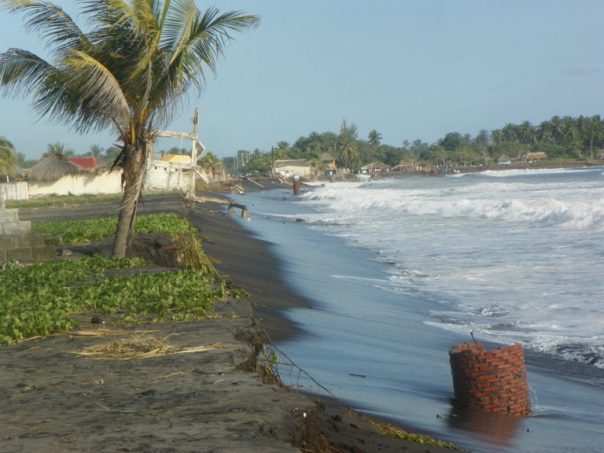
Eroded beach at Puerto Madero
By: Andrés Domínguez
Chiapas would be one of the states most affected due to the increase of the average sea level.
As a consequence, the beaches close to Puerto Madero would disappear due to the increase of the average sea level; additionally, the number and intensity of hurricanes would also increase in that Soconusco area.
San Benito and Villa San José, are beaches located in Puerto Madero, Tapachula, which have lost more than 132.99 hectares of terrain due to erosion and climate change. These are considered one of the first affectations and it’s expected to intensify in the coming years, as Vicente Castro, a researcher at the Natural Resources and Climate Change Unit of the Autonomous University of Chiapas, reported.
The community of Puerto Madero is naturally located in a high risk zone, where the increase in the intensity and number of hurricanes will rise, as well as the increase in the average sea level; these are factors that would considerably increase the danger for the population, the infrastructure, and the productive activities, especially tourism, Castro said.
In his most recent research, Castro estimated a loss in surface terrain of 1 million 329 thousand 918 square meters between the two beaches; therefore, the damage would exceed an economic damage of 500 million pesos, considering the damage to the tourist infrastructure and the work of protection.
In this scenario, the academic mentioned that at the end of the 21st century, the temperature in Mexico will have an increase between 2 and 4 º C, in the particular case of the Soconusco an increase between 2.3 and 2.5 º C towards 2080-2099 is expected, which will bring more severe consequences for the area that may even include the disappearing of population. About this last topic, in 2007 the Inter-governmental Panel on Climate Change (IPCC) elaborated a scenario of an increase of at least one meter in the middle level of the sea in Mexico in which the most affected states would be Campeche, Chiapas, Nayarit, Oaxaca, Quintana Roo, Sinaloa, Tabasco, Tamaulipas, Veracruz and Yucatán.
Given this, the academic warned that the beaches of the western sector of Puerto Madero community are strongly eroded beaches; at the same time, the work of building a “height port” [Puerto Chiapas] contributed to the deterioration of the area. [1]
Climate change in Tapachula is already causing economic losses due to infrastructure damage to the community that surely exceeds 500 million pesos, this without counting the proper value of the beaches, Castro communicated.
[1] Puerto Chiapas is a relatively new commercial port built for cruise ships and tourism at Puerto Madero.
—————————————————-
Originally Published in Spanish by Chiapas Paralelo
February 26, 2019
Re-Published with English interpretation by the Chiapas Support Committee
The National Indigenous Congress: balances and challenges

By: Magdalena Gómez
Last weekend the third assembly of the National Indigenous Congress and the Indigenous Government Council (CNI-CIG) was held in Mexico City with 288 participants, among delegates, councilors and invitees, to carry out an evaluation of the peoples of the CNI faced with the neoliberal capitalist attack and, consequently, to agree on the steps to follow.
The presence of members of diverse peoples from Campeche, Mexico City, Chihuahua, Chiapas, Guerrero, Jalisco, Morelos, Nayarit, Oaxaca, Puebla, Quintana Roo, Sonora, Tabasco and Yucatán was very significant. It permitted them to share a wide panorama of threats to their territories both from organized crime and the behavior of companies with projects sponsored or endorsed by the current government. They will now share, if they decide to, the narration of their work and their agreements. For now, I emphasize some personal appreciations. It was reaffirmed, with numerous evidences, the neoliberal continuity of the period opened with the opening of the land market and the successive mining and energy reforms, which now, before questioning them, constitute the basis for the already-announced megaprojects, in times of the badly-named Fourth Transformation.
They also brought up the political situation and the siege of violence and criminalization that exists in regions characterized by the manipulation of forces, those definitely conservative, who are dressed as Morena, now also beneficiaries of the very broad electoral support achieved by the President of the Republic. At the same time, it was clear that the inequality would not be abated with the welfare-like offer of supports to different sectors and, nevertheless, constitutes a patronage-style link that is operating in the imaginary of its beneficiaries.
It was evident in the assembly that the murder of Samir Flores Soberanes is a parting of waters that already marked the current government, and therefore in Amilcingo, Morelos, as well as in numerous towns that do not participate in the CNI-CIG, the consider it a betrayal of the President of the Republic to make decisions like the so-called citizen consulta (consultation or referendum) on the Huexca thermoelectric plant, in contradiction to his campaign offering that was recorded and has been reproduced in social networks.
In that sense, even the obscure investigation into the murder of Samir, emblematic leader of the opposition to the Plan Integral Morelos (PIM), who was at first defamed and now it is said that the evidence was lost. The immediate social reaction of repudiation of the crime in the Mexico City march expresses that the opposition is no longer just to the PIM, the grievance includes the head of the Executive. And that factor will continue to be present in the opponents to other projects like the Maya Train (Tren Maya) or the Trans-Isthmus Corridor.
That meeting of the CNI-CIG was very important and representative, for defining its horizons of anticapitalist resistance.
For now, one should suggest caution to the opponents of the Los Cardones Mine in Baja California Sur, who have just received the presidential offering that he doesn’t support the project and “it will not be “consulted,” under the argument that it isn’t inherited from the previous government, like the airport or the PIM and it is, therefore, within his ability to reject it.
The serious problem that, in my judgment, indigenous peoples face is the continuous nature of the negation and trampling of their collective rights. That is not the horizon of governmental action. The presidential will, in practice, is the one that determines, and for this purpose it has been coated with a supposed citizen consultation of the popular will to pretend to legitimize previous decisions. It’s not about lead by obeying, as has been said, much less can you compare that principle with the constitutional obligations of a head of State, who would have to obey in the first instance the fulfillment of rights.
One hundred days have been enough to give an account of where the priorities are. Nothing new will bring the peoples the consulta that by constitutional mandate must be held with all the citizens about the National Development Plan 2019-24. In the indigenous case for 10 days, from next March 8 to 18, they will hold 25 forums that the National Institute of Indigenous Peoples (INPI) convokes directed to: “indigenous municipal authorities; community authorities (delegates, agents, commissioners, chiefs of tenure, site authorities, assistantships, among others); traditional indigenous authorities; indigenous agrarian authorities (communal and ejido); indigenous organizations and institutions; civil society organizations and academic institutions specializing in indigenous questions, and those interested in providing recommendations and proposals.”
It’s obvious that forums lasting a few hours are not the mechanism for consulting based on their own forms, as it’s also that their agenda is not agreed upon with the peoples.
———————————————————–
Originally Published in Spanish by La Jornada
Tuesday, March 5, 2019
https://www.jornada.com.mx/2019/03/05/opinion/017a1pol
Re-Published with English interpretation by the Chiapas Support Committee
Chiapas teachers declare they are “in resistance and rebellion”

Thousands of teachers from Local 7 of the National Education Workers Union (SNTE), adhered to the National Coordinator of Education Workers (CNTE), marched yesterday down Central Avenue in Tuxtla Gutiérrez to demand the annulment of the education reform and declared themselves: “in rebellion and disobedience.” Photo: Óscar León
By: Elio Henríquez
San Cristóbal De Las Casas, Chiapas
Teachers from Local 7 of the National Education Workers Union (SNTE), adhered to the National Coordinator of Education Workers (CNTE), in Chiapas, declared themselves: “in rebellion and disobedience” as long as President Andrés Manuel López Obrador will not abrogate the education reform, and go from ‘speeches to deeds.’ Not one step back, no one splits here,” they said.
Thousands of teachers, with the support of teachers’ college students and members of social organizations (some 100,000 according to organizers of the mobilization) marched yesterday from the east side of Tuxtla Gutiérrez, the capital of Chiapas, towards the center of the city, where they held a rally.
There, the leader of Local 7, Pedro Gómez Bahamaca, said that the education reform is still in effect and is being applied against teachers of that local union.
The permanent state assembly of Local 7 ratified “the disavowal of and demand for the resignation of Rosa Aída Domínguez, head of the Education Ministry, and of José Hernández de León, undersecretary of Federal Education.”
“It’s not enough that the president (López Obrador) repeats here and there that the badly named education reform will be cancelled; as long as the Constitution does not reflect the absolute abrogation of the reform and its secondary laws (regulations), this will continue being a mere campaign promise or media speech to disqualify and stigmatize the struggle of the CNTE,” he explained.
Although López Obrador subscribes to an agreement to “cancel” the education reform and send the initiative for reform of Constitutional Articles 3, 31 and 73, and although “every day he states to the media that the Peña reform will be cancelled, while the new law isn’t promulgated, and the Peña reform remains in effect, they can apply it,” he said.
Gómez Bahamaca maintained that the initiative sent to the Congress of the Union by the Federal Executive, which is maintained in at least 15 initiatives of the government, the political parties, businessmen and private parties, “is a simulation, and it’s probable that they won’t take away what’s punitive and the labor defenselessness will remain.”
He said that the intention “is to impose a governmental reform; there is no other explanation, because the analysis indicates that each part of the third constitutional article, especially the 73rd, they didn’t take anything off of it, it remains complete; that’s where the secondary laws come from.”
He pointed out that: “the executing arm” is the Chiapas Ministry of Education because the calls for applicants and job promotions are carried out within the educational reform’s guidelines.
“We ask that they save us from the application of the reform, labor activity is definitely in danger if they apply it to us, without the need of police.”
He added that the government must explain how it will stop the education reform, because it is the current law, there is not a transition or opinion from the Secretary of Education or from the President of the Republic, and how do they guarantee us our rights?
The teachers declared a “maximum alert,” installed themselves in a state assembly and reiterated that they will hold the protest march today. And they warned: “the resistance and disobedience will continue. Not one step back, no one splits here!”
For his part, Governor Rutilio Escandón Cadenas said that: “there is no longer a reason to protest, the badly-named education reform already fell. Now those who may want to protest freely may do so, but they may do so against corruption.”
———————————————————–
Originally Published in Spanish by La Jornada
Saturday, March 2, 2019
https://www.jornada.com.mx/2019/03/02/estados/025n1est
Re-Published with English interpretation by the Chiapas Support Committee
Film successes and contemporaneous Mexican racism

Yalitza Aparicio at the Oscars.
By: Mariana Mora*
The figure of Yalitza Aparicio opened a debate about racism in Mexico, but Yalitza is not the answer to combatting racism in the country.
Although many will say the opposite, Roma does not unmask the underlying racism that supports the privileges of a minority sector of Mexican society, that role fell to the actress that plays a Cleo. The film naturalizes, instead questioning, the role assigned to the domestic employee (maid); although it would seem that the family supports Cleo, she is supported as the domestic employee who dedicates her entire life to taking care of their needs. Cleo never confronts or criticizes her environment; to the contrary, she fulfills her chores in a disciplined way and accepts her way of life. By the same token, the scenes show clearly, not the essence of an indigenous woman, but the good vibes and generosity of the Mexican middle class (“look at how well they treat their employee.”)
Crude racism leaps out when a body is outside of its assigned place (being indigenous in the city is equal to being a domestic employee or its equivalent). The fashion magazine Vogue publishes the actress’s image on its cover. Among the parade of the rich and famous of Hollywood, Yalitza walks on the red carpet at the Oscars accompanied by her mother, a woman who was a domestic employee for an important part of her life and whose principal language is Triqui. She becomes a star instead of the simple background of a telenovela (soap opera). The backlash borders on the violent, in attitudes, comments, yes, even morbid, which operate implicitly or explicitly to remind you of your “real” place.
The magazine Hola also puts her photograph on its cover but it’s a Photoshop version that approximates her complexion and figure to determined parameters of beauty and whiteness (she can only belong that way). At other times the racism is disguised as an infantilizing towards her person. A reporter interviews her during the Oscars using the tone that one usually uses when addressing a child: How does it feel to fulfill the dream that every girl has of being Cinderella? And, how nice that you are accompanied by your “mommy.” Others use jokes that point to the supposed innate ignorance that a woman like her surely has. Jimmy Kimmel asked her: Did you know what Netflix was, although you didn’t know who Cuarón was? And still others, celebrities as well as mere mortals of the social networks, comment with a good dose of amazement that how is it possible that a “pinche india” (fucking Indian) has been nominated as best actress at the Oscars.
Reactions like these have been the source of mass comments, as much in defense of the actress as to continue pushing her towards the place where she “belongs.” But reactions to the figure of Yalitza are also expressed in an opposite sense; they uncover a collective desire and hunger for recognition. A few weeks ago, the Oaxacan collective Lapiztola captured her image in a mural painted in black and white from the scene where she is in bed contemplating Fermín, the character portrayed by the actor Jorge Guerrero. It’s an almost mythical version of Yalitza, it now decorates a building in the Las Peñas district of Iztapalapa, as a reflection of the expectations generated and deposited in her persona.
We cannot understand the phenomenon of Yalitza outside of the historical conditions in which Roma sees the light of day. It’s a context marked by a defensive nationalism versus the xenophobic, racist anti-immigrant wave of the Trump wall and his detention centers. It’s also marked by the so-called Fourth Transformation, which is based on the message that the previously inaccessible –which historically has been prohibited to the type of family to which Yalitza belongs– is now accessible. On December 1, Los Pinos became a popular park for the enjoyment of all Mexican families, the photo (also published in Hola) of the former first lady La Gaviota posing with her daughter at the side of the stairs, replaced by a photo of parents with their children who take a “selfie” in the same place. Call it “miscegenation reloaded” or the return to State multiculturalism, that still needs to be defined, but the Fourth Transformation is fed in part from that genuine desire of millions of people that have been systematically treated with contempt –as if they were ignorant, or children, or too dark to truly be included in la society– that they can be someone. An orphan wish in search of an image to adopt.
That’s the seductive trap of the figure of Yalitza. The ideology of the mestizos as well as the multicultural policies, especially in their neoliberal facets, open the doors of social inclusion promising a promotion in exchange for correct individual decisions (“I marry someone with light skin to improve the race; if I study a lot and achieve entering a good university, I am going to be someone in life.”) They confuse individual success with a change in basic social conditions, which resist being transformed by creating small drops of people that manage to get ahead, “being someone” as if everything depended on a sum of well-executed strategies. By the same token, charging anti-racist responsibility to the figure of Yalitza makes up part of the same machinery of racism that hides its structural gear behind individual successes and attitudes.
Without a doubt you must celebrate Yalitza’s talent and achievements, but she is not a lifesaver. Nor does it fall to her to carry that responsibility on her shoulders. Don’t confuse the celebration of a well- deserved success with the necessity of a profound debate about the racism that sustains the Mexican middle class, a debate that must go beyond the screen (in its double meaning) and the fashion magazines; it must go beyond the after-dinner talks that abounded in these days. If the Mexican middle class does not confront its (historically) racist position, there will be no film or Oscar nomination that saves it.
* Professor and researcher of Ciesas–CDMX (Mexico City)
———————————————————–
Originally Published in Spanish by La Jornada
Thursday, February 28, 2019
https://www.jornada.com.mx/2019/02/28/opinion/015a1pol
Re-Published with English interpretation by the Chiapas Support Committee
Raúl Zibechi: “What the progressive governments have done is deepen capitalism” part 2
Raúl Zibechi
–What does the arrival of López Obrador represent for the American continent?
-I would like to say that it represents something for the region, but I don’t think that it represents anything, because from the point of view of Latin American regional integration, it doesn’t contribute anything, and from the point of view of a turn to the left in the region, it’s no longer possible, and doesn’t contribute anything either, and because the foreign policy, as far as I understand it, is going to be totally aligned with the new NAFTA and with the policies of Donald Trump. Then I don’t expect anything.
If it had been ten or fifteen years ago, something else could be expected in a different climate, but nowadays, when there is a trade war between China and the United States, when there is a crispness in international relations and a very strong intransigence, like a week ago when Trump and Macron fought and there was a very strong mutual withdrawal… because there is no chance for any other policy.
–Let’s talk about the social movements inside the progressive governments.
–The progressive governments have been masters at the art of deactivating social movements and social protest. They have blinded the social bases of their movements with social policies, small cosmetics that enthused many people that had never before received anything. They also coopted the leaders of those movements.
The personal politics of the progressive governments comes from below, the technocratic cadres that are in the front were born in and are familiar with the organizational culture of the social movements; then, when they are above they know very well what keys to touch in order to weaken them, and that is very dangerous.
There are two things that put the social movements in danger. First, the State is clothed with the legitimacy of progressivism, and a State with legitimacy, a strong State, is dangerous. Then, the knowledge of below that has arrived up there above is destined to weaken us. And these two questions can be enormously predatory for the popular movements. An example is Bolivia with Evo Morales and Álvaro García, who disguised themselves by saying that it was the government of the social movements and then made State coups to them.
In Argentina there is the piquetero [1] case. The piquetero movement was completely neutralized, dispersed and destroyed due to the social policies. There is a manual in a book at the Ministry of Social Development, where Nestor Kirchner’s sister was; it says that the Ministry’s ideal official is “that social activist who in the ‘90s opposed and organized people in the social base of territories against the neoliberal model.” They suck political cadres and activists (militantes) and knowledge towards the States and that is a very defining and fundamental element.
The third example can be the Brazil’s compañeros in the Movement of those Without Land and of those Without Homes, very important movements, very good fighters, with an impeccable trajectory, who recognize that Lula and Dilma delivered less land with the agrarian reform than the neoliberal government of Fernando Henrique Cardoso, but even so, they supported them because there was a stream of money destined to education, housing, etcetera. These are potentially revolutionary movements that were completely neutralized.
–And the case of Mexico, a country you have also known very well since a quarter of a century ago.
–In Mexico there are many potent movements. The urban movements have a long trajectory of having been dispersed, above all by the PRD governments, but the indigenous movements worry me a lot; they are a minority of the population, but very important, and what worries me is the isolation and the possibility of blows or surgical repression. I worry a lot that in the next six years there will be a process of weakening of Zapatismo and of the CNI, and of other indigenous and popular movements, the ones that have been opposed to the large projects.
There is a high quality operation. The consultations (consultas) that have been held and those that are going to take place are mechanisms of disarticulation of protest. Tomorrow you can say that you are against the Maya Train (Tren Maya) for this or that reason, and they will tell you to go and vote. In the consultation (or vote) about the airport, there were a million votes, but I believe that in the coming consultations more people can vote, and if more people vote the greater the legitimacy of the consultation will be, even though it may be illegal, without legal support and without any kind of sustenance.
Let’s suppose that they respect the consultation. The message that the progressives and López Obrador are sending is that conflict isn’t worthwhile because it’s risky, and that voting or supporting the Government is going to solve the problems. The consultation’s mechanism seeks to encasillar and drive protest into the terrain of the ballot box. Why am I going to oppose the highway if I am against it and I am able to vote? And if I lose, at least I was able to opine in a democratic exercise in which I didn’t have to put my body [on the line] and the police didn’t hit me. What’s done is to delegitimize conflict and delegitimize protest, and that goes hand in hand with isolating those who protest. Those who protest in isolation quickly become victims of state repression. That is the risk that I see there.
I hope that the consultation does not have the final word. With the consultation, the peoples have two options: either to play along with the consultation, which I don’t believe they are so capable of, or to say that they can make all the consultations they want, but they don’t want the train to pass through there, which is what other peoples in Latin America have done.
Fortunately, in some cases like the Zapatista communities or Cherán, there is strength. The same thing is can go very badly, I believe and I hope that I’m wrong, but it’s not the same to go badly when you are trembling as when you are well and firm in your bases, like the Zapatistas.
On the other hand, I am sure that López Obrador will retire. I don’t think that he can be re-elected, although I imagine that he is already thinking of being re-elected. Six years will pass, Morena will go away or not, but Zapatismo is going to continue standing, and that is important because the struggles are five centuries old and they are not going to disappear because there is a government that smiles or has good manners.
–And the resistance?
–There will be resistance. What the progressive governments have done is deepen capitalism, brought more capitalism, more transnationals and more monopolies. Making megaprojects in the south is for coopting the rest of Mexico, because it has been the most rebellious zone and we all know that. The peoples are going to resist. There are a lot of people who, as we say in Uruguay, “don’t swallow the pill,” they are not deceived. The people are alert, and besides, they already have 15 years of our experience and know what happened in the south. One would have to be a little more optimistic.
–What role do Donald Trump and the United States play?
–Trump is more than Trump. It’s the greatest intransigence of the dominant classes, of the rich, and the greatest intransigence of the Pentagon, which has as much weight as the dominant classes. These people are inclined to war, to militarizing the global scenario. The trade war against China is a war and, for now commercial. The war is going to escalate and it’s probable that we will arrive at wars between nations with nuclear weapons, that which the Zapatistas call the collapse.
The Trump regime has aspects of the collapse; it is a manifestation of the crisis of the system, of Yankee imperialism, but it is also a manifestation of the fact that they can gamble on the collapse before jumping from the frying pan that they created or fearing that it is running away from them. A horrible scenario! Whoever comes after Trump, although it may be a Democrat, is going to follow in many of Trump’s footsteps. The government of Trump is not a parenthesis, but rather a shift in the strategies of the dominant classes.
The United States gambles more and more on the absolute subordination of Mexico. It is a backyard of which they are not going to loosen their claws and, therefore, in that project of having a subordinate Mexico, the López Obrador government can even come out very well, because of bringing the megaprojects to the south, of facilitating the flow of merchandise, commodities, minerals, timber, everything there is to take out, the monopolies view him very well, and even more if he manages to appease a part of the citizenry.
What this government or any government is not going to achieve, for now, is lowering the levels of violence, femicides and drug trafficking activity, of illegality. That is something important to the United States, because ever since the war on drugs it gambles on violence, on the Plan Merida [the Merida Initiative], on the decomposition of the social fabric. All are plans of the empire that López Obrador is now going to execute. With this gentleman they are also going to complete the plans that deepen capitalism, monopoly, and what the Zapatista compas have called the Fourth World War, the dispossession of the peoples. That’s what is the order of the day.
–Finally, what is your reading of the migratory phenomenon that we are experiencing these days from Central America towards the north?
–I want to believe that a movement is being born with this massive march of migrants, because before migration was individual, of families, drop by drop, but now it is massive and organized. In order to mobilize seven thousand people all together one must be organized. Competent that it is the first of many marches and if so it’s good, because solitary migration is easily repressed, vulnerable, but with this people have probably come to the conclusion that it’s better to migrate in mass in order to be more protected. I am not clear that Trump will be able to impede the passage of migrants through the border, despite all the gargling he does. It’s a very high political cost. The good news is that something new is being born from below.
[1] The Piquetero Movement – A movement of unemployed workers that united to secure a sustainable life in Argentine. Piquetero means picketer.
—————————————————
Originally Published in Spanish by El Ciudadano
Friday, January 18, 2019
Re-Published with English interpretation by the Chiapas Support Committee
Raúl Zibechi: “What the progressive governments have done is deepen capitalism”

Raúl Zibechi
[Part 1 of a two-part interview]
By: Gloria Muñoz Ramírez
“The result of the progressive governments in Latin America is negative,” Zibechi concludes in an interview with Desinformémonos, after participating in a series of meetings with social and indigenous movements of Chiapas and Oaxaca, during a brief tour through Mexico in which he presented his most recent book: Los desbordes desde abajo [The overflows from below]. Raúl Zibechi is a Uruguayan journalist, writer and an accompanier of different social movements on the continent for more than 30 years.
Regarding the arrival of Andrés Manuel López Obrador to the presidency of Mexico, Zibechi points out that he doesn’t represent any change for the region. And his consultations (votes), he opines, “are mechanisms of disarticulation of protest.” There will be resistance, he says: “because the struggles are not going to disappear just because there’s a government that smiles.”
The disarticulation of social movements, the inclusion of cadre from below in the new government, the imposition of extractive projects, the isolation of critics, the polarization of the press, the role of the United States, among others, are the themes of this interview.
–What is the balance of the progressive governments in Latin America?
–The result of the progressive governments in Latin America is negative. The result is Bolsonaro, the result is Macri, is a Venezuela destroyed. The result is Daniel Ortega, genocidal and a rapist. As Chico de Oliveira said in Brazil, the founder of the Workers Party, “Lulism was a political regression.”
And when we say that we’re not talking about those millions that were lifted out of poverty but have now returned to it, we’re not talking about some interesting questions that were asked, like the quotas for black people in Brazilian universities. What we’re talking about is that they destroyed the emancipatory power of the peoples because they dispersed the social movements, put the leaders in [government] ministries and thus corrupted them.
There is no country with a progressive government in which there has not been cases of corruption. The man who was vice president of my country, Uruguay, who has a noble surname, Raúl Sendic, had to resign the vice presidency due to a case of corruption. In Argentina they threw bags full of money inside a convent to escape the undue appropriation matter that existed.
The balance is negative, but that doesn’t mean that the people don’t understand that they voted for them, that they supported them and that they continue supporting them, because the alternative to that is a frightening right. But in a balance of accounts the results are negative.
–Concretely, what are the results in the economic ambit?
–In the economic ambit there was no agrarian reform, but there was not a reform of the tax system. There were structural reforms. There was higher income for the popular sectors, but that income was banked, financed, and then they attained through the social policies that people had a little more money, but they also have a card like a credit or debit card, which they need to be able to draw money out of the social policies from the bank and with that go to the malls or shopping centers to buy plasma televisions, motorcycles and cars. It’s integration through consumption.
During the time of Lula in Brazil, the sector that profited most and that had the greatest gains in their history was banking. So, it was integration of the popular sectors, but through consumption, and that de-politicizes and also enriches banking as an intermediary.
–And the megaprojects in indigenous territories?
–Extractivism, soybeans, the expansion of agribusiness and mining generated displacement or corralling of indigenous peoples. There is a case in Brazil that is insane and it’s called Belo Monte, which is the dam, the third largest in the world, which diverts 100 kilometers from the Xingú River, and in that basin that is emptied fishermen are going to die of hunger or they will have to emigrate. The inhabitants of the riverbanks, all the people that live from the river are original peoples. The boundaries of indigenous lands are also not respected.
On the other hand we have the paradigmatic example that is Bolivia. In Bolivia the popular movement had five organizations that made the unity pact, and after the march in defense of the Territorio Indígena y Parque Nacional Isiboro-Sécure (Tipnis) in 2011, the government began to divide the organizations.
There are two organizations, and outside of Bolivia this is little known: the Consejo Nacional de Ayllus y Markas del Qullasuyu (Conamaq) and the Confederación de Pueblos Indígenas de Bolivia (Cidob), two historic organizations of indigenous peoples, to which Evo Morales and Álvaro García gave a State coup. They sent the police, threw out the legitimate leaders and afterwards leaders related to the government, the State, arrived protected by the police. That is an authentic State coup and it happened in Bolivia.
When we say that progressivism has resulted in a regression, for the indigenous peoples it has meant a double or triple regression, because it has “folklorized” them. Now there are men in sombreros and women in traditional skirts in Parliament, but folklorized, not politically representing their peoples. It is a policy of dispossession that forces them to displace. And in that, there is not any difference between the progressive governments and the conservative governments of the right, like the ones in Peru or Colombia. The anti-indigenous attitude is a constant in both cases.
– We’re entering the terrain of freedoms. What happened in these [progressive] governments to freedom of speech and the freedom to demonstrate? Did they carry out [extrajudicial] “executions” of those on the left who opposed them or questioned what they were doing?
–During the first years there was an expansion of freedoms, to demonstrate, criticize, but beginning with the 2008 crisis there was a withdrawal of these governments. Once again Brazil is a paradigmatic case because in June 2013, 20 million young people went into the streets in 353 cities for one month, initially against the increased cost of transportation, which is very expensive in Brazil (each bus or metro ride costs between 20 and 25 Mexican pesos), but ended up being a revolt against inequality.
São Paulo is the city that has the most heliports and helicopters in the world because the bourgeoisie doesn’t deign to drive a car over the surface.
That revolt against inequality touched the limits of progressivism, which was limited to distributing salary income a little better, but not the total profit, and it didn’t touch the inequalities. When that movement emerged there was a withdrawal of the Dilma Rousseff government, of the PT and the left as a whole, and they sent the police. Of course, what a leftist government should have done was to take the side of the people, but by sending the police they generated a political vacuum and demoralization so strong that the right came to take advantage of that until this very day. 2013 was a parting of waters in Brazil and throughout the region. The movements are the irruption of people tired of being teased, of being mocked, one of the two or three main causes of the crisis of the progressivisms in Latin America.
–And the communications media? What role did they play and do they play?
–There are various dynamics about the communications media. There are countries where the States have been advancing about the media, like Venezuela, closing them, domesticating them or buying them. The bulk of the Venezuela media are state or pro-state. The other extreme could be Argentina, where there are around 200 cultural media, self-managed digital and paper media, like Desinformémonos in Mexico. Those 200 media have between five and seven million monthly readers, in a country of 40 million inhabitants. These are minority media, but they are no longer marginal. Moreover, when there is a conflict, like when a Monsanto factory was going to be installed in the Argentine Malvinas, and from Uruguay, if you wanted to know what was happening, you entered the rightwing press, La Nación, Clarín, and nothing appeared. If you entered the left-wing press, like Página 12, and nothing would appear either. You had to get informed in these community or alternative media.
These media are no longer a marginalized minority, but rather have a critical mass, and fulfill the role of informing our people of what others don’t report.
–We have seen that there has been a polarization of the media during these years. Those that are with the government, in this case progressive, and those that the extreme right has…
-Yes, for sure! In Brazil, something incredible is happening. Bolsonaro campaigns against Red Globo, which is hegemonic, and against Folha de São Paulo, which is the newspaper of the elites, and is supported in social networks and the evangelical communications media, which are both extreme right. There is a very interesting reconfiguration of the media, which one must follow, because Bolsonaro even threatened to close Folha de São Paulo, which is a scandal; it’s like closing a rightwing daily newspaper in Mexico. It’s the same attitude that Donald Trump has towards the media. But other media are emerging, as is the case of the evangelical media. They are a political and social force that deserves to be studied in depth, and are already competing with Red Globo in Brazil. On the other hand, in the majority of countries there are media like ours, alternative, but not all of them are strong.
– There are other media that are not alternative or marginal, but large left media, or critical of power, and well placed in their countries, such as Brecha in Uruguay, or Página 12 in Argentina. What role do they play with the progressive governments?
–I should say that Brecha was criticized before the arrival of those governments and during the progressive governments. We have always been a critical newspaper. Página 12, on the other hand, became like Kirchner and depended until today on resources from the State. Everything bad has a good part, and here in Mexico they are going to exist. The bad part is that the progressives destroy us or create lots of problems for us. The good part is that the scenario is clarified, there are no longer places for the middle-of-the-road media: you are with the State or not. When you are with the State the excuse is that now the left governs, but you are with the State, that is the main thing. And those who are maintained in their work of autonomy work outside the institutions.
Página 12 gave up; in the ‘90s it was a very important newspaper, not only in Argentina. It had a particular aesthetic and an impact with very powerful page covers. On the other hand, there are other media that have remained loyal to their trajectory. I don’t want to exaggerate, but I would say that Brecha, in South America, is one of the few that have crossed through progressivism with many economic difficulties. We do not live from Brecha, we are bad economically, but we maintained our dignity and an independent position, although there are nuances. There are some journalists inside closer to the government, but always critical.
– And what are the costs of being critical of the progressive governments from the left?
–The costs of maintaining a critical posture are isolation, they don’t call you to take interviews and/or they ignore you. There is personal economic deterioration, we have to look for little jobs to survive, and that is an important cost, but we must pay close attention, there is a trap of progressivism that we have managed to overcome, because just like the journalism profession, in the case of Brecha, it now has a very low salary, but has had a generational and gender renewal. And now most staff members are young people and women. Those who want to earn more have gone with the government or create newspapers akin to progressivism, and those who remain with us, well, we earn little, but we are there.
– Is what you’re telling us that it’s going to go very badly for us if we maintain a critical posture, in Mexico, towards Andrés Manuel López Obrador?
– I would not say: “go very badly.” The isolation is hard, but you become stronger. And we also don’t aspire to get rich. For example in Brecha, with 35 workers, there will be five or six with a car, the rest of us take public transportation, and that seems very important to me because it marks something that at this moment is a planting; it is not seen, but the seeds are there and at some point they will bloom.
But one must read what’s happening in Mexico another way for two reasons. The progressive cycle in Latin America began in 2000 and ended in 2014, and is a cycle that was possible thanks to the high prices of commodities, oil, soy and iron ore, because it didn’t matter much to the bourgeoisies in that epoch of economic boom that they raised taxes a little, and because the popular sectors were calm. But nowadays we experience the 2018 post-crisis. The world’s dominant classes have become more bestial, more brutal. The one percent has a wealth it never dreamed of having in history and they have become much more intransigent, more extreme, and they are against the peoples.
The López Obrador government comes at a time in which the dominant classes are not willing to cede anything. There is a situation what will very quickly lead the government to align with business interests. These few days that I have been in Mexico, I have seen something surprising. I turn on the television and in the parliament some PAN deputies put up a banner that says: “#NoALaDictaduraObradorista” (#NoToTheObradorDictatorship). They are terrible, but from the first day they are already opposing, they don’t give him any chance. It seems that that is going to designate: You yield completely or you are going to have an implacable opposition like Dilma had in her last years in Brazil.
(To be continued)
Statement of the CNI-CIG-EZLN on the murder of compañero Samir Flores Soberanes

To the people of Mexico and the people of the world
To the networks in support of the CIG
To the networks of resistance and rebellion
To the National and International Sixth
To the communications media
We denounce with pain and rage the cowardly assassination of our compañero Samir Flores Soberanes, a community leader in Amilcingo, Morelos; one of the principal opponents to the Morelos Integral Project and a delegate of the National Indigenous Congress for many years.
At approximately 5:40 am on February 20, armed people arrived aboard two vehicles and knocked on door and when Samir came out, they shot him four times, two bullets to the head that a few minutes later took away his life.
Yesterday, Samir explained the reasons that the peoples of Morelos have for opposing the Morelos Integral Plan, at an event organized by the bad federal government delegate Hugo Erick Flores, who was present in the municipality of Jonacatepec to organize the forum related to the alleged “consulta” (referendum or vote) with which they seek to impose the thermoelectric plant in Huexca, Morelos and the complementary projects that dispossess territory and threaten the life of the entire region.
We place responsibility for this crime on the bad government and its bosses, which are the companies and their legal and illegal armed groups that seek to rob us, bring us death and turn off the lights that give us hope, like compañero Samir.
Sincerely,
February 2019
For the Integral Reconstitution of Our Peoples
Never More a Mexico Without Us
Nacional Indigenous Congress
Indigenous Government Council
Zapatista National Liberation Army
Below is the initial report of the murder in La Jornada (photo added)
They murder an opponent of the gas pipeline and thermoelectric plant in Morelos
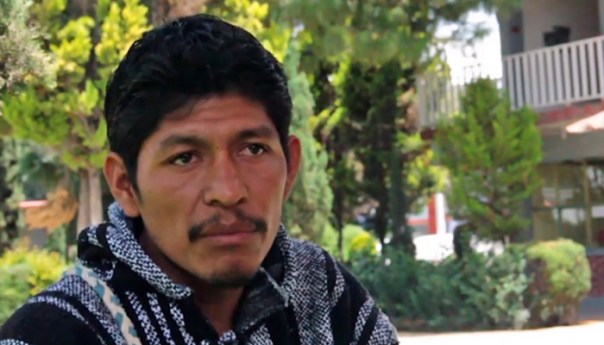
Samir Flores Soberanes
By: Rubicela Morelos Cruz, correspondent | Wednesday, February 20, 2019
Cuernavaca, Morelos
Samir Flores Soberanes, one of the opponents of the Morelos Integral Project (Proyecto Integral Morelos, PIM), was murdered this morning outside his house, located in the town of Amilcingo, municipality of Temoac. According to his family members and compañeros in struggle, around 6 o’clock in the morning two cars arrived at his home; the occupants called to him, he came out and they shot him with four bullets. His family and neighbors took him to the hospital in Jonacatepec, but he died on the way.
According to Jaime Domínguez, of the Peoples’ Front in Defense of Land, Water and Air of Morelos, Puebla and Tlaxcala, Samir was prepared to go to conduct an Amilcingo community radio program, a means by which residents of that town resist the extending of the pipeline that passes through their lands, which they consider an official imposition, as well as the two thermoelectric plants in Huexca, and the aqueduct that they say will leave the campesinos of Ayala without water.
Domínguez, a compañero of Flores Soberanes, demanded that president Andrés Manuel López Obrador and Governor Cuauhtémoc Blanco Bravo “clarify our compañero’s murder, because in our country things go unpunished; we demand that se dé the whereabouts of the material killers be given, as well as those of the intellectual authors of this cowardly murder and that justice be done.”
Samir had already been physically attacked and beaten by a shock group that was created in that town in 2014. On that occasion he, together with other neighbors, tried to stop the work on the gas pipeline in their community. He also suffered various violent evictions and blows in mobilizations from members of the Mando Único (Single Command) of former governor Graco Ramírez’ administration, in Amilcingo as well as in Huexca.
Samir Flores Soberanes suffered direct attacks on the part of the leader of the Central Campesina Cardenista, Humberto Zamora and his people, the same ones that acted as a shock group against local opponents of the PIM.
Yesterday, Samir Flores Soberanes questioned the federal delegate in Morelos, Hugo Eric Flores, at a forum held that the state government held in the municipality of Jonacatepec. According to Jaime Domínguez, he told the federal official that they are opposed to the thermoelectric plant in Huexca because it would finish off the water because of the pollution that it would bring to the whole state. He asked the federal delegate not to lie to the population with respect to the water scarcity the hydroelectric project will cause, and to admit that there will be pollution of the environment.
Flores Soberanes had stayed with other compañeros of the Peoples Front in Defense of Land, Water and Air of Morelos to go to rebuke Hugo Erick in Hueyapan, where the state government has scheduled another forum on the matter. Members of that social group placed responsibility on the Federal Electricity Commission and both current and former state governments: “for the dirty politics they have done in the affected towns, confronting them and even creating shock groups to attack opponents of the PIM.”
“A few days ago we sent an open letter to the country’s president, in which we asked Obrador whom to blame if the attacks against our compañeros continued to escalate, since in Amilcingo, in Huexca, and in other communities they constantly attack them both verbally and physically, and there were even death threats.”
———————————————————–
Originally Published in Spanish by La Jornada
Wednesday, February 20, 2019
Re-Published with English interpretation by the Chiapas Support Committee
National Indigenous Congress: this government deepens neoliberal policies
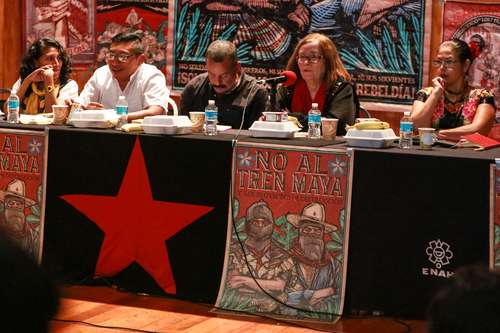
▲ Yamili Chan Dzul y José Koyoc, concejales de la Asamblea Regional de la Península de Yucatán; Carlos González, abogado del CNI; Magdalena Gómez, académica de la UPN y articulista de La Jornada, y Bettina Cruz, concejal de los pueblos del Istmo, durante el foro realizado en la ENAH.
By: Carolina Gómez Mena
“What we are seeing with this new government is the continuation of neoliberal policies,” but it’s also the “deepening,” [of those projects] based “on the support, on the consensus that the president (Andrés Manuel López Obrador) has from a good part of the population,” and this is added to “occurrences,” participants maintained in the forum 23 years after the San Andrés Accords, in defense of Mother Earth, No to the Maya Train and the Trans-Isthmus Corridor, and No to the National Guard.
In the National School of Anthropology and History (ENAH, its initials in Spanish), representatives of original peoples from regions “affected” by megaprojects and academics who are members of the Network of Networks of Zapatista Support for the Zapatista National Liberation Army (EZLN) considered that: “the project of the badly named Fourth Transformation seeks to individualize members of the indigenous peoples,” through welfare policies, instead of respecting the rights of the communities as a whole.
Carlos González García, a lawyer of the Congreso Nacional Indígena–Concejo Indígena de Gobierno (CNI-CIG) criticized the consultas (consultations or referendums) that the federal government has carried out, and the one that it seeks to carry out around different megaprojects, like the Maya Train and now the thermoelectric plant located in Huexca, in the municipio of Yecapixtla, Morelos.
He classified these consultas as “occurrences.” “A popular consulta can only be carried out by the Congress of the Union” and he said that with said thermoelectric plant it seeks to generate “an industrial belt” in the territorial strip that goes from Morelos to Puebla.
About the Trans-Isthmus project, he said that it is: “something long longed for by the United States.” And on the theme of the National Guard he maintained that: “the Army has always been on the side of the most nefarious interests,” therefore it should not intervene in “questions of public security.”
Magdalena Gómez Rivera, an academic at the National Pedagogic University (Universidad Pedagógica Nacional, UPN) and a La Jornada opinion writer, lamented the attitude of the president with those who disagree with his points of view.
“We live in a climate of absolute disqualification,” because “he has the power to disavow all of us who dare to point out that this is not the path, that the country’s problems will not be resolved with old “indigenist” policies and welfare programs.”
She considered that López Obrador’s project in general “seeks to contain and disarticulate social protest” and assured that “a political schizophrenia” is experienced because, she said, “one thing is the discourse from the power” and another is what it does. She pointed out that: “many believe in the badly named Fourth Transformation,” which is cemented “on promised supports,” which “will not abate the social inequality,” although they can serve so that some families can survive.
Bettina Cruz Velázquez, councilor for the indigenous peoples of the Isthmus ante el CNI, criticized the wind farms and mining projects carried out in the zone, as well as the Trans-Isthmus project that is foreseen. “We don’t see how the indigenous peoples are incorporated into these projects.” She added that historically these plans “bring us prejudice, we must defend our territories.”
———————————————-
Originally Published in Spanish by La Jornada
Sunday, February 17, 2019
https://www.jornada.com.mx/2019/02/17/politica/006n1pol
Re-Published with English interpretation by the Chiapas Support Committee
Constructing the Maya Train “is going to be a disaster,” Francisco Toledo warns
The painter asks the President “to assert the right that the region’s indigenous communities have to grant or refuse their consent” to that infrastructure project
 Photo by Jorge A. Pérez Alfonso: Francisco Toledo, who participated in inauguration day of the Gathering in defense of territory, the commons and the rights of the peoples, in Santa María Atzompa, Oaxaca, explained to La Jornada that before executing a megaproject “a serious consultation” is needed.
By: Jorge A. Pérez Alfonso and Mónica Mateos-Vega
Santa María Atzompa, Oaxaca, Mexico
The Maya Train project “if going to be an ecological disaster,” said the artist Francisco Toledo in an interview with La Jornada after participating in the inaugural session of the Gathering in defense of territory, the commons and the rights of the peoples, which was held yesterday in Santa María Atzompa, Oaxaca, which members of cultural and environmental organizations attended, as well as representatives of campesino and indigenous communities of this state and the country.
The painter considered that before executing that megaproject, “a serious consultation” should be made, mainly with the original peoples of the areas that will be affected, “and not like those things that they did (the questioned citizen consultation last December). Technicians must give their opinion, as well as biologists and other specialists, to know everything that’s necessary to do before touching the region,” pointed out the founder of the Pro Defense and Conservation Board for the Cultural and Natural Patrimony of the state of Oaxaca (Pro-Oax).
More information is needed
Toledo, who in Oaxaca has headed a series of struggles in defense of land and territory, insisted that: “indubitably (the Maya Train) is going to be an ecological disaster, that’s for sure,” because, he reiterated, it will affect the biosphere, mainly in Yucatán.
With respect to the Isthmus of Tehuantepec, through which the train would travel, he considered that it could damage the area of the Chimalapas, which borders on Chiapas.
Another one of the problems with the Maya Train (Tren Maya) that the artist observes is that: “it has not really been announced what exactly the project consists of; not much is known, just that the President talked about two or three tracks, but nothing concrete. We’ll have to ask for more information.”
He said that there must be an authentic dialogue in which the project is presented in detail, in such a way that you do not get the idea that it’s about an imposition for the benefit of big businessmen and with the people being affected.
He shares a letter that he sent to AMLO with La Jornada
Toledo shared with this newspaper the letter that he sent to President Andrés Manuel López Obrador on December 1, 2018, in which he asks him: “to assert the right that the indigenous communities of the Maya region have to grant or deny their prior, free and informed consent with respect to an infrastructure project that will affect their lives, beliefs, institutions and spiritual wellbeing, like it will also affect the lands that they inhabit.”
Toledo sent that letter to the President one week after he (the president) criticized a public display in the media, headed by the artist, in which dozens of academics, scientists and intellectuals explained their reasons for opposing the construction of the Maya Train. At that time, López Obrador told them then that “the undersigned” needed “more contact with the people.”
In that letter the painter reiterated to the Executive his opposition to the construction of the Maya Train, “without taking the opinion of the indigenous communities historically settled on the lands that the tracks will cross.”

C
He said that in July 1990 the Congress of the Union approved Convention 169, which is “a binding instrument and a legal reference point for creating legislation that asserts the indigenous rights of our country, because Article 7 of said convention establishes: ‘the interested peoples should have the right to decide their own priorities in relation to the development process, to the extent that this will affect their lives, beliefs, institutions and spiritual wellbeing and the lands that they occupy or utilize in any way, and to control, to the extent possible, their own economic, social and cultural development.’”
The anthropologist Salomón Nahmad participated in the Gathering in defense of territory, the commons and the rights of the peoples. He is a recipient of the National Prize for Arts and Literature, and he criticized the fact that the megaprojects that have been announced, principally the Maya Train, are advancing without having the necessary studies to know if the benefits really outweigh the damages.
“There is always an impact, regardless of the size of the project,” the anthropologist pointed out. He also considers urgent: “an in-depth social investigation so that the communities that will be affected really know what could occur in their localities, since in the end they will be the ones that suffer in the first instance the impacts of this work, but also that they should be the only ones consulted, because the project will not affect those who live in the north of the country.”
In the meeting, the participating social organizations offered proposals for an action plan for the coming weeks against the ‘‘megaprojects” and in favor of the rights of the original nations and peoples.
———————————————————–
Originally Published in Spanish by La Jornada
Wednesday, February 6, 2019
https://www.jornada.com.mx/2019/02/06/cultura/a03n1cul
Re-Published with English interpretation by the Chiapas Support Committee
 Chiapas Support Committee