Chiapas Support Committee
Home of the Compañero Manuel blog on zapatistas & mexico
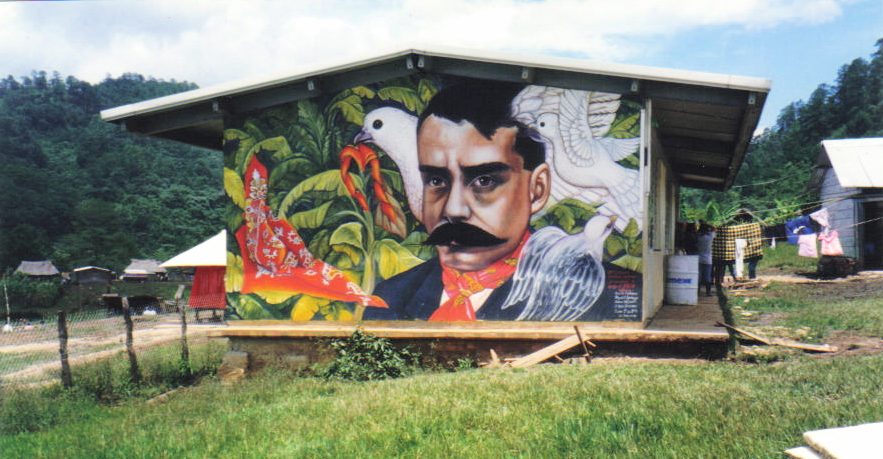
Burial without a corpse
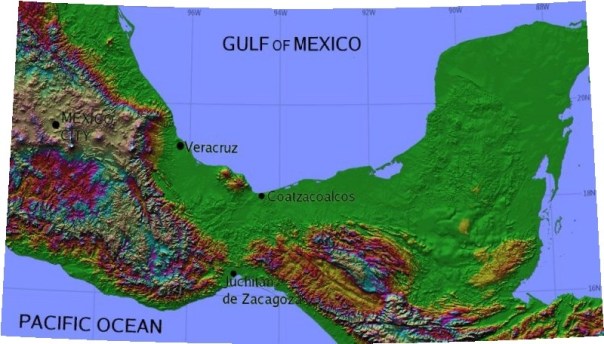
The Isthmus of Tehuantepec
By: Gustavo Esteva
The funeral of neoliberalism was decreed, but we do not know which corpse they will bury.
President López Obrador once again showed his desire to liquidate the neoliberal era, to which he rightly attributes a large amount of the troubles that overwhelm the country. His conviction is clear. But his personal definition of the enemy jeopardizes his intentions.
López Obrador seems sure that exiting the neoliberal world will be enough to retake the State leadership. It is true that renouncing the basic State functions to give them away to private corporations, in a way as corrupt as incompetent, is one of the worst mistakes of the Mexican governments since 1982. But before celebrating the recovery we need to know the meaning. It seems that everything changes… for nothing to change. This State leadership is used to giving away public programs to corporations and adopting the path that they are indicating.
One of the clearest examples is the Isthmus of Tehuantepec. It is said loud and clear that the new plan satisfies the national interest and generates wellbeing for the people of the region. Nevertheless, even the most superficial analysis of the plan´s contents, shows that it is a dispositive that inserts the country more deeply in not it´s own logic, but into the one of private interest. It constitutes a very real threat to people in the region, because it endangers their ways of life, their traditions and their hopes.
When Porfirio Díaz created the idea for the first time, it seemed viable that Mexico to strategically use the project, which awoke huge interest among the Americans. At some moment of tension with the United States, Díaz Ordaz discovered that large portions of the Isthmus were in foreign hands, so he organized a massive distribution of ejido and communal lands as a pretext for expropriation. It was too dangerous for Mexico that these lands were not our own.
When López Portillo thought that it was his turn to administer abundance, he ordered the preparation of the project in order to invest petroleum profits in it. The project was very advanced when they discovered that they had run out of money and the risks were too high. Today, under entirely different conditions, they seek to reorder activities on the Isthmus in order to connect it to an operation that only big corporations could assume and in order to cancel an autonomous path.
The protocol of the process of the free, previous and informed consultation for the peoples and indigenous communities of the Tehuantepec Isthmus in Oaxaca and Veracruz, regarding the Development Program for the Isthmus of Tehuantepec [1] is a document that deserves a careful consideration. It is an exemplary case of the forms of the state of siege (State of emergency), when the law is used to violate itself, to twist itself. It describes the pertinent legal dispositions for the case and finds solace in the legal value of good faith, to right afterwards describe the way in which people will be betrayed in spirit and in word.
The consultation that was made in a hurry and will end on March 31 is not even “previous”. The government has already made the decision to do the program. Their actions haven´t even reached the communities involved, but decisions have been made that will affect them. Every day contracts and commitments are announced. It’s urgent for the government to process the 5 billion dollars that were promised to Trump for the area.
It won´t be a “free” consultation either. It is made according to the time and conditions defined by the federal authorities, not for the peoples, which “customs and habits” are being quickly adjusted to the demands of the process. It won´t be an “informed” exercise. The presentation has a clear bureaucratic mark, with incomprehensible terms for ordinary people and formats typical of a promotional flyer. During the meetings, the expositions are accompanied with clientele suggestions, in order to incorporate some of the projects that the communities had demanded a long time ago, therefore facilitating a positive answer. [2]
The most awful thing about this consultation is that it only “informs” about the government’s program so that the people take it or leave it without presenting options. The only way of make this consultation valid is allowing the people to choose what they really want.
The operators of the mechanism of civic participation will give good news to the president by the end of the month. He would “win” another one. They will affirm with all cynicism and ignorance, that the program it is made with civic participation and in accordance with the principle of “mandar obedeciendo” [3] (to govern obeying). The result will be used as “proof” that the peoples just want to access the forms of capitalism that prevail in the north, leaving behind their “underdevelopment”, as some of the organic intellectuals of the new government affirm.
Now comes the answer of the peoples. It has already been announced in Guelatao, when the people AMLO drove-in (acarreados) surpassed the locals to honor Benito Juárez. He will not wait.
NOTES:
[1] According to reports in the press, the Development Program for the Isthmus of Tehuantepec, aka the Trans-Isthmus Corridor, is a project to revitalize the existing single-track railroad between the port of Coatzacoalcos (Veracruz) and the port of Salina Cruz (Oaxaca). The existing railroad would be upgraded to a high-speed railroad with two tracks that would carry freight between the Gulf of Mexico and the Pacific Ocean, thus providing a Panama Canal-lite and facilitating trade with China. Both ports are designated Special Economic Zones, tax-free zones for trans-oceanic commerce. The Mexican government believes that this mega-project would promote “development” in the region and provide jobs, not only for the local population, but also for migrants from Central America.
[2] See the CNI-CIG and the EZLN’s communiqué about the referendum here.
[3] Mandar obedeciendo is a set of principles for governing and leadership that are practiced by the CNI-CIG and the EZLN.
———————————————————–
Originally Published in Spanish by La Jornada
Monday, March 25, 2019
https://www.jornada.com.mx/2019/03/25/opinion/015a2pol
Re-Published with English interpretation by the Chiapas Support Committee
EZLN and CNI-CIG on the Isthmus of Tehuantepec referendum
COMMUNIQUE FROM THE CNI-CIG AND THE EZLN: Another Simulated Referendum to Justify Megaproject Development on the Isthmus of Tehuantepec

To the people of Mexico:
To the people of the world:
To the CIG Support Networks:
To the Networks of Resistance and Rebellion:
To the National and International Sixth:
To the media:
The plans for dispossession and destruction that the bad governments call the “Isthmus of Tehuantepec Development Program,” are for us as original peoples an announcement of the tragedy they now intend to extend through the territories of all of the Isthmus peoples.
As the CNI-CIG, we reject and condemn the bad governments’ so-called referendum, to be carried out throughout the Isthmus communities March 30 and 31, which simulates consultation of our peoples in order to impose these megaprojects of death.
We denounce the corrupt practices with which the bad governments, through their National Institute for Indigenous Peoples, have sought to divide, deceive, and intimidate our communities, offering programs and projects in exchange for yes votes in their so-called referendums, as if it were not precisely our territories and natural resources which are at stake.
The Binizzá, Ikoot, Chontal, Zoque, Nahua and Popoluca original peoples who inhabit the Isthmus of Tehuantepec in the states of Oaxaca and Veracruz have already made clear our “NO” to these megaprojects of death, which will lead to the destruction of our territories and the death of our mother earth.
We reject the invasion of our territories by mining companies that will destroy the mountains, springs, rivers, and air, as well as by the wind power companies that use the wind as a tool of negotiation to displace us from our lands. We do not want their trains, which only transport death, nor their repressive military or paramilitary violence, which devastate our territories.
We state once again that we will not cease in our struggle to protect mother earth and our indigenous communities and territories no matter how many simulated referendums the bad neoliberal capitalist government carries out in order to impose—via war—projects that prioritize money over the life of the original peoples and of nature. On the contrary, we will continue to organize ourselves in resistance and rebellion with all those below.
We call upon all honest organizations and collectives, on the CIG support networks and on the national and international Sixth to be alert and ready to respond in solidarity to this new attempt to impose projects of dispossession.
Attentively,
March 2019
For the Full Reconstitution of Our Peoples!
Never Again a Mexico Without Us!
National Indigenous Congress
Indigenous Governing Council
Zapatista National Liberation Army
Provocations, infamy, apologies
[Admin: The EZLN and the CNI-CIG are focusing their joint resistances on the Morelos Integral Project (PIM). This article begins to explain why: Resistances to the PIM could be repeated with the Maya Train, the Tehuantepec dry canal (aka Trans-Isthmus Corridor) and other pending megaprojects impacting indigenous peoples throughout Mexico.]

CUERNAVACA MORELOS, FEBRUARY 8, THE PERMANENT ASSEMBLY OF PEOPLES -PHOTO: TONY RIVERA
Gilberto López y Rivas
Upon completing the first 100 days of the new government, it’s concerning that its ex oficio lawyers make targeted statements about those indigenous peoples, who from their knowledge and anti-capitalism, denounce and resist the renewed development, neo-indigenist and militarization policies of the Fourth Transformation.
The EZLN and the National Indigenous Congress-Indigenous Government Council were not responsible nor were the “isolated voices” of the “Zapatista environment” for the fact that President Andrés Manuel López Obrador would ratify the PIM (Proyecto Integral Morelos, Morelos Integral Project) in his speech in Cuautla on February 10, in which he reversed his public commitments in 2014 and 2018, and in which he stigmatized “leftist radicals,” and classified them as “conservatives,” without distinguishing that, in reality, they were members of peoples and communities that for years have been waging an unequal battle against the PIM, and, now, paradoxically against the new government, that defends and represents said project.
The murder of Samir Flores Soberanes, the very incarnation of that struggle, took place ten days after the presidential harangue. Pointing out, as does Armando Bartra, that it seeks to make political use of this death to “feed blood to a cause that doesn’t need it” is trivializing that murder and an unsustainable political infamy. Samir is a symbol of the struggle of the peoples that remember with admiration and respect their teachings. Amilcingo, his birthplace, becomes the epicenter of mobilizations like the Emerging National Assembly versus State Violence and Self-determination of the Peoples, held on March 9, in which the current government was characterized, in fact, as a continuity of neoliberalism, calling for a national and international mobilization next April 10 in Chinameca, and declaring AMLO a “persona non grata” in Morelos: “We will not permit –participants in this assembly assert– that the death of our caudillo of the south is insulted with the presence of one who seeks to impel death projects on Zapatista land.” The resistances to the PIM could be repeated with the Maya Train, the Tehuantepec dry canal and other megaprojects at the doorstep.
The apologists of AMLO’s achievements in his first 100 days seem to not take into account the unavoidable reality of the profound gap between the original peoples and a government that already decreed the end of neoliberalism, in the “100 days that moved Mexico” (sic). Of course, as indigenous peoples organized in defense of their territories and their autonomic processes, it’s not a priority on the governmental agenda, except when it refers to the National Institute of Indigenous Peoples (INPI), which as of today has not made one single statement about the Morelos Integral Project and the continuity of the violence against those who struggle in defense of Mother Earth, like Samir.
The INPI is carrying out consultations in communities formally comply with Convention 169 of the ILO, although Victoria Tauili-Corpuz, the UN’s special relator on the Rights of Indigenous Peoples, already firmly expressed her concerns to the current government about the obligations contracted in this regard by the Mexican State, in accordance with the constitutional context and the international treaties in effect.
Also, from the ambits authorized, difficult of being accused of “conservative” and “ultra-leftist,” emerge critical observations that coincide with those sustained by community resistances. Greenpeace lamented the little attention of the current government, “beyond the discourse,” to the theme of the environment, and evaluated that in just 100 days of government President Andrés Manuel López Obrador’s policies –on environmental and energy matters– profile Mexico in the direction of a climate disaster. Among the five points on which such affirmation is sustained, specifically, the reactivation of the thermoelectric plants, like the one in Huexca.
Within this context of authoritarianisms from the power: To what hypothetical dialogue does Bartra refer and who is hindering it when consultations are imposed from the federal Executive that have been considered illegal, illegitimate, in violation of the collective rights of the original peoples? Is it dialogue with the delegate of the Presidency of the Republic in Morelos, Hugo Éric Flores, a systematically questioned operator that harassed the dignified people of Huexca with his presence on the night of last March 5, without being invited by a community assembly, accompanied with public force, and offering patronizing and corporative aid that seeks to buy consciences and, that yes, fraction and divide communities? Is it dialogue with the prosecutor that “investigates” Samir’s murder, insulting his memory and the ethical integrity of the atmospheres of family and struggle? Is it dialogue with one who only listens to the echo of his word made law?
———————————————–
Originally Published in Spanish by La Jornada
Friday, March 22, 2019
https://www.jornada.com.mx/2019/03/22/opinion/016a2pol
Re-Published with English interpretation by the Chiapas Support Committee
The Maya Train would threaten Palenque because of tourist overpopulation
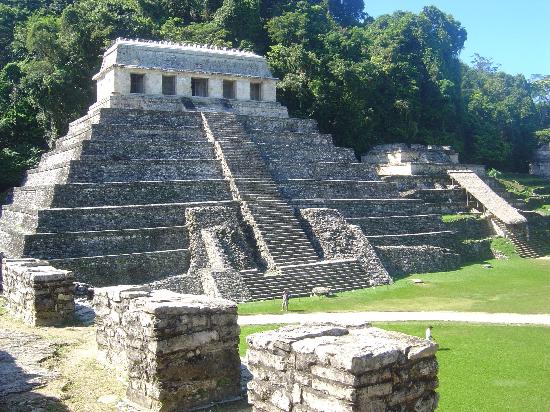
Temple of the Inscriptions, Palenque, Chiapas, Mexico.
By: Andrés Domínguez
“The maximum capacity is 700,000 visitors, but we will adhere to our management program, which has already happened in other areas where the buffer capacity is exceeded and that has put the area at risk” Julio César Romaní Cortés said, National Director in charge of Palenque for the National Commission for Natural Protected Areas (CONANP, its acronym in Spanish), regarding the 8 million tourists estimated to visit Palenque annually thanks to the Maya Train project.
Romani Cortés, also the director of the Agua Azul Cascades flora y fauna protection area, indicated that a management program already exists, in which are defined what extractive and non extractive activities can be carried out, besides the support capacity that the area to not be affected could have.
Also, the director indicated that as of now they don’t know much about the Maya Train, to the extent that they have not even approached them or delivered studies about the impact that the influx of tourists in the natural protected areas of Palenque and the Agua Azul Cascades could have.
Therefore, he stated that inside the public use areas of Palenque 450,000 people are received annually, with support of up to 700,000. Given that, the Maya Train project, which according to estimates from the National Tourism Fund (Fonatur, its Spanish acronym) would bring more than 8 million visitors, “beyond what can be done,” he added.
The director of one of the zones of the most national and international tourist attraction in the country, he communicated that there have already been cases of overpopulation of tourists in a natural protected area, which have put the areas at risk, closing them and therefore the authorities seek more controls for regulation.
With respect to the projection that the State Secretary of Tourism, Katyna de la Vega, will make about the creation of 9 eco-tourist centers close to the Maya Train, he said: “I have no qualms about whether they create one or ten, you just have to consider the sites to visit, since they all have a limit of acceptable exchange, because upon it being exceeded the place and its environment could be at risk.”
Romani Cortés, insisted on saying that the capacity that the Palenque area can support is 700,000 people and that: “those will be the ones they allow to pass.” However, he did not rule out the opening of new spaces that would undoubtedly benefit the local and national economy, through the new attractive places, which diversifies the offer.
However, he urged respect for the normative system that already exists, like the management system, which will be the one they will follow and apply for the purpose of not affecting the biodiversity present inside of a protected area.
“If there is a path that accepts the visitation of 200 people per day, but then they ask us to let 1,000 enter, the contamination and support would reach its limit. Therefore, we have to talk to the population, since that would harm a place, under a strict norm and geographic, faunal, spatial y floristic analysis” he said.
——————————————————————–
Originally Published in Spanish by Chiapas Paralelo
Thursday, March 21, 2019
Re-Published with English interpretation by the Chiapas Support Committee
Evangelical power against feminism
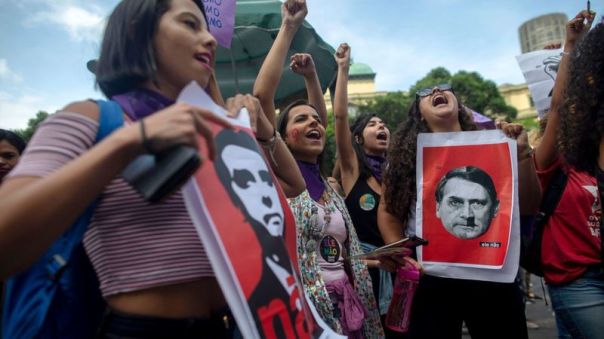
Brazilian women take to the streets to protest the election of Jair Bolsonaro.
By: Raúl Zibechi
At some point in the next few years, the evangelical wave will reach all the Latin American countries because it’s growing exponentially and it’s becoming a social and political tsunami capable of modifying the scenarios to which we are accustomed. So we should learn something about what is happening where that wave has been imposed.
Brazil is the most symptomatic case of Evangelical and Pentecostal growth. The studies that are appearing show that the victory of Jair Bolsonaro was possible thanks to the Evangelical electorate. (goo.gl/YbPEoW). Among the Catholic population there was a tie between Bolsonaro and the PT’s candidate, Fernando Haddad. Among other religions, as well as among atheists and those who don’t profess any religion, there was a slight majority in favor of the candidate of the left.
But the difference was overwhelming among the Evangelical population, among which it got more than double the votes and obtained a difference of 11 million votes, which marked his triumph. Other analyses estimate that he obtained the greatest difference among poor and Evangelical women, where the difference in favor of the extreme right would be even greater.
The change in religious tendencies is very important in Brazil, although other countries in the region seem to be producing a similar although more attenuated process. In 1950, Catholics represented 93.5 percent of the population and Evangelicals 3.4 percent. In 2010 the Catholic population had fallen to 64 percent and the Evangelical climbed to 22 percent.
In 2017, an investigation carried out by a foundation linked to the PT, showed that among residents of the urban peripheries of large cities individualist values were advancing that favored conservative behaviors (goo.gl/3LtZJT).
One of the most interesting works, because of its qualitative character, was carried out in Morro da Cruz, the largest poor periphery of Porto Alegre, which had stood out since 1990 because of its increasing politicization through the participatory budget that the PT implemented in that city. The neighborhood voted massively for Lula, but in 2018 it turned over massively for Bolsonaro.
The first conclusion of the anthropologist Rosana Pinheiro, one of the study’s organizers, says that: “it’s impossible to separate Bolsonaroism from anti-feminism” (goo.gl/HHVNuF). Observing the changes in the same population over a decade, allowed them to understand with greater detail the deep motivations of those who turned to the extreme right. Their conclusions are tremendous, although they contradict other studies.
Since 2014, the economic crisis, has dramatically affected the peripheries that felt the political system abandoned them. In parallel, since the June 2013 protests a new popular mobilization of women, blacks and LGBT was born. “For teenagers from the periphery, Bolsonaroism was a reaction to the new generation of feminist girls, which was unprecedented in Brazil,” the investigator concludes.
Many husbands supported Bolsonaro “as a way of attacking women, who are now more empowered,” she adds. Among other reasons, it’s because it’s impossible to separate the “macho crisis” from the economic crisis, since both feed each other.
The struggle for the recognition of black minorities, LGBT and women was deployed in Brazil just in the last five years. According to Pinheiro, a large part of the population experiences tension and insecurity with their identity, “divided between the role of the oppressed and the desire to be on the side of the oppressor.” She concludes: “As a consequence of colonization, there is also a constant struggle to be/ to seem part of the elite. That explains why so many poor people, blacks, women and LGBT supported Bolsonaro.”
I believe that these analyses illuminate some problems that we have in the antisystemic movements to confront the new right.
The first problem is that there is no other path than territorial work with the popular sectors, direct, without shortcuts, institutions or social policies. Only a militant presence in the territory can allow us to reverse this situation. We cannot attribute our failures to either the social networks or to the media (which do their part), but rather to our abandonment of the popular territories.
The second is that it’s urgent to address the place of men, in general, and that of poor young men, in particular. In a broader work, Pinheiro and her colleague Lucia Mury Scalco, maintain that one of the decisive factors in the formation of “Bolsonaro youth” was “the loss of social leadership and the sensation of the destabilization of hegemonic masculinity” (goo.gl/ZkGhYH).
We have become badly accustomed to the fact that macro policies, inspired in the World Bank, can solve political problems. The social technologies of above cannot substitute for organization and militancy that, like popular education, are the only ones capable of modifying the realities of below.
———————————————————–
Originally Published in Spanish by La Jornada
Friday, March 15, 2019
https://www.jornada.com.mx/2019/03/15/opinion/016a1pol
Re-Published with English interpretation by the Chiapas Support Committee
98 dams threaten water and life in Chiapas
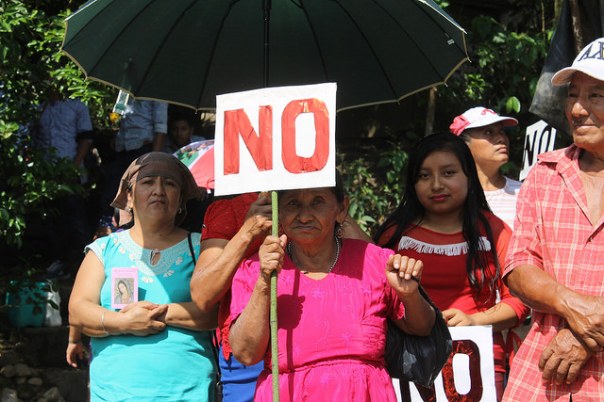
Zoque peoples declare their territory a safeguard zone
Dams in Chiapas would fundamentally be to provide water and electricity to mining and oil extraction projects that exist in the state. There is resistance because of human rights violations.
Some 79 dam projects are planned in the state, proposed by the Federal Electricity Commission, plus the state government’s 19 mini-hydroelectric dams, projects that in sum threaten the life and territory of nearby communities, according to organizations and academics, because of their relationship to the operation of mining and oil projects that already violate rights to water and life.
Antonino García, a research professor at the Autonomous University of Chapingo with offices in San Cristóbal de las Casas, indicated that operation of the 98 hydroelectric projects would not benefit the communities at all; to the contrary, their ecological consequences would be fatal.
Within the framework of the Day of Global Action against Dams and in Defense of Rivers, organizations spoke out against the realization of such projects and, therefore, demanded a new alternative energy and water management model from the Mexican State.
The researcher said that the most advanced project is the one for 4 hydroelectric dams on the Usumacinta River, which the then Water Resources Ministry, now known as the National Water Commission (Conagua), first proposed decades ago; however, a lack of planning and the corruption caused the projects to break down and not advance.
García mentioned that the 4 hydroelectric plants that currently operate in a 100,000-hectare area don’t bring any benefit to Chiapanecos, since the electricity was sent to the north and center of the country.
Additionally, García pointed out that the implementation of activities for a dam in Chiapas would serve to accompany mining activities, since dams provide the water and electricity for mining. He added: “for example, if the 142 mining projects that exist in the state and that encompass 1,121,000 hectares were put into operation, the amount of water and electricity needed would be unimaginable because the dams would serve the mining operations.”
The consequences of the implementation of those projects on the environment would be to leave the hills without biodiversity, perforated wells and also wells fractured because of fracking, the rivers dammed and the water contaminated by mining. He added: “the construction of a mining company cannot happen without the construction of a dam.”
“If the welfare period, which dates from 1950 to 1982, didn’t bring any benefit, the construction of the 4 big hydroelectric dams in Chiapas won’t bring it now. The government of Andrés Manuel López Obrador is between a rock and a hard place because there are many international interests involved, with multimillionaire oil, mining and construction entrepreneurs,” he said.
Finally, the teacher said that the resistance of the Movement in Defense of Life and Territory (Modevite), is the strongest example of opposition to the dams, since their human rights have been threatened by the implementation of oil extraction projects, plus a geothermic plant in the Chichonal Volcano, therefore the construction of a dam, would be used to feed those projects, which would increase the damage.
For its part, the Otros Mundos A.C organization and the Movement of those Affected by Dams in Latin America (MAR) expressed that it is regrettable that as of today the large, medium and mini companies for the production of energy and the dams for the supply of water continue being part of the water and energy management model in Chiapas, without taking into account the complaints about damages.
In addition, they demanded an alternative energy and water management model because as long as plans and development of projects for large companies to generate electricity and offer water for the mining companies, they will continue being [projects] “of death” and they would violate the human right to water and life.
Therefore, they asked the three levels of government for training, analysis and discussion of the current energy model, since an improvement is needed in the strategies for the defense of rivers and territory.
—————————————————————
Originally Published in Spanish by La Jornada
Friday, March 15, 2019
Re-Published with English interpretation by the Chiapas Support Committee
CNI-CIG-EZLN: A Call to Days of Struggle

CONVOCATION
OF THE DAYS OF STRUGGLE
“ZAPATA LIVES, SAMIR LIVES, THE STRUGGLE CONTINUES”
100 YEARS AFTER THE ASSASSINATION OF GENERAL EMILIANO ZAPATA SALAZAR
Considering that the neoliberal regime killed our brother Samir Flores Soberanes; we don’t know if it was the government, the entrepreneurs, their criminal cartels or, the three together;
Observing that the self-named “Fourth Transformation” started with Miguel de la Madrid Hurtado, was deepened with Carlos Salinas de Gortari, continued its war of conquest with Ernesto Zedillo Ponce de León, Vicente Fox Quezada, Felipe Calderón Hinojosa and Enrique Peña Nieto; and it now continues with the cross-term project of Andrés Manuel López Obrador and the Partido Movimiento de Regeneración Nacional (National Regeneration Movement Party). For the original peoples the only “real change” is the increase of lies, deceits, persecutions, threats, incarcerations, dispossession, murders, trickery and contempt, human exploitation and the destruction of nature; in sum: the annihilation of the collective life that we are;
Assuming that the neoliberal government that Andrés Manuel López Obrador heads has its sight set on our peoples and territories, where, with the National Institute of Indigenous Peoples, it extends a network of cooptation and disorganization, which opens the way to a war that has an industrial name, made of projects and violence, which, supported in the military corporations and in the coming National Guard, expands a dark web of death and destruction into the country’s original peoples;
Reiterating our firm opposition to the neoliberal policies of the old and new governments, our opposition to the consultations, whatever they’re called, which have no other purpose than the dispossession of our territories; our opposition to mining, to the damming of our rivers, to the construction of superhighways, to the accelerated real estate speculation of our lands, to the neoliberal death megaprojects like the Morelos Integral Project, the Trans-Isthmus Corridor or the Maya Train;
Remembering that the struggle headed by General EMILIANO ZAPATA SALAZAR and the Liberation Army of the South and Center represented and continue representing the interests and aspirations of our peoples and of millions of exploited in Mexico and in the world; and that this coming April 10 completes 100 YEARS OF THE COWARDLY ASSASSINATION OF GENERAL EMILIANO ZAPATA SALAZAR on the part of the political regime that, despite its “transformations,” continues governing us to this day:
WE CONVOKE
THE NATIONAL ASSEMBLY BETWEEN THE INDIGENOUS PEOPLES OF THE NATIONAL INDIGENOUS CONGRESS/INDIGENOUS GOVERNMENT COUNCIL AND ADHERENTS TO THE SIXTH, THE NETWORKS OF SUPPORT FOR THE INDIGENOUS GOVERNMENT COUNCIL AND COLLECTIVES AND ORGANIZATIONS THAT STRUGGLE AND ORGANIZE AGAINST CAPITALISM
To be held on April 09 of this year in the indigenous community of Amilcingo, municipality of Temoac, Morelos, from 10:00 in the morning to 6:00 pm.
As well as the:
NATIONAL AND INTERNATIONAL MOBILIZATION 100 YEARS AFTER THE ASSASSINATION OF GENERAL EMILIANO ZAPATA SALAZAR, WHOSE EPICENTER WILL BE IN CHINAMECA, MORELOS, ON APRIL 10, 2019, STARTING AT 9 O’CLOCK IN THE MORNING.
The program of activities will be published soon.
ATTENTIVELY
March 2019
For the Integral Reconstitution of Our Peoples
Never More A Mexico Without Us
RESISTANCE ASSEMBLY OF AMILCINGO
PEOPLES FRONT IN DEFENSE OF LAND AND WATER MORELOS-PUEBLA-TLAXCALA
NATIONAL INDIGENOUS CONGRESS/INDIGENOUS GOVERNMENT COUNCIL
ZAPATISTA NATIONAL LIBERATION ARMY
By agreement of the Emerging National Assembly in the face of State Violence and the Self-Determination of the Peoples, held in the community of Amilcingo, Morelos, on March 9 of this year, this call is being promoted together with the following organizations:
Huexca en Resistencia, Asamblea Permanente de los Pueblos de Morelos, Red de apoyo al CIG-Morelos, Organización Popular Francisco Villa de Izquierda Independiente, Trabajadores de Morelos, UPCI, Cholultecas Unidos en Resistencia-CHUR, Nodorolidente, MOPIM-CNPA-MN, Instituto Cultural Autónomo Rubén Jaramillo, UPVA 28 de octubre, Red contra la Represión, Red Coyoacan, Praxis en América Latina, CNI Tepoztlan, CNI Puebla, Colectivo Resistrenzas, Red de Resistencia y Rebeldía Cineteca, Red de Rebeldías y Resistencias, UPCD, EPM, Colectivo Obrero, JEN, Comunidad de Huazulco, Zapatistas del sur de Morelos, UCIZONI, MAIZ, Integrantes UAM-Azcapozalco, Solidaka, Unión por la Soberanía Popular, Escuela Normal Rural Popular Mactumactzá, Ejido Tenextepango, Ruacig, Rebelión, Hecho en Tlalpan, Colectivo El Zurdo, Mov. por la libertad de los defensores del agua Tlanixco Edo. Mex., San Miguel Cajono Oaxaca, Universidad de Chapingo, Libertad bajo Palabra, Flor de la Palabra, Organización Nacional del Poder Popular.
The peoples will continue in struggle against the Morelos Integral Project
[This struggle in the Mexican state of Morelos has become the CNI’s (National Indigenous Congress’) focal point for resistance to the government’s megaprojects.]
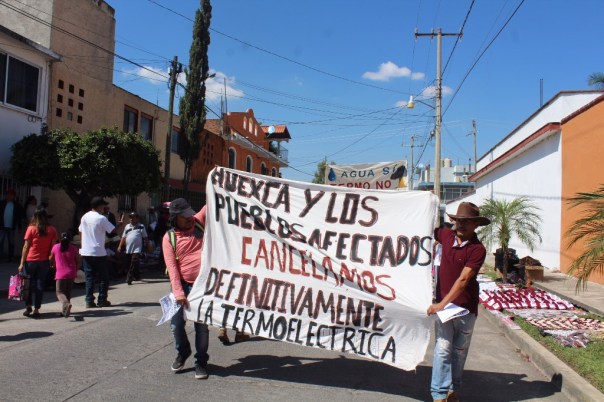
Protest against the Huexca thermoelectric plants.
By: Gilberto Lopez y Rivas
Manipulated consultations, marked by a political crime, like the one that took place on February 23 and 24 [1] in some arbitrary chosen or vetoed places in Morelos, Puebla and Tlaxcala, are not enough to bend the people’s will to stand against the death projects, like the one that it intends to impose in these three states with a thermoelectric plant, gas pipeline and aqueduct, whose fundamental purpose is to benefit the existing industrial enclaves and those to be built.
In the following days, representative organizations of the struggle against the PIM (Proyecto Integral Morelos, Morelos Integral Project) made public their decision to continue their resistance by legal, political and peaceful ways, as they have been doing over seven years, suffering the state’s institutional and clandestine violence, at the service of capitalist corporations, whose last victim was Samir Flores Soberanes, outstanding communicator and indigenous leader, murdered February 20, a day after he questioned the federal delegate, Eric Flores, at an event in support of the PIM. February 19, people and citizens representatives of the three states. asked the CNDH (Comisión Nacional de Derechos Humanos, National Human Rights Commission) for precautionary measures for the PIM opponents, in ratification of a complaint regarding the fundamental human rights and collective indigenous rights that the PIM violates. Nothing stopped the henchmen.
The state attorney general, Uriel Carmona Gándara, a few hours after the attack, re-victimized Samir and his family, by declaring that it was an execution related to organized crime and to venture an unusual line of investigation that directs responsibility for this death to his movement´s compañeros!
On February 28, the Asamblea Permanente de los Pueblos de Morelos (Permanent Assembly of Morelos Peoples) disclosed their word and their decision to struggle, talking to the almost 20,000 people of that state that voted NO to the Huexca thermoelectric plant, facing the disinformation and manipulation of a consultation that violates the constitution and international jurisprudence regarding indigenous rights, in which the government was both judge and jury, and without an independent body that monitored the “democratic” exercise, in which not more than one percent of the electorate participated.
Even in these conditions, the Assembly highlights: “The results of the simulated, illegal and illegitimate poll are clear, the municipalities near the thermoelectric plant: Yecapixtla, Ocuituco, Tetela del Volcán, Hueyapán, Xacualpan, Temoac, Jantetelco, Ayala and Cuatla, aware that what´s at stake is the future of the territory and life itself, said a resounding NO: 11,409 to the thermoelectric and only 4,975 said yes. The dignified and rebellious town of Tepoztlán was forceful with it’s NO vote. The indigenous communities of Huexca and Hueyapan municipality with widespread community assemblies have joined the NO vote, as is it the way that the indigenous peoples and communities have to decide the path we want, which is recognized in the ILO-Convention 169, that the government disowns.”
Therefore, the Permanent Assembly of the Peoples of Morelos (Asamblea Permanente de los Pueblos de Morelos) addresses president Andrés Manuel Lópex Obrador to communicate that he disclaim the “supposed democratic exercise”; it also points out that he not trust his delegate in Morelos “because of his right-wing background and defense of murderers in Chiapas and the person towards whom they point lines of investigation for the murder of our brother Samir Flores Soberanes.” They also demand that the federal prosecutor´s office accept the case and remove the state attorney general. Based on the polling results from the affected municipalities, they demand the definitive cancellation of the Huexca thermoelectric plant and an end to the criminalization of social struggle.
Juan Carlos Flores Solis, a lawyer from the Peoples Front in Defense of Land and Water of Morelos, Puebla and Tlaxcala, jailed for ten months due to his activism against the PIM, made known the protections filed by the communities of Huexca and Anenecuilco and others ejidos of this region in order to make the Federal Electricity Commission abstain from disposing of contaminated waters into the Cuatla River and to stop using the water for their crops. Also, they made known the protections won in Puebla State against the gas pipeline and the interposition of new protections against the February consultation. The indigenous people know very well the limits of the judicial realm if it’s not accompanied by political mobilizations.
Tomorrow, March 9, Amalcingo will welcome delegates from all over the country, to agree on a plan of struggle against the megaprojects of the capitalist fourth transformation, and on April 10 there will be political acts all over the country in defense of life, autonomy, territories and against the official manipulation of Emiliano Zapata.
Zapata and Samir are alive, the struggle continues!
Note:
[1] The results of the consultation on the PIM and the Huexca thermoelectric plant were that 55,715 citizens participated; 59.5% voted Yes, 40.1% voted No and 0.1 votes were void. As López y Rivas points out, the communities close to the project voted overwhelmingly NO, while towns and communities farther away from the project voted Yes.
———————————————————–
Originally Published in Spanish by La Jornada
Friday, March 8, 2019
https://www.jornada.com.mx/2019/03/08/opinion/016a1pol
Re-Published with English interpretation by the Chiapas Support Committee
The 4T: politics for life or death?
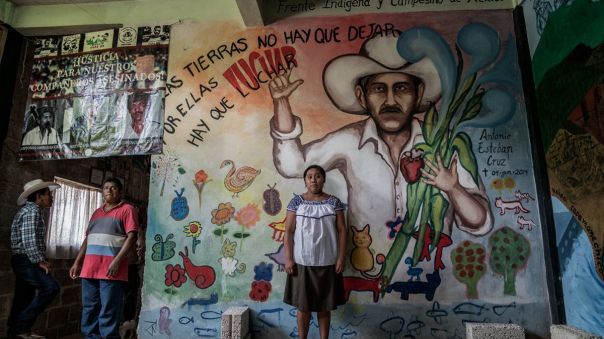
The mural portrays Antonio Esteban, an environmentalist in Puebla, murdered in 2014.
By: Víctor M. Toledo
The classic distinction in conventional politics between “lefts” and “rights” is being undrawn to give way to a new dilemma. Now it’s increasingly necessary and adequate to speak of “politics for life” and “politics for death.” As we saw in a previous installment, the devastating attack of a transnational oligarchy that barely reaches one percent of the human population extends and intensifies throughout the planet, destroying nature and humans alike. The ecological depredation and exploitation of human labor continues as corporate capital bends governments of all kinds to put them at their service, giving rise to what we have named “black holes of modernity.” This displacement of the old political geometry by a challenge of greater transcendence results from globalization and from the impact that industrial societies have on the balance of the planetary ecosystem. The conjunct of these politics for death leads to a collapse of civilization, as is analyzed and discussed with more intensity and frequency in innumerable circles (think tanks) of the world.
As has been confirmed by comparison to the Latin American “progressive governments” or [governments] of the left, this dilemma between eco-politics (or bio-politics) and necro-politics, upon being ignored, became a time bomb that ended up exploiting them, united in various cases into the corruption of leaders and parties. What are in dispute are the territories and their rich visible and hidden resources. In the Mexico of today, the sparks that generate the fires are precisely the conflicts that emerge from the clash (of civilizations?) between the projects of death of the private and state corporations, and the projects of life woven and long-held by the human communities, their natures and their regions. We’re talking about 560 socio-environmental conflicts, according to our sources, which have already left a trail of violence and death: 503 cases of community defenders attacked between 1995 and 2015 (threats, illegal detentions, physical attacks, criminalization), according to the thesis of the UNAM researcher Lucía Velázquez Hernández, and that reaches 125 activists murdered (data from Global Witness and the Mexican Environmental Law Center: https://www.mexico.com/nuestras-causas/mexico-el-cuarto-lugar-donde-asesinan-a-mas-ambientalistas/.

Estelina López Gómez
The murder of Samir Flores (2/20/19), an indigenous Nahua and one of the principal leaders of the opposition to the Morelos Integral Project (gas pipeline and two thermoelectric plants), is only one of the four environmental defenders murdered since the change of government. Those murdered before Samir Flores were: Estelina López Gómez (01/23/19) from the la Santo Tomás community of Amatenango del Valle [Chiapas]; Rafael Murúa Manríquez (01/20/19), director of the Radiokashana community radio, and Manuel Martínez Bautista (12/24/18), from Yahualica, Hidalgo.
As we pointed out in a previous text (“Will the new government conquer neoliberal fantasies?” https://bit.ly/2Tf0sy5), the new government is obliged to confront and take a diaphanous position on these territorial battles. Each concession (tactic?) that the Fourth Transformation (4T) makes to the “industrial ogre’s” projects of death in both its corporate and state versions, reveals a lack of long-term visualization, because we are already facing a challenge on a civilizational scale in which not only are the destinies of a social system being played out social, but a “way of conceiving the world” and of the human species itself. Therefore, the traditional communities cannot be sacrificed, once again for the sake of “progress” and “development” of the nation (which is the litany of neoliberals), and much less in the name of a consultation imposed and oriented beforehand by the state power.
Why does the new government start to repeat the errors of the progressive regimes in Latin America? Behold, here the question leads to a greater imbroglio, to a supreme lack: no theoretical clarity exists and, therefore, tactics and strategy in the 4T, because this nation, as an electoral slogan, from the visionary head, brilliant and pragmatic, but also solitary and limited as a leader, and not from collective discussion that is from a political program. There are thus only immediate reactions to each problem, whose repetition will be irremediably marking a vague, confusing, contradictory and, therefore, erratic policy. Until a political program that gives corpus to the 4T is collectively analyzed and clarified, the current government will go on inexorably diluted until, once again, the right reaches us.
———————————————————–
Originally Published in Spanish by La Jornada
Tuesday, February 26, 2018
https://www.jornada.com.mx/2019/02/26/opinion/016a2pol
Re-Published with English interpretation by the Chiapas Support Committee
I prefer life
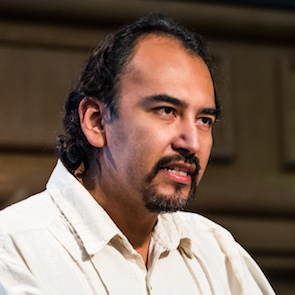
Juan Carlos Solís
By: Juan Carlos Flores Solís *
After nine years of the peoples of the Popocatépetl Volcano saying no to the Morelos Integral Project (Proyecto Integral Morelos, PIM), of experiencing incarcerations, judicial persecutions, torture, defamation, militarization, community radio closings, division of communities, purchase of consciences, deception, the formation of shock groups, the population’s confrontations with the police, CNDH recommendations and protective orders won, now they tell us that they are going to consult us about whether the PIM is carried out, that the people will be taken into account to decide. But, what people; the people affected or the people in general? The consultation about the PIM is the first official consulta (consultation or referendum) that the new government promotes and the third citizen consulta after those on the NAICM and the Maya Train, where the opinion of AMLO about the project coincided with the results of the consulta.
Violation of the right to information
Now the President says “yes to the PIM, but I’m going to submit it to a consulta,” and “but it won’t affect the environment and it’s only lacking 100 meters to be connected,” as well as an infinity of arguments that are refutable by the peoples affected and specialists knowledgeable about the PIM. But, our voice doesn’t have the same echo that AMLO’s has, the peoples that have reasons for legitimately opposing don’t have 40 minutes at a press conference where they can expose why the PIM does affect the communities. That’s why the citizen consulta is inequitable, because the population doesn’t have the same means that the authority has for spreading la information and there is no serious and public debate between the disagreeing parties. The express period of 13 days to apply the consulta violates the principle of the right to information, because it’s not enough time for the peoples, organizations, environmentalists, human rights defenders and scientists that have compiled hundreds of documents about the PIM to synthesize and report to all the populations. Thirteen days is not enough for the people to know about the project and resolve their questions. Nine years seeking justice and 13 days to report to millions of people in the three states, with the opinion of the president loading the dice for the consulta.
This consulta is unconventional because it violates the right of self-determination of the indigenous subject that inhabits the territory through which the project crosses, because the decision of the people affected is replaced by a regional poll of outside people that don’t live in the indigenous territory affected. Regarding the PIM, the theme must not be reduced to a question of a public poll, but rather be the beginning of the recognition of the rights of the indigenous peoples affected by a megaproject, because justice must prevail over any economic interest. A consulta about the PIM must be indigenous, community by community, each one with its times and rhythms, a binding consulta, where if a community says no to the gas pipeline, it must change it’s course on that stretch and withdraw its tubes from that community, because that is recognizing indigenous peoples’ right to self-determination in their territory. A poll cannot supplant the substantive right of the indigenous peoples to be consulted about the projects that affect their territory and traditional way of life, because it would violate Articles 6, 7, 13, 14 and 15 of Convention 169 of the ILO and the rights expressed in Constitutional Article 2 and the United Nations Declaration of the Rights of the Indigenous Peoples.
What can be consulted about and what cannot? Can one consult about living without adequate civil protection measures? Living in a polluted environment so that money isn’t thrown away? Permitting conditions that prejudice public health due to the emission of nitrogen oxides? The evacuation routes from the Popocatépetl Volcano were not consulted about whether they were made, they were made because it’s necessary to protect the populations. Before taking the PIM to a consulta, it must be determined whether or not the project places the communities that inhabit the zone of the dangerous volcano at greater risk, the main risk of the megaproject, which the Morelos federal super-delegate omitted completely in the presentation of the project’s impact.
Saying yes to the PIM, is deciding that the communities close to the volcano will live at greater risk; saying yes to the PIM is impelling change in the use of the soil and water from agricultural to industrial; it’s saying yes to environmental and health impacts so that corporations don’t lose their investment. That’s why: “I prefer life: water for life, land to work and the security to live without fear.” The time bomb is installed, the thing is to light it; it’s the real problem inherited from the previous two six-year presidential terms.
* Juan Carlos Flores Solís is a lawyer and ex political prisoner because of the Morelos Integral Project. https://www.frontlinedefenders.org/en/profile/juan-carlos-flores-solis
———————————————————–
Originally Published in Spanish by La Jornada
Tuesday, February 12, 2019
https://www.jornada.com.mx/2019/02/12/opinion/018a1pol
Re-Published with English interpretation by the Chiapas Support Committee
 Chiapas Support Committee