Chiapas Support Committee
Home of the Compañero Manuel blog on zapatistas & mexico
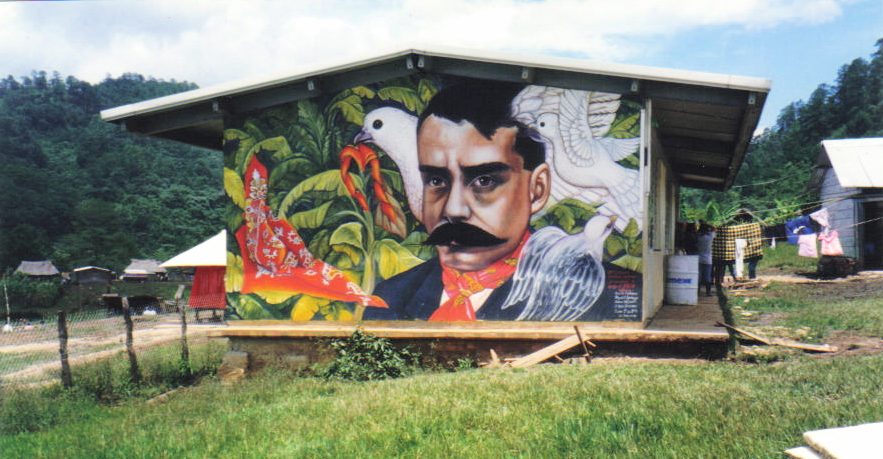
Ejido Tila occupies municipal headquarters
[Intro: The Ejido Tila continues to occupy the municipal building that its members partially destroyed and then occupied on Decembers 16, 2015. Ejido members occupy the building and the ejido publishes frequent updates (comunicados) on their website: http://laotraejidotila.blogspot.mx/ The comunicado below expresses solidarity with other adherents to the EZLN’s Sixth Declaration that are facing eviction or paramilitary attacks, thus giving an overview of what’s happening in Chiapas with adherents to the 6th.]
=================

Banner hanging on the facade of the Tila municipal headquarters, now reclaimed and occupied by members of the ejido and adherents to the EZLN’s Sixth Declaration.
AGAINST the GOVERNMENT’S PARAMILITARY ACTIONS TOWARDS LAS ABEJAS, RESPECT for SAN ISIDRO LOS LAURELES and A THANK YOU TO BACHAJÓN
Ejido Tila, Chiapas, Mexico January 02, 2016
To: Public Opinion
To: The national and international Mass communications media
To: The social organizations that fight for justice and dignity
To: The Network against Repression and for Solidarity
To: The adherents to the Sixth Declaration of the Lacandón Jungle
To: The Non-Governmental Human Rights defenders
To: The National Indigenous Congress (CNI)
To: The National and International Sixth Commission
Receive a cordial greeting from adherents to the (EZLN’s) Sixth Declaration of the Lacandón Jungle of the Ejido Tila, Chiapas Mexico and an embrace to all the organizations in solidarity with our struggle, a struggle that will be tireless because we must be in solidarity with each other against that capitalist monster that converts our lands into merchandise in order to gain more money and subject the poor to being even poorer. To the compañeros and compañeras of San Sebastián Bachajón: thank you for your solidarity with our struggle.
We demand that the state government not repress our compañeros and compañeras of San Isidro Los Laureles [1] in the municipality de Venustiano Carranza, Chiapas and from the Ejido Tila and all the corners we will continue demanding because it’s time to join forces, because we will not permit that they continue committing injustices towards the indigenous communities. The lands that our indigenous brothers of San Isidro Los Laureles reclaimed must be respected, just like they respected the belongings of the alleged owner that monopolizes large extensions of land.
Our brothers and sisters fear a possible eviction on the government’s part and from here we demand respect and that decisions to reclaim their lands that were in the possession of the large estate owners for a long time and that they have decided to reclaim be respected. Also, on December 16, 2015, the Ejido Tila recuperated its land and expelled the municipal authorities that wanted to expropriate 130 hectares of our land in order to convert them into private property. We will be demonstrating forcefully over anything that may happen to our brothers because the Ejido Tila is also on maximum alert for whatever counterinsurgency attack that the three levels of government are preparing for attacking the Ejido Tila and other Chiapas organizations with the use of paramilitaries whatever you call them.
We reproach the constant aggressions that our brothers and sisters of the organization Las Abejas of Acteal, Chenalhó, Chiapas have suffered that paramilitaries ambushed near Pantelhó municipality on December 29, 2015 [2] and as always all these aggressions have been kept in complete impunity as they have the support of the three levels government, therefore they continue murdering and harming our brothers and the municipal police don’t do anything because they are well coordinated from the three levels of government. Attorney General C. Raciel López Salazar denies that paramilitary groups exist and as always he comes out and tells us that it’s an intercommunity conflict. But from here we demand a stop to the attacks and harassment; and also that those responsible for these acts are punished. There are more social fighters and political prisoners in Mexico’s prisons than criminals, because the government utilizes them for hiding and stockpiling its Armed Forces.
We ask all the social organizations and non-governmental human rights defenders to be on alert for the wave of attacks on our brother and sister fighters and we will continue reporting how often they are and we will not tire.
Sincerely,
Tierra y Libertad
EJIDO TILA
President of the Ejido Commission
President of the Vigilance Council
(SEALS)
NEVER MORE A MEXICO WITHOUT US!
STOP THE REPRESSION AND ATTACKS AGAINST THE INDIGENOUS COMMUNITIES!
WE ARE ALL ABEJAS OF ACTEAL!
Ejido Tila Adherents to the Sixth
http://laotraejidotila.blogspot.mx/2016/01/contra-las-acciones-paramilitares-del.html
—————————————————
[1] On December 20, 2015, Los Laureles community reclaimed (recuperated) approximately 407 acres of neighboring land formerly worked by their grandparents as serfs. Los Laureles community is a member of the Semilla Digna organization, which is an adherent to the Sixth Declaration of the Lacandón Jungle.
[2] On December 29, armed men wearing military clothing shot at 3 young brothers from a family belonging to Las Abejas of Acteal. No one was seriously injured, but one of the brothers sustained an injury to his foot. Las Abejas denounced that these armed men were dressed the same as those who murdered Manuel López Pérez 6 months ago in the same region of Pantelhó municipality.
——————————————————-
English interpretation, Intro and footnotes by the Chiapas Support Committee
Background article: http://compamanuel.com/2015/12/29/accuse-tila-mayor-of-reactivating-paramilitaries/
Esteva: Disputing politics
By: Gustavo Esteva
It will be a year of intense political dispute, in the midst of war. But the dispute among the politicians will be irrelevant. What will be important is disputing politics itself, reclaiming it.
On the surface, attention will be on the politicians. There will be advances of the 2018 presidential contest and elections for governors, municipal authorities and deputies in more than a third of the country. Electoral propaganda will conceal the void. The maximum distribution of the irrelevant will dissimulate the absence of a debate about what’s important, particularly about the ominous perspectives of environmental and social disaster that hover over us. All over the country it will continue becoming evident the distance between the discourse of the political and economic leaders and the real conditions of the population and the country.
In the world of politicians, nobody dares to recognize the state of things. They intensely dispute to win government positions, under the superstition that once in them they will be able to govern… and that they will do it for the common good. They are not able to recognize that they could only win soft jobs and privileges and a marginal influence on what happens, at the price of becoming accomplices of all kinds of corrupt acts and of the destruction of the natural and social life to which all governments are dedicated. It cannot be any other way. In today’s world, all the “governments” have to subordinate themselves to the logic of capitalism… and one cannot govern with capitalism, if by government we understand regular behaviors and events functioning for the common good.
There are many ways of dealing with the capitalist hydra. All the following adjectives fit: cruel, ingenuous, efficient, blind, incompetent, skillful, populist, fascist, xenophobic… But all, because of the very structure of the governments, as much the state apparatus as what continues to be called democracy, are subordinate to the logic of capitalism and therefore to its corrupting and destructive impetus. Few politicians dare to react before anticapitalist postures in the terms of the leader of Podemos, in Spain, who declared last June 25: “May you hold onto the red flag and leave us in peace. I want to win.” And that way he won what he won: the sacred right to complain. His position is not mere cynicism. It’s about a realistic attitude in the electoral game: in order to win it is indispensable to sell your soul, because once above it isn’t possible to hold on to it. It is pure demagogy to maintain that once in the government it will be possible to really be occupied with the common good and to preserve decency and an ethical sense.
Because of that the real dispute is in another place: it is the struggle to justify political activity, drawing away from the stench of the electoral fight and on the other hand occupying ourselves with resisting and constructing: resisting the dominant and destructive horror, more blind and aggressive all the time, and constructing the new world, a world that leaves behind the capitalist mode of production as well as its form of political existence, the “democratic despotism” that prevails in the nation-states and the international institutions.
Resistance and construction of the new, each time more inseparable, in practice demand being busy day after day, tirelessly, in homes, families, communities, collectives and organizations of all kinds, for dismantling capitalist social relations and the political relations that make them possible.
The dominant regime, with its two-faced politics and economics, now organizes an unprecedented devastating war against life in all its forms. It is not the will of a few politicians or capitalists that enrich themselves from it: it is an inertia in which they themselves are prisoners. Therefore it’s useless to pretend that the substitution of some (others) could stop that war. The only way to achieve that is to dismantle its basis for existence through the construction of political and economic autonomy.
The EZLN says well in its January first comunicado that: “a bloody night… extends over the world (…) It’s clear that the worst is coming (…) We must organize ourselves, prepare ourselves to fight, for changing this life, for creating another way of life, another way of governing ourselves, the peoples (…) There is nothing now to trust in capitalism (…) Now only the trust among ourselves remains… Therefore we must unite more, organize ourselves better for constructing our ship, our house, in other words, our autonomy, because it’s what is going to same us from the storm that approaches (…) It’s the time for reaffirming our conscience of struggle and for committing to continue forward, cost what it may and whatever happens (…) It is not the time to get discouraged or for getting tired, we ought to be firmer in our struggle.”
In the face of what is coming, the temptation to surrender, sell out and give up is great. It has many faces and justifications. There doesn’t seem to be any other option than to adapt to what exists… There is no other way, is said continuously. But there is! And that other plural way, difficult and uncomfortable but valiant and imaginative, that option of resistance and construction, appears each time more as the only form of surviving the general war that is currently unleashed against everything that’s alive and will be intensified this year to unprecedented levels. There is no place for optimism, but we begin the year full of hope. The voice of the EZLN is not marginal or isolated. It finds resonance in the entire world. At the end of the day, we are the most.
———————————————————–
Originally Published in Spanish by La Jornada
Monday, January 4, 2016
Re-published with English interpretation by the Chiapas Support Committee
Zibechi: Domination and resistance in the favela

By: Raúl Zibechi
Pedestrians are the kings to whom cars must surrender. Perhaps it’s the biggest difference between the favela and the asphalt, something neither the media nor analysts of the system repair. The street is the paradise of the common people, of the little boys that play ball, of the little girls that jump and run, of the women that haul bags of food and the youths that open the way with their motorcycles making pirouettes between the cars and the teenagers, which they don’t seem to impress.
Timbau is one of the 16 favelas (shantytowns) of Maré, an enormous space adjacent to Guanabara Bay with 130,000 inhabitants, which northeastern migrants obtained from the sea meter-by-meter from their precarious stilt houses, which they started to build a century ago. Timbau is one of the few favelas north of the city (Rio de Janeiro) on the buttocks of a hill. It enjoys the privilege of overlooking the Bay and the hills. When the sun beats down it becomes hard to walk uphill and everything moves in slow motion.
If the favela is defined by what it doesn’t have, as the research centers usually do that prioritize “lacks,” one would have to begin by saying that there are no banks or supermarkets, nor those cathedrals of consumption called malls. It seems like a proletarian neighborhood of any industrial center at the beginning of the 20th Century, when “the workers lived differently than the rest, with different vital expectations, and in different places,” as Eric Hobsbawm reminds us (Historia del siglo XX, Crítica, p. 308).
In one of the alleyways, between a warehouse and a barbershop where the teenagers smooth their hair, a small business has a hand-painted sign that says Roça, which in Portuguese is the name for the family agricultural area. A small group of youths sell agro-ecology products and make artisan beer, demonstrating that it’s possible to work collectively and with self-management. It’s a space where groups come together from other favelas that resist the militarization and urban (real estate) speculation.
Maré was occupied militarily until a few months ago and the soldiers will surely return before the 2016 Olympic Games. The Army was there for 15 months, 3,000 soldiers with rifles and war tanks, but the Military Police relieved them at the beginning of July. The Military Police are one of the bodies that the popular sectors hate most, especially the young blacks. They are responsible for thousands of deaths every year.
A group of young men from the Occupy Alemão collective, a nearby favela occupied since 2010 by the military where Pacifying Police Units (UPP) and a cable car network have been installed, assert that: “the greatest contradiction that exists in Brazil is racism.” Occupy Alemão was born to resist police brutality with rock festivals, cine-debates, children’s games, graffiti workshops and an “economic blackness fair,” inspired in the solidarity tradition of the Quilombos (republics of fugitive slaves); they destine 20 percent of the sales to a fund to support the mothers of victims of the State in Río de Janeiro.
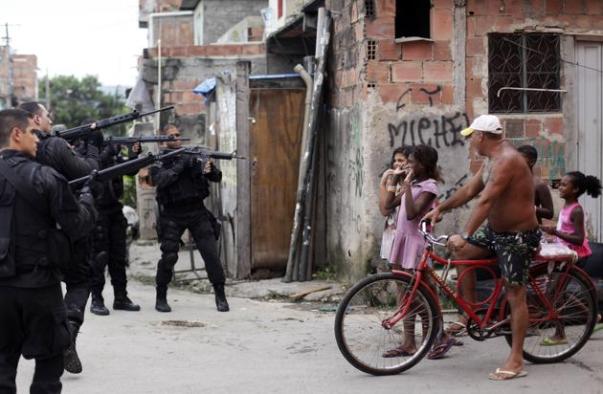
Police units in Maré during 2014
The fair is itinerant and proposes: “to defend political autonomy and strengthen the collective economy,” as they emphasize on their Facebook page. We’re dealing with an initiative of movements that are majority black in the areas of health, culture, education, cooking and audiovisual to spread Afro-Brazilian culture and promote self-development as a way of constructing autonomy.
One of the youths says that in the Alemão Complex there are five UPP and that one of them functions in a school, with its façade covered with bullet holes. He talks about the racism as a form of domination: “When they go to the doctor, white women are attended to on an average for 15 minutes, but black women barely three minutes.” Every word sounds like a hammer on stone. “We for Us,” is the slogan of Occupy Alemão, which has won a space among the gang of movements that were born after the Days of June 2013.
For what comes from outside, the details are disconcerting. The “tourism safari” in the favelas causes havoc. Green Jeeps like those that the soldiers use, with blonde tourists camera in hand, violating the daily life of the residents. From the Alemão cable car they can photograph them while they eat, dance or do their more intimate necessities. A panoptic as insulting as the la insensitivity of the market. They (the tourists) buy souvenir T-shirts that say, above the favela’s photo de la favela, “I was here,” although they may have flown ten meters above it. It’s sad to check out how the logic of the tourist and that of the military police is identical, although they use different weapons.
Night in the favela is noisy. The music sounds powerful, but nobody complains. Just as cars cede to pedestrians, the favela understands that silence can’t go against the rhythms. It seems rare and even disturbing to the foreigner that he can’t go to sleep. Nevertheless, it’s the worker logic of all times, according to Hobsbawm, where “life was, in its more pleasant aspects, a collective experience” (idem).
It’s probable that that culture of the collective explains the genocide that the favela residents suffer, in the vast majority black. A culture woven of social relations different than the hegemonic ones, as irreducible as the space where it has taken refuge, represents a latent threat to the dominant classes. In more than a century, no government was able to get along with the favelas that continue growing despite the violence of the State and the traffickers.
There are hundreds of youth collectives that resist: hip-hop collectives, collectives of black culture, against genocide, economic collectives and collectives of mothers of the murdered and disappeared. The impression is that they tend to multiply and it’s more difficult all the time to make them turn back from the bullet. In the next cycle of struggles, the women and youths from the favelas will be present, and the white lefts will have to decide whether to fight and die together with them or continue looking towards above.
———————————————————–
Originally Published in Spanish by La Jornada
Thursday, December 24, 2015
Re-published with English interpretation by Compamanuel.com
Accuse Tila mayor of reactivating paramilitaries
THEY ACCUSE THE MAYOR OF TILA OF REACTIVATING THE PAZ Y JUSTICIA PARAMILITARY GROUP
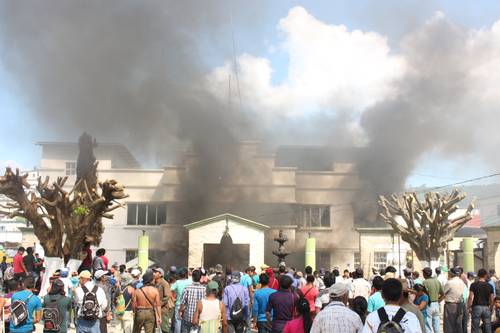
Members of the Tila ejido set county offices on fire.
From the Correspondents
Tuxtla Gutiérrez, Chiapas
Tila ejido owners, adherents of the Sixth Declaration of the Lacandón Jungle accused municipal president Edgar Leopoldo Gómez Gutiérrez of reactivating the paramilitary group Paz y Justicia (Peace and Justice) “in his service” and for “his ambition to control” the inhabitants of that Chol town.
In a comunicado, the president of the commission and the vigilance council of the Tila ejido place responsibility on Mateo Rey, from the Cruz Palenque community; Mateo Guzmán, of Agua Fría, and Don Pascual, of El Limar, for incentivizing the armed group’s activities.
The death or disappearance of 122 indigenous in Northern Chiapas and the displacement of more than 4 thousand indigenous Chols and Tzetzals in that region between 1995 and 2000 is attributed to Paz y Justicia.
The Fray Bartolomé de Las Casas Human Rights Center (Frayba), representative of the families of the victims, asserted that the paramilitary group’s actions responded to the Army’s low-intensity war against the Zapatista insurgency.
In November 1997, members of Paz y Justicia ambushed a pastoral caravan composed of the then Bishop of San Cristóbal de Las Casas, Samuel Ruiz García; the Bishop coadjutor, Raúl Vera, two catechists and the majordomo of the Señor of Tila Sanctuary, Manuel Pérez. Ruiz García and Vera López were not injured, but three others were.
“As of this date they have remained unpunished and they once again want to impose the (municipal) president by blood and fire; these people live from our taxes, they are aviators that get paid without working, and because of that the public works that the politicians promise are not finished in the communities, because part of the money is used for maintaining these shameful acts,” Tila’s ejido authorities exposed.
They pointed to Regino, from the middle zone of Tila, and to Nicolás, the rural agent of Unión Juárez community in the Tila ejido annex, as being some “spongers and traitors” and placed responsibility on them, together with three cited previously, for what might occur in the ejido.
They denounced that utilizing the Tile municipal government’s communications equipment, these individuals have started to coordinate the paramilitary group (named) Paz y Justicia for the purpose of submitting whoever may be in disagreement with the mayor’s decrees.
The comuneros (who are) adherents to the Sixth Declaration of the Lacandón Jungle of the Zapatista National Liberation Army (EZLN, its initials in Spanish) expressed their fear of suffering an armed attack, because of which they alerted social and human rights organizations to be on the lookout for what may occur in the Tila ejido, located in the municipal capital.
The ejido owners demand the return of 321 acres that belong to them, according to the 1934 presidential resolution, because 72 years ago the county offices were illegally built on 128 acres of their land.
Last December 16 hundreds ejido members, who asserted having suffered harassment and arbitrariness, held a march that culminated with the burning and destruction of some areas of the county building.
They remembered that in 2008 the agrarian tribunal issued a resolution in favor of the ejido owners, but as it was not executed they went to the Supreme Court of Justice of the Nation (SCJN), which has not resolved the case, allegedly because it would occasion a social problem, because it would be necessary to relocate practically all of the county seat.
In the comunicado the president of the Tila ejido commission and the vigilance council accused that rural agents from other ejidos that support the country council are provoking them.
“If they want the county council so much that they bring it to their communities, we will expel them because of the constant violations of our individual rights, as well as the violation of protective order number 73/2014, which was won so that the casino of the people would not be destroyed, without the permission of the general assembly of ejido owners,” they stated.
The Tila ejido owners agreed not to undertake any dialogue or negotiations with the governments, “because our lands are not negotiable or for sale and we will continue fighting to avoid any dispossession or against any imposition.
“In Mexico, the three levels of government always create violence, hiding behind the paramilitary groups at their service so that they can say afterwards that it is a conflict between communities,” they concluded.
————————————————————
Originally Published in Spanish by La Jornada
Monday, December 28, 2015
Re-published with English interpretation by Compamanuel.com
Esteva: It was an atrocious year
Support Zapatista Autonomous Education! It’s anti-capitalist and anti-colonialist! (Just click on the DONATE button.)

Indigenous peoples protest climate change in Paris.
By: Gustavo Esteva
In Mexico, the moral degradation, cynicism and corruption of the political classes became more and more evident, while the combined violence of legal and illegal forces continuously increased. Thus, a structure was consolidated that inside and outside the institutions seeks to subject the population to control and smother resistances and rebellions, inside of an undeclared state of exception.
Something similar, with very different degrees and modalities, occurs in the world. In the face of the political changes in Argentina or Venezuela, the persistent Brazilian political crisis, or events in Greece or France, betrayals, errors or weaknesses of the “lefts” are denounced or it warns about restorations or assaults on power from the “rights.” It characterizes what occurred as a setback of popular forces and a rise of capital, of its state administrators and the social sectors that support them. Trump would confirm this interpretation: millions of Americans support positions that even The New York Times classifies as fascist, at the same time that, in the United States and Europe, social behaviors that clearly have that character multiply. Just as 12 million Germans voted for Hitler in 1932 and 17 million in 1933, los media and other factors would be leading large groups to support governments and politicians of the “right,” even against their own interests. Thus the popular forces would be turned back and the neoliberal constellation would continue winning.
The Paris Agreement can be useful for illustrating what occurs and for trying to explain it. The conference that produced it was the result of the prolonged public demand to confront climate change. What they signed wasn’t good; the governments publicly proclaimed its merits and many applauded it without reservation, but it was rather a deceptive farce. Grain, for example, which represents a very qualified and respected opinion, pointed out that the agreement it not legally binding in the goal of reducing emissions, does not advance de-carbonization, it supports the industrial agricultural model, the generator of 50 percent of the emissions and protects that these will continue by means of actions that supposedly compensate them. The most serious is that, under the excuse of carbon “seizure,” it will now be openly supportive of geo-engineering, which for many is the principal cause of climate change.
Grain, as well as a good part of the demonstrators present in Paris, emphasized that what’s important is changing the “system,” not the climate. Since we’re talking about that, it doesn’t seem reasonable to ask it of the very same “system,” ensnared as it is in a destructive logic that it cannot stop by itself. As is continuously denounced, it’s killing the hen with the golden eggs and rapidly undermining its own basis for existence. The problem is that its suicidal behavior increasingly puts at risk the survival of the human species and life on the planet and can only be instrumented with a growing authoritarianism. First, an immense global effort was exerted to hold the conference, and later to make the decisions that are lacking. Does that make sense? Why continue trusting in the superstition that those governments and institutions are going to make decisions contrary to the interests of those who control them, that 1 percent that Occupy Wall Street denounced?
That would be the year’s principal lesson, which we are far from having learned. Awareness is more general all the time that the current predicaments cannot be overcome inside the framework of ideas, policies and practices that they produce; in other words, inside the current “system.” It’s not enough to change policies or modify the ideological composition of those who are in charge of the institutions. Nor is it sufficient to reform them. It’s illusory and superstitious to continue hoping that the “system” will correct itself, with the same or other leaders, as Paris and all the other cases prove. Therefore, we need to withdraw our trust from the same representation regimen and its electoral dispositive. We also need to withdraw from mere social mobilization, if it is only capable of producing the replacement of leaders, as the result of the Arab Spring demonstrated or of inducing marginal changes in the orientation of policies, as is proven everywhere and was proven in Paris.
At this point, the atrocious year allows a crack of hope. It’s underway everywhere, a reorganization from below that step by step transforms resistance into emancipation. The need for the apparatuses of capital and the market is dismantled and for its state administrators and new social relations are forged. Little by little, devices capable of stopping the dominant horror are established, so that the organized people themselves, not their representatives, leaders or delegates, realize the changes that are lacking. It’s not about another superstition or about mere utopias. It begins to be reality.
———————————————————–
Originally Published in Spanish by La Jornada
Monday, December 21, 2015
Re-published with English interpretation by the Chiapas Support Committee
Accuse private police of murdering migrants
ACTIVISTS ACCUSE POLICE OF MURDERING MIGRANTS THAT TRAVEL TO THE U.S.

Rubber rafts take people across the Suchiate River between Tecún Uman, Guatemala and Ciudad Hidalgo, Mexico.
** They maintain that those responsible belong to the Cusaem and Sepromex corporations
** The first one has million dollar contracts with federal government agencies and with the state of Mexico
By: José Antonio Román
Human rights defense organizations denounced the existence of private police corporations, with federal government contracts, which have committed grave human rights violations against migrants that travel through national territory towards the United States.
In a press conference headed by Leticia Gutiérrez, a religious woman of the Scalabrini order, who has developed widely recognized work in favor of migrants, it was reported that they already presented to the Attorney General of the Republic (PGR) a series of denunciations for eight homicides that can be attributed to members of the Auxiliary and Urbana Security Corps of the State of Mexico (Cusaem).
They pointed out that this private police corporation has million dollar contracts with different federal government agencies and with the state of Mexico.
For example, they said that since last July in the state of Querétaro the presence that corporation’s agents has been noticed along the railroad tracks from the state of Mexico to the city of Celaya, Guanajuato.
“That extra-police group has committed armed attacks, harassment, threats and aggressions against migrants. They also directly threaten collaborators at the dining room of the González and Martínez Migrant Stay,” they denounced.
After quoting testimonies of the migrants they attend to in their shelters, the human rights defenders denounced that that police corporation –whose members dress in black and carry high-powered firearms, permitted exclusively to the Army– has committed grave violations against migrants, like torture and illegal deprivation of freedom, and on many occasions there is complicity with federal and state police authorities.
Besides Cusaem, another corporation exists named Special Protection Services in Mexico (Sepromex, its Spanish acronym), which also has a list of human rights violations against migrants; it operates principally in the states in the center of the country and in the Bajío.
The denunciations were presented by Ramón Verdugo, from the organization Everything for Them; Leticia Gutiérrez, from Mission with Migrants and Refugees; Heyman Vázquez Morales, from the Home of the Migrant in Huixtla, Chiapas, and Martín Martínez, González and Martínez Migrant’s Stay, besides the priest Alejandro Solalinde, of Brothers on the Road.
The activists demand that the federal government modify the policy of violence evidenced in the Southern Border Plan and that it revise the concessions granted to private security companies, so that the harassment against migrants and against those who defend their rights.
———————————————————-
Originally Published in Spanish by La Jornada
Thursday, December 17, 2015
Re-published with English interpretation by the Chiapas Support Committee
Zibechi: The old mole pierces stone

Subcomandante Galeano: “While above they accumulate capital below they accumulate rage.”
By: Raúl Zibechi
Secondary students brought down the Sao Paulo state government headed by the neoliberal Geraldo Alckmin, who had to withdraw his reorganization plan for the education system faced with massive rejection and strong youth mobilization. In these times of right-wing advances, the student triumph ought to be a reason for celebrations because it illuminates the future that we desire, one of resistances capable of disarticulating conservative plans.
In September the Sao Paulo government announced the reorganization of public teaching with separate centers based on three cycles, which would lead to the regrouping of the students, the closure of 93 centers and the transfer of 311,000 students. Immediately, teachers and students agreed that there would be school overpopulation and attributed the measure to an attempt to lower the cost of the education system.
In October the education workers’ unions and students carried out demonstrations, which impelled the ministry to speed up the reforms and announce the centers that would be closed. All of them are on the periphery, inhabited by the popular sectors, which already suffer a low-quality education.
The first state school was occupied on November 9, in Diadema, the center of a region with a long tradition of union struggle in the ABC Paulista (a region in the state of Sao Paulo on the periphery of the city of Sao Paulo). The occupation had the support of parents and teachers. One week later there were already 19 centers occupied, while justice denied the request to evict by deciding that the students didn’t want to appropriate the centers but rather to open a debate. There were more than 100 centers now occupied on the 23; las universities y unions began to take positions against the school reorganization. There were 196 centers occupied at the beginning of December.
At a certain moment the students decided go out in the streets, to cut off the avenues and diffuse the protest. According to the polls, 61 percent of Paulistas reject the government’s measure and 55 percent support the students, while the governor’s popularity fell to his lowest approval ratings. On December 4, Alckmin decided to postpone the school reorganization for one year.
It’s interesting to look at what happened inside the occupied centers. The students created work commissions to sustain the occupation: food, security, press, information, cleaning, external relations, among the most common. Besides the days work they hold assemblies, convoke debates with professors, parents and solidarity collectives about the most varied themes. They edited a manual (How to occupy a school), inspired in the recent struggles of the Chilean and Argentinian students.
They are thousands of youths from 14 to 15 years of age that are producing a formidable experience, confronting the authoritarianism of the social democrat-neoliberal government, challenging police repression and the media’s manipulations. A new generation of militant youths is living their experience. A movement that is born, becomes massive and triumphs in the midst of the Brazilian right’s largest offensive in many years, and that also shows that there is sufficient social energy, on the outside of the institutions, parties and unions, to change the state of things in Brazil.
The days of June 2013 are the antecedent and immediate referent of the current movement. June was a parting of waters. From that moment on the movements were reactivated, new grass roots organizations and collectives were born in all spaces of society, and the street was converted into the new scene of debates and protests. The militants of the Free Pass Movement, now divided, continues working in the peripheries, where new groups are born against the rising cost of transportation, against the State’s violence, feminist and cultural collectives, which now come together against the school reorganization.
But different than what happened in June 2013, where the dominant norms were large demonstrations that consumed a few hours of the participants’ time, the occupations “demand of the occupants that they assume being political protagonists of the events 24 hours of the day,” according to the analysis of the theater professional and militant Rafael Presto in Passapalavra (http://goo.gl/HP3glz).
Thus the occupations are “an intense formative process, a generation of militants formed in the heat of the struggles.” If to that is added that the occupied centers are converted into spaces where diverse struggles, social movements, artists, militant educators, territorial groups and groups of women converge, we can evaluate the importance of what happened in November.
The way I look at it, there are three aspects to emphasize.
The first is that the social and political energy from below has been capable of defeating an emboldened right, but one that must recede before the potency of the street. That should be a motive for reflection to those who bet everything on the institutions and cannot comprehend that the axis of change is in another place and with other styles.
The second is that the emancipatory energy is always born at the margins and among the youth. Without that youthful fire, of class and gender, possibilities for confronting a process of change do not exist. The last occasion on which Brazil registered a potent process of those below was in the 1970s, when the experience of millions of persons in the 80,000 faith-based communities (ethical commitment), young industrial workers and campesinos displaced by the green revolution, gave life to big organizations: the CUT, the MST and the PT.
Finally, as Presto points out, those who emphasize what the movements lack always appear. “They lack a political project,” they say, when in reality they want to say that: “it lacks a direction that puts things into an order,” of which they wish to become a part. But the young people are now organized, they are already militants, they just don’t aspire to form a part of the institutions that they reject because they are familiar with them. The stone is pierced from below.
———————————————————–
Originally Published in Spanish by La Jornada
Friday, December 11, 2015
Interpreted and Published in English by Compamanuel.com
Pope Francisco to visit Chiapas
THEY FORMALLY ANNOUNCE POPE FRANCISCO’S VISIT TO CHIAPAS

Pope Francisco gives his thumb up as he leaves at the end of his weekly general audience in St. Peter’s square at the Vatican, Wednesday, Sept. 4, 2013. (AP Photo/Riccardo De Luca)
By: Isaín Mandujano
This afternoon, the Archdiocese of Tuxtla Gutiérrez confirmed the visit of Pope Francisco to Chiapas, where he will live and will send a message to indigenous peoples and migrants from this southern border of the country.
Father Edilberto Pérez Vicente, coordinator of the Pope’s visit to Tuxtla announced in a press conference the official communication of the Mexican Episcopal Conference (CEM, its initials in Spanish) and confirmed that the Supreme Pontiff will be in Tuxtla Monday, February 15, 2016.
The “Missionary of Mercy and Peace,” as they call Pope Francisco, will arrive on a flight coming from Mexico City at the Angel Albino Corzo International Airport; from there he will fly in a helicopter to San Cristóbal de Las Casas.
At 10:15 in the morning he will officiate a mass with indigenous communities that will come from the different regions of the state, and it is hoped also from other corners of the country and from Central America.
It will be here where he is expected to make a pronouncement directed to the indigenous peoples and the migrants that cross this border on their route towards the country’s north.
After the mass he will eat with representatives of the indigenous peoples.
At 3 PM he will visit the San Cristóbal de Las Casas Cathedral, where se the tomb of Bishop Samuel Ruiz García is located.
Pope Francisco will fly in a helicopter to Tuxtla where he will head the “Meeting with Families” in the Víctor Manuel Reyna Stadium at 4:15 PM.
This would be the second visit of a Supreme Pontiff of the Vatican to Chiapas; the first was Juan Pablo II on May 11, 1990.
Pérez Vicente said that the Apostolic Journey to our country from February 12 to 17 next year, in the framework of the Extraordinary Jubilee of Mercy.
He added that the sites in which it would be carried out –the Primatial Archdiocese of Mexico, the Diocese of Ecatepec, the Diocese of San Cristóbal de las Casas, the Archdiocese of Tuxtla Gutiérrez, the Archdiocese of Morelia and the Diocese of Ciudad Juárez– “would have the pleasure of being the Pope’s hosts, as well as of the laity, the devoted, clerics and all people of good will that will come to represent the different dioceses and regions of the country.”
He said that the Pope’s presence would be to make a call to dignify life, as has always been his work. He added that they are prepared to receive some 100,000 in the San Cristóbal de Las Casas Municipal Sports Center and some 80,000 in Tuxtla.
———————————————————————————
Originally Published in Spanish by Chiapas PARALELO
Saturday, December12, 2015
Re-published with English interpretation by Compamanuel.com
Chiapas teachers sign truce
CHIAPAS TEACHERS AGREE to “TRUCE” and RETURN to THEIR WORKPLACES

Chiapas teachers hold press conference in Tuxtla. Photo: Isaín Mandujano/Chiapas PARALELO
By: Angeles Mariscal
[The teachers warned that they would not allow those who presented the evaluation to return to their workplaces. Photo: Isaín Mandujano/Chiapas PARALELO]
After the exchange of five police that members of the National Coordinator of Education Workers (CNTE) retained for six teachers detained during demonstrations, they suspended the labor strike and demonstrations that some 50,000 teachers maintained for three days in Chiapas.
Since this morning, demonstrators took down the occupation they had on the principal plaza of the capital of Chiapas, and initiated the return to their workplaces.
The suspension of the labor strike was announced after the CNTE of Chiapas classified as positive having achieved the liberation of their compañeros that were detained during last Tuesday’s confrontations and the suspension of the evaluation of the second block of teachers that were going to be evaluated.
Another 2,300 were present during the first day that this process was carried out, the same day that members of the Coordinator were in the midst of protests. It was during those protests that a teacher David Ruiz Estudillo died from being run over and the police detained another six demonstrators.
The teachers carried out different actions to achieve their liberation, among them the retention of five police, two of them women, who they liberated Wednesday night, after 8 hours of holding them in the center of the place where they were demonstrating, and when the state government released the six detainees.
Early this morning the CNTE of Chiapas held an assembly in which they agreed to maintain a “truce” and to return to their workplaces. In the voice of one of its leaders, Pedro Gómez Bamaca, warned that: “the Labor Reform will not happen in Chiapas,” and for that they announced that next December 18 they will be added to the protest actions in Mexico City.”
They will not permit those who attended the evaluation to return to work
The CNTE’s assembly in Chiapas also agreed that they would not permit the 2,300 teachers that attended their evaluation exam last Tuesday to return to their workplaces.
According to the Coordinator, we’re dealing with teachers that entered teaching in 2014, when the Education Reform was already in effect. The Secretariat of Education issued them contracts wherein it establishes that in order to remain they are obliged to be present and to pass the exams.
Versions of dissident teachers maintain that facing the refusal of several of them to participate in the process, the Secretariat of Education offered them all permanent contracts, independent of the result they obtain on the tests; all in exchange for accepting being present at the evaluation processes.
Before abandoning the occupation, members of the Coordinator demanded the exit of Ricardo Aguilar Gordillo, Secretary of Education in Chiapas, who they accused of not working to overcome the education backlog –Chiapas occupies first place at the national level- and contrived the whole strategy for breaking the dissident teachers.
The Chiapas government asserts that it reduced the conflict with the teachers
Hours after the exchange of police for the detained teachers, the state government issued a press release wherein it asserted that it achieved reducing the teacher conflict and the return of the teachers to their workplaces, through the dialogue with the CNTE’s leaders.
“The Secretary General of Government, Juan Carlos Gómez Aranda, asserted that the Chiapas government is and will be respectful of the free expression of ideas, as long as these ideas don’t violate the rights and freedoms of citizens,” the communication points out.
It adds that the six people that were liberated –three teachers, two normalistas and a father- are “under the legal conditions described in Article 140 of the National Code of Criminal Procedure.”
——————————————————————
Originally Published in Spanish by Chiapas PARALELO
Thursday, December 10, 2015
Re-published with English interpretation by Compamanuel.com
Chiapas government and teachers exchange hostages

Teachers confronted Federal Police outside the Hotel Safari, in Tuxtla Gutiérrez. The photo shows 3 of the hostages (with heads covered) displayed at their central plaza occupation, as well as “material for repression.” Photo: Victor Camacho
By: Elio Henríquez, Correspondent
San Cristóbal de Las Casas, Chiapas
The state government liberated three teachers, two normalistas and a father detained Tuesday during the confrontation between police and members of Sections 7 and 40 of the National Education Workers Union (SNTE, its initials in Spanish), when they tried to boycott the application of the teacher evaluation.
The liberation occurred at 6 PM yesterday, after a meeting between federal and state functionaries with the leadership of the Chiapas teachers, in which the teachers agreed to deliver a federal agent, two policewomen and two “informants” retained Wednesday afternoon.
The teachers retained these five persons after a confrontation that occurred at midday with federal police in front of the hotels in which the police were lodged. Yesterday, the federal police were guarding the teachers that went to the exam at the National School for Civil Protection, located in the municipality of Ocozocoautla.
The activities of the teachers that are opposed to the education evaluation began at 10 AM in Tuxtla Gutiérrez, with a march to demand the liberation of the six detained Tuesday for participating in the boycott of the teachers’ exam. At the front of the contingent they carried a casket, “as part of the honors” to Professor David Gemayel Ruiz Estudillo, who died during the confrontation in Ocozocoautla. According to the organizers, more than 50,000 participated.
Manuel de Jesús Mendoza Vázquez, alternate secretary general of Section 7 of the SNTE, pointed out that the demonstration was going “calmly towards the principal park when on one of the streets of Central Avenue the federal police came out of their hotels with shields and clubs in an act of provocation, because there was no need for that because the march was peaceful.”
He reiterated that the agents “started to verbally attack the compañeros and when they responded, they threw tear gas at them. The people defended themselves and obliged them to go inside their hotels, which permitted taking away from them an impressive quantity of material for repression: boxes full of projectiles, tear gas bombs, bulletproof vests, helmets and other things that were placed in view of the media in the park, where a massive occupation has been installed since last Monday.”
He pointed out that in the battle the teachers retained a federal police agent, who was also taken to the central plaza, in front of the government palace, at the time that they damaged several buses transporting the agents.
Afterwards, he added, the teachers retained two state policewomen and two “informants,” which obliged authorities to continue the negotiations that started Tuesday night.
As a result of the dialogue, the government liberated the three teachers, two normalistas and a father around 6 PM and the teachers delivered the 5 they retained yesterday to authorities.
Mendoza Vázquez commented that they did not bring the cadaver of Ruiz Estudillo to the march. Ruiz Estudillo was a primary school teacher, 29 years old, belonging to Section 40, who was working in Ocozocoautla, although he was a native of Villaflores. “The casket was carried as a political act.”
He explained that the Tuesday protest “was a peaceful act for boycotting the evaluation, but in the face of the fascist regime’s repression we looked for the means to defend ourselves and in the battle, in the advance of the two rhinoceros (an armored unit of Federal Police) that they used to dissuade the education workers, Compañero” Ruiz Estudillo fell.
He maintained that the police “not only used tear gases and rubber bullets, but also real bullets, which can be demonstrated because we have a compañero injured in the leg with a projectile.” He affirmed that: “the federal government attempted to surprise us on Tuesday by advancing the evaluation programmed for the 12th and 13th, and because of that they created a bunker in the School of Civil Protection, where a disproportionate number of police and Army soldiers were concentrated.”
The conflict ended, affirms the state government
Last night, the Chiapas government reported in a comunicado that after several hours of dialogue with members of the National Coordinator of Education Workers it achieved in cooling down the teachers conflict, with which the teachers ended the occupation that they were maintaining in the center of Tuxtla Gutiérrez.
The Secretary General of Government, Juan Carlos Gómez Aranda, reiterated the state administration’s will to channel the demands of Chiapas teachers and that they can be attended to by the corresponding instances, in such a way that the quality of education in the state is strengthened.
He explained that the detainees were released under reserve, in terms of article 140 of the National Code of Criminal Procedure.
———————————————————–
Originally Published in Spanish by La Jornada
Published with English translation by Compamanuel.com
Thursday, December 10, 2015
 Chiapas Support Committee