Chiapas Support Committee
Home of the Compañero Manuel blog on zapatistas & mexico
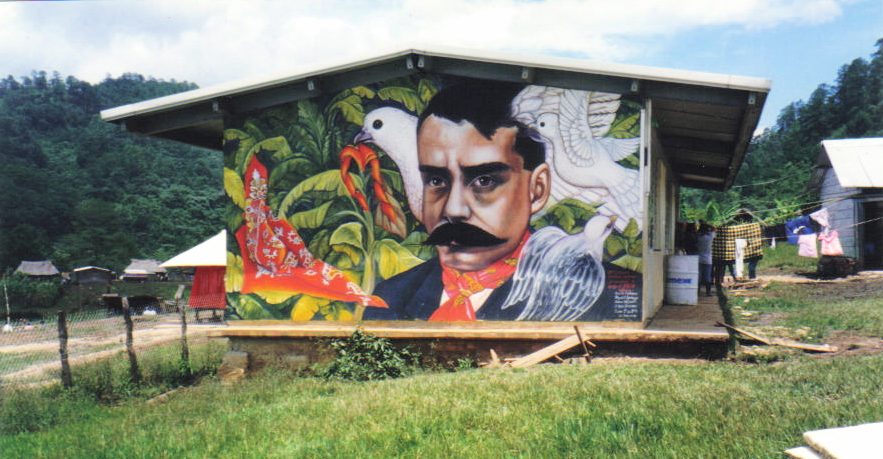
People of Faith in resistance await Pope Francisco in Chiapas
BELIEVING PEOPLE IN RESISTANCE AWAIT POPE FRANCISCO IN CHIAPAS

Banner reads: Believing People of the southeast with Pope Francisco against mining and for the defense of our Mother Earth.
By: Enriqueta Lerma Rodríguez
February 2, 2016
Beyond the condemning discourses about the Pope’s visit to Chiapas, accusing the event as a form of control of the masses that responds to the need for recuperating the faith of the few faithful Catholics that are left in the region facing the increase of Evangelicals and of the desire of government authorities to show the “good Indian,” it’s pertinent to analyze the relevance that the Vicar’s presence acquires for an important percentage of indigenous Catholic believers. If the visit to Tuxtla could be omitted from a profound analysis it doesn’t come out the same with the Diocese of San Cristóbal de Las Casas where the largest percentage of the population is indigenous, con a diversified rural economy and grouped together in a diocese that for more than fifty years has shown particularities of significant social resistance.
The influence of the diocese in the region is highly important if one remembers the theological and political tradition inherited from Bishop Don Samuel Ruiz, who presided over it from 1959 to 1999. Many of the political, indigenous and campesino organizations, which currently contend in the state’s political arena have their germination in the 1974 Indigenous Congress, where, for the first time, secular catechists from the different diocesan regions had the opportunity to discuss the common problems about which they complained: mistreatment, discrimination, exploitation on the fincas (estates), dispossession of their land, abuses from those monopolizing crops, a lack of school and health services, threats and violence. The 1974 Congress, organized by the Diocese, was the inaugural parting of waters for a new stage of resistance and empowerment in the communities, generating campesino movements and the formation of numerous groupings demanding agrarian distribution.
One could argue against the importance of the Diocese of San Cristóbal with the decrease of Catholics in the state. Nevertheless, while it’s certain that religious diversity has increased in Chiapas, provoking social problems of expulsions and religious intolerance, it’s also necessary to say that despite that the Catholics continue to represent the most numerous religion among the Indigenous population. The data provided by the INEGI in its latest document on the theme, 2010 Panorama of Religions in Mexico, contradicts the diagnostics that point out that Indigenous Catholics have been exceeded at 60%. It’s possible to observe that in a population of 1,209,057 speakers of any indigenous language Catholics represent 50.35% with 608,819 followers; on the other hand, the total of Presbyterians, Evangelicals, Protestants, Christians, Jehovah’s Witnesses, Mormons, Jews and Muslims is 450,257, in other words 34.25%; the rest don’t point out any religion. Nevertheless, in opposition to the heterogeneity that religious secularization represents, Indigenous Catholics, even with their doctrinal particularities, compose a more cohesive sector, the majority subscribed to the universal church, which has permitted an important number of them to mobilize constantly in order to work in favor of social justice and for the defense of native territories. This organized sector is recognized as “Pueblo Creyente (Believing People);” a name that Bishop Samuel Ruíz designated in his time for the indigenous people of faith that demonstrated in the streets against the unjust incarceration of the parish priest of Simojovel, Joel Padrón, who in 1991 would denounce the numerous human rights violations in the northern part of Chiapas. He was accused of conspiracy against the government, criminal association, plunder, robbery, threats and provocation, among other crimes. Pueblo Creyente’s tenacious resistance attained his freedom despite all the state pressure.
Pueblo Creyente, now with more strength, has added itself to different processes of resistance and solidarity. However, the history of struggle and congruence for the social welfare was made palpable since years ago. For example, in the 1980s, during the period of Guatemalan refuge, through the diocesan Solidarity Committee, camps, basic education courses, workshops for artisans and for analysis of the reality were organized and steps were even taken for the definitive stay of some Guatemalans on lands acquired by diocesan agents. These same agents accompanied the organized return to Guatemala, earning the respect and gratitude of thousands of former refugees forever, a recognition that not even the United Nations High Commission for Refugees attained.
The mediation of the Church of Don Samuel has been so important in the region and so polemical that during the juncture of expulsions of “Christians” in San Juan Chamula, the diocese condemned the acts perpetrated in said municipality, promoting dialogue. That also provoked the expulsion of the Catholic Chamulan followers of Don Samuel and the rupture with the Diocese of San Cristóbal, since the expellers opted for the Orthodox Catholic Church. Within this context the Diocese promoted religious tolerance and supported the re-accommodation of those expelled, thereby showing their first practices towards ecumenism.
The very same territory of this diocese has been the scenario of the Zapatista Uprising, which is not a simple fact: it’s enough remember the notes of Jan de Vos, who Subcomandante Marcos assured in an interview that the meeting between the guerrillas and the catechists of Don Samuel, in the middle of the Jungle, permitted the first ones to transform their “squared” vision of the world into “round.” It’s not too much to say that the tijwanej method of “receiving and returning the word to the community” and “discussing among everyone to interpret the reality and to carry out actions” is a contribution from liberation theology to Zapatismo and not the inverse. At the same time it’s appropriate to remember that the rebellion in the Cañadas (Canyons), had its germ in the migration of indigenous campesinos, supported by the Jesuits, to the Jungle from the fincas of Ocosingo, Altamirano and other places and that many catechists and church agents were accused, after the Zapatista Uprising, of being promoters of the revolt, such as Andrés Aubry, Carmen Legorreta and Xóchitl Leyva point out. The nomination of Samuel Ruiz to participate in the dialogue with the federal government as part of the CONAI was also a demonstration of the analytical ability of the church’s agents and of the trust that the communities had deposited in the Catholic Church, especially in its bishop.
Among other work of great importance the diocese also founded the Fray Bartolomé de las Casas Human Rights Center; the civil association Economic and Social Development of Indigenous Mexicans (DESMI, its initials in Spanish), in charge of incentivizing and advising agro-ecology production in various communities; and the Support Commission for Unity and Community Reconciliation (CORECO) that since the Zapatista Uprising had the charge of promoting the resolution of inter-community conflicts through dialogue and promoting peace.
The response to the diocese’s attempts at pacification and justice, however, has awakened little sympathy in the state and federal governments. It’s appropriate to point out the case of Father Miguel Chateau, the parish priest of Chenalhó, extradited by the federal government after having denounced the characteristics and type of training that the paramilitaries had that perpetrated the massacre of Las Abejas in Acteal. The response was the deportation and condemnation of the diocese for its intervention. Stories like these are repeated in all corners of diocesan territory. There are the recent threats against Father Marcelo Pérez of Simojovel, who is opposed to the increase of organized crime, the cantinas, the sale of drugs and prostitution. Pueblo Creyente supported him with a pilgrimage of dozens of kilometers through various municipios, given that his “enemies” offered a reward of up to a million and a half pesos for his head. Pueblo Creyente’s request that Father Marcelo meet with the Pope to tell him the crime situation in Chiapas was blocked from the current top leadership of the San Cristóbal Diocese: he will not be able to interview with the Pope, although he DID achieve being present at the papal mass as animator of the event.
Beyond the complicated conjunctures, which are not few, it is also necessary to point out the important work that the diocese carries out on a daily basis. Organized in its seven diocesan zones (central, south, Tzeltal, Tzotzil, Chol, Chab and southeast), the pastoral agents, secular deacons and catechists, carry out different tasks: through the social pastoral work they attend to specific problems in matters of human rights; gender equity –from the women’s commission, CODIMUJ-; youth advisory; support to migrants, among other actions. With the recently created Mother Earth Pastoral they seek to coordinate efforts in defense of territory, opposing the sale of land, the monoculture of non endogenous species, the use of genetically modified organisms, the construction of highway and hydraulic mega-projects, the mining extraction, dispossession of land and migration provoked by the poverty that disarticulates the family nucleus. At the same time Pueblo Creyente demonstrates with pilgrimages against the structural reforms, against the genocide reflected in the country’s clandestine graves, against the disappearance of students like in the Ayotzinapa case, against femicides and against the private guards that subject the peoples. On this list of objectives Pueblo Creyente has also added the project of the New Constituent, feeling proud that Bishop Raúl Vera is one of its principal promoters.
Pueblo Creyente nurtures its spirituality starting from Indian theology and continues –to the grumbling of the diocesan leadership and against the suspension dictated from the Vatican- ordaining permanent indigenous deacons: men from the community that serve at the side of their wives and with the support of their families the ministry of imparting the sacraments and of reading the word of God in light of the times; men and women committed to their communities in the project of achieving spiritual liberation, and pledged to eliminating social oppression. Nevertheless, perhaps the biggest challenge that Pueblo Creyente has is the equal proliferation of currents inside the diocese, where renewed and charismatic Catholics are opposed to the tasks of the pastoral agents that seek to construct a liberating church. The dispute inside of Catholicism in San Cristóbal is between these two projects: a liberating church or a conservative one. An example of this contradiction was observed this January 25. Diocesan authorities were opposed to the pilgrimage in memory of the fifth anniversary of the death of Don Samuel Ruiz, with the justification that it was better to channel efforts to the Pope’s visit, but Pueblo Creyente, loyal to their pastor, who they call Caminante, [1] went to remember his work and honor it with the continuation of his work. During the event differences were evident between the current bishops that seek to discourage the Pueblo Creyente organization. For example, before starting the mass, the faithful that showed land-painted signs in defense of territory were asked to put away their banners and slogans.
Among other questions, this is the context that the Pope will encounter during his visit to Chiapas: a Catholic community in resistance starting with the base church communities and a sector of Catholics that seek to finish off Don Samuel’s project. Because of that the controversies are now harsh and unpleasant in San Cristóbal, where the “coletos” [2] feel excluded because the Pope decided to meet only with eight indigenous for sharing food.
The Pope’s visit in San Cristóbal without a doubt represents a key moment for Catholicism in the diocese of San Cristóbal. Pueblo Creyente hopes that he has knowledge of the problems that affect the weight of the indigenous population in the region, that he knows about the work that they have carried out in favor of justice and for the defense of their original territories, that he is witness to the importance that the permanent indigenous deaconship holds for the communities and that he authorizes their ordainment. They hope that the balance inclines in their favor and they attain giving continuity to the path traced by jTatik Samuel Ruíz. And surely the people of faith hope that what they cried out in chorus to Felipe Arizmendi when he started his participation in the fifth anniversary of the death of Don Samuel happens: “We want a bishop on the side of the poor, we want a bishop on the side of the poor!”
[1] Caminante – a walker or, one who walks, a wayfarer
[2] Descendants of the Spanish invaders
—————————————————————–
Originally Published in Spanish by Desinformemonos
Tuesday, February 2, 2016
Re-published with English interpretation by the Chiapas Support Committee
Victory in Oxchuc, Chiapas
THE MAYOR OF OXCHUC RESIGNS AFTER SIX MONTHS OF PROTESTS

Protest yesterday in Oxchuc
By: Isaín Mandujano
Tuxtla Gutiérrez, Chiapas. (apro).
After six months de protests on the part of residents of Oxchuc municipio, María Gloria Sánchez Gómez, mayor-elect of the Green Ecologist Party of Mexico (PVEM, its initials in English), resigned her position.
Local deputy Judith Torres Vera, Vice President of the local (state) Congress, confirmed it. She specified that last night Sánchez Gómez went to the legislative confines to request an indefinite leave of absence, which is interpreted as a definitive resignation according to local law.
Within the framework of the dialogue table installed this afternoon, the local deputy reported to leaders of the dissident movement that the mayor had presented her resignation, as they demanded, and therefore next Wednesday, February 10 it will be sent to the standing commission and on Thursday, February 11 the substitute mayor will be named.
Torres Vera warned that a municipal council would not be formed, but rather through uses and customs, through a plebiscite, the communities would elect their new mayor to propose to the full local Congress.
“What we want if for peace to prevail in the municipio of Oxchuc and in our state, and in that context she gave her resignation,” the legislator pointed out.
She indicated that while only the mayor presented her resignation, it is understood that all her council members leave with her, as 105 of the 115 communities demanded today in a big march, but that will be defined between Wednesday and Thursday.
About the agreements made at the dialogue table this noon, the indigenous accepted returning to classes and the return of those expelled from the municipio, in other words, family members and collaborators of María Gloria Sánchez Gómez (around 22 family members).
Since last July 19, when María Gloria Sánchez was declared the winner after Election Day, groups of dissidents began a series of protests against her. The mayor should have taken possession of the office on September 1, 2015, but she was never permitted.
The first group that initiated the protests was repressed in October, after which new communities joined in, and on January 8 the majority joined when the second attack was perpetrated. In total, the residents of 105 of the 115 communities marched this Friday to demand the abdication of the PVEM’s mayor, who together with her husband, Norberto Sántiz López, former federal deputy and twice mayor for the PRI, maintained a political boss system (cacicazgo) in Oxchuc for 15 tears.
—————————————————————
Originally Published in Spanish by Proceso.com
Friday, February 5, 2016
Re-published with English interpretation by the Chiapas Support Committee
Ayotzinapa investigators face rightwing smears
BUITRAGO: THEY PURSUE US BECAUSE WORK ON THE IGUALA CASE IS UNCOMFORTABLE

Angela Buitrago, a member of the Interdisciplinary Group of Independent Experts designated by the Inter-American Commission on Human Rights to investigate the Ayotzinapa case. Photo: Sanjuana Martínez
By: Sanjuana Martínez, Special to La Jornada
To former prosecutors Angela Buitrago y Claudia Paz y Paz, members of the Interdisciplinary Group of Independent Experts (GIEI, the group’s initials in Spanish) designated by the Inter-American Commission on Human Rights (IACHR) in the Ayotzinapa case, the campaign to damage their reputation that they currently suffer is related to their work and to the State’s apparently “untouchable” power groups, who are affected by the truth about the whereabouts of the 43 teachers college students.
“In the measure in which we get closer to the truth, to what really happened on September 26 and 27 (of 2014) in Iguala, there are people that can feel fear along with the perpetrators,” the former attorney general of Guatemala, Claudia Paz y Paz, advises in and interview with La Jornada.
In a separate interview, Angela Buitrago agrees: “It’s a persecution that we are experiencing and that is happening at the times in which we are taking inconvenient positions or making uncomfortable decisions. Nevertheless, neither defamations nor injuries are the proper way to try to clarify the facts of Iguala.”
Groups sympathetic to the Mexican Army, the ultra-right and conservative sectors have started a campaign against them. They vaguely accuse Paz y Paz of “violating human rights” in Guatemala, where she incarcerated, among others, the former dictator Efraín Ríos Montt. They accuse Buitrago, of “unjustly” incarcerating former Colonel Luis Alfonso Plazas Vega, recently released in a spurious process.
Both have confronted the military estates of their respective countries in the search for justice and reparations for the victims, something that, they say, has disturbed some groups related to the “perpetrators,” just as in Mexico, where General Salvador Cienfuegos Zepeda, the head of the Secretariat of National Defense (Sedena) still refuses to receive the IACHR’s experts with the argument that they are “foreigners,” and refuses to let them interview the soldiers involved in the Ayotzinapa case.
The dirty campaign, they point out, is directed at the group’s work, but also has a “gender component.” The attacks are directed directly at the GIEI’s two women, at the two prosecutors that have denounced corrupt soldiers and functionaries complicit for committing genocide and grave crimes in Guatemala as well as Colombia.
“We are experiencing moral killings,” Buitrago says without restriction. She adds: “they seek to morally finish off Claudia Paz and me, but when one has a clear conscience and knows that what they are saying is completely false, it makes no sense.”
–Has this defamation campaign affected the GIEI’s work?
–It’s very uncomfortable, it’s absolutely unsupportable that we are receiving these kinds of insults, but we have decided to continue the work permanently, without any obstacle, despite the fact that they want to treat us this way. Anyhow, that spreads a media aura, but we’re trying to continue our work with the same effort, because what interests us is looking for the Ayotzinapa students and find the means to do that.”
Lacking the Army
The GIEI’s latest investigations lead to the Army, an aspect of the investigation that the Sedena has not permitted; it has refused to accept the experts’ presence in the interrogations of the soldiers involved in the case.
Claudia Paz y Paz explains that from the beginning they attempted to interview members of the Army, something that has repeatedly been denied them: “Since the first month we have asked for a direct interview with the soldiers that were on duty that night, because in the case record are all their statements where it’s clear that they had witnessed the capture and detention of the youths that are now disappeared; at another time they had guarded the crime scenes and had visited the police command center.
“It’s fundamental for us to obtain these interviews, not only for the information, but also for the search for the disappeared students,” she adds.
The Attorney General of the Republic (PGR, its initials in Spanish) delivered the interrogations in writing, something that has not dispelled the experts’ doubts: “Many blanks still remain. On the one hand, the questions and answers are not found; on the other hand, there are contradictions with second statements, which instead of clarifying, are even more ambiguous,” the former Guatemalan prosecutor points out.
Their latest attempt has been to ask President Enrique Peña Nieto to “reconsider” the possibility of permitting us to interview the soldiers: “And we still have no answer. The reason is not clear to me. We have been interviewing directly the members of the Federal Police that were on duty those days. We have been present when the PGR has interviewed them; we are in agreement that the prosecutors ask the questions, but the only thing we ask is to be present at that time, as we have done in several ministerial interrogations.”
Despite the fact that time is running and their second investigations period will end next April, the State’s answer has been negative, something that evidently raises suspicions.
The PGR has only acceded to conduct a third interrogation at this time, but repeated the same scheme, something that does not contribute precise data to the investigations into the whereabouts of the 43 students: “It’s important for us to be present, to suggest questions, because there are themes that are not clear to us. It’s the third time that some of them are giving statement. It would be very important for them, and for everyone, that the diligence would be as exhaustive as possible, to not leave any space unclear.”
The injuries
Angela Buitrago, known in Colombia as “The Iron Prosecutor” for having faced the powerful and untouchable military estates and investigating 20 years later crimes of disappearance, torture and extrajudicial executions, with historic and exemplary sentences, has been attacked in Mexico by groups that sympathize with the Army.
Among the defamers are: the National Observatory of the Armed Forces, directed by Rafael Herrera Piedra; the Citizens Council for Public Security and Criminal Justice, headed by José A. Ortega Sánchez; and the Roundtable for Judgment and Peace and White Movement, coordinated by Ramón Hernández Flores.
The latest action of these ultra-conservative and pro-military groups was to organize, last January 12 in the Law School of La Salle University, the conference titled “The truth in the Ayotzinapa investigation,” specifically in charge of recently released Colombian Colonel Luis Alfonso Plaza Vega, incarcerated by former Attorney General Buitrago for enforced disappearance and sentenced to 30 years in prison, but absolved five years later in an irregular process.
The presence of the Colombian military man talking about Ayotzinapa is inscribed inside of this defamation campaign: “It’s a way of trying to question the activities that the group does, which has no relation to my activity. One thing is that I was able to have lived facing a permanent persecution and distortion through attacks on me as a functionary of instruction in Colombia; another is what it’s doing to the GIEI in Mexico, from which they have to distance themselves perfectly,” Buitrago indicated.
Quoting the German philosopher Arthur Schopenhauer, the former Attorney General clarifies that these defamations cannot attack the impeccable work of the group of experts, because they decide to center it on her: “The objective is to attack the work of the GIEI through things that are already more than clarified in Colombia and shown to have never happened. They are generating that dirty war because we are inconvenient at the moment in which we are doing the investigation.”
Among the accusations of the conservative groups is having rejecting “evidence” from the UNAM and from the University of Innsbruck about the Ayotzinapa case.
“I have not disqualified Innsbruck or UNAM; to the contrary, the latest report as a group we specifically based on evidence that the latter (UNAM) pointed out to say that there was no evidence to consider that the Cocula garbage dump would have been the place of the incineration.
We specifically utilized the documents that repose in the investigation to argue and maintain all the assertions that we make.”
–Is there a gender component in this dirty war against the two women members of the GIEI?
–Yes, the attack has been directed for reasons of gender, because of the position that we occupy and the investigations that we carry out, which touch certain sectors that are untouchable in certain parts of the world and for that reason the sentences against the politicians are firm, and other State functionaries that were convicted for corruption are firm. It is a persecution without any valid justification, but rather to simply create an atmosphere, to bring forth an idea that would remain in the collective imaginary and to disparage us. When they have no serious arguments to debate and discuss to the contrary, what they opt for is to attack personally in order to end its ethical and moral concept moral, and also to bring down and cause obstruction in the investigations.
–They attack two strong women, two ex prosecutors that have confronted untouchable estates, like the Army, in their respective countries…
–Yes, because of the discrimination that exists in some conceptions and especially in individuals about the woman, something that leads to attacking this sector to achieve greater adherence to that class of disqualifications when discrimination is taken advantage of as an essential element. The bottom line is trying to delegitimize the group’s work and the GIEI at the same time. When deceit, lies, infamy and insults are used, it is not a good future that awaits us.”
Claudia Paz y Paz clarified the government leaks to the effect that the experts threatened to leave: “We’re not going to leave; rather, we hope to have conditions that will make our work on Ayotzinapa possible.”
———————————————————–
Originally Published in Spanish by La Jornada
Sunday, January 17, 2016
Re-published with English interpretation by the Chiapas Support Committee
Child victims of the war in Chiapas
A PUBLIC APOLOGY WITHOUT THE AGGRESSOR PRESENT; THEY ACCUSE THE ARMED FORCED OF BEING A POWER SUPERIOR TO THE CIVILIAN
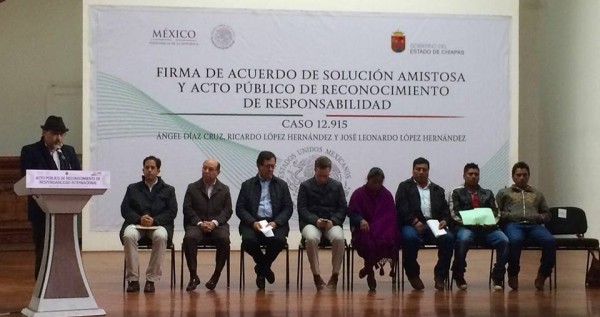
Pedro Faro, Director of Frayba (speaking), government officials and the victims (the 4 on the right) at the public apology.
By: Angeles Mariscal
Ever since military personnel arrived in Chiapas in 1994 to carry out actions against the Zapatista National Liberation Army (EZLN), the human rights violations increased: Frayba
The federal government asks the parents of Angel, Ricardo and José, victims of the explosion of a military grenade, for public forgiveness. Representatives of the Armed Forces refused to attend the event, whose realization was brought about with the intervention of the Inter-American Commission on Human Rights (IACHR).
Angel Díaz Cruz, just 9 years old, died from the impact of an anti-personnel grenade that Mexican Army personnel had “forgotten” some 500 meters away from El Aguaje community, in the municipio of San Cristóbal de las Casas. Ricardo and José López Hernández were injured.
The acts occurred in September 2000. Now, 15 years later, the Mexican government held a public act of recognition of the Mexican State’s responsibility, and asked the family members of the victims for forgiveness.
The big absence at the event, were any representatives from the Armed Forces, whose members utilized a piece of land as a training field that the El Aguaje community used to collect mushrooms and to graze their flocks of sheep.
“The only thing that these poor children did lo was to look for mushrooms to eat.” They saw the grenade and thought it was a toy, and they brought it inside of the house where it exploded, explained the father of Ricardo and José, who also spoke in the name of Cristina Reyna Cruz López, Angel’s mother.
“My family and the residents of El Aguaje are now obliged to live with all kinds of noises provoked by the explosives, the mortars and the machine guns, which provoked a lot of fear,” he remembered.
The family of the injured boys and of Angel denounced the act to judicial authorities. The Military Prosecutor’s Office demanded jurisdiction over the investigations and beginning at that moment access to the record was closed to the family and its representatives, without reparations being made for damages or medical attention being given to the two survivors.
With help from the Fray Bartolomé de las Casas Human Rights Center (Frayba), the family took the case to the IACHR, which after several years of investigations, concluded that the Mexican government was responsible for not carrying out its practices in sage zones far from the civilian population, and that it denied the victims access to justice upon bringing the case to military jurisdiction.
According to the Mexican government, Infantry Major Raúl Anguiano Zamora and Lieutenant Emilio Sariñana Marrufo were arrested for these acts. The families don’t know what the penalty given to them was because they were never notified of the process.
The IACHR asked the government and the victim to reach an agreement for an amicable solution, which includes the public apology that took place today, and that Homero Campa Cifrián, Assistant Secretary of Human Rights for the Secretariat of Governance gave, as well as the Governor of Chiapas, Manuel Velasco Coello.
Homero Campa reported that the families would be indemnified for the damages and that a school will be constructed in El Aguaje that carries the name of Angel Díaz Cruz.
Pedro Faro, current director of the Frayba, explained that the IACHR has had to intervene in three other cases where the Mexican Army has violated the human rights of Chiapas residents, in situations that include the torture and homicide of civilians where arrive to set up their camps.
He explained that ever since military members came to Chiapas in 1994 to carry out actions against the Zapatista National Liberation Army (EZLN), human rights violations have increased.
Faro emphasized that despite the fact that the Mexican government has committed to stop human rights violations, the Mexican Army has maintained contrary. “Today we lack the principal character of this story (…) The Mexican Army is not present because it is untouchable in Mexico; it’s clear to us that it is a supra power to civilian government,” he emphasized.
For his part, José López Cruz demanded that the agreements the Mexican government signed today “are totally fulfilled.”
——————————————————————-
Originally Published in Spanish by Chiapas Paralelo
Friday, January 29, 2016
Re-published with English interpretation by the Chiapas Support Committee
Oxchuc: From a postelectoral conflict to a social one

Protesters paint: “Maria Gloria Out” on Oxchuc municipal building.
By: Isaín Mandujano
The Oxchuc Rebellion…
Many weeks ago Oxchuc went from being a post-electoral conflict to being a social conflict.
The post-electoral protest that the ex-candidates for mayor of the Nueva Alianza and the Chiapas Unido started after the July 19, 2015 elections was rebuffed in the beginning by state authorities, but with the passing of months spread like foam.
Little by little more and more of the 115 communities that make up the Tzeltal Indigenous municipio (county) of Oxchuc added themselves to the protest.
The entire town rose up to put an end to the political bossism (cacicazgo) that the husband and wife Norberto Sántiz López [1] and María Gloria Sánchez Gómez have maintained for more than a decade, all with the support of the PRI and now of the PVEM.
According to the Institute of Elections and Citizen Participation Ciudadana (IEPC, its initials in Spanish), María Gloria Sánchez Gómez won at the ballot box in accordance with the local and federal tribunals. But the residents are convinced that if she won if was not cleanly and transparently. She did everything in the purest style that characterizes the PRI and the PVEM, bullying and conditioning delivery of government aid, buying votes, busing in voters, stuffing ballot boxes, cloning ballots, etcetera.
From the Secretary General of Government, all of the PRI structure incrusted in important positions moves and covers up for Norberto Sántiz López and María Gloria Sánchez Gómez, who started a political boss system in that municipio dating from the time of ex-governor Roberto Albores Guillén. [2]
They support and defend her insistently from the Government Palace. They don’t leave María Gloria and her husband alone. They defend their interests, the political interests, the economic interests and those of her party.
For the time being, those in the General Ministry of Government are looking for someone to blame in order to hide their inefficiency. They accuse the PVEM’s local deputy, Cecilia López Sánchez, of being behind it and she has firmly denied that accusation. Nevertheless, they now want to take away immunity.
State authorities believed that it was going to be easy to sway and negotiate with Oxchuc’s residents. They thought that it would be the same as with the Chamulas, that offering them municipal government posts and public works would silence them.
In Oxchuc they are decided to not let them govern more. The entire population said: “Ya basta!”
And as the days pass the movement doesn’t diminish, it gets stronger. The most recent support is from the parents of the 43 Ayotzinapa disappeared. And, many other local social groups locales now start to come and give them backing.
That’s because what was started here was a fight against political bosses [caciques) that proliferate in the majority of the 122 municipios de Chiapas just like they do in Oxchuc. Oxchuc is just the tip of the iceberg of all the conflicts that are there and haven’t yet broken out.
The State Congress del Estado resists letting her fall and installing a municipal council as residents demand.
We’ll see how much more time passes and how it continues to grow.
“It’s no longer post-electoral, but rather social as many people lead it, since the communities of this municipio have expressed their opposition in a single voice and demand the immediate dismissal of Sánchez Gómez and her town council,” says Oscar Gómez López of the Permanente Commission of Justice and Dignity of Oxchuc.
—*—
Translator’s Notes:
[1] Norberto Sántiz López was a former mayor of Oxchuc. Agents of Mexico’s Attorney General arrested him as he was trying to leave the country in 2005. The charges against him were related to misappropriating municipal funds for his personal enrichment. He was also alleged to be the leader of a paramilitary group known as the “Anti-Zapatista Revolutionary Indigenous Movement” (Movimiento Indígena Revolucionaria Antizapatista, MIRA). Before going to prison, Santiz López arranged for his wife to replace him as mayor. Her installation was widely publicized as the election of Mexico’s first Indigenous woman mayor.
[2] Roberto Albores Guillén was appointed substitute governor of Chiapas on January 7, 1998. His predecessor had been forced out following the Acteal Massacre. He remained interim governor until December 2000 when his successor took office. Albores Guillén did a lot of anti-Zapatista stuff and is the ex governor the Zapatistas call “Croquetas” (Dog Biscuits).

See also: http://compamanuel.com/2016/01/13/66-police-injured-in-oxchuc-chiapas-confrontation/
Originally Published in Spanish by Chiapas Paralelo
Monday, January 18, 2016
Re-published with English interpretation by the Chiapas Support Committee
Zibechi: A Left for Century XXI
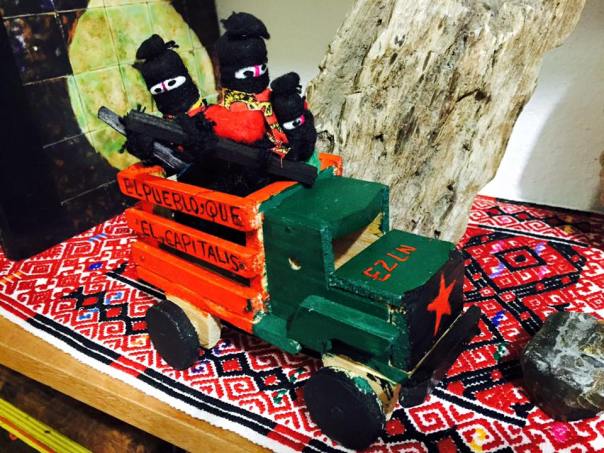
Zapatista paraphernalia on display
By: Raúl Zibechi
In the ‘60s and ‘70s, those who joined the militancy often heard a phrase: “Being like Che.” An ethic was synthesized with that, a conduct, a mode of assuming the collective action the personage inspired that –with the delivery of his life– became the compass for a generation.
“Being like Che” was a motto that didn’t expect militants to follow point-by-point the example of someone who had become an inescapable reference. It was something else; not a model to follow, but rather an ethical inspiration that implied a series of renunciations in the image and resemblance of Che’s life.
Renouncing comforts, material benefits, including the power won in the revolution, being willing to risk your life, they are central values in the heritage that we call “Guevarismo.” For a good while, those were the axes around which a good part of the leftist militancy, at least in Latin America.
That left was defeated in a brief period that we can situate between the State coups of the 1970 and the fall of real socialism, a decade later. It didn’t come out of the big defeats unscathed. Just as the fall of the Paris Commune was a parting of waters, according to Georges Haupt, which led the lefts of that epoch to introduce new themes on their agendas (the party question moved to occupying a central place), the defeats of the Latin American revolutionary movements seem to have produced a fissure in the lefts at the start of the 21st Century.
It’s still very early to make a complete evaluation of that turn since we are at the beginning of it and without sufficient critical distance and, above all, self-criticism. However, we are able to advance some hypotheses that connect those defeats closely with the current conjuncture we experience.
The first is that we’re not talking about turning back the clock to repeat the old errors, of which there were many. Vanguardism was the most evident, accompanied by a serious volunteerism that impeded comprehending that the reality we sought to transform was very different than what we thought, which led to underestimating the power of the dominant classes and, above all, to believing that a revolutionary situation existed.
But vanguardism didn’t cede easily. It is solidly rooted in the culture of the lefts and although it was defeated in its guerrilla version, it seems to have mutated and remains alive as much in the so-called social movements as in the parties that pretend to know what the population wants without the need of listening to it. A large part of the governments and progressive leaders are good examples of the perseverance of a vanguardism without a proclaimed vanguard.
The second has a relationship to the method, armed struggle. The fact that the generation of the 60s and 70s had committed gross errors in the use and abuse of violence is not saying that we have to throw everything out. We remember that at least in Uruguay it was thought that: “action generates conscience,” thus granting an almost magical ability to the armed vanguard for generating action in the masses only with its activity, as if the people could act by mechanical reflexes without the need for organizing and preparing themselves.
The armed organizations also committed indefensible atrocities, using violence not only against their enemies, but often also against their own people and also against those compañeros that presented political differences with their organization. The assassinations of Roque Dalton and Comandanta Ana María, in El Salvador, are two of the gravest deeds inside the rebel camp.
However, that doesn’t mean that we don’t have to defend ourselves. We must not go to the opposite extreme of trusting in the system’s armed forces (as the Vice President of Bolivia points out), or strip the repressive forces of their class character. The examples of the EZLN, of the Mapuche people of Chile, of the Indigenous Nasa Guard in Colombia and of the Amazonian Indigenous of Bagua in Peru demonstrate that it’s necessary and possible to organize collective community defense.
The third question is the most political and also ethical. Within the legacy of Che and within the practice of that generation, power occupies a central place, something that we cannot deny, nor should we. But the conquest of power was for the benefit of the people; never, never for one’s own benefit, not even for the group or party that took state power.
There is an open discussion about this theme, in view of the negative balance of the exercise of power by the Soviet and Chinese parties, among others. But beyond the errors and horrors committed by the revolutionary powers in the 20th Century, even beyond whether or not it’s convenient to take State power in order to change the world, it’s necessary to remember power was considered a means for transforming society, never an end in itself.
There’s a lot of cloth to cut about this issue, in view of the brutal corruption encrusted in some progressive governments and parties (particularly in Brazil and Venezuela), questions that few now dare to deny.
The left that we need for the 21st Century cannot but help to have present the history of past revolutionary struggles. It’s necessary to incorporate that motto “being like Che,” but without falling into vanguardism. A good update of that spirit can be: “everything for everyone, nothing for us.” The same thing can be said of the “to govern obeying,” which seems like an important antidote to vanguardism.
There is something fundamental that would not be good to let escape. The type of militants that the 21st Century left needs must be modeled by the “will to sacrifice” (Benjamin). It is evident that the phrase sounds fatal in the current period, but we cannot obtain anything without doing away with that tremendous fantasy that it’s possible to change the world voting every five years [or four] and consuming the rest of the time.
————————————————————
Originally Published in Spanish by La Jornada
Friday, January 22, 2016
Re-published with English interpretation by the Chiapas Support Committee
Mexico suffers an epidemic of disappearances
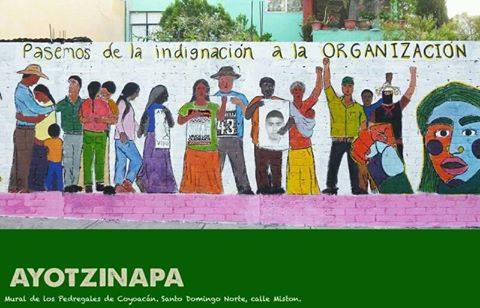
We went from indignation to ORGANIZATION.
By: José Antonio Román
An epidemic of disappearances exists in Mexico, fed by the government’s “incompetence, inertia and indolence,” which has been more worried about giving “entirely political responses” than about designing real and articulated efficient public policies for confronting that phenomenon, Amnesty International (AI).
Upon presenting the report Treated with indolence: the state’s response to disappearance in Mexico, the international human rights organization emphasized that almost half of the 27,600 people disappeared or not located, according to official numbers, have been reported during the administration of president Enrique Peña Nieto; 3,425 of them in 2015.
AI points out in the 52-page document that many cases derive from detentions by members of the Army or police, and the fact that Mexico lacks a registry of apprehensions “permit the authorities to deny all responsibility and wash their hands of it.”
It warns about the urgency with which the Mexican State recognizes the magnitude of the problem and fully assumes its duty to investigate all the cases of disappearance and enforced disappearances that occurred in the country, and of bringing those responsible before justice, adhering to due process guaranties, as well as assuring access to integral reparations for the harm to all the victims and their family members.
In the report, AI chose two emblematic cases that demonstrate various facets of the problem. One case is that reported in recent years in Ciudad Cuauhtémoc, Chihuahua, where 351 people have disappeared since 2007; 1,700 people have disappeared in the entire state.
The other case is that of the 43 students from the Raúl Isidro Burgos Rural Teachers College, of Ayotzinapa, Guerrero.
“In Mexico it doesn’t matter whether a disappearance is treated as a hidden situation or is a high profile case, the authorities seem incapable of giving a solid and institutional response that may lead to finding the truth and guarantying justice,” the report presented officially yesterday at the Memory and Tolerance Museum points out.
Amnesty International points out that the incompetence that affects the whole system and the total absence of will from state and federal authorities to investigate the disappearance of thousands of people and dutifully look for them feed a human rights crisis of epidemic proportions.
“The incessant wave of disappearances that has seized Chihuahua and the total lack of responsibility with which the investigation into the enforced disappearance of the 43 Ayotzinapa students is being managed show the Mexican authorities absolute disrespect for dignity and human rights,” asserted Erika Guevara-Rosas, director of Amnesty International’s program for the Americas.
It emphasized that in many cases of denounced disappearances the victim was last seen when members of the police or the Army detained him. Nevertheless, “the Mexican government lacks a detailed registry of detentions, which permits the authorities to deny all responsibility and wash their hands of the commission of enforced disappearances.”
As a result of an investigation, as well as interviews and testimonies from family members of the victims in the case of Ciudad Cuauhtémoc and that of Ayotzinapa, AI assures having established that in neither of them has the search for the disappeared been adequate and well planned.
In both situations, it adds, the authorities have been irresponsible in the way in which they manage the case information.
They also observed that the treatment that the authorities in charge of the investigation give the families is insufficient, hurtful and profoundly disinterested.
The report concludes with 21 recommendations for the Mexican State in the legislative ambit, the search for those disappeared and investigation of the facts, integral repair of the harm and other public policy matters.
———————————————————–
Originally Published in Spanish by La Jornada
Friday, January 15, 2016
Re-published with English interpretation by the Chiapas Support Committee
San Francisco Teopisca defends its land
AFTER 19 YEARS OF DEFENDING THEIR LAND, PROVOCATIONS CONTINUE AGAINST SAN FRANCISCO TEOPISCA, AN ADHERENT TO THE SIXTH
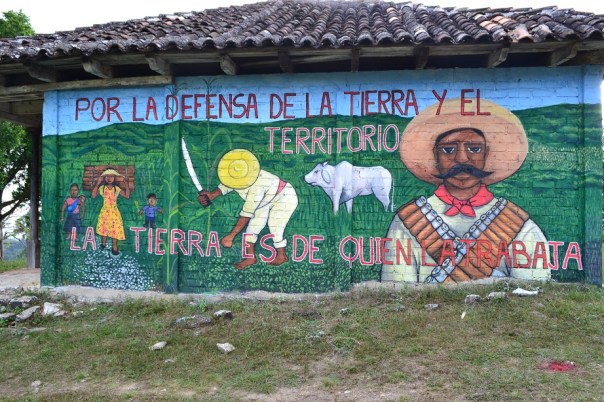
San Francisco Teopisca, Chiapas, Mexico.
“We place responsibility on the 3 levels of government for what can happen to any one of our compañeros for not giving priority to our land demands that we demand as campesinos. We also place responsibility on Señor Pedro Hernández Espinoza for any physical harm that any of our compañeros may suffer.” (Campesinos and campesinas of San Francisco, municipio of Teopisca, Chiapas México, January 10, 2016.)
To the EZLN
To the CNI (Congreso Nacional Indígena, National Indigenous Congress)
To the adherents to the Sixth Declaration of the Lacandón Jungle
To the alternative communications media
To the human rights defenders
To national and international society
We are a group of men and women adherents to the Sixth Declaration of the Lacandón Jungle since 2009, when we started in the struggle as the Other Campaign. Currently, we are part of Semilla Digna (Dignified Seed), which is a group formed by communities of the Sixth in Chiapas, belonging to the CNI. Our struggle is the defense of land and territory.
In 1995, we campesinos started to take steps with the state government of Chiapas to legalize the piece of land called “El Desengaño,” approximately 170 hectares (421 acres) owned by Pedro Hernández Espinoza. But the government never gave us a solution to our need for land. Much time passed and we saw that it was impossible that the government would attend to our request. We decided to occupy these lands because we have the legitimate right being the original peoples and the right to free determination as Convention 169 of the ILO points out.
We have been defending these lands for 19 years, organizing men and women and after several years we decided to formally work these lands. In 2012, we placed a banner on which it says that these lands are ours for the reasons mentioned on March 24, 2014. We placed various hand-painted signs (letreros) to declare and demand our legitimate right. On July 19, 2014, we declared ourselves to be in formal possession of “El Desengaño.”
On September 24, we campesinos once again pronounced that we would continue working it. We, the campesinos of this San Francisco group, have been looking for the most kind and peaceful way to dialogue with Señor Pedro Hernandez Espinoza. We have extended various invitations in various ways, but he never accepted or fulfilled any invitation we made. Now, Señor Hernández Espinoza animals are kept in a smaller space and we gave him 5 days to come and take them out, because we hold to our word that we don’t want the animals, WE WANT THE LAND.
We place responsibility on the 3 levels of government for what could happen to any of our compañeros because of not giving priority to our demands for the land that the campesinos urgently need. We also place responsibility on Señor Pedro Hernández Espinoza for any physical harm that any of our compañeros may suffer.
Sincerely,
Organized Group of Teopisca, Chiapas, Mexico
Adherents to the EZLN’s Sixth Declaration
Members of Dignified Seed, a space for struggle
Members of the National Indigenous Congress
NEVER MORE A MEXICO WITHOUT US
—————————————————–
Originally Published in Spanish by: Pozol Colectivo
Monday, January 11, 2016
Re-Published with English interpretation by the Chiapas Support Committee
Zibechi: From the Bagua Massacre to autonomous government
By: Raúl Zibechi
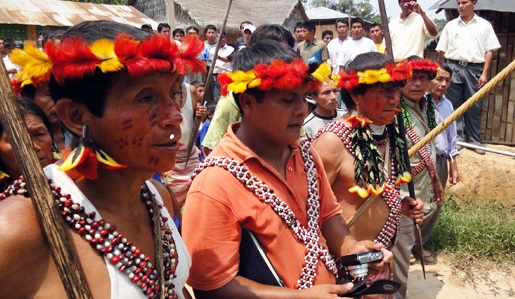
The formation of Peru’s first autonomous government, on Sunday, November 29 in Soledad community in the Río Santiago District, in the Amazon Province, is the fruit of a long history of frustrations and struggles. That day, 300 representatives from 85 Wampis communities installed their self-government as a way to defend 1.3 million hectares (3.2 million acres) of forests from the extractive multinationals.
They elected the first president of the autonomous territorial government and the 80 members of their parliament, which is to be installed in February. The newspaper Lucha Indígena (Indigenous Struggle), directed by Hugo Blanco, advanced the news in its July edition pointing out: “Appealing to autonomy as a way of solving problems is something novel in the country, but it is present in various indigenous nationalities of other countries. We hope that this will be the start of a new way of behaving from our social movements.”
The immediate background for the installation of the autonomous government was the Wampis Summit on Integral Territory and Autonomous Governance held last June 29-30 in Nueva Alegría community, where 120 representatives of the communities close to the Morona and Santiago Rivers met, in Northern Peru near the border with Ecuador. In that meeting they debated the internal situation of the Wampis people, approved the Autonomous Statute of Territorial Government of the Wampis Nation, designated a commission for the constitution of the government and presented the project of the biological corridor in their territory.
The nine-page document is the traditional text of the indigenous peoples, where below three pages of print appear another six replete with signatures, seals and even fingerprints that put the mark of approval on what was agreed, community by community, completing the ritual of big decisions. It’s a sample of the democracy of those below.
In the first part, the document titled “Act of Validation of the Autonomous Statute of Territorial Government of the Wampis Nation” analyzed the weaknesses in the communities and organizations. It emphasizes the threat that the presence of oil, mining and lumber companies represents to the people, and defends the union for “asserting our rights with the State and the private sector.” The Statute approved consists of 61 articles and three temporary articles whose contents were amplified during the debate, while others were left out.
Among the agreements figures the rejection of the entry of extractive companies without consultation, “not permitting that other indigenous organizations continue emerging since we are preparing to install our own government structure.” This exclusion is justified in the affirmation of sovereignty and self-determination in the face of State’s interference, international cooperation and the NGOs that usually promote the formation of organizations outside the control of the communities in order to weaken the indigenous nation’s project.
Finally, the meeting set the dates of November 28 and 29 for installing the autonomous government, as effectively was done.
The distant background implies going back to the decade of the 1970s when the Aguaruna-Huambisa Council, made up of Awajún and Wampis (names in the language of these warring communities), was formed around 1977. That signified a profound change in the history of the peoples. Representatives of the communities coming from the Cenepa, Nieva, Marañón and Santiago Rivers went to the first General Assembly.
It was the first occasion on which both peoples overcame their historic rivalry to confront external threats. Later would come a long period of resistances more or less open, more or less implicit, as so many native peoples of this continent have lived.
On June 5, 2009, a massacre took place against the Awajún and Wampi that had been mobilizing against decrees of the Alan García government that delivered their wealth within the framework of the FTA with the United States. The government sent the armed forces to dislodge a peaceful protest that lasted 57 days focused in the jungle regions of five departments (states): Amazonas, Cusco, Loreto, San Martín and Ucayali. Three MI-17 helicopters flew over the highway that joins the jungle with the Pacific at Devil’s Curve, which some five thousand Awajún and Wampis occupy. They launched tear gas at the crowd the (although other versions say that they also fired machine guns) while police attacked the blockade on land, firing their rifles.
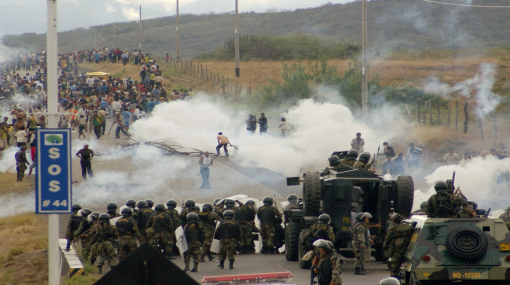
Police officers take up positions against native people in Bagua province June 5, 2009. The death toll rose on Saturday after Peruvian security forces battled native Indians in clashes that highlighted opposition to exploration in the Amazon and could threaten Peru’s investor-friendly government. Nine police officers held hostage by the protesters were killed and another 22 were freed by troops in a rescue operation, National Police Chief Miguel Hidalgo told Peru’s RPP radio broadcaster. He said seven other hostages were missing. Picture taken June 5, 2009. REUTERS.
The Bagua population went out in the streets in support of the indigenous, setting state and local institutions of the officialist (pro-government) APRA party on fire. Dozens of indigenous were dead because of the soldiers and a still undetermined number were disappeared. Several police were dead because of the indigenous. The Prime Minister Yehude Simón, a former ally of the armed group MRTA (Tupac Amaru Revolutionary Movement), classified the indigenous demands as “whims.”
The decision to form their self-government can be a decisive step for Peru’s popular struggles. In the case of the Wampis it seems the corollary of a long path on which they comprehended that you can’t expect anything from those above.
—————————————————————–
Originally Published in Spanish by Desinformemonos
Monday, December 7, 2015
Re-published with English interpretation by the Chiapas Support Committee
Zibechi: Movements facing the end of the democracies
By: Raúl Zibechi
In his first 2016 article, the winner of the Nobel Prize for Economics, Paul Krugman, analyzes the consequences of the domination of the oligarchy’s money in his country’s political system. Under the title “Privileges, pathology and power” (The New York Times, January 1, 2016), he maintains that: “the rich are, on the average, less likely to show empathy, with respect to the norms and laws, even more likely to be unfaithful, than those that occupy the lower rungs on the economic scale.”
It’s not just about a social and cultural condition, even less about a spiritual tendency. He centers his analysis on the answer to a key question: “What happens to a nation that grants greater political power all the time to the super rich?”
The answer is pearled from examples. Half of the contributions to all candidates in the first part of the 2016 electoral campaign come from less than 200 wealthy families. Those kinds of families have children whose behavior Krguman classifies as “spoiled egomaniacs” whose best example is the candidate that marches at the front of the Republican gang, Donald Trump. In his opinion, he could have been “a blowhard and a bully” in any place he occupies, because “his billions permit him to evade the controls that impede the majority of people from releasing their narcissistic tendencies.”
Another example: Sheldon Adelson, is a magnate of Las Vegas games of chance, accused of links to organized crime and the business of prostitution. To block his court proceedings, he bought Nevada’s largest newspaper, displaced the print version, told the reporters to start monitoring all activity of three judges of the court in charge of his case and allegedly started to “publish negative reports about the judges.” The multi-millionaire Adelson started to play an important role inside the Republican Party from his Las Vegas bastion, which he uses as an electoral platform.
Krugman talks about an oligarchy that has taken possession of politics. It can be said that this is nothing new and that there are only a few analysts that agree with that judgment. Paul Craig Roberts, former assistant secretary of the Treasury in the Ronald Reagan government, maintains that the collapse of the Soviet Union in 1991 provoked an explosion of arrogance in the United States elites that carried the neo-conservatives to control of the country’s foreign and domestic policy. The repeal of internal financial regulation and the tendency to lead the world towards nuclear war at the international level are some of the most ominous consequences of this systemic turn.
For the popular movements, the problem does not consist only in establishing that up there above they have lost direction, since they don’t have either contact with society or the least bit of interest in that society’s survival. Only money interests them, the non-stop accumulation of wealth, even at the price of the destruction of life. Our problem is what to do with an electoral system that has been converted into the political system’s only public rite that really exists. Although the majorities know that the elections are rigged, that fraud is systematic (before, during and after the emission of the vote), that although they get to elect the lesser of the evils (if one exists) nothing fundamental is going to change, there are many below that still believe their best path is to improve the current situation.
I think that the recent comunicado of the EZLN, on January 1, gives us some clues about how to get out of this involuntary situation that leads to the hegemonic political culture. The text that Subcomandante Moisés read in Oventic, emphasizes that the standard of living of the Zapatista communities is very superior to what they had 22 years ago, when the open rebellion started, and better than that of the communities related to the government. “Selling out to the bad government not only did not resolve their needs, but rather added more horrors. Where before there was hunger and poverty, now hunger and poverty continue, but there is also despair.”
While the party members have been converted “into groups of beggars that don’t work, they just wait for the next governmental program,” the Zapatistas are not only known for using the paliacate but because they know how to work the land and take care of their culture, because they study and they also respect women, for their dignity. The Zapatistas have “the clean and lofty view,” they consider the autonomous government as a service and govern collectively.
The Zapatistas don’t expect solutions to come from above; for 22 years, the comunicado says, “we have continued constructing another way of life” that includes self-government. I believe the key is here. Even the most renowned members of the system, like Krugman, recognize that everything is rotten up there above. We know that and it’s good to remember it.
But we still lack constructing that other way of living: being capable of governing ourselves. Above all, we still lack believing that we are capable of doing it and, therefore, starting to do it. The new political culture won’t come from books or from declarations: it emerges from collective work with others.
——————————————————————–
Originally Published in Spanish by Desinformemonos
January 4, 2016
Re-Published with English interpretation by the Chiapas Support Committee
 Chiapas Support Committee