Chiapas Support Committee
Home of the Compañero Manuel blog on zapatistas & mexico
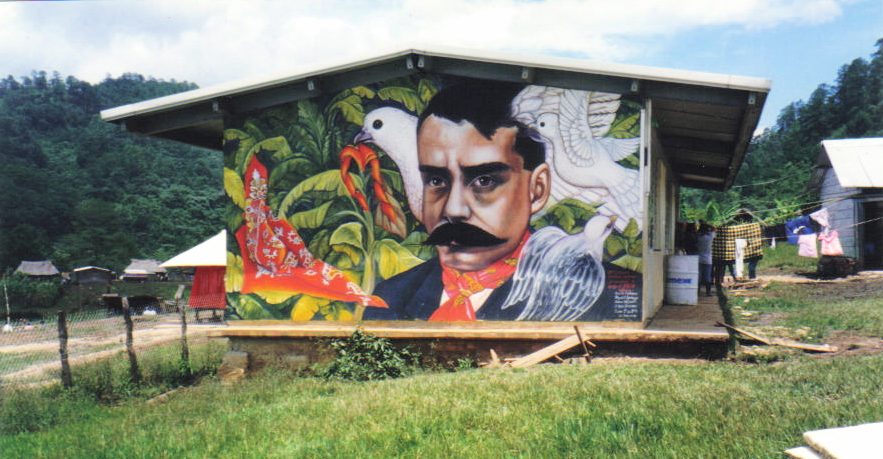
One of the EZLN’s founders dies of Covid-19
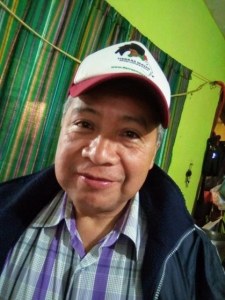
The body of Gómez Álvarez, who spoke Tzotzil, Tzeltal and Chol, was cremated this Saturday in Tuxtla Gutiérrez. Photo: Courtesy of his family
By: Elio Henríquez
San Cristóbal de Las Casas, Chiapas
Hidadelfo Gómez Alvarez, (Frank), one of the founders of the Zapatista National Liberation Army (Ejército Zapatista de Liberación Nacional, EZLN) on November 17, 1983, died in this city from Covid-19, his family members reported.
They said that the former insurgent lieutenant, 57, died Saturday afternoon in the Covid-19 clinic installed in the area known as La albarrada, located in southern de San Cristóbal, after being hospitalized for 18 days.
Socorro, his compañera for life, related that Gómez Alvarez was born December 20, 1962 in Lázaro Cárdenas, Huitiupán municipality, located in northern Chiapas.
She said that Frank left his community to find work in San Cristóbal when he was 12, and started to participate in political activities when he was between 16 and 17, which led him to form part of the National Liberation Forces (Fuerzas de Liberación Nacional, FLN), which gave origin to the creation of the EZLN.
Some of his friends remember that he was the principal link for the FNL leaders to make contact with the majority of the most important Zapatista political cadres that were formed in the 1980s of the last century.
On November 16, 2004 he told this newspaper how the EZLN was founded in the Lacandón Jungle. “The founders are German, Elisa, Rodolfo, Javier and Frank,” the latter three, indigenous. [1] First, the prior work of exploration was done for a year, with people in communities” located in Ocosingo.
“On November 15, we left from Ocosingo, the municipal capital, at night in three-ton trucks. We slept in Rómulo Calzada, several kilometers from the mountain. The driver returned. We crossed the Jataté River on the 16th as 6 am and ate breakfast in La Sultana, where a contact was already waiting for us,” he said.
And he added: “Then, with the load on horses, we walked slowly, in khaki uniforms and with pistols and rifles kept in sacks. On the way we met people and when they asked us who we were, we would say we were from Pemex (Petróleos Mexicanos), and that we were going to explore deposits in various communities.”
He said that on the 16th they walked all day and they crossed through Lacandón Jungle communities; that day they slept on the outskirts of Laguna Santa Elena. “Up to there we were eight people because three indigenous Chols who live in the San Quintín Canyon (Ocosingo) were with us as guides.”
On the night of the 16th, he continued, they slept between Guadalupe and El Calvario and on the 17th, only the five founders entered the mountain to camp.
“The first camp where we founded the EZLN on November 17, 1983 was called La Garrapata (the Tick). We spent three days there to heal the blisters and for the swelling of our feet to go down and to explore the area so as to reach the Río Negro, which was our guide for entering into the heart of the jungle.”
He stated that their foods were canned, plus pozol, pinole and tostadas. “The first nights we didn’t light a fire so as not to call attention. It rained a lot. Some read war manuals and others chopped (to open a gap).”
He said that later they abandoned La Garrapata and moved on to the Río Negro, located a day’s walk away. Some stayed for several weeks at that site and others, the 3 indigenous, went out to the communities to continue organizing the population, to buy provisions and wait for the arrival of equipment. “A few were focused on military formation and others on the political.”
In 1989, when the EZLN was already formed, Frank was one of the leaders of the Emiliano Zapata Independent Campesino Alliance (ACIEZ), the rebel group’s political arm, and in 1991 he organized a congress in Puebla, where the Emiliano Zapata Independent Campesino National Alliance (Alianza Nacional Campesina Independiente Emiliano Zapata, ANCIEZ) was born.
When war broke out in Chiapas in January 1994, he was in Oaxaca, where he was doing political work. He left the ranks of the EZLN in 1997 due to political differences.
“He devoted all his youth to the movement. And of what use was it later,” commented his compañera, with whom he installed a cafeteria in San Cristóbal years later, which has been maintained to date. Since then he called himself Manuel.
The body of Gómez Álvarez, who spoke Tzotzil, Tzeltal and Chol, was cremated this Saturday in Tuxtla Gutiérrez and his ashes were moved to the place in which the cafeteria that was his property functions, where family members and friends came to participate in traditional prayers and ceremonies.
This Sunday, his remains were taken to Lázaro Cárdenas, his birth community, where his parents le organized prayers and indigenous rituals that are customary in that Tzotzil region. After a few days the urn will return to San Cristóbal de las Casas.
[1] Frank‘s account of five people being the original founders of the EZLN differs from that of Subcomandante Galeano (formerly Marcos), who says there were 6 original founders. Researchers on FLN/EZLN history all document that 6 FLN members entered the Lacandón Jungle on November 17, 1983 to found the EZLN.
———————————————-
Originally Published in Spanish by La Jornada
Sunday, July 26, 2020
Re-Published with English interpretation by the Chiapas Support Committee
Indigenous in Aldama, Chiapas, between famine and gunfire

Aldama, Chiapas
More than two thousand indigenous Tsotsiles from the municipality of Aldama sleep and wake amidst the fear of an ambush. They have written down in a notebook the 98 times they have been shot at during the last three months from a mountain adjacent to their land. In the face of the authorities indifference, on July 14th humanitarian organizations brought some beans and corn, because the famine is already reflected in their bodies.
Text and photos: Angeles Mariscal
On Manuela Sántiz Hernández, her thinness is a product of insufficient food. You can see it in her cheekbones and her body, it looks like that of an adolescent that has barely begun to develop. She is 24 years old and responsible for eight children. Three are hers and five were from her mother-in-law, who died and left five small children orphaned.
They all lived in the community of Yetón, one of the 11 hamlets where 60 hectares of land are located that their aggressors from the municipality of Chenalhó try to take from them by means of armed force.
The dispute for these lands, the villagers explain began 7 years ago, but in recent times escalated to the level that has led to the forced displacement of 115 families, a total of 2 thousand 36 people.
“One night they entered the house, put a gun to our heads and told us that we had to leave, and we left…we don’t have anything, everything stayed there, absolutely everything, our belongings, our harvests, our house. We have to start over, says Manuela.
Monday the 14th of July, in the morning, representatives of each of the 115 displaced families arrived at the municipal seat of Aldama. There, each family received a sack with corn, a little bit of beans and salt.
This food was acquired with the donation of individuals in solidarity, which were collected by the Trust for the Health of Indigenous Children (Fisanim) an organization promoted by the actress Ofelia Medina. This ration of food could last them between 15 and 20 days.
The indigenous families were grateful for the solidarity, but they reiterated, “We are going to keep fighting for those 60 hectares because they are our lands. We want them to return them to us, because it is from there that we get our food, our daily sustenance,” explained Rosa Sántiz Sántiz.
With the help of another woman translator — because Rosa speaks primarily Tsotsil — she demanded that the government “give us a solution to this conflict, because we are already tired.”
Literally tired. Rosa Sántiz Sántiz gets up at three in the morning to boil the beans and corn, prepare the tortillas that they will eat during the day, her husband and her four children. Before the sun rises, the whole family begins to walk the path that will take them from the community of San Pedro Cotzilnam to the village of Santiago El Pinar.
In Santiago El Pinar, for 80 pesos daily, they work from 7 in the morning to 4 in the afternoon in the harvest of coffee.
Rosa has the organizational and the leadership capabilities that make her one of the representatives of the commission of displaced community members; and coordinates the distribution of food. In Aldama, the displaced have organized themselves to resist the aggressions of their neighbors of Chenalhó.
The apparent dispute is over 60 hectares of adjacent land between both municipalities; but the armed civilians of Chenalhó have expelled inhabitants of Chalchihuitán, and peasants within Chenalhó. All based in armed aggression. They use, according to the shots that can be seen in the walls of the homes, high-caliber weapons and assault rifles.

“Don’t fall for provocations”
On January 23rd 2019, faced with the denunciation of the aggressions of armed civilians the federal government was forced to set up a detachment made up of federal and state police and the Mexican army.
The aggressions did not stop with this measure. The armed civilians continued shooting and to date, the displaced account for 15 wounded by firearms and 7 of their comrades murdered, among them Ignacio Peréz Girón, municipal trustee of Aldama.
A few months following their deployment, the detachment of police and military withdrew; they agreed to carry out patrols, but with the onset of the pandemic, they became sporadic, and the aggressions intensified.
In the group of displaced Martin Sántiz Sántiz is the one in charge of writing each time they are shot at from the mountains of Chenalhó. Carrying a little book where he writes the numbers, he pulls it out and counts 98 recent aggressions. The last one, a few hours before they arrived at the municipal seat to receive the food donations.
He explains that he carries that notebook to make the report that he delivers to the Chiapas Attorney General’s office. When he delivers it to them, “I always ask them how the investigations are going, and they always answer that they still need to complete the investigation.”
In the last four months -he says- they have only carried out police and military patrols once a week. “They drive along the highway, look at the place where the shots come from and then they go away. What they says to us is: keep quiet, don’t fall for the provocation.”
The Chiapas government, explains Manuel Melesio Sántiz López, another of those displaced, has offered to divide the land and relocate the affected families on a ranch located in Ixtapa municipality, a place infertile land where the prolonged use of agrochemicals has finished with the fertility of the land. However, the same authorities have suspended the process for a possible relocation.
To the contrary, at the beginning of March, the Attorney General’s Office arrested Cristóbal Sántiz Jiménez, one of the spokespersons for the displaced. To date, Cristóbal is a prisoner in El Amate Prison. With the arrest, the demand for restitution of their lands, and the halt to the aggressions, the demand for the release of the community leader is now added.
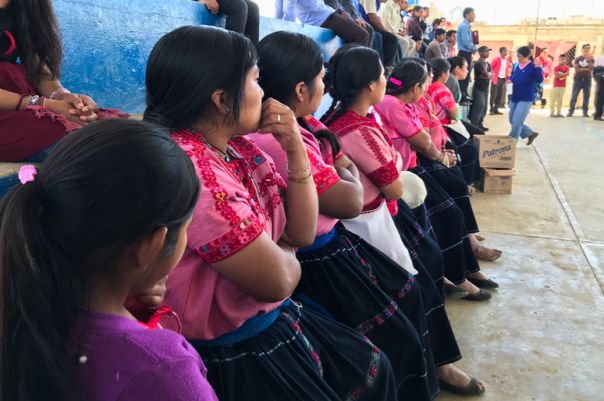
“This pandemic has complicated everything because there is a shortage of food; there is a very severe crisis economically, and of work, because in the town of Aldama we work in the countryside, we live from the countryside and we are of the countryside,” asserts Silvia, an youth from the area that has had to leave her studies to take up leadership in systematizing the problems, and serving as a link to the outside.
Denunciations of the situation in Aldama have reached the National Human Rights Commission (CNDH), the Inter-American Commission (IACHR), and the Subsecretariat of Human Rights of the Ministry of the Interior. No declaration or intervention by these bodies has served to stop the violence. In addition to the months of the pandemic, there has been famine, as displaced peasants have had difficulty finding work.
Besides humanitarian organization, specialists also worriedly watch the situation of the displaced people of the zone. Anthropologist Araceli Burguete, who knows the region well and is a member of the Center for Higher Studies in Social Anthropology (CIESAS), explains: the path to peace in Aldama is very clear. First, attend to the displaced population and the humanitarian emergency.
Video https://youtu.be/eXAW107_VNU
Also, “take effective measures to halt the violence and to give assurance to the population; disarm the aggressors, investigate and punish, and dismantle the armed groups. These are minimal measures that can contribute to restoring peace and the coexistence between two communities of ancestral tradition in this territory.”
But, as a matter of urgency, “prevent more deaths of the defenseless population.”
A Displaced Girl is Injured
Amidst a famine situation in which 2036 indigenous people of Aldama live, a girl, María Luciana Luna Pérez, of 13 years of age, was shot twice by a firearm as she was embroidering in the courtyard of a home in the village of Cocó, one of the 11 locations that live under siege from armed civilians.
According to the hospital report from Aldama, María Luciana, received two gunshot wounds, one in the eye and the other in the chest. The shots came from the village of Nech’en Santa Martha Chenalhó, and were directed toward the community of Cocó Aldama.
Only last Tuesday the displaced indigenous of Aldama reported that until that day, they had counted 98 armed aggressions in the past three months by people who shot at them from adjacent mountains toward their towns.
Martin Sántiz Sántiz reported that they keep this log to make the report to hand over to the Chiapas Attorney General’s office. It detailed that since the beginning of the pandemic, the numbers of patrols of the military and police in the region have diminished. Now they only travel the main road in the region once a week, “they take a turn around the highway, look around for where the shots are coming from, and leave. What they tell us is this: You keep quiet, don’t fall into provocation.”
—————————————–
This article was originally published in Spanish in Pie de Página on the 17th of July, 2020. https://piedepagina.mx/indigenas-de-aldama-chiapas-entre-hambruna-y-disparos/ This English interpretation has been re-published by Schools for Chiapas.
Re-published with permission by the Chiapas Support Committee
Paramilitaries shoot a teenager in Aldama, Chiapas

María Luciana, the shooting victim, is cared for in a San Cristóbal de Las Casas hospital.
By: Elio Henríquez
San Cristóbal De Las Casas, Chiapas
This Friday, the Fray Bartolomé de Las Casas Human Rights Center (Frayba) reported that paramilitaries fired off shots that wounded a 13-year old teenager from Aldama municipality in her eye and shoulder.
The Permanent Commission of the 115 Comuneros Displaced from Aldama pointed out that María Luciana Lunes Pérez was shot at approximately 1:30 pm in Koko, her community. They stated that she was immediately transported to the Cultures Hospital, located in San Cristóbal, where her condition was reported as delicate.
They said that the shots came from a place known as Nech’én, belonging to the Santa Martha ejido, Chenalhó municipality, located in the Chiapas Highlands.
The Frayba, meanwhile, said that according to testimony, starting around 12:40 am on Friday, “attacks from Chenalhó paramilitary groups against the Tabak, San Pedro Cotsilnam and Koko communities intensified; the shooting with high-caliber weapons persisted until 2pm.”
The Permanent Commission of the 115 Comuneros Displaced from Aldama reported that: “the teenager María Luciana Lunes Pérez received a bullet impact in one eye and another in the shoulder, while she was working on her loom, in her house, in Koko community.”
Frayba, over which Bishop Raúl Vera López presides, assured that it has documented that: “in the last three days (July 15, 16 and 17) there were at least 28 armed attacks, of a total of 71 during in the first part of this month and 307 since March 2018.”
In an “urgent action,” Frayba expressed that “given the risk to the life, security and integrity of the population, the Frayba made 167 interventions to different state and national government bodies from March 22, 2018 to date, without having an effective response to the demand to stop the armed attacks”.
The Frayba demanded that the Mexican State: “provide and guarantee access to timely, adequate, comprehensive and urgent access to medical care to María Luciana Lunes Pérez, who is” hospitalized; adopt effective measures to protect the life and personal integrity of the population of Aldama communities.”
They demand disarming the paramilitary groups
At the same time, it demanded: “disarming and disarticulating the civilian armed groups of a paramilitary cut from Chenalhó that act without punishment under the permissiveness of the Chiapas government ” and “investigate and sanction a the material and intellectual people responsible for violence in the Highlands region and by acquiescence Chiapas government officials.”
Aldama and Santa Martha have been confronted for more than 40 years due to a dispute over 60 hectares (approximately 148 acres), which has left around 25 deaths on both sides and several injured. Both towns have been participating for several weeks in a dialogue table with state authorities to try to find a solution to the dispute, after Santa Martha proposed to Aldama dividing the [disputed] lands into equal parts to put an end to the conflict.
———————————————————
Originally Published in Spanish by La Jornada
Saturday, July 18, 2020
https://www.jornada.com.mx/2020/07/18/estados/026n1est
Re-Published with English interpretation by the Chiapas Support Committee
Change in era and ethnocide
By Francisco López Bárcenas
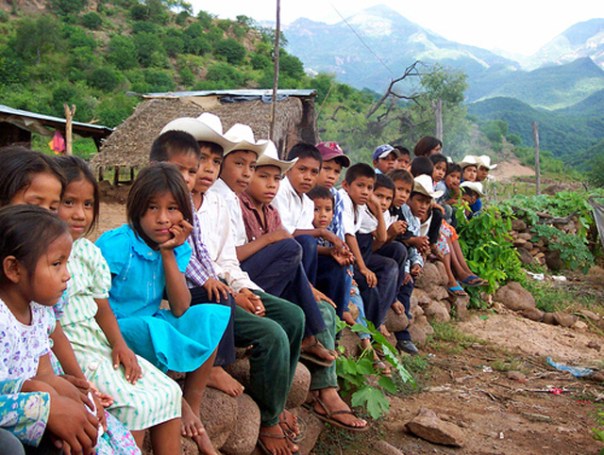
I have to tell you that I am indeed amazed. I did not think things would be like this. I believed that the Fourth Transformation (4T, Cuarta Transformación, for more on the 4T, click here, ) would imply a substantial change in the way megaprojects were developed. But no. I hope you will put on your thinking cap quickly. I ask myself: Where is the National Institute of Indigenous Peoples (INPI, Instituto Nacional de Pueblos Indígenas)? And where are all my friends who are in their offices and who haven’t done anything? The previous words were said by Armando Haro, a PhD in social anthropology and member of the Kabueruma Network (Red Kabueruma), composed of researchers from diverse academic institutes meant to support the peoples of the Mayo River, who are being affected by the construction of the Pilares dam. He pronounced these words after listening to the testimony of members of the Guarijío people, who live on the banks of the Mayo River, where the locks were closed this past July 8 so that the dam would start filling up with water.
The system for the protection of human rights, with all its advances, once again broke down in the face of economic interests. The legal protections that were won were useless, as were the complaints filed with the National Commission on Human Rights (CNDH, Comisión Nacional de los Derechos Humanos) and the request for precautionary measures made to the InterAmerican Commission on Human Rights (CIDH, Comisión Interamericana de Derechos Humanos), institutions whose function is to safeguard human rights and order their restitution when they are violated. Neither did the promise made last October formulated in public by the President of the Republic stating that works would not be built without first consulting with the affected peoples. With the forceful action of dousing them with water, families are gripped by fear and desperation. The people are quite angry and indignant by all the corruptions and impunity with which economic powers bribe and pay mercenaries to consummate the blow.
Not for less: The constructions will profoundly affect their already precarious life. The flooding will take away the tribe’s riparian eco-system and, with that, gravely undermine their bicultural relationship with their ancestral territory and sacred sites. The dammed-up waters will overtake the network of roads that for so many generations have made it possible for them to control their resources. And they will become incommunicado, no longer having clean water from the river. It will become impossible for them to plant seasonally their mahueches [medicinal plants?] and milpas [cornfields]. Their displacement is imminent. But what causes them anguish and fills the Guarijíos with fear are the immediate consequences. “They realize the summer rains are coming and that they will remain shut in. As much as we warned the ‘responsible’ offices about the case, everything seems to indicate that Mesa Colorada, Chorijoa and other nearby rancherías [settlements] will become isolated because they did not know or foresee this aspect of the ground roads being flooded.”
What the Guarijíos, in the voice of Dr. Armando Haro, denounced was the making of an ethnocide as defined by Rodolfo Stavenhagen, the first rapporteur of the United Nations on Indigenous Peoples. “The process by which a people…loses their identity due to policies designed to undermine their territory and base of natural resources, the use of their language and political and social institutions, as well as their traditions, art forms, religious practices and cultural values. When governments apply these policies, they are guilty of ethnocide.” Nothing has changed in these times of change. The government’s policies will deprive the Guarijíos of their territory, whereupon many will have to migrate and they will lose their language, their traditions, their art and, in general, their cultural values. As has happened with many Indigenous peoples affected by the construction of dams throughout history.
This is the same thing that has been explicitly recognized with the construction of the Maya Train, which for its promoters, ethnocide has a positive opposite: ethno-development. This has led the anthropologist Benjamin Maldonado to affirm that to see ethnocide as enabling ethno-development is a clear political position. There is no change in focus because the Fourth Transformation is the fourth reiteration of the same will of power. For the State, ethnocide is a form of ethno-development. From the Indigenism of Gamio to that of López Obrador this has been suffered.
The arenas of struggle have been well defined. The horizons as well. The pandemic that we suffer today and that overwhelms us all has somewhat overshadowed the changes of the times that we are living. But that they exist, they exist; and they represent a great challenge that requires intelligence and imagination to be able to overcome this crisis that we have to live through. From the state apparatus, the positions have been set. The peoples’ position, which in the end is all that counts, is being configured. Step by step, with its own time and resources, like they have done so historically. You have to learn to look at it and then not be fooled.-
———————————————————-
Originally Published in Spanish by La Jornada
Thursday, July 16, 2020
https://www.jornada.com.mx/2020/07/16/opinion/016a2pol#texto
Re-Published with English interpretation by the Chiapas Support Committee
The Maya Train and the right to Indigenous Autonomy
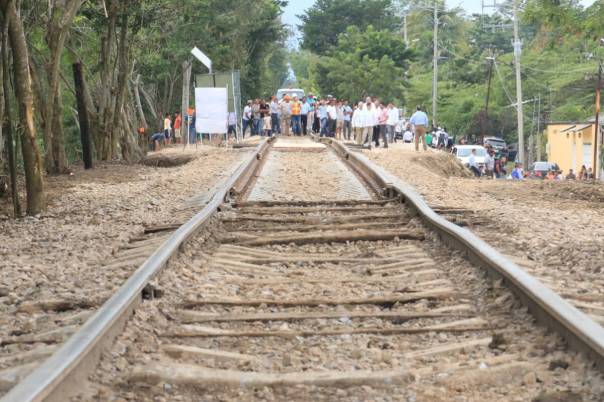
Mexico’s president, Andrés Manuel López Obrador, inspects the old Maya Train tracks.
By Magdalena Gómez
The project that is called the Maya Train is on its way and the director of Fonatur (Fondo Nacional del Fomento al Turismo, the National Fund for the Promotion of Tourism) has unfurled his strategy to outmaneuver the rights of indigenous peoples. As we know, there are Maya and human rights organizations that are taking legal and political actions to denounce the impacts of the project on their territories, caused by the so-called development poles that define it and whose blows are being omitted during the current stage.
Also, a set of collective landholder (ejidales) authorities lent themselves to support this project in the name of communities that have not necessarily been informed about the commitments being made by them. This was evident in the process of the so-called consultation that was carried out at the end of last year, where without significant participation and no prior and insufficient information on the positive and even negative impact of the project, their “consent” was obtained.
The offices of the UN High Commissioner for Human Rights noticed that in that exercise international standards on the right to carry out a consultation were not fulfilled. With this supposed “endorsement,” the bidding, adjudications and winning businesses participated with the executive branch in the banner call of the Maya Train.
The landscape is quite complex for communities and opposition organizations. They face enormous challenges, even more so with the pandemic, to mobilize and inform communities. They also face them in the legal arena where it seems that the Judicial Branch is creating a pattern in its district rulings. The collegiate court rules in favor of FONATUR and restricts the impacts of the initial suspensions that were defined in three lawsuit rulings. However, they are denouncing it. And even the Asamblea de Defensores del Territorio Maya Múuch Xíinbal (Assembly of Defenders of the Maya Múuch Xíinbal Territory) went to the Inter-American Commission on Human Rights (CIDH), requesting precautionary measures; and they also went to Mexico’s National Commission for Human Rights (CNDH).
Given that the Maya Train project had not been released, not even before the simulated consultation, we are only just seeing official evidence of the FONATUR strategy, while partial, in reference to phase I of the train. The institution decided to present its environmental impact statement (EIS) to the Semarnat’s Dirección General de Impacto y Riesgo Ambiental (DGIRA, General Office on Environmental Impact and Risk), even though this Secretariat gave them an exemption, supposedly because it was only going to carry out the maintenance of old railways and with prior right of way.
The EIS phase I is divided in three sections: 1) Jungle 1: Palenque-Escárcega; 2) Gulf 1: Ascárcega-Calkiní; 3) Gulf 2: Calkiní-ANP Cuxtal, and Gulf 2a: ANP Cuxtal-Izamal. It is recognized that it is no longer about maintenance. The phase includes the trees that will be cut down and they will build 13 railway stations in the 631.25 kilometers of the line, 146 vehicular passes, 24 viaducts, three maintenance stations, a maintenance workshop, 40 passes for fauna, drainage works and two cargo loading stations in Candelaria and Campeche.
The document is riddled with statements and, in the case of indigenous rights, it transforms them into authentic rhetorical and regressive speech. It includes international instruments, the constitutional norm of Article 2, the constitutions of the five states that the project impacts and its state laws and offers to respect each one and enumerates that there are Mayas, Tzeltales, Ch’oles, Tzotziles and others in the states of Chiapas, Tabasco, Campeche, Yucatán and Quintana Roo. These hollow statements do not recognize the right of self-determination and autonomy and in turn reflect an authentically racist and discriminatory picture.
Let’s see: “FONATUR is conscious that the protection of the indigenous peoples and communities constitutes the protection of a vulnerable group or minority. Which is to say, a group smaller in number that places them in an inferior position and who does not dominate, with challenging development of its economy and which has conserved its features that characterize it throughout time, such as its culture, race and customs; they seek to maintain their difference from the majority” (III. p. 438).
They cannot say that this position was a typo, as they argued with respect to the phrase “ethnocide can have a positive turn, ‘ethno-development’” and then “correcting” it: Ethnocide has a positive opposite, “ethno-development,” a concept that refers to public policies that went beyond assimilation or integration, but have always been foreign to the historic struggles of indigenous people. More: the allusion in the EIS to the results of the consultation does not look like proof of good faith efforts, where the great majority of indigenous people denied that there existed traditional authorities and recognized as authorities those institutions like municipal presidents and commissioners of the collective landholders (ejidales). Are they betting on ethnocide?
———————————————————–
Originally Published in Spanish by La Jornada
Tuesday, July 7, 2020
https://www.jornada.com.mx/2020/07/07/opinion/019a2pol
Re-Published with English interpretation by the Chiapas Support Committee
T-MEC, agriculture and neoliberalism

T-MEC is what they call the new NAFTA in Mexico. Trump calls it the USMCA.
By: Luis Hernández Navarro
The free trade hurricane devastated the Mexican countryside, ruined small and medium-sized farmers and obliged millions of campesinos to migrate to the United States or agricultural fields in northwest Mexico. The free movement of agricultural merchandise across borders, with few regulations, placed unequal parties competing in equal conditions.
Not only that. It radically upset the diet of the popular classes causing an epidemic of obesity, malnutrition and diabetes, the consequences of which surface today with the Covid-19 crisis. According to a study published by The New York Times, “in 2015, Mexicans bought an average of 1,928 calories of packaged food and drinks per day –380 calories more than in the United States–, more than people in any other country.”
The commercial opening of agriculture began before the effective date of the North American Free Trade Agreement (NAFTA) in January 1994. The free import of agricultural products went hand in hand with the dismantling of guaranteed prices and their alignment with international prices. The treaty went further, deepening this liberalization. It obliged going from a mere commercial relationship to a variegated subordinate economic-productive integration. It was the padlock that closed the door of neoliberal reforms in agriculture.
NAFTA provided a devastating blow to the cultivation of grains and oleaginous seeds. Mexico was left to the fickleness of the global market. We import more than 45 percent of the foods we consume. The United States provides almost half of them. In 2018, 23 million tons of basic grains were imported, equivalent to nearly 4 billion 910 million dollars. Some 82.2 percent of yellow corn, 86 percent of rice, 70 percent of wheat, 13 percent of beans and 39.3 percent of pork were purchased from abroad. Many of these products are leftovers. We import 6 million tons of American food waste, byproducts or residues, for human consumption.
NAFTA caused the loss of some 2 million agricultural jobs. Putting life and health at risk, those expelled from the land marched, with or without papers, to the nation of great promise. Mexico became the largest migratory corridor in the world.
Heroically, against thick and thin, the milpa campesinos have maintained the production of white corn. Supported by remittances that they receive from their relatives in the United States, they have made their economic production units trenches where they keep their seeds, productive systems and the culture associated with them alive.
As if that were not enough, peasants who are in possession of better lands, or of water, suffer the harassment of real estate agents, tourism companies and large farmers to acquire their land. And those who live in the steepest regions, suffer pressure from the mining companies that long to dispossess them of their territories and natural resources. To make matters worse, others live under the constant intimidation of drug traffickers for the purpose of using their lands for the production of narcotics.
After razing the old rural fabric, free trade constructed a new one, closely linked to production chains and US transnationals. In the new free trade normal the enclaves producing berries and avocados proliferated. With the California region experiencing a serious water problem, Uncle Sam’s packing companies moved to Mexico without having to pay environmental costs to grow the vegetables that their market demands.
Thousands of young people in western Mexico became day laborers that way, and became addicted to a kind of stone that permit them to work without rest from sunrise to sunset, while it fries their neurons.
The country became a proud exporter of tequila and beer (on the hands of transnational consortiums) and also of shrimp. Meanwhile, the once vigorous production of coffee deflated like a balloon, hit by the rust and a lack of governmental support.

If we had to put a simile of the relationship that was established with NAFTA, we would say that it’s a cheesecake in which the United States puts wheat flour, eggs, yeast, cheese, cream and butter, and Mexico contributes exotic raspberries, vanilla and sugar (as long as it’s made of cane). Far from reversing the rapacious nature of this agro-industrial vassalage, the new trade agreement between Mexico, the United States and Canada (it’s called T-MEC in Mexico and USMCA by Trump) preserves, amplifies and deepens it. It gives it another twist, obliging the Mexican State to adhere to the 1991 Act of the Convention of the International Union for the Protection of New Varieties of Vegetables (UPOV 91), which grants intellectual property rights to plant breeders –principally transnational seed corporations– and limits the use and exchange of seeds by farmers, who will not be able to replant the product of their harvest without the permission of the company that has the breeder’s right. It opens the door even further to transgenic seeds and puts native seeds and improved public seeds at grave risk.
In the agricultural terrain, T-MEC is more of the same, but worse. It’s a central instrument for oligopolies to dispossess those who have developed and taken care of campesino seeds for thousands of years of the use and control of them. It is a key piece of the neoliberal order in the region.
———————————————————
Originally Published in Spanish by La Jornada
Tuesday, July 14, 2010
https://www.jornada.com.mx/2020/07/14/opinion/018a2pol
Re-Published with English interpretation by the Chiapas Support Committee
74 Armed attacks against families displaced from Aldama, Chalchihuitán and Chenalhó
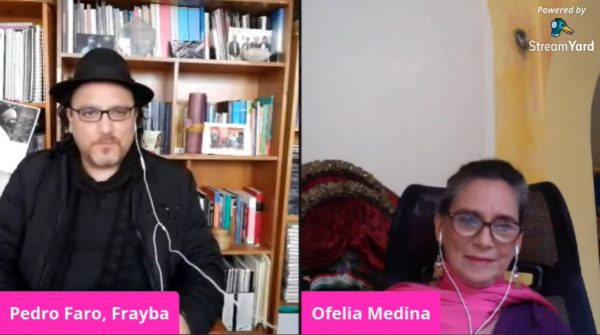
Presentation of the public letter: “Stop the violence in forcibly displaced communities in Chiapas.” Photo: Frayba.
By: Yessica Morales
In the state of Chiapas there are a total of 10,113 victims of forced displacement, paramilitary violence and armed criminal groups that are protected by officials of the state and municipal governments, moved by dark interests and dispossession.
The Fray Bartolomé de Las Casas Human Rights Center AC (Frayba), presented “Preserving life, a public letter: Stop the violence in forcibly displaced communities in Chiapas,” with the participation of Pedro Faro, director of the Frayba, and Ofelia Medina, actress and activist, with the objective of placing forced displacement into evidence, specifically in the Chiapas Highlands (los Altos).
Therefore, they announced that in the month of June and the few days of July, the Permanent Commission of 115 Comuneros and Displaced Persons of Aldama municipality reported 74 armed attacks [1] in San Pedro Cotsilnam, Yetón, Tabak, KoKo’, Xuxch’en, Tselepotobtic, Chivit and the town of Aldama, the municipal seat.
Medina read the letter written by the Frayba and the Trust for the Health of the Indigenous Children of Mexico A.C. (Fideicomiso para la Salud de los Niños Indígenas de México A.C. (FISANIM or Fideo). She expressed her utmost concern about the acts of violence and the urgency in which the people in the situation of internal forced displacement from Aldama, Chalchihuitán and Chenalhó municipalities are living.
Consequently, the organizations demanded justice and a stop to the violence that the Civil Society Las Abejas of Acteal, the Permanent Commission of the 115 Displaced Comuneros of Aldama and the Autonomous Committee of the Internally Displaced Chalchihuite denounced.
“We see with fear that the constant escalation of violence seems to have no end and in recent months the attacks with high-caliber firearms are daily. Previously they fired from distant barricades, now the shots are directly at the campesinos and comuneros when they are going to their crops,” Medina said.
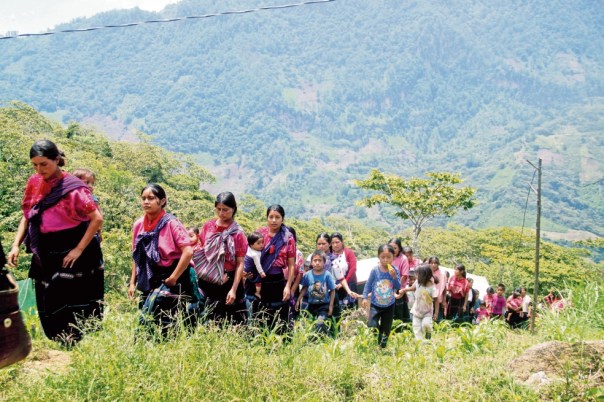
DISPLACED INDIGENOUS WOMEN of ALDAMA. PHOTO: MARÕA DE JES/S PETERS
There are currently a total of 2,036 people who are victims of forced displacement in Aldama municipality. That’s why the CNDH issued recommendation No. 71 /2019 regarding the human rights violations of personal integrity and the superior interest of children, to the detriment of the indigenous communities in Aldama municipality, as well as the loss of life of 3 victims.
The Autonomous Committee of Chalchihuite Internally Displaced denounced 8 attacks in Kanalumtik, at the Tsamtechen and Tseleltik points, the Pom community in the Chacojton section, Cruz Cacanam in Chalchihuitán, and at the Las Limas community limit with Chenalhó.
In the case of Chalchihuitán there are 1,237 people who are victims of forced displacement, the CNDH issued recommendation 87/2018 regarding the victims of internal forced displacement in different communities within Chalchihuitán and Chenalhó municipalities.
They also have Precautionary Measure No. 882-17 from the Inter-American Commission on Human Rights in favor of 10 Maya Tsotsil indigenous communities in Chalchihuitán and one in Chenalhó, which have been forcibly displaced since November 2017.
Regarding Civil Society Las Abejas of Acteal, they revealed the threats and intimidation that the 31 people displaced from Los Chorros experience constantly, besides the inefficiency of the state and municipal authorities of Chiapas, to put a stop to the violent actions in Chenalhó. Thus, Las Abejas of Acteal has precautionary measure CEDH/VARSC/MPC/ 069/2020 from the State Human Rights Commission (CEDH) in file CEDH/ 805/2019.
“The state and municipal officials have extensive knowledge of all of the above, but their response has been scant, slow, inadequate and inefficient since the situation gets worse every day,” the activist said.
In addition, the State Council for Integral Attention to Internal Displacement in the state of Chiapas has not complied with its commitment. They also know that the food emergency among the families in the situation of forced displacement is increasingly more serious.
“As human rights organizations we see the need for the State Executive Commission for Attention to Victims for the State of Chiapas to carry out urgent work to attend to the victims of forced displacement in Chiapas,” Medina said.
On the other hand, the organizations of the displaced communities have had countless meetings and agreements with state and municipal authorities; they have made trips to Mexico City to consult with authorities of the Ministry of Interior, deputies and senators.
Officials from the Undersecretary of Human Rights, Migration and Population have visited the zone, and have held meetings with municipal and state authorities, as well as with representatives of the displaced and the Frayba.
“To date there has not been a solution to the violence,” the actress added. Last May 26, FISANIM and the Frayba stated the urgent need for attention to the displaced communities; due to the pandemic they are in a state of high risk, because of the lack of health infrastructure and a food crisis.
Both human rights organizations demand a stop to the paramilitary violence in Chiapas, and that they recognize, urgently take care of and prioritize the food emergency that the people in internal forced displacement from the communities of Aldama, Chalchihuitán and Los Chorros, Chenalhó suffer.
“We launched this letter and those who are listening to us may join us in signing this letter in order to place into evidence the displacement, but also the efficiency with which the government has already effectively and thoroughly gone to the root of these critical situations that are happening to the communities and the peoples of Chiapas, due to generalized violence and paramilitary violence,” the director of the Frayba commented.
Finally, Ofelia Medina said that we must join in this petition for justice and dignified treatment in accordance with national and international standards. The treatment given to displaced persons in the State is inhumane and undignified, and therefore something must be done.
“There are many proposals, let’s unite the organizations. I am pleased to state that, thanks to the support of Civil Society, that since the conference I gave in San Cristóbal, we have already joined together to bring an offering to the families of the 115 comuneros of Aldama,” she concluded.
[1] Due to the increasing violence against these displaced families, the Chiapas Support Committee is extending our Campaign for Las Abejas: End the Famine until the end of July in order to raise additional funds for food.
——————————————————————-
Originally Published in Spanish by Chiapas Paralelo
Wednesday, July 8, 2010
Re-Published with English interpretation by the Chiapas Support Committee
Chenalhó paramilitaries fire at displaced Maya Tsotsils

Mayor of Chenalhó ambushed, his driver killed
Mayor of Chenalhó attacked, his driver killed
By: Hermann Bellinghausen
The National Guard just dismantled the barricades of the paramilitary-style civilian armed groups of Chenalhó, Chiapas, last May 31; the [paramilitaries] have returned, and so have the shots they fire at the displaced families of Aldama and Chalchihuitán who have lived in shelters and other people’s houses for many months. [1] There had been 65 barricades located in Santa Martha, and they extended to the neighboring municipality of Aldama. Some dated back many years.
In this context, the mayor of Chenalhó, Abraham Cruz Gómez, suffered an attack Monday night [July 6] in which he was injured. His driver, Efraín Pérez, died when he was transferred to San Cristóbal de Las Casas. The aggression was perpetrated near Las Minas community, in San Juan Chamula.
The mayor, from the PVEM, was returning from an official meeting in Tuxtla Gutiérrez. An agreement had been signed on June 4 between the Tzotzil municipalities of Los Altos of Chiapas, in the presence of the Undersecretary of Governance, Alejandro Encinas. However, in recent days, Cruz Gómez “accused” the neighboring municipality of Aldama of “not complying with the agreements,” and thus justifying the attacks that followed. The only aggressor gang has been the one from Chenalhó, and it has never been disarmed.
On May 27, the Fray Bartolomé de Las Casas Human Rights Center (Frayba) pointed out that it was fundamental that violence “provoked by ‘civilian armed groups with a paramilitary cut’ that come from decades of impunity” be deactivated in these territories.
Repeated testimonies of displaced families from both Aldama and Chalchihuitán confirm that in the last week, beginning June 29, the shootings against people in forced displacement are almost every day. The permanent commission of 115 comuneros and displaced persons from Aldama denounced that the place of attack was and is Tojtik, in Santa Martha, where shots are fired with high-powered weapons at the community of Tabak, in Aldama.
In recent days the attack points multiplied in the T’elemax, Colado and Chino sites. Transported in cars and small trucks, the armed Chenalhó attackers entered the 60-hectare territory in dispute with Aldama (the origin of the problem) and fired shots at San Pedro Cotzilnam community, in Aldama. Additionally, cars and passersby, as well as Tabak were attacked from Tulantik, Chenalhó. The Chalchihuitán displaced are victims of a border conflict that has been unresolved for 40 years.
Yesterday, while the president of uses and customs of Aldama, the PRI member Adolfo López, distanced himself from the attack on Cruz Gómez in a press conference, the displaced persons reported new shots from the Santa Marta sector at 6:20pm.
[1] The displaced referred to are members of Las Abejas – They are facing famine. You can help here: https://chiapas-support.org/2020/06/26/campaign-for-la-abejas-end-the-famine/
———————————————————–
Originally Published in Spanish by La Jornada
Wednesday, July 8, 2020
https://www.jornada.com.mx/2020/07/08/politica/016n1pol
Re-Published with English interpretation by the Chiapas Support Committee
This is how they protect themselves from Covid-19 in Zapatista territory
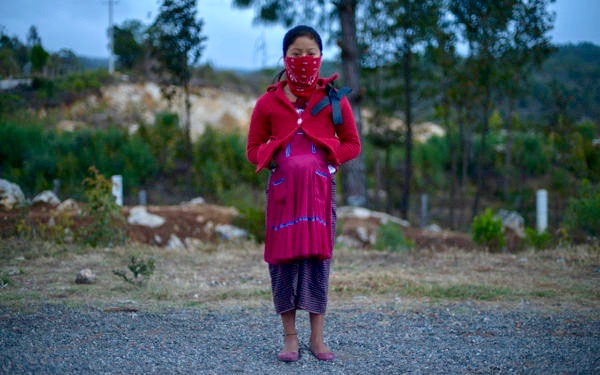
Teopisca, Chiapas. Young Zapatista woman at the international Women’s Gathering in the Caracol of Tulan Kau.
How do the Zapatistas protect their territory from the coronavirus? With a diffuse and extensive territory, the EZLN has bet on prevention and lack of physical movement of the inhabitants.
Text: Orsetta Bellani
Photo: Isabel Mateos
OCOSINGO, CHIAPAS. Doctor Luis Enrique Fernández Máximo learned about the red alert of the Zapatista Army of National Liberation (EZLN) through the Internet. He left the Zapatista autonomous clinic of the community of Las Tazas, where he works, and bought a card that allows him to connect to the web even in the area of the Lacandón Jungle where there is no signal. Since he left Tlaxcala to work with the NGO Sadec (Community Health and Development) in this community, the young doctor discovered that not only did he love the simple life and the nighttime silences of the jungle, but that his real need for connection to the internet is that of a couple hours a week.
It was March 16th 2020, and in Mexico there were only 82 positive cases of coronavirus. Luis Enrique Fernández read on his cell the communiqué from the EZLN:
“Given the serious and scientifically proven risk to human life presented by COVID-19 or “Coronavirus”; given the frivolous irresponsibility and the lack of seriousness shown by the bad governments,” writes the Revolutionary Indigenous Clandestine Committee (CCRI) General Command of the EZLN.
“Given the lack of accurate and timely information about the spread and severity of the virus and the lack of a coherent plan to confront it. Given that our commitment as Zapatistas is to struggle for life. We have decided: to declare a red alert in all of our towns, communities, barrios and in all Zapatista organizational bodies.”
Upon reading the statement, the young doctor thought that the EZLN would invite him to leave their territory. That’s what was done with the other four doctors and dentists from Sadec, who work in four communities of Palenque and Ocosingo. However, that was not the case. His stay was allowed in order to support the only “health promoter”(fem), as those Zapatistas who heal people with plants and western medicine are called.
When the EZLN took up arms in 1994, it reclaimed more than 150 thousand hectares of land, where it constructed systems of government, justice, education and health totally autonomous from the state; this in regions where neither teachers, nor doctors nor lawyers ever arrived. It did this with the solidarity and support of national and international collectives and organizations, among them Sadec. Since 1995, Sadec has collaborated in medical consultations in some autonomous communities, and in training courses for community health promoters, many of whom are, in turn, educators of their own colleagues.
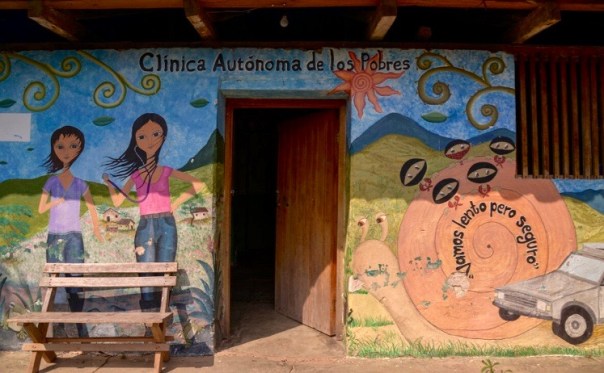
Las Tazas, Chiapas. Autonomous Clinic of the Poor in the community of Las Tazas.
Joel Heredia, the founder of Sadec, says that they learned that health is much more than the absence of sickness; and it has to do with “the ability to feel like waking up, walking, laughing, going to the milpa. Health means that your heart is content, that you feel good about yourself and others.”
At the time the the Red Alert was declared, the EZLN closed all of its Caracoles and the Centers of Resistance and Rebellion (CRAREZ); Paralel to the declaration of a red alert, the EZLN closed the Caracols and the Centers of Resistance and Rebellion; similarly, the “administrative centers” that are the seats of its government and of its largest and most equipped clinics. The health promoters were trained in the prevention of Covid-19; after which they were sent to their own communities, the most remote as well, where there are small autonomous “houses of health.”
“It is a clearly strategic approach: to not have mobility to prevent the spread of the virus, and to have the capacity to provide seasonal, local care at each point where there is a health promoter,” Joel Heredia explained. It surprises me that they haven’t set up an “autonomous Covid Center” to isolate suspected cases. I suppose that making the cold calculation of the costs and benefits that they assume that it wasn’t worth trying to provide care, given the high risk of contagion amongst health personnel; instead they focused on community preventive action. Without a doubt, knowing that in balance, this carries some cost, as people with other illnesses are not being treated.”
The element that most complicates this strategy is that the territory under the influence of the EZLN is not clearly delineated. In it, Zapatistas live side by side with partisans, and it becomes very difficult for the autonomous authorities to exert strict health controls.
“When the coronavirus arrived in Mexico, in the community of Arroyo Granizo the Zapatista authorities called together the whole population, both Zapatista and partisan — in order to discuss safety measures,” Joel Heredia explained. It worked for a few days, and then the ability to maintain vigilance was lost, mostly because of the migrant people who returned.”
As in many corners of the world, one of the greatest concerns of the EZLN is the reception of migrants returning to their communities after losing their jobs in the northern maquilas or on the beaches of the Caribbean. The recommendation of the Zapatista Command is to put them in quarantine.
“We know that the brothers and sisters of some communities, who come from outside, have been isolated. After 15 or 30 days, they re-join their families,” says Comandante Tacho in an WhatsApp audio that was broadcast among the EZLN support bases. “The care you have taken is the right thing to do. This way we are sure that we are avoiding a contagion that could come from outside. We don’t want it for anyone, but we have to take the necessary precautions so that we all come out of this alive confronting this disease that has spread so much in various parts of the world.”
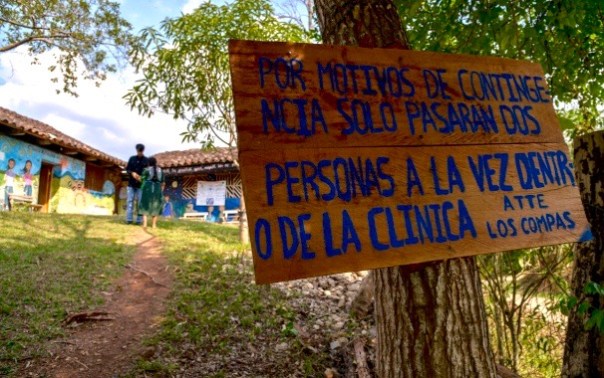
Las Tazas Clinic. The sign read: Because of the emergency only 2 people can enter the clinic at the same time. Sincerely, The Compas.
The Autonomous Clinic of the Poor | La Clínica Autónoma de los Pobres
The autonomous clinic of Las Tazas opened in 1995; and it is located in the zone of Dolores Hidalgo, one of the new Zapatista caracoles announced a little more than a year ago. It is a clay building painted blue, with murals of women with stethoscopes, plants, and covered faces. A plastic banner hung from the outside wall describes the symptoms of the new coronavirus and its preventive measures. Outside a poster warns of the new rules. “For contingency reasons, only two people at a time may enter the clinic. Signed, the compas.”
The Autonomous Clinic of the Poor has a pharmacy; consultations are free, but the medicines have a cost. It also has a dental clinic and a doctor with an ultrasound and doppler machine. The Zapatista health promoter (fem) and the doctor on rotation from Sadec attend to patients every day of the week, afternoon and morning. Prior to the health emergency caused by the pandemic, they also made house visits. They receive some ten patients a day, people from Las Tazas as well as eight other communities.
The service that the autonomous clinic provides is essential to the population of the zone, Zapatista and partisan alike; now the the Rural Medical Unit of the IMSS (Mexican Institute of Social Security) in Las Tazas only opens three days a week, and in the month of May, the doctor only arrived a few days.
“Many people that come to the autonomous clinic had already been at the IMSS clinic, and they arrive asking us if the diagnosis of the other doctor is right,” says Luis Enrique Fernández of Sadec.
Every twenty days, Luis Enrique takes a shift at the autonomous clinic of Las Tazas with Juan Carlos Martínez Vásquez. This is another young doctor originally from Mexico City that, before arriving in the Lacandón Jungle, had no knowledge of Zapatista thought and practice. Although the health promoter helps him with translation, his biggest difficulty is communication in Tseltal, since a good number of the patients don’t speak Spanish.. Thanks to the health promoter, Juan Carlos Martínez came to know the medicinal plants and learned what they don’t teach in universities — to treat the person and not the disease. “If you were to see a promoter speak with a patient one day, it is truly the most human approach that you would get,” he says.
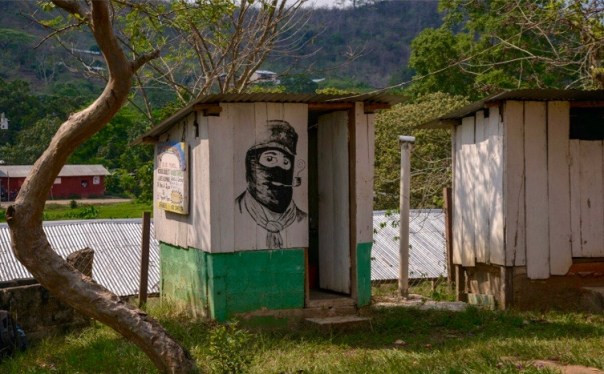
Las Tazas Autonomous Clinic of the Poor.
So far, six patients with symptoms of Covid-19 have come to the Las Tazas clinics, and are sheltering in their homes. The most severe cases would have to be transported to the Respiratory Attention Center opened by the Secretariat of Health in Ocosingo. This is located three hours away.
According to Joel Heredia, founder of Sadec, in Ocosingo and Palenque, attention in the public health system paradoxically improved with the pandemic. “Before, the hospitals didn’t have intensive care areas or ambulances because the people who most needed them were indigenous women who had complications during childbirth.”
“This pandemic let us see the vulnerability of the whole world, even the municipal president or a deputy. It’s not a good thing about the pandemic, but rather the terrible thing about the pandemic,” Heredia concluded.
——————————————————————
This article was originally published in Spanish, on July 4, 2020 by Pie de Pagina. https://piedepagina.mx/asi-se-cuidan-del-covid-19-en-territorio-zapatista/ This English interpretation has been re-published by Schools for Chiapas and re-published with permission by the Chiapas Support Committee
Join us in new online film series: Zapatista | where reality is more real
The Chiapas Support Committee presents a new online program:
¡Viva Zapata Film Series!
rebellious films | películas rebeldes
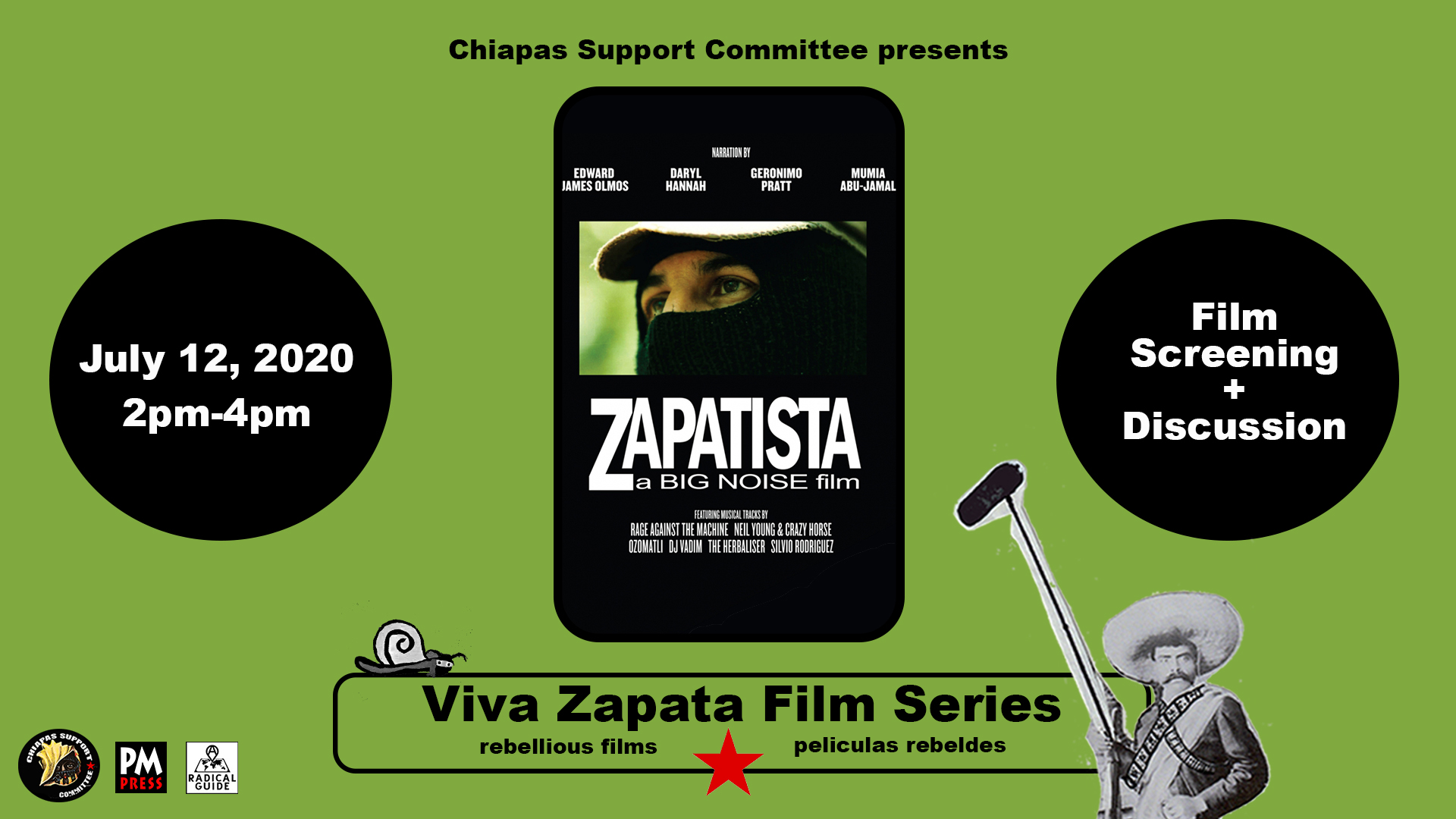
Join us for the first screening in this series. We will be showing the documentary, ZAPATISTA, as the first installment of our new online film series.
Register here to receive the link to the online screening, showing online Sunday, July 12, 2020, 2:00–4:00pm.
The film screening will be followed by circle discussion with members of the Chiapas Support Committee in partnership with PM Press and A Radical Guide.
The Reality seen through this camera is more real.
—Subcomandante Marcos
The Zapatista uprising on January 1, 1994, has been the camera through which the anti-capitalist struggle has become more real, possible and desirable.
The EZLN, the Zapatista Army of Liberation (Ejército Zapatista de Liberación Nacional, EZLN), broke the capitalist encirclement on the day U.S. “free” trade neoliberalism crossed into Mexico. And nothing has been the same ever since.
Join us to view and discuss the “definitive” film on the EZLN uprising. Afterwards, take part in a discussion of the roots of the EZLN rebellion, how it has unfolded over the last 26 years, changing the global terrain of justice and land struggles and movements everywhere.
About Zapatista
January 1, 1994. The day the North American Free Trade Agreement (NAFTA) comes into effect. A few minutes after midnight in Southeastern Mexico, several thousand Mayan soldiers take over half the state of Chiapas, declaring a war against the global corporate power they say rules Mexico. They call themselves the Zapatista National Liberation Army (EZLN).
Zapatista is the definitive look at the uprising in Chiapas. It is the story of a Mayan peasant rebellion armed with sticks and their word against a first world military. It is the story of a global movement that has fought 175,000 federal troops to a stand still and transformed Mexican and international political culture forever.
Co-Sponsored by
PM Press
A Radical Guide
 Chiapas Support Committee