Chiapas Support Committee
Home of the Compañero Manuel blog on zapatistas & mexico
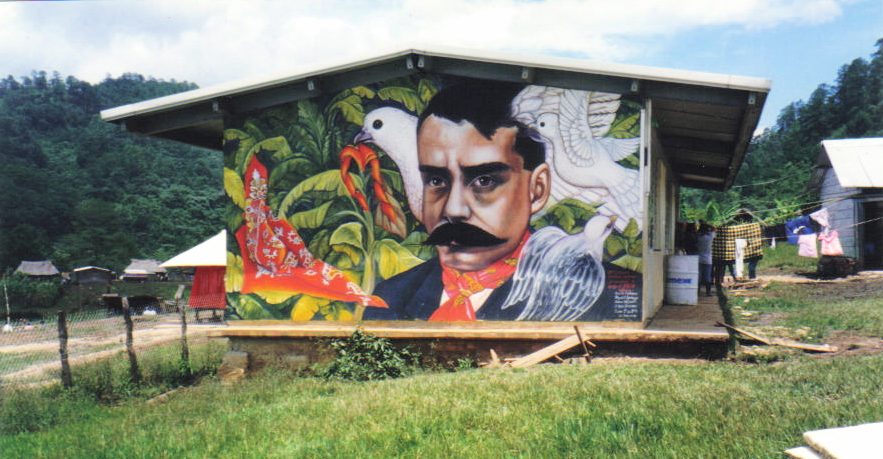
Invitation to CompArte 2020 for the 26th
[La versión en español sigue a la en inglés]
An invitation to CompArte 2020 para el 26 | ComradesShareArt 2020 for the 26th
Shelter in Art, Solidarity & Resistance | Quédate en el arte, la solidaridad y la resistencia
Dear Compas,
We are inviting you to participate in this year’s CompArte / ComradesShareArt: A Zapatista Art Gathering by sharing your art with compas and comrades around the world. CompArte 2020 will be celebrating the 26th year of the Zapatista’s uprising for justice and autonomy.
Every year since the Zapatistas launched the first CompArte in 2016, the Chiapas Support Committee has organized a parallel CompArte gathering in Oakland. We have organized our CompArte as a space to gather in community and celebrate the art and music, the poetry and movements of justice in solidarity with the Zapatistas and indigenous justice struggles.
Unlike previous years, we will not be able to gather physically but that won’t stop us. We will connect across the distances through a virtual bridge. This year’s CompArte 2020 will be an online Zapatista Art gathering!
Please join us: Our first of three CompArte 2020 gatherings is on August 26, 2020, 6:30-8:00pm PST: Register here.
Towards a horizon of art, justice and solidarities
The virtual CompArte 2020 will have two components:
1. We will hold three monthly gatherings via zoom, August 26, September 26 and October 26 (6:30-8:00pm PST every time), where we will come together to collectively imagine, co-create and share art; and
2. We will have an Instagram account where we will share art, poetry, music and visions with compas/comrades around the world: CompArte Zapatista instagram
We will invite you to share an art piece through our CompArte Zapatista instagram. You can share a poem, a screenprint, a song, a painting, a performance, a photograph, anything to share and accompany each other in the struggles ahead.
We invite you to focus on imagining a future free of capitalism and all of its ills, and envisioning a more just world that stands in stark contrast with the collapsing capitalist world around us — a world that is leaving millions in the shadows of poverty and vulnerable to the pandemics of COVID-19, racism and militarism. Your art piece can speak to the spirit of resistance, of hope, of collective action and of solidarity with struggles for justice around the world.
CompArte | ComradeShare Art
Your art will be shared via our CompArte Zapatista Instagram page and together with artists around the world, we will create a collective of visions for a new and better world.
If you are interested in participating you can share your art in two different ways:
- You can submit your art piece by emailing it to compartecsc@gmail.com. Once we receive it we will upload it to our Instagram account
- Or, you can upload it to your own Instagram account and tag us @compartezapatista
- You can message us on Instagram
- Please use hashtags: #comparte #zapatistart
You can read more about this year’s CompArte 2020 here.
You can register here for the first CompArte 2020 gathering.
Please share your thoughts and questions with us to improve CompArte 2020.
Gracias.
In the spirit of resistance and solidarity,
The Chiapas Support Committee
Comité de Apoyo a Chiapas
Una invitación a CompArte 2020 para el 26 | ComradesShareArt 2020 for the 26th
Quéate en arte, solidaridad y resistencia | Shelter in Art, Solidarity & Resistance
Querid@s Compas,
Te invitamos a participar en el encuentro zapatista de CompArte 2020, donde podrás compartir tu arte con compas de alrededor del mundo. El CompArte 2020 celebrará el vigésimo sexto año de la rebelión zapatista por la justicia y la autonomía.
Cada año desde que las y los zapatistas lanzaron el primer CompArte en el 2016, el Comité de Apoyo a Chiapas (CSC, Chiapas Support Committee) ha organizado un encuentro paralelo al CompArte zapatista en Oakland. Organizamos nuestro CompArte como un espacio para reunirnos en comunidad y celebrar el arte, la música, la poesía y los movimientos de la solidaridad con las y los zapatistas y las luchas de los pueblos indios por la justicia.
A diferencia de años anteriores, no vamos a poder reunirnos en persona; pero eso no nos detendrá. Nos conectaremos a pesar de las distancias mediante un puente virtual. ¡El CompArte de este año será un encuentro de arte zapatista en línea!
Por favor únete a nosotras: El primero de tres encuentros del CompArte 2020 se llevará a cabo el miércoles, 26 de agosto, 2020, de 6:30 a 8:00pm PST. Matricúlate aquí,
Hacia un horizonte de arte, justicia y solidaridades
El CompArte 2020 virtual tendrá dos componentes:
- Vamos a convocar tres encuentros mensuales a través de zoom, el 26 de agosto, el 26 de septiembre y el 26 de octubre donde nos reuniremos para colectivamente imaginar, co-crear y compartir arte.
- Compartiremos arte, poesía, música y visiones con sus compas de alrededor del mundo en el CompArte Zapatista instagram
Están invitados a compartir su arte a través de nuestro CompArte Zapatista instagram. Podrás compartir un poema, una serigrafía, una canción, una pintura, un performance, una fotografía, cualquiera cosa para acompañarnos unas a las otras en las luchas.
Las y los invitamos a enfocarse en imaginar un futuro libre del capitalismo y todos sus males, e imaginándonos un mundo mejor que está en marcado contraste con el mundo capitalista que está en colapso alrededor de nosotras y nosotros — un mundo que está poniendo a millones de personas en las tinieblas de la pobreza y vulnerables a las pandemias del COVID-19, el racismo y el militarismo. Su arte puede hablar en el espíritu de la resistencia, de la esperanza, de la acción colectiva y de la solidaridad con las luchas por la justicia alrededor del mundo.
CompArte | ComradeShare Art
Su arte será compartido a través de nuestra página de Instagram CompArte Zapatista y juntos a otras artistas de alrededor del mundo, crearemos un colectivo de visiones para un mundo nuevo y mejor.
Si estás interesada en participar, puedes compartir tu arte de dos maneras:
- Mándanos tu arte enviándolo a compartecsc@gmail.com. Una vez que lo recibamos lo subiremos a nuestra cuenta de Instagram.
- O puedes subirlo a tu propia cuenta de Instagram y etiquetarnos con @compartezapatista
- Nos puedes mandar un mensaje a Instagram
- Utiliza los hashtags: #comparte #zapatistart
Puedes leer más sobre el CompArte 2020 aquí.
Y puedes matricularte para el primer CompArte 2020 aquí.
Por favor les invitamos a compartir sus pensamientos y preguntas con nosotras y nosotros para mejorar el CompArte 2020.
Gracias.
En el espíritu de resistencia y solidaridad,
El Comité de Apoyo a Chiapas | The Chiapas Support Committee
One dead and one injured as armed attacks persist in Chiapas; they fear another Acteal
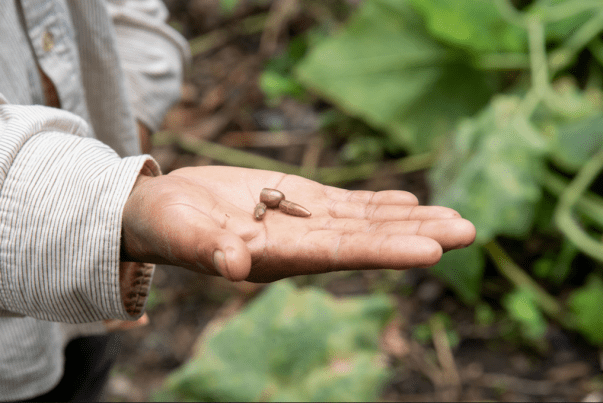
Aldama shows bullets fired from Chenalhó
There is cause for concern about what’s going on in Chiapas right now, perhaps cause for alarm! To at least some of us who vividly recall the lead-up to the Acteal Massacre, the present reminds us all too painfully of the past. Below are 2 articles from La Jornada, translated from Spanish, which detail the attacks, remind us of similarities to Acteal and report on one dead and one injured in Santa Martha. Those affected are Sociedad Civil Las Abejas of Acteal, civilian Zapatistas and non-Zapatistas belonging to various political parties. Press coverage in Mexico is widespread and daily, as if in anticipation of an even bigger story to come. (Compañero Manuel Blog Admin)
—–
ARMED ATTACKS PERSIST IN CHIAPAS; THEY FEAR ANOTHER ACTEAL
By: Hermann Bellinghausen
This Tuesday the armed attacks continued against the indigenous people displaced by violence and against communities in the municipality of Aldama, in the Chiapas Highlands. The shots come from Santa Martha community and other localities within Chenalhó municipality.
At 12:35pm shots were reported from Ontik and Xchuch te’, Santa Martha in the direction of Yeton, Ch’ivit and Stzelejpotobtik communities (Aldama). Meanwhile at T’ul Vits in Santa Martha, three white cars came down and shot at the community of San Pedro Cotzilnam (Aldama) to then head for Saclum (Chenalhó). The shooting at these communities occurred throughout the day, until evening.
In the vehicles, they were transporting armed men dressed in black, reported residents and the Commission of the 115 displaced from Aldama. They toured Vivero, T’elemax, Colado, T’ul Vits, Vale’tik and Ontik.
[…]
On Monday afternoon, the armed group entered Aldama territory at the territorial limits, entering through the community of Stzelejpotobtik. At the close of this edition the shooting continued at Tabac community from the Telesecundaria, Tojtik, Curva Tontik, and Volcán Santa Martha, exactly where there is a detachment of state la police that still doesn’t intervene. The state police arrived in Santa Martha Chenalhó, where they also reported shooting at Stzelejpotobtik and Cabecera Aldama.
As of this date the town of Aldama [1] has received around 350 attacks from these paramilitary groups, resulting in seven dead and 16 injured.
It’s appropriate to remember that on July 17, in one of the paramilitary attacks on Coco, one of the 11 communities under fire in Aldama, María Luciana Lunes Pérez, 13, was wounded by bullets in her shoulder and face, and had to receive surgical care in San Cristóbal de Las Casas.
The families displaced from Aldama are defenseless, without food or medical care, and they have only received small food supplies from the state government, more with propagandistic ends than with real nutritional quality, denounced the Trust for the Health of the Indigenous Children of Mexico (Fideicomiso para la Salud de los Niños Indígenas de México, FISANIM) over which the actress and activist Ofelia Medina presides.
State and federal authorities only acknowledge receipt of threats from Chenalhó; in other words, from the aggressors, as if accepting the version that the shots are coming from Aldama, when the increasingly aggressive paramilitary group comes from Chenalhó and has the support of municipal authorities. The strategic attack patterns that preceded the 1997 Acteal Massacre are repeated.
[1] Aldama is the name of the municipality and also the name of the municipal seat (capital).
————————————————————
Wednesday, August 19, 2020
https://www.jornada.com.mx/2020/08/19/politica/011n2pol
ARMED ATTACKS LEAVE ONE DEAD and ONE INJURED IN CHENALHO
By: Elio Henríquez
San Cristóbal de Las Casas, Chiapas
An indigenous man from the the Santa Martha ejido, Chenalhó municipality, died and another was injured from a bullet after armed attacks between residents of that place and the neighboring Aldama municipality in the dispute over 60 hectares, official sources reported.
They reported that the deceased is called Javier Jiménez Sántiz, 50, while the injured man is Aurelio Jiménez Méndez, who received a bullet in the left clavicle and was moved to Hospital of the Cultures in San Cristóbal de Las Casas.
Jiménez Sántiz was killed around 3 pm and his body was moved to the municipal seat, without an agent from the Public Ministry attesting and ordering the removal of the cadaver, since there were no security conditions for it to be moved to the community.
The sources pointed out that residents of Santa Martha are holding some 10 state police agents who installed a camp more than two weeks ago to prevent violent acts.
Authorities and inhabitants of both both municipalities mutually accuse each other of carrying out armed attacks since last weekend, which intensified yesterday morning.
Yesterday afternoon, Aldama officials divulged a video in which detonations are heard that they attribute to their neighbors in Santa Martha.
————————————————————
Wednesday, August 19, 2020
https://www.jornada.com.mx/2020/08/19/politica/016n2pol
Re-Published with English interpretation by the Chiapas Support Committee
Chiapas municipality suffers 30 armed attacks in three days
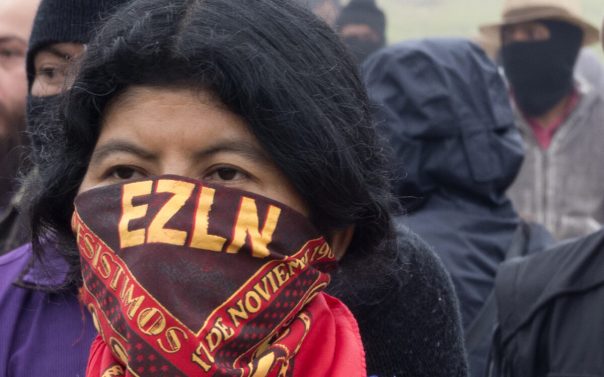
Zapatista woman in Aldama. Photo: Orsetta Bellani
By: Hermann Bellinghausen
This past weekend grave armed attacks began against residents of various communities in the Maya Tzotzil municipality of Aldama, in the Chiapas Highlands. The attacks come from Santa Martha and other towns in Chenalhó municipality, also Maya Tzotzil, with which there is a territorial dispute over 60 hectares of land on their common border. According to reports received by La Jornada, the shooting continued until 5 pm yesterday. During a phone call from Aldama, around midnight on Sunday, this reporter could hear the detonations and received brief videos of the flashes and shots in total darkness. Before six o’clock in the morning yesterday (Monday) he received new videos with large detonations and shots towards the cell phone with which he was filming, at a point where the displaced families of Aldama are located.
La Jornada receives constant reports from the commission of 115 community members displaced from Aldama, detailing the places and times of the shooting, coming from different places in Santa Martha, and even from the land in dispute, where according to the agreements no one should enter. In Tabac, one of the communities attacked, there is a detachment of state police that has not intervened. At the close of this edition the attacks totaled more than 30 in three days.
Although it has never been proven that the displaced Tzotzils (who are in a state of grave poverty, hunger, terror and forced displacement) are armed, federal and state officials operate under the theory that both groups are shooting. According to the indigenous commission, Santa Martha paramilitaries shoot at their own community, to make people believe they are under attack. It’s not a new practice, the same thing occurred in 1997, in the weeks and months prior to the Acteal Massacre.
Agreements exist between Aldama and Chenalhó, allegedly reached by the Interior Ministry (Secretaría de Gobernación), but in fact the acts of hostility and danger are greater than ever. Institutional inaction in the face of recent violence, in particular that initiated this Friday, presumably obeys the intention not to aggravate the situation.
It’s not about one more dispute between campesino communities. The attackers possess high-caliber weapons and explosives, and are the direct heirs of the paramilitaries that perpetrated the Acteal Massacre in 1997; many paid with prison, but were never disarmed, and throughout all these years they have attacked members of Las Abejas de Acteal, Zapatista support bases and other political or religious groups in Aldama, Chalchihuitán and Chenalhó itself on different occasions. It is known that new and powerful weapons have been added to those weapons.
The Fray Bartolomé de Las Casas Human Rights Center (Frayba) sent the Mexican government an urgent action wherein it recapitulates the same log book received by La Jornada. The attacks began the night of Saturday, August 14. On Saturday the 15th, residents reported that the armed group had crossed limits of Aldama, the communities of San Pedro Cotzilnam and Yeton being in danger. They reported that they were able to observe three armed groups in different positions. There were also shots against Yeton, and strong detonations. The families attacked had to displace to another community.
On Sunday, August 16, the armed group continued attacking Yeton and two other Aldama communities. The attacks are coming from a number of Chenlhó communities, at least some of which are inside the 60 hectares in dispute. Attacks continued against San Pedro Cotzilnam (Aldama). The armed actions armadas follow “a pattern,” Frayba points out.
Armed attacks also continued against Coco’ (Aldama) and another community is under fire from high-caliber weapons. “Despite requests for intervention,” says the Frayba, “the response is indifference charged with racism and discrimination from the federal and state governments.”
———————————————————–
Originally Published in Spanish by La Jornada
Tuesday, August 18, 2020
https://www.jornada.com.mx/2020/08/18/politica/010n1pol
Re-Published with English interpretation by the Chiapas Support Committee
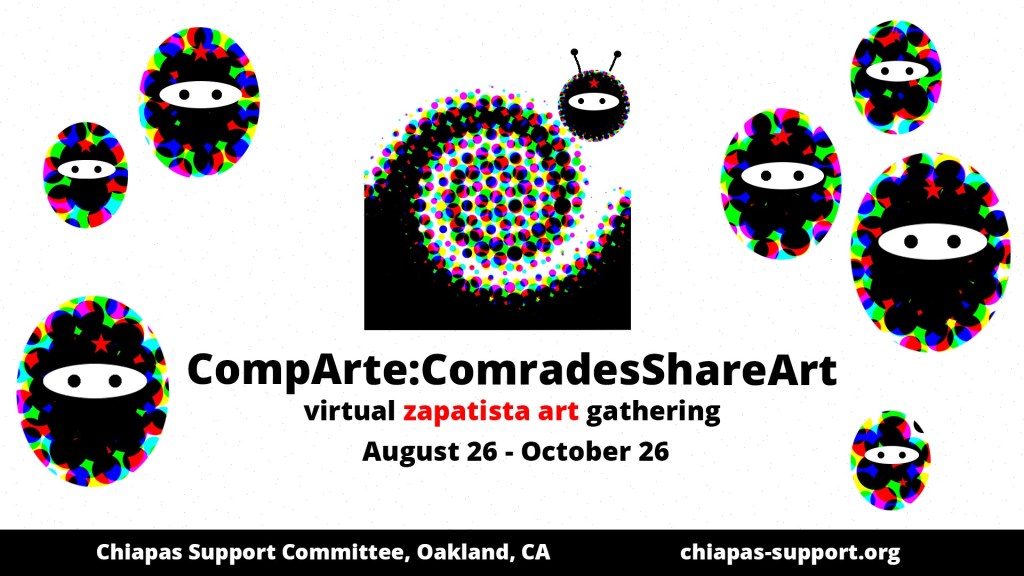
CompArte 2020: Quédate en el arte, la solidaridad y la resistencia
[To read the English version of this message on CompArte 2020, click here.]
El Comité de Apoyo a Chiapas (CSC, Chiapas Support Committee) los invita al quinto “CompArte: El festival comunitario Emiliano Zapata,” celebrando el vigésimo sexto año de rebelión, de justicia por la tierra y la autodeterminación zapatista con poesía, arte, música y comunidad.
Mientras nos refugiamos en nuestros hogares para mantener la salud contra el nuevo coronavirus, no ha significado que nuestras comunidades y sus luchas y movimientos contra el racismo y la guerra y por una justicia y liberación profunda se han detenido. Estamos transformando nuestro refugio en casa en un tiempo y en un espacio para reflexiones críticas y liberadoras, y para transmitir nuestras demandas por la justicia. mientras millones se están movilizando para poner fin al racismo y la violencia policial contra las vidas negras y morenas .
El refugio en casa es un espacio para la autogestión, para florecer en visiones de justicia y liberación enraizadas en nuestras comunidades. Estamos alzando nuestras voces y nuestras visiones compartidas desde donde vivimos, trabajamos, estudiamos, oramos y jugamos con el arte para la liberación, con solidaridad con las y los zapatistas y las luchas indígenas y en resistencia contra los estragos del capitalismo.
“CompArte 2020 para el 26” tomará lugar entre tu hogar y el nuestro durante tres encuentros en línea: el 26 de agosto, el 26 de septiembre y culminando en un gran CompArte en línea con un programa de música, arte y poesía el 26 de Octubre.
¡Únete!
CompArte es un espacio para compartir nuestros sueños de un mundo diferente y más justo mientras honramos a las y los zapatistas en su vigésimo sexto año construyendo autonomía y liberación.
Estás invitad@ a compartir tu trabajo de arte y tu arte-activismo a través de nuestra página de Instagram, CompArte Zapatista instagram. Puedes enviar tu trabajo por correo electrónico a compartecsc@gmail.com y nosotr@s subiremos tu poema, tu serigrafía, canción, pintura, tu video, un performance, una fotografía, cualquier cosa a nuestra página de IG. Etiquetanos @compartezapatista en tus publicaciones IG y usa los hashtags: #comparte #zapatistart
Matricúlate aquí para el primer encuentro en línea de CompArte, 26 de agosto.
Para más información, visita el blog del Comité de Apoyo a Chiapas (CSC, Chiapas Support Committee) blog: www.chiapas-support.org
Su invitación al CompArte para el 26!
Pon estas fechas de CompArte 2020 en tu calendario: 26 de agosto, 26 de septiembre y 26 de octubre:
1. Nuestro primer encuentro en línea será el miércoles 26 de agosto, 6:30-8:00pm PST. Matricúlate aquí.
El primer encuentro se enfocará en construir comunidad. Esta será una sesión de trabajo para crear arte colectivamente y hacer planes para traer más gente a las próximas sesiones. Matricúlate aquí para la sesión de CompArte del 26 de agosto.
2. Nuestro segundo encuentro, el sábado 26 de septiembre, de 6:30pm a 8:00pm PST, también será en segmentos de 26 minutos de cultura.
En esta sesión construiremos sobre el trabajo colectivo de nuestro primer encuentro. Miembros del Comité de Apoyo a Chiapas proveerán noticias y educación sobre las y los zapatistas y las luchas actuales en México. Invitamos a las y los participantes a presentar un poema, una canción, un video o el arte para compartir en línea. La matriculación al evento será enviada a principios de septiembre.
3. La última sesión del CompArte será el 26 de octubre, 2020.
Desde las 6:30pm a las 8:30pm PST llenaremos el CompArte con actuaciones que compartiremos en segmentos de 26 minutos. Seguiremos compartiendo mientras haya poetas, pintores, artistas y músicos que quieran compartir. La matriculación será enviada a principios de octubre.
CompArte 2020 para el 26
CompArte 2020 para el 26 se presentará mientras todas y todos estamos refugiados en nuestros hogares y durante un momento histórico en la lucha estadounidense por la justicia racial, económica y ambiental.
El CompArte durante el refugio en nuestros hogares significa crear un espacio desde donde fortalecemos nuestras relaciones, profundizamos nuestros valores que están enraizados en la solidaridad con todas y todos en resistencia al capitalismo y para hallar maneras de trabajo juntos para detener la violencia capitalista cotidiana y sus ganancias a través del racismo, el militarismo y la pobreza.
Bajo el impacto del COVID19, el mundo capitalista se desaceleró en todo menos su vil explotación de la vida. Pero el COVID19 no frenó el deseo de nuestros corazones por la justicia y la liberación.
Estamos viviendo y participando en una de las más grandes rebeliones en la historia estadounidense, con el movimiento de las Vidas Negras Importan (BLM, Black Lives Matter) que ha galvanizado a las comunidades a través del mundo a exigir justicia y responsabilidad de la policía y otras fuerzas gubernamentales por la violencia y la matanza de vidas negras y morenas . El llamado al seguro médico universal, sueldos dignos, agua, aire y tierra libre de contaminación, y el cese del racismo y la violencia de estado y policiaca es expresado por un coro masivo de voces multirraciales, multilingües, y multinacionales, que refuerzan la demanda de desfinanciar a la policía y que piden justicia por las y los que han sufrido a manos de la policía y el sistema de “justicia” criminal.
CompArte: Las y los compas comparten sueños de justicia y liberación
Mientras el capitalismo se desaceleró debido a los severos reveses económicos, las instituciones que gobiernan mantienen a las y los obreros y otras clases sociales y pueblos de color y pueblos indios esclavizados como siempre. Sigueindole los pasos de otros asesinatos policiacos de hombres y mujeres negras en los días y meses anteriores, el asesinato policiaco de George Floyd el 25 de mayo en Minneapolis,, fue la última gota. El asesinato de George Floyd desató un movimiento masivo anti-racista por la justicia dirigido por el pueblo negro que está estremeciendo los cimientos del capitalismo estadounidense.
En los EE.UU., millones de obreros y obreras han perdido sus trabajos. Aquellas y aquellos que no pueden trabajar en línea desde sus hogares (campesinos, trabajadores y proveedores de la salud, trabajadores en las tiendas de comida, las que procesan y distribuyen la comida, jornaleros y otros trabajadores esenciales) son sujetos a la explotación cruel, expuestos al virus mortal con muchas y muchos perdiendo sus vidas, su salud y su sustento.
La pandemia ha mostrado las fallas raciales y de clase en los EE.UU, exponiendo las brechas devastadoras en la salud, la educación, el empleo, la vivienda y la violencia mortal policial desatada contra las vidas negras. La mayoría de las y los infectados por el virus COVID19 son hombres y mujeres negros y morenos, jotos, pueblos indios, trabajadores migrantes, prisioneros — las y los más vulnerable entre los vulnerables que son negros, indígenas y los pueblos de color.
Quédate en arte, solidaridad y resistencia
Porque nos estaremos conectando a través del espacio virtual, nos podremos reunir literalmente de cualquier lugar del mundo. Nuestras voces y demandas por la justicia, nuestra invitación a expresar solidaridad y apoyo a las luchas de las y los zapatistas y de los pueblos indios, conectándose con el arte y la cultura a través de movimientos de liberación, serán magnificadas.
Proponemos a re-imaginar el quédate-en-tu-hogar como el espacio y el tiempo para la autogestión enraizada en la autodeterminación por un mundo más justo y saludable. El auto-cuidado enraizado en el cuidado de la comunidad.
Cada año desde que las y los zapatistas lanzaron el primer CompArte en el 2016, el Comité de Apoyo a Chiapas (CSC, Chiapas Support Committee) ha organizado un encuentro paralelo al CompArte de Chiapas en Oakland. Organizamos nuestro CompArte como un espacio para reunirnos en comunidad y celebrar el arte, música, poesía y los movimientos de la solidaridad con las y los zapatistas y las luchas de los pueblos indios por la justicia.
El pasado agosto de 2019, como los tres años anteriores, CompArte abrió con Danzantes bendiciendo el Omni y luego pasábamos el resto de la tarde escuchando a artistas locales ofrecer sus canciones, poemas, sus buenas palabras, y con arte sobre las paredes. Compartimos tamales, cafecito y artesanía mientras las y los artistas estaban sacando afiches en serigrafía y la gente se visitaba unas a las otras llenos de pláticas. Crearemos el mismo ambiente mientras estemos refugiados en nuestros hogares.
CompArte 2020 continuará construyendo sobre esta tradición un espacio para reunir y conjugar nuestros mejores sueños e imaginarnos un mundo diferente y más justo que él del mundo capitalista que se está cerrando, dejando a millones de trabajadores en las sombras de la pobreza y vulnerables a las pandemias del COVID-19, el racismo y el militarismo.
Acompáñanos el 26 de agosto, el 26 de septiembre, y el 26 de octubre en CompArte 2020.
Que vivan las, los y loas zapatistas en todas partes.
Matricúlate aquí para el primer encuentro virtual de CompArte el 26 de agosto, 2020.
Visita el Instagram del CompArte Zapatista. Comparte/camaradas compartan su arte. Usa los hashtags: #comparte #zapatistart
Para más información, visita el blog del Comité de Apoyo as Chiapas: www.chiapas-support.org
Medios sociales del CSC
Email: enapoyo1994@yahoo.com
Website: www.chiapas-support
Facebook: https://www.facebook.com/CSCzapatistasInstagram:CompArte Zapatista instagram
CompArte 2020: Shelter in Art, Solidarity & Resistance
[Para leer este mensaje en español sobre, CompArte 2020, haga clic aquí.]
The Chiapas Support Committee is inviting you to the fifth annual “CompArte: The Emiliano Zapata Community Festival,” celebrating the Zapatistas’ 26th year of indigenous rebellion, land justice and self-determination with poetry, art, music and community.
Sheltering-in to stay healthy and safe from the novel coronavirus has not meant that our communities and their struggles and movements against racism and war and for deep justice and liberation have stopped. We are transforming sheltering-in into a time and space for critical and liberatory reflections and to broadcast our demands for justice, as millions continue mobilizing to end racism and police violence against black and brown lives.
Sheltering-in-place is a space for self-gestation, to flourish in community-based visions of justice and liberation. We are raising our voices and our shared visions from where we live, work, study, worship and play with art for liberation, with solidarity with the Zapatistas and indigenous struggles and in resistance to the ravages of capitalism.
“CompArte 2020 for the 26th” will take place between your home and ours in three online gatherings, August 26, September 26 and, culminating in a big online CompArte with a program of music, art and poetry, on October 26!
¡Join us!
CompArte is a space to share our dreams of a different and more just world as we honor the Zapatistas in their 26th year of building autonomy and liberation.
You are invited to share your art work and art-activism through our CompArte Zapatista instagram. Email us to compartecsc@gmail.com and we will post your poem, a screenprint, a song, a painting, a performance, a photograph, anything on our IG account. Tag us @compartezapatista in your IG posts and use the hashtags: #comparte #zapatistart
Register here for the August 26 CompArte
Register here for the first online CompArte gathering August 26.
For more information: Visit the Chiapas Support Committee blog: www.chiapas-support.org
Your Invitation to CompArte | ComradesShareArt 2020 for the 26th!
Put these CompArte 2020 dates on your calendars: August 26, September 26 and October 26:
1. Our first online gathering is on Wednesday, August 26, 6:30-8:00pm PST.
The first gathering will focus on community building. This will be a working session to collectively envision creating art and make plans to bring in more people to the next sessions.
Register here for the August 26 CompArte session.
2. Our second session, on Saturday, September 26, 6:30-8:00pm PST, also in 26 minute culture sets.
We will build on the collective work of our first gathering. Members of the Chiapas Support Committee will provide updates and education on the Zapatistas and the ongoing struggles in Mexico. We will invite participants to bring a poem, a song, a video or art to share online. Registration will be sent out at the beginning of September.
3. Our culminating CompArte gathering will take place on October 26, 2020.
From 6:30-8:30pm PST, the CompArte space will be filled with performances and sharing in 26 minute segments. We will go as long as we have poets, painters, artists and musicians to share. Registration will be sent out at the beginning of October.
CompArte | ComradesShareArt 2020 for the 26th
CompArte | ComradesShareArt 2020 for the 26th is taking place while everyone shelters in place and during a historic moment in the U.S. struggle for racial, social and environmental justice.
CompArte shelter-in-place means creating a space where we strengthen our relationships, deepen our values rooted in solidarity and resistance to capitalism and to find ways to work together to stop daily capitalist violence and how it extracts profits through racism, militarism and poverty.
Under the impact of COVID19, the capitalist world was forced to slow down in all but its vile exploitation of life. But COVID19 did not slow down our hearts’ desire for justice and liberation.
We are living through and participating in the biggest rebellion in U.S. history, as the Black Lives Matter movement has galvanized communities worldwide to demand justice and accountability from the police and other government forces for the violence and killings of Black and Brown lives. The call for universal healthcare, living wage jobs or income, clean water, air and soil, and an end to racism and state and police violence is coming from a massive chorus of multi-racial, multilingual and multi-national voices, reinforcing the demand for defunding policing, and justice for those who suffered at the hands of police and the criminal “justice” system.
CompArte: Comrades Share Dreams of Justice & Liberation
While capitalism slowed down because of severe economic setbacks, the institutions that govern and keep workers and other oppressed classes and people of color and indigenous people enslaved carried on with business as usual. The police murder of George Floyd on May 25 in Minneapolis, coming on the heels of other police killings of Black men and women in the days and months before, was the last straw. George Floyd’s death sparked a massive Black-led justice and anti-racist movement that is rocking the foundations of U.S. capitalism.
In the U.S., millions have lost their jobs. Those not able to work from home (farmworkers, healthcare workers and providers, grocers, food processors and distributors, day laborers and other essential workers) are subjected to cruel exploitation, exposed to the deadly virus with many losing their lives, health and livelihood. The pandemic has bared the racial and class fault-lines in the U.S., exposing the devastating gaps in healthcare, education, employment, housing and the deadly police violence meted out against Black lives. The majority of those infected by and dying from COVID19 are Black and Brown women and men, queers, indigenous people, migrant workers, prisoners, — the most vulnerable of the vulnerable BIPOC.
Shelter in Art, Solidarity & Resistance
Because we will be connecting through virtual space, we will be able to gather together literally from anywhere in the world. Our voices and demand for justice, our invitation to express solidarity and support for Zapatista and indigenous peoples’ struggles for self-determination, connecting with the art and culture across liberation movements, will be magnified.
We propose that we re-envision sheltering in place as a time for self-gestation rooted in self-determination for a more just and healthier world. Self-care rooted in community-care.
Every year since the Zapatistas launched CompArte in 2016, the Chiapas Support Committee has organized a parallel CompArte gathering in Oakland. We have organized our CompArte as a space to gather in community and celebrate the art and music, the poetry and movements of justice in solidarity with the Zapatistas and indigenous justice struggles.
Last August 2019, like the previous three before, CompArte opened with Danzantes blessing at the Omni and then we spent the rest of the afternoon hearing local artists share songs, poems, good words and art on the walls. We shared tamales, coffee and artesania while artists were cranking out silkscreen posters and people visited with each other. We will create this same ambience while we shelter-in-place.
CompArte 2020 will continue building on this tradition as a space to gather all our best dreams and envision a different, more just world from the capitalist world that is shutting down, leaving millions in the shadows of poverty and vulnerable to the pandemics of COVID19, racism and militarism.
Join us August 26, September 26 and October 26 in CompArte | ComradesShareArt!
Vivan las, los y loas zapatistas everywhere.
Register here for the August 26, 2020 online CompArte gathering.
Visit CompArte Zapatista instagram. Comparte/comrades share art. Use the hashtags: #comparte #zapatistart
For more information, visit the blog of the Chiapas Support Committee: www.chiapas-support.org
CSC Social Media:
Email: enapoyo1994@yahoo.com
Website: www.chiapas-support
Facebook: https://www.facebook.com/CSCzapatistas
Instagram: CompArte Zapatista instagram
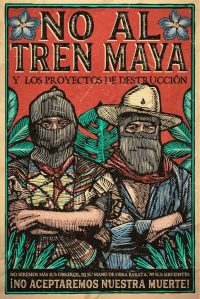
Civil Society and the CIG file legal actions over 5 megaprojects
 By: Daliri Oropeza of Pie de Página
Civil organizations filed two new legal and international appeals against five megaprojects: Interoceanic Corridor, New Santa Lucia International Airport, Dos Bocas Refinery, Morelos Integral Project and Maya Train. They assure that they consider them to violate Human Rights.
The legal actions filed by members of the la Anticapitalist-Anti-patriarchal Metropolitan Coordination and the Indigenous Government Council (Consejo Indígena de Gobierno, CIG} its initials in Spanish) are a claim for indirect protection in the Fifteenth Court in Mexico for the grave Human Rights violations of the five megaprojects.
They also filed a complaint with the Inter-American Commission on Human Rights (IACHR) for violating the rights of indigenous peoples established in the Constitution and that are part of Convention 169 of the International Labor Organization (ILO) signed by Mexico. They were filed on August 7.
In a press conference, Carlos González, a lawyer specializing in agrarian law, said that for the first time civil organized civil society filed the legal actions in order to remove the communities from a direct confrontation with the federal government. In addition, by filing requests for protection (amparos) from the five megaprojects, they give an overall vision of the problem and the interests to which they respond.
“These megaprojects are part of a large project, the Plan Puebla Panamá, later called the Mesoamerican Project (Proyecto Mesoamerica) and now presented to us in a different way. The five megaprojects as a whole obey the geopolitical interests of the United States. They have been imposed; the affected populations have never been consulted, especially the indigenous populations, with which a specific procedure must be carried out and adapted to international standards that are framed in the conventions to which Mexico is a party at the constitutional level,” González says.
Pedro Uc, a defender of Maya territory was also at the conference, and he assures that, in the case of the Maya Train, the communities were not freely, previously consulted or properly informed, nor in good faith.
He assures that the peoples have been sidelined in the legal bodies, although “the legal way is not our great hope. Unfortunately, it’s a necessity to go through it. The laws that are constructed were made from a Western perspective and vision and they did not look at forms of coexistence and existence of indigenous peoples.”
Pedro Uc denounces that: “within the framework of the misnamed Maya Train, we put in a first amparo (request for protection) that the judicial power refused to accept because no work was being done in Yucatán.” He denounces that there is still racism from the courts, there are no indigenous judges or courts in Mayan languages. And they do not consider the peoples’ forms of organization.
“The paradox is that the official discourse says that the train is going to remedy our problems of marginalization, poverty, health and education. This is one of the discourses that all past governments have made. And now the train is a miraculous god that’s going to solve our needs. This is what many people have been led to believe. (…) A train is not going to solve our problem. We want to coexist with our forests, our animals and make decisions about our development, decisions that don’t treat us as stupid, as they have been for 500 years,” he adds.
According to the lawyer Carlos González, since the government is the intention to rearrange territories with these five megaprojects, in addition to buying gas from the United States; that’s why they are proposing more gas pipelines, thermoelectric plants and industrial zones on the Trans-Isthmus Corridor that would be connected with the southwest, because it’s a “hinge” megaproject.
The lawyer reiterates: “The intension is to build 10 urban industrial corridors and to fix the population so that they won’t migrate to the north. In the Maya Train project that contemplates 30 stations, they want to build development poles in 19 of them and some industrial ones; urban industrial or tourist corridors. All these projects have a tremendous impact on populations and on nature.”
Territorial defender Pedro Uc said that the communities would continue with legal strategies and any way that permits them to ensure the life of their peoples and nature.
“The violation of the powers of their own laws is a real shame. Even with laws for their own benefit, with a form in which they have advantage, treachery and premeditation, they’re still not enough for dispossession. We have known how to find the loopholes and nooks of these laws in order to defend ourselves,” Uc says.
He also denounces that, the theme of the consultation has been a joke on the government’s part, and that they have never approached the defenders of territory to start a dialogue. “Before the current president took office he had already announced the construction of the misnamed Maya Train and this makes us think that what follows from this is a kind of justification of a decision that had already been made.
He deployed propaganda and a crusade with the ejido commissioners through Fonatur officials,” denounces Uc, who emphasizes that they offered scholarships, and support from “Welfare” in exchange for endorsing the project, of which the communities are still completely unaware.
He emphasizes that the 135 forthcoming consultations that the Semarnat announced on the [Yucatan] Peninsula to evaluate the Environmental Impact Statement also violate the rights of the Maya peoples, since the project has not been endorsed. You can’t continue advancing legally if the communities don’t accept it, he says.
——————————————————————————
Originally Published in Spanish by Chiapas Paralelo
Tuesday, August 11, 2020
Re-Published with English interpretation by the Chiapas Support Committee
Zapatista Coffee growers under attack in Chiapas
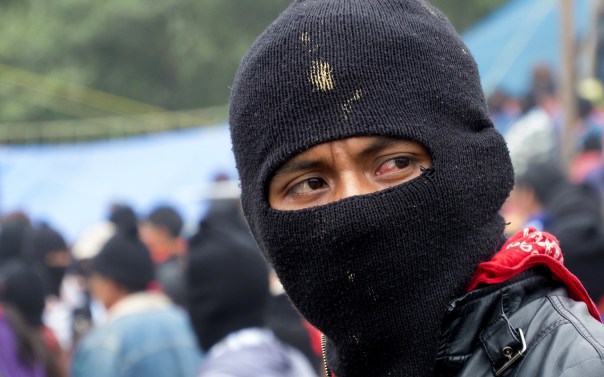
For four years, Aldama residents have lived under constant threat from paramilitary groups that shoot at them and force them to displace. Despite a non-aggression pact promoted by Alejandro Encinas in 2019, the conflict rages. Residents denounce the loss of their crops, abandoned because of the threats
Text By: Orsetta Bellani of Pie de Página
Photos: Orsetta Bellani
ALDAMA, CHIAPAS
Araceli is three-years old and knows that when she hears a shot she must throw herself on the ground. They taught it to her after the kitchen of her house was shot up. It was January 22, 2019 and her mother, her aunt and her grandmother – all support bases of the Zapatista National Liberation Army (Ejército Zapatista de Liberación Nacional, EZLN) – were making tortillas in front of their hearth, when from the Santa Martha community (Municipality of Chenalhó) came a volley that made holes in the wooden plank walls and destroyed the tin roof. Fortunately, there were no injuries that time.
“Armed groups with a paramilitary cut shoot almost daily, both night and day,” says Gabriel, Araceli’s father and a member of the Yach’il Xojolabal Zapatista coffee cooperative. “We are thinking about building a concrete wall out here, so that if they come to shoot again the bullets can’t enter.”
Everyone in San Pedro Cotzilnam (Aldama), both Zapatista and partisan families, agree: the last week of January 2019 was one of the most violent. It’s a conflict that began in 2016, when Aldama denied Santa Martha residents permission to use a water hole. Tensions between the two municipalities actually date back to the 1970s. The dispute is over 60 hectares (around 148 acres) of forests, milpas and coffee fields, which a Unitary Agrarian Court decision granted to Aldama in 2009.
Since 2016, the Aldama population, which according to the last study on poverty (Coneval, 2015) is the third poorest municipality in Mexico, lives under the constant threat from paramilitary-style armed groups. They fire shots from Santa Martha community, taking advantage of the fact that it lets them be on higher ground than Aldama. They shoot at houses and people, be they Zapatistas or members of political parties. [1] They shoot at cars, although they may transport the injured, and at campesinos while they head out to their fields.
The conflict in Aldama has caused, in total and up to now, 7 deaths, 19 bullet wounds and some 2,000 people that constantly have to “intermittently” displace themselves. In other words, during the shooting they hide in the mountains, in a relative’s house or in shelters, and they return to their homes when calm returns.
Last March 14, they arrested the spokesperson for the Aldama displaced, Cristóbal Sántiz Jiménez, for homicide. Several human rights organizations denounce the existence of legal irregularities and request his release. On the other hand, Santa Martha resident accuse Sántiz Jiménez of being responsible for the 19 murders that occurred in their community.
“What we, as the Fray Bartolomé de Las Casas Human Rights Center (Frayba) have documented, is that of these 19 deaths, 15 were murdered before the more serious conflict started (2016) and with brutal violence, which makes us think that it’s about a settling of scores between criminal groups,” says Pedro Faro, director of Frayba. “We think the other 4 people may have been murdered as a response from Aldama to the attacks from Santa Martha.”
The conflict takes place in a region – the Chiapas Highlands – where in two and a half years paramilitary-style armed groups have displaced more than 7,000 indigenous Maya Tsotsils (including those from Aldama).
Several of the paramilitaries were formed in Chenalhó municipality. In that same municipality in 1997, they massacred 45 people, in the Acteal community chapel.
The Frayba does not point to the existence of a direct connection between the current paramilitary-style armed groups and those that were formed in the 90s after the EZLN Uprising. But it denounces that they released those individuals arrested for the Acteal Massacre. Many of them returned to Chenalhó, and they never confiscated their weapons. Some of the politicians who supported them continue operating in the region.
What’s behind the attacks?
According to the Zapatistas of Aldama, there are interests that go beyond the 60 hectares in dispute, a possible real motive for so much violence. “The people in the Santa Martha armed groups are campesinos, where do they find the money to buy the bullets,” asks Gabriel.
Gabriel is a member of the Yach’il Xojolabal cooperative. He says that some power groups could promote the violence as a pretext for militarizing the region. The January 2019 opening of the Mixed Operation Base (Base de Operaciones Mixtas, BOM) in Cocó, one of the Aldama communities hit hardest by the violence, would demonstrate that.
According to this theory, more than guarantying the population’s security, the military presence would be functional to the entry of extractive companies. In Aldama there are rumors of an interest in extracting its underground mineral resources and in constructing a hydroelectric dam on the river that crosses el valley that divides it from Chenalhó. However, the Mexican Geological Service does not point to the presence of any kind of mineral in the municipality’s soil and the Frayba has not documented any of these activities.
“We have investigated in the federal government’s annual budgets and there is no money dedicated to the construction of projects of this kind,” affirms Jorge Luis López, a member of the Frayba.
In a February 6, 2019 communiqué, the Good Government Junta of Oventic denounced the violence that affects the Zapatista families of Aldama and Santa Martha. It placed responsibility on the three levels of government for not having thoroughly resolved the problem. “Their policy is to distribute money and crumbs, create conflicts and militarize the indigenous communities. They just get accustomed to giving out money to calm the people. And is that not corruption,” the autonomous Zapatista authorities ask.
A failed agreement
In June 2019, the federal administration of Andrés Manuel López Obrador promoted de non-aggression pact between Aldama and Santa Martha. He signed in the presence of Assistant Secretary of Governance Alejandro Encinas, who considered it as “the beginning of a new stage of peace and reconciliation.”
However, the shootings began a few days later and in late July 2019 Filiberto Pérez Pérez, a young man from Tabak community (Aldama), was murdered by a sniper during his grandfather’s wake. A bullet struck him in the neck.
Displaced, lost harvests
Gabriel works in the Yach’il Xojolabal coffee cooperative’s San Cristóbal de Las Casas office, from Monday to Friday. On the weekends he returns to his family and his home in [the town of] Aldama.
When Gabriel returns Araceli, his 3-year old daughter, takes his cell phone and starts watching videos, her mom takes it away from her and tells her that she best go out and play with her neighbors. There have been no recent shootings and that allows them a certain freedom to travel.
According to Gabriel, the violence affected Zapatista families less than the party members because the Zapatistas are organized. EZLN support bases have radio for communicating with each other in case of an emergency and a discipline that requires them to respect the instructions of the autonomous Zapatista authorities. And these instructions are clear: not to respond to the gunfire from Santa Martha, not to yield to the provocations.
“If our authorities tell us not to go out to our plots of land on such a day because it’s dangerous, we don’t go,” says Gabriel. “In many cases this saved us, because the snipers fire at us just as we walk in the direction of the coffee fields.”
In the beginning, the Zapatistas were going to their fields before sunrise and returning after sunset to hide themselves from the armed groups. They carried the coffee on their shoulders in big black sacks (costales) instead of the usual white ones, so as to hide them in the darkness. But in August 2018, a family of 5 was murdered in their car in an ambush. After that, many campesinos decided to abandon the crops in their coffee fields in order to save their lives.
“Do you see it? They were shooting from there,” says Juan, a member of Yach’il Xojolabal, “last year it was impossible to be here, now it’s calmer.” Juan points to a place on the side of the mountain in front of us; we’re in the coffee fields, some two hundred meters away: that’s where the armed groups from Santa Martha are entrenched behind some sandbags.
The violence caused grave economic effects to the 25 Aldama families that are members of the Yach’il Xojolabal coffee cooperative. This cooperative was founded in 2001 and has a total membership of some 700 families from 8 autonomous municipalities of Chiapas.
In 2019, Zapatista coffee growers lost 50 percent of their grains, but this year the losses have been less. Just for the harvest season – between November 2019 and the beginning of March 2020 – there were no shootings in Aldama.
However, because of the shootings last year, the coffee fields didn’t receive the maintenance that they need, and the 2020 harvest for the Zapatistas in Aldama reached only 60-70 percent of what was estimated.
“In any case, the situation in Aldama just partially affects our total production for 2020,” says Yach’il Xojolabal. Of the 8 municipalities where they produce coffee “we harvest around 87 percent of the estimated production and we will have no problem in complying with the contracts that we signed.”
—————————————————————
Originally Published in Spanish by Pie de Página
Re-Published in Spanish by Chiapas Paralelo
Sunday, April 12, 2020
Re-Published with English interpretation by the Chiapas Support Committee
The next three months of great danger to the world

By: Raúl Zibechi
The three months that separate us from elections in the United States will be critical to life on the planet, according to various analyses and, in a very particular way, in the opinion of Chinese leaders, those most interested in neutralizing the offensive underway from the White House and the Pentagon.
Last Sunday, July 26, the editor-in-chief of the Global Times, official newspaper of the Chinese Communist Party (CCP), Hu Xijin, published a call for the nation to construct more nuclear missiles as a measure to confront unprecedented security challenges from the United States. In his account he wrote: “Hurry up and build more nuclear missiles to deter the crazy Americans” (https://bit.ly/3jJxbGa).
Months ago, there was another call in the same media, with the same orientation: increasing the nuclear arsenal to deter the Pentagon. According to the newspaper, it was not China’s will to increase its atomic arsenal, but the current situation suggests that clashes will take place in the South China Sea, which has become the epicenter of the conflict between the two powers.
Donald Trump’s electoral strategy is designed in an extensive interview with Steve Bannon in Asia Times, on June 12 (Bannon was head of the Trump campaign in 2016, a banker at Goldman Sachs and a White House advisor in the magnate’s presidency). He assures that if he focuses his campaign against China, he can win the election in November.
His opinions are tremendous and some sound delusional, like accusing China for the death of George Floyd, because the Afro-American had Covid-19, “which came from the CCP,” consumed fentanyl, an opioid that dice comes from the same nation, and that he never got a factory job because industry went away to the Asian country https://bit.ly/30Xo2kz).
However, it’s necessary to read the interview because it exposes US policy and the thinking of its elites. He claims that: “the Chinese government is a group of mobsters” and that the Communist Party is “a group of gangsters.” Even worse, he says that the CCP “is the unfinished work of the 20th Century” and that this is the time to liquidate it.
There are two points of attack: stifling Hong Kong because China must be prevented access to the technology and capital of the West, and constructing a regional alliance with Japan, Australia, India and Vietnam, “around the South China Sea and the Strait of Malacca.” Both strategies are underway, but in Bannon’s opinion must be increased until the Communist Party is overthrown.
On June 4, Steve Bannon released what he calls the “New Federal State of China,” which even has a flag, proclaimed on the anniversary of the 1989 Tiananmen Square repression, and is made up of a handful of millionaires that fled China. Beyond the fact that this objective is unattainable, the will to overthrow the Chinese regime by force should be noted.
Beijing’s response to US aggression can be read in the Global Times on that same July 26, in an article that emphasizes the “extreme danger” that bilateral relations will contain in the next three months (https://bit.ly/39CeAqI). In it, he anticipates that in those three months “it’s probable that the Trump administration launches more attacks to force China to retaliate.”
The newspaper, which reflects the Chinese government’s opinion, insists that Trump’s desire to get a second term can aggravate things in the short term. But it assures that the anti-China position “reflects the bi-partisan consensus among the US elites, and therefore China should not expect a significant change in Washington policy, even if there is a transition of power in November, which means that China should be prepared for a long fight.”
This is the central point. United States foreign policy veered from its previous centrality on the Middle East towards the Pacific and China since the Obama presidency. Based on the opinions of Chinese experts, the Global Times concludes that Beijing should not enter into provocations, like the closure of the Houston consulate.
“The key to China avoiding conflict and to winning the competition forced by the United States is to focus on its own development and to be prepared for the worst situation,” the newspaper said. The lucidity of the team leader permits it to conclude with a statement typical of its millennial culture: “The United States is not afraid of a cold war with us, it’s afraid of our development.”
They make clear that “the worst” can happen: A war in maritime waters that can derive into a nuclear war. They want to be prepared for that eventuality, but concentrate on their own development.
Those of us below must assume that things are going to get worse, that the storm/pandemic that affects us is just the first in a series of calamities that we will not be able to prevent, and that the arks in permanent construction help us face this period that puts our resistances to the test.
———————————————————
Originally Published in Spanish by La Jornada
Friday, July 31, 2020
https://www.jornada.com.mx/2020/07/31/opinion/018a2pol
Re-Published with English interpretation by the Chiapas Support Committee
It’s Not the Virus
 By Hermann Bellinghausen
The crisis of the virus is here to stay and leave sequels. Its prevalence will be greater than the mere seasonal flu, and it foreshadows a time where viral infections and other new ills will rain more and more, and they won’t be as unpredictable as the governments, churches and media would have us believe.
As the quarantines and the resistances to it unfold, the returns to a new future, the need to come to terms with the idea of too many changes to daily life, one also acquires a perspective of the number of deaths, injured and disappeared, like in a war. A greater realism in the face of death itself, its other causes, its other statistics, allows us to relativize (normalize?) the psychological and health impacts caused by Covid-19 as it passes through the world.
Many more die of cancer, hunger, afflictions associated with the absurdities of consumption, the brutal damage to the environment, or for the wars, almost all of which are criminal. With other data we are reassured: ahh yes, we are already screwed, it’s up to all of us. Silvia Ribeiro never stops warning us in these very pages and in others, like Desinformémonos, about the pandemics that are coming, the imminent paths of all our poisons.
In a world in which staying healthy becomes increasingly difficult, even though the advances in medicine would seem to indicate the contrary, it is clear that the big loser is allopathic or scientific medicine. As a source of thinking, not of mere knowledge. It preferred the foolishness of power to the collective good. It rejected prevention as the base of its actions. It embraced the effects and disdained the causes. The breaking point was forged 40 years ago, when another allopathy seemed possible, but instead it steered toward the logic of budding neoliberalism.
The notion that health depended on taking care of it, rather than curing ailments, won ground in the schools, hospitals and institutions. More family doctors and less hyper-specialists. More care in daily life of the body and mind and less industrial medications. More and better first class services and less white elephants for people who could not avoid getting sick. On the contrary, there was a pact between the medical guild and the pharmaceutical industry, an overgrown monster in the stock market, mostly for economic reasons (the vile business) as well as military and political ones.
Allopathy erected walls to isolate and devalue any other thought or practice before the clinical case and the construction of human well-being. The world was inundated with medications/drugs that as much save as kill, relieve as worsen, that rarely prevent and are an illness in themselves (there is even a Green word for this: iatrogeny). Instead of taking advantage of this bunch of different paths, that would not have to be rivals, institutionalized medicine denied any alliance with approaches which were homeopathic, acupuncture, holistic, shamanic, where magic comes from experience and not the other way around. Nor did it agree to reform its approach from a curative to a preventative one, according to the prudent perceptions of Pasteur, Ehrilch, et al. Health problems could be prevented or moderated, with results that were both better for life and cheaper.
Ariel Guzik is one of the most interesting minds in Mexico today. Iridologist, inventor, scientist, and musician that works with the sounds and songs of Nature (wind, water, whales, electromagnetic fields), in a recent text reflects on the pandemic and reads in it plot an utterance of the human naivety and capacity for submission. As for the viruses themselves, he concludes that they are but traces at the scene of the crime. He points out that the declaration of a pandemic that suddenly determines and blurs our lives, and from one day to the next eclipses calamities, punishes encounters and silences verbal expression has been managed through the media from the narrow and circular perspective of the virus, control and numbers. It exalts the imaginaries that we have forged from the vast preparatory universe of fiction. I think it is necessary to exonerate the virus from its role as the sole cause and central focus of this phenomenon:
From his experience in herbalism and traditional medicines, Guzik questions the conception that we have of the pandemic, of our surrender to what is presented to us as rational. His writing makes sense in a a situation directed by the reason of the State, the cost and benefit for the markets, the repressive control, the focused and medicalized combat of a biological event that takes place in diverse dimensions.
We are entering into a new era of health and illness that redraws the faces of life, death and the desirable good life. It’s urgent to think everything through anew, before it is too late. The problem is not the virus, but rather what makes possible all that it unleashes.
———————————————————–
Originally Published in Spanish by La Jornada
Monday, July 27, 2020
https://www.jornada.com.mx/2020/07/27/opinion/a06a1cul
Re-Published with English interpretation by the Chiapas Support Committee
Covid-19, the Chiapas mirror
Mad Doctor
By: Luis Hernández Navarro
Dr. José Manuel Cruz Castellanos is a peculiar character. He would seem taken from a humorous Monty Python film. When they asked him if the arrival of dust from the Sahara could affect the health of Chiapanecos, or make them susceptible to contracting Covid-19, he responded: “The arrival of no foreigner, of no Mexican, of no one who comes to Chiapas, is harmed and cannot harm Chiapas because we have the great filter of the airport.”
Before the rant, the journalists specified that they were referring to the dust cloud that would enter Mexico.
“Without any problem –the doctor replied–, everyone who arrives is subject to epidemiological surveillance and laboratory studies, in such a way that we have a context for protecting the population. Health filters were established for that.”
The nonsense wouldn’t matter, except for one fact. Cruz Castellanos is the Secretary of Health of Chiapas.
His delusions are enough to write a book. When the journalist Lizbeth Jiménez questioned him about irregularities in the number of patients with the coronavirus registered in the state, he blurted out: “Interpreting costs when one does not have a very clear mind in what one is doing, as I see in your case that it wasn’t clear to you. Record it so that you don’t come with absurd questions. You just walk around with a lot of precaution, I’m not going to grab you over there and we don’t want that. You are very pretty, very elegant for something to happen to you.”
The reporter’s question was correct. The Chiapas Secretary of Health is a magician with the numbers. Since last June l8, he made the number of infections diminish, literally from one day to the next. And like a good illusionist, he kept the number below 100 cases per day. A convenient management for the state to move to the orange light!
Cruz Castellanos’ dance of the numbers has been questioned by a multitude of voices. One of those voices is that of the state delegate of the Red Cross, Francisco Alvarado Nazar –himself infected with the coronavirus–. The delegate reported that on June 23 they received “an hourly emergency call from people with Covid-19 problems, which in 40 percent of the cases, the condition of the possibly infected person was critical and the chain of infections in Tuxtla Gutiérrez urgently needed to be cut.”
The Secretary’s response was flamboyant. He accused the Red Cross delegate of not having correct information and that the patients who are recovering (like Alvarado) “remain half crazy.” He added that the criticisms of his management “slide off” of him, because “every morning I put on a little oil and everything slides off of me.”
Cruz Castellanos is a figure very close politically to the Tabasco woman Rosalinda López Hernández, general administrator of the Fiscal Auditor of the SAT and the wife of Rutilio Escandón, the Governor of Chiapas. He jumped from the PRI, to the PRD and then to the PVEM until his incorporation into Morena. In 2015 he competed on behalf of the Green Party (PVEM), to be deputy for the sixth district. That’s where he built an alliance with Rosalinda, who was a candidate for that same party to the mayoralty of Villahermosa. Both were defeated.
The Chiapas Secretary of Health made his political career in the Tabasco health sector, during the governorship of Manuel Andrade Díaz (2002-06). Local deputy Olvita Palomeque accused the official of committing grave irregularities in his Chiapas term of office, benefitting from public works and contracts through a direct award to three Tabasco companies.
The governmental management of the pandemic in Chiapas has been a calamity. Hundreds of people have denounced infections and deaths of their family members, without medical attention and without tests, whose deaths are not counted (https://bit.ly/2Wwccg2). According to Section 7’s democratic teachers, “the data that health entities provide is far from the information that is known. Not all suspected or confirmed cases or deaths have been taken into account for the statistical record. Every day we know about stories of people who tested positive or who had a tortuous pilgrimage to receive attention until they died.”
Ignoring the enormous confusion caused from the social networks (https://bit.ly/3fR3yjS), local authorities reported about the disease in indigenous languages until June, despite being the state with the third highest proportion of the population speaking them (https://bit.ly/2CQnwMT). Personnel of the state’s Health Secretariat work without protective equipment, with grave risk of contracting the disease: 42 have died and 751 have contracted the virus. For years, workers of Section 50 of the SNTSS have denounced the corruption, dismantlement and lack of equipment in the state’s hospitals.
Dr. José Manuel Cruz’s figures are not accidental. They are a substantial part of the style of doing politics of the political bosses (cacicazgos) that control political power in Chiapas, protected for years by a counterinsurgency policy. Today, those political bosses wear the clothing of the 4T.
The pitiful management of the health crisis in Chiapas is a mirror in which the rest of the country should see itself. The damage the population has suffered has been catastrophic. The federal government’s decision to hide that disaster will aggravate it even more.
———————————————————–
Originally Published in Spanish by La Jornada
Tuesday, July 21, 2020
https://www.jornada.com.mx/2020/07/21/opinion/019a1pol
Re-Published with English interpretation by the Chiapas Support Committee
 Chiapas Support Committee