Chiapas Support Committee
Home of the Compañero Manuel blog on zapatistas & mexico
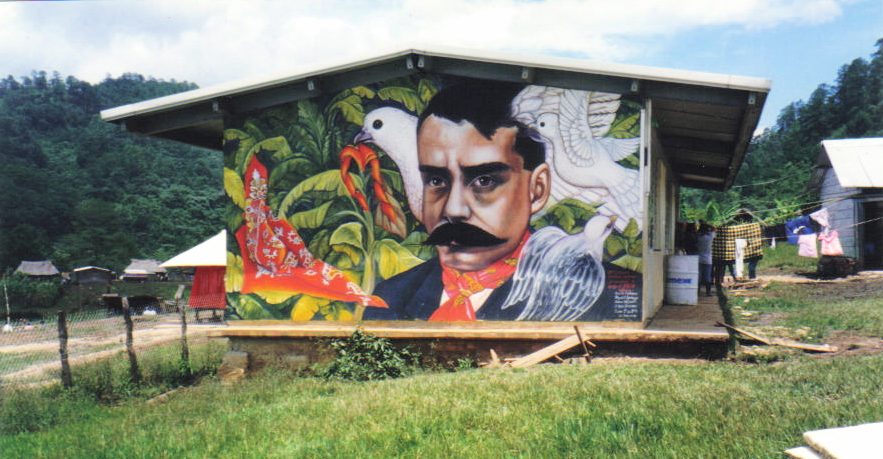
Paramilitary attacks intensify in Aldama; “the government’s omission” continues
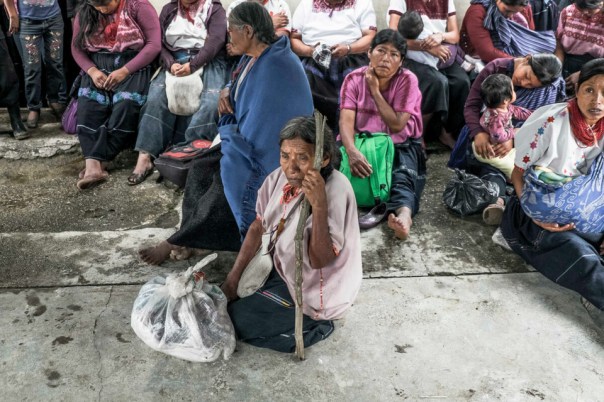
A camp of displaced persons from Aldama.
By: Hermann Bellinghausen
Tsotsiles: They hunt us at our jobs, on the roads and attack us in our homes
Just last September there were six injured with firearms in Aldama, Chiapas, denounce the residents of Magdalena Aldama who introduce themselves as “the voice of the people” and have given a timely follow-up on the escalation of violence that affects the communities of this Tzotzil municipality. On September 4, Mario Pérez Gutiérrez, 22, and Juan Pérez Gutiérrez, 27, were injured by the fire that that systematically comes from Santa Martha, Chenalhó.
On September 12, Andrés Ruiz Santiz, 61, was injured and on September 13 Raymundo Pérez Santiz, 16, suffered injuries, as did Armando Pérez, 31. On September 30, paramilitary bullets hit Artemio Pérez Pérez in both lungs; he remains hospitalized. The three men were wounded at the attack point of El Volcán and three at T’elemax, Santa Martha, Chenalhó.
So far in October, the Tsotsil campesinos add, “the armed attacks from these paramilitary groups have intensified day and night; they hunt us at our jobs, on the roads, and they attacks us in our own homes and want to kill us casas. As a consequence of this, intermittent displacements have resulted. In other words, they not only dispossess us of our Mother Earth, on which we live and which ancestrally our grandparents have left us and which has been ratified at the Tribunal Unitary Agrarian Court.” Previous and current governments, they add, “have been negotiating our lands.”
Frayba: risk of a massacre like Acteal
For its part, the Fray Bartolomé de Las Casas Human Rights Center (Frayba) warned “about the scenario of a violence of great magnitude and that a massacre like that of Acteal can occur, and, therefore, in fact, difficult or impossible to repair.” According to the Frayba, “the persistent omission and complicity of the Chiapas government and of the federal government causes the escalation of violence in the Highlands region and increases the risk to life of the population in 13 communities in Aldama municipality, mostly women, children, adolescents and elderly people.”
Consequently, it demands that the authorities investigate and punish“ the responsible authorities for the impunity of these events, as well as the intellectual authors.”
Yesterday morning, Magdalena residents expressed: “We denounce once again these paramilitary-style armed groups in Santa Martha Chenalhó that operate freely in that area of the Chiapas Highlands.
“We are an internal forcibly displaced people who have suffered for several years, who now live under armed attack from paramilitary groups in Santa Martha, Chenalhó municipality, where the Chenalhó paramilitaries have always been operating and remain active as of this date.”
The Magdalena indigenous people lament the Mexican government’s inability to bring about resolution,” faced with an agrarian conflict that has been aggravating the continuous armed attacks. “We have suffered and continue suffering. What happened on October 11 at 9:30 am at the T’elemax point in Santa Martha is an example. They attacked the Tabak community and, as a consequence of that, Hugo Alfredo Pérez Hernández was injured by a high-caliber bullet, when he was coming back from San Andrés Larráinzar.”
It’s not the first time that this has been denounced, they conclude: “The same groups have also attacked the town of Chalchihuitán, and today we ask the government: how many more wounded is it going to take in order to resolve this agrarian conflict? How long must we endure these armed attacks from the paramilitary group in Santa Martha Chenalhó? Now what’s next? What hope do the people of Aldama have?”
————————————————————
Originally Published in Spanish by La Jornada
Wednesday, October 13 2020
https://www.jornada.com.mx/2020/10/13/politica/009n1pol
Re-Published with English interpretation by the Chiapas Support Committee
Part Five: The Gaze and the Distance to the Door
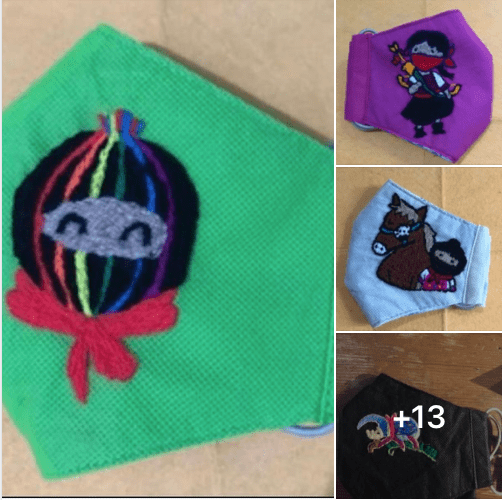
Some of the face masks that the Zapatistas are making. to protect from Covid-19.
October 2020
Let’s suppose it is possible to choose where to direct your own gaze. Suppose that you could free yourself, if only for a moment, from the tyranny of social networks that impose not only what you see and talk about, but also how you see and how you talk. Then, suppose that you lift your gaze higher: from the immediate to the local to the regional to the national to the global. Can you see that far? Yes, it’s chaos, confusion and disorder out there. Then let’s suppose you are a human being, not a digital application that quickly scans, classifies, orders, judges and sanctions, and as such, you choose where to look… and how to look. It could be (this is just a hypothetical) that looking and judging aren’t the same thing, such that you don’t just choose where to direct your gaze, you also decide what your inquiry is, shifting the question from “Is this good or bad?” to “What is this?” Of course, the former implies a juicy debate (are there still debates?), which in turn leads to “This is good—or bad—because I say so.” Or perhaps to a discussion about what good and evil are, and from there to arguments and citations with footnotes. Yes, you’re right, that’s better than resorting to “likes” and “thumbs up”, but what I’m proposing is to change the starting point: choose where to direct your gaze.
For example: you decide to direct your gaze to Muslims. You could choose to look, for example, at those who perpetrated the Charlie Hebdo attacks, or at those who are currently marching through the streets of France to voice and demand their rights. Since you’ve read this far, it’s likely that you would opt for the “sans papiers[i].” Of course, you also feel obligated to declare that Macron is an imbecile. But, that quick look upwards aside, you again turn to look at the migrants’ protest encampments and marches. You ask how many of them are out there—seems like a lot, or a few, or too many, or just enough. Your interest has moved from their religious identity to their numbers. Then you ask yourself what they want, why they struggle. Here you have to decide whether to turn to the media and social networks to find out… or whether to listen to the migrants directly. Suppose you could talk to them. Would you ask them about their religion, or how many of them are there? Or would you ask them why they left their homeland and decided to come to these distant lands with a different language, culture, laws and customs? Perhaps they will answer you with a single word: war. Or perhaps they will give details of what that word means in their reality. War. You decide to look into it: war where? Or better yet, why war? They overwhelm you with explanations: religious beliefs, territorial disputes, theft of natural resources or simply stupidity. But you aren’t satisfied yet and you ask who benefits from the destruction, the depopulation, the reconstruction and the repopulation. You come across the names of many different corporations. You look into these corporations and discover that they are located in several countries and that they manufacture not just weapons, but also cars, interstellar rockets, microwave ovens, packing and shipping services, banks, social networks, “media content”, clothing, cell phones and computers, underwear, organic food and non-organic food, shipping companies, online sales, trains, heads of state and cabinet members, scientific and non-scientific research centers, hotel and restaurant chains, fast food, airlines, thermoelectric plants, and, of course, “humanitarian” aid foundations. You could say, then, that the responsibility lies with humanity or the whole world.
But you ask yourself whether the world or humanity aren’t also responsible for the march and the migrant encampment, for that resistance. You conclude that, yes, maybe, it’s possible that a whole system is responsible: a system that produces and reproduces the pain as well as those who inflict it and those who endure it.
Now you return your gaze to the march making its way through France. Suppose that there are few, very few people, that there’s just one woman carrying her baby. Do you care about her religious beliefs, her language, her clothing, her culture, her customs? Does it matter that she’s just one woman carrying her baby in her arms? Now forget about the woman for a moment and focus your gaze just on her little one. Does it matter whether it’s a boy, girl, or other? Does the child’s skin color matter? Perhaps you discover then that what matters is its life.
Now go further. After all, you’ve gotten this far, so a few more lines won’t do you any harm. Not much at least.
Suppose that woman speaks to you and you have the privilege of understanding what she says. Do you think she’ll demand that you ask her forgiveness for the color of your skin, for your religious beliefs or lack thereof, for your nationality, your ancestors, your language, your gender, or your customs? Are you in a hurry to apologize to her for being who you are? Do you think she’ll forgive you and then you can go back to your life with that debt fully paid? Or that she won’t forgive you, and you’ll be able to say, “Well, at least I tried, and I am sincerely sorry for being who I am”?
Or are you afraid that she won’t talk to you, that she’ll just look at you silently and you’ll sense that her gaze asks, “And you?”
If you arrive at this reasoning-feeling-anguish-desperation, well then, I’m sorry, there’s no cure for you: you’re a human being.
-*-
Thus assured that you’re not a bot, repeat this exercise on the Island of Lesbos, the Rock of Gibraltar, the English Channel, Naples, the Suchiate River and the Río Grande.
Now turn your gaze and look for Palestine, Kurdistan, Euskadi [ii] and Wallmapu [iii]. I know, it’s dizzying… and there are many more places to look. But in these places there are people (whether many or few, too many or just enough) who also struggle for life. And they understand life as inseparably tied to their land, their language, their culture, their customs; what the National Indigenous Congress [CNI] taught us to call “territory,” which isn’t just a piece of land. Wouldn’t you like those people to tell you their stories, their struggle, their dreams? I know, perhaps you’re thinking it would be easier just to check Wikipedia, but isn’t it tempting to hear it from them directly and try to understand?
Return now to what’s between the Suchiate River and the Río Grande. Go to a place called “Morelos.” Then turn your gaze to the municipality of Temoac, and focus on the community of Amilcingo. Do you see that house? That’s the home of a man who was called Samir Flores Soberanes. In front of that door, he was murdered. His crime? Opposing a megaproject that represented the death of the life of the communities to which he belonged. No, I haven’t misspoken: Samir was killed not for defending his individual life, but for defending the life of his communities.
What’s more, Samir was murdered for defending the life of not yet thought of generations. For Samir, as for his compañeras and compañeros, and for the Native peoples that make up the CNI and for us, nosotros, nosotras, nosotroas Zapatistas, the life of a community doesn’t take place only in the present: it is above all what is to come. The life of a community is something that is built today, but built for tomorrow. That is, life in community is something that is passed on to future generations. Do you think that the debt of his death is paid if the intellectual and material authors of the murder ask for forgiveness? Do you think that his family, his organization, the CNI, nosotr@s, will be satisfied by the criminals’ apology? “Forgive me, I put the price on his head for the hit men to take him out; I’ve always been quite the gossip. I’ll try to be better—or not. All right then, I’ve asked for forgiveness, now get rid of your protest encampment so we can finish the thermoelectric plant, or else a lot of money is going to be lost.” Do you think that’s what they’re waiting for, that that’s what we’re waiting for, that that’s why they struggle and why we struggle: for them to apologize? For them to declare: “Oh sorry, yes, we murdered Samir and what’s more, this megaproject is murdering your communities. Our bad. All right, forgive us already. Though if you won’t forgive us it doesn’t matter anyway, the project must go on”?
It turns out that the same people who would ask forgiveness for the thermoelectric plant are behind the badly named “Mayan” Train, the “Trans-isthmus Corridor”, the dams, the open pit mines and the electric power plants. They’re the same people who close borders to stop migration flows triggered by the wars that they themselves encourage. They’re the same ones who pursue the Mapuche people, massacre the Kurds, destroy Palestine, and shoot African Americans; who directly or indirectly exploit workers in every corner of the globe; who cultivate and glorify gender violence and prostitute children; who spy on you to know what you like and sell it to you (and if you don’t like anything, to make you like it); the same ones who destroy nature. They’re the same people who want to make you, us, and everyone else believe that responsibility for these global crimes being carried out lies with particular nations and religions, with resistance to progress, with conservatives, with certain languages, histories, or ways of being, or that everything can be synthesized in one individual (an individuo… or individua – don’t neglect gender equality!).
If you could go to all those corners of our moribund planet, what would you do? Well, we don’t know what you’d do, but we Zapatistas, nosotros, nosotras, nosotroas would go to learn. To dance, too, of course, but I don’t think the two are mutually exclusive. If that opportunity existed we would be willing to risk everything for it: not just our individual lives but our collective life. And if that possibility didn’t exist, we would do everything possible to create it, to construct it, as if it were a vessel. Yes, I know it’s crazy—unthinkable even. Who would have thought that the destiny of people resisting a thermoelectric plant in a tiny corner of Mexico could be of interest to Palestinians, to the Mapuche, to the Basque people, to migrants, to African Americans, to a young Swedish environmentalist, to a Kurdish woman warrior, to women struggling in other parts of the planet; to Japan, China, the Koreas, Oceania and Mother Africa?
On the contrary, shouldn’t we go, for example, to Chablekal, in the Yucatan Peninsula, to the office of Equipo Indignación [Team Indignation] and demand, “Hey! You guys are religious and have white skin: ask our forgiveness!” I’m almost certain they would respond, “No problem, but you’ll wait your turn because right now we’re busy accompanying those who are resisting the Mayan Train and suffering displacement, persecution, prison and death.” And they would add:
“Also, right now we’re dealing with the accusation by the Supreme Leader that we’re financed by the Illuminati as part of an interplanetary conspiracy to stop the 4T.”[iv] What I am sure of is that they would use the verb “accompany” and not “direct,” “manage” or “control.”
Or should we invade Europe with a cry of “Surrender, pale-faces!” and then proceed to destroy the Parthenon, the Louvre, and the Prado, and instead of sculptures and paintings, fill everything with Zapatista embroidery, especially Zapatista face masks—which, can I just say, are both effective and attractive. Instead of pasta, seafood and paella we could impose a diet of elote, cacaté, and yerba mora; instead of soda, wine, and beer we could introduce obligatory pozole[v]; and for whoever is caught out on the street without a ski mask, either a fine or prison time (one or the other, no reason to go overboard). We could also announce, “Listen rockstars, from now on you play marimba! And we only want to hear cumbias, no more reggaeton (tempting, right?). Hey you two, Panchito Varona[vi] and Sabina[vii]—everybody else join the chorus—let’s hear “Cartas Marcadas”[viii], on loop, even if it’s 10pm, 11, 12, 1am, 2am, 3am… we’ll cut it off then because we have to get up early tomorrow! And you over there, fugitive ex-King[ix], leave those elephants alone and get cooking! Squash soup for the whole court! (I know, isn’t my cruelty is exquisite)”?
Now you tell me: do you think the nightmare of those above is that they be forced to apologize? Could it be, rather, that their worst nightmare is to disappear, to cease to matter, for no one to care about them anymore, that they become nothing, that their world collapses without making a sound and without anyone remembering them, erecting statues, museums, chants, or days of remembrance? Could it be that that possible reality is what really causes them panic?
-*- It was one of few occasions when the defunct SupMarcos did not resort to a cinematic comparison to explain something. You all weren’t around to know and I wasn’t around to tell, but the late SupMarcos would explain all of the stages of his short life with reference to a film. Or he’d illustrate any explanation of the national or international situation with the phrase “just like in such-and-such movie.” Of course, oftentimes he’d have to modify the script to address the situation at hand, but since most of us had never seen the film nor did we have internet connections to check Wikipedia on our cellphones, we believed him. But let’s not get off topic. Wait a sec, I think he left it written here somewhere in this pile of papers that fill his old trunk…. Here it is! Okay, here goes:
“To understand our determination and the size of our audacity, imagine that death is a doorway. There are endless speculations about what’s behind the door—heaven, hell, limbo, nothing—and dozens of descriptions of all of those options. Life, then, could be imagined as a path to that door. The door—death that is—would be in that case a point of arrival… or an interruption, an impertinent slash of absence wounding the air of life.
One would arrive at that door, then, via the violence of torture and murder, an unfortunate accident, the painful half-closing of the door in sickness, through fatigue or through desire. That is, while the majority arrive to that door without wanting to or meaning to, it is also possible for it to be a choice.
Among the Native peoples that today are Zapatistas, before, death was a door introduced early, almost as of birth. Children often reached that door before five years of age, crossing over with fever and diarrhea. What we tried to do on January 1, 1994, was push that door into the distance. We did of course have to be ready to go through the door in our effort to achieve that goal, although that wasn’t what we wanted. Since then, our determination has been and continues to be to push that door as far into the distance as possible, to “extend life expectancy” as the experts say. Dignified life, we would add. We try to distance that door to the point that it can be pushed off to the side, very far ahead of us. That’s why we said from the beginning of the uprising that “we would die in order to live.” After all, if we do not hand down life—that is, a path—to the next generations, then what did we live for?
-*-
To hand down life.
That is precisely what Samir Flores Soberanes tried to do, and that is what is encapsulated in the struggle of the Frente de Pueblos en Defensa del Agua y de la Tierra de Morelos, Puebla y Tlaxcala [People’s Front in Defense of the Water and Land of Morelos, Puebla, and Tlaxcala] and their resistance and rebellion against the thermoelectric plant and the poorly named “Integrated Project for Morelos.” The government’s argument against their demand to cease and remove that death project has been that it will lose a lot of money.
What’s happening in Morelos summarizes the current conflict across the entire world: money versus life. In that confrontation, in that war, no honest person can be neutral: one is on the side of money or one is on the side of life.
We could conclude, then, that the struggle for life isn’t an obsession among originary peoples. It’s more like a vocation… a collective one.
All right then. Cheers and don’t forget that forgiveness and justice are not the same.
From the mountains of the Alps, wondering where to invade first: Germany, Austria, Switzerland, France, Italy, Slovenia, Monaco, Liechtenstein? Just kidding… or not.
SupGaleano practicing his most elegant wretching.
Mexico, October of 2020.
From the notebook of the Cat-Dog:
A Mountain on the High Seas. Part I: The Raft
“In the seas of all of the worlds of this world, there were mountains that moved above the water and upon them the obscured faces of women, men, and others.”
“Chronicles of Tomorrow,” Don Durito de La Lacandona, 1990.
After a third failed attempt, Maxo paused thoughtfully for a few seconds before exclaiming, “We need a rope.” “Told you” replied Gabino. The remainders of the raft dispersed and collided in the water, running into each other in accord with the current of the river which, true to its name of “Colorado,” took on the tint of the red clay of its banks.
They called in a miliciano cavalry battalion which arrived to the rhythm of “Cumbia Sobre el Río Suena” [Cumbia by the River] by the great Celso Piña. They tied several ropes together, making two large sections, and sent one team to the other side of the river. Tying their ropes to the raft, both groups could control the direction of the vessel without it breaking up, pulling the pile of logs along a river that was itself quite unaware of the navigation effort.
The illogical act in process had emerged after we had decided upon the invasion … oh pardon me, I meant the visit to the five continents. So the deed had been done. When the idea was voted on and SupGaleano said, “You all are crazy, we don’t have a boat,” Maxo responded, “We’ll build one.” And immediately the proposals started to flow.
As with all things absurd in Zapatista territory, the construction of the “boat” got the attention of Defensa Zapatista’s gang.
On the fourth attempt, as the boat weakened almost immediately, Esperanza declared, with her legendary optimism, “The compañeras are going to die wretchedly.” (She had come across that word in a book and understood it meant something horrible and irreparable, and began to use it indiscriminately: “My mom fixed my hair wretchedly,” “The teacher marked up my homework wretchedly,” and so on).
“The compañeros too!” Pedrito piped up, though not entirely sure gender solidarity was appropriate when the destiny was… wretched.
“Nah,” Defensa replied, “Compañeros are easy to replace, but compañeras… where would we even begin? A real compañera… that’s not just anybody!”
Defensa’s gang was positioned strategically, not to contemplate the ups and downs of the CCRI [Indigenous Revolutionary Clandestine Committee] members’ attempts to build the raft, but rather so that Defensa and Esperanza could hold onto both Calamidad’s hands after the little girl had twice already tried to throw herself into the river to rescue the boat. Both times she was intercepted by Pedrito, Pablito, and the beloved Amado. The one-eyed horse and the cat-dog were dumbfounded from the beginning, worrying unnecessarily. As soon as SupGaleano saw the gang arrive, he assigned three militia units to the bank of the river and instructed, with his typical smiling diplomacy, “If that little girl makes it into the water, you’re all dead.”
After some success on the sixth attempt, the CCRI members tried filling the boat with what they called trip “essentials” (a kind of Zapatista survival kit): a bag of tostadas, panela [cane sugar], a gunny sack of coffee, some maize prepared for pozol, a bundle of firewood, and a piece of plastic in case of rain. After thinking a bit they realized something was missing, and without delay the marimba was brought to the banks.
Maxo approached Monarca and SupGaleano who were looking over some designs that I’ll tell you about on another occasion and said, “Hey Sup, you’re going to have to send a letter to the other side and tell them to get a rope and tie it up to make a long piece and throw one end over here so that from both banks we can get the “boat” moving. But they’re going to have to get organized because if each side just throws their rope out whichever way, it’s not going to reach. We’re going to have to be organized and tie the ropes up properly.”
Maxo didn’t wait for SupGaleano to emerge from his confusion and try to explain that there was a big difference between a log raft tied together with reed and a boat that could cross the Atlantic.
Maxo left to go supervise the trial run of the raft loaded with supplies. They were debating who should get on to test it out with people on board, but the river thrashed about with an ominous rumbling, so they opted for making a rag doll and tying it to the middle of the raft. Maxo was acting as the naval engineer because years ago, when a Zapatista delegation went to support the Cucapá encampment, Maxo got into the Gulf of California. He hadn’t explained to anyone that he almost drowned because his ski mask stuck to his nose and mouth and he couldn’t breathe. Like an old sea dog he explained to the others: “[the Gulf] is like a river but without a current, and thicker, by a lot, like Lake Miramar.”
SupGaleano was trying to decipher how to say “rope” in German, Italian, French, English, Greek, Basque, Turkish, Swedish, Catalan, Finnish, etc., when Major Irma approached and said, “tell them they are not alone [solas].” “Or alone [solos]!” Marijose added, who had come to ask the musicians to compose a cumbia version of Swan Lake. “A happy version, one you can dance to, so their hearts are not sad.” The musicians asked what “swans” were. “They’re like ducks but prettier, like they stretched out their necks and got stuck that way. They’re like giraffes but they walk like ducks.” “Can you eat them?” the musicians asked. It was lunchtime and they had only shown up to deliver the marimba. “Oh for pity’s sake, no, swans are for dancing!” The musicians muttered among themselves that a version of “Pollito con papas[x]” might work. “We’ll study up,” they said and went to have their pozol.
Meanwhile, Defensa Zapatista and Esperanza convinced Calamidad that given that SupGaleano was busy, his hut was probably empty and it was very likely that he had a package of honeybuns hidden away in his tobacco tin. Calamidad was doubtful so they had to tell her that they could play popcorn (making corn kernels explode like firecrackers) when they got there. Off they went. The Sup saw them wander off in that direction but he wasn’t worried, the honeybun hideaway was impossible to find, buried as it was under bags of moldy tobacco. He looked at Monarca and gestured to one of the diagrams. “You sure that’s not going to sink? It’s going to be heavy.” Monarca paused and thought a moment and then replied, “Hmm, it could.” He then added seriously, “They should take balloons just in case, so they can float.”
The Sup sighed and said, “What we need more than a boat is some sense.” “And more rope!” added SubMoy who had arrived just as the raft, weighed down with cargo, sank.
While the CCRI members contemplated the remains of the shipwreck from the riverbank and the marimba floated by, bottom up, someone said, “Good thing we didn’t put the sound system on there, that would have been expensive.”
Everybody applauded when the rag doll floated to the surface. Somebody, with some foresight, had put two inflated balloons under her arms.
I give my word.
Meow-Woof.
————-
There are 3 Music Videos attached to the comunicado. You can listen to them here: http://enlacezapatista.ezln.org.mx/2020/10/09/quinta-parte-la-mirada-y-la-distancia-a-la-puerta/
Translator’s Notes
[i] French for “undocumented.”
[ii] Refers to Basque country.
[iii] Refers to Mapuche territory.
[iv] López Obrador deemed his own governing project the “Fourth Transformation” (4T), supposedly on par with historic events such as Mexican Independence (1810), a period of reform in the mid-19th century, and the Mexican Revolution (1910). On August 28, 2020, López Obrador’s administration declared that opposition to his government’s pet project [the “Mayan Train”] was financed by foreign foundations linked to the US State Department. See: https://www.proceso.com.mx/645590/fundaciones-extranjeras-financian-oposicion-al-tren-maya-acusa-amlo
[v] Elote is fresh corn on the cob, cacaté is a fruit typical in Chiapas, yerba mora is black nightshade, and pozole is a beverage made of ground corn mixed with water, all common in Zapatista territory.
[vi] Renowned Spanish rock music writer and producer.
[vii] Joaquín Sabina, legendary Spanish songwriter and musician.
[viii]“Cartas marcadas” (“Marked Cards”) is a popular song sung by Pedro Infante in the classic 1948 film of the same name. The EZLN has referenced this song many times over the years, including when a protest encampment of Zapatista residents of the community of Amador Hernandez sang the song to soldiers maintaining the Mexican military occupation of the area in 1999. See: https://www.jornada.com.mx/1999/08/19/payan.html
[ix] Former Spanish King Juan Carlos I fled the country earlier this year to avoid court cases relating to corruption charges against him. In 2012 photos came to light showing him hunting elephants in Botswana while Spain was in the midst of an extreme economic crisis.
[x] “Pollito con papas” (Chicken and fries) is a cumbia by Los Vaskez, for which their 1986 album is named.
Samir Flores was murdered for defending life, says Subcomandante Galeano

March held in honor of Samir Flores in Mexico City last February. Photo: Víctor Camacho
By: Hermann Bellinghausen
In many corners of “this dying planet” there are those who do not give up. In a written Zoom exercise, to refer to the struggle and death of Samir Flores Soberanes, Subcomandante Insurgente Galeano closes in Morelos the planetary lens of his last communiqué, now that the Zapatista National Liberation Army (Ejército Zapatista de Liberación Nacional, EZLN) announced that it would travel to the five continents. It proposes an approach to Temoac municipality. “Focus now on the Amilcingo community. Do you see that house? It’s the house of a man who in life bore the name of Samir Flores Soberanes. He was murdered in front of that door. His crime? Opposing a megaproject that represents death for the life of the communities to which he belongs.”
Galeano continues: “Samir was murdered for defending the life of generations that are not even thought of now. Because for Samir, for his compañeras and compañeros, for the Native peoples grouped together in the National Indigenous Congress (Congreso Nacional Indígena, CNI) and for is Zapatistas, the life of the community is not something that happens only in the present. It is, above all, what will come. The life of the community is something that is constructed today, but for tomorrow. Life in the community is something that is inherited, then.”
He remembers that the Zapatistas said at the beginning of the Uprising: “to live, we die,” because “if we don’t inherit life, that is to say path, then what do we live for?” That is precisely what worried Samir Flores, he emphasizes.
“And that is what can synthesize the struggle of the Peoples Front in Defense of Water and Land of Morelos, Puebla and Tlaxcala, in their resistance and rebellion against the thermoelectric plant and the so-called ‘Morelos Integral Project’. To their demands to stop and disappear a project of death, the bad government responds by arguing that a lot of money would be lost.”
In Morelos “the current confrontation throughout the world is synthesized: money versus life,” he expresses. “In that confrontation, in that war, no honest person should be neutral: either with money, or with life.” And he maintains: “the struggle for life is not an obsession in Native peoples” but rather “a vocation… and collective.”
In its broad text, the Zapatista commander invites the reader to “free yourself, even for a moment, from the tyranny of the social networks that impose not only what to look at and what to talk about, also how to look and how to speak.” By lifting up one’s view “from the immediate to the local to the regional to the national to the global” you will find, yes, “a chaos, a mess, a disorder.” But we also choose what to look at, Galeano points out. It can be at Kurdistan, Palestine, those without papers in Europe or Wallmapu in Chile.Considering “that march, sit-in, migrant camp, that resistance,” it may be that “a comprehensive system” is responsible. “A system that produces and reproduces pain, those who inflict it and on those who suffer it.” But he considers it useless “to ask for forgiveness” from those responsible.
In the fifth communiqué of six (four are missing because, he said, it goes in reverse), the EZLN expands on the reasons for its announced international tour in 2021. It asks: “Who benefits from the destruction, from the depopulation, from the reconstruction, from the repopulation?” And he comes across “diverse corporations” in several countries, “which manufacture not only weapons, but also cars, interstellar rockets, microwave ovens, parcel services, banks, social networks, ‘media content’, clothing, cell phones and computers, footwear, organic and non-organic foods, shipping companies, online sales, trains, heads of government and cabinets, scientific and non-scientific research centers, hotel and restaurant chains, fast food, airlines, thermoelectric plants and, of course, ‘humanitarian’ aid foundations.”
He mentions some current scenarios: the Isle of Lesbos, the Rock of Gibraltar, the English Channel, Naples, the Suchiate River, the Rio Grand, where there are those who “also struggle for life” and conceive it, “inseparably linked to their land, their language, their culture, their way. What the CNI taught us to call ‘territory’, and that is not just a piece of land.”
———————————————————
Originally Published in Spanish by La Jornada
Saturday, October 10, 2020
https://www.jornada.com.mx/2020/10/10/politica/007n1pol
Re-Published with English interpretation by the Chiapas Support Committee
Part Six: A Mountain on the High Seas
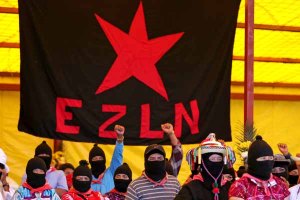
Communiqué from the Indigenous Revolutionary Clandestine Committee General Command of the Zapatista National Liberation Army
MEXICO
October 5, 2020
To the National Indigenous Congress—Indigenous Governing Council:
To the Sixth in Mexico and abroad:
To the Networks of Resistance and Rebellion:
To all honest people who resist in every corner of the planet:
Sisters, brothers, hermanoas: Compañeras, compañeros and compañeroas:
We Zapatista Native peoples of Mayan roots send you greetings and want to share with you our collective thought about what we have seen, heard, and felt.
First: We see and hear a socially sick world, fragmented into millions of people estranged from each other, doubled down in their efforts for individual survival but united under the oppression of a system that will do anything to satisfy its thirst for profit, even when its path is in direct contradiction to the existence of planet Earth.
This abomination of a system and its stupid defense of “progress” and “modernity” crash into the wall of their own criminal reality: femicides. The murder of women has no color or nationality; it is global. If it is absurd and unreasonable for someone to be persecuted, disappeared, or murdered for the color of their skin, their race, their culture or their beliefs, it’s simply unbelievable that the fact of being a woman is equivalent to a death sentence or a life of marginalization.
The criminal logic of the murder of women is that of the system, escalating in predictable fashion (harassment, physical violence, mutilation, and murder) and backed by structural impunity (“she deserved it,” “she had tattoos,” “what was she doing out at that hour?” “Dressed like that, what did she expect?”). This happens to women across geographies, social classes, races and ages from early girlhood to old age; gender is the one constant. The system is incapable of explaining how this reality goes hand in hand with its “development” and “progress.” The outrageous statistics say it all: the more “developed” a society is the higher the number of victims in this veritable war on women.
“Civilization” seems to be telling the Native peoples: “the proof of your underdevelopment is evident in your low rate of femicides. Here you go, here are your megaprojects, your trains, your thermoelectric plants, your mines, your dams, your shopping centers, your home electronics stores—television channel included. Learn to consume. Be like us. To pay back the debt of this “progressive” aid we’re offering, your lands, waters, cultures, and dignity won’t quite be enough—you’re going to have to throw in the lives of women.”
Second: We have seen and heard a nature that is gravely injured and yet, in its agony it is warning humanity that the worst is yet to come. Each “natural” disaster announces the next and conveniently forgets the cause: the actions of a human system.
Death and destruction are no longer off in the distance, limited by borders, customs and international agreements. Destruction in any corner of the world has repercussions on the whole planet.
Third: We see and hear the powerful retreating and taking cover within the so-called nation-states and their walls. In this impossible leap backward, they are reviving fascist nationalisms, ridiculous chauvinisms and a deafening torrent of meaningless blather. We are sounding the alarm about the coming wars fed by false, empty, deceptive histories that translate nationalities and races into supremacies that will be imposed with death and destruction. Disputes play out in various countries between the current overseers and those who aspire to succeed them, hiding the fact that the real boss, the owner, the ruler, is the same everywhere and has no nationality other than that of money. In the meantime, international organizations languish and become mere names, like museum artifacts… if that.
In the darkness and confusion that precede these wars we hear and see that any trace of creativity, intelligence and rationality is being attacked, persecuted and surrounded on all sides. Faced with critical thought, the powerful demand and impose their fanaticisms. They sow, cultivate, and harvest a death that is not only physical; it also includes the extinction of what is our unique human universality: intelligence, with all of its advances and achievements. New esoteric currents are created or reborn, secular and otherwise, disguised as intellectual fashions or pseudo-sciences. The arts and sciences are subordinated to political partisanship.
Fourth: The Covid-19 pandemic demonstrated not only the vulnerabilities of human beings, but also the greed and stupidity of the national governments and their supposed opposition groups. The most basic, commonsense measures were discarded on the gamble that the pandemic would play out in a short timeframe. As the epidemic’s timeline extended, numbers began to replace tragedies. Death became a statistic, lost amidst the noise of daily scandals and declarations in a dark contest of ridiculous nationalisms, playing with percentages like batting averages and earned runs to decide which team, or nation, is better or worse.
As we detailed in previous texts, Zapatismo opted for prevention and health safety measures based on the advice of scientists who offered their counsel without hesitation. The Zapatista communities want to show their appreciation for this assistance. Six months after the implementation of these measures (face masks or their equivalent, distance between people, cutting off direct personal contact with urban areas, 15-day quarantine for anyone who has been in contact with someone who is contagious, frequent hand-washing with soap and water), we mourn the passing of three compañeros who presented two or more symptoms associated with Covid-19 and were directly exposed to infected persons.
Another eight compañeros and one compañera who died during this period presented one symptom associated with the illness. As we have no access to tests, we will assume that these 12 compañer@s died of corona virus (scientists told us to assume that any respiratory problem was Covid-19). These 12 deaths are our responsibility. They are not the fault of the 4T [i] or the opposition, of neoliberals or neoconservatives, of the sell-outs or the bourgies, or of conspiracies or plots. We think we should have implemented precautionary measures even more rigorously.
Currently, after the death of those 12 compañer@s, we are improving our prevention measures with the support of nongovernmental organizations and scientists who, individually or as a collective, are helping us orient our approach in order to be in a stronger position for any potential new outbreak. Tens of thousands of masks (affordable, reusable, specifically designed to avoid transmission by a probable contagious person to others, and adapted to our specific circumstances) have been distributed in all of the communities. Tens of thousands more are being produced in the insurgentes’ sewing and embroidery workshops as well as those in the communities. The measures we have recommended to our own communities as well as to our party-affiliated brothers and sisters—the widespread use of masks, a 2-week quarantine for those potentially infected, physical distance, continual hand and face washing with soap and water, and avoidance of the cities to the greatest extent possible—are all oriented toward containing any spread of contagion as well as permitting the maintenance of community life.
The details of what our strategy was and is will be analyzed at an appropriate time. For now we can say, with life pulsing through our bodies, that in our estimation (which may well be mistaken) it has been our approach of facing the threat as a community, not as an individual issue, and orienting our primary efforts toward prevention that has put us in a position to say now, as Zapatista peoples: here we are, resisting, living and struggling.
Now, all over the world, big capital intends to get people back on the streets to resume their role as consumers. What concerns capital are the problems of the market, the lethargic rate of commodity consumption.
We do need to get back on the streets, yes, but to struggle. As we’ve said before, life, and the struggle for life, is not an individual issue, but a collective one. Now we see that it’s not a national issue either, but a global one.
-*-
We have been seeing and hearing a lot of things along these lines, and we’ve given them a lot of thought. But not only that…
Fifth: We have also heard and seen the resistances and rebellions that, even when silenced or forgotten, do not cease to be vital indicators of a humanity that refuses to follow the system’s hurried pace toward collapse. The deadly train of progress advances with impeccable arrogance toward the edge of the cliff, with the conductor believing they are actually driving the train, forgetting he is just another employee of the system following the prison of the rails toward the abyss.
These are resistances and rebellions that remember those who have been taken from us as they struggle for—who would have thought—the most subversive cause out there in these worlds divided between neoliberals and neoconservatives: life. These resistances and rebellions understand—each according to their own way, time, and geography—that solutions cannot be found through faith in the various national governments, protected by borders and dressed in flags and different languages. These are resistances and rebellions that teach us Zapatistas that the solutions may be found below, in the basements and corners of the world, not in the halls of government or the offices of large corporations. They are resistances and rebellions that show us that if those above destroy bridges and seal borders, then we’ll just have to navigate rivers and oceans to find each other. They show us that the cure, if there is one, is global; it is the color of the earth, the color of the work that lives and dies in the streets and barrios, oceans and skies, hills and valleys—like the Native corn, it has many colors, hues, and sounds.
-*-
We saw and heard all of this and more. We saw and heard ourselves as what we are: a number that doesn’t count. Because life doesn’t count—it doesn’t sell, it doesn’t make the news, it doesn’t enter into the statistics, it doesn’t compete in the polls, it has no following on social media, it provokes no response, it does not represent political capital, party loyalty, or a trending scandal. Who cares if a small, a tiny group of Native peoples, indigenous peoples, lives, that is, struggles?
Because it turns out that we do live. Despite paramilitaries, pandemics, mega-projects, lies, slander, and oblivion, we live. And by that, we mean we struggle.
That is what we are thinking; that we will continue struggling, that is, continue living. We are thinking about the fraternal embrace of people in our own country and around the world that we have received throughout these years. We think that if life here resists and even, against all odds, flourishes, it is thanks to all those people who challenged distances, red tape, borders and differences of language and culture. We want to thank them: the men, women, and others—but above all the women—who confronted and defeated calendars and geographies to be with us.
In the mountains of Southeastern Mexico, all of the worlds in the world have found, and still find, a listener in our hearts. Their words and actions have fed our resistance and rebellion, which are just a continuation of the struggles of our predecessors.
People who walk the path of art and science found a way to embrace and encourage us, even from a distance. There were journalists, both bourgie and not, who reported the death and misery we suffered before and the dignity of life always. There have been people of all professions and trades who, through what were perhaps small gestures for them that meant a great deal to us, have been and continue to be at our sides.
These are the thoughts in our collective heart, and we also think that now is the time in which we Zapatistas [nosotras, nosotros, nosotroas] reciprocate the listening ear, word, and presence of those worlds, for those who are geographically near and far.
Sixth: We have decided that:
It is time for our hearts to dance again, and for their sounds and rhythm to not be those of mourning and resignation. Thus, various Zapatista delegations, men, women, and others, the color of our earth, will go out into the world, walking or setting sail to remote lands, oceans, and skies, not to seek out difference, superiority, or offense, much less pity or apology, but to find what makes us equal.
It is not just our humanity that unites our different skin, our different ways of life, our different languages and colors. It is also, and above all, the common dream we have shared as a species as of the moment, in a seemingly distant Africa, from the lap of the very first woman, when we set out on the search for freedom that guided our first steps and which continues its path today.
Our first destiny on this planetary journey will be the European continent.
We will leave Mexican lands and set sail for Europe in April of 2021. After journeying through various corners of Europe below and to the left, we plan to arrive in Madrid, the Spanish capital, on August 13, 2021, 500 years after the supposed conquest of what is today Mexico. We will then immediately continue our journey.
We want to speak to the Spanish people. Not to threaten them, scold them, insult them, or make demands of them, and not to demand they ask our forgiveness. We are not there to serve them nor demand they serve us. We want to tell the people of Spain two simple things:
One: You didn’t conquer us. We continue to resist and rebel.
Two: There’s no reason for you to ask our forgiveness for anything. Enough of this toying around with the distant past to justify, with demagoguery and hypocrisy, the current crimes in process: the murder of community organizers, like our brother Samir Flores Soberanes; the hidden genocides behind the megaprojects, conceived and carried out to please the most powerful player—capitalism—which wreaks punishment on all corners of the world; the pay-outs to and impunity for the paramilitaries; the buying off of peoples’ consciences and dignity with 30 pieces of silver.[ii]
We Zapatistas do NOT want to return to that past, not on our own, much less accompanied by someone trying to seed racial resentment and feed his outmoded nationalism with the supposed splendor of the Aztec Empire which built itself from the blood of its neighbors, and convince us in turn that with the fall of that empire, the originary peoples of these lands were defeated.
Neither the Spanish state nor the Catholic Church have to ask our forgiveness for anything. We will not echo those frauds who seek to legitimize themselves with our blood while they hide the fact that their hands are stained with it.
What is Spain going to ask our forgiveness for? For having birthed Cervantes? Or José Espronceda? León Felipe? Federico García Lorca? Manuel Vázquez Montalbán? Miguel Hernández? Pedro Salinas? Antonio Machado? Lope de Vega? Bécquer? Almudena Grandes? Panchito Varona, Ana Belén, Sabina, Serrat, Ibáñez, Llach, Amparanoia, Miguel Ríos, Paco de Lucía, Víctor Manuel, Aute siempre? Buñuel, Almodóvar and Agrado, Saura, Fernán Gómez, Fernando León, Bardem? Dalí, Miró, Goya, Picasso, el Greco and Velázquez? For some of the best critical thought in the world, born under the liberatory “A”? The Spanish Republic? The Spanish republican exile? Our Maya brother Gonzalo Guerrero?
What is the Catholic Church going to ask our forgiveness for? For the life of Bartolomé de las Casas? For Don Samuel Ruiz García? For Arturo Lona? For Sergio Méndez Arceo? For Sister Chapis? For the lives of priests and religious and lay sisters who have walked beside the Native peoples without trying to lead or supplant them? For those who risk their freedom and their lives to defend human rights?
-*-
The year 2021 marks 20 years since the March of the Color of the Earth, the march we carried out alongside the peoples of the National Indigenous Congress to reclaim our place in this Nation that is now in total collapse.
Now, 20 years later we will set sail and journey once again to tell the planet that in the world that we hold in our collective heart, there is room for everyone [todas, todos, todoas]. That is true for the simple reason that that world will only be possible if all of us struggle to build it.
The Zapatista delegations will be constituted principally by women, not just because they want to reciprocate the embrace they received in earlier international gatherings, but also and above all to make clear to the Zapatista men that we are what we are and we aren’t what we aren’t thanks to them, for them, and with them.
We invite the CNI-CIG to form a delegation to accompany us and thus further enrich our word for the other who struggles in distant lands. We make a special invitation to the communities who hold up the name, image, and blood of our brother Samir Flores Soberanes, so that their pain, rage, struggle, and resistance travels far.
We invite those who hold the arts and sciences as their vocation, endeavor, and horizon to accompany our journey from a distance and help us spread the idea that in the sciences and the arts lie not only the possibility of the survival of humanity, but that of the birth of a new world.
In sum, we leave for Europe in April of 2021. Date and time? We don’t know… yet.
-*-
Compañeras, compañeros, compañeroas: Brothers, sisters, and hermanoas:
This is our pledge:
In the face of the powerful trains, our canoes.
In the face of the thermoelectric plants, our little lights that the Zapatista women put in the care of the women who struggle all over the world.
In the face of walls and borders, our collective navigation.
In the face of big capital, a common cornfield.
In the face of the destruction of the planet, a mountain sailing through the small hours of the morning.
We are Zapatistas, carriers of the virus of resistance and rebellion. As such, we will go to the five continents.
That’s all…for now.
From the mountains of the Mexican Southeast
In the name of all of the Zapatista women, men, and others,
Subcomandante Insurgente Moisés
Mexico, October of 2020.
P.S. Yes, this is the sixth part and, like our journey, will go in inverse order. That is, the fifth part will come next, then the fourth, then the third, followed by the second, and finishing with the first.
[i] López Obrador deemed his own governing project the “Fourth Transformation” (4T), supposedly on par with historic events such as Mexican Independence (1810), a period of reform in the mid-19th century, and the Mexican Revolution (1910).
[ii] López Obrador has made repeated claims, starting in March 2019 and most recently in a September 20, 2020 press conference, that Spain and the Vatican should apologize for colonialism. The López Obrador administration has also doubled down on previous administrations’ socially and environmentally destructive capitalist mega-projects.
En español: http://enlacezapatista.ezln.org.mx/2020/10/05/sexta-parte-una-montana-en-alta-mar/
EZLN: We will go to find what makes us equal // despite oblivion, we live
Zapatistas will go to Europe to say that they continue in resistance and rebellion

By: Hermann Bellinghausen
The Zapatista National Liberation Army (Ejército Zapatista de Liberación Nacional, EZLN) announced that in April 2021 several of their diverse delegations will travel to Europe, “seeking not difference, not superiority, not affront, much less pardon and pity. We will go to find what makes us equal.” It anticipates that, after touring various corners of Europe “from below and to the left,” they will arrive in Madrid next August 13. “500 years after the supposed conquest of what is now Mexico.” A communiqué signed by Subcomandante Insurgente Moisés explains that such an initiative comes from the “common thought” of the Zapatista communities of Chiapas.
“We look at and listen to a sick world in its social life, fragmented,” where people are “under the oppression of a system willing to do anything to quench its thirst for profits, even and when it’s clear that their path goes against the existence of Planet Earth.”
“The aberration of the system,” it adds, “crashes against a criminal reality: the femicides, which have no criminal logic other than that of the system.” Meanwhile, “nature wounded to death” warns that the worst is yet to come, because of “the action of a human system that causes it.” The EZLN finds “the powerful retreating” in the states and their walls. “They revive fascist nationalisms, ridiculous chauvinisms and a deafening verbiage. In this we warn of the wars to come.” The Covid-19 pandemic “showed the vulnerabilities of being human,” as well as “the greed and stupidity” of the governments “and their supposed oppositions.”
The communiqué reports the death of 12 Zapatistas, notwithstanding the application of health measures. Three of them presented two or more symptoms associated with Covid-19 and had contact with infected persons. Nine others presented one symptom. Given the lack of tests, we assume that they died of the coronavirus. “These absences are our responsibility,” the EZLN admits, “for not taking extreme precautions,” which they now improve to confront “a possible surge.”
The Zapatistas attend to “resistances and rebellions that, because of not being silenced or forgotten,” cease being traces of a humanity that refuses “to follow the mortal train of progress that advances, proud and impeccable, towards the cliff.” Said experiences confirm the importance of the collective, and that: “the solutions could be below, in the basements and corners of the world.” and they wonder: “Who cares that a small, very small, group of natives, of indigenous peoples, lives, that is, fights?” Because it turns out that: “despite paramilitaries, pandemics, megaprojects, lies, slanders and oblivion, we live.”
They announce that they will talk to the Spanish people to show them “two simple things: that they didn’t conquer us, and that we continue in resistance and rebellion” and “they don’t have a reason to ask that we forgive them for anything. Enough of playing with the distant past to justify, with demagoguery and hypocrisy, the current crimes and those underway! The murder of social strugglers, like brother Samir Flores Soberanes and the genocides hidden behind the megaprojects.”
“We don’t want to return to that past,” they say. “Much less from the hand of the one who wants to sow racial rancor and pretends to feed their outdated nationalism with the supposed splendor of an empire, the Aztec [Empire], which grew at the expense of their peers, and who wants to convince us that, with the fall of that empire, the Native peoples of these lands were defeated.” Because of that, “neither the Spanish State nor the Catholic Church have to ask us forgiveness for anything.”
In 2021, they will celebrate 20 years since la Marcha del Color of the Earth, which the Zapatistas and the National Indigenous Congress (Congreso Nacional Indígena) made, “to claim a place in this now crumbling nation.” Now they again invite the CNI to accompany the Zapatistas, “[email protected] with the virus of resistance and rebellion. As such, we will go to the five continents.”
El comunicado Zapatista en español: http://enlacezapatista.ezln.org.mx/2020/10/05/ sexta-parte-una-montana-en-alta-mar/
———————————————————–
Originally Published in Spanish by La Jornada
Tuesday, October 6, 2020
https://www.jornada.com.mx/2020/10/06/politica/012n1pol
Re-Published with English interpretation by the Chiapas Support Committee
They injure a campesino in Tabak, Aldama, Chiapas
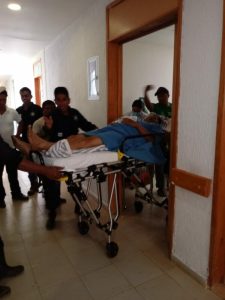
Artemio Pérez arrives at the hospital.
By: Hermann Bellinghausen
In the midst of incessant gunfire attacks against the Tsotsil communities of Aldama, Chiapas, this morning Artemio Pérez Pérez, 25, was wounded in the chest in the community of Tabak, of which he is a native. The shots coming from T’elemax, in Santa Martha, Chenalhó, began at 9 o’clock in the morning and lasted until after noon on Wednesday.
According to the Permanent Commission of the 115 community members and displaced persons of Aldama, the injured man was first treated at the basic hospital in the municipality, and subsequently moved to the Cultures Hospital, located in San Cristóbal de Las Casas. Last night his condition was reported as critical due to gastric bleeding and lung perforation.
The bullets started in the early hours of Wednesday, when the bullets rained from Tok’oy Saclum (Chenalhó) in the direction of Coco’ Aldama a little after midnight.
The Permanent Commission of the 115 community members and displaced persons reports every day on the paramilitary attacks they suffer without the authorities intervening to stop that violence, under the false argument that they’re dealing with crossfire.
Last Monday, shots from high-caliber weapons were fired from El Templo, Chalontik, Puente and Tijera Caridad in Santa Martha at Juxton community in Aldama.
“Every day is the same” and the displaced wonder: “how long will these armed groups from Chenalhó continue to attack us with impunity?”
As part of this unresolved territorial conflict between the municipalities of Aldama and Chenalhó, in the Highlands of Chiapas, the attacked indigenous also demand the release of their compañero Cristóbal Santiz Jiménez, “a social fighter and prisoner of the Chiapas state government; his only crime is denouncing the injustices that his town of Magdalena Aldama suffered from the Santa Martha paramilitary groups. “
For its part, the Fray Bartolomé de Las Casas Human Rights Center (Frayba) demanded that the Secretary General of the Government “immediately address the serious human rights violations, and fulfill the duty to safeguard these rights of the inhabitants of communities in Aldama municipality. ”
The Frayba requested from the Ministry of Health that “the rights to health of young Artemio Pérez Pérez be respected,” who was injured this Wednesday while working. The agency highlights his vulnerability “due to the health context in which Chiapas is currently located” where, despite being in a yellow spotlight, “the risk of contracting Covid-19 is present.”
The NGO demanded that the State’s Attorney General: “initiate investigations into those who are responsible for the criminal acts and punish the material and intellectual authors.”
———————————————————–
Originally Published in Spanish by La Jornada
Thursday, October 1, 2020
https://www.jornada.com.mx/2020/10/01/politica/010n1pol
Re-Published with English interpretation by the Chiapas Support Committee
Aldama, Chiapas, reports 8 armed attacks in 24 hours
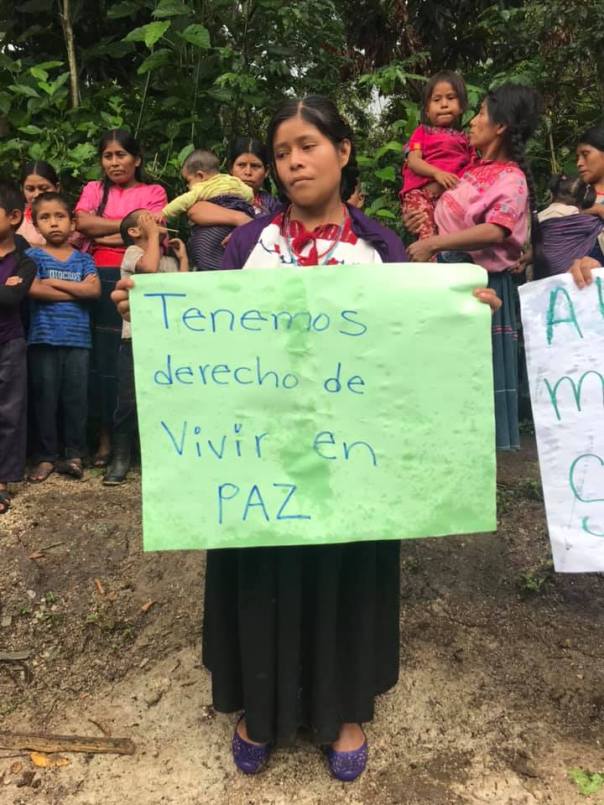
The poster reads: “We have the right to live in peace.” Displaced women and children are in background.
By: Elio Henríquez, Tuesday, September 29, 2020
https://www.jornada.com.mx/2020/09/29/politica/004n3pol
San Cristóbal De Las Casas, Chiapas
The mayor of Aldama, Rodolfo López Gómez, reported that yesterday “reports were received about eight armed attacks with different caliber weapons” from different points in the Santa Martha ejido, Chenalhó, against the municipal capital (the town of Aldama) and other locations in Aldama municipality, without any injuries reported.
He said that bullet impacts come from points known as Tijera Caridad, Templo, Chuchté, Ladrillos, Valetik, T’ulvits and Tok’oy, belonging to the Santa Martha sector.
López Gómez said that “the attacks” were against the communities of Cocó, Tabac, San Pedro Cotzilnam, Stzelejpotobtic, Juxton and the municipal capital.
He reminded that there were also shots fired at Aldama locations last Friday and Saturday, despite the presence of state police in Santa Martha.
Release a political prisoner
Meanwhile, the Fray Bartolomé de Las Casas Human Rights Center (Frayba) demanded the release of the “political prisoner” Cristóbal Santiz Jiménez, a native of Aldama, arrested last March 14 “for publicizing the generalized violence in his municipality, caused by paramilitary-style armed civilian groups.”
The Frayba specified that the indigenous Tzotzil is “a representative of the Permanent Commission of Comuneros and Displaced of Aldama, and a member of the families that a paramilitary-style group in Santa Martha, Chenalhó dispossessed of their lands and attacked with high-caliber weapons.”
It added that Santiz Jiménez is a community defender, has held positions in his town as a traditional councilor and worked for 21 years as a watchman at the Training Center for Industrial Work number 133, based in San Cristóbal de Las Casas.
That human rights defense organization remembered that state police arrested Santiz Jiménez last March 14 “when was leaving his work; they kept him incommunicado for five hours and he is currently incarcerated” in El Amate Prison, located in Cintalapa municipality, located in the center of the state.
Aldama and Santa Martha (Chenalhó municipality) have been confronted for 45 years in a dispute over 60 hectares (148 acres), which has left 26 deaths and various injuries on both sides.
Translator’s Note: See article below about continued shooting at communities of displaced persons and a proposal to resolve the dispute.
———————————————————–
ALDAMA WITHSTANDS A DOUBLE DAY OF SHOOTING FROM SANTA MARTHA
By: Elio Henríquez
San Cristóbal de Las Casas, Chiapas
The mayor of Aldama, Rodolfo Gómez López, reported that for the second consecutive day, members of the paramilitary group in Santa Martha, Chenalhó, fired high-caliber firearms at Aldama communities, although no injuries have been reported, presumably because of the dispute over 148 acres (60 hectares) between the two municipalities.
He said that on Friday: “shots were fired from the points known as Tok’oy, Pajaltoj, Tojtic, T’elemax, T’ulvits, Valetik, Chino, Ranchito, Ladrillo, Chuchte and Puente Caridad.
He stated that: “the armed groups that are attacking Aldama communities were positioned at different points of the Santa Martha sector.”
Gómez López pointed out that this Saturday at 2:25 pm, “we received reports from Juxtón that it was being the target of shooting from Chalóntic, located near the center of Santa Marta.”
He assured that: “a tense situation prevails, since the armed attacks continue, and it was already reported to the different levels of government for the purpose of asking for their urgent intervention.” The Santa Martha men, the municipal president commented, detained passersby despite the presence of the state police. The police “are far away from the attacks, so they have been asked to install themselves in specific places like Tok’oy and Chuchte or else in Valetik, but that hasn’t happened.” He reminded that Aldama already reached a consensus on and delivered to federal and state authorities its proposal that the 60 hectares be divided among both peoples in order to put an end to the conflict that has lasted 45 years and has left 26 dead and various injured.
Proposed solution
“There is a proposed solution from Aldama, we’re just waiting for Chenalhó municipality and the Santa Marta sector to analyze and also come agreement.”
He specified that Aldama has proposed that it be granted 32.5 hectares and that the rest, 27.5 hectares, go to Santa Martha. “Months ago, the people and the Aldama authorities reached consensus, with the desire to seek peace and a definitive solution to the conflict; this alternative has been accepted, which is the state government’s proposal.”
———————————————————–
Originally Published in Spanish by La Jornada
Sunday, September 27, 2020
https://www.jornada.com.mx/2020/09/27/politica/007n1pol
Re-Published with English interpretation by the Chiapas Support Committee
Aldama, Chiapas, lives threatened by paramilitaries
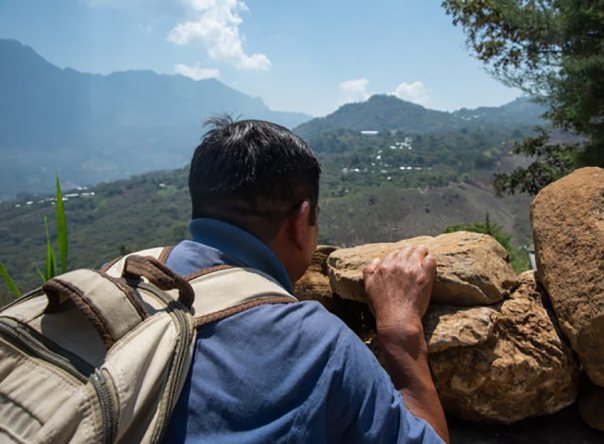
A man in Aldama looks over protective barriers towards Santa Martha, Chenalhó, where the paramilitary group operates.
By: Hermann Bellinghausen
Tsotsil Maya residents of Magdalena Aldama, in the Chiapas Highlands, denounced incessant armed attacks from Chenalhó against many Aldama communities: “Today we reiterate once again that here in our town we live under threat, under the rain of shots from Santa Martha paramilitary groups in Chenalhó municipality.” They add: “We have been announcing the threats and aggressions that we suffer day after day.” Last weekend, there were three people injured by bullets and yesterday morning the harassment of San Pedro Cotzilnam worsened.
They denounce that: “despite the presence of the Indigenous Prosecutor’s office and the Public Ministry (PM) in the capital of Aldama, where they came to take statements from the wounded,” when the Santa Martha paramilitaries initiated another attack, “the prosecutor and the PM refused to witness the armed aggressions; they didn’t want to go down into the communities or know the motive.”
They state that: “we are tired and fed up with this situation that we suffer as peoples who they dispossess of 60 hectares and they want to finish off at once. This is the reality that Chiapas experiences; not just Magdalena Aldama is suffering these armed attacks from paramilitary groups, but also in several towns like Chalchihuitan, Tila ejido, Cuxuljá Zapatista community, among other communities and towns.” They reiterate that: “what may happen” will be the responsibility of “the governments that have never taken care of this situation. They mention that Santa Martha “is in itself the continuation of paramilitarism and is the history that has been repeated since 1994 and 1997. In other words, it’s low-intensity warfare against the peoples who struggle for their rights and for life.”
Just this Sunday, September 13, an “intense armed attack” was recorded from almost 30 attack points in Chenalhó. “There are firearms detonations from the paramilitaries throughout the river strip that divides these two neighboring towns, against the following Aldama communities: Ch’ayom te’, Juxton, Stselej Potov, Cabecera Aldama, Ch’ivit, Yeton, Yoctontik, Sepelton, San Pedro Cotsilna’m, Tabak, Coco’ and Xuxch’en.”
“There have been people displaced since morning,” they reported Sunday night. The shooting continued on Monday.
They point out that the state and federal governments, as well as Chenalhó authorities: “have supported these paramilitary groups that have operated for years. The only thing that they have done is to militarize the Native peoples and threaten to imprison us as peoples. But that doesn’t silence us. We continue the struggle for the total recuperation of our lands that the Santa Martha paramilitaries have dispossessed.”
Presenting themselves as “the voice of Magdalena Aldama,” they denounce: “the human rights center allegedly called the ‘Digna Ochoa Committee’, formed by two people who use to belong to the National Front of Struggle for Socialism (FNLS, its initials in Spanish). They have always attacked the other human rights centers and support and back up the paramilitary groups.”
The indigenous people conclude: “the people have said enough, no more dispossession of our lands; if the government doesn’t want to solve this situation, time after time it will be responsible for what may happen. No more promises. We’re not going to waste our time at dialogue tables when they have just administered the conflict.” They warn that they will not go to the tables “because there is no progress. We are not dispossessing anyone, we just fight for what is our. The government knows well who owns the land ancestrally and legally,” something that “it has not been able to resolve.”
———————————————————–
Originally Published in Spanish by La Jornada
Tuesday, September 15, 2020
https://www.jornada.com.mx/2020/09/15/politica/010n2pol
Re-Published with English interpretation by the Chiapas Support Committee
Tila, political bosses, paramilitaries and autonomy
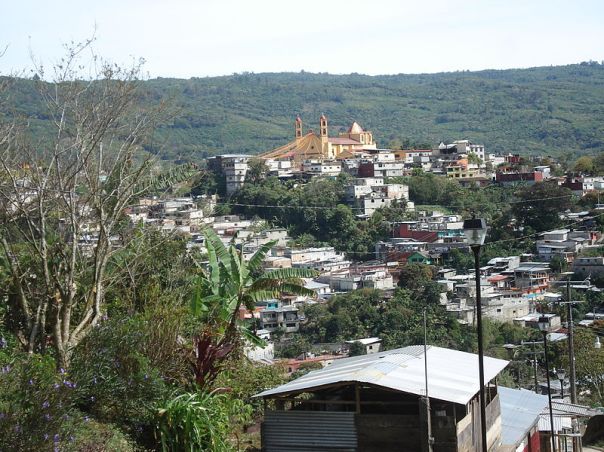
A view of Tila, Chiapas, Mexico. The church of the Black Christ rises in the background.
By: Luis Hernández Navarro
For centuries, the Lord of Tila has been venerated with fervor. On the Feasts of Corpus Christi, the Holy Cross, in Holy Week and the miraculous renewal of January 15, thousands of devoted faithful celebrate him. Their devotion to him goes beyond borders. Each year, they travel from Central America, Tabasco, Campeche and Veracruz to worship him.
Singers like Chico Che, Joan Sebastian and José Manuel Figueroa revered him.
Tila, the place where the ebony image is found, known as the land of miracles, is simultaneously an ejido, a town and a municipality in the state of Chiapas. Unfortunately, it’s a place of passage not only for religious pilgrimages, but also a route through which undocumented migrants, arms and drugs coming from Central America travel.
Since the end of 1994, northern Chiapas is known not only for being the ceremonial site of the Black Christ, but also for the bloody violence unleashed in its municipalities and communities by the paramilitary group Desarrollo, Paz y Justicia (Development, Peace and Justice). Although the organization born of Solidaridad Campesino-Magisterial (Peasant-Teacher Solidarity) formally split, and gave rise to two different groupings, which they baptized as the Union of Indigenous, Agricultural and Forest Communities (Uciaf, its initials in Spanish) and the Organization of Peasant Agricultural Producers (Opac), they continue acting with official protection as armed civilians.
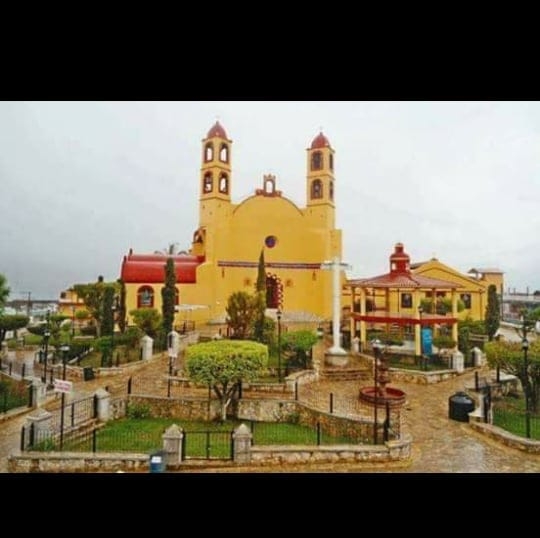
The church of the Black Christ, el Señor de Tila.
Despite the years that have passed since then, attacks on the rebel Chols don’t stop. Just last September 11, paramilitaries attacked a demonstration of Tila ejido owners with firearms. At least two people died.
The conflict is not in essence a problem between poor people or between indigenous people; nor is it a religious or inter-community problem. Its matrix is different. In Tila there is a terrible fiefdom (cacicazgo) [1], linked, among other forces, to the Chiapas family that, with different party initials, governs the state and the counterinsurgency policy against autonomic processes of the Zapatistas and of the peoples who belong to the National Indigenous Congress (Congreso Nacional Indígena, CNI).
The Petalcingo architect and builder Límberg Gregorio Gutiérrez Gómez and his wife, Sandra Luz Cruz Espinosa, originally from Pijijiapan, head the cacicazgo in Tila. With the initials of the Green Ecologist Party of Mexico (PVEM, its initials in Spanish) they have held the municipal presidency, directly or through their family members, without interruption since the 2008-2010 period (https://bit.ly/2ZS7A5K).
Before that date, Límberg –then a member of the Institutional Revolutionary Party (PRI)– served as director Public Works during the mayoralty of Juan José Díaz Solórzano (2005-07), involved with Paz y Justicia. They accused him of using the budget to finance his political campaign for mayor, leaving various projects in bad condition and others unfinished.
He concluded his first period as municipal president with “ranches, registered cattle, quarter horses, residences, luxury vehicles and public transportation concessions for the Salto de Agua-to-Palenque routes.” His wife Sandra replaced him between 2011 and 2012 (https://bit.ly/3mxvw7Y). The Good Government Junta of the Zapatista Caracol That Speaks for All denounced death threats, robberies, damage to private property and dispossessions against the San Patricio community, on the part of paramilitaries of Paz y Justicia and its derivatives.
Límberg was elected mayor again for the period 2012-15, in the midst of accusations of vote buying, fraud and violence (with several injured and one dead among supporters of the Greens and the PRIístas).
For the 2015-18 administration, the architect puts his cousin, Professor Edgar Leopoldo Gómez Gutiérrez, as mayor and his wife Sandra Luz Cruz Espinosa as local deputy, both for the Green Party. Finally, arguing gender parity, the Greens nominated as its candidate Juanita Fabiola Velázquez, who, after winning, asked for an indefinite leave of absence so that her cousin Límberg would become the municipal president, later accused by various communities of robbery (https://bit.ly/2Hc93x2).
To reinforce his dominance, Límberg again became the municipal president of Tila for the period 2018-21. For this, he has the support of builders (he himself is accused of being one), transporters, merchants, ranchers, paramilitaries of Paz y Justicia and its derivatives, the Chiapas family and the forces of order.
The cacique has confronted with everything, paramilitaries and terror included, the Ch’ol ejido owners of Tila, the Zapatista support bases and the pastoral agents that recuperated the Tila ejido, expelled the municipality from its territory on December 16, 2015 and began to govern itself without asking permission.
Besides refusing to enter the Program of Certification of Ejido Rights and Titling of Urban Parcels (Procede), the Tila ejido owners have won, one after the other, the legal battles that they have undertaken in order to return to their hands the 130 hectares of the Legal Fund, which the municipal council has sought to take away from them.
The agrarian controversy in Tila is not only an issue of land; it’s also a dispute to confront the power of the caciques, to stop privatization of the land, reconstitute the Ch’ol people, construct autonomy and resist the counterinsurgency policy.
[1] Cazicazgo – A group of political and economic bosses (caciques) that dominate political and economic power in a region; in Chiapas, that could be a municipality or a micro-region.
————————————————————
Originally Published in Spanish by La Jornada
Tuesday, September 22, 2020
https://www.jornada.com.mx/2020/09/22/opinion/017a1pol
Re-Published with English interpretation by the Chiapas Support Committee
Chiapas: the law of déjà vu
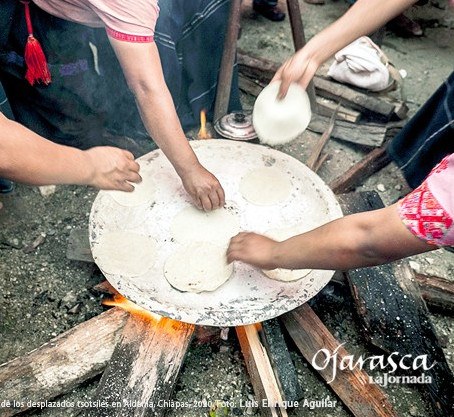
Kitchen of the displaced Tsotsil Mayas in Aldama, Chiapas, 2020. Photo: Luis Enrique Aguilar
By: Hermann Bellinghausen
Governments may change, but the counterinsurgency war against the people in Chiapas is ongoing; and judging by the events of recent months in the mountains of Maya territories, in 2020 it worsened on a scale not seen for years. Since 1994, five presidents and three political parties have filed through the federal government, and in the state, eight official governors from five parties. The great militarization continues around and within the indigenous communities, as the profound demands for self-determination that gave rise to the Zapatista uprising that year remain unfulfilled. The legitimate autonomy of the autonomous Zapatista municipalities is neither recognized nor respected; in the same vein, extractive activities, agro-industry, infrastructure and tourism projects move forward in spite of the indigenous communities, rebellious or not, in the Highlands, the northern zone, the Lacandón Jungle and the border region of the Jungle.
What has been seen in recent months, particularly during July and August, confirms that the same counterinsurgency manuals of a quarter a century ago are still being applied (with some adjustments for the local context) that the Pentagon generated for its war in Vietnam and against the Guatemalan revolution: “winning hearts and minds” and establishing local armed groups that erode and combat popular resistance.
Given the rhetoric of Andrés Manuel López Obrador’s government, the concept of resistance of the people must seem unwieldy. If things have “changed,” what need do the Native peoples have to resist? But neither centralist voluntarism nor magical-ideological thinking are enough. Nothing beats out reality, and the facts speak for themselves. In these weeks of 2020, the feeling that we have already seen the succession of events that are unfolding in indigenous Chiapas is inevitable.
New-old forms of co-optation, divisionism, control and chaos are deployed across the territory by the centralism of the Secretariats of Welfare and Agriculture, operated by the same local political class as always, and oiled by the shameful neo-indigenism of the new-old National Institute for the Development of Indigenous Peoples.
Meanwhile, we are witnessing the intensification of conflicts, or rather, of aggressive actors who take advantage of new and old territorial disputes between peoples, propelled by the paramilitary groups born during the Zedillo administration in Chenalhó, Tila, Chilón and Ocosingo. The perpetrators of the Acteal massacre are in force among the new armed forces, now publicly presented and televised, which are relentlessly attacking a dozen and a half communities in the neighboring municipality of Aldama, in the Tsotsil Highlands.
Similarly, in the Chol region, a group that never died has been recycled, only changing in its acronym and partisan contributions, colloquially known as Peace and Justice. In Tseltal lands, those Chinchulines of Chilón, as well as the failed “guerrilla group” called MIRA in the jungle of Ocosingo, rise again from their ashes, today through an alleged quesque revolutionary indigenous “army,” which up to now is known only to the media.
Add to this the renewed raids by organizations long ago absorbed by the government. In military terms, in Chiapas the same powers of the supreme government continue, be it the PRI, PAN, PRD or Morena. We see this in the aggressiveness of an organization once in resistance, a decomposed Regional Organization of Ocosingo Coffee Growers (ORCAO) that operates between Oxchuc and Ocosingo against the support bases of the EZLN and other independent organizations. With repeated violence, particularly by ORCAO truck drivers, they gained visibility with the burning and looting of a grain (coffee bean) warehouse in the autonomous municipality of Lucio Cabañas at the Cuxuljá crossroads on August 22. This organization disputes land recovered after the 1994 uprising; even though it abandoned the resistance years ago, it has endorsed successive governments and linked itself to criminals in the region.
Of all these events and their ramifications, the most disconcerting is that which concerns San Pedro Chenalhó and its explicit paramilitary groups, the only side to which the Mexican State and its civilian satellite organizations give credit in the revived territorial conflicts with the municipalities of Chalchihuitán and Aldama which have resulted in deaths, wounded people, the looting of villages and crops, robberies, terrorism, dispossession, and finally, the forced displacement of hundreds of indigenous people in these two municipalities (and sometimes within Chenalhó, since in the region of Los Chorros and Ejido Puebla, hostility against Las Abejas de Acteal is manifest, although under the guise of “religious differences”).
In the same vein we find the forced but much publicized “amicable agreement” of the government, in relation for the Acteal Massacre that took place in 1997, signed with a minority split-off from the original group of survivors of Las Abejas de Acteal, put in place by the regime.
The paramilitary structures of that time remain intact, without ever having seized a single weapon from the paramilitaries (whose weapons are growing). The intellectual perpetrators remain unpunished, as does the federal army, which encouraged, financed and trained these “armed civilians.” The September 3 agreement with the Secretary of Governance, as in the case of the 43 disappeared and murdered students of Ayotzinapa, which “will get to the bottom [of the case]” without touching the armed forces, that is, without touching the bottom.
The growing danger of the violence exerted from the community of Santa Martha against the inhabitants of the region traditionally known as Magdalena (formerly part of San Andrés Larráinzar, and since 1999 the official municipality of Aldama, to limit Zapatista autonomy in the heart of the most traditional Tsotsil world; it should be remembered that the municipal seat of San Andrés has been occupied since the 1990s by the autonomous Zapatista civilian government, and in response the paramilitary government of Roberto Albores Guillén split San Andrés Sakamch’en de Los Pobres, as the Zapatistas call it, in three by creating Aldama and Santiago El Pinar).
Additionally, making the necessary changes, the Lopez Obrador regime repeats and even escalates the discursive hostility against the civil and human rights organizations that take evidence from the people who are persecuted, violated or in resistance. At this point in the century we are also talking about defenders of territory and the environment, of the political rights of the original peoples to be guardians of their own security and to exercise community self-government.
With a devious logic, the president tried to expose human rights centers, media and civil organizations as destabilizing entities, financed by the “Gold of the Foreigners,” whose avid purpose is to oppose the great mega-projects of his government. With this, he “puts them,” as we saw in the painful case of Samir Flores murdered in Amilcingo, Morelos. He already criminalized them with a white glove on the mouth of his acting commissioner Jesús Ramírez Cuevas on August 28, when he “exposed ” the team at Indignation, the Regional Indigenous and Popular Council of Xpujil, and the Mexican Center for Environmental Law. These organizations legitimately participate in the peaceful opposition to the so-called “Maya Train” (which, by the way, would also pass through the northern strip of Chiapas, a very attractive tourist area, rich in unique natural resources and spoils from the cutting-edge agro-industries that “Vice President” Alfonso Romo likes so much; his business interest has no qualms about attracting and taking advantage of foreign and transnational capital, more affiliated indeed with the power of Washington than the foundations demonized by the president).
In this vein, independent civil organizations, of an “inconvenient” nature, are today as much or more undesirable than in the times of Zedillo and Albores. As has been the case for decades in Chiapas for the Fray Bartolomé de las Casas Human Rights Center, they are targets of military intelligence, susceptible to threats and smear campaigns.
Chenalhó’s escalation against Aldama follows a disturbingly similar pattern to that of the 1997 crisis of paramilitary violence. Displacements of families left in conditions of helplessness and fear, forced by gunfire to leave their homes and plots of land. They survive in precariousness, hunger and cold. The State does not take care of their health, security or food, except for the supply of processed food and flour which has little nutritional value but is profitable in terms of propaganda.
Armed men dressed in black concentrate at strategic points, shoot down the slopes, they hole up and cross the border river without the state police or the National Guard (that is, the federal army) doing anything to stop them. (Ah, but one day they dismantled the barricades of the attackers, and so on.) Instead, it is the paramilitaries who disarm the police, withdraw the docile National Guard, and take over the disputed territory. They shoot, wound, slander, and persecute “the others” (people like the ones the reader can see here in Luis Enrique Aguilar’s photographs). It is not a macabre fantasy to fear a new massacre like those that took place in Los Altos and the northern part of Chiapas between 1996 and 1998. We have already seen the scenario.
Meanwhile, the federal government establishes friendly agreements with some victims of the past and presents them as the core of its policy of détente, without the Armed Forces assuming any historical responsibility. Meanwhile, violence is repeated, and their alliance with the caciques (political-economic bosses) of Chenalhó is not very different from the one famously maintained by Zedillo and General Mario Renán Castillo, insofar as militarization is maintained. For the displaced Indigenous people, the political parties just change their names.
BY WAY OF A CODA
To the indigenous people things are given, granted, and “fulfilled” (as long as they are not the San Andres Accords, of course). Nothing is expected of them except their gratitude. They are never considered worthy of governing themselves, or deciding about their territories and their world. They are recruited electorally, they are not listened to. And if they don’t conform to the State, they are repressed, denied, maligned and criminalized.
Resistance, legitimate as it is, continues to be illegitimate for the Mexican State, which consequently does not accept any real autonomy, despite the fact that there are even international standards. Self-determination, appropriate forms of justice, government, education and health are anathema to the imaginary Mexico (as Guillermo Bonfil said), today represented by the dominant capitalist classes and a personalist and centralist government.
Indigenous resistances will not cease to emerge beyond the erosion and permanent negation on the part of the State. We see this in the Chimalapas, the Isthmus of Tehuantepec, the Yucatan peninsula, Morelos, the Purepecha Plateau, Atenco, the mountains of Guerrero. Not only in Chiapas. As in all wars, even the “soft” ones, the State only thinks about the defeat of its enemy. That here would be internal, but it is not even recognized as an enemy. The Zapatistas and the National Indigenous Congress have spoken of a prolonged “war of extermination,” which happens, as revealed by the management of mining and tourism concessions, and of the six-year mega-projects that the government imposes, presenting them as virtuous by exposing them to real or media violence. Yes, they are good business for the investors and would create “sources of work” that would de-populate the land; that is, they would be instrumental in the dispossession and at the expense of the original peoples, the owners of these lands.
—————————————————————————–
Originally Published in Spanish by La Jornada
Saturday, September 12, 2020
https://www.jornada.com.mx/ultimas/estados/2020/09/12/ojarasca-chiapas-la-ley-del-deja-vu-9270.html
Re-Published with English interpretation by Schools for Chiapas and
Republished with permission by the Chiapas Support Committee
 Chiapas Support Committee