Chiapas Support Committee
Home of the Compañero Manuel blog on zapatistas & mexico
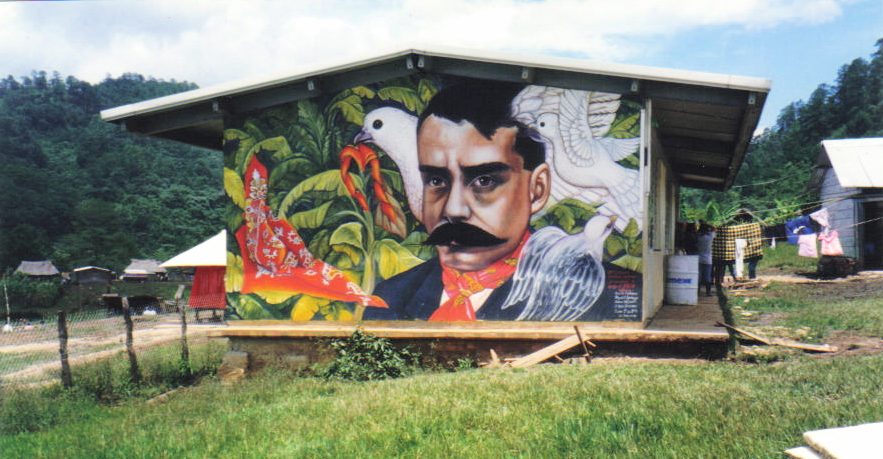
Paramilitaries kidnap a Zapatista
Frayba demands that the authorities liberate Félix López, EZLN support base [1]
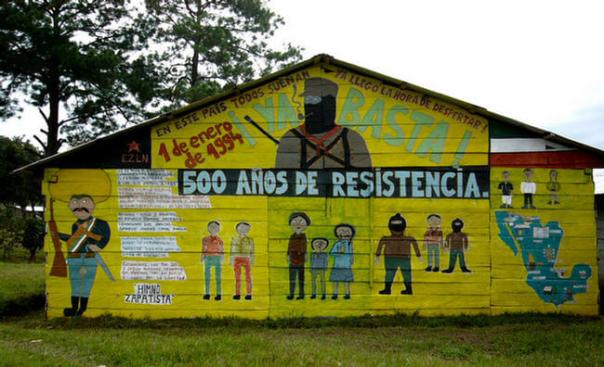
Mural in Moisés Gandhi community.
By: Elio Henríquez
San Cristóbal de Las Casas, Chiapas
The Fray Bartolomé de Las Casas Human Rights Center (Frayba) asked the Mexican State to intervene “immediately for the release of Félix López Hernández,” a support base of the Zapatista National Liberation Army (EZLN, its initials in Spanish), who members of the Regional Organization of Ocosingo Coffee Growers (Orcao) have held since last Sunday.
In an “urgent action” published Tuesday night, the Frayba also demanded from the authorities: “effective actions to stop Orcao’s armed attacks, since there is a high risk to the life and integrity of women, girls, boys and men” the Zapatista support bases of Moisés Gandhi and other localities located in Ocosingo territory.
The human rights center said it had received information from the Zapatista Good Government Junta (Junta) New Dawn in Resistance and Rebellion for Life and Humanity, belonging to the Patria Nueva Caracol, that: “since November 8, at approximately 3:30 pm, Félix López Hernández, a native of the San Isidro community, an annex of (the autonomous town) of Moisés Gandhi, was arbitrarily deprived of his freedom and tortured by approximately 20 Orcao members.”
It stated that, according to testimonies, “Félix was coming back from the official municipal capital of Ocosingo and was headed to his house when they took him to an unknown location; later, it was learned that it was a few meters from where the Orcao burned and looted the cooperative store located at Cuxuljá on August 22.”
The Junta added that on Tuesday at 10:40 am “Orcao members shot, a just 150 meters away, at another inhabitant, an EZLN support base, when he was gathering fire wood.”
The Frayba demanded that: “the jurisdiction, autonomy and self-determination of the Zapatista Good Government Junta New Dawn in Resistance and Rebellion for Life and Humanity be respected.”
“At the close of this urgent action (released Tuesday evening) we received the report that Orcao members continue shooting towards Moisés Gandhi community, so there is a grave risk to the life and integrity of the life and integrity of the EZLN support EZLN,” it added.
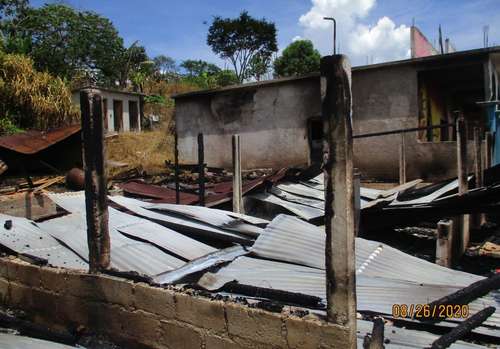
Members of the Fray Bartolomé de Las Casas Human Rights Center (Frayba) documented an attack on the Zapatista support bases by members of the Regional Organization of Ocosingo Coffee Growers, committed last August 22 on a house that was used as a coffee warehouse in the autonomous community of Moisés Gandhi, Chiapas. Photo: courtesy of the Frayba
According to the Junta, Orcao members took Félix López away “and keep him tied up, locked up, without water and without food.” The Junta pointed out in a communiqué that this case was denounced, but “the bad government, instead of solving the kidnapping, justifies the paramilitaries” of the Orcao, “telling the lie that we Zapatistas went to provoke at their workplace.”
It assured that the government’s argument that the Zapatistas provoked their ORCAO neighbors “is completely false,” because “the compañero was coming back from the official municipal capital of Ocosingo” on the way to his home when he was kidnapped.
[1] The Frayba reports that the ORCAO has turned Compañero Felix López Hernández over to its staff.
————————————————————
Originally Published in Spanish by La Jornada
Thursday, November 12, 2020
https://www.jornada.com.mx/2020/11/12/estados/028n2est
Re-Published with English interpretation by the Chiapas Support Committee
Death toll rises to 20 in Chiapas from tropical storm Eta
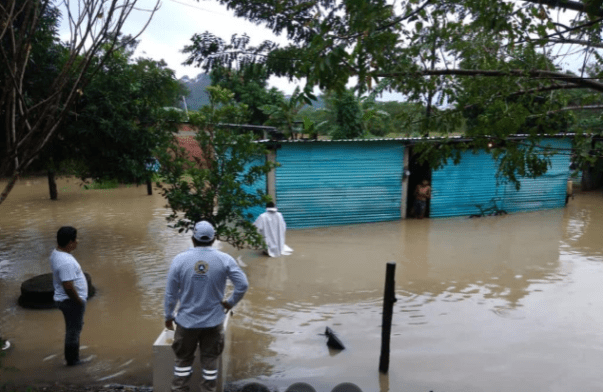
Flooding in Chiapas.
By: Isaín Mandujano
At least 20 people died [1] in the last several hours in Chiapas, after intense rains that caused rivers to burst their banks, houses smashed in landslides, traffic accidents and roads collapsed by mudslides in 32 municipalities and 7 regions of Chiapas.
The Preliminary Register of Damages in the face of Emergencies and Disaster (REPDAED) reported that due to the rise in the levels of rivers and the overflows, landslides and mudflows, 32 municipalities in 12 regions have been affected, which are: Ocozocuoautla, La Concordia, Chilón, Tumbalá, Chamula, Mitontic, Pantelho, Oxchuc, Tila, Yajalón, Salto de Agua, Sunuapa, Pichucalco, Amatán, e Ixhuatán.
Equally, Ixtapangajoya, Mezcalapa, Ocotepec, Tecpatán, Ocosingo, La Grandeza, Amatenango de la Frontera, San Andrés Duraznal, Jitotol, Bochil, El Bosque, Siltepec, Larráinzar, Juárez, El Bosque, Rincón Chamula San Pedro, Arriaga y Huixtla.
2,845 homes have been affected, 26 sections of road interrupted by landslides of unstable slopes, two pedestrian bridges damaged, 5 rivers overflowed, three communities have lost communication due to flooding, one section of electrical line was affected, and 5 sections of potable water pipe.
One of the municipalities with the greatest impact on homes is Chilón, in the Tulijá Region, where more than 684 homes are flooded at this time. The affected communities are El Mango, Sacum San Miguel, Sacum San Pedro, and Sacum Guadalupe. Due to the overflowing of the Agua Azul river, families have been evacuated.
The Northern Region is registering damages to the road infrastructure from instability of the mountain side in the sections of road Ixtapangajoya-La Unión (Teapa, Tabasco). The communities of Chapayal, Zaragoza and Zapata in the municipality of Ixhuatán remain out of communication due to flooding.
Four people have been reported dead in the community of Altagracia, municipality of El Bosque, one adult, and three minors. Additionally, in the community of Toquian de la Grandeza, two people are reported injured and 4 dead. Mr. Bulmaro Velásquez Velázquez said that due to heavy rains a section of land above his house broke free, burying it and breaking the walls of the room where his four youngest children, now dead, slept. His children were 14-year-old, Aile Celina Velásquez Cruz, 4 year-old Javier Velázquez Cruz, 8-year-old Margarita Concepción Velázquez Cruz, and 10-year old Alexa Xucoa Pérez.
Also, 10 dead bodies were found in the river that crosses the community of Kaomtealhucum II, located in the municipality of Chenalhó; the people who died were originally from the community of Muquém, in the municipality of Chamula. The first reports indicate that they were swept away by the strong currents in the stream that passes through the community; the same happened with a minor in Mitontic.
In Oxchuc one person was confirmed dead having been swept by the current of the stream, besides the death of a minor in the hamlet of Mitontic.
In total, 20 people have died so far, and more people have yet to be found who disappeared in the various events brought about by these intense rains.
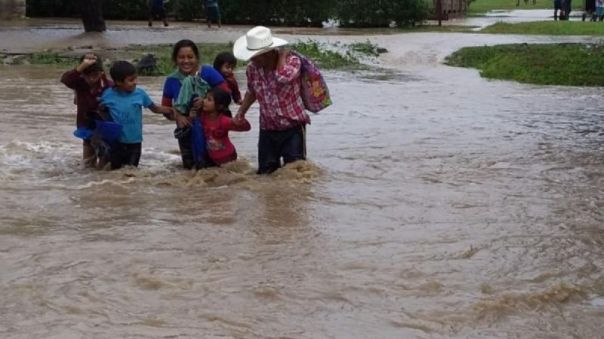
Families escape fooding in Chiapas.
Regarding the activation of temporary shelters in Juarez, one is located in the Ejido Santa Cruz Tepate Abajo with 10 families, and one in the Rancheria Nicolas Bravo 1a. Meanwhile, in Ocosingo one was installed in the local cattle ranch with a total of 22 families. And in Ixhuatán, 25 people from the Ejido Chapayal are given lodging. In San Cristóbal de Las Casas, 30 people are being cared for.
For this purpose, the State Emergency Committee is in permanent session, activating the protocols of attention to the population through federal, state and municipal agencies.
[1] The death toll in Chiapas from tropical storm Eta has climbed to 22.
——————————————————————-
Originally Published in Spanish by Chiapas Paralelo
Friday, November 6, 2020
Re-Published with permission by the Chiapas Support Committee with English interpretation by Schools for Chiapas
The fall of the Empire

The Capitalist Ruler, art from the Zapatista communities.
By: Raúl Zibechi
In periods of deep confusion like the one we live in today, exacerbated by a tsunami of information that clouds understanding, it’s convenient to focus our attention on the data that don’t depend on the whims of the moment and embody profound tendencies. We should not limit ourselves to economic information, which has considerable weight, but not defining.
I want to deploy some elements for reaching the conclusion that imperial decline is inevitable, regardless of who is in charge of the White House in the next four years. Donald Trump or Joe Biden can accelerate or slow down said decline, but in no way can they prevent it. In the same sense, the rise of China and of the Asia-Pacific doesn’t depend on factors of a conjuncture, although I don’t envision Chinese hegemony, but rather a multipolar world.
The primary tendency is what I call the “human factor,” the state of the population (https://bit.ly/3jXNtu2). China is a flourishing society, the population has been benefited by development, its standard of living has improved and everything indicates that it will continue doing so. The people of the United States are divided, one half hates the other half, a portion of them are sick and depend on the consumption of legal drugs.
China has created the world’s largest social security system, with basic health insurance that covers 1.3 billion people, while pension insurance covers almost one billion. The health system in the United States doesn’t reach the entire population; it’s expensive and unaffordable for half of the people with lower incomes (https://bit.ly/3ehWrkH).
In half a century, the “bottom” half of the US population was impoverished. It went from an annual income of $19, 640 dollars in 1970 to $27, 642 in 2018, 42 percent more, but below inflation. One dollar in 1970 is equivalent to $6.82 dollars today (https://bit.ly/38azkaH).
At the opposite extreme, 0.1 percent of the population multiplied its income by 5, while the middle class receded, according to a study in The Washington Post (https://wapo.st/32cUTU7). It’s a polarization impossible to sustain; a society unhinged, adrift and unprotected that takes up arms to defend itself.
Life expectancy in China today is 76.7 years; it was 43 in 1960. In the United States it’s 78.5 years, but it has been stagnant since 2010 and has fallen slightly since 2012, a unique case among developed countries (https://bit.ly/2TRJC71). The United States is ranked 37th in the world in life expectancy at birth, below most European nations and behind countries in the Americas like Chile, Cuba and Costa Rica.
In the United States, deaths from heroin overdoses have quadrupled since 2002. While addiction was high in poor black ghettos in the 1960s, new users are now overwhelmingly white, according to the Boonshoft School of Medicine, in Dayton Ohio ( goo.gl/IfBhaC).
Half a million people between 45 and 54 died due to cirrhosis, suicide, alcohol and drugs, an unprecedented situation that had never affected demographic groups in developed countries, with the exception of the AIDS epidemic, a study by Princeton University says (goo.gl/ZOJlDP).
The use of hard drugs has skyrocketed among the middle classes, with a strong incidence in the industrial cities in decline due to the movement of industry [and industrial jobs] to China, Asia and Central America. While the weight of the financial sector in the gross domestic product doubled since the end of the 1990s; half of the 25-year old population now lives with their parents because they cannot become independent, versus 25 percent in 1999.
Empires collapse from the inside and population is the most important data, although it’s often dismissed for overestimating the economy that not a few economists believe consists only in a sum of numbers and statistics, forgetting that it is people who produce, consume, enjoy and suffer in the inevitable cycles of material life.
Fernand Braudel said that: “events are dust,” because he was convinced that the short-term is the most capricious of all times, that we must give priority to the long-term and to the continuities, to better understand the turns. The assertion is valid for evaluating electoral results in the United States.
More important than the name of the winning tenant is that 19 million weapons have been sold in seven months, 91 percent more than in the same period of 2019, and days before the voting, many businesses protected themselves with fences for fear of post-electoral violence (https://bit.ly/3l0xGM8).
The Economic Policy Institute in the United States, assures that the salaries of the chief executive officers (CEOs) of the 350 principal companies are now 320 times superior to the average salary of a worker, while in 1989 the difference in income was at 61 to one (https://bit.ly/2Yggs4l). This means that the salary gap grew five times in two generations.
Even inequality has limits. After a certain threshold, as we should have learned from history, it becomes a time bomb.
———————————————————–
Originally Published in Spanish by La Jornada
Friday, November 6, 2020
https://www.jornada.com.mx/2020/11/06/opinion/019a1pol
Re-Published with English interpretation by the Chiapas Support Committee
Caravan heads out to deliver support to Zapatista communities
By: Elio Henriquez
San Cristóbal de Las Casas, Chiapas
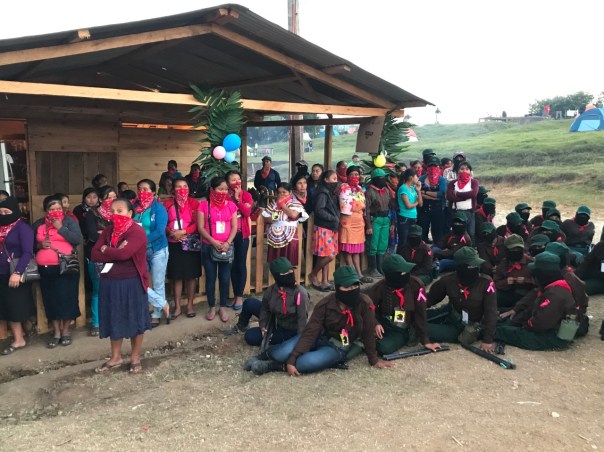
Members of organizations, collectives, and individuals, adherents to the Sixth Declaration of the Lacandón Jungle, traveled this Thursday to the communities of Moíses Gandhi and Nuevo San Gregorio in the autonomous municipality of Lucio Cabañas, in order to bring humanitarian aid, conduct human rights observation activities and “document the recent aggressions, threats and harrassment perpetrated by armed groups opposing the support bases of the Zapatista National Liberation Army (EZLN).”
The caravan made up of different vehicles left at 6 AM, with various products suchs as corn, beans, salt, sugar, coffee, oil, pasta, and soap, among others.
The participating groups reported in a communique that “since the previous year, these autonomous communities, located in the official municipality of Ocosingo — a couple of hours in a vehicle from San Cristóbal — “have suffered constant attacks on their lands, crops, houses and workers.”
They added that what happened previously “is added to by the events that took place the 22nd of August 2020 when autonomous facilities were burned, like the Arcoiris (Rainbow) store, the Compañera Lucha cafeteria, and the coffee warehouses, that represent a guarantee of their food and sustenance, as well as attacks against the community with firearms.”
They reiterated that their position “is in favor of peace,” while demanding respect for the right to Zapatista autonomy and self-determination where the recuperated lands are located that are part of their territory, as well as respect for and guarantee of the integrity, security and life of the bases of support of the EZLN.”
They said that they asked the International Service for Peace (Sipaz) to accompany the caravan to conduct international observation activities during the tour, work that the Fray Bartolomé Center of Human Rights (Frayba) will also do.
The caravan was made up of members of the Chiapas Center for the Rights of Women; Civil Association for the Economic and Social Development of Indigenous Mexicans (DESMI); Space of Struggle Against Neglect and Repression (ELCOR); Doctors of the World, Switzerland-Mexico; Living Memory, ProMedios Community Communications; Ajmaq Network of Rebellion and Resistance; Community Health and Development; Digna Ochoa Center for Human Rights; and other collectives, organizations, and adherents to the Sixth Declaration of the Lacandón Jungle.
———————————————————
Originally Published in Spanish by La Jornada
Thursday, October 29, 2020
Re-Published with English interpretation by the Chiapas Support Committee
The “ya basta” of the indigenous Otomí community

Marichuy and the CNI-CIG support the Otomís.
By: Magdalena Gómez
A movement is underway that did not begin on October 12 with the decision of the Otomí community of indigenous Otomí residents in Mexico City to take over the central offices of the National Institute of Indigenous Peoples (INPI, its initials in Spanish) indefinitely. This movement must be analyzed in its different dimensions. Indigenous natives of Santiago Mexquititlán, Amealco municipality, Querétaro, residents in Mexico City for more than 20 years, are heading the takeover. Since then, they have fought for their right to access dignified housing, they have toured government agencies, have done the paperwork, without results. They have lived crowded, without basic services on four abandoned properties on 74 Zacatecas Street and 200 Guanajuato, in the Roma District; 1434 Zaragoza Avenue, by Pantitlán, and Roma 18, in Juárez. This latter one has been abandoned since the 1985 earthquakes, but the 2017 earthquake made it uninhabitable and forced them to camp on the street, Last year, public forces evicted them without fulfilling the promise to legalize their situation..
So far, we have located the local dimension of the problem. However, for four years the National Indigenous Congress (Congreso Nacional Indígena, CNI) and the Indigenous Government Council (Concejo Indígena de Gobierno, (CIG) have been linked to the demands of the peoples for their collective rights. That’s why they call their brave decision “Takeover for the dignity of our peoples.” They added: “It’s time to raise your voice and not remain silent. They have oppressed us for 528 years, they have dispossessed us, as if to leave us 528 more years,” indicated Maricela Mejía, a councilor of the CIG, backed up by her compañeras. At first they asserted that the INPI doesn’t represent them, nor did the previous initials, but that now it will be true that this building will be their home. As such, they proceeded to occupy two of its six floors and upholster them with posters of the Zapatista National Liberation Army (Ejército Zapatista de Liberación Nacional, EZLN). In the installations of the INPI the Otomí community, last October 17, held the forum “528 years: our little light of resistance and rebellion is still lit,” with the participation of the CIG spokesperson, María de Jesús Patricio (Marichuy), who supported the action of the Otomí community in the CDMX (Mexico City). She told them: “We’re going to continue because you have a very important tool, which is your voice. We may not have weapons, but our weapon is the voice and we don’t have to keep quiet.” They are part of the national indigenous movement. In their press conferences the Otomís include questioning of the megaprojects in progress, demand that real indigenous consultations be held and state that they oppose the Tren Maya/Maya Train, the Morelos Integral Project, which includes a thermoelectric plant, and the Interoceanic Corridor on the Isthmus of Tehuantepec.
The peoples and organizations of the CNI and the National Indigenous Network (Red Nacional Indígena, RNI) have added themselves to their demands and expressed support for them, in contrast with other indigenous groupings that suppose it necessary to close ranks with the director of the INPI, allegedly aggrieved by the takeover of its offices.
It’s interesting to observe how the Government of Mexico City, the one directly responsible for the long-standing lack of attention to the Otomí community, has been camouflaged in the INPI, which shows that it represents the federal government of Mexico in its official communiqués. To date, its posture is not known. The CDMX Secretariat of Government and the CDMX Human Rights Commission are referred to as the mediating institution (press release 10/15/20). Surely the Otomí community will be analyzing the proposal to participate in a work group that will cause it doubts, since throughout the years that it has been expressing its demands and carrying out official procedures, they now la invite them to dialogue in order “to know their needs and requests and to advance in attention to them.” Already Nashieli Ramírez, president of Mexico City’s Human Rights Commission, went to the takeover and offered, with respect, mediation in a dialogue, as well as follow-up on compliance with the agreements that are made, and is awaiting their response.
The “ya basta” of the Otomí community has placed a mirror on the “neo-indigenism” underway, for now the evidence that individual support programs or scholarships are not enough, as long as the structural problems of the indigenous peoples with respect to their self-determination and autonomy are not addressed. This movement grows with the national agenda, which adds previous grievances to the current ones in the times of the so-called 4T. It’s unthinkable that the government would propose and the CNI-CIG, much less the EZLN, would accept a “dialogue” that will produce a new version of the unfulfilled San Andrés Accords. It’s a coin toss. To begin with, it’s uncertain whether they will provide housing to Otomí residents in Mexico City.
————————————————————
Originally Published in Spanish by La Jornada
Wednesday, October 27, 2020
https://www.jornada.com.mx/2020/10/27/opinion/020a2pol
Re-Published with English interpretation by the Chiapas Support Committee
Chenalhó asks for 50 million pesos to end the conflict with Aldama
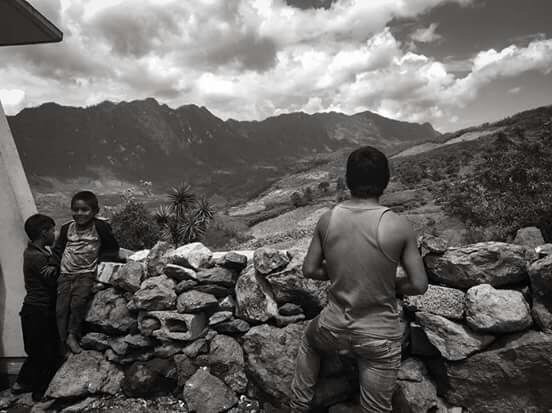
A view of the mountains that form the natural border between Aldama and Chenalhó municipalities, in the Chiapas Highlands Photo: Carlos Ogaz.
By: Isaín Mandujano
Indigenous Tsotsils in Santa Martha community, Chenalhó, asked for 50 million pesos to cede 32.5 hectares of land to their adversaries in Aldama, as well as 200,000 pesos for each one of their dead and 100,000 pesos to repair the damage to the 16 who were injured.
Communal authorities of Manuel Utrilla Santa Martha made public a copy of their official record through the Digna Ochoa Grass Roots Human Rights Committee of Chiapas (“Digna Ochoa Committee”) [1], wherein they respond to a government proposal to resolve the agrarian conflict that exists between residents of Aldama and Santa Martha, Chenalhó.
The official record was delivered last October 9 to the Secretary General of Government, the Commissioner for Dialogue with the Indigenous Peoples in the Interior Ministry (Secretaría de Gobernación) and the Undersecretary for Human Rights and Population in the Interior Ministry. Members of the Manuel Utrilla Santa Martha Communal Wealth (the commons) Assembly responded to the proposal that the el Secretary General of Gobierno, Ismael Brito Mazariegos, sent.
The document signed by all the authorities of the Manuel Utrilla Santa Martha Commons and the 20 municipal rural agents from the communities that group together the communal wealth and represent the 3,336 comuneros put forward a proposal regarding the solution to the conflict over the 59.5 (147 acres) hectares of land in dispute with Aldama.
State authorities mentioned that they would cede 32.5 hectares (80 acres) and retain 27 hectares (67 acres), with an economic contribution of 3 million pesos, plus 100,000 pesos for each of the families who lost a family member as a result of the conflict.
However, the indigenous Tsotsils said that they accept retaining 27.5 hectares and ceding 32.5 to Aldama, but that it’s for the amount of 50 million pesos and that in the process of attention to the solution of the agrarian conflict, the Municipality of Aldama will cease attacks with firearms.
With respect to the offer of 100,000 pesos, as economic support for each family of those who dies due to the agrarian conflict, they asked for 200,000 pesos; without forgetting that there 16 injured, and for them they asked as indemnification the amount of 100,000 pesos for each one.
Additionally, they demanded the immediate freedom of their imprisoned compañeros, Enrique López Pérez and Efraín Ruiz Alvares, as well as cancellation of the arrest warrants in effect against inhabitants of communities in the Santa Martha Sector.
Likewise, they asked for Infrastructure works for the benefit of 20 communities in the Santa Martha Sector, such as the expansion and paving of the highway stretch from Central Santa Martha to Saclum and from Saclum to the municipal seat of Chenalhó and the opening of the road from the town of Yoc Ventana on time.
The Digna Ochoa Committee said that once this document was delivered unfortunately armed attacks and shooting started coming from the Aldama side, the communal authorities acknowledging that there was “crossfire” in accordance with what they have investigated, and that Sunday they were in Saclum to see the situation and that they heard the rain of shots coming from Tabak, Coco and Xuxhen on the Aldama side attacking Saclum community and Pajaltoj on the Santa Martha side.
However, the “Fray Bartolomé de Las Casas Human Rights Center, denounced that the attacks are constant from Chenalhó towards the residents of Aldama. And the Permanent Commission of 115 Displaced Comuneros of Aldama denounced that members of the National Guard and the State Police who are in Santa Martha, Chenalhó and in Aldama don’t act efficiently to stop the armed attacks and to protect the population.
Counting Hugo Alfredo Pérez Hernández, 29 people have been injured and six murdered during attacks with high-caliber weapons on the communities of Maya Tsotsil People in Aldama, coming from de civilian armed groups of a paramilitary nature in Santa Martha, Chenalhó, since March 2018, the Frayba said.
They also pointed to the disappearance and subsequent execution of the then municipal president of Aldama Ignacio Pérez Girón [2], whose body was found on May 05, 2019, at the entrance to Yalebtay, in the municipality of Zinacatán.
The persistent omission and complicity of the Chiapas government and the federal government causes the escalation of violence in the Highlands region and increases the risk to life of the population within 13 communities in the municipality of Aldama, mostly women, children, adolescents and the elderly, the human rights body indicated.
What’s the conflict between Chenalhó and Aldama about?
The Undersecretary of Human Rights, Population and Migration in the Interior Ministry described that the conflict that exists in the Chiapas Highlands is a dispute over 59 hectares (approximately 47 acres) between the “Manuel Utrilla” Commons in Chenalhó and 115 community members in Aldama.
He detailed that in 2009, the Chiapas government signed an agrarian settlement between the two parties, in which it gives possession of the lands to the Aldama community members and an indemnification of 1 million, 300 thousand pesos to Chenalhó.
Nevertheless, in 2014 the conflict re-emerged due to the fact that the Aldama community members did not want to provide water from the Chayomté spring to Santa Martha, so the latter declared the 2009 settlement broken, as well as the 59-hectares solution.
Encinas stated that the conflict has cost the life of 26 people: 5 from Aldama and 20 from Chenalhó, as well as 24 injured: 13 in Aldama and 11 in Chenalhó.
[1] According to an article by Hermann Bellinghausen, the “Digna Ochoa Committee” was started by several people from the National Front of Struggle for Socialism (FNLS) and denounced by those in Aldama as always supportin g and backing up the para,military groups.
[2] Ignacio Pérez Girón was a member of the National Indigenous Congress (Congreso Nacional Indígena, CNI).
——————————————————————-
Originally Published in Spanish by Chiapas Paralelo
Tuesday, October 13, 2020
Re-Published with English interpretation by the Chiapas Support Committee
Part Four: Memory of What Is to Come

October 2020.
Let’s go back, to 35 Octobers ago.
Old Antonio watched the bonfire resist the rain. Beneath his dripping straw hat he lights his hand-rolled cigarette with a burning ember. The fire stays alive, hiding occasionally beneath the logs; the wind helps it, its breath reviving the coals, red with rage.
The camp is called “Watapil”[i] and is located in the Sierra Cruz de Plata that rises between the wet arms of the Jataté and Perlas rivers. It’s 1985, and October receives the group with a storm, presaging their future. The tall almond tree (which will become the namesake of that mountain in the insurgent’s vernacular) looks down with compassion at the small, minuscule, insignificant group of men and women at its feet, with their gaunt faces, haggard bodies, bright eyes (perhaps from fever, stubbornness, fear, delirium, hunger or lack of sleep), ragged brown and black clothes, and boots distorted by the knotted vines that are intended to hold their soles in place.
Softly and slowly, his words barely audible over the howl of the storm, Old Antonio speaks as if he were talking to himself:
“The Ruler will return again to impose his harsh word, his ego that kills all reason and his bribe disguised as a handout on the color of the earth.
The day will come when death will wear its cruelest clothes, its steps accompanied by the screeching cogs of the machine that sicken each path it takes with the lie that it brings abundance, even as it sows destruction. Whosoever opposes that noise which terrifies plants and animals will be killed, both in life and in memory: the first with lead, the latter with lies. Night will thus be longer. Pain will be drawn out. Death will be more deadly.
The Aluxo’ob [ii] will alert the Mother Earth: “Death is coming, mother, it’s killing as it comes.”
Mother Earth, the first mother of all, will wake up—shaking awake the parrots, macaws, and toucans—reclaim the blood of her guardians and speak to her people:
“Let some of you go to taunt the invader. Let others of you sound the call to our brethren. May the waters not frighten you; may neither cold nor heat discourage you. Cut paths where there are none, cross the rivers and seas. Traverse mountains, fly through rain and fog. Whether night or day or the small hours of the morning, go and alert all creatures. My names and colors are many, but my heart is one, and my death will be the death of everything. Do not be ashamed of the skin color I have given you, nor of the language I have placed in your mouth, nor of your stature, which keeps you close to me. I will give light to your gaze, warmth to your ears and strength to your feet and arms. Do not fear different colors and customs, or different paths. One is the heart I have passed down to you—one understanding, and one gaze.”
Then, under siege by the Aluxo’ob, the machines of deadly deception will fall apart, their arrogance broken, their greed destroyed. The powerful will bring lackeys from other nations to rebuild the broken death machine. They will examine the innards of the death machine and discover why it is so damaged: “it is full of blood inside.” In an attempt to explain the reason for this terrible wonder, the bosses will announce, “We don’t know why, all we know is that the blood is directly descended from Native blood.”
Then, evil will rain down upon itself in the grand mansions where the Power gets drunk and commits abuses. Unreason will enter into its territory and blood, rather than water, will run through its waterways. Its gardens will wither and the hearts of its workers and servants will turn cold. Power will thus bring in other vassals to use: they will come from other lands, and hate will grow between equals, spurred on by money. They will fight amongst themselves, and death and destruction will emerge between people with shared history and pain.
Those who before worked and lived off of the land will become servants and slaves of the Powerful on the very lands and under the skies of their ancestors. They will see misfortune befall their houses. They will lose their sons and daughters, drowned in the rot of corruption and crime. The practice of the “right of the first night” will return, by which money kills innocence and love. Babies will be ripped from their mothers’ breast, their flesh taken by the great Lords to satisfy their evilness and cruelty. Disputes over money will cause children to raise hands against their parents, and their houses will be cast into mourning. Daughters will be lost in darkness and death, their life and being killed by the Lords and their money. Unknown illnesses will attack those who sold their dignity and that of their loved ones in exchange for a few coins; those who betrayed their people, their blood, and their history; and those who created and spread the lie.
The mother ceiba tree, sustainer of worlds, will scream so loudly that even the most distant deafness will hear her injured cry. Seven distant voices will approach her; seven distant arms will embrace her; and seven different fists will join together with her. The mother ceiba will then lift her skirts and with her thousand feet kick and dislodge the iron railways. The wheeled machines will run off their metal tracks. The waters will overflow the rivers and lakes and the sea itself will howl with fury, and the entrails of the earth and the skies will open in all worlds.
The mother Earth, the first mother of all, will rise up and reclaim her house and her place with fire. Upon the arrogant edifices of Power, trees, plants and animals will grow, and in their hearts Votán Zapata will live again. The jaguar will again walk its ancestral paths, reigning once again where money and its lackeys sought to reign.
The Powerful will die only after seeing their ignorant arrogance crumble without making a sound. With its last breath they will understand that the Ruler is no more, no more than a bad memory in a world that rebelled and resisted death that its orders commanded.
They say the dead of always tell this story, those who will die once again but this time in order to live.
They say to carry this word to the valleys and the mountains, to the canyons and the wide plains. Let the tapacaminos bird [iii] repeat it as a warning on the path of the brotherly hearts; let the rain and the sun sow it in the gaze of those who inhabit these lands; let the wind carry it a long distance that it might nest in the thoughts of compañeros.
Terrible and awesome things are coming to these lands and these skies.
But the jaguar will once again walk its ancestral paths, reigning once again where money and its lackeys sought to reign.
Old Antonio falls silent, and with him, the rain. He sleeps not at all, and dreams everything.
-*-
From the mountains of the Mexican Southeast,
SupGaleano.
Mexico, October 2020.
From the Notebook of the Cat-Dog: Part II: The Canoes
I should remind you that the divisions between countries are solely for the purpose of classifying contraband and justifying wars. There are clearly at least two things that stand above borders: one is the crime—disguised as modernity—of distributing poverty at a global level; the other is the hope that shame only arises when you mess up a dance step, not every time you look in the mirror. For the former to end and the latter to flourish, it is merely necessary to struggle and be better. Everything else carries on by itself and tends to end up in libraries and museums. There’s no need to conquer the world; it’s enough to make it anew. Cheers then, and keep in mind that for the purposes of love, a bed is just a pretext; for dance, a tune is just decor; and for struggle, nationality is merely circumstantial.
—Don Durito de La Lacandona, 1995
SubMoy was telling Maxo that maybe we should try making the raft out of balsa wood (“cork” as it’s called around here), but the naval engineer [Maxo] argued that, being lighter, it would be even more easily pulled by the current. “But you said there’s no current in the ocean,” SupMoy reminded him. “Well, what if there is!” Maxo retorted. SubMoy told the other CCRI [Indigenous Revolutionary Clandestine Committee] members to move on to the next experiment: dugout canoes.
They began carving. Under their axes and machetes, the tree trunks that were originally destined to become firewood began to take on a maritime shape and function. SubMoy had left for a moment so they went to ask SupGaleano if seafaring vessels should have names. “Yeah, of course,” the Sup responded distractedly, as he watched el Monarca check out an old diesel engine.
The canoe-carvers began tracing and painting in names—measured and rational, of course—on the sides of the boats. One read “Chompiras the Swimmer and Puddle-Jumper.”[iv] Another: “The internationalist: One thing is one thing, another thing is no me jodas man.” Another: “On my way love, be right there.” And another: “Well why’d they invite us then, it’s on them [v].” The CCRI members from Jacinto Canek baptized theirs “Jean Robert,”[vi] their way of bringing him along on the journey.
Another canoe a little further away read, “Why cry when saltwater abounds?” Which was followed by: “This boat was built by the Maritime Commission of the Zapatista Autonomous Municipality in Rebellion [MAREZ] going under the name of ‘We get criticized for giving the MAREZ and Caracoles really long names but we don’t give a shit,’ headed by the Good Government Council named, ‘Neither do we.’ Perishable cargo. Expiration date: depends. Our boats don’t sink, they expire, which is different. Canoe manufacturing contracts and musicians available at the Centers of Autonomous Zapatista Rebellion and Resistance [CRAREZ] (marimba and sound system not included—because what if they sink and stop working—but we’ll sing with gusto… maybe). This canoe’s value is calculable only in terms of resistance. To be continued on the side of the next canoe…” (You had to walk all the way around the canoe and even peer in to read the inside walls to see the whole “name.” Yes, your assumption is correct, it would take so long for an enemy submarine to transmit the whole name that by the time it finished, the vessel it was going to sink would have reached European shores.
As they carved the logs into canoes, word got around of what was going on. Beloved Amado told Pablito who told Pedrito who informed Defensa Zapatista who discussed with Esperanza who whispered: “don’t tell anybody” to Calamidad who then told her mom who announced it to the whole group of women.
When SupGaleano heard the women were coming, he shrugged his shoulders and handed the half-inch ratchet wrench to el Monarca as he spit out pieces from the mouthpiece of his pipe.
After a bit Jacobo arrived asking, “Hey Sup, is SubMoy going to be long?”
“No idea,” SupGaleano responded, looking, disconsolate, upon his broken pipe.
Jacobo continued, “Do you know how many people are going to make the journey?”
“Not yet,” the Sup answered, “Europe from below hasn’t told us yet how many people they can accommodate. Why?”
“Well… you better come see for yourself,” Jacobo replied.
SupGaleano broke another pipe when he saw the Zapatista “fleet.” Six canoes with eccentric and extravagant names lined the riverbank, loaded down with plants and flowerpots.
“What’s all this?” the Sup asked, just as a formality.
A very resigned Rubén answered, “that’s the women’s luggage.”
“Their luggage?” The Sup inquired.
“Yeah, they came and loaded all those plants and just said, ‘you’re going to need these.’ Later a little girl came, I don’t know her name, but she was asking if the trip was going to take a long time, like if it would be long before we got to where we’re going. I asked her why, if her mom was going or what. She said it wasn’t that, but that she wanted to send along a little tree and if the trip was going to take awhile, well by the time we got there the tree would be big and we could take a break for pozol [vii] in its shade if the sun was strong.”
“But they’re all the same,” argued the Sup (referring to the plants of course).
“No, they’re not,” Alejandra, a CCRI member replied, “This one is a prairie sage, it’s for stomachaches; this one is thyme; that one is spearmint; over here we have chamomile, oregano, parsley, cilantro, laurel, epazote, aloe vera; this one is for diarrhea, this one for burns, that one for insomnia, that one for toothache, this one here is for cramps, this one is known as “cure-all,” that one over there is for nausea, and also here we have hoja santa, black nightshade, wild onion, rue, geranium, carnation, tulips, roses, mañanitas, and so on.”
Jacobo felt obligated to clarify, “As soon as we finished one canoe we turned around and they had it full of plants already. The second we finished the next one, same thing. We’ve finished six so far, which is why I’m asking if we should keep going, because they’re just going to fill them up.”
“But if they want to send all that along, where will the compañeros sit?” the Sup tried to reason with a compañera, one of the women’s coordinators who was carrying two potted plants in her arms and a baby on her back.
“Compañeros? There are men going?” she answered.
“Whatever, either way, women aren’t going to fit either,” argued the Sup, on the verge of a nervous breakdown.
“Oh,” she replied, “we’re not going in the boat. We’re going by plane so we won’t get nauseous. Well, maybe a little, but less.”
“Who said you all are going on a plane?” the Sup asked.
“We did,” she answered.
“These decisions you are telling me about, where are they coming from?”
“Well, Esperanza came to our women’s meeting and told us that all of us would die wretchedly if we travel with the damned men. So we discussed it as an assembly and determined that we weren’t scared and are quite decided that the men can die wretchedly without us.”
We did the math and calculated that we can rent the plane that Calderón bought for Peña Nieto and that the bad governments in power now doesn’t know what to do with. They say it costs 500 pesos per person. We’ve got 111 compañeras signed up already, though I don’t think that’s counting the milicianas’ soccer teams. But let’s say there were just 111 of us, that would be 55,500 pesos, but women and infants pay half price, making it 27,750. From that you’d have to take off taxes and speaker’s fees, so let’s say some 10,000 pesos for all of us. That’s if the dollar isn’t devalued in the meantime, if so, then even less. But we don’t want to be quibbling over the money, so we’re going to throw in my compadre’s ox, which acts like a you-know-what, but what can you do, that’s what all machos are like.
SupGaleano remained silent for once, trying to remember where the hell he left his emergency pipe. But when he saw the women begin to carry out chickens, roosters, chicks, pigs, ducks, and turkeys, he urged el Monarca: “Quick, call SubMoy and tell him to come now, it’s urgent.”
The procession of women, plants, and animals stretched past the pasture. They were followed by Defensa Zapatista’s gang: headed up by Pablito (now acting on the premise of “if you can’t beat ‘em, join ‘em) with his horse, followed by beloved Amado with his bicycle with the flat tire, followed by the cat-dog herding along some cattle. Defensa and Esperanza were measuring the canoes to see if soccer goals would fit. The one-eyed horse had a bag of plastic bottles hanging from its snout. Calamidad followed holding a piglet squealing in terror that she’d throw it in the river just so she could rescue it… and for good reason.
At the end of the procession was someone who looked extraordinarily like a beetle, with an eye-patch over his right eye, a piece of twisted wire on one leg in a version of a pirate’s hook and something mimicking a peg leg on the other, really just a splinter of wood from where the canoe-carving was going on. This strange being, wielding a little piece of tin as a face mask, recited with admirable oratory:
“The breeze fair aft, all sails on high,
Ten guns on each side mounted seen, She does not cut the sea, but fly, A swiftly sailing brigantine; A pirate bark, the “Dreaded” named, For her surpassing boldness famed, On every sea well-known and shore, From side to side their boundaries o’er.”[viii]
Subcomandante Insurgente Moisés, head of the expedition in the making, returned to find SupGaleano smiling inexplicably. The Sup had just found another pipe, unbroken, in his pants pocket.
I give my word.
Woof-meow.
TRANSLATOR’S NOTES:
[i] “Watapil” was the name given to one of the early jungle encampments (circa 1985) of the small group of insurgents that would later become the EZLN. See https://www.alterinter.org/?The-Fire-and-the-Word
[ii] In Mayan folklore, the Alux are small, mythical beings primarily inhabiting the jungle and other natural areas, something like elves in English folklore. Aluxo’ob is the plural in Mayan.
[iii] Pájaro tapacaminos is a nocturnal bird in Mexico with a loud, distinctive call that can be heard up to 1km away.
[iv] Chompiras is the name of a renowned three-ton truck in Zapatista territory, used for many solidarity efforts.
[v] “Pa’ qué me invitan” (Why’d you invite me then?) is a meme that originated with a viral cell-phone video of an extremely inebriated man being dragged out of a party who complains to the hosts that if they know he always gets hammered, well then what did they invite him for? See https://www.youtube.com/watch?v=Fn1TgATT6hs
[vi] Jean Robert was a philosopher and architect based in Cuernavaca, Morelos, Mexico, who long supported the Zapatista movement. He recently passed on October 1, 2020.
[vii] Pozol is ground corn mixed with water, commonly consumed in the Chiapas countryside as a midday meal.
[viii] José de Espronceda’s “Song of the Pirate,” translation from James Kennedy, published in Hispanic Anthology: Poems Translated from the Spanish by English and North American Poets, ed. Thomas Walsh. G. P. Putnam’s Sons, New York, 1920.
En español: http://enlacezapatista.ezln.org.mx/2020/10/19/cuarta-parte-memoria-de-lo-que-vendra/
The “new” war of conquest and defense of territory

By: Raúl Romero*
Oscar Eyraud Adams, of the Kumiai people, was murdered on September 24, 2020 in Baja California. Jesús Miguel Jerónimo and his son Jesús Miguel Junior, of the P’urhépecha People of Ichán, were murdered on July 23, 2020, in Michoacán. Josué Bernardo Marcial Santos, known as Tío Bad, a rapper and delegate of the Popoluca People to the National Indigenous Congress (Congreso Nacional Indígena, CNI), was found dead on December 16, 2019 in Veracruz. All of them had common elements: they were indigenous, defenders of the territory and they achieved opening dialogues and generating convergences, inside and outside their communities, around struggles against extractive projects and megaprojects of dispossession.
They are not the only ones murdered so far in this six-year term. There are also Samir Flores Soberanes (Nahua), Ignacio Pérez Girón (Tzotzil), Julián Cortés Flores (Mephaa) and twenty more stories.
The murder of territory defenders in Mexico, most of them Native peoples, is a systematic and recurring practice. The offensive is part of the war over territories that neoliberal capitalism has waged all over the world for several years.
At the end of the 1990s, the then spokesperson for the EZLN, Subcomandante Marcos, shared the analysis that the Zapatistas have about the issue. Two texts that seem pre-figurative today stand out: “The seven loose pieces of the world jigsaw puzzle” and “What are the fundamental characteristics of the Fourth World War?” In those analyses he characterized neoliberalism as “a new war for the conquest of territories,” a war in which there is a process of “destruction / depopulation and reconstruction / reordering,” a “total war,” in other words, it occurs “at any time, in any place, under any circumstance.” It’s a war against humanity in which “everything human that opposes the logic of the market is an enemy and must be destroyed.”
In that war against humanity, the peoples who inhabit the territories that capital seeks to conquer and reorder are the first enemies. They hinder the process of the financialization of nature and of the construction and integration of new commercial regions.
For those territories to have “value” in the market, they must first be destroyed and de-populated, either with paramilitaries, organized crime groups, or directly with state forces. The elimination also implies destroying worlds of life; in other words, erasing the ways of being of the peoples, above all, breaking their nexus with the land and their being a community. Simultaneously, ocurre the process of reordering and reconstruction of those territories occurs to make them functional to the logic of the market. Wherever there are towns and communities with their own ways of looking at and relating to the world, they begin to build cities that link to other cities, which they euphemistically call development poles or centers. Of course the former members of the peoples, now as consumers of merchandise or as cheap labor, will be able to integrate into capitalist modernity.
Even those who not long ago called themselves left and even revolutionaries, today defend these ecocidal and colonialist projects. They do so by dusting off their manuals: one must promote “development of productive forces,” “industrialize the country,” “proletarianize the indigenous.”
In the new war of conquest, organizations of Native peoples, like the CNI, are a constant target of attacks. The journalist Zósimo Camacho revealed that, with data from the Congress itself, he was able to document at least 117 murders and 11 disappearances of people since the founding of the CNI in 1996 up to June 2019. But the “real number is higher, because generally only those who had political and/or operational responsibilities appear on this tentative list. The list lacks the names of those who were killed and resisted from their milpas, their ceremonies, their daily jobs.
The same thing happens with the EZLN and its bases of support. A significant increase in hostilities against them has been recorded since December 2018. At least three lines of confrontation stand out: 1) the physical war, which includes military incursions, paramilitary attacks and the expansion of organized crime groups that operate with total impunity in Chiapas; 2) the media war, based on the publication of lies, rumors or conspiracy theories in the social networks and communications media, and 3) the political war, directed at coopting, dividing and confronting organizations and communities through individualized and paternalistic social programs that don’t modify the structural conditions.
The indigenous peoples articulated in the CNI and the EZLN are also, in Mexico, the principal resistance in this struggle in defense of life. Those peoples once again launch a call to all humanity: it’s the time for our “common dream,” it’s the time for freedom.
*Sociologist
———————————————————–
Originally Published in Spanish by La Jornada
Tuesday, October 13, 2020
https://www.jornada.com.mx/2020/10/13/opinion/016a1pol
Re-Published with English interpretation by the Chiapas Support Committee
Stop the paramilitary violence in Chiapas!
The Chiapas Support Committee sends its most heartfelt thanks to everyone who expressed their solidarity regarding the paramilitary violence in Chiapas by signing our protest letter to the Mexican Consulate. We also wish to thank those who contributed to our fundraising campaign for Las Abejas. These expressions of solidarity come from around the world and the collective sum of all solidarity actions matter.
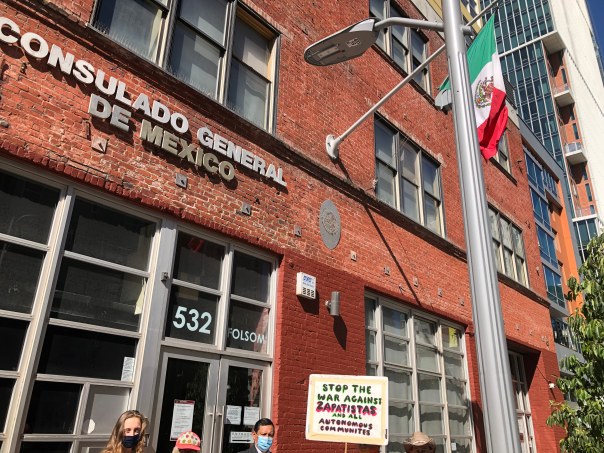
On October 13, members of the Chiapas Support Committee went to the Mexican Consulate in San Francisco to deliver the letter demanding a stop to the paramilitary violence in Chiapas. (The letter with signatures is posted below.) A few others joined them and we brought posters. To our great surprise, the deputy consul general, Guillermo Reyes, actually met with us and listened to our concerns (he is the person in the black suit in the pictures below). He didn’t know anything about the violence in Chiapas, but had heard of FRAYBA, which was probably helpful when we mentioned their active denunciations. I looked him up and he has a special focus on humanitarian situations. He promised to convey the letter and the message and get back to us in a week.
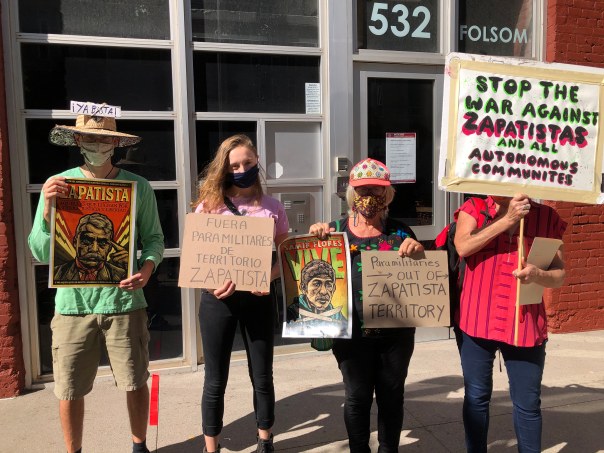
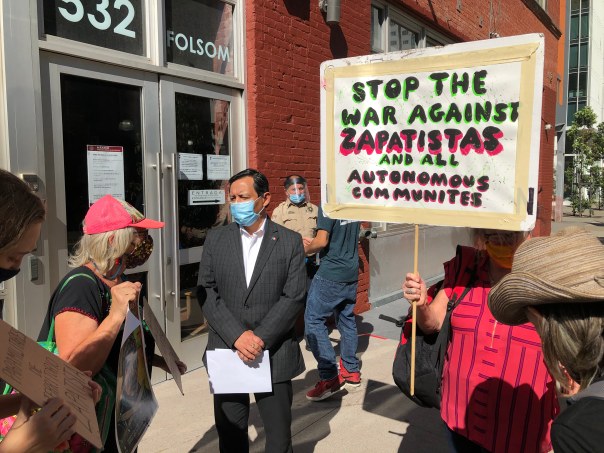
Remedios Gómez Arnau, Consul General
Mexican Consulate in San Francisco
532 Folsom St.
San Francisco, CA 94105
Dear Consul General Gómez Arnau,
We write to express our alarm over the growing violence in the Highlands of Chiapas, Mexico; specifically, in the municipalities of Aldama, Chenalhó and Chalchihuitan, where paramilitaries have violently attacked and forcibly displaced thousands of indigenous people from their homes, fields and communities. We are demanding that the Mexican government stop the paramilitary violence, stop any support being given to the paramilitaries and dismantle them.
According to the internationally respected Fray Bartolomé de Las Casas Human Rights Center (Frayba), paramilitary-style civilian armed groups in Chenalhó municipality perpetrate the violence, shooting indiscriminately into the civilian communities where displaced persons are sheltered, often causing them to flee for safety in the mountains, thus leaving them outdoors without shelter and food. In Aldama, for example, bullets fired from Chenalhó injured13-year-old María Luciana Lunes Pérez in the face and shoulder while she was working on her loom inside her home in Koko’, Aldama.
These paramilitary groups also patrol roads and block access to fields so that those displaced cannot grow or harvest their food, creating hunger and the threat of famine in the midst of the novel coronavirus pandemic, as well as preventing the harvesting and sale of cash crops that provide the only income these subsistence farmers have. Meanwhile, deaths and injuries are claimed on both sides.
A troubling photo apparently taken from a video in the local press shows heavily armed men in Chenalhó, dressed in camouflage uniforms, wearing ski masks and sporting high-powered rifles. The video’s release, in which the paramilitaries introduce themselves to society, would seem to assert: “We have impunity!” Further evidence of impunity appeared on social media with the news that 80 residents of Santa Martha (Chenalhó) took weapons and munitions away from a detachment of police in that town and continued to retain the weapons.
Another report from those displaced in Aldama indicated that there have been 30 armed attacks in three days against the people of Aldama, with the gunfire coming from Chenalhó. This shocked readers in Mexico and abroad. These egregious human rights violations must be stopped now to avoid further loss of life and serious bodily injury. Human rights defenders and those displaced are seeking such intervention.
This is a crisis situation that requires the Mexican government’s immediate intervention to dismantle these paramilitaries and repair the damage done to all victims. Mexico’s federal and state governments failed to do this before and after the December 22, 1997 Acteal Massacre in which paramilitaries attacked and murdered 45 women, men and children. Paramilitary violence forcibly displaced thousands in the months before that massacre, as is happening now. Additionally, there is evidence that the current paramilitary group is related to the one involved in that massacre.
The growing paramilitary attacks on Aldama feel eerily reminiscent of the conditions that preceded the Acteal Massacre. And the present reminds us all too painfully of the past. The Mexican government can prevent a greater calamity from taking place by stopping and dismantling the paramilitary violence now.
We, therefore, urge Mexico’s federal and state governments to stop the paramilitary attacks, dismantle the paramilitary group(s) in Chenalhó and begin repairing the damage done to all the victims.
Sincerely,
The Chiapas Support Committee and Friends
Arnoldo Garcia
Carolina Dutton
Jose Plascencia
Roberto Martinez
Jason Bayless
Evette Padilla
Caitlin Manning
Mary Ann Tenuto Sanchez
John Torok
Charlotte Saenz, Core Faculty, California Institute of Integral Studies, San Francisco
Todd Davies, Initiative for Equality
Anya Briy, PhD student in Sociology, Binghamton, NY
Meredith Tax, Writer, New York
Amanda Ayala
Carla Green, Missoula, Montana
Katherine E. Keller, Missoula, Montana
Sarah McClain
Julia McClure
John Wolverton, Missoula, Montana
Drew Lefebvre
Hermina Jean Harold
Susan Keller
Adam Fix, PhD, Columbus, Ohio
Diana Block, San Francisco, California
Amanda Bloom
Norma J F Harrison, for the Peace and Freedom Party
Meredith Walters
Jeff Conant
Julie Harris, El Sobrante USA
Jane Welford, Berkeley, California
Jason Bechtel, San Diego, California
Vanessa Nava
Kristin Walter, Partner, Crew. Partner, Enlight Collaborative
Michael Bass, Activist, Oakland, California
Charlene Woodcock, Berkeley, California
Joanne Shansky, St. Francis, Wisconsin
Alice Levey
Colombe Chappey
Ariana Thompson-Lastad
Owen Thompson-Lastad
Maria Mackey
Targol Mesbah, PhD, Assistant Professor, California Institute of Integral Studies
Ishan Bouabid
Joseph E. Bender II
Ellen Bepp
Jenny Ryan
Ingrid Perry-Houts, Oakland, California
Andrew Claycomb, Registered Nurse, Los Angeles, California
Marilyn Naparst, Berkeley, California
Stefan Ali
Julie Webb-Pullman, Nueva Zelanda
Dra. Linda Quiquivix, California
Roger Knoren, U.S. Engagement and Community Development, Pachamama Alliance
Tatiana Tilley
Mark E. Smith
Joe Liesner, Oakland, California
Jessica Gudiel
Helen Finkelstein, Berkeley, California
Rachel West
Elise Youssoufian, Artist, singer, poet
Julibeth Saez Negron, DVM
Sexta Grietas del Norte Network
Enrique Davalos
Mario Galván
Mariana Rivera, Sacramento, California
Rosa Maria Barajas
Ymoat Luna
Newman Clarke
Susan Marsh
José Hernández, Napa, California
Dr. Stuart Jeanne Bramhall, New Zealand
Ann Puntch
Jo Podvin
Terri Freedman, California resident
Greysonne Coomes
Sue Stuart, Director, East Bay Community Space
Robb Benson
Annie Heuscher, Missoula, Montana
Dana Bellwether
Kate Savannah
Mora Rogers
David Early, Berkeley
Joanna Burgess Integrated Health & Wellness, Berkeley, California
Jose Sánchez, Bonn, Germany
Esau Cortez
Camille Izvarin
Chiapas Support Committee/Comité de Apoyo a Chiapas
P.O. Box 3421, Oakland, CA 94609
Tel: (510) 817-4280
Email: enapoyo1994@yahoo.com
http://www.facebook.com/CSCzapatistas
A Zapatista mountain on the high seas

By: Gilberto López y Rivas
The communiqué of the Zapatista National Liberation Army (Ejército Zapatista de Liberación Nacional, EZLN), entitled A mountain on the high seas, released by its spokesperson Subcomandante Moisés last October 5, contains long-range reflections about the national and global reality, as well as the announcement of a forthcoming departure of Zapatista delegations to the five continents, starting with Europe, and planning to arrive in Madrid, the Spanish capital, on August 13, 2021, “500 years after the supposed conquest of what is now Mexico.” [1] In that world that the Zapatista Mayas observe “sick and fragmented into millions of people, committed to their individual survival, but united under the oppression of a system that goes against the existence of Planet Earth,” with “nature wounded to death, and that, in its agony, warns humanity that the worst is yet to come,” their delegations will go to find, they maintain, “what makes them the same.”
They specifically want to speak with the Spanish people: “not to threaten, reproach, insult or demand. Not to demand that you ask us for forgiveness. Not to serve you or to serve us. We will go to tell the Spanish people two simple things: one, that they did not conquer us, that we continue in resistance and rebellion, and two, that they don’t have to ask us to forgive them for anything. Enough of playing with the distant past to justify, with demagoguery and hypocrisy, the current and ongoing crimes, like the case of brother Samir Flores Soberanes; the genocides hidden behind megaprojects, conceived and carried out to the joy of the powerful –the same one that whips all corners of the planet; the monetary encouragement of impunity for the paramilitaries; the purchase of consciences and dignities for 30 coins.” Given the manipulations of history from the presidential power, the severe criticisms of Zapatismo are expressed about what it considers “outdated nationalism,” which “wants sow racial rancor (…) with the supposed splendor of an empire, the Aztec, which grew at the expense of the blood of their fellow man, and that wants to convince us that, with the fall of that empire, the original peoples of these lands were defeated. Neither the Spanish State nor the Catholic Church has to ask us for forgiveness for anything. We will not echo the phonies who ride on our blood and thus hide the fact that their hands are stained with it.”
They point out that the powerful hide and retreat into the so-called national states and their walls, “and, in that impossible leap back, they revive fascist nationalisms, ridiculous chauvinisms and deafening verbiage” and, at this point, they warn of wars to come: “Those that feed on false, hollow, lying stories and that translate nationalities and races into supremacies that will impose themselves on the path of death and destruction.” And in that darkness and confusion that precedes those wars, Zapatismo denounces: “the attack, siege and persecution of any hint of creativity, intelligence and rationality. Faced with critical thinking, the powerful demand, demand and impose their fanaticism.”
This audacious planetary travel initiative corresponds to its persistent political will to break the sieges that the Mexican State has imposed upon the EZLN on multiple fronts of the counterinsurgency war –military, paramilitary, media, social networks, patronizing programs, delusional defamatory campaigns –, ever since the historic multiplication from 5 to 12 Good Government Juntas, which took place in 2019; the international meetings in their territory of thousands of women from more than 40 countries in 2018 and 2019; the seminar on critical thought versus the capitalist hydra in 2015, in which it called for the formation of the collective intellectual that the struggle of the peoples requires; the Escuelita courses in 2013, in which they shared their autonomous process; the mass marches through municipal capitals in 2012, on the occasion of the “end of the world,” and their tours, now memorable, through the country, like the march of the 1,111 in 1997, or the March of the Color of the Earth in 2001, the Intergalactic Encuentro in 1996, the first meeting against neoliberalism in the world arena, after the implosion of the USSR and the supposed “end of history.” That infusion of an isolated, essentialist, corporate movement, propagated by the intelligence services of the Mexican State and their spokespersons in the paid communications media, and which is now taken up by the staunch defenders of the 4T, has no trace of credibility or support.
Faced with neoliberals and neoconservatives, the EZLN represents the critical conscience of the country, made invisible by both. Nevertheless, its message of resistance, rebellion and life will undoubtedly find receptive ears in that new world that will be constructed from below.
[1] http://enlacezapatista.ezln.org.mx/2020/10/09/quinta-parte-la-mirada-y-la-distancia-a-la-puerta/
———————————————————–
Originally Published in Spanish by La Jornada
Friday, October 16, 2020
https://www.jornada.com.mx/2020/10/16/opinion/016a2pol
Re-Published with English interpretation by the Chiapas Support Committee
 Chiapas Support Committee